Our New Column in Trailer Life Magazine – Roads to Adventure!

We are very excited to announce that we are going to be writing and providing photos for a regular column in Trailer Life Magazine!

Trailer Life Magazine January 2017

Our column debuts in the January issue of Trailer Life Magazine.

For many years, the back page of Trailer Life has featured the unique stories and insights of RVer and writer Bill Graves.

Bill’s unusual tales from the less traveled roads of America have been such a delight to readers that we’ve heard people say that the first thing they do with Trailer Life is to flip it over and read Bill’s column on the back page.

I admit that I have done the same thing!

His stories provided a wonderful glimpse of life in America off the beaten path, and he ended each column with a fun tag line: “Welcome to America’s Outback.”

Bill has decided to retire from writing his column, and Trailer Life has asked us and travel writer Lisa Densmore Ballard to take turns luring readers to the back page.

We are thrilled to have been given this honor.

Trailer Life has named the new column “Roads to Adventure,” and we’ve come up with a new and different format for the column that will highlight our love of photography.

Each column will feature a beautiful photograph from a special place we’ve seen in our travels and will include a brief description of our experiences there.

Photography and RV travel Horshoe Bend Arizona

Our “Roads to Adventure” columns will bring you a stunning photo from an enchanting place.

We will be writing this column every other month beginning with the January, 2017, issue. Our first column is about the wonderful sweeping bend in the Colorado River that RVers can see when they make a trek to Horseshoe Bend, Arizona.

Photography at Horseshoe Bend Arizona

Horseshoe Bend is a fantastic place for RVers to do a little photography.

This is a gorgeous spot that is well worth making a detour to see. We wrote in detail about our experience at Horseshoe Bend and shared lots of photos in the following blog post:

Horseshoe Bend Overlook in Arizona – Stunning!

We were utterly smitten when we visited, both by the immense size and scale of the cliffs and by the crazy antics tourists did on out on the hairy edge. We took endless photos, and one of Mark’s finest is the one that Trailer Life chose for our debut column.

Sunset was a wild time at Horseshoe Bend with hoards of people taking selfies and photographers lining up at the edge, tripod to tripod, watching the sun slip away on the horizon. Sunrise, however, was peaceful and still and hauntingly beautiful.

Even though the sun rose at our backs, it was a thrill to watch the shadows disappear down the rock walls under the pink sky in front of us as it climbed higher and higher in the sky.

Sunrise at Horseshoe Bend Arizona

Although famous for its sunsets, our favorite moments at Horseshoe Bend were at sunrise!

We captured many wonderful images at Horseshoe Bend, and one of Mark’s just won the Photo of the Day at Steve’s Digicams a few days ago. This is the fifth photo of his that has been featured on that website.

 Horseshoe Bend Arizona

Horseshoe Bend, Arizona – What a place!

Both for seasoned RVers and for those that are new to the hobby, Trailer Life is an informative magazine that offers lots of RV tech tips, overviews of major RV upgrade projects as well as enticing travel destination features.

You can subscribe to the print and digital editions at these links:

We have lots more fun destinations in store for Trailer Life readers from the many places we’ve visited over the years, and we hope that our spot on the back page will be one that readers turn to.

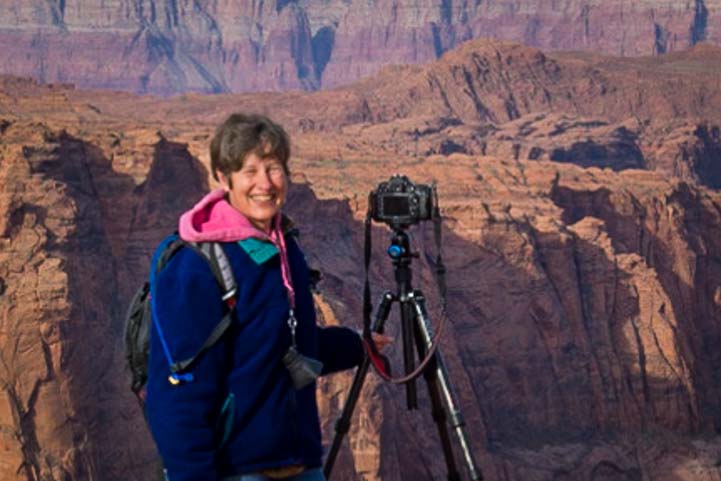
All smiles at Horseshoe Bend Arizona

Look for us on the back page of Trailer Life Magazine!

Subscribe
Never miss a post — it’s free!

Other blog posts from our travels in northeastern Arizona:

Our most recent posts:

More of our Latest Posts are in the MENU.
New to this site? Visit RVers Start Here to find where we keep all the good stuff!!

Visiting the Dentist in Mexico

Dentistry is really expensive these days, and RVers that make their way south in the wintertime can take advantage of the good quality dental care that is available just over the border in Mexico.

The November/December 2016 issue of Escapees Magazine features our article about some of the great experiences we have had with dentists in Mexico just across the border from Yuma, Arizona, in San Luis Rio Colorado, Mexico.

Mexican Dentistry Escapees Magazine Nov-Dec 2016

Escapees Magazine Nov-Dec 2016
Article by: Emily and Mark Fagan

Escapees has posted the article on their website at this link:

The Affordable Alternative of Mexican Dentistry

Our dentist, Dr. Sergio Bernal, is a general practitioner in San Luis Rio Colorado just over the border from San Luis, Arizona (south of Yuma).

Last year he coordinated and oversaw a root canal I had done in a tooth that already had a crown on it (described in detail here).

Eight years ago, Dr. Bernal put a porcelain crown on a baby tooth of Mark’s that had never fallen out. It was an exccellent crown and very easy procedure.

The crown was fabricated by the lab and ready to be installed within 18 hours of us arriving at Dr. Bernal’s office for the very first time. It fit perfectly and cost just $130.

Mark always said it was the best crown in his mouth.

Unfortunately, the baby tooth under this crown came loose this past October, and Mark was suddenly in a lot of pain. He needed another solution.

Ironically, this happened just as the issue of Escapees Magazine with our article about Mexican dental care was being mailed out to Escapees members.

Because we lived on our sailboat in Mexico for the better part of four years, we have enjoyed top notch dental care all over Mexico, from the Arizona border to the beautiful Bays of Huatulco very near the Guatemala border.

We have always been very satisfied with both the dental care and the price.

With Mark’s tooth aching, we dashed to Yuma and then zipped across the border from San Luis, Arizona, to San Luis, Mexico, on our bikes (you can learn more about doing this as well as walking over the border in our blog post about Mexican dental care here).

Even though dental care in Mexico is excellent, the upscale frills that Americans are accustomed to are not necessarily a part of the deal.

For starters, dentistry in Mexico is usually handled on a walk-in basis rather than making an appointment in advance.

Some people have read my writings about dentists in Mexico and have tried to find these dentists on the internet. Well, most Mexican dentists don’t bother with the expense of setting up a website, as they rely more on word of mouth and patients showing up at the door when they need care.

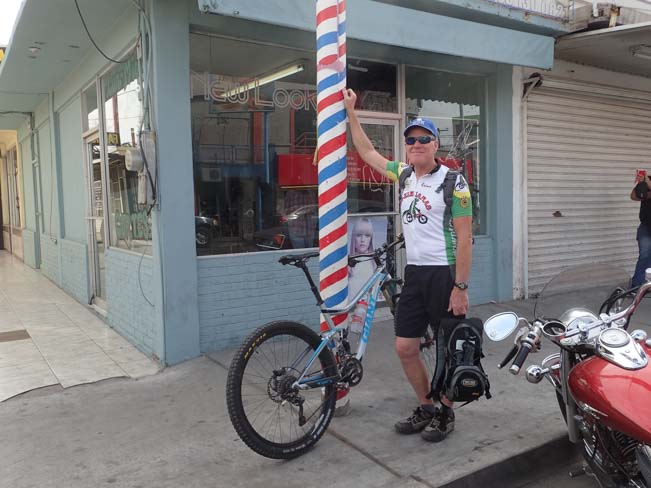
So, we got psyched up for a day of dentistry, rode the 1/2 block from the border to Dr. Bernal’s office, leaned our bikes against the wall and peered in the door. Unfortunately, he wasn’t there.

Rather than wait, we decided to ride over to visit the endodontist, Dr. Horacio Avila, who had done such an excellent job on my root canal last year. I needed to see him for a follow-up on my root canal anyway, and we figured he might have some thoughts about Mark’s aching baby tooth. We each took a quick turn in his dentist’s chair and looked at our x-rays with him on his computer screen on the wall.

My root canal was doing great, but Mark’s situation was more complex. The adult tooth was present but was lying sideways, which meant there was no option for an implant. Instead, Dr. Avila felt he probably needed a bridge.

Mexican dentist San Luis Rio Colorado Mexico

Mark and Dr. Avila check out his tooth on an x-ray.

Being an endontontist and not a general practice dentist, bridges are not his line of work. So, he handed us the x-rays and sent us on our way.

The bill for our five x-rays at Dr. Avila’s office was $50.

We biked back to Dr. Bernal’s office and found he had returned from his errands and was happy to see us.

Mark got in his dentist chair, and Dr. Bernal had a look at his tooth and Dr. Avila’s x-rays. Of course, Dr. Bernal has an x-ray machine too, but there was no need to duplicate the x-rays. He agreed that an implant was out and that a bridge was probably the best way to go.

He pulled Mark’s tiny baby tooth out of his mouth with a quick yank and explained that a bridge involves grinding down the two adjacent teeth, putting crowns on them, and then suspending a false tooth in between. Egads!!

Sadly, the two teeth on either side of Mark’s (now absent) baby tooth were 100% healthy. Mark felt really badly about grinding those teeth down to support two crowns and suspend a false tooth in between.

Dr. Bernal scratched his head for a while and studied Mark’s teeth for a while and then suggested he consider a different option: grinding a tiny channel on the back side of each of the two healthy teeth and suspending a false tooth in between on wings that were inserted and glued into the channels.

This sounded intriguing.

He suggested that Mark try a temporary solution like that and see how it felt before committing to a permanent solution. So, we hung around San Luis for about three hours while Dr. Bernal’s lab technician across the street fabricated a plastic temporary tooth. In the middle of the afternoon, Dr. Bernal inserted it and off we went back over the border.

He charged us $20 total for all of his work and the lab’s work.

Mexican Dentist San Luis Rio Colorado Mexico

Dr. Bernal goes over Mark’s options with him.

Mark liked the idea of being able to keep his healthy teeth mostly intact and not crown them, so we returned a few weeks later to get the permanent work done. Again, we showed up unannounced around 8:00 in the morning, and by late afternoon Dr. Bernal’s technician had fabricated a permanent false tooth with wings and Dr. Bernal had prepped Mark’s teeth and installed it.

The cost: $250.

Mark absolutely loves this tooth. He’s had it for a few months now and doesn’t even notice it’s there. It chews fine, looks fine, and the teeth on either side of it are totally intact except for a tiny indent in each one to support the wings of the false tooth. A retired dentist friend of ours said similar dental work in the US would have cost over $1,000.

Besides the high quality workmanship and low cost, the best thing about all of this was the back-and-forth conversation we were able to have with Dr. Bernal. Rather than the brusque manner of many dentists, he took the time to consider other options besides a bridge and to listen to our concerns about destroying two perfectly good teeth. I was in the room with Mark the whole time, and I liked the feeling that we were participants in Mark’s dental care rather than being just recipients.

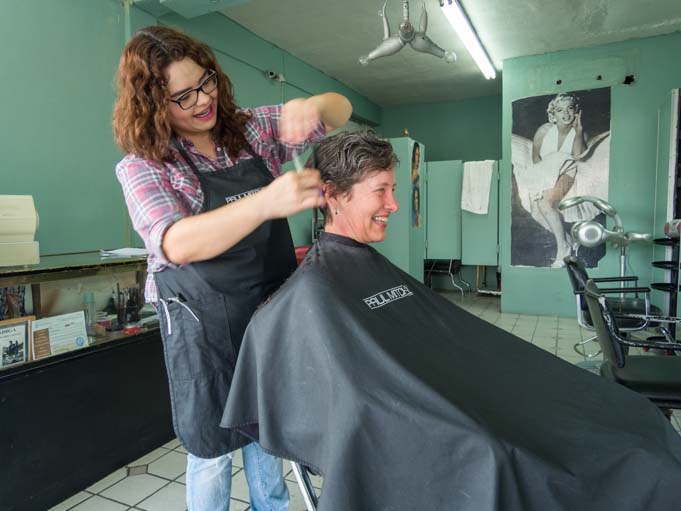
Next door to Dr. Bernal’s office there is a hair cutting salon. Both times we visited Dr. Bernal, we dropped in on the hair cutting salon to get haircuts. The most delightful stylist named Amber works there, and for just $3 for men and $5 for women, she does a great job.

To find her shop: as you walk into the alcove where Dr. Bernal’s office is, the hair salon is on the right side before his office. For both of us, these have been the bests haircut we’ve had in over a year!

Barber next to Mexican dentist San Luis Rio Colorado Mexico

Next to Dr. Bernal’s office there is a great little hair cutting place.

Getting a haircut in San Luis Rio Colorado Mexico

Amber gives me a haircut

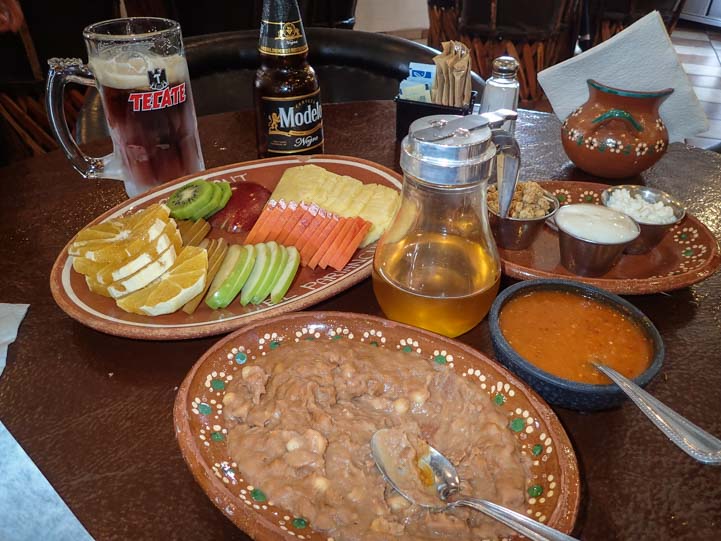
Another thing that’s great about going to Mexico for dental care — besides receiving excellent care at a fraction of American prices — is that it’s an excuse to enjoy a daytrip to another culture and eat some really wonderful Mexican food.

In San Luis there is an absolutely fantastic restaurant called El Parianchi that serves incredible food, complete with fun entertainment. We’ve now eaten several lunches there and a breakfast too, and we have loved the experience every single time.

El Parianchi Meal San Luis Rio Colorado Mexico

The first course of a feast for two for $13 (pancakes and omelette not shown) at El Parianchi restaurant.

We’ve gotten to know several of the waiters as well as the harpist, Elias. Mexicans enjoy listening to folk songs played by various kinds of musicians while dining, and the harp music adds a special something to the ambiance at El Parianchi.

Mexican restaurant El Parianchi San Luis Rio Colorado Mexico

Elias entertains us with his harp.

El Parianchi also has a stash of huge sombreros, and sometimes the waiters bring them out and put them on their guests as a gag. We ended up wearing these crazy hats on one of our visits for my root canal last year (see this post). On one of our visits this year, a group celebrating a 26th birthday ended up in the hats right behind us!

People in sombrero hats El Parianchi Restaurant San Luis Rio Colorado Mexico

Sombreros for everyone at the birthday party!

For lots more details about dental care in Mexico, including directions to our dentists’ offices, check out this link:

Mexican Dentists – Finding Affordable Dental Care in Mexico

Basic info for our primary care dentist. He’ll set you up with specialists in town as needed:

Dr. Sergio Bernal

Call him directly from the US by dialing this number: 011 52 653 534 6651
Address: First St. #118-9 San Luis Rio Colorado, Mexico

Open Monday-Friday 9-5, Saturday 9-2, Sunday 9-11

For first timers, walk 100 yards from the border to Dr. Bernal’s office (detailed directions at this link), and then take $2-$3 cabs to visit other dental specialists, if needed, and be sure to enjoy a meal at El Parianchi! Here is a map showing the locations we visited:

Locations of Dr. Bernal’s Office, El Parianchi Restaurant and Dr. Avila’s Office – Interactive Google Maps

On the above map, the locations are labeled as:

  • Dr. Bernal = “Calle 1 115”
  • Dr. Avila = GPS 32.477776,-114.766224 (Calle 13 & Madero)
  • El Parianchi is in between them at Calle 10 & Captain Carlos Calles

To get the hours of operation of the San Luis, Arizona, USA / San Luis Rio Colorado, Sonora, Mexico border crossing and other info about the border, call: 928-627-8854

When we crossed the border for our first visit with Dr. Bernal this past October, we were alarmed to see a huge group of illegal immigrants waiting to cross into the US. On our return visit a month later, Mexican authorities had removed them from the sidewalks and placed them in shelters. The sidewalks near the border were empty as they always had been before.

So how do you get hooked up with a good dentist in Mexico?

We first heard about Dr. Bernal from fellow Escapees members at the Escapees Kofa RV Park in Yuma. For new RVers, we highly recommend joining Escapees RV Club, as it is little tidbits like getting the name and address of a trusted Mexican dentist that are the unsung benefits of being part of this club.

Escapees is known for its fabulous magazine, its many member parks, its discounts on RV parks across the country, its workcamping job board, its massive database of boondocking locations, its bootcamp training for new RVers and its incredible mail forwarding service and RV advocacy work.

But sometimes it is the little things that are passed on member to member, like dentist and doctor referrals, that make the club particularly helpful for folks living on the road in their RV. Lots of people go RVing, but there is a comaraderie among Escapees members that is unique.

To learn a little more about the unusual history of Escapees, check out our links:

If you think you might want to join Escapees RV Club, you can become a member at the link below…and if you mention that you heard about Escapees from this blog, Roads Less Traveled, they will put a little something in our tip jar as a thank you (and thank YOU!!):

Join Escapees RV Club

We’ve been members since 2008!!

Subscribe
Never miss a post — it’s free!

Our most recent posts:

More of our Latest Posts are in the MENU.   New to this site? Visit RVers Start Here to find where we keep all the good stuff. Also check out our COOL NEW GEAR STORE!! *** CLICK HERE *** to see it!

<-Previous || Next->

Photography – Cameras, Gear, Tips and Resources

Note: This page was written in 2016 and reflects the gear we used and what was on the market at that time. Our current gear is all professional quality and includes Nikon Z8 and Nikon D850 camera bodies, Nikon lenses, Nikon polarizing filters, Really Right Stuff tripod legs, Benro tripod legs, Sunway Foto table top tripod legs, Really Right Stuff ball heads and Wimberly gimbals, Think Tank camera backpacks, 14 inch Apple Macbook Pros with M2/Max CPU 64 GB memory and 4TB internal drives, and SanDisk G-Raid external hard drives for backups and archiving. We still highly recommend the resources we used for learning photography and post-processing described further down the page.

Since we began our full-time RV travels in 2007, photography has become a huge part of our lives. Photography is an ideal hobby for travelers, and it isn’t hard to learn. Our learning curve has played out on the pages of this website, and it is satisfying to see our improvement over the years. When we first started traveling, we each shot about 6,000 photos per year. Now we each shoot over 35,000 photos per year (a little under 100 per day per person!).

Camera on a tripod - photography

Photography is a lot of fun, and it’s not hard to learn.

People have asked us what cameras and equipment we use, and how we improved our skills. This page presents all of our gear choices over the years, from our camera bodies to our favorite lenses to our filters and tripods to the goodies we use to take our cameras out for a hike to the software we rely on for post-processing.

It also explains how we organize all our photos and lists all the books, eBooks and online tutorials we have studied to learn to take better photos. We are entirely self-taught, and the inspiring resources we reference here lay it all out in plain language.

We’ve invested in our camera equipment because photography is our passion and we do it all day long. What you’ll see here is our progression through good solid “value” gear, from the “entry level” gear we started with to the more professional quality gear we use today.

For easy navigation, use these links:

The best time to buy camera gear is during the lead up to Christmas or when a manufacturer discontinues a camera model. An inexpensive but good quality DSLR is the Nikon D3400 camera which is available in kits with one or two lenses, camera bags, filters, etc., here

CAMERAS and LENSES

Return to top

Our Current Cameras and Lenses

As of 2018, we both shoot with Nikon D810 cameras. This is a professional level, truly awesome, full-frame 36 megapixel camera. We use these primarily for landscape shots.

We also both have Nikon D500 cameras which are crop-sensor 20 megapixel cameras that can shoot 10 frames per second, ideal for fast moving objects like wildlife and our adorable puppy.

Prior to these cameras, we both used Nikon D610 cameras. This is a full-frame, 24 megapixel camera. It is considered a “pro-sumer” camera, not quite professional quality but at the high end of the hobbyist ranks.

Although we have a big collection of lenses, we typically take no more than two apiece with us when we are out and about on foot. It’s just too much stuff to lug around!

I have a Nikon 28-300 mm lens on my camera which I use almost exclusively, simply because I love the flexibility of having both wide angle and zoom options with the twist of my wrist without having to change lenses.

Photographer with camera tripod in the water

When we got into photography, we jumped in with both feet.

Mark likes to pick a lens for the day and work within its limits. His favorites are prime (non-zooming) lenses, and he uses the Nikon 50 mm and Nikon 85mm lenses a lot. These are a lot less expensive than zoom lenses, and they are much faster lenses too (meaning they can be used in lower light). However, they do not have vibration resistance (also known as “image stabilization”), a technology that reduces the inherent wiggle caused by hand-holding a lens.

He also uses the Nikon 24-120 and the Sigma 24-105. These are very similar lenses, and we would have just one of them, but I used to use the Nikon 24-120 all the time before I got the Nikon 28-300, so he got the Sigma 24-105 to have one with a similar range. They’re both terrific lenses, so we can’t decide which one to keep and which one to sell!

We have a Nikon 70-200, which is a truly beautiful lens. For a long time neither of us used it much, but after I commented to that effect when I first published this post, Mark put it into his regular arsenal and uses it frequently now. It is a fabulous lens with excellent color rendition. Another advantage is that the zoom feature doesn’t lengthen or shorten the lens — it is always one length and all the zooming is physically done inside the lens. This means that dust doesn’t sneak into the lens when it is zoomed in and out the way it does with other lenses (like the 28-300, 24-120 and 24-105 mentioned above).

For wide angles, we have a Nikon 16-35 and a Nikon Nikon 18-35 so we can each shoot very wide angles simultaneously. Mark LOVES wide angle photography, and he uses these all the time. The 16-35 is more expensive, and was purchased as an upgrade from the 18-35, but he can’t seem to part with the 18-35 now, so I inherited it.

For super wide angles like at Horseshoe Bend in Arizona or for shooting stars at night (like the final image in this post or the first image in this post), we turn to the Rokinon 14 mm lens (with the Nikon focusing chip) or our very cool fisheye lens, the Rokinon 12 mm lens.

A few years back we bought a Tamron 150-600 mm G1 lens for shooting birds (like wild peach faced lovebirds here) and for wildlife — or even for stationary cacti at a faraway distance as in this image here. We loved this lens so much we bought the upgraded Tamron 150-600 mm G2 lens. While we got lucky with the first one and it worked great right off the bat, we had to send back our first copy of the G2 and get a replacement because it didn’t focus well. Now both lenses are awesome. Frankly, if you are picky about testing the lens to make sure you have a good copy, we find we are getting just as good pics from the older G1 lens as from the newer G2, so you might save a few bucks and get the G1. We used both lenses as well as the Nikon D500 and the Nikon D810 to capture the eagle and moon images in this post: Magical Moments in the RV Life.

An alternative to this lens that is priced similarly is the Sigma 150-600 contemporary series lens. Another awesome option that has become available since our purchase is the Nikon 200-500 mm lens.

What about those third party lenses?? Some are better than others, although Sigma’s Art Series lenses are really great these days (and expensive). When I was casting about for a “do it all” lens, we initially bought a Tamron 28-300 mm lens. It had terrible color rendition and didn’t focus for beans, so we returned it to buy the Nikon 28-300, which I totally love.

Our Past Cameras and Lenses

Do you need all this crazy stuff when you first get started? No!

When we began traveling, we purchased two Nikon D40 cameras, which were 6 megapixel crop-sensor cameras. Each came with a Nikon 18-55 mm lens, and we got a Nikon 55-200 mm lens for distance. This was a great camera model to learn on, and we published five magazine cover photos taken with it.
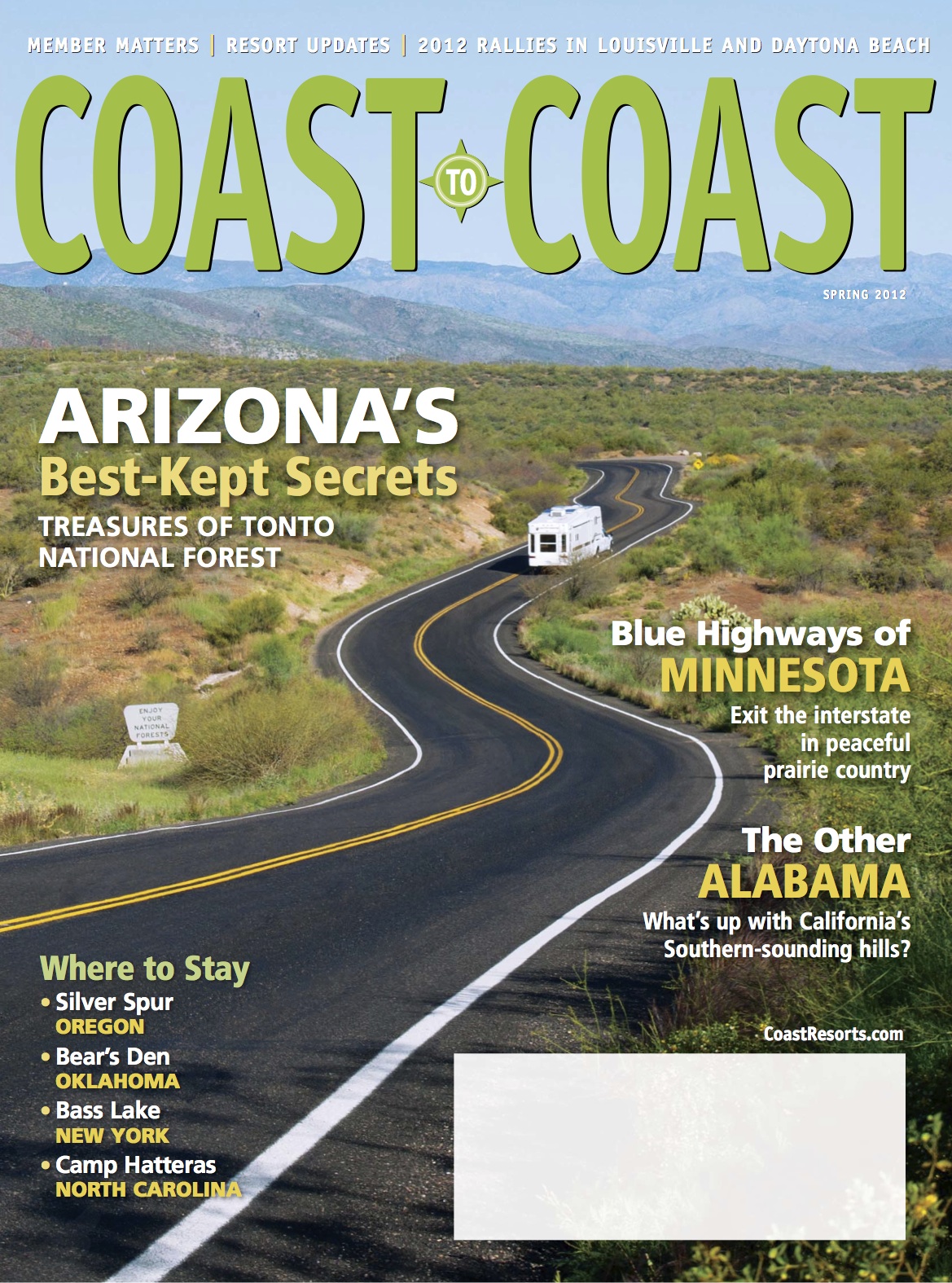
Coast to Coast Cover Spring 2012

Do you need to spend a bundle on a camera? No!
I took this photo with a Nikon D40 that you can buy today (used) for $100.

The Nikon D40 (and its modern day equivalent Nikon D3400) are “crop sensor” cameras (or “DX” in Nikon lingo). This means the sensor is smaller than on a “full frame” camera (like our current Nikon D810 cameras which are “FX” in Nikon lingo). This, in turn, means the image quality is slightly lower and if you blow up the image to poster size it won’t look quite as good up close.

The D40 was discontinued long ago, but can be found on Craigslist and eBay for $100 with two lenses. One that has been lightly used will work just as well now as it did years back.

How do you tell how “used” a used camera is??

If you have a Mac, an easy way to find out how many shutter clicks a camera has is to take a photo, download it to your computer, export it or locate it in the Finder, and open it in Preview by double clicking on it. Then click on Tools > Show Inspector, click the “i” button and then the “Exif” button. The Image Number is the number of shutter clicks the camera has on it. This works only for cameras that have a mechanical shutter, not for pocket cameras with an electronic shutter.

My only frustration with the Nikon D40 was that there was no built-in cleaning system for the camera sensor, so every time we changed lenses the sensor was vulnerable to picking up dust — and it did! We used the Nikon D40 cameras fro 2007 until 2011.

Today’s “equivalent” entry level DSLR is the Nikon D3400. It is a 24 megapixel camera that is far more sophisticated than the D40 and not “equivalent” in any way except the price point. If you want to get it in a kit with multiple lenses, filters, camera bag, tripod, etc., there are lots of kits here.

The Tamron 150-600 lens can be hand held

The Nikon D610 and Tamron 150-600 mm lens.
I’m in camo to keep from scaring the birds away.
Think it will work when I point this huge scary lens at them? Not!!

In 2011, we upgraded to the Nikon D5100, a 16 megapixel crop-sensor camera. Like the Nikon D40, this camera was also a “crop sensor” or “DX” camera. It came with a Nikon 18-55 mm lens. We got a Nikon 55-300 lens, and I ran all over Mexico with both of those lenses, switching back and forth all day long.

In hindsight, I should have gotten the Nikon 18-300 lens and spared myself the hassle of carrying a second lens and switching lenses all the time (I missed so many great shots because I was fumbling with the camera!). But I had read some iffy reviews of the first edition of that lens and decided against it (the current model is its 3rd generation and I’ve met people who LOVE this lens. Oh well!).

The best thing about that camera was the built-in sensor cleaner. Living in the salty and dusty environment of coastal Mexico, this was huge. The other fun thing about that camera was the flip-out display on the back. You could put the camera in Live View, then set it on the ground or hold it overhead and still see your composition on the back of the camera.

We used the Nikon D5100 cameras from 2011 to 2013. The Nikon D5100 has been discontinued. Today’s “equivalent” level DSLR is the Nikon D5300. It is a 24 megapixel camera that, again, is far more sophisticated than the predecessor that we had. This is an outstanding “intermediate” camera and can be purchased in a Nikon D5300 camera and lens bundle.

If you have a few more dollars to spend, the Nikon D7200 is even better. It is still a crop sensor camera, but it is very sophisticated. Like the others, if you are starting out, getting a Nikon D7200 Camera and Lens Kit is very cost effective.

Pocket Cameras

Sometimes carrying a big DSLR camera is inconvenient. We both like having a pocket camera for times when a DSLR is too big.

I use an Olympus Tough TG-4 camera when I ride my mountain bike. I used its predecessor when I snorkeled in Mexico too.

This camera is very rugged. The bruises it has given me on my backside are proof that it holds up a lot better than I do when I fall off my bike and land on it. I like it because the lens doesn’t move in and out when it zooms, and you can drop it and not worry about breaking it. Here are a bunch of photos it took: Bell Rock Pathway in Sedona Arizona.

Mark has a Nikon Coolpix A that he is nuts about because it is just like a mini DSLR. He doesn’t do crazy things like take photos while riding his bike one handed the way I do (and he’s less prone to falling off), so he doesn’t mind having a more delicate camera in his pocket. It is a 16 megapixel camera that has most of the features of a the Nikon D610, except it is a crop-sensor camera that has a fixed 28 mm lens that can’t be changed. It has been discontinued.

Prior to that, he had a Nikon Coolpix P330 (also discontinued). It could shoot in raw format, which was the reason he chose it, but it didn’t produce nearly the quality images of the Coolpix A.

Lots of folks use a smartphone for all their photo ops or as an alternative to their DSLR. We don’t have a smartphone, but we have used a lot of them at scenic overlooks when groups of people pass their cameras around to get pics of themselves. One thing we’ve noticed is that there is a big difference in dynamic range (the rendering of bright spots and shadows) between Androids and iPhones, with iPhones being much better. This is probably common knowledge and not news to you at all, and it may be partly due to which generation of smartphone a person hands us to get their portrait taken.


ADDITIONAL PHOTOGRAPHY EQUIPMENT and ACCESSORIES

Return to top

Batteries – We have two batteries for each of our cameras, so we each always have a fully charged battery on hand besides the one in the camera. We’ve found the Watson batteries are a good alternative to the more expensive Nikon batteries. My Watson battery died shortly after the manufacturer’s warranty expired, and I was impressed that they honored it anyway and replaced it for me. However, note that the Nikon D500 camera can’t use third party batteries, so you have to spend the bigger bucks on a Nikon brand EL-15 battery for that camera.

Memory Cards – We also have two memory cards in each camera (the Nikon D610, D810 and D500 all have two card slots in them). We use Sandisk brand for all our memory cards. We like the SanDisk “Extreme Pro” 95 MB/second SD cards. We like these fast SD cards because when we start shooting in a burst (holding the shutter down and letting the camera take pics as fast as it can — for instance, when a bison jumps over a fence in front of us), the faster the card can be written to, the faster the camera’s internal memory buffer will empty, and the longer the camera can keep shooting at top speed. Faster SD cards are also faster when downloading photos to a computer. Our Nikon D500s use Sandisk XQD cards and our Nikon D810s use Sandisk CF cards.

Every evening we download all our photos onto our laptops and reformat the memory cards in the camera. We’ve heard that this reduces the chance of the card failing and losing all our photos (which happened to me once long ago with a Kingston card – ugh!).

The Hoodman Loupe – A Game Changer! The Hoodman Loupe revolutionized our photography because we were suddenly able to see our photos clearly on the back of our cameras and then retake the photo if necessary. The loupe fits over the LCD screen, blocking the glare and magnifying the image. The lens is adjustable, so no matter how good or bad your eyes are, you can adjust it until you can see the image perfectly clearly. We have the original hard sided loupe. A new model collapses down so it can be stored more compactly. In a lot of the photos of me on this website, you can see my Hoodman loupe hanging around my neck!

Hoodman Loupe on a Nikon D610 Camera

The Hoodman Loupe lets you see the image on the back of the camera clearly, adjusted for your eyes, and without glare.

Battery Grip – Mark occasionally uses a Vello Battery Grip on his camera. This grip can hold extra batteries and also makes it possible to take portrait oriented shots (vertical images) while holding the camera as if it were upright rather than twisting your right arm over your head. Mark absolutely loves his. I use mine only occasionally because I can’t use it with my tripod L-bracket (see below).

Camera Straps – We replaced the standard Nikon camera straps with the Optech Pro Strap. This strap is thick and cushy and is slightly curved to fit the curve of your shoulder. It also has quick release clasps so you can easily unclip it from the camera when you’re using a tripod.


LENS FILTERS

For a long time we preferred the B+W brand for all our filters, although we’ve used a lot of Hoya filters over the years too. We’ve also tried Tiffen filters, but find they are hit-and-miss. Often, if a “lens deal” includes a filter with the lens, it’s not a great one. Most recently, we have begun buying Nikon filters which seem to be the best quality all around. Just be sure you get the right size for your lens (52 mm or 77 mm, etc.).

Camera UV Filter, Polarizing Filter and Neutral Density Filter

UV filter (top), Polarizing filter (left) & neutral density filter (right)

UV Filters – We have UV filters for all our lenses to provide protection for them.

Polarizing Filters – We also have polarizing filters for all our lenses. A polarizer makes it possible to enhance the colors or reduce the glare in certain lighting situations. It is best around midday and has less effect at dawn and dusk. It is wonderful around bodies of water and for removing the dashboard glare on the windshield when taking photos from inside a car. A polarizer adds a lot of contrast to an image, however, so while it can enhance a landscape beautifully, I’ve found it makes street photography of people too contrasty.

Graduated Neutral Density Filters – We occasionally use a graduated neutral density filter when the sky is very pale and the scene we are shooting is dark. This kind of filter is half colored and half clear. By twisting it so the colored part lines up with the sky and the clear part lines up with the darker landscape, the sky and landscape come out more evenly exposed. They are also very helpful for sunrises and sunsets.

Neutral Density Filters – When shooting moving water, a neutral density filter darkens what the camera sees enough so the shutter speed can be increased to show silky movement in the water without it being blown out and all white. These filters are also helpful if you want to use a very big aperture (small “F number”) to blur out a background and the camera’s top shutter speed isn’t fast enough to get proper exposure. These filters come in different degrees of darkness. A 10-stop filter is good for shooting a waterfall in broad daylight while a 4-stop filter is good for the same scene at dawn or dusk. We had fun with moving water photography at Watkins Glen in Upstate New York, the Blue Ridge Parkway in N. Carolina, and Great Smoky Mountains National Park in N. Carolina.

Lee Filter System – Mark also uses a Lee Filter System and loves it. This is a multi-part system of square filters that can be placed on any camera lens. You need the Lee Foundation Kit, an adapter ring sized to your lens and some filters. The advantage of this system is that for graduated neutral density filters you can position the transition point between light and dark. So, if you are shooting a sunset and have very little land and lots of sky, you can darken the sky and lighten the land even if the horizon is just above the bottom of your photo. Likewise if you have a bright sky and a dark hillside – you can rotate the filter so the transition is on an angle and not a horizontal line right through the middle of the photo.


TRIPODS

It is really hard to invest in a tripod after blowing the bank account on a nice camera, a few lenses, spare batteries, memory cards and filters. And you can have loads of fun with photography without getting a tripod. But if you want to play with shooting (and showing) motion (i.e., a car going by with a blurred background, clouds streaking across the sky or silky water flowing) or you want to have perfect exposure in very low light (like a sunset) without a flash, or you want to do some timelapse videos (very cool at sunrise in a big canyon) then a tripod is a must.

Sunwayfoto XB-52DL Ballhead with T2C40C Tripod and DDC-60LR Quick Release Clamp

Sunwayfoto XB52-DL Ballhead with T2C40C Tripod and
Sunwayfoto DDC-60LR Quick Release Clamp

Most people end up upgrading their tripod several times because they just can’t believe, at first, that they have to spend good hard earned money on a tripod, and they go through a bunch of cheap ones before they bite the bullet and get a decent one! We did that, and lots of our friends did too.

The biggest difference between tripods is how much weight they can hold solidly, how easy they are to set up and adjust, and whether things drift or droop a little after you tighten the buttons. I have a Benro carbon fiber tripod that I absolutely love for hiking. The legs slide in and out really smoothly, and the adjustments are easy. I also have a set of super long Really Right Stuff tripod legs and a Wimberly gimbal which is awesome for letting me swing the Tamrom 150-600 lens around smoothly while shooting birds.

Mark has Sunwayfoto tripod legs and smaller ballhead for hiking and bigger ballhead that he loves and he uses a Sunwayfoto GH-01 gimbal head as well. We reviewed them in depth at this link:

Choosing a Tripod – Sunwayfoto Tripod and Ballhead Review

Sunwayfoto GH-01 Ballhead Review – Great Support for a Long Lens

We both have the SunWay Foto L-Bracket that attaches to the camera body and lets us set the camera in the tripod in either Landscape or Portrait orientation very easily. I keep my L-bracket on the camera all the time for simplicity in case I want to grab my tripod quickly, but it means I can’t use my Vello Battery Grip. Mark loves his battery grip, so he has to switch back and forth between the regular tripod bracket that fits on the camera along with the battery grip and the L-bracket that doesn’t.


FLASHLIGHT

We love doing night photography, photographing the milky way and the stars, and doing light painting on old buildings for ghostly effects. At Waterton Lakes National Park we did a timelapse video of the Milky Way.

When we are hiking on a remote trail in the middle of the night, or light painting a building to make it appear visible in a nighttime photo, we find that a good flashlight is essential.

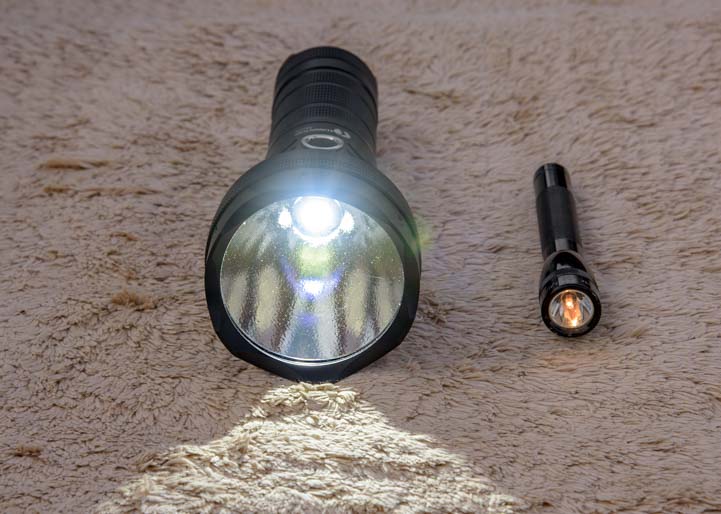
We use the fabulous, super high powered LED flashlight from Lumintop, the Lumintop SD75 4000 lumen flashlight. It is like having a car’s headlight in your hand!
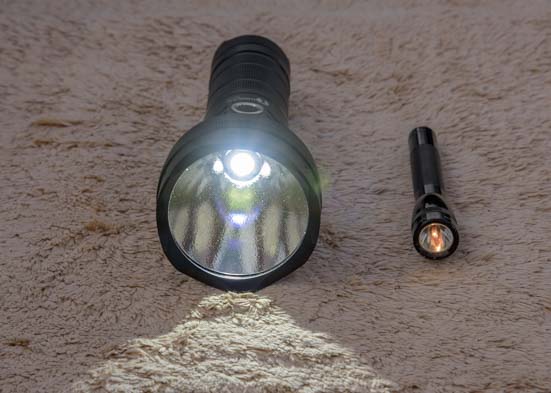
Lumintop SD75 4000 lumen tactical flashlight

Lumintop SD75 4000 lumen tactical flashlight next to a pocket Mag Light

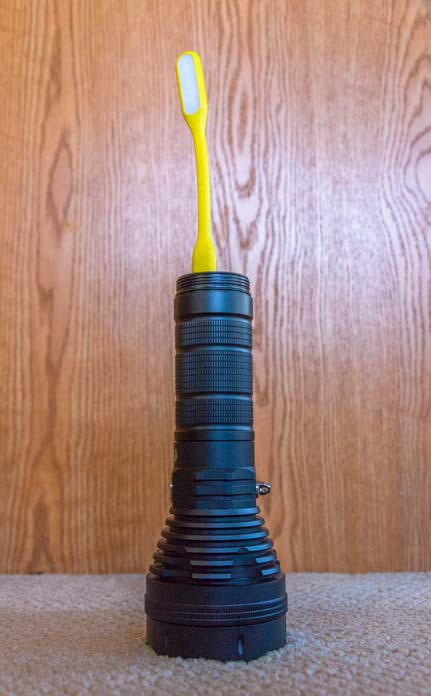
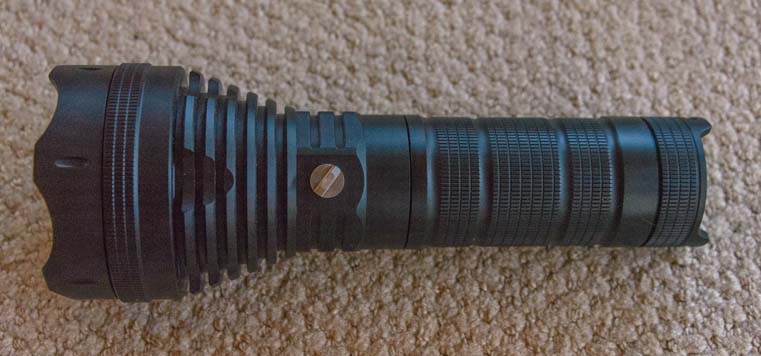
Built with heavy duty aerospace aluminum, it has a military grade hard-anodized aluminum finish and is water resistant to 2 meters. Offering 3 power levels plus a strobe, there’s also an LED tail light that can be used as a night light when we’re setting up our camera gear in the dark. It also has threads on the bottom for mounting on a tripod.

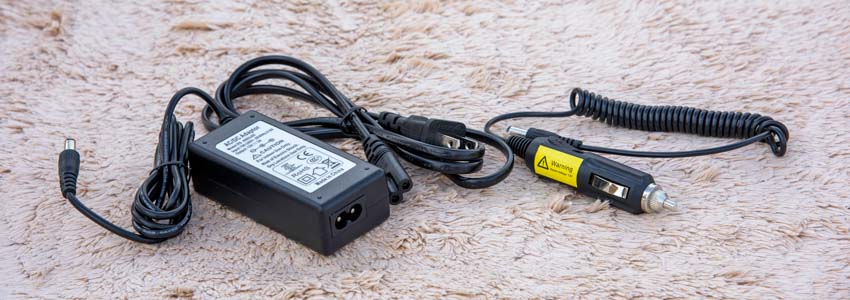
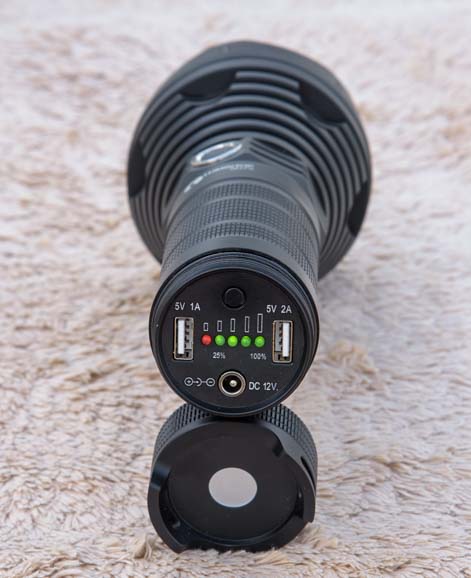
The flashlight batteries are rechargeable and there is a battery level indicator. The flashlight ships with a wall charger and 12 volt car charging cords, and it comes in a suitcase! The batteries are so strong, it can be used to recharge other smaller devices like cell phones via 2 USB ports.

This is not a pocket flashlight, but it has slots in the end for a strap that makes it very easy to carry.

We love this flashlight and just wish we had had it when we cruised Mexico on our sailboat, as it is far more powerful than the emergency floodlight we had for rescuing a man overboard!


HAULING, STORING & MAINTAINING OUR CAMERA GEAR

Return to top

With all this camera stuff, it can be a challenge to figure out how to carry it to scenic spots and where to store it in the RV and truck when we’re not using it. Also, our camera gear takes a lot of abuse from dusty air out west, salty air on the coast, and sunscreen from our faces and hands. So it needs to be cleaned periodically. Here’s where we’re at with all this right now:

Hiking With Camera Equipment

When we go on a hike of a few miles, it is likely to take us four hours or more because we stop to take so many photos. So, we want to have water, snacks, our camera gear, tripods, and possibly a jacket with us. There are a lot of camera-specific backpacks and sling style camera bags on the market, but none we’ve seen is really designed for hiking.

After a lot of searching, we finally decided to use big Camelback hydration packs instead of bona-fide camera bags when we hike with all our photography stuff, and we’ve been really happy with this choice.

I have a Camelback H.A.W.G. and Mark has a Camelback Fourteener. Both can carry 100 ounces of water, and each has enough capacity for the Tamron 150-600 lens along with everything else if need be. (We never take more than two lenses with us — one on the camera and one in the pack).
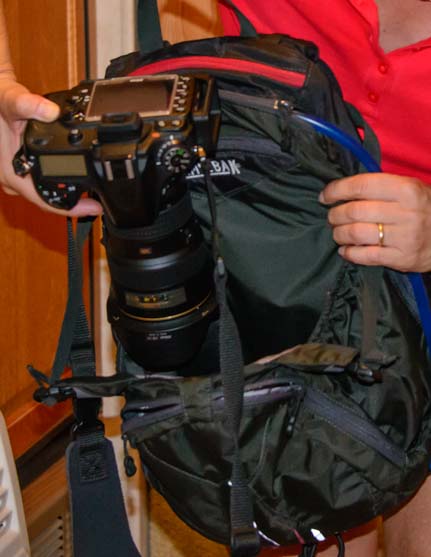
Camelback H.A.W.G. camera bag

The Camelback H.A.W.G. can hold a big camera.

We generally hike with our cameras slung around our necks so we can take photos with them as we walk. I put the Camelback on first and then put the camera on afterwards so the camera straps aren’t trapped under the shoulder straps of the Camelback. There’s nothing like getting caught in the Tourist Tangle!

My main criteria for choosing a Camelback was that I wanted to be able to put my camera (with the 28-300 mm lens attached) inside the Camelback and then close that compartment so I could scramble over something gnarly that required two hands and not worry about the camera slipping out of the pack. And it had to do that with 100 ounces of water in the hydration pack.

My other criteria was that I wanted to be able to hang my tripod on one of the Camelback straps and hike without carrying it in my hand.

The straps on the sides of the H.A.W.G. aren’t designed to carry a tripod, and they may fatigue over time, but I’ve been really happy with how this Camelback has held up on the many hikes I’ve taken with it so far in two years of owning it.

The straps on the sides of the Fourteener are designed to hold ice picks and things like that, so they are probably a little more rugged. If I had known about the Fourteener before I bought my H.A.W.G., I probably would have bought that model instead. Mark has had it almost as long as I’ve had my H.A.W.G., and he is very happy with it as well.

Camelback H.A.W.G. with camera tripod

The tripod fits neatly on the side of the H.A.W.G., and the camera straps aren’t trapped under the Camelback straps.

One really nice feature of both of these Camelback models is that they have a waterproof rain sack that can be pulled out of a hidden pocket and slipped over the whole Camelback, keeping the contents dry if you’re caught in a downpour. This came in super handy at the Duggers Creek Falls on the Blue Ridge Parkway!

One of the tricks with backpacks in general is that, if they have a waist belt, you can loosen the belt a little, slip your arms out of the arm straps and then swing the pack around so it is in front of you. This way you can get something out of it without taking it off and putting it on the ground. This is fantastic when you want to swap filters, grab a snack, or change batteries without taking the whole darn thing off.

Once we get to an area where we’re going to take a lot of photos, we take the tripods off the Camelbacks and we carry them around in our hands until we’re ready to hike out again.

We carry a plastic bag (a shopping bag is fine) in our packs in case it sprinkles and we want to cover our cameras for a short time. We also carry rain ponchos so we can cover ourselves and our Camelbacks in the event of unexpected rain.

Short Walks With Photography Gear

If we are going to spend the day roaming around but not hiking, or if we’re taking photos a short distance from the truck, we don’t take the big Camelbacks. I use a small fanny pack to carry a spare battery and possibly a second lens. Mark likes to wear a photographer’s vest that has lots of pockets for all his goodies. He likes the one he has, but has his eye on the Phototools Photovest 14!

Storing All This Stuff

In the trailer we have Ruggard camera cases and Ruggard backpacks to hold the cameras and lenses. We also have camera cases in the truck. We’ve found good homes for the tripods in the truck too, and they generally stay there so they are with us if we arrive somewhere and suddenly wish we had them with us.

Cleaning

A great way to get the dust off the camera and lenses is to blow it off with the Giotto Rocket Blaster (the largest size is best). The Nikon LensPen Lens Cleaner is good for brushing dust off too. For smudges and smears, we use the Eclipse Camera Cleaning Kit which comes with a cleanser and pads.
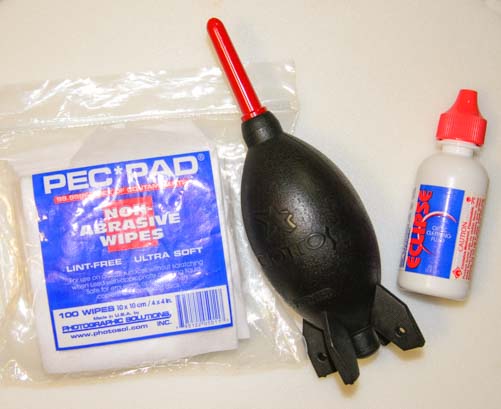
Giotto Rocket Blaster & Camera Cleaning Kit

Giotto Rocket Blaster & Camera Cleaning Kit

Sometimes the camera’s built-in sensor cleaning system doesn’t quite do the trick, and getting debris off the camera sensor can be really intimidating. Rather than paying for an expensive cleaning at a camera shop, we’ve discovered that the Sensor Gel Stick sold by Photography Life does a phenomenal job (don’t get the cheap Chinese imitation ones). Check out the video under the product description here to see how to do it. It’s easy and we have done it many times.


PHOTO ORGANIZATION and POST-PROCESSING TOOLS

Return to top

We each have a plain MacBook Pro (no retina display) with 16 GB RAM and a 1 TB internal drive and slots for CD, SD card, Thunderbolt, etc. (2012-style case). We also each have a 4 TB external hard drive with a Thunderbolt dock that allows multiple drives to be daisy-chained.

We use Adobe Lightroom for most of our post-processing. The easiest way to learn Lightroom is the Julianne Kost Lightroom Videos. Julianne is Adobe’s “Lightroom Evangelist” (what a great title and job!) and her presentations are clear and concise.

Organizing photos is never easy, and everyone has a different method. Lightroom lets only one person work on a catalog at a time, so we each have separate Lightroom catalogs. We make use of the Smart Previews in Lightroom to get access to each other’s photos without transferring all the original photo files between our laptops. All we have to transfer is the catalog, previews and smart previews. It’s clunky — I know they could do better — but it works.

We also have a separate Lightroom catalogs for each year. The older catalogs are stored on external hard drives and the current year catalogs are on our laptops. We try to make sure all our photos are in two places (laptop and external drive or on two external drives). Some of our older photos are in Apple’s Aperture and our oldest are in Apple’s iPhoto, the two post-processing programs we used prior to Lightroom.

I don’t want to have to plug in an external drive every time I go into Lightroom, which is why we keep our current year’s photos and catalogs local to our laptops. We have our previous year’s catalogs and smart previews on our laptops so we can see and work with our older photos. If we need the full image of an older photo, we plug in the appropriate external hard drive, and the catalog on the laptop reconnects with the original images.

We don’t store anything in the cloud.

We organize our photos by location but like to have an overall sense of the chronological order in which we visited places, since that is the way we remember our travels. So, we label our folders with 2 digits followed by the state to bring up the states in the order in which we visited them.

Inside of each state folder, we name every download with a 4-digit date (month/day) followed by the specific location. For photos that aren’t location specific (like photos of our trailer disc brake conversion or fifth wheel suspension failure, we move them after downloading to a MISC folder and name a subfolder within it more appropriately or add them to an existing folder.

Lightroom Folder Organization

2 digits to order the states chronologically, then 4-digit dates on subfolders with the specific location.

We also use PHOTOSHOP for post-processing. The best instruction for learning Photoshop is offered by Brendan Williams. His free online tutorials on his YouTube channel are terrific. However, if your goal is to MASTER Photoghop, buy his video course and go through each of the videos slowly — and practice the techniques he teaches. His course is extremely well done and is worth every penny!

Photomatix Pro is an excellent program for creating HDR (high dynamic range) effects from several identical photos taken at different exposures, and Topaz Adjust and Topaz Detail in the Topaz Suite of software are great for getting a little wild with crazy effects at the click of a button.

For panoramas, we use Panorama Maker to stitch together a series of photos.

We use the X-Rite Color Checker Passport to create custom color profiles calibrated to specific camera and lens combinations. It also comes with a gray card that we sometimes use to set a custom white balance for particular light conditions.


RESOURCES FOR LEARNING PHOTOGRAPHY

Return to top

Photography is something you can spend the rest of your life learning. We’ve been reading and studying photography books and blogs for a few years now, and we have found the following printed books and ebooks and online resources to be really helpful in conquering both the technical aspects of understanding what all those buttons on our cameras do and the artistic aspects of how to capture the essence of what we’re seeing.
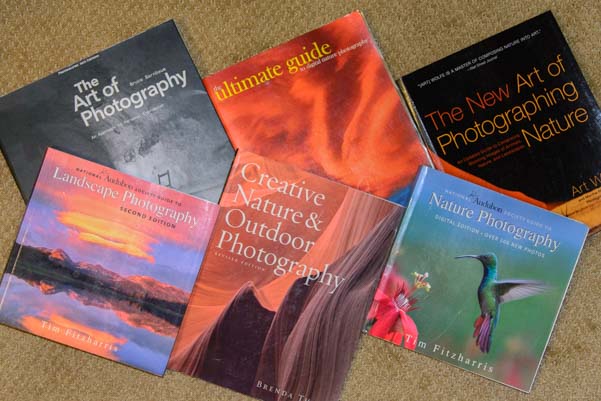
Photography Books

Some of our Favorite Photography Books

BOOKS ON PHOTOGRAPHY


eBOOKS ON PHOTOGRAPHY


ONLINE TUTORIALS

Steve Perry of Backcountry Gallery offers incredibly thorough and detailed camera reviews and photography tutorials on his YouTube channel, Backcountry Gallery. We were very fortunate to meet Steve and photograph prairie dogs and bison with him in South Dakota in 2017. In 2023 Steve was honored as one of the Top 40 wildlife photographers in the world. His eBooks are worth every penny and his videos offer outstanding and easy-to-follow instruction. He also leads wildlife photogrpahy tours to the far corners of the world where the most exotic wildlife live!

The website that taught us the most in the beginning was Photography Life written by Nasim Mansurov and his very talented team. He has super detailed gear reviews and his site is read by many of the top professionals in the photography world. His tutorials are excellent, and he has two pages with links to them all:

We were very fortunate to meet Nasim at his 2012 fall foliage photography workshop in Ridgway Colorado. Those extraordinary three days were a real turning point for our photography.


BLOGS, TIPS and GEAR REVIEWS

The photography blogs we read regularly are these:

  • Nikon Rumors – The latest info about everything related to Nikon cameras: future products, recalls, Nikon deals and specials
  • Photography Life – The most comprehensive camera/lens reviews anywhere and a top team of writers producing tutorials
  • Ken Rockwell – The first online photography resources we found. We’ve been following ever since
  • Ming Thein – Excellent and detailed camera reviews and truly inspiring photographs
  • DigitalRev TV – Hilarious (and very informative) videos on all kinds of photography topics.
  • Thom Hogan – Interesting photography-related essays as well as gear reviews
  • Dreamscapes – Phenomenal, jaw-dropping photography that makes us want to keep learning, plus tutorials & eBooks
  • DxO Mark – A laboratory that uses industrial testing equipment to do comparative camera, sensor and lens ratings


Subscribe
Never miss a post — it’s free!

Our most recent posts:

More of our Latest Posts are in the top MENU above.
New to this site? Visit RVers Start Here to find where we keep all the good stuff!!

Kuat NV Bike Rack Review

Roads Less Traveled

This page is a review of the Küwat NV Bike Rack, a high quality and easy-to-use bike rack that mounts in a hitch receiver.

Nifty new Küwat NV Bike Rack.

This page is a review of the Kuat NV bike rack

The bike rack folds flat against the back of the truck.

A nifty new bike rack from Kuat is easy to use.

The bike rack is folded down and ready for bikes to be mounted.

Kuat

A strap is cinched over the rear

wheel to hold the bike in place on

the rack.

Strap cinching system for Kuat bike rack Kuat rack strap system

A lever arm folds up and down to hold each bike in place.

Lever arm hold bikes in place on Kuat bike rack

The lever arm can extend and

retract with the press of a button.

The lever arm holds the bike in

place on the rack.

Mounted and ready to go.

There is a built-in, retractable bike lock.

The two ends pull out and can be

snaked through the bike(s) to lock them

to the rack.

This image shows the locked lock without a bike.

The Kuat NV bike rack features a built-in bike lock.

One end of the lock inserts into the other.

Bike is mounted and locked to the rack.

The bikes are mounted and run no risk of dragging on the ground if the trailer bottoms out.

Two bikes mounted and locked.

An clever feature is the bike stand.

Insert the stand into this quick release

fitting...

A terrific feature of the Kuat NV bike rack is the built-in bike stand.

The bike rack is folded flush to the back

ot he truck/trailer, the bike stand is

inserted into it and clamped down with a

quick release.

A bike is mounted on the Kuat NV bike stand, ready for bike mechanic work.

Magic!!  A bike stand!!  The bike's wheels and

pedals are free to spin and you can do

whatever bike mechanic work you need to do.

We highly recommend the Kuat bike rack

Two bottoming-out episodes and the round

knob was beginning to look square.

The Kuat NV bike rack is awesome

Jack of JM Welding comes to our rescue.

We get a custom-designed hitch extension made to raise the bikes another 8

He draws the design on the floor using parts he had

available that day.

Designing an extension for the Kuat rack

The pieces are laid out.

We fabricated an extension for our Kuat rack

The hitch extension is welded

and has gussets for added

strength.

Jack powder coats the whole thing.

"I think it's gonna work!"

Awesome hitch extension for the Kuat bike rack

Perfect - the bike rack is raised 8" or so off the

ground.

We lock the bike rack to the hitch

extension.  An internal bolt/nut

attaches the hitch extension to

the hitch receiver and would be

very difficult to undo.

With hitch extension on Kuat NV bike rack bike is well of the ground

Ahhh… the bike is well off the ground.

The bikes are up well off the ground and we are ready to roll!!

Two bikes mounted and ready for their next adventure.

Kuat 2 Bike NV Rack

This is a review of the Kuat NV Bike Rack, a high quality, extremely

easy-to-use bike rack that mounts on a trailer hitch.

For several years we lugged our bikes around on the back of our

trailer using a cheap Swagman bike rack that held 3 bikes.  It held the

bikes by gripping the top tubes in metal jaws.  To mount a bike on the

rack or to dismount it you had to screw or unscrew two long screws

that cinched the rack's jaws closed around the top tube.  There were

several frustrating problems with this rack:

• It was time consuming to mount and dismount the bikes

• The rack's gripping jaws gouged the bikes' top tubes and

chipped off the paint

• The whole rack jiggled wildly in the hitch receiver as we drove,

especially on rough roads

• If the trailer bottomed out in a ditch, the bikes' tires dragged on the ground

• There was no way to lock the bikes onto the rack

• We had to use bungee cords to keep the wheels from spinning as we drove

At the 2011 Interbike bicycle trade show in Las Vegas Mark checked out every bike rack manufacturer for a better solution.  He

finally settled on one made by Küwat, a small company out of Missouri.  This is a slick bike rack.  It is simple, easy to use and

solves almost all the problems we had with the Swagman (see note below).

RACK IS HELD TIGHT IN THE HITCH RECEIVER

The rack cinches into the trailer hitch using a clever expansion

mechanism you control with a round plastic knob at the back of the

rack.  Set the rack into the hitch receiver, tighten the knob until very

tight (or use an allen wrench to get it super tight), and the inner

expansion mechanism holds the rack rock solid in the hitch receiver.

The rack doesn't move at all.

The rack can be folded flush against the back of the trailer (or car/

truck) when not in use.

Then fold it down when you are ready to load some bikes onto it.

EASY MOUNT / DISMOUNT

The rack holds two bikes that face in opposite

directions.  Each bike's wheels rest on a tray.  The front

wheel goes into a rounded tray that keeps it from

rolling.  An adjustable strap loops over the rear wheel to

hold it in place.  Then an adjustable lever-arm is

tightened onto the front wheel next to the fork to keep

the whole bike in place.

So to mount a bike there are three quick steps:

1.  Place the bike's wheels on the rack's tray

2.  Tighten the rear strap around the rear wheel.

3.  Move the lever arm into place on the front tire in front

of the fork and apply pressure to cinch it down.

The bike(s) can be locked using

retractable built-in plastic shielded

cable wires.  One wire comes out of

each end of the rack.  Snake the two

wires through the wheels and frame(s)

of the bike(s), and insert one

connector into the other to lock the

bikes to the rack.  Easy!

To dismount the bikes simply release the rear wheel strap,

press the thumb button on the front wheel lever arm to extend

it and lower it, and lift the bike off the rack.

KUAT NV BIKE RACK BECOMES A BIKE STAND!

As a bonus, the rack includes a built-in bike stand for working

on your bikes.

Simply fold the bike rack up so it is flush with the trailer (or

back of your car/truck).  Insert the bike stand unit using a

quick release lever.

Mount the bike into the stand by its top tube using the quick

release clamps.

Now the pedals and wheels can spin freely and you can do

whatever maintenance your bike needs, from lubing the

chain to replacing the bottom bracket.

ONE PROBLEM - AND A GREAT FIX

Side note: Kuwat does not recommend putting their bike

racks on the backs of trailers due to the long distance

between the rack and the rear wheels of the trailer.  That long

distance puts extra force on the bike rack as the trailer goes

over bumps in the road and makes it possible for the rack to

hit the ground when the trailer bottoms out going through dips

in the road.

The only problem we had with this rack -- one that was

easily remedied -- is that the rack sat quite low to the

ground because the hitch receiver on the back of our

fifth wheel is fairly low, and the rack sticks out quick far

from the back of the trailer.  When the trailer bottomed

our (for instance, entering/exiting some gas stations),

the outer end of the rack dragged on the ground.  We

had two episodes like this, one going in and out of a gas

station and the other doing a u-turn at a National Park

parking lot.  These mishaps scraped the rubber right off

the rack's expansion knob in two places.

While driving through Blanding, Utah, we asked at the

Visitors Center if there was a good welder/fabricator in

town.  We were sent to see Jack Montella of JM

Welding, and in a few hours he created the

perfect solution.

He built an S (or Z) shaped hitch extension that

fits into our trailer hitch receiver and provides a

new higher receiver for the bike rack.

Things like this are available commercially, but when we

priced it out, the cost would have been similar and would

have required waiting for the part to be shipped.  So Jack

made a custom one for us on the spot.

After drawing a picture of the hitch extension on the floor, he quickly cut the

pieces and welded it together.  He put two gussets in the corners to provide

extra strength and powder coated it.  Our only concern with the design was

that this new extension wouldn't fit tightly in the trailer's hitch receiver,

making both the rack and bikes jiggle as we drove.

Jack had a perfect

solution.  He welded a

nut into the inside of the

new hitch extension

where the hitch pin goes through the hitch receiver and the

hitch extension.  Then he fabricated a long bolt that would go

through both the trailer's hitch receiver and the hitch

extension.  As the bolt was screwed into the nut on the inside

of the hitch extension, the hitch extension was cinched up

tightly against the inside of the trailer's hitch receiver.  This

made a rock solid connection.

At the other end of the hitch extension, our bike rack fits into the hitch

extension receiver just as it did into the original trailer hitch receiver,

using Küwat's expansion mechanism inside its tubes.

This has raised the bike rack 8" further off the ground.  Now when we

go through a deep dip in the road, the hitch cable rings (a part of the

hitch receive we don't use or care about) drag on the ground rather

than the bottom of the bike rack.

After we installed the bike rack on the new hitch extension I walked behind the trailer

as Mark drove it over a very rough dirt road.  The rack and the bikes followed the motion of the trailer and nothing more

-- no jiggling whatsoever.

You can purchase the Kuat NV Bike Rack here.

If you have more than two bikes and are mounting the rack on a car or truck (not recommended for an RV),

you can purchase the Kuat NV bike rack extension here.

After a few years wiggles crept in and we started using Hitch Tighteners to make the rack even more stable


The Kuat NV Bike Rack is available at Amazon (left ad), and if you are putting this rack on a car (not an RV), you can add the extension (right ad).

We receive a 4-6% commission from Amazon (at no cost to you) if you use one of our links to get to Amazon, no matter what you buy or when you finalize the sale. This helps us cover our out-of-pocket costs for this site, but doesn’t pay us for our time writing reviews like this.

If you make an Amazon purchase here, please drop us a line to let us know so we can say thank you!


Other RV-related product reviews:

Our most recent posts:

More of our Latest Posts and Quick Pics are in the top MENU above.

Subscribe
Never miss a post — it’s free!


Lumintop SD75 Flashlight Review – A Car Headlight In Your Hand!

This flashlight is no longer available. However, a comparable flashlight can be found HERE.

We’ve been doing a lot of night photography lately, catching the Milky Way at Waterton Lakes National Park in the Canadian Rockies and hiking in the dark out onto a rocky point to catch sunrise at Deadhorse Point State Park in Utah. We even hiked the Fairyland Trail in Bryce Canyon National Park after midnight.

Stars at Fairyland Point Bryce Canyon National Park Night Sky

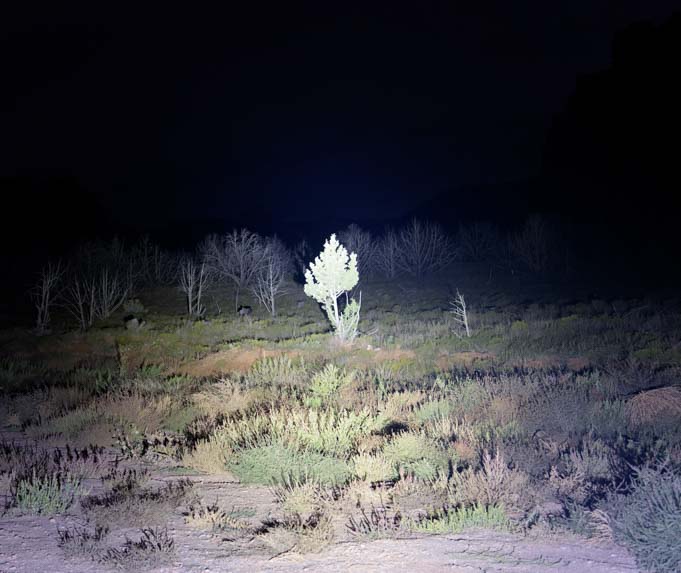
The Lumintop SD75 flashlight brightens the rock formations at Fairyland Point, Bryce Canyon National Park

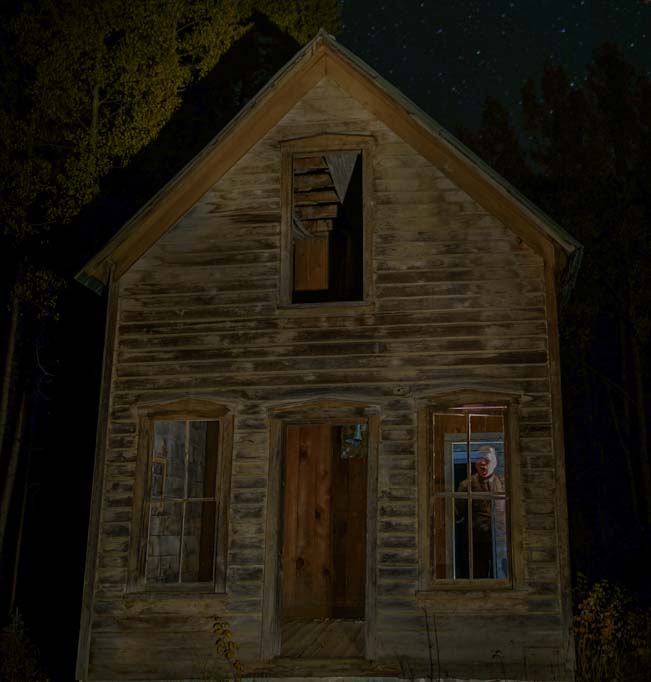
We’ve also played with creating ghostly images by doing Light Painting in old buildings in Ouray Colorado.

Ghostly image in a ghost town

Mark gets a selfie of his own ghost.

A key piece of gear we have relied on for all of this is a Lumintop SD75 4,000 Lumen flashlight.

In the past we used Maglites and smaller LED flashlights to find our way in the dark and to cast light on the surroundings during a long exposure of the night sky. However, even the best of these flashlights was hopelessly dim.

Lumintop SD75 LED flashlight

Our Lumintop SD75 flashlight next to our Maglite.

Mark is a huge flashlight junkie, and he searched for a long time for a big and powerful flashlight to use for our nighttime photography excursions and to use when we roam around our boondocking spots at night.

He decided on the Lumintop SD75 flashlight.

This is a “search” flashlight similar to the ones used by law enforcement.

There are three power levels, and at max power it is a whopping 4,000 lumens.

The light it throws at max power is astonishing — it goes 0.4 miles!!

Walking in the dark with this flashlight is like holding a car’s headlight in your hand!

Lumintop SD75 flashlight low power

Low power.

Lumintop SD75 flashlight medium power

Mid Power.

Lumintop SD75 flashlight high power

High Power.

  • At low power, it can run for 50 hours
  • At mid power, it can run for 8.33 hours
  • At max power (4,000 lumens), it can run for 2.68 hours

Fairyland Point Bryce Canyon National Park Night Sky

Light painting the rock pinnacles at Fairyland Point, Bryce Canyon National Park

There is a strobe mode as well, and at max power strobe, it can run for 50 hours!

The Lumintop SD75 is made of heavy duty aerospace aluminum and has a hard-anodized anti-scratching HAIII military grade finish. The LED bulbs are the latest CREE XHP70 LED technology.

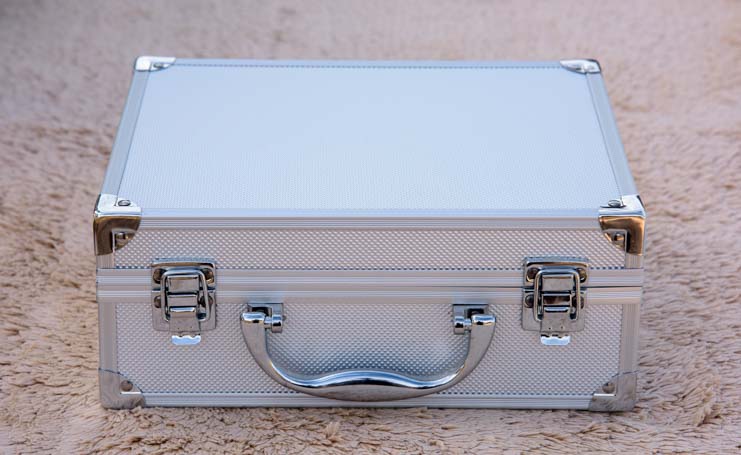
This is a serious piece of gear that comes in an equally serious suitcase!

Lumintop SD75 flashlight suitcase

The flashlight has its own suitcase. Don’t worry, it’s about the size of a very very big lunch box.

This aluminum suitcase has foam cutouts inside for all the goodies that come with it.

Lumintop SD75 flashlight suitcase open

Foam cutouts for all the extras.

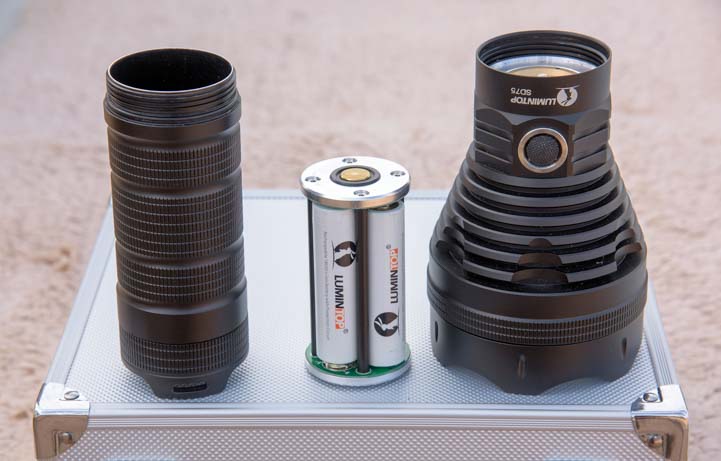
The flashlight comes with four lithium-ion batteries that are rechargeable. It also comes with a wall charger as well as a 12 volt car charger.

Lumintop SD75 flashlight parts

The flashlight packs into the suitcase in two halves. The battery pack is shown in the middle.

So, we can charge the flashlight batteries either in our RV or in our truck, whichever is more convenient.

Lumintop SD75 flashlight charger

Wall charger and 12 volt charger.

There is a battery charge indicator light on the back end of the battery, so we know exactly how well charged the batteries are.

There are also two USB connectors for charging cell phones or other devices FROM the flashlight battery! That’s how much charge these batteries can hold!

Lumintop SD75 tactical flashlight back end

Cap off: Battery indicator light, 2 USB ports + slots for a strap.

There are also two slots on the cap that covers the back end of the flashlight that can be used to attach a carry strap or piece of line.

One very handy feature for when we are setting up our tripods and camera gear in the dark is an LED taillight that attaches to the back end.

Standing the flashlight on end, this taillight illuminates the area all around the flashlight. This would be ideal in a tent or doing emergency truck or RV repair work in the dark too!

Lumintop SD75 Flashlight with LED taillight

LED taillight
Handy in a tent, setting up photo gear or working on the RV.

There is a quarter inch tripod socket on the side of the flashlight so it can be mounted on a camera tripod as well.

Lumintop SD75 tactical Flashlight tripod mount

Unscrew this cap to access the standard 1/4″ tripod mount.

One feature we haven’t taken advantage of — because we haven’t been caught out in the rain or gone swimming with this flashlight just yet — is that it is water resistant to 2 meters!! It comes with extra O-rings to help keep it watertight as well.

Overlook night stars North Rim Grand Canyon

My camera aims at the stars at the North Rim of the Grand Canyon.

I wish we had had this flashlight when we cruised Mexico with our sailboat. We had a 12 volt “4 million candlepower” spot light that we kept on deck during every overnight passage just in case one of us slipped overboard.

Of course, we wore harnesses and clipped ourselves to the boat at sunset and stayed clipped in until sunrise as long as we were outside the cabin. But there was always the chance that the quick release mechanism on the harness might accidentally undo itself or some other catastrophe might happen that would send one of us into the drink.

Milky WayLodge at North Rim of the Grand Canyon starry night and fifth wheel trailer RV

The Lodge at the North Rim of the Grand Canyon.

Frankly, there is no way in any conditions but the calmest seas that our spot light would have been bright enough to illuminate a bobbing head in the water.

This flashlight is so much more powerful, we both would have felt a lot more comfortable it we’d had it aboard with us!

Milky Way and fifth wheel trailer RV

The Lumintop SD75 flashlight brightens up our buggy.

If you are looking for a high quality flashlight for walking around your RV campsite at night, or for hiking in the dark, or for light painting old ghostly buildings in the wee hours of the morning, the Lumintop SD75 is a terrific choice.

It’s also a neat gift idea for that sweet hubby who loves gadgets and is so hard to buy for!!

You can buy the Lumintop SD75 flashlight at this link.

If this flashlight is a little big for your needs, we have also written a detailed review about two excellent pocket flashlights:

Pocket Flashlight Review: Lumintop EDC25 and Lumintop SD26 1000 Lumen Flashlights

Subscribe
Never miss a post — it’s free!

Below are some of our most POPULAR POSTS (also in the MENUS above)

Buddy - A Journey in Spirit - The story of an event that changed our lives forever.

ARTICLE INDEXES
  • RV Tech Tips Articles - A one page index of links to all our RV Tech Tips, RV Upgrades & RV Maintenance articles.
  • RV Lifestyle Tip Articles - An index of links to all our RV Lifestyle Tips (finances, boondocking, major repairs, work/jobs, etc.)
  • Solar Power Articles - Overview and tutorial articles for how to design and install solar power on an RV or boat
  • Product Reviews - An index of links to all of our Product Reviews
RV UPGRADES, SYSTEMS & TIPS MONEY FULL-TIME RV LIFESTYLE GEAR STORE
  • Gear Store - A list of the goodies, equipment and gear we've found useful in our RV lifestyle!
 

Our most recent posts:

More of our Latest Posts are in the MENU.
New to this site? Visit RVers Start Here to find where we keep all the good stuff!!
Immigrants Flood California’s & Arizona’s Borders – Surprise in San Luis AZ!

This blog post is a departure from our normal fare of cheerful travel stories, but as documenters of what we see in our day-to-day travel lives, it is something we encountered that we believe is worthy of sharing. This is not intended to take a political side or offend anyone.

October 2016 – A few days ago, we crossed the border between the US and Mexico at San Luis, Arizona. We were returning to the fun, small town of San Luis Rio Colorado, Mexico, for checkups with our dentist and endodontist whose excellent work we describe here.

After quite a few visits to this Mexican border town, we now know it pretty well. We like to make this border crossing by bicycle, because that gives us great transportation around town in Mexico. It also makes it super easy to return back across the border into the US, because bicycles bypass all the lines and go straight to a gate set aside especially for them and for holders of the US Sentri pass.

After wrapping up our dentist appointments, we rode our bikes back to the border to cross back into the US. As we approached the border gate, we stopped dead in our tracks when we saw dozens of people sitting on the sidewalk right outside the US border gate on the Mexican side.

Illegal immigrants waiting in Mexico to cross the border in Arizona

.

How bizarre! We’ve never seen anyone sitting on the sidewalk in this area before.

Pedestrians always simply walk up to the border crossing gate, show their passports and walk on through into the US. Often there’s a line of people, but everyone stands in the line, rather than sitting on the ground, and the line keeps moving.

These folks appeared to be settled in for a while. They were leaning against the fence in the border crossing zone that separates the US and Mexico. They had hung some blankets up to shade themselves from the intense sunshine, and they had bedding and luggage around them.

What the heck was going on?

800 Undocumented migrants wait to enter the United States in Arizona

.

Two US border patrol agents in front of the gate asked us for our passports before we even got to the actual US Immigration booth. That was weird too. Usually you present your passport to the agent in the booth, not to agents standing in front of it on the sidewalk.

We asked them who all these people were and what was going on.

“They are from Haiti, Africa, Central America, Asia, even Russia — lots of different countries — and they’re waiting to come into the US,” he told us. “But they don’t have any documentation, so they are waiting for an appointment with an agent.”

He went on to explain that his job was crowd control. Fortunately, this was a quiet crowd. On the other side of the street several Mexican soldiers in camo gear held rifles and stood watch as well.

He told us there has been a huge increase in migrants since last spring, and there had been so many at the San Ysidro/Tijuana crossing in recent months that the area in front of the US border there was quickly turning into a Tent City.

So, the migrants were moving to other, less crowded border towns in Mexico at the California and Arizona ports of entry. More and more were coming to the San Luis port of entry on the Arizona border.

“But this is nothing,” he said, sweeping his hand in the direction of all the people. “You should have seen this place a few days ago.”

721 Illegal immigrants wait to enter the United States in Arizona

.

We have crossed the border between the US and Mexico many times. We spent the better part of four years cruising Pacific Mexico on our sailboat, and we have crossed the border at least 25 times, by car, on foot, by bicycle and by boat.

We’ve crossed at the massive San Ysidro/Tijuana border crossing south of San Diego, the busiest port of entry in the Western Hemisphere. It resembles a mammoth freeway tollbooth plaza: 25 or so regular booths and perhaps 10 or so other booths for buses, commercial trucks and “Sentri Pass” holders who cross the border frequently.

And we’ve crossed at the smaller border crossings in Tecate (in rural southern California), Nogales (south of Tucson, Arizona), Los Algodones (western Yuma, Arizona), San Luis (south of Yuma, Arizona) and Boquillas del Carmen (at Big Bend National Park in Texas). At sea, we crossed just off the Pacific coast of southern California and northern Baja California, Mexico.

Going into Mexico is always very simple, and when on foot or bicycle, no one ever checks out passports. Returning into the US, however, is always an adventure. The wait in line to get into the US by car is usually at least an hour and is generally closer to two hours. It can be as much as four hours.

771 Undocumented migrants wait to cross from Mexico into the United States in Arizona

.

The fun thing about this mind-numbing wait in an idling car, creeping along inch by inch, is that entrepreneurial Mexicans make the most of their captive audience. They walk up and down the road between the cars and provide crazy entertainment for tips, and they sell things, from food to cold drinks to trinkets of various kinds.

Crossing into the US from Canada with an RV at Calais, Maine, and Chief Mountain, Montana, in the early morning avoids the lines, but you don’t want to have any fruits or veggies in the RV’s refrigerator!

Sailing across the border from Mexico into the US was quite different. Helicopters buzzed our boat and border patrol boats zoomed out to get a good look at us through binoculars. US Customs and Immigration came down to inspect our passports, boat documents and the boat itself when we tied up at the dock in San Diego.

But we’ve never, ever seen people hanging out on the sidewalks a few feet from the border gates setting up tent cities.

What had brought all these migrants here in such huge numbers? Even the agents themselves expressed shock at what was going on!

Illegal immigrants wait to enter United States from Mexico

.

Researching things a little bit, we discovered that after the big earthquake in Haiti in 2010, many Haitians moved to Brazil and stayed there for a few years. Many worked in construction-related jobs in the lead up to the 2016 summer Olympics. Unfortunately, Brazil’s economy has gone into a deep recession, so the Haitians began leaving Brazil this past year to come to the US.

It is a long journey to get through all of the Central American countries and Mexico, and without documentation, they can’t cross the borders in these countries legally. So, they pay smugglers to get them from one border to the next. The cost for them to get from Brazil to the US has been estimated to be at least $2,350.

When they reach Mexico’s southern border, many claim they are from Congo or other countries with which Mexico has diplomatic relations. This allows them to get a 20-day permit to remain in Mexico, which gives them enough time to get to the US border and wait for admission.

Illegal aliens wait to cross the border from Mexico into America

.

Haitians aren’t the only immigrants that are arriving in large numbers. Central Americans, Africans, Asians and others are taking this same route to America’s southwestern borders too.

Apparently 5,000 have arrived, and US Immigration and Customs Enforcement Director Sarah Saldaña says 40,000 more are on their way. This movement of so many people is putting huge pressure on the Central American countries and Mexico as they try to find places to sleep and eat along the way.

Will they be deported?

Would they make this long journey and pay all that money if they knew they had no chance?

People arriving at the US border can ask for asylum. Held in detention for a short time until their request to apply for asylum is approved, they can then file their actual application for asylum.

Once this application for asylum has been filed, they can legally live in the US while their case goes through the court system until they are either granted or denied asylum. The time period is generally three to five years, and if asylum is denied there is an appeals process which allows them to stay longer.

This is different than people who are outside the US that are classified as refugees before they arrive. Both refugees and people granted asylum status are eligible for the same cash and medical benefits.

The Border Patrol agent commented, “The vetting process starts with figuring out if they are actually from the country they say they are from.”

I asked him how they do that. He said he had no idea.

Undocumented migrants waiting to enter the United Sates from Mexico

.

Coming face to face with “the immigration issue” like this was startling and disturbing, to say the least.

For most of us, it is something that’s happening “over there,” beyond our neighborhood, at least for the moment.

I have wrestled with this post for three long days now, unsure if I should share this tale on my usually very upbeat website.

However, I was shocked that the Arizona Republic (the Phoenix, Arizona, newspaper) hasn’t mentioned a thing about it in their online edition and that the Arizona Daily Star (the Tucson, Arizona, area newspaper) has reported it online only once…two days ago. It doesn’t appear to be on the Arizona TV news networks either.

Many Arizonans are unaware that the state of Arizona is taking in more Syrian refugees per capita that any other state in the union. In raw numbers, it is taking in more refugees than all but two other states, California and Michigan!

I think this story is important for people to know about. So here it is.

More info:

Update – April 16, 2017

After Donald Trump was elected president, things changed dramatically not only for asylum-seeking immigrants at America’s formal ports of entry, like the border crossing (“port of entry”) in San Luis, Arizona, described on this page, but also for illegal immigrants sneaking across the border in between the formal ports of entry.

During the month of October, 2016, when we saw these prospective American immigrants seated on the Mexican side of the border in San Luis as they waited to plead their cases to US authorities, a total of 66,000 “inadmissible” migrants showed up at America’s ports of entry or crossed the border illegally in between.

During the month of March, 2017, the total was down to 16,400, a drop of 75%.

The flow of Haitians into the US dropped from 3,000 in October to 100 in March, a drop of 97%.

Reports in November and December, 2016, indicated that many of the Haitian immigrants were being released in the US to live freely while their cases moved through the courts.

Reports in February and April, 2017, indicated that many of them are remaining in detention centers, are being deported, or are now living in northern Mexico and seeking legal status there so they can remain in Mexico.

Mexico has no plans to change their immigration policies to allow the migrants to stay within their borders.

For those who are unaware, simply obtaining a temporary residency-only visa in Mexico can be challenging. When we decided to upgrade from a standard, automatic 6-month travel visa to a one-year “FM3” non-working residency visa in Mexico in 2010, we had to supply the following:

  • A letter of recommendation from the manager of our marina
  • 6 months of bank statements translated into Spanish showing a minimum income level of $2,000 US per month
  • A set of black and white photos of ourselves that met very stringent hairdo and clothing and size requirements.

It took us several weeks to obtain the visa the first time, including several trips to the immigration office, and it took no small amount of effort to renew it a year later. The Mexican FM3 visa has since changed to a 3-year Residente Permanente – No Inmagrante visa, but the requirements are similar.

Unlike these migrants, we were not seeking to work in Mexico or to stay indefinitely.

Here are some follow-up articles:

Subscribe
Never miss a post — it’s free!

Our most recent posts:

More of our Latest Posts are in the MENU.
New to this site? Visit RVers Start Here to find where we keep all the good stuff!!
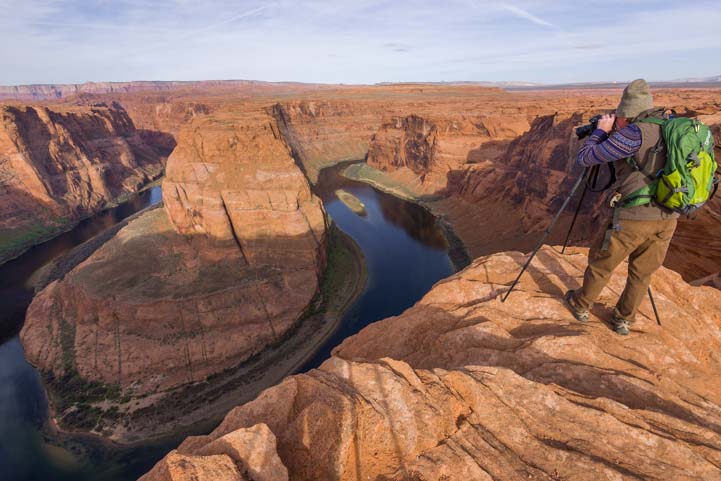
Comments are disabled on this post. Other internet forums are better suited for discussion.

Power Inverters – Exeltech’s Pure Sine Wave Excellence

An inverter, sometimes called a “power inverter,” is a piece of electronic gear that converts DC power to AC power, and it is what enables RVers to use regular household appliances in an RV without hookups to an RV park power pedestal relying on a generator.

The September/October 2016 issue of Escapees Magazine features our detailed article about inverters: what they are, how they are sized, what flavors they come in and how to wire one into an RV.

Power inverter for an RV - an Exeltech XPX 2000 watt inverter

.

For RVers who enjoy dry camping in public campgrounds or boondocking on public land, an inverter is the key piece of the puzzle that gives their RV traditional 110 volt AC power — like the power in the wall outlets of a house — without plugging the RV into a power pedestal at an RV park or a noisy gas-hungry generator.

WHAT IS AN INVERTER?

For beginning RVers, it is easy to confuse a converter with an inverter, because the words are so much alike. The difference is actually very straight forward:

  • A converter converts the 110 volt AC power coming out of a wall outlet, RV park power pedestal or generator into 12 volt DC power, and charges the RV’s 12 volt battery bank.
  • An inverter converts the batteries’ 12 volt DC power into 110 volt AC power so household appliances like the TV, blender, microwave and vacuum can run.
Exeltech XPX 2000 watt pure sine wave inverter living off the grid in an RV

Our “house” inverter – an Exeltech XPX 2000 watt inverter.

RV FACTORY INSTALLED CONVERTERS

Most trailers and some smaller motorhomes come with a factory installed converter. Frequently, these factory installed converters are inexpensive units that are not multi-stage chargers. So, for RVers who want to dry camp a lot and keep their batteries in tip-top shape, or charge them up efficiently with a generator while dry camping, it is a good idea to replace the factory installed converter with a better quality converter (we did).

More info on upgrading an RV power converter here: Converters and Inverters in an RV

RV FACTORY INSTALLED INVERTERS and INVERTER/CHARGERS

A few high end trailers and most higher end motorhomes come with a factory installed inverter.

In many cases, especially high end trailers, the inverter is dedicated to powering a residential refrigerator that runs exclusively off of 110 volt AC power (unlike an RV refrigerator that can run on propane). The inverter is there so the fridge can continue to run off the batteries while the rig is being driven from one RV park to another without a connection to 110 volt AC electricity. This inverter is sized to support the refrigerator and is not intended to be used for any other purpose in the rig.

So, for most trailer owners that want to do a lot of camping without hookups, an inverter is an extra piece of gear that must be installed.

In contrast, many higher end motorhomes come with a factory installed inverter/charger that can do two things: 1) provide the RV with household 110 volt AC power at the wall outlets via the batteries while dry camping and 2) charge the batteries when the RV is getting its 110 volt AC power from an RV park power pedestal or a generator. These inverter/chargers essentially do the work of both a converter (charging the batteries from shore power) and an inverter (providing AC power via the batteries while dry camping).

So, for folks with a higher end motorhome, an inverter is usually already installed in the motorhome at the factory in the form of an inverter/charger, and it does not need to be added later. However, it may not be a pure sine wave inverter (see below).

INVERTER SIZES

Inverters come in all shapes and sizes and all price ranges too, from little biddy ones that cost a few bucks to big beefy ones that cost a few thousand dollars.

They are rated by the number of watts they can produce. Small ones that can charge a pair of two-way radios or a toothbrush are in the 150 watt range. Huge ones that can run a microwave and hair dryer are in the 3,000 watt range.

  • Small inverters (400 watts or less) can be plugged into a cigarette lighter style DC outlet in the rig. Mark has one that he uses for his electric razor every morning.
  • Larger inverters (500 watts are more) must be wired directly to the batteries and require stout wires that are as short in length as possible.

Our RV has a “house” inverter that is 2,000 watts. It can run our microwave and hair dryer and vacuum comfortably (we don’t run those appliances all at the same time, however, as that would overload it). Our small portable inverter lives in our bedroom and gets used for a few minutes every day before we head downstairs:

RV power inverter with electric razo

Mark uses this small inverter to power his electric razor every morning!

MODIFIED SINE WAVE vs. PURE SINE WAVE INVERTERS

Inverters also come in two flavors:

Modified sine wave inverters are cheaper than pure sine wave inverters and are the most common type of inverter sold in auto parts stores, Walmart and truck stops. Many inverter/chargers on the market are modified sine wave inverters.

Our sailboat came with a 2,500 watt inverter/charger that produced a modifed sine wave. It was wired into the boat’s wall outlets, including the microwave outlet. We used this inverter when we wanted to run the microwave but not for anything else (we preferred using a pure sine wave inverter instead).

Some vehicles now ship with an inverter installed in the dashboard. Our truck has a small modified sine wave inverter in the dashboard, and I use it all the time to plug in our MiFi Jetpack and get an internet signal for my laptop as we drive.

Exeltech XP 1100 Inverter

Our first pure sine wave inverter: an Exeltech XP 1100 watt inverter. We keep it now as a backup.

WIRING AN INVERTER INTO AN RV – DC SIDE

As mentioned above, small inverters can plug into a DC outlet in the RV wall (these outlets look like the old cigarette lighters found in cars).

Large inverters must be wired directly to the batteries. The wire gauge must be very heavy duty battery cable and short to support the big DC currents that will flow through it. If possible, the length should be less than four feet. A wire gauge chart gives the correct gauge of wire to use for the current that will flow and the length the wire will be.

To determine the maximum possible DC current that might flow through these wires, simply divide the maximum wattage the inverter is rated for by the lowest voltage the inverter can operate at. In our case, we divided our inverter’s maximum 2,000 watts by the minimum 10.5 volts it will operate at before it shuts off. This yields 190 amps DC. Our cable connecting our inverter to the batteries is 2 feet long. So the proper wire size is 2/0 gauge (“double ought”) and can be purchased here: High quality Ancor Battery Cable.

Heavy duty battery cable on Exeltech XPX 2000 inverter in an RV

We used 2/0 Gauge Ancor Battery Cable to wire the DC side of our inverter.

WIRING AN INVERTER INTO AN RV – AC SIDE

All inverters have at least one household style female 110 volt AC outlet. Usually they have two. These outlets look like ordinary household wall outlets.

One very simple way to wire the AC side of the inverter is to plug an appliance directly into it, for instance, plug the power cord of the TV into the inverter. We did this with a 300 watt inverter and our 19″ TV in our first trailer. The inverter was plugged into a DC outlet on the trailer’s wall, and the TV was plugged into the inverter right behind where it sat on our countertop.

If you want to plug more than two appliances into the inverter at once, then plugging a power strip into one or both of the inverter’s AC outlets is one way to go. We did this on our sailboat. We had a 600 watt pure sine wave inverter on the boat. Plugged into one of the inverter’s AC outlets, we had a power strip supporting our TV and DVD player. Plugged into the other AC outlet, we had a power strip supporting everything else: two-way radios, toothbrush, and laptop charging cords and camera battery chargers.

Exeltech XPX 2000 inverter and Trojan Reliant AGM Batteries in an RV

Our inverter is placed as close to the batteries as possible by being suspended above them.

Obviously, you have to be careful not to run too many things at once, or they will overload the inverter. Most inverters will shut down when overloaded or sound a beeping alarm if your appliances demand more from it than it can give. We ran into that a lot when we lived on our portable inverter for a few days while our house inverter was being repaired.

A more sophisticated way to wire an inverter’s AC side so it supplies power to all the wall outlets in the RV is to wire it into the rig’s AC wiring using a transfer switch.

WHICH INVERTER TO BUY for a BIG INSTALLATION?

Because we live off the grid and never plug our RV into a power pedestal (we’ve lived this way for nine years and hope to do so for many more), we rely on our trailer’s house inverter to run all of the AC appliances we own, every single day.

For this reason, we invested in the highest quality inverter we could find on the market: an Exeltech XP 2000 watt pure sine wave inverter. This is a very pricey unit, but it is our sole source of AC power day in and day out. It is the brand that was selected for both the American and Russian sides of the International Space Station, and its signal is pure enough to run extremely sensitive medical equipment.

Exeltech power inverter manufacturing

We visited the Exeltech manufacturing plant in Texas and saw first-hand how meticulously these inverters are made and tested prior to shipping.

Exeltech is a family run company with electrical engineering PhDs heading up their R&D department. All manufacturing is done in-house at their headquarters in Fort Worth, Texas. They have phenomenal tech support and an excellent warranty.

When our beautiful new Exeltech XP 2000 inverter was inadvertently blown up by a welding snafu at a trailer suspension shop during our trailer’s suspension overhual (the plastic sheathing on a bundle of AC wires got melted onto the trailer’s frame, bonding the wires to the frame and creating an electrical short — ouch), they got it repaired and back to us very quickly.

And thanks to our RV warranty, our failing suspension was rebuilt completely at no cost to us, and has worked flawlessly for 12 months now.

Power inverter

This high quality Exeltech inverter is a serious piece of electronic gear!

Many RVers like the Magnum brand of inverters. These inverters have a built-in transfer switch which makes them easy to wire into the RV’s AC wiring system.

There are many other brands on the market from Schneider Electric / Xantrex to Go Power, Power Bright and others. If you are going to dry camp a lot, then installing a high quality and expensive pure sine wave inverter makes sense. But if you are going to dry camp for just a few days, week or month here and there, then a cheaper one may make more sense.

MORE INFO ABOUT INVERTERS and SOLAR POWER

All of this info and more is covered detail in our feature article in this month’s Escapees Magazine. We also have loads of other info about inverters, converters right here on our website. Links to our many RV electricity related articles are at the bottom of this page.

ESCAPEES MAGAZINE and RV CLUB

RV Power Inverters

Inverters – AC Power from DC Batteries
Escapees Magazine Sep/Oct 2016
By Emily Fagan

Our five page article on inverters in this month’s issue of Escapees Magazine is typical of the kind of detailed technical articles the magazine publishes.

I have been publishing articles like this in Escapees Magazine since 2008, and I have written about anything and everything we’ve learned in our full-time RVing lives, from solar power to photography to batteries to the importance of fulfillling our dreams.

What makes Escapees Magazine unique is that it is written by RVers for RVers.

The magazine article topics come from real life experiences that RVers have encountered in their lives on the road.

Just as my article in this issue of Escapees Magazine is about what we’ve learned about inverters since we started RVing (and believe me, back in 2007, I was the one asking trailer salesmen what the difference was between inverters and converters, and I got some wacky, wild and very wrong answers!), other RVers write articles for Escapees Magazine about things they have learned.

When I sat down to read the September/October issue, I was impressed — as I am with every issue — by the quality of both the articles and the presentation.

Besides including some cool travel articles about RVing Alaska via the Alaska Marina Highway ferry system, and visiting the Very Large Array that listens to the cosmos in New Mexico, and traveling on the Natchez Trace in Mississippi, this issue has two wonderful profiles of full-time RVers doing intriguing things as part of their RV lifestyle.

RV by ferry on the Alaska Marine Highway

RV Alaska by Ferry!
Escapees Magazine Sep/Oct 2016

One article this month is about a full-time RVer who lives in an Airstream trailer and has dedicated himself to ensuring that the original silkscreen art prints created by the WPA artists in the 1930’s for the National Parks remain in the public domain, owned by the NPS rather than private collectors. It is a fascinating tale, written by Rene Agredano who has been full-timing since 2007 and writes the very informative blog Live, Work, Dream, a terrific resource for anyone who wants to learn the ins and outs of work camping.

Another article this month shares the stories of three very long term (10+ years) full-time RVers who have flourished as artists on the road. One RVer/artist specializes in watercolors and has held many exhibitions of her work around the country. Another RVer/artist discovered the fun craft of decorating gourds and teaches classes at her home RV park. A third RVer/artist has self-published a photojournal about her travels specifically for her grandchildren. This insipring Escapees Magazine article is written by full-time RVer Sandra Haven who shares the same home base RV park as the artists.

There is also a detailed article written by a lawyer on what it takes to establish a legal domicile and register to vote when you’re a full-time RVer without a sticks-and-bricks home built on a foundation that stays in one place.

These kinds of articles aren’t found in most RV industry publications!

Full-time RV traveler artist

RVers take their art on the road
Escapees Magazine Sep/Oct 2016

And what’s neat for would-be writers and photographers who are Escapees RV Club members is that the magazine’s editorial staff is always eager for new material from members…click here!.

Escapees Magazine is just a tiny part of the overall Escapees RV Club, however.

Founded by full-time RVing pioneers Joe and Kay Peterson, the Escapees Club strives to serve the varied interests of all RVers and to alert RVers to changes in government policies or the RV industry itself that might affect us as consumers of RVs, RV and camping products and RV overnight accommodations.

They also work as tireless advocates on behalf of all RVers at both the local and national levels.

RVers BootCamp at Escapees RV Club

RVers BootCamp – A training program for new RVers

One of the most interesting articles in this month’s magazine alerts members to corporate consolidations in the industry that will affect our choices as RV consumers in years to come. It also reveals that the Escapees advocacy group is investigating possible changes at the Bureau of Land Management that will affect RVers ability to use their RVs on BLM land nationwide.

In addition to the magazine, the Club offers discounts for RV parks, regional chapter groups, national rallies, bootcamp training programs for new RVers, and assisted living for retired RVers who are ready to hang up their keys but not ready to give up living in their RV.

One of the most charming articles in this month’s magazine is about Nedra, a woman in her mid-80’s who was once an avid RVer but now lives at CARE, the Escapees assisted living facility in Livingston Texas. I had the good fortune to meet Nedra when we visited the Escapees headquarters at Rainbow’s End, and she took me on a fun tour of the CARE facilities. Escapees is like a big extended family, and it was very heartwarming to see her story in this month’s issue.

We’ve been members of Escapees RV Club since 2008 and highly recommend joining if you are a current or future RVer, whether you plan to travel full-time or just occasionally. Supporting their advocacy work benefits everyone who owns an RV and ensures we consumers and hobbyists have a voice in this very large industry.

You can join Escapees (or Xscapers, the branch of Escapees dedicated to younger, working age RVers) here:

Join Escapees RV Club

If you mention this blog, Roads Less Traveled, when you join, they put a little something in our tip jar. We began recommending Escapees RV Club to our readers many years ago, and this friendly gesture from Escapees is a brand new development in the last few months. So, this is not a sales pitch from us to earn tips, by any means. We simply believe in the work Escapees RV Club does to support RV consumers and hobbyists and hope you do too!

Subscribe
Never miss a post — it’s free!

SOLAR POWER OVERVIEW and TUTORIAL

BATTERIES and BATTERY CHARGING SYSTEMS

LIVING ON 12 VOLTS

Our most recent posts:

More of our Latest Posts are in the MENU.   New to this site? Visit RVers Start Here to find where we keep all the good stuff. Also check out our COOL NEW GEAR STORE!! *** CLICK HERE *** to see it!

How to Heat an RV in Cold Weather and Winter Snow Storms

Heating an RV in cold weather during the winter, especially in a snow storm, is quite different than heating a house, and it often requires utilizing different kinds of heaters and a little creativity too.

RV camping and travel in snow in winter

Is that SNOW??!! We sure didn’t expect THAT!!!

A few weeks ago, at the end of September, we woke up to find ourselves in a beautiful snowstorm at 10,000′ elevation in Colorado.

We had to pull out all the stops to make sure we were cozy warm in our RV even though overnight lows were in the 20’s and daytime highs didn’t get out of the 40’s for a week.

Bikes on RV bike rack in snow in winter

We looked out our back window and saw snow covering our bikes!

The first order of business was to go outside and build a snowman, and Mark got right to it.

Winter RV tips for staying warm in cold weather

It’s snowing!!! Let’s make a snowman!!!

While he’s busy getting that snowman together, I wanted to share with you the strategies we’ve used for heating our RV without electrical hookups, because we use different heating appliances in different situations.

For “cool” conditions, like December and February in the Arizona desert or May in the Canadian Rockies, when lows are in the 30’s, keeping our buggy warm is a cinch with our blue flame vent-free propane heater that Mark installed back in 2008.

But in in “extreme” conditions, like this recent snowstorm on a mountaintop in Colorado, we use a different strategy and rely more on our RV furnace that was factory installed in our trailer.

We have tried different strategies in very cold weather at very high altitudes like this in the past, and this most recent cold spell was our most comfortable, despite the wet gloppy mess of snowy covered jackets, hats, mittens and boots and the sullen gray skies that persisted for several days. So, we seem to have gotten it right this time.

Of course, “lows in the 20’s” is far from “extreme” for North Americans living in houses with central heating, but it definitely feels extreme when living in an RV off the grid. In reality, RVs are most comfortable in temperatures that stay above freezing.

Winter RVing in the snow

The snowman gets sticks for his arms…

Even though high end RVs are marketed as being “four season” coaches, boasting high R-factors in the walls, ceiling and floor, you just can’t compare 1.5″ styrofoam walls that have a thin layer of gelcoat and wallpaper board to a residential house wall that’s made of 3.5″ fiberglass insulation covered with a half-inch of drywall, half-inch of plywood, Tyvek and exterior siding.

Besides the skimpy walls, we find that the RV windows are the biggest reasons for the poor insulation. The metal window frames are extremely cold to the touch when temps outside are in the 20’s, and all that metal around our many windows conducts the cold right into the rig.

Some folks like to have thermopane (dual pane) RV windows, but if moisture gets between the two panes, which can happen more easily in an RV that rattles down the road all the time than in a house that stands still on its foundation, the moisture is likely to remain there permanently, no matter what the weather does outside or how many years go by.

RV windows don’t seal all that well either. Our top quality, four season fifth wheel trailer is downright drafty inside, with a definite breeze that can, at times, flutter a tissue by the “escape” windows. You don’t notice it so much when it is 70 degrees both outside and inside with no wind blowing. But when it is a blustery18 degrees outside and we are trying to heat the rig to 65 degrees inside, the breeze by those windows is a shock.

The microwave vent is another drafty spot, and if the wind is howling outside and blowing directly on that wall of the RV, it blows right into the kitchen through the vent holes on the top of the microwave. One solution for that, of course, is to tape over the vent on the outside of the rig and not use the microwave for the duration of the cold snap (we haven’t done that, however).

Winter RV trip in the snow

The snowman gets a hat!

So, in our experience, keeping an RV and everything in it toasty warm when it is snowing out can require a little creativity.

Back in our house living days in snow country, we would set the thermostat to our preferred indoor temperature and keep it there 24/7, perhaps raising it slightly at the breakfast and dinner hours and lowering it slightly while we were at work or asleep.

When a blizzard blows into our RV lifestyle nowadays, we can have that kind of stable heat in our rig if we plug into shorepower with access to unlimited electricity. Portable electric heaters can back up the RV furnace, and RVs that have an air conditioner with a heat pump can use that (ours doesn’t).

We have a portable electric ceramic heater for just such an emergency where going to an RV park and plugging in is our best line of defense for weathering a storm.

However, it is possible to stay warm without hookups, even when it starts snowing.

RV in snow in winter

What fun!!

We rely on our vent-free propane heater for 95% of our heat year round. These little heaters use propane very efficiently, don’t need any electricity to run, and can be installed in an RV permanently to run off the RV’s propane tanks.

There are also handy portable models that can be stored in a closet when not in use and then placed anywhere in the rig where you want a little heat. These run on disposable propane bottles, so it isn’t necessary to plumb the heater to the RV’s big propane tanks.

Animal tracks in the winter snow

We found fresh animal tracks in the snow.

We have a detailed article describing the different kinds of vent-free propane heaters on the market, the pros and cons of each type and the type of heat they generate, plus a step-by-step guide for how to install one in an RV at this link:

How to Install a Vent-free Propane Heater in an RV

These heaters heat the rig amazingly quickly. We find that our 20k BTU blue flame heater warms our rig at a rate of about one degree every two minutes. So, in twenty minutes we can warm up our home by 10 degrees, and in an hour we can raise the inside temp by 30 degrees.

The best part is that we can hover over it and warm our hands, bodies and clothes, just like standing in front of a woodstove or fireplace. We do that a LOT and totally love our little heater for the terrific blast of instant hot air it provides!!!

How to heat an RV in winter and cold weather

When you’re chilled, there’s nothing like hovering over this heater!

We use our blue flame heater year round, and we have used it at elevations ranging from sea level to 10,000′.

This past year we traveled primarily in cold places where overnight lows were in the 30’s and 40’s. We went north through Utah, Idaho and Montana in March and April and spent May and early June in the Canadian Rockies. Consequently, we saw quite a bit of snow and hail, and during those months we used our heater almost every day.

Aspen and pine trees in winter snow

The snow in Colorado fell for hours and gave us a beautiful winter wonderland — in September!

Colorful aspens in winter snow storm with pine tree

Fall colors with snow – Magic!

We thawed out in July long enough to get overheated and write a blog post: “How to Beat the Heat in an RV.” Then it was back to the high elevations of Utah and Colorado in mid-August where we saw more hail and overnight lows in 30’s once again.

Our vent-free blue flame heater has been keeping us warm during all four seasons like this since Mark installed it in 2008!!

Snowy road with aspen for an RV in winter

.

Snowy road in winter

It was really cold, but it was so beautiful we didn’t mind!!

The basic difference between an RV furnace and a vent-free propane heater is this:

  • RV furnace – Uses a lot of electricity, uses propane inefficiently, brings fresh air into the rig (because it’s vented)
  • Vent-free propane heater – Doesn’t use electricity, burns propane efficiently, uses up oxygen in the RV

So each has its place under certain circumstances. In a nutshell:

— The ventless propane heater is awesome as long as there is sufficient oxygen for it to run. We like to use it in the mornings and evenings, and since we are in and out of the rig a lot, there is a lot of air exchange inside our RV from opening and closing the front door all day long as well as from all the drafts and breezes that blow in the RV windows and microwave vent.

— The RV furnace is best for other scenarios: in cases where there is a risk of the water pipes freezing (the hot air ducts keep the basement and water lines warm), at very high elevations in extreme cold, and at night, because it is vented and continually circulates the air in the rig. The RV furnace is very loud and tends to wake us up at night, however, so we don’t use it overnight very often.

So, we use our vent-free blue flame heater for 95% of our RV heating, and we turn to our RV furnace on rare occasions.

Aspen and pine trees in snow in winter

Fall colors and snow — a gorgeous combinations!

Dodge pickup truck covered in winter snow

This snowfall was definitely sticking around a while!

Vented vs. Ventless Propane Heaters and Propane RV Stoves & Ovens – Safety Concerns

An RV furnace is a vented system, meaning that it releases warm, moist air from inside the RV to the outside, and it brings cold air from outside to the inside of the rig. This makes it very inefficient in its use of propane, because it is essentially heating the outdoors as well as the indoors. Put your hands by the RV furnace vent outside, and they will get nice and warm and a bit damp too!

While RV furnaces are safely vented yet very inefficient, vent-free gas heaters are very efficient and are required by law to have an automatic shutoff when the available oxygen goes below a certain threshold (there is a built-in sensor that triggers the shut-off). We know when ours is about to shut off because the flame begins to sputter and make noise. Once it has shut itself off, it won’t turn on again until we air out the RV a little by opening the door or windows for a while.

Ironically, propane RV stoves and ovens are not required to shut off automatically when the available oxygen is depleted. To me, this makes them inherently quite a bit more dangerous than vent-free propane heaters.

Of course, an RV fitted with propane tanks is basically a rolling bomb, so it’s a very unsafe place to call home (I say this with a smile, because we wouldn’t trade our 9 years on the road for anything)!

Every time we have seen our blue flame heater shut itself off (probably 30+ times), the RV stove and/or oven has kept right on a-cookin’ without any hint that our supply of oxygen inside the rig was running out. We could easily have baked something in our factory installed propane RV oven and simmered something on our factory installed propane RV stove for hours while camped at 10,000′ with no inkling that the oxygen in our rig had dipped below safe levels!

Winter snow on RV steps

Welcome home…. Brrrrr!

Which Heater is Best Under Which Conditions?

For most of this year as we traveled in cold country, the lowest temperatures we saw were in the low to mid 30’s overnight. Daytime highs were in the mid-60’s to mid-70’s. These kinds of conditions are very similar to what we see in the southwestern deserts in the winter months (except January, which can be colder). These conditions are ideal for a vent-free propane heater.

We usually run our vent-free propane heater every morning until the rig is 60 to 75 degrees inside (depending on our mood) and then again in the evening if the temperature inside has dipped below 65. If the windows have fogged up from condensation (about 5% of the time, usually only in the winter), we run the RV furnace too to help dry the air out.

In general, we don’t heat our RV overnight in this kind of climate. We prefer to bundle up with down comforters instead. If we do run the heat at night, we use the RV furnace and set it to 50 degrees. If outdoor temps drop into the 30’s overnight, the RV furnace will come on once or twice in the pre-dawn hours.

Golden aspen in snow in winter

Golden aspen leaves in snow.

Ironically, if the outside temps dip really low — into the 20’s or teens — and daytime highs don’t get much past 50 degrees, then the RV furnace will start coming on before midnight and will come on every hour for 15-20 minutes as it struggles to keep the rig at 50 degrees.

Since we are light sleepers, this is extremely annoying. So, at the times we would want to run the RV furnace most — overnight when it’s really cold — we opt not to!

On overnights that we don’t heat the rig, when we wake up in the morning our bedroom is around 10-12 degrees warmer than the outside air (bedroom door closed all night) and our living area is around 5-7 degrees warmer than the outside air.

It is routine for us to wake up to temps in our trailer that are between 37 and 42 degrees. For us, that is a small price to pay for living off the grid, however, for many RVers it is good reason to get electric hookups and have more substantial and consistent heat in the rig overnight.

Aspen covered with snow in winter

The colors of Fall in Colorado.

There is a lot of debate about whether you can operate a ventless propane heater at high elevations. By the time we got caught in that September snow storm in Colorado two weeks ago, we had been living at elevations between 8,000′ and 10,000′ for 5 straight weeks, running our vent-free propane blue flame heater every morning and evening without a hitch.

Along with many weeks spent heating our rig at high elevations in previous years, including 8 weeks or so at 6,000′ or higher this past spring, our 5 weeks at 8 to 10 thousand feet this fall kind of proved the point for us: it’s no problem to run a vent-free propane heater at high altitudes in cool weather.

But in sub-freezing overnight temperatures and daytime highs in the 40’s under stormy skies at 10,000′ elevation, we’ve found a vent-free propane heater is best used in combination with the RV furnace.

Bikes on back of RV in snow

Well, we won’t be biking any time soon!!

Until the the snowstorm came to our mountaintop spot in the Colorado Rockies at 10,000′, we hadn’t been using the RV furnace at all. But once the temps dropped to the 20’s (lows) to 40’s (highs) at that elevation, we couldn’t rely on our blue flame heater exclusively any more and had to change our heating strategy for three reasons.

1) There is less available oxygen at 10,000′ than at lower elevations, and once the oxygen in the rig dipped below a certain level, the blue flame heater would shut itself off automatically. Because it was so cold outside, we weren’t thrilled about opening the windows and doors to let in more air just so we could turn on the blue flame heater again. It was time to use the RV furnace.

2) Our RV roof and ladder — along with our solar panels — was covered with snow and ice. Mark wasn’t jumping up and down with excitement to climb up there to clear off the solar panels, and I wasn’t about to get up on that slippery roof either. So, our batteries were no longer getting charged by the sun and wouldn’t have enough juice to run the RV furnace.

3) Vent-free propane heaters emit a lot of moisture. We had just had several days of torrential rain, and everything in our rig was wet. Our shower was filled with raincoats and rain hats hung up to dry, our boots and socks were wet and muddy by the door, our pants were wet and hanging in the bathroom and our bath towels refused to dry. While our blue flame vent-free heater would exacerbate the moisture problem, our RV furnace would help dry out the air inside our buggy.

Doing all these things gave us a nice dry and toasty warm environment to live in during this cold spell in snowy conditions at 10,000 feet.

To implement this heating strategy, we did two things. We stocked up on gasoline and propane and ran our Yamaha 2400i generator and RV furnace a lot. Sometimes we also ran the blue flame heater alongside the furnace.

Yamaha generator in bed of pickup truck in snow

Our Yamaha generator got a good hard workout for over a week.

The generator ensured that the batteries got fully charged. Because we were running our RV furnace so much, which burned up lots of electricity, the batteries were being depleted much faster than normal. So, not only did we need the generator because the solar panels were snoozing under the snow and ice, we also needed it because of running the RV furnace.

RV in snow in winter

A few weeks prior we had been roasting in the summer heat. What a crazy life we live in this RV!!

In general, we ran the RV furnace every morning until the rig was 65 degrees inside and then ran it on and off during the day and in the evening. If the air wasn’t too moist, we also ran blue flame vent-free heater alongside the furnace to warm things up faster. The vent-free propane heater never shut itself off, so the RV furnace was doing its job of circulating the air.

Golden aspen in snow by pond in winter

Getting creative heating our RV made it possible to enjoy views like this as it snowed.

Using the RV furnace also lessened the possibility of the water pipes freezing. The heater is ducted through the belly of the rig, and the warm air passing through the ducts helps warm the nearby water and sewer pipes. If the temps had gotten below 20 degrees, we would have run the RV furnace once or twice overnight as well just to be sure no ice formed in the pipes.

If we had had brilliantly sunny days every day, we may or may not have needed the generator. Our 490 watt solar panel array may have been able to charge the batteries fully, despite the additional load from the RV furnace.

Also, we probably wouldn’t have needed to use the RV furnace so much because the sun would have warmed up our rig and dried it out a bit during the day.

See how flexible and variable all this is??!!

Colorado fall colors after winter snow

This is why we came to Colorado at this season… Wow!!!

We have descended out of the clouds now and have been living at elevations between 5,000′ and 6,500′ for the past few weeks. The RV furnace is back on vacation and our trusty blue flame heater has taken over all the RV heating duties. Our generator is on break for another 6 months or year, and the shore power cord is buried somewhere in the basement once again.

RV in winter snow staying warm in cold weather

Snug as a bug in a rug!!

If you are going to be using your RV in cold weather this winter, we have another post full of tips for keeping warm that you might enjoy:

How to Stay WARM in an RV – Winter RVing Survival Tips

And if you think a vent-free propane heater is something you’d like to get, have a look at our detailed article that discusses the different types of heaters and shows how we installed ours:

Vent-free Propane Heaters (Catalytic, Infrared and Blue Flame) PLUS How to Install One in an RV

Subscribe
Never miss a post — it’s free!

For more images of the Colorado fall colors in the snow, see this post:

Below are some of our most POPULAR POSTS (also in the MENUS above)

Buddy - A Journey in Spirit - The story of an event that changed our lives forever.

ARTICLE INDEXES
  • RV Tech Tips Articles - A one page index of links to all our RV Tech Tips, RV Upgrades & RV Maintenance articles.
  • RV Lifestyle Tip Articles - An index of links to all our RV Lifestyle Tips (finances, boondocking, major repairs, work/jobs, etc.)
  • Solar Power Articles - Overview and tutorial articles for how to design and install solar power on an RV or boat
  • Product Reviews - An index of links to all of our Product Reviews
RV UPGRADES, SYSTEMS & TIPS MONEY FULL-TIME RV LIFESTYLE GEAR STORE
  • Gear Store - A list of the goodies, equipment and gear we've found useful in our RV lifestyle!
 

Our most recent posts:

More of our Latest Posts are in the MENU.
New to this site? Visit RVers Start Here to find where we keep all the good stuff!!
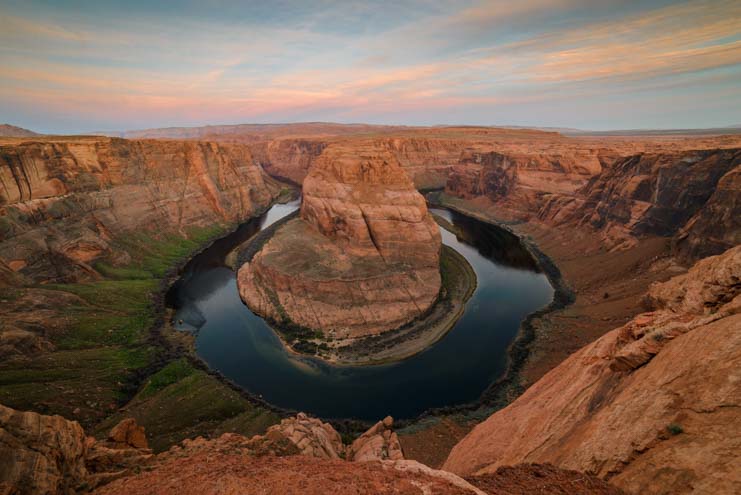
Maine’s Pretty Acadia National Park in Motorhome Magazine!

Last summer we enjoyed a fabulous RV trip to the eastern states, and one of the highlights was Acadia National Park in Maine. We are very proud that the September 2016 issue Motorhome Magazine features our article about this beautiful oceanfront National Park: Maine Course: Acadia National Park Offers Beauty and History Off the Beaten Path.

Motorhome Magazine Acadia National Park Maine Article by Emily Fagan

Motorhome Magazine September 2016 Issue
Article: Emily Fagan, Photos: Emily & Mark Fagan

Acadia National Park was the first Eastern National Park to be established, back in July, 1916. The Park takes up much of Mt. Desert Island on the northern Maine coast. Very close to the Park entrance lies the small, upscale town of Bar Harbor.

Bar Harbor Maine

Bar Harbor is a trendy and charming town on Mt. Desert Island near the entrance to Acadia National Park

There are boutiques and tourist shops of all kinds and a pretty waterfront walking path where you can take in the views.

Bar Harbor Maine

Bar Harbor has lots of boutiques and tourist shops.

While Bar Harbor is where the human action is on Mt. Desert Island, the gorgeous scenic drive along Acadia National Park’s craggy coast is where Nature reins supreme.

Pink granite boulders on the Acadia National Park shore

Maine’s coast is all craggy granite boulders that lead to the sea.

The beautiful granite slabs and boulders make for some really fun (and easy) scrambling, and there are a number of sights and hiking trails on this very quiet shoreline.

Acadia National Park Maine

Acadia National Park has a beautiful, rocky shoreline.

Mt. Desert Island is a big island with two main lobes, several small towns and lots of little peninsulas that jut out into the sea. Acadia National Park takes up much of the land, and the whole island is fun to explore. Many spots on the shoreline are wonderful for relaxing and soaking in the view.

Tranquility on the Maine Coast Acadia National Park

Huge granite slabs on the shore are great for kicking back and enjoying the view!

Lobster boats fill many charming harbors in the area, and the Schoodic National Scenic Byway is a gorgeous drive that passes by a few.

Lobster boats on the Maine Coast

Maine lobster is a delicacy, and the small harbors are filled with lobster boats that catch them.

Of course, the lobstermen catch lots of lobsters. There’s nothing like a Maine lobster roll (lobster meat with mayo on a hotdog bun) eaten out on a sunny deck, or an all out Maine lobster dinner complete with a bright red whole lobster on your plate, a bib around your neck, butter melting in a tiny dish over a flame and a nutcracker and pick to get at the tasty morsels inside!

Lobster restaurant Bar Harbor Maine

There are lobster shacks on every corner and lobster restaurants on every pier!

We were floored by the immense lupines that grow wild all over everywhere in the summertime. They range from pale pink to deep purple and they enhance every view in every direction!!

Wild lupines Mt Desert Island Maine

We were stunned by the gorgeous wild lupines growing everywhere.

One of the biggest highlights in Acadia National Park is a trip up Cadillac Mountain. At the top we checked out the view while a seagull checked us out to see if we had any food to spare!

Seagull Cadillac Mountain Acadia National Park Maine

On Cadillac Mountain we enjoyed the view while a seagull waited for a treat, or maybe a tip!

We were very lucky during our stay in Acadia National Park to be there when a national Model A club was holding a rally.

Model A car climbing Cadillac Mountain Acadia National Park Maine

A national Model A rally in Acadia National Park — How cool!

There were Model A cars on every road, and we watched them climbing up Cadillac Mountain on roads that were originally built for them.

Model A Car on Cadillac Mountain Acadia National Park Maine

Cute Model A cars were driving all the roads in Acadia National Park while we were there.

Cyclists had a ball descending from Cadillac Mountain too, and what a view they had as they flew down.

Cyclist rides down Cadillac Mountain Acadia National Park Maine

Flying down Cadillac Mountain on a bike would be a lot of fun!!

One of the coolest things in Acadia National Park is the Carriage Roads that were built by John D. Rockefeller, Jr. These roads were built to give the rich city folks from New York and Boston a place to go for a carriage ride from their vacation estates in Maine at the turn of the century and were closed to motorized cars. Nowadays, they are wonderful for biking.

Acadia National Park Carriage Roads Maine

The Carriage Roads are an ideal place for a leisurely bike ride through the beautiful Maine woods.

Although we heard that John D. Rockefeller, Jr’s son, David Rockefeller, now age 101, can occasionally be spotted enjoying his dad’s carriage roads in his own horse-drawn carriage, the public can walk, ride a bike or ride in a horse-drawn wagon on these roads that wind through the thick and wonderfully fragrant Maine woods on Mt. Desert Island.

Horse-drawn wagon ride Acadia National Park Carriage Roads Maine

The 50 miles of Carriage Roads are unique to Acadia National Park and can be enjoyed many ways!

Besides providing a road system that was free of motor cars, John D. Rockefeller, Jr. wanted all the bridges and tunnels on his roads to have a non-industrial and hand-made flare. Each was built by expert masons and is just beautiful.

Acadia National Park Carriage Roads

John D. Rockefeller, Jr. made sure the bridges and tunnels were finely crafted by hand.

The Carriage Roads zig-zag for 50 miles all over Mt. Desert Island, and near the center of the island they pass by Jordan Pond. This is a haven for kayaks and has a wonderful little restaurant where you can sit on the deck and enjoy the view.

Jordan Pond Acadia National Park Maine

Jordan Pond in the heart of Acadia is a wonderful change of pace from the rugged ocean shoreline

We enjoyed many sunny days during our stay in June, but late spring and early summer also bring a lot of fog to the Maine coast. This can be drippy and miserable, but there is also a special and mysterious beauty that shrouds everything in Maine when the fog rolls in.

Lobser boats in the Maine fog

Fog is common in Maine, and it can make for some very memorable and scenic images.

As a side note, Acadia National Park is just outside of Bangor, Maine, where we had the first of our four major RV repairs that hit us last summer, all in a row: the replacement of our trailer axle. We had it done by an excellent RV repair shop, Harvey RVs in Bangor, Maine, and you can read about what happened here:

5th Wheel Trailer Axle Replacement (a BIG repair job!)

A major RV repair like that is disconcerting, to say the least, but northern Maine was a great place to be stuck for a while because it is so scenic, peaceful and calming!

Calm harbor on the Maine Coast at Acadia National Park

Life is very tranquil in Maine!

Motorhome Magazine is a terrific monthly magazine that covers all things related to RVing, motorhome ownership and maintenance. We are very proud to be contributors this month.

Occasionally, Motorhome posts our articles on their website. Some of our previous articles can be read at this link (this article about Maine is not among them): Motorhome Magazine Articles by Emily & Mark Fagan

For newer RVers looking to learn about the RV lifestyle, learn about motorhomes and get ideas for cool travel destinations, Motorhome is a great resource. And for seasoned RVers who already know the ropes, there are lots of tid-bits to be gleaned from their pages too.

You can subscribe here (please note that the digital subscription price is “$0” but you will be charged when you open the download):

Motorhome Magazine Subscription – Print Edition
Motorhome Magazine Subscription – Digital Edition

A boat leaves the harbor in Maine's Acadia National Park

A classic Maine image!

If you are planning an RV trip to Acadia National Park or elsewhere in Downeast Maine, the blog posts below from our RV travels to the area may get you inspired and help with your travel planning.

More Info for an RV trip to Acadia National Park:

Subscribe
Never miss a post — it’s free!

Our most recent posts:

More of our Latest Posts are in the MENU.
New to this site? Visit RVers Start Here to find where we keep all the good stuff!!
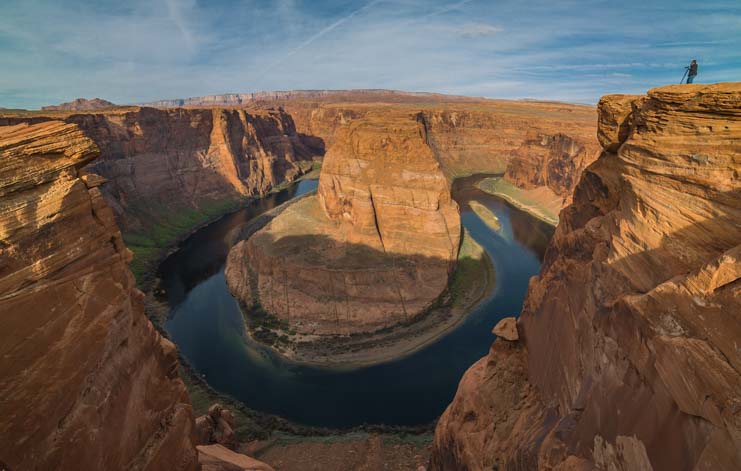
National Parks & World Heritage Sites in America, Canada, Mexico & SE Asia

National Park Service

The National Park Service was created by the “Organic Act” and signed into law by President Woodrow Wilson, August 25, 1916.

Since we began our full-time travels in our RV in 2007, and during our cruise of Mexico on our sailboat (2010-2013), we’ve made it a point to visit as many National Parks, National Monuments and UNESCO World Heritage Sites throughout North America as possible.

This page provides an index of links to all of our blog posts from these special places, grouped by country. They appear in reverse chronological order. America’s National Parks are also broken down by state. This page is accessible from the Menus as well.

If there is a particular park you are looking for, use the “Ctrl-F” key (Windows) or “Command-F” key (Mac) to search for it on this page.

Links to the official websites for each of North America’s National Park agencies plus lists of the UNESCO World Heritage sites in each country are given at the bottom of this page.

Google Maps links to the locations of all the parks we’ve visited are at the bottom of this page as well. These are interactive maps that you can zoom in and out of.

You can navigate to each section of this page using these links:

In our travels, we have loved all of the National Parks we have visited, and we were intrigued to learn that Yellowstone National Park was the first National Park ever created in the world. It was established by the US Congress with the Yellowstone Act of March 1, 1872, which was signed into law by President Ulysses S. Grant. Lots more National Parks followed, both in the US and abroad.

On August 25, 1916, President Woodrow Wilson created the National Park Service, a bureau in the Department of the Interior, to consolidate the management of Yellowstone and the 35 other National Parks that had been established in the years since 1872.

Following is the index of posts from our visits to these wonderful places…

.


America’s National Parks and National Monuments

The National Park Service manages not only America’s National Parks but also the National Monuments, National Seashores, National Historic Sites, Battlefields, some of the National Recreation Areas and much much more.

As of the summer of 2023, the National Park Service is managing 424 sites that spread out across nearly 133 square miles. The sites were visited by nearly 312 million tourists in 2022, down from the pre-pandemic peak of 331 million tourists in 2017. In 2022, the NPS had 20,000 employees and 279,000 volunteers.

Here are the National Parks we’ve visited in our RV travels:

ARIZONA

Sunrise Horseshoe Bend Arizona

Horseshoe Bend, Glen Canyon National Recreation Area

CALIFORNIA

Death Valley National Park California

Death Valley National Park

COLORADO

Mesa Verde National Park Colorado

Mesa Verde National Park

FLORIDA

Gulf Island National Seashore Florida

Gulf Islands National Seashore

IDAHO

Craters of the Moon National Monument

Craters of the Moon National Monument

MAINE

Ford Model A car drives down Cadillac Mountain Acadia National Park Maine

Acadia National Park – Cadillac Mountain

MISSISSIPPI

Natchez Trace Parkway Mississippi

Natchez Trace Parkway

MONTANA

Happy camper Glacier National Park Montana

Glacier National Park

NEW MEXICO

White Sands National Monument New Mexico

White Sands National Monument

NORTH CAROLINA

Indian Creek Waterfall Deep Creek Hiking Trail Great Smoky Mountains National Park N. Carolina

Great Smoky Mountains National Park – Indian Creek Waterfall

OREGON

Crater Lake National Park Oregon

Crater Lake National Park

TEXAS

Rio Grande at Santa Elena Canyon iin Big Bend Texas

Big Bend National Park – Santa Elena Canyon on the Rio Grande

VIRGINIA

Mabry Mill Blue Ridge Parkway RV camping adventure

Blue Ridge Parkway in Virginia – Mabry Mill

UTAH

Turret Arch Arches National Park Utah

Arches National Park – Turret Arch

WYOMING

Mirrored magic in Grand Teton National Park Wyoming

Grand Teton National Park at Dawn

.


Canada’s National Parks and World Heritage Sites

In 1911, Canada was the first country in the world to establish a government agency specifically to oversee its National Parks. This agency is Parks Canada.

Parks Canada preserves and protects nationally significant examples of Canada’s natural and cultural history and is mandated to commemorate Canada’s history. In 2016, Parks Canada is managing 46 National Parks, 168 National Historic Sites and 11 UNESCO World Heritage Sites covering nearly 350,000 square miles of land and water.

We’ve enjoyed the extraordinary beauty of Canada’s National Parks located in the Canadian Rockies in British Columbia and Alberta as well as the picture postcard perfect town of UNESCO World Heritage Site Lunenburg, Nova Scotia.

Moraine Lake RV travel Banff National Park Alberta Canada

Banff National Park – Moraine Lake

.


Mexico’s National Parks and World Heritage Sites

Many of Mexico’s most thrilling places are designated as UNESCO World Heritage Sites, and some are National Parks as well. These sites include expansive grounds of ancient ruins that were built by the Mayans, Zapotecs and other cultures 2,000 years ago as well as historic Spanish Colonial cities that are home to exquisite architecture and cathedrals built by the Spanish in the 16th and 17th centuries.

Unique natural sites have also been preserved, including some of the islands in the Sea of Cortez as well as habitats on the mainland where migratory monarch butterflies come each year.

If you have never traveled in Mexico, we highly recommend it. The Mexicans have an exuberant and colorful culture that is extraordinarily friendly. Mexico is easily the friendliest place we’ve traveled (besides Maysville, KY…). If you are concerned about safety, we jotted down some notes that are worth pondering at this link: Is Mexico Safe?

Other helpful posts for planning a travel adventure in Mexico are: Spanish Learning Tools and Long Distance Bus Travel in Mexico and Mexican Dentists.

Monte Alban Ancient Zapotec Ruins National Park Oaxaca Mexico

Monte Alban – Oaxaca, Mexico – Step Pyramids Built by the Zapotecs 2,000 Years Ago

.


Thailand’s National Parks and World Heritage Sites

Thailand has many stunning National Parks, both in the jungle and on the coasts where the water is turquoise and the reef fish are extraordinary.

Most beautiful waterfall in Thailand Erawan Falls Erawan National Park Kanchanaburi_

Erawan Falls – Erawan National Park, Kanchanaburi, Thailand

Subscribe
Never miss a post — it’s free!

More info about North America’s National Parks and UNESCO World Heritage Sites:

Map Links for the Locations of America’s National Parks & Monuments We’ve Visited

These maps will give you an idea of where these wonderful sites are in each state, but they are not intended for routing or itinerary purposes. You can only absorb the beauty of so many National Parks at once! Please note that you can zoom in and out of each map too.

Map Links for Canada’s National Parks & World Heritage Sites

Map Link for Mexico’s National Parks & World Heritage Sites

For our European readers, renting an RV is great way to explore America:

Our most recent posts:

More of our Latest Posts are in the MENU.   New to this site? Visit RVers Start Here to find where we keep all the good stuff. Also check out our COOL NEW GEAR STORE!! *** CLICK HERE *** to see it!