Our 20th Magazine Cover Photo in Coast to Coast + Trailer Life Feature!

We are really proud to announce that we have published our twentieth magazine cover photo! It is showcased on the Summer 2016 issue of Coast to Coast Magazine, and it’s a pretty shot of our buggy at sunset in eastern Oregon.

Coast to Coast RV Magazine Cover Summer 2016

Coast to Coast Magazine – Summer 2016
Photo by: Emily Fagan
Cover story: Exploring Oregon’s Quiet Side

Inside the magazine, our cover story reveals many special hidden gems for RVers that can be found in the northeastern corner of Oregon.

Unlike the cool and dramatic Oregon coast where towering rock cliffs plunge straight down to the crashing Pacific surf below, the eastern part of Oregon is high desert, a parched and hot land where you can still see the wagon wheel ruts from the pioneer wagon trains that traveled west on the Oregon Trail.

Oregon Trail Wagon train ruts

We stood on the original wagon train ruts on the Oregon Trail…Incredible!

A while back we took our RV from Bend, Oregon into eastern Oregon. We visited the new Oregon Trail Interpretive Center and hunted down the wagon wheel ruts that are just a ways outside the museum. Staring down the road that once had pioneer wagons on it as far as the eye could see, we marveled at the differences between the early 1800’s and now, both in modes of travel and in our country.

Farm and prairie in eastern Oregon

Eastern Oregon offers a beautiful glimpse into an earlier era.

In Baker City we were charmed by the historic downtown that is lined with Victorian era buildings, and we loved the quiet and intimate feeling that this small city of 10,000 exudes. What a surprise it was to find out that, unlike other major cities in Oregon and neighboring states that have quadrupled in size in just a few decades, the population in Baker City hasn’t changed since 1940.

Geiser Grand Hotel Baker City Oregon

The beautiful Geiser Grand Hotel was built in Baker City in 1889.

Baker City is also home to the fabulous annual Baker City Cycling Classic Bike Race whose final event takes place in the downtown city streets much like the last stage of the Tour de France. While cyclists fly by at 35 mph, fans drink beer on restaurant patios and cheer the riders on. It’s quite something!

Baker City Cycling Classic Bike Race in Oregon

Cyclists fly past on the downtown streets of Baker City, Oregon

Traveling out into the even more remote reaches of northeastern Oregon, we found the towns became so small that each was home to just a thousand or two thousand people, and they were spaced ten miles or so apart. We arrived in the charming village of Joseph that sits at the base of the beautiful Wallowa Mountains and fell in love with the area.

Main Street and mountains in Joseph Oregon 681

Joseph Oregon’s Main Street

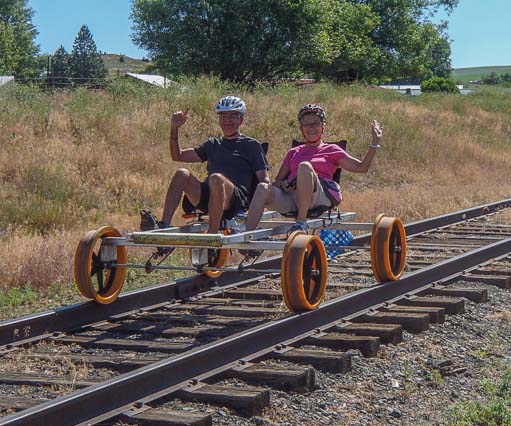
It takes so long to get to Joseph from any major city that everyone who goes there sticks around for a while, and not all that many people go there. There is a wonderful state park for camping right on the edge of beautiful Wallowa Lake, and there are oodles of fun things to do, from visiting a bronze foundry to riding special “bicycles” built for the narrow gauge railway line that runs between Joseph and Enterprise.

Riding the rails with the Joseph Branch Railriders in Oregon

Our friends Katie and Dick check out the rails on a unique “bike.”

We also took a wonderful gondola ride to the peaks of the Wallowas to have lunch with a fabulous view at the Summit Restaurant and enjoy a hike around the top of the mountain.

Hiking the Wallowa Mountains in Joseph Oregon

Hiking into the Wallowa Mountains above Joseph, Oregon

Seeking more mountain views, we hiked the Hurricane Creek trail in nearby Enterprise where we passed meadows of wildflowers in full bloom. Then we visited Hell’s Canyon, both from the overlook on the Oregon side and from the water level on the Idaho side.

Coast to Coast is the membership magazine for Coast Resorts, an RV park membership program with a network of around 400 parks. This is a “high end” RV membership program where you pay a hefty fee up front to buy into a home park and also pay an annual fee for park upkeep. However, as a member, you can stay at the 400 or so elegant member RV parks for just a few dollars a night.

We’ve met several full-time RVers who make the most of these kinds of RV membership programs. One very savvy couple we met last year in Quartzsite excitedly told us they had continued to upgrade their membership and purchase more perks in the program as the years went by, which now gave them some really exceptional long term benefits. As new full-timers in their mid-sixties, they’ll have plenty of time to travel the country in style, using their membership and paying pennies on the dollar for their overnight stays.

Deer at Wallowa Lake in Oregon

“No Trespassing? No Problem!
I’m a card carrying Coast to Coast Member!”

The trick is to do your research first and to negotiate with gusto. These memberships are sold in the same fashion as timeshares, giving you a tour in exchange for a few nights’ stay, but putting you on the hot seat for a few hours before letting you go. However, for the smart and knowledgeable shopper, there are real deals to be had.

On a different but similar note, we are excited to announce that the August 2016 issue of Trailer Life Magazine is featuring our article about a really fun train ride we did in New Hampshire‘s White Mountains aboard the Cog Railway.

Mt Washington Cog Railway Trailer Life Magazine August 2016

Trailer Life Magazine – August, 2016
Feature story by Emily Fagan. Photos by Emily and Mark Fagan

The Cog Railway claws its way straight up Mt. Washington, the northeastern states’ highest mountain peak. It uses a cog wheel installed on the train with teeth on it that link into a special track that lies between the two conventional rails on the ground in much the same way that the teeth on a bicycle cog rotate through the links in a bicycle chain. Completed in 1869, it was the first of its kind in the world, and the story behind its creation and the inventor who conceived of it is quite a tale.

Mt Washington Summit

At the summit of New Hampshire’s Mt. Washington
It was an extraordinary climb…aboard the Cog Railway!

Trailer Life Magazine has posted our story on their website and you can read the article at this link:

New Hampshire’s Little Engine that Could!

We have had the good fortune to have published many articles and photos in the pages of Trailer Life Magazine, and a few of them can be read at this link:

Emily & Mark Fagan’s articles and photos in Trailer Life Magazine

Trailer Life is celebrating its 75th anniversary this year, and they have been publishing some super fun stories about the history of trailer travel and RVing in the magazine and on their website.

We subscribed to Trailer Life within a few months after buying our first popup tent trailer, and we have learned a lot from reading it over the years. There’s a bit of a learning curve when you first start RVing, and a monthly magazine like Trailer Life is a great way to get a general introduction to the hobby.

It offers tech tips and lifestyle ideas and articles describing major upgrades. The beauty of these professionally written articles is that they are critiqued by a team of experienced editors who make sure that every word is something they can stand behind.

If you are new to RVing, I highly recommend subscribing to Trailer Life for a year or more. You’ll catch our articles as they are published, which is nice, but much more importantly, you will gain valuable insights into the entire RV industry. You can subscribe to Trailer Life here:

Subscribe to Trailer Life Magazine

Mt. Washington Cog Railway in New Hampshire White Mountains

1875 technology at its finest – What a great ride!
The Cog Railway’s steam train runs once a day, however, bio-diesel trains run all day long.


A little more info on all this:

Our blog posts from Eastern Oregon:

Our eastern Oregon itinerary:

Bend to Baker City to Joseph to Hell’s Canyon

Our blog post on riding the Cog Railway plus its location on the map:

Taking the Cog Railway to the top of Mt. Washington
Location of the Mt. Washington Cog Railway in New Hampshire’s White Mountains

Our most recent posts:

More of our Latest Posts are in the MENU.
New to this site? Visit RVers Start Here to find where we keep all the good stuff!!

Subscribe
Never miss a post — it’s free!

How to Beat the Summer Heat in an RV

There are a lot of ways to beat the heat in summertime when you’re traveling in an RV. The most obvious is simply to head to a cool place when a heat wave hits. Afterall, your home has wheels!

How to Beat the Heat in an RV

.

But there are other things you can do to prevent the sun from baking the interior of your home, even if you don’t have electrical hookups to run the air conditioner. And if it does get unbearably sultry, and you do need to run the A/C from a portable gas generator, there are some tricks we’ve learned to make it possible…

GO SOMEWHERE COOL – In the MOUNTAINS, FAR NORTH and/or NEAR WATER

Cooler places are located either in high elevations, and/or up north, and/or by a big body of water — the ocean or a lake.

This may seem simplistic, but places in the eastern states like Acadia National Park in Maine, where you might get out on a boat, or the White Mountains in New Hampshire where you might catch a cool train ride to the top, are good bets.

Moraine Lake Rocky Mountains in Canada

Moraine Lake in Banff National Park is a cool place, even mid-summer.

In the west, the key to temperature is elevation. Many folks who are new to the western states are surprised to find out that there can be a 20 degree difference in temperature between two places that are just 150 miles apart.

For instance, Phoenix, Arizona (1,100′ elevation), is 20 degrees hotter than Flagstaff, Arizona (6,900′ elevation). And the North Rim of the Grand Canyon (9,000′ elevation), (about 200 miles further away) can easily be another 10 degrees cooler than that.

Likewise, Stanley, Idaho is about 15 degrees cooler than Boise, Idaho. It is just a few hours north but is 3,500′ higher up.

In Utah, Zion National Park (3000′ elevation) is 10 degrees hotter than Bryce National Park (9,000′ elevation), and if that’s still a little toasty, a run up to Cedar Breaks National Monument (10,000′ elevation) will be just a bit cooler still.

RV in mountains and trees

Camping near trees in the mountains is pretty cool!

Generally, you can’t go wrong in the Rocky Mountains, and a trip to Ouray, Colorado (7,700′), or Banff National Park in Canada will definitely be much cooler than most other places when a heat wave buries North America.

Similarly, the coasts enjoy wonderfully cool sea breezes. The whole west coast, from San Diego to the Olympic Peninsula in Washington is much much cooler than the communities that lie directly inland (over the coastal mountains), 150 miles from the coast.

Go to the beach to stay cool in summer

Life is definitely cool at the beach (Lake Pend Oreille, Sandpoint, Idaho)!

Bandon, Oregon, on the Pacific coast is 15 degrees cooler than Bend, Oregon, which is in the inland desert, baking away behind the range of coastal mountains that stop the flow of cool air coming in from the Pacific.

If the ocean isn’t easily accessible, spending time near a big lake can do the trick.

Play in the water to stay cool in summer

Want to get cool? Find your inner child and play in the water with a toy wagon.

Large lakes offer “sea breezes” in the afternoons, and many lakeside towns have fantastic waterfronts, like Seneca Falls, New York, in the Finger Lakes, and McCall, Idaho, on Payette Lake.

GO SOMEWHERE COOL IN TOWN

The worst part of the day is the late afternoon and evening, and that’s a great time to get out of the rig. A late afternoon or early evening outdoor picnic under a shady tree in a place with a breeze or cool grassy lawn will work wonders. A trip to the air conditioned library or bookstore with a little cafe inside can be a delightful change of pace.

A hot afternoon is a perfect time to take in a matinee at the local cinema. If the laundromat is air conditioned, the heat of the afternoon might be the time to get that chore done, or if your laundry is already clean, doing the week’s grocery shopping could give you an hour or two of air conditioned respite at the supermarket.

HOW TO RUN a 15K BTU RV AIR CONDITIONER with a YAMAHA 2400i GENERATOR

Sometimes, it’s just too darned hot to survive without air conditioning, and in that case it’s really nice to turn it on.

We boondock every night, and we have just 490 watts of solar power on our RV roof and 434 amp-hours of battery capacity in the basement.

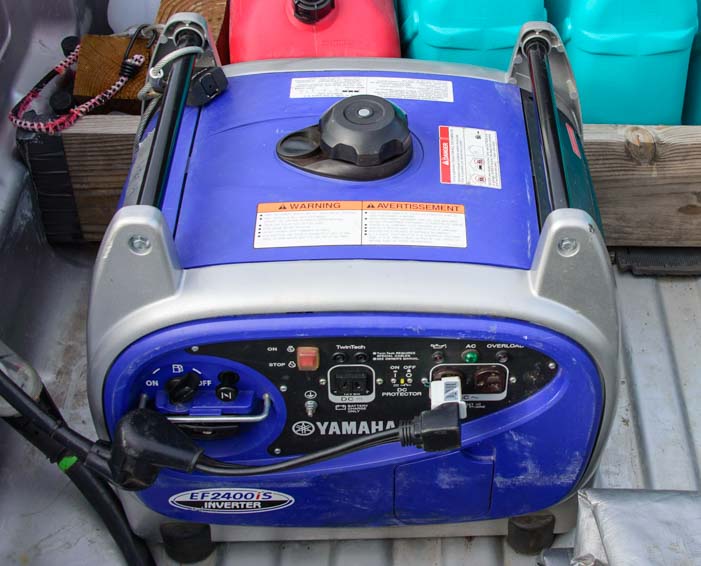
Yamaha 2400i portable gas generator for RV

Our generator gets a good workout a few times a year running our 15k BTU air conditioner.

Dometic RV Air Conditioner 15k BTU

This RV roof AC unit takes some oomph to run!

So, the only way we can get air conditioning in our trailer is to drag out our Yamaha 2400i gas generator and set it up to run our Coleman 15,000 BTU air conditioner.

Some folks say this can’t be done, but we’ve been doing it for years.

We use a variety of adapters to plug the generator into the shore power outlet on the outside of the rig.

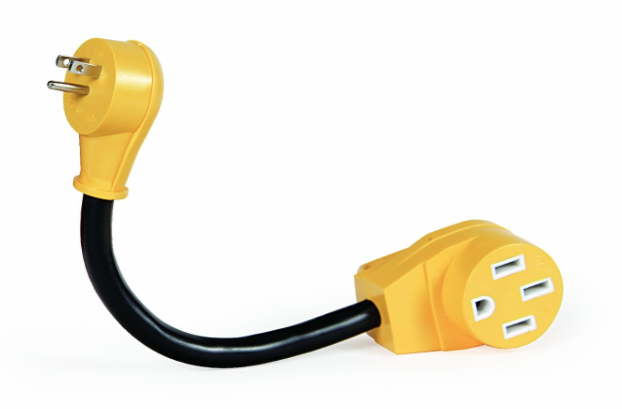
To get from the 15 amp outlet on the generator to our shore power outlet on the outside of our trailer, we could use one adapter plus the shore power cord:

50 amp Female to 15 amp Male dogbone adapter

15 amp Male to 50 amp Female dogbone adapter (15 amp Male plugs into generator)

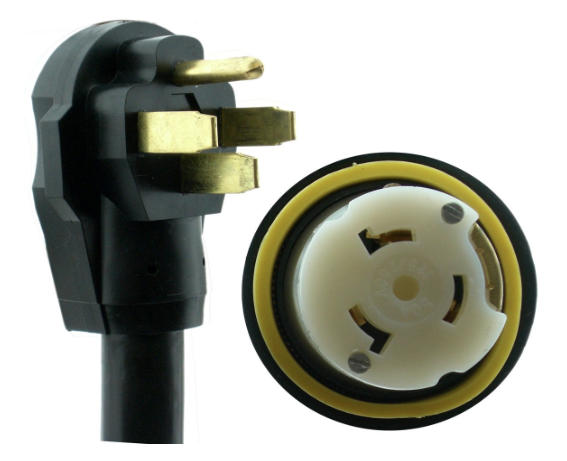
50 amp 125 : 250 volt RV shore power cord

50 amp 125-250 volt RV shore power cord (50 amp Male plugs into dogbone above)

However, when we first bought our trailer, we stayed at an RV park that had a 30 amp pedestal that didn’t match our 50 amp shore power cord, so we had to buy an adapter. Making good use of that adapter with our generator now, we use two adapters plus our shore power cord when we connect to the generator:

30 amp Female to 15 amp Male dogbone adapter

15 amp Male to 30 amp Female dogbone adapter
(15 amp Male plugs into generator)

50 amp Female to 30 amp Male RV dogbone adapter

30 amp Male to 50 amp Female to RV dogbone adapter
(30 amp Male plugs into previous dogbone)

50 amp 125-250 volt RV shore power cord

50 amp 125-250 volt RV shore power cord
(50 amp Male plugs into previous dogbone)

When the generator is powering the RV this way, the generator supplies power to the converter inside the trailer (or inverter/charger), which charges the batteries as efficiently as possible using a multi-stage charging algorithm (if the converter or inverter/charger is a “smart” charger).

Our 2400 watt generator is able to power our 15K BTU air conditioner just fine. However it sometimes takes a little coaxing to get it to fire up because there is a big spike when the air conditioner’s compressor first turns on. Over the years, we’ve learned that the trick to persuading it to run is the following:

  1. Run the generator for a few minutes with no load and make sure it is warmed up
    (also make sure the hot water heater and fridge are set to “gas” and no other electrical appliances are running)
  2. On the air/heat control unit, set the Fan button to High On
  3. Set the System button to Fan and let it run for a few minutes
  4. Set the System button to Cool and listen to the compressor come on
Coleman RV air conditioning control unit

Make sure the genny is warm and let it power the fan on high for a while first… THEN switch on the A/C.

Sta-Bil Gas stabilizer

Keeps the gas in the genny fresh

If the last step trips the breaker on the generator, set the System button back to Off, restart the generator and try again.

On a few occasions it has taken us 2-3 tries to get the air conditioner going. However, most of the time it fires up on the first try.

We always run it for 4-6 hours when we turn it on, and it purrs along just fine. However, we run the air conditioning just a few days each year. The rest of the time we stay cool using other means.

To keep the gas in the generator (and in the gas can) fresh and to ensure quick starts after storage and to prevent gumming and varnish, Mark puts the stabilizer Sta-Bil Gas stabilizer in the gas.

POSITION THE RV
— BIGGEST WINDOWS FACE NORTH and SMALLEST WINDOWS FACE WEST

The toughest time of day is the afternoon when the sun is in the southwest and western sky and is slowly baking the RV. Sometimes it seems to take forever for the sun to set while everything inside the rig quietly fries!

No matter what the wall and roof insulation R-factor is for an RV, the windows are where all the heat comes in. So, keeping them shaded as much as possible throughout the day makes all the difference in the world.

Every rig has a different arrangement of windows, but if you can position the biggest ones to face north or east and the smallest ones (or the wall with no windows if you have one) towards the west and southwest, the difference to the interior temperature will be astonishing.

If there is a way to block the afternoon sun entirely by parking next to shade trees or a building, that is even better.

SET UP THE RV AWNING

Even if the awning will only shade a small part of the RV’s walls and windows for a few hours of the day, this is still helpful! When an RV wall gets hot, you can feel the warmth on the inside of the rig. And you can especially feel it in the cabinets. There’s nothing like a hot bottle of olive oil in the kitchen pantry!

Shade from RV awning

Even though it’s shading just one small window, the awning is keeping the whole wall cool.

Modern rigs have wonderful powered awnings, but ours is the old fashioned manual crank type of awning. The other day we heard two RVers complaining about how putting these old awnings out was really difficult and was a two man job.

It’s actually not that bad, and Mark does it by himself in just a few minutes. Here are the steps:

How to set up RV awning - loosen handle

1. Unscrew the knob on the back of each awning arm.

How to set up RV awning - undo clip

2. Open the clip right above the knob on each awning arm

How to set up RV awning - use tool to lower lever

3. Use the awning tool to open the lever on the roller

How to set up RV awning - lower lever

4. Pull down on the lever to open it.

How to set up RV awning - lever in lowered position

The roller lever is now in the down position.

How to set up RV awning - hook awning loop

5. Use the awning tool to pull out the awning by grabbing the webbing loop

How to set up RV awning - pull awning out

6. Pull the awning part way out with the awning tool

How to set up RV awning - lower awning completely

7. Grab the webbing and pull the awning out the rest of the way

How to set up RV awning - Close RV door handle

8. Close the RV door handle to get it out of the way

How to set up RV awning - Pull awning arm out

9. Slide out the awning arm in its track

How to set up RV awning - Tighten down awning arm

10. Pushing down on the awning arm to keep the canvas taught, tighten the knob.

How to set up RV awning - Tighten down other awning arm

Do this on both sides

How to set up RV awning - Raise awning

11. Open the big awning handle to raise the awning up.

If it looks like it might rain, position one side of the awning a little lower than the other so the water will drain off of the awning.

When Mark closes up the awning for travel, he puts velcro straps around the arms to keep them from accidentally opening as we travel.

Another neat awning trick is to get an awning shade extension that drops from the edge of the awning to the ground. This provides shade from touching the rig even when the sun is at a low angle.

INSULATE THE WINDOWS and HATCHES INSIDE

The day/night shades in most RVs are great for reducing sunshine in the rig, but do little for eliminating the heat that pours in through the glass and metal frame.

RV window in summer heat

Pulling down our night shades doesn’t block much direct sunlight.

We cut Reflectix, which is a bubble wrap kind of aluminum foil that comes in a huge roll, to fit each window (a pair of scissors is all you need). We labeled each piece for the window it fits into.

Reflectix rolled up to keep RV cool in summer

Reflectix picks up where RV insulation leaves off…

We raise the RV’s day/night shades, press the piece of Reflectix against the window, and then lower the shade to hold the Reflectix in place.

RV window in summer heat with Reflectix

A layer of Reflectix behind the shade blocks all the sun!

RV Vent Insulator

When leaving the trailer, we close the hatches
and put vent insulators in them.

In our big rear window we jam a pillow under the large piece of Reflectix to hold it up. Otherwise it would drop to the floor.

If we are going to leave the rig for a while, we close all the windows and put an RV Vent Insulator in each of the roof vents. It is amazing to come home after many hours of running around to find that the rig is still fairly cool inside.

However, if we are planning to stay home, we don’t like to live in a tomb, so we have another strategy using fans and open windows that allows us to have some ambient light coming in…

STAY COOL WITH FANS

We rely on two different types of fans to stay cool.

Vent Fans

We have a Fan-tastic Vent Fan in two of our trailer’s four roof hatches. These are designed to push a maximum amount of air in or out of the rig. We set them to push the air out of the rig, and then we open the windows on the shaded side of the trailer to let the cool air from outside come in.

Fan-tastic Fan in RV hatch

Fan-tastic Fan in an RV hatch

If we were to replace our Fan-tastic Fans, or if we wanted to upgrade another hatch to one of these or a similar type of vent fan, we would choose a very simple model that does just the basics.

Our Fan-tastic Fans are whiz-bang models with remote control, rain-sensing, auto-opening, auto-closing, slicing and dicing and who knows what else. Unfortunately, they have minds of their own, and they won’t listen to reason.

They auto open and auto close at the weirdest times, they don’t necessarily know when it’s raining, and they make it impossible for the mechanically challenged (ahem…me) to turn them on or off or to open and close them. There are way too many buttons that do way too many different things.

Also, Mark has had to rebuild various parts of both of these fans, and by the colorful flow of expletives I heard him let loose on these jobs, I would gather that it was not easy.

Portable Fans

While vent fans help move fresh air through the rig by forcing hot air out the vents and pulling cool air in through the windows, portable fans are a godsend to aim right at you when you start reaching the boiling point.

We have a standalone, portable 12 volt Fan-tastic Endless Breeze Fan (and DC extension cord) so we can move it around the rig.

Fan-tastic Endless Breeze Fan

A 12 volt fan may seem necessary, but…

We got this fan in Quartzsite one year for our (not yet purchased) sailboat and we’ve used it a lot in the years since then. But it is extremely noisy. Forget trying to sleep with it running nearby! It’s also kind of silly to spend so much money on a 12 volt fan when a smaller and quieter 120 volt fan will do just as good a job, if not better, for a fraction of the cost. All you need is an inverter.

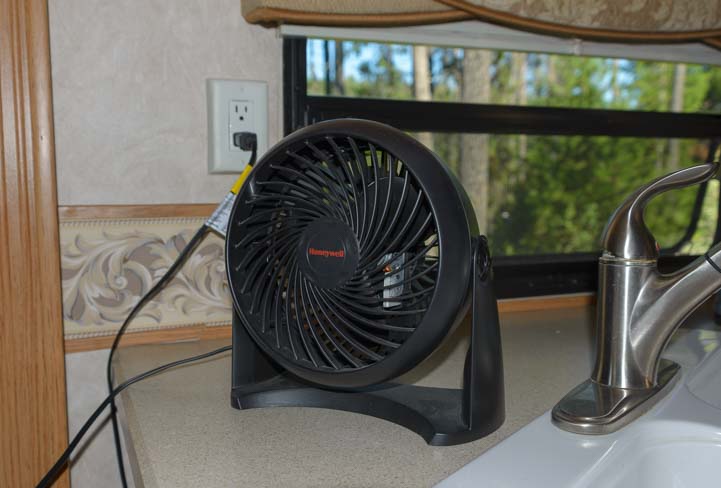
Portable fan in RV to keep cool

…A small, quiet, cheap portable fan will run on an inverter just fine!

Our little portable fan is terrific, but there are lots of portable fans in all kinds of styles that are just as good.

MAKE ICY DRINKS!

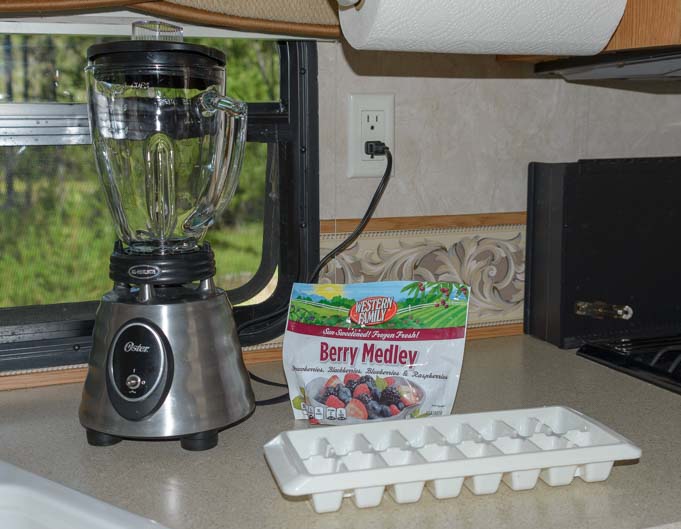
Last of all, there’s nothing that can cool down your body temp like an ice cold drink. A smoothie in a blender tastes wonderful and can bring your core temp down quite a bit. We make ice using old fashioned ice cube trays in our freezer, and we use a few cubes and frozen fruit in our smoothies to ensure they are as cold as possible.

Our Osterizer blender draws 1000 watts, which is well within the limit for our 2,000 watt pure sine wave inverter.

Osterizer blender and frozen berries for smoothie to keep cool in RV in summer

Smoothie time – Get cool with lots of ice and frozen fruit!!

Those are a few of our tips for surviving the dog days of summer in our RV without hookups. It can take a little finagling and strategy, but these things have kept us cool in our trailer for ten summers now!

Subscribe
Never miss a post — it’s free!

Below are some of our most POPULAR POSTS (also in the MENUS above)

Buddy - A Journey in Spirit - The story of an event that changed our lives forever.

ARTICLE INDEXES
  • RV Tech Tips Articles - A one page index of links to all our RV Tech Tips, RV Upgrades & RV Maintenance articles.
  • RV Lifestyle Tip Articles - An index of links to all our RV Lifestyle Tips (finances, boondocking, major repairs, work/jobs, etc.)
  • Solar Power Articles - Overview and tutorial articles for how to design and install solar power on an RV or boat
  • Product Reviews - An index of links to all of our Product Reviews
RV UPGRADES, SYSTEMS & TIPS MONEY FULL-TIME RV LIFESTYLE GEAR STORE
  • Gear Store - A list of the goodies, equipment and gear we've found useful in our RV lifestyle!
 

Our most recent posts:

More of our Latest Posts are in the MENU above.

A Summer RV Road Trip on Florida’s Northern Gulf Coast

The July 2016 issue of Motorhome Magazine features our story about taking an RV roadtrip along the seashore at the top of the Sunshine State. It’s called Jewels of Florida’s Northern Gulf Coast.

Jewels of Florida's Northern Gulf Coast Trailer Life Magazine July 2016

Motorhome Magazine – July 2016
Article: Emily Fagan, Photos: Emily & Mark Fagan

We have ventured to the northern part of Florida several times during our years of RVing, and we have enjoyed it immensely.

Most seasonal and full-time RVers think of Florida as a warm destination and a good place to escape the cold of winter. So it may seem odd for this article to appear in the July issue.

However, as anyone who ventures to northern Florida in January quickly discovers, the peak season for beach-goers along Florida’s panhandle is actually summertime!

Crazy as it seems, the winter months generally isn’t warm enough for swimming or even for sunbathing in Florida’s panhandle! We were shocked to find ourselves shivering in our jackets and long pants on this part of the Gulf coast when we were there one January.

By March, however, it was lovely on the beach, and we were assured that by summertime the water is downright toasty for swimming. And that’s when the RV park rates go up.

So, for RVers planning a winter trek to the northern Gulf Coast, it may be chilly but the RV parks will be cheaper. Summer visitors might pay a premium, but they’ll have one big beach party!

Northern Florida Emerald Coast

What a spot for a stroll!

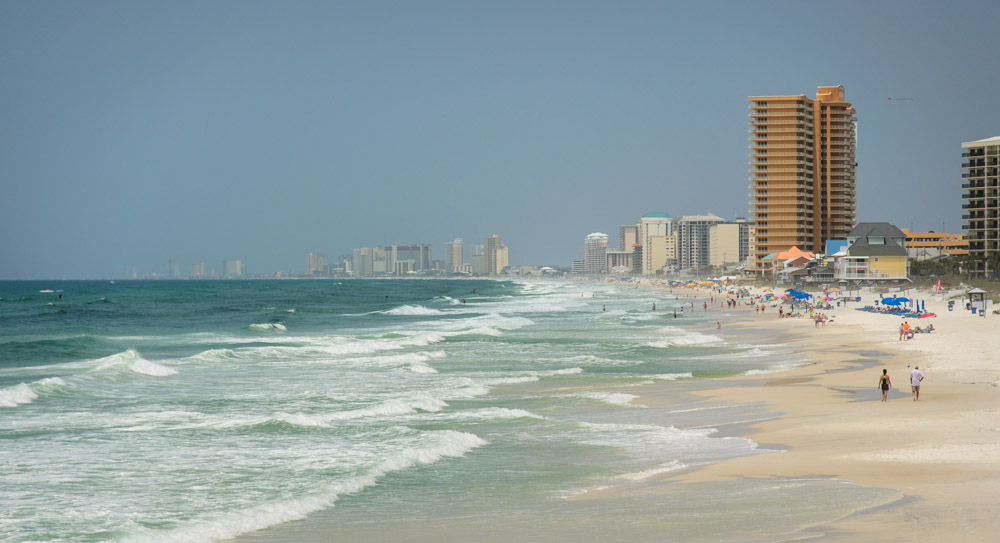
The coast around Pensacola Beach and Panama City Beach is called the Emerald Coast, and it is for good reason. The water is a stunning shade of green.

Emerald Coast beaches Florida Gulf Coast

The Emerald Coast beaches have vivid aquamarine water and incredibly white sand.

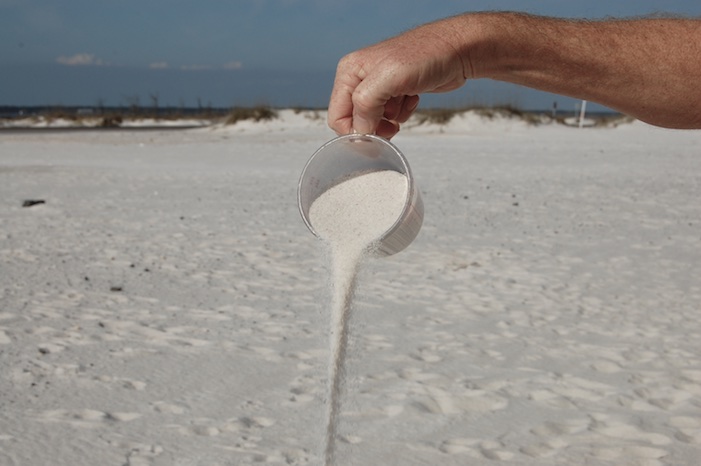
And the sugary sand is blindingly white, super soft, and fun to play in.

Gulf Island National Seashore Florida

Sand or snow?!

One of our favorite areas is the Gulf Islands National Seashore between Pensacola Beach and Navarre. This is a thin 10 mile long strip of barrier island that has a paved bike path and a paved road connecting the communities at either end.

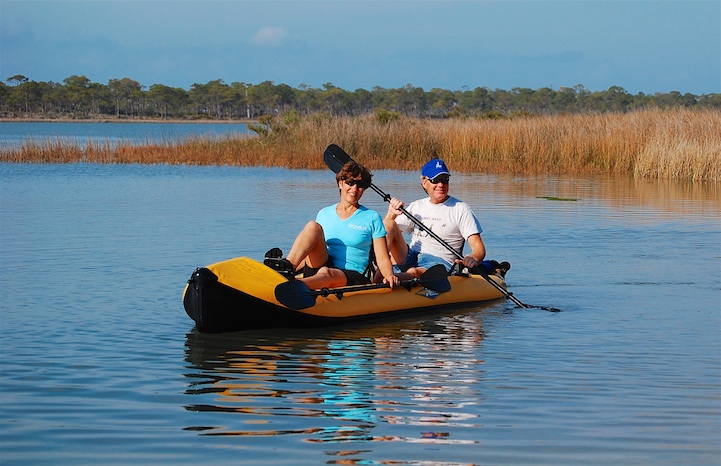
On one side of the Gulf Islands National Seashore barrier island there is a calm bay that is wonderful for kayaking.

The bay side of Gulf Islands National Seashore

The bay side of Gulf Islands National Seashore is calm and was ideal for our Hobie inflatable kayak.

On the other side the open ocean is emerald colored and there are endless miles of white sand beaches.

Vivd green water on the Emerald Coast

The Emerald Coast is just that!

Playing in the white sand of Florida Northern Gulf Coast

This place is one huge sandbox!

The beaches are busy at each end of the strip near the communities of Pensacola Beach and Navarre. But for the many miles in between there is nothing but sand and ocean. And the beach is sensational at sunrise.

Sunrise Florida Gulf Coast beach

Sunrise can be breathtaking on this coast.

There are lots of beautiful beaches along Florida’s northern Gulf coast, and they range from remote and peaceful to urban and bustling. Panama City Beach is loaded with highrises.

Panama CIty Beach Florida

Panama City Beach is full of high rises but is still a great beach for strollling, body surfing and sun bathing.

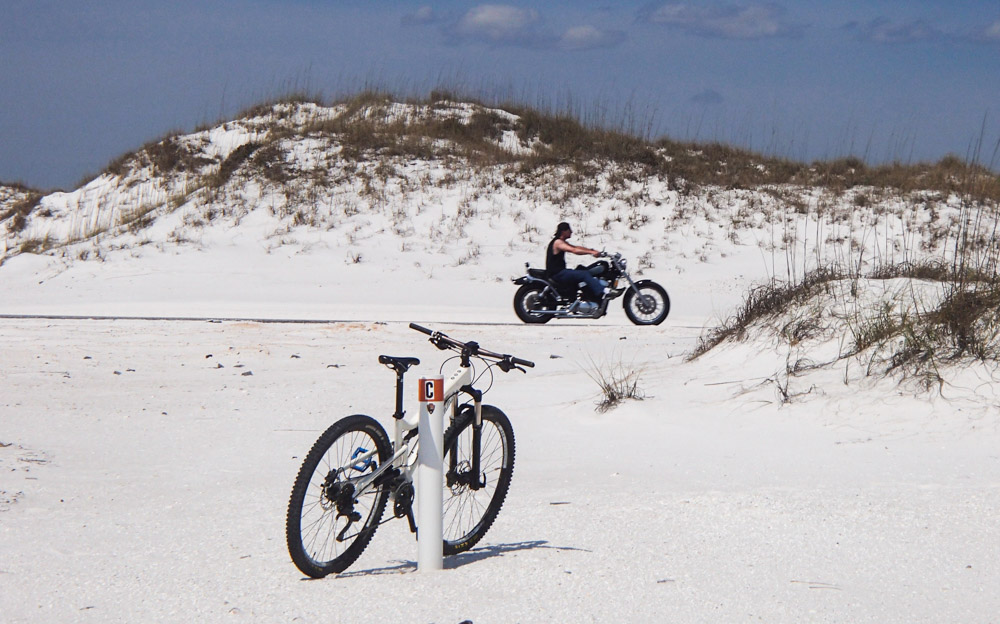
The fun thing about Florida is that as soon as you drive into the state you feel like you’re on vacation. Riding our bikes along the beach, we found ourselves riding past resorts with beach bars, live music and a tropical feel.

On vacation in Florida's Panhandle

You can get beers to go and hear live music at the beach resorts.

Florida has lots of beautiful state parks, and three we enjoyed in this area were St. George Island State Park, St. Joseph State Park and Ochlockonee River State Park. The first two parks not only have beaches loaded with seashells, but they have cool boardwalks. The third has stands of tall trees and pure white squirrels. And they all have RV camping too.

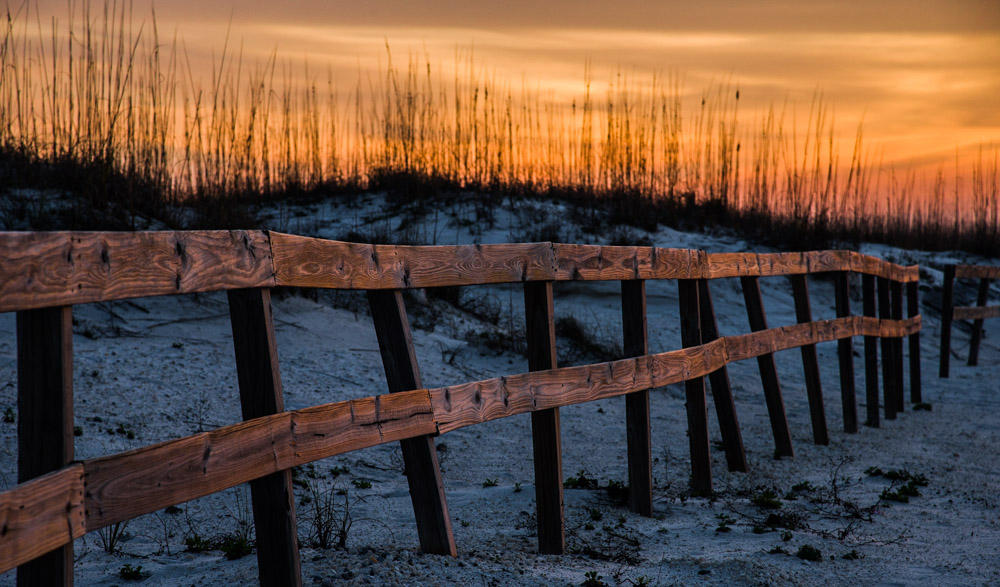
Florida Gulf Coast beach sunrise

Orange light at dawn.

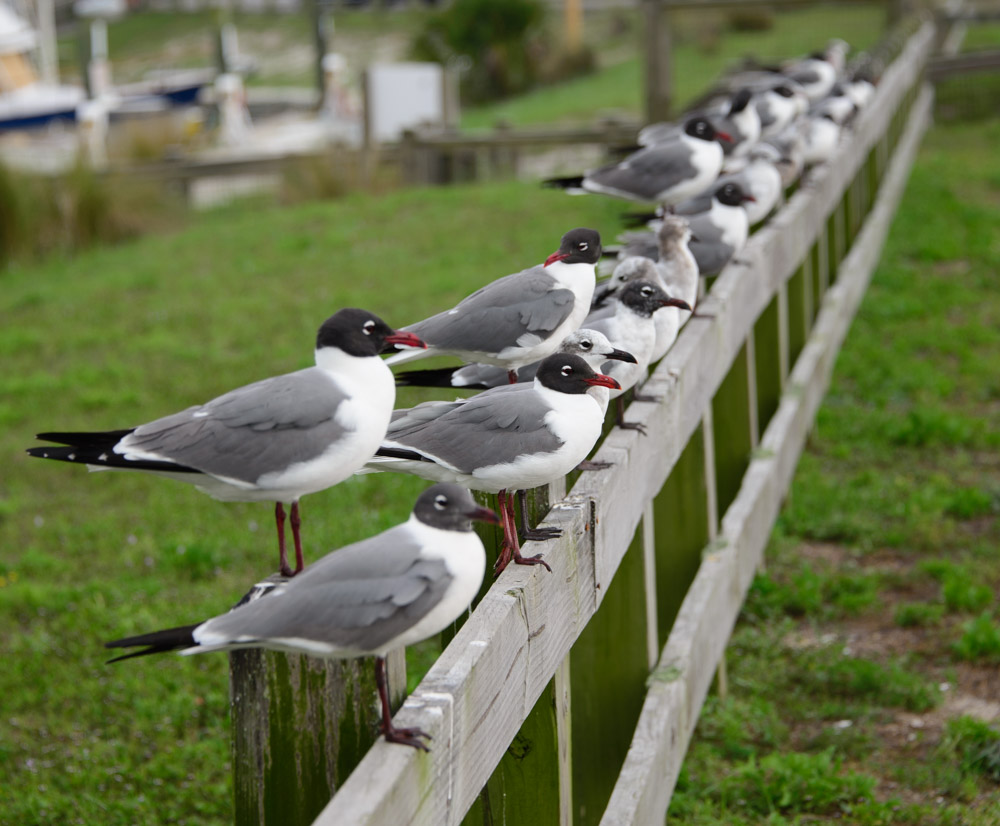
No matter where you go along the waterfront, seagulls will be hanging around and squawking!

Seagulls Florida Northern Gulf Coast

Seagulls line up along a fence by the beach.

The town of Apalachicola has lots of history and is home to a large shrimping fleet tied up at the docks. There are also some fun restaurants and neat little shops too. For oyster lovers, there are many places to get a plate of oysters.

Shrimp boat Apalachicola Florida

Apalachicola is a small working town with a big fleet of shrimp boats.

We have lots of blog posts about our RV travels in and around Florida’s Northern Gulf Coast at these links:

On the beach Florida's Northern Gulf Coast Emerald Coast

Standing up or lying down, there are many ways to have a great time on the Gulf Coast.

Motorhome Magazine is a terrific magazine that is published every month. Besides highlighting fun RVing destinations like Florida’s northern Gulf Coast, it also has lots of articles about RV maintenance, RV repair, and reviews of recently released motorhome models.

Sugar sand beaches line the Emerald Coast

The sand is like sugar…

For those interested in learning about RVing, Motorhome Magazine is a great way to pick up little golden nuggets of info about RVs and where to take them! An annual subscription to either the print or digital edition is not expensive and can be obtained at this link:

Subscribe to Motorhome Magazine

We have been publishing articles in Motorhome Magazine for a few years now, and some of our articles, including one about RVing full-time, are posted on Motorhome’s website at this link:

Motorhome Magazine articles by Emily & Mark Fagan

Sunset Pensacola Beach Florida

Pensacola Beach at sunset…

Subscribe
Never miss a post — it’s free!

Here’s some info about these areas:

Our most recent posts:

More of our Latest Posts are in the MENU above.

How To Change The Inner Rear Tire on a Dually Truck

One of the first questions we had when we began considering buying a new pickup truck to tow our fifth wheel trailer was: How do you change the inside rear tire on a dually truck? Well, a few days ago we found out!

How to change an inside rear tire on a dually truck copy

We got a flat on our dually’s inside rear tire (passenger side) while towing our trailer — Oof!!.

Our 2016 Dodge Ram 3500 Dually has been a fabulous truck for us since we bought it six months ago, and we’ve now got 9,100 miles on it now, 4,633 miles towing and 4,467 miles driving around without our fifth wheel trailer attached.

A few days ago, we stopped at the Libby Dam on the Kootenay River in Montana to get a photo. As I walked around the back of the truck, I heard a weird hissing noise. I stuck my head into the wheel well, and my heart sank when I saw a huge bolt head on the rear inside tire. I put my finger on it, and the hissing stopped. I lifted my finger and the hissing started again. Oh, no!

I almost didn’t have the heart to tell Mark, but after we’d gotten our photos of the dam, I told him the bad news.

We were in a pretty remote spot, completely out of cell phone and internet range. We hit the nifty “Assist” button on the rear view mirror of the truck to give Dodge a call and ask some questions about changing rear tires, but the call wasn’t able to go through.

Assist button rear view mirror Dodge Ram 3500 truck

Ram trucks have a cool “Assist” button that connects you straight to Dodge…if you’re not in the boonies!

The closest town was Libby, Montana. It boasts a population of 2,700 people, but it was 17 miles down the road.

So much for getting any kind of roadside assistance!

The timing for this little inconvenience wasn’t great. We’d been on the road, towing, for 100 miles, and Mark had just been telling me he was ready to call it quits and take a nap. Oh well. No napping just yet!

Luckily, unlike the last time we’d been stranded on the side of the road — when one of our trailer tires blew out four months ago, shortly after our trailer suspension repair — rather than being on the traffic side of an interstate with cars whizzing by at 75 mph, we were working curbside in a nice big pullout next to an extremely quiet country road where a car would leisurely pass by us every five minutes or so.

We unhitched the truck from the trailer to make it a little easier to get at the rear wheels. Mark got our bottle jack out from its storage spot under the driver’s side rear seat of the truck, and he began setting it up. I grabbed a stool from our fifth wheel basement and laid out some mats on the ground to create a work space for him.

From a lifetime of mechanical work, he learned long ago to protect his hands, so he pulled on a pair of leather work gloves that he keeps in the truck.

The first step for changing the tire was to remove the hubcap.

Remove hub cap on Ram 3500 truck rear wheel

Start by removing the hubcap to reveal the lug nuts.

Then, using a breaker bar, he loosened all of the lug nuts. Doing this with the wheel still on the ground is easier than after it’s lifted, because the wheel can’t spin.

Breaker bar to remove rear wheel on dually truck

Use a breaker bar to loosen the lug nuts while the wheels are still on the ground.

We used to carry a 4-way lug wrench for swapping out flat tires, but one time one of the arms twisted like a strand of licorice as Mark tried to unscrew a stubborn lug nut that wouldn’t budge. It was probably a cheap 4-way lug wrench. Most likely, a better quality 4-way lug wrench wouldn’t have done that, but Mark swore off of those things right then and there, and we’ve been carrying a breaker bar ever since.

The lug nuts on our 2007 Dodge Ram 3500 required a 15/16″ socket. The ones on our 2016 Dodge Ram 3500 require a 7/8″ socket.

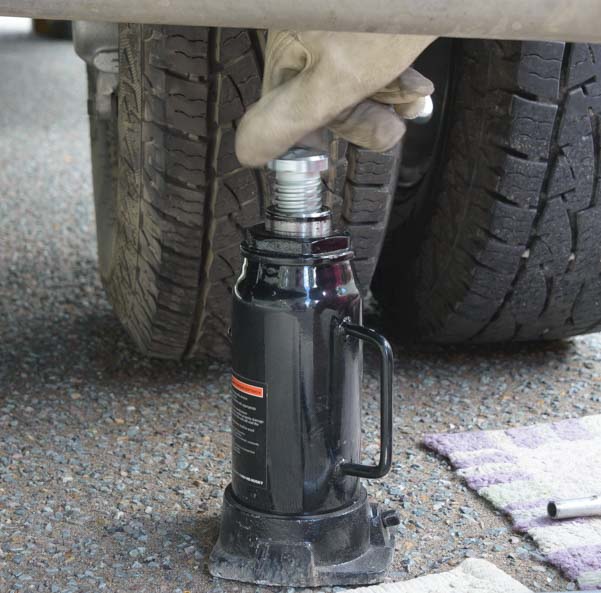
Our bottle jack is rated for 12 tons, enough to hold up the axles of either our trailer or truck easily. More important, it’s also tall enough for the axles on our trailer which we raised a few inches higher from the factory standard during our trailer suspension overhaul to help keep our rear end from dragging on steep ramps at gas stations and on uneven dirt roads.

He unscrewed the top of the bottle jack to raise it up.

Bottle jack for fixing a flat tire

Unscrew the top of the bottle jack by hand to raise it.

He placed it under a flat metal piece that was welded onto the axle.

Bottle jack under the rear axle of a dually truck

Place the bottle jack under a solid flat spot on the axle.

The bottle jack comes with a two-part handle. After removing the two plastic end caps, one tube can be fitted into the other to make a long handle and give you some leverage while pumping up the jack.

Bottle jack handle for fixing a flat tire

Remove the plastic endcaps and fit the tubes together to form a long handle.

He pumped the handle up and down to raise the top of the bottle jack and lift the axle slightly so the wheels no longer touched the ground.

Raise the jack under Ram 3500 dually truck rear axle-2

Raise the rear axle of the truck by pumping the bottle jack handle.

With the lug nuts slightly loosened, he now used a Rigid cordless impact driver to remove them completely.

Impact driver to remove lug nuts fix rear flat tire Ram 3500 dually truck

A Rigid 18 volt cordless impact driver makes it a breeze to remove the lug nuts.

We got the impact driver, a cordless drill and a portable radio as part of a terrific kit that included two lithium-ion battery packs. We use the drill every time we raise and lower our fifth wheel’s stabilizer jacks, and we listen to the portable radio all the time!

He collected the lug nuts in the hub cap.

Fixing rear flat on Ram 3500 dually pickup

Collect the lug nuts in the hubcap so they don’t roll away.

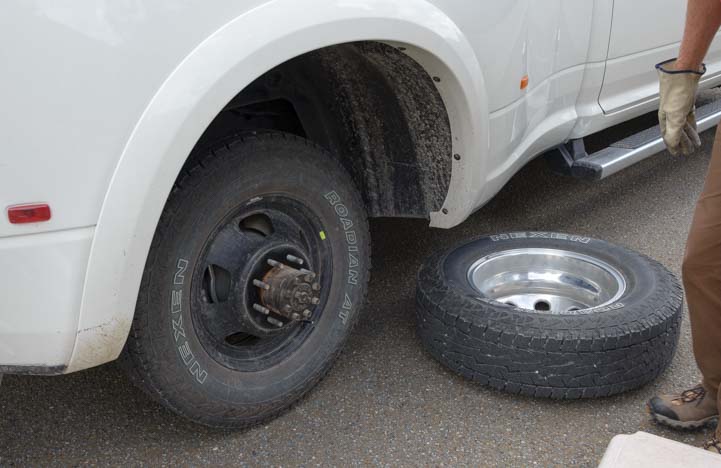
Then he pulled off the outer wheel.

How to change a flat tire on a dually pickup truck

Pull the wheel off.

How to change a flat tire on a dually pickup truck

The outer wheel is off, now for the inner wheel…

The wheel studs on a dually are extra long to hold both wheels onto the truck. So, once the outer wheel was removed, he could pull off the inner wheel.

Remove the inner rear tire of a dually truck

Slide the inner wheel off.

And there was the culprit — a big fat self-tapping bolt!

Flat tire on a dually pickup

And there it is — a nasty self-tapping bolt. Arghh!!

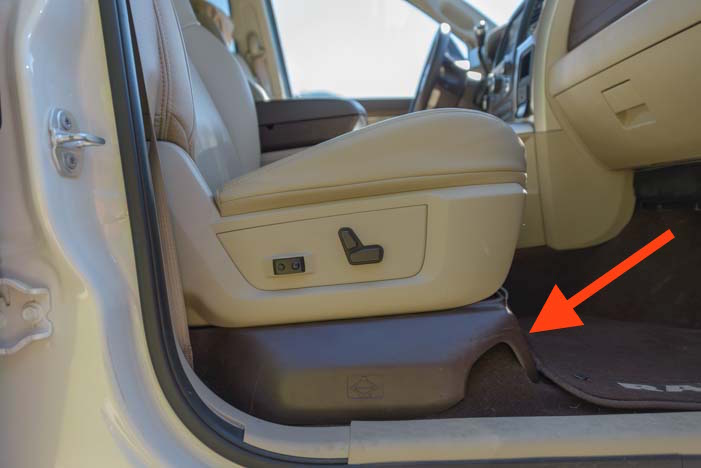
Our 2016 Ram 3500 came with a toolkit for raising and lowering the spare tire. It is located behind a plastic trim piece under the passenger’s seat.

Spare tire toolkit in Ram 3500 truck stored under passenger seat

The toolkit for lowering the spare tire is under the passenger’s seat.

He pulled off the plastic trim piece to get the toolkit out.

Spare tire toolkit Ram 3500 pickup truck

Here is the toolkit for lowering and raising the spare tire from its spot under the truck chassis.

Then he pulled the toolkit out from under the passenger’s seat. It is held in place with two knobs, one of which is tightened with a wingnut. When he put the toolkit back in place later, he had to align it before sliding it in, and then tighten the wingnut.

Mounting brackets spare tire toolkit Ram 3500 truck

The toolkit is held in place by these knobs (the left one is a wing nut).

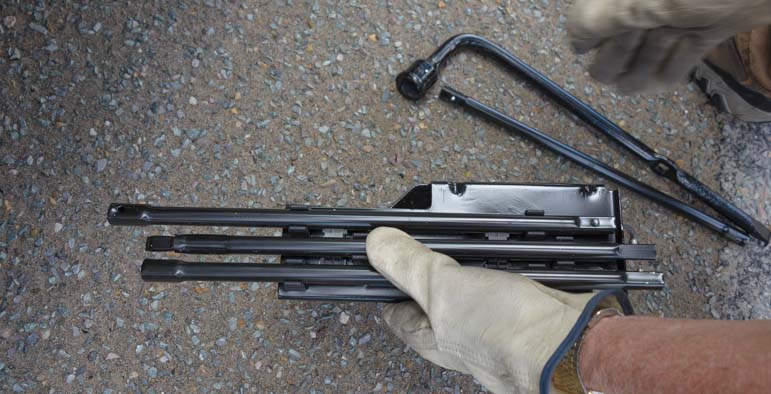
The toolkit has several handle extensions and other goodies in it.

Spare tire toolkit Ram 3500 truck

The toolkit has all kinds of goodies in it, including a lug wrench that Mark opted not to use since it is probably even more flimsy than a 4-way.

One of the goodies is an L-shaped handle, and there are several extensions that interconnect to lengthen the handle as well.

Spare tire toolkip Ram 3500 pickup truck

Two of these tubes fit together to form a long handle that attach to the L-shaped handle.

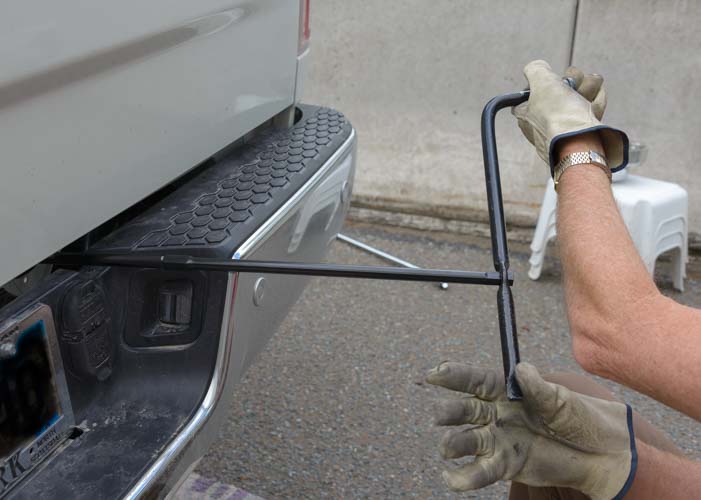
He assembled two handle extensions to make a long rod and attached the L-shaped handle to the end. Then he inserted this handle into a hole above the license plate bracket. There is a square fitting inside the hole. The end of the handle slipped over the square fitting.

Lowering the spare tire on a Ram 3500 dually truck

The L-shaped handle and extension tubes fit onto the square fitting in the hole next to the license plate bracket.

Then, he rotated the handle slowly.

Lowering the spare tire on a Ram 3500 dually truck

Twist the handle to lower (or raise) the spare tire.

This gradually lowered the spare tire from its storage spot under the chassis of the truck onto the ground

Lowering the spare tire on a Ram 3500 pickup truck

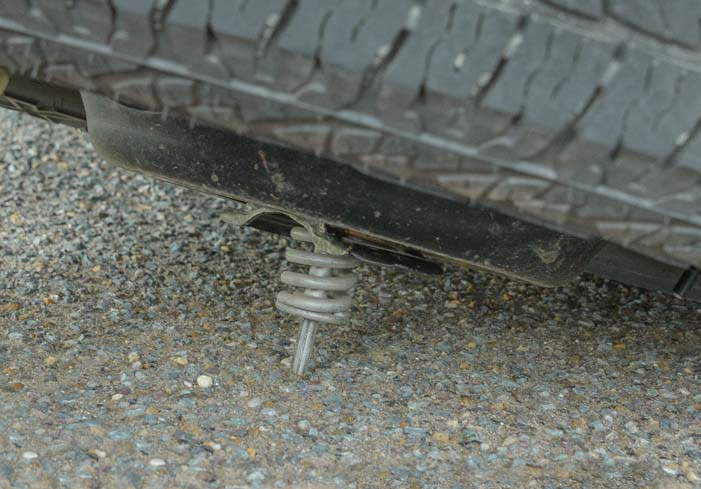
The spare tire is held to the truck chassis by a brace that compresses a spring.

The spare tire is held tight to the underside of the truck with a spring fitting that can be snugged nice and tight.

Spare tire mounting system Ram 3500 pickup truck

Bracket and spring under the spare tire.

Then he mounted the spare tire on the truck to replace the flat tire.

Mounting the spare tire on rear of Ram 3500 dually truck

The spare tire is mounted on the truck.

Next, he slid the outer wheel in place. Using his cordless impact driver, he replaced the lug nuts, tightening them in increments. Starting at the valve stem, he tightened the closest lug nut a bit and then tightened the one that was opposite, then tightened the next one, and then the one opposite that one, etc., working his way around the rim and tightening the wheel equally all the way around. Then he gave each lug nut a final tightening using the breaker bar.

Then he put the hubcap back on. It didn’t pop on really easily using his palm, so he used the top of a rubber mallet to tap it in place.

Replace hub cap on dually truck rear wheel

The hubcap didn’t snap in place using palms only, but the butt end of a soft rubber mallet did the trick.

Interestingly, we could now see exactly how much rubber we had worn off our rear tires in 9,100 miles, because the wheels didn’t hang down evenly.

Spare tire and used tire height difference on Ram 3500 dually truck

The brand new spare and 9,000 mile used tire are different heights.

Using a pocket knife, he got a rough estimate of just how much rubber had been worn off — maybe 1/8″ or so.

Rear tIre wear dually truck 9000 miles

About 1/8″ of rubber has come off of the tire in 9,000 miles of driving.

He raised the flat tire up into the storage spot under the truck chassis where the spare tire had been, and lowered the bottle jack under the axle so the truck was sitting on all four rear wheels again. We hitched the trailer back up and started to drive.

This little hiccup in our RVing lifestyle had taken about 30 minutes.

Our fancy new truck has a cool display (the DID, or Driver Information Display) that shows the air pressure in each of the six tires on the truck (this is the TPMS, or Tire Pressure Monitor System). We were both really alarmed when the spare tire reported that it had 17 lbs. of pressure while the other three rear tires all had 63 to 65 lbs. What the heck??

Tire pressure dashboard readout Ram 3500 truck

The tire pressure for the spare is 17 lbs. Yikes!! (huh????)

The dealership where we bought the truck had told us they’d aired up the spare when we bought the truck new six months earlier. Even though Mark usually uses a tire gauge to measure the air in the spare, he hadn’t this time because it was a brand new tire that seemed perfectly good, had the right sound when he thumped it, and bounced nicely on the ground.

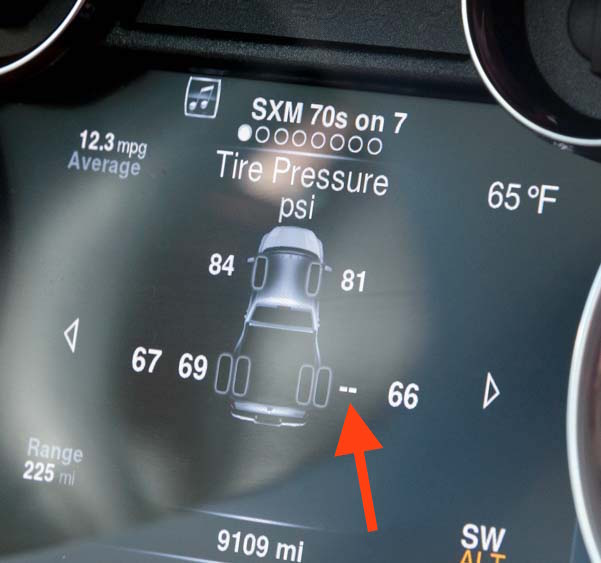
But we grew ever more alarmed as the dashboard display showed 15 lbs., then 13 lbs., and then went to dashes. The road was super quiet, so while driving the 17 miles to get to the Les Schwab tire place in Libby, we pulled over several times to check that the tire wasn’t heating up… It wasn’t.

Tire pressure dashboard readout Ram 3500 truck

Now the tire pressure is dashes. What does THAT mean??

We made it to Les Schwab, and they put a terrific new kind of patch on the tire that mounts from the inside. It has a big round rubber flange that mounts inside the tire with a plug that fills the hole.

The spare turned out to have 65 lbs. of air pressure, just the way it should have. So, we all scratched our heads for a while about the weird air pressure numbers we’d seen on the dashboard.

Then our service guy suddenly brightened up. “I know what it was!” he said. “The spare tire doesn’t have a sensor in it to report its tire pressure to the truck, but the original tire did!”

So, as the original tire was being carried under the chassis of the truck, where the spare usually sits, it was transmitting its decreasing tire pressure to the console on the dashboard, and the dashboard was dutifully displaying the numbers as coming from the right inside rear tire even though the tire was no longer in that position. Eventually the tire pressure got so low it was below the minimum, so the display showed dashes.

It turns out that that option for the spare tire to have a sensor on the valve stem is only available on Premium models of Ram trucks. We never saw that option in any dealer option lists.

I just showed this post to Mark to see what he thought, and he looked at me in astonishment and said, “When did you take all these photos? This is great!”

“When you were changing the tire!” I explained. “I’m sneaky!” (And I’d MUCH rather write about changing a tire than do it myself!)

Subscribe

Never miss a post — it’s free!

Other blog posts about trucks and trailer towing:

Our most recent posts:

More of our Latest Posts are in the MENU.   New to this site? Visit RVers Start Here to find where we keep all the good stuff. Also check out our COOL NEW GEAR STORE!! *** CLICK HERE *** to see it!

RV Tips and Tricks – Make RVing EASY and FUN!

There are a million RV tips and tricks to make the RV life easier, and this page offers some little jewels we’ve discovered since we started RVing full-time in our fifth wheel trailer in 2007. We’ve broken them down into:
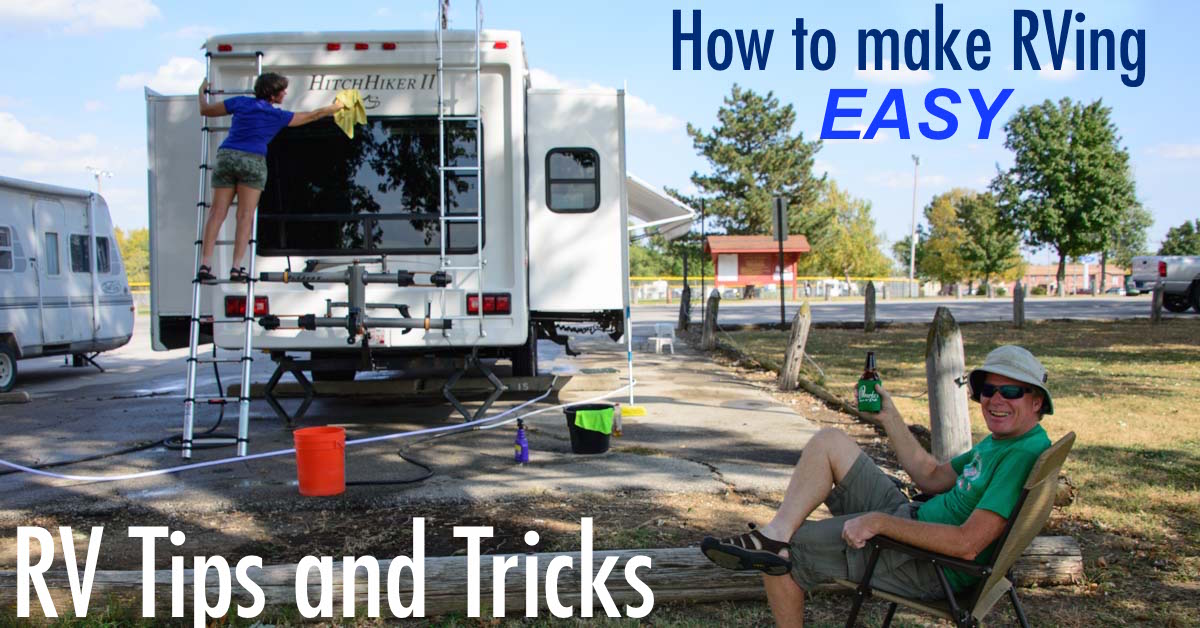
RV Tips and Tricks for making RVing and the RV Life easy

.

OUTDOOR RV TIPS and TRICKS

High Powered “Search” Flashlight

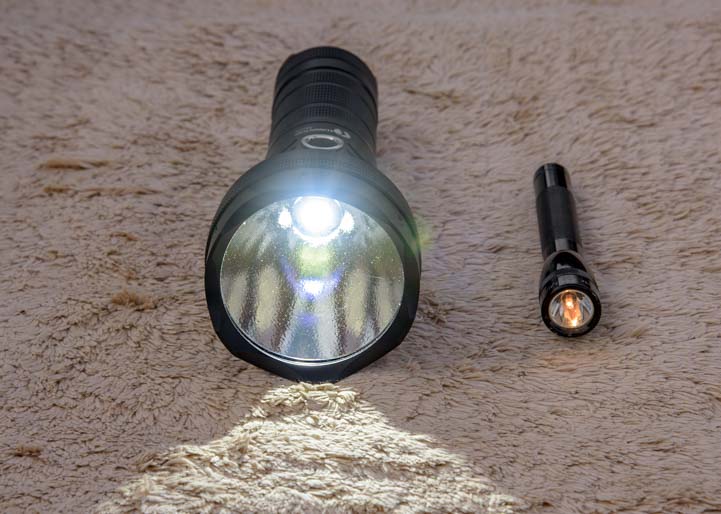
We often camp in areas that are quite remote, and getting to and from and around the rig at night is much easier with a very high powered flashlight!

Lumintop SD75 LED flashlight

Lumintop SD75 Flashlight compared to a pocket Maglite

We have a Lumintop SD75 Flashlight which is downright phenomenal. We have hiked Bryce Canyon and the Grand Canyon at night to photograph the stars and the Milky Way, and this flashlight is literally like holding a car headlight in your hand.

Here is more info about this flashlight:

Lumintop SD75 Flashlight Review

Getting Parked Without Damaging Anything

The most basic element in RVing is learning to hitch up and unhitch, whether you are driving a car pulling a popup, a diesel truck towing a fifth wheel or a Class A motorhome towing a car. Of course, lots of people have loads of fun in their motorhomes without towing a car behind, but getting hitched up and unhitched is part and parcel of the RV lifestyle for an awful lot of us.

The most important thing for the driver and the person standing outside of the rig is to stay in eye contact with each other. This is entirely up to the person running around outside. If you can see the driver’s face in the rear view mirrors, you are golden. If you can’t, then any kind of gesture you make, including jumping up and down and waving your arms because the driver is about to drive the rig right off a cliff, will never be seen.

We use two-way radios to give us a way to talk to each other and to lessen the impact if I inadvertently end up in a position where Mark can’t see me in the rearview mirror. We use the longest distance radios we can get, to make sure the signal is decent. Right now we have 36 mile GMRS radios, which are realistically good to about 3-5 miles. We used these on our boat (a godsend when anchoring) and we’ve used them ever since we started RVing. We’ve gone through three sets so far, because the salt air ate up two pairs during our cruising years.

Two-way radios for backing up an RV

We use our two-way radios all the time…

Besides the radios, it’s really helpful to have good hand signals. I indicate the distance until disaster by spreading my arms wide and then bringing my hands closer and closer together until I give a “halt” sign (palms forward). Shaking my head and waving my hands and giving a few slices to the neck can help too if it starts to look really bad.

Midland 36 mile GMRS radios

36 mile GMRS radios

It is royally embarrassing to make all these gestures when you’ve got an audience of people watching, but I’ve learned that there’s no ego in getting the rig parked well. Every RVer who has been around a while has made a huge blunder of some kind while parking, and they’ve all lived through it. So a few members of your giggling audience will probably be very sympathetic to whatever mistakes you have up your sleeve.

My worst gaffe was in front of two very special friends we hadn’t seen since we’d moved into our fifth wheel a year earlier. They had come out to camp with us, and we were all excited. I had just finished telling them (with great pride) that we didn’t need their help parking because we parked our rig all the time, we had a system, and we had gotten pretty darn good at it.

Mark began to back up as our friends watched, and I began to warn him that he needed to go more towards the driver’s side to avoid a tree. He adjusted, but again, I told him, he needed to go more towards the driver’s side! I kept repeating my instructions louder and louder as our good friends watched in bewilderment. When Mark was just about to cream the tree, we all started shouting STOP!!! Mark got out of the truck, calmly assessed the situation, and then said to me: “Ahem…. which side does the driver sit on?”

Our friends smiled weakly and I looked for the nearest rock to crawl under…

So, don’t be embarrassed and don’t be shy. Make your gestures big and strong, and remember which side of the rig the driver sits on!

Hitching and Unhitching a Fifth Wheel Trailer

Some folks drive their RVs solo, and although I can’t say much about hitching and unhitching a motorhome and car combo, our good friend Bob has found a great way to hitch and unhitch a fifth wheel trailer solo. He marked the front landing leg that’s near the extend/retract button at regular intervals all the way up and down the leg.
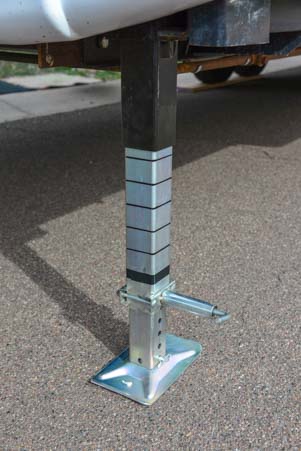
Fifth wheel landing leg marked with hash marks

Hash marks on a landing leg help get the rig back to the right height before hitching up.

Then he numbered each hash mark. He keeps a pad and pen in the hatch near the landing legs button. When unhitching, once he’s raised the trailer to where he can drive the truck out from under it, he jots down the hash mark number that is visible on the leg. Then he drives out, parks, and returns to the trailer and raises or lowers the landing legs as necessary to get the trailer level.

When he hitches up again to leave, he adjusts the trailer height to the exact position where he unhitched. That way, when he gets in the truck to hitch up, he knows the trailer will be at the correct height as he backs the truck up into the hitch pin (and he doesn’t have to get in and out of the truck several times to check and adjust the height of the trailer).

We marked our landing legs at 1.5″ intervals and have not numbered them. There are only 6 hash marks, and I make a mental note of what mark we were at when we unhitched. Frequently, by the time we leave, I’ve forgotten where we were at before we leveled the trailer, but I’ve developed a good eye for knowing how much to raise or lower the rig as Mark backs the truck towards the trailer.

We also marked the centerline of the fifth wheel pin box and pin plate so it is easy for Mark to line up the hitch with the pin box and king pin when he is backing the truck into the trailer.

Leveling the Trailer

There are many methods for getting a trailer level, and hydraulic leveling is a blessing that takes all the excitement out of it. For those without hydraulic leveling, we found in our early years that with two 5′ lengths of 2″x8″ board and one 5′ length of 1″x8″ board we could always find a combination that worked to get the trailer level from side to side. A 5′ board is relatively easy to drive onto and provides a solid platform for the trailer’s wheels.

We store the boards in the bed of the pickup. When using two boards, we stagger them a few inches so the trailer is driven first onto one level and then up a step to the next. We have to remember to back up when coming off stacked boards or the upper one will tip up and hit the bottom of the trailer while driving off it (think of a sailor walking the plank).

Leveling boards fifth wheel RV trailer

This was an extremely unlevel spot where we used quite a few boards and strips of horse stall mat.

If you don’t like the idea of hauling long boards around in your truck, there are nifty plastic leveling board kits (here’s another type) that are very popular.

We also use plastic wheel chocks whenever we park on a steep incline to prevent the trailer from rolling, especially while unhitching and hitching up.

Our friend Ken introduced us to using a sliced up horse stall mat rather than pine boards. We cut a 4’x6′ sheet of horse stall mat into five 1×5 strips and four 1×1 squares, and those have worked really well for us. They hold up to the elements really well and they roll along with the contour of whatever crazy surface we might park on. It is also possible to drive off of them either forwards or backwards because they don’t slap the underside of the trailer.

The only disadvantage is that they are much heavier than pine boards, but we can drag them around and they don’t disintegrate. We use the 1’x1′ squares under the landing legs and scissor jacks for cushioning.

We also have four large blocks made of three 1′ lengths of 2″x8″ boards screwed together. We put handles on the ends to make them easy to lug around. In a really unlevel site in the Smoky Mountains we had to stack them on top of each other AND extend the jack legs all the way!

RV fifth wheel landing legs

A very unlevel spot that required two blocks plus all the leg length.

What Is Level and How Do You Know?

Determining what constitutes “level” inside an imperfectly constructed RV is an interesting trick. We used a carpenter’s level on our kitchen floor, in several directions, and on our table, and on the bedroom floor. Of course, none agreed! But we found a good compromise and then mounted some RV levels on the outside of the rig to give us a reasonable guess when we’re setting up.

There are two different types of levels: Bubble Levels that have an air bubble that floats to the high side, and Ball Levels that have a ball that drops to the low side. Bubble levels are more responsive (the bubble moves more quickly as the RV moves). Ball levels take a few seconds to react. If you use both types, you can get confused because they move in opposite directions.

We have a large Level Master level on the fifth wheel pin box that is easy to see from inside the truck. We also have two small bubble levels on the trailer on the corner by the landing jack power button, one facing forward (for left to right leveling) and one facing sideways (for front to back leveling).

RV Fifth wheel hitch level and center mark

The ball style level (visible from inside the truck) shows which side of the rig is low.
We painted a line on the pin box to help with hitching up.

Our pin box mounted Level Master, a ball level, is easy to see from inside the truck. When the trailer is higher on one side than the other, the Level Master ball falls to the low side.

Our smaller levels on the front corner of the fifth wheel are bubble levels, so the one on the front of the rig showing the side-to-side level has a bubble that rises to the high side. This is the opposite of the ball level on the pin box, and sometimes, when we are struggling with white line fever from hours on the road, this messes us up.

RV bubble levels on a fifth wheel trailer

Small bubble levels show left/right and front/rear level near the landing jack power button on our fifth wheel.

I’d recommend sticking to either ball levels or bubble levels and not mixing and matching like we did! A good solution might be to mount a ball level like this on both the pin box and on the front of the trailer near the landing jack power button.

Why do you need two side-to-side levels? When I’m running around placing the boards in line with the wheels for Mark to drive onto, I want to see a level on the fiver easily myself, and the front of the pin box is impossible to see from the side of the truck when we’re hitched up.

However, lots of folks rely on a single pin box mounted level that has both side-to-side and forward-back levels in it. There are a few from Camco and Hopkins that are very popular.

You can forego all this nonsense with a slick hydraulic leveling system. However, this does introduce a complicated and expensive system into your life, and we’ve heard many stories of the jacks falling down while driving, or not retracting properly and systems failing in other ways. On the plus side, though, you can easily jack up the trailer to change a flat!


Cordless Drill for Easy Jack Setup

We don’t have electric stabilizer jacks on our fifth wheel trailer (nor did we on our travel trailer). However, we use an 18 volt cordless drill, and it’s very easy.

Cordless drill set up for RV stabilizer jacks

Ready for action with the drill, extension and socket for the stabilizer jacks

We use the following setup to crank the scissor jacks:

We keep the 1/4″ Hex to 3/8″ Socket Adapter in the drill. Mark glued the extension and 3/4″ socket together with JB Weld, making it ultra easy to grab the extension, jam it in the drill and go.

18 volt cordless drill, 8" extension and socket for RV scissor jacks

18 volt cordless drill, extension, socket and adapters for RV scissor stabilizer jacks

This setup worked on both the four stab-jacks on our travel trailer and the two rear scissor jacks on our fifth wheel. We keep the drill right inside a basement hatch door so it’s easy to find during both setup and breakdown of the trailer.

RV stabilizer jacks with cordless drill

Raising and lowering the jacks takes 2 seconds!

Rigid Drill Set Radio

This goofy radio is in the Rigid Drill Kit (along with an impact driver & regular drill & lithium ion batteries and charger). We love it even more than the other stuff!

Camco makes a special Leveling Scissors Jack Socket that replaces those three pieces, but there is no 8″ extension. Personally, I like the long extension because you don’t have to crawl in so far to make contact with the scissor jacks.

Last year we bought a Rigid drill kit which includes a regular 18 volt drill, an impact driver (awesome for the lug nuts when changing a tire) and a radio as well as two rechargeable lithium-ion batteries and a charger.

After going through three different 18 volt drills during our years of RVing and sailing, we’ve been really impressed with this Rigid kit. The Lithium-Ion battery charges up in about 15-20 minutes and it’s good for a really long time.

The kit comes with two batteries, so we use one for the drill and one for the radio. And what a hoot it is to have a portable radio. In this day and age of slick electronics, we’ve gotten such a kick out of this thing…


Cleaning the RV

No matter where we park, the slide roofs need attention before we bring them in. Either they are dusty, in the desert, or they are covered with twigs and leaves, in the woods, or they are wet from rain. Slide toppers might help with this, although I have heard that they tend to make noise in high winds, sag over time, and sometimes end up with leaves and twigs trapped underneath.

Mark has a long handled squeegee he uses to get the water off, a broom for the leaves and branches, and a California Duster and/or broom for the dust. Getting up on the roof is also useful for checking out all the rooftop items like hatches, TV antenna, solar panels and wiring. His favorite cleaning tool for all this is a telescoping scrub brush that we used for cleaning our boat.

Scrub brush on RV roof

Our telescoping brush from our boat is a favorite for cleaning the rig.

He just loves this soft bristled brush. Murphy’s Oil Soap mixed with water is a good solution to wash the roof. To get rid of black scuff marks on the outside of the rig, he uses Mr. Clean Magic Eraser sponges.

Telescoping Ladder
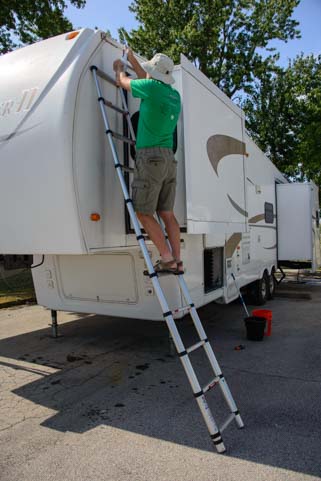
Telescoping ladder on an RV

A second ladder is really helpful!

Telescoping ladder

.

The first trailer we lived in full-time didn’t have a walk-on roof, and the signature of an RV without a walk-on roof is that it doesn’t have a built-in ladder.

We got a telescoping ladder so we could get up on the roof, and we have kept that ladder and used it ever since, even though our fifth wheel has a built-in ladder.

You may not think you need a second ladder when you’ve got one on the rig already, but polishing the front cap is one job where you do.

Washing or working on any part of the rig that is high up and out of reach of the ladder on the back is much easier with a second ladder, including the high corner of the rear end opposite the built-in ladder!


RV Patio Mats

A beautiful patio mat extends your living space and defines your outdoor area in an elegant way, and we love ours.
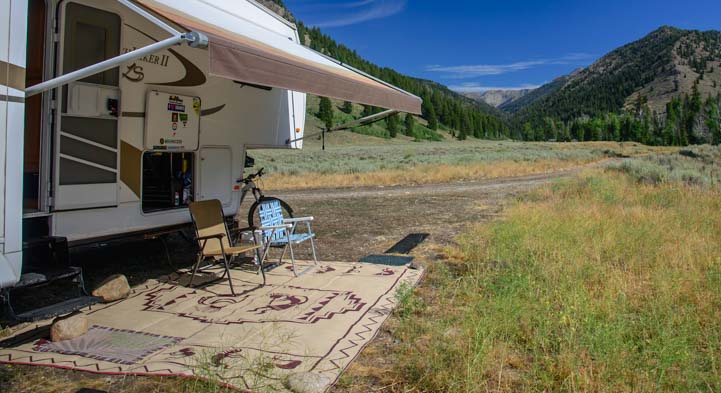
RV Patio mat defines outdoor space while camping

A classy patio mat extends your living space into the outdoors.

But they can be pricey if you’re just getting started with weekend RVing. An alternative is to get some green indoor/outdoor carpeting. We had this with our popup tent trailer, and it fit the bill perfectly (and our friends who now own our popup still use it!).

Popup tent trailer indoor-outdoor carpet patio mat

Save a few bucks and use green indoor/outdoor carpeting!

Waxing the Fifth Wheel Cap

Unfortunately, there’s no quick fix for getting the fifth wheel cap to have a deep shine. It’s made of ABS plastic and shows every swirl mark of a first-pass at waxing. The only way to bring back the luster it had when it was new is to use an orbital buffer and fiberglass polish and a whole lot of elbow grease.

Polished front cap on RV fifth wheel trailer

An orbital buffer and 3M Marine Cleaner Wax give the front cap a nice shine
but leave Mark’s shirt speckled with white spots!

Mark likes the 3M Marine Cleaner & Wax that we used on our sailboat. Unfortunately, you’ve gotta do this a bunch of times, and the worse condition the front cap is in, the more times it takes. But eventually you can get the shine back. Just be sure you keep the buffer moving lightly across the surface at all times so you don’t dig a hole in the plastic!

We have more cleaning tips for giving an RV that extra shine while boondocking here: Tips for Washing an RV While Boondocking


Truck Overloads
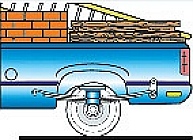
Timbren SES Suspension System for truck

Timbren SES Suspension

Our 14,000 lb. fifth wheel was right at the weight limit of what our 2007 Dodge 3500 could tow, and the pin weight of the trailer along with all the things we carry in our truck loaded down the bed of that truck quite a bit.

When hitched up, although the rig looked quite level, the truck sagged a bit, leaving the front wheels a little light and giving the truck a tendency to wander.

To alleviate this, we installed a Timbren Suspension Enhancement System between the axles and leaf springs of the truck. These are solid rubber donuts (not airbags) that fit between the axle and the leaf springs. That made the truck sit better and wander less.

We had that setup for eight years. In 2016 we purchased a 2016 Dodge Ram 3500 dually truck which had a much higher weight capacity in the truck bed and could handle the pin weight of the trailer along with the additional weight of the water jugs and leveling boards we carry in the bed of the truck much better.

How to Put Diesel Exhaust Fluid (DEF) in a Truck

Our 2016 Dodge Ram 3500 has a five gallon Diesel Exhaust Fluid tank which needs to be refilled every thousand miles or so. We’ve got some tips for where to get this stuff cheap and how to get it in the truck without spilling here:

How to Put Diesel Exhaust Fluid (DEF) in a Truck and Which Brand is Cheapest
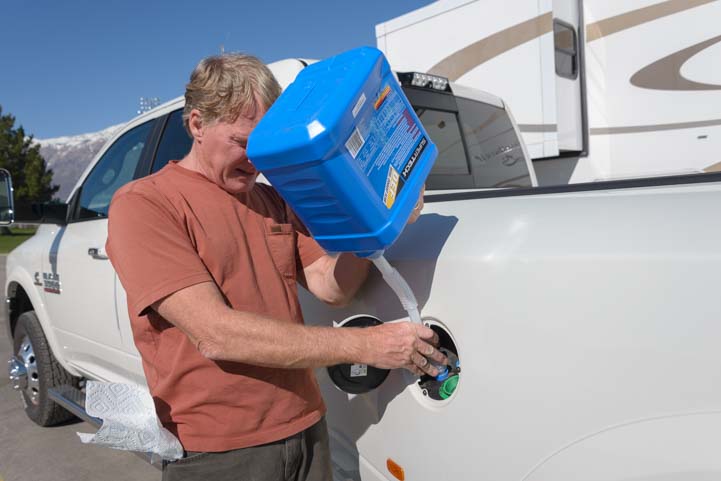
How to put Diesel Exhaust Fluid (DEF) in a truck without spilling

Putting DEF in a diesel truck is a new necessary evil, but there are tricks to make it cheap and easy…

RV Grill Operating on the RV’s Propane Tanks

Mark loves to barbecue, and ever since our first popup trailer, we’ve had a wonderful, small RV barbecue, the “RV sidekick grill.” It comes with a mounting kit to hang it on the side of an RV. Flipped sideways, this same kit becomes legs so the grill can stand up off the ground.

RV grill attached to fifth wheel trailer

The RV sidekick grill is designed to hang on the side of an RV or stand on its own.

We had this grill installed on the side of both our popup tent trailer and travel trailer, but with the fifth wheel, Mark installed an extra gas line and valve coming from the RV’s propane tanks so it can run from them. A quick disconnect LP gas hose goes from the grill to this gas line.
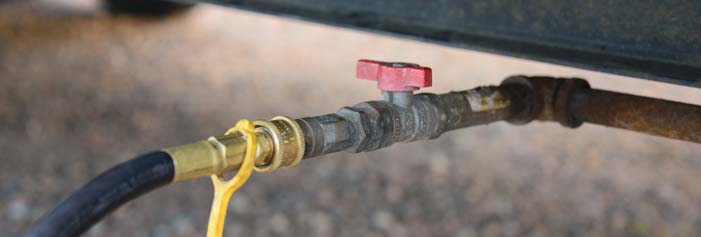
RV grill gas pipe connection

An extra gas line and valve lets the grill runs from the trailer’s propane tanks.

We’ve had this little grill since 2005 and it still makes a great meal!


RV Water Toys – Water Spigot Connections

In many dry camping campgrounds where there are water spigots available but no water hookups at the campsites, the water spigots don’t have threads. We’ve found a water bandit makes it possible to thread our water hose onto the spigot so we can fill up with water easily.
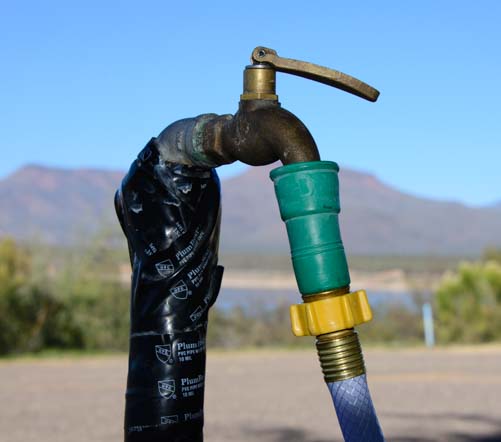
Water Bandit spigot adapter for RV fresh water at campgrounds

The water bandit makes it possible to connect a fresh water hose when there are no threads on the spigot.

In cases where we get water hookups and leave the water hose connected to the trailer, we screw a 90 degree elbow onto the trailer so the hose can hang straight down rather than come out of the our city water connection horizontally and then droop down towards the ground, putting pressure on the connection and potentially causing drips. We discovered this nifty little elbow when we lived on our boat in a marina before our cruise.

In addition, a water pressure regulator keeps the water pressure down to a level inside the rig that prevents any unexpected damage or leaks. A quick release makes it easy to connect and disconnect the fresh water hose. Mark also keeps a Y valve in his water hose arsenal. This is handy if the rig is connected to city water and we want to fill pails with water for washing the truck, or if an RV dump station has only one water spigot and we want to fill our fresh water tanks and run the black water flush at the same time.

Lots of folks like to attach a water filter as well. We used various filters at first, but no longer use any, although we periodically add a cap full of bleach to the fresh water tank. When we got a new fresh water tank, we were surprised that there was no sludge of any kind inside the old tank, even after 7 years of use.

Changing the Inner Rear Tire on a Dually Truck

We have a Dodge Ram 3500 dually truck with a B&W fifth wheel hitch, and wouldn’t you know it, the first time we had to change a tire on it, it was the inner rear tire. Ugh!

We had always wondered exactly how you went about doing this, and we found out. Here is a blog post that explains the entire process:

How to Change the Inner Rear Tire on a Dually Truck


INDOOR RV TIPS and TRICKS

Creating STORAGE SPACE with Seating for Four in the Dinette

We replaced the two chairs in our dining area with two wonderful storage ottoman benches, and this has increased our storage space by quite a bit. The storage ottomans we chose have a nice faux leather padded top that is really comfy to sit on, and they have voluminous storage space inside.

Storage benches in RV dinette

Our dining area – lots of storage and seating for four.

We have his-and-hers benches, and we keep our camera gear in them. The great thing is it got rid of all our clutter and gave us a place that is low down in the trailer and slightly ahead of the trailer’s axles (a smoother ride) where we could make custom padded storage for this delicate gear.

For more info and more pics of our benches, see this blog post about our setup: Making STORAGE SPACE in an RV.

You can buy the storage ottomans we purchased HERE, and you can get ideas of other brands and sizes of storage ottomans on the market HERE.

Protecting the Carpets Under the Slide-Outs

The carpets take a beating as the slide-outs roll in and out. Some slide-outs aren’t quite square and one wall or the other presses particularly hard on the floor while driving. You can buy fancy carpet protectors that fit under the slides. We went a cheaper route and bought a package of four flexible plastic cutting boards.
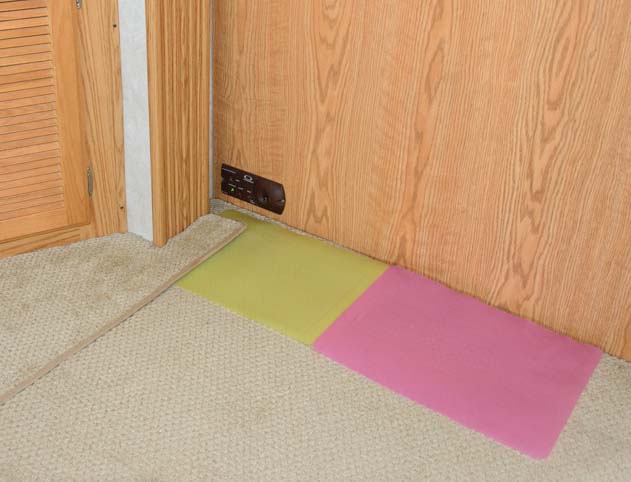
RV tips - cutting boards under RV slide-out

Flexible cutting boards taped together protect the carpet under the slide-outs.

We used packing tape to tape two of these together, end-to-end, and each pair fits under the slide-out walls perfectly yet are thick enough to protect the carpets. I keep one pair under one slide-out wall while driving, because that slide is crooked and its one wall gets wedged against the floor pretty tightly. The other slide-out walls hover above the carpet as we drive, so I pull the plastic cutting boards out from under them so they don’t get lost underneath while in transit.

Keeping the Cabinets Closed

After having a cabinet door fly open while driving over a bumpy road, causing two unbreakable Corelle bowls to fly across the trailer and break in half, we now latch every cabinet door with 6″ bungee balls. For drawers we use mini 10″ bungee cords with a hook at each end, hooking the top and bottom drawer handles.

RV tips bungee balls and bungee cord on RV cabinet doors and drawers

Bungee balls and bungee cords ensures the cabinets and drawers all stay closed.

Rolled up Carpets

We have a large pots-and-pans drawer that occasionally likes to open. We roll up our throw rugs and place them so they can’t unroll in front of the drawer to keep it closed.
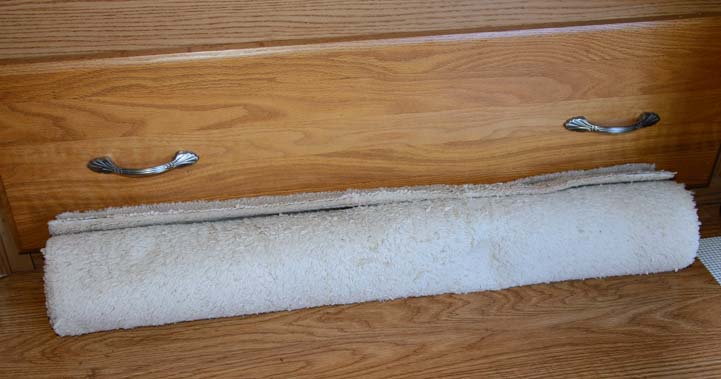
How to keep RV drawer closed in kitchen

Rolled up throw rugs keep this big pots and pans drawer closed while driving.

Rubber Shelf Liners

Rubber Shelf liners are invaluable, keeping everything in its place on each shelf as we travel. We try to make sure no plates, mugs or glasses are touching each other when we set out.
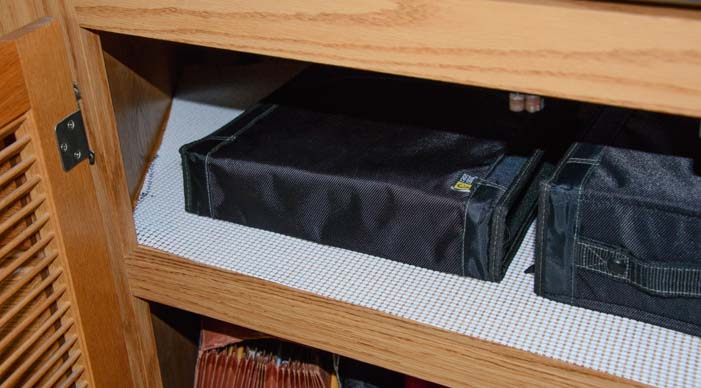
Shelf liner for RV shelves

Shelf liner keeps things in place when we drive

Closet Organization with Plastic Drawers

Our bedroom has a marvelous 8′ wide closet with sliding doors on it, but the interior is just open space with a rod for hangers. We don’t use it as a hanging closet (we have a different closet for that). Instead, we put stacked plastic drawers inside to give us more drawer space as well as a horizontal surface on the top.

RV closet plastic drawer organizer

We created more drawer space in one closet with lightweight, inexpensive plastic drawers.

These drawers don’t latch closed, so Mark drilled a hole through each drawer and the frame, and we simply slip a screw through each hole to keep it closed as we drive.
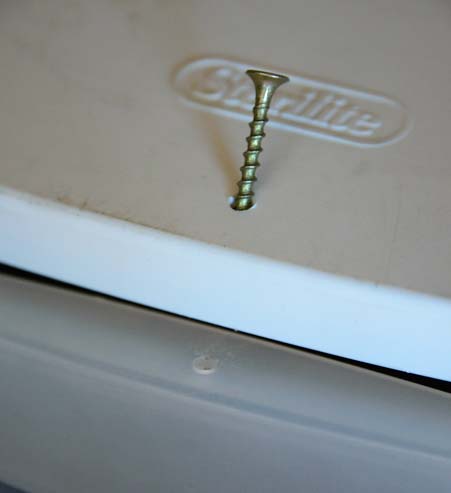
How to keep RV drawers closed

A screw through each drawer keeps it from opening in transit

Book Organization with Special Bins

We like to keep our heaviest items, like books, on the floor, as shelving in an RV tends to be quite flimsy. I found an awesome line of Rubbermaid “All Access” bins that have a clear plastic latching door on the front. Ours fits neatly under our desk (which we never use as a desk, so it’s wasted space). We can move the whole thing easily, can load it from the top easily and can get at the books from the front easily.
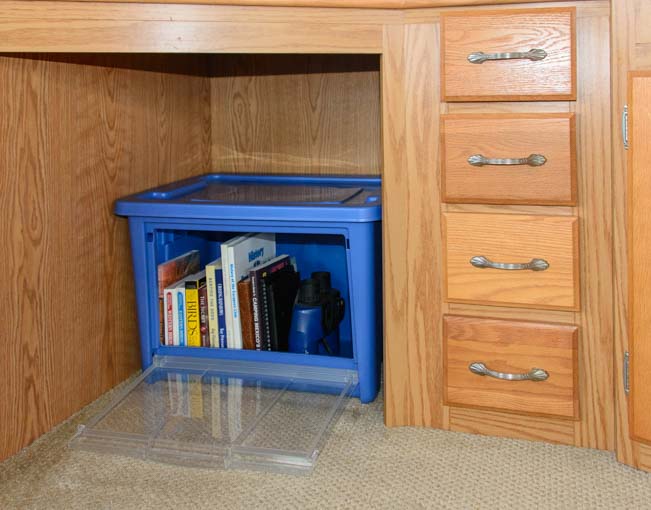
Rubbermaid All Access storage in RV

Rubbermaid’s “All Access” bins have clear front opening doors!

Dish Drying Mat

We do several small loads of dishes everyday, and I just love our little dish drying mat. It soaks up all the water, and once I move the dishes off of it I can hang it up to dry. Every so often I throw it in the laundry with the dish towels, and it comes out just fine.

RV dish drying mat

A dish drying mat sops up water, can be hung out to dry and thrown in the laundry.

How to Defrost an RV Refrigerator in 20 Minutes!

Propane RV refrigerators build up a lot of frost very quickly. After trying many different methods for defrosting our fridge over the years, we’ve outlined the steps we use to get this job done quickly:

How to Defrost an RV Refrigerator in 20 Minutes!
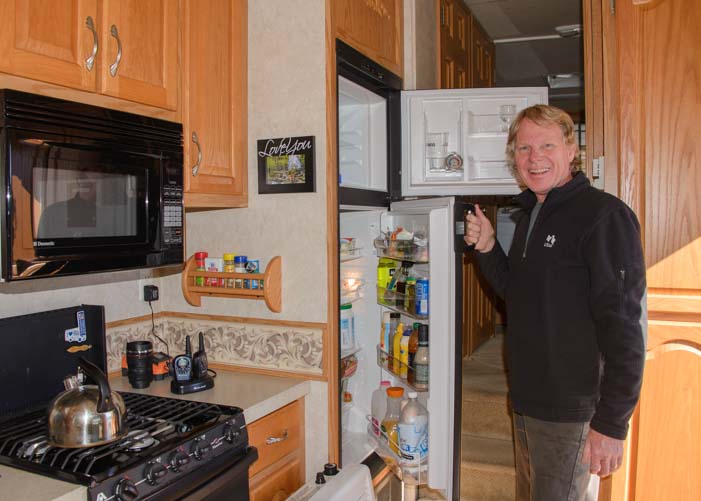
How to defrost an RV refrigerator

Defrosting the fridge doesn’t have to be a big nasty chore…

LED Wax Pillar Candles

I love romantic lighting, and there’s nothing like candles for that. But having an open flame isn’t great. Sailing friends of ours introduced us to pillar shaped LED candles made of real wax, and they are delightful. We’ve had ours for five years now, and we’ve had to change the batteries just once. They are wonderful for dim lighting in the pre-dawn hours or late at night, and they are a nice light around the rig when we watch a movie. The best part is they really look and feel like real candles, but you don’t have the risk that comes with an open flame.

RV tips LED flameless wax pillar candles in RV

LED pillar candles add warmth and create romantic mood lighting

Departure Checklist

RV Departure Checklist

All our mistakes on one page
with the worst ones underlined!

We thought we could memorize all the things that need to be done when we pack up the rig for towing, but a few mishaps taught us otherwise.

We now have a checklist taped inside the same cabinet that houses the main slide-out controls.

A quick glance before we leave ensures us that indeed all the hatches are closed, the shower door is latched, the window-mounted hummingbird feeder is not stuck on a window somewhere, etc.

This list is a comedy of errors made over several years of RVing. I’m sure more items will be added in the future!


Simmons Beautyrest Mattress

An RV can be outfitted with ordinary residential furniture, and we have upgraded our recliners to comfy La-Z-Boys.

More important for full-time RVers, there is no need to sleep on some funky RV mattress every night. We upgraded our mattress to a Simmons Beautyrest and just love it.

One important note is that many RV mattresses are non-standard sizes. An “RV Queen” is shorter than a standard Queen, and an “RV King” is narrower than a standard King. Here’s a chart showing the differences:

Standard “RV” Size
Queen 60″ x 80″ 60″ x 74″
King 76″ x 80″ 72″ x 80″
Simmons Beautyrest Plush Pillowtop mattress for RV

A good night’s rest…

In most rigs that have a Queen bed, the floorplan clearly states whether it is an RV Queen or a regular Queen. However, in virtually all RVs that have a king bed, it is an RV king. If you are buying an RV with a king bed and think you might want to upgrade to a residential mattress someday, make sure there are 4″ of extra width on the sides so the mattress can fit, even if it hangs over a little.


Laptop Lap Insulator

I mentioned that we don’t use our desk, and that’s because we use our dining room table for writing things out by hand and we use our laptops on our laps in our recliners. To keep from frying our legs with our laptops, we each have a laptop sized thin piece of foam that was part of the packaging of a solar panel. If you don’t have that handy, there are laptop lap insulators that can do the trick.

Laptop on thin foam insulation

A thin piece of foam keeps our legs from cooking under our laptops

Cleaning the Ceiling

We have a fabric ceiling liner and twice we’ve had to clean a stain from it. Each time we used spray bleach and the results were miraculous. You couldn’t see where the stain had been. Just make sure you cover everything nearby before spraying bleach in the air or you’ll have not just a clean ceiling but white spots on the rugs and upholstery too.


HEALTH and COMFORT in the RV LIFE

Living in an RV is not all that different than living in a stick-built house, so anything you enjoy in a conventional life is more than likely going to be something you can enjoy in your RV life. Here are some goodies that we use everyday, that have made a significant difference in our lives, and that we will continue to use daily no matter what kind of home we live in:

Amazing Grass

Amazing Grass powdered wheat grass drink

Helps keep fair haired people with thin skin from bleeding!

Mark has found that when he works around the rig, it is really easy for him to get little cuts and blood spots on the backs of his hand his hands. This turns out to be common with fair haired (red haired) formerly freckle-faced guys over 50. After some research, we found that the remedy is bunches of Vitamin K, and it turns out that wheat grass is loaded with Vitamin K! It has lots of other beneficial nutrients as well.

As long as Mark drinks a small dose of wheat grass everyday, his hands are as tough as when he was 20. But miss that wheat grass for a few days, and the next time he does any work around the rig, the slightest flick of his hand against something breaks the skin and he’s bleeding again. The best brand we’ve found is Amazing Grass.

Sound weird or too good to be true? We’ve suggested this crazy remedy to formerly red-haired friends, and they are now big believers and wheat grass connoisseurs too. Mark mixes it with fruit juice and actually loves the flavor! For those who don’t like veggies, the claim is that a spoonful of this wheatgrass powder is akin to a bushel basket of veggies. I don’t believe that myself, and I keep putting broccoli on our plates, but I think this stuff is worth its weight in gold when it comes to toughening up thin skin.

Hand-held Electric Massager

As former athletes, we’ve both spent a lot of time looking for ways to soothe aching muscles. We’ve owned a lot of different hand-held massaging tools over the years, including the very popular massager, and they’ve all been okay. But many of them ultimately wound up in yard sales because they had bad habits of pinching skin or were awkward to use.
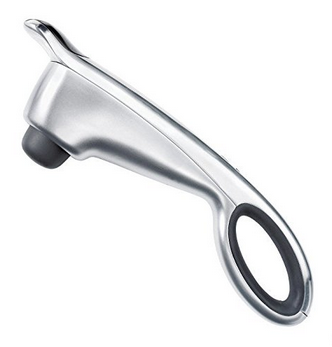
 electric massager

electric massager

We’ve found that the hand-held massager is really fantastic. Because it has just one ball head on it (rather than the more common and goofy twin ball heads), you can place it over any sore spot and get instant relief. Rub it slowly on your leg muscles after a hike or bike ride or rub it on that weird spot in your neck after you sleep funny and wake up unable to turn your head, and you’ll feel better right away.

This massager was a lifesaver for me after a bad cycling accident I had years ago that messed up my shoulders and collar bone for a very long time, and Mark recently relied on it heavily when he wrenched his back. We’ve never had it pinch our skin at all.

The neat thing about these massagers is that they increase the blood and fluid flow in the sore area, which is really helpful for getting nutrients into the injured spot and getting waste fluids out. You don’t need to press hard on it — just place it on the sore area and you’ll feel the muscle relax instantly.

We have had ours for four years now, and we used it both on the boat and in our RV. It’s amazing just how kinked up you can get living in a small space, and it is so helpful to be able to get unkinked in a matter of minutes. We keep it in our living room so it’s always handy.

Sonicare Toothbrush

Sonicare toothbrush

Sonicare toothbrush

If only these Sonicare toothbrushes (and toothbrush heads) had been around when we were kids! It may seem ridiculous to spend a bunch of money on an electric toothbrush, but brushing your teeth with one of these makes your mouth feel like you just came from a cleaning at the dentist’s office. I’ve used a Sonicare toothbrush for 13 years now, and what a difference it has made in the overall health of my teeth.

One note for boondockers and off-the-grid RVers living on solar power, Phillips, the manufacturer of Sonicare toothbrushes has noted that the rechargeable batteries do not like modified sine wave inverters very much. I read this years ago, and have always charged ours on our pure sine wave inverter. Perhaps the batteries are better in newer models, I don’t know.

Also, for tech junkies who like to collect tech goodies, the magnet inside the Sonicare toothbrush heads is incredibly strong. Mark has saved a few of the magnets from our discarded Sonicare toothbrush heads and has found all kinds of interesting uses for them, including gluing one onto a long stick to retrieve tiny metal objects from hard to reach spots in the bowels of something.

Other RV Tips & Tricks

We have loads of other tips and tricks for RVers on this website. Many of the links can be found here:

RV Tech Tips and Product Reviews

A small sampling is below:

A wonderful website dedicated to RVing tips and tricks is RVtravel.com

Subscribe
Never miss a post — it’s free!

Our most recent posts:

More of our Latest Posts are in the MENU.   New to this site? Visit RVers Start Here to find where we keep all the good stuff. Also check out our COOL NEW GEAR STORE!! *** CLICK HERE *** to see it!

Below are some of our most POPULAR POSTS (also in the MENUS above)

Buddy - A Journey in Spirit - The story of an event that changed our lives forever.

ARTICLE INDEXES
  • RV Tech Tips Articles - A one page index of links to all our RV Tech Tips, RV Upgrades & RV Maintenance articles.
  • RV Lifestyle Tip Articles - An index of links to all our RV Lifestyle Tips (finances, boondocking, major repairs, work/jobs, etc.)
  • Solar Power Articles - Overview and tutorial articles for how to design and install solar power on an RV or boat
  • Product Reviews - An index of links to all of our Product Reviews
RV UPGRADES, SYSTEMS & TIPS MONEY FULL-TIME RV LIFESTYLE GEAR STORE
  • Gear Store - A list of the goodies, equipment and gear we've found useful in our RV lifestyle!
 

One Ton Towing Machines and 75 Years of Trailer Life

The July 2016 issue of Trailer Life Magazine is featuring our article about what it takes for a One Ton Truck to be a true heavy duty towing machine. We are incredibly proud to have been asked to write this article about diesel trucks for Trailer Life, and especially that it appears in this month’s very special edition: Trailer Life’s 75th Anniversary Issue.

Trailer Life Magazine Choosing a Truck for Heavy Duty Towing

Trailer Life Magazine – July 2016
Article by: Emily Fagan. Photos by Mark & Emily Fagan
You can read the article here: One Ton Towing Machines

Trailer Life Magazine has been reviewing trucks and giving readers insights and pointers for towing trailers since 1941. As they note on the cover, Trailer Life is “North America’s oldest and most-read magazine for RV enthusiasts.”

Besides our 7 page article about selecting a diesel pickup truck for towing a heavy trailer, this issue looks back at 75 years of RV history and has some wonderful articles on the evolution of RVing.

2016 Dodge Ram 3500 Dually truck in Valley of the Gods Utah

Trucks and trailers have gone through a huge evolution in the past 75 years!

From the Bowlus Road Chief aluminum sided trailers that resembled an upside down boat and inspired the Airstream, to the Shasta trailers that my hubby Mark remembers from his boyhood camping days with his family, to the iconic Winnebago bread box motorhomes with the big “W” on the side that we still see people driving all over the country, this issue of Trailer Life takes us back in time.

1937 Bowlus Road Chief

A 1937 Bowlus Road Chief — precursor to the Airstream Trailer!

1954 Shasta Travel Trailer

1954 Shasta Travel Trailer – Mark camped in one of these as a kid!

In this issue, they also talk about the resurgence of interest in retro trailers — we see so many retro trailers on the road as we travel! — and they also have a biographical article about the “Godfather” of Trailer Life Magazine, Art Rouse.

1950 Chevy and 1947 Tear Drop Trailer

We spotted a 1950 Chevy and 1947 Tear Drop Trailer in Sun Valley Idaho

1959 Streamline Trailer

We met up with owners/restorers of a 1959 Streamline Trailer in Lost Dutchman State Park, Arizona

It is really exciting for our contribution about 2016 diesel trucks to be published this month right alongside such a fun and detailed retrospective look at the RV industry’s history.

Americans — and the world — have taken to RV living in trailers and motorhomes with great gusto for many years. We first got a true feeling for this long history when we visited the RV/MH Hall of Fame Museum in the heart of the RV industry — Elkhart, Indiana — back when we traveled through that area in 2010.

A Visit to the RV/MH Hall of Fame Museum

Besides being able to go into the museum library and peruse yellowed copies of Trailer Life, Escapees Magazine and Motorhome Magazine, as well as many others, from decades ago (the advertisements are hilarious and say so much about American culture in each era!), we also took a walk back in time along their winding indoor “Road Back in Time” exhibit. This took us past and through small and classic RVs from every decade.

RV-MH Hall of Fame Museum Road Back in Time

The “Road Back in Time” at the RV/MH Hall of Fame Museum in Elkhart, Indiana

Some of the craziest and earliest trailers of nearly 100 years ago were just a canvas tent on wheels (some even had wooden wheels!). The museum also displays Mae West’s House Car and other exotics, as well as a few Shasta, Mallard and Coachmen trailers and Winnebago motorhomes from the 50’s to the 70’s.

1967 19' Winnebegao Motor Home

a 19′ 1967 Winnebegao Motorhome on the “Road Back in Time”

But the cool thing is to see these oldies-but-goodies out on the road and still in use as we travel, and to meet people who have bought brand new retro style trailers too. You can get the old fashioned look but have all brand new appliances with the latest technology. How fun!

Modern retro trailer RV

We had a chance to peek inside a brand new retro-style trailer in City of Rocks. NM – Wonderful!

Retro trailer RV

This fantastic retro trailer was pulled by a Honda Element… perfect!

Trailer Life Magazine has been celebrating their 75th anniversary all year long with some really intriguing online articles about the RV industry’s history. Here a link to a few delightful ones:

75 Years of Trailer Life – Online Article Index

For anyone contemplating the RV life or currently enjoying it, Trailer Life Magazine fills a special educational and inspirational niche. It is available both as a glossy print magazine and in digital form online.

After being subscribers ourselves for many years, we began publishing travel destination and technical features in their pages a few years ago (a sampling can be read here), and we still find something new and valuable in every issue. You can subscribe to Trailer Life’s print magazine or digital edition here:

Subscribe to Trailer Life Magazine

We love vintage trailers and get such a kick out of seeing them on the road. We’ve had a few fun enounters with owners of special trailers who have lovingly restored them:

As for buying a big ol’ truck to tow a modern monster fifth wheel trailer, there are some important things to take into account, as not all One Ton trucks are created equal, by a long shot. We talk about a few of those “must have” features in this blog post:

What to Look For When Choosing a Truck for Heavy Duty Towing – Tips for Truck Buyers

There are also quite a few other articles about trucks and towing on this blog as well:

Blog posts about trucks and trailer towing:

Subscribe
Never miss a post — it’s free!

Our most recent posts:

More of our Latest Posts are in the MENU above.

Choosing a Tripod – Sunwayfoto Tripod & Ball Head Review

Selfie mania has taken the world by storm, and in our travels we are no exception.

Selfie photo taken with a bear

Mark gets a selfie with a bear. Wow!

And selfie sticks are all the rage at every scenic overlook we go to.

Selfie sticks and camera tripod

The gear of choice in the National Parks is the selfie stick!

But there is a better way to hold a camera still, especially a big DSLR: a good quality tripod and ball head!

Nikon D810 on Sunwayfoto T2C40C Tripod with XB-52DL ballhead and PNL-D810R bracket

Sunwayfoto T2C40C Tripod and XB-52 Ballhead

Photography has become a major part of our lives and travels, and as our skills have improved, we have upgraded our camera equipment as well. In the following link we outline all of the gear we use, from cameras and lenses to accessories like flashes and tripods to software for post-processing (as well as explaining how we organize our photos), and we also provide links to all the resources we’ve used to learn how to take photos:

Photography Gear, Tips and Resources

Tripods – Cheap vs. Expensive

It is said that as a photographer improves, his or her biggest equipment concern goes from getting the right camera body to buying the most appropriate lenses to finding the best tripod. We are working our way along this progression, and soon after Mark purchased his Nikon D810 camera a few months ago, he began casting about to find a suitable tripod for it.

Mark’s old tripod / ball head combo was too flimsy to support the D810 properly, and it wasn’t all that easy to use. He decided on the Sunwayfoto XB-52DL “Low Profile” Ball Head sitting on the Sunwayfoto T2C40C tripod legs with an optional DDC-60LR Quick Release Clamp.

Because we have a lot of readers who are seeking to improve their photography as they travel, just like we are, we wanted to share our experiences with this new tripod kit.

Sunwayfoto XB-52DL Ballhead with T2C40C Tripod and DDC-60LR Quick Release Clamp

Sunwayfoto DDC-60LR Quick Release Clamp atop an XB-52 Ballhead
all sitting on a Sunwayfoto T2C40C Tripod

When we first became interested in photography, we couldn’t understand why tripods could be as cheap as $29 or as much as $1,500. But we have learned since then that the price/performance trade-off is very simple, and it all boils down to three things:

  • Sturdiness
  • Overall weight
  • Ease of use

Cheap tripods take precious time to set up, can be difficult to position the camera correctly to get the image you want, don’t necessarily hold the camera perfectly still (and sometimes even let it droop a little after you’ve got everything in place), and are often too short to put the camera at eye level. Expensive tripods do all those things with ease, and they are lightweight enough to carry comfortably.

When is a tripod handy to use? Whenever the shutter speed is so slow that hand-holding the camera will make the whole image blurry because your hand moves while taking the photo.

Sunwayfoto XB-52DL Ball Head T2C240C Tripod PNL-810R L-Bracket Review-2

With a tripod, flowing water can be made to look silky smooth.

We use ours all the time for low light photography (sunrise and sunset), for night photography (shooting starry nights and the Milky Way), for long shutter speeds to reveal movement, like the flow of waterfalls, and for time-lapse sequences that show movement in a video format, like fast moving clouds and changing light.

Sunwayfoto XB-52DL Ballhead with DDC-60 Quick Release Clamp

The Sunwayfoto XB-52DL ball head is rated to support a whopping 132 lbs., far more than other comparable tripod ball heads.

Like most budding photographers, we’ve frittered away lots of good money on cheap tripods as we’ve learned these lessons. After all, when you’ve broken the bank buying a camera and lenses, who wants to dig deeper in their pockets to get a decent tripod?

As is his way, Mark did an exhaustive search with a few criteria in mind for what he wanted in his new tripod. It had to be:

  • Stable enough to hold the camera with our longest lens, which is a Tamron 150-600mm 
  • The ball head had to be strong enough that the camera wouldn’t droop after it was tightened 
  • The tripod legs had to be carbon fiber (i.e., strong and lightweight)
  • He didn’t want it to spend all our savings on it
Sunwayfoto XB-52DL Ballhead with T2C40C Tripod and DDC-60LR Quick Release Clamp

An excellent value.

In the end he settled on the Sunwayfoto T2C40C Tripod with the Sunwayfoto XB-52DL “Low Profile” Ball Head. This is a Chinese brand that is not particularly well known in the US yet, and is competing against the much more expensive brands like Gitzo.

Sunwayfoto – Quality Camera Gear at a Good Price

Mark began looking into the Sunwayfoto brand because we both used their L-Brackets on our Nikon D610 cameras and Mark now uses the Sunwafoto PNL-D810R L-Bracket on his new Nikon D810. We liked the craftsmanship of our L-brackets, and when we discovered Sunwayfoto makes tripods and ball heads, their tripod kits seemed worthy of a closer look.

Side note: an L-Bracket is a handy piece of gear that mounts on the camera so the camera can be slipped onto the tripod easily. Because the bracket is an L-shape, the camera can be switched from a landscape orientation to a portrait orientation quickly and easily.

PNL-D810R Bracket for Nikon D810 camera

The Sunwafoto PNL-D810R L-bracket mounts on the camera to simplify the use of a tripod.

Sunwayfoto PNL-D810R mounted on Nikon D810 camera

Nikon D810 camera with Sunwafoto L-bracket attached.

Sunwayfoto PNL-D810R mounted on Nikon D810 camera

The L-bracket gets screwed into the bottom of the camera.

What’s neat about the Sunwayfoto L-brackets is that they fit the camera body perfectly, even when the plastic cover protecting the camera’s LCD display is in place. L-brackets made by other manufacturers don’t always fit properly when the plastic LCD protector is on. The Sunwayfoto L-brackets also provide lots of room to plug optional cables (like an external microphone) into the left side of the camera.

Sunwayfoto XB-52 “Low Profile” Ball Head

Getting a good, solid and easy to use ball head was the most important criteria for Mark’s new tripod. The Sunwayfoto XB-52DL “Low Profile” Ball Head is the biggest of Sunwayfoto’s ball head offerings, and it is truly unbelievable in craftsmanship and strength. It is beautifully machined and anodized from a solid piece of aluminum. It also has a geared locking mechanism that claims a Max Load of 132 lbs (60 kg)! That is 82 more pounds than top-of-the-line Really Right Stuff’s largest ball head.

Sunwayfoto XB-52DL Ballhead for camera tripod

Sunwayfot XB-52DL Ballhead

Sunwayfoto XB-52DL camera ballhead

Sunwayfoto XB-52DL ballhead

When locked down, the camera does not budge on this ball head. Even when carrying the tripod on his shoulder, Mark has found the camera doesn’t droop like it did with his old tripod setup.

Carrying Sunway T2C40C Tripod with XB52-DL and Nikon D610 camera

The ballhead holds the camera securely when walking around with the tripod on your shoulder.

The large locking knob on this ball head is made from solid metal and has an excellent feel to it. There is no rubber to wear out or come loose.

Sunwayfoto XB-52DL Ballhead Adjustment Knob

There are two adjustment knobs for the ball,
a large outer knob and a smaller inner dial.

There are two knobs for adjusting the position of the camera, a larger knob for gross adjustments and a fine tuning dial within that knob that lets you set precisely how easily (loosely) the camera swivels on the ball head.

Sunwayfoto XB-52DL Ballhead Fine Tuning Knob

The smaller knob fine-tunes how easily the camera flops around on the ball when it is loose. The larger one tightens it down.

There are also two notches on the ball head body to allow the camera either to be dropped extra far forward (for images aimed towards the ground) or to be tilted sideways (for portrait oriented images).

Sunwayfoto XB-52DL Ballhead notches

There are two notches that allow the camera to be dropped down, rather than just a single one like many ball heads.

Sunwayfoto XB-52DL ballhead notches for camera angles

The notches in the ballhead allow the camera to be faced down.

Sunwayfoto XB-52DL ballhead notch points camera down

.

The notches for setting up a portrait orientation are handy if you don’t want to use an L-bracket.

Nikon D810 on Sunwayfoto XB-52DL ballhead PNL-D810R bracket and T2C40C Tripod

The notches allow the camera to be flopped on its side for a portrait shot.

We prefer using an L-bracket and not using the ball head notches for portrait shots because of the inherent stability of placing the camera on the top of the tripod for portrait orientations instead of having it hang off the side.

Nikon D810 camera landscape mode on Sunwayfoto PNL-D810R and XB-52DL ballhead

Using an L-bracket gives the option of either a
landscape orientation…

Nikon D810 camera portrait mode on Sunwayfoto PNL-D810R and XB-52DL ballhead

…or portrait orientation
Here the camera is on top of the tripod and not flopped to the side in one of the notches, a more balanced and secure setup.

For the weight conscious, the Sunwayfoto XB-44 ball head is slightly smaller and lighter than the XB-52 but can still support a whopping 88 lbs. It weighs just 483 grams as compared to the 685 grams of the bigger ballhead, a difference of over 7 ounces (nearly half a pound), which some folks would find makes a difference on a long hike.

“Quick Release” or “Lever Release” Clamps

One of the best things about the XB-52DL “Low Profile” Ball Head is the fast action of the quick release. Simply flip the quick release lever open and slip the camera into the Arca Swiss compatible slot and then close the lever, and you are ready to go.

Sunwayfoto DLC60 Quick Release Lever Clamp

The Sunwayfoto quick release clamp makes it super easy to lock the camera in position.

Note that the Sunwayfoto XB-52 ball head without the “DL” suffix does not have a quick release clamp.

I was so impressed by Mark’s new tripod ball head, and especially the quick release mechanism, that I got one too. It replaced the Benro V2 ball head that had come with my Benro Travel Angel II tripod. The Benro ball head had a knob that had to be unscrewed and screwed back in each time the camera was mounted or dismounted on the tripod, something that got to be a real pain when I wanted to switch between portrait and landscape orientations quickly. It is also not nearly as finely crafted.

Like Mark, I absolutely LOVE the XB-52DL ball head. Even though it is almost 13 ounces heavier than my old Benro ball head, I find it is fast and easy and precise and worth the few extra ounces of carrying weight on a long hike. My tripod can still be strapped onto my Camelback H.A.W.G. hydration pack for those long days of hiking where I want 100 ounces of water along with a second lens, assorted filters, spare battery and SD cards.

Sunwayfoto XB-52DL ball head on Benro Travel Angel II Tripod Legs carried on a Camelback H.A.W.G

The ultlra strong Sunwayfoto XB-52DL ball head fits comfortably on my Benro tripod legs and can be carried easily with my Camelbak H.A.W.G. hydration pack.

The quick release clamp locking lever has three positions: Open (right), Center, and Closed (left). There is a slide-lock on the lever so you can’t accidentally bump it and risk having your camera fall off the tripod.

The knob opposite the quick release clamp is used to fine-tune the tension, or grip, on the clamp holding the camera’s L-bracket in place. This is an important knob if you have more than one camera body and L-bracket (or other Arca Swiss style plate), because the widths vary ever so slightly.

Sunwayfoto DLC60 Quick Release Lever Clamp

In the “open” position, the camera slips onto the plate.
The knob (top) adjusts the grip on the camera’s L-bracket or plate

When the lever is in the Center position, the locking mechanism is half open and allows the camera to slide from left to right within the range of the stops on the L-Bracket, but is still secure so the camera won’t slide out and fall to the ground.

Sunwayfoto DLC60 Quick Release Lever Clamp

In the “center” position the camera can be slid from side to side on the plate without falling off.

Nikon D810 on Sunwayfoto T2C40C Tripod with XB-52DL ballhead and PNL-D810R bracket

The camera can be slid about an inch to the left and right while everything else remains in place on the tripod.

When the lever is opened all the way, the camera can be removed for handheld shooting or for switching to the other orientation (portrait or landscape) quickly.

Sunwayfoto DDC-60LR Quick Release Clamp

Mark likes to do panorama shots, so he opted to replace the quick release clamp (or “Lever Release”) plate that comes with the XB-52DL ball head with the DDC-60LR Quick Release Clamp instead, because it has a bubble level that indicates whether the series of shots are going to be level with the horizon or are going so go sailing off on some kind of crazy diagonal, ruining the final, stitched image.

Sunwayfoto DDC-60LR Lever Release clamp bubble level and tension knob

The optional DDC-60LR lever release has a bubble level which helps with stitching multiple images into one panorama shot.

This is another finely made product that not only makes mounting the camera on the tripod a snap and makes switching from landscape to portrait (with an L-bracket) an absolute breeze, but provides a mechanism for leveling as well.

The primary difference between this quick release clamp and the one that comes with the XB-52DL ball head is that the knob opposite the quick release clamp that is used to adjust the grip tension on the camera’s L-bracket (or other Arca Swiss style plate) is no longer there. It has been replaced by the bubble level. In the absence of this knob, there is a small dial on the plate for adjusting the grip tension instead.

Sunwayfoto DDC-60LR Lever Release clamp bubble level and tension knob

The fine tuning grip tension knob is now a dial on the plate itself.

There is a spring that sits against the dial to hold it in place once you set it to your liking. Mark found the spring was a bit loose and the dial would turn a little on its own until he put a drop of Blue Loctite on the threads. In hindsight, he’s found that this has made it difficult to adjust the tension.

Another subtle difference between the Sunwayfoto DDC-60LR Quick Lever Release Clamp and the one that comes with the XB-52DL ball head is that the open/closed positions of the quick release lever can be reversed (for left handed people). Simply place the lever in the center position, pull it out slightly, and rotate it. Then the open and closed positions will be in the opposite directions (left to open and right to close).

Our overall impression is that the quick release clamp that comes with the Sunwayfoto XB-52DL Ball Head is easier to work with than the DDC-60LR Quick Release Clamp because the grip tension adjustment is done with a knob rather than a tiny dial. However, it also has a minor limitation, for those who want to stitch together lots of images for panoramas, that it doesn’t have a bubble level.

Sunwayfoto T2C40C Tripod

The tripod legs Mark chose are the Sunwayfoto T2C40C tripod legs. This tripod is a thing of beauty, with 8 layers of woven carbon fiber and a one piece CNC machined main structure.

Sunwayfoto T2C40C Tripod legs

The Sunwayfoto T2C40C tripod has carbon fiber legs.

The leg joints on this tripod have longer (40mm) friction tubes in them than are found on most comparable tripods, which makes a sturdier connection between the leg joints when they are extended. The tripod is rated at a max load of 12KG or 26.5 lbs. which isn’t the beefiest tripod out there, but the legs seem solid enough for the Nikon D810 and big Tamron 150-600 lens.

Sunwayfoto T2C40C Tripod leg joints

The legs extend and retract by rotating a knob at each joint.

The only drawback is that the tripod is only 52.5” tall (without the center column extended). Once the XB-52 ball head is attached, it stands 56” high, which is a few inches taller than Mark’s older tripod setup and is almost at eye level for him (he would love for it to be just a few inches taller!).

Another improvement would be to have some foam on at least one of the legs for carrying in cold weather, although foam might start to deteriorate over time, and this tripod looks like it will last a long time.

Sunwayfoto T2C40C Tripod with Nikon D810 camera

The tripod is just about at eye level for Mark, but not quite.

The Sunwayfoto T2C40C tripod also has a very innovative (patented) leg pivot mechanism. Instead of the typical hex head screw attachment to connect the legs, there is a connector which has a special anti-twisting boss design on one screw head while the other side screws into it with a torx type connecting screw (the Torx wrench is included with the tripod). This prevents the screws from twisting and loosening up inside the leg attachment as the legs are pivoted and moved back and forth to set up. Most Tripods legs need to be tightened frequently with two hex style wrenches.

Mark found that after using this tripod for about a month he actually needed to tighten those screws a bit. He removed the screws and put a drop of Blue Loctite on the threads which helped.

Sunwayfoto T2C40C Tripod and XB-52DL ballhead

There are torx screws to keep the leg joints at the top stiff.

One neat feature of the Sunwayfoto T2C40C tripod is that the rubber feet on the bottoms of the legs can be unscrewed and removed to expose corrosion resistant Titanium spikes. These spikes plant the tripod firmly in loose conditions. Some of the other hardware used in this tripod is also made of Titanium, which very impressive indeed!

Sunwayfoto T2C40C Tripod titanium feet covers

The rubber feet at the bottom of the tripod legs can be unscrewed.

Sunwayfoto T2C40C Tripod titanium feet

Underneath the rubber protection booties, the tripod has titanium points for gripping loose soil.

The center column of the tripod can be removed and replaced with the included short column so you can splay the legs out all the way out for close-to-the-ground macro photography.

Sunwayfoto T2C40C Tripod without center column for macro photography

The center column is removable to allow for close-up photography
that is low to the ground.

The Sunwayfoto T2C40C tripod also comes with a spring hook that can be put on the bottom of either the long or short center column tube to help weight it down in windy conditions. Mark likes to hang his gear bag on it to keep his pack off of the ground and help steady the tripod.

Sunwayfoto T2C40C Tripod with gear bag suspended

You can hang your gear bag on the center hook to weight the tripod down.

The Sunwayfoto T2C40C tripod comes packed in a high quality padded carry bag that has carry straps that can be attached to it for hiking. The kit even includes a nice lens cleaning cloth (a cleaning cloth is also provided with the Sunwayfoto XB ball heads).

Sunwayfoto T2C40C Tripod in padded carrying case

The Sunwayfoto T2C40C tripod comes with a good quality
padded carrying case.

Sunwayfoto T2C240C Tripod Review

The tripod carrying case has both a shoulder strap and a carrying handle as well as several pockets for small items like spare memory cards and battery.

Sunwayfoto is continuing to perfect their design of this tripod. When it was first introduced, it had only one anti-twist slot or groove in each of the legs, which made it prone to rotating and breaking. This resulted in some unfavorable online reviews of the tripod. The design has been upgraded and now has 2 slots in each leg. 

If you are in the market for a quality tripod kit, the Sunwayfoto ball heads, quick release clamps, L-brackets and tripod legs are a good bang for the buck. All of these are mix-and-match, so if you already have tripod legs you like, as I did, you can simply upgrade the ball head and/or the quick release clamp. Or, go all out like Mark did, and get the whole darn kit!

Sunwayfoto XB-52DL Ball Head T2C240C Tripod PNL-810R L-Bracket Review

.

Happy shooting!!

Subscribe
Never miss a post — it’s free!

Here is a little more manufacturer info about these products and links to buy them:

Here is all the camera gear we use and resources we’ve relied on to learn photography:

Our most recent posts:

More of our Latest Posts are in the MENU above.


Cruising Mexico’s Sweet Costalegre (“Happy Coast”) – in Sailing Magazine!

The June 2016 issue of Sailing Magazine is featuring our article about cruising Mexico’s sweet Costalgre coast. This 50 mile long stretch of Pacific coast shoreline has 10 or so anchorages that vary in size from tiny to enormous and that vary in spirit from an immersion in nature to fancy and elegant resorts.

It is a favorite cruising ground for sailors heading to Mexico — they call it the “Gold Coast” — and some cruisers return year after year.

Sailboat anchored in Chamela Bay Gold Coast Mexico Costalegre

Mexico’s Costalegre has some beautiful anchorages

The seeds for publishing this article in Sailing Magazine were planted over two years ago, but the opportune moment didn’t strike until this month. We are very proud to be contributors to this outstanding magazine and to have our story and photos appear in its pages.

Porta-bote on the beach in Paraiso on the Costalegre Mexico

The tiny cove at Paraiso has a sweet beach and jade colored water.

Many of our readers know us only as RVers, so I thought this would be a nice time to reflect back a bit on the life altering years we spent on our sailboat Groovy in Mexico between 2010 and 2013 and to share some of our photos from Mexico’s Costalegre in a larger format than is available on our older blog pages that were written while we were there.

Boats at the Las Hadas Resort Marina Manzanillo Mexico Pacific Coast Costalegre (2)

The Las Hadas Resort in Manzanillo looks like the Mediterranean!

The Costalegre (a concatenation of the words “Costa” (coast) and “Alegre” (cheerful or happy)) is situated south of and around the corner from Puerto Vallarta.

Map of Mexico Costalegre Pacific Coast

The Costalegre is a small bit of coast that is one of Mexico’s major cruising destinations.

Interactive Link: Location of the Costalegre and its anchorages on Google Maps

Most of western Mexico’s cruising grounds are very spread out between Ensenada, just below San Diego, and Puerto Chiapas down by the Guatemala border some 2,000 miles away. However, in the Costalegre region it is possible to daysail from one anchorage to the next, rather than sailing overnight as most destinations require, which is part of what makes it so popular.

Manzanillo Bay lies at the far southern end of the Costalegre, and it is home to several anchorages that are within an hour or two of each other by sailboat. Manzanillo Bay has incredible sunsets and sunrises — or it did when we were there — due in part to the power plant at the south end of the bay that spews soot particulates into the air!

Sailboat at Sunset Santiago Bay Manzanillo Mexico on the Costalegre

The sunrises and sunsets in Manzanillo Bay are stunning.

Construction was underway to convert the power plant to natural gas when we were there. Once it’s up and running, the sometimes polluted air will improve, but it may be the end of these reliably gorgeous skies!

Next door is the Las Hadas Resort where the movie 10 with Bo Derek was filmed. This is a charming resort full of crazy architecture decorated with funny gargoyles. It has a decidedly Mediterranean feeling to it.

Las Hadas Resort beach Manzanillo Mexico Costalegre Gold Coast (1)

Las Hadas Resort anchorage in Mexico – Beautiful!

The bay is big enough for about 15 or 20 boats and is a great place to stay a while.

Sailboat anchored at Las Hadas

Our boat Groovy anchored at Las Hadas

In our cruise we passed through the Costalegre four times all together on our way to and from the Sea of Cortez up north and Zihuatanejo and Huatulco in the far south of Mexico.

Las Hadas Resort sailing anchorage Manzanillo Mexico Costalegre

Las Hadas is great stop between Puerto Vallarta and Zihuatanejo, and we spent a lot of happy weeks there.

One of the most unexpected pleasures of cruising Mexico’s Pacific coast was that so many of the anchorages are in front of resorts. We hopped in and out of lots of resort swimming pools — what a life!

Las Hadas Resort Beach with sailboats on the bay Manzanillo Mexico Costalegre (1)

Sometimes resorts will let cruisers use the amenities like this glorious swimming pool at Las Hadas.

Occasionally the resorts ask cruisers to pay a day use fee to enjoy their resort facilities. Other times, buying a beer and snacks at the pool bar will suffice.

Las Hadas Resort Manzanillo Mexico Pacific Coast Costalegre

Not a bad spot to spend a day!

Manzanillo Bay is anchored by the city of Manzanillo at its south end. We met an adventurous RVing couple from Cuba (he) and Mexico (she), and at one point we jumped in their truck together to go get propane for our sailboat and for their rig. This took us into downtown Manzanillo, which is quite colorful but very urban.

Manzanillo downtown Mexico Costalegre (1)

Downtown Manzanillo gives a more realistic picture of life in Mexico than the resorts.

One of the things that took some getting used to, but that we found very fun, was the open air markets. There is lots of street food available as well as fresh veggies and sometimes deliciously fresh orange juice that enterprising people sell from carts in the street. And there’s nothing like grabbing lunch from a taco stand — the trick is always to buy this kind of food where there is a long line of locals. That means it’s good!

Fresh produce was available at many small markets.

Fresh produce was available at many small markets.

Another thing that taught us a lot about Mexico, about our own ability to be resourceful, and about how to speak Spanish, was going to the hardware stores in search of parts to fix broken things on the boat. RVs often need repairs and maintenance, but boats need a whole lot more because they are more complex vehicles and the salt air and salt water is extremely corrosive.

Once we learned how to say the word for hardware store (“ferretería”), we were off and running.

Carrying the broken boat part with us, we’d hunt down a hardware shop and throw around some beginner Spanish and some slowly spoken English.

Invariably, we’d get a lot of sympathy as well as directions to another ferretería that might actually have what we were looking for!

Usually the directions were off by a few blocks one way or the other, so after a bunch more walking (and a bit of sightseeing, of course) we’d arrive at the next place and do it all over again!

It was a hoot and we met a lot of really wonderful people that way.

America is very efficient, but keeping a boat maintained and in tip-top working order in Mexico gave us endless heartwarming experiences and chances to get to know a little about our neighbors to the south.

Hardware store on Pacific Coast of Mexico

Does this place have the little gizmo we need for the boat?

And whether or not we got the part we needed to finish our repair, there was usually a fabulous sunset at the end of the day that would light the sky on fire.

Sunrise on Costalegre Mexico Pacific Coast Gold Coast

Ahhhh…

We found that in the wintertime much of Mexico’s Pacific coast has murky water that is often plagued by red tide. However, one spring we stopped in the tiny bay of Paraiso on the Costalegre and found ourselves surrounded by crystal clear jade colored water. What a delight! Let’s jump in!

Well, jumping off the boat to play in the water always included 15 or 20 minutes of scraping the barnacles off the bottom of the boat! That was a chore we did frequently, but how wonderful to be able to do it in such beautiful water!

Snorkeling at Paraiso Bay in Costalegre Mexico

Cleaning the hull of the boat was fun in this kind of water!

In the Las Hadas anchorage in Manzanillo, we needed to fuel up. There is diesel available at a boat dock, but it was very challenging to get a big boat up to that dock easily. We managed that tricky maneuver in our third year when we were seasoned sailors, but in our first year we hauled diesel in jerry jugs from the fuel dock out to our boat in the dinghy, and we used a Super Siphon to get the diesel from the can into the boat’s fuel tank.

Filling the diesel tank with jerry jugs cruising Mexico

There is diesel available in Las Hadas, but it’s not so easy to tie the boat up to the dock.
Using jerry jugs and a Super Siphon was a simple alternative!

Another jewel of an anchorage on the Costalegre is Careyes. This is a tiny cove tucked behind an island, and all the homes have been painted vibrant primary colors. What a backdrop!!

Sailboat at Costa Careyes Mexico

Groovy anchored at Careyes

It is rumored that Heidi Klum has a home here. Unfortunately, we didn’t see her!

Careyes is a very difficult place to anchor because there are contrary currents and tides and winds that all join forces to set every boat off on a wild dance. So, very few boats go there. We were the only cruising boat in the anchorage the whole time we were there.

A stern anchor is an absolute necessity to keep the boat pointing in the right direction. We chose a Manson because it had no moving parts to bite our shins and had a nice handle to hold onto!

Stern anchor is necessary for sailboat in Careyes Bay Mexico Costalegre Gold Coast

Careyes is a beautiful anchorage, but a stern anchor is necessary to counteract the enormous current and swell.

But it is worth the effort to get the boat anchored in Careyes. What a lovely view of the palm tree lined beach!

Beach and houses at Careyes Mexico Costalegre

Pretty view at Careyes

Swell is part of the everyday picture when cruising Mexico, and for boaters whose experience is cruising the protected anchorages of the Pacific Northwest or Maine (like me), it is a real surprise to discover just how much a boat can roll. I wrote a blog post about the joys of swell here and it shows the action of the swell on a huge tanker near the Las Hadas anchorage in Manzanillo— yikes!

The waves are wild because Mexico’s Pacific coast is wide open to the Pacific, and there is nothing stopping the waves or slowing them down as they come in from the open ocean!

Perula Beach Chamela Bay in Mexico Riviera

Swell is significant on Mexico’s Pacific coast. It can be a challenge to land the dink on the beach!

So, landing a dinghy can be a challenge. And getting the dinghy launched from the beach to go back to the big boat is an even greater challenge!! But the beaches themselves are wonderful. The beach at Pérula in Chamela Bay is filled with fishing “pangas” (the open boats the locals use…all made in Mazatlan).

Fishing pangas on the beach at Perula

Fishing pangas on the beach at Perula

We wandered into Pérula (known to cruisers as Chamela) a little ways, and found a delightful little restaurant with a tiny kitchen and two or three tables.

Restaurant at Punta Perula in Chamela Bay Mexico

This little hole-in-the-wall restaurant in Pérula is typical of the fun and informal eateries on the coast.

Of course, almost every beach has plastic chairs and tables set out, and you can always plop down and dig your toes in the sand and enjoy the view with a Corona.

Perula Chamela Bay Beer on the Beach Costalegre Mexico Pacific Coast (1)

Now THIS is cruising!

Since Mexico’s Pacific coast is filled with high end resorts, there are plenty of places to find more elegant beachfront dining. In the tiny Costa Cuastecomates (once known as the “Secret Anchorage” because the entrance is hard to see from the open ocean — until the GPS coordinates were published in a guidebook (and a great book it is)), we found a beautiful resort at one end of the beach.

Cuastecomate bay resort Costalegre Mexico Gold Coast

We found an upscale waterfront dining option in the “secret anchorage” of Cuastecomate.

In front of Las Hadas Resort there are tables set up to enjoy the beach and a view of the sailboats anchored in the cove.

Las Hadas Resort beach dining

Beach dining at Las Hadas Resort

With its Mediterranean flair, Las Hadas (which means “the fairies”) also has very cute pairs of beach chairs lined up facing the bay.

Beach chairs Las Hadas Resort Manzanillo Costalegre Mexico

Fun little beach chairs at Las Hadas in Manzanillo

One of the all-time favorite destinations for cruiser’s on the Gold Coast is Barra de Navidad. Unlike all the other anchorages which are merely indentations in the land that are not protected from the open ocean, Barra de Navidad is in an estuary that is entirely enclosed.

Lots of cruisers settle in here for a few weeks or months, not only because the boat is unaffected by swell and sits flat on the water, but because the entire bay is lined with fun little eateries, beach bars and watering holes.

The only downside to anchoring here long term is that the water is too silty and dirty to make water with a watermaker and you can’t discharge the holding tanks unless you hoist the anchor and weave down the shallow and narrow channel to go out for a day sail on the open ocean.

There is a water taxi service in Barra de Navidad that can take you from your boat to anywhere on the shore for a few pesos. There is even a baker who hails from France and who sells his fresh croissants and quiches from boat to boat every morning!!

French Baker in Barra de Navidad anchorage in Mexico Costalegre

Every morning in Barra de Navidad, the French Baker delivers croissants and quiche to cruisers that are eagerly waiting in their cockpits, coffee cup in hand!

Gosh, will it be a chocolate croissant or an almond croissant this morning??

Barra de Navidad boat-in bar Costalegre Pacific Coast Mexico

Barra de Navidad has water taxis throughout the estuary to take you to waterfront dining of all kinds.

I just have to show another sunrise shot from Manzanillo Bay. It is so amazing to peek out the window and find yourself on a sea of pink!!

Sunrise Manzanillo Bay Mexico

Sunrise in Manzanillo Bay

Some spots on the Costalegre are busy and full of people, like the estuary of Barra de Navidad, the beach at Santiago Bay, and Las Hadas Resort in Manzanillo.

Dinghies lined up on the beach Santiago Bay Manzanillo Mexico Costalegre

Dinghies lined up on the beach at Santiago Bay in Manzanillo

But others are supremely quiet, like the little islands off of Chamela bay. Here, we pulled our dinghy up on the beach and had the island to ourselves.

Sailboat anchored in Chamela Bay near Perula Mexico Costalgre Gold Coast

Our dink on its own at the offshore islands of Chamela Bay.

And in a lot of places we found there were RV parks that backed right up to the beach.

RV on the beach in Mexico

There are RV parks on many beaches. This is at Pérula on Chamela Bay.

In the years we were there, the biggest ongoing story in the media was about all the violence in Mexico. We never saw any violence in all the years we were in Mexico.

The rumor among the many travelers who love Mexico and the one million ex-pats who live there was that the media smear was a ploy to keep Americans in the US spending their vacation dollars on American soil rather than in Mexico. After all, we were at the height of the financial woes that followed on the heels of the the banking meltdown of 2008.

Full-time RV childhood in a Motorhome in the 1980's

Imagine growing up in an RV traveling the Americas!

The few RVers that we met were enjoying their RV parks all by themselves all winter long. Many had taken their RV to Mexico each winter for a decade or more, and they told us those same RV parks had been booked to overflowing by mid-November in prior years.

At the end of our cruise, the owner of a pretty villa in the Costalegre village of La Manzanilla invited us to stay at his place for a week.

It turned out that he was German and his parents had raised him living in a motorhome full-time as they traveled throughout North and South America from Alaska to Cape Horn.

His unique tales and photos of growing up in a motorhome and boondocking on the beach in the 1980’s are told in these two blog posts:

RVers in Mexico saw a lot more of the country than we did, since our travels were restricted to the coast. We did take some phenomenal trips inland on long distances buses, though, visiting the colonial cities of Oaxaca, Guanajuato and San Cristobal de las Casas and visiting the Mayan ruins of Palenque and Monte Alban.

Cuastecomate view of the beach Mexico Costalegre

Beach bars galore in the “secret anchorage” of Cuastecomate

However, there are sights to be seen in Mexico that RVers can’t easily reach because they require the use of a privately owned boat. One of these is Isla Isabel (Isabella Island). This tiny island is a bit north of the Costalegre but is a definite “must see” for any cruiser sailing Mexico’s west coast.

There’s nothing there but a few fishermen and lots of nature. And blue footed boobies!

Blue footed boobie Pacific Mexico Coast

Blue footed boobies! In Mexico!!!

We were there in the spring, and a mixed flock of brown boobies, masked boobies and blue footed boobies were all nesting on the island. The chicks were full sized but still covered with down. The parents let us get close, but they made a point to stand in front of their babies as we walked up.

Blue footed boogie guards its chick in Mexico (1)

A blue footed booby guards its baby.

There is lots of other unusual wildlife to be spotted along the Costalegre, and we watched a group of frigate birds hanging around a partially submerged shipwreck in Santiago Bay.

A frigate bird takes a close look at us.

A frigate bird takes a close look at us.

Around the bend in the Las Hadas Resort anchorage we were greeted by a flock of adorable little birds that perched on our lifelines. These guys know cruisers and boats quite well, and each time we went through that area we found them chirping and flying on and off our lifelines!!

Birds on the lifelines of our boat (1)

These little guys greeted us and landed on our lifelines every time we came into Manzanillo

Out in the open ocean along the Costalegre we also saw lots and lots of sea turtles. Mexico has done a great job of protecting these guys, making sure their nesting sites are not disturbed and that the little babies can get down to the ocean without human interference. Of course, after their dangerous scramble down the beach to the crashing waves, they are met with the eager beaks of waiting birds that circle and fly low over the water to snatch them up as yummy snacks.

A sea turtle on Mexico's Pacific Coast

The waters along the Costalegre are filled with sea turtles.

Birds like to land on the sea turtles, and the turtles don’t seem to mind. So we often saw “turtle-birds” when we went out sailing. On more than one occasion we saw a particular turtle-bird on our way out on a daysail, and the same turtle-bird was floating there when we came back three hours later!

Sea turtle and Boobie on Mexico Pacific Coast

Sometimes sea birds catch a ride on a turtle’s back – and stay there for hours!

Perhaps the most exotic animal we saw on the Costalegre (and in the Sea of Cortez) was the flying mobula rays. These guys fly out of the water and flap their wings like mad and then land on the water with a big smack. It was loud enough that if you were down below in the cabin, you’d come running up on deck to see what made the noise.

The funny thing was that these guys seem to do this jumping thing out of sheer joy. They don’t just jump up and down. They do somersaults and back flips!!

Flying mobula ray manta ray Mexico Pacific Coast

The mobula rays fly into the air and do all kinds of acrobatics!

One day while we were out day sailing in Manzanillo Bay, we saw a whale breaching. We saw whales in quite a few places in Mexico, and sometimes they breached near us, but this was really unusual because the heavily populated shoreline was right there!

On another occasion, while dinghying between the small town of La Manzanilla (a favorite ex-pat hangout for Canadians) and the anchorage that cruisers call Tenacatita (and is actually known to the locals as Blue Bay or Crazy Angels Bay), we saw a mother whale and her baby playing in the water. It was early morning and the water was as still and clear as glass. The mom flopped around on her back and waved her fins around, and the baby did the same thing right next to her. Sweet!

Breaching whale Santiago Bay Manzanillo Costalegre Mexico

A breaching whale in Manzanillo Bay

Mexico’s Pacific Coast is a tourist destination, and there are tourist oriented activities of all kinds. One afternoon we looked out from the cockpit of Groovy in Santiago Bay and saw horseback riders walking along the sand.

Horseback riding on Santiago Bay Manzanillo Mexico Pacific Coast

Riders on horseback on the beach at Santiago

But perhaps the best thing about cruising Mexico and taking it slow in the Costalegre was getting to know a little about the Mexican culture. Young girls celebrate their 15th birthday with a huge party called the Quniceañera, and we often saw beautiful 15 year olds in photo shoots dressed in very pretty and flouncy dresses.

The Belle of the Ball preps for her 15th birthday.

Sweet 15!

In the final weeks of our Mexico cruise when we were staying in a marina in Ensenada, a thousand miles north of the Costalegre, we ended up hosting a Quinceanera photo shoot aboard Groovy. What fun!

For more detailed info about each of the anchorages on the Costalegre as well as Puerto Vallarta and Ensenada, we have created a video that makes it easy to get the lay of the land with a bowl of popcorn!

This video (the first in a series of three videos) shows what there is to see and do in each anchorage and also gives insights into Mexico’s weather patterns and climate and suggests an overall itinerary for getting the most out of your Mexico sailing cruise.

For more stories from our Mexico cruise, we have loads of blog posts here.

We also have a two page series chock full of tips for cruisers heading to Mexico:

If you are an avid sailor or are curious about the cruising lifestyle, I highly recommend checking out Sailing Magazine. It has been inspiring sailors for decades and was on my family’s coffee table in the 1960’s as I was growing up, fueling my dad’s secret cruising dreams. Even if, like my dad, you never have a chance to fulfill those dreams, Sailing Magazine has endless stories from folks who have had the good fortune to sail off over the horizon, and it makes for fantastic escapist adventure reading.

The June issue is on newsstands now and has lots more of our photos and info from the Costalegre. You can buy a subscription here:

Sailing Magazine Subscription

More info for cruisers sailing to Mexico can be found on these pages:

  • Planning Your Cruise – Tips plus Cruising Guides, Field Guides and Travel Guides
  • What To Expect On Your Cruise – Living on a boat in Mexico is crazy and fun, but there’s an adjustment period!
  • Maps of Mexico – Lots of maps that show what’s where on Mexico’s Pacific Coast and in the Sea of Cortez
  • More links and info below…

Subscribe
Never miss a post — it’s free!

Map, geography and cruising info for the Costalegre and Isla Isabel:

Other blog posts, links and webpages from our Mexico sailing blog:

Our most recent posts:

More of our Latest Posts are in the MENU above.

Sell or Lease the House? Full-time RVer Dilemma!

For many RVers planning to fulfill their dream of living in an RV full-time, one of the biggest challenges is figuring out what to do with the house. More than deciding which rig to buy or which truck will be the best towing machine or whether solar power is a necessity, downsizing and getting out from under the house can cause an awful lot of stress. Sometimes market conditions are ideal, and it’s possible to sell the house for a tidy profit in just a few days. But that isn’t always the case.

Full-time RVer's Guide to Leasing Your House Escapees RV Club Magazine May-June 2016

Article by: Emily and Mark Fagan
Escapees Magazine May/June 2016

For us, the housing market was just tipping over the edge into one of its most horrific death spirals in seven decades during the very month that we decided to go full-time.

Although we initially sold our house in three days, our buyer backed out a few weeks later, leaving us high and dry with almost no possessions left to our names, a trailer waiting for us to move in, and echoes bouncing off the walls of our home because it was so empty.

We knew we could lease our house a whole lot faster than we could find another buyer, and time was of the essence, because we were halfway out the door and into our new lifestyle already!

So, we took the plunge and decided to hang onto our house and lease it while we traveled in our RV full-time.

A “For Rent” sign in the yard brought us a qualified tenant within a week, and off we went into our new lives still shouldering the burden of being homeowners.

Looking back at that crazy few weeks of transition, and the tears I shed over losing our buyer, I am so grateful that the gods were showering their fairy dust on us at the time and forcing us to keep a hand in the housing market.

Since then, house prices more than halved and then nearly doubled, but rents have steadily increased, and there has never been a shortage of good people looking to rent a nice home.

We have had five different sets of tenants ranging in age from recent college grads to folks long past retirement age. We’ve rented to people richer than us and poorer than us.

And perhaps most surprisingly, we’ve leased not just to people who’ve never owned a home of their own, but to folks who owned a home in the past, and even to folks who currently owned a home somewhere else (including a couple who owned a house three times the size of ours just one mile down the road!).

People have all kinds of reasons for needing to rent a home for a while!

What to do with the house in the full-time RV life

We thought it would be better to sell the house,
but we’re glad we’ve leased it all these years.

The common assumption that tenants will destroy a house and skip out on the rent is only a small part of a much larger story about tenants and landlords. What we’ve found with this home, and what I found with previous homes I have leased out in earlier phases of my life, is that the bottom line in how well the home fares — and how well the landlord fares — is dependent on how good the relationship is between tenant and landlord.

If there is no relationship at all — that is, if the home is being leased by a property manager — then there is no chance for any kind of trust and respect to develop between the tenant and landlord.

Leaving home to live in an RV

Tenants may take better care of your home than you expect!.

However, if you do the work yourself of hand-picking your tenants and collecting rent and overseeing repairs, and if you are the one who transfers the care of your house — your kitchen, your bedroom, your garden and all the things you like about the house — to your tenants, then it is much more likely they will respect both you and the home, and pay their rent on time, and take good care of the house.

We have been back to our home a few times since we ran off in our trailer in 2007, and each time, within a week or two, we have brought the house back to a spit-and-polish condition and have even upgraded it a bit.

These days our home is much nicer than when we lived in it ourselves all those years ago because we’ve had the time — and the empty house between tenants — to do the upgrades we always wanted to do before!!

On the financial side of things, depending on how much equity you have in your house, the income stream can be very favorable.

If you multiply the rent you can get for your house times the number of months and years you think you might be traveling full-time, the total amount of rent you could receive is staggering.

Obviously, you have to take out property taxes, HOA fees and repairs, insurance and mortgage payments, but the net can still be a sizeable amount. It might even be more than you would get if you put that equity into some other kind of investment.

Full-time RV lifestyle decisions

Along with the Yard Sale sign,
will it be a For Rent sign or a For Sale sign?

Certainly, if you keep the house, you don’t have to forfeit 6% of its total value (which is potentially a much larger percentage of your hard earned equity) to real estate agents.

We have published an article with some pointers we’ve picked up from our personal experience with leasing our house for the May/June 2016 issue of Escapees Magazine.

I am just one of many members who publishes articles in Escapees Magazine, and both Mark and I find that each issue (there are 6 issues a year) is chock full of interesting tid-bits that help us out in this crazy nomadic life we live on the road. It is a terrific member benefit!

Escapees is a very unusual RV club because they offer a wide variety of goodies besides the magazine that assist in every imagineable facet of the RV lifestyle.

Escapees has a special program called CARE for elderly RVers who are looking for an assisted living situation but don’t want to move out of their RV. They also offer discounted RV park stays for RVers that are actively traveling with their RV. For those who want a place to call “home,” they offer RV park site ownership, and for those who want to camp for free they offer the Day’s End Directory listing of boondocking sites all over North America.

Escapees RV Club

A Multi-faceted RV Club.

For RVers who love to travel but who want to see places they can’t drive their RV to, they offer group tours, from cruises to international destinations. And for newcomers to the RV lifestyle they offer Bootcamp programs to teach them everything they need to know. Every year there is a club-wide rally called Escapade, and individual chapters all across the continent have get-togethers of all kinds.

Join Escapees RV Club has reached out to younger RVers with the new Xscapers program (check out their a popular Facebook page), and there are interest-based groups that bring together like-minded RVers who share hobbies like beading, geo-caching, photography and more. Escapees has an active presence on the RV social site RVillage.com.

We visited the Escapees Headquarters in Livingston, Texas, last spring and saw the incredible mail sorting facility in action. Along with offering a mail forwarding service, they also offer all the assistance necessary to establish a legal domicile in Livingston, Texas.

Perhaps the most important service that Escapees provides, and something that benefits all RVers, no matter whether they are members or not, is the RV advocacy program. They stay on top of all legal and political wranglings that could affect the RV lifestyle, whether it’s a vacation lifestyle or full-time lifestyle. Most recently, they helped stave off proposed changes to the ability of South Dakota based full-time RVers to vote in elections (including the upcoming presidential election).

Escapees RV Club

.

We became members a year after we started this crazy full-time traveling lifestyle. Over the years, as we have become more sensitive to what it means to be an RVer and to live the RV lifestyle full-time, our appreciation for the club’s many benefits has grown.

I have been recommending Escapees to our readers since I started this blog in 2008, because I believe in what they are doing and I believe they have something to offer to everyone who is interested in RVing.

Launching the full-time RV lifestyle

Renting our house has worked out for us!

Join Escapees RV Club

The editors of Escapees Magazine have kindly allowed me to share my article about leasing our house here:

Full-time RVer’s Guide to Leasing Your House

If you’ve been stressing out about finding a buyer for your house so you can run away to live your RV dreams, it’s possible that leasing it out would not be just a viable option but might even be a preferable way to go.

Subscribe
Never miss a post — it’s free!
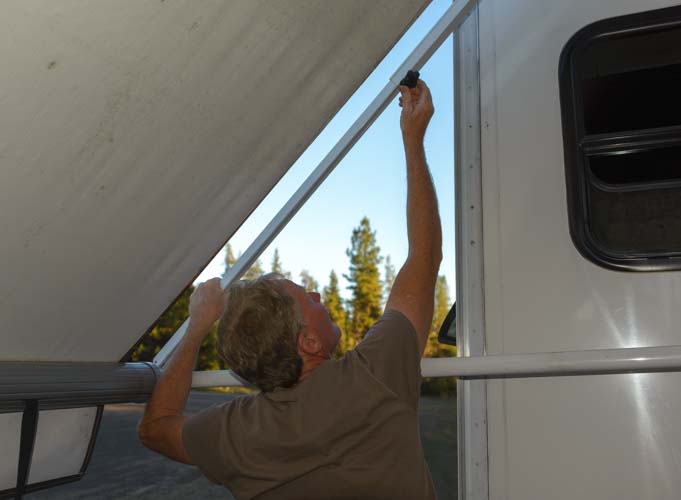
Other blog posts related to the financial and logistical aspects of being a Full-time RVer:

Our most recent posts:

More of our Latest Posts are in the MENU above.

9th Anniversary of Full-time Travel by RV and Sailboat – Reflections!

Today is our 9th anniversary of traveling full-time. We left the comfort and security of hearth and home on May 22nd, 2007. We’ve spent this morning looking at old photos and reminiscing, and it’s amusing, sweet and very nostalgic. We are still the same people we were nine years ago, but we have changed and grown immensely, and our lives have taken delightfully unexpected twists and turns.

9 years of traveling full-time in an RV and sailboat

Time flies when you’re having fun – Today is our 9th Anniversary of traveling full-time!!
Here we are in our first year…a little green behind the ears but so excited to be free!

We’ve also mastered a lot of things related to travel, RVing, sailing, and living, and it’s all due enrolling in the School of Hard Knocks where we signed up for classes taught by the incomparable professor, Experience.

I know many of our readers are planning their eventual escape to a life of freedom on the road or at sea, and I know that in reading blogs like this one and many others, it is really easy to forget that all those exciting travel stories began somewhere, and in a lot of cases, like ours, that starting point was very humble.

Happy campers in the full-time RV lifestyle

Nine years later…seasoned travelers, but still so excited to be free!
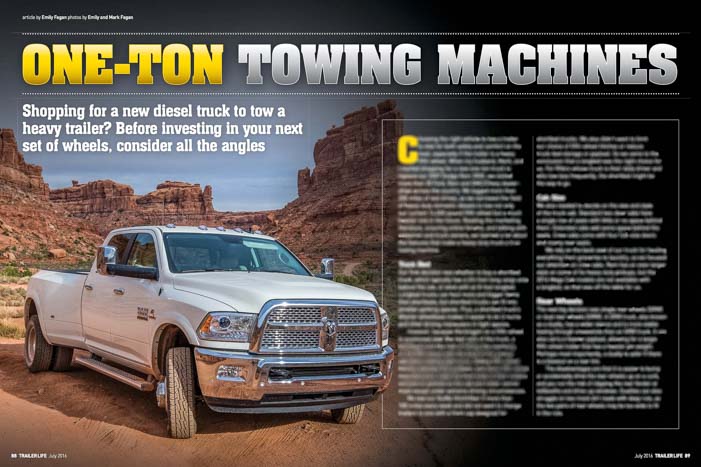
I think a lot of future travelers look at the folks that are out there doing it already and want to jump into their lives full-blown and skip the learning curves and mistakes. I know I did! I read lots of magazine articles and books by sailors and other travelers and watched lots of inspiring videos before we left, and I wanted to blink myself into their shoes.

And I figured that by doing a lot of reading I could bypass all the silly mistakes they’d made.

2007 Fleetwood Lynx travel trailer for ful-time RV living

Our first full-time RV – a 2007 Fleetwood Prowler Lynx Travel Trailer, seen here on its first day!

But I’m really glad for all the notes we’ve taken in our classes with Prof. Experience and for all the difficult assignments and horrifyingly challenging exams he has given us over the years, and I’ve been thinking about a few of them today.

We took an enormous leap of faith on this day nine years ago, and we had a very busy, euphoric, scary and thrilling period of downsizing in the weeks leading up to our launch.

Everything we owned had to fit in the back of our ’04 Toyota Tundra or in an 11′ x 5′ shed in a friend’s back yard before we could drive 1,000 miles to pick up our brand new, bought-over-the-internet 2007 27′ Fleetwood Prowler Lynx travel trailer.

2004 Toyota Tundra for full-time RV travel

Everything we would be taking in our travels had to fit into the truck bed!

Unfortunately, during our first days of testing out our our new home in an RV park attached to a gas station a few miles from the dealership, we discovered that because the trailer had sat on the dealer lot in the wild Texas rains for a while, and a small leak in the RV refrigerator vent had resulted in mold growing under the refrigerator!!

If downsizing and evaluating all of our worldly possessions and choosing which ones to keep and which to toss hadn’t been stressful enough (and, as part of that, reviewing our entire lives up to that point — a very emotional task), driving 1,000 miles to move into a trailer riddled with mold could have put us over the edge.

But we gathered our wits together, made our plea to the dealership (Marshall’s RV in Kemp Texas), and fortunately, they were extremely accommodating and swapped out the rig we had bought for an identical one they had just received from the manufacturer the week before.

Phew!!

Moving from one Fleetwood Lynx Travel Trailer to another

We hit bumps in the road right off the bat with mold in our brand new rig. The dealer let us swap it for another!

Like most full-time travelers who have taken the plunge and hit the road or sailed off to sea, our memories of our first months of travel are as vivid today as when they happened 9 years ago.

After staying in RV parks in Texas, and struggling to figure out where the RV parks were, which ones were nice, and how to fit our rig into the small spaces, we gave boondocking a try one night in New Mexico.

We had no idea how boondocking worked, and we weren’t set up for it yet, but we just parked randomly and went to bed. We figured that if we woke up in the morning, still alive, and without having gotten a knock on the door in the middle of the night, boondocking was A-okay.

Lesson learned? In hindsight, we would never ever park in a place like that now. We were so close to the road the rig swayed every time a car went by. But what the heck did we know then? Nothing!! And thank goodness we gave it a try! The only thing that approached our rig that night was a herd of curious cows who came by in the morning.

A pair of boondockers was born that night, and our lives were changed forever!

Fleetwood Prowler Lynx travel trailer for full-time RVing

Our first boondocking spot. Hmm… we had a lot to learn about finding good campsites!

In New Mexico we stopped in a coffee shop where we met an unusual fellow who made and sold dream catchers. He had a beautiful one decorated with macaw feathers, and he offered it to me for free for good luck in our new full-time travels.

I was really touched by his generosity, but I knew that if we started collecting things, our new little buggy would be overflowing in no time. So I sadly turned him down and satisfied myself with a photo.

A theme of simple living without accumulating stuff had begun.

Dreamcatcher art made from Macaw feathers

How many cool souvenirs could we keep in this lifestyle?

As I chatted with him, two cowboys came into the coffee shop. We had never seen real cowboys before, and the cling-clang of their spurs as they walked made us smile. Wow!! We were seeing cool stuff!! This is why we went traveling!! Life was awesome!!

We both cracked up when the cowboys ordered their coffee. They wanted fancy latte drinks with all the trimmings. After placing their lengthy order, one said to the other, “When did coffee get so complicated?”

Indeed! We wanted to live the simple life

Travel experiences on the road in an RV

We discovered that the locals are the most interesting people we meet in our travels.

We were on a mission to get to the west coast, because our goal was Vancouver Island.

Driving the less traveled roads of New Mexico, we passed through an area that was filled with delightful metal art. Ranch gates were beautifully decorated with metal art, and a whole town was filled with it.

Most of my photos of this wonderful area are blurry because we drove through it so fast and didn’t stop. We’d left home just 8 days prior and we were in One Big Hurry.

This past fall, we went through Tatum, New Mexico, once again, but this time we stuck around and savored the flavor of this very cool little town and even met one of the artists responsible for the fantastic metal art.

We’ve learned to slow down in our tavels: Why rush?

Metal Art in Tatum New Mexico

Slowing down was a huge lesson for us.
Almost nine years later we returned to Tatum NM and explored it for real!

Once we got to California, we swung through a few National Parks at a lickety-split pace. We were ecstatic to be free, to be on our own, and to be living without an agenda (other than getting to Vancouver Island).

Such joy!!

Happy camper in the full-time RV lifestyle

Radiantly happy!

Looking at these pics now, we can see how the years have passed — we looked so much younger in those days — and it really drives home for us how important it is not to put off your dreams for too long.

Life has a funny way of slipping through our fingers, and if there’s one lesson we try to remember each and every day, it’s that life is very precious, very short, and deserves to be lived to the fullest.

Exploring California and Yosemite full-time RV lifestyle

Looking back, we were just kids then!

We had done a ton of camping in our popup tent trailer before we moved into this great big travel trailer, and we knew that we wanted to dry camp a lot in our new lifestyle too. In fact, we rarely got hookups even when we went to campgrounds.

This was possible because of a single little solar panel we’d purchased. When we stayed in the campground at Mammoth Lakes, California, we were still setting up the solar panel on the ground every day. It would be another few weeks before we’d get to a campground on the California coast overlooking the ocean where Mark would mount the solar panel permanently on the roof and run the wiring to the charge controller and batteries.

RV camping Mammoth Lakes California

We’ve learned a lot of technical things about RVing, including how solar power works.

I had hopes that we would become experts in various aspects of RVing like solar power. Little did I know that what we would learn about RVing and sailing would soon fill volumes — and actually does on this website as well as in 80 magazine articles! But that incredible acquisition of knowledge and expertise happens to all RVers and sailors who travel for a long time, it’s just that some are more inclined to write it all down.

A lot of people put off their full-time RVing dreams because it isn’t the right time. Either the housing market is wrong for getting out from under the house, or gas prices are too high, or the pension possibilities that might be coming after another five years of the grind at work are too good to pass up.

Gas prices June 2007 full-time RV travel and camping

Gas prices in May 2007
Whether they go up or down shouldn’t alter our dreams.

Yet I don’t think too many people on their deathbeds look back over their lives and say they should have spent more time in the office. And gas prices — well — you never know about those. We’ve seen prices bounce all over the place between $1.67 per gallon and $5+ per gallon in our nine years on the road!

These old photos are amusing too, because they show just how much the world has changed since we stopped living a conventional lifestyle. In the early days, I would look forward to being in places where I could get a copy of USA Today and read it at leisure over coffee.

RV camping first days of full-timing

The only things we still have in our lives today: me and that jacket!

One photo caught my eye because it shows me reading the newspaper with coffee made in a French Press I’d used in an earlier sailing lifestyle where there is unlimited rinse water all around the boat. I quickly ditched the French Press for a Melitta filter. And who reads the newspaper any more?

Perhaps the most interesting in the photo is that when we started out, we relied on travel and camping guides to decide where to go and where to stay. What I found, though, was that the travel guides were written by people who didn’t travel the way we wanted to. Their interests and opinions were different from ours, and their five star recommendations were often two stars in our book.

So we got rid of all travel guides and now rely on conversations with the locals and fellow travelers, Google searches (clicking on “Images”) to see what places look like, and our own instincts and current mood.

It can be scary to think about running off in an RV or sailboat to go traveling, and a lot of that fear has to do with giving up the things you cherish and that you know won’t be the same or even possible on the road. This is different for everyone, but for us it had to do with giving up intense, race-level cycling.

We rode as much as 250 miles a week before we began full-time RVing, and cycling was the focus of our daily lives. In our life on the road now, we ride every so often, but not intensely, not far, and, of course, not with the same group of friends that we once had.

Cycling and bicycling in the full-time RV lifestyle

Giving up cycling was the hardest part of going full-time for us, and in this early photo we were making a valiant effort to keep it up, but it has proved impossible to do. We miss it, but we wouldn’t trade our nine years of travels for it!

We aren’t as fit as we used to be, and we both sorely miss those days of panting for hours on end on gorgeous mountain climbs on 17 lb. race bikes. But would we trade nine years of travel for that fitness level and those hours in the saddle? Never.

The experiences we’ve had since we left home have shaped us and taught how to travel — something that takes time and patience — and we’ve been introduced to people, places and things that we never would have seen if we were still cycling those beloved routes round and round our old house.

For one thing, we had no idea when we started that we would buy a boat and cruise Mexico!

Perhaps best of all, we’ve been able to indulge a new passion that we felt budding in our old lives but couldn’t do much about while living in one spot: photography. When we started traveling, we loved our beginner cameras and used them bunches, but we knew nothing about how to take a photo or process it, other than the basics.

Now we live each day looking for beautiful places where we can improve our photography skills and enjoy the splendor of this world as much as possible. Our evenings are spent processing our photos.

When we started, we had absolutely no idea our travels would take us in that direction of personal development and fulfillment.

Happy RV campers at Bridal Veil Falls Yosemite National Park California

We were so thrilled to visit Yosemite our first year!

So, if you are pondering doing some travel, or have a dream of any kind that is lurking in the shadows, let it take wing and fly. Our evolution was gradual and is still unfolding. You can see that our beginnings were modest.

We didn’t jump into this lifestyle as full-blown RV experts or as professional photographers or published freelance writers. We didn’t start with any knowledge about solar power, and we didn’t start with a big fancy rig. All of that took time, and the educational process was extraordinary.

Canadian Rockies RV adventure travel

What we saw yesterday in the Canadian Rockies!!

So…

Dream Big and Go for it!!

Subscribe
Never miss a post — it’s free!

Other blog posts with our insights and reflections on living our dreams:

An Overview of Our First 10 Years of Full-time Travel + Reflections after 9 Years!

Summaries of Each Year on the Road - All of our travel posts in chronological order:

Our most recent posts:

More of our Latest Posts are in the MENU.   New to this site? Visit RVers Start Here to find where we keep all the good stuff. Also check out our COOL NEW GEAR STORE!! *** CLICK HERE *** to see it!