The other day we found ourselves at a fabulous RV dealership in Missoula, Montana: Bretz RV and Marine on I-90. This is a huge place that has a mammoth inventory of trailers and motorhomes that spills over several lots. What a great spot to go RV shopping!
But what brought us here? Well, the 99 cents per gallon propane deal they are offering was one thing, and the free and extremely well laid out RV dump station was another. What a place!
A free dump and ultra cheap propane brought us to a very cool RV dealership in Montana
After we’d dumped and gotten our propane, we decided to have a look around the RV lots and check out some of the very pretty RVs. Bretz has an enormous selection of Airstream trailers, and we got a huge kick out of seeing a few up close. Beautiful!
How fun it was to prowl around these classic Airstream trailers.
I have written a little about what to look for in an RV for full-time living, and one of the things that a lot of new RVers don’t realize when they go shopping is how important it is to get a trailer with an adequate Cargo Carrying Capacity.
Cargo Carrying Capacity is the difference between what the RV weighs when there is nothing in it (the “Unloaded Vehicle Weight” or UVW) and what it weighs when you have loaded it down with all of your personal belongings plus food, water and propane as well as upgrades like solar power, washer/dryer, a big battery bank, a generator, a bike rack and bikes, etc., (the “Gross Vehicle Weight” or GVW).
It is important not to exceed the Cargo Carrying Capacity!
If you do, then you’ve gone over the trailer’s GVWR (“Gross Vehicle Weight Rating”) which is the maximum safe weight for the trailer when it is fully loaded.
On older trailers the GVWR is posted on a sticker that is placed on the outside of the trailer up near the front on the driver’s side. On newer trailers there is usually another sticker that indicates the Cargo Carrying Capacity.
A sticker for the trailer’s weight capacities is usually on the driver’s side up by the hitch.
So we had our trailer weighed using the Escapees Smartweigh Program at the Escapees RV park at North Ranch near Wickenburg, Arizona. Our trailer had gained 250 lbs. and now weighed 14,100 lbs. The weight on our rear axles was 11,250 lbs.
The trailer was built with two 7,000 lb. axles. It also came from the factory with E-rated (10-ply) tires that were rated to carry 3,032 lbs. apiece, or 6,084 lbs. per pair on an axle.
When it comes to GAWR (“Gross Axle Weight Rating”), the axles are rated according to the weaker component, whether it is the axles or the tires. So our GAWR was 6,084 lbs. due to the E-rated tires. However, by upgrading to G-rated (14 ply) tires that are rated to carry 3,960 lbs. each, or 7,920 lbs. all together, the weak link became the axles themselves rather than the tires. So our GAWR was now 7,000 lbs. due to the axles.
Either way, the 11,250 lbs. actual weight we had on our axles was well within both the original axle rating of 12,780 lbs for the pair (6,084 per axle x 2 axles = 12,780) and the new axle rating of 14,000 lbs for the pair (7,000 per axle x 2 axles = 14,000 lbs).
In 2013 we began to worry about the battle of the bulge.
We knew the trailer weight was well within the towing capacities of the new truck, but we had had to replace a trailer axle in August 2015 and then replace the entire trailer suspension (ugh!) in October of 2015. Needless to say, we were concerned about the weight on the trailer axles.
When the trailer was weighed this time around, the weight on the trailer axles had increased to 11,600 lbs., 350 lbs. higher than two years earlier, but still well within the limits of the 14,000 lbs. that the axles and tires could carry.
Mark gets the low-down on our truck and trailer weights.
We didn’t weigh the truck and trailer separately, so we don’t have a figure for the overall trailer weight yet. However, my suspicion is that the extra 350 lbs. on the axles means our 14,100 lb. overall trailer weight has increased by 350 lbs. to about 14,450 or so. This means the trailer is 455 lbs. or so over the its GVWR of 13,995 lbs.
Despite having many cabinets that are only partially full, our trailer is over its weight limit!
Besides being overweight, we’ve learned something important from this.
The UVWR (“Unloaded Vehicle Weight Rating”) on our trailer is 10,556 lbs. Since 13,995 GVWR – 10,556 UVW = 3,439, this means the Cargo Carrying Capacity of our trailer is 3,439 lbs. That’s a little above average for most fifth wheel trailers.
However, if our trailer’s true weight is now 14,450 lbs., then the cargo we are actually carrying weighs 3,894 lbs (because 14,450 True Weight – 10,556 UVW = 3,894 Actual Cargo Weight).
A few weeks ago (in March 2016) we were back on the scales again.
So, what this means is that for us to live in our trailer comfortably over a period of many years, as we have done, we need a trailer with a Cargo Carrying Capacity of around 4,000 lbs. Other RVers may have different requirements.
Frankly, if we were to buy a new trailer, we would be looking for a Cargo Carrying Capacity of at least 5,000 lbs.
We dry camp 100% of the time, so we always tow the trailer with the fresh water tank full (since we will need a full tank when we set up camp). Water weighs 8.3 lbs. per gallon. So, our 70 gallons in the fresh water tank and 10 gallons in the hot water heater, weigh 664 lbs.
Our waste tanks are empty when we travel.
RVers who don’t dry camp at all can travel with as little as 20 gallons or so of water all together between the fresh water tank and hot water heater, or 166 lbs. of water weight instead of 664 lbs. like we have.
So, what does all this have to do with our RV window shopping at Bretz RV & Marine the other day?
Well, whenever we go RV window shopping, we routinely check the weight capacity sticker on every trailer we look at, because overall GVWR and Cargo Carrying Capacity are just as important to us as the kitchen and living room layout. And while we were checking out cool new trailers, we got a big surprise…
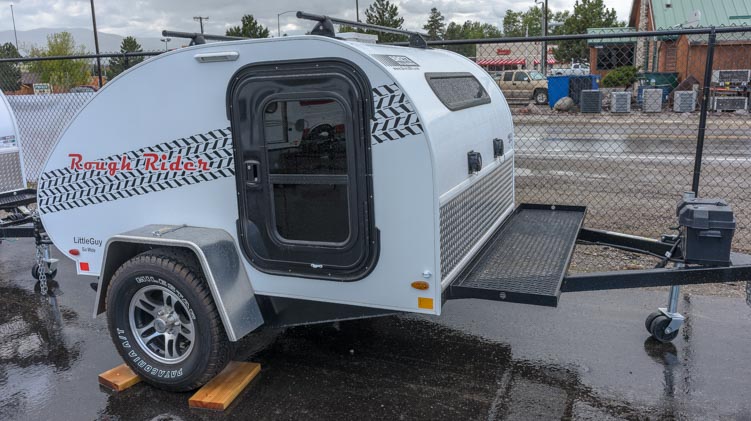
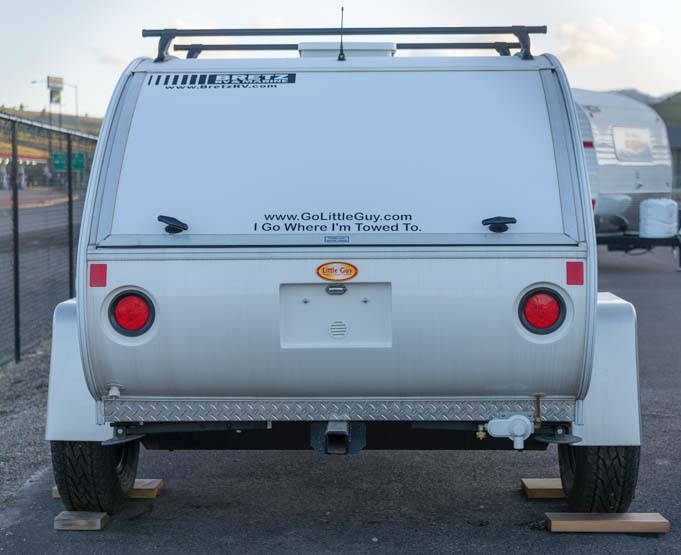
I LOVE little trailers, and I was smitten by a sweet tear drop trailer called the Little Guy Rough Rider.
The Rough Rider – How Adorable!!
What a fun little trailer! It even has a cute saying on the back…
“I Go Where I’m Towed To” — Funny, that’s what Mark says!!
We also really liked a big Redwood fifth wheel.
A beautiful Redwood fifth wheel trailer caught our attention.
It was a monster with two exterior doors and five slides. Wow!!
This big beautiful baby has two exterior doors and five slides!!
Well, which one do you think can carry a heavier load — the little weekend trailer that is just a bed on wheels with a wee mini-kitchen on the back, ideal for summer camping, or the big “full-time,” four season fifth wheel trailer that might replace someone’s house??
Ahem, not the trailer you’d think.
The stickers on these two trailers gave the following:
The weights capacity sticker for the teardrop trailer: Cargo Carrying Capacity of 1,925
Weights capacity sticker for the big beautiful fifth wheel trailer: Cargo Carrying Capacity of 1,876 lbs.
Wow!
Reeling from this sticker shock, we wandered around the RV dealership lot a little more and found a wonderful big fifth wheel toy hauler.
Curious about cargo carrying capacities for toy haulers, we checked out this big trailer.
This triple axle behemoth had three slides and was built to carry big toys with motors, like ATVs, motorcycles, and other goodies.
Three slides and three axles — ready to go do some ATV adventuring in style!!
Like all toyhaulers, it had a big door in the back that would drop down to become a ramp so you could roll out on your ATV or motorcycle with ease.
The back has a huge door that drops down to form a ramp so you can ride out!
So this big guy was built to haul a big load, right?
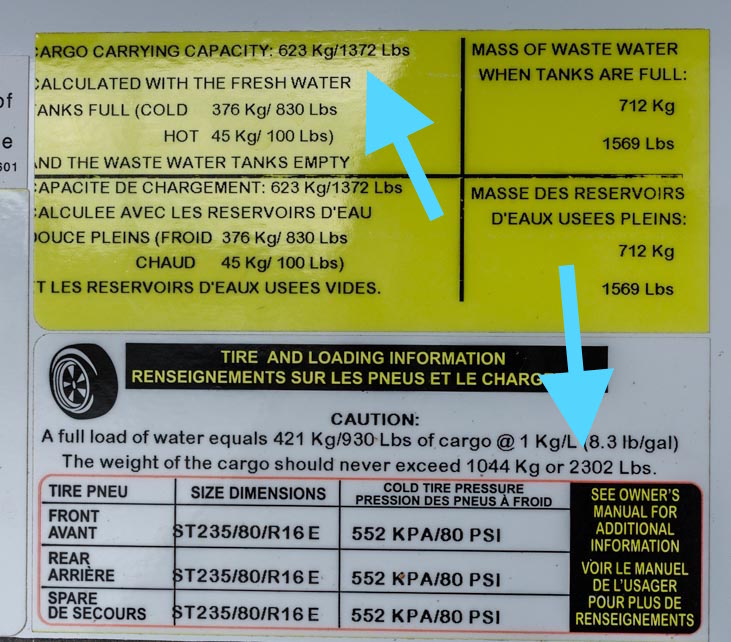
Well, not exactly. It has a Cargo Carrying Capacity of 2,302 lbs. That is just a little more than the Little Guy Rough Rider teardrop!
The sticker on this toy hauler makes it very clear that when the trailer’s fresh water tank and hot water tank are both full, then the Cargo Carrying Capacity drops to 1,372 lbs.
So, your clothes, food, generator, on-board gas tank, propane tanks and your big toys like your ATV or motorcycle can’t weigh more than 1,372 lbs. all together if you wish to dry camp. If you are going to get hookups, then your limit will be 2,302 lbs., still a very tight squeeze if your toys weigh a few hundred pounds.
If this toy hauler is towed with empty water and waste tanks, it can carry 2,302 lbs. If the fresh and hot water tanks are full and waste tanks are empty, it can hold just 1,372 lbs.
I’m not advocating one RV brand over another or knocking any particular RV brand with this info. Far from it! These specs and stickers come from random trailers that appealed to us and that happened to be on the dealership lot the day we were there.
When we have wandered through other RV dealership lots in different states at other times, we have discovered that many very popular brands have similar specs.
Need a pick-me-up after looking at all those trailers and calculating all those numbers? There’s a great little coffee kiosk next door to Bretz RV & Marine!
The important thing is that if you are shopping for a trailer that you are going to tow a lot, you should try to estimate how much weight you will put into it, including however much fresh water it will have in it when you hitch up. Then make sure the trailer you buy has sufficient cargo carrying capacity.
Unsure what your stuff weighs?
You can use a bathroom scale to get a rough estimate of what your clothes weigh by putting your laundry basket on it or weighing yourself holding your laundry basket and subtracting out your weight. You can also grab a bunch of clothes/jackets on hangers and do the same thing.
Likewise after a big grocery shopping spree — weigh yourself holding bunches of bags of groceries before you put it all away. Then look at what you already have in the fridge and pantry. The same can be done with pots and pans, dishware, tools, shoes, bikes etc. And don’t forget any upgrades you plan to do to the trailer after you buy it.
Or use our numbers as a guideline. We still haven’t filled all the shelves in our fifth wheel!
More of our Latest Posts are in the MENU.
New to this site?
Visit RVers Start Here to find where we keep all the good stuff. Also check out our COOL NEW GEAR STORE!!*** CLICK HERE *** to see it!
How do you put DEF fluid in a truck without spilling a drop? Here are a few tips for diesel truck owners out there as well as lots of helpful info about Diesel Exhaust Fluid, what it does and where we found it’s cheapest to buy.
Since 2010, diesel pickup truck engines have relied on Selective Catalytic Reduction technology (SCR), which uses Diesel Exhaust Fluid (DEF), to meet the EPA emmissions standards. DEF is a mixture of 1/3 urea and 2/3 de-ionized water, and it is sprayed into the exhaust system of diesel trucks to reduce the nitrous oxide (NOx) emissions into harmless nitrogen and water.
Late model diesel trucks require refilling the DEF tank!
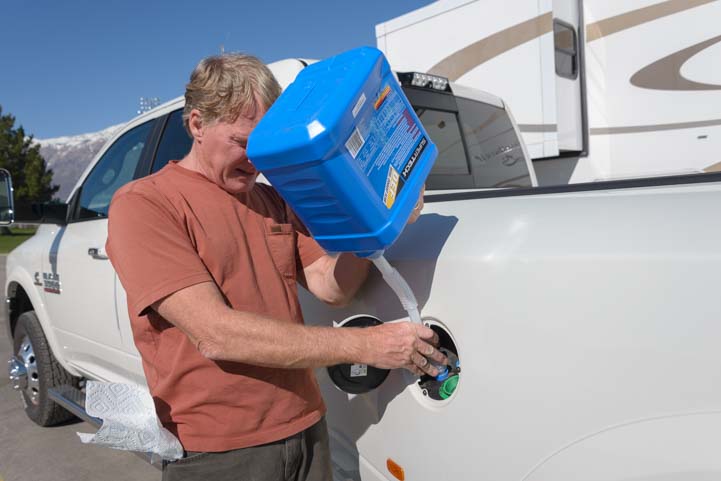
Each manufacturer designs their trucks with a tank to hold the DEF, and you have to replenish it every so often. Our 2016 Dodge Ram 3500 has a 5 gallon DEF tank. The filler hole is under the gas cap next to the diesel filler hole. On some brands of trucks the filler hole is in the engine compartment under the hood.
The Dodge Ram has the DEF filler hole next to the diesel filler hole under the gas cap
We use this handy magnetic gas cap.
As a side note, opening the gas cap on a Ram truck is interesting because there is no screw-on dust cap covering the diesel filler hole inside. There’s just a spring-loaded flap. We find we need to wipe down the whole area after we’ve taken the truck out on four wheel drive roads in dusty places like southeastern Utah.
We use a nifty aftermarket diesel gas cap that uses a magnet to keep it handy during fill-ups. Just stick it on the side of the truck. Very cool! A slightly less expensive one is also available here.
While it would seem trivial to refill the DEF tank, we struggled the first few times with the bulky jugs and awkward spouts, and it dripped here and there and was basically a pain in the neck.
However, the best deal we’ve found is the big blue 2.5 gallon jug of SuperTech DEF sold at Walmart (in-store) for $7.88. The jug is easy to use and it’s drip-free.
SuperTech Diesel Exhaust Fluid (DEF)
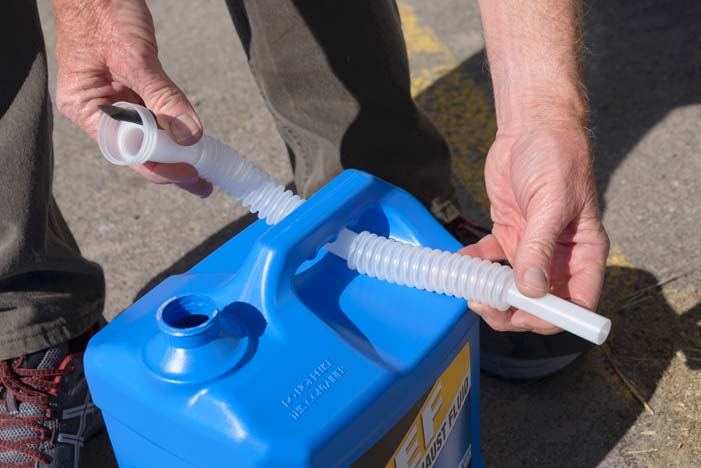
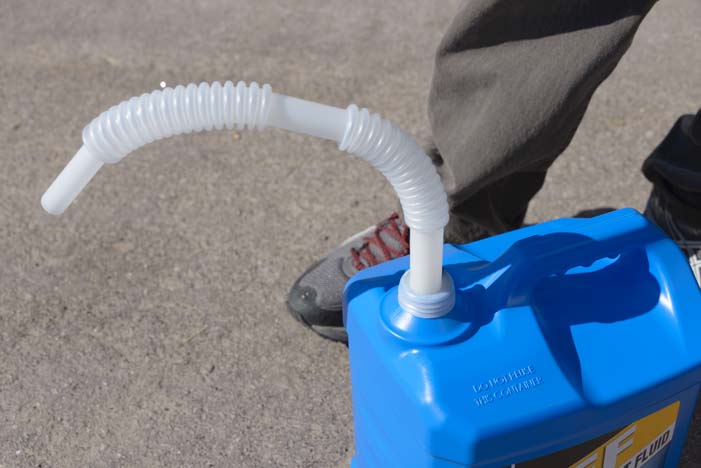
SuperTech DEF comes with a flexible pouring spout that is wrapped around the handle. Simply unscrew the jug’s cap and screw the spout on until it’s really tight.
The SuperTech DEF jug comes with a flexible pour spout wrapped around the handle
Screw the flexible pour spout on tightly
Ready to pour.
There is a small black vent hole on the spout, and this little guy is essential to making the whole process go smoothly and cleanly.
The black air vent on the pour spout is the key to doing this chore without dripping or spilling
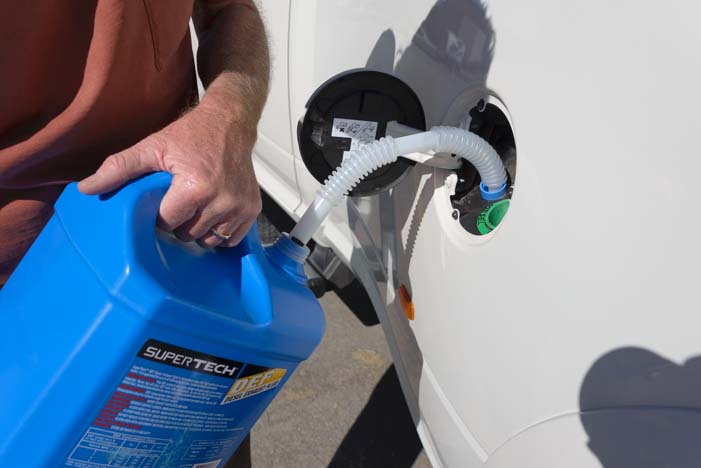
After putting the flexible spout securely into the filler hole on the truck, give the jug a small squeeze to start the flow of fluid. This will make the vent hole on the jug such air in, which vents the jug and allows the fluid to flow easily.
Once the spout is inserted securely in the filler hole, squeeze the bottle slightly to start the flow.
Make sure all the fluid has been poured into the tank, and then you’re done!
Empty the contents into the DEF tank.
The first time we did this, we didn’t squeeze the jug first, and DEF dribbled out the air vent. But if you get the siphon going properly, by squeezing the jug as you start to pour, it’s a cinch.
Our Ram truck has a dashboard gauge that indicates the fill level of the DEF tank. When it gets down to half full, we put a 2.5 gallon jug of DEF into the tank to fill it back up again. We typically do this every 1,000 miles or so.
DEF has a minimum shelf life of a year. We keep just one 2.5 gallon jug on hand at all times. Since we refill our tank about every four to six weeks, we never remotely approach its shelf life.
Buying DEF in Bulk
Another option for DEF fluid is to get it in bulk at a gas station. This is not common yet, and most gas stations don’t have DEF in bulk. However, Flying J and Pilot truck stops carry it at some of their travel centers (see links at the end for locations).
In our travels, we don’t often fill up at Flying J or Pilot, simply because they tend to be on the interstates and we tend to be on back country roads. So, we haven’t yet seen or been able to take advantage of their bulk DEF at the pump.
However, for RVers that use these travel centers a lot, this is a super way to go. The current bulk Flying J / Pilot DEF price at many of their centers is a little less than the SuperTech bottled price (~$2.79/gallon vs. $3.16/gallon).
Pilot / Flying J offers a discount card for RV travelers that gives a few cents off on fuel and 50% off on RV dump station fees, and special discounts for Good Sam Club members.
Pilot and Flying J have DEF in bulk at the pump AND a discount card for RVers
What are the pros and cons with a truck that uses DEF fluid? An obvious disadvantage is that you’ve got to do this extra little chore every so often.
However, there are benefits too. The fuel mileage is slightly better on SCR equipped engines than on older trucks that used a Diesel Particulate Filter (DPF) to meet the EPA emissions standards (like our 2007 Dodge Ram 3500). Cummins, manufacturer of the engine in the Dodge Ram line of diesel trucks, says the improvement can be up to 5%.
This increase in fuel economy is because the improved conversion of NOx emissions allows the newer engines to be fully optimized. Also, the older engines go into a “Regen” frequently to burn off the particulates in the Diesel Particulate Filter. In a Regen, a higher quantity of fuel than normal is pumped into the engine to make it run hot so the particulates can be burnt off. This wastes fuel and ultimately lowers the truck’s overall fuel mileage.
The newer engines that use SCR technology (and DEF) don’t need to go into a Regen quite as often.
For more info on all of this, there are lots of links below that explain the history and mechanics behind Diesel Exhuast Fluid.
More of our Latest Posts are in the MENU.
New to this site?
Visit RVers Start Here to find where we keep all the good stuff. Also check out our COOL NEW GEAR STORE!!*** CLICK HERE *** to see it!
A few weeks ago we camped in Sedona, Arizona, with two good friends who own popup campers. We were reminded how much fun these little trailers can be and how much we learned in the two years we owned ours before we started RVing full-time in our first big trailer.
If you are thinking about RVing full-time sometime down the road, a year or more from now, the most valuable thing you can do in the meantime is buy a little rig and go play. There is no better way to learn about RVing than to go out and do it, and a small RV provides an awesome introduction.
You can trade in the little rig for a bigger one when you are ready to take the plunge and go full-time.
We camped in our fifth wheel with good friends who have two different styles of popup campers.
We owned our popup for two years and spent every possible weekend and vacation in it before we started full-timing. We towed it all over the place. It was routine for us to travel 300 miles with it for a long weekend or to tow it 1,500 miles on a week’s vacation.
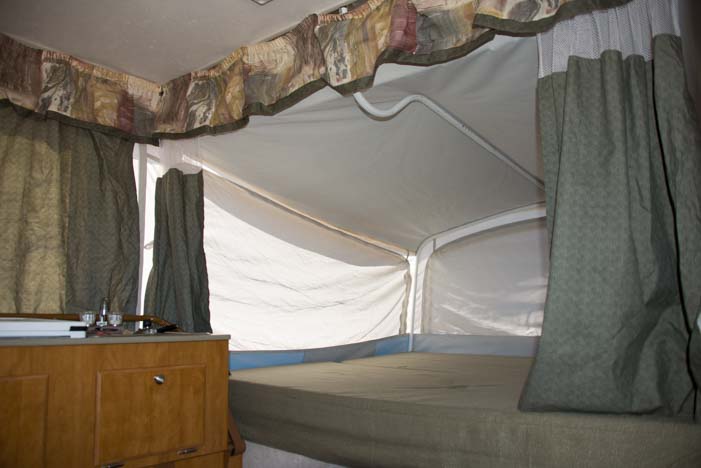
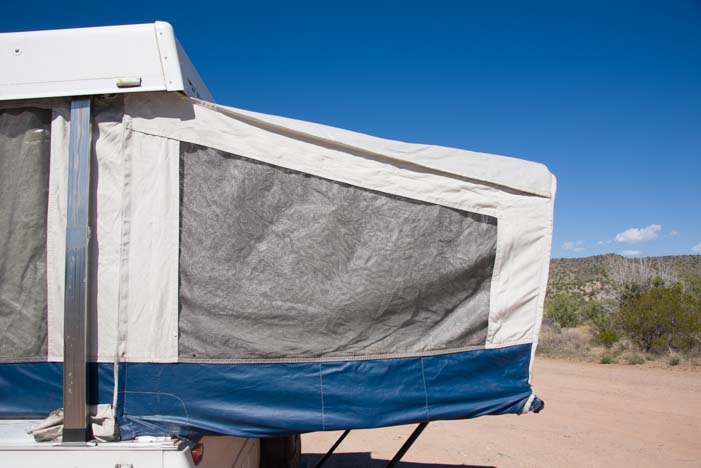
A popup tent trailer folds up small and opens up to be a nice sized rig with beds on each end.
Before we even knew what full-time RVing was, we had already learned a lot about the RV lifestyle from camping in our popup.
We dry camped in it most of the time, so we learned little things like exactly how much water we typically used in a day, and how to take a one gallon shower. We made all kinds of classic rookie mistakes as we tried to keep our battery charged, and we figured out how to “live small” and cook in a dollhouse sized kitchen.
The surprising thing is that our popup camper had many of the same basic systems as our current fifth wheel trailer that we now live in year round. It had DC lights, a propane RV fridge, 26 gallons of water, including a 6 gallon propane hot water heater, a water pump and a propane furnace. It had a shower and a two burner propane stove, and it could hook up to shore power for electricity and to a city water connection for water.
Home sweet home!
It even had one thing our current RV doesn’t have: a king size bed!
There were two things it didn’t have. One was a toilet. When we bought it, we knew we’d be camping in campgrounds, and they always have toilets, so we decided that rather than give up precious space in the trailer for a toilet and have to deal with dumping it, we’d just use the campground toilets instead
It also didn’t have an air conditioner. We knew we’d be camping in places where we wouldn’t need one, so why pay for something we wouldn’t need?!
A popup trailer is small and easy to tow and fits in the garage!
The fun thing about running around in a little RV is that you can can go almost anywhere the Big Rigs go and get a taste of living a nomadic lifestyle without spending a fortune.
We took our popup camper to some wonderful RV parks and hooked up to electricity and water just like the big fifth wheels and motorhomes. We stayed in RV parks in San Diego (right on the water – wow!), and the Bay Area in California (in a cool wooded area not too far from the city), in the Moab Utah area where we bicycled in the red rocks, and in New Mexico, where we bicycled in the mountains.
Our friends have two styles of popup: an A-frame (smaller & lighter) and a tent trailer (big beds on each end)
Camping in these RV parks gave us a chance to wander around the loops and meet people that were experienced RVers. We’d talk with them about their rig, find out what they liked and didn’t like about it, and we’d get their advice for what to look for if we ever wanted a bigger RV (we had NO idea we ever would!) and we’d get suggestions for where to travel with our little popup.
We learned about full-timing, and we learned about work camping, and we discovered a world we’d never known anything about. We supplemented that education with online research and magazine subscriptions, but there is no better way to understand an RV’s systems than to use them, and no better way to understand the RV lifestyle than to live it.
This is a Chalet A-frame, and it has a twin bed, a dinette that folds into a full size bed and kitchen. The beauty of an A-frame is it’s light enough to be towed easily by a minivan.
Lots of people email me expressing interest in going full-time and some express interest in boondocking too. These are big steps, and having as much first-hand experience as possible before you jump in is a really good idea. Online resources are great, but they are limited and only go so far.
If you haven’t done much tent camping, and you dream of camping in the wild, learning how to dry camp in a cheap, small, rolling box is a wonderful way to start. It’s a lot of fun, and it will teach you what to look for when you buy a bigger rig, and more importantly, it will help you decide if it’s something you enjoy before you make a big commitment and turn your life upside down.
Boondocking is basically glorified tent camping in a fancy rolling box.
If you are interested in solar power, you can learn all about it for just a few hundred dollars with a folding solar panel kit and an inverter. The batteries on a popup are right there on the trailer tongue. So, it’s easy to see what’s going on!
Before you go full-time, you can sell the solar panel the kit, either with the little trailer or without!
Here’s a pretty campsite in Utah’s red rocks.
The transition to full-time RVing is a lot less stressful if you are an experienced RVer already. It’s not a requirement, and plenty of people jump right into living in an RV without ever having used one before, but I think that having hands-on experience is the best way to go.
The wonderful thing about getting a little “starter” RV and playing with it for a while before going full-time — besides all the fun you’ll have — is that the mistakes you make don’t cost much, and you haven’t got a lot at risk.
Here’s another a great camping spot — on Cape Breton Island in Nova Scotia
If you don’t like it, you can sell it.
If you DO like it but have some unexpected repairs, they won’t break the bank and you won’t be trying to live in it while it’s being fixed.
Best of all, you can go home after every excursion and take a long hot shower, wash your clothes in your own washing machine, and you can savor your photos and your memories in the comfort of your big living room, all things that will no longer be possible once you commit to the RV lifestyle full-time.
A few weeks ago we camped next to a couple in their early 40’s who are a river rafting and white water kayaking guide (him) and a mountain biking guide (her). They live in a 17′ travel trailer, and they absolutely love it.
They boondock full-time with the seasons as their jobs move between Colorado and Arizona. The trailer is a huge upgrade for them. They lived in a tent for a few years until this past October when they bought the trailer.
A river rafting guide and mountain biking guide love living in this 17′ travel trailer.
We’ve known a lot of 40-somethings over the years who lived in much fancier digs, with granite counter tops and sleek cars in the driveway. But they weren’t happy with their lives. It was enlightening and motivating and inspiring to spend time with these two people who had decided fifteen-plus years ago, right out of college, that they wanted to spend their days doing what they loved, even if it meant having a very simple home.
So, for those who think a nomadic lifestyle is out of reach financially, it just depends on how you want to live.
Our friends Rich and Mary bought our popup camper from us when we went full-time nearly nine years ago. While Rich was setting up camp, he let me take pics of the process so I could show you just how easy it is to set up a popup tent camper.
Here are the steps:
First you crank it up with a cranking tool that comes with the trailer.
First, crank up the roof all the way.
The roof is fully raised but the bed slides are still inside the trailer.
Then you pull out the bed slides on either side. Each slide locks into place in the open position.
Pull out the bed slide at each end. In many models one or both beds is a King.
Then you put the support struts in place. While traveling, these are latched under the bed sllides. Once the bed slide is opened, just hook the end onto a latch on the frame.
Attach the supports for the bed slide.
The bed slide is in place but the canvas tent isn’t propped up yet.
Then go inside and remove anything that’s hogging up space. Rich stores his solar panel inside while traveling, so he takes it out at this point.
Bring out whatever is stored inside: solar panel, camp chairs, patio mat, etc.
This popup camper — a 2005 Fleetwood Colonial — has a slick lower half door that folds down to become the entrance step. There are lots of designs out there, but this is common in the old Fleetwood lineup.
Fold down the entry step.
.
Now remove the door from its travel spot where it is suspended from the ceiling and put it in place using the velcro strips on either side. The door and its frame are one unit, so the hinging is solid, but it stands upright in place using latches and velcro.
Lower the door from the ceiling and press it into place along the velcro strip on the canvas.
Now open up the canvas above each bed. There is a special support rod that hooks in place that holds up the center of the canvas roof over the bed and gives it its shape.
Prop up the canvas over each bed with the support rod You can hang things from the loop – a lantern, fruit basket, whatever.
The canvas over the bed slide is fully opened.
Now crank down the landing jacks. These give the camper floor a bit of rigidity as you move around inside. The interior isn’t huge — it’s just a 10′ by 8′ box or so — but you can walk around. Having the landing legs down keeps the floor solid.
Lower the landing jacks.
Last of all, set up the gray tank. This is a bucket outside the back of the trailer! If you want to see exactly how much water you use to wash dishes, there it is!
Set up the gray water tank (this popup camper doesn’t have a toilet).
The shower is a shower wand on the back of the popup camper. We just wore bathing suits and stood on interlocking rubber mats. If you are more modest than that, you can set up a shower enclosure.
We didn’t have any kind of solar gear when we owned our popup. We used a battery charger in our garage to charge the batteries before we’d go on a trip, and that was it. We learned really quickly how to be conservative with electricity.
Rich decided to install a second battery on the trailer tongue. He also bought a solar panel and had it wired so it could be connected to the batteries easily.
You can also run heavy gauge wire from the batteries to an 800 or 1,000 watt inverter located inside the popup and then run a power strip from the inverter to a handy place in the rig so you can charge your phone or laptop or run a small appliance.
Put out the patio mat, raise the awning and set up the solar panel. Done!
What a fabulous rig!!
If you are looking forward to having big RV adventures on the road someday in the future, make that “someday” be today! Go out and get a cool little RV and have a blast.
Popup tent trailers like ours are a little heavier (the GVWR is 3,000 lbs.), so both we and Rich bought Toyota Tundra pickups to tow it. An A-frame popup is lighter, because there are no bed slides, so our friend Mark tows his with a minivan.
More info and links for specific popup camper manufacturers below.
More of our Latest Posts are in the MENU.
New to this site?
Visit RVers Start Here to find where we keep all the good stuff. Also check out our COOL NEW GEAR STORE!!*** CLICK HERE *** to see it!
Defrosting an RV refrigerator is a surprisingly easy job. We’ve been living with a propane RV refrigerator for many years now, and they always need defrosting after a few weeks or months. Being meticulous about not leaving the refrigerator door open unnecessarily can help, but when you find yourself living in a hot and humid environment or if you have the refrigerator side of your trailer or motorhome facing the blazing hot summer sun all afternoon, the frost is going to build up over time.
Over the years, we’ve tried several different techniques for defrosting our RV fridge, and in the old days this was a big job that, with some methods, could take well over an hour. We now have it down to a super fast method that makes this pesky job a cinch. The last time we did it, I made a note of the time on the clock as we went through each step. From start to finish, it took 20 minutes.
The first step is to turn off the refrigerator and empty the contents of the freezer into cooler bags or a cooler of some kind. Since these things will be out of the freezer for just 20 minutes, they won’t defrost and the ice cream won’t melt. If your RV is hot inside, covering the cooler bags with blankets for extra insulation can help.
9:17 a.m. – Turn off fridge and unload freezer into cooler bags
We used to unload the whole refrigerator and empty it out completely, but that isn’t necessary and it takes a lot of time. An awful lot of what is in the refrigerator can handle warming up slightly as you keep the refrigerator door open to defrost it.
Instead, just unload the most temperature sensitive items — milk, yogurt, lunch meats, mayonaise, etc., into an insulated cooler bag or a cooler. Most of the fruits, veggies, bread, cheese, condiments, etc., can remain right where they are in the fridge for the 20 minutes it takes to defrost it.
Set the cooler bags aside. Covering them with blankets will keep everything even cooler.
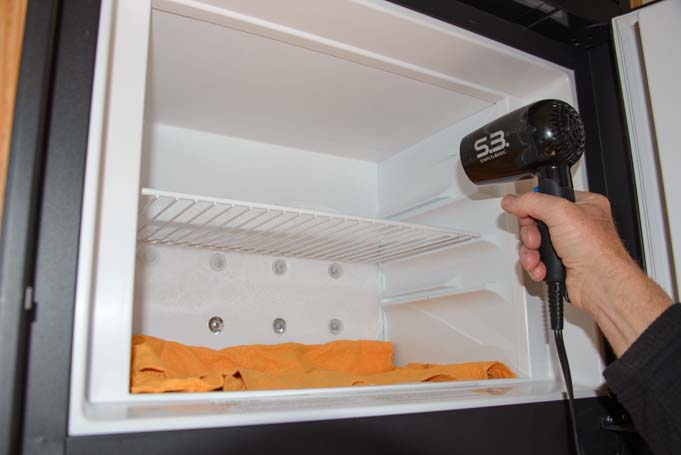
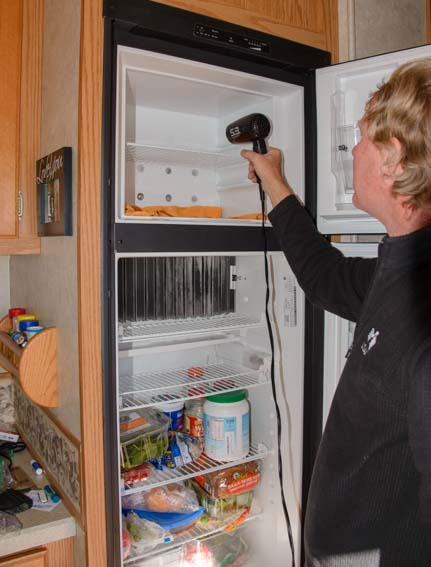
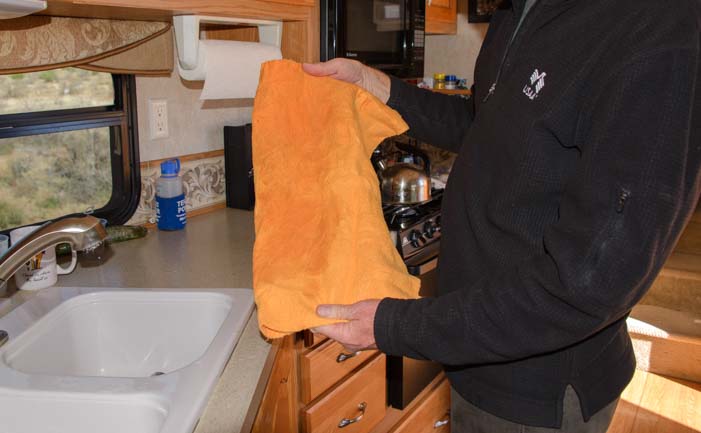
Next, put a super absorbant chamois towel in the bottom of the freezer compartment to absorb the water from the melting ice, and use a hair dryer to thaw the walls of the freezer.
9:22 a.m. – Use a hair dryer to thaw out the freezer.
We put it on the high setting and keep a distance of about 8″ between the hair dryer and the walls of the freezer. A higher wattage hair dryer may need to be put on the low heat setting. Hold your hand about 8″ from the hair dryer and see how hot it feels.
Be sure you keep the hair dryer from heating up the plastic walls or they will crack from being cold and then getting hot. Keep the hair dryer moving and test the temp of the plastic walls with your hands.
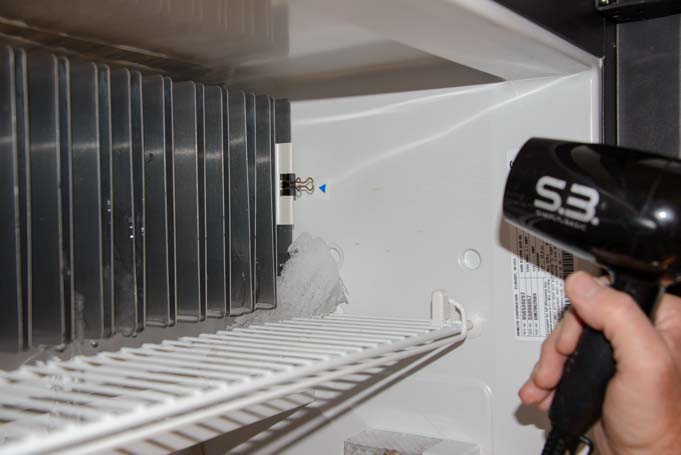
After thawing the walls of the freezer a little, move down to the cooling fins in the refrigerator compartment. Keep the hair dryer in constant motion, sweeping it back and forth from side to side.
Slowly wave the hair dryer in front of the cooling fins.
Alternate working on the freezer compartment and the refrigerator compartment.
Alternate between the cooling fins in the refrigerator compartment and the freezer compartment.
At the beginning, when the cooling fins are caked in ice, the hair dryer can be closer to them.
Little ice sheets will begin to fall off the refrigerator cooling fins into the drip tray underneath. As the thawing process continues, increase the distance between the hair dryer and the cooling fins.
As ice drops and the cooling fins thaw, move the hair dryer back a little.
Don’t chisel the ice off the fins or the freezer walls with a tool. If you pierce the metal base behind the cooling fins or the walls of the freezer, the refrigerant (ammonia) will leak out. We don’t use any chiseling device. We simply assist the thawing process with the hair dryer.
Check beneath the cooling fins and you’ll see the bits of ice dropping into the drip tray.
Check below the cooling fins where the ice drops off in chunks.
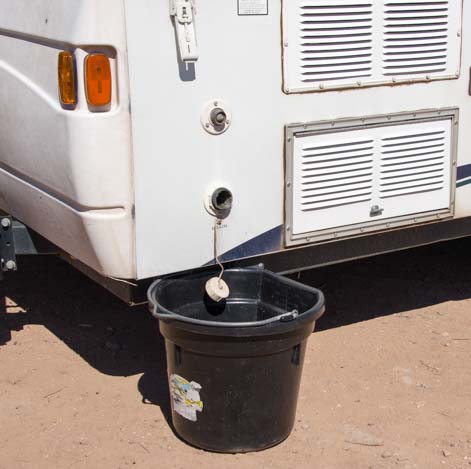
If you go outside, on the back of the RV you’ll see water seeping out of the refrigerator vent.
Outside the rig, water will be seeping from the refrigerator vent.
A little trickle of water flows down.
Once all the ice has fallen off the cooling fins, pull out the drip tray and dump the ice in the sink.
9:34 a.m. – Once all the ice has dropped off the cooling fins, empty the tray of ice into the sink.
Up in the freezer compartment, the chamois towel is now fairly wet with water that has dripped down off the walls. Wring it out and use it to wipe down the freezer and the fridge.
9:35 a.m. – The chamois towel in the freezer is pretty wet. Use it to wipe down the fridge and freezer.
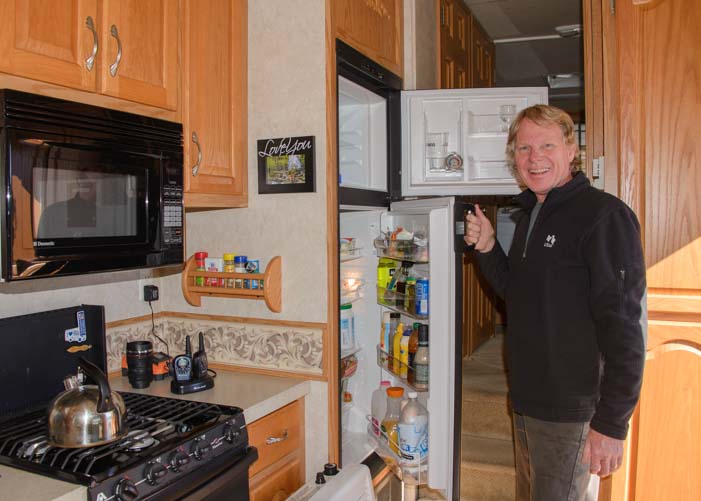
Load the food from the cooler bags back into the refrigerator and freezer compartments, and you’re done! Put the fridge at max temp for a few hours to help it cool back down, and then set it to the temperature setting you normally use.
9:37 a.m. – After loading the food back in the refrigerator, turn it back on. Done!
Other RV Refrigerator Tips
The key to having an RV refrigerator work optimally is having the air circulate inside well. Overstuffing the fridge with food makes this difficult for it. We have used a little RV refrigerator airator fan that’s designed to keep the air flowing. We’ve had mixed results with this, and when it died we didn’t replace it. I think this would work well if there were space between all the food, but our fridge is usually packed (the turf wars between the beer and the veggies can be brutal…sometimes we can hear them battling it out in there!).
As a maintenance item, we keep the door seals clean, wiping them down periodically.
We use simple refrigerator thermometers to monitor the temperatures in the fridge and freezer. It has a built in hook, and we hang it from one of the rungs in the top shelf in the refrigerator. The one in the freezer rests against one wall.
We were surprised to learn that RV refrigerators have an expected lifespan of about 8 to 10 years. A classic sign of impending failure is the appearance of yellow dust in the refrigerator vent area behind the fridge (go outside and take the vent cover off and look around with a flashlight). Click the following link to read the funny story of our RV refrigerator replacement and see how an RV fridge replacement is done.
Because of the shorter lifespan, higher price, and use of propane in RV refrigerators, many (most) “full-time” level fifth wheels and motorhomes are now being built with residential refrigerators that run on AC power only (a dedicated inverter is installed so it can run from the batteries while in transit). For folks that have plans to dry camp and boondock a lot in their RV life, a residential refrigerator will require a much bigger battery bank and solar panel array than would otherwise be needed. We discuss that in more detail at this link in our introductory solar power article.
If our hair dryer method of defrosting an RV fridge seems unorthodox to you, believe me, we have tried many other methods. We tried opening the fridge and freezer doors and letting the fridge thaw out on its own. We tried doing that and “helping it along” by chiseling the ice off with a small plastic scraper. We tried putting a bowl of hot water in the fridge to help it warm up.
All of these methods were adequate, but they were time consuming. We’ve been using our current method with the mini travel hair dryer for a few years now and really, really like it.
More of our Latest Posts are in the MENU.
New to this site?
Visit RVers Start Here to find where we keep all the good stuff. Also check out our COOL NEW GEAR STORE!!*** CLICK HERE *** to see it!
Choosing a truck to pull a trailer is a critical decision for RVers, because getting there, and particularly getting there safely, is the first and most important part of enjoying the RV lifestyle! Towing specs and towing guidelines always give the outer limits of what a truck can safely tow. Too often, in towing situations, the trailer is a little too big for the truck, or the truck is a little too small for the trailer, pushing the truck right to its outer safety limits or beyond.
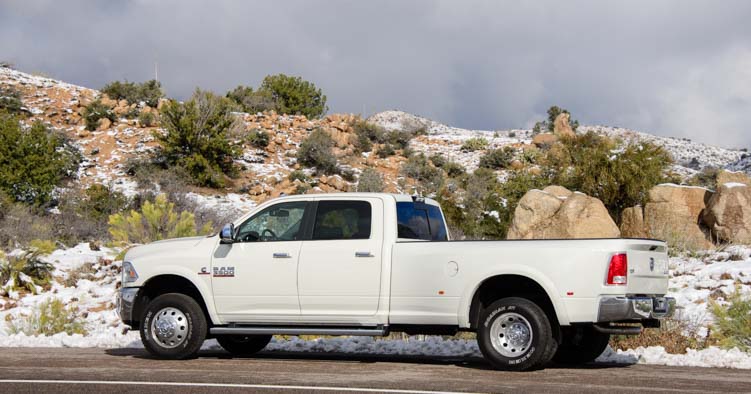
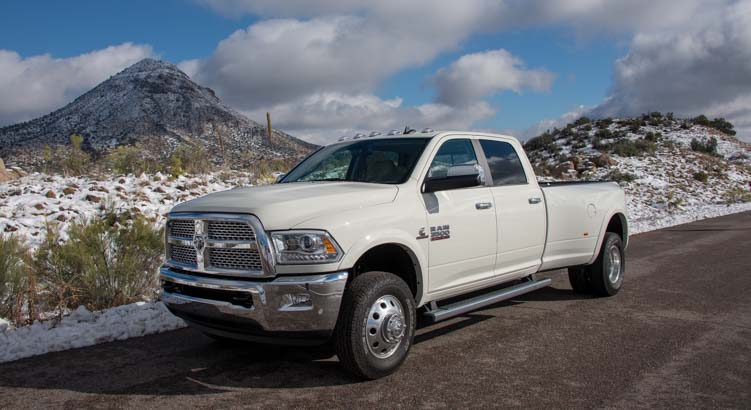
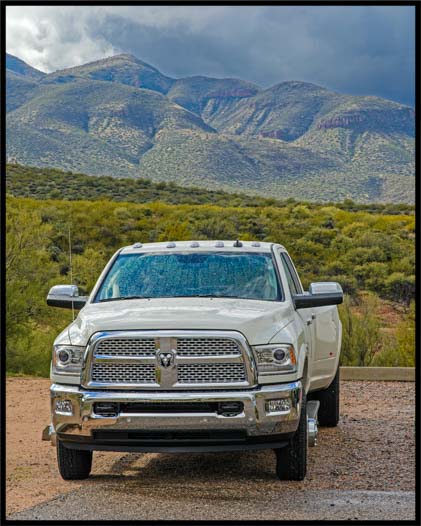
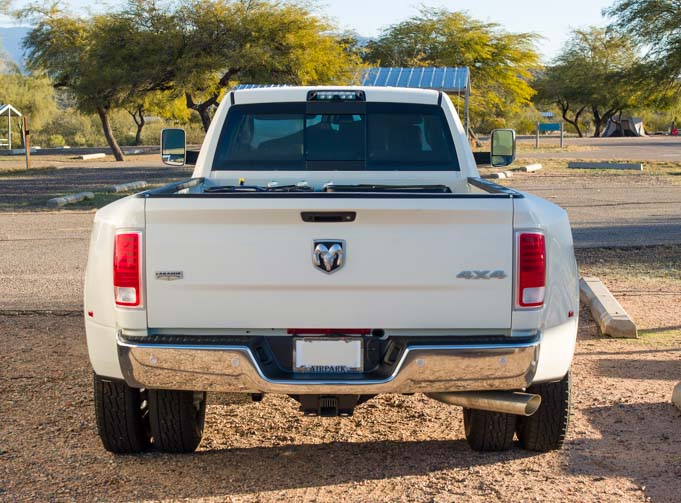
The 2016 Ram 3500 Dually is an awesomely powerful truck for towing big and heavy trailers
The truck-trailer combo may be just a little out of spec on paper, so it may seem okay, like you can get away with it, but it is a really unwise decision. Not only is it absolutely no fun to drive a truck that is screaming its little heart out to tow the load its tied to, but if you have an accident and it is determined your truck was towing a load that is beyond its safety limits, you will be liable.
Heaven forbid that there is a fatality in the accident — either yours or someone else’s. There are lots of horror stories out there of people’s lives that were transformed because someone decided not to get a truck that could tow their trailer safely.
Of course, truck and trailer salesmen don’t help. We have heard time and again, “That truck is fine for this trailer,” or “This trailer will be no problem for that truck.” Don’t listen to them! Trust your instincts and your gut feelings. If you are studying the specs and are nervous that your truck *might* be too small because your trailer puts it on the hairy edge of its specs, then you need a bigger truck or a smaller trailer.
We have been amazed at the huge difference between our old 2007 Dodge Ram 3500 Single Rear Wheel and this new 2016 Ram 3500 dually
This article covers all the specifications we studied and were concerned about when we placed the order for our 2016 Ram 3500 truck to tow our 14,100 lb. 5th wheel trailer. You can navigate to the various sections with these links:
When we bought our 2007 Dodge Ram 3500 Single Rear Wheel long bed diesel truck with the 6.7 liter Cummins engine, its purpose was to tow a 7,000 lb. (fully loaded) 2007 Fleetwood Lynx travel trailer. Our 2004 Toyota Tundra (4.7 liter engine) had been okay to tow that trailer on paper, but when we took it on its first mountain excursion up and over Tioga Pass on the eastern side of Yosemite in California, it could not go faster than 28 mph with the gas pedal all the way to the floor. What a scary, white knuckle drive that was. Who needs that?
Our ’04 Toyota Tundra half-ton pickup rests as it tries to tow our 27′ travel trailer over Tioga Pass… sigh.
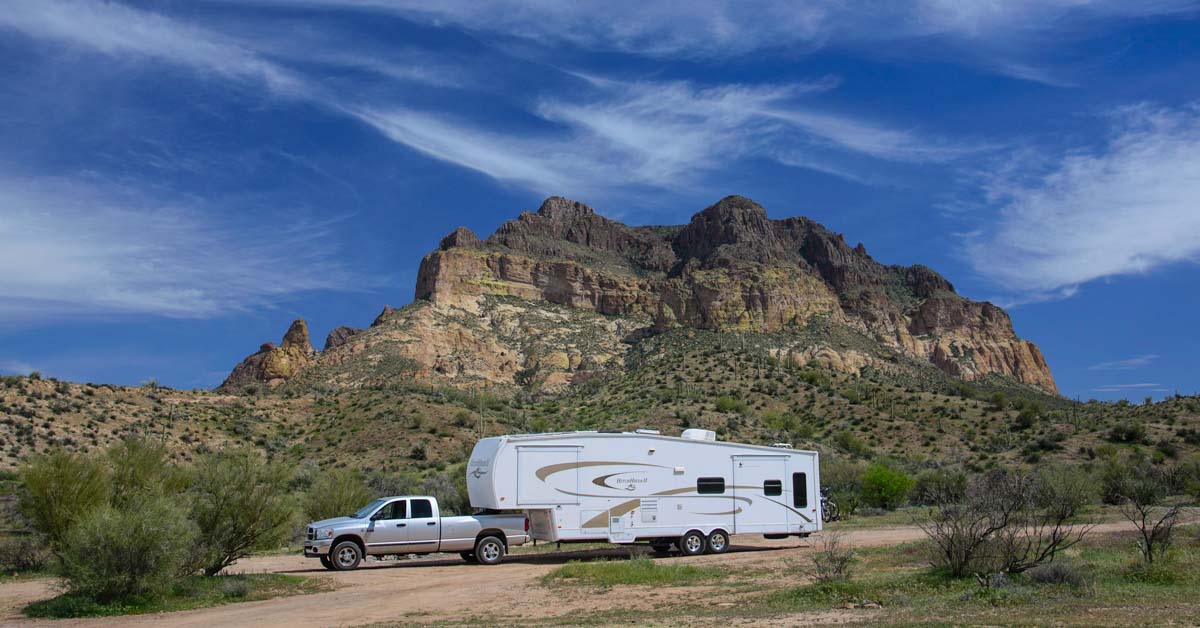
We replaced the Toyota Tundra with a 2007 Dodge Ram 3500 which was rated to tow much bigger trailers than the little Lynx travel trailer, so all was good with that small travel trailer. However, within a year, we upgraded our trailer from the lightweight Fleetwood Lynx to a full-time quality, four season, 36′ NuWa Hitchhiker LS II fifth wheel trailer that the scales told us was 14,100 lbs. fully loaded. Suddenly, our big beefy diesel truck was at its outer limits!
We drove our ’07 Dodge Ram 3500 and 36′ fifth wheel combo for seven years without a mishap, but it was not an ideal situation. The truck would strain in the mountains and would wander in strong cross winds on the highway. We installed a K&N Cold Air Intake Filter and an Edge Evolution Diesel tuner which helped the engine breathe better and increased its power (see our Edge Evolution Tuner Review), and we installed a Timbren Suspension Enhancement System to keep the truck from sagging when hitched to the trailer. But the frame of the truck and the transmission were still stressed by the heavy load on steep inclines.
We wanted a truck that was well within its towing limits and that could tow our trailer effortlessly.
The weight ratings for trucks and trailers are an alphabet soup of confusion that takes a little imagination to grasp. Here’s a synopsis:
UVW
Unloaded Vehicle Weight
The weight of the vehicle without fuel, people and stuff
GVWR
Gross Vehicle Weight Rating
The heaviest weight the vehicle can safely be when it is loaded up with fuel, people and stuff
GCWR
Gross Combined Weight Rating
The most a truck-and-trailer combo can safely weigh when hitched together and loaded up with people, fuel, food, etc
Payload
The GVWR less the UVW
The amount of weight the truck can safely carry. Compare to the trailer’s Pin Weight
PW
Pin Weight
The actual weight on the truck’s rear axle when a trailer is hitched up. Compare to the Payload
The Pin Weight is most easily visualized by first imagining yourself standing on a bathroom scale and making a note of your weight. Then your teenage kid walks up and puts his arms around your neck and hangs on your shoulder. The weight on the scale goes up a little bit, but not a huge amount, because your kid is still standing on the floor on his own two feet. The more he leans on you, the more weight the scale shows.
The difference between the weight the scale shows when your kid is hanging on your shoulder and the weight it shows when you’re by yourself is the “pin weight.” In the case of you and your kid, the “pin weight” might be 30 lbs.
The Pin Weight is the weight of the trailer at the hitch pin, a value that has to be calculated.
The following chart shows the factory safety weight ratings given by Chrysler and NuWa and the actual weights for our ’07 Dodge Ram 3500 truck and ’07 36′ NuWa Hitchhiker 5th Wheel trailer. We had our rig weighed by the Escapees Smart Weigh program at their North Ranch RV Park in Wickenburg, Arizona. This is a detailed, wheel by wheel, RV specific method of weighing.
Our truck, when loaded, carries fuel, 24 gallons of water, a generator and BBQ, the fifth wheel hitch, several leveling boards, two huge bins of “stuff” and ourselves, as well as the pin weight of the trailer. So, even though the pin weight itself was within tolerance on our ’07 Dodge 3500, all that other stuff made the truck way overweight. Moving those things to the trailer would clog our fifth wheel basement and would just make the trailer way overweight instead.
2007 Dodge Ram 3500 SRW (Single Rear Wheel) Truck
UVW
GVWR
GCWR
Payload/Pin Weight
Rating
7,147
10,100
21,000
2,953
Actual
8,025*
10,850
22,125
2,850
* LOADED with passengers, fuel and cargo but not towing
Besides the pin weight, our truck carries spare water, a heavy hitch, leveling boards, and generator. And there’s more stuff plus ourselves in the cab!
We improved our trailer’s cargo carrying capacity by upgrading from E rated tires to G rated tires and by revamping the suspension completely (I have not yet written about that project). So, even though some elements of the trailer frame are still at the spec limit, we have some leeway with our trailer in those places where the rubber meets the road.
The truck, however, was over its limit for both GVWR and GCWR, and it was pushed nearly to its max when towing.
The 2007 Ram 3500 towing guide is here: 2007 Dodge Ram Trucks Towing Guide. Our truck is on p. 20, on the 2nd to last line. Search for this text: “D1 8H42 (SRW)” (you can copy and paste it from here).
There are three brands of big diesel pickup trucks on the market: Chevy/GMC, Ford and Dodge. People have lots of brand loyalty when it comes to diesel trucks, and the bottom line is it’s pointless to get into a religious war over truck manufacturers. That said, the following are our personal opinions and there is no offense intended to anyone who loves a particular brand.
GMC makes the Chevy Silverado and GMC Sierra which both have the Chevy Duramax 6.6 liter engine and the Allison transmission. The Allison transmission is widely used throughout the commercial trucking industry and is considered to be the best.
FORD makes the Super Duty series of trucks which have Ford built engines and transmissions. Ford has modified its Power Stroke engine several times since the early 2000’s. The current engine is a 6.7 liter engine and it has performed well. Earlier models, the 6.0 liter engine and 6.4 liter engine, both had significant problems and were less reliable.
CHRYSLER makes the Ram series of trucks which have the Cummins 6.7 liter engine and Aisin transmission. The Cummins engine is widely used throughout the commercial trucking industry and is considered to be the best.
With the late model Ram trucks there are two models of 6 speed automatic transmissions to choose from. The 68RFE transmission was the only one available for our ’07 Dodge, and we found it developed problems over time (before our installation of the K&N Cold Air Intake and Edge tuner). It stuttered on climbs and didn’t always shift smoothly. The new (in 2013) Aisin AS69RC transmission is much more rugged and reliable and is now available as an option in the Ram Trucks lineup.
All three big diesel truck brands are good. After much research and many test drives, we chose the Ram 3500.
PICKUP TRUCK SIZES
All trucks are categorized into eight weight classes, from Class 1 (lightest) to Class 8 (heaviest) according to their GVWR. Pickup trucks fall into the smallest (lowest) three classes:
Class
GVWR
Class 1
0 – 6,000 lbs
Class 2
6,001 – 10,000 lbs
Class 3
10,001 – 14,000 lbs
All three classes of pickups are referred to as “light duty” trucks, as compared to dump trucks and semi tractor-trailers in the higher “medium duty” and “heavy duty” classes. Within the pickup truck market, however, they are referred to as “Pickups” (Class 1), “Full Size Pickups” (Class 2) and “Heavy Duty Pickups” (Class 3). So, even though a large diesel pickup is marketed as “heavy duty,” it is not technically a heavy duty truck. It’s just a heavy duty pickup. This may be obvious to many, but sure had me confused at first glance.
When we were first time truck buyers shopping for a truck to pull our popup tent trailer, the advertising made the ’04 Toyota Tundra look like it was a heavy duty towing monster that could pull a mountain right across a valley. But it is not so! Pickups come in all sizes.
Toyota Tundra and Ram 3500 — Which one is the towing monster?
Pickup truck sizes are referred to as “half-ton” “three-quarter ton” and “one ton,” and they are numbered accordingly:
Size
Ford
Chevy/Dodge
Half-ton
150
1500
Three-quarter ton
250
2500
One ton
350
3500
Ford also mass markets 450, 550 and larger pickups. Some people make custom Chevy and Dodge trucks in those sizes too, but they don’t come from the factories that way.
Ensuring the tow ratings of the truck are well beyond the actual weight of the trailer is essential.
For reference, a ton is 2,000 lbs. The truck naming convention comes from the original payloads these trucks could carry when they were first introduced decades ago. Back in those days, a half-ton truck could carry 1,000 lbs. (half a ton) in the bed of the truck. A three-quarter ton could carry 1,500 lbs and a big one ton truck could carry 2,000 lbs.
In 1918 Chevy had a very cute half-ton pickup that was basically a car with sturdy rear springs. By the mid-1930’s pickups came with factory installed box style beds, and a 1937 Chevy half-ton truck went on a 10,245 mile drive around the US with a 1,060 lb. load in the bed. It got 20.74 miles to the gallon!
As the payload capacities increased, the manufacturers assigned model numbers that corresponded to the weights the trucks could carry. But technology advances never quit!
Our 2016 Ram 3500 dually can tow this trailer with one hand tied behind its back.
Since those early times, truck and engine designs have improved dramatically, and the payloads modern trucks can carry now is significantly higher. For instance, the payload of a 2016 Toyota Tundra, a half-ton truck, is 1,430 to 2,060 lbs., depending on the options, making it essentially a “one ton” truck. The payload of a 2016 Dodge Ram diesel can be as high as 6,170 lbs. (and even higher for the gas HEMI version), making the 3500 model more of a “three ton” truck than a one ton.
In the modern trucks, the major difference between a three quarter ton 250/2500 truck and a one ton 350/3500 truck is the beefiness in the rear end suspension for supporting a heavy payload, that is, the number of leaf springs on the rear axle. In our opinion, if you are going to spend the money to buy a three quarter ton truck for towing purposes, you might as well spend the tiny incremental extra few bucks to buy a one ton.
Pickups come with more than one bed size. A “short bed” truck has a box that is a little over 6′ long and a “long bed” truck has a box that is around 8′ long. When a fifth wheel hitch is installed in the bed of a pickup, it is placed so the king pin of the fifth wheel will be over the rear axle. In a short bed truck this leaves less distance between the hitch and the back of the pickup cab than in a long bed truck.
The advantage of a short bed truck is that the two axles are closer together, so the truck can make tighter turns. This is really handy in parking lots and when making u-turns. The truck also takes up less space when it’s parked, again, a big advantage in parking lots.
A long bed truck is less maneuverable when it’s not towing but is preferable for towing a fifth wheel trailer
However, when towing a fifth wheel trailer, there is a risk that the front of the fifth wheel cap will hit the back of the pickup cab when making a tight turn. For this reason, there are special sliding fifth wheel hitches, and some 5th wheel manufacturers make the fifth wheel cap very pointy and even concave on the sides so there’s room enough to ensure the pickup cab doesn’t touch the fifth wheel cap on tight turns.
The advantage of a long bed truck is that not only can it carry more and bigger things in the bed of the truck, but when it is hitched to a fifth wheel trailer, doing a tight turn will not risk the front of the fifth wheel hitting the back of the truck cab.
Also, you can open and close the tailgate when the fifth wheel trailer is hitched up. We can actually walk from one side of our trailer to the other through the gap that’s between the open tailgate and the front of the trailer, even when the truck is cocked in a tight turn.
With a long bed, the truck can be at a sharp angle to the trailer and still have the tailgate open.
For folks that use their pickup primarily in non-towing situations and take their fiver out for just a few weekends a year (and stay close to home), a short bed truck is fine. However, in our opinion, if you are going to tow a large fifth wheel frequently, and especially if you are a seasonal or full-time RVer traveling longer distances, a long bed truck is the way to go.
We bought a long bed as our first diesel truck for our little travel trailer, knowing we might eventually get a fifth wheel, even though it takes much more real estate to back a travel trailer into a parking spot with a long bed truck that it does with a short bed truck (because the pivot point on a travel trailer is behind the bumper rather than over the truck axle, forcing the front end to swing exceedingly wide to make a turn).
When we use our truck as a daily driver, even though we always have to park away from the crowd and walk a little further, and we sometimes struggle making u-turns and maneuvering in tight spaces (it takes nearly four lanes to do a U-turn in a long bed pickup without the trailer attached), we have never once regretted having a long bed truck.
SINGLE REAR WHEEL vs. DUAL REAR WHEEL (DUALLY)
In the one ton class of trucks (Ford 350, Chevy/Dodge 3500), there is an additional consideration: single wheels on the rear axle of the truck (“single rear wheel”) or two pairs (“dual rear wheel” or “dually”).
The advantages of a single rear wheel truck are:
Only 4 tires to maintain instead of 6
Changing a flat will never involve accessing an inner tire under the truck
No wide rear fender to worry about at toll booths and drive-through bank windows and fast food windows
Easy to jump in and out of the bed of the truck from the side using the rear wheel as a foothold
Can handle rough two track roads better because the rear wheels fit neatly into the ruts
Gets traction on slick ice, snow and muddy roads better than a dually
The advantages of a dual rear wheel truck (“dually”) are:
Wider stance supporting the weight of the king pin (or bumper hitch)
Can carry a heavier payload — heavier trailer pin weight and/or bigger slide-in truck camper
Much safer if there’s a blowout on one of the rear wheels, and you can still drive (for a while)
A dually has a wider stance, providing more stability, and it can handle much more weight in the bed of the truck.
Why do you need to get in and out of the truck bed from the side? Climbing in on the tailgate is great, and there is a very handy foothold at the license plate mount on the 2016 model that is low enough for a short person to reach easily. However, when the truck is hitched to the fifth wheel, it’s not possible to climb in from the tailgate, and sometimes we need to get into the bed of the truck when the fiver is attached!
For instance, we keep 22 gallons of spare water in the bed of the truck in 5.5-gallon jerry jugs. I’m the one who holds the hose in the jugs while Mark goes to the other end of the hose and turns the water on or off at the spigot. We could switch roles, but I like that job!
When we’re hitched up, I have to get into the bed of the truck from the side to get to the water jugs. I plant one foot on the rear tire, and I hoist myself up and over the side. Getting over that fat fender is not so easy with the dually!
When hitching/unhitching, Mark also reaches over the side of the truck to loop the emergency break-away brake cable from the trailer onto the hitch in the truck bed. That way, if the trailer comes unhitched as we’re driving, the quick yank on the small cable (as the trailer breaks free) will engage the trailer’s own brakes as we wave it goodbye behind us.
Obviously, for both of these maneuvers, the width of the dually fender makes reaching into the bed of the truck a whole lot harder. Doing these things on a single rear wheel truck is trifling by comparison!
RESEARCHING SINGLE REAR WHEEL vs DUALLY TRUCKS
Our biggest debate was whether or not we should simply buy a new single rear wheel truck that had the latest engine and drive-train and chassis improvements or if we should take the plunge and get a dually. We do occasional research online, but our preferred method of learning about things in the RV world is to talk to experienced people in person, especially since we are out and about all day long and we enjoy meeting new people.
So, we interviewed every single dually truck owner that we ever saw. For two years! Whenever we saw a dually parked somewhere, we’d look around to see if the owner was anywhere nearby. If so, we’d walk up and ask him about his truck.
Did he like it? What did he tow with it? How long had he had it? Was it his first dually? Did he have trouble maneuvering in tight quarters? Had he towed that same trailer with a single rear wheel truck? How did they compare?
We asked lots of people how their dually performed compared to a one ton single rear wheel long bed truck towing the same heavy trailer.
To our astonishment, although we searched for two years for a person who had towed the same large fifth wheel trailer with both a dually and a single rear wheel truck, and we talked to dozens of dually truck owners who had towed all kinds of trailers, we found only one who had towed the same fifth wheel trailer with both styles of truck.
This guy was a rancher with several big cattle and horse trailers as well as a 40′ toy hauler fifth wheel. He’d been towing comparable trailers with single rear wheel long bed trucks for over twenty years. Three years ago he’d switched to a dually, and he said the difference for his toy hauler was night and day. He’d never go back.
Another fellow told us the ranch he worked on had both single rear wheel and dually trucks and that the duallies were used exclusively for the big trailers because they were better tow vehicles.
We LOVED the new, sleek styling on the Ram duallies.Our biggest questions: is the wide dually fender flare a pain? How does it do at toll booths and drive-through windows?
This was very convincing, but an interesting side tid-bit we learned is that many folks go either dually or single rear wheel when they buy their first diesel truck for a big trailer, and they stick with that type of truck when they replace it. Guys love their trucks, so we heard few complaints, but when folks raved about how their single rear wheel or dually was the ultimate towing machine and that they’d never switch, when pressed for details, we found they didn’t have first-hand experience using the two different types of trucks to tow the same large trailer.
For those looking to conduct their own research, in addition to talking with ranchers and horse owners, one of the best sources of information we found was the trailer transport drivers who drive their own personal trucks to tow both large RV and horse trailers from the manufacturers to the dealerships where they are sold..
Our questions would have all been answered in a heartbeat if we could have hitched our trailer onto a dually sitting in a truck dealership lot and towed it up a mountain and on a few back roads. However, that wasn’t possible.
Perhaps in the future, because of the fantastic new hitch puck systems that can be factory installed in pickups these days, dealerships will decide to keep one of the nifty B&W OEM fifth wheel hitches on hand for prospective customers to do just that (if they can sort out the liability and insurance issues).
Ultimately, we held out on the dually versus single rear wheel decision until the very end, but we knew inside that if we did buy a new truck it would probably be a dually. So every test drive we did was with a dually truck.
We took all three brands of pickups out on over 200 miles of test drives at 25 or so dealerships.
Going for test drives is lots of fun and is the best way to learn the product
Dealing with Slick Salesmen
A reader wrote me recently to say he was intimidated by the sales tactics at car dealerships, so he was reluctant to do many test drives or much dealership research. That is a real shame, because the only way to learn about trucks is to spend time with them, test drive them, sit in them, crawl underneath, study what’s under the hood, read the marketing literature, and hound the salesmen with questions.
After all, the salesmen are there to teach you what you need to know about the product, and if they don’t sell you a truck today, they are helping another salesman (or themselves) sell you a truck tomorrow. What goes around comes around, and any good salesman understands that. You can easily deflect the high pressure sales tactics by saying, “We are starting our search and just want to do a test drive today. We won’t be ready to buy for a few months.”
Where to Do a Test Drive? Where to Buy?
The best places to find knowledgeable diesel truck salesmen and buy big diesel trucks, especially duallies, is in cattle ranching country. As we scoured dealerships from San Diego to Maine and from Sarasota to the Tetons, we found urban areas generally have few big trucks on the lot and the salesmen know very little about diesel trucks. Cattle ranchers, horse owners and big commercial farmers know their trucks, and so do the salesmen they work with.
The most knowledgeable truck salesmen are in places where people need and use big trucks — a lot!
Our first test drives were focused on the turning radius and maneuverability of a dually truck as compared to the single rear wheel truck we knew so well. It was hard to tell, but the turning radius seemed to be the same or better (and we now feel the 2016 Ram dually definitely turns tighter) than our old 2007 single rear wheel Ram.
As for general maneuverability, Mark didn’t notice a whole lot of difference driving a dually versus our single wheel truck. Frankly, owning a long bed diesel truck period means you have to park in the back 40 and walk long distances anyway, so we soon realized that dealing with a dually in parking lots would be no different.
We did one round of comparative test drives on the uphill entrance ramp to an interstate in Baker City, Oregon. We visited each truck dealership in town, and when we did our test drives, we floored each dually truck on the incline to see how powerful it felt. The 2015 Chevy won by a long shot, against the Ford and Dodge 2015 models, but did not feel as powerful as our single rear wheel ’07 Dodge Ram (at that point our truck had the K&N Cold Air Intake and Timbrens but did not have the Edge Evolution Diesel tuner).
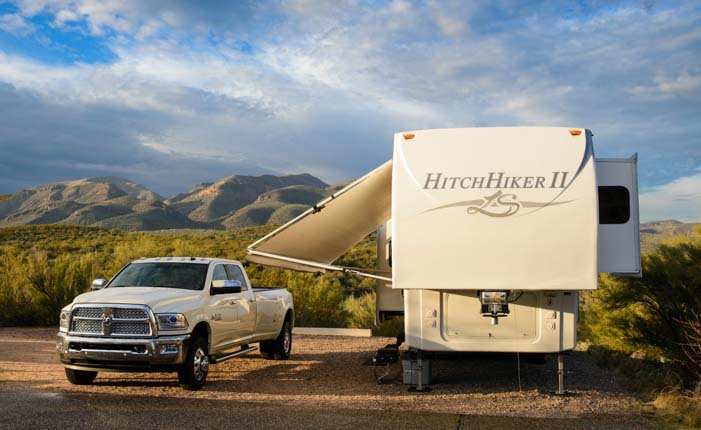
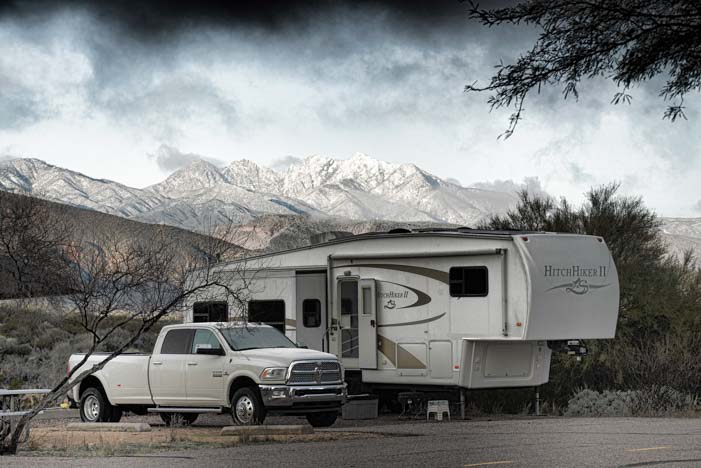
Our trailer snuggles up to its new companion, a 2016 Ram 3500 dually
Deciding Factor – The Cummins Engine
In the end, the deciding factor for us for choosing a brand was the Cummins engine. This was true when we were researching our ’07 single rear wheel truck and again when researching the 2013-2016 duallies. Lots of people wish they could buy a pickup with both the Cummins engine and an Allison transmission in one brand of truck, a combo that is on many commercial trucks. But that’s not possible.
For us, the simplicity of the inline 6 cylinder Cummins engine (as compared to the more complex V8 engines in the Chevy and Ford) along with the longer stroke (inherently higher torque) makes a lot of sense. Inline engines are used commercially in big rigs and tractors, and the 6.7 liter Cummins engine has a long and solid track record, not just in Ram trucks but in many commercial applications as well. The Cummins quality control and manufacturing seem to be top notch.
Here is a fantastic video showing a Cummins engine being built:
Amazingly, with each passing year, the payload and towing capacity of each brand of truck jumps higher. From the time we started test driving duallies in 2013 until we placed our order for our new 2016 Ram 3500, the horsepower and torque across all three brands increased, and the towing and payload capacities climbed too.
Built with the right options, the 2016 Ram 3500 diesel truck has an eye-popping, 385 horsepower and 900 ft-lbs. of torque with a GCWR of 39,100 lbs. It can tow a trailer weighing 31,210 lbs. and has a max payload of 6,720 lbs.
This is absolutely astonishing, and neither the Chevy nor the Ford trucks match that torque right now.
Accurate comparisons between brands are challenging within the same model classes, however, because there are different standards for making measurements. Ram Trucks uses the SAE J2807 standards, while other manufacturers don’t. Also, we were able to locate Ford’s towing and payload capacity charts online (see the links at the bottom of the page), but did not locate a similar chart for GM.
Some of the head-to-head tests between the brands that are posted online are also a little misleading, because, for instance, a Ram 3500 is pitted against a Ford F450. Even though both of those models are Class 3 trucks (10,001 to 14,000 lbs GVWR), one would expect the Ram 3500 to compete head to head with the Ford F350, not the Ford F450.
Best in Show
Here are the towing and payload capacities of the many models of Dodge Ram trucks:
As mentioned above, the Ram trucks are sold with two options for the transmission. After our troubles with the old 68RFE automatic transmission in our ’07 Dodge Ram 3500, we wanted the new and better one, the AISIN AS69RC automatic transmission. In the Ram Trucks marketing literature, the 6.7 liter Cummins engine is paired with the AISIN AS69RC transmission to make their “High Output Engine” because it delivers max torque at the low end for heavy towing situations. This combo became available in 2013.
“High Output” engines on Ram Trucks pair the Cummins 6.7 liter engine with the Aisin AS69RC transmission
The rear axle gearing on a pickup determines the GCWR for the truck (the maximum safe weight of truck and trailer hitched together and fully loaded) and the maximum weight trailer that the truck can tow safely. It also makes a huge difference in how the truck drives, both while towing and not towing.
Rear axle gear ratios are given as a ratio, for example “4.10” which means 4.10:1 or “3.73” which means 3.73:1. The ratio refers to the number of teeth on the axle ring gear as compared to the number of teeth on the driveshaft’s pinion gear. With a 4.10 rear end, the driveshaft has to turn 4.1 times in order to rotate the rear wheels one revolution. With a 3.73 rear end, the driveshaft must turn 3.73 times to rotate the rear wheels one revolution. So, with a 4.10 rear axle ratio the driveshaft’s pinion gear is spinning more quickly at a given speed than with a 3.73 rear axle ratio.
“Easier” Gears vs. “Harder” Gears
If you think of riding a bike, when you have the bike in a “hard” gear, it takes a lot of leg strength to turn the wheels, but one pedal stroke will cover a lot of distance. For example, going uphill in a “hard” gear would be especially hard. Your legs are turning really slowly and straining and you’re wishing you could put it in an “easier” gear! But when you descend in that same gear, you can hit high speeds easily. Back to trucks, this is like having the driveshaft turn a little to make the wheels turn a lot as it does with the 3.42 or 3.73 rear axle gear ratios found on Dodge Rams.
However, when the bike is in an “easy” gear, just a small amount of leg strength will turn the wheels, but one pedal stroke doesn’t get you very far. For example, going uphill isn’t so bad — you can inch up slowly — but once you began descending you’re spun out because your legs can’t pedal fast enough to hit super fast top speeds. In the truck world, this is like having the driveshaft turn a lot to make the wheels turn a little as it does with the 4.10 rear axle gear ratio.
Wide Load!! The highest tow ratings are achieved with a high rear axle gear ratio (like 4.10)
Towing Heavy Loads vs. Driving Fast on the Highway
So, on a truck, the higher ratio (4.10) is ideal for towing heavy loads. It takes more turns of the driveshaft to rotate the rear wheels of the truck, so the engine revs higher, putting it in the power band for RPMs, and the heavy load gets moved. But the top end speed and fuel economy get sacrificed a bit.
With a lower gear ratio (3.73 or 3.42) it takes fewer turns of the driveshaft to rotate the rear wheels of the truck. When the truck is zipping along at highway speeds, the gears are turning a little more slowly (lower RPMs) than they would with a 4.10 rear end, which saves on fuel efficiency and makes the fastest attainable speed a little higher.
The highest tow ratings are achieved with a 4.10 rear end, so the heaviest trailers will be best if towed by a truck with a 4.10 rear axle gear ratio. However, if most of your towing is with lighter weight trailers, and your driving will be primarily on interstates, and your personal preference is to drive fast, a 3.73 or 3.42 rear axle gear ratio may make more sense.
Our ’07 Dodge had a 3.73 rear end. The problem was that at the speeds we tended to drive — 55-65 — the engine would lug. Mark manually changed gears a lot to try to keep the RPMs up, but he found it fatiguing to have to monitor the gears so closely and to change gears all the time.
We also don’t drive on interstates very often, and when we do, we’re the grannies of the road, moseying along in the right lane.
We take life, and the open road, fairly slowly, so a 3.73 rear end, which is awesome a 75 mph, was not the right choice for us.
4.10 vs. 3.73 – RPMs at Different Speeds
We wanted a 4.10 rear end on our new truck, but we wanted to be 100% sure this would truly make the kind of difference we expected. So, on one Ram dually test drive we drove a stretch of highway in our ’07 Dodge at various speeds between 45 and 65 mph, noting the RPMs in a notebook, and then we took a 2015 Ram 3500 dually with a 4.10 rear end out on the same road at the same speeds. The salesman raised an eyebrow in surprise when we marched into the dealership and announced we wanted to do a test drive at various speeds to note the engine RPMs, but he went along with the idea!
On that test drive we found the 4.10 rear end shifts out of lower gears sooner than the 3.73 rear end, and generally keeps the engine RPMs about 100-200 RPMs higher at each speed. Our new truck bears out those findings.
So, how can you tell if a truck on the dealer lot has a 4.10 rear end without peering at the window sticker? Check underneath the back end of the truck. The differential is the big round casing that hangs between the rear wheels. On trucks with a 4.10 rear end, the differential has a series of vertical cooling fins on it. These help keep it cool since the gears spin faster and it is designed for heavier towing loads, both of which make it heat up.
Looking under the rear end of the truck, the differential has cooling fins if the rear axle ratio is a 4.10
BEEFED UP FRAME
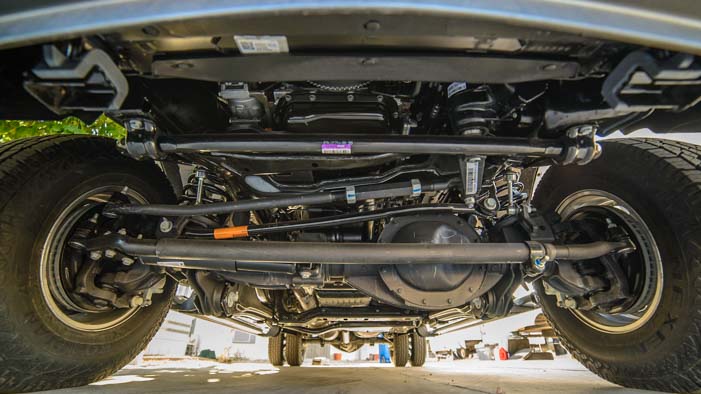
Besides the more powerful engine tuning and transmission, Ram has improved the truck frame on the dually considerable. Every aspect of the frame is more sturdy than it used to be, making the truck not only powerful enough to pull heavier loads but strong enough to withstand the multitude of forces as it hauls the load up a mountain.
Peering under the front end of the truck, the frame has been strengthened for heavy towing
We learned with our ’04 Toyota Tundra truck towing our 7,000 lb. 27′ travel trailer that four wheel drive is a necessity for us in our RV lifestyle. In our first weeks of full-timing, a small, wet grassy incline prohibited us from camping in a campground in Texas, because our truck kept slipping and couldn’t tow the trailer up over the short rise! From that moment on, we’ve felt that a four wheel drive is mandatory if you are going to tow a big trailer.
Also, while descending a really gnarly, skinny, twisty, single lane road on a mountain in Utah, with grades of 10% or more in places, we discovered that the safest way to drive DOWN a very steep descent is to put the truck in four wheel drive LOW gear, and creep down the mountain at 5-10 mph using the exhaust brake. This tactic was a lifesaver for us on that mountain with our ’07 Dodge truck and fifth wheel trailer. Without it, we would still be living at the summit of that mountain!
The new Dodge Ram and Ford Super Duty trucks have a really fantastic option for a factory installed puck system in the bed of the truck where you can mount either a fifth wheel or gooseneck hitch. During our truck search, GM did not have that option on their trucks. However, GM trucks now have the puck system as well.
B&W Trailer Hitches makes a fifth wheel hitch specifically for each truck brand’s puck system. We installed one and you can read about it at this link: B&W OEM Companion Fifth Wheel Hitch DIY Installation. The three hitches are shown below, Ram, Ford & GM:
This option has five holes in the bed of the pickup, one in the center for a gooseneck hitch and four outer ones to hold a fifth wheel hitch. The idea behind this mounting system is that rather than drilling holes in your brand new truck bed to install hitch rails to support a fifth wheel hitch — the method that was always used until this new system was devised — you can buy a hitch designed for these puck mounts and simply drop it in.
Looking towards the tailgate, there’s a gooseneck puck in the middle and four pucks in a square to mount a fifth wheel hitch. The bed is totally flat without the hitch in it.
If you want to use the bed of your truck for hauling, and you won’t be towing your fifth wheel, you can easily remove the fifth wheel hitch temporarily and have the entire bed of the truck available to you. Not only is it a snap to remove the hitch, but the bed of the truck will be flat and obstacle free because there won’t be any hitch rails installed in it.
The B&W Companion Fifth Wheel Hitch is easily installed and removed (facing the front of the truck)
Another huge benefit is that installing the hitch is an easy do-it-yourself job. We have a detailed pictorial step-by-step guide showing how to install a B&W Companion OEM Fifth Wheel Hitch here (it took just one hour from start to finish!):
Our 2007 Dodge Ram came with an exhaust brake built into the turbo. Mark LOVED this brake and used it all the time, both towing and not towing. The only thing that bugged him about it was that coming down mountains with our trailer hitched on, he often had to shift gears manually and feather the gas pedal to keep the truck going the speed he wanted.
The 2016 Ram trucks have an improved exhaust brake that has two modes: max braking power and constant speed braking. We definitely wanted that option!
BACKUP CAMERAS
Dodge Ram trucks have two backup cameras, one that aims at the bed of the truck (for hitching and unhitching) and one that aims behind the truck (for backing up). Beginning in 2016, both of these cameras could be set to display their image on the main touch screen display (in the 2015 model, one camera would display in the rear view mirror while the other would display on the touch screen display).
It’s nice to have a backup camera when backing the truck in next to the trailer!
AUTO-LEVEL SUSPENSION
An option on the 2016 Ram trucks is to have four leaf springs with computer controlled air bags to provide for auto-leveling of the rear suspension. This is instead of the standard six leaf springs without air bags that have a fixed height suspension.
Without the air bags — the standard configuration — the “rake” of the truck’s rear end is four inches, meaning that the rear end of the truck is raised four inches higher than the front to compensate for the weight of the trailer which will push it down when it’s hitched up. For a shorter person, this is quite high, and I was astonished how much higher the tailgate of a 2016 Ram truck sits than our old ’07 truck did.
With the air bags, the rear end is raked only one inch, making the whole back end of the truck much easier to access for those of us who aren’t that tall. In addition, there is an “Alt Ride Height” button that can be used to lower the back of the truck one more inch. Hurray for short people!
When the trailer is hitched onto the truck, pushing the truck down, the on-board compressor kicks on and pumps air into the air bags, raising the back end of the truck until it achieves its normal one inch rake. If you prefer to drive with the truck level, the “Alt Ride Height” button can be pressed to lower the back end one inch.
When we did our test drives, we found that the duallies with the auto-level suspension had a slightly smoother ride when not towing than the ordinary leaf spring only models did. This has proven true with our new truck too.
VENTED and HEATED LEATHER SEATS and STEERING WHEEL plus OTHER GOODIES
As we test drove different trim levels of trucks, we decided that if we were going to buy a new truck, we’d go all out and get the many little conveniences and options that are a “splurge” but that make using the truck a pleasure.
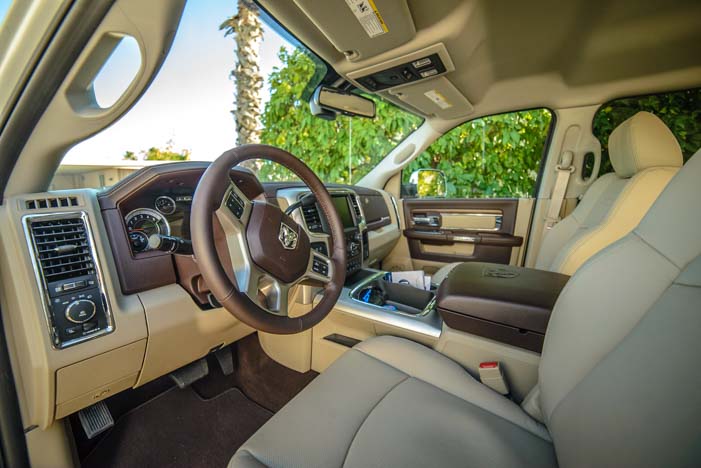
Let’s go for a ride!
Heated and vented leather seats with power seat adjustments and lumbar support, a side step to make it easier to get in and out of the truck, independent climate control for driver and passenger, a CD player, OWL on/off-rad tires, the fancy electronics console with the big touch screen display and GPS nav system and power adjustable pedals were all on our list.
Most of these options are bundled into the Laramie model of the Ram 3500 trucks.
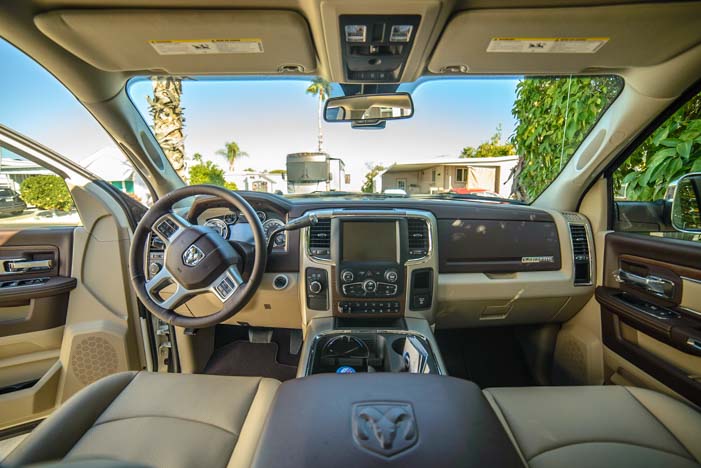
The Laramie comes with a beautiful interior that includes all the fancy stuff.
Top level Nav/GPS Display with voice activation and climate control
Tan colored Heated/Vented Leather Seats and Steering Wheel
The Tow and Payload Ratings for the 2016 Ram 3500 dually with the above options as compared to our 2007 Dodge Ram 3500 single rear wheel are the following:
Rating
2016 Dually
2007 SRW
Trailer
UVW
8,319
7,147
GVWR
14,000
10,100
GCWR
39,100
21,000 lbs.
Payload
5,565
2,953
2,850
Max Trailer Weight
30,200
13,700
14,100
Even though the make and model of these two trucks is the same, separated by just nine years, these numbers show that they are two radically different trucks!
After doing so many test drives, studying all the material and thinking about this truck for two years, there was no way we would give up any of the options we wanted, especially the ones that made the tow ratings and payload rating so high. But we never found a dealership that ordered this exact truck for their lot. Time and again, Mark would find a truck that was close, but there would be some things missing and other things we didn’t want.
So we decided to order the exact truck we wanted and wait 8 weeks for it to be built.
We had a ball ordering this truck through Airpark Dodge in Scottsdale, Arizona, where a marketing connection with Alice Cooper made one of Mark’s lifelong dreams come true. See our really fun blog post:
A significant difference between our 2007 Dodge Ram truck and our new 2016 Ram dually is that the new truck requires occasional refilling of the DEF (Diesel Exhaust Fluide) tank. Here are some tips we’ve discovered about DEF since we purchased our new truck:
Dodge Ram Truck Owners — Please note:
Late model Dodge Ram 1500, 2500 and 3500 trucks have been recalled (beginning 6/23/17) for side airbag problems in a rollover accident. See this article for details: Dodge Ram Side Airbag Recall
More info about Pickup Trucks, Ram Trucks, Tow Ratings, etc.:
2016 Ram Trucks Towing Guide – Ours is on p. 5, 2nd section, last line. Search for: “CREW CAB LONG BOX, 4X4, DRW”
Current Ram Trucks Model Specific Weight Ratings – Choose Heavy Duty / Crew / 8′ Box / 6.7 Liter Cummins / Auto / 4×4 / Premium Axle Ratio. The truck like ours is the first Laramie in the list. If you know a VIN number, click the red button “Look Up My Vehicle” to get the specs for that truck.
Note (July 2018): Folks have asked us if we like our truck now that we’ve driven it for two and a half years. We LOVE our truck. It now has about 40,000 miles on it, about half of that towing, and we couldn’t be happier with it.
Below are some of our most POPULAR POSTS(also in the MENUS above)
More of our Latest Posts are in the MENU.
New to this site?
Visit RVers Start Here to find where we keep all the good stuff. Also check out our COOL NEW GEAR STORE!!*** CLICK HERE *** to see it!
Note: This article was published in 2016 and discusses Senate Bill 164 which under consideration at the time. That bill did not pass.
Lots of Americans assume that they have a constitutional right to vote. After all, the founding fathers of the country shaped America’s legal structure to ensure everyone’s voice could be heard. However, the “right to vote” is actually a privilege, not a constitutional right, and it is granted by the individual states to most American citizens but not all.
A proposed bill in South Dakota could prevent nomadic RVers based in that state from being able to vote in the future, including the upcoming presidential election.
Although there have been broad, sweeping amendments to the US Constitution to ensure the ability to vote is not denied based on sex or race, ultimately the “right” to cast a ballot is decided individually by each state. States determine what it takes to register to vote, and they can deny groups of potential voters based on whatever criteria they see fit. As an example, most states prevent convicted felons from being able to vote.
.
In the past, full-time RV “residents” of South Dakota who did not have a real physical address in the state could register to vote simply by driving to South Dakota, staying at least one night in a campground, and using that campground address as their physical address to register to vote. When elections rolled around, they would submit an absentee ballot from wherever they were currently located. Voter registration was good for one year, and they had to re-register each year they wanted to cast a ballot.
A debate has been simmering in South Dakota for a long time about whether or not nomadic RVers who use the state as their legal domicile should be allowed to vote.
Way back in 2004, there was a hue and cry that perhaps full-time RVers, who tend to be white, Republican and retired, would influence the Senate race. For more info, see this article: RV Vote Could Affect Senate Race
In recent months, this debate has heated up to a raging boil, with the charge being led by Republican State Senator Craig Tieszen, a former police chief. The event that brought the issue to the fore was when Pennington Country, home of Americas Mailbox, a popular full-time RVer mail forwarding company, proposed a “wheel tax” that would increase vehicle taxes by $60. The concern was that the 3,467 registered voters that are RVers with an Americas Mailbox domicile address would vote in droves against it and prevent it from passing.
In the end, only 11% of this influential RV voting bloc voted. Naturally, 98% voted against the proposed wheel tax, yet everyone else did too and the RVers had no effect on the outcome.
Nonetheless, South Dakota Senator Craig Tieszen has proposed Senate Bill 164 that would prevent anyone who doesn’t have a real physical address in South Dakota from being able to register to vote. Because of the structure of the state voting laws, this would affect both votes on local issues like vehicle taxes and votes on national issues like the presidential election coming up later this year.
.
The bill is currently under review and is scheduled for a hearing. If it passes, then South Dakota based nomadic RVers will not be able to vote for the next president.
I learned of this from the Advocacy arm of the Escapees RV Club, and it is for reasons like this that I highly recommend RVers join Escapees, as they have their ears to the ground and they work very hard on our behalf. A few days later a reader contacted me with a link to a news story about the issue from the Rapid City Journal (see the links at the end of this post). Interestingly, the email announcement from Escapees mentioned that they had not yet been able to reach Senator Teiszen.
Senator Tieszen has a website, and I wrote him a note on his contact form. Believe me, I was shocked when I received a reply within 24 hours. The Senator was very forthright about his opinion, stating in his email to me:
“This is an issue of right and wrong. It is simply wrong to have people that have no connection to South Dakota influencing our elections.”
I wrote him back explaining that as nine year nomadic residents of South Dakota, we have paid sales tax and registration fees on $160,000 worth of vehicles which, to me, constituted a very real connection to South Dakota. After all, I joked, we’d be happy to receive a check reimbursing us for all that money so he could accurately describe us as having no “real connection” to the state. I also referenced the fact that full-time RVers contribute to the employment of people at their mail forwarding companies and even at South Dakota insurance agencies as well.
.
To my utter astonishment, he responded again. This time he was much more specific, saying, in part:
“That is the issue I have with your ‘residency’. The fact that you spend money here and rent a P.O. box does not qualify you to vote and decide local issues. I understand you may want to vote in national elections and I would agree to do that if that could be separated from the rest of the ballot(I have been assured that it can’t) but what qualifies you to decide who is mayor, who is the state representative, whether we should build a city building, tax more to fix our roads, etc. People that actually live here should make those decisions. And——-when there are thousands like you, actual residents are at risk of controlling their own destiny”
I am very impressed that he took the time to write. I know how much time it takes to correspond with people. I receive and respond to emails and comments every day myself, and it is extremely time consuming. So, for a busy Senator to write a few quick sentences to me really blew me away.
Also, I was very surprised that, unlike a lot of my friends who email me from work and have a footer at the bottom of the message from their employer full of legal verbiage concerning the content of the email message, his had none of that. He simply signed his messages “Senator Craig Tieszen.” I am sure he did not expect his email to be quoted online, but I think it is important for people to see a glimpse of the man behind the bill, as he expressed himself to me.
I did not agree with his statements, though, so I wrote to him one more time, pointing out three things I think are very important.
1) Before passing this bill, there must be a true legal precedent of nomadic RVers actually casting their votes in large numbers in local elections. The wheel tax referendum in Penington County should have been one of the hottest of hot button issues for nomadic RVers, since our vehicles are our biggest tie to the state and are often our biggest asset too.
Yet if the voter turnout of RVers was just 11% on this issue, which was below the 15% voter turnout county wide, then full-time RVers don’t seem to pose a threat in local elections for selecting city mayors, state representatives and city building plans. I certainly have never voted in a local election.
2) When it comes to local issues like vehicle taxation, everyone who pays South Dakota vehicle sales taxes and vehicle registration fees should be allowed to vote so they can “control their own destiny” (borrowing Senator Tieszen’s words) regarding those taxes.
3) Some of the nomadic RVers who use South Dakota as their domicile actually have very close ties to the state and are even former “physical” residents. Some RVers return to South Dakota in the summers to work at the State and National Parks, or to work for other employers, like private RV parks, or simply to enjoy retirement life in South Dakota for a few months.
Other RVers own property in South Dakota that can’t be used as a legal domicile (i.e., open land or commercial property), so they use a mail forwarding service because it simplifies the legal logistics of their lives enormously, both for receiving mail as they move around the country and for keeping vehicles properly registered and licensed. Of course, these nomadic residents pay property taxes to the state in addition to vehicle sales tax, licensing and registration fees.
There is a provision in the bill for voter registration applicants to appeal a denial, but it is a complex, tiered process, and the criteria that must be met rule out all nomadic RVers who do not own a permanent residence in South Dakota with sleeping quarters.
The bottom line is that by denying all nomadic RVers the right to vote in local elections, this bill would effectively prohibit both seasonal residents of South Dakota and property tax payers from voting in presidential elections if they happen to rely on a mail forwarding address for domicile purposes.
Ironically, once RVers hit the road full-time, they often have no “real” ties to any state, so they are no more residents of one state than they are of another. If full-time travelers can’t vote in the state that is their legal domicile, the state where they pay their vehicle sales taxes and licensing and registration fees, and where they may pay commercial property taxes too, then where else could they possibly register?
In the end, if you think about it, full-time travelers are being lumped in the same voter category as convicted felons.
Unfortunately, Senator Tieszen has not responded to those points.
I’m not an activist, but I would very much like to be able to vote for our new president next fall. For other RVers who are concerned about protecting their ability to vote in the future, especially our “neighbors” from South Dakota.
UPDATE 02/15/16: This bill is scheduled to be heard on Wednesday, February 17, 2016, at 10:00 a.m., and the Escapees Advocacy team recommends that all comments and opinions be expressed directly to the chairman of the committee, Senator Gary Cammack. Here is the link to contact Senator Gary Cammack
UPDATE 02/17/16: This bill was tabled by the committee, however the issue has not gone away. In an email to Escapees members, the Escapees Advocacy team reviewed the committee meeting as follows:
“South Dakota Senate Bill #164, entitled, “An Act to revise certain residency requirements for voter registration,” has been tabled by the State Senate Affairs Committee. During the Committee meeting, Senator Tieszen stated, ‘I believe there is a legal solution to this.’ He continued, ‘I believe it’s legal and constitutional to put reasonable residency requirements on voting in South Dakota.’ He is looking for a solution that ‘does, in fact, disenfranchise those folks that have no connection to South Dakota other than the fact that they rent a P.O. box here for financial gain.’ He continued by stating, ‘I’m going to continue to try to work for that solution.’ Tieszen stated, ‘Senate Bill 164, I’ve concluded, is not the solution.’ He concluded by asking that Senate Bill 164 be tabled. After the vote was taken, Senate Bill 164 was tabled by an 8 to 1 vote.
“In conclusion, Senate Bill 164 is a non-issue at this time. But, in the future, a voting restriction may be re-introduced. Escapees will continue to monitor this issue for future action.”
Yet from time to time politically charged issues like this come up that affect us and others like us directly. So, I write about them here in hopes that you will be encouraged to think deeply and to take action if the spirit moves you.
Here are two other “RV advocacy” posts I’ve written about changes occurring on America’s public lands that have far reaching ramifications for all Americans and for the future of the country as well:
There is no doubt that we are Living the Dream. We have been utterly blessed with wonderful experiences as we’ve traveled around by RV and sailboat. It’s as though the gods have reached down from the heavens and sprinkled us with fairy dust. And it keeps on twinkling!
Much more importantly, we have fallen in love with life and each other all over again, and grown immeasurably as people.
Black Canyon of the Gunnison, Colorado
I know many of our readers are doing similar things or dream of doing them in the future. And for quite a few readers 2016 will be “The Year.” The very cool thing is that dreams definitely do come true. Ours did. Yours can and will too.
But what’s the trick to making it happen?
Before we started traveling full-time, we had both done a bit of travel, but not a whole lot. We were too busy living conventional lives that kept us rooted in a single neighborhood with a predictable pattern of commutes. We had both lived several different phases of that lifestyle over the decades, and although each one was rich and deep in its own way, we both yearned to get more out of our lives.
I had backpacked around Europe for a few months in college and did the same around Australia in my early thirties. Mark had gone on a huge motorcycle adventure through the Canadian Rockies and western states. But other than exploring the few hundred miles from where we’d lived, we knew very little about the country we’d been raised in.
Riding in the red rocks of Sedona, Arizona
We didn’t do a lot of planning or even all that much research before we set off in our RV. I had read cruising books and cruising magazines for much of my adult life, dreaming of casting off on the ocean and enchanted by people who set sail from some shore and wound up in exotic places in the Caribbean or the South Pacific.
From them, I knew that a life of independence, travel and freedom was possible. I just wasn’t sure how to put it together or when the opportunity would arise.
Our boat Groovy bobs at anchor in the morning light at Las Hadas Resort, Manzanillo, Mexico
Two books written by travelers really got my wanderlust humming. One traveler was Tania Aebi, a girl who took off to sail around the world as a teenager, and then, at the ripe old age of 21, wrote a fascinating coming-of-age story about her eye-popping adventures. It’s called Maiden Voyage, and I highly recommend it.
I had followed Tania’s monthly column in Cruising World Magazine and devoured her stories blow-by-blow as she inched around the world for two years. I was smitten.
She was a few years younger than me, and rather than spending every day commuting to an engineering job in an office park and writing software in a tiny cubicle while the world passed by beyond the out-of-view windows, she was in her bikini on her boat living an astonishing life.
I wanted that! But I couldn’t see a way clear…
One of the most beautiful anchorages in Mexico’s Sea of Cortez: Agua Verde
It made me wonder: what does it take to have a Big Adventure?
Tania’s father thought his rather headstrong daughter might be headed for teenage trouble where they lived in New York City. So, he made a deal with her. Rather than spend his money sending her to college for an education she probably wouldn’t appreciate, he bought her a small sailboat, outfitted it with some basic gear, helped her load it up with beans and rice and untied the dock lines for her.
Her job was to get around the world, come back to New York, sell the boat and give him whatever cash she got for it. In the meantime, she would get her education from what she affectionately came to call Ocean U.
The view from one of our favorite beaches, Playa Las Gatas, in Zihuatanejo, Mexico
But she wasn’t exactly an experienced old salt. She had cruised with her family in the past, but when she went to drop the anchor on her first night out, she realized she had no idea how to handle a boat by herself.
The first leg of her trip took her from New York to Bermuda. Miraculously, she made it there alive, albeit days late. But as she sat at a dockside restaurant, scarfing the biggest hamburger on the menu, she was overcome by an incredible sense of pride. She was the captain of her own ship, and she had sailed to Bermuda from New York by herself, a feat few others on the island had done.
The rest of her tale is gripping, and her story has inspired many a sailor. Beth Leonard and Evans Starzinger, two of the most celebrated and widely published sailor-writers of recent times leaned heavily on Tania’s story for inspiration and moral support as they began their own world cruise as newbies years later. Evans has written that at times he would say to himself, “If Tania could do it, so can I!”
We had no idea when we went camping in our popup tent trailer that we would soon take off on the adventure of a lifetime.
The other book that seduced both me and Mark and kept drawing our thoughts away from convention and towards adventure was An Embarrassment of Mangoes by Ann Vanderhoof.
She and her husband left the demands of urban life in Toronto to savor many months of carefree, sunny days aboard their sailboat in the Bahamas and Caribbean islands.
They tackled the cruising life with very little cruising experience, had loads of misadventures on the way to becoming seasoned sailors, and ultimately came home after two years completely reborn as two very different people with a whole new outlook on life. It wasn’t long before they did it again.
What a beautiful setting – Mabry Mill in Virginia
So, what does it take to have an adventure?
Ours had very humble beginnings. With my job coming to an end in the spring of 2007, and Mark’s job being one he could put on hold for the summer, we planned to take our popup tent trailer on a four month voyage from Arizona to Vancouver Island and back.
We would close up our home for those months, go out and see some of the western states, and then figure out what to do with our lives when we got back home.
Smith Rock State Park in Oregon has such an iconic landscape that we recognized it while watching the John Wayne & Katharine Hepburn movie, Rooster Cogburn. When the dialog mentioned “Fort Smith,” we laughed: we had been right!
We had perused a few websites that talked about RVing full-time, and we had read excerpts from a few sailors that were posting their photos and stories online as they cruised around the world.
But it was a pipe dream, just like our other pipe dream of going cruising in a sailboat. Nonetheless, we spent every spare minute visiting RV dealerships all around us, to the point where we had settled on the exact make and model trailer we would want to buy if we took the plunge and became full-time RVers.
Grand Teton National Park remains one of our all time favorite places to go.
Our frivolous daydream only got serious on my last day of work when I came home to find two signs in our yard: “For Sale by Owner” and “Yard Sale.”
When I raised my eyebrows at Mark, he just told me he was tired of “scenario building” and daydreaming about doing something exciting. He felt that a four month trip to Vancouver in our popup wasn’t going to satisfy our wanderlust itch. We’d just come home at the end of it all and be flummoxed once again.
So… up went the signs in the yard on that fateful Friday.
Little did we know, during our first weeks on the road in California, what incredible thrills and adventures lay ahead of us in the years to come. We were 53 and 47 in this photo. A month or so from now we will turn 62 and 56. The years go by whether you’re chasing your dreams or not!
I jumped on board with Mark’s idea wholeheartedly, and by the end of the weekend the house was in escrow, the car and popup were sold, half of our stuff was gone, and we had put a deposit on the dream trailer we’d set our hearts on — 1,000 miles away. Mark had spotted a smoking deal online and negotiated $500 towards our gas costs if we drove out to pick it up. Score!
Three weeks later, with the rest our stuff sold or given away, we hopped in our Toyota Tundra and drove 1,000 miles, with all our remaining worldly possessions in the bed of the truck, except for five custom bicycles and 10 Rubbermaid bins full of memorabilia we had stored in a friend’s backyard shed. We were off to see our new home for the first time.
Sometimes, for some people, a burst of action and a leap of faith with your eyes closed (but peeking), is the way to go!
Our new home on the road: an ’04 Toyota Tundra and ’07 Fleetwood Lynx travel trailer. The day after this was taken we discovered the Tundra couldn’t handle the 7,000 lb. trailer on Tioga Pass on the way in to Yosemite National Park from the east. So we began researching diesel trucks.
When we started, we had absolutely no idea what was to come. Mark was intimidated at the idea of towing a 27′ travel trailer, and I had no clue about solar power except that I knew it worked for sailors so it oughtta work for us. We knew just a smidge about photography, and although we had both sailed a lot and I had lived aboard a sailboat at a dock and been a weekend cruiser for four years in New England, neither of us had sailed more than 70 miles on a passage at sea.
We replaced our Tundra with a Dodge Ram 3500 in our sixth week on the road. We replaced our 27′ travel trailer with a 36′ Hitchhiker fifth wheel at the end of our first year of travel.
We had great fun attending the School of Hard Knocks together, and even now we continue to learn and grow and evolve with every passing day.
When you find yourself traveling through large cities on a one day trip, luggage storage airport Barcelona can be a real game-changer, offering a stress-free way to explore without the burden of your bags.
Perhaps the best part of our traveling adventure has been that it has opened our eyes in ways we never imagined, and has opened doors for us that we never knew existed.
Venturing beyond the end of a hiking trail on the Utah/Arizona border, we discovered a seemingly unnamed and unmarked canyon. We had it to ourselves!
As I contemplate these exhilarating years of our lives, I really think what it takes to “live the dream,” whatever that dream might be, is not the ordinary, practical things that first come to mind, like money.
What it takes to Live the Dream is a passion to break the bonds that hold you
and to chase down your dream for all you’re worth.
The Mayan ruins in Mexico’s southern state of Chiapas were utterly thrilling to wander through.
Obviously, good health, minimal responsibility and a bit of money are very helpful, but they aren’t required. Mike Harker, a paraplegic, sailed around the world solo on a 49′ Hunter sailboat. He was in “good health” but obviously didn’t have the physical advantages most of us have.
As for being free of responsibility, some families travel full-time on both land and water, with the parents bearing the enormous responsibility of child-rearing and homeschooling and sometimes earning a living as well.
And as for money being a pre-requisite, the stories of the various sailboats without electricity, refrigeration, plumbing or engines that show up in the South Pacific islands, some all the way from Europe, are astonishing, and we’ve met plenty of RVers traveling on skinny budgets.
This past year we went to the northeast where we saw some beautiful sights in Nova Scotia.
It helps to have a catalyst to tip you over the edge. Mark’s sudden decision that “it was time,” and his signs in the yard got us out the door. We aren’t planners, so that kind of leave-taking was just right for us. Others prefer to have an official departure date. One person I know hung up a roll of toilet paper with a number on each square representing the number of days left.
However you get yourself launched, the image you have of your traveling life before your journey actually starts will turn out to be only a faint sketch of the picture you’ll paint as you go along.
A banyan tree in Sarasota, Florida, spreads its limbs wide… and so does Mark!
I sure had dreams of becoming a published writer “some day,” but never in my wildest dreams did I imagine we would reach a point where we’d publish three articles on widely varying subjects in three different magazines and have a cover photo on a fourth, all at the same time, in January 2016.
But that has happened, and I swear it is because we are truly loving our lives and cherishing every minute of what we do.
The barns and snowcapped peaks of the Wallowa Mountains in NE Oregon blew us away.
Just like everybody else, we have more dreams on the horizon, and we have New Year’s resolutions we’ve talked about and will try to achieve. As we develop and mature, we master certain elements of our lifestyle, but then we come up with new ambitions and desires that we’d never even thought about before. These new dreams propel us forward.
Yet I don’t think think we’d be dreaming these dreams today, to the same colorful degree, if we had stayed home and never moved into our first small trailer. We would still be dreaming our earlier, preliminary dreams that pushed us out the door in the first place, and we wouldn’t be able to imagine embellishing those dreams in any way.
The experience is cumulative, and the evolution is continuous.
Sailing to Mexico opened our eyes to the beauty and incredible friendliness of our southern neighbor. These little girls were dressed up for a school festival.
The other day, we returned to our shed in our friend’s backyard to swap out a few things. We stored some goodies we don’t need right now and retrieved a few others we’ve missed. As we rummaged through the various bins we’d so carefully packed all those years ago, we both came across a few items we had held dear at the time of our launch but that we had long since forgotten about.
And that’s the ironic part of the scary Big Purge you have to go through before going full-time. A lot of the things that are precious to you today won’t hold the same meaning a few years down the road. You won’t be the same person.
The things that will be vitally important to you after you’ve been out touring for a while will very likely be things that don’t even enter your consciousness right now, because you can’t even conceive of them.
A classic western town thousands of feet up in the mountains in Silverton, Colorado.
For me, that is the great beauty of trying a new lifestyle like one lived on the road. The decades are going to pass by no matter whether you chase down your travel dream or let it slip through your fingers. You will grow old despite every attempt you make not to. It will all be over before you know it.
If you give your dream wings now, and let it fly free, you will give yourself a chance to live life to the fullest, to grow, to broaden your perspective and to invite and embrace new experiences that you won’t have otherwise.
And if there is anything that holds most people back from fulfilling their dreams, it is plain old fear.
Yet… what is there to be afraid of? You’re not going to get out of this life alive, and you’ve got a fixed number of years left. Why not go for it?!
The scariest thing in life is getting to the end and never fulfilling your deepest dreams. Driving a rig over the Million Dollar Highway isn’t scary at all if you prepare and drive it a few times in a car or truck first.
And who’s to say we wouldn’t have had scary and disturbing situations there too?
Mark emerges from the stunning slot canyon at Buckskin Gulch in Arizona.
So… is the passion to fulfill a dream really all it takes to shake up your life and go have a great adventure? I think it’s a huge part. But there are other things that come into play too.
I discovered a book last year that has really helped both of us crystallize in our minds what we love in our lives and what we want to expand on. It’s called The Magic, and it is part of the series of books, videos and online materials called The Secret by Rhonda Byrne.
What I love in this book is that it outlines a step-by-step process for recognizing what’s wonderful in your life and opening your heart to even more great experiences. The essence of the book is to find everything in your life that you are grateful for, and to itemize these things and to express thanks for them on a regular basis, either in your mind or in writing.
One simple technique is just to take a few minutes at bedtime to list 10 things you are grateful for in your life and to remind yourself why they are meaningful to you. These don’t have to be monumental things, but little things — blue skies, your favorite song, the smell of lilacs, the dance of waves on the ocean, the warm smile of a loved one, the feel of your child’s or grandchild’s hand in yours.
The cathedrals in Mexico were gorgeous. This one is in the town square in San Miguel de Allende near our favorite city, Guanajuato.
Another easy bedtime tactic is to think through the whole day you just experienced and to pick out the one very best thing that happened. Even if it was a rotten day, there was surely something worthwhile. It might have been just that you got to eat your favorite cereal for breakfast or stop for your favorite coffee at Starbucks. Lots of people around the world don’t get that chance.
Doing these things puts you in a good frame of mind and takes your focus off the petty frustrations that sidetrack and sometimes derail us all.
There are many other similar ideas like this in the book, and I have found it worth reading and re-reading several times.
This 9 day passage can be a hair raising adventure, and we did it while flying along between two hurricanes that were traveling up the coast with us. Every minute of my off-watch that I wasn’t pretending to sleep, I was reading passages of that book!
Texas has some of the craziest weather in America. An early spring storm brought ice crystals to the desert at Big Bend National Park.
It reminded me that life, for all it’s drama and seemingly external events (including things like a scary passage up the Baja Pacific coast), is actually lived entirely between your ears. The most recent minute, hour, days and years are gone forever into the mist of memory, and the next minute, hour, days and years hover ahead in the fog of the future.
Every single bit of that stuff resides in your mind, and you can cast it in sunshine or in clouds as you wish.
The only “reality” is the here and now. And if you ask the Physicists, even that is a figment of the imagination that’s wildly different than our limited perceptions can witness.
The San Juan Mountains in Colorado light up in shades of gold every fall. We stayed long enough to get a dusting of snow too.
If I have discovered anything at all as I’ve pondered our unusual lifestyle choices, our dreams and the lives we left behind long ago, it is that a combination of nurturing my dreams and nudging the thoughts i am thinking onto a positive track both go a long way towards my personal happiness and ability to live my dreams.
Sitting in a bed of wildflowers on the Schoodic National Scenic Byway in Maine. We wouldn’t trade this life for any other!
2016 is a brand new year, full of opportunity and promise. We hope it turns out to be “your year” to make your dreams come true.
2015 was a year of extraordinary adventures for us as we gallivanted around North America in our ninth year of full-time travel. Looking back at our year of RV voyaging, it is astonishing to re-live the wide ranging experiences we had on the road.
A view of New Hampshire’s White Mountains gives us pause for reflection on our sensational year of RV travel to the eastern states in 2015.
Gas prices were at an unbelievable low at the start of the year at about $2.79/gallon in Arizona, so we realized this particular year would probably be a great one to travel a long distance. After pondering Alaska versus Nova Scotia as destinations from our starting point in Arizona, we decided to head to the northeast. What a boon it was to watch fuel prices decrease all year long, hitting $2.09 a gallon when we returned to Arizona at the end of the year.
“Buses by the Bridge” VW Microbus fest in Lake Havasu Arizona
In January, the death of a cherished mentor of mine, Toller Cranston, made me realize with more poignancy than ever before that life is precious and we must savor every moment we have here on earth.
Thousands of sandhill cranes fill the sky near Willcox, Arizona
Boondocking in the wilds at Big Bend National Park in Texas
The Caverns of Sonora, a few hundred miles east of Big Bend on I-10, gave us a chance to explore a truly gorgeous underground world in a massive cave, but a scary ice storm on the highway as we made our way from there to Fort Worth jolted us back to reality.
The Caverns of Sonora in Texas are among the world’s prettiest
2015 turned out to be a year of major repairs and upgrades on our trailer, and we had no idea of what was to come when we did our first big trailer upgrade in Fort Worth, Texas. We replaced our trailer’s electric brakes with electric over hydraulic disc brakes. This turned out to be a perfectly timed upgrade, as the traffic, hills and chaotic driving in the northeast tested our trailer’s braking system again and again for the rest of the season.
Our first big upgrade in 2015 – Trailer disc brakes
New batteries, new inverter and new converter – yay!
One of our more unusual discoveries this year was The Ringling in Sarasota, Florida, a one-of-a-kind estate where we found fabulous art created by the European masters from the Middle Ages to the 19th century that had been collected by one of the founders of Ringling Brother’s Circus.
“The Ringling” in Sarasota – An estate and art museum full of treasures from the circus
A sandhill crane mom checks on her chick in the nest
I flew to Massachusetts for a week and reveled in the delights of the seaside town of Rockport before we packed up the buggy in Florida and began our long trek to the northeastern states.
Quintessential New England beauty in Rockport, Massachusetts
The Carriage Roads in Acadia National Park – A gift to all of us from John D. Rockefeller, Jr.
Taking our RV further downeast, we were delighted by a series of lighthouse sightings, first the candy-striped West Quoddy Head lighthouse and then the red crossed East Quoddy Head lighthouse at Lubec (Maine) and Campobello Island (Canada).
Maine’s West Quoddy Head Lighthouse in Lubec
New Brunswick’s East Quoddy Head Lighthouse on Campobello Island
These lighthouses were just a warm up for the incredible evening we experienced after we crossed the border for real into Nova Scotia and watched the setting sun play upon the Peggy’s Cove Lighthouse in south-central Nova Scotia.
Peggy’s Cove Lighthouse on the south coast of Nova Scotia
Wild skies at Peggy’s Cove Lighthouse in Nova Scotia
The visual wonders kept us in awe throughout our stay in Nova Scotia, first at Lunenburg and Mahone Bay on the southern coast, then on the Northumberland Shore on the north coast.
The classic colorful fishing village of Lunenburg, Nova Scotia
The Cabot Trail winds through the highlands of Cape Breton Island in Nova Scotia
Seaside camping at the northern tip of Cape Breton Island, Nova Scotia
At this point, in early July, we turned around and began the long journey back south and west. Our first stop was cute (and remote) Eastport, Maine, followed by the fun town of Bangor where we spent precious time with very special friends.
A bat on the gate protects the house of author Steven King in Bangor, Maine
While we were in Bangor, we underwent the first major repair of the year when we got our trailer’s rear axle replaced. The original axle had been bent by the bad roads in Nova Scotia, and we were extremely grateful that our newly minted RV warranty came to the rescue.
The service team at Harvey RVs in Bangor Maine did an outstanding job replacing our rear trailer axle.
From Maine, we zipped west to the White Mountains in New Hampshire where we summitted Mt. Washington, the tallest peak in the northeast. We did it the easy way by taking The Cog Railway.
The Cog Railway climbs a 37.5% grade straight up Mt. Washington in New Hampshire’s White Mountains
A community of Amish people make their home in the New York Finger Lakes
The farmer’s produce auction – a glimipse of another era.
The rural countryside of the Finger Lakes was lovely, and we were just delighted when a pair of fawns and a fox paused at the edge of the woods to check us out.
The New York Finger Lakes have their wild side!
A rainy daytrip to exquisite Watkins Glen State Park proved to be an ideal way to see this jewel, as the overcast light and flowing waterfalls were perfect for taking photos.
The waterfalls at Watkins Glenn blew us away.
From the Finger Lakes, we dropped south along the Ohio River until we spotted a pretty town on the far shore that turned out to be the unusual and historic town of Maysville, Kentucky.
We were charmed by the historic buildings and warm hospitality of Maysville, Kentucky
From the brick streets to the wonderful old buildings to the towering flood wall that holds back the Ohio River when it swells to threatening heights, we were enchanted by Maysville, Kentucky.
In Maysville, Kentucky, everyone loves to gather in the streets, especially outside O’Rourke’s Pub!
A stop for a beer at O’Rourke’s Pub introduced us to a warm community of newfound friends who went out of their way to make us feel welcome and special in their town.
We watched tobacco being harvested — an industry that once thrived but is now disappearing
We toured tobacco farms, ran local running races, saw a fabulous car show, enjoyed free music concerts, learned about Freemasons, checked out the historic village of Washington and even met the Mayor.
We were shocked and touched when the local newspaper published a story about us on their front page.
This was a glorious introduction to Kentucky, and we had high hopes of seeing more of the state and to swing through Tennessee as well, but our refrigerator died and the closest place that could do a quick repair was in Indianapolis. So, off we went to get a new RV fridge. Again, thank goodness for that RV warranty, as this repair was covered too!
Our refrigerator quit working, but some fast footwork got us back on the road quickly.
With the beer sufficiently cold in our fridge once again, we headed to Missouri and visited the incomparable Spacecraft Manufacturing plant where luxurious, ultra rugged and fully custom fifth wheel trailers are designed and built.
The great plains of Kansas gave us some great skies!
Continuing west and south through Manhattan Kansas, we arrived in Humboldt, Kansas, just in time for their unique Biblesta celebration that unites the entire community as they share, retell and re-enact the stories of the Bible.
The Biblesta Bible celebration in Humboldt, Kansas, is one of a kind.
This quiet celebration in rural Kansas and a fun fall festival in Welch, Oklahoma both took place not long before tragic world events unfolded in Paris, and it was a bittersweet moment when we reviewed our photos later and reflected on our memories of peaceful Paris, Texas, set against the ongoing chaos in its namesake City of Lights in France.
Tiny Tatum, New Mexico, is loaded with fun metal art by two extraordinary artisans.
Nature’s rock art at City of Rocks in New Mexico makes a fabulous backdrop for camping
When we crossed the border into Arizona, we had come full circle, ending an extraordinary year of RV adventures on the road. Autumn was in full regalia and it felt wonderful to be “home” as we explored Mt. Graham, the area around Roosevelt Lake and the ancient Indian Ruins at Tonto National Monument.
A late November return to Arizona brings us in during the peak of Autumn splendor.
After arriving in Arizona, to our utter astonishment and chagrin, we had to turn to our RV warranty for a fourth time in as many months. We replaced our trailer’s entire suspension system (shocks, leaf springs and axle hangers) which had failed badly due, in part, to weak springs on our new trailer axle, and had left the coach’s tires nearly touching. I haven’t shared that story here — I just haven’t had the heart to write about another round of trailer repairs as of yet — but believe me, we sure were glad to have that warranty. This last repair brought us to a total of over $6,700 in repair reimbursements that were all covered by our $1,904 contract.
Our trailer suspension sagged so badly between Maine and Arizona that the tires almost touched.
Repairs aside, as we look back on this magnificent year of travel, we feel truly blessed to be living this life, and we know just how fortunate we are. We feel grateful for and awed by every day that dawns. Throughout 2015, and in an all our years of RV and sailing travel, we have been the lucky recipients of many deeply fulfilling and truly life changing experiences.
These are our happy golden years…
This memorable year of RV travel was very different from all of our prior years because we covered so much distance and were on the move for so long. We drove our truck a total of 19,837 miles, about half of which was towing our trailer. We stayed in 108 different locations, 50 of which were one night stands and only three of which lasted 3 weeks or longer.
No matter how big an RV you get, if you live in it long enough, eventually you will begin to fill it up with stuff. This has happened to us and our 36′ fifth wheel trailer. When it was new and we first moved in years ago, it was so big that half our cabinets were empty.
Our old dining area – no storage and seating for two.
We began storing lenses in a drawer with dish towels (soft padding) and we had four camera bags that lived on our desk and under our dining room table. Camera bodies were always strewn across the sofa, fanny packs got piled on the desk, and tripods often got stuck on top of the subwoofer under our TV. Tucking everything away for safe passage while driving was a real pain. We needed to get this stuff organized!
Mark had a brilliant idea one morning — replace our dining room chairs with big storage ottoman benches!
Our new dining area – lots of storage and seating for four.
We began researching storage benches and ottomans and found the perfect thing from Simpli Home Furnishings. They are made of a nice faux leather, and there are no decorative buttons on the top, so the plush, padded top is very comfortable for sitting on (here’s more info).
These storage ottomans are 36″ wide by 18″ tall and 18″ deep.
The outside dimensions are 36′ long by 18″ high by 18″ deep. The inside dimensions are 33.25″ long by 11.5″ high by 15.5″ deep.
Our new storage ottomans have voluminous interior space.
We bought them sight unseen from Amazon and couldn’t be happier. They come with four short legs, with three screws each, which were easy to attach.
The only assembly is attaching the four legs.
Some customers have complained that the screws are too long and coming up through the floor of the box, but the legs simply need to be oriented correctly with the three screw holes aligned with the outside edges of the ottoman.
Be sure to align the screw holes with the outer edges of the ottoman.
The legs were attached in just a few minutes using our cordless drill.
A cordless drill makes this a quick job!
The end result is much more comfortable seating at our table and a whole bunch more storage space for our camera gear.
Ta da!
The tricky thing about storage space in an RV is that anything located behind the coach’s rear wheels is going to bounce around a whole lot as you drive down the road. That’s why most RVs don’t have the kitchen in the rear.
Our new storage ottomans sit just slightly forward of the trailer’s axles.
The box tops easily clear the table when they open.
Another tricky thing with storage space in an RV is that in many coaches, like ours, the shelving is very flimsy. We prefer not to put anything heavy into the wall cabinets (except in the kitchen where our cabinets are more sturdily built). But it doesn’t take long to run out of storage space down near the floor.
This new storage space is solid.
A few throw pillows makes these pretty darn comfortable for lounging!
We put some throw pillows on our new benches and now we’ve got not only a great place to keep our camera gear organized and a nice, new, clean look to our dining area, but we can kick back after a meal, prop our legs up on the benches and chit chat for a while. It’s fun to sit there together and get a new perspective on our little rolling home and on life!
We never used to hang out after meals on our old chairs… but this is fun!
These benches are ideal for us, but Amazon sells lots of other similar storage ottomans of different sizes and shapes too and you can find all kinds of storage benches for sale at Amazon at this link HERE).
If you find the benches are a little low, one good way to raise them up is with the plastic rug protectors made for furniture legs. We also removed the feet from our table to bring it down a smidge.
More of our Latest Posts are in the MENU.
New to this site?
Visit RVers Start Here to find where we keep all the good stuff. Also check out our COOL NEW GEAR STORE!!*** CLICK HERE *** to see it!
Winter RVing is loads of fun, but figuring out how to stay warm in an RV on those chilly winter mornings and long cold dark evenings makes all the difference between having a great time and wishing you were in a house. Going to a southern state is a good start, but it may not always fit with your overall full-time RVing itinerary. You might get caught in an early winter storm, like we did in one year in Colorado’s Rocky Mountains. Or you might get whipped by a blizzard on your way south, as has happened to some of our snowbirding friends who wanted to celebrate the holidays at home in Montana before trekking south to Arizona in January.
Here are some tips for ways we’ve found to stay warm in our RV in winter…
Brrr…How do you stay warm inside of this??
WINTER RV TIP #1 – STAY IN BED UNDER THE COVERS TIL SPRING!
One winter RVing tip is to go to bed and stay in bed until the spring wildflowers begin to bloom. Our two little RV companions, Chrissy the cockatoo and Weazie the ferret (named for former beloved pets) seem to have decided to go that route this year.
One solution – jump under the covers and stay there until Spring!!
WINTER RV TIP #2 – GET AN EFFICIENT SPACE HEATER!
A better option is to get a good and efficient heater. The factory installed propane furnaces that come with most RVs is very inefficient. The blower uses a lot of electricity. What’s worse, the heater goes through a lot of propane, because much of the hot air is exhausted outside the RV (just go outside on a cold day and put your hands by the RV furnace vent — they’ll be warm in a jiffy!).
If you will be plugging into electric hookups a lot, and staying for just a few days at a time in most of the places you travel to (with no metering on the electricity and unlimited power built into the overnight camping fee), then it makes sense to get a really great electric space heater.
WINTER RV TIP #3 – INSTALL A VENT-FREE PROPANE HEATER!
If you are going to be boondocking (or dry camping), out in the southwestern deserts — or even in Florida or Texas — then you will need an RV heater that is efficient both in its use of electricity and its use of propane. The best option is a vent-free propane heater.
We LOVE our vent-free propane heater.
We have been using ours since Mark installed it in 2008, both during the winter and the summer, and we love it. We have a whole blog post explaining how this kind of heater works, what the technologies are behind the different styles of vent-free propane heaters on the market, what kind of heat each type of heater produces, and how to install one here:
We have used this heater from sea level to 10,000′ altitude year round, and we share some tips for heating strategies we’ve used when we’ve camped on a lofty mountaintop as temps plummeted and a snowstorm rolled in:
WINTER RV TIP #4 – GET A PORTABLE VENT-FREE PROPANE HEATER!
A portable vent-free propane heater is an easy way to go.
If you love the idea of using an efficient propane heater that doesn’t use any electricity, but you’re not keen on doing a permanent installation, another great option is to get a portable propane heater.
WINTER RV TIP #5 – INSTALL A VENT-FREE PROPANE FIREPLACE!
How about a vent-free propane FIREPLACE?!!
On the other hand, if you are outfitting the RV of your dreams for a life of full-time RV travel or of winter snowbirding RV adventures, then you might consider installing a vent-free propane fireplace that is built into an elegant mantel. These heaters give off the same incredible heat as the more industrial looking vent-free propane heaters, but they have the cozy and inviting appearance of a fireplace and produce a beautiful (and mesmerizing) flame. What a great addition to an RV!!
WINTER RV TIP #6 – SHRINK-WRAP YOUR RV SCREEN DOOR!
One of the easiest ways to winterize an RV is to shrink-wrap the screen door. By covering the screen door with a thin layer of plastic, you can keep the big RV door open all day long, close the screen door, and let the sunshine fill your rig with light and warmth. It is really surprising that just a thin layer of plastic on the door is all it takes to keep the cold air out and let the warm air in (if you aren’t in sub-freezing temps!!).
Shrink-wrapping our RV screen door keeps the cold air out and lets the sun shine in!
We learned this trick from our RVing mentors, Bob and Donna Lea, in our first winter of RVing back in 2007-08. The beauty is that the installation of the shrink-wrap is less than a one hour job, and you can remove it in the springtime in just a few minutes.
Window shrink-film kit
We love having shrink-wrap on our screen door so much that we’ve gone through quite a few summers without removing it. Up in the mountains, it can be chilly in the summertime, with a brisk breeze blowing into the rig in the mornings, so the shrink-wrap can work its magic there too, and it also keeps the dust out.
This year, however, we took the shrink-wrap off our screen door when we got into the heat and humidity of the northeastern states in August, so we had to reinstall it just a few weeks ago.
All the tools we used to shrink-wrap our screen door.
The window shrink film kit comes with double-sided tape, and all you have to do is outline the door with the tape, remove the backing, press the plastic onto the tape, trim off the excess and then heat it up with a hair dryer to make the plastic taught. It is best to clean the frame of the door with alcohol or film remover first so the tape adheres well.
Press the double-sided tape along the frame of the door, going around the plastic sliding insert by the door handle.
Go around the little slider opening for the door handle, because you need to be able to slide this open and closed (the shrink-wrap is covering only the screened parts of the door!). Then peel the backing off the tape all the way around the door.
Remove the backing from the tape.
Press the plastic onto the sticky tape around the door frame.
Hang the shrink wrap around the door frame.
Then use a razor blade to trim off the excess all the way around the door. Get the plastic as taught as you can. It doesn’t have to be perfect, though, because all the wrinkles will be taken care of in the next step.
Use a razor blade or box cutters to trim off the excess plastic.
Using the hair dryer on the high setting, wave it gently back and forth over the edges of the door. The plastic will miraculously shrink up and become taught.
Use a hair dryer on the high setting to shrink up the plastic along the door frame.
Once you’ve gone around the frame of the door, wave the hair dryer across the middle to tighten that up too. Keep the hair dryer moving so it doesn’t melt the plastic in one spot.
Keep the hair dryer moving and wave it across the plastic to tighten it up.
If it’s cold out, you can always give yourself a blow dry too!
.
Once it is done, open the outer RV door open and close the screen door. The warm sun will pour in, but the cool breezes will stay outside!
Morning sunshine fills our kitchen
Note: Since publishing this post, we have refined our shrink-wrap system even further. We have found that it is easy to make this into a Dual Pane system but adding a second layer of shrink-wrap film on the INSIDE of the RV door. What a world of difference this second layer makes!!
WINTER RV TIP #7 – ORIENT THE RV WINDOWS (and DOOR) TOWARDS THE SUN
Every RV floorplan is different, with the largest windows and the door placed in various locations, depending on how long it is and whether it’s a trailer or a motorhome. Take a look at where your biggest windows are, and try to orient the rig so those windows are in the sun for most of the day.
Our biggest windows are in a big slideout on the curb side (passenger side) of the trailer and also in the rear of the coach. So, in the wintertime we are best off orienting our rig with the truck headed northeast. This places our biggest windows towards the southeast and southwest.
In the summertime, the opposite is true as we try to avoid having our windows facing the sun. Our best orientation in the summertime is for the truck to be headed northwest. This way, although we get blasted with some sun in the morning, our biggest windows are blissfully shaded during the long hours of blazing hot sun as it shines from the south and sets in the northwest.
This does place our RV refrigerator in direct sunlight during the hottest hours of the day in the summer, but we’ve never had trouble keeping our food cold with the fridge on the highest setting during those hot months (of course, our fridge died recently, but we discovered that that was to be expected because of its age!).
For our rig, it’s best to orient the truck to the northwest in summer and the northeast in winter.
Note that the sun doesn’t travel the same arc in the sky in the summer months as it does in the winter, as shown by the orange arrows in the graphic above.
In the dead of summer, the sun rises in the northeast and sets in the northwest. During the day it is high in the sky, almost directly overhead. In mid-winter, the sun rises in the southeast and sets in the southwest, traversing a very low arc in the sky. At its highest, the sun is only halfway up the sky. These low angles are advantageous for keeping an RV warm in winter, however, as the sun shines directly in the windows into the center of the coach.
WINTER RV TIP #8 – INSULATE THE HATCH VENTS
The RV roof may have some fabulously high R-rating that the manufacturer proudly touted when you bought it, but that applies only to the parts of the roof that are solid. Most RV vent hatch covers are thin pieces of plastic, and they don’t have much of an R-factor at all.
You can give the vent hatch covers a hand by using a hatch vent insulator. These have reflective insulation on one side to make them even more effective.
Another option is to cut styrofoam to the exact dimensions of the hatches. When we bought our fifth wheel trailer from the manufacturer NuWa Industries, we asked them to cut four pieces of the Blue Dow insulating styrofoam that they used in the walls to the exact dimensions of our four roof hatches.
The great thing about having insulation on the hatches is that they work both summer and winter. We often use ours in the summertime when we leave the rig for the daytime hours.
Another helpful benefit is that they block out all light. So, if you are parked under a bright light or there is a full moon that wakes you up as it shines right in your eyes, you can block out the light with an insulator in the bedroom hatch.
We use Blue Dow foam from the fifth wheel walls cut to the dimension of our hatches
WINTER RV TIP #9 – DEALING WITH CONDENSATION!
One of the biggest annoyances in cold, winter weather in an RV, is condensation. If you run a vent-free propane heater while boondocking, whether it’s a portable heater or one that is permanently installed, condensation will build up on the insides of the windows when the dew point is at a certain level.
Insulation on our windows – ugh!
You can minimize the condensation build-up by running the RV furnace for a while to blow out the moist air. You can also open a window a crack, or open the RV door for a bit.
Absorber towels sop up moisture with ease.
The fastest way to deal with the condensation is simply to wipe it off with an Absorber towel. As the name implies, these towels are incredibly absorbant. They are most effective when they are damp, so they come with a little plastic container that will keep them damp for months.
Simply wipe the window and then wring out the towel. And repeat. Once the window is dry, give it a final swipe with a soft microfiber towel. This gets rid of any streaks.
To make your life easier during the winter condensation season, remove the window screens and put them in a closet. This way, you aren’t fighting with the screens every time you wipe down the insides of the windows.
How much do we love our Absorber towels? We have two — blue for him and red for me!
WINTER RV TIP #10 – INSULATE THE WINDOWS AT NIGHT
Like the big roof insulation R-factor that doesn’t account for the hatch vents, the well advertised high R-factor in the walls doesn’t account for the windows, which is where much of the heat in a rig escapes, especially at night. Closing the blinds makes a difference. When we’re in a remote area with no one around, we prefer to keep the blinds open so the first light of morning fills the rig. But we can’t do this in the wintertime unless we want to wake up to a rig that is 5 degrees cooler than it could be.
Likewise, on the worst of the cold winter nights, covering the windows with Reflectix insulation makes a big difference. This aluminum foil insulation comes in a big roll, and you can cut it to the exact dimensions of each window. Just use a marker to write on each one which window it’s for.
To put one of these window insulators in place, simply hold it against the glass and then lower the blinds over it. In the case of our biggest one in the back of the rig, we rest the bottom of it on a spare pillow so it doesn’t slip down.
The window-sized piece of Reflectix Insulation is held in place by the window shade.
We keep all of them rolled up together in a closet and use them both summer and winter. In the summertime, they help immensely with keeping the heat out during the day.
WINTER RV TIP #11 – USE THE OVEN
One of our favorite ways of warming up the inside of our buggy is by baking. Mark is the Resident Baker in our household, and there is nothing like a batch of yummy muffins or a fresh loaf of banana bread coming out of the oven to warm us up inside and out!
On a brisk morning, there’s nothing like a fresh loaf of banana bread coming out of the oven!
After the baking is done and the oven is off, we keep the oven door open for a while so we can enjoy the residual warmth as it cools down. By the way, we recently discovered Chiquita banana bread mix, which is absolutely delicious and tastes just like a loaf made from scratch. It requires two bananas, and lately Mark has been adding raisins to it too.
On a cold afternoon, we’ll bake something in the oven for dinner. The longer it takes, the warmer the buggy will get during the baking process! Anything from frozen pot pies or lasagna to a whole chicken does the trick nicely.
WINTER RV TIP #12 – DO SOME EXERCISES
As soon as we wake up in the morning, we do some modest exercises. We might be shivering when we first turn on the vent-free heater, but a quickie round of 25 sit-ups and pushups always gets the blood flowing, and by the time we get in a few rounds with the hand weights, we’re sweating and turning the heater off!
This is also a great way to work off those extra calories from the tasty muffins, sweet breads and pies that keep coming out of our oven!
One way to take the chill off — do a set of sit-ups. Still cold? Roll over and do a set of push-ups!
WINTER RV TIP #13 – PLAY THE FIREPLACE DVD
Fireplace video.
This may sound a little goofy, but a video of a fire burning in a fireplace is really fun and makes the rig cozy. The video simply shows logs in a fireplace burning down to embers, accompanied by the crackling sound a fire makes. It is surprisingly realistic, and quite funky. The crazy thing is that whenever we play it, the person sitting in the recliner closest to the TV always feels a little warm on the side by the fire!
WINTER RV TIP #14 – INSULATE THE HOT WATER HEATER and HOT WATER PIPES
To conserve propane, we always heat the water just once a day, right before we take our showers. After we’re done, we have warm water for dishes, etc. By insulating the hot water heater, the water stays warmer longer. We also put insulating pipe foam on the hot water pipes that run from the heater to the shower and the vanity and kitchen sinks.
Taking a shower in an RV in the winter can be a numbing experience if temps got to freezing the night before, no matter how hot the water is in the hot water heater, because the cold water has to run through the pipes before the hot water reaches you in the shower.
If we are conserving water, we’ll bring a small cooking pot into the shower and run the cold water into it. Then we’ll warm that water up on the stove later for dishes or whatever. Even though it’s less than a quart of water, this way it’s not wasted on our bodies as we hop around in the shower shouting expletives and soaping up our goose bumps!
For more tips on heating an RV, see these articles:
Thank you for using any of our links to Amazon to shop online. When you access Amazon this way, anything you put in your shopping cart right after that results in a small commission to us at no cost to you (no matter what you buy) and helps us keep our site online. It’s a true win-win — THANKS!
Below are some of our most POPULAR POSTS(also in the MENUS above)
More of our Latest Posts are in the MENU.
New to this site?
Visit RVers Start Here to find where we keep all the good stuff. Also check out our COOL NEW GEAR STORE!!*** CLICK HERE *** to see it!