When Reality Interferes with Fun RV Travels and Blogging!

This week was one of those weeks where our idyllic lifestyle of sightseeing and playing in beautiful places had to be put on hold while we took care of some important repairs on our fifth wheel trailer. We have been waiting for these repairs since we were in Nova Scotia three months ago where the rough roads bent an axle on our trailer and caused a leak in our fresh water holding tank.

Kansas Sunrise

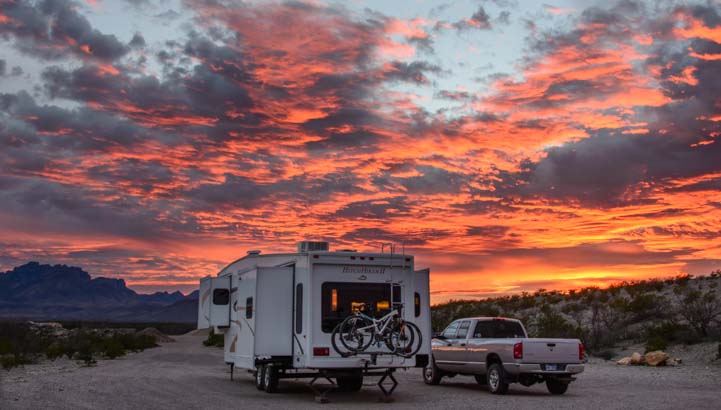
A stunning Kansas sunrise!

We were able to replace our trailer axle in Maine over two months ago at Harvey RVs, an outstanding RV repair facility in Bangor. Unfortunately, they did not have a fresh water tank in stock that would fit our trailer. I doubt any RV repair facility would stock such a tank, as they are generally custom made to fit between the floor joists, with fixtures and plumbing connections placed in locations that are unique to each RV.

RV fresh water tank in fifth wheel trailer underbelly

Getting ready to remove the fresh water tank.

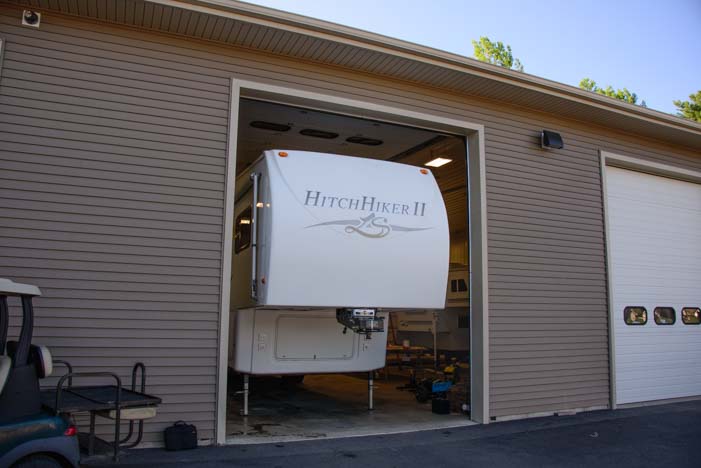
So, we decided to return to Chanute, Kansas, where our trailer was built in 2007, to have the fresh water tank replacement done at the NuWa service center. We were assured they had the proper fresh water tank in stock.

Since we were relying on our RV extended warranty to cover the fresh water tank replacement cost, we decided to have a few other broken things taken care of at the same time. We had been living with these broken items for a while, as they weren’t too critical, but because each one qualified to be repaired under warranty, we could bundle the repairs together and get them all fixed at once while paying just one warranty deductible for everything.

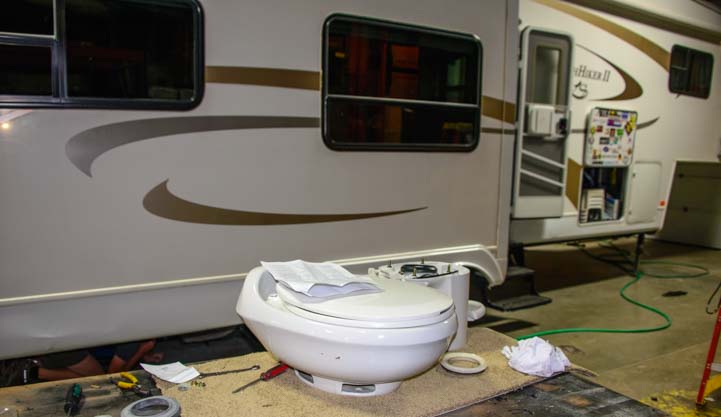
RV toilet replacement repair

RV toilet rebuild — fun fun fun!!

The day of our repair appointment in Kansas finally came on Monday this week, and we have had a whirlwind (tornado?) of a week as we watched and assisted as many as five mechanics working on our rig at once, all day long, for three days. To add to our own personal confusion, we had to move out of our trailer and into a motel for a few days.

Turmoil in our RV

Chaos reins!

All of our repairs were related to water in some way, with most of them having to do with either our fresh water or sewer water plumbing systems. For the entire job, our precious rolling home straddled an open grate in the floor that serves as the RV dump station for the shop. This is where they fix clogged black tanks and replace broken ones. They had just replaced five black tanks the week before we got there!

RV fresh water holding tank replacement

Our new fresh water tank gets installed.

This meant that for three days both we and the mechanics were lying on and scooting around on the (often wet) floor that was layered with who knows what kind of muck, from who knows whose rigs.

RV holding tank valve replacement

New black tank valve…nice!

Of course, most people don’t hang out with their mechanics when their RV is being worked on, but we were with them every step of the way. We learned a lot about how RVs are put together, and we were able to catch quite a few bloopers that would have bitten us big time down the road.

RV kitchen faucet replacement

A new kitchen faucet goes in.

Being present throughout the repair process ensured us that everything was installed correctly using best practices (i.e., using teflon tape and hose clamps where needed, installing all the o-rings that came with the replacement parts not just some of them, and testing each repair after it was finished). Several projects on our list were done two or three times to get them to 100%.

This was awesome for us in the long run, because we knew our repairs were being done well, but it was exhausting to live through. Needless to say, there wasn’t any creative writing or blogging going on!

Fifth wheel RV window removed

Rear window removed.

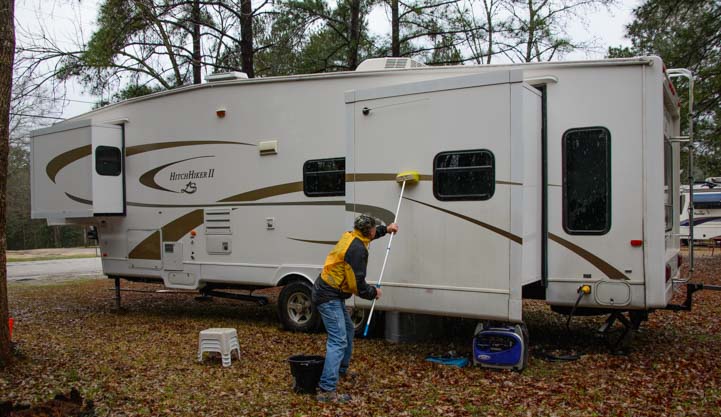
But life is groovy once again and our buggy is back together and fully functional. NuWa provides an awesome cleaning service after a repair job, and Sharon did a terrific job making sure our living areas were clean before we left. Once we were back in the wonderful (and nearly free) city RV park, we followed her lead and shampooed the carpets and detailed the exterior of the rig too.

Washing our fifth wheel RV

Working hard…well, one of us is!

With this big interruption behind us, and with a huge sigh of relief, we are now planning to leave Kansas in our wake and head south through Oklahoma and Texas over the next few weeks before turning west. Yay!

Oh yes — and that Trailer Warranty we have through Wholesale Warranties? What great fortune that we had it, as these repairs came to $1,242, and all we had to pay was the $100 deductible.

Note added later: Sadly, we had another major repair waiting for us just a few weeks in the future when our trailer suspension failed when we got to Phoenix, Arizona for the holidays. Here’s how the warranty has worked for us to date:

Here's a summary of what our four year RV warranty through Wholesale Warranties cost, what our repairs WOULD HAVE cost, and what our warranty reimbursements have been to date:

Cost of Warranty $1,904
Total Cost of Repairs we've had done $7,834
Total Out of Pocket Costs for those repairs $1,145
Repair Reimbursements:
Trailer Axle Replacement $1,036
RV Refrigerator Replacement $1,647
Plumbing Issues & Window Leak $1,142
Suspension Replacement $2,550
RV Toilet Replacement $314
Total Repair Reimbursements $6,689

Our trailer warranty has paid for itself 3.5 times over!
Confused about the nitty gritty fine print buried in RV Extended Warranties? Here's an excellent detailed explanation!!

If you are thinking about getting a warranty for your trailer or motorhome, Wholesale Warranties is offering a $50 discount to our readers. Just mention that you heard about them from our website, Roads Less Traveled, and the discount will come off the quoted price at the time of purchase. You can get a quote from them here:

Wholesale Warranties Quote Form

Subscribe
Never miss a post — it’s free!

Similar stories of our adventures with RV repairs and installations:

Our most recent posts:

More of our Latest Posts are in the top MENU above.

RV Refrigerator Replacement – How an RV Warranty Saved Our Bacon!

We’ve been reporting on whether or not an RV warranty is a good investment for RVers, and this page — the second of four installments — presents our latest findings.
(Hint: the answer is a resounding YES!)

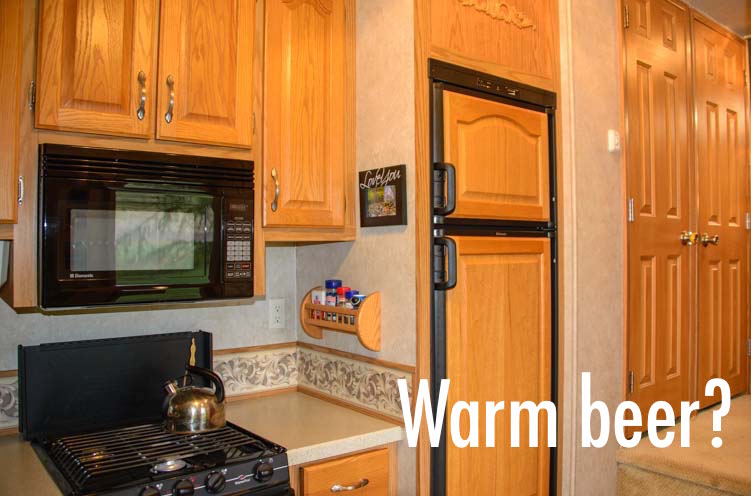
Ten days ago, after a fabulous two weeks in Maysville, Kentucky, and a long day of driving, we set up camp, grabbed a beer, and kicked back to enjoy a cold one. But to our dismay, the beer was kinda warm. We ratcheted the RV refrigerator up a notch and went about our business. After dinner and a movie in our RV, we decided to have a bowl of ice cream. When Mark lifted the lid on the Haagen Dazs, what he found inside could only be described as cool chocolate soup.

Oh no! Our 8 year old RV refrigerator had died.

RV extended warranty repair RV refrigerator replacement

Do something quick! We’re going to lose everything in the fridge and freezer!!

As the clock neared midnight, we began a frantic search for RV repair shops in the area. We put together a list of them, went to bed quite distressed, and first thing the next morning we started making phone calls. Mark threw bags of ice in the fridge and freezer and we didn’t dare open either door after that. We lamented sadly that all our frozen meats — all those nice burgers and steaks, and even our bacon, darn it — were quickly defrosting.

After about 15 phone calls, we were still nowhere. Everyone told us it would be a two week wait to get a fridge and that it would probably cost upwards of $1,500. Finally, we called Camping World just south of Indianapolis. They had an identical unit in stock and they could squeeze us in for service the next morning. They told us they always try to make an extra effort for desperate travelers passing through.

Well, we weren’t exactly passing through. We were in Kentucky driving west towards Tennessee, and they were 150 miles to the north in the totally wrong direction. But what can you do? We were absolutely thrilled to find an RV repair facility that had an RV refrigerator in stock and could install it quickly, so a 150 mile detour was not a problem!

This would be our second major repair in just over a month. We had just had our 36′ fifth wheel trailer axle replaced. What’s worse, we were actually on our way to an RV repair appointment in Kansas to fix a leak in our fresh water tank. What kind of luck was that?

As it turns out, Lady Luck was following us very closely. Our RV extended warranty had covered the bulk of the trailer axle repair, and we were pretty sure it would cover this one too.

Where we stood on our trailer warranty at this point was the following:


We were 11 months into a 4 year RV extended warranty
Cost of RV warranty: $1,904
Reimbursements (less deductibles) to date: $1,036
Remaining Reimbursements to Break Even: $868

You can see the current status of our warranty HERE.

It looked like this RV warranty repair would not only bring our total reimbursements to the point of covering the original cost of the RV extended warranty but would go well beyond that.

18 hours after we’d discovered our fridge was dead, Camping World service manager Rick Helvey was in our trailer examining its hulking carcass. He told us that propane RV refrigerators typically last only 10 years.

What??!!

It was no surprise to him that our 8 year old unit had kicked the bucket. He opened the fridge vent on the outside of the trailer and showed us the telltale signs of a dying RV refrigerator: greenish or yellowish dust.

The presence of this dust meant the ammonia was leaking out and the cooling unit had given up the ghost. The crazy thing is that the price of a cooling unit is nearly the same as the price of a new RV refrigerator — Not Cheap!

RV warranty repair on a refrigerator - inside the vent

Yellowish dust in the fridge vent area is proof positive that the fridge is dying.

RV warranty repair RV refrigerator installation

Here is a closer look at the greenish – yellowish dust.

He called our warranty provider, Portfolio Protection, to get approval to proceed with the repair the next morning. To his astonishment (and ours), they said they wouldn’t reimburse us for a replacement refrigerator. They would reimburse us only for the replacement of the cooling unit to save themselves a little money. Here’s the breakdown:

Install New RV Refrigerator Parts: $1,389.99
Labor: $267.00
Tax: $97.00
Total: $1,753.99
Replace Cooling Unit Only Parts: $1,049.00
Labor: $356.00
Tax: $73.43
Shipping: $100.00
Total: $1,578.43

DIFFERENCE IN OVERALL COST: $175.56

This was a problem — for us and for Camping World!!

If we got our refrigerator replaced, we would be in and out of Camping World in 3 hours the next morning and they could go back to business as usual with their local customers. If we had to have the cooling unit replaced, we would have to wait a week or two for the part to come in and Camping World would have to reshuffle their appointments the next morning, once again, because our appointment was already on the books. We had all assumed the approval of a replacement refrigerator would be a slam-dunk.

New RV fridge ready for installation

Our new refrigerator is ready and waiting — all we need is approval to install it!

What to do?

Well, here’s one reason we are becoming more and more enamored of our RV extended warranty through Wholesale Warranties. Unlike most warranty brokers who wash their hands of the deal once you’ve purchased the contract and signed on the dotted line, they are willing to go to bat for you if the warranty reimbursement process isn’t going as smoothly as it should.

We called Wholesale Warranties and told them what was going on. The difference in cost between repairing and replacing was not astronomical. Couldn’t the warranty company allow us to go ahead with the refrigerator replacement?

Within an hour they had called our warranty company, Portfolio Protection, explained to them why it made more sense for everyone involved to install the new fridge Camping World had in stock and, magically, our refrigerator replacement had been approved. We were floored that Wholesale Warranties would do this and that they could be such effective facilitators. Yet it turns out that making these calls is business-as-usual and is routine customer support for them.

Early the next morning we parked the fifth wheel in front of Camping World, and service technician Raymond and his assistant José got started on it right away. Unfortunately, our old refrigerator was 1/4″ too wide and could not fit through our front door. RV refrigerators are installed at the factory before the doors and windows are in place!

RV warranty repair Removing RV refrigerator from fifth wheel trailer

Good heavens, the old fridge can’t go out the front door!

So, the dining room window had to come out!

RV extended warranty Removing an RV window from fifth wheel trailer

The dining room window has to be removed
so the refrigerators can be hoisted in and out.

RV extended warranty repair RV window removed

It would have been so much easier if the refrigerators could have gone through the door!

RV warranty refrigerator replacement gets through window

The new fridge is ready for some strong person to pick it up!

A forklift was used to remove the old fridge and hoist up the new one. It was at this point that I realized just what a challenging DIY project this would have been for Mark!

RV warranty refrigerator replacement New RV fridge on forklift

Thank goodness for fork lifts! This is not an easy DIY installation for one guy!

Then the new RV refrigerator was put in place.

RV warranty repair New RV refrigerator installed in fifth wheel trailer

Raymond settles the new refrigerator into place.

The pretty oak panels from our old refrigerator were slipped into place on the new door.

Under warranty Oak panel installed on RV refrigerator door

Our oak panels from the old fridge slide neatly into place.

Then Raymond ran around back to hook everything up in the refrigerator vent.

RV extended warranty repair new RV refrigerator installation

The back of the new fridge is exposed in the vent area where Raymond hooks it all up.

Meanwhile, his assistant José removed the silicone remnants from the wall around the window opening using a scraper and wiping the wall down with Acrysol

Removing silicone seal on RV window

José scrapes the old silicone sealant off the outside wall
around the window opening.

Removing silicone from RV window

The wall has to be completely clean for a good seal on the window.

Raymond lifted the window into place, and he and José screwed it in place.

RV warranty refrigerator replacement Installing RV window

Raymond puts the window back in place.

Installing RV window on fifth wheel trailer

The guys work together to get the window screwed into place.

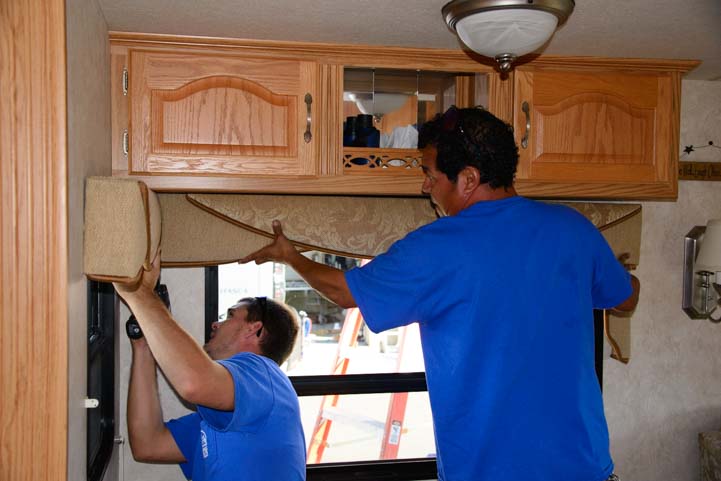
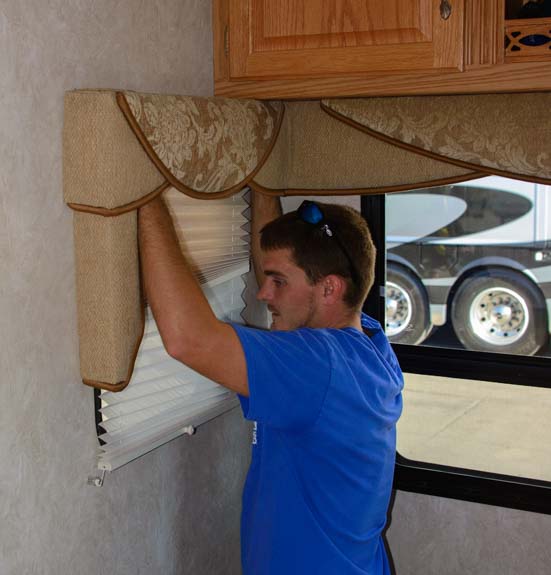
Then they remounted the window valence and reinstalled the day-night shades.

Installing valence on RV window

The window valences are reinstalled over the windows.

Installing day-night shades on RV window

The day-night shades are reinstalled on both windows.

Raymond gave us instructions not to put a bead of silicone around the window frame for about a week because he had used caulk tape that would ooze a little for the next few days.

We were impressed with how quickly these guys worked and got the job done, and we were really grateful to Rick for making an opening for us. In just 36 hours from the time we had soup for ice cream, we had a brand new RV refrigerator up and running. Now we just had to wait for it to cool down (about 9 hours).

In the meantime, our frozen meats had fully defrosted but were still cold. We couldn’t re-freeze any of them when the refrigerator finally cooled down. Arghhh!

As we hitched up the fifth wheel, I noticed Mark had a twinkle in his eye as he drove it around to the back lot. He hopped out and instantly set up the barbecue, right there in the Camping World parking lot. He happily began grilling burgers, hot dogs, steaks, chicken and brats.

“We can’t let all this good meat go to waste!” He said to me as he handed me the bacon and sent me inside to fry it up.

It turned out he’d invited the service guys to come on over to our place for a barbecue lunch, and when the yummy smells from our grill began to waft across the Camping World parking lot, they quickly showed up in a golf cart and began chowing down.

The crew enjoys a barbecue lunch

The Camping World service team stops by for an impromptu barbecue. Thank you guys for a super job!

At last it was time to settle up the bill with the service manager, Rick. Our RV warranty deductible was $100. Indiana charges sales tax on deductibles, so our total out of pocket cost for this phenomenal repair was only $107. Wow!!

Our RV warranty (less our $107 deductible + tax) covered $1,647 on this one repair alone — that is nearly the cost of the entire four year RV extended warranty itself!

Shockingly, this RV refrigerator replacement was just one of a slew of major repairs our trailer needed in a four month period in 2015:

Here's a summary of what our four year RV warranty through Wholesale Warranties cost, what our repairs WOULD HAVE cost, and what our warranty reimbursements have been to date:

Cost of Warranty $1,904
Total Cost of Repairs we've had done $7,834
Total Out of Pocket Costs for those repairs $1,145
Repair Reimbursements:
Trailer Axle Replacement $1,036
RV Refrigerator Replacement $1,647
Plumbing Issues & Window Leak $1,142
Suspension Replacement $2,550
RV Toilet Replacement $314
Total Repair Reimbursements $6,689

Our trailer warranty has paid for itself 3.5 times over!
Confused about the nitty gritty fine print buried in RV Extended Warranties? Here's an excellent detailed explanation!!

Are we happy with our extended trailer warranty? OMG Yes!!

Having suffered four major repairs in four months, we have come to the conclusion that anyone with an RV older than four or five years should seriously consider getting an RV extended warranty, especially if they don’t like unexpected financial surprises.

What a shock it was to find out that RV refrigerators are expected to fail by their tenth year of service. All you need is that one repair plus another one or two (air conditioner, water heater, furnace, slide-out mechanism, hydraulic leveling system, etc.) to cover the cost of a four year warranty and even wind up ahead.

Do I sound enthusiastic and excited about our trailer warranty? I am!! I was hugely skeptical about RV warranties before our trailer axle and RV refrigerator replacements, and all I can say is that this has been an amazing process!!

If you want to find out what a warranty would cost for your rig, Wholesale Warranties is offering a $50 discount to our readers. Call our contact, Missi Emmett at (800) 939-2806 or email her at missi@wholesalewarranties.com. Or go to this link:

Wholesale Warranties Quote Form

The discount comes off of the quoted price at the time of purchase — just be sure to ask!

To learn how RV warranties work and how they differ from RV insurance, see this article:

What Is An RV Warranty and Is It A Good Investment?

If propane RV refrigerators are so prone to failure, why don’t we have a residential refrigerator? — It takes a huge solar panel array and big (heavy) battery bank to power a residential refrigerator along with everything else in an RV. See the following:

Can a Residential Refrigerator Run on Solar Power in an RV?

Subscribe
Never miss a post — it’s free!

The Full Case History of our RV Extended Warranty:

Below are some of our most POPULAR POSTS (also in the MENUS above)

Buddy - A Journey in Spirit - The story of an event that changed our lives forever.

ARTICLE INDEXES
  • RV Tech Tips Articles - A one page index of links to all our RV Tech Tips, RV Upgrades & RV Maintenance articles.
  • RV Lifestyle Tip Articles - An index of links to all our RV Lifestyle Tips (finances, boondocking, major repairs, work/jobs, etc.)
  • Solar Power Articles - Overview and tutorial articles for how to design and install solar power on an RV or boat
  • Product Reviews - An index of links to all of our Product Reviews
RV UPGRADES, SYSTEMS & TIPS MONEY FULL-TIME RV LIFESTYLE GEAR STORE
  • Gear Store - A list of the goodies, equipment and gear we've found useful in our RV lifestyle!
 

Our most recent posts:

More of our Latest Posts are in the MENU.   New to this site? Visit RVers Start Here to find where we keep all the good stuff. Also check out our COOL NEW GEAR STORE!! *** CLICK HERE *** to see it!

Canada RV Travel Tips – RVing Nova Scotia & the Canadian Rockies!

Taking an RV into Canada to explore the Canadian Rockies or the Atlantic Maritime provinces of New Brunswick and Nova Scotia is very easy, but there are a few fun and funky things we thought fellow RVers would appreciate knowing about.

TRAVEL TIPS FOR RVers THAT ARE PLANNING A TRIP TO CANADA:

For starters, you need a passport to cross the border into Canada. If you don’t have a passport, Visa Express can help you obtain one easily.

The border agent in the booth at the Calais border crossing in downeast Maine asked us a bunch of questions about where we were going and how long we’d be staying. He did not look inside our trailer. It was very easy. Likewise, crossing the border north of Eureka, Montana, at Roosville, British Columbia was a quick affair, and our trailer was not checked.

Coming back over the border the US border in Calais, Maine, the agent wanted to check our fridge for fruits and veggies. The only thing in our veggie drawer was a peach, and he took it. Crossing into the US at Chief Mountain, Montana, the border agent took the keys to our trailer and opened it up and inspected it himself (we offered to get out of the truck and accompany him, but he refused). This time we had no fruits or veggies in the fridge, and nothing was confiscated. Checking things over later, we assume he also looked in the basement compartment of our fifth wheel trailer, as we found it was unlocked when we arrived where we were going, and we’re sure we’d locked it when we’d packed up to leave Canada.

Credit and Debit Cards

To avoid having our cards declined at stores in Canada, we called our credit card companies and banks before we crossed the border to let them know we’d be traveling in Canada.

Because every transaction on a credit card or debit card involves exchanging money between Canadian dollars and US dollars, most credit cards and banks charge a 3% fee for making the exchange, no matter where you use the card (i.e., at an ATM or restaurant or gift shop). This 3% charge on every transaction quickly adds up!

Some credit card companies and banks list the 3% fee as line item on their statement. Others may not.

If you will be spending a long time in Canada, or plan to do many repeat visits, consider getting a credit card and checking account with Capital One. They do not charge a currency exchange fee on their credit and debit cards.

Getting Cash

On each visit to Canada, we were in Canada for three to six weeks and we used only $20-$50 in cash (to do laundry). If you need cash, you can get it without paying an ATM fee by asking for cash over on a small debit card purchase at a big supermarket like the popular supermarket chain Sobeys.

We also had clerks in tiny mom-and-pop stores change a US $20 bill for us so we could either make a purchase from them or could get some coins to finish drying our laundry next door.

By the way, $1 coins are called “Loonies” for the cute loon on the back of the coin and $2 coins are “Toonies” to rhyme with Loonies.

Data / Phone Plans

Your best bet for internet access is to install Starlink on your RV. We installed Starlink on our trailer and it was a total game changer in our traveling lives. See our detailed post about our permanent RV rooftop installation here.

Verizon MiFi Jetpack in Canada

Verizon MiFi Jetpack shows “GSM” for Global Service in Canada.

Contact your cell phone provider and mobile internet data provider to see what happens when you take their phone or internet device into Canada. Technology is changing rapidly, and these companies are modifying their plans all the time.

If you don’t like the company’s plans and restrictions for taking your devices to Canada for some reason, you may be able to suspend the account for a period of time and reinstate it once you get back. Find out if there is a disconnect or reconnect fee for doing this.

It also may be possible to swap out the SIM card in a smartphone for one from a Canadian carrier, but from what we saw, it is brand and model dependent. Some can and some can’t. Canada has a lot of cell phone providers.

Internet Access via Public WiFi

There is ample free and open (no password) internet access in both the Canadian Rockies and Nova Scotia via WiFi at town halls, visitors centers, big box stores like Walmart, restaurants and coffee shops.

Unlike the US where almost all WiFi signals are password protected, there is usually a free signal available in the more populated areas. However, they aren’t always all that fast and, of course, they aren’t secure.

Currency Conversion

The following links give the current currency conversion between US and Canadian dollars:

Canadian Dollars to US Dollars
US Dollars to Canadian Dollars

Gas and Diesel prices New Brunswick Canada

1.10 $C / liter = $3.30 $US / gallon
Note: diesel is cheaper than gas!

Fuel Costs – Converting Canadian $ per Liter to US $ per Gallon

Contrary to many crazy rumors we’d heard before we got there, fuel prices in Canada were about 20% higher than fuel prices in the US. That’s it.

The easiest way to get from Canadian $/liter to US $/gallon is to bundle it all into one conversion factor taking two things into account:

— There are 3.79 liters in a gallon.
— The current exchange rate (it was 0.8 $C to 1.0 $US when we went)

Converting from $C / liter to $US / gallon uses this conversion factor:

$US / gallon = (3.79) x (exchange rate) for the price you see advertised for fuel

During our visit the conversion factor was: 3.79 * 0.8 = 3.03 or approximately 3.

So, we multiplied the advertised gas price (or other liquid liter price) by 3 to get the equivalent US dollars per gallon.

For instance, the sign says diesel is 1.097 (Canadian) per liter (call it 1.10 Canadian). Multiply that by 3 and it’s around $3.30 (US) per gallon, or a little over.

We also found that New Brunswick was slightly higher (averaging around $1.25 per liter) than Nova Scotia (averaging around $1.10 per liter).

Sales Tax

If you see a great sale on something because the price is low and the conversion math in your head makes it seem like a steal, don’t forget that there is a much larger sales tax than in most American states.

During our visits, the sales tax in New Brunswick was 13%, the sales tax in Nova Scotia was 15% and the sales tax in British Columbia was 12%. Alcohol is taxed a little extra and other goods are taxed a little less.

Comparative Cost of Groceries and Beer

We found that groceries were just slightly more expensive than the eastern states and New England where we had been traveling prior to visiting Nova Scotia. Groceries were perhaps 5% to 10% higher for identical items. The same proved true in the Canadian Rockies as compared to Idaho and Montana.

Beer and cigarettes are heavily taxed, and we found the typical cost of a six pack of darker beer was around US $10-$12.

In the National Parks in the Canadian Rockies, everything is priced a little higher simply because these are heavily visited tourist destinations.

Microbrew Beer

For lovers of dark ales, porters and stouts, the selection in Nova Scotia is almost non-existent. After trying every “dark” ale we could find, and discovering that they were all just a shade darker than Bud Light, we discovered a wonderful brew called Propeller Porter.

Propeller Porter Beer in Nova Scotia Canada

We really liked Propeller Porter.

In the Canadian Rockies we had much better luck with finding good darker microbrew beers.

Parks Canada Discovery Pass

Parks Canada (similar to the National Park Service in America) offers various ways to pay the entrance fees at the national parks. There are day rates but there is also an annual pass called the Discovery Pass.

The easiest way to get the Discovery Pass is when you arrive at the entrance gate to a National Park. The fee when we got ours in 2016 was C$136.40 per couple/family group.

Because Canada is celebrating its 150th year of confederation in 2017, all the National Parks entrance fees will be waived in 2017. So, the ranger happily informed us that our 2016 pass would be effective for two years, which is another way of looking at it.

There is more info here: Parks Canada Discovery Pass Info

Entering Kootenay National Park British Columbia Canada

Knowing we’d be in Canada’s National Parks for a while, we bought a Discovery Pass as we drove into Kootenay National Park near Radium Hot Springs

Navigating the Web

The first time you do a Google search in Canada, you may be surprised to see that rather than www.google.com you end up on www.google.ca. The search results are quite different, because the search is done primarily on Canadian websites.

This is a wonderful chance to see how cyberspace looks from another vantage point, and we truly enjoyed browsing the internet with a Canadian slant.

However, if you get lonely for the Google that you know, simply enter the following:

http://www.google.com/ncr

The “/ncr” will go away the next time you visit Google.

Time Zone

New Brunswick and Nova Scotia are in the Atlantic Time Zone which is one hour earlier than Eastern Standard Time, so you will need to set your clocks forward when you cross the border.

We have atomic clocks in our RV that beam up to satellites every so often to get the current time of day according to the time zone they think they are in (we tell them what time zone they are in via buttons on the back of the clock).

Unfortunately, these are American clocks that don’t have a setting for Atlantic Time. So, we spent three weeks in Nova Scotia not really knowing the correct time. The manual override on the bedroom clock worked okay, but the living room clock insisted on beaming up despite being set on manual, and unfortunately the satellite it got its time from was four hours off.

Oh well! The computers had the right time, and who really cared what time it was anyway?

Canadian Tire

There are lots of great boutique stores and wondrous shopping experiences to be found in the Canadian Maritimes, and Walmart and all the other big box stores have a strong presence in urban parts of New Brunswick (less so in Nova Scotia). One incredible store that is well worth a visit is Canadian Tire. It is a combination of Walmart, Home Depot, Ace Hardware and Target all rolled into one. They also sell tires.

Weather

Nova Scotia was having a cool summer during our visit in June and July, but more important than that was the variability of the weather. In general, we found the coast could often be foggy or rainy, so we tried to make hay when the sun was shining.

Here’s a classic eight day forecast for the pretty twon of Lunenburg on the South Shore:

Lunenburg weather 10 day

What’s the forecast? A little bit of everything!

We visited the Canadian Rockies ahead of the main tourist season in May. We saw high temps ranging from as low as the 40’s to as high as the 80’s (Fahrenheit). We saw low temps get as low as the 20’s. We saw beautiful sunny days, snow, sleet and rain. Be prepared for anything and everything!

Later in the season, the Canadian Rockies is much warmer, but can still throw a cold day at you. The trade-off is that the number of tourists skyrockets as the Rockies warm up.

Medical Care

We didn’t need medical care during any of our visits. However, if you are concerned about needing emergency assistance while traveling, you might consider getting a fall emergency call button that has a built-in GPS and can send emergency services to you anywhere in Canada.


DECIPHERING THE ROAD SIGNS IN NOVA SCOTIA

Striking off on the highway in New Brunswick was ordinary enough until we noticed some of the highway signs flying by. Canada’s official languages are both English and French, so the road signs are written in both languages. What a cool truck scale sign!

Truck scale sign New Brunswick Canada

We’d never seen a truck scale sign like this before!

Then we were reminded that Canada uses the metric system for all units of measurement, including speed.

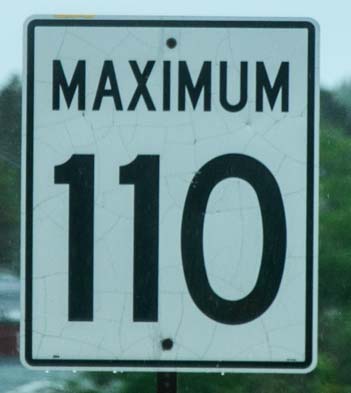
Speed limit 110 km-hour road sign

WOW!!
Oh, wait, that’s kilometers per hour. Darn!

This includes not just kilometers per hour for speed but Celsius for temperature too.

Bridge Freezes Road Sign Canada

Bridge may be icy

Including both English and French words on a small sign can get crowded, so lots of the highway signs in Canada use creative imagery instead. It was really fun to look at the signs and try to figure them out.

Highway entrance ramp roadsign

Eye catchers on the side of the highway

Did a lighthouse picture mean there was a lighthouse somewhere? What about that snail vine looking thing?

Lighthouse and snail roadsign_

What???

We got an eye full when we pulled off the highway and had to decide which way to go.

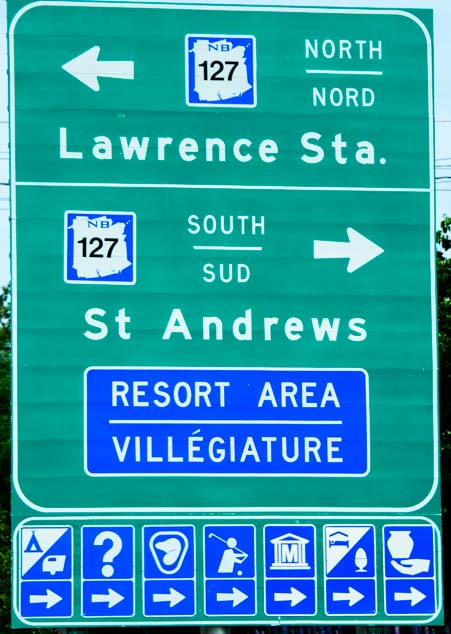
Road sign New Brunswick Canada

That’s a lot to take in all at once!

Wait a minute — can we see that again up close?

Road sign up close New Brunswick_

Oh my goodness. What are all those things?

The traffic piled up behind us as we studied the icons and tried to guess their meaning. Our route was to the left, despite all the wonderfully artistic imagery that tried to lure us off to the right.

We got back on the highway only to pass an exit that made it very clear we were now traveling in a foreign country. English might be spoken here, but then again, maybe not!

Confusing road sign New Brunswick Canada

Where are we, exactly?

The icons are really imaginitive, and at first glance, going by at 60 mph, it was impossible to know what they all referred to.

Exit road sign with icons New Brunswick Canada

Some of these are obvious, but some…what the heck are they??

Icons on highway road sign in New Brunswick Canada

.

Was the “@” sign something with email? Was the flower and barn a nursery? Were the masks a theater?

There was a key icon — we sure could use a key to unlock the other icons!

It became a fantastic game to spot these signs whipping past us and to try to remember all the icons we saw and to guess what they represented.

Egg spinning wheel and vase road sign New Brunswick Canada

.

International road sign Canada

.

Icons on international road sign Canada

.

Icons on road sign New Brunswick Canada

.

We stopped at a visitors center, and the hosts shed some light on a few that they knew. The egg in an egg cup was a bed and breakfast. The wrapped gift was a gift shop.

They had never noticed the barn with the people in it waving, so they weren’t sure what that was. We had seen several — one had a silo and another was under water with a fish swimming above… who knows!

There was a seahorse and there was a father and son looking off to sea with a spyglass and pointing. There was a tulip in a house and a vase on a hand. Just wonderful, but utterly baffling!

Inventing meanings for these signs sure beat the old alphabet game we used to play as kids in the back of the family station wagon!

We learned later that some were icons for designated scenic drives, and the hosts at the visitors center told us that one time a fellow came in and was very irate because he had followed all the lighthouse signs to the end of the road and had never seen a lighthouse. They’d had to explain to him that the lighthouse icon stands for a scenic drive that has lighthouses along the route, but you have to get off the route to see them!

Cuttlefish road sign

Mystifying

Another mysterious icon for a scenic drive had triangles and stripes that looked to me like a fish skeleton. I don’t know what that indicated, but when we saw the beer stein icon we knew for sure that a brewery was nearby.

Brewery Sign Nova Scotia Canada

Ahhh… follow that sign!!

Some signs were very familiar and very obvious.

Moose Sign New Brunswick Canada

This one we know…

Others were familiar but had a special twist. McDonald’s puts the Canadian maple leaf in the middle of their logo, and we later noticed that many online retailers like Amazon put the red maple leaf on their websites too (along with the “.ca” extension rather than “.com”).

McDonalds Road Sign Maple Leaf New Brunswick Canada

…and this one too, but it has a special maple leaf twist~

Within a few days, though, the novelty of these exotic road signs wore off and we felt very much at home.


That’s about it. Going to Canada to do some RV travel is pretty darn easy. I hope these little tips and insights are useful to you, and have fun RVing the Canadian Maritimes!!

Our RV travel posts from the Canadian Rockies:

Our RV travel posts from Nova Scotia:

Subscribe
Never miss a post — it’s free!

Our most recent posts:

More of our Latest Posts are in the top MENU above.

What Is An RV Warranty – Do You Need One? Is It A Good Investment?

An RV Extended Warranty (or “RV Warranty“) is a mechanical breakdown protection product that you can purchase for your RV to give you a financial boost in the event that a system on your RV suddenly fails. By their very nature and reputation, RV warranties are contracts that most RVers either swear by or swear at, and for those of us whose eyes glaze over when reading legal documents, it can be really hard to figure out whether or not buying an RV extended warranty is a worthwhile investment.

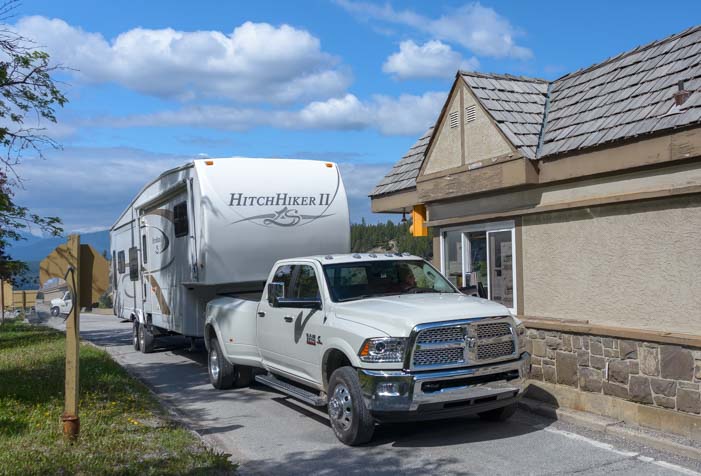
This article is the first in a series of articles about RV extended warranties that present our personal case history with our RV warranty on our 2007 NuWa Hitchhiker II LS fifth wheel trailer (four year warranty cost: $1,904). This first article begins by explaining what RV extended warranties are, how they work, and how they differ from RV insurance. It also explains what to look for when buying an RV extended warranty contract. Then it goes on to show our own RV warranty in action during our first claim which was an axle replacement on our fifth wheel trailer ($1,136 reimbursement).

The rest of the articles in this series show our warranty in action. How valuable is this extended trailer warranty to us?

Here's a summary of what our four year RV warranty through Wholesale Warranties cost, what our repairs WOULD HAVE cost, and what our warranty reimbursements have been to date:

Cost of Warranty $1,904
Total Cost of Repairs we've had done $7,834
Total Out of Pocket Costs for those repairs $1,145
Repair Reimbursements:
Trailer Axle Replacement $1,036
RV Refrigerator Replacement $1,647
Plumbing Issues & Window Leak $1,142
Suspension Replacement $2,550
RV Toilet Replacement $314
Total Repair Reimbursements $6,689

Our trailer warranty has paid for itself 3.5 times over!
Confused about the nitty gritty fine print buried in RV Extended Warranties? Here's an excellent detailed explanation!!

What is an RV Warranty and should you have one?

To buy or not to buy an RV warranty?

You can navigate through this article using these links:


RV Extended Warranty Overview

Return to top

All RVs come with a manufacturer’s warranty when they are purchased new, and these warranties are good for a year or two.

After the manufacturer’s warranty expires, you can purchase an RV Extended Service Contract, commonly known as an RV Warranty, from an independent warranty company for another few years. Or you can just hope for the best.

RV extended warranties are contracts that describe in detail what is covered and what is not covered by the policy, and they have a specific start date and end date. You can pay for the warranty outright when you sign the contract or you can purchase it over time with payments. These contracts are designed to cover the mechanical working components on and in your RV.

If you have an RV extended warranty, when there is a system failure on your RV, you begin the process of filing a claim with your warranty provider by finding an RV repair shop of your choice to diagnose the problem. The shop then calls the warranty company’s administrator for authorization to do the repair. The claims adjustor then reviews the details of your failure to determine if the failure falls under the coverage offered by the contract you purchased. After a covered repair is completed, the RV repair facility contacts the warranty company to present them with the bill, and the warranty company pays for the covered items immediately with a corporate credit card. You then pay for the items that were not covered by the warranty plus a deductible.

The real sticking point comes with what is covered and what is not covered by the warranty. It is up to you to determine the likelihood that enough items on your RV will break during the time period that the warranty is in place to cover the cost of the warranty. Obviously — and hopefully — it will cover a bit more than that, just to make you feel like you made a smart decision by buying a warranty in the first place.

What Is The Difference Between Insurance and A Warranty?

In a nutshell, the difference between an insurance policy and a warranty is that insurance covers damage caused by an incident or accident happening, while a warranty covers the failure of something mechanical that shouldn’t have broken.

Insurance is there for damage that can be pinpointed to an event on a particular date: a fire, a theft, a tree falling on the rig, a tornado. Warranties are there for systems that die without an obvious cause: the hot water heater can’t warm the water any more, the fridge can’t keep the food cold any more, the air conditioning is on the fritz, or a slideout room refuses to budge in or out.

Insurance is something we all understand pretty well since we’ve all had to have car insurance since we bought our first car. Warranties are a little less familiar because, for most of us, our only experience is with manufacturers’ warranties or with a home warranty we got as part of the deal when buying a house. There are no laws that say we have to purchase a warranty of any kind for any big asset we own, so many folks (like us) steer clear of them!

Risks

The value of an RV warranty all boils down to risk. Just like insurance, you pay some money up front in the hopes that something major goes wrong that will cost a lot more than the money you paid for the contract. It’s a way of protecting yourself from having to come up with a massive amount of money to pay for an unexpected repair — a way of hedging your bets by paying a little now instead of (possibly) a lot later.

Just like playing the slot machines at the casino, you put in quarters — either with regular payments or by paying for the whole contract at the beginning of the warranty — and you hope the bells suddenly go off and a huge pile of quarters lands in your lap. Unfortunately, in the back of our minds, we all know that when it comes to casinos, “the house” always wins. And who owns the biggest and fanciest office buildings in most major cities? The insurance companies!

So, while we consumers are betting that something bad will happen when we buy insurance or a warranty, the insurance and warranty companies are successfully betting that it won’t.

Our RV warranty Personal Case History

RV extended warranties provide the most value for folks that have a rig that is two or more years old. Our fifth wheel trailer that we live in full-time is a 2007 model, and its aging equipment could be very costly to repair. The hot water heater, RV refrigerator and air conditioning systems are all more and more prone to failure as the days pass. Sometimes older rigs like our develop cracks in the frame or the big slide-outs fail (we have three slides). We’ve heard heard horror stories from fellow RVers of broken trailer axles and unexpected $1,700 refrigerator replacements. We realized that an RV warranty could make a lot of sense for us.

As we did our research, we had no idea that we would soon experience both trailer axle AND RV refrigerator failures!

We decided to work with Wholesale Warranties, an RV extended warranty broker. We gave them the details about our rig, and they got quotes from the warranty companies they work with and chose the one that was best suited to our situation. We signed a contract with Portfolio Protection for a $1,904 four year Exclusionary RV Extended Warranty with a $100 deductible.

Fifth wheel trailer RV at Harvey RVs in Bangor Maine

Our fifth wheel peeks out from the its hospital room at Harvey RVs in Bangor Maine

Some warranty companies are fly-by-night operations that might go out of business before the contract period ends, and others have top ratings with the Better Business Bureau and are backed by A-rated insurance companies that will step in and take over if the warranty company fails.

Wholesale Warranties makes it their business to sort out which companies are the best ones and to establish relationships with them. Wholesale Warranties has been growing by leaps and bounds and was named one of Inc 5000’s Fastest Growing Companies in 2014, and one of San Diego’s fastest growing companies in 2015. More important, they have made many clients very happy.

What is unusual about Wholesale Warranties is that they don’t simply sell a contract and walk away. They are there for their clients to help smooth the process, if necessary, when a claim is filed. In fact, they are willing to pay for a client’s claim themselves, if they believe it was wrongly denied, and then fight with the warranty company behind the scenes after the fact.


Little did we know that before the first year of our contract was up, we would need FOUR major repairs on our trailer and we’d end up almost $4,500 AHEAD of the cost of our trailer warranty!

.

The RV Warranty In Action – Trailer Axle Replacement!

Return to top

About three weeks ago, in mid-July, 2015, Mark noticed some serious and irregular wear on the passenger side tire on our rear trailer axle. Our tires were just 14 months old, had been properly cared for, and had less than 10,000 miles on them. Oddly, one half of the tire had okay tread while the opposite half, 180 degrees out, was a mess. On the bad half, the tire was severely cupping on the outside tread and was nearly bald. The other three tires looked great. Much research and many phone calls later, we realized that our problem was probably a bent axle.

Bald tire

Weird tire wear: bald on one side, on one half of the tire

Bald tire other side

Same tire spun 180 degrees – bad but not bald!

We were wrapping up our travels in Nova Scotia at the time. We weren’t sure what was involved in replacing an axle, and even though our warranty covered repairs in Canada as well as the US, we had friends in Bangor, Maine, and felt better about doing the repair there. Lippert Components helped us locate a phenomenal RV repair facility in Bangor — Harvey RVs — and we nervously drove 450 miles to Bangor on the faulty tire and took the buggy in.

The diagnosis was exactly what we had expected: a bent axle. The bizarre wear on the tire was due to the tire “dribbling” like a basketball as it rolled down the road. Unfortunately, by the time we got to Bangor, the driver’s side tire on the bad axle was also beginning to cup, and we needed both tires replaced.

We decided to take advantage of our RV warranty to have some other broken items repaired as well. This way, one deductible payment would cover all the different warranty repairs. The extender on one of our awning arms had sheered off, and we had just developed some kind of leak in the fresh water tank during the last few weeks.

Brent Horne, the service manager at Harvey RVs, called our warranty company’s administrator and got same-day authorization to do all three repairs, with the water tank repair pending a full diagnosis.

The axle replacement and awning arm replacement went like clockwork, although we did have to wait ten days for the new axle to be built and shipped from Indiana. A minor complication with the replacement was that the new axle came with electric drum brakes pre-installed and we had to move our new disc brakes from the old axle to the new one.

The diagnosis on the water tank was inconclusive. The leak was at the top of the tank, and we would have to drop the tank out of the trailer frame to determine the cause. Because it was at the top of the tank, it leaked only when the tank was totally topped off, not when it was less than full. We decided to defer that repair to the service folks at the Kansas RV Center (which used to be NuWa, the manufacturer of our trailer) rather than delay our travels waiting for a replacement tank to be shipped to northern Maine. Kansas would be in our general direction as we headed west in the fall.

Old trailer axle new fifth wheel RV axle

The new axle (left) has electric drum brakes and old axle (right) has our nifty new disc brakes.
The challenge with this repair was moving the disc brakes from the old axle to the new one.

When the bill for the repairs came, it was the following:

Awning Arm, tax and labor 46.73
Trailer axle, tax and labor 1,089.42
Freight for trailer axle 219.90
Tires, tax and labor 417.78
Total Repairs: 1,773.83

The Service Manager, Brett, called the warranty company and was immediately paid by credit card for the following:

Awning Arm, tax and labor 46.73
Trailer axle, tax and labor 1,089.42
Total Covered by Warranty: 1,136.15

Our bill was the following:

Freight for trailer axle 219.90
Tires, tax and labor 417.78
Deductible 100.00
Total Out of Pocket: 737.68

 
So, on a total bill of $1,773.83, our savings was $1,036.15.


RV Warranty Analysis

Return to top

As mentioned above, RV warranties are intended to reimburse the parts, tax and labor expenses for repairing system failures, and the trailer axle and awning arm piece were clear system failures.

However RV warranties do not cover the freight costs for shipping large replacement parts from the manufacturer to the RV repair facility, and they don’t cover “maintenance items” that wear out or need regular maintenance to operate correctly. There is also a very large gray area when it comes to items that were damaged by the failure of something else, like the tires being damaged by the failed axle. Similarly, water damage due to plumbing or roofing failures may or may not be covered.

In our case, even though the tires were very obviously disintegrating because of the bent axle, they are classified as a maintenance item so they weren’t covered. We learned later that Wholesale Warranties has a separate policy for tire failures due to road hazards, but it wouldn’t have helped us in this case either.

So, we paid for the tires out of pocket.

Has our RV warranty done the job so far?

Absolutely! 10 months into our 4 year warranty contract, here’s where we stand:

 
Cost of warranty: $1,904.00
Reimbursed so far: $1,036.15
Remaining to break even: $867.85

We are 20% of the way through our warranty contract period.
We are 54% of the way through our contract cost.

So, we are ahead of the game at this point. $867.85 more in repairs in the next 38 months, and we will have matched the cost of the warranty.

NOTE: We did not know at the time we wrote this that we’d have a bunch more major repairs in the next THREE MONTHS!

A financial breakdown of all our repairs is at the top of this page HERE

Harvey RVs Bangor Maine

All smiles at Harvey RVs after the repair is finished
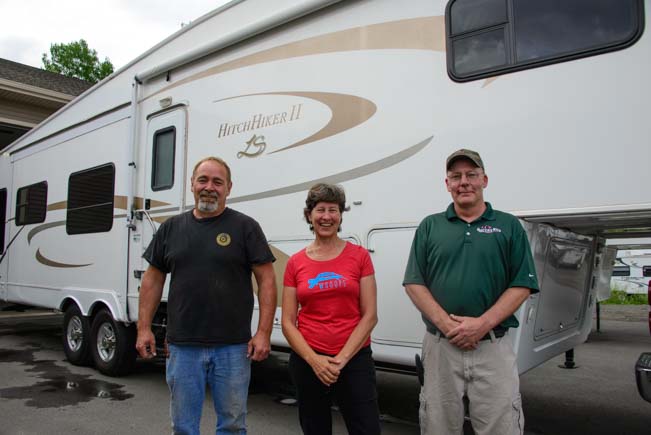
Expert Technician Steve and Service Manager Brett join me in front of our rolling home.

Could An Insurance Policy Have Done The Job?

Usually, insurance and warranties don’t overlap in the kinds of things they cover. Insurance generally requires an event that caused damage while a warranty generally requires a system to fail on its own. In this particular situation of a bent trailer axle, however, if we could have pinned the axle failure to a particular event, perhaps when we hit one particuarly gargantuan pothole of the thousands we encountered in Nova Scotia, then we could have filed an insurance claim based on hitting that pothole.

Using insurance, our claim would have been:

Trailer axle, tax and labor 1,089.42
Freight for trailer axle 219.90
Tires, tax and labor 417.78
Total Claim: 1,721.10

Note that we couldn’t have slid the awning repair into the insurance claim.

If the claim were approved, all of those items would have been covered. However, we have a $500 deductible on our trailer insurance and we would have had to pay the $46.73 awning repair out of pocket.

Here’s the breakdown for comparable repair work (axle and awning) using our warranty versus our insurance policy:

Covered Out Of Pocket
Warranty 1,136.15 737.68
Insurance 1,721.10 546.73


Why Use a Warranty When Insurance Works Too?

If we had filed an insurance claim, there would have been a wait for an insurance adjuster to assess the damage. With the warranty, the authorization for the repair is given to the service provider as soon as they call. Also, our “reward” for filing the insurance claim would have been a ding on our insurance record which would have affected our insurance premium in the future.

If we had had one of those nifty insurance policies that has a “disappearing deductible” that decreases each year that no claim is filed, the clock would have started over again at the maximum deductible amount the next year after we filed the claim.

I’m not sure if the difference in out of pocket costs of $190.95 ($737.68 in the case of using the warranty minus $546.73 in the case of using the insurance policy) would have been made up in the next three years of insurance premiums (the time period that the warranty will continue to be in effect), but it’s easy to imagine this claim resulting in an increase in our annual insurance premium of $66.67 ($190.95 / 3 years).

Of course, this particular system failure — a bent trailer axle — is unusual in that it is even possible that an insurance policy might have been used to pay for it. In most cases, RV systems die on their own without a specific event causing the failure (an accident, road hazard, theft, etc.), and those failures are not eligible for insurance coverage at all.


Is An RV Warranty A Good Value?

Return to top

RVs are notorious for system failures, and sooner or later big expensive stuff is going to break on every RV.

If you don’t like large, unexpected financial outlays, an RV extended warranty can mitigate or eliminate the cost completely when a major system on board goes on the blink. There’s a lot to be said for that when you are suddenly jerked off the road and away from your travels and dumped into the waiting room at an RV repair shop while you nervously wonder if the service guys are any good and if your rolling home is going to be repaired correctly.

Bicycle riding in Nova Scotia Canada

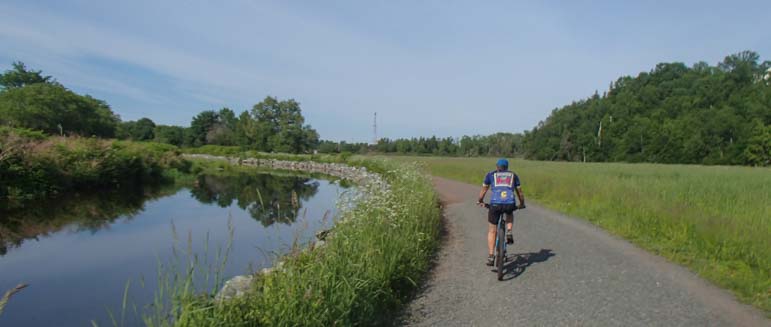
It’s a shock to be dragged away from your happy travels to deal with an RV repair

Obvioiusly, you could simply bank the amount you would have put into buying an RV warranty and use that cash as needed when things fail. It is easy to go that route when you remember that, on average, RV warranties must work out in favor of the warranty companies or they couldn’t stay in business.

However, an intangible in all of this is peace of mind when chaos reins. Abandoning your travels to take care of an ailing RV is really stressful. Believe me! And there are lots of stresses involved in any repair that is big enough to be warranty-worthy.

There is stress in finding a repair facility that has the right equipment and the right skill set and a good reputation, especially when you are traveling in a part of the country you don’t know. There’s stress in taking a detour to get your RV to the shop if it’s not in totally safe driving condition (like ours was). There’s stress in figuring out where you’re going to stay while your RV is in the shop, if you can’t stay in it. And there’s stress as you wait, first for a shop appointment, and then for the necessary parts to come in.

Going through all that stress while also knowing in the back of your mind that the repair is going to put a big hole in your bank account makes it even worse.

Directions to Everywhere

It’s all fine and dandy to be traveling in remote areas,
but where do you find a top quality RV service repair shop?

The purpose of an RV warranty is to pay up front to cover potential costs later. Where they get the bad rap is when you pay up front to cover potential costs that never materialize or that materialize but aren’t covered. However, if you think about it, in many ways the devil that you don’t know may be worse than the devil that you do.

What I mean is that paying a fixed amount for an RV warranty, an amount that you know up front, may save you more or less cash for repairs in the end, but at least you’ve lessened the surprises and you know your costs. Plus, you may save far more than just cash when all is said and done. Even if having the warranty doesn’t save you all the cash you spent on it, you can view the difference as the price of peace of mind. If it saves you more than it cost you, you’re ahead.


What to Look For in an RV Extended Warranty

Return to top

It is easiest to turn to a company like Wholesale Warranties to get a warranty. When you work with them they will evaluate which warranty product is the best fit for your RV. Whichever warranty company they recommend for you, one of their requirements is that the warranty company call them if you file a claim that is over $500 so they can be part of the claims process and help it be as smooth as possible.

Since we got our RV warranty (our warranty company is Portfolio Protection), Wholesale Warranties has grown a lot and has begun providing their own warranty protection in addition to brokering for warranty companies like Portfolio Protection. This is a new and exciting development, because they have been through the claims process with their clients so many times that they know what RVers really need. The name of their warranty company is Viking Protection.

However, if you want to research RV warranty companies on your own, here are some things to think about:

Inspection and Age of RV

With the better warranty companies you will need to make your RV available for an inspection to determine the condition of everything at the start of the contract. This way, when you file a claim, there is no question as to whether the problem was a pre-existing condition. The warranty companies that Wholesale Warranties works with will send an agent to your RV, wherever it is parked, to do the inspection, and you don’t have to lift a finger.

If your RV is older than a 2001 model or has over 100,000 miles on the odometer, it may be difficult to find a warranty company. In some cases, a motorhome with more than 100k miles can get a “coach only” warranty for everything except the engine and drive train.

Warranty Types

There are two major warranty types: Stated Components and Exclusionary Contracts. Stated Component contracts cover only what is listed in the contract. Exclusionary Contracts cover everything EXCEPT the items listed. Definitely get an Exclusionary Contract, as many more things are covered in that type of contract.

You Choose the RV Repair Shop

Make sure there’s no clause that restricts who can do the work. You want to choose the best repair facility you can find and not be forced into using one that is not up to your standards.

Deductible

Deductibles can vary. Make sure you know what it is!

Fair Treatment of the RV Repair Shop

Be sure the warranty company guarantees to pay the RV repair shop quickly, preferably immediately with a corporate credit card, and make sure they pay the shop’s standard prices for the parts rather than wholesale or some amount to be negotiated. RV repair shops are often little outfits, and they can’t afford to be toyed with by a warranty company.

What Happens if the RV is Sold

Be sure the contract will be valid for another owner, just in case you decide to sell before it expires. A warranty is a nice perk to offer the buyer that may set your rig apart from others they are considering.

Cancellation, Missed Payments and Refund

Find out what happens if you decide to cancel the contract prematurely, and whether the purchase price will be refunded in whole or in part, and find out what happens if you miss a payment. Some warranty companies offer a month-to-month payment arrangement, but in the event that you miss a payment the contract terminates. Wholesale Warranties goes the extra mile and will work with you if you have extenuating circumstances that make it hard to make a payment, and if you cancel before the contract is up, you will be refunded the unused portion of the contract.

Hotel & Lodging Reimbursement

Some warranties cover a certain amount of lodging if you can’t stay in the RV during the repair. This is where Wholesale Warranties is really taking care of RVers with their new Viking Protection contracts. You will be reimbursed for “trip interruption” expenses of: $150/day in hotel rooms (up to $750), $50/meal for 2 meals a day (up to $500), $75/day for a rental car (up to $450), up to $100 towards boarding your pet and up to $200 to cover a mobile mechanic’s upfront fee for coming out to your RV.

Towing and Roadside Assistance

Some warranty companies offer reimbursements for some amount of towing and/or roadside assistance. Wholesale Warranties‘ new Viking Protection reimburses up to $750 in towing expenses.

Canadian RVers and RVing in Canada

If you plan to travel to Canada, make sure the warranty company covers repairs done in Canada. Also, not all warranty companies cover RVs that are registered in Canada. Wholesale Warranties’ new Viking Protection does!


Final Notes

Return to top

We couldn’t be happier with our RV warranty so far, and have been convinced in the value of purchasing an RV warranty.

At this point we still have three years to go on our warranty, and we have a big repair looming as we tackle the problem with our fresh water tank. We have no idea how our RV warranty will come into play on that repair, or if it will at all, and of course, we will be posting and analyzing that repair!

It’s a pain to feel that you have to buy yet one more big ticket item for your RV, and I am the last person to say you need to do this or that in your RVing adventures. However, if you are interested, Wholesale Warranties is offering a $50 discount to our readers. Mention that you heard about them through our website, Roads Less Traveled, and they will deduct $50 from the quoted price at the time of purchase. Just be sure to ask! You can get a quote for your RV (not including the discount) at this link:

Wholesale Warranties Quote Form

Or you can call them at 800-939-2806. Ask for our contact, Missi Emmett. Or email her at missi@wholesalewarranties.com.

NOTE: We had no idea during this first repair that in the next few months we would have a slew of major failures after our trailer axle was replaced. The summary of our warranty reimbursements to date is below:

Here's a summary of what our four year RV warranty through Wholesale Warranties cost, what our repairs WOULD HAVE cost, and what our warranty reimbursements have been to date:

Cost of Warranty $1,904
Total Cost of Repairs we've had done $7,834
Total Out of Pocket Costs for those repairs $1,145
Repair Reimbursements:
Trailer Axle Replacement $1,036
RV Refrigerator Replacement $1,647
Plumbing Issues & Window Leak $1,142
Suspension Replacement $2,550
RV Toilet Replacement $314
Total Repair Reimbursements $6,689

Our trailer warranty has paid for itself 3.5 times over!
Confused about the nitty gritty fine print buried in RV Extended Warranties? Here's an excellent detailed explanation!!

Subscribe
Never miss a post — it’s free!

Below are some of our most POPULAR POSTS (also in the MENUS above)

Buddy - A Journey in Spirit - The story of an event that changed our lives forever.

ARTICLE INDEXES
  • RV Tech Tips Articles - A one page index of links to all our RV Tech Tips, RV Upgrades & RV Maintenance articles.
  • RV Lifestyle Tip Articles - An index of links to all our RV Lifestyle Tips (finances, boondocking, major repairs, work/jobs, etc.)
  • Solar Power Articles - Overview and tutorial articles for how to design and install solar power on an RV or boat
  • Product Reviews - An index of links to all of our Product Reviews
RV UPGRADES, SYSTEMS & TIPS MONEY FULL-TIME RV LIFESTYLE GEAR STORE
  • Gear Store - A list of the goodies, equipment and gear we've found useful in our RV lifestyle!
 

Our most recent posts:

More of our Latest Posts are in the MENU.   New to this site? Visit RVers Start Here to find where we keep all the good stuff. Also check out our COOL NEW GEAR STORE!! *** CLICK HERE *** to see it!

Boondocking at Big Bend National Park – Cheap & Scenic RV Camping

How to “Boondock” at Big Bend National Park

Big Bend in Texas is an unusual park in the National Park System because they offer a few inexpensive RV dry camping sites scattered about the park grounds. It isn’t really “boondocking” like you’d find on other government public land managed by the US National Forest Service and the Bureau of Land Management. However, it is a very inexpensive and scenic alternative to staying in a conventional RV park or campground. For first-time boondockers, it can offer a great introduction to dry camping amid nature and solitude in your RV.

Big Bend National Park assigns these campsites on a first-come first-serve basis, as if the entire National Park were one huge campground. The sites that are big enough for large RVs are very few and are tightly controlled, and the system for obtaining a “Backcountry Camping Permit” to stay in one can be confusing. Here is what we learned about the system when we took part in it a few years back.

RV Boondocking and camping in Big Bend National Park Texas

“Boondocking” at Big Bend National Park

All five of the Visitors Centers in the park have computer access to a database of dispersed campsites throughout the park. You can obtain a permit and reserve a site in person from a ranger at one of these Visitors Centers 24 hours ahead of your stay. The permit is $10 and you can reserve up to 14 consecutive nights in specific campsites on a single permit, reserving as many different sites as you like and as are available.

An important point is that the permit is good only for the actual nights and sites you reserve through the ranger when you purchase the permit. If you want to extend your stay or change your campsite after you buy your permit, you have to cancel the remaining nights on your permit and buy a new one. Also, you can’t obtain a permit to reserve a site without appearing at a Visitors Center in person.

As a courtesy to other campers: if you don’t use all the nights on your permit (the weather might turn and send you scurrying, as it did to us), be sure to cancel the remaining nights on your permit by stopping in at the Visitors Center or calling them. Otherwise, the site will sit vacant while other RVers are wishing they could use it.

Big Bend National Park Texas RV boondocking_

“Boondocking” at Big Bend National Park

Many RVers have small driveable rigs and there is no evidence they are using a site during the day while they are out hiking, so unless you tell the Park Service you are vacating your site, they will have no way of knowing that you left early.

Our Experience Getting a Permit

From what we observed, there is one computer at each Visitors Center that has access to the backcountry camping permit database, so a line for permits forms during popular times. We stood in line at the Panther Junction Visitors Center in the middle of the park for 30 minutes on a Saturday morning when the weather for the next few days was predicted to be sunny and in the high 70’s.

The other people in line were primarily backpackers and car/tent campers getting permits either to do extended overnight hikes across the park or to camp in remote dispersed campsites we could never reach with our truck and trailer. We were the only RVers in line waiting for a site big enough for a big rig.

Each person spent about 5 minutes with the ranger, first reviewing the map of the National Park to pick out a campsite and to learn from the ranger what the site was like, and then filling out the permit application, and lastly listening to the ranger read the camping rules aloud.

Big Bend National Park RV camping and boondocking in Texas_

Hannold Draw

When our turn came, we were advised against staying in a particular site that we later found out would have been perfectly fine. However, an RVer had complained at one time that the site was unlevel, so this particular ranger decided not to present that site as a viable option to other RVers with big rigs.

It is wise to study the National Park map (click here and go to “View Park Map” — the campsites are the light colored tents) and even to drive to the various dispersed campsites to assess whether or not your rig will fit and whether you might enjoy camping there. In general, rigs under 30-35 feet in total length end-to-end (hitched up) would fit in most sites along the main roads.

One of the rules that appears to be enforced is that you are not allowed to run a generator in backcountry camping sites. We overheard two rangers discussing a tent camper who had hidden a generator in his tent! If you don’t have solar power installed on your RV, a small portable solar power kit may be the way to go.

amping in Big Bend National Park in an RV in Texas

“Government Spring” site at Grapevine Hills

RV Camping Strategies at Big Bend

It is common to find that all the campsites are booked for the first few days after you arrive. So, plan to stay elsewhere at first and keep checking back until a site opens up.

The campground at Rio Grande Village on the far eastern end of the park has both full hookup sites that can be reserved online and dry camping sites that are first-come first-serve.

The other two campgrounds inside Big Bend National Park — Cottonwood, towards the southwest near the Santa Elena Canyon hike, and Chisos Campground, up in the mountains near the Lost Mine and Window Trail hikes (review of those hikes here) — have smaller sites that may not accommodate bigger rigs. However the Big Bend Resort & Adventures RV Park in Terlingua-Study Butte just outside the western boundary of the park offers full hookups and advanced reservations.

Each of the “boondocking” campsites we saw in Big Bend has pros and cons. One strategy for tackling Big Bend National Park with an RV is to spend a few days camped on the western side at Big Bend RV Adventures, a few days of “boondocking” in the dispersed campsites in the middle and a few days in Rio Grande Village at the eastern end of the park, as there are outstanding things to see and do in each of these locales. Camping near your planned activiites will cut way down on the commuter driving you do across the park!

For those with more rugged rigs, there are some fabulous sounding campsites that will get you deep into nature. We didn’t camp at or even see these locations, but friends with an Earth Roamer RV enjoyed some true backcountry camping experiences in their rig.

RV camping boondocking in Big Bend National Park Texas

Grapevine Hills

Summary of the Larger Backcountry RV Campsites in Big Bend:

Grapevine Hills

There are three campsites on this dirt road that goes 6 miles out to the Grapevine Hills hike with the balancing rock. The first is 0.3 miles in on the left side and is suitable for a big rig. This particular site is also known as “Government Spring” and can accommodate a big rig and a smaller one comfortably if friends are traveling together.

Campsites two and three are 3.7 miles down the road on the right hand side and they are essentially a double site. The views of the Chisos Mountains are lovely, however this is a very busy road with lots of people flying by at wild speeds to get to and from the hiking trail at the end, so it can be very dusty.

Paint Gap

There are three campsites on the first part of this dirt road. The first at 0.9 miles would be suitable for a rig of 35′ or less end-to-end. The second and third are 2.1 miles in and are good for a trailer of 25′ or so. We weren’t sure we could have squeezed our 36′ fiver in there. See the comment from Robin below who had a great time there with a 24′ travel trailer.

Croton Springs

There are two campsites in a huge open area at the end of this dirt road down about 0.5 miles. Probably 3 or 4 big RVs could fit if friends were traveling together. This is the site that one RVer apparently felt was too unlevel for a big rig, but when we drove down here we thought it would have been an awesome place to stay and just wished the ranger had mentioned it as an option.

K-Bar

This is a very rough dirt road that has a small site for a small trailer, van or truck camper at 1.1 miles. Further on, at 1.5 miles, there is a little more room, but it would take some jockeying for a big rig to get set up. See the comment below from Robin who said they loved the second site and got their 24′ travel trailer into it just fin!

Hannold Draw

This is a highway maintenance yard about 0.1 miles down a dirt road that has a huge site big enough for several RVs and even has a horse corral. The entrance is quite steep and we used 4×4 Low Gear to climb out. The enormous trash heaps are a little off-putting as you drive in (“Are we going camping in a junkyard?” we asked each other!), but there is a berm on the west side that provides wind protection (if it’s from the west), and the mountain view is beautiful.

Dust on the road camping in Big Bend Texas

Dust can be a problem at some sights (this is Grapevine Hills).

Notes

  • The busy seasons at Big Bend National Park are Thanksgiving, Christmas and Spring Break in March.
  • There is water at the Panther Junction VIsitors Center (limit: 5 gallons per person per day)
  • There are RV dump stations at Big Bend Adventures RV Park outside the western boundary of the park and at Rio Grande Village at the eastern end of the park.
  • Cell phone and cellular based internet access is acceptable at the boondocking sites with a WiFi booster and antenna. WiFi is sometimes available at Rio Grande Village, however when we were there we heard it had been turned off because someone had been abusing the priviledge.


Subscribe
Never miss a post — it’s free!

More info from the National Park Service website:

Related Posts about Big Bend National Park:

Related Posts about Solar Power and Boondocking:

Other great RV camping areas:

Our most recent posts:

More of our Latest Posts are in the top MENU above.

What To Do in the Rain while Boondocking? Wash the RV!!

Did I mention that Texas has been giving us extreme weather lately? First she tried to freeze us out, covering our buggy in ice.

Icicles on our fifth wheel RV

Icicles on our rig – wow! And look at that layer of grit and grime!

Then Texas dumped a bunch of snow on us. We opened the RV door one morning to find ourselves surrounded by the white stuff!

Looking outside our RV door at snow

We woke up to snow one morning

Snow on our RV steps

Right up to our door!

Snow on our RV in Texas

You never know what you’ll get for winter weather in Texas!

This eventually turned to rain, and we drove a few hundred miles on roads that spat all kinds of miserable black grime all over the rig. When we finally stopped in Livingston (for a few days of drizzle and fog!), our beautiful home was a dirty mess!! Of course, it began to rain again and then it began to pour.

What to do while boondocking in the rain rather than just forlornly wishing you could play outside? Clean the rig !! After all, the pre-rinse had already been done, and all the sticky things (like bugs!) were nicely unstuck by now.

Mark got out his favorite telescoping brush that did us such great service on the boat, and he spent two hours in the pouring rain sudsing up the truck and trailer and letting the soft rain water rinse it all off. Clever!

Washing our RV in the rain

Mark takes advantage of the rain water for an easy rinse cycle…

After the rain stopped (not that it was sunny… just not raining), the rig dried off and now sported a wonderful shiny luster, thanks to a wax job we got back in Florence, AZ. We were very happy campers, especially Mark, who had worked so hard and gotten so drenched in the rain.

But then it was time to move on. Our aim was to get out of Texas and go east. But this crazy state wouldn’t have any of that. While the rest of the country basked in clear skies, Texas persuaded her neighboring states to the east to join her in taking a good long bath.

Texas Rain

Not Fair!!

Good grief! We waited for a few days for a weather window, and it finally seemed to come. At least, it came long enough for us to escape a little ways east of Houston. So we ran for it.

Big mistake! Out on I-10 the skies began to spit. We slipped into the first rest area we could find. Mark was crestfallen as he inspected the RV in the drizzle. The whole thing was covered in a thin layer of road grit. His wonderful washing job was history. Ugh!

What to do while waiting for the rain to stop? Aw, heck — wash the RV!

We didn’t have a water source, so we put our two buckets behind the back of the fifth wheel to catch the rainwater that was falling in a steady stream from the gutters. They filled up in no time. We also didn’t need any soap. The dirt was primarily on the bottom half and was already streaming down the sides of the trailer!

Buckets catch rain from the RV roof

Our buckets were soon overflowing with rain water!

We try to avoid dividing the labor in our buggy into pink and blue jobs as much as possible, preferring to find some shade of lavender for all the chores that need to be done. So, now it was my turn to get wet. Out I went into the drizzle to bring a little shine back to our RV and to try to put a smile on Mark’s face.

It didn’t take much effort, just a little elbow grease and a nice upper body workout. Then our truck and trailer were sparkling clean again.

Mark absolutely loved it. He got to enjoy the whole process with a beer in hand, and he didn’t have to lift a finger. Ha! He sure gets a kick out of watching me work!!

Using rain water to wash the RV

I get the new layer of road grit off the rig while Mark enjoys a beer and a laugh!

As I mentioned above, the great thing about rain water is that it is soft water and it doesn’t spot. There’s no need to wipe down the windows! The key, though, is to wash the rig before it stops raining so you get a good natural rinse.

Next morning the roads were dry, and our clean truck and trailer hit the road once again.

If you find yourself sitting in the rain in a soggy, dirty buggy, and you want to play outside and knock out a chore at the same time, throw a bucket or two under the RV’s gutters, and give your baby a wash!

Subscribe
Never miss a post — it’s free!

Our most recent posts:

More of our Latest Posts are in the top MENU above.

Related posts:

Making Money RV Workamping with Amazon CamperForce

One of the most interesting booths at the RV Show in Quartzsite, Arizona a few weeks ago was Amazon CamperForce, an RV workamping program designed by Amazon specifically for full-time and seasonal RVers. We spent some time chatting with a delightful CamperForce veteran, Nancy, and were very intrigued by the program.

Amazon has been an unusual and forward thinking company since its inception, and this program has taken the RV workamping world by storm. Nancy and her husband have been a part of Amazon’s CamperForce for several years now, and they have found it is a fabulous way for them to pick up a cool $10,000 each year between October and Christmas!

Amazon CamperForce booth at the Quartzsite Arizona RV Show

Amazon CamperForce veteran Nancy explains the program at the Quarzsite RV Show

Every fall, Amazon needs extra labor in their shipping warehouses to get products into boxes and out the door in time for Christmas. Full-time RVers love to make money on the road without making long-term time commitments. So there is a perfect employer/employee match between the two.

Nancy explained that from September until December 23, Amazon hires RVers at a rate of $10.00 – $11.25 an hour to work 40 hours or more per week, starting on the date of their choosing. There are opportunities for bonuses and wage perks too.

The work ranges from receiving to stowing, sorting, shipping and picking, and is physically very demanding. As Nancy said with a laugh, it’s a great workout program and she always drops a few pounds! For those that want to fill up their RV travel kitty quickly, she says you can work as much as 60 hours a week. She also mentioned that CamperForce employees are guaranteed work, so even if things get slow for a day or two, full-time employees are sent home while CamperForce workers are given things to do.

There are RV parks in the communities where Amazon has its warehouses, and workers’ RV sites are free. Nancy talked of how a whole community spirit envelops the CamperForce workers each fall, and how they look forward to seeing each other from season to season. A neat benefit for the communities where the warehouses are located is that a big group of RVers shows up every fall, contributing to the local economy and giving them a boost!

Their warehouses are located in the following locations, and they start hiring as early as February the year before:

  • Campbellsville, Kentucky
  • Haslet, Texas
  • Murfreesboro, Tennessee

I was really surprised when she mentioned that last year there were 800 applications for 500 positions, and that all the positions were filled by March!!

I had heard of this program before, but didn’t know a whole lot about it, so I was excited to be able to learn a little at the RV show. What a cool gig for full-time RVers!

Several full-timers have written about their Amazon CamperForce experiences on their blogs. Here are a few links from folks who have really been there and done that, as well as Amazon’s official CamperForce link:

There are more links below!

Subscribe
Never miss a post — it’s free!

Related Posts about Full-time RVing Finances and Earning Money on the Road:

Below are some of our most POPULAR POSTS (also in the MENUS above)

Buddy - A Journey in Spirit - The story of an event that changed our lives forever.

ARTICLE INDEXES
  • RV Tech Tips Articles - A one page index of links to all our RV Tech Tips, RV Upgrades & RV Maintenance articles.
  • RV Lifestyle Tip Articles - An index of links to all our RV Lifestyle Tips (finances, boondocking, major repairs, work/jobs, etc.)
  • Solar Power Articles - Overview and tutorial articles for how to design and install solar power on an RV or boat
  • Product Reviews - An index of links to all of our Product Reviews
RV UPGRADES, SYSTEMS & TIPS MONEY FULL-TIME RV LIFESTYLE GEAR STORE
  • Gear Store - A list of the goodies, equipment and gear we've found useful in our RV lifestyle!
 

Our most recent posts:

More of our Latest Posts are in the MENU.   New to this site? Visit RVers Start Here to find where we keep all the good stuff. Also check out our COOL NEW GEAR STORE!! *** CLICK HERE *** to see it!

What Is Your Dream?

Escapees Magazine Cover Jan-Feb 2015

Escapees Magazine Jan-Feb 2015
Cover photo by Emily Fagan
Feature Story: Stay the Course on the Road to Your Dreams

The January, 2015, issue of Escapees Magazine is graced with a photo of ours on the cover, taken at Lost Dutchman State Park in Apache Junction, Arizona, at dusk, with the stately Superstition mountains in the background.

We were out walking the campground loop one evening when we noticed that the host campsite looked very inviting. It was huge, and the hosts had done some creative landscaping to make it really homey. The lights were glowing in their rig, and they had just started a campfire. It was a classic camping scene — I had to get a pic!!

Because it was evening, it would be a long exposure photo that would require a tripod. The light was fading fast, however, much too fast to be able to run home and grab a tripod and return for the shot. So, we gave up on the idea and walked over to their campfire instead. We introduced ourselves to the hosts, Dave and Linda, who were very warm and friendly, and we started chatting with them.

After an hour or so of happy chit-chat (including us telling them what a perfect photo their campsite would make), it was now pitch dark and time for us to find our way home.

As we were leaving, they invited us to come back another night for a beer — and to bring a tripod and get the shot. And so we did — and what a wonderful evening we had sitting around their campfire sharing stories afterwards.

This kind of spontaneous and informal socializing is one of our favorite things about the full-time RV lifestyle. It suits our personalities and our style perfectly because we just aren’t big on formalities and planning things. We like leaving ourselves open to interesting happenings that find their way to us.

Full-time RVing is a dream-come-true lifestyle for us, and our feature in Escapees, “Stay the Course on the Road to your Dreams,” touches on what it takes to get from dreaming about going full-time to actually doing it: tenacity!

Happy campers at Grand Teton National Park Wyoming

Grand Teton National Park in Wyoming is one of our favorite destinations

The article sprang from a blog post I wrote a little over a year ago when we were leaving our boating life behind and returning to RVing full-time.

We were madly selling everything we had purchased to live on a boat (plus the boat itself), and our life was utter chaos as we downsized back into our fifth wheel trailer.

The only thing that held us together was the absolute certainty that we were doing the right thing. How were we so sure? Because we had been full-time RVers already and we knew exactly what lay ahead.

Caribbean Dreams

With our trailer in storage, a fateful Caribbean trip landed us in the cruising lifestyle!

Generally, future full-timers don’t have that luxury, and I often receive emails from people who are both excited and terrified by the prospect of going full-time (or going cruising).

As they downsize and sell off everything they own, the terror begins to come in waves, and every doubt they’ve ever had about running off in an RV or sailboat looms monstrous around them.

Most future full-timers are folks nearing retirement, and the idea of breaking out of the bonds of the workaday world is tantalizingly delicious.

Yet, at the same time, the thought of running away to a life of free-spirited adventure after decades of predictability is daunting. Letting go of the house and its contents — your very roots — can be overwhelming.

It is one thing to be wild and crazy at twenty, when no one is looking and you have nothing to lose.

Sailing Groovy

Our sailboat “Groovy” taught us many incredible life lessons.

It’s a whole different story to be wild and crazy at retirement age when you’ve become accustomed to certain luxuries, routines and structure, when you’ve been responsible for and beholden to other people for eons, and especially when your kids, or friends, or in-laws are looking at you like you’ve lost your mind as you tell them you are going to sell up and go.

For most of us, retirement is the first time in our lives when we have both the financial resources and the time to pursue our dreams.

What a boon!

Fifth wheel trailer RV on Million Dollar Highway in San Juan Mountains Colorado

An RV roadtrip is a dream come true, whether you make it a lifestyle or do it just once.

But how frightening it can be too.  With a finite amount of time, and a finite amount of money, you sure don’t want to waste either one. It is even more unsettling when you realize that all the joy or misery your precious dream may bring you is entirely on your own shoulders.

For the first time in your life, you’re chasing a dream that doesn’t belong to someone else. You’re not doing this to please your parents, or to help the kids, or to impress a boss. This dream is all your own.

For that reason, I believe the most important thing to do before turning your life upside down to move into an RV or boat and go traveling is to spend some time figuring out why you want to go.

What is the real draw to this lifestyle: Is it independence? spontaneity? freedom from schedules and agendas? a yearning to see new places? a desire to live more simply? a need to spend time with far-flung family in distant states? Or will this be an in-depth multi-year search for a permanent retirement home?

For all the time spent researching whether life is better in a Class A motorhome or a fifth wheel trailer, it makes sense to spend an equal amount of time digging around in your own soul to figure out why you want to leave hearth and home to live in a box on wheels.

Golden aspen and snow-capped peaks in Colorado's San Juan Mountains

What a combo – golden aspens and snow-capped peaks in Colorado

The more you understand the origins of your dream — and the origins of your spouse’s dream — the better you will be able to create a full-time RV lifestyle that is truly fulfilling.

If your dream is to be wild and free, then boondocking may play a big part in your lifestyle. If your dream is to integrate deeply into two seasonal communities, then choosing the right sites at the right RV parks will be important.

If the hubby dreams of seeing all the Civil War historic sites in the eastern states and the wife dreams of traveling primarily between the kids’ homes in Montana and Utah, then some careful itinerary planning (and negotiation!) will be necessary.

Santa Cruz Bay in the Bays of Huatulco Mexico

The exquisite Bays of Huatulco, Mexico, were a stunning discovery in our travels

The very nature of what it is that you want out of your RVing lifestyle is what will drive all your decisions about how to put your lifestyle together.

The beauty of pursuing your own dreams is that it is an evolutionary process, and that is the part that has really surprised us over the years.

We started with very little idea of what we were getting into. Like a young bride who is totally focused on her fancy dress and big party, and not really thinking about the 50 years of togetherness that lie ahead, we were focused more on leaving than on where we were going!

However, we did know we wanted independence and freedom in our day-to-day lives, something neither of us had had since our youth, and that theme is with us still. Our personal evolution as full-time travelers has taken that theme a step further.

After several years of dealing with the many big challenges that come with the boating life — something that was completely self-inflicted because going cruising on a sailboat in foreign waters was our dream — we came to realize that our primary life theme is actually very simple:

We want to spend as much time as possible doing the things that make us happy, and we want to spend as little time as possible doing the things that make us unhappy.

That may sound ridiculously simplistic, but it has helped us immensely to crystallize our biggest life decisions and to understand what we really want, deep down inside, in our day-to-day lives.

Butterfly in a flower

Our travels introduced us to the fun of photography,
a passion we both share.

Too much of adult life is spent in some middle ground, doing things that are “good for you” (or good for your job, or your kids, or your retirement package, or something else), but that aren’t a whole lot of fun.

Until you start trying to fulfill your own innermost dreams in that wee bit of time that lies between retirement and the Great Beyond, it is very hard to understand that “good for you” and “truly satisfying” are very different things.

This is especially true when your dream is a little off-beat, like wanting to move from a house into an RV or boat.

There is a lot of support in our society for doing the conventional things that are good for you, but there’s not a lot of support for doing things that excite you but that don’t fit the norm. And this is where fear creeps in.


The one thing that holds most people back from fulfilling their dreams is fear.

What if…your dream doesn’t pan out, you blow all your money, you don’t like the lifestyle, you lose touch with friends and family back home, and all those other horrible things that might happen if you start RVing full-time. Is pursuing this fantasy of an unusual and adventurous lifestyle worth that risk?

Wildflower

Peace.

Understanding why you are attracted to the idea of full-timing will give you the answer and limit your fears.

There are lots of ways to achieve many of the thrills of the full-timing lifestyle without actually going full-time.  Loads of people RV seasonally because they want the exhilaration of traveling but they also want to go home and enjoy their roots. That’s great!

For others, it is the actual act of living on the road all the time that really matters, and for them, giving up the sticks-and-bricks home is an essential part of the process. That’s great too! There’s no badge of honor for living this lifestyle in one manner or another — or for living it at all.

Regardless of what your individual dream is, the only thing that should strike fear in your heart is reaching the end of the road and not having had the guts to give your dream a chance. If you know what your dream really is, and you believe in it and are passionate about it, then nothing should frighten you from chasing it down.

Rainbow arching over saguaro cactus in  Arizona

Recent rainstorms brought us gorgeous images of saguaro cactus framed by rainbows.

Even if you aren’t ready to cast off in your new life today, or next week, there are steps you can take everyday — internal, thoughtful and emotional ones — that will strengthen your resolve and ease your lifestyle transition immensely when your time finally comes.

But don’t dally. Life is extraordinarily short.  If you are on the verge of retirement, you may have 20 years ahead of you to enjoy some travels.  Great!  But look back 20 years.  How fast did those two decades go?!  Yikes!

We have met dozens of people over the years who have seen what we’re doing and said, “I want to do that!” For them, the opportunity is there.

Sadly, we’ve met many others who said, “I always wanted to do that when I was younger, but now I can’t.” That’s tragic.

Why didn’t they go when they could? Was it fear of the unknown? Were they waiting for the housing market to improve? Did they hang in on the job an extra five years to get a little bigger pension?

We’ve heard people give all those reasons and many more for not pursuing their dreams today. As Kay Peterson, the co-founder of Escapees RV Club, wrote in the October 1990 issue of the magazine:

“Because we have no way of knowing how long our life’s cycle will last, it upsets me to hear people, young and old, who are waiting for a particular event to start doing whatever it is they want to do… If you don’t fulfill your dreams now, when will you?

Mirrored magic in Grand Teton National Park Wyoming

The Tetons wake up to their reflections at sunrise.

If all this sounds a little heavy or deep, it shouldn’t be. Mark and I talk about these topics every single day as we continually create and refine our dream lifestyle, and we have since we first stepped out of our old lives and hit the road.

Sometimes our conversations have been a little edgy, because this process brings you around to figuring out who you really are, but for us, thinking about this stuff, thinking about the meaning of life — of our lives — has become an essential part of everyday living.

As you list your New Year’s resolutions and look forward to new adventures in 2015, ponder this:

What do you really want out of life, and what makes you truly happy?

Then get ready to jump in with both feet!

Happy campers at Black Canyon of the Gunnison National Park Wyoming

Happy 2015!

Other articles about “Living the Dream:”

Related Posts:

Subscribe
Never miss a post — it’s free!

Our most recent posts:

More of our Latest Posts are in the MENU.   New to this site? Visit RVers Start Here to find where we keep all the good stuff. Also check out our COOL NEW GEAR STORE!! *** CLICK HERE *** to see it!

2014 – A Year of Beauty

Our RV travels in 2014 were absolutely stellar in every way. It was a year full of memories that we will always cherish.

We live in our RV full-time and we love it!

A-Traveling We Will Go!

Here is a retrospective look at our 2014 travels with links to each post. Enjoy them all from this page, or read the first post and then use the right arrow at the bottom of each post to link to the next.

ARIZONA

2014 was our first year back in our fifth wheel after four years of alternating between our RV and sailboat, and we returned to the full-time RV lifestyle with enthusiasm.

We started in Phoenix, Arizona, where we did lots of hiking and photography in the lush Sonoran Desert.

Fishing on the Salt River in Arizona at sunset

A fisherman waits for his catch at sunset on Arizona’s Salt River.

Despite knowing the Phoenix area very well, we were delighted to discover the beauty of the Salt River and the lovely shores of Saguaro Lake.

The waterbirds dancing on the riverbanks were absolutely enchanting, and the wild horses kept us captivated, especially when a small family group showed up with a newborn colt.

Phoenix is teeming with little oases in the desert.  We camped at pretty Roosevelt Lake where we saw early signs of spring in April.  Soon the wildflowers in the desert began to bloom in earnest.


Mountain biking at Cathedral Rock in Sedona Arizona

We test our skills mountain biking in Sedona — yikes!


In late April, we left the Phoenix area and headed north to Sedona, where we enjoyed stunning drives around town.

Sedona is Mountain Biking Mecca, and we tested our skills on the very challenging mountain bike trails through the red rock vistas. Wow! and Ouch!

The West Fork Hiking Trail, with its thick vegetation and glassy waters, was a highlight during our Sedona stay, as was the sensational and lively 4×4 drive down Schnebly Hill Road.


Hiking Wire Pass Trail Slot Canyon Buckskin Gulch Arizona

The Wire Pass Trail is a magnificent slot canyon.

The warmth of May sent us further north to hike the glorious slot canyon at Wire Pass Trail that is part of exquisite Paria Canyon.

We explored the Toadstool Trail nearby where the wildflowers were a riot of color blowing in the breeze. What a surprise it was when a massive, unmarked red rock canyon opened up in front of us beyond the end of the trail!

From the Arizona/Utah border we zoomed through Utah. We LOVE Utah but knew that if we stopped there we’d never leave!

Ely Nevada Car Race

At the start line of the 90-mile Open Road Challenge from Ely to Las Vegas, Nevada

NEVADA

We made a pit stop in Ely, Nevada, where we accidentally stumbled on the annual Nevada Open Road Challenge car race and mingled with exotic cars and their drivers.

With speed on our minds, we stopped at the site of many land speed records, the Bonneville Salt Flats and then Lamoille Canyon outside Elko, Nevada.

Driving across northern Nevada into southern Oregon, we saw vast stretches of absolute emptiness, where there is literally nothing out in the middle of nowhere but strange road signs!

Happy campers at Crater Lake National Park Oregon

Crater Lake was breathtaking. The water is truly royal blue, just like this pic!

OREGON

What a thrill it was, then, to arrive at spectacular Crater Lake National Park on Memorial Day weekend where the wondrous royal blue of the lake was set against the blinding white of the surrounding snow-capped peaks.

Bend, Oregon, proved to be fun, trendy and a true outdoorsman’s delight, and we mountain biked, hiked and took stunning scenic drives around central Oregon.

The Two Bulls wildfire smoked us out of Bend, however, and sent us packing to the east — with stops at the Crooked River and John Day National Monument.

Baker City Oregon Bicycle Classic bike race

Baker City Oregon’s architecture and small town charm enchanted us.
Watching the bike race around town with the locals was icing on the cake!


The deeper we got into eastern Oregon, the more we fell in love with the area.

Baker City was absolutely charming, not only for being a friendly and wholesome small Victorian-era town that is the same size it was in the 1940’s, but for its thrilling annual bicycle race.

Still floating on a high from the bicycle race, we arrived in the tiny town of Joseph in far northeast Oregon to be swept off our feet completely.


Kayaking at Wallowa Lake

The Wallowa Mountains in eastern Oregon captured our hearts.

The Wallowa mountains are a gorgeous range, and they set the backdrop for this small, remote outpost that boasts not only a sweet main drag but a pretty town beach nestled into the mountains.

One great way to enjoy the scenery around town was to ride the old railroad tracks on funky bicycle rail cars. Another was to take the special tramway into the heavenly peaks.

A delightful hike along Hurricane Creek was filled with wildflowers and views. Unfortunately, we were pushed down the road once again by a series of wildfires.

Hiking the Wallowa Mountains in Joseph Oregon

Hiking into the peaks above cute little Joseph, Oregon. We’ll be back!

The Snake River at Hell's Canyon Oregon

Hell’s Canyon is best seen from the Idaho side.

IDAHO

We glimpsed Hell’s Canyon in Idaho where the hellacious ruggedness is tamed by bucolic river views.

A skip and hop across Idaho brought us to to the old train depot town of Shoshone, which is so humble you would never guess a multi-millionaire’s paradise is just a few miles north.

We reached Sun Valley just in time for the annual Sun Valley Road Rally car race on the Sawtooth Scenic Byway which included six $2.7 million Bugatti Veyrons and a very happy young gazillionaire who took his Veyron to victory while setting the course record.

Sun Valley Idaho Pleine Aire artists painting in nature

Sun Valley Idaho’s artsy vibe was infectious — how fun to see artists painting out in nature!

The cool outdoor skating rink at the Sun Valley Resort was a great spot to be in August, and we watched both young kids and budding professionals compete in back to back figure skating competitions.

While boondocked in the endless lands of possibility around Ketchum, we bumped into a group of professional artists painting landscapes around the valley.

Over at the Sun Valley Pavilion, we also took in several of the free, nightly Sun Valley Symphony concerts that are held throughout August.


A motorhome driving through Grand Teton National Park Wyoming

Our travels just kept getting better when we arrived at Grand Teton National Park.

Traveling across Idaho, we visited otherworldly Craters of the Moon National Monument and stopped in Arco, home of the historic ERB-1 nuclear power plant, the first nuclear plant to power an American town.

WYOMING

Grand Teton National Park greeted us with wild skies and fabulous, lugubrious clouds.

Rising before dawn many mornings, we captured the mirrored reflections of these magnificent mountains, and reveled in the beauty of this park.

Fire in the sky at Grand Teton National Monument in Wyoming copy

Fire in the Wyoming sky at sunset dwarfed the massive Tetons on the horizon.

Hiking at Maroon Bells Colorado

Maroon Bells is the most photographed spot in the Colorado Rockies — no wonder!

Spectacular rainbows, ancient barns, leaping bison and other wondrous sightings rounded out our stay in the majestic Tetons.

COLORADO

This year was proving to be a total thrill, and in September the wonders continued to unfold when we dropped south to visit Maroon Bells, Colorado.

Romance was in the air as Mark suddenly found himself watching a young man drop to his knee and propose to his girlfriend, and I found myself next to a wedding party’s photo shoot!


Camping at the Black Canyon of the Gunnison Colorado

Rugged Black Canyon of the Gunnison offers another kind of beauty in Colorado.

Black Canyon of the Gunnison left us breathless as we gaped at its steep and deep chasms. These craggy peaks showed us a raw side of Colorado that isn’t the typical brochure image.

But it was magical Ouray, Colorado, resplendent in her autumn gold colors, that truly made our jaws drop.

Ouray is an engaging small mountain town set high in the lofty peaks of the Rocky Mountains, and while we were there during the last days of September and first days of October, the aspen leaves were at their most vibrant.


Golden Aspen in autumn in the San Juan Mountains between Ouray and Silverton Colorado

Southwestern Colorado in fall is just plain GORGEOUS!

The Million Dollar Highway was ablaze in color, and we traversed that extraordinary road between Ouray and Silverton many times.

When the weather turned to rain and the overnight temps dropped into the twenties, we woke up to find ourselves and our buggy buried in snow. Happily, the scenery had gone from stunning to truly out of this world!

ARIZONA

Ready to thaw out, we hustled over the mountains into sunny northern Arizona to the mysterious Navajo Nation.


Hiking through red rock hoodoos and canyons in Arizona copy

The Navajo Nation holds its secrets close to its heart.

This unusual land is home to a lesser known people and, after our travels through the reservation, a pro photographer friend of our showed us her special and moving video about the Navajo Nation Fair.

When I first wrote my post about this video, I forgot to include the password for viewing it. If you couldn’t watch it before, please give it another try!

From Indian Country in NE Arizona, we returned to Sedona’s red rocks, and finally went back to Phoenix where we spent November and December relaxing from our travels and visiting friends and family.

Happy campers at Cathedral Rock in Arizona

Sedona Arizona is a place worthy of many return visits.

REFLECTIONS

Putting together this post has been a vivid trip down memory lane. What a year it was!!

I hope these pics and stories inspire you to go adventuring. Perhaps you’ll find a place or two among all these to add to your travel bucket list too.

Thank you for coming along with us in spirit this year as we traveled around the awe-inspiring western states.

We don’t know where we are headed next, but as we roll across the countryside next year, we’ll bring you lots more fun travel pics and stories!!


Goodbye, sweet 2014 — and Welcome 2015!!

An Overview of Our First 10 Years of Full-time Travel + Reflections after 9 Years!

Summaries of Each Year on the Road - All of our travel posts in chronological order:

<-Previous || Next->

New to this site? Visit our Home page to read more about our full-time traveling lifestyle and our Intro for RVers to find out where we keep all the good stuff. If you like what you see, we'd love for you to subscribe to receive our latest posts!

Subscribe
Never miss a post — it’s free!

RV Budget, Costs & Expenses – What does it cost to RV full-time?

The biggest question most people have before they run away to live in an RV full-time is: Can I afford it? To help you answer that question, this page outlines our living expenses for six months of RV travel in 2014, and it compares those costs to the costs we incurred during our first year of full-time RVing in 2007-08.

This is a long post. To read it in sections, the following links skip further down:

1. Is the Full-time RV Life Affordable?
2. Fixed Expenses
3. Variable Expenses
4. Cost Comparison: 2007 vs. 2014
5. Capital Costs & Depreciation

IS THE FULL-TIME RV LIFE AFFORDABLE?

Return to top

People enjoy the full-time RV lifestyle on all kinds of budgets, and the money full-timers have to work with comes in all kinds of forms. Some retirees have big pensions but not a lot of savings. Others have a nest egg of savings but no pension. Many younger full-time RVers work while they travel, either to cover all of their living expenses or to supplement other income streams.

The form your money is in makes a difference in how you RV and what your expenses will be. If you have a big income that comes from a limitless source (a pension and/or Social Security), then a large loan on a new luxury Class A motorhome may be just fine and the nightly expense of high-end RV parks won’t be a problem. However, if you are trying to make a small nest egg last to your dying day, and you are not even retirement age yet, you may be best off spending a portion of it to purchase your RV outright, rather than paying interest on a loan, and you will also be looking to save money on camping and overnight parking.

If you are planning to work camp in exchange for an RV campsite, or if you will be working part-time jobs as you travel, or working via the internet from your RV, your choice of overnight parking spots may be based more on your job’s requirements than on the whims of your travel interests, and your camping costs and the kind of work you do will subsequently be tightly linked.

The bottom line, however, is that if you can afford your current lifestyle in a stick-built home, you will probably be able to afford a more mobile lifestyle in an RV.

Full-time RV Costs are Very Personal, including ours!

Everyone has different priorities and lives differently, making budgeting a highly personal project. My numbers here reflect who we are. We have been frugal in our choices, and we have adjusted to a simple life.

In my former corporate life, I hit Starbucks most mornings and ate dinner out almost every night. We owned and maintained two cars, and we each had significant commutes. Now we eat dinner out very infrequently, and we limit our coffee shop splurges. We own just one vehicle and drive much less. Where we used to have property taxes, utilities and HOA fees, we have none of those things in our RV lifestyle. All in all, we spend about $500 less per month in our RV than we did in our house. But that huge savings is entirely a function of what our old lifestyle used to be and what our current lifestyle is now. Other full-time RVers might not see those same savings.

To cut to the chase, our living expenses for our six months of summer travel in 2014 came to $2,090 per month. But that’s a meaningless number until we uncover where it came from…

How We Travel

We have a 2007 Dodge RAM 3500 single wheel diesel truck that we bought new one month into our full-time RV lifestyle. It now has 84,000 miles on it. This truck tows a 2007 NuWa Hitchhiker 36′ fifth wheel trailer that we bought new at the end of our first year of full-timing in the spring of 2008.

We own our truck and trailer outright and do not carry any debt. This not only helps us keep our monthly expenses down but makes it easier to sleep at night. There is a lot to be said for the budget traveler’s creed: “Go cheap, go small, go now!”

To save money, we don’t have a cell phone. We estimate that since we started traveling this may have saved us about $50/month or as much as $4,500 all together. We have also equipped our trailer with solar panels and we camp for free virtually every night. These choices make us happy, but may not suit everyone. Here’s a description of our minimalist internet and communications solution and our tips for how to live off the grid in an RV.

What Will Your RV Budget Be?

Budgets for this lifestyle are both easy and difficult to anticipate. Your full-time RV lifestyle budget will be exactly what your stick-built-home budget is now, minus the expenses related to living in your current home, plus the expenses of living in your RV.

It’s that simple.

You already know what you typically spend at the supermarket, and that will stay the same when you travel in an RV. Look at your current bills and scratch off your mortgage/rent, utilities, property taxes, HOA, house maintenance costs and the gas/registration/insurance costs for your current vehicles that won’t be coming along on your adventure.

If you want help managing expenses and boosting rental income when your rig isn’t in use, RVManagement USA offers resources and support.

Then estimate your future lifestyle costs that you need to add in (the numbers we share below will help with that). These include your fuel costs and your vehicle insurance and registration fees for both vehicles that make up your rig, whether it is a motorhome/car combo or a truck/trailer combo. If you have chosen your domicile city/state, you can do very specific research to estimate your future vehicle insurance and registration fees. We have some notes on domicile selection on our full-time RVing page.

There are also maintenance, repair and upgrade costs for the rig and your own personal interests to consider as well.

Of course, the whims of the economy are beyond anyone’s control. In the spring of 2008 diesel fuel prices soared out of sight in just a few months. Half a year later the world economy fell apart. Yet, the full-time RVers that were on the road then just kept on going — like everyone else — finding ways to make the best of a grim situation. So, once you launch your full-time RV lifestyle, you will find yourself adapting as the world changes around you — just like you did at home.

A Look at our Expenses, Then and Now

Mickey Mouse Calculator

Mickey always makes this stuff more fun.

My plan before we started in 2007 was to spend about $1,800 per month. I estimated $500 per month for food and household items (which is what we had been spending at home); $500 per month for gas; $500 per month for campground fees; $100 per month for RV and truck insurance; and I left a slush of $200 per month for other things.

We ended up spending $1,672 per month during our first year on the road, beating our budget by a little. During those twelve months we saw diesel prices jump by almost 90% from $2.75 to $5.16 per gallon (in the places where we were buying diesel). At the same time, we also learned about boondocking and discovered that we didn’t need to spend anything on campgrounds. Those two unexpected events cancelled each other out!

Seven years later, we are now spending $2,090 a month. This is a 25% increase. Part of that is due to inflation which has raised consumer prices 14% between 2007 and 2014. The other reason for the increase is that we have changed our lifestyle a little bit, and we’ve become less stringent about splurging on things like eating out.

FULL-TIME RV EXPENSES BREAKDOWN

Return to top

RV Lifestyle expenses can be broken into “fixed costs” that you spend every month regardless of what happens worldwide or to you, and “variable costs” that depend on your activities.

FIXED COSTS – Six Months – May 1 to Oct 31, 2014

Our fixed costs for the six months between May and October of 2014 are shown in this chart. There is an explanation of what each category represents below that.

Expense Category Amount
Food & Household Items $582
Vehicle Insurance $135
Communications $88
Propane $50
Laundry $50
Miscellaneous $40
Mail & Postage $32
Vehicle Registration $29
Hair Care $15
RV Dumps $4
Health Insurance
Total $1,025

Food & Household Items – $582 / month
This item covers all supermarket purchases, including groceries, household cleansers, toiletries, laundry detergent, over-the-counter pharmaceuticals and anything else that can be found at Walmart, Safeway, Albertsons, Target and other places. Our rig is fully outfitted, but occasionally we get a small kitchen appliance or pick up a DVD. Those things get lumped into this number.

Vehicle Insurance – $135 / month
This includes both truck and full-time RV insurance for our 5th wheel trailer. We pay it annually, but the monthly cost is shown. If we had kept our Arizona home address, this line item would have been twice as much. There is more detailed info on the selection of a domicile (home address) and the implications that choice has on your vehicle insurance in the fulltiming section.

Communications – $88 / month
After five years of relying on free wifi signals for internet access and using pay phones for phone calls, we got a Verizon MiFi jetpack in 2012, and we now use it for all our communications, including phone calls. This figure includes both our Verizon account with 10 GB of data per month and our $2.99/month Skype account that lets us make unlimited phone calls to the US and Canada no matter where we are in the world (this was very helpful while we were on our sailboat in Mexico). We’ve gotten used to using the laptop as a phone on Skype. It’s a little weird because the person you are talking to ends up on speaker phone, which they may or may not appreciate, and some calls get dropped, but it works well enough.

Our complete communications strategy is described in detail HERE.

Propane – $50 / month
Prices for LP are all over the map, and we haven’t been very diligent about shopping around. We just buy it when we need it from whoever has it nearby. We’ve been paying anywhere from $2.59/gallon to a little over $4.00 a gallon in 2014. We use about 15 gallons per month: a little more in December/January/February when we use our vent-free propane heater to heat the trailer, and less in summer. RVers that stay in RV parks and campgrounds with electric hookups use a lot less propane than this, because they don’t run their refrigerator on propane 24/7. If you have hookups and don’t have metered electricity, you can save on propane costs in the winter by using an electric space heater.

Laundry – $50 / month
After a few years of messing with the little single-load washing machines at laundromats, we discovered that it is much better to use the biggest machines in the place because they are generally the newest machines, they do the best job, and they hold a heckuva lot. Dryers are usually 25 cents for a set period of time that ranges from 5 to 10 minutes, and we’ve found that most commercial dryers need about 35-40 minutes to get the job done. Washers and dryers at RV parks are usually much cheaper than those in the local laundromat.

Miscellaneous – $40 / month
My mom was a professional bookkeeper, and she taught me never to have a “miscellaneous” category because things get lost in there. However, I can’t ignore the $40 of cash we spend every month that is unaccounted for with receipts — little things like a coke and snacks from a convenience store on the road, or whatever.

Mail/Postage – $32 / month
This includes both our mail forwarding service and monthly mail delivery (discussed in more detail in the full-time RVing section) as well as postage we buy to send letters and packages.

Vehicle Registration – $29 / month
As with Vehicle Insurance, we pay this annually, but I show the monthly cost here. The cost is lessened by careful selection of a home address, discussed in more detail in the full-time RVing section.

Personal Care Services – $15 / month
For us, this is just hair cuts. Other full-timers may have other personal care services to consider like manicures, pedicures, massages, etc. (you never know!).

RV Dump – $4 / month
This item is here because it is a regular part of the boondocking lifestyle (you’ve gotta go every two to three weeks at a minimum). Many RV dump stations are free, but if you have to go to an RV park to dump the tanks because there aren’t any free ones nearby, it will generally cost anywhere from $5 to $15. Our RV dump station page has other tips and tricks related to managing the holding tanks.

Health Insurance —
Health insurance costs are totally individual, and the coverage for everyone is evolving. We do not have health insurance. Other younger full-time RVers have posted some terrific articles about health insurance and the impact on one’s choice of domicile state. Check out the excellent posts by Wheeling It and Interstellar Orchard. They both reference insurance agent Kyle Henson of RVer Health Insurance who is quickly becoming the go-to agent for all RVers’ health insurance needs.


VARIABLE COSTS – May 1 to Oct 31, 2014

Return to top

“Variable costs” are lifestyle expenses that are essentially optional — at least for a while. They can be deferred to a later month, foregone all together, or can make a fun splash in the current month. The great thing about these expenses is that they are controllable. If fuel costs skyrocket or you are short on funds, then stay put and save money! If you’ve got a more modest budget, consider staying in each location for a month or a full season to take advantage of the monthly or seasonal rates at RV parks. If you really want to skimp, boondock or at least stay in the dry camping sites at any RV park or campground that will allow it and has them available.

Expense Category Amount
Diesel $497
Upgrades* $163
Maintenance & Repair* $106
Restaurants $175
Entertainment $46
Clothes $37
Supplies & Tools $26
Memberships $15
Camping & Overnight Costs $0
Hobbies
Total $1,065
Grand Total Fixed + Variable $2,090

*These numbers are averaged since we started traveling. See descriptions below.

Diesel – $497 / month
Fuel costs are highly variable, both because they go up (and sometimes down) and also because you may drive more or less in any given month. Fuel can cost as little as $0 per month, if you stay in one place and ride your bike around town. Or fuel costs can dominate your budget if you decide to take your RV from Florida to Alaska and back via the scenic routes through New England and Southern California — in six months!

The figure here is our average monthly fuel cost for a six month summer season of travel. We drove a loop from Phoenix, Arizona through Nevada to Crater Lake in central Oregon and then went from northeastern Oregon to Sun Valley Idaho and Grand Teton National Park in Wyoming and finally dropping south through Ouray Colorado and into northern Arizona and back to Phoenix.

Our stats for this trip were as follow:

Total Driven: 9,092 miles Loop: AZ-OR-WY-AZ
Towing: 4,673 (47%)
Not Towing: 5,267 (53%)
Fuel Mileage: Towing: 10 mpg
Not Towing: 17 mpg
Gas Prices: Low: $3.59 (AZ)
High: $4.39 (NV)
Types of Roads: Interstates: 392 miles (3%)
State/Local: 9,573 miles (97%)
47 Stops Shortest Stay: 1 night (15 times)
Longest Stay: 22 nights
Average Stay: 4 nights

To show just how variable the fuel cost can be in the full-time RVing lifestyle, during the four months prior to this trip, from January to April of 2014, we stayed in the greater Phoenix, Arizona, area and had dramatically lower fuel costs. We towed the trailer very short distances (20-40 miles) every few weeks as we explored different places in a 50 mile radius of downtown. We drove the truck on its own only once every few days. During that time our average monthly fuel bill was $195. Our lowest fuel bill was $112 (in January). Diesel prices during that time ranged from $3.59 to $3.79 per gallon.

Maintenance & Repair – $106 / month

This item is hard to predict, but now that we have owned our truck and trailer all these years, we can provide an average of what we’ve spent so far on maintenance and repairs since we started full-timing.

This figure is an average of all our truck and trailer maintenance costs from 2007 to 2014 rather than being just the expenses we incurred over our six months of summer travels in 2014. We did not use the trailer when we lived on our sailboat, although we did use our truck when our boat was in San Diego and Ensenada at the beginning and end of our cruise, and all that is factored into this average.

Mark is very handy, and he does a lot of the maintenance work himself (not the oil changes, though). He replaced both of the fifth wheel’s front landing jack legs and landing jack motor while we boondocked in Arizona (absolutely amazing to witness — I will write a post with step-by-step procedures and pics eventually!).

A summary of our maintenance and repair expenditures since we started (totaling $5,830) is the following:

  • Oil changes: $75 or so every ~5,000 miles on the truck
  • New Tires: 2 sets of new tires on the truck, one set on the trailer, $800 per set
  • New Brakes: Replaced front brakes on truck
  • 5th Wheel Landing Legs: Replaced the landing jacks and motor on the front of the 5th wheel
  • Engine Maintenance: We have performed all the maintenance (and minor repairs) required on the truck
  • Wash/Wax: We wash the rig regularly and wax once or twice a year

For budgeting reference, the maintenance and repairs on our rig have cost 0.128% of the purchase price of our truck and trailer per month since we bought them. That may be applicable to other truck/trailer combos. I am not sure it would be applicable to a motorhome/car combo, as motorhomes are inherently more complicated and expensive to maintain.

Note: In 2015, although all of our expenses were about the same as in 2014, we had several MAJOR and UNEXPECTED repairs as shown below. Luckily, our RV Extended Warranty covered the repairs:

Here's a summary of what our four year RV warranty through Wholesale Warranties cost, what our repairs WOULD HAVE cost, and what our warranty reimbursements have been to date:

Cost of Warranty $1,904
Total Cost of Repairs we've had done $7,834
Total Out of Pocket Costs for those repairs $1,145
Repair Reimbursements:
Trailer Axle Replacement $1,036
RV Refrigerator Replacement $1,647
Plumbing Issues & Window Leak $1,142
Suspension Replacement $2,550
RV Toilet Replacement $314
Total Repair Reimbursements $6,689

Our trailer warranty has paid for itself 3.5 times over!
Confused about the nitty gritty fine print buried in RV Extended Warranties? Here's an excellent detailed explanation!!

Upgrades – $163 / month
Unlike Maintenance & Repair costs which must be done (although some can be put off until you have the funds to do them), upgrades to the rig are entirely optional. The figure here is the average of all our improvement and upgrade costs on our truck and trailer since we bought them rather than just the upgrade costs we incurred during our six months of summer travel in 2014.

The upgrades we have done total $8,235 and include the following:

Restaurants – $175 / month
This is a hugely variable cost that has changed a lot in our lives over the years. The figure for these six months of summer travel in 2014 is way higher than ever before. Our biggest “eating out” cost comes from getting coffee and muffins at coffee bistros (so nice!). The rest is a combination of beers at cute brewpubs and meals at Subway and other fast food joints. For comparison, in the first four months of 2014 before this trip, from January to April, our monthly restaurant bill was $70. In those months we weren’t camping near many inviting places!

Entertainment – $46 / month
We don’t pay for entertainment often because we find so much great entertainment that is free. However, we do miss out on some museums and events that charge an entrance fee.

Clothes – $37 / month
We have a two-week rotation of clothes for both warm and cold weather, and since we started traveling we have replaced almost all of these garments. Commercial washing machines are hard on clothes and they wear out. Our biggest clothing expense is shoes. We replace our hiking shoes and running shoes regularly, and we buy high quality, expensive shoes. As a side note, if you get a credit card from Cabellas, REI or another outdoors store, and put all your living expenses on it, and pay it off each month to avoid interest charges, you can use the points each year to get your hiking shoes or other camping gear for free.

Supplies & Tools – $26 / month
This category includes all the tools and supplies we use to keep the rig in good shape. Mark loves to try new products and has a growing collection of tools in his toolbox. Before we left, he made the mistake of selling almost all of his tools. If you are handy and can work on your rig, don’t make that mistake too! He tried to “make do” with the bare minimum of tools for the first year, which is why this category didn’t used to exist for us, but now he regularly buys little goodies that make his maintenance tasks easier.

Memberships – $15 / month
This includes both annual memberships and magazine subscriptions. We belong to Join Escapees RV Club and Good Sam Club and we purchase an America the Beautiful Federal Lands Pass to the national parks each year. We also subscribe to several magazines.

Camping – $0 / month
Camping fees and overnight costs are extremely variable from one RVer to the next, because this is the very essence of the lifestyle. In addition, full-time RVers are a broad mix of people with a wide variety of tastes and preferences.

From May to October, 2014, we did not pay for any overnight camping, and that is the norm for us. However, although we did not pay for camping over the summer season (or in January, 2014), the months of February, March and April, 2014, were unusually expensive for us. Those three months averaged $83/month because we spent time at three different campgrounds visiting friends and chasing wildflowers at a state park (we were a little late for the flowers — rats!).

Many people boondock to save money, and we started that way too. However, we have found that it is by far our preferred way to camp. If we couldn’t boondock, we wouldn’t live in an RV.

That said, it is not for everyone. We have met very few full-time RVers who boondock as much as we do. Most people who enjoy boondocking, or “free camping,” do it from 25% to 75% of the time, at most. For full-timers who work, it is hard to find a boondocking location near most jobs, and you have to pack up and go to the RV dump station every 10 days to 2 weeks, disrupting your life. Even if your work is location independent, and you work out of your RV, finding good boondocking locations that have adequate internet access to do that is not easy. During the summer of 2014 we spent 5 weeks camping in places that were 10 miles or more from the nearest internet access. Now things are a lot easier, as you can type in on Google terms like “internet services near me” and when you do, you’ll be given lots of hotspots to choose from that offer free WiFi. You can also install Starlink on your RV and have good internet access everywhere, including while driving.

Overnight campsite and RV park fees with hookups typically range from $30 to $50 per night or more. That is $900 to $1,500 per month. However, a lot of full-timers avoid paying anywhere near that much and average closer to $500 to $900 per month. There are many ways to save money on overnight camping costs, and those are covered on our Full-time RV Lifestyle Tips page.

As a budget figure, if you are a future full-timer, and you are excited by the $0 figure here, and you plan to boondock a lot but haven’t don’t it much yet, include a “slush” camping fee figure of $350 per month in your budget until you find out if you really like it. Some folks plan to “free camp” all the time but find it isn’t practical for their lifestyle once they hit the road.

Hobbies —

An area I completely overlooked before we started full-timing was the cost of our personal interests and hobbies. This was an important oversight that we came to recognize only after we had been on the road for a few years.

Before starting a life of adventure, it may be hard to imagine that you will need or want to have any hobbies. Sightseeing ought to be enough! But it isn’t. After a while, you will want to have pursuits that complement your travels in one way or another or that perhaps are not even related to your travels at all. Our hobbies are photography, writing and mountain biking, and these all cost money.

Since we started full-timing, we have upgraded both of our DSLR cameras twice and upgraded both of our pocket cameras twice. As for biking, we started out with cyclo-cross bikes but sold those when we found we were almost always camped near very rugged dirt roads. We replaced them with mountain bikes in March, 2014. Bike maintenance isn’t a huge cost, but it’s there. We also upgraded our bike rack a few years ago. And back in 2008 we splurged on a fabulous Hobie inflatable kayak that we loved for several years but eventually sold because we needed more room in the basement.

Mountain BIking

All smiles mountain biking in Bend, Oregon

Even my writing has its expenses. Keeping a blog can be free, but hosting, backup services, firewall services and other things add up. Writing also requires a computer. When we started out, Mark and I shared a single MacBook Pro laptop. After four years, this became impossible because we always wanted to use it at the same time. So, we replaced that one MacBook Pro with two newer ones in 2011 and 2012. Then, in 2014 we replaced the older one of those with yet another newer one.

All of these expenses hit the bank account with a resounding thwang and can’t be ignored or wished away. You may not know exactly what your hobbies will be when you start full-timing, but put some kind of figure into your budget that allows for replacing your computer and phone as often as you have in the past (if you plan to use them as much) and for buying the various things that will make your favorite pastimes possible.


EVALUATION – COST COMPARISONS – Year 1 and Year 8 – Lifestyle Changes and Inflation

Return to top

Budgets and actual expenditures vary over time. Most fulltimers find that they spend a lot more in the first few months of travel than they do once they have been out for a while. It takes some time, and quite a few purchases, to make an RV a home, and most of those costs come at the beginning. These are things like patio mats, camping chairs and grills, tools your suddenly discover you need, area rugs, throw pillows, kitchen gadgets, campground directories, travel guide books, and all those funky gismos they sell at Camping World that are just so perfect for the RV lifestyle.

When budgeting for a fulltime RV lifestyle, it is probably wise to assume that the first three months will cost about 50% more than the target monthly figure. Make room in the budget for this, and you won’t panic when it happens.

5th wheel RV camper in the woods

Peace.

Also, it takes a while to figure out how you want to live this lifestyle. What kinds of campgrounds do you like? Are you okay with overnighting in a parking lot? How much do you want to drive each day? How long do you want to stay put in one spot?

Most new fulltimers dash all over the country in the first year, and we were no exception. The exhilaration of having the whole continent to yourself, with no one tapping their watch and expecting you home, is such a thrill that we all run around and try to see as much as possible. Only when we are utterly exhausted do we start to slow down.

It also takes a long time to let go of old living patterns and establish new ones. When we first started fulltiming we were accustomed to one- and two-week vacations, and we lived as though we were on vacation. It was only after a few months on the road that we began to realize, deep inside, that we didn’t have to see all the sights in three days. We could stay three weeks and see them only when it was sunny and when we were in the mood for sightseeing.

This change in the rhythm of life ultimately affects how you spend your money. You begin to realize that this is not a vacation, so you can’t spend money as if it were. You begin to slow down and appreciate the truly priceless pleasures, like a quiet morning reading a book, or an afternoon hike that has no other purpose than to smell the fresh air.

Over time, both lifestyle changes and inflation have affected our monthly expenses. Inflation has hovered at around 2% a year (which compounds to a gross jump of 14% between 2007 and 2014 — here’s a graph showing inflation trends) and food prices have increased by 20% in the same time period.

FIXED COST Comparison

Studying the expenses we published on this page after our first year of RVing as compared to the costs for the current year (2014), it seems that, as expected, our fixed costs were most influenced by inflation.

Expense Category 2007-08 2014
Food & Household Items $477 $582
Vehicle Insurance $108 $135
Communications $88
Propane $42 $50
Laundry $40 $50
Miscellaneous $36 $42
Mail & Postage $30 $32
Vehicle Registration $15 $29
Hair Care $15
RV Dump Stations $4
Total $746 $1,025

VARIABLE COST Comparison

Our variable costs have changed more due to changes in our lifestyle than anything else.

Expense Category 2007-08 2014
Diesel $482 $497
Upgrades $140 $163
Restaurants $175
Clothes $8 $37
Supplies & Tools $26
Memberships $15 $15
Camping $145 $0
Total $926 $1,065
Grand Total Fixed + Variable $1,672 $2,090

What’s amazing (and a big relief!) is that our “Upgrade” and “Maintenance” costs didn’t bring any unwanted or nasty surprises during the years we have been on the road, and they have remained much the same as they were in the first year, although there were plenty of years without any upgrades or big maintenance projects. As mentioned above, we barely ate out in the beginning and we splurged this past summer. We had mostly new clothes when we started and have replaced almost all of them, and we now see the importance of having the right tools and supplies for little “RV Owner” projects.

CAPITAL COSTS & DEPRECIATION

Return to top

The biggest difference in costs between living in an RV full-time and living in your own stick-built house is that the RV will depreciate very quickly while the house will appreciate over time. The recent real estate collapse notwithstanding, housing prices always increase as the decades go by. In contrast, RVs, cars and trucks quietly make their way to a value of $0 and eventually breathe their last breath in the crushing facility.

In a five year period, a brand new rig (that is, a motorhome/car combo or truck/trailer combo) will typically lose 30% to 50% of its value, and by the end of a decade it will be down to 25% to 40% of its original MSRP. The only way to know what the full-time RVing lifestyle really costs is to know both what you paid for your RV at the beginning and what you sold it for at the end. The difference, divided but the number of months you lived in it, is the true cost of ownership.

That figure doesn’t show up in a regular living expenses budget. However, for a brand new $150,000 rig that reaches the ripe old age of 10 years, you may be looking at “losing” around $75,000 or $625 a month while you own it. Of course, that doesn’t include the additional cost of interest on a loan if you have one.

I’ve had several eager 20-something future full-timers email me saying they wanted to live in an RV after college because they didn’t want to throw away money on rent and they didn’t think buying a house would be a good investment. Unfortunately, an RV involves “throwing away” lots of money too. In the end, the cost of owning an RV — from purchase to sale and through the thick and thin of all the maintenance and repairs in between, not to mention the cost of campgrounds and RV parks — probably adds up to the same amount as renting an apartment or paying a mortgage/taxes plus utilities.

No one should ever give up their dream of RVing full-time because an RV is a bad investment. At the same time, no one should go into RVing full-time because buying an RV is a good investment.

SUMMARY

I hope all this info helps you out as you plan your full-time RV adventures. Despite all the words on this page, your future full-time RVing costs can be approximated fairly easily, and planning your budget involves just three steps:

  1. Write down all your expenses now
  2. Subtract the ones that won’t apply when you start full-timing
    (property taxes, utilities, car expenses for cars you won’t own and commutes you won’t make, HOA fees, etc.)
  3. Add the new expenses you’ll incur in your new lifestyle
    (motorhome/car or truck/trailer insurance and expenses, camping costs, “fun” – restaurants, hobbies, entertainment)

Quite a few RV bloggers share their budgets and their thoughts about the costs of the RV lifestyle on their blogs. The following links offer itemized expense lists and excellent insights into creating a full-time RVing budget:

  • WheelingIt – Personal budget and analysis
  • Technomadia – Personal budget and analysis
  • Gone with the Wynns – Personal budget and analysis (reported by quarter — divide by 3 for monthly!)
  • RV Dreams – Three tiers of hypothetical sample budgets

A final note — I posted this image in a Quick Pic post the other day, but I think it bears repeating here:

If you are lucky enough to find a way of life that you love, you have to find the courage to live it.

Words to live by.

Don’t stress out about the numbers too much.
Spice up your life, take the plunge, and go have an unforgettable RVing adventure!

Subscribe

Never miss a post — it’s free!

Below are some of our most POPULAR POSTS (also in the MENUS above)

Buddy - A Journey in Spirit - The story of an event that changed our lives forever.

ARTICLE INDEXES
  • RV Tech Tips Articles - A one page index of links to all our RV Tech Tips, RV Upgrades & RV Maintenance articles.
  • RV Lifestyle Tip Articles - An index of links to all our RV Lifestyle Tips (finances, boondocking, major repairs, work/jobs, etc.)
  • Solar Power Articles - Overview and tutorial articles for how to design and install solar power on an RV or boat
  • Product Reviews - An index of links to all of our Product Reviews
RV UPGRADES, SYSTEMS & TIPS MONEY FULL-TIME RV LIFESTYLE GEAR STORE
  • Gear Store - A list of the goodies, equipment and gear we've found useful in our RV lifestyle!
 

Our most recent posts:

More of our Latest Posts are in the MENU.   New to this site? Visit RVers Start Here to find where we keep all the good stuff. Also check out our COOL NEW GEAR STORE!! *** CLICK HERE *** to see it!