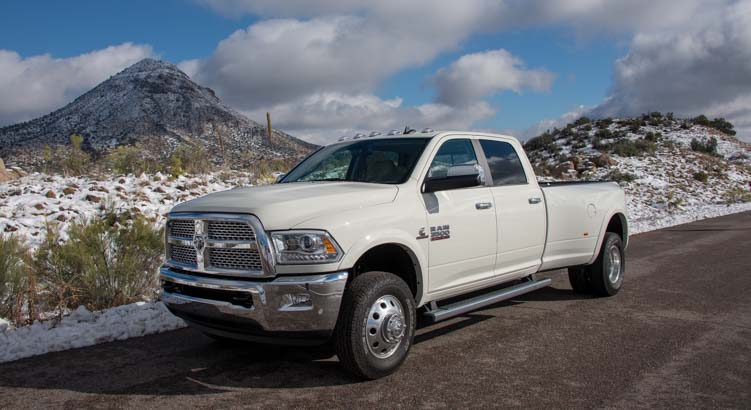
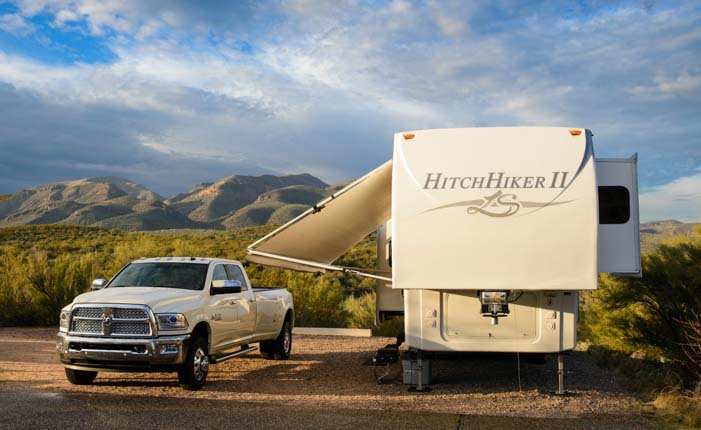
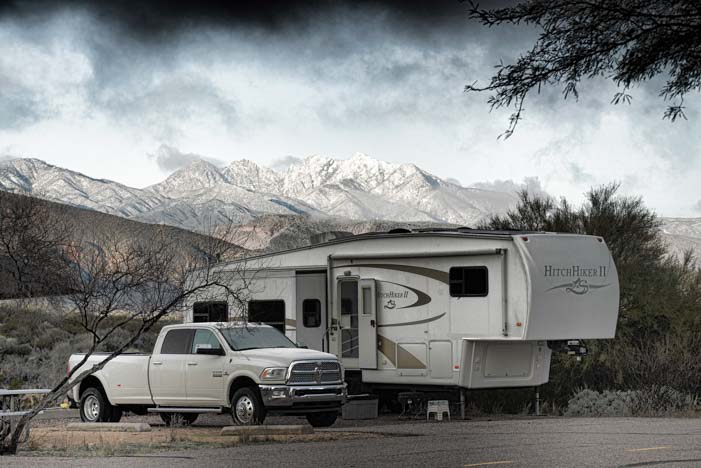
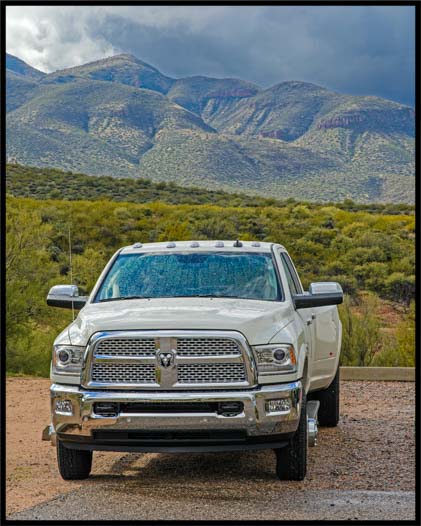
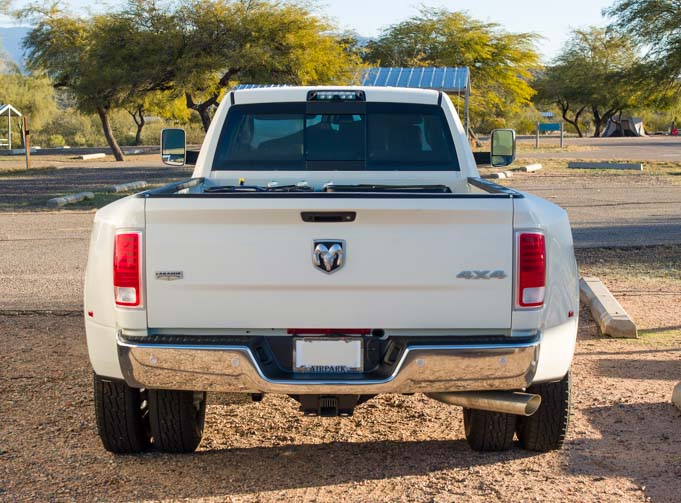
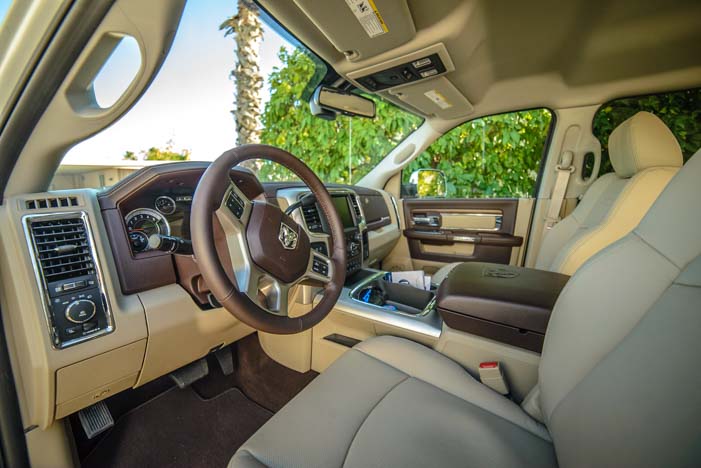
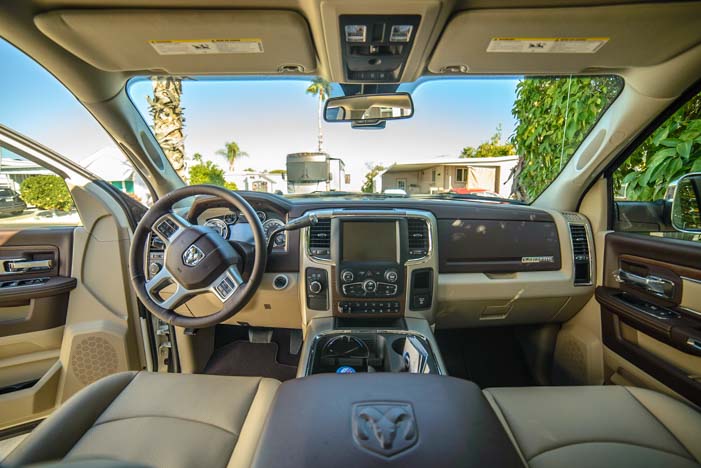
After our big beautiful Ram diesel truck gave up the ghost in May 2024 right before our summer RV travels, we sold our 2022 Genesis Supreme toy hauler and quit RVing. Just like that!
It was a bitter blow to turn our backs on a lifestyle we loved, and it took a few months to adjust to the idea. After all, we’d been just weeks away from a summer of RV travel adventures when we walked away from it all!
But we’d had it with modern diesel trucks and were ecstatic to trade in our now unreliable 2016 Ram 3500 for a trusty little gas powered 2021 Toyota Tundra. It couldn’t tow a big fifth wheel trailer, but it was perfect for hauling a tent.
Above all else, we didn’t want to make an investment in an RV until we’d thought it all over for a good long time. We were willing to think it all over for as many years as necessary!
Periodically we’d notice a trailer for sale on a street corner or we’d peruse the online ads for various types of rigs, but we had no inclination to do any serious RV shopping. The tent was just fine for now…or forever.
As time went on, though, we really began to miss having a rolling weekend getaway home. We began talking about small trailers the Tundra could tow comfortably. We even took a very long look at an ad for a barely used popup tent trailer. But for some reason we didn’t pick up the phone to go see it.
And then, on the very last day of 2024 — New Year’s Eve — everything changed.
Our cute new digs.
Mark had noticed an ad in Craigslist for a small, “NEW” and “NEVER USED” pre-owned trailer.
Huh? How could a “pre-owned” trailer be “new” and “never used” ??
He contacted the seller to see if it was a scam or if it was being sold by a dealership. No, it was for real and the seller was a private party who’d towed it home from the dealership a few months ago and never used it!
In Arizona there is no sales tax levied on private sales of used vehicles, so buying from a private seller would be very advantageous.
I shrugged it all off, though. I was standing by our strategy of waiting to get back into RVing…indefinitely, if need be!
But on New Year’s Eve morning, Mark said, “Hey, we’ve got nothing going on today. Why don’t we go kick the tires on that trailer I saw in Craigslist?”
Aw heck…it was a beautiful sunny day…why not?! So, the three of us hopped into the Tundra and drove 100 miles to take a look at it.
As soon as we stepped inside, we were smitten. It was perfect!!
The funny thing is we’d had no idea what “perfect” was before we opened the door of this trailer. But we knew this trailer was it when we saw it!
Within an hour we were signing papers.
We drove home in shocked silence. We’d had no idea when we woke up that morning that we’d be buying a trailer that afternoon. But we sure were getting 2025 off to a great start!
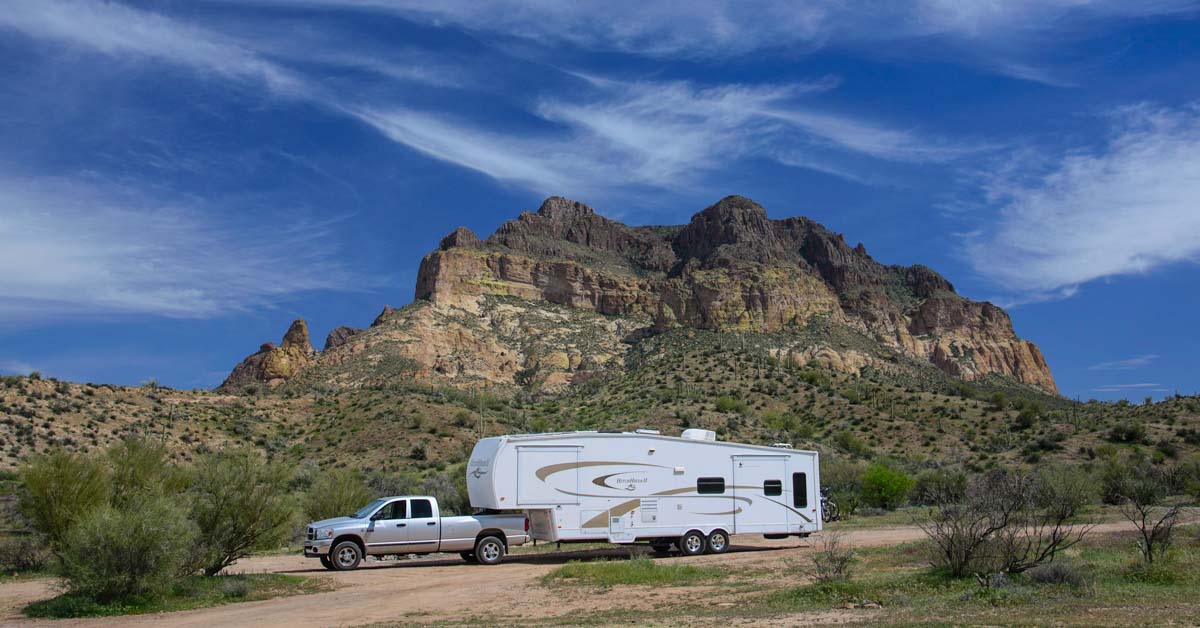
One of our first shakedown cruises to Canyon Lake.
This trailer is a 2024 Forest River Arctic Wolf 17CB travel trailer. It’s 23’ long end-to-end and it has a single slide-out.
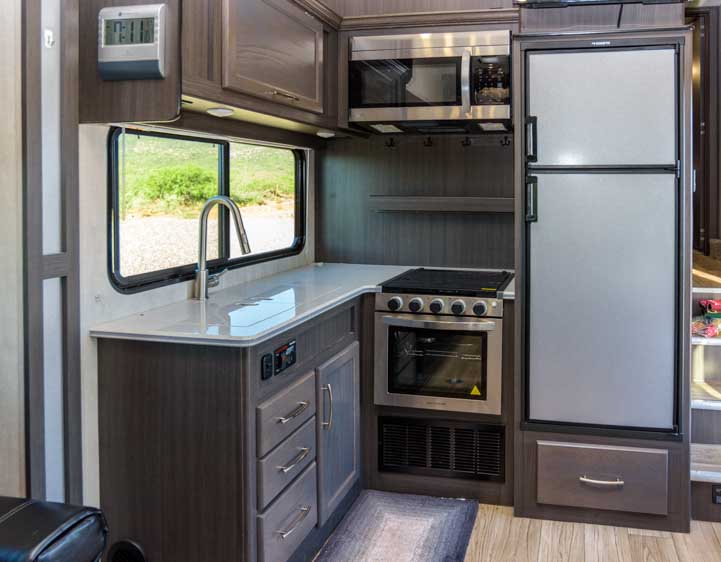
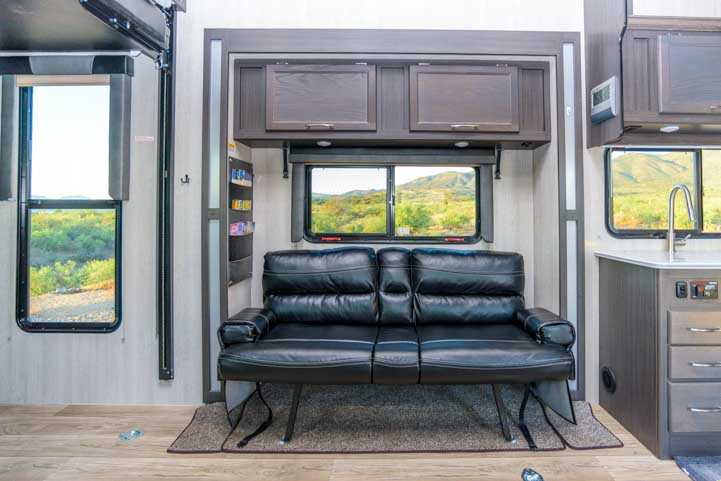
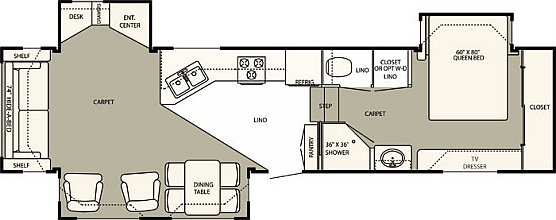
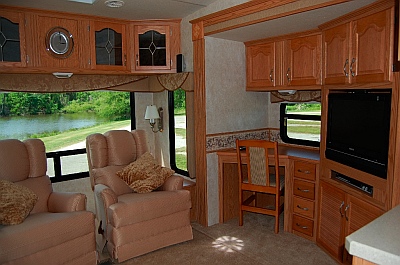
It has an open floor plan with a walk-around queen bed, super comfy wall hugging theater seat recliners, a small but functional kitchen and a big enough bathroom to do what ya gotta do comfortably.
It’s light and airy inside and has a pass-through basement compartment underneath.
2024 Forest River Alpha Wolf 17CB. In our unit the dinette was upgraded to theater seats. More details here.
The biggest surprise, though, was that it has many features of a much larger trailer despite its small size.
It stands on two axles and has a cargo carrying capacity of nearly 2,400 lbs. Yet it’s GVWR (Gross Vehicle Weight Rating) is only about 7,000 lbs., a weight the Tundra can handle, even in the mountains (its “limit” is 12,000 lbs.). It can carry 81 gallons of fresh water, has a whopping 10 cubic foot refrigerator and a 15,000 btu air conditioner.
These large capacities are not at all typical in small and lightweight travel trailers!
Basic specs for the 2024 Forest River Alpha Wolf 17CB. More details here.
But was it really “new” and “unused” ?? The seller had an interesting story.
He’d owned a huge $200,000+ motorhome outright and wanted to get the cash out of it quickly. But he’d had trouble selling it. It occurred to him that it would be a whole lot easier to unload a super cheap and small travel trailer.
He’d been a car salesman at a big name dealership for 25 years, so buying and selling vehicles was old hat for him.
He traded in the motorhome at an RV dealership for one of the smallest brand new trailers on their lot. He got his cash out of the motorhome, and he also avoided paying sales tax because his net outlay on the transaction was negative (he’d already paid sales tax on the motorhome when he bought it).
All he had to do now was sell the little trailer.
The Tundra and the Alpha Wolf 17CB make a nice and tidy little package.
We lucked out because he did all this during the holidays and he had more trouble selling the trailer than he’d expected. By the time we came along, he was so thrilled to get out from under it that he happily let it go for a song. We were equally thrilled to find such a cute little brand new trailer at a bargain basement price. Win-win!
Best of all, it’s homey and cozy but has enough space for the three of us to move around without crowding each other.
Come on inside and have a look around!
Welcome to our new digs!
When you walk in, the kitchen is on the right (passenger’s side), the bed is up front and the recliners are on the left. It’s surprisingly spacious!
It’s an open but compact layout.
The kitchen is small but it has everything we need, including an oven, which we might use if we’re out for a while and Mark gets a hankering to make muffins or banana bread!!
The microwave is a wonderfully small low energy unit, drawing just 900 watts. It is hard to find a modern RV that has a low wattage microwave like this, as most are residential size and draw 1,500 to 1,800 watts. But this little guy is perfect for warming a small plate of food which is all we’ll ever use it for.
There are only two upper cabinets for our pantry and dishware. However, there are three full-size drawers for everything from eating and cooking utensils to office supplies like pens, paper, scissors and other goodies.
There’s also a very large cabinet under the sink that can hold 9 one-gallon bottles of drinking water. We like carrying our drinking water this way and storing it on the floor of a lower cabinet.
The kitchen storage is modest but we’ve found it is plenty adequate for the three of us.
The bed is a walk-around queen. The mattress is 80 inches long but the platform under it is actually the length of a short queen (75 inches) or perhaps an inch or two longer. The mattress is firm enough that it doesn’t flex a whole lot at the foot end even though it is unsupported there.
“Walk-around” is a little bit of wishful thinking because the bedside tables (which are actually the ceiling and walls of the basement below) stick out far enough that it’s a challenge to tuck anything in along the top of the bed unless, perhaps, you’re over 6′ tall! But it’s good enough if you aren’t super fussy about how beautifully the bed is made!
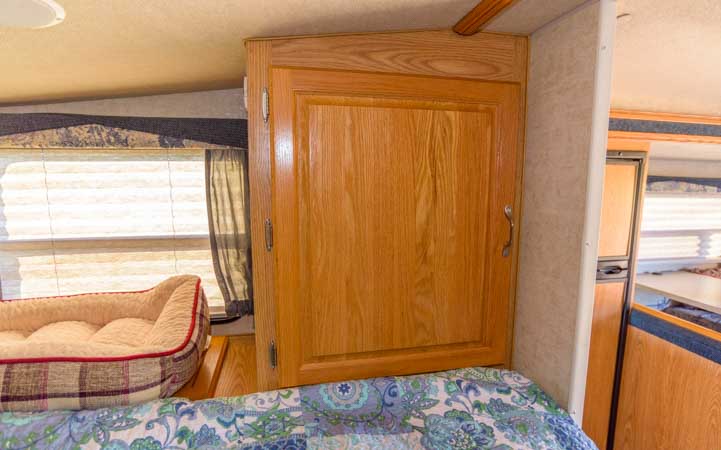
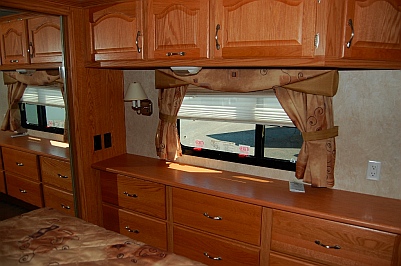
There are closets on either side of the bed with hanging space for shirts and jackets. Above the head of the bed there are three doors that open to a single upper cabinet that runs the width of the trailer.
Each side of the bed has a closet and a drawer. The cabinet above the bed runs the whole width of the trailer.
The earlier editions of this trailer a few years ago came with a window at the head of the bed. Many small trailers are built with windows like that and it really makes the interior bright and gives you a cool view of the stars while lying in bed.
However, some people—including a friend of ours—have had the nasty experience of a rock flying up and breaking the front window on their trailer when it was being towed. For our friend, the expense was covered by the trailer’s factory warranty, but the time lost to repairing their new trailer was frustrating.
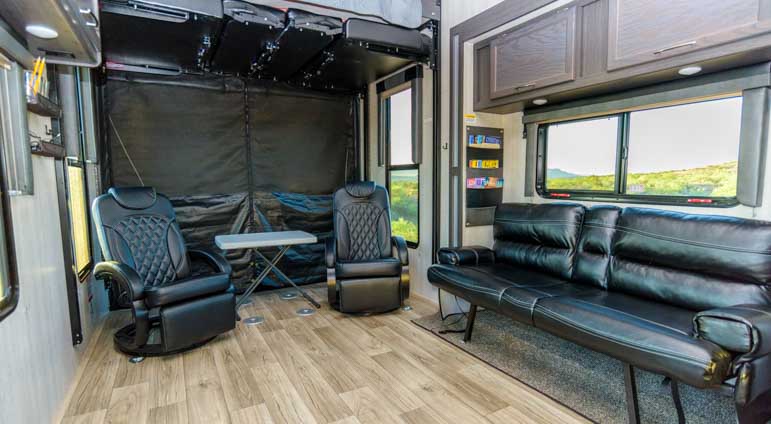
The wall hugging theater seat recliners stole the show for us. If anything clinched the deal, it was when we both sat down in those chairs. They are super comfortable!!
For us, being able to relax completely in a comfortable recliner at the end of the day is really important.
We had recliners in our full-timing fifth wheel and we actually went through two different pairs of wonderful recliners during our 12 years of living in that RV. We loved being able to come home, kick back and put our feet up, and chat with each other about that day’s adventures or mess around on our laptops.
The theater seat wall hugging recliners clinched the deal.
We didn’t have recliners in any of our other rigs besides our full-timing fifth wheel — not in our popup tent trailer which we owned before full-timing, nor in our 27’ Lynx travel trailer that we used for our first year of full-timing. We didn’t have recliners in either of the rigs we used part-time after ending our full-time travels either…these were a truck camper and a fifth wheel toy hauler.
And we really really missed them in those rigs!!
It is possible to sit sideways in a dinette and put your feet up in front of you, but it’s awkward and not relaxing. We did that in the truck camper and Lynx travel trailer, but it wasn’t great.
Our toy hauler’s Euro Chairs could recline a little bit, but they weren’t anything like truly cushy recliners. Toy hauler furniture has to be easily moved, and we tried replacing those chairs with gravity chairs and thick cushions, but they were hard to lock into position so they’d stay at the right reclining angle. The arms weren’t cushioned either and the chairs were uncomfortable for sitting with a laptop in your lap.
But these wall huggers in our new trailer are absolutely fabulous.
It’s embarrassing to say, but we almost feel like we’re towing around a pair of recliners. The rest of the trailer is just icing on the cake!
We’ve sat in a lot of recliners and these are among the most comfortable!
We aren’t the only ones who love the recliners. Buddy loves them too, especially my side.
Fortunately, the bed is a perfect height for him to spread out and still be part of the scene with us near his eye level. So there’s a place for each of us to relax.
Buddy claims my side of the twin recliners.
“Mine… Don’t even think about it!”
As you can see, the kitchen is compact. However, it works better than the L-kitchen did in the big fifth wheel toy hauler. There’s a flip down top for the stove and a slotted insert for the sink that extends the counter space so we can stand side by side and not get in each other’s way.
We can maneuver side by side without crowding each other
Hmmm…Buddy wants to show you what’s in the bathroom!
“Hi Dada! Can we come in too?”
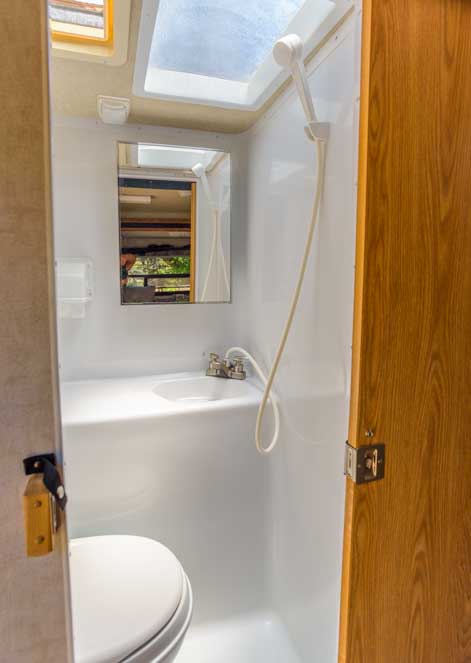
There is a big stall shower, toilet and vanity. It’s funny, not all stall showers are the same. This one has a long wide shelf for soap, shampoo, razors, etc., that’s very convenient. It also seems larger than some other stall showers.
.
There are two things in the trailer that gave us pause, though. But we decided they weren’t deal breakers and thought we might actually appreciate them in the long run.
One is that gargantuan 10 cubic foot 12 volt refrigerator. Sure, plenty of RVs have full size 110 volt residential fridges that are 18 to 22 cubic feet. But we’ve always had a propane fridge that was 8 cubic feet or less, and even though one had to be replaced, they’ve worked well enough and not put any demands on our solar power system.
We like to boondock and were off grid about 98% of the time when we were full-timers. An electric fridge will require a lot of solar power to support it. So, we’ll have a much bigger solar power system than any we’ve had before, yet we have less roof space than ever before too!
The other thing we weren’t crazy about is the “instant” hot water heater. I had an “instant” hot water heater in a liveaboard sailboat in the mid-1990s, and all I can say is that we never had hot water at the kitchen sink even though it was located just two feet away.
You had to waste precious water while it ran cold until it finally heated up, and if you turned the faucet on and off while you did dishes or took a shower, it wasted even more water as it went from cold to hot every time you turned the faucet back on. Frankly, I hated that thing.
While we would have been perfectly happy with an 8 cubic foot propane refrigerator and a 6 gallon hot water heater, that’s not how this trailer or many other 2024/2025 small trailers are being built.
So, we decided to take a “wait and see” attitude…and hope we could fit enough panels on the roof to satisfy the fridge and hope that “instant” hot water systems have improved over the last 30 years!
Let’s head outside again and have a look at the exterior once more.
We got a lovely shot of the trailer at sunset and then another at sunrise!
.
.
We feel a little Like Goldilocks and the three bears with this trailer! When she entered their house, the papa bear’s porridge was too hot, the mama’s too cold and the baby bear’s porridge just right. Then when she sat it their chairs, the papa bear’s chair was too hard, the mama bear’s was too soft but the baby bear’s chair one was just right!
The truck camper turned out to be too small and cramped (among other things).
The toy hauler ended up being too big and ungainly (among other things).
But this new Alpha Wolf 17CB travel trailer may be just right.
We’ve taken it on a few shakedown cruises and have MUCH to report about how those went.
Hint: It wasn’t until the THIRD shakedown cruise that all the systems were fully operational (YIKES!). We even had to cut the second journey short and head home earlier than planned because of a catastrophic failure!! (YIKES AGAIN!!). But we’re still smiling about this trailer because it’s just right!
We’ll have more on our shakedown cruise (mis)adventures coming up!
Our second shakedown cruise was fun but had to be cut short!!
More of our Latest Posts are in the MENU.
New to this site?
Visit RVers Start Here to find where we keep all the good stuff. Also check out our COOL NEW GEAR STORE!!*** CLICK HERE *** to see it!
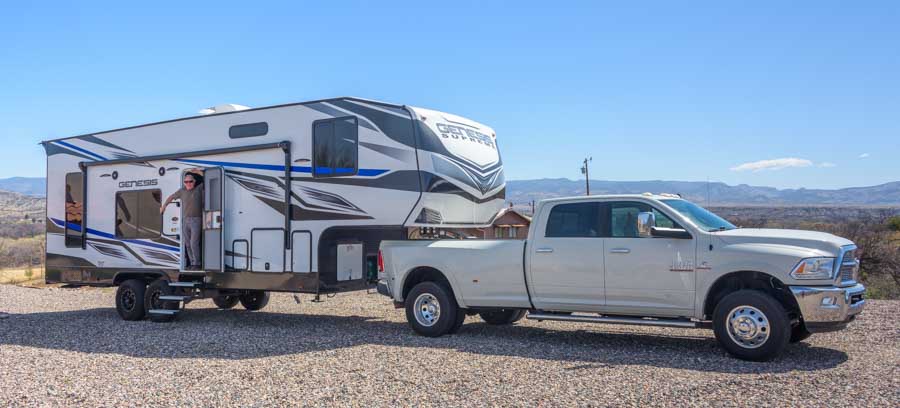
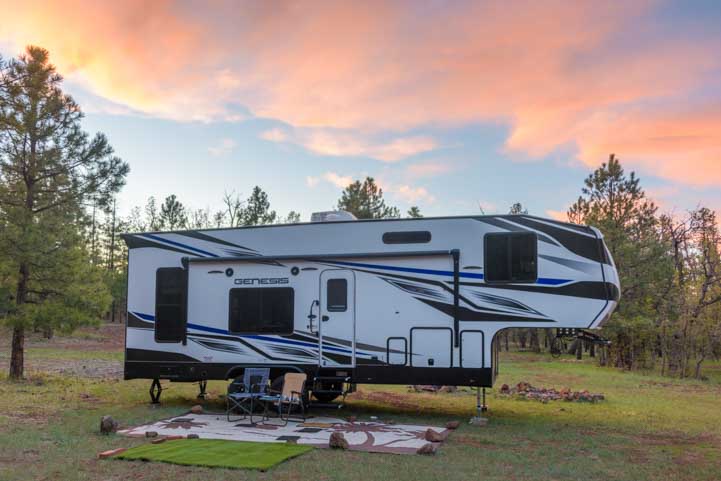
Our new rig for our summertime travel adventures is a 2022 Genesis Supreme 28CRT Toy Hauler. Here is a walk-through with the floor plan, lots of pics and notes about why we chose it!
My last post left off with a bit of a cliff-hanger after I described selling our Arctic Fox truck camper. I dropped a big hint about what was coming, though, with this final image:
It is the logo that appears on the back of all Genesis Supreme toy haulers!
Back when we were full-timing, we struggled for several years with figuring out what to get to replace our 2007 Hitchhiker fifth wheel. We went on several factory tours in Elkhart, Indiana, and I even did a big research project that resulted in a feature article for Trailer Life Magazine about the larger toy haulers on the market at the time. It appeared in the September 2019 issue of Trailer Life.
However, we couldn’t find a toy hauler that was built as solidly as we wanted for full-time use. We also wanted a separate garage that was at least 12′ long, but that meant the whole trailer would be north of 40′ and even as long as 44′. That is a Really Long Trailer! And Mark was not enthused about towing such a huge beast.
Also, the longer trailers were often a bit skinny on Cargo Carrying Capacity for our RZR plus full tanks and all our stuff (you have all your worldly possessions with you when you’re full-time). We’d had enough trouble with failing axles and a failed suspension on our fifth wheel trailer (and it wasn’t even overloaded beyond the factory specifications) that we didn’t want to risk towing around a huge trailer that was at or near its load limit.
Basically, we wanted it all, but we wanted it to be fairly short and really stout too. But we couldn’t find such a rig.
While we were camping in our truck camper last summer, I realized we could make do with a tiny kitchen and tiny bedroom for a few months of travel but we needed a big open area inside the trailer to relax and stretch out — recliners, sofa, something! If we could convert that open area to be a garage for the RZR and bikes while we were in transit, I’d be thrilled!
It suddenly dawned on me that what we needed was an open box toy hauler!
These rigs have a big garage area that converts into a living space with moveable furniture. The advantage over a unit with a separate garage is that you can arrange the living room furniture any way you wish and the overall length can be quite modest. The disadvantage is that you have a stinky dirty toy in your living room when you travel. It’s a tough trade-off and one we’d never make if we were living in the rig full-time. But for a few summer months it holds a lot of promise.
We would be able to haul the RZR and bikes inside the rig rather than having the RZR outside on a trailer or the bikes collecting road grime on a hitch receiver mounted bike rack. It would also give us an onboard gas tank to fuel up the RZR rather than carrying jugs of gasoline and we’d have an on-board gas generator which would allow us to turn on the air conditioning at a moment’s notice. If we bought a modern open box toy hauler, the ramp door would convert into an 8′ x 8′ patio off the back of the rig. All huge pluses!
Here’s where we landed:
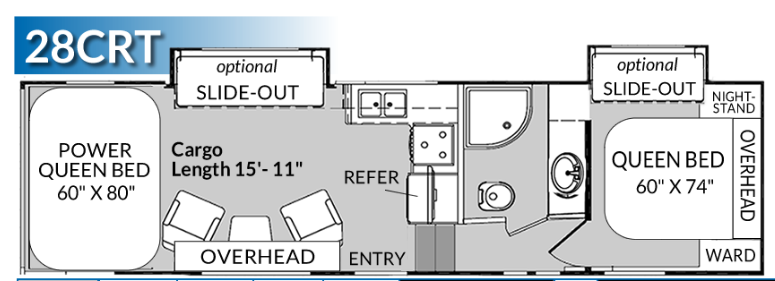
2022 Genesis Supreme 28CRT Toy Hauler Floor Plan Ours has the two slide-outs. The “power queen bed” is on an electric lift system.
But how did we end up here?
There aren’t a lot of open box toy haulers on the market. The big Indiana RV manufacturers are focused on building toy haulers with a separate garage because no one wants that stinky dirty toy in their living room.
However, a small builder in California, Genesis Supreme, is manufacturing them under the brand names Genesis Supreme, Vortex and Wanderer.
Ironically, while out camping last summer, we met a guy camping in a Genesis Supreme Vortex. It was a massive model — 42 feet long — and it was cavernous inside. He didn’t use it to bring any kind of toys with him, though. Instead, being a really outgoing and fun-loving type of guy, he’d set up the whole interior to be Party Central for him and his wife and his crowd of friends and family that he camped with regularly.
He could fit 18 people in his rig comfortably (he had several Euro Chairs and gravity syle reclining camping chairs for them all). He also had a fully stocked bar and a beautiful huge kitchen with tons of counter space. The bedroom had a king bed and the shower was a full size tub enclosure rather than a stall shower. He stored it 10 minutes from where he liked to camp and he’d just drive his truck from the house to the storage lot (an hour’s drive) and then hitch up and drive a few miles to go camping. An ideal situation for him.
We went back to our truck camper in awe and with fresh new ideas swimming around in our heads. We woudn’t want to tow that beast, but my oh my, the things you can do with an open floor plan and moveable furniture!
I began searching online for open box toy haulers and there were very few. Genesis Supreme makes open box toy haulers exclusively, however, and they had a really cool unit that would suit our needs: the Genesis Supreme 28CRT.
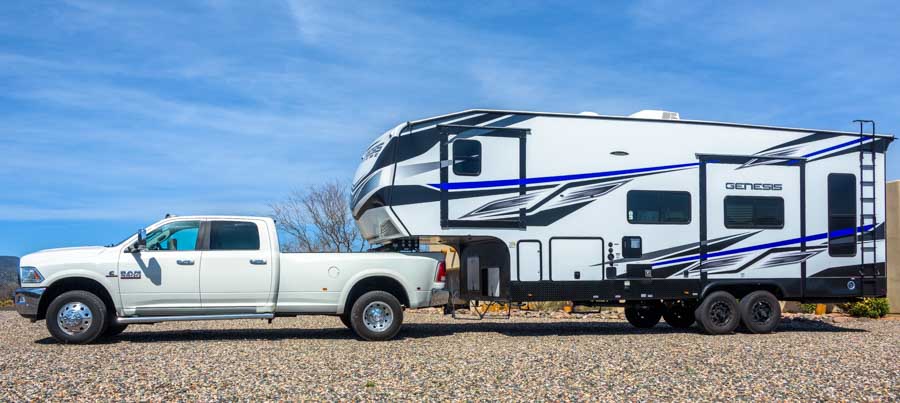
2022 Genesis Supreme 28CRT Toy Hauler
The fresh water tankage was better than the Hitchhiker by 22 gallons and although the waste tanks were smaller than ideal they were manageable for shorter-term, on-the-go, frequently-moving travels. It also had a generous an on-board gas tank for the RZR and the on-baord generator:
Fresh Water: 100 gallons
Gray Tank: 40 gallons
Black Tank: 40 gallons
Propane: 14 gallons
Gasoline: 40 gallons
I used to wonder why toy haulers are so often built with huge fresh water tanks and totally inadequate gray tanks — where did the manufacturer expect all that water to go? Well, most have an outside shower or hose for cleaning off the toy before putting it away. So, the assumption is that much of the fresh water will be used that way and will end up on the ground and not in the gray tank. Needless to say, the manufacturers should provide an appropriately sized gray tank for people who won’t be pouring fresh water on the ground as they wash their toys.
The weights and carrying capacity were good too (CCC nearly 5,000 lbs) and could easily accommodate full propane/gas/fresh water tanks (which is how we typically travel) as well as the RZR and our gear, clothes, bedding, tools and food:
UVW: 10,110 lbs
GVWR: 15,000 lbs
CCC: 4,890 lbs
When looking for a rig, especially a toy hauler that will carry something heavy, it’s important to add up all the fluids in the tanks plus the toy and then estimate the weight of all the other stuff you’ll be carrying, including upgrades with hidden weights like extra solar panels and batteries.
Our RZR is 1,250 lbs, our two bikes are 50 lbs, a full 100 gallon water tank is 830 lbs, a full 40 gallon gas tank is 244 lbs, and 14 gallons of propane is 60 lbs. The total for all that is 2,434 lbs. That leaves a comfortable margin of 2,486 lbs for any upgrades we install, our kitchen gear, tools, spare parts, clothing and food.
We saw plenty of toy haulers that had just over 3,000 lbs of cargo carrying capacity, and some of those had a 160 gallon fresh water tank which weighs 1,328 lbs. We wouldn’t be able to use one of those rigs and bring any clothes or food.
The Genesis Supreme 28CRT is 3′ shorter than our Hitchhiker was, a foot taller and 6 inches wider:
Length: 33′
Width: 8′ 6″
Height 13′ 6″
Although we don’t have the measurement from the Hitchhiker, the Genesis Supreme appears to have less of an overhang behind the rear wheels, a plus when taking a tight turn which makes the back end swing out and potentially hit things. Years ago our Hitchhiker hit a guard rail which peeled the entire fiberglass endcap back about a foot, revealing all the insulation and wiring inside the wall. Ugh! The cost of the repair (covered by insurance) was 25% of the new purchase price of that 5th wheel.
It also appeared that the Genesis Supreme was higher off the ground than the Hitchhiker which is good when going through dips and washes.
There was a Genesis Supreme 28CRT for sale at a dealership an hour or so away, so I went there with a tape measure, notepad and camera in hand to see what it was like. Mark decided to stay home with Buddy and he just said, “If you like it, make an offer!”
I really liked it, but I wasn’t going to commit us to anything without him seeing it and liking it too! I came home and we went over all the photos and discussed it at length. He liked the looks of it but didn’t particularly want to go to the dealership to negotiate.
“I don’t want to buy anything unless it falls in my lap!” He said.
I agreed 100%. Fall-in-the-lap deals are the best. You set the stage, do your homework, and aim for success, but you can’t force the right thing to happen. I’ve come to realize that every seemingly “perfect” deal that tragically falls through does so because it is making way for a better deal to come along. I knew RVs were selling fast, though, and I was concerned we’d lose this one if we didn’t act soon.
I called Genesis Supreme to see how busy they were. It’s a small enough company that you can actually call and easily get through to someone knowledgeable who has real answers! They said they had several dealer orders for Vortex 2815V models in the coming months and that those units were identical to the Genesis Supreme 28CRT models inside but were painted a different color on the outside (battleship gray instead of white with black, blue and gray stripes). These units would be shipping with a higher MSRP, of course, but at least the unit at the dealership wasn’t the last one to be delivered for 12 months as I’d been told last summer about a Desert Fox model I liked and that was nowhere to be found west of the Mississippi.
2022 Genesis Supreme 28CRT Toy Hauler
One night, I casually looked on Craigslist, and tucked in between all the dealership ads for 2022 Genesis Supremes there was a 2022 Genesis Supreme 28CRT for sale by a private party. Huh?
I contacted the seller and he said he’d had it for 5 months and realized it didn’t work for his purposes. He’d bought it to visit his inlaws on weekends and travel a little on the side but decided it made more sense to buy a small second home near his inlaws and get a small motorhome for traveling.
That would all be much more money than a truck and trailer, but he was more concerned about getting the right solution than the cost. Plus, a second home is an investment that will generally appreciate whereas an RV is a asset that will generally depreciate in value. We were intrigued that he didn’t own a big motorized toy like a RZR and he used the trailer to haul two big tricycles for riding around his inlaws’ neighborhood.
I asked if we could see it and he said, “Yes, but unfortunately I’m storing it in a lot that’s 90 miles from where I live…”
It turned out his storage lot was right down the street from where WE live! WOW!!
It seemed like a very cool opportunity was falling our laps!
We saw it, loved it, struck a deal that was way below what we would have paid at the dealership, and brought it home. The unit at the dealership didn’t have an onboard generator because of supply chain issues while this one had a generator and some other small upgrades already installed. It had been used so few times that the microwave and stereo still had plastic film protecting the display.
The furniture is black, which is not my first choice. The unit at the dealership had more appealing cream colored furniture and some lighter trim which lightened the interior significantly.
However, unlike a full-time rig where I’d be very fussy about the interior, we’ll be in this for just a few months at a time, and hopefully we’ll be outside doing and seeing exciting things most of that time. We don’t have to worry about the long dark months of winter when full-timers can wind up staying inside quite a bit.
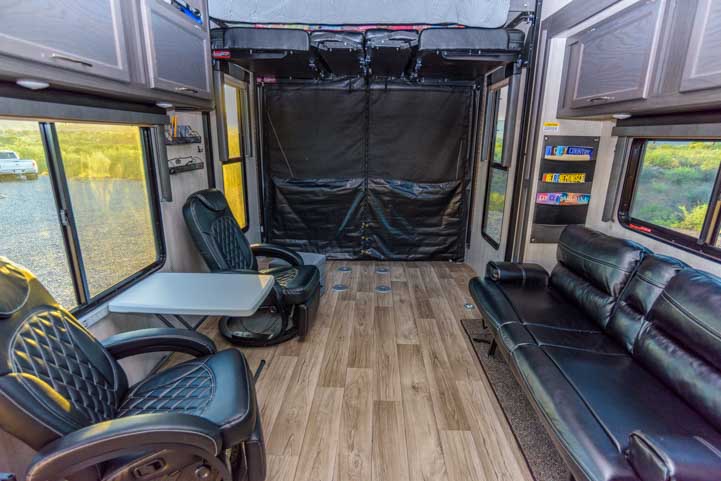
Stepping inside, you are facing the kitchen, and the garage/living area is to the left.
The sofa is pretty comfy both for sitting and for napping (it’s a jackknife sofabed)
The length of the garage area is 15’11” from the ramp door to the refrigerator. Our RZR is 9′ long. There are two small 20″ deep slide-outs, one in the main area for a fold-up sofa/bed and one in the bedroom for some drawers and a closet.
An open box floor plan allows you to arrange the interior however you like with moveable furniture!
The tiny L-shaped kitchen is workable although not optimal, but with some minor modifications we’ve made it more spacious (details coming in another post).
The sofa and kitchen are on the driver’s side
The L-kitchen is small, but with some simple modifications (not shown here) we’ve made it more spacious
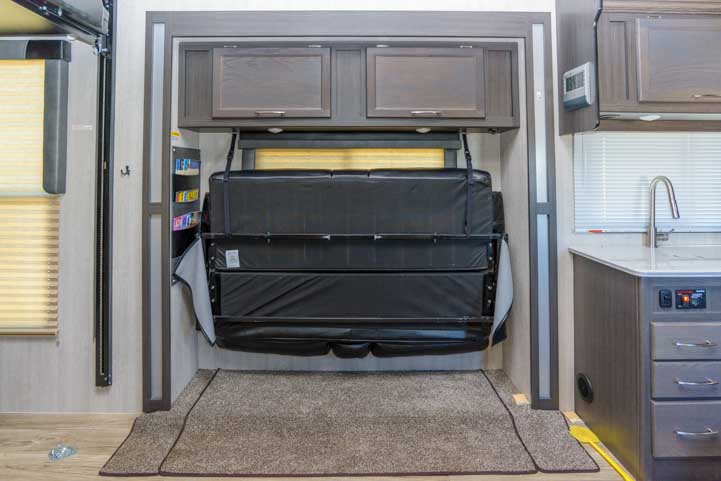
The interesting thing about open box toy haulers is that everything is geared towards making room for and bringing in that big ol’ toy. The jack-knife sofa can fold out into a full-size bed but it can also fold up against the wall to make room for a big toy.
The jackknife sofa in its “living room” position.
The sofa is folded up against the exterior wall in “travel position.”
The recliners are very light and can be moved easily. The official setup has a small removable table between them.
The recliners are light and can be moved easily. The factory provides a removable pedestal table.
But they could also be set up in the rear. This is where the guy who towed around Party Central really had fun. He could arrange seating for all his friends and family in many different ways. For us, we’ll see how we end up using it. I like having options!
The recliners can also be placed in the rear of the rig the way they are in many traditional fifth wheel trailers.
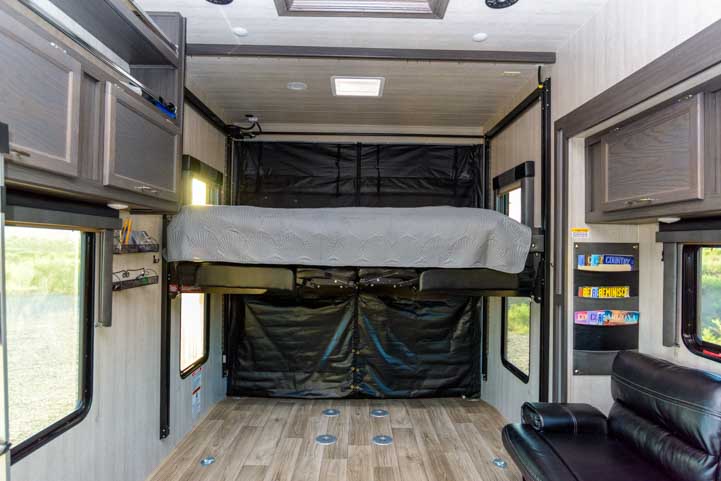
In the rear there is a queen size top bunk (60 x 80 inches) and two sets of “rollover” sofas that can face each other or be laid flat to form a full-size lower bunk bed (54 x 80 inches).
Both bunks can be raised and lowered. The sofas (lower bunk) are the ones that actually move up and down the track while the top bunk simply rides on top of them. There are stops placed a few feet down on the rails to force the top bunk to stop descending as the lower bunk is lowered. Once the top bunk has stopped, the sofas that make up the lower bunk can be lowered all the way down to be set up as either opposing sofas or as a single full-size bed.
The bunk beds in the back are in the fully raised position so you can walk (or fit a RZR) underneath.
The top bunk rides on top of the two opposing sofas which flatten out to make a full size bed.
The top bunk stops descending at some stoppers placed midway down the track. The sofas (laid out as a lower bunk) descend down to traditional bed level.
The top bunk is really cozy and comfy and you get a great view out the window at the beautiful outdoors. The lower bunk is surpisingly comfy too, and what we’re finding is it’s fun to have it set up as a kind of lounging area, great for napping, reading a book or for watching the Outdoor Channel (Buddy’s favorite station on his Window TV).
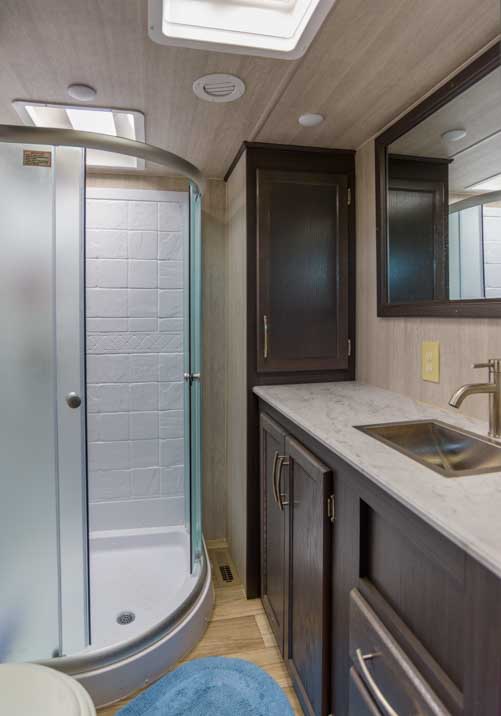
Heading upstairs, the spaciousness missing in the kitchen has been totally regained in the bathroom. It is big and roomy.
The bathroom is very spacious.
Fancy stall shower.
What the kitchen lacks in space, the bathroom makes up for in spades!
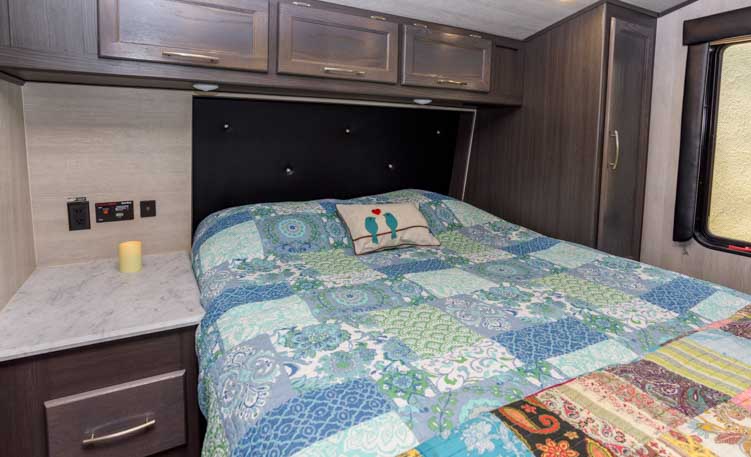
The bedroom is very small and the bed is a short RV queen (60 x 74.5 versus 60 x 80) that runs “north-south,” i.e., parallel to the road. There are two hanging closets, four drawers, a lot of storage over the bed and a cubby for laundry as well as a bedside table. Plus there are windows on both sides of the bed.
The bedroom has good storage space but just a short RV queen bed (60 x 74.5 inches).
There is plenty of drawer and closet space in the bedroom.
Oh, look who just jumped up on the bed!
Buddy feels right at home here!
I think he wants to head outside, so let’s go.
.
One thing we love is that the windows are very large.
The trailer is 13’6″ tall and you can see the height in this pic where Mark seems quite small next to it.
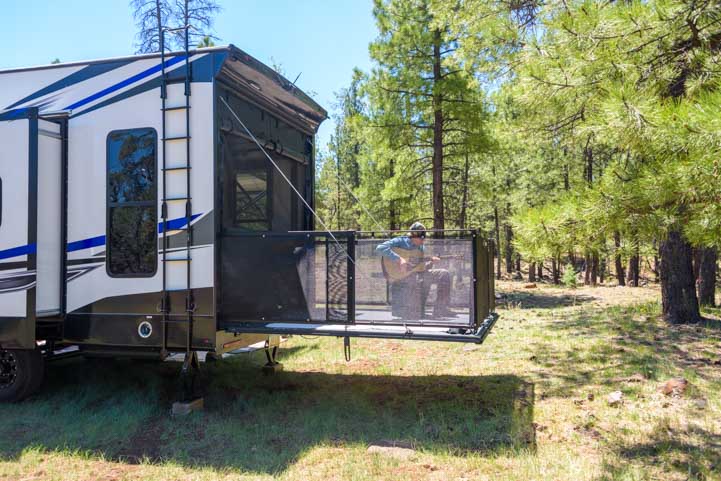
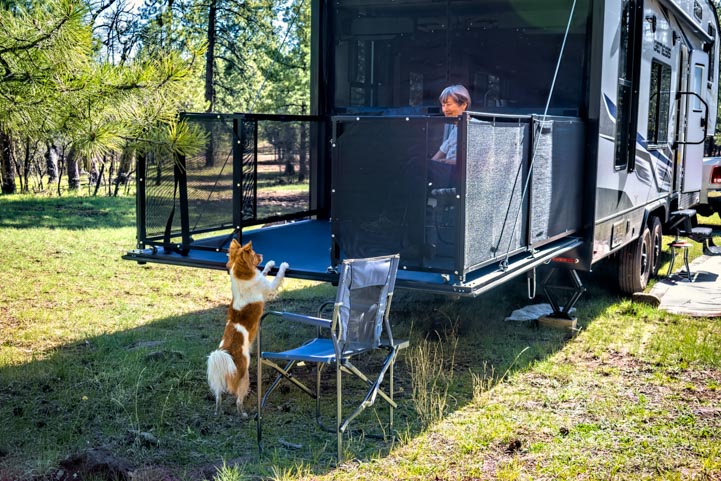
Another wonderful feature is the back patio. The ramp door opens up and hangs on cables from the frame to form a patio that can hold 3,000 lbs. A set of railings (by MorRyde) roll out and clip into place. Those rails will be handy for giving Buddy a way to be outdoors at times when we don’t want to let him run free.
The ramp door to the garage converts to a patio.
There’s a back gate you can open to get down to the ground.
It’s very cool to have an elevated outdoor space to hide out in!
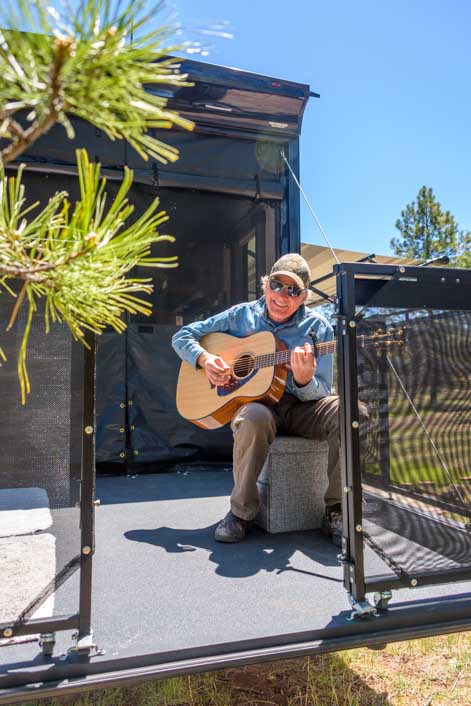
Happy camper!
“What’s going on up there?”
Solar Power
Another bonus is that it came from the factory with a basic solar power setup. All the components are from Go Power. It’s a small system, but it may be enough for us to squeak by in the summer months when the days are long, the sun is high, and we use very little power because we go to bed at sunset and wake up at sunrise.
One 190 watt solar panel
Solar charge controller + Battery Monitor
1500 watt pure sine wave inverter
Four 12-volt Group 24 wet cell batteries
We’ve never had a battery monitor before, so this is a new gizmo for us. We always kept an eye on the voltages reported on the solar charge controller to get a sense of how the batteries were doing. Now we can glance at the screen in the living room and it tells us the batteries are 100% charged, or whatever. How accurate it is, I have no idea!
As for all the other solar gear, we’ll do a summer with the factory installed setup and see how it goes. Down the road we might put more solar power on the roof and/or upgrade the batteries and/or upgrade the inverter. But for now, in 9 days of camping in mid-May, the system did just fine and the batteries were fully charged before nightfall. Of course, there’s always the onboard generator that has a switch in the kitchen and a switch by the bed so if you feel a need for power at 2:00 a.m., you can roll over, hit the switch, and snooze to the hum of the genny.
We really enjoyed our shakedown cruise and can’t wait to go on our bigger summer trip.
A few other big positives for us are:
Refrigerator
We didn’t want one of the huge 18 cubic foot four door refrigerators because they go through propane pretty quickly when boondocking and, over time, there have been more problems with them than with the smaller 6 to 10 foot double door refrigerators.
The double door 8 cubic foot refrigerator on this rig is the same size we lived with for all those years in our Hitchhiker, so we’re used to living with a small fridge. This particular one has a bigger freezer than our old one, so that’s a nice plus.
In our Hitchhiker, our 8 cubic foot fridge and our range used 7 gallons of propane every 3 weeks. If we had a refrigerator that was more than twice as big, we might be hunting for places to fill our propane tank every 7 to 10 days. It’s not always so easy to find propane, and it’s enough of a pain to unload the tank from the rig and into the truck and then chauffeur it to the propane store and load it back into the rig that we’d rather do it as infrequently as possible.
An electric fridge is fine if you have enough solar power to support it, but we’re just trying to have fun for a few months each year and we’re not looking for a long term full-time RVing type of solution.
Two Fresh Water Intakes and No All-In-One Compartment
Unlike most modern fifth wheels that have an all-in-one filling/dumping compartment on the side of the rig, this unit has all those things placed separately but near each other. We like having them all spaced out and operating independently of each other and not having to follow a chart for switches to be aligned different ways to go between dry camping, winterizing and full hookup camping.
There are 2 separate fresh water intakes, one for filling the tank for dry camping and the other for a fresh water hookup.
The all-in-one sanitation compartments often have the fresh water intake recessed within the compartment which makes it impossible to add water to the tank with jerry jugs. It’s possible to rig up a pump to pump water out of a tank or jug and into that recessed intake, but we like the simplicity of hoisting a jug up and emptying it into the tank rather than getting out the pump and all that. Obviously, with some creativity, it is possible to make it very easy to use a pump and many people do.
Some rigs we’ve seen don’t even have a gravity fill fresh water intake which makes it difficult or impossible to add water to the tank from water jugs. The system uses switches instead to direct the water flow to the holding tank or to the interior of the rig.
This unit has one fresh water intake specifically for filling the fresh water holding tank that is located a little lower than the one on the Hitchhiker which will make it easier to access. It has another fresh water intake for a city connection for when we have fresh water available at our campsite (which is rare).
Electric Awning
Mark never thought he’d want or like an electric awning, but he’s loving this one. “As long as the motor keeps working!” he says. Hopefully it will because even I can open and close this awning in my sleep at 3 a.m. if I have to!
Keyless Door Lock
Again, we never thought we’d want or like having a keypad on the entry door that can be used in place of a key. But we love it! So often we approach the door and realize we don’t have the key with us. Now, we just punch in the magic code and Sesame opens for us!
There are keys for the door too, so you can use a key if you wish. There’s also a key fob with a remote so you can open or lock the door from a distance too!
Keyless entry is handy when you don’t have your keys on you.
Radio Reception and Outdoor Speakers
We could never get good radio reception on the radio in the Hitchhiker and that was something we noticed right away when we bought the Arctic Fox truck camper because it got great reception. It is so nice to listen to the radio and tune in to whatever is going on locally.
Music outside – what fun!
We’ve enjoyed many a radio show consisting of call-in classified ads for farming and ranching equipment in the big rural western states, something we just don’t find elsewhere. The Genesis Supreme gets great radio reception and the outdoor speakers are an added bonus.
Shhhh — We promise to keep the outdoor volume down so we don’t bother the deer and the rabbits!
Hopefully we’ll enjoy many years of travel in this baby!
More of our Latest Posts are in the MENU.
New to this site?
Visit RVers Start Here to find where we keep all the good stuff. Also check out our COOL NEW GEAR STORE!!*** CLICK HERE *** to see it!
After 13 years of living on the road, first in a 2007 27′ Fleetwood Lynx travel trailer and then in a 2007 36′ Hitchhiker 34.5 RLTG fifth wheel, we switched gears and moved back into a sticks-and-bricks home.
But we didn’t want to give up the thrill of the open road completely! Since we still owned our 2016 Dodge Ram 3500 dually pickup truck, we decided a truck camper would do the trick for shorter duration adventures.
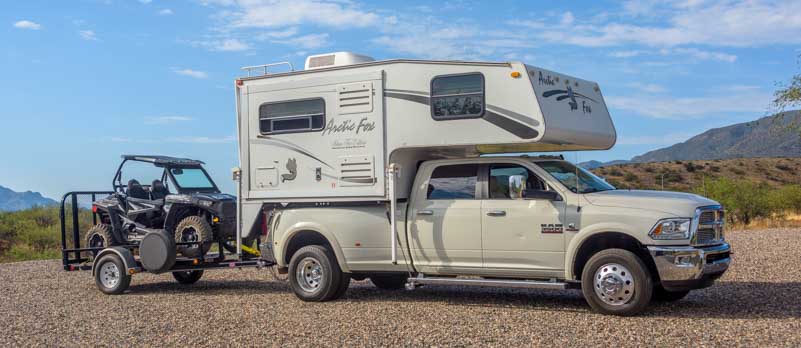
A 2005 Arctic Fox truck camper turned up on Craigslist in excellent condition, garage kept and barely used. Counting our lucky stars, we took the plunge, bought it, and have been having fun setting it up and taking it on a few short trips.
Here’s a quickie tour of the camper that will be our new little home on wheels.
Our new little buggy!
The Arctic Fox 860 has one slideout on the passenger side and is on the smaller size for a long bed truck camper. It is designed to be carried by a single rear wheel pickup truck so it is an easy load for our dually.
.
One of our goals was to be able to travel with our Polaris RZR in tow. We had triple towed the RZR on a small flat bed trailer behind our fifth wheel for two years. That worked, but it was cumbersome.
Having the RZR right behind the truck now rather than 40′ behind us makes it a lot easier to bring the RZR along on our travels. One thing that Mark has found, though, is that because our utility trailer is only 5′ wide, he can’t see it in the rear view mirrors when he’s driving unless he makes a very sharp turn. This makes it a bit tricky to back up!
Also, because our utility trailer is only 10′ long, it holds our Polaris 900 series UTV but can’t carry our bikes at the same time. I have a secret wish for a larger utility trailer which might solve both problems… we’ll see!
We can tow the RZR easily with this new rig.
The Arctic Fox 860 does not extend beyond the back of the truck. Many larger truck campers hang out a foot or two beyond the back bumper of the truck. With those campers you need a hitch extension to tow anything behind. With this model, the RZR trailer hitches directly to the hitch receiver on the truck without an extension.
The camper doesn’t hang far off the back of the truck, so the RZR can be hitched directly to the ball mount in the truck’s hitch receiver.
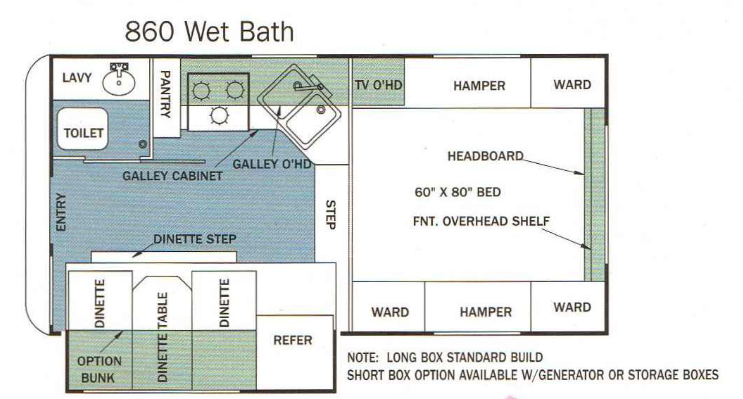
FLOOR PLAN
Arctic Fox 860 truck camper floor plan
CAPACITIES
Here are the tank and HVAC capacities for the Arctic Fox 860:
Fresh Water: 46 gallons, including 6 gal. hot water heater
Gray Water: 25 gallons
Black Water: 25 gallons
Propane: 14 gallons (60 lbs.)
Furnace: 20k BTU
Air Conditioner: 11k BTU
INTERIOR
Oh look, there’s Mark at the door. Let’s head inside!
Come on in!
The interior is open and bright.
The slideout (right side of the pic) gives the interior an open feeling.
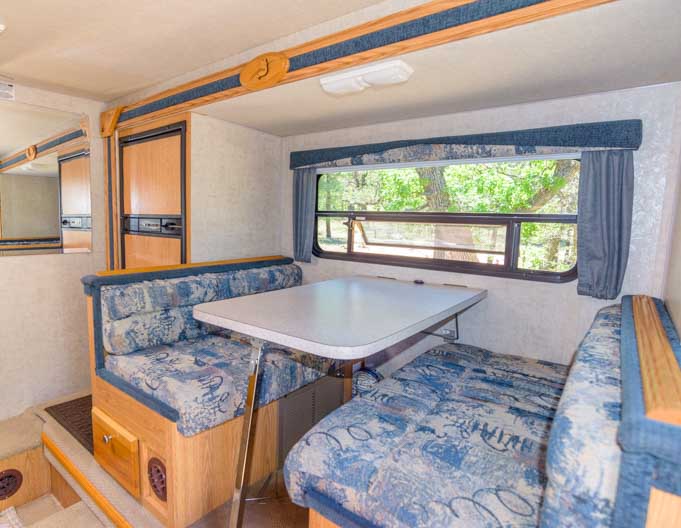
The dinette is on the passenger side as you walk in and it’s very comfortable for two. Since there are no recliners or sofa, we both like to turn sideways on the benches, lean against a cushion behind us and stretch out our legs!
The louvered window makes it possible to keep the window open even when it drizzles.
The dinette is comfortable and the window brings in lots of light.
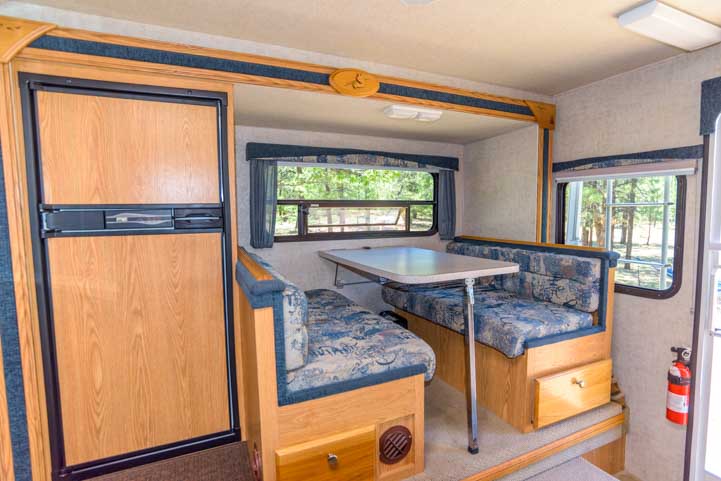
The three-way 6 cubic foot refrigerator can run on 12 volt DC electricity, 110 volt AC or propane. The fridge is the same size as the one in our Lynx travel trailer that we lived in during our first year on the road. Our fifth wheel had an 8 cubic foot refrigerator.
The 6 cubic foot refrigerator is a 3-way (12v DC, 110v AC, or LP) .
The bathroom is on your left as you enter, behind a sliding door, and the kitchen is beyond that.
The bathroom and kitchen are on the left (the driver’s side) as you enter.
This camper has two showers, one in the bathroom and one outside. Back in our days of camping in our little popup tent trailer, we made good use of our outdoor shower and got a kick out of bathing in the fresh air (in remote places, of course!). Mark used to love showering on the back of the boat too!
Wet bath (ie., the toilet is your shower companion)
Wet bath
The kitchen is small but very workable and I’ve found it easy to make good meals in it.
Sliding pantry rack
The cupboards and drawer space are sufficient.
Years ago, for the boat, I bought a stainless steel Magma nesting pots and pans set which has several sizes of pots, pans and tops that all stack into each other along with two removable handles. I’ve always said this high quality, handy dandy compact kit would be ideal for a truck camper, and it is! (I just noticed that Camco and Stansport make similar smaller sets that are much less expensive).
I’ve never used the plastic cutting board sink covers in our previous RVs, but I find I tend to cover one side of the double sink all the time in the camper to get a little more working area when cooking.
Small but functional kitchen
When we took the camper out for our first overnight, we quickly realized we needed a little trash can. Mark improvised and converted a Deschuttes Pale Ale 12-pack box. Ya gotta have a little whimsy in life, so we’re keeping it for now!
Mark’s Deschuttes Pale Ale trash can is working out well!
The bed is in the cabover part of the camper and is a queen size 60″ x 80″ mattress.
The bedroom 🙂
On either side of the bed there are two shirt length hanging closets with mirrored cabinet doors. There’s also an alcove with a window on each side. This makes the bed feel wider than a queen.
Each alcove has lift-up tops to access a deep storage area underneath. We can easily fit two week’s worth of summer clothing with plenty of room to spare.
Each of the window alcoves has a deep storage area beneath cabinet doors that lift up.
At the foot of the bed on the driver’s side there is a TV cabinet with a slide-out tray for the TV.
There is a large cabinet for a TV at the foot of the bed on the driver’s side (kitchen side).
On the opposite side at the foot of the bed a small door opens to reveal a full-length hanging closet that goes deep below the level of the bed.
Behind this door is a full length hanging locker.
And that’s the tour!
I’m heading out — I think there’s a hammock under the trees waiting for me out there!!
A sweet little home that fits right into the bed of our truck!
More of our Latest Posts are in the MENU.
New to this site?
Visit RVers Start Here to find where we keep all the good stuff. Also check out our COOL NEW GEAR STORE!!*** CLICK HERE *** to see it!
Choosing a truck to pull a trailer is a critical decision for RVers, because getting there, and particularly getting there safely, is the first and most important part of enjoying the RV lifestyle! Towing specs and towing guidelines always give the outer limits of what a truck can safely tow. Too often, in towing situations, the trailer is a little too big for the truck, or the truck is a little too small for the trailer, pushing the truck right to its outer safety limits or beyond.
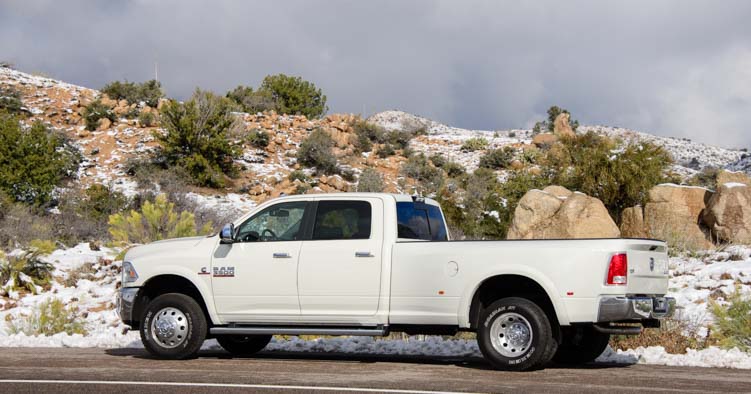
The 2016 Ram 3500 Dually is an awesomely powerful truck for towing big and heavy trailers
The truck-trailer combo may be just a little out of spec on paper, so it may seem okay, like you can get away with it, but it is a really unwise decision. Not only is it absolutely no fun to drive a truck that is screaming its little heart out to tow the load its tied to, but if you have an accident and it is determined your truck was towing a load that is beyond its safety limits, you will be liable.
Heaven forbid that there is a fatality in the accident — either yours or someone else’s. There are lots of horror stories out there of people’s lives that were transformed because someone decided not to get a truck that could tow their trailer safely.
Of course, truck and trailer salesmen don’t help. We have heard time and again, “That truck is fine for this trailer,” or “This trailer will be no problem for that truck.” Don’t listen to them! Trust your instincts and your gut feelings. If you are studying the specs and are nervous that your truck *might* be too small because your trailer puts it on the hairy edge of its specs, then you need a bigger truck or a smaller trailer.
We have been amazed at the huge difference between our old 2007 Dodge Ram 3500 Single Rear Wheel and this new 2016 Ram 3500 dually
This article covers all the specifications we studied and were concerned about when we placed the order for our 2016 Ram 3500 truck to tow our 14,100 lb. 5th wheel trailer. You can navigate to the various sections with these links:
When we bought our 2007 Dodge Ram 3500 Single Rear Wheel long bed diesel truck with the 6.7 liter Cummins engine, its purpose was to tow a 7,000 lb. (fully loaded) 2007 Fleetwood Lynx travel trailer. Our 2004 Toyota Tundra (4.7 liter engine) had been okay to tow that trailer on paper, but when we took it on its first mountain excursion up and over Tioga Pass on the eastern side of Yosemite in California, it could not go faster than 28 mph with the gas pedal all the way to the floor. What a scary, white knuckle drive that was. Who needs that?
Our ’04 Toyota Tundra half-ton pickup rests as it tries to tow our 27′ travel trailer over Tioga Pass… sigh.
We replaced the Toyota Tundra with a 2007 Dodge Ram 3500 which was rated to tow much bigger trailers than the little Lynx travel trailer, so all was good with that small travel trailer. However, within a year, we upgraded our trailer from the lightweight Fleetwood Lynx to a full-time quality, four season, 36′ NuWa Hitchhiker LS II fifth wheel trailer that the scales told us was 14,100 lbs. fully loaded. Suddenly, our big beefy diesel truck was at its outer limits!
We drove our ’07 Dodge Ram 3500 and 36′ fifth wheel combo for seven years without a mishap, but it was not an ideal situation. The truck would strain in the mountains and would wander in strong cross winds on the highway. We installed a K&N Cold Air Intake Filter and an Edge Evolution Diesel tuner which helped the engine breathe better and increased its power (see our Edge Evolution Tuner Review), and we installed a Timbren Suspension Enhancement System to keep the truck from sagging when hitched to the trailer. But the frame of the truck and the transmission were still stressed by the heavy load on steep inclines.
We wanted a truck that was well within its towing limits and that could tow our trailer effortlessly.
The weight ratings for trucks and trailers are an alphabet soup of confusion that takes a little imagination to grasp. Here’s a synopsis:
UVW
Unloaded Vehicle Weight
The weight of the vehicle without fuel, people and stuff
GVWR
Gross Vehicle Weight Rating
The heaviest weight the vehicle can safely be when it is loaded up with fuel, people and stuff
GCWR
Gross Combined Weight Rating
The most a truck-and-trailer combo can safely weigh when hitched together and loaded up with people, fuel, food, etc
Payload
The GVWR less the UVW
The amount of weight the truck can safely carry. Compare to the trailer’s Pin Weight
PW
Pin Weight
The actual weight on the truck’s rear axle when a trailer is hitched up. Compare to the Payload
The Pin Weight is most easily visualized by first imagining yourself standing on a bathroom scale and making a note of your weight. Then your teenage kid walks up and puts his arms around your neck and hangs on your shoulder. The weight on the scale goes up a little bit, but not a huge amount, because your kid is still standing on the floor on his own two feet. The more he leans on you, the more weight the scale shows.
The difference between the weight the scale shows when your kid is hanging on your shoulder and the weight it shows when you’re by yourself is the “pin weight.” In the case of you and your kid, the “pin weight” might be 30 lbs.
The Pin Weight is the weight of the trailer at the hitch pin, a value that has to be calculated.
The following chart shows the factory safety weight ratings given by Chrysler and NuWa and the actual weights for our ’07 Dodge Ram 3500 truck and ’07 36′ NuWa Hitchhiker 5th Wheel trailer. We had our rig weighed by the Escapees Smart Weigh program at their North Ranch RV Park in Wickenburg, Arizona. This is a detailed, wheel by wheel, RV specific method of weighing.
Our truck, when loaded, carries fuel, 24 gallons of water, a generator and BBQ, the fifth wheel hitch, several leveling boards, two huge bins of “stuff” and ourselves, as well as the pin weight of the trailer. So, even though the pin weight itself was within tolerance on our ’07 Dodge 3500, all that other stuff made the truck way overweight. Moving those things to the trailer would clog our fifth wheel basement and would just make the trailer way overweight instead.
2007 Dodge Ram 3500 SRW (Single Rear Wheel) Truck
UVW
GVWR
GCWR
Payload/Pin Weight
Rating
7,147
10,100
21,000
2,953
Actual
8,025*
10,850
22,125
2,850
* LOADED with passengers, fuel and cargo but not towing
Besides the pin weight, our truck carries spare water, a heavy hitch, leveling boards, and generator. And there’s more stuff plus ourselves in the cab!
We improved our trailer’s cargo carrying capacity by upgrading from E rated tires to G rated tires and by revamping the suspension completely (I have not yet written about that project). So, even though some elements of the trailer frame are still at the spec limit, we have some leeway with our trailer in those places where the rubber meets the road.
The truck, however, was over its limit for both GVWR and GCWR, and it was pushed nearly to its max when towing.
The 2007 Ram 3500 towing guide is here: 2007 Dodge Ram Trucks Towing Guide. Our truck is on p. 20, on the 2nd to last line. Search for this text: “D1 8H42 (SRW)” (you can copy and paste it from here).
There are three brands of big diesel pickup trucks on the market: Chevy/GMC, Ford and Dodge. People have lots of brand loyalty when it comes to diesel trucks, and the bottom line is it’s pointless to get into a religious war over truck manufacturers. That said, the following are our personal opinions and there is no offense intended to anyone who loves a particular brand.
GMC makes the Chevy Silverado and GMC Sierra which both have the Chevy Duramax 6.6 liter engine and the Allison transmission. The Allison transmission is widely used throughout the commercial trucking industry and is considered to be the best.
FORD makes the Super Duty series of trucks which have Ford built engines and transmissions. Ford has modified its Power Stroke engine several times since the early 2000’s. The current engine is a 6.7 liter engine and it has performed well. Earlier models, the 6.0 liter engine and 6.4 liter engine, both had significant problems and were less reliable.
CHRYSLER makes the Ram series of trucks which have the Cummins 6.7 liter engine and Aisin transmission. The Cummins engine is widely used throughout the commercial trucking industry and is considered to be the best.
With the late model Ram trucks there are two models of 6 speed automatic transmissions to choose from. The 68RFE transmission was the only one available for our ’07 Dodge, and we found it developed problems over time (before our installation of the K&N Cold Air Intake and Edge tuner). It stuttered on climbs and didn’t always shift smoothly. The new (in 2013) Aisin AS69RC transmission is much more rugged and reliable and is now available as an option in the Ram Trucks lineup.
All three big diesel truck brands are good. After much research and many test drives, we chose the Ram 3500.
PICKUP TRUCK SIZES
All trucks are categorized into eight weight classes, from Class 1 (lightest) to Class 8 (heaviest) according to their GVWR. Pickup trucks fall into the smallest (lowest) three classes:
Class
GVWR
Class 1
0 – 6,000 lbs
Class 2
6,001 – 10,000 lbs
Class 3
10,001 – 14,000 lbs
All three classes of pickups are referred to as “light duty” trucks, as compared to dump trucks and semi tractor-trailers in the higher “medium duty” and “heavy duty” classes. Within the pickup truck market, however, they are referred to as “Pickups” (Class 1), “Full Size Pickups” (Class 2) and “Heavy Duty Pickups” (Class 3). So, even though a large diesel pickup is marketed as “heavy duty,” it is not technically a heavy duty truck. It’s just a heavy duty pickup. This may be obvious to many, but sure had me confused at first glance.
When we were first time truck buyers shopping for a truck to pull our popup tent trailer, the advertising made the ’04 Toyota Tundra look like it was a heavy duty towing monster that could pull a mountain right across a valley. But it is not so! Pickups come in all sizes.
Toyota Tundra and Ram 3500 — Which one is the towing monster?
Pickup truck sizes are referred to as “half-ton” “three-quarter ton” and “one ton,” and they are numbered accordingly:
Size
Ford
Chevy/Dodge
Half-ton
150
1500
Three-quarter ton
250
2500
One ton
350
3500
Ford also mass markets 450, 550 and larger pickups. Some people make custom Chevy and Dodge trucks in those sizes too, but they don’t come from the factories that way.
Ensuring the tow ratings of the truck are well beyond the actual weight of the trailer is essential.
For reference, a ton is 2,000 lbs. The truck naming convention comes from the original payloads these trucks could carry when they were first introduced decades ago. Back in those days, a half-ton truck could carry 1,000 lbs. (half a ton) in the bed of the truck. A three-quarter ton could carry 1,500 lbs and a big one ton truck could carry 2,000 lbs.
In 1918 Chevy had a very cute half-ton pickup that was basically a car with sturdy rear springs. By the mid-1930’s pickups came with factory installed box style beds, and a 1937 Chevy half-ton truck went on a 10,245 mile drive around the US with a 1,060 lb. load in the bed. It got 20.74 miles to the gallon!
As the payload capacities increased, the manufacturers assigned model numbers that corresponded to the weights the trucks could carry. But technology advances never quit!
Our 2016 Ram 3500 dually can tow this trailer with one hand tied behind its back.
Since those early times, truck and engine designs have improved dramatically, and the payloads modern trucks can carry now is significantly higher. For instance, the payload of a 2016 Toyota Tundra, a half-ton truck, is 1,430 to 2,060 lbs., depending on the options, making it essentially a “one ton” truck. The payload of a 2016 Dodge Ram diesel can be as high as 6,170 lbs. (and even higher for the gas HEMI version), making the 3500 model more of a “three ton” truck than a one ton.
In the modern trucks, the major difference between a three quarter ton 250/2500 truck and a one ton 350/3500 truck is the beefiness in the rear end suspension for supporting a heavy payload, that is, the number of leaf springs on the rear axle. In our opinion, if you are going to spend the money to buy a three quarter ton truck for towing purposes, you might as well spend the tiny incremental extra few bucks to buy a one ton.
Pickups come with more than one bed size. A “short bed” truck has a box that is a little over 6′ long and a “long bed” truck has a box that is around 8′ long. When a fifth wheel hitch is installed in the bed of a pickup, it is placed so the king pin of the fifth wheel will be over the rear axle. In a short bed truck this leaves less distance between the hitch and the back of the pickup cab than in a long bed truck.
The advantage of a short bed truck is that the two axles are closer together, so the truck can make tighter turns. This is really handy in parking lots and when making u-turns. The truck also takes up less space when it’s parked, again, a big advantage in parking lots.
A long bed truck is less maneuverable when it’s not towing but is preferable for towing a fifth wheel trailer
However, when towing a fifth wheel trailer, there is a risk that the front of the fifth wheel cap will hit the back of the pickup cab when making a tight turn. For this reason, there are special sliding fifth wheel hitches, and some 5th wheel manufacturers make the fifth wheel cap very pointy and even concave on the sides so there’s room enough to ensure the pickup cab doesn’t touch the fifth wheel cap on tight turns.
The advantage of a long bed truck is that not only can it carry more and bigger things in the bed of the truck, but when it is hitched to a fifth wheel trailer, doing a tight turn will not risk the front of the fifth wheel hitting the back of the truck cab.
Also, you can open and close the tailgate when the fifth wheel trailer is hitched up. We can actually walk from one side of our trailer to the other through the gap that’s between the open tailgate and the front of the trailer, even when the truck is cocked in a tight turn.
With a long bed, the truck can be at a sharp angle to the trailer and still have the tailgate open.
For folks that use their pickup primarily in non-towing situations and take their fiver out for just a few weekends a year (and stay close to home), a short bed truck is fine. However, in our opinion, if you are going to tow a large fifth wheel frequently, and especially if you are a seasonal or full-time RVer traveling longer distances, a long bed truck is the way to go.
We bought a long bed as our first diesel truck for our little travel trailer, knowing we might eventually get a fifth wheel, even though it takes much more real estate to back a travel trailer into a parking spot with a long bed truck that it does with a short bed truck (because the pivot point on a travel trailer is behind the bumper rather than over the truck axle, forcing the front end to swing exceedingly wide to make a turn).
When we use our truck as a daily driver, even though we always have to park away from the crowd and walk a little further, and we sometimes struggle making u-turns and maneuvering in tight spaces (it takes nearly four lanes to do a U-turn in a long bed pickup without the trailer attached), we have never once regretted having a long bed truck.
SINGLE REAR WHEEL vs. DUAL REAR WHEEL (DUALLY)
In the one ton class of trucks (Ford 350, Chevy/Dodge 3500), there is an additional consideration: single wheels on the rear axle of the truck (“single rear wheel”) or two pairs (“dual rear wheel” or “dually”).
The advantages of a single rear wheel truck are:
Only 4 tires to maintain instead of 6
Changing a flat will never involve accessing an inner tire under the truck
No wide rear fender to worry about at toll booths and drive-through bank windows and fast food windows
Easy to jump in and out of the bed of the truck from the side using the rear wheel as a foothold
Can handle rough two track roads better because the rear wheels fit neatly into the ruts
Gets traction on slick ice, snow and muddy roads better than a dually
The advantages of a dual rear wheel truck (“dually”) are:
Wider stance supporting the weight of the king pin (or bumper hitch)
Can carry a heavier payload — heavier trailer pin weight and/or bigger slide-in truck camper
Much safer if there’s a blowout on one of the rear wheels, and you can still drive (for a while)
A dually has a wider stance, providing more stability, and it can handle much more weight in the bed of the truck.
Why do you need to get in and out of the truck bed from the side? Climbing in on the tailgate is great, and there is a very handy foothold at the license plate mount on the 2016 model that is low enough for a short person to reach easily. However, when the truck is hitched to the fifth wheel, it’s not possible to climb in from the tailgate, and sometimes we need to get into the bed of the truck when the fiver is attached!
For instance, we keep 22 gallons of spare water in the bed of the truck in 5.5-gallon jerry jugs. I’m the one who holds the hose in the jugs while Mark goes to the other end of the hose and turns the water on or off at the spigot. We could switch roles, but I like that job!
When we’re hitched up, I have to get into the bed of the truck from the side to get to the water jugs. I plant one foot on the rear tire, and I hoist myself up and over the side. Getting over that fat fender is not so easy with the dually!
When hitching/unhitching, Mark also reaches over the side of the truck to loop the emergency break-away brake cable from the trailer onto the hitch in the truck bed. That way, if the trailer comes unhitched as we’re driving, the quick yank on the small cable (as the trailer breaks free) will engage the trailer’s own brakes as we wave it goodbye behind us.
Obviously, for both of these maneuvers, the width of the dually fender makes reaching into the bed of the truck a whole lot harder. Doing these things on a single rear wheel truck is trifling by comparison!
RESEARCHING SINGLE REAR WHEEL vs DUALLY TRUCKS
Our biggest debate was whether or not we should simply buy a new single rear wheel truck that had the latest engine and drive-train and chassis improvements or if we should take the plunge and get a dually. We do occasional research online, but our preferred method of learning about things in the RV world is to talk to experienced people in person, especially since we are out and about all day long and we enjoy meeting new people.
So, we interviewed every single dually truck owner that we ever saw. For two years! Whenever we saw a dually parked somewhere, we’d look around to see if the owner was anywhere nearby. If so, we’d walk up and ask him about his truck.
Did he like it? What did he tow with it? How long had he had it? Was it his first dually? Did he have trouble maneuvering in tight quarters? Had he towed that same trailer with a single rear wheel truck? How did they compare?
We asked lots of people how their dually performed compared to a one ton single rear wheel long bed truck towing the same heavy trailer.
To our astonishment, although we searched for two years for a person who had towed the same large fifth wheel trailer with both a dually and a single rear wheel truck, and we talked to dozens of dually truck owners who had towed all kinds of trailers, we found only one who had towed the same fifth wheel trailer with both styles of truck.
This guy was a rancher with several big cattle and horse trailers as well as a 40′ toy hauler fifth wheel. He’d been towing comparable trailers with single rear wheel long bed trucks for over twenty years. Three years ago he’d switched to a dually, and he said the difference for his toy hauler was night and day. He’d never go back.
Another fellow told us the ranch he worked on had both single rear wheel and dually trucks and that the duallies were used exclusively for the big trailers because they were better tow vehicles.
We LOVED the new, sleek styling on the Ram duallies.Our biggest questions: is the wide dually fender flare a pain? How does it do at toll booths and drive-through windows?
This was very convincing, but an interesting side tid-bit we learned is that many folks go either dually or single rear wheel when they buy their first diesel truck for a big trailer, and they stick with that type of truck when they replace it. Guys love their trucks, so we heard few complaints, but when folks raved about how their single rear wheel or dually was the ultimate towing machine and that they’d never switch, when pressed for details, we found they didn’t have first-hand experience using the two different types of trucks to tow the same large trailer.
For those looking to conduct their own research, in addition to talking with ranchers and horse owners, one of the best sources of information we found was the trailer transport drivers who drive their own personal trucks to tow both large RV and horse trailers from the manufacturers to the dealerships where they are sold..
Our questions would have all been answered in a heartbeat if we could have hitched our trailer onto a dually sitting in a truck dealership lot and towed it up a mountain and on a few back roads. However, that wasn’t possible.
Perhaps in the future, because of the fantastic new hitch puck systems that can be factory installed in pickups these days, dealerships will decide to keep one of the nifty B&W OEM fifth wheel hitches on hand for prospective customers to do just that (if they can sort out the liability and insurance issues).
Ultimately, we held out on the dually versus single rear wheel decision until the very end, but we knew inside that if we did buy a new truck it would probably be a dually. So every test drive we did was with a dually truck.
We took all three brands of pickups out on over 200 miles of test drives at 25 or so dealerships.
Going for test drives is lots of fun and is the best way to learn the product
Dealing with Slick Salesmen
A reader wrote me recently to say he was intimidated by the sales tactics at car dealerships, so he was reluctant to do many test drives or much dealership research. That is a real shame, because the only way to learn about trucks is to spend time with them, test drive them, sit in them, crawl underneath, study what’s under the hood, read the marketing literature, and hound the salesmen with questions.
After all, the salesmen are there to teach you what you need to know about the product, and if they don’t sell you a truck today, they are helping another salesman (or themselves) sell you a truck tomorrow. What goes around comes around, and any good salesman understands that. You can easily deflect the high pressure sales tactics by saying, “We are starting our search and just want to do a test drive today. We won’t be ready to buy for a few months.”
Where to Do a Test Drive? Where to Buy?
The best places to find knowledgeable diesel truck salesmen and buy big diesel trucks, especially duallies, is in cattle ranching country. As we scoured dealerships from San Diego to Maine and from Sarasota to the Tetons, we found urban areas generally have few big trucks on the lot and the salesmen know very little about diesel trucks. Cattle ranchers, horse owners and big commercial farmers know their trucks, and so do the salesmen they work with.
The most knowledgeable truck salesmen are in places where people need and use big trucks — a lot!
Our first test drives were focused on the turning radius and maneuverability of a dually truck as compared to the single rear wheel truck we knew so well. It was hard to tell, but the turning radius seemed to be the same or better (and we now feel the 2016 Ram dually definitely turns tighter) than our old 2007 single rear wheel Ram.
As for general maneuverability, Mark didn’t notice a whole lot of difference driving a dually versus our single wheel truck. Frankly, owning a long bed diesel truck period means you have to park in the back 40 and walk long distances anyway, so we soon realized that dealing with a dually in parking lots would be no different.
We did one round of comparative test drives on the uphill entrance ramp to an interstate in Baker City, Oregon. We visited each truck dealership in town, and when we did our test drives, we floored each dually truck on the incline to see how powerful it felt. The 2015 Chevy won by a long shot, against the Ford and Dodge 2015 models, but did not feel as powerful as our single rear wheel ’07 Dodge Ram (at that point our truck had the K&N Cold Air Intake and Timbrens but did not have the Edge Evolution Diesel tuner).
Our trailer snuggles up to its new companion, a 2016 Ram 3500 dually
Deciding Factor – The Cummins Engine
In the end, the deciding factor for us for choosing a brand was the Cummins engine. This was true when we were researching our ’07 single rear wheel truck and again when researching the 2013-2016 duallies. Lots of people wish they could buy a pickup with both the Cummins engine and an Allison transmission in one brand of truck, a combo that is on many commercial trucks. But that’s not possible.
For us, the simplicity of the inline 6 cylinder Cummins engine (as compared to the more complex V8 engines in the Chevy and Ford) along with the longer stroke (inherently higher torque) makes a lot of sense. Inline engines are used commercially in big rigs and tractors, and the 6.7 liter Cummins engine has a long and solid track record, not just in Ram trucks but in many commercial applications as well. The Cummins quality control and manufacturing seem to be top notch.
Here is a fantastic video showing a Cummins engine being built:
Amazingly, with each passing year, the payload and towing capacity of each brand of truck jumps higher. From the time we started test driving duallies in 2013 until we placed our order for our new 2016 Ram 3500, the horsepower and torque across all three brands increased, and the towing and payload capacities climbed too.
Built with the right options, the 2016 Ram 3500 diesel truck has an eye-popping, 385 horsepower and 900 ft-lbs. of torque with a GCWR of 39,100 lbs. It can tow a trailer weighing 31,210 lbs. and has a max payload of 6,720 lbs.
This is absolutely astonishing, and neither the Chevy nor the Ford trucks match that torque right now.
Accurate comparisons between brands are challenging within the same model classes, however, because there are different standards for making measurements. Ram Trucks uses the SAE J2807 standards, while other manufacturers don’t. Also, we were able to locate Ford’s towing and payload capacity charts online (see the links at the bottom of the page), but did not locate a similar chart for GM.
Some of the head-to-head tests between the brands that are posted online are also a little misleading, because, for instance, a Ram 3500 is pitted against a Ford F450. Even though both of those models are Class 3 trucks (10,001 to 14,000 lbs GVWR), one would expect the Ram 3500 to compete head to head with the Ford F350, not the Ford F450.
Best in Show
Here are the towing and payload capacities of the many models of Dodge Ram trucks:
As mentioned above, the Ram trucks are sold with two options for the transmission. After our troubles with the old 68RFE automatic transmission in our ’07 Dodge Ram 3500, we wanted the new and better one, the AISIN AS69RC automatic transmission. In the Ram Trucks marketing literature, the 6.7 liter Cummins engine is paired with the AISIN AS69RC transmission to make their “High Output Engine” because it delivers max torque at the low end for heavy towing situations. This combo became available in 2013.
“High Output” engines on Ram Trucks pair the Cummins 6.7 liter engine with the Aisin AS69RC transmission
The rear axle gearing on a pickup determines the GCWR for the truck (the maximum safe weight of truck and trailer hitched together and fully loaded) and the maximum weight trailer that the truck can tow safely. It also makes a huge difference in how the truck drives, both while towing and not towing.
Rear axle gear ratios are given as a ratio, for example “4.10” which means 4.10:1 or “3.73” which means 3.73:1. The ratio refers to the number of teeth on the axle ring gear as compared to the number of teeth on the driveshaft’s pinion gear. With a 4.10 rear end, the driveshaft has to turn 4.1 times in order to rotate the rear wheels one revolution. With a 3.73 rear end, the driveshaft must turn 3.73 times to rotate the rear wheels one revolution. So, with a 4.10 rear axle ratio the driveshaft’s pinion gear is spinning more quickly at a given speed than with a 3.73 rear axle ratio.
“Easier” Gears vs. “Harder” Gears
If you think of riding a bike, when you have the bike in a “hard” gear, it takes a lot of leg strength to turn the wheels, but one pedal stroke will cover a lot of distance. For example, going uphill in a “hard” gear would be especially hard. Your legs are turning really slowly and straining and you’re wishing you could put it in an “easier” gear! But when you descend in that same gear, you can hit high speeds easily. Back to trucks, this is like having the driveshaft turn a little to make the wheels turn a lot as it does with the 3.42 or 3.73 rear axle gear ratios found on Dodge Rams.
However, when the bike is in an “easy” gear, just a small amount of leg strength will turn the wheels, but one pedal stroke doesn’t get you very far. For example, going uphill isn’t so bad — you can inch up slowly — but once you began descending you’re spun out because your legs can’t pedal fast enough to hit super fast top speeds. In the truck world, this is like having the driveshaft turn a lot to make the wheels turn a little as it does with the 4.10 rear axle gear ratio.
Wide Load!! The highest tow ratings are achieved with a high rear axle gear ratio (like 4.10)
Towing Heavy Loads vs. Driving Fast on the Highway
So, on a truck, the higher ratio (4.10) is ideal for towing heavy loads. It takes more turns of the driveshaft to rotate the rear wheels of the truck, so the engine revs higher, putting it in the power band for RPMs, and the heavy load gets moved. But the top end speed and fuel economy get sacrificed a bit.
With a lower gear ratio (3.73 or 3.42) it takes fewer turns of the driveshaft to rotate the rear wheels of the truck. When the truck is zipping along at highway speeds, the gears are turning a little more slowly (lower RPMs) than they would with a 4.10 rear end, which saves on fuel efficiency and makes the fastest attainable speed a little higher.
The highest tow ratings are achieved with a 4.10 rear end, so the heaviest trailers will be best if towed by a truck with a 4.10 rear axle gear ratio. However, if most of your towing is with lighter weight trailers, and your driving will be primarily on interstates, and your personal preference is to drive fast, a 3.73 or 3.42 rear axle gear ratio may make more sense.
Our ’07 Dodge had a 3.73 rear end. The problem was that at the speeds we tended to drive — 55-65 — the engine would lug. Mark manually changed gears a lot to try to keep the RPMs up, but he found it fatiguing to have to monitor the gears so closely and to change gears all the time.
We also don’t drive on interstates very often, and when we do, we’re the grannies of the road, moseying along in the right lane.
We take life, and the open road, fairly slowly, so a 3.73 rear end, which is awesome a 75 mph, was not the right choice for us.
4.10 vs. 3.73 – RPMs at Different Speeds
We wanted a 4.10 rear end on our new truck, but we wanted to be 100% sure this would truly make the kind of difference we expected. So, on one Ram dually test drive we drove a stretch of highway in our ’07 Dodge at various speeds between 45 and 65 mph, noting the RPMs in a notebook, and then we took a 2015 Ram 3500 dually with a 4.10 rear end out on the same road at the same speeds. The salesman raised an eyebrow in surprise when we marched into the dealership and announced we wanted to do a test drive at various speeds to note the engine RPMs, but he went along with the idea!
On that test drive we found the 4.10 rear end shifts out of lower gears sooner than the 3.73 rear end, and generally keeps the engine RPMs about 100-200 RPMs higher at each speed. Our new truck bears out those findings.
So, how can you tell if a truck on the dealer lot has a 4.10 rear end without peering at the window sticker? Check underneath the back end of the truck. The differential is the big round casing that hangs between the rear wheels. On trucks with a 4.10 rear end, the differential has a series of vertical cooling fins on it. These help keep it cool since the gears spin faster and it is designed for heavier towing loads, both of which make it heat up.
Looking under the rear end of the truck, the differential has cooling fins if the rear axle ratio is a 4.10
BEEFED UP FRAME
Besides the more powerful engine tuning and transmission, Ram has improved the truck frame on the dually considerable. Every aspect of the frame is more sturdy than it used to be, making the truck not only powerful enough to pull heavier loads but strong enough to withstand the multitude of forces as it hauls the load up a mountain.
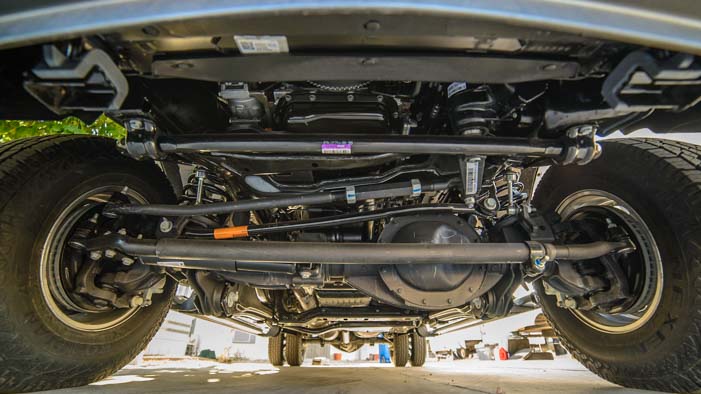
Peering under the front end of the truck, the frame has been strengthened for heavy towing
We learned with our ’04 Toyota Tundra truck towing our 7,000 lb. 27′ travel trailer that four wheel drive is a necessity for us in our RV lifestyle. In our first weeks of full-timing, a small, wet grassy incline prohibited us from camping in a campground in Texas, because our truck kept slipping and couldn’t tow the trailer up over the short rise! From that moment on, we’ve felt that a four wheel drive is mandatory if you are going to tow a big trailer.
Also, while descending a really gnarly, skinny, twisty, single lane road on a mountain in Utah, with grades of 10% or more in places, we discovered that the safest way to drive DOWN a very steep descent is to put the truck in four wheel drive LOW gear, and creep down the mountain at 5-10 mph using the exhaust brake. This tactic was a lifesaver for us on that mountain with our ’07 Dodge truck and fifth wheel trailer. Without it, we would still be living at the summit of that mountain!
The new Dodge Ram and Ford Super Duty trucks have a really fantastic option for a factory installed puck system in the bed of the truck where you can mount either a fifth wheel or gooseneck hitch. During our truck search, GM did not have that option on their trucks. However, GM trucks now have the puck system as well.
B&W Trailer Hitches makes a fifth wheel hitch specifically for each truck brand’s puck system. We installed one and you can read about it at this link: B&W OEM Companion Fifth Wheel Hitch DIY Installation. The three hitches are shown below, Ram, Ford & GM:
This option has five holes in the bed of the pickup, one in the center for a gooseneck hitch and four outer ones to hold a fifth wheel hitch. The idea behind this mounting system is that rather than drilling holes in your brand new truck bed to install hitch rails to support a fifth wheel hitch — the method that was always used until this new system was devised — you can buy a hitch designed for these puck mounts and simply drop it in.
Looking towards the tailgate, there’s a gooseneck puck in the middle and four pucks in a square to mount a fifth wheel hitch. The bed is totally flat without the hitch in it.
If you want to use the bed of your truck for hauling, and you won’t be towing your fifth wheel, you can easily remove the fifth wheel hitch temporarily and have the entire bed of the truck available to you. Not only is it a snap to remove the hitch, but the bed of the truck will be flat and obstacle free because there won’t be any hitch rails installed in it.
The B&W Companion Fifth Wheel Hitch is easily installed and removed (facing the front of the truck)
Another huge benefit is that installing the hitch is an easy do-it-yourself job. We have a detailed pictorial step-by-step guide showing how to install a B&W Companion OEM Fifth Wheel Hitch here (it took just one hour from start to finish!):
Our 2007 Dodge Ram came with an exhaust brake built into the turbo. Mark LOVED this brake and used it all the time, both towing and not towing. The only thing that bugged him about it was that coming down mountains with our trailer hitched on, he often had to shift gears manually and feather the gas pedal to keep the truck going the speed he wanted.
The 2016 Ram trucks have an improved exhaust brake that has two modes: max braking power and constant speed braking. We definitely wanted that option!
BACKUP CAMERAS
Dodge Ram trucks have two backup cameras, one that aims at the bed of the truck (for hitching and unhitching) and one that aims behind the truck (for backing up). Beginning in 2016, both of these cameras could be set to display their image on the main touch screen display (in the 2015 model, one camera would display in the rear view mirror while the other would display on the touch screen display).
It’s nice to have a backup camera when backing the truck in next to the trailer!
AUTO-LEVEL SUSPENSION
An option on the 2016 Ram trucks is to have four leaf springs with computer controlled air bags to provide for auto-leveling of the rear suspension. This is instead of the standard six leaf springs without air bags that have a fixed height suspension.
Without the air bags — the standard configuration — the “rake” of the truck’s rear end is four inches, meaning that the rear end of the truck is raised four inches higher than the front to compensate for the weight of the trailer which will push it down when it’s hitched up. For a shorter person, this is quite high, and I was astonished how much higher the tailgate of a 2016 Ram truck sits than our old ’07 truck did.
With the air bags, the rear end is raked only one inch, making the whole back end of the truck much easier to access for those of us who aren’t that tall. In addition, there is an “Alt Ride Height” button that can be used to lower the back of the truck one more inch. Hurray for short people!
When the trailer is hitched onto the truck, pushing the truck down, the on-board compressor kicks on and pumps air into the air bags, raising the back end of the truck until it achieves its normal one inch rake. If you prefer to drive with the truck level, the “Alt Ride Height” button can be pressed to lower the back end one inch.
When we did our test drives, we found that the duallies with the auto-level suspension had a slightly smoother ride when not towing than the ordinary leaf spring only models did. This has proven true with our new truck too.
VENTED and HEATED LEATHER SEATS and STEERING WHEEL plus OTHER GOODIES
As we test drove different trim levels of trucks, we decided that if we were going to buy a new truck, we’d go all out and get the many little conveniences and options that are a “splurge” but that make using the truck a pleasure.
Let’s go for a ride!
Heated and vented leather seats with power seat adjustments and lumbar support, a side step to make it easier to get in and out of the truck, independent climate control for driver and passenger, a CD player, OWL on/off-rad tires, the fancy electronics console with the big touch screen display and GPS nav system and power adjustable pedals were all on our list.
Most of these options are bundled into the Laramie model of the Ram 3500 trucks.
The Laramie comes with a beautiful interior that includes all the fancy stuff.
Top level Nav/GPS Display with voice activation and climate control
Tan colored Heated/Vented Leather Seats and Steering Wheel
The Tow and Payload Ratings for the 2016 Ram 3500 dually with the above options as compared to our 2007 Dodge Ram 3500 single rear wheel are the following:
Rating
2016 Dually
2007 SRW
Trailer
UVW
8,319
7,147
GVWR
14,000
10,100
GCWR
39,100
21,000 lbs.
Payload
5,565
2,953
2,850
Max Trailer Weight
30,200
13,700
14,100
Even though the make and model of these two trucks is the same, separated by just nine years, these numbers show that they are two radically different trucks!
After doing so many test drives, studying all the material and thinking about this truck for two years, there was no way we would give up any of the options we wanted, especially the ones that made the tow ratings and payload rating so high. But we never found a dealership that ordered this exact truck for their lot. Time and again, Mark would find a truck that was close, but there would be some things missing and other things we didn’t want.
So we decided to order the exact truck we wanted and wait 8 weeks for it to be built.
We had a ball ordering this truck through Airpark Dodge in Scottsdale, Arizona, where a marketing connection with Alice Cooper made one of Mark’s lifelong dreams come true. See our really fun blog post:
A significant difference between our 2007 Dodge Ram truck and our new 2016 Ram dually is that the new truck requires occasional refilling of the DEF (Diesel Exhaust Fluide) tank. Here are some tips we’ve discovered about DEF since we purchased our new truck:
Dodge Ram Truck Owners — Please note:
Late model Dodge Ram 1500, 2500 and 3500 trucks have been recalled (beginning 6/23/17) for side airbag problems in a rollover accident. See this article for details: Dodge Ram Side Airbag Recall
More info about Pickup Trucks, Ram Trucks, Tow Ratings, etc.:
2016 Ram Trucks Towing Guide – Ours is on p. 5, 2nd section, last line. Search for: “CREW CAB LONG BOX, 4X4, DRW”
Current Ram Trucks Model Specific Weight Ratings – Choose Heavy Duty / Crew / 8′ Box / 6.7 Liter Cummins / Auto / 4×4 / Premium Axle Ratio. The truck like ours is the first Laramie in the list. If you know a VIN number, click the red button “Look Up My Vehicle” to get the specs for that truck.
Note (July 2018): Folks have asked us if we like our truck now that we’ve driven it for two and a half years. We LOVE our truck. It now has about 40,000 miles on it, about half of that towing, and we couldn’t be happier with it.
Below are some of our most POPULAR POSTS(also in the MENUS above)
More of our Latest Posts are in the MENU.
New to this site?
Visit RVers Start Here to find where we keep all the good stuff. Also check out our COOL NEW GEAR STORE!!*** CLICK HERE *** to see it!
To help you plan your cruise and get you inspired, we created the video series, "Cruising Mexico Off the Beaten Path - Volumes 1-3," shown below. This is a fun-to-watch and easy-to-digest introduction to Mexico from a cruiser's perspective, giving you lots of valuable information that isn't covered by the cruising guides. Each video is available individually at Amazon, either as a DVD or as a download. For discount package pricing on the whole series, visit our page Cruising Mexico Video Series.
Volume 1 reviews the geography, weather and seasons in Mexico and shows you what the best anchorages between Ensenada and Manzanillo are like.
Volume 2 gives detailed info that can't be found in any of the guidebooks about the glorious cruising ground between Manzanillo and the Guatemala border.
Volume 3provides all the info you need to get off the boat for an adventure-filled trip to Oaxaca.
Our Gear Store also has a boatload of ideas for your cruise!
Ever since that time, other than a nearly four year cruise of Mexico on our sailboat from 2010-2013, during which time we alternated between cruising and RVing, this fifth wheel trailer has been our only home.
It is a 36′ long fifth wheel with an open floorplan that includes three slides and offers 360 square feet of living space. It was designed and built with full-timing in mind, so it is more rugged and better insulated than almost any other brand on the market.
The floorplan is open and spacious.
For us, the two recliners and the desk were the major reasons for our move from our smaller travel trailer into this bigger fifth wheel, as those features make life infinitely more comfortable. We swapped the position of the sofa and recliners, and put one of the four chairs at the desk and the other in storage so there are just two chairs at the dinette table.
The specs for our 5th wheel are:
70 gallons of fresh water
78 gallons of grey water
50 gallons of black water
Dry weight 10,556 lbs
GVWR 13,995 lbs (which we reached with the cabinets only 1/3 full)
Before we bought this 5th wheel trailer in 2008, we already owned a 2007 Dodge RAM 3500 long bed single rear wheel truck which we had purchased brand new the summer before. It works a lot harder pulling this trailer than it did the Lynx travel trailer, which was our previous full-time RV, however we could still get up and down the big mountains out pretty well..
We used to get 8.5-10.5 mpg while towing, but since we installed an Edge Tuner on our diesel engine in October 2014, we now get 10.5 to 13 mph while towing.
To learn more about the upgrades we have done on our truck and trailer, visit these pages:
Solar Power – Tutorial pages with extensive details about our solar power setup
Edge Tuner – Gives us programming control over our truck engine for better mileage / performance without “chipping” the engine.
The dining room table and chairs and the sofa are in the big slide-out on the curb side.
We love the big picture windows along the side and back of the trailer – they let in light and give us views!
Most modern trailers have short (60″ or 66″) sofas. This one has a 74″ sofa, long enough for Mark to stretch out on.
The recliners are very relaxing. We found we weren’t as comfy without them in our old trailer.
The kitchen is open and easy to work in.
A big window and expansive counter tops.
The desk was a nice addition and gets the mess off the kitchen table!
The queen bed has a window for each occupant — a nice feature if you want a light breeze on you at night.
The dresser and wide closet allow enough space for all our clothes for all seasons.
Unfortunately, the economic downturn in 2008 shook up the RV industry right to its core, and many excellent manufacturers of full-time quality RVs went out of business. NuWa ceased building fifth wheel trailers in 2014. Their outstanding RV service center in Chanute, Kansas, is still in operation, however. Their manufacturing plant has been replaced with an RV dealership called Kansas RV Center.
Dodge Ram 3500 Dually Long Bed Truck to tow our 36′ NuWa Hitchhiker 34.5 RLTG Fifth Wheel Trailer
As for towing this trailer, after towing it over 50,000 miles with our 2007 Dodge Ram 3500 Single Rear Wheel Long Bed truck, in December, 2015, we replaced that truck with a much more powerful 2016 Ram 3500 Dually Long Bed. The difference in power is staggering. We have a very detail post explaining the differences between these two trucks and why our new truck is so superior here:
We had a blast buying this truck when we found out that our dealership had a marketing relationship with Alice Cooper, one of Mark’s rock star idols since his teenage days:
We decided to add some really awesome bling to this truck by outfitting it with a new B&W Companion Fifth Wheel Hitch. This hitch is unique because it takes advantage of the Dodge Ram fifth wheel hitch in-bed puck system. It took just one hour to install this hitch, and we have a step-by-step pictorial installation guide with instructions for how to install it:
More of our Latest Posts are in the MENU.
New to this site?
Visit RVers Start Here to find where we keep all the good stuff. Also check out our COOL NEW GEAR STORE!!*** CLICK HERE *** to see it!