Power Inverters – Exeltech’s Pure Sine Wave Excellence

An inverter, sometimes called a “power inverter,” is a piece of electronic gear that converts DC power to AC power, and it is what enables RVers to use regular household appliances in an RV without hookups to an RV park power pedestal relying on a generator.

The September/October 2016 issue of Escapees Magazine features our detailed article about inverters: what they are, how they are sized, what flavors they come in and how to wire one into an RV.

Power inverter for an RV - an Exeltech XPX 2000 watt inverter

.

For RVers who enjoy dry camping in public campgrounds or boondocking on public land, an inverter is the key piece of the puzzle that gives their RV traditional 110 volt AC power — like the power in the wall outlets of a house — without plugging the RV into a power pedestal at an RV park or a noisy gas-hungry generator.

WHAT IS AN INVERTER?

For beginning RVers, it is easy to confuse a converter with an inverter, because the words are so much alike. The difference is actually very straight forward:

  • A converter converts the 110 volt AC power coming out of a wall outlet, RV park power pedestal or generator into 12 volt DC power, and charges the RV’s 12 volt battery bank.
  • An inverter converts the batteries’ 12 volt DC power into 110 volt AC power so household appliances like the TV, blender, microwave and vacuum can run.
Exeltech XPX 2000 watt pure sine wave inverter living off the grid in an RV

Our “house” inverter – an Exeltech XPX 2000 watt inverter.

RV FACTORY INSTALLED CONVERTERS

Most trailers and some smaller motorhomes come with a factory installed converter. Frequently, these factory installed converters are inexpensive units that are not multi-stage chargers. So, for RVers who want to dry camp a lot and keep their batteries in tip-top shape, or charge them up efficiently with a generator while dry camping, it is a good idea to replace the factory installed converter with a better quality converter (we did).

More info on upgrading an RV power converter here: Converters and Inverters in an RV

RV FACTORY INSTALLED INVERTERS and INVERTER/CHARGERS

A few high end trailers and most higher end motorhomes come with a factory installed inverter.

In many cases, especially high end trailers, the inverter is dedicated to powering a residential refrigerator that runs exclusively off of 110 volt AC power (unlike an RV refrigerator that can run on propane). The inverter is there so the fridge can continue to run off the batteries while the rig is being driven from one RV park to another without a connection to 110 volt AC electricity. This inverter is sized to support the refrigerator and is not intended to be used for any other purpose in the rig.

So, for most trailer owners that want to do a lot of camping without hookups, an inverter is an extra piece of gear that must be installed.

In contrast, many higher end motorhomes come with a factory installed inverter/charger that can do two things: 1) provide the RV with household 110 volt AC power at the wall outlets via the batteries while dry camping and 2) charge the batteries when the RV is getting its 110 volt AC power from an RV park power pedestal or a generator. These inverter/chargers essentially do the work of both a converter (charging the batteries from shore power) and an inverter (providing AC power via the batteries while dry camping).

So, for folks with a higher end motorhome, an inverter is usually already installed in the motorhome at the factory in the form of an inverter/charger, and it does not need to be added later. However, it may not be a pure sine wave inverter (see below).

INVERTER SIZES

Inverters come in all shapes and sizes and all price ranges too, from little biddy ones that cost a few bucks to big beefy ones that cost a few thousand dollars.

They are rated by the number of watts they can produce. Small ones that can charge a pair of two-way radios or a toothbrush are in the 150 watt range. Huge ones that can run a microwave and hair dryer are in the 3,000 watt range.

  • Small inverters (400 watts or less) can be plugged into a cigarette lighter style DC outlet in the rig. Mark has one that he uses for his electric razor every morning.
  • Larger inverters (500 watts are more) must be wired directly to the batteries and require stout wires that are as short in length as possible.

Our RV has a “house” inverter that is 2,000 watts. It can run our microwave and hair dryer and vacuum comfortably (we don’t run those appliances all at the same time, however, as that would overload it). Our small portable inverter lives in our bedroom and gets used for a few minutes every day before we head downstairs:

RV power inverter with electric razo

Mark uses this small inverter to power his electric razor every morning!

MODIFIED SINE WAVE vs. PURE SINE WAVE INVERTERS

Inverters also come in two flavors:

Modified sine wave inverters are cheaper than pure sine wave inverters and are the most common type of inverter sold in auto parts stores, Walmart and truck stops. Many inverter/chargers on the market are modified sine wave inverters.

Our sailboat came with a 2,500 watt inverter/charger that produced a modifed sine wave. It was wired into the boat’s wall outlets, including the microwave outlet. We used this inverter when we wanted to run the microwave but not for anything else (we preferred using a pure sine wave inverter instead).

Some vehicles now ship with an inverter installed in the dashboard. Our truck has a small modified sine wave inverter in the dashboard, and I use it all the time to plug in our MiFi Jetpack and get an internet signal for my laptop as we drive.
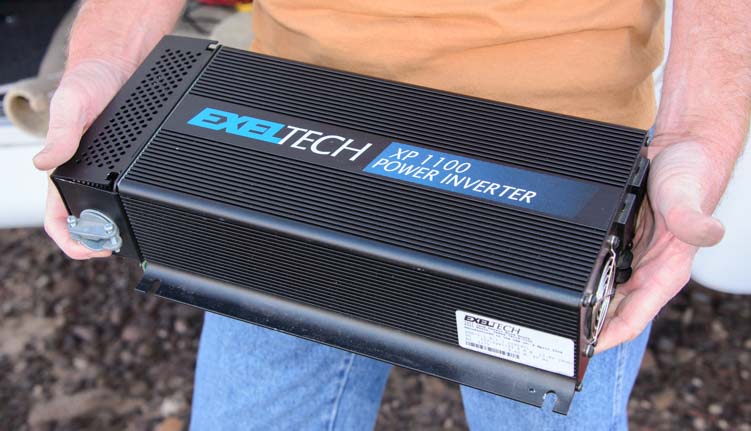
Exeltech XP 1100 Inverter

Our first pure sine wave inverter: an Exeltech XP 1100 watt inverter. We keep it now as a backup.

WIRING AN INVERTER INTO AN RV – DC SIDE

As mentioned above, small inverters can plug into a DC outlet in the RV wall (these outlets look like the old cigarette lighters found in cars).

Large inverters must be wired directly to the batteries. The wire gauge must be very heavy duty battery cable and short to support the big DC currents that will flow through it. If possible, the length should be less than four feet. A wire gauge chart gives the correct gauge of wire to use for the current that will flow and the length the wire will be.

To determine the maximum possible DC current that might flow through these wires, simply divide the maximum wattage the inverter is rated for by the lowest voltage the inverter can operate at. In our case, we divided our inverter’s maximum 2,000 watts by the minimum 10.5 volts it will operate at before it shuts off. This yields 190 amps DC. Our cable connecting our inverter to the batteries is 2 feet long. So the proper wire size is 2/0 gauge (“double ought”) and can be purchased here: High quality Ancor Battery Cable.

Heavy duty battery cable on Exeltech XPX 2000 inverter in an RV

We used 2/0 Gauge Ancor Battery Cable to wire the DC side of our inverter.

WIRING AN INVERTER INTO AN RV – AC SIDE

All inverters have at least one household style female 110 volt AC outlet. Usually they have two. These outlets look like ordinary household wall outlets.

One very simple way to wire the AC side of the inverter is to plug an appliance directly into it, for instance, plug the power cord of the TV into the inverter. We did this with a 300 watt inverter and our 19″ TV in our first trailer. The inverter was plugged into a DC outlet on the trailer’s wall, and the TV was plugged into the inverter right behind where it sat on our countertop.

If you want to plug more than two appliances into the inverter at once, then plugging a power strip into one or both of the inverter’s AC outlets is one way to go. We did this on our sailboat. We had a 600 watt pure sine wave inverter on the boat. Plugged into one of the inverter’s AC outlets, we had a power strip supporting our TV and DVD player. Plugged into the other AC outlet, we had a power strip supporting everything else: two-way radios, toothbrush, and laptop charging cords and camera battery chargers.

Exeltech XPX 2000 inverter and Trojan Reliant AGM Batteries in an RV

Our inverter is placed as close to the batteries as possible by being suspended above them.

Obviously, you have to be careful not to run too many things at once, or they will overload the inverter. Most inverters will shut down when overloaded or sound a beeping alarm if your appliances demand more from it than it can give. We ran into that a lot when we lived on our portable inverter for a few days while our house inverter was being repaired.

A more sophisticated way to wire an inverter’s AC side so it supplies power to all the wall outlets in the RV is to wire it into the rig’s AC wiring using a transfer switch.

WHICH INVERTER TO BUY for a BIG INSTALLATION?

Because we live off the grid and never plug our RV into a power pedestal (we’ve lived this way for nine years and hope to do so for many more), we rely on our trailer’s house inverter to run all of the AC appliances we own, every single day.

For this reason, we invested in the highest quality inverter we could find on the market: an Exeltech XP 2000 watt pure sine wave inverter. This is a very pricey unit, but it is our sole source of AC power day in and day out. It is the brand that was selected for both the American and Russian sides of the International Space Station, and its signal is pure enough to run extremely sensitive medical equipment.

Exeltech power inverter manufacturing

We visited the Exeltech manufacturing plant in Texas and saw first-hand how meticulously these inverters are made and tested prior to shipping.

Exeltech is a family run company with electrical engineering PhDs heading up their R&D department. All manufacturing is done in-house at their headquarters in Fort Worth, Texas. They have phenomenal tech support and an excellent warranty.

When our beautiful new Exeltech XP 2000 inverter was inadvertently blown up by a welding snafu at a trailer suspension shop during our trailer’s suspension overhual (the plastic sheathing on a bundle of AC wires got melted onto the trailer’s frame, bonding the wires to the frame and creating an electrical short — ouch), they got it repaired and back to us very quickly.

And thanks to our RV warranty, our failing suspension was rebuilt completely at no cost to us, and has worked flawlessly for 12 months now.
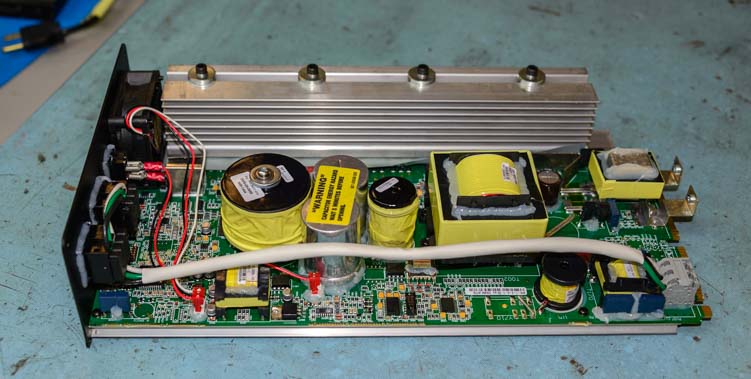
Power inverter

This high quality Exeltech inverter is a serious piece of electronic gear!

Many RVers like the Magnum brand of inverters. These inverters have a built-in transfer switch which makes them easy to wire into the RV’s AC wiring system.

There are many other brands on the market from Schneider Electric / Xantrex to Go Power, Power Bright and others. If you are going to dry camp a lot, then installing a high quality and expensive pure sine wave inverter makes sense. But if you are going to dry camp for just a few days, week or month here and there, then a cheaper one may make more sense.

MORE INFO ABOUT INVERTERS and SOLAR POWER

All of this info and more is covered detail in our feature article in this month’s Escapees Magazine. We also have loads of other info about inverters, converters right here on our website. Links to our many RV electricity related articles are at the bottom of this page.

ESCAPEES MAGAZINE and RV CLUB

RV Power Inverters

Inverters – AC Power from DC Batteries
Escapees Magazine Sep/Oct 2016
By Emily Fagan

Our five page article on inverters in this month’s issue of Escapees Magazine is typical of the kind of detailed technical articles the magazine publishes.

I have been publishing articles like this in Escapees Magazine since 2008, and I have written about anything and everything we’ve learned in our full-time RVing lives, from solar power to photography to batteries to the importance of fulfillling our dreams.

What makes Escapees Magazine unique is that it is written by RVers for RVers.

The magazine article topics come from real life experiences that RVers have encountered in their lives on the road.

Just as my article in this issue of Escapees Magazine is about what we’ve learned about inverters since we started RVing (and believe me, back in 2007, I was the one asking trailer salesmen what the difference was between inverters and converters, and I got some wacky, wild and very wrong answers!), other RVers write articles for Escapees Magazine about things they have learned.

When I sat down to read the September/October issue, I was impressed — as I am with every issue — by the quality of both the articles and the presentation.

Besides including some cool travel articles about RVing Alaska via the Alaska Marina Highway ferry system, and visiting the Very Large Array that listens to the cosmos in New Mexico, and traveling on the Natchez Trace in Mississippi, this issue has two wonderful profiles of full-time RVers doing intriguing things as part of their RV lifestyle.

RV by ferry on the Alaska Marine Highway

RV Alaska by Ferry!
Escapees Magazine Sep/Oct 2016

One article this month is about a full-time RVer who lives in an Airstream trailer and has dedicated himself to ensuring that the original silkscreen art prints created by the WPA artists in the 1930’s for the National Parks remain in the public domain, owned by the NPS rather than private collectors. It is a fascinating tale, written by Rene Agredano who has been full-timing since 2007 and writes the very informative blog Live, Work, Dream, a terrific resource for anyone who wants to learn the ins and outs of work camping.

Another article this month shares the stories of three very long term (10+ years) full-time RVers who have flourished as artists on the road. One RVer/artist specializes in watercolors and has held many exhibitions of her work around the country. Another RVer/artist discovered the fun craft of decorating gourds and teaches classes at her home RV park. A third RVer/artist has self-published a photojournal about her travels specifically for her grandchildren. This insipring Escapees Magazine article is written by full-time RVer Sandra Haven who shares the same home base RV park as the artists.

There is also a detailed article written by a lawyer on what it takes to establish a legal domicile and register to vote when you’re a full-time RVer without a sticks-and-bricks home built on a foundation that stays in one place.

These kinds of articles aren’t found in most RV industry publications!

Full-time RV traveler artist

RVers take their art on the road
Escapees Magazine Sep/Oct 2016

And what’s neat for would-be writers and photographers who are Escapees RV Club members is that the magazine’s editorial staff is always eager for new material from members…click here!.

Escapees Magazine is just a tiny part of the overall Escapees RV Club, however.

Founded by full-time RVing pioneers Joe and Kay Peterson, the Escapees Club strives to serve the varied interests of all RVers and to alert RVers to changes in government policies or the RV industry itself that might affect us as consumers of RVs, RV and camping products and RV overnight accommodations.

They also work as tireless advocates on behalf of all RVers at both the local and national levels.

RVers BootCamp at Escapees RV Club

RVers BootCamp – A training program for new RVers

One of the most interesting articles in this month’s magazine alerts members to corporate consolidations in the industry that will affect our choices as RV consumers in years to come. It also reveals that the Escapees advocacy group is investigating possible changes at the Bureau of Land Management that will affect RVers ability to use their RVs on BLM land nationwide.

In addition to the magazine, the Club offers discounts for RV parks, regional chapter groups, national rallies, bootcamp training programs for new RVers, and assisted living for retired RVers who are ready to hang up their keys but not ready to give up living in their RV.

One of the most charming articles in this month’s magazine is about Nedra, a woman in her mid-80’s who was once an avid RVer but now lives at CARE, the Escapees assisted living facility in Livingston Texas. I had the good fortune to meet Nedra when we visited the Escapees headquarters at Rainbow’s End, and she took me on a fun tour of the CARE facilities. Escapees is like a big extended family, and it was very heartwarming to see her story in this month’s issue.

We’ve been members of Escapees RV Club since 2008 and highly recommend joining if you are a current or future RVer, whether you plan to travel full-time or just occasionally. Supporting their advocacy work benefits everyone who owns an RV and ensures we consumers and hobbyists have a voice in this very large industry.

You can join Escapees (or Xscapers, the branch of Escapees dedicated to younger, working age RVers) here:

Join Escapees RV Club

If you mention this blog, Roads Less Traveled, when you join, they put a little something in our tip jar. We began recommending Escapees RV Club to our readers many years ago, and this friendly gesture from Escapees is a brand new development in the last few months. So, this is not a sales pitch from us to earn tips, by any means. We simply believe in the work Escapees RV Club does to support RV consumers and hobbyists and hope you do too!

Subscribe
Never miss a post — it’s free!

SOLAR POWER OVERVIEW and TUTORIAL

BATTERIES and BATTERY CHARGING SYSTEMS

LIVING ON 12 VOLTS

Our most recent posts:

More of our Latest Posts are in the MENU.   New to this site? Visit RVers Start Here to find where we keep all the good stuff. Also check out our COOL NEW GEAR STORE!! *** CLICK HERE *** to see it!

Bryce Canyon National Park – “Mossy Cave” – Mystery Waterfall!

September 2016 – Just as headlines sell news stories, the same thing is true with hiking trails at the National Parks.

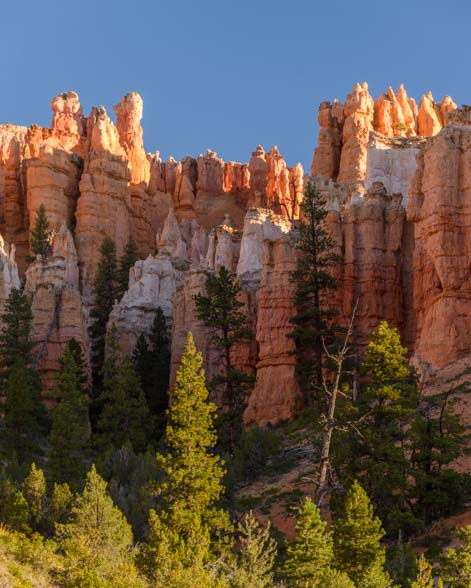
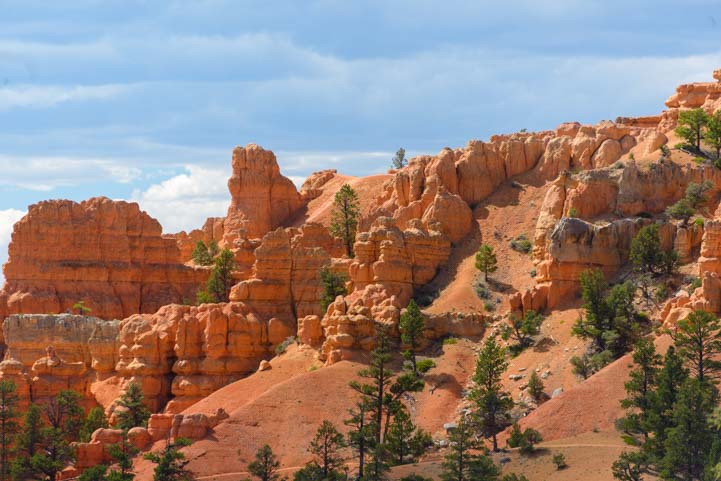
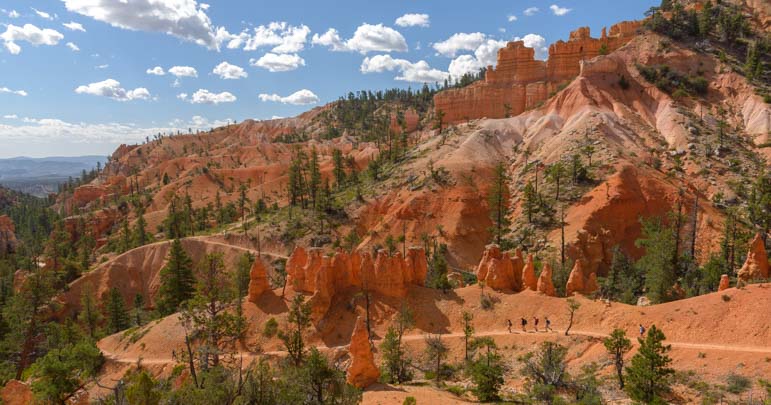
Red rock pinnacles Mossy Cave Bryce Canyon National Park Utah

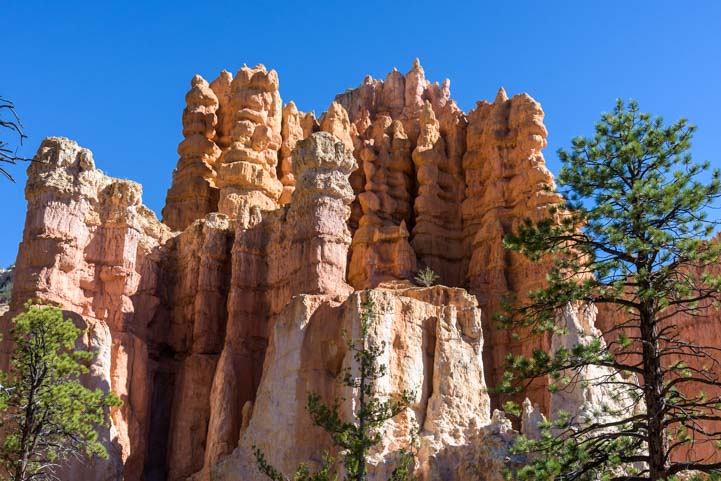
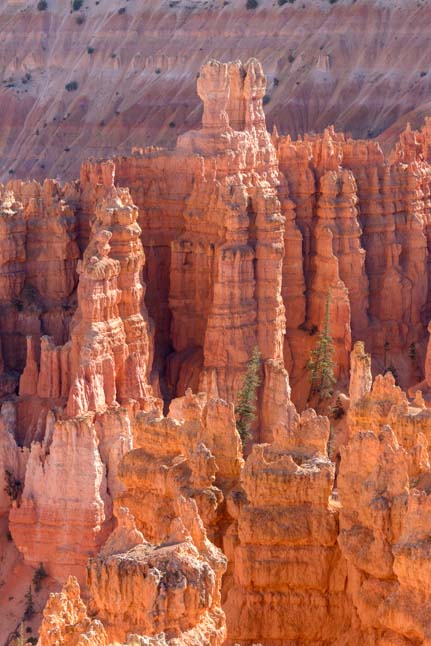
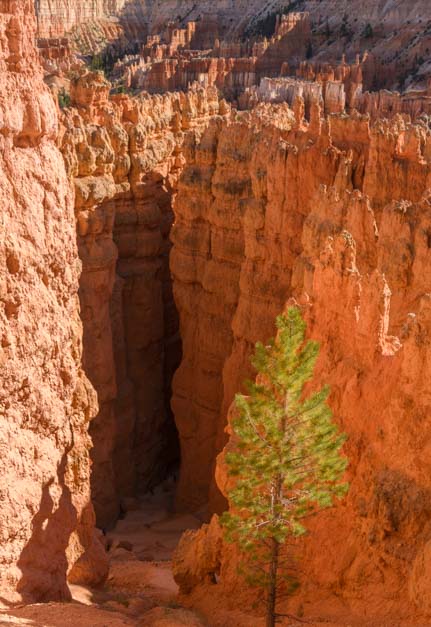
Bryce Canyon has beautiful red rock hoodoos everywhere, even on the less visited trails.

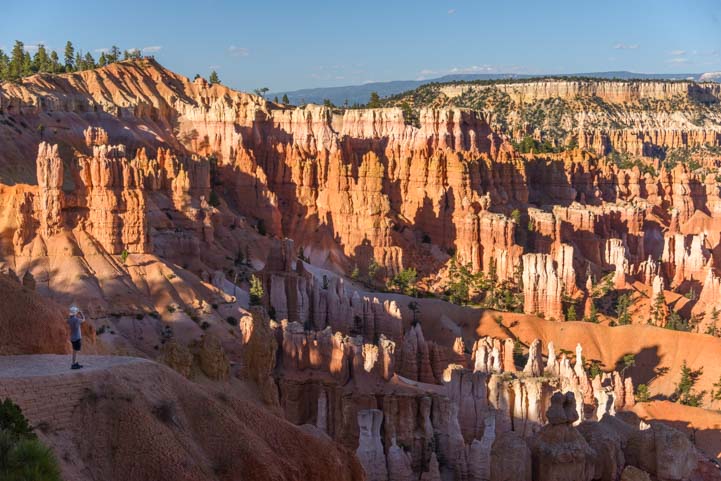
At Bryce Canyon National Park there are lots of great hiking trails and overlooks with fabulously inviting names like: Fairyland Trail, Inspiration Point, Sunrise and Sunset Points and Peek-a-boo Trail to name a few.

Colorful trees and red rocks Mossy Cave Trail Bryce Canyon National Park Utah

Wonderful colors on the Mossy Cave hike.

But up in the northeast corner of Bryce Canyon National Park, well off the beaten path, and not even on the main drive through the Park, there’s a hiking trail called Mossy Cave. This is an interesting name, perhaps, but it sure didn’t jump out at us and beg us to come check it out!

Bridge at Mossy Cave Trail Mossy Cave Trail Bryce Canyon National Park Utah

The Mossy Cave trail crosses a cool bridge at the beginning of the hike.

I wonder if because of this rather drab sounding name, other visitors respond like we do and don’t bother to drive outside the Park and around to its far northeastern edge to find out what Mossy Cave is all about.

Whatever the cause, this hiking trail is very lightly used compared to the other more popular trails at Bryce Canyon National Park.

Red rock windows Mossy Cave Trail Bryce Canyon National Park Utah

“Windows” appeared high above us among the red rock formations.

My suspicion is that if this trail bore the name “Waterfall Cascades” or “Glittering Pools,” both of which is has, the trail would be overrun with visitors!

How fortunate that the feature this trail is named after is the other thing you’ll see on the hike — a shallow overhang that seeps water and is covered with various types of moss — instead of the beautiful waterfall!

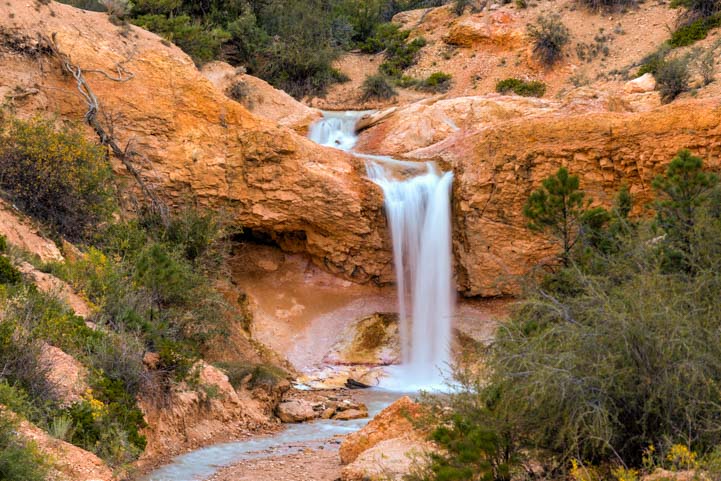
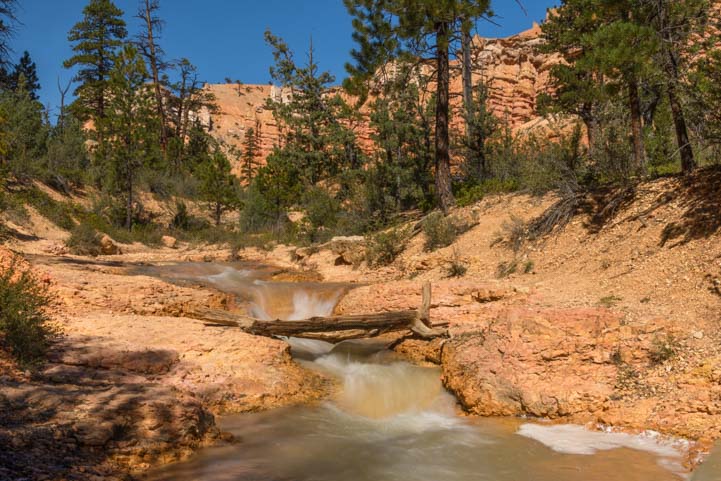
Mossy Cave Trail Bryce Canyon National Park Utah

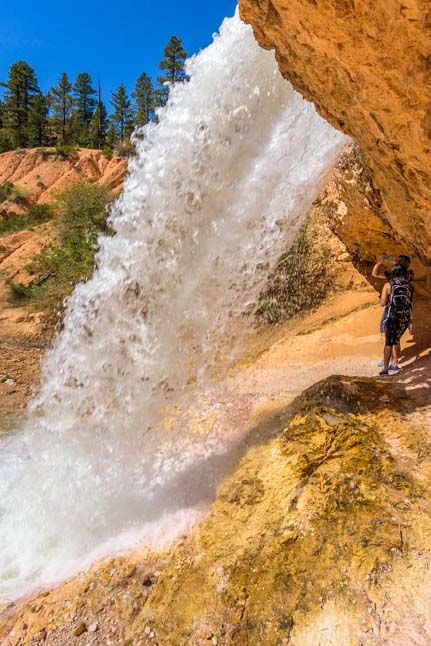
The waterfall on the Mossy Cave hike takes a lot of people by surprise!

Mossy Cave Trail Waterfall Bryce Canyon National Park Utah

A beautiful waterfall in the desert!

To a naturalist or biology expert, the mossy cave is probably the more fascinating feature on this trail. And photos we’ve seen of icicles in the cave during the winter are beautiful.

However, to everyday hikers and tourists, it is the waterfall and cascades upstream from it that are the real draw!

Mossy Cave Trail Bryce Canyon National Park Utah Waterfall

Who knew Bryce Canyon had a waterfall?!

The branch canyon that Mossy Cave is in is called Water Canyon, and rightfully so. In the early 1890’s, mormon pioneers diverted some of the East Fork of the Sevier River to flow through here so they could use the water for irrigation purposes. With picks and shovels they carved a ditch and let the water flow.

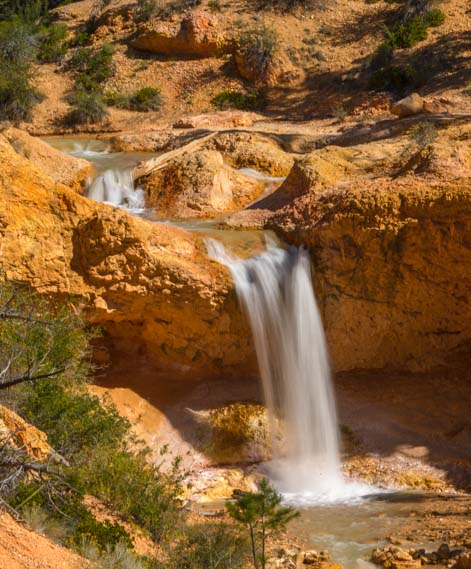
Mossy Cave Trail Waterfall Mossy Cave Trail Bryce Canyon National Park Utah

Silky falls and pools.

So, it is not a natural water course. But the waterfall itself is totally natural, and the water drops down over a red rock overhang as if this year-round stream were meant to be here and had been here all along!

Mossy Cave Waterfall Mossy Cave Trail Bryce Canyon National Park Utah

A rush of water over the desert rocks.

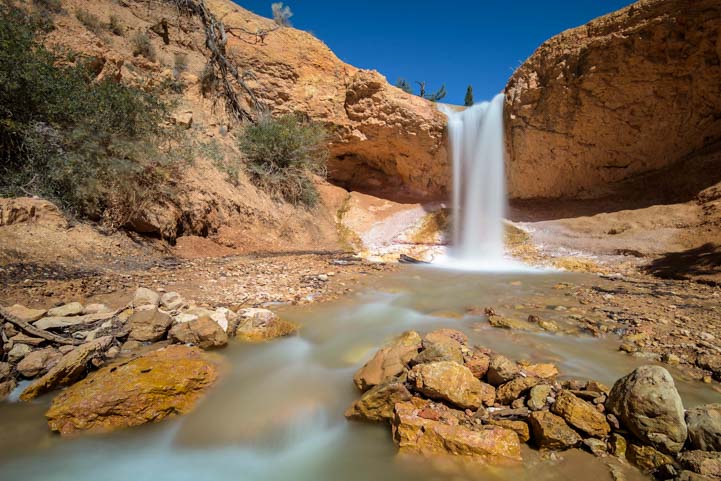
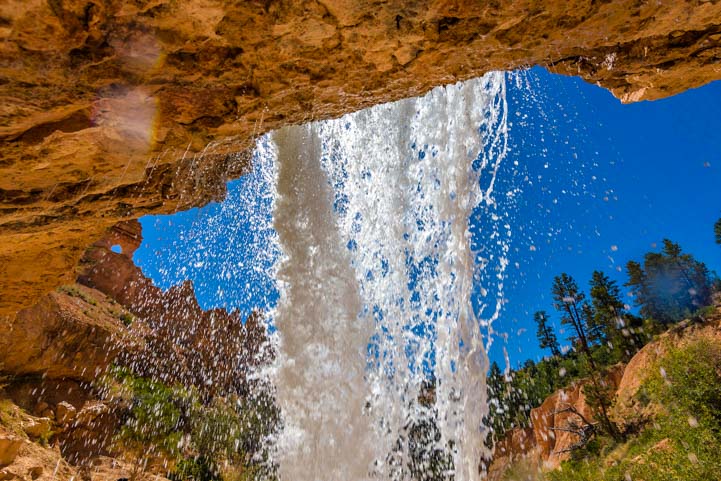
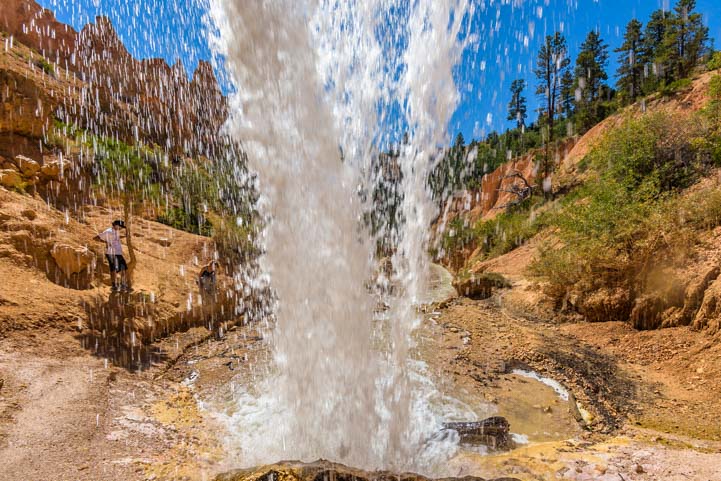
The overhang is fairly large, so Mark slipped in behind it to get some very cool images.

Hiking under the waterfall Mossy Cave Trail Mossy Cave Trail Bryce Canyon National Park Utah

The overhang makes it easy to walk under this waterfall.

Under waterfall Mossy Cave Trail Mossy Cave Trail Bryce Canyon National Park Utah

View from under the waterfall on the Mossy Cave hike.

View under waterfall Mossy Cave Trail Mossy Cave Trail Bryce Canyon National Park Utah

How refreshing on a hot day!

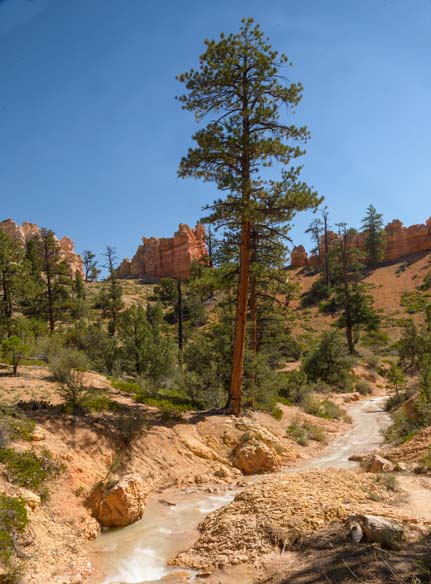
We walked upstream from the main waterfall and found that the stream is a babbling brook for quite a distance, tripping over stones and rocks along the way.

Stream Mossy Cave Trail Bryce Canyon National Park Utah

We turned the corner at the waterfall and found the hike continues upstream.

There are other smaller waterfalls too.

Waterfall Mossy Cave Trail Bryce Canyon National Park Utah

Looking upstream.

Mossy Cave Waterfall Bryce Canyon National Park Utah

We discovered another smaller waterfall too.

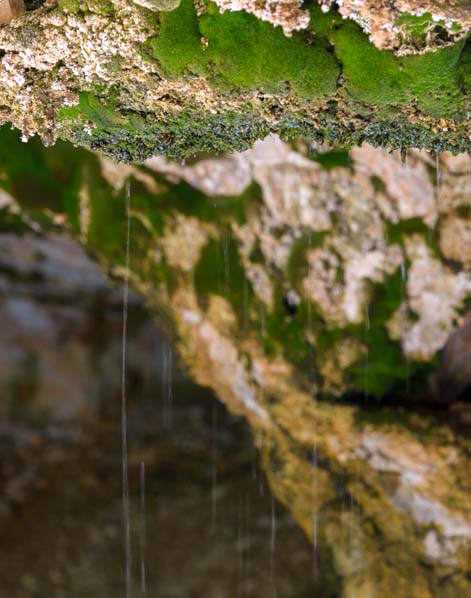
We wandered back down the trail to a fork and took the path leading to the Mossy Cave. A short distance down the trail we came to the cave. The water was seeping through the rocks in such quantities that it was dripping from the roof of the cave onto the gravel floor below. Patches of moss covered the rocks, and the air was cool. The trail didn’t go inside the cave, but we could stand on one side and peer in.

Water seeps through rock and drips down moss in Mossy Cave Bryce Canyon National Park Utah

Water seeps through the rocks and drips from the moss at Mossy Cave.

We ended up doing the Mossy Cave hike several times during our stay in Bryce Canyon. It is a short and easy trail that is lovely in both morning and afternoon light. And there are some wonderful hoodoos high up on the ridges.

Red rock window Mossy Cave Trail Bryce Canyon National Park Utah

.

One morning, as the sun was rising, Mark caught a fantastic starburst in one of the red rock windows.

Starburst Mossy Cave Trail Bryce Canyon National Park Utah

.

If you have already enjoyed some of the major hikes and overlooks at Bryce Canyon National Park, the Mossy Cave trail makes for a very pleasant trek. And on a hot day, what could be better than hanging around a waterfall!

Subscribe
Never miss a post — it’s free!

Here are some more links for planning a visit to Bryce Canyon National Park and doing the Mossy Cave hike:

More blog posts from our RV trips to Bryce Canyon

Related posts from our RV travels:

Our most recent posts:

More of our Latest Posts are in the MENU.
New to this site? Visit RVers Start Here to find where we keep all the good stuff!!

<-Previous || Next->

Red Canyon Utah and the Bryce Canyon Bike Trail!

On the way in to Bryce Canyon National Park, visitors pass through stunning Red Canyon. The red rocks in this magical canyon are such a vivid color and such a huge surprise that visitors are instantly in a quandary — should they stick around and check out this gorgeous canyon they’ve never heard of before, or continue on the remaining 12 miles to Bryce Canyon, full speed ahead??

01 721 Hoodoos in Red Canyon Utah

For many visitors to Bryce Canyon, the warmup act at Red Canyon is a fantastic surprise.

Red Canyon is a beautiful area the has several wonderful hiking trails and lots of incredible scenery.

Hiking Pink Ledges Trail in Red Canyon Utah

Hoodoos at Red Canyon

We hiked the easy Pink Ledges trail that took us right into the heart of the red rock hoodoos in just a few uphill steps.

Hiking Pink Ledges Trail Red Canyon Utah

Views on the Pink Ledges Trail

We’ve hiked the beautiful trails in Red Canyon before, and it was wonderful to be immersed once again in this lovely red rock canyon that so many tourists blow right by.

Huge caves and holes in the rocks

Huge caves and holes in the rocks

The various hiking loops in Red Canyon can be mixed and matched to make a hike of any length, and the Pink Ledges Trail soon merged into the Bird’s Eye trail.

Heading out on the Bird's Eye Trail Red Canyon Utah

Views on the Bird’s Eye Trail

This took us out along the edges of the red rocks and rose higher and higher.

Hiking the Bird's Eye Trail Red Canyon Utah

Hiking the Bird’s Eye Trail.

Bird's Eye Trail hike in Red Canyon Utah

.

We wandered back to the central part of the canyon and admired the twin hoodoos that stand like sentries high up on a ledge.

Closeup Hoodoos in Red Canyon Utah

Enormous stone sentries guard Red Canyon

Below them, we ran into a young couple sitting on a park bench enjoying the shade of a ponderosa pine and the views all around them. We found out they had just gotten engaged moments before, and they proudly showed us her beautiful brand new ring!

Couple on park bench in Red Canyon Utah

What a lovely spot to get engaged!

Red Canyon holds a special place in our hearts, because it was where we discovered the wonders of the RV lifestyle.

We were on a whiz-bang weeklong tour of Grand Canyon’s South and North Rim, Bryce Canyon and Zion National Park with our tent and bicycles, back in our workaday lives long ago, and we wound up camping at Red Canyon on the suggestion of a forest ranger we spoke with when we stopped in at the ranger’s office on the way to Bryce Canyon.

After a beautiful day at Bryce Canyon, we returned to the Red Canyon Campground to a massive deluge and thunderstorm that was followed by two days of rain.

Tent camping Red Canyon Campground Utah

Camping at Red Canyon Campground holds special memories for us

After scurrying from coffee shop to lunch bistro to dinner restaurant around Panguitch and Brian Head, desperately trying to stay warm and dry, we returned to the campground to find all the other campers happily kicking back in their RVs. They were reading books and playing board games with the lights on in their rigs, while we crawled back into our dark soggy tent.

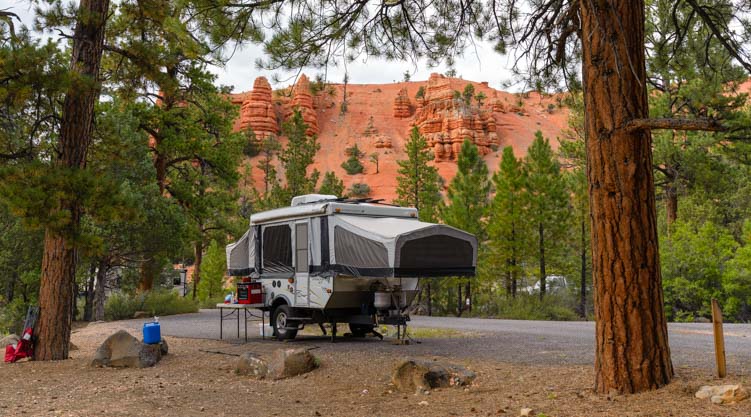
RV Camping in Red Canyon Campground Utah

Life can be pretty sweet in an RV

Within a few days, we were the proud owners of a Toyota Tundra truck and a popup tent trailer!

RV Camping in Red Canyon Campground Utah

Camping at Red Canyon in a popup – Fun!!

Of course, tent camping is absolutely wonderful too, and we look back on our tenting days with fondness. But there’s nothing like being warm and dry and having a comfortable place to sit that is sheltered and high up off the ground when Mother Nature decides to let loose with a storm!

Tent camping under the stars

Camping under the stars

Red Canyon Campground is an absolute delight. You can camp within view of the red rock hoodoos, and there are a few campsites that are big enough for a big trailer like our fifth wheel.

Another treat at Red Canyon is the paved bike path. Being at 8,500′ elevation, we had to work a bit with each pedal stroke, but the scenery was second to none.

Red Canyon Bike Path in Utah

Riding in the Red Rocks at Red Canyon

The Red Canyon Bike Trail goes all the way from Red Canyon to Bryce Canyon City, the little hamlet that used to appear on maps as “Rubys Inn” because it is home to Ruby’s Inn, a family run operation that includes an inn, restaurant and an RV park.

Biking on the Red Canyon Bike Path Utah

We love this bike path

Every time we’ve been to this area in the past, we’ve wished that the bike trail went all the way into Bryce Canyon.

Bicycling the Red Canyon Bike Trail in Utah

There’s a little bridge on the east end of Red Canyon

Bicycling the Red Canyon and Bryce Canyon Bike Path

The bike path runs parallel to the highway for some of its route

Lo and behold, the National Park Service granted our wish this season and extended the paved bike trail all the way into Bryce Canyon as of a few weeks before our arrival!! It is now 17 miles long and you can ride from the west end of Red Canyon all the way to Inspiration Point in Bryce Canyon.

This project was undertaken and completed for the 100th anniversary of America’s National Parks this past August, and it takes a wonderfully winding route through the ponderosa pine forest right to the Bryce Canyon Visitors Center.

Bicycling on the Bryce Canyon Bike Trail Utah

The new paved bike path in Bryce Canyon passes through Ponderosa Pine forest

From the Visitors Center, the Bryce Canyon bike trail passes all the main overlooks and wanders away from the rim for a bit too as it swings by the Bryce Canyon Lodge.

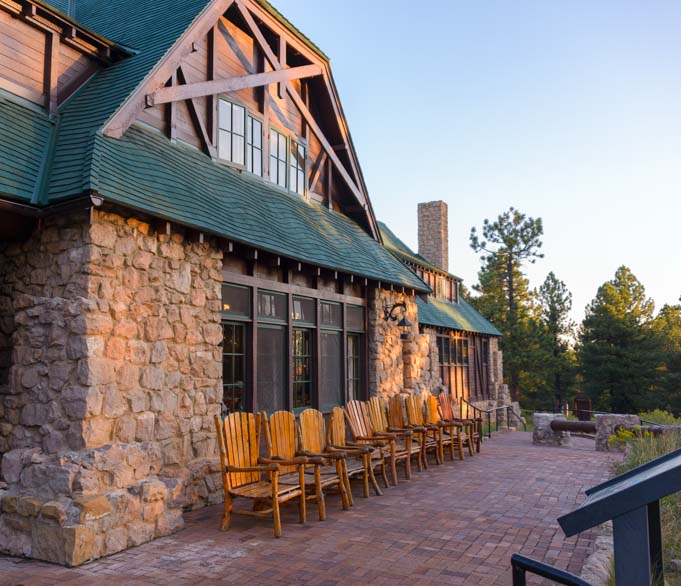
Bryce Canyon Lodge Bryce Canyon National Park Utah

Bryce Canyon Lodge is on the route for the new Bryce Canyon bike trail

We had to get off our bikes and walk when we visited the overlooks in Bryce Canyon, but what a fabulous addition this bike trail is to one of the National Park Service’s premier parks. We were absolutely thrilled by the new bike path, and we rode it many times during our stay.

New Bryce Canyon Bike Trail to Inspiration Point

In Bryce Canyon we walked out to the overlooks

Hopefully the National Park Service will continue building bike paths at other National Parks. The bike trail at Grand Teton National Park is superb as well, and keeps getting longer each time we visit.

The best way to experience a National Park is to be outdoors in the thick of it, and how fantastic it is to be able to fly along and enjoy the views from the seat of a bike!

Subscribe
Never miss a post — it’s free!

More info about Red Canyon and the Bike Trail:

Our previous RV trip to Red Canyon:

Red Canyon Utah – An Overlooked Treasure09/15/11

More blog posts from our RV trips to Bryce Canyon

Related posts from our RV travels:

Our most recent posts:

More of our Latest Posts are in the MENU.
New to this site? Visit RVers Start Here to find where we keep all the good stuff!!

<-Previous || Next->

Bryce Canyon Gone Wild – Tempests, Rainbows & Wildlife

September 2016 – Bryce Canyon National Park is enchanting, and during our stay we were mesmerized by the beauty at Inspiration Point at sunrise, along the Rim Trail at the peak of midday, and descending into the Canyon along the Fairyland Trail in the early hours of the morning. We had lovely sunny weather for these excursions, but suddenly the skies went dark and storms threatened.

Storm Bryce Canyon National Park Inspiration Point Utah

An afternoon thunderstorm rolls into Bryce Canyon National Park

Watching a storm develop in Bryce Canyon National Park is a thrill, and they are regular afternoon occurrences in late summer.

Storm at Bryce Canyon National Park Inspiration Point Utah

A storm brews over the red rocks.

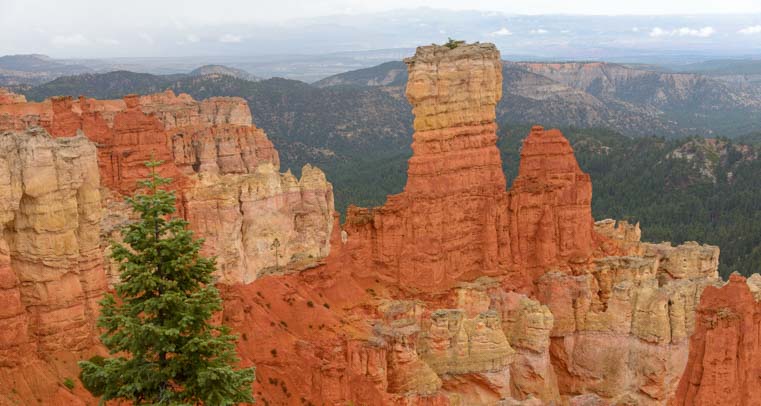
We had some all day rains, and on one of these days we drove down towards the south end of the Park. On the way, we stopped at Agua Canyon.

Colors at Agua Canyon Bryce Canyon National Park Utah

Looking down into the depths of Agua Canyon.

This is a beautiful part of Bryce Canyon in any weather, but as we climbed the trail that rises above Agua Canyon on its north side, we were blown away by how the colors of the soaking wet red rocks came alive.

Agua Canyon Bryce Canyon National Park Utah

Brilliant colors of wet rock pinnacles at Agua Canyon

With no shadows to define each vivid red and white pinnacle, the shapes blended together in fantastic patterns.

Agua Canyon Bryce Canyon National Park Utah

.

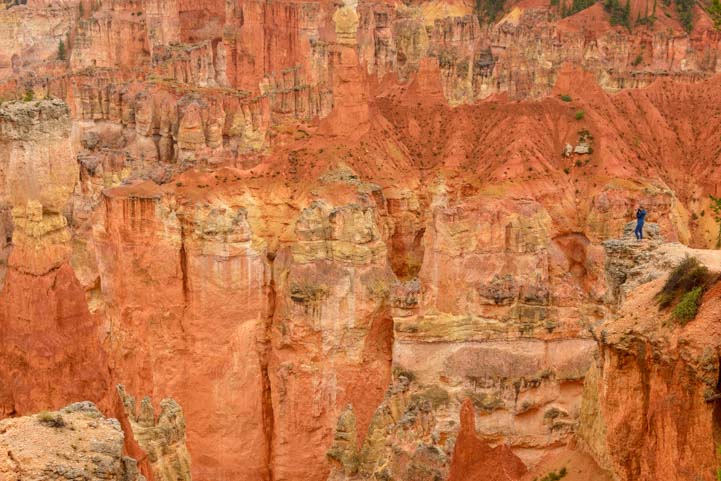
A woman stepped out on a precipice to take a photo, and her tiny blue figure looked like a mere speck against this vibrant backdrop.

Agua Canyon Bryce Canyon National Park Utah

A woman is engulfed by the radiant red rock landscape.

We hiked higher and higher above Agua Canyon, smitten with the beauty of this canyon in these wet and miserable conditions. What luck to have discovered this spot on just such a day.

Photography at Agua Canyon Bryce Canyon National Park Utah

They always say, “Bad weather makes for great photography,” and how true that was on this rainy day!

At the far south end of the park at Rainbow Point, lots of tourists were huddled under a shade ramada, bundled up to the hilt. The usually stunning vistas were invisible because of the mist and fog, but we found a spot where the fog lifted just enough to peer through.

Fog and mist Rainbow Point Bryce Canyon National Park Utah

The mist clears for a moment at Rainbow Point.

Out on the ranch lands around the edges of Bryce Canyon National Park, we saw some incredible storm clouds brooding in the sky.

Storm clouds in Bryce Canyon National Park Utah

A storm sweeps across the plateau near Bryce Canyon.

Suddenly a bolt of lightning split the heavens above us.

Lightning strikes Bryce Canyon National Park Utah

The gods let loose their fury!

We hopped in the truck to go do some errands in nearby Panguitch, and in no time we heard the unmistakable sound of hail pelting the truck’s roof. This was crazy! We were barely into the first week of September!

Hail at Bryce Canyon National Park Utah

We’re in a hailstorm!

The hail piled up and made a wonderful contrast to the wildflowers that were blooming by the curb.

Hail on roads Bryce Canyon National Park Utah

The roads between the wildflowers turned white with hail pellets!

The hail was pea sized, but it made an incredible racket as it struck our truck’s roof. When we got back to the trailer, we were relieved that nothing had broken or been dented on our RV roof!!

Hail on the ground

Yup, that is definitely hail!

Wild thunderstorms and hailstorms brushed across the landscape more than once during our stay in Bryce Canyon, and at Inspiration Point one afternoon, we met a very soggy pair of hikers who had been hiking on the Peek-a-boo Trail for the last hour while we enjoyed the storm from the comfort of inside our heated truck!

Hikers in hail storm Bryce Canyon National Park Utah

Soaked to the bone!

Getting caught in an afternoon storm turned out to be pretty common in Bryce Canyon at this time of year. During our visit we became accustomed to the gathering clouds and eventual torrents that took place every afternoon, but they caught lots of hikers and visitors by surprise.

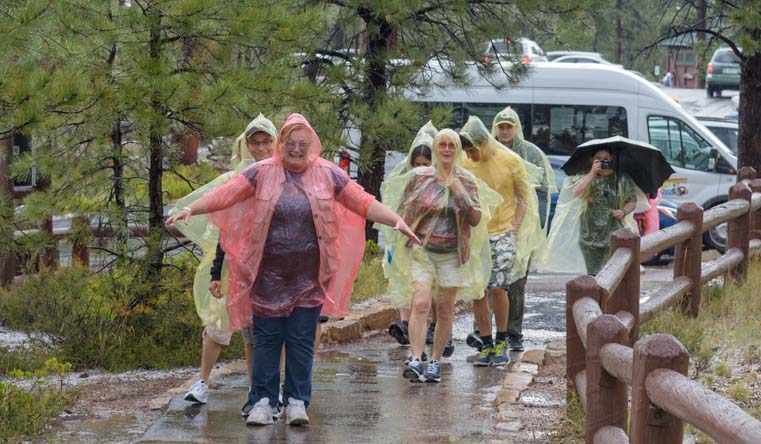
The show must go on, however, and a wet group of tourists on a guided tour passed us as we arrived at Sunset Point, and each was adorned in rain poncho of a different color.

Photography tour in hail Bryce Canyon National Park Utah

.

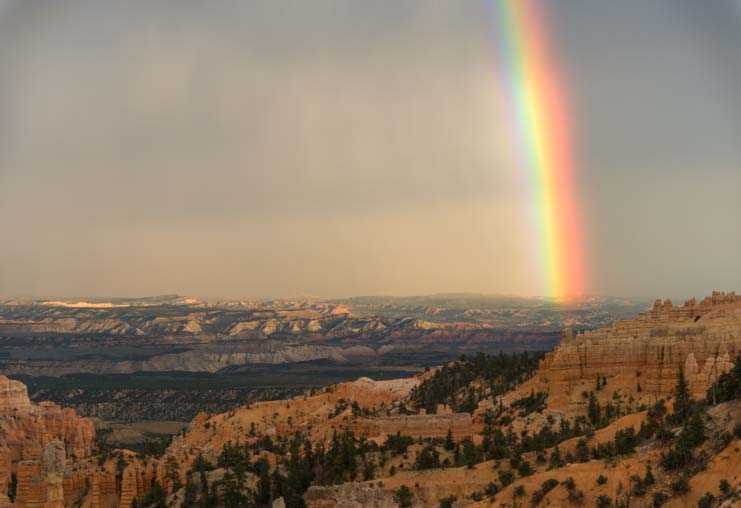
The gods took pity on all of us drenched visitors, however, and one afternoon as we drove along the wet scenic drive through the park we could see the sun shining beyond the black clouds.

We whipped our heads around looking for the rainbow that had to be shimmering somewhere, and saw it was hanging over the canyon. We flew out to Fairyland Point, the closest part of the rim we could reach, and there was the rainbow, in all its glory, spanning the canyon.

Rainbow Bryce Canyon National Park Utah

A rainbow sails over Fairyland Canyon

We watched in awe as it hovered over the canyon, and then grew brighter and dimmer at each of its ends, intensifying first on one side and then on the other.

Rainbow Fairyland Point Bryce Canyon National Park Utah

.

Rainbow Fairyland Point Bryce Canyon National Park Utah

.

The wild weather we were experiencing at Bryce Canyon National Park was an adrenaline rush, especially as we dashed around from place to place trying to catch the drama in the peak of action.

Back on our computers Mark had fun playing with some of his photos in Photoshop Elements. Suddenly a simple image of a tree against the red rocks was mirrored as if in a pond.

Mirrors Bryce Canyon National Park Utah

A little wild magic applied later!

We were loving witnessing “Bryce Canyon Gone Wild,” and we soon saw lots more evidence of this National Park‘s untamed heart as creatures of all kinds wandered in and out of our cameras’ viewfinders.

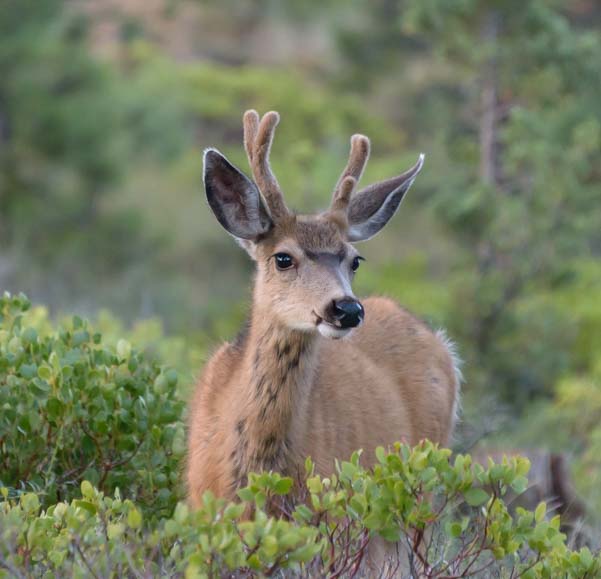
One morning we took our gaze off the stunning red rocks at Sunset Point and noticed a young buck with fuzzy soft antlers peeking over the bushes.

Young buck deer Bryce Canyon National Park Utah

A young buck appears behind the bushes.

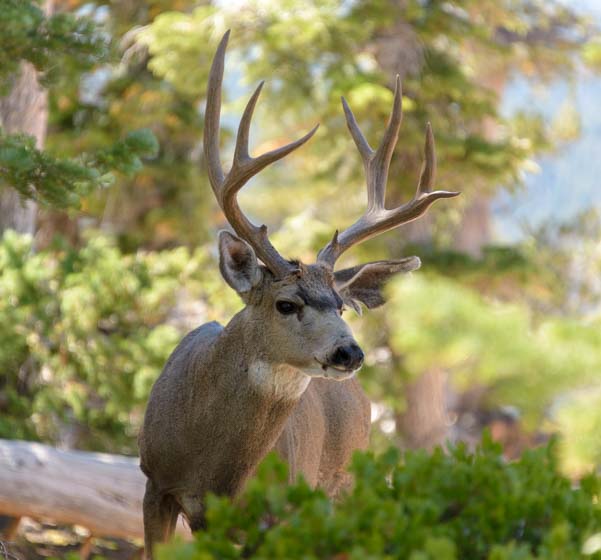
How funny, a week later, to catch a mature buck with a beautiful rack standing in the bushes in almost the exact same pose a few miles away at Rainbow Point!

Buck deer Bryce Canyon National Park Utah

A week later and many miles away another older buck strikes the same pose!

At Piracy Point we noticed a little chipmunk munching away on a pine cone. He was making quite a mess and had bits of his breakfast on his whiskers and fur.

Chipmunk Bryce Canyon National Park Utah

.

One morning we saw a sweet little face peeking out at us from the front tire of our truck. This little guy was the size of a chipmunk, but he was some other kind of critter.

We looked him up online, and discovered he was a little stoat. We hoped he’d stick around, but we never saw him again after that morning.

Stoat on a truck tire in Utah

A stoat peeks out at us from the front tire of our truck!

On another afternoon, we spotted a beautiful pronghorn antelope in the grass.

Pronghorn antelope Bryce Canyon National Park Utah

A pronghorn antelope pauses in the grass.

He was part of a small group of pronghorns, and a few minutes later two more ran across the road.

Pronghorn Antelope Bryce Canyon National Park Utah

A pair of pronghorn dash across the road.

As happens to us on every visit to Bryce Canyon National Park, we were utterly bewitched by everything we saw, from the turbulent weather to the animals that call the place home. It is pure magic!

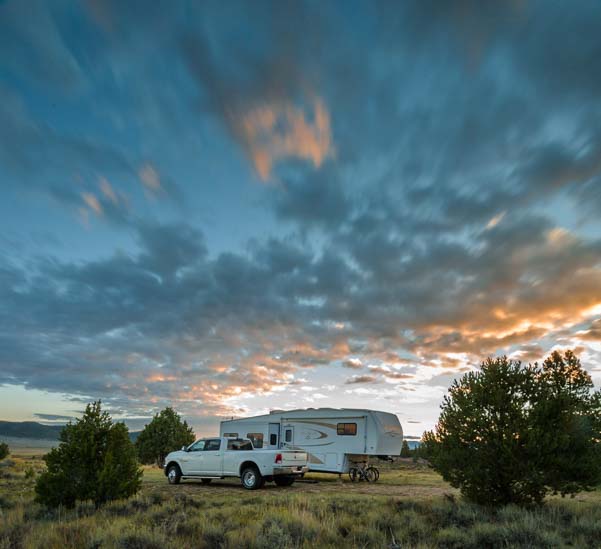
RV camping in Utah

Fast moving clouds at sunset.

Subscribe
Never miss a post — it’s free!

More info about Bryce Canyon National Park:

More blog posts from our RV trips to Bryce Canyon

Related posts from our RV travels:

Our most recent posts:

More of our Latest Posts are in the MENU.
New to this site? Visit RVers Start Here to find where we keep all the good stuff!!

<-Previous || Next->

How to Heat an RV in Cold Weather and Winter Snow Storms

Heating an RV in cold weather during the winter, especially in a snow storm, is quite different than heating a house, and it often requires utilizing different kinds of heaters and a little creativity too.

RV camping and travel in snow in winter

Is that SNOW??!! We sure didn’t expect THAT!!!

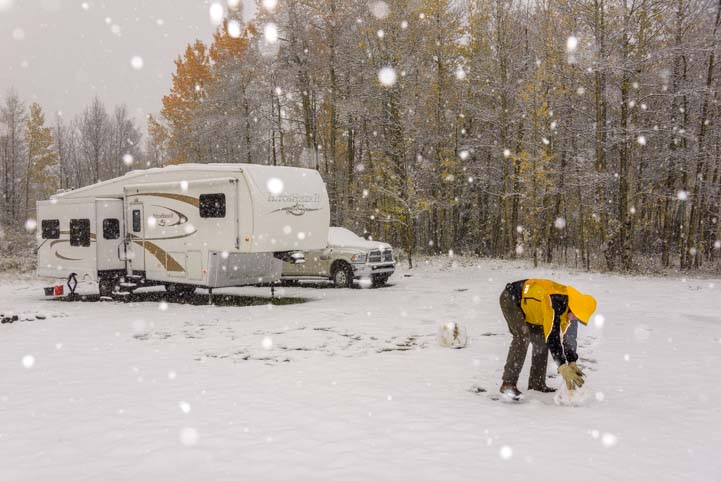
A few weeks ago, at the end of September, we woke up to find ourselves in a beautiful snowstorm at 10,000′ elevation in Colorado.

We had to pull out all the stops to make sure we were cozy warm in our RV even though overnight lows were in the 20’s and daytime highs didn’t get out of the 40’s for a week.

Bikes on RV bike rack in snow in winter

We looked out our back window and saw snow covering our bikes!

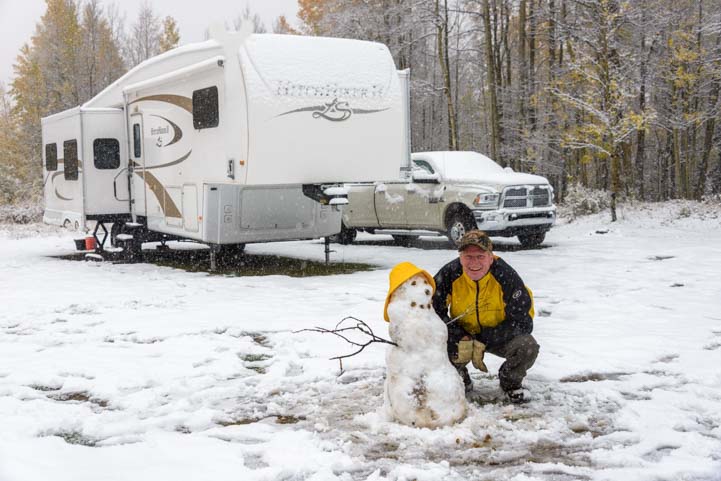
The first order of business was to go outside and build a snowman, and Mark got right to it.

Winter RV tips for staying warm in cold weather

It’s snowing!!! Let’s make a snowman!!!

While he’s busy getting that snowman together, I wanted to share with you the strategies we’ve used for heating our RV without electrical hookups, because we use different heating appliances in different situations.

For “cool” conditions, like December and February in the Arizona desert or May in the Canadian Rockies, when lows are in the 30’s, keeping our buggy warm is a cinch with our blue flame vent-free propane heater that Mark installed back in 2008.

But in in “extreme” conditions, like this recent snowstorm on a mountaintop in Colorado, we use a different strategy and rely more on our RV furnace that was factory installed in our trailer.

We have tried different strategies in very cold weather at very high altitudes like this in the past, and this most recent cold spell was our most comfortable, despite the wet gloppy mess of snowy covered jackets, hats, mittens and boots and the sullen gray skies that persisted for several days. So, we seem to have gotten it right this time.

Of course, “lows in the 20’s” is far from “extreme” for North Americans living in houses with central heating, but it definitely feels extreme when living in an RV off the grid. In reality, RVs are most comfortable in temperatures that stay above freezing.

Winter RVing in the snow

The snowman gets sticks for his arms…

Even though high end RVs are marketed as being “four season” coaches, boasting high R-factors in the walls, ceiling and floor, you just can’t compare 1.5″ styrofoam walls that have a thin layer of gelcoat and wallpaper board to a residential house wall that’s made of 3.5″ fiberglass insulation covered with a half-inch of drywall, half-inch of plywood, Tyvek and exterior siding.

Besides the skimpy walls, we find that the RV windows are the biggest reasons for the poor insulation. The metal window frames are extremely cold to the touch when temps outside are in the 20’s, and all that metal around our many windows conducts the cold right into the rig.

Some folks like to have thermopane (dual pane) RV windows, but if moisture gets between the two panes, which can happen more easily in an RV that rattles down the road all the time than in a house that stands still on its foundation, the moisture is likely to remain there permanently, no matter what the weather does outside or how many years go by.

RV windows don’t seal all that well either. Our top quality, four season fifth wheel trailer is downright drafty inside, with a definite breeze that can, at times, flutter a tissue by the “escape” windows. You don’t notice it so much when it is 70 degrees both outside and inside with no wind blowing. But when it is a blustery18 degrees outside and we are trying to heat the rig to 65 degrees inside, the breeze by those windows is a shock.

The microwave vent is another drafty spot, and if the wind is howling outside and blowing directly on that wall of the RV, it blows right into the kitchen through the vent holes on the top of the microwave. One solution for that, of course, is to tape over the vent on the outside of the rig and not use the microwave for the duration of the cold snap (we haven’t done that, however).

Winter RV trip in the snow

The snowman gets a hat!

So, in our experience, keeping an RV and everything in it toasty warm when it is snowing out can require a little creativity.

Back in our house living days in snow country, we would set the thermostat to our preferred indoor temperature and keep it there 24/7, perhaps raising it slightly at the breakfast and dinner hours and lowering it slightly while we were at work or asleep.

When a blizzard blows into our RV lifestyle nowadays, we can have that kind of stable heat in our rig if we plug into shorepower with access to unlimited electricity. Portable electric heaters can back up the RV furnace, and RVs that have an air conditioner with a heat pump can use that (ours doesn’t).

We have a portable electric ceramic heater for just such an emergency where going to an RV park and plugging in is our best line of defense for weathering a storm.

However, it is possible to stay warm without hookups, even when it starts snowing.

RV in snow in winter

What fun!!

We rely on our vent-free propane heater for 95% of our heat year round. These little heaters use propane very efficiently, don’t need any electricity to run, and can be installed in an RV permanently to run off the RV’s propane tanks.

There are also handy portable models that can be stored in a closet when not in use and then placed anywhere in the rig where you want a little heat. These run on disposable propane bottles, so it isn’t necessary to plumb the heater to the RV’s big propane tanks.

Animal tracks in the winter snow

We found fresh animal tracks in the snow.

We have a detailed article describing the different kinds of vent-free propane heaters on the market, the pros and cons of each type and the type of heat they generate, plus a step-by-step guide for how to install one in an RV at this link:

How to Install a Vent-free Propane Heater in an RV

These heaters heat the rig amazingly quickly. We find that our 20k BTU blue flame heater warms our rig at a rate of about one degree every two minutes. So, in twenty minutes we can warm up our home by 10 degrees, and in an hour we can raise the inside temp by 30 degrees.

The best part is that we can hover over it and warm our hands, bodies and clothes, just like standing in front of a woodstove or fireplace. We do that a LOT and totally love our little heater for the terrific blast of instant hot air it provides!!!

How to heat an RV in winter and cold weather

When you’re chilled, there’s nothing like hovering over this heater!

We use our blue flame heater year round, and we have used it at elevations ranging from sea level to 10,000′.

This past year we traveled primarily in cold places where overnight lows were in the 30’s and 40’s. We went north through Utah, Idaho and Montana in March and April and spent May and early June in the Canadian Rockies. Consequently, we saw quite a bit of snow and hail, and during those months we used our heater almost every day.

Aspen and pine trees in winter snow

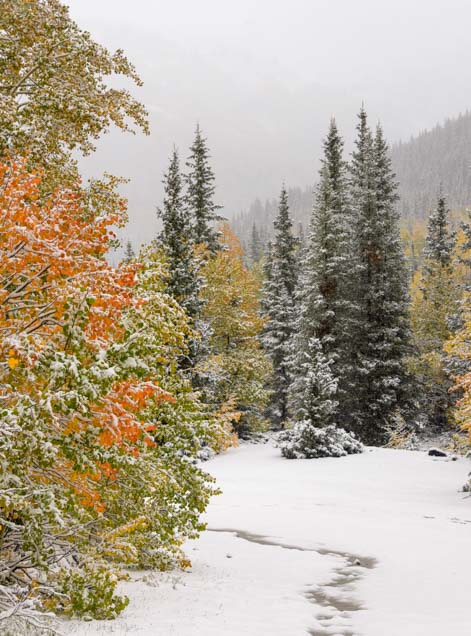
The snow in Colorado fell for hours and gave us a beautiful winter wonderland — in September!

Colorful aspens in winter snow storm with pine tree

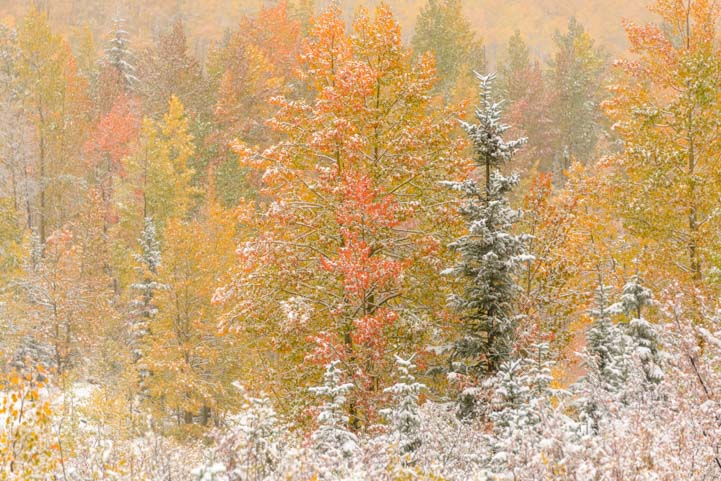
Fall colors with snow – Magic!

We thawed out in July long enough to get overheated and write a blog post: “How to Beat the Heat in an RV.” Then it was back to the high elevations of Utah and Colorado in mid-August where we saw more hail and overnight lows in 30’s once again.

Our vent-free blue flame heater has been keeping us warm during all four seasons like this since Mark installed it in 2008!!

Snowy road with aspen for an RV in winter

.

Snowy road in winter

It was really cold, but it was so beautiful we didn’t mind!!

The basic difference between an RV furnace and a vent-free propane heater is this:

  • RV furnace – Uses a lot of electricity, uses propane inefficiently, brings fresh air into the rig (because it’s vented)
  • Vent-free propane heater – Doesn’t use electricity, burns propane efficiently, uses up oxygen in the RV

So each has its place under certain circumstances. In a nutshell:

— The ventless propane heater is awesome as long as there is sufficient oxygen for it to run. We like to use it in the mornings and evenings, and since we are in and out of the rig a lot, there is a lot of air exchange inside our RV from opening and closing the front door all day long as well as from all the drafts and breezes that blow in the RV windows and microwave vent.

— The RV furnace is best for other scenarios: in cases where there is a risk of the water pipes freezing (the hot air ducts keep the basement and water lines warm), at very high elevations in extreme cold, and at night, because it is vented and continually circulates the air in the rig. The RV furnace is very loud and tends to wake us up at night, however, so we don’t use it overnight very often.

So, we use our vent-free blue flame heater for 95% of our RV heating, and we turn to our RV furnace on rare occasions.

Aspen and pine trees in snow in winter

Fall colors and snow — a gorgeous combinations!

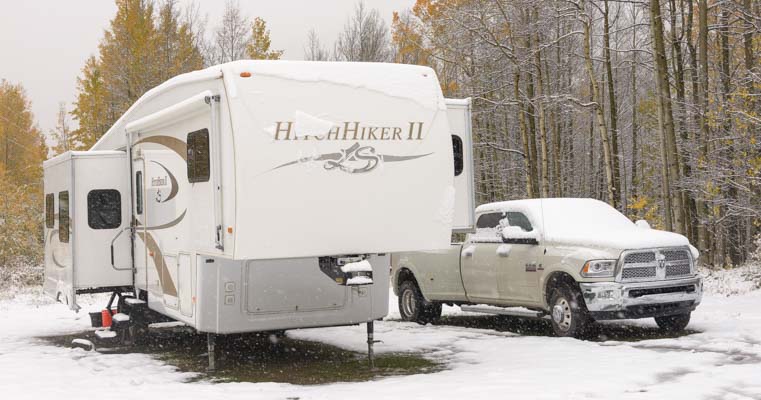
Dodge pickup truck covered in winter snow

This snowfall was definitely sticking around a while!

Vented vs. Ventless Propane Heaters and Propane RV Stoves & Ovens – Safety Concerns

An RV furnace is a vented system, meaning that it releases warm, moist air from inside the RV to the outside, and it brings cold air from outside to the inside of the rig. This makes it very inefficient in its use of propane, because it is essentially heating the outdoors as well as the indoors. Put your hands by the RV furnace vent outside, and they will get nice and warm and a bit damp too!

While RV furnaces are safely vented yet very inefficient, vent-free gas heaters are very efficient and are required by law to have an automatic shutoff when the available oxygen goes below a certain threshold (there is a built-in sensor that triggers the shut-off). We know when ours is about to shut off because the flame begins to sputter and make noise. Once it has shut itself off, it won’t turn on again until we air out the RV a little by opening the door or windows for a while.

Ironically, propane RV stoves and ovens are not required to shut off automatically when the available oxygen is depleted. To me, this makes them inherently quite a bit more dangerous than vent-free propane heaters.

Of course, an RV fitted with propane tanks is basically a rolling bomb, so it’s a very unsafe place to call home (I say this with a smile, because we wouldn’t trade our 9 years on the road for anything)!

Every time we have seen our blue flame heater shut itself off (probably 30+ times), the RV stove and/or oven has kept right on a-cookin’ without any hint that our supply of oxygen inside the rig was running out. We could easily have baked something in our factory installed propane RV oven and simmered something on our factory installed propane RV stove for hours while camped at 10,000′ with no inkling that the oxygen in our rig had dipped below safe levels!

Winter snow on RV steps

Welcome home…. Brrrrr!

Which Heater is Best Under Which Conditions?

For most of this year as we traveled in cold country, the lowest temperatures we saw were in the low to mid 30’s overnight. Daytime highs were in the mid-60’s to mid-70’s. These kinds of conditions are very similar to what we see in the southwestern deserts in the winter months (except January, which can be colder). These conditions are ideal for a vent-free propane heater.

We usually run our vent-free propane heater every morning until the rig is 60 to 75 degrees inside (depending on our mood) and then again in the evening if the temperature inside has dipped below 65. If the windows have fogged up from condensation (about 5% of the time, usually only in the winter), we run the RV furnace too to help dry the air out.
In general, we don’t heat our RV overnight in this kind of climate. We prefer to bundle up with down comforters instead. If we do run the heat at night, we use the RV furnace and set it to 50 degrees. If outdoor temps drop into the 30’s overnight, the RV furnace will come on once or twice in the pre-dawn hours.

Golden aspen in snow in winter

Golden aspen leaves in snow.

Ironically, if the outside temps dip really low — into the 20’s or teens — and daytime highs don’t get much past 50 degrees, then the RV furnace will start coming on before midnight and will come on every hour for 15-20 minutes as it struggles to keep the rig at 50 degrees.

Since we are light sleepers, this is extremely annoying. So, at the times we would want to run the RV furnace most — overnight when it’s really cold — we opt not to!

On overnights that we don’t heat the rig, when we wake up in the morning our bedroom is around 10-12 degrees warmer than the outside air (bedroom door closed all night) and our living area is around 5-7 degrees warmer than the outside air.

It is routine for us to wake up to temps in our trailer that are between 37 and 42 degrees. For us, that is a small price to pay for living off the grid, however, for many RVers it is good reason to get electric hookups and have more substantial and consistent heat in the rig overnight.

Aspen covered with snow in winter

The colors of Fall in Colorado.

There is a lot of debate about whether you can operate a ventless propane heater at high elevations. By the time we got caught in that September snow storm in Colorado two weeks ago, we had been living at elevations between 8,000′ and 10,000′ for 5 straight weeks, running our vent-free propane blue flame heater every morning and evening without a hitch.

Along with many weeks spent heating our rig at high elevations in previous years, including 8 weeks or so at 6,000′ or higher this past spring, our 5 weeks at 8 to 10 thousand feet this fall kind of proved the point for us: it’s no problem to run a vent-free propane heater at high altitudes in cool weather.

But in sub-freezing overnight temperatures and daytime highs in the 40’s under stormy skies at 10,000′ elevation, we’ve found a vent-free propane heater is best used in combination with the RV furnace.

Bikes on back of RV in snow

Well, we won’t be biking any time soon!!

Until the the snowstorm came to our mountaintop spot in the Colorado Rockies at 10,000′, we hadn’t been using the RV furnace at all. But once the temps dropped to the 20’s (lows) to 40’s (highs) at that elevation, we couldn’t rely on our blue flame heater exclusively any more and had to change our heating strategy for three reasons.

1) There is less available oxygen at 10,000′ than at lower elevations, and once the oxygen in the rig dipped below a certain level, the blue flame heater would shut itself off automatically. Because it was so cold outside, we weren’t thrilled about opening the windows and doors to let in more air just so we could turn on the blue flame heater again. It was time to use the RV furnace.

2) Our RV roof and ladder — along with our solar panels — was covered with snow and ice. Mark wasn’t jumping up and down with excitement to climb up there to clear off the solar panels, and I wasn’t about to get up on that slippery roof either. So, our batteries were no longer getting charged by the sun and wouldn’t have enough juice to run the RV furnace.

3) Vent-free propane heaters emit a lot of moisture. We had just had several days of torrential rain, and everything in our rig was wet. Our shower was filled with raincoats and rain hats hung up to dry, our boots and socks were wet and muddy by the door, our pants were wet and hanging in the bathroom and our bath towels refused to dry. While our blue flame vent-free heater would exacerbate the moisture problem, our RV furnace would help dry out the air inside our buggy.

Doing all these things gave us a nice dry and toasty warm environment to live in during this cold spell in snowy conditions at 10,000 feet.

To implement this heating strategy, we did two things. We stocked up on gasoline and propane and ran our Yamaha 2400i generator and RV furnace a lot. Sometimes we also ran the blue flame heater alongside the furnace.

Yamaha generator in bed of pickup truck in snow

Our Yamaha generator got a good hard workout for over a week.

The generator ensured that the batteries got fully charged. Because we were running our RV furnace so much, which burned up lots of electricity, the batteries were being depleted much faster than normal. So, not only did we need the generator because the solar panels were snoozing under the snow and ice, we also needed it because of running the RV furnace.

RV in snow in winter

A few weeks prior we had been roasting in the summer heat. What a crazy life we live in this RV!!

In general, we ran the RV furnace every morning until the rig was 65 degrees inside and then ran it on and off during the day and in the evening. If the air wasn’t too moist, we also ran blue flame vent-free heater alongside the furnace to warm things up faster. The vent-free propane heater never shut itself off, so the RV furnace was doing its job of circulating the air.

Golden aspen in snow by pond in winter

Getting creative heating our RV made it possible to enjoy views like this as it snowed.

Using the RV furnace also lessened the possibility of the water pipes freezing. The heater is ducted through the belly of the rig, and the warm air passing through the ducts helps warm the nearby water and sewer pipes. If the temps had gotten below 20 degrees, we would have run the RV furnace once or twice overnight as well just to be sure no ice formed in the pipes.

If we had had brilliantly sunny days every day, we may or may not have needed the generator. Our 490 watt solar panel array may have been able to charge the batteries fully, despite the additional load from the RV furnace.

Also, we probably wouldn’t have needed to use the RV furnace so much because the sun would have warmed up our rig and dried it out a bit during the day.

See how flexible and variable all this is??!!

Colorado fall colors after winter snow

This is why we came to Colorado at this season… Wow!!!

We have descended out of the clouds now and have been living at elevations between 5,000′ and 6,500′ for the past few weeks. The RV furnace is back on vacation and our trusty blue flame heater has taken over all the RV heating duties. Our generator is on break for another 6 months or year, and the shore power cord is buried somewhere in the basement once again.

RV in winter snow staying warm in cold weather

Snug as a bug in a rug!!

If you are going to be using your RV in cold weather this winter, we have another post full of tips for keeping warm that you might enjoy:

How to Stay WARM in an RV – Winter RVing Survival Tips

And if you think a vent-free propane heater is something you’d like to get, have a look at our detailed article that discusses the different types of heaters and shows how we installed ours:

Vent-free Propane Heaters (Catalytic, Infrared and Blue Flame) PLUS How to Install One in an RV

Subscribe
Never miss a post — it’s free!

For more images of the Colorado fall colors in the snow, see this post:

Below are some of our most POPULAR POSTS (also in the MENUS above)

Buddy - A Journey in Spirit - The story of an event that changed our lives forever.

ARTICLE INDEXES
  • RV Tech Tips Articles - A one page index of links to all our RV Tech Tips, RV Upgrades & RV Maintenance articles.
  • RV Lifestyle Tip Articles - An index of links to all our RV Lifestyle Tips (finances, boondocking, major repairs, work/jobs, etc.)
  • Solar Power Articles - Overview and tutorial articles for how to design and install solar power on an RV or boat
  • Product Reviews - An index of links to all of our Product Reviews
RV UPGRADES, SYSTEMS & TIPS MONEY FULL-TIME RV LIFESTYLE GEAR STORE
  • Gear Store - A list of the goodies, equipment and gear we've found useful in our RV lifestyle!
 

Our most recent posts:

More of our Latest Posts are in the MENU.
New to this site? Visit RVers Start Here to find where we keep all the good stuff!!

Bryce Canyon National Park – Fairyland Trail – A Beautiful Hike!

September 2016 – Bryce Canyon National Park knocked our socks off at the main overlooks of Inspiration Point and the Rim Trail, where we shared our awe with thousands of other visitors. But a foray out onto the Fairyland Trail from Fairyland Point gave us a wonderful feeling of solitude and peace.

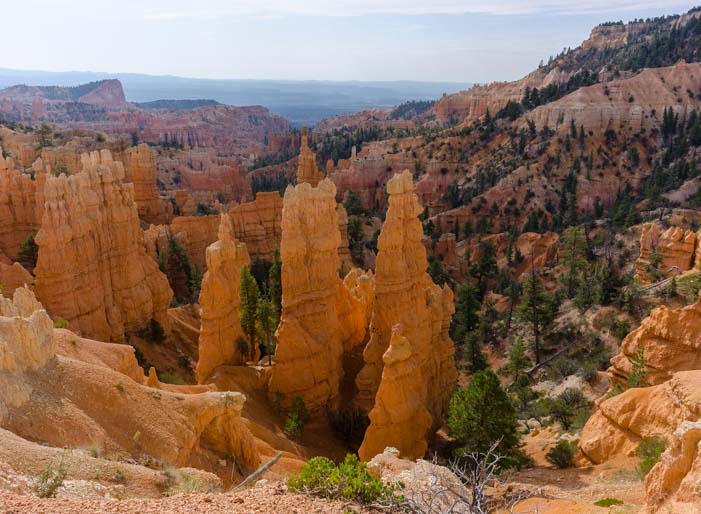
Hoodoos Fairyland Trail Bryce Canyon National Park Utah

Looking down at Fairyland from the rim of Bryce Canyon

Driving into Bryce Canyon National Park, Fairyland Trail is the very first left-hand turn-off, and it comes up quickly, right after the Bryce Canyon National Park entrance sign and before the fee station.

Dawn Fairyland Point Bryce Canyon National Park Utah

Spires in Fairyland Canyon.

During our visit, one of the reasons this trail may have been so little visited is that there was no sign at the turn-off for people driving into the Park!! We zipped right by it on our first drive in.

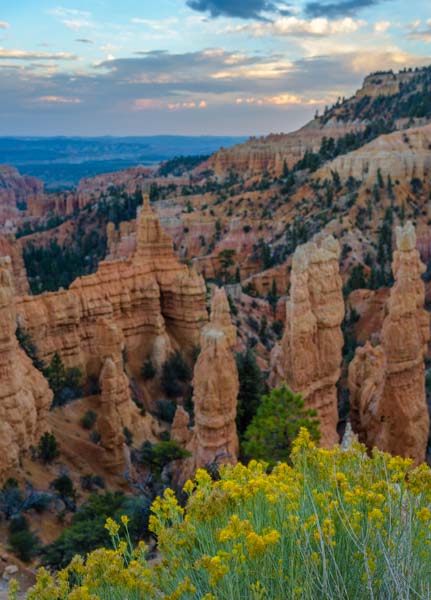
Flowers at Fairyland Point Bryce Canyon National Park Utah

Wildflowers at sunrise.

We first visited the Fairyland Trail in the wee hours of the night to do some star gazing. It was an incredible experience that was both eerie and awe-inspiring.

After navigating the trail with flashlights in the pitch dark, it was quite an eye-opener to hike the Fairyland Trail by day and see what it actually looked like, minus the stars!

Fairyland Trail Bryce Canyon National Park Utah

The beginning of the trail leading down into Fairyland Canyon

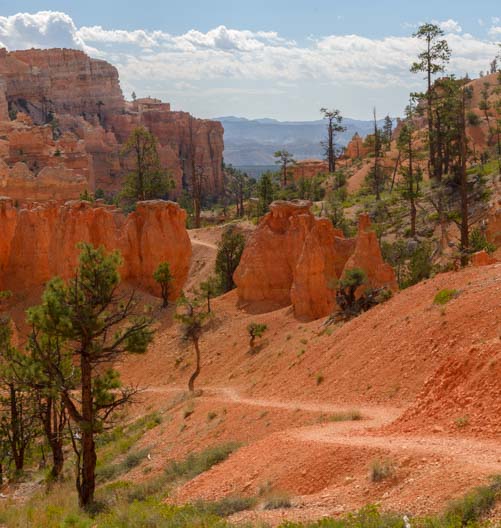
At the outset, the Fairyland Trail promptly descends into the depths of Bryce Canyon, and we walked between delightful spires and hoodoos that rose up around us.

Hike Fairyland Trail Bryce Canyon National Park Utah

Hikers slip between the hoodoos as they descend into Fairyland.

After a few twists and turns, the views opened up with rows of hoodoos close at hand and cliffs in the distance.

Hike at Fairyland Point Bryce Canyon National Park Utah

.

Turret formations Fairyland Point Bryce Canyon National Park Utah

White and pink pinnacles.

Hiking Fairyland Trail Bryce Canyon National Park Utah

.

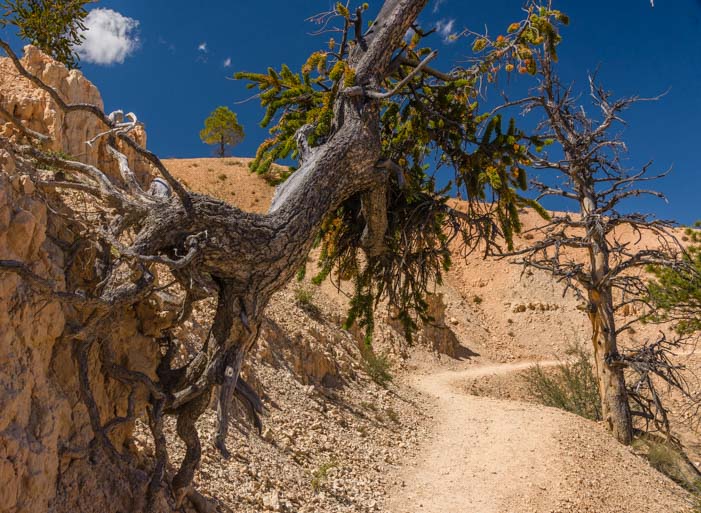
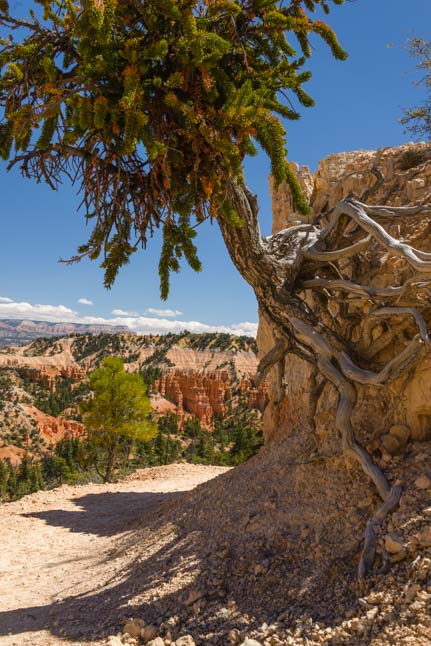
The far south end of Bryce Canyon at Rainbow Point is home to a collection of ancient Bristlecone Pines. However, a few of these gnarly trees reach out over the Fairyland Trail too!

Bristlecone Pine on Fairyland Trail Bryce Canyon National Park Utah

A Bristlecone Pine defies gravity and hangs out over the hiking trail.
What a way to spend a few centuries!

Bristlecone Pine Fairyland Trail Bryce Canyon National Park Utah

Hanging on by a thread!

We started our hike shortly after sunrise, and we were utterly alone on the trail for the first two hours.

Fairyland Trail Bryce Canyon National Park Utah

The trail snakes its way through Fairyland Canyon.

We are slow hikers these days, because our cameras are very demanding, and they insist that we stop every few feet to take yet another photo! But we gradually passed through both wooded areas and beautiful open areas too.

Trees and walls Fairyland Trail Bryce Canyon National Park Utah

The woods were thick in spots.

Red rock walls Fairyland Trail Bryce Canyon National Park Utah

Red rock walls frame our view.

As we got deeper into the canyon, the pinnacles rose higher.

Hoodoos and trees Fairyland Point Bryce Canyon National Park Utah

Hoodoos clustered on one side of the trail.

Hoodoos and spires Fairyland Trail Bryce Canyon National Park Utah

Towering spires…

The red rocks are mostly a burnt orange kind of hue, but in certain places we found a rainbow of sandstone colors.

Colorful hoodoos Fairyland Trail Bryce Canyon National Park Utah

Shades of pink…

Pink orange hoodoos Fairyland Point Bryce Canyon National Park Utah

…and shades of yellow too

Finally we came across some other hikers on the trail. They were coming from the other trail head for Fairyland Trail near the center of Bryce Canyon and had been enjoying total solitude on their hike as well.

Fairyland Trail Hike Bryce Canyon National Park Utah

.

The Fairyland Trail is an 8 mile loop with one trail head near Sunrise Point and North Campground in the heart of Bryce Canyon’s visitor area and the other trail head, where we started, by the Park entrance.

After following the Fairyland Trail through the canyon, you can return to your starting point by hiking on the Rim trail from one trail head to the other.

Hiking Fairyland Trail Bryce Canyon National Park Utah

Hoo dat in da hoodoos?

Or, in the summertime when the free shuttle bus is running, you can leave your car (if you drive into the Park) at one trail head, hike the loop to the other trail head, and then catch the shuttle back to your parked car and skip hiking the Rim Trail portion.

Beautiful Fairyland Trail Hike Bryce Canyon National Park Utah

What a view.

Glowing hoodoos Fairyland Trail Bryce Canyon National Park Utah

A little closer.

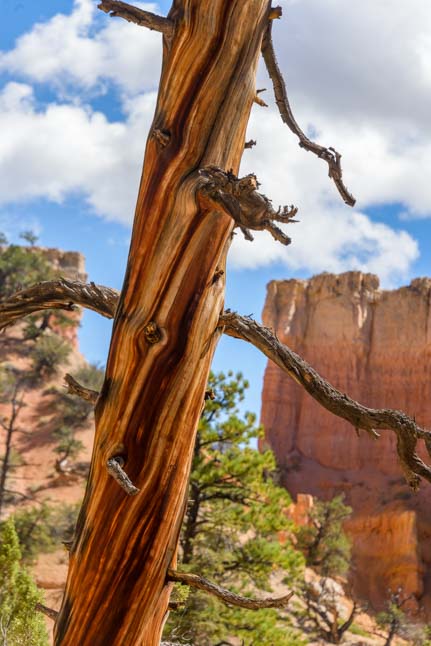
One of the things we found really intriguing on our hike was all the dead and denuded ponderosa pine trees. Each one had a fascinating twisted wood grain like a candy cane that was clearly visible without the bark on the tree.

It made me wonder if, when they were alive and growing, the trees loved their surroundings so much that they continually turned around and around so they could take in the views in every direction!

Spiral wood grain ponderosa pine Fairyland Trail Bryce Canyon National Park Utah

Spiraling wood grain of a dead ponderosa pine tree.
Did it turn as it grew to see the views in every direction?

Hikers we met on the trail told us a tour guide had explained to them that Ponderosa pines spiral spontaneously and instantly when they are hit by lightning!

This sounded a little far-fetched to me, so I poked around online and discovered that the current theory of why the ponderosa pines have a twisting wood grain is actually because it helps distribute water across the full breadth of the tree. By spiraling as they grow, each root can supply water to the entire tree. If one root dies, the impact on the health of the tree is minimized.

In addition, the angle of the spiraling turn of the wood grain is such that the tree can be as supple as possible and bend without breaking as it withstands high winds and heavy snow.

If you enjoy mathematics and mechanics, here is an interesting paper from the University of Utah that explains the theory in lots of detail: Why Grain in Trees’ Trunks Spirals

Along with the twisted wood grain in the dead ponderosas, we were equally fascinated to find some Abstract Art on another tree trunk where some worms or bark beetles had etched an elaborate pattern.

Wood carving Fairyland Trail Bryce Canyon National Park Utah

Nature’s wood carving is a work of art!

As we hiked and the sun rose higher, the red rock formations began to take on an ethereal glow.

Windows Fairyland Trail Bryce Canyon National Park Utah

.

We got down to the base level of the hoodoos, and the pinnacles soared to immense heights.

Size of scale Fairyland Point Bryce Canyon National Park Utah

A tree is dwarfed by a stone pinnacle.

Magic Fairyland Point Bryce Canyon National Park Utah

.

Even though we had completed a good portion of the Fairyland Trail loop hike, we decided to turn around and retrace our steps. On our return trip, all of the views we had enjoyed all morning had a slightly different look now that we were in the light of midday.

Glowing spires Fairyland Trail Bryce Canyon National Park Utah

.

If you plan to take your RV to Bryce Canyon National Park and you have time to do some of the less visited hikes, Fairyland Trail is really rewarding, and early in the morning you will have the trail to yourself!

Hiking Fairyland Trail Bryce Canyon National Park Utah

Hikers on the Fairyland Trail.

There are links for planning an RV trip to Bryce Canyon below.

Subscribe
Never miss a post — it’s free!

More info about Bryce Canyon National Park:

More blog posts from our RV trips to Bryce Canyon

Related posts from our RV travels:

Our most recent posts:

More of our Latest Posts are in the MENU.
New to this site? Visit RVers Start Here to find where we keep all the good stuff!!

<-Previous || Next->

Bryce Canyon – Hiking The Rim & Navajo Loop + A Tourist Time-lapse!

August 2016 – The views in Bryce Canyon National Park are absolutely breathtaking from the Rim Trail. This easy walking path extends for 5.5 miles along the edge of the canyon, going from Fairyland Point in the north and taking in the all the major overlooks until it arrives at Bryce Point in the south.

Sunrise Bryce Canyon National Park Utah View of Amphitheater

Bryce Canyon National Park at sunrise.

During our stay, we wandered up and down the Rim Trail many times, and we were stunned by the beauty every single time.

View from the Rim Trail 01 721 Sunset Point Bryce Canyon National Park Utah

Good Morning from the Rim Trail

View of hoodoos from Rim Trail at Bryce Canyon National Park Utah

Huge orange pinnacles dwarf the evergreens – Fantastic!

But the magic of Bryce Canyon is to get down in among all those hoodoos.

Sunset Point Bryce Canyon National Park Utah View from Rim Trail

A hiker snags a photo of this incredible view.

There are lots of hiking trails that wander between the peaks like thin pink ribbons strung all though the park. The tricky part is choosing which one to do!

Hikers Navajo Loop Trail Bryce Canyon National Park Utah

A ribbon of trail leads down into the hoodoos.

As we descended down the Navajo Loop trail from Sunset Point, the rock walls and pinnacles rose higher and higher around us.

Navajo Loop Trail Bryce Canyon National Park Utah

Hiking down into the hoodoos.

Navajo Loop Trail Bryce Canyon National Park Utah

Hikers pause on the trail to take in the magnificent views.

The spires soared into the sky like turrets on a fairy tale castle.

Hoodoos Rim Trail Bryce Canyon National Park Utah

This is a fairy tale landscape.

We hiked through this wonderland of rock formations utterly mesmerized.

Hiking the Rim Trail Bryce Canyon National Park Utah

.

Here and there, the rocks would open up, offering a view through a window to the canyon beyond.

Window Rim Trail Bryce Canyon National Park Utah

.

The rock formations seemed to grow up from the depths of the desert floor.

View from Rim Trail Bryce Canyon National Park Utah

.

Some rocks formed thin walls, creating craggy partitions within the canyon.

Windows Rim Trail Bryce Canyon National Park Utah

A tree perched on top of a rock wall showed us just how big the wall is — Immense!

The trail heads down many steep switchbacks, offering peeks into enticing nooks and crannies on its way to the canyon floor far below.

Navajo Loop Trail Bryce Canyon National Park Utah

A glimpse down into the depths…

These hiking trails are extremely popular, especially in the summer months when families from around the world are on vacation. It doesn’t make the trails any less appealing, but it is truly astonishing to watch the throngs of people climbing up and down these trails.

One afternoon I got chatting with a traveler from Germany, and as we talked idly about his travels in Patagonia, I set up my camera to do a time-lapse video of the hikers walking up and down the top few switchbacks of the Navajo Loop Trail at Sunset Point in front of us.

The result was fabulous. Check out the action not just at the top of the trail on the right but in the lower parts of the trail on the left. This is one of Bryce Canyon’s most popular hiking trails at its peak in August – Yikes!!

To replay, click the circular arrow in the bottom left corner

Of course, not all of Bryce Canyon National Park is crowded, and it doesn’t take much to get away from the masses. But these popular trails are a total thrill, and they are well worth doing, even if you’re sharing the experience with a busload of tourists and all their Facebook friends!

For a more solitary hike, we set out on the much less visited Fairyland Loop Trail one morning at dawn. That was an exquisitely serene experience which I’ll share in the next post.

If you are planning an RV trip to Bryce Canyon, there are links with more info below.

Subscribe
Never miss a post — it’s free!

More info about Bryce Canyon National Park:

More blog posts from our RV trips to Bryce Canyon

Related posts from our RV travels:

Our most recent posts:

More of our Latest Posts are in the MENU.
New to this site? Visit RVers Start Here to find where we keep all the good stuff!!

<-Previous || Next->

Bryce Canyon National Park – Inspiration Point – OMG!

August 2016 – We have been fortunate to visit Bryce Canyon National Park three times in the past, and we often refer to it as our favorite of America’s National Parks. But this fourth visit with our RV was sensational.

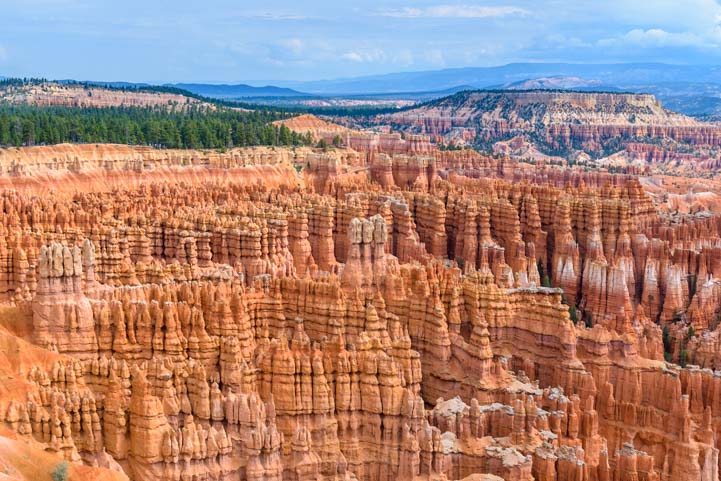
View Bryce Canyon National Park Inspiration Point Utah

Inspiration Point – Bryce Canyon National Park in Utah.

We overheard a ranger telling a newcomer that the best way to see Bryce Canyon National Park is to drive the 20 miles or so straight to the very far south end of the Park at Rainbow Point and then to turn around and drive back slowly, stopping at all the overlooks on the way back.

If you are into saving the best for last, then this strategy is fine. It’s also great for easing traffic congestion at the main part of the park.

Pink and White Spires Bryce Canyon National Park Inspiration Point Utah

Orange, pink and white spires seen from Inspiration Point.

However, we say, “Life is short, so eat dessert first!” and “Go for the gusto!”

Our suggestion is to drive (or take the Park Shuttle) directly to the Inspiration Point parking lot, walk straight out to the rim, and feel the breath get sucked right out of you as you gape in awe at the wondrous landscape laid out in front of you.

Overlook at Bryce Canyon National Park Inspiration Point Utah

View from Inspiration Point.

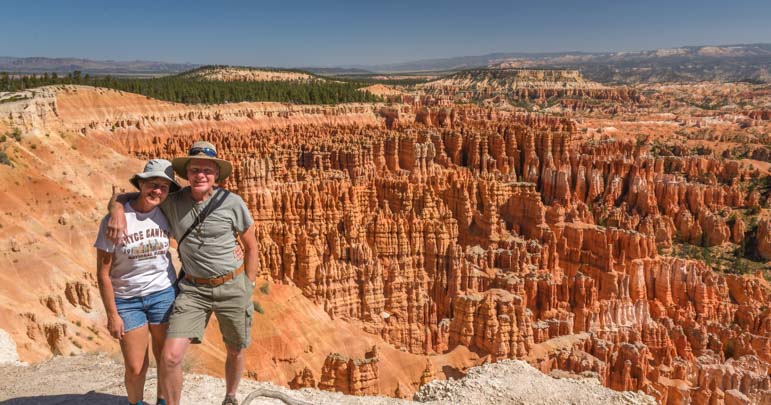
Then, just like every other one of the thousands of tourists alongside you, you’ve gotta get a selfie. Of all the backdrops for self-portrait, this has to be one of the best.

Bryce Canyon RV trip Inspiration Point

Happy campers at Bryce Canyon.

The thing that sets Bryce Canyon National Park apart from all other magnificent, world class canyons, including its nearby little sister, Cedar Breaks National Monument is the jaw-dropping symmetry of the red rock formations.

Red rock patterns Bryce Canyon National Park Inspiration Point Utah

Dizzying symmetry.

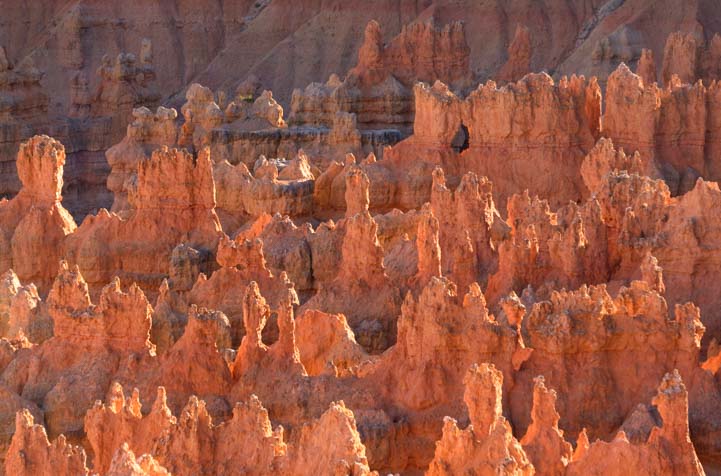
That wind and rain can join forces to carve sandstone into rows and rows of nearly identical pinnacles is extraordinary. There are legions and legions of hoodoos in this red rock army!!

Pinnacle closeup Bryce Canyon National Park Inspiration Point Utah

.

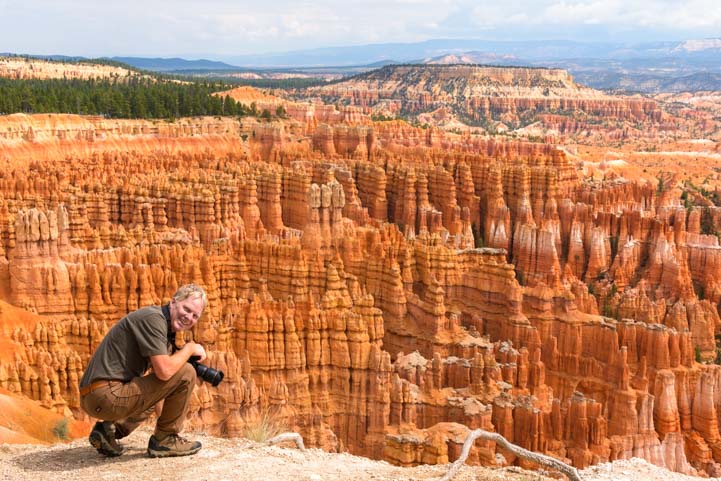
Bryce Canyon National Park is a fantastic area for photography, and we shot five thousand images between us during our stay.

Photography at Bryce Canyon National Park Inspiration Point Utah

What a place for photography!

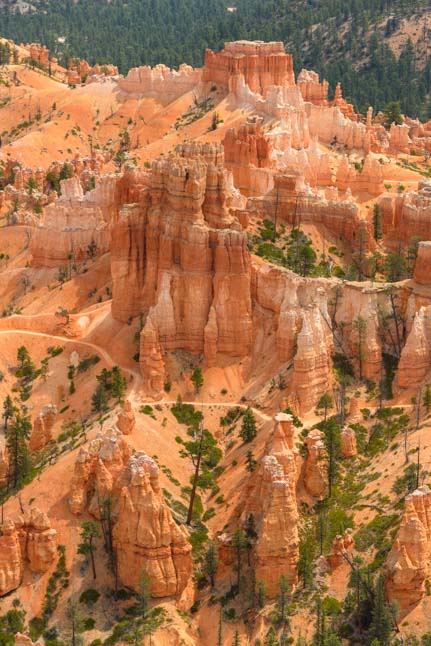
Bryce Canyon National Park is a massive amphitheater of red rock pinnacles and pink and white striped spires. It’s as if the gods were playing on a huge red sand beach and created a million giant dribble castles.

Closeup spires Bryce Canyon National Park Inspiration Point Utah

These are hundreds of feet tall! A person would be a mere speck.

There is a wonderful trail along the rim of the canyon that is wide and smooth and easy to walk on. There are also many hiking trails into the heart of the canyon where you have a view from the base of these towers looking up towards the sky. From Inspiration Point we could spot a few of these trails in the distance.

Hiking trails Bryce Canyon National Park Inspiration Point Utah

A hiking trail weaves between the spires.

Some of the hikes are really popular and we could see people starting their hikes on the far side.

Hiking trails Bryce Canyon National Park Inspiration Point Utah

People head into the canyon on a hike.

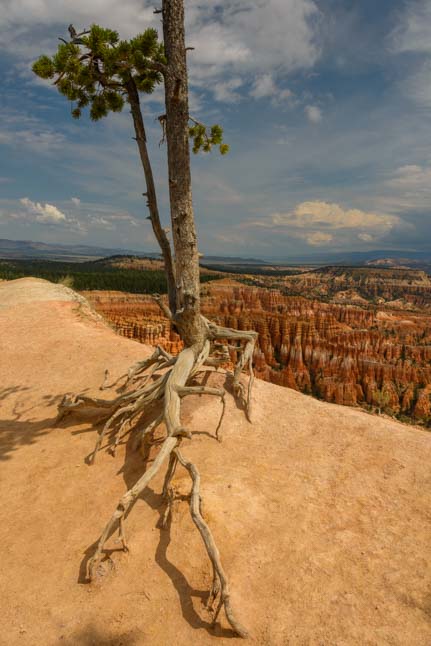
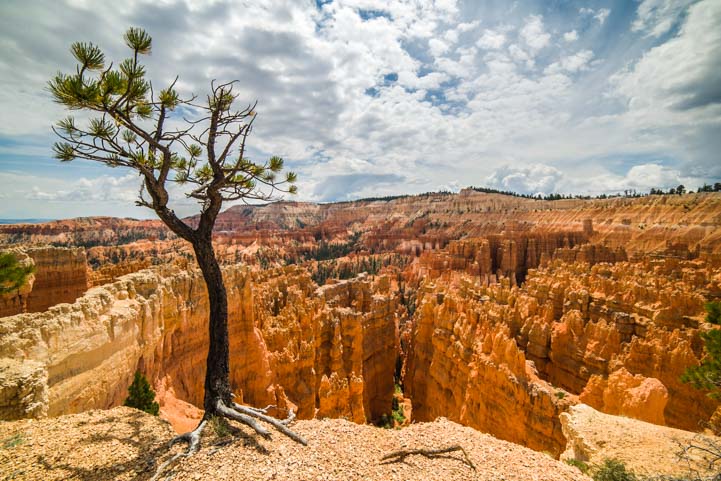
Here and there on the rim, a pine tree clung to the edge with a tenacious grip.

Pine tree Bryce Canyon National Park Inspiration Point Utah

.

Following the Rim Trail up a steep climb past a series of overlooks, the final overlook is on top of the world and has a view across the entire canyon to the mountains, cliffs and valleys beyond. What a place to spot a soaring eagle!

Top overlook Inspiration Point Bryce Canyon National Park Utah

Bird’s eye view!

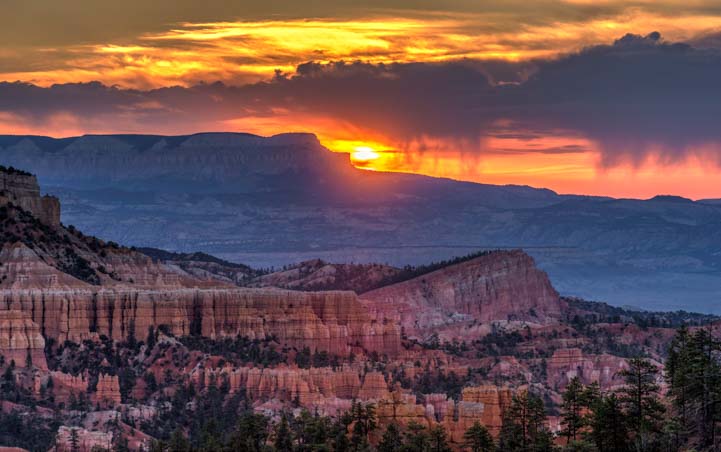
We are morning people, and we love getting out on the trail at dawn. One morning, the sun peaked through storm clouds in dramatic fashion.

Sunrise over Bryce Canyon National Park Inspiration Point Utah

The sun works its way through storm clouds at dawn.

The rising sun lit a ponderosa pine in beautiful shades of vivid orange.

Sunrise Bryce Canyon National Park Inspiration Point Utah

Sunrise at Bryce Canyon.

Even at this early hour, we were far from alone on the trail. Some people brought cups of coffee and wrapped themselves in blankets to see the sun rise. Others brought fancy cameras and tripods and staked out spots for beautiful photos.

All of us lined up and faced the far side of the Canyon, which is due east, like little birds sitting on a telephone wire.

Sunrise on the Rim Bryce Canyon National Park Inspiration Point Utah

.

As I walked along the rim enjoying the glow of the sunrise light, I noticed a camera sitting on a tree branch. It was still displaying the image of a guy holding his hands out towards the rising sun. But the guy was nowhere to be seen!

Camera Bryce Canyon National Park Inspiration Point Utah

.

When the final shades of pink faded to gray and the sun peeked over the horizon, everyone at the rim seemed to let out a collective sigh and begin to chat with each other. There were smiles all around.

Sunrise Inspiration Point Bryce Canyon National Park Utah

.

The Rim Trail goes both north and south from Inspiration Point, and a walk in each direction is worthwhile, especially when the sky lights up at sunrise.

Trees at Bryce Canyon National Park Inspiration Point Utah

.

Of course, Bryce Canyon National Park is all about vivid color, and the oranges, pinks, yellows and whites of the sandstone blending together in mesmerizing patterns. But even when the color is taken away, a black and white image of the Park is alluring.

Bryce Canyon National Park Utah Inspiration Point Black and White

.

Heading south a few paces from Inspiration Point one afternoon, we came across a different kind of red rock hoodoo than the precision cut ones seen in the views as you face north. These were more haphazard and jagged and they glowed in the afternoon light.

Tree at Bryce Canyon National Park Inspiration Point Utah

.

Rim Trail Hoodoos Bryce Canyon National Park Inspiration Point Utah

.

Pine tree Bryce Canyon National Park Utah Inspiration Point

.

As the sun lowered in the sky, the craggy rock formations seemed to be lit from within.

Spires Rim Trail Bryce Canyon National Park Inspiration Point Utah

.

Pinnacles on Rim Trail Bryce Canyon National Park Inspiration Point Utah

.

Rim Trail Bryce Canyon National Park Inspiration Point Utah

.

In the same way that sunrise casts an angelic glow across Bryce Canyon in the morning, the light in the late afternoon becomes a rich orange, and it lit up the backside of a pine tree perched on the rim.

Sunset Bryce Canyon National Park Inspiration Point Utah

.

The sun sets behind the Canyon, that is, it sets behind your back as you face Bryce Canyon’s views. But once it has sunk below the horizon, the eastern sky takes on the unique pink and blue hues of dusk in the desert.

Sunset Bryce Canyon National Park Utah Inspiration Point

The desert sky turns pink and blue at twilight.

Inspiration Point is truly the most dazzling part of Bryce Canyon National Park, and whether you have three hours or nearly three weeks to explore the Park, as we did, it is a thrilling place to start.

RV camping in Utah

.

For RVers planning an RV road trip to Bryce Canyon National Park, there’s more info and links below:

Subscribe
Never miss a post — it’s free!

More info about Bryce Canyon National Park:

More blog posts from our RV trips to Bryce Canyon

Related posts from our RV travels:

Our most recent posts:

More of our Latest Posts are in the MENU.
New to this site? Visit RVers Start Here to find where we keep all the good stuff!!

<-Previous || Next->

Cedar Breaks National Monument – A Hidden Jewel in Utah

August 2016 – Cedar Breaks National Monument is a jewel of a destination in the heart of southwestern Utah’s many spectacular State and National Parks. It looks a lot like Bryce Canyon National Park, but it’s smaller, more intimate, less well known and much much less visited. On our last visit we wondered, “Is Cedar Breaks better than Bryce?

Photographer Sunrise Cedar Breaks National Monument Utah

Cedar Breaks National Monument – WOW!

Cedar Breaks National Monument lies just above Cedar City, Utah, at a lofty elevation of 10,000 feet, ideal when the summer temps in the surrounding desert get unbearable.

Prior to visiting Cedar Breaks, we had an incredibly heartwarming experience while in Cedar City. Some of our readers might have missed this post, thinking it was just another bird story about the release of a golden eagle back into the wild.

However, if you have ever been a First Responder — working in law enforcement, search and rescue, fire fighting, EMT services or other professions that send you headlong into danger to help others get out of danger — this story will have special meaning for you. For those that have lost a loved one in the line of duty, this post will touch your heart.

It was one of the most moving experiences we have had in our nine years of travel. The link is here and also at the bottom of this page:

Eagle Whisperer & Healer of Angels – Martin Tyner of Southwest Wildlife Foundation in Utah

Soaring high above Cedar City, Cedar Breaks National Monument is a mammoth crater filled with pink and orange sandstone spires that jut up from the canyon floor like turrets in a fairytale castle. We snuck onto the trail before dawn to catch the soft colors in the sky above the canyon.

Sunrise Cedar Breaks National Monument Utah

Sunrise at Cedar Breaks National Monument

Suddenly the sun peeked over the horizon.

Sunrise starburst Cedar Breaks National Monument Amphitheater Utah

“Here comes the sun…”

All the exotic sandstone shapes in the canyon came to life in vivid color.

Dawn Cedar Breaks National Monument Utah

Early morning light at Cedar Breaks

Amphitheater Cedar Breaks National Monument Utah

.

The neat thing about hiking as the sun is rising at Cedar Breaks National Monument is that no one else is out there.

Sunset light Cedar Breaks National Monument Utah

.

Cedar Breaks is a quiet park to begin with, but at dawn the silence in this majestic canyon was broken only by the occasional bird chirping in the trees or the rustling of some small critter in the underbrush along the trail.

Dawn Cedar Breaks National Monument Utah

Patterns of light and shadow dance across the canyon.

There are quite a few overlooks that offer slightly differing views looking down into Cedar Breaks from above or across the canyon to the colorful walls on the far side.

Colorful Cedar Breaks National Monument Utah

Vivid colors — and dark pine trees — on the canyon walls

It is impossible to comprehend the size and scale of this canyon unless you are standing on the rim trying to take it all in.

Pinnacle red rocks Cedar Breaks National Monument Utah

Looking down into the Cedar Breaks amphitheater

Looking down from above, the red rock turrets at the bottom seem miniscule, yet the the tall pine trees offer a hint of their size.

Orange rock formations Cedar Breaks National Monument Amphitheater Utah

The tall pines were dwarfed by the fairy tale spires.

There are no hiking trails that go down into the Cedar Breaks National Monument amphitheater of rocks. This is a canyon that is enjoyed entirely from the rim up on top.

pink rocks Cedar Breaks National Monument Utah

We could peer down from the rim, but there are no trails to the bottom of Cedar Breaks.

Even though people can’t crawl around in the depths of this beautiful canyon, the local marmot population wanders freely all over the place. These little guys are quite fearless, and I was amazed at how close they let us come.

Marmot Cedar Breaks National Monument Utah

A marmot pauses in the middle of his busy morning.

Cell phone and internet access is very sparse in this area, but I discovered that one place you can get a reasonable signal is at the overlook by the visitors center. One morning, I perched my laptop on the railing at this overlook, and started writing emails that were many days past due while I savored the view between sentences. Suddenly, I noticed a marmot was sitting on a ledge right in front of me.

Marmot Cedar Breaks National Monument Utah

“Who are you writing to on your laptop??”

Darn if “being in touch with the world” on the internet wasn’t getting in the way of snagging a great photo at one of America’s most beautiful National Monuments!! What was I thinking doing email silliness instead of taking pics? Mark wandered by and snickered while he got a great photo of the little guy with the canyon in the background.

Marmot at Cedar Breaks National Monument Utah

A marmot’s eye view of Cedar Breaks!

But my camera was way down in the parking lot in our truck! Oh well. I just watched the marmot as he went about his business with grass in his mouth and I went about mine on my laptop.

Fifteen minutes later, when I finally put away the darn computer, I was amazed that the little guy was still sitting there right in front of me, doing his thing with the grass in his mouth. So, I ran back to the truck, got my camera and came back to the overlook to get some photos of him myself.

Not only was he still there, he was kind enough to pose for a few shots.

Marmot Cedar Breaks National Monument Utah

This marmot did his thing while I did mine until I finally went and got my camera!

Cedar Breaks National Monument is home to one of my all time favorite hikes, the Spectra Point Trail. This trail follows the rim of the canyon from the parking lot right out onto a huge peninsula that juts out into the middle of the red rock amphitheater.

It starts with a fabulous passage through tall pine trees that heads towards the rim. The heavenly scent of pine needles nearly knocked me off my feet!

Hiking trail Cedar Breaks National Monument Utah

Spectra Point trail heads through pine trees to the canyon rim.

We did this hike at dawn one morning, and as we looked back towards the parking lot, a dead tree was silhouetted against the colorful sky.

Dead tree at sunset Cedar Breaks National Monument Utah

The bright colors of sunrise played behind an old dead tree.

This is an easy hike that has stunning canyon views the whole way. However, even though the path is wide and smooth, it goes uphill and downhill a lot, and being at 10,000 feet elevation, not only are the views breathtaking but you end up out of breath too!

Red Rocks Cedar Breaks National Monument Utah

The views on the Spectra Point Trail were stunning.

One of the special treats at Cedar Breaks National Monument is the neighborhood of Bristlecone pines that lives near the end of the peninsula at Spectra Point. Many of these unique trees are 1,000 years old or more, and one beautiful biggie has celebrated its 1,600th bithday. We could see him standing half naked at his sentry point out near the end.

1600 Year Old Bristlecone Pine Cedar Breaks National Monument Utah

A 1600 year old Bristlecone pine tree stands sentinel at the end of the trail.

As we walked out onto Spectra Point, the Bristlecone pines crowded in around us. These trees are the very definition of “gnarly,” with claw-like roots that snake across the ground without bothering to tunnel underneath.

Bristlecone pine Cedar Breaks National Monument Utah

Bristlecone pine trees are gnarly and tenacious, hanging onto the rim of the canyon in brutal weather.

Life is tough here where they like to live, with high altitudes and strong winds, nasty cold winters and all too brief summers. I think these trees must slumber through life with just one eye open. Whole branches and trunks of these trees are totally devoid of any signs of life.

Yet there are a few branches on every tree that are covered in the softest bristles. For such craggy trees that are entirely bald and bent like little old grandpas, their short pine needles are as soft and as full of life as can be.

The 1,600 year old great-grandaddy Bristlecone of them all gave me pause for thought as I walked around and around it to try and fit its expansive branches into my camera’s viewfinder.

1,600 years is a very long time!

1600 Year Old Bristlecone Pine Cedar Breaks National Monument Utah

A 1,600 year old Bristlecone pine tree – a true antique!

There are lots of tree species that live a long life. In Arizona, the “ancient” saguaro cactus that preside over the Sonoran Desert with a regal (and whimsical) air don’t even bother to grow their first branches until they are 75 years old. And the grand multi-branched 150 year old beauties that dot the scorching desert were mere babes when Americans were first settling the Arizona Territory.

But this Bristlecone Pine in front of me predated those juvenile saguaro cacti by centuries PLUS a millenium. It even predated the “ancient” Native Americans who roamed this area! The prehistoric Anasazi people of the southwest who left their artwork behind on canyon walls didn’t make their mark until this Bristlecone pine already had a few hundred years under its belt.

This tree put its roots down right around the time that the Goths sacked Rome!

And it has looked out on this fabulous view at the end of Spectra Point the whole time.

Sunset light Spectra Point Cedar Breaks National Monument Utah

Spectra Point overlook at the end of the trail.

Besides red rock beauty and ancient trees, Cedar Breaks National Monument is also known for it’s incredible wildflower displays in mid to late July. The monument even celebrates with a special wildflower festival.

We got there a little late for seeing the blankets of wild color in the meadows, but brilliant yellow Snowy Goldeneye were blooming thickly everywhere, right up to the fencing by the visitors center.

Snowy Goldeneye wildflowers at Cedar Breaks National Monument Utah

Snowy goldeneye swarm a fence post.

Snowy goldeneye wildflowers Cedar Breaks National Monument Utah

.

There were a few other pretty wildflowers here and there.

Wildflowers Cedar Breaks National Monument Utah

.

We just loved finding a bright red Indian Paintbrush tucked in between some low lying pine boughs.

Indian Paintbrush in pine branch

Indian paintbrush — surrounded by pine needles!

The weather in late August at Cedar Breaks National Monument can be very unpredictable. While many folks in other parts of the country were enduring an intense heat wave, we got hit with lots of afternoon thunderstorms that made the nights downright chilly.

Thunderstorm brewing over Cedar Breaks National Monument Utah

August is thunderstorm season at Cedar Breaks.

One day we even got a wild hail storm that left a sheet of icy pellets on the road!!

Hail storm Cedar Breaks National Monument Utah

A surprise hailstorm left a layer of ice on the road… yikes!

Cedar Breaks National Monument is a little gem in Utah that gets overshadowed by the more famous National Parks nearby. But if you take your RV to southwestern Utah, a detour to Cedar Breaks is an absolute must!! There are some links for planning an RV trip to Cedar Breaks National Monument below.

Note: The road from Cedar City to Cedar Breaks (Rte 14) is steep and winding. If you have a strong engine in your motorhome or a strong truck to tow your trailer, it’s no problem. We towed our 14k lb. 36′ fifth wheel up the hill easily. Driving the road with your toad/tow vehicle first will help alleviate any concerns you might have (we did!).

Subscribe
Never miss a post — it’s free!

More info about Cedar Breaks National Monument:

Other posts from our RV travels in Southwestern Utah:

Our most recent posts:

More of our Latest Posts are in the MENU.
New to this site? Visit RVers Start Here to find where we keep all the good stuff!!

<-Previous || Next->

“Healer of Angels” – The Eagle Whisperer – Martin Tyner of Southwest Wildlife Foundation

August 2016 – During our RV travels in Utah we have had many unique and memorable experiences, and one particularly delightful encounter was when we met Martin Tyner of the Southwest Wildlife Foundation back in 2008. Martin is one of America’s top master falconers as well as a native animal rehabilitation specialist. He revives ailing creatures that have been found and brought in to him, and he releases them back to nature.

Golden Eagle release Southwest Wildlife Foundation Cedar City Utah

Into the wild — with prayers!

Those animals that can’t be released become part of his education program where he teaches young and old, both far and near, about the beauty and wonder of Nature’s creatures.

Back in 2008, we watched Martin’s heartwarming presentation of several rehabilitated raptors during the Iron County Fair in Parowan, Utah. His gentle manner with these big, beautiful, birds of prey was remarkable, and his tales of healing countless injured and sick birds over more than four decades were extraordinary.

Martin Tyner Harris Hawk Thumper Education Outreach Iron County Fair Parowan Utah 2008

Martin Tyner tells us about Thumper the Harris Hawk at the Iron County Fair in Parowan, Utah, in 2008

Years ago, Martin had a unique encounter with a Native American spiritual leader, Clifford Jake, and he learned that the Paiute Indians have long believed that a prayer said over an eagle feather is carried directly to the heavens. To them, eagles are angels who fly between the human world and the Great Spirit.

Martin had the idea that since an eagle has 7,000 feathers, it can carry 7,000 prayers when it is released into the wild after being nursed back to health, and he has been releasing eagles carrying special prayers to the gods ever since.

In recognition of his gift nurturing eagles, spiritual leader Clifford Jake held a special ceremony and gave Martin a Paiute name which means Healer of Angels.

Martin Tyner Golden Eagle Scout Education Outreach Iron County Fair Parowan Utah 2008

Scout, Martin’s companion Golden Eagle at Parowan Utah’s Iron County Fair in 2008

After we watched Martin’s bird presentation all those years ago, we found out he was going to release a rehabilitated golden eagle a few days later.

He was gathering together Utah’s “downwinders,” that is, cancer survivors who have suffered the ravages of disease caused by being downwind of the nuclear bomb testing that took place next door in Nevada in the 1950’s. This eagle would carry the community’s prayers for their health and healing up to the heavens.

Unfortunately, we couldn’t stay to see this unusual event, and we left the area heartbroken to have missed it. However, we got onto the Southwest Wildlife Foundation newsletter mailing list, and we have wistfully watched announcements of raptor releases from afar ever since.

Martin Tyner Peregrine Falcon Igor Education Outreach Iron County Fair Parowan Utah 2008

Martin presents Igor, a speedy Prairie Falcon

Miraculously, just as we brought our RV into Cedar City, Utah, in late August this year, we received a Southwest Wildlife Foundation newsletter email announcing that a golden eagle would be released from a mountaintop outside Cedar City in a few days.

This eagle would be carrying prayers for America’s First Responders who put their lives on the line everyday despite ever increasing violence in the streets.

We were thrilled! On the appointed afternoon, we drove up to the parking area on the mountain and found that a crowd was gathering and excitement filled the air.

People wait for the rehabilitated eagle release by Southwest Wildlife Foundation in Cedar City Utah

People were waiting on the mountaintop for the much anticipated eagle release.

A videographer had set up cameras to capture the release on video so it could be streamed live on Facebook!

Video equipment to film rehabilitated eagle release by Southwest Wildlife Foundation in Cedar City Utah

Video gear is set up to stream the eagle release live on Facebook

The view from the mountain looked out over gorgeous red rock hills in the distance and Cedar City far below. People were staking out spots all over the place to get a good view of the eagle as it returned to its home in the wild.

View from mountain over Cedar City Utah

An eagle eye’s view over the red rock mountains outside Cedar City.

Martin Tyner has written a delightful book about his journey to becoming one of America’s top master falconers and wildlife rehabilitators, called Healer of Angels. As I read his hilarious and deeply touching stories about his boyhood and young adult years, I found myself alternately laughing aloud and wiping away tears.

Martin Tyner Autobiography Healer of Angel

A must-read for any animal lover: Healer of Angels,
Martin Tyner’s heartwarming autobiographical stories!

Anyone who has a soft spot for animals will absolutely love this book!

A native of California and a true lover of nature as a youngster, Martin nursed an orphaned baby barn owl when he was just twelve and soon began receiving all kinds of injured animals from friends, neighbors and even the game warden to care for.

As a teenager he apprenticed himself to Hubert Wells of Animal Actors of Hollywood who taught him the ins and outs of training elephants and big cats. Then he became the Curator of Birds of Prey at Busch Gardens in Van Nuys, California.

Whether it has two wings or four legs, big teeth or fierce talons, or even a tiny hummingbird’s beak, Martin knows how to take care of it.

Here on the top of this mountain above Cedar City the crowd quickly parted when Martin showed up in the Southwest Wildlife Foundation’s cool Subaru wagon.

Utah's Cedar Canyon Nature Park by Southwest Wildlife Foundation Cedar City

Martin arrived with his special cargo in the back.

GoWildlife.org Subaru with Golden Eagle Image

This car is the Southwest Wildlife Foundation’s animal transport vehicle, and the website is www.gowildlife.org

His precious cargo was with him, and he swung open the tailgate to reveal the eagle’s carrier.

Southwest Wildlife Foundation Golden Eagle Release Preparation

The lucky golden eagle was waiting patiently inside her carrier.

Martin had spent the last month bringing this golden eagle back to vibrant health after she was found nearly dead during a massive heat wave in July.

Because the Southwest Wildlife Foundation was dedicating her release to First Responders, the event was well attended by the local police, EMTs, sheriffs and others whose job it is to run headlong into danger when chaos and violence erupt in the community.

Several representatives of each group gave speeches, and Lisa Hendrickson from Southwest Wildlife Foundation read aloud a letter written by Ken Osmond, the actor who played Eddie Haskell on the TV show Leave it to Beaver.

As the former actor explained in his letter of support for the Foundation’s eagle release, he had spent his early adult career as a policeman in LA, and he had been shot, nearly fatally, on two different occasions just a few months apart.

Dignitaries speaking at Golden Eagle Release Southwest Wildlife Foundation GoWildlife.org

First Responders share their deep appreciation for this unique event.

Then Martin headed over to the car and brought out the guest of honor.

Martin Tyner prepares to release a Golden Eagle above Cedar City Utah

The guest of honor arrives.

The eagle’s eyes were covered with a leather hood to keep her from getting too stressed out by all the people.

As Martin carried the eagle to the release spot, he explained that they have eyesight that is phenomenally better than ours. An eagle can spot a jackrabbit from 5 miles away! So, it is easy to imagine that if this eagle suddenly found herself surrounded by people staring at her, she would have been terrified. She was much calmer with her little blindfold on.

Southwest Wildlife Foundation Director Martin Tyner prepares to release a Golden Eagle into the wild in Cedar City Utah

Martin told us a little about the eagle’s history and her amazing capabilities.

Martin went on to tell us that eagles are extraordinary hunters. They dive from enormous heights and grab their prey with their feet. And what amazing (and huge!) feet they have!!

Talons of a golden eagle ready to be released into the wild in Utah

I wouldn’t want to be a rabbit looking up at these talons!

Martin was the first falconer ever licensed to keep an eagle for falconry, and the golden eagle he worked with, named Bud, was his constant companion for fifteen happy years.

Martin would take him out hunting a few times a week, not to get food for himself but to get dinner for Bud and keep his hunting skills sharp. Martin would run ahead flushing rabbits out of the underbrush while Bud would soar high above and wait for the right moment to dive.

An eagle’s hit rate isn’t as good as you might expect, however! Martin found it took about 40 rabbit flushings for Bud to score a meal. And the bird clearly had his human companion well trained to help him out!!

Martin Tyner master falconer releases rehabilitated eagle from mountain in Cedar City Utah

Martin sets up at the release spot.

Turning to a woman by his side, Martin introduced Nannette Wride, the widow of Sgt. Cory Wride who was shot and killed in the line of duty two years ago. Representing all the First Responders who have died as well as their loved ones left behind, Nannette took the microphone for a few moments and told the most touching story.

Golden Eagle Release in Cedar City Utah

.

Nannette’s husband was tragically shot and killed by a couple that turned out later to be on a wild crime spree. He had simply been checking on a seemingly abandoned pickup truck. The pickup truck was on the side of the road in Utah near, of all places, Eagle Mountain.

Shortly after her husband’s death, Nannette began having dreams about him. In one dream he brought an eagle to her and set it on her arm, and it walked up and sat on her shoulder. He told her this eagle would watch over her and protect her until she could be with him again.

Understandably, she was utterly astonished when she got a call from Southwest Wildlife Foundation the day before this eagle release asking her to be the one to hold and release the eagle, carrying prayers for all of America’s First Responders and their loved ones.

A shiver ran up my spine as she said this and I felt tears in my eyes. All around me, people were wiping their eyes too.

Martin gently placed the eagle in Nannette’s arms and showed her how to hold the eagle by the legs and then release her by pushing her away.

Martin Tyner master falconer Southwest Wildlife Foundation releases rehabilitated eagle from mountain in Cedar City Utah

Martin places the eagle in Nannette’s arms and explains how to release the bird.

“I have my eagle now,” she whispered through tears.

“You have your eagle now,” he said gently.

Martin Tyner of Southwest Wildlife Foundation prepares to release a Golden Eagle back into the wild in Cedar City Utah.jpg

.

Martin untied the hood on the eagle’s head and asked us all to say a prayer to send up to the heavens with her.

Southwest Wildlife Foundation releases rehabilitated Golden Eagle in Cedar City Utah

.

Then suddenly Nannette let the bird fly while everyone held their breath.

A golden eagle is released into the wild by Martin Tyner of Southwest Wildlife Foundation Cedar City Utah

.

Just released by Southwest Wildlife Foundation - a golden eagle soars over Cedar City Utah

.

The eagle stretched her feathers across the air currents, flapped her powerful wings, and joyfully took off.

Rehabilitated Golden Eagle release to freedom Southwest Wildlife Foundation Cedar City Utah

.

Rehabilitated Golden Eagle release to freedom Southwest Wildlife Foundation Cedar City Utah

.

Flying far out over Cedar City, she flapped once or twice more, banked left, and then soared out of sight.

Southwest Wildlife Foundation rehabilitated golden eagle release Cedar City Utah

.

Golden eagle release Cedar City Utah Southwest Wildlife Foundation

.

The focus of this eagle release was on gathering people together in support of America’s First Responders. But the real hero, to me, is Martin Tyner and his foundation.

Martin has worked tirelessly for 48 years nurturing Utah’s native wildlife and returning the animals back to nature. The ones who can never fend for themselves again in the wild — the birds with broken wings and other disabilities — he uses for educational purposes.

The Southwest Wildlife Foundation holds 100 educational events every year and reaches 30,000 people with their message of healing, teaching and conservation.

However, Martin has bigger dreams. He wants his Foundation being able to build the Cedar Canyon Nature Park and wildlife rehabilitation facility just outside Cedar City. By a series of miracles, the Southwest Wildlife Foundation has been given a beautiful piece of property in Cedar Canyon that lies at the end of the paved bike path coming from town. This property will become the Nature Park and rehabilitation facility he envisions.

However, Southwest Wildlife Foundation doesn’t yet have the funds to build the park, despite energetic efforts to raise money. Of all crazy things, they don’t qualify for Kickstarter funding because they are a non-profit organization.

One easy way to contribute to this unique park and facility is to buy Martin’s book, Healer of Angels. It is available on Amazon too, but the Southwest Wildlife Foundation receives only $1 when it is purchased through Amazon. So, buy the book directly through the SWF website here and the entire purchase price except shipping and handling will go towards the Nature Park!

The inside cover of the book is signed with a footprint from Martin’s golden eagle, Scout. How cool is that?!

The Foundation also sell t-shirts and donor plaques that are placed on the Memorial Bridge at the Cedar Canyon Nature Park property.

If your RV travels ever take you along I-15 through Cedar City, Utah, experiencing one of these wild raptor releases is something you will never forget. The way to find out when they are is to sign up for the Southwest Wildlife Foundation newsletter.

Subscribe
Never miss a post — it’s free!

More info:

Other blog posts about cool bird encounters we’ve had:

Our most recent posts:

More of our Latest Posts are in the MENU.
New to this site? Visit RVers Start Here to find where we keep all the good stuff!!

<-Previous || Next->