Damnoen Saduak Floating Market – Bangkok or Disney’s Epcot Center?

January 2017 – On our first days in Bangkok, Thailand, we got a huge kick out of everything we saw around us, because it was so familiar yet so different. We went to the 7/11 store (yup, 7/11 is huge in Thailand and can be found on every street corner) and we picked up one of every kind of beer they had in the cooler.

Beer in Thailand

A selection of Asian beers!

The beers are decidedly a lot lighter than we’re used to consuming at home, but what fun it was to sample such a wide variety. Three of them were named for large cats, from Leo beer to Singha (which refers to a mythical lion in Thai folklore) to Tiger beer (originally from Singapore)!

Lay potato chips are also easy to find everywhere, and what an interesting way Pepsico has modified the familiar red and white label on the bag to give it a Thai twist.

Lay Potato Chips Thailand

Same same, but different!
(the chips themselves are identical)

Mass market food products are a part of most cultures nowadays, but we wanted to try to get a little deeper than that in our introduction to Thailand. However, uncovering the “real” Thailand proved a little elusive at first.

In the olden days of a hundred years and more ago, Bangkok was a city of canals. “Floating markets” held aboard open boats were commonplace. However, since then, most of Bangkok’s canals have been filled in to make way for traditional roads and wheeled vehicles.

There are still many floating markets to be found, but they are a bit contrived as they are intended more for tourists to experience a touch of the bygone Thai culture than for Thai people to peddle their wares to each other.

Longtail boat floating market Bangkok Thailand

Mark gets in a longtail boat for a tour of a floating market

I searched high and low for an “authentic” floating market, and found one called the Tha Kha Market just outside of Bangkok that seemed like it would fit the bill.

Longtail boat damnoen saduak floating market Bangkok Thailand

All smiles as we started down the canal.

We hopped in a cab to make our way out to this unusual sounding market, but were alarmed when we drove right by the signs for “Tha Kha Market” and arrived at the parking area for the known-to-be-touristy Damnoen Saduak Floating Market instead.

I chastised the driver for taking us to the wrong place, but he kept insisting this market was better, especially for photography. In the end we relented and hopped in a longtail boat and were piloted along a canal system.

The jungle was thick, and the ride was actually very cool.

Longtail boat canal damnoen saduak floating market Bangkok Thailand

We cruised down the canal through dense jungle vegetation.

We passed the homes of people who live on these canals.

House Damnoen Saduak Floating market Bangkok Thailand

A different kind of waterfront life.

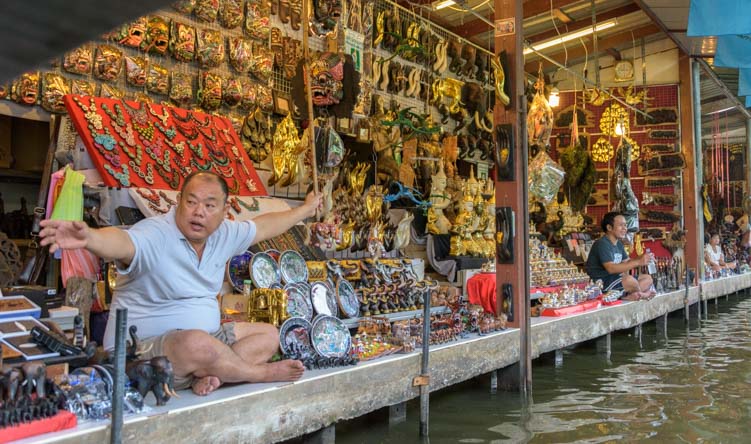
Then we arrived at our first “store.” A series of shops stood right on the water’s edge, tucked under a wide corrugated metal roof overhang, and vendors sat in each stall.

Shopping Damnoen saduak floating market Bangkok Thailand

The first of many canal-side shops.

Damnoen saduak floating market Bangkok Thailand

Get your “spicies” here!!

Negotiating is a natural part of shopping in Thailand, and we’d heard that the standard patter is to ask the price, counter what the vendor says with something outrageously low, and then accept his counter if you want to buy the item.

Shops damnoen saduak floating market Bangkok Thailand

Negotiating is part of the fun and part of the deal!

We had come to this market with photography in mind, however, and we weren’t looking to make any purchases.

Our pilot slowed down a little as we passed each shop, and we admired the many items but simply shook our heads “no.” After all, we wanted our luggage to be able to meet the extremely stringent international weight guidelines on our flight home!

Damnoen Saduak floating market Bangkok Thailand

Trinkets, souvenirs and keepsakes of all kinds were for sale.

But in the days that followed, as we talked with other tourists around town, we realized that lots of people come to Bangkok specifically to shop, and many go to these floating markets hoping to score a deal.

Ironically, we found that the asking prices on many items at Damnoen Saduak Floating Market were ten times higher than in other places!

Sandals for sale Damnoen Saduak Floating Market Bangkok Thailand

Need some sandals??

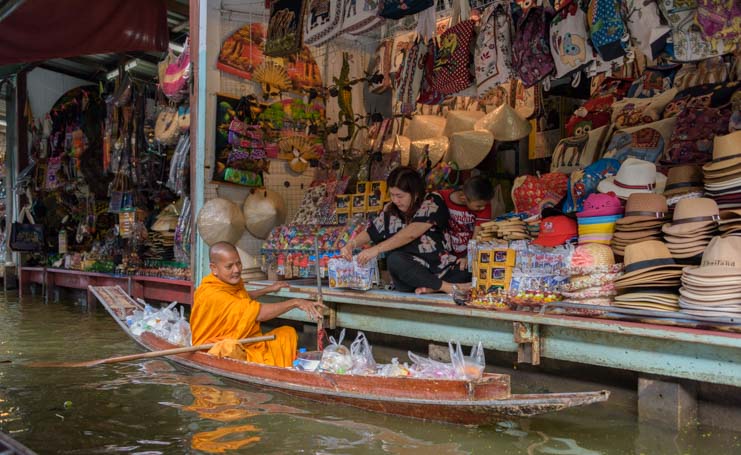
We were surprised to see a monk out shopping too!

Buddhist monk shopping Damnoen saduak floating market Bangkok Thailand

Shopping in Thailand might be a religious experience for some!

We had arrived at the Damnoen Saduak Floating Market very early, but soon we began seeing boats filled with other tourists.

Tourist shoppers Damnoen Saduak Floating Market Bangkok Thailand

A boat full of happy shoppers passed us.

We joked with each other that we were a long ways from home and never would have seen something like this if we’d gone to Quartzsite for the RV show as we have so many times in Januaries past! Even with inadvertently getting caught in a tourist trap, we were having a blast!

Woman vendor damnoen saduak floating market Bangkok Thailand

.

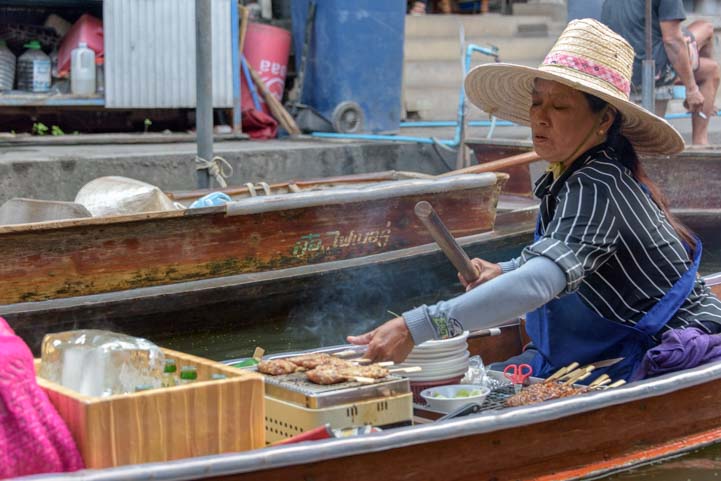
Besides trinkets sold in the shops along the sides of the canals, many vendors were cooking things in their boats and selling various edible goodies to passersby.

Woman cooking in boat damnoen saduak floating market Bangkok Thailand

Some vendors cooked delicacies right on their boats.

Boat selling produce Damnoen Saduak Floating Market Bangkok Thailand

Food of all kinds was for sale.

Beautiful tropical fruits and veggies were on full display.

Fruit for sale damnoen saduak floating market Bangkok Thailand

Fruit for sale!

Women at damnoen saduak floating market Bangkok Thailand

Veggies too!

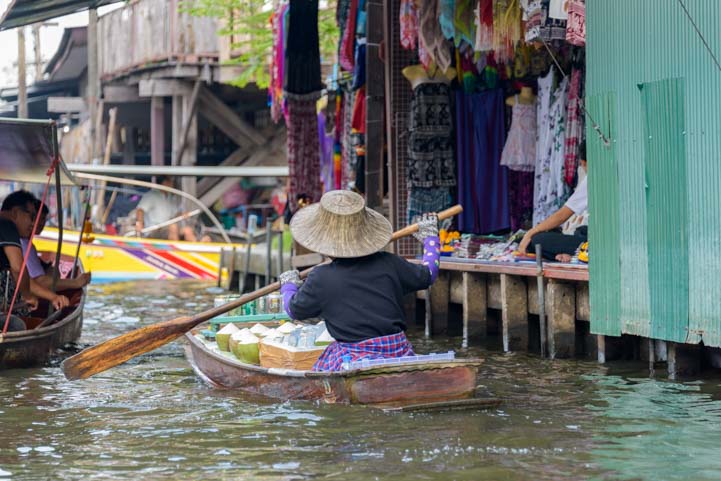
As the morning wore on, the canals became busier and busier as vendors and tourist boats passed each other continuously.

Lady Damnoen Saduak Floating Market Bangkok Thailand

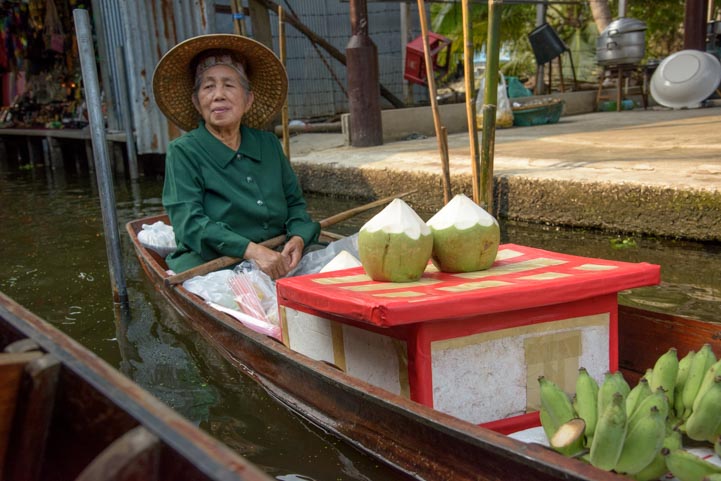
Coconut drinks.

Veggies for sale Damnoen Saduak Floating Market Bangkok Thailand

.

It was a little early for a beer, but some tourists imbibed as they floated along.

Beer for sale Damnoen Saduak Floating Market Bangkok Thailand

A Singha beer for you??

Of course, the display of traditions from long ago was just a show, and modern life lurked just out of sight.

On the cell phone damnoen saduak floating market Bangkok Thailand

Sometimes even the best displays of tradition include a fast-forward to the modern era.

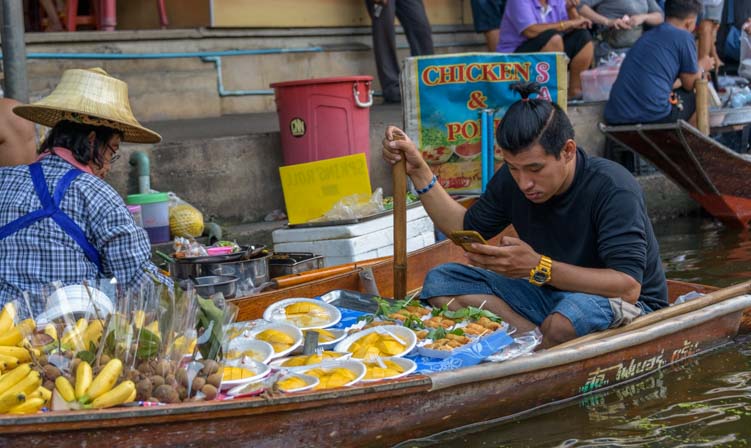
Vendor on cell phone damnoen saduak floating market Bangkok Thailand

A quick Facebook check between sales.

The Damnoen Saduak Floating Market could easily be a showpiece at Disney’s Epcot Center, but experiencing it on the outskirts of Bangkok gave it a certain kind of realism.

And what fun it was to immerse ourselves in an event that hints at a lifestyle lived long ago.

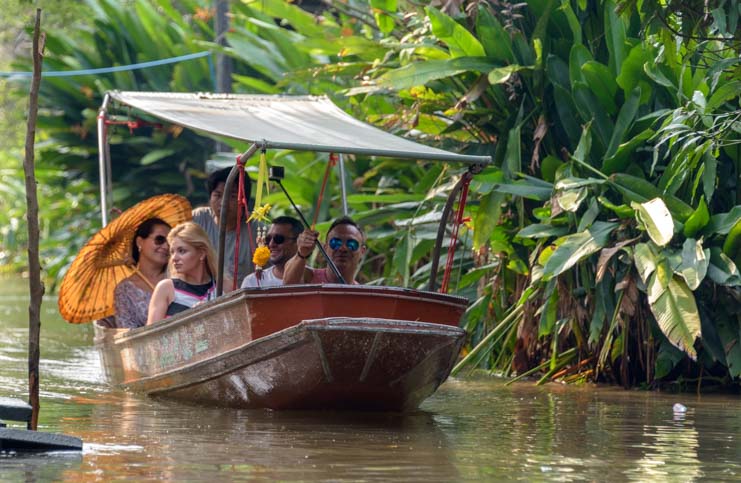
Tourists damnoen saduak floating market Bangkok Thailand

Slipping through the jungle on the canals was truly wonderful.

Little boy Damnoen Saduak Floating Market Bangkok Thailand

.

As we putted back to the parking area in our longtail boat, we passed some men holding jungle critters for us to see up close.

Furry animal Damnoen Saduak Floating Market Bangkok Thailand

.

Snake charmer Damnoen Saduak Floating Market Bangkok Thailand

Snake charmer.

As our taxi driver took us back to Bangkok, we passed signs for the Tha Kha market, the slightly more authentic floating market that I had originally wanted to go to. I tried to find out from the cabbie exactly why he hadn’t taken us there but couldn’t really understand his response.

Damnoen saduak floating market Bangkok Thailand longtail boat

The Damnoen Saduak Floating Market was a very fun excursion even if it wasn’t particularly authentic!

When we returned to our hotel, I asked the concierge about the Tha Kha market. I pointed out its location on the map and he called over some colleagues to discuss it with them. In the end, they all agreed that the Tha Kha market had been closed and there was nothing there to see any more.

Whether the Tha Kha Market is truly closed — or whether we were taken to a more touristy market in hopes we’d buy a few things — the Damnoen Saduak Floating Market was a great spot for photography and made for a memorable morning.

Subscribe
Never miss a post — it’s free!

Other blog posts from our travels in Thailand:

More info about the Damnoen Saduak Floating Market:

Fun markets we’ve visited in our travels:

Our most recent posts:

More of our Latest Posts are in the MENU.
New to this site? Visit RVers Start Here to find where we keep all the good stuff!!

<-Previous || Next->

One Day in Bangkok – A trip on the Chao Phraya Tourist Boat!

January 2017 – When we moved off our sailboat and back into our trailer three years ago, the main reason we ended our sailing cruise of Mexico was that we’d found exotic travel to tropical destinations was a lot easier by airplane than by boat. Many of our dream destinations were hard to get to in a sailboat!

Boat on Chao Phraya River Bangkok Thailand

River views from the Chao Phraya River in Bangkok, Thailand

Yet, the last exotic foreign destinations we’d visited were all in Mexico during that cruise. We hadn’t made good on our promise to ourselves to get on planes and fly to cool places!

So, last week we hopped on an airplane and flew to Bangkok, Thailand. We will be touring around the country for a month.

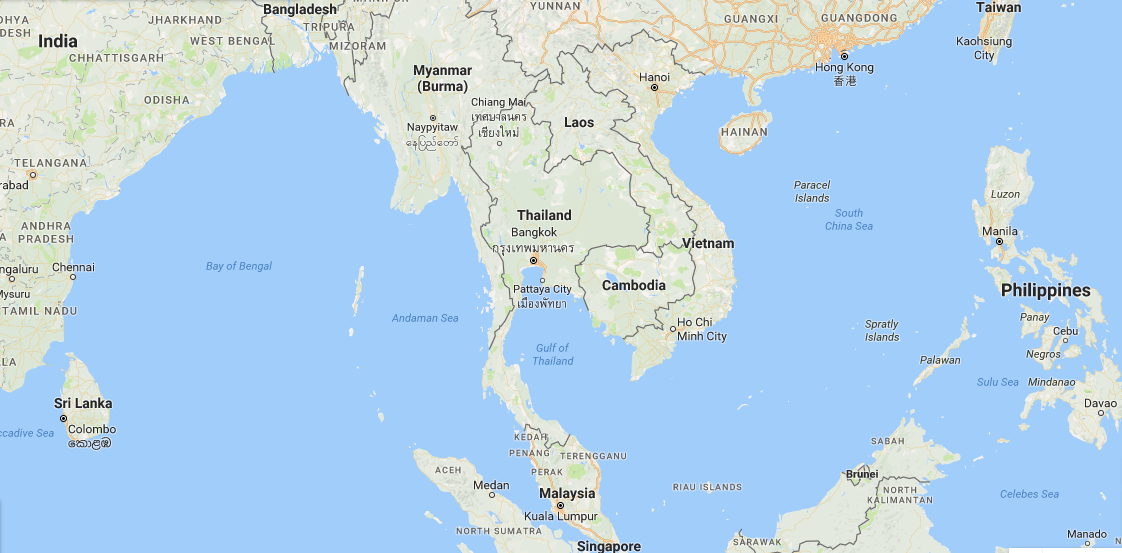
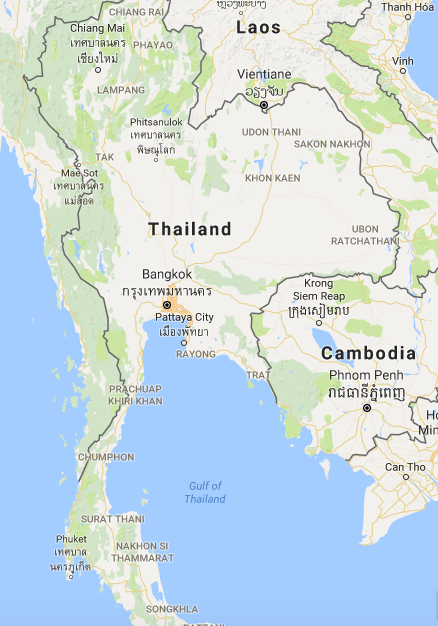
If you haven’t looked for Thailand on a map lately, it is located in Southeast Asia, bordered by Laos, Cambodia, Malaysia and Burma (Myanmar):

Southeast Asia Map

Southeast Asia

Bangkok, the capital of Thailand, is very close to the Gulf of Thailand, and a long skinny portion of the country drops south between the Gulf of Thailand and the Andaman Sea:

Thaland and Cambodia Map

Thailand

This was all news to us when we started thinking about going to Thailand a few months ago, as the only thing we knew about the country was that everyone we’ve ever talked to who’s been there absolutely loved it.

RVers we met in Montana last summer told us about the many happy winters they’d spent visiting Thailand, and a loyal reader of this blog who has lived in Thailand for 10 years encouraged us to throw caution to the wind and check it out.

So, I jumped into researching places to go in Thailand and came up with a four week plan that will hopefully introduce us to many beautiful facets of this country.

Of course, the first hurdle to all of it was getting through 28 hous of travel door-to-door. When we stepped off the plane in Taipei after 13 straight hours in impossibly tiny seats (the width of the seats, from armrest to armrest, was the length of my forearm from elbow to fingertips), we were bleary eyed.

But how exciting it was to realize we had actually arrived in Asia!

Welcome to Taipei

We landed in Taipei, Taiwan, for a layover – We’re in Asia!

Once we finally got out on the streets of Bangkok, stumbling all over ourselves from lack of sleep, we were instantly caught up in the vivid sights and sounds and smells of downtown Bangkok as scooters, buses, tuk-tuks and intrepid bicyclists jammed the streets around us.

It felt like we were back in Mexico, except the writing on the signs was totally different!

Bangkok Thailand Road Sign

Thank goodness for the hints in English!

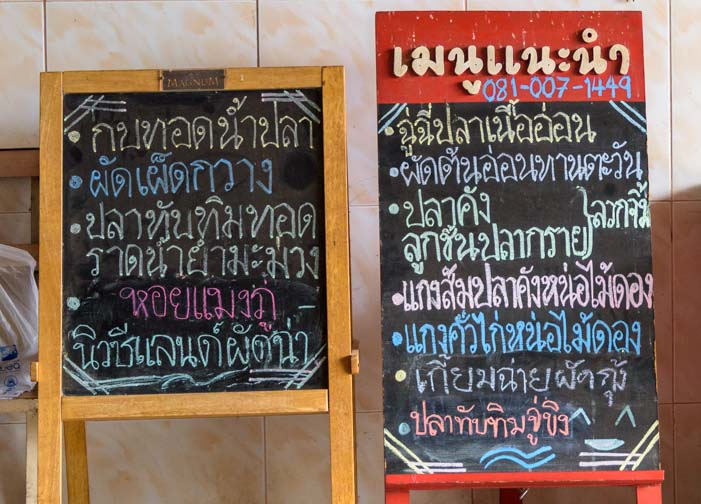
Thai menu in Thailand

What would you like for lunch?

We’ve been told that Thailand has two seasons: Hot and Hotter. We were there in the Hot season of January, so the daily highs were a balmy 90 degrees with 70% humidity, quite a change from the cool and dry Arizona desert climate in mid-winter.

Street vendor Bangkok Thailand

A Bangkok street vendor grins at me as he walks by

The locals were all cool as cucumbers, though, and motorbikes lined up at every Intersection as if they were at the startling line of a race.

Motorbikes line up at intersection in Bangkok Thailand

Motorbikes lead the pack in Bangkok’s notorious traffic.

Street vendors were selling food and drinks of all kinds and exotic smells filled the air.

Street Food Bangkok Thailand

We found street food everywhere in Bangkok

Bangkok is known as Krung Thep (กรุงเทพ), or the City of Angels, just like Los Angeles. But an aspect of its soul may be closer to Las Vegas’ Sin City.

I found myself humming the 1980’s son, “One Night in Bangkok” and looked up the lyrics and YouTube video only to learn that it was written for the musical “Chess” and talks of the irony of a nerdy international chess tournament being held in this city of sensual pleasures.

A hundred years ago or so, Bangkok was considered the Venice of the East, as it was built on a canal system and everyone got around town by boat.

On our first full day in Bangkok, we wanted to get an overview of the city as it looks from the water. So we took the Skytrain from our hotel to the public boat pier on the Chao Phraya river near Saphan Taksin station. Mark made his way through the many buttons on the Skytrain ticket machine, and we joined the throngs that travel through Bangkok by train everyday.

Getting train ticket in Bangkok Thailand

Bangkok’s Skytrain is super easy to use.

Chao Phaya Tourist Boat is a hop-on-hop-off ferry system that is just 150 Thai Baht (about US $4.50) per day. Perfect! Within moments we were out on the water.

Boats and buildings Chao Phraya River Bangkok Thailand

The Chao Phraya river runs through downtown Bangkok

Boats of all kinds were zooming up and down the river. There was so much boating action that the water was choppy from all the wake!

Boats on Chao Phraya River Bangkok Thailand

Bangkok’s Chao Phraya River is busy!

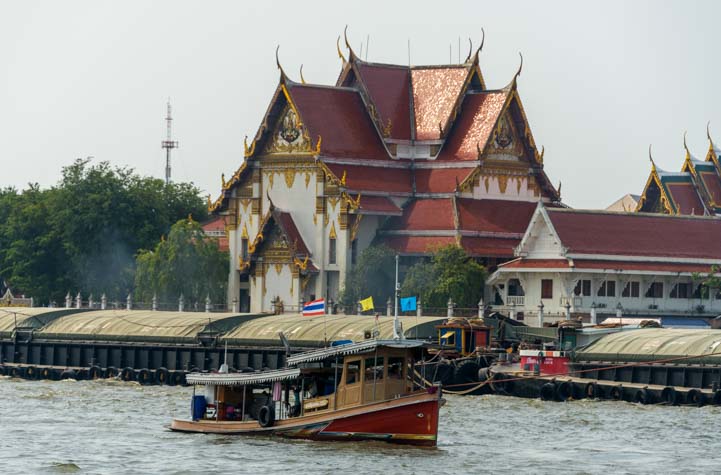
But the sights — oh my. Between the temples and highly ornamented buildings on the shoreline and the exotic boats plying the water of the river, we knew we had arrived in another world!!

Boat and temple Chao Phraya River Bangkok Thailand

We loved the classic images that surrounded us on the Chao Phraya Tourist Boat ride.

Boats seen from the Chao Phraya Tourist Boat Bangkok Thailand

What a great scene!

Thailand is a monarchy, and the much adored King Bhumibol Adulyadej (formally crowned King Rama IX of the Chakri dynasty) who ruled the Thai people for the last 70 years just died in October at age 88. Images of him, his 65 year old son who will replace him, and his wife are absolutely everywhere.

From splash screens across Thai websites to shrines in front of businesses built in his memory to billboards on the highways to the black pins and black clothing that many Thai people are wearing for a year of mourning, the sadness of this man’s passing is ever present.

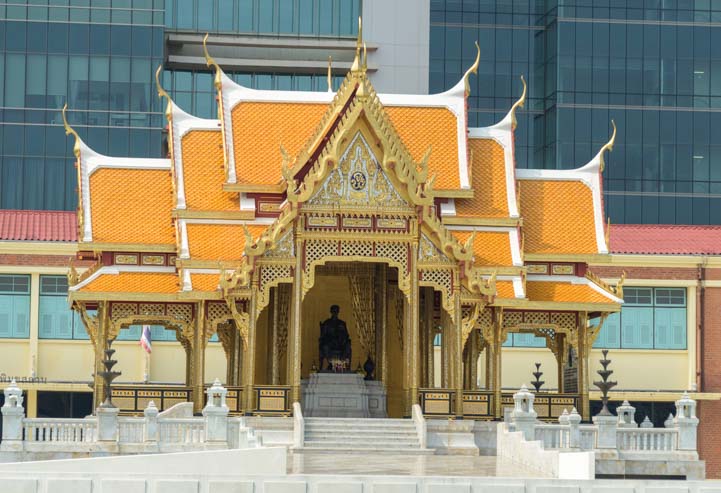
On the Royal Thai Navy Headquarters building we saw portraits of the royal family.

Royal Navy Headquarters Chao Phraya River Bangkok Thailand

Portraits of the royal family at the Royal Navy Headquarters.

There were all kinds of unusual sights to be seen all along the river’s edge.

Sighting on Chao Phraya River Bangkok Thailand

.

In the distance, we saw the spires of the Grand Palace appear over the rooftops.

Boat and Grand Palace Chao Phraya River Bangkok Thailand

Grand Palace spires peak over the roofs.

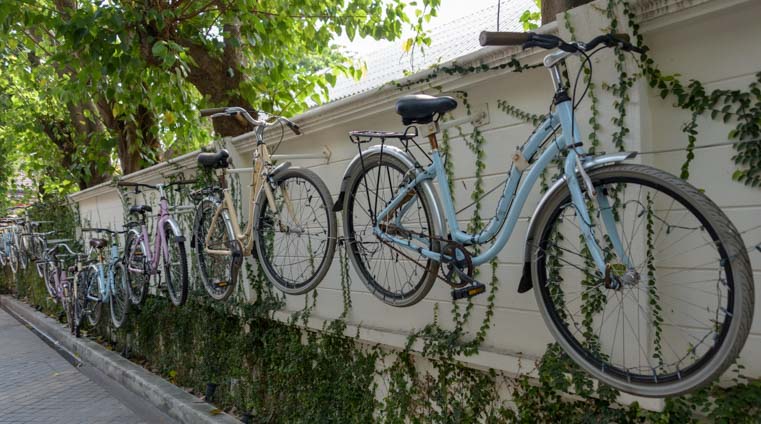
We got off at this stop to explore a little. As we made our way from the pier to the main street, we passed a creative display of bicycles hanging on a wall.

Bikes on a wall Bangkok Thailand

.

The throngs of tourists surrounding the enormous city block that makes up the Grand Palace was intense.

It was a Saturday, and thousands of people filled the streets in all directions. Many were Asian tourists led by a strident person out front holding a flag high in the air to keep the group together.

A passing Buddhist monk caught my eye.

Buddhist monk Bangkok Thailand

.

The Grand Palace was built in 1782, and the spires of its many buildings in the complex rose above the high white wall that encloses the palace grounds.

Grand Palace spires Bangkok Thailand

Peaks of the Grand Palace

Mark and I had to laugh as we snapped endless pics. Two days earlier we’d been boondocking in Arizona. Now we were in Bangkok!

Tourist at Grand Palace Bangkok Thailand

OMG – We’re in Thailand!!

In order to approach the entrance gate to the Grand Palace, we had to show our passports and walk through a metal detector and get wanded. From there we moved into a massive line outside the gate to buy tickets.

Ornate rooftop Grand Palace Bangkok Thailand

.

Grand Palace views Bangkok Thailand

.

There is a strict dress code for visitors to the Grand Palace — elbows and knees must be covered — and even though officials would lend us cover-ups, our hearts weren’t into touring the palace just yet. There was still so much to see on the river.

Ministry of Defence Grand Palace Bangkok Thailand

Ministry of Defence at the Grand Palace

So, we made our way back to the Chao Phraya Tourist Boat at the pier where a breeze on the water made the sultry heat bearable.

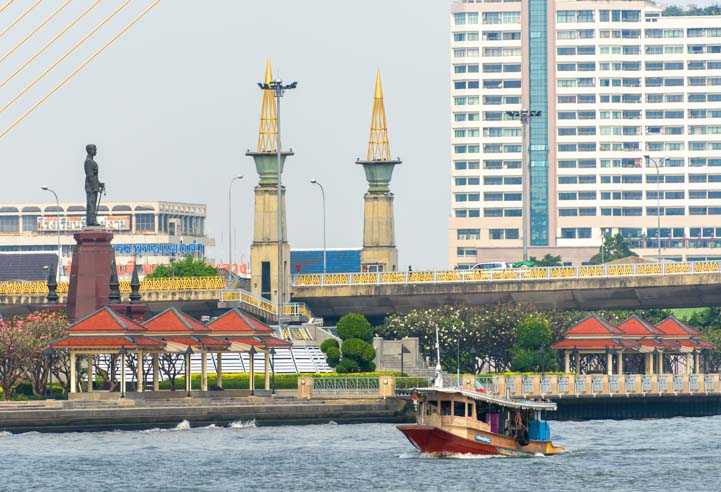
Up ahead, a public ferry boat passed us as we approached one of the modern suspension bridges that crosses the Chao Phraya River. These boats are just 40 Thai Baht (about $1.15 US) for a point-to-point ride, and we saw a few foreigners (“farangs”) taking these ferries. But to us, the few dollars more for an all day hop-on-hop-off pass on the tourist boat was worth every penny.

Boat and suspension bridge Chao Phraya River Bangkok Thailand

A public ferry boat is dwarfed by a towering suspension bridge.

Compared to the public ferries which were packed, there were no lines at the piers for the Chao Phraya Tourist Boats. The wait for a boat was never longer than a few minutes, there was always plenty of room on the boat, and we could listen to narration about what we were passing on the shore.

Lots of room on Chao Phraya Tourist Boat Bangkok Thailand

The “hop-on-hop-off” tourist boat wasn’t crowded and we never had to wait long to catch it.

As we floated along the river, we loved the juxtaposition of the old style boats, the historic Thai temples and the modern highrise business buildings.

Temple and highrise building reflections Chao Phraya River Bangkok Thailand

Reflections: Old meets new and East meets West.

Tourist Boat and suspension bridge Chao Phraya River Bangkok Thailand

Views from the river in Bangkok.

Temple and boat Chao Phraya River Bangkok Thailand

Getting out on the river is a great way to see the shore.

Lots of people live on the river’s edge, and we passed a few housing blocks where laundry was hanging out to dry.

Houses on Chao Phraya River Bangkok Thailand

Houses along Bangkok’s Chao Phraya River

The Chao Phraya river is very dirty, and a few large patches of leaves and debris floated past.

Debris and Houses on Chao Phraya River Bangkok Thailand

.

One man’s trash is another man’s treasure, though, and we noticed an egret standing in the middle of one debris pile.

Egret in trash on Chao Phraya River Bangkok Thailand

.

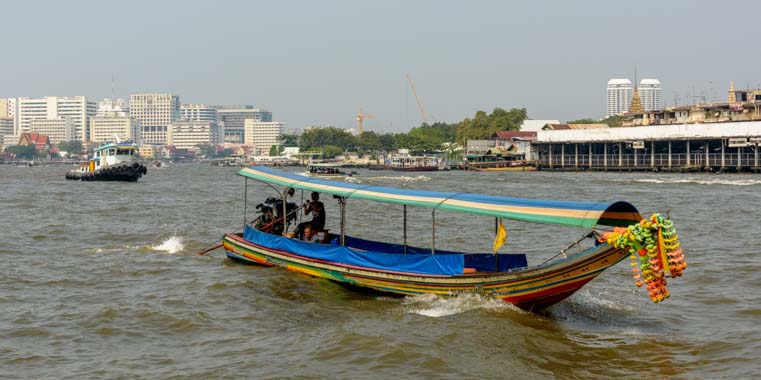
There are dozens of ways to get out on the Chao Phraya River in Bangkok, as many of the big city hotels offer their own tours for their guests and private longtail boats offer tours not only on the main river but onto some of the smaller canals too.

Longtail boat Chao Phraya River Bangkok Thailand

Tourists can take rides on longtail boats and float up some of the smaller canals.

These private tours can cost as much as 1,600 Thai Baht, or about $45 for an hour of driving around. For us, the Chao Phraya Tourst Boat with its all day hop-on-hop-off service was a much better deal!

Longtail boat Chao Phraya River Bangkok Thailand

Longtail boats offer private rides.

Getting out on the water in the Chao Phraya Tourist Boat is a great way to get an overview of Bangkok.

Longtail boat Bangkok Thailand Chao Phraya River

.

The Chao Phraya Tourist Boat makes 8 stops along the river. We started at the Sathorn Pier near the Saphan Taksin BTS (Skytrain) station (station #S6). After getting off the train, we simply walked down to the street level and asked a BTS station official which way to go to get to the pier.

After a short walk to the pier, we walked past the enormous line of people waiting to take the cheaper ferry boat and ignored the many vendors selling expensive longtail boat rides and made our way to the well marked “Tourist Boat” loading dock at the end.

BTS Map Bangkok Thailand

BTS Skytrain map. Chao Phraya Tourist Boat stops at Sathorn Pier next to Saphan Taksin station (S6) on the southern line.

Subscribe
Never miss a post — it’s free!

More info about Chao Phraya Tourist Boat:

Blog Posts from Other Tropical Winter Escapes in the Caribbean:

Our most recent posts:

More of our Latest Posts are in the MENU.
New to this site? Visit RVers Start Here to find where we keep all the good stuff!!

<-Previous || Next->

Our New Column in Trailer Life Magazine – Roads to Adventure!

We are very excited to announce that we are going to be writing and providing photos for a regular column in Trailer Life Magazine!

Trailer Life Magazine January 2017

Our column debuts in the January issue of Trailer Life Magazine.

For many years, the back page of Trailer Life has featured the unique stories and insights of RVer and writer Bill Graves.

Bill’s unusual tales from the less traveled roads of America have been such a delight to readers that we’ve heard people say that the first thing they do with Trailer Life is to flip it over and read Bill’s column on the back page.

I admit that I have done the same thing!

His stories provided a wonderful glimpse of life in America off the beaten path, and he ended each column with a fun tag line: “Welcome to America’s Outback.”

Bill has decided to retire from writing his column, and Trailer Life has asked us and travel writer Lisa Densmore Ballard to take turns luring readers to the back page.

We are thrilled to have been given this honor.

Trailer Life has named the new column “Roads to Adventure,” and we’ve come up with a new and different format for the column that will highlight our love of photography.

Each column will feature a beautiful photograph from a special place we’ve seen in our travels and will include a brief description of our experiences there.

Photography and RV travel Horshoe Bend Arizona

Our “Roads to Adventure” columns will bring you a stunning photo from an enchanting place.

We will be writing this column every other month beginning with the January, 2017, issue. Our first column is about the wonderful sweeping bend in the Colorado River that RVers can see when they make a trek to Horseshoe Bend, Arizona.

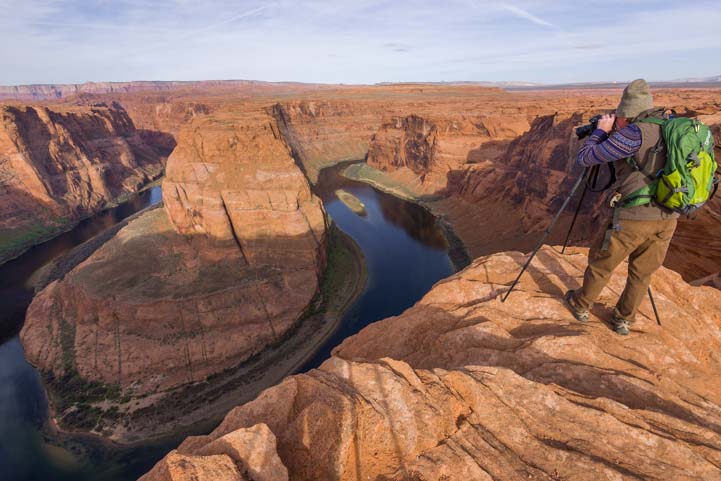
Photography at Horseshoe Bend Arizona

Horseshoe Bend is a fantastic place for RVers to do a little photography.

This is a gorgeous spot that is well worth making a detour to see. We wrote in detail about our experience at Horseshoe Bend and shared lots of photos in the following blog post:

Horseshoe Bend Overlook in Arizona – Stunning!

We were utterly smitten when we visited, both by the immense size and scale of the cliffs and by the crazy antics tourists did on out on the hairy edge. We took endless photos, and one of Mark’s finest is the one that Trailer Life chose for our debut column.

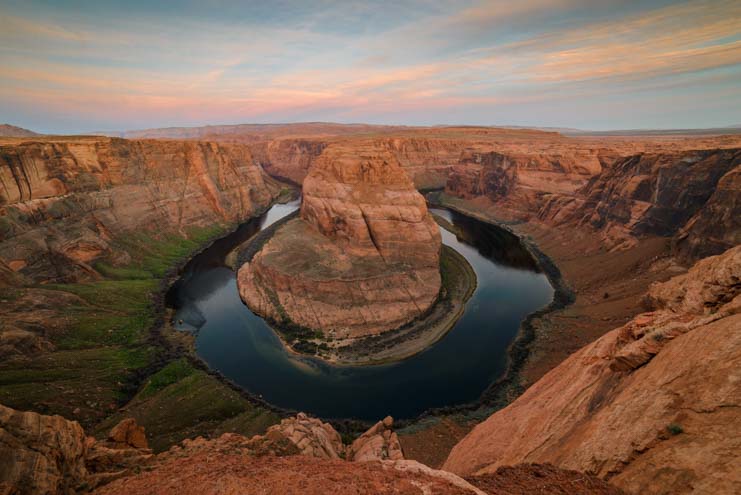
Sunset was a wild time at Horseshoe Bend with hoards of people taking selfies and photographers lining up at the edge, tripod to tripod, watching the sun slip away on the horizon. Sunrise, however, was peaceful and still and hauntingly beautiful.

Even though the sun rose at our backs, it was a thrill to watch the shadows disappear down the rock walls under the pink sky in front of us as it climbed higher and higher in the sky.

Sunrise at Horseshoe Bend Arizona

Although famous for its sunsets, our favorite moments at Horseshoe Bend were at sunrise!

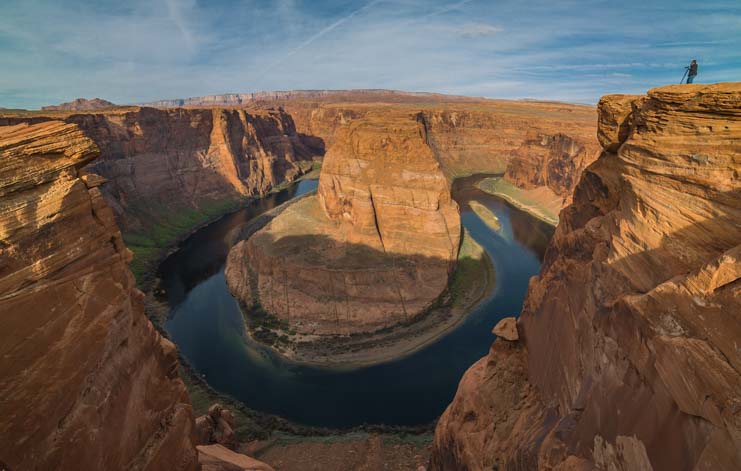
We captured many wonderful images at Horseshoe Bend, and one of Mark’s just won the Photo of the Day at Steve’s Digicams a few days ago. This is the fifth photo of his that has been featured on that website.

 Horseshoe Bend Arizona

Horseshoe Bend, Arizona – What a place!

Both for seasoned RVers and for those that are new to the hobby, Trailer Life is an informative magazine that offers lots of RV tech tips, overviews of major RV upgrade projects as well as enticing travel destination features.

You can subscribe to the print and digital editions at these links:

We have lots more fun destinations in store for Trailer Life readers from the many places we’ve visited over the years, and we hope that our spot on the back page will be one that readers turn to.

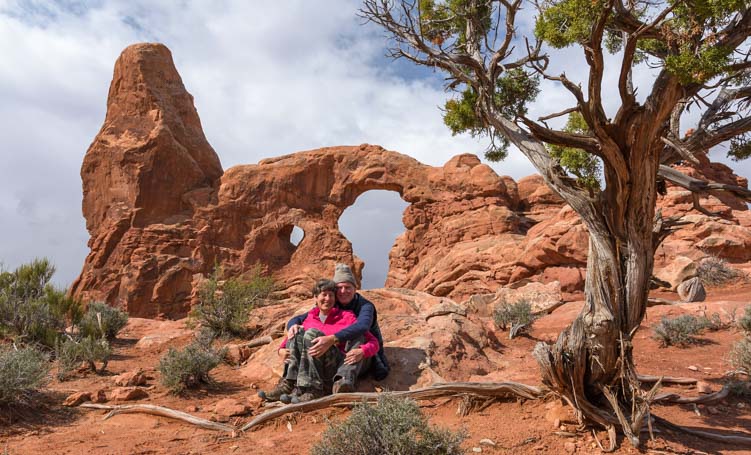
All smiles at Horseshoe Bend Arizona

Look for us on the back page of Trailer Life Magazine!

Subscribe
Never miss a post — it’s free!

Other blog posts from our travels in northeastern Arizona:

Our most recent posts:

More of our Latest Posts are in the MENU.
New to this site? Visit RVers Start Here to find where we keep all the good stuff!!

2016 – A Year of RV Travels in the National Parks

When 2016 burst upon us last year, our only goal for the year was to take our RV to the Canadian Rockies. As it turned out, on the way there and again on the way back, our year of full-time RV travels took us to a slew of National Parks.

Lake Louise in Banff National Park Alberta Canada

Lake Louise, Banff National Park, Alberta, Canada

By mid-year, we had visited so many that we gathered all of our National Parks adventures from our nearly 10 years of travels onto one page:

National Parks and UNESCO World Heritage Sites Travel Adventures

We always keep a list of our most recent posts at this link (under “Latest” in the menu bar). But we also wanted to share our yearlong journey from 2016 on one page for RVers and other travelers who would like to follow in our path.

Arches National Park Utah

Arches National Park, Utah

Living as we do is a dream come true for us, and we began the year with some reflections on what it takes to live the dream. We were in Phoenix, Arizona, to ring in the new year where we enjoyed some wonderful encounters with wild (feral) parrots that take up residence in the saguaro cacti.

Peach faced lovebird parrot saguaro cactus Scottsdale Arizona

A peach faced lovebird perches on a saguaro cactus in Phoenix, Arizona.

From Phoenix we made our way to Quartzsite, Arizona, the RV gathering place.

Quartzsite Arizona RV boondocking in the desert

Quartzsite, Arizona, is the RV Gathering Place each winter

The Quartzsite RV Show was in full swing in this crazy truck stop town where the name of the game is “Anything Goes.”

Quartzsite Desert RV Boondockging AZ

Sunrise in the Arizona desert in Quartzsite

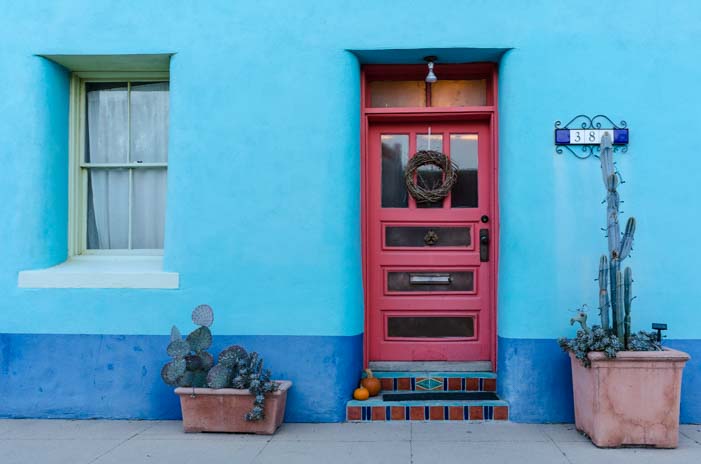
From Quartzsite we headed east to Tucson, Arizona, where the historic part of town is filled with wonderful old adobe doorways.

Adobe door in Historic Tucson district Arizona

Historic Old Town Tucson in Arizona

We visited the beautiful Xavier Mission in Tucson which evokes the days of the Spanish explorers.

Front San Xavier del Bac Mission Tucson Arizona

San Xavier Mission, Tucson, Arizona.

We found even more ancient history among Saguaro National Park’s ancient Indian petroglyphs. This was our first National Park visit of the year, and we discovered wonderful native Arizona animals in their habitats at the Arizona-Sonora Desert Museum there as well.

Arizona Sonoran Desert Musuem Tucson Mountain Lion

A mountain lion at the Arizona-Sonora Desert Museum in Tucson, Arizona.

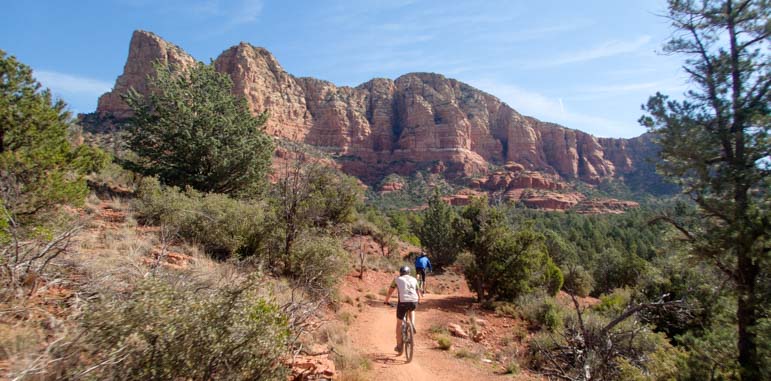
Despite being February, temps suddenly hit 90+ degrees in Tucson, so we began our trek north, stopping in Sedona, Arizona, to ride our bikes on the Bell Rock Pathway and hike The Crack at Wet Beaver Creek.

Mountain Bikers Bell Rock Pathway Sedona Arizona

The Bell Rock Pathway is an easy hike or bike ride in Sedona’s quintessential red rock scenery

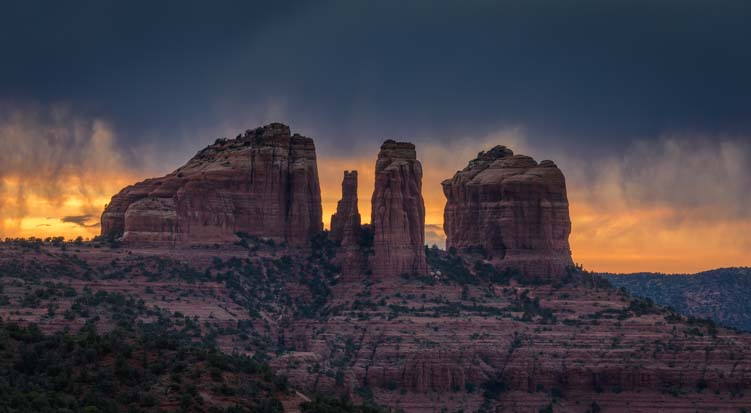
We took in some sunsets under stormy skies.

Cathedral Rock at sunset Sedona Arizona

Sunset peeks through brooding skies at Cathedral Rock in Sedona, Arizona

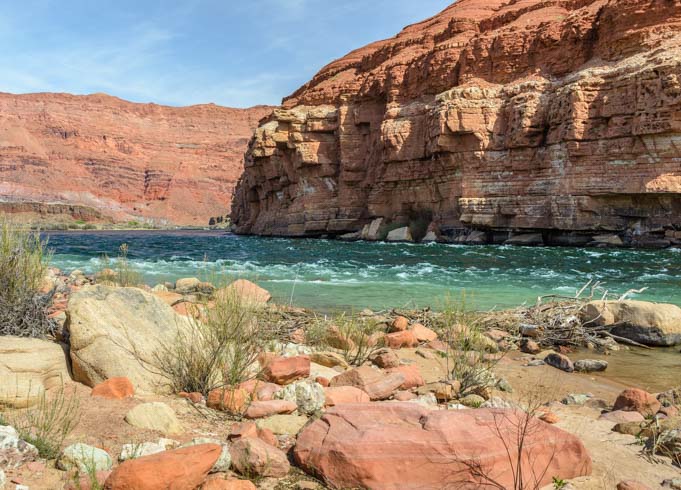
In early March, we witnessed another stunning sunset and sunrise at Horseshoe Bend Overlook near Page, Arizona and explored Lees Ferry and Marble Canyon nearby.

Horseshoe Bend Sunset Arizona

Horseshoe Bend, Arizona

Paria Riffle and Paria Beach Lees Ferry Arizona

The Paria Riffle at Lees Ferry, Arizona

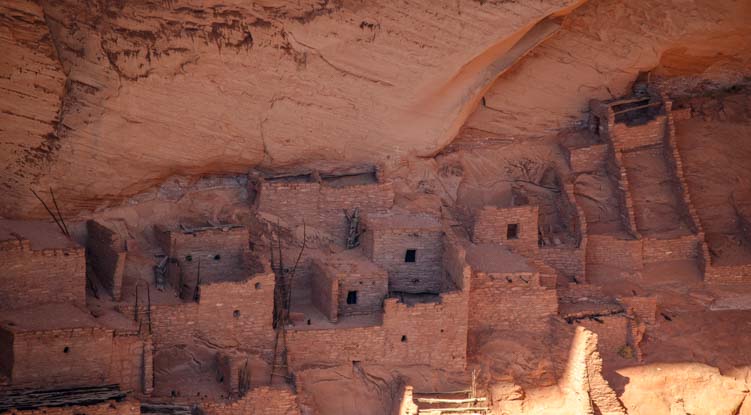
The ancient Indian ruins at Navajo National Monument and Monument Valley beckoned, and we learned about the proposed (and staggeringly massive) Bears Ears National Monument. For the next few weeks we would travel in and around the land area that would become Bears Ears National Monument by year’s end.

Ruins at Navajo National Monument Arizona

Betatakin cliff dwelling ruins at Navajo National Monument.

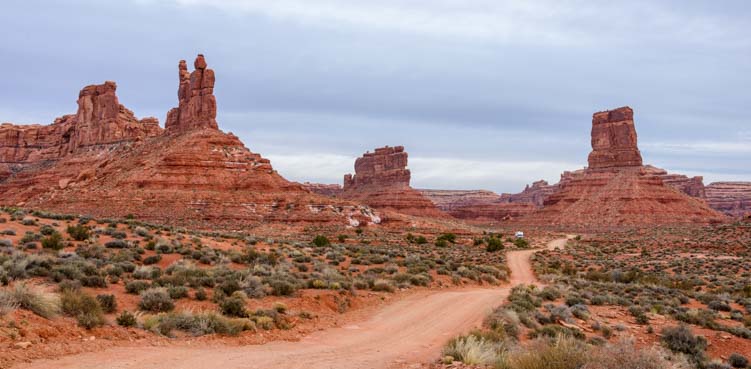
At Valley of the Gods and Goosenecks State Park, we were swept us up in the otherworldly red rock beauty of southern Utah.

Valley of the Gods Utah Scenic Drive

Valley of the Gods, Utah.

It was only mid-March, so a surprise snowstorm at Newspaper Rock wasn’t really a surprise.

Ancient Indian Petroglyphs Newspaper Rock Utah Mixture

A few of the hundres of petroglyphs at Newspaper Rock in Utah

Southern Utah is peppered with stunning scenery and National Parks, and our eyes were popping as we hiked the Needles District of Canyonlands National Park.

Canyonlands National Park Needles District Utah

Canyonlands National Park – Needles District.

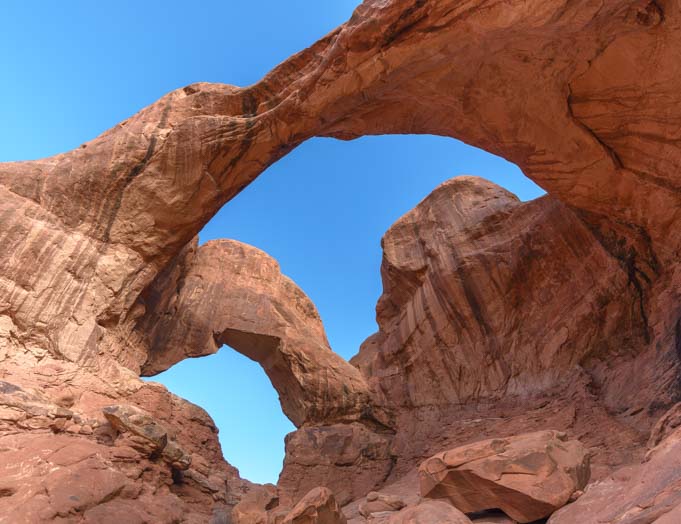
We took in Moab’s gorgeous snowcapped mountain views and visited Arches National Park.

Double Arch Arches National Park Utah

Double Arch in Arches National Park Utah

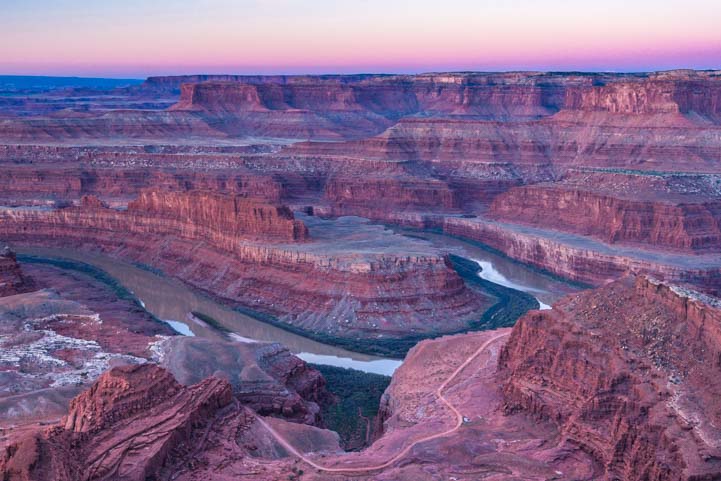
Nearby, we witnessed a stunning sunrise at Dead Horse Point State Park, a spit of land that is embraced by the much bigger Island in the Sky District of Canyonlands National Park where we enjoyed brilliant night skies.

Dead Horse Point State Park Utah Before Dawn

Dead Horse Point State Park, Utah

It was now April, and it was warm enough to take our trailer further north through southeastern Idaho’s picturesque mountains and farmland.

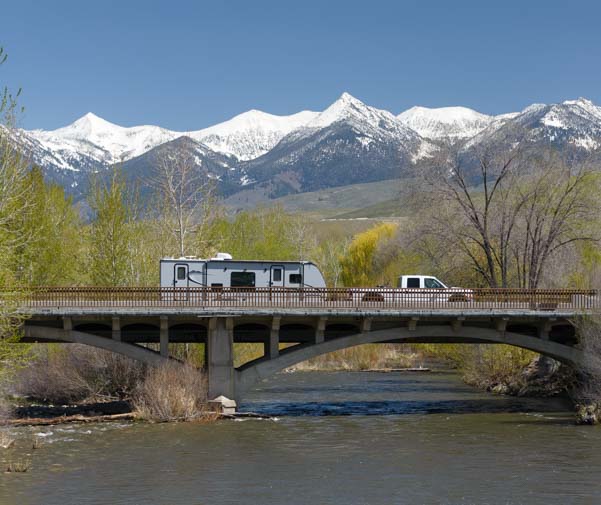
RV travel trailer on bridge Salmon Idaho

RVing Idaho’s back roads on the Salmon River.

We traveled along US-93 following the Salmon River through Challis and Salmon, Idaho.

RV roadtrip through southeastern Idaho mountains

Idaho in early Spring

Driving up through the Bitterroot Valley of Montana, we watched a herd of elk cross the highway in front of us.

Elk crossing road Bitterroot Valley Montana

.

We had a chance to sample a little cowboy life and cattle ranching too.

Riding horses in the Bitterroot Valley of Montana

Savoring the views of Montana’s Bitterroot Valley on horseback.

In Phillipsburg, Montana we discovered a sweet town that’s been dubbed one of “America’s Prettiest Painted Places.”

Philipsburg Montana main street

Philipsburg, Montana, one of “America’s Prettiest Painted Places.”

Early May found us on the western side of Montana’s Glacier National Park before the park was really open for the season. Placid Lake McDonald shimmered lovely reflections.

Lake McDonald Glacier National Park RV travel

Lake McDonald, Glacier National Park

Crossing into British Columbia, Canada, we had finally arrived in the Canadian Rockies. We were blown away by the casual attitude of the big horn sheep who wander all over the roads in and around Kootenay National Park.

Big horn sheep crossing a road in British Columbia

Big Horn Sheep just outside Kootenay National Park, British Columbia, Canada

Kootenay National Park gave us glimpses of bears nibbling Spring’s earliest treats, but our arrival at Lake Louise was when we began to feel like we were in the heart of the Rockies!

Lake Louise in Banff National Park Alberta Canada

Lake Louise, Banff National Park, Alberta, Canada

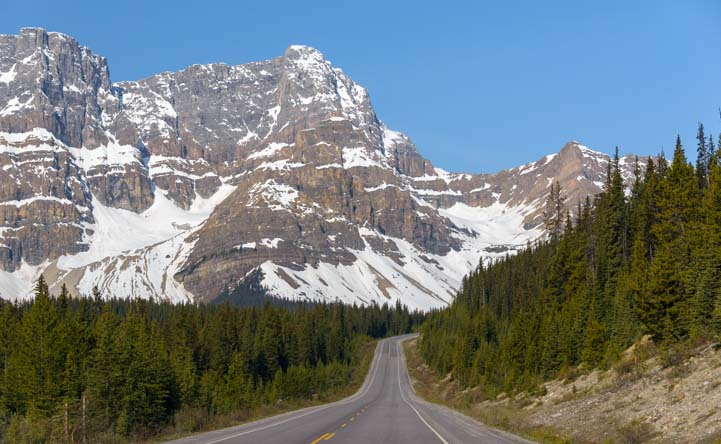
We took several trips up and down the southern half of the Icefields Parkway, a scenic drive like no other.

Icefields Parkway Banff National Park Alberta Canada

Icefields Parkway, Banff National Park, Alberta, Canada

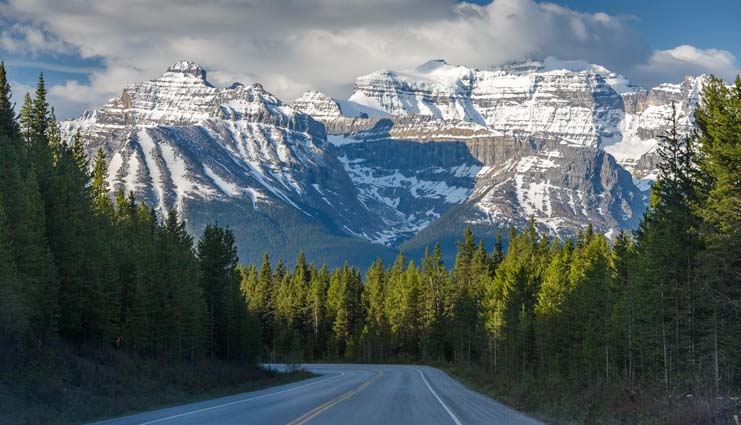
We were stunned by the majesty of the towering snowcapped mountains all around us in Banff National Park.

Rental RV Icefields Parkway Banff National Park Canada Rocky Mountains

Icefields Parkway, Banff National Park, Alberta, Canada.

Icefields Parkway Banff National Park Alberta Canada

Icefields Parkway, Banff National Park, Alberta Canada

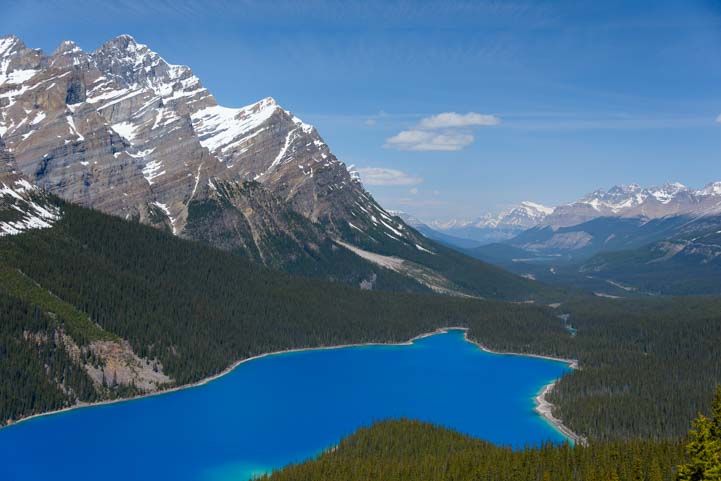
On the Icefields Parkway, which included a stop at royal blue Peyto Lake, we felt like we were driving on a highway right across the pages of a brochure for the Alps.

Peyto Lake Icefields Parkway Banff National Park Alberta Canad

Peyto Lake in Banff National Park is an incredibly vivid royal blue.

In contrast, we reached picture perfect Moraine Lake in Banff National Park by bicycle, and we had it almost to ourselves because the road to it was still closed for the season.

Moraine Lake Banff National Park Alberta Canada

Moraine Lake, Banff National Park, Alberta, Canada

Canada has four National Parks that are adjacent to each other in the heart of the country’s best Rocky Mountain scenery, split between the provinces of Alberta and British Columbia. On our trip to Emerald Lake in Yoho National Park, we bumped into the fabulous waterfall at Natural Bridge.

Natural Bridge Yoho National Park British Columbia Canada Rocky Mountains

Natural Bridge surprised us on our way to Emerald Lake in Yoho National Park, British Columbia, Canada.

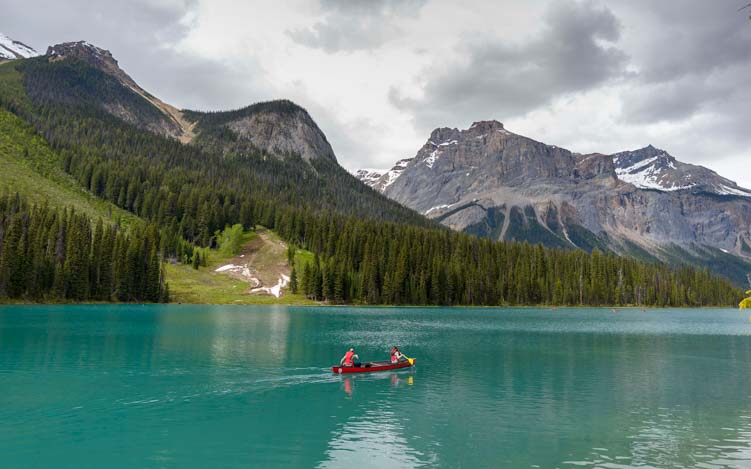
Emerald Lake Yoho National Park Alberta Canada

Emerald Lake, Yoho National Park, British Columbia, Canada

Banff, Alberta, has been a resort town since its inception, and we met an inspiring pair of young artists at the historic hotel in town.

Banff Alberta Canada and Cascade Mountain Canadian Rockies

Banff, Alberta, Canada

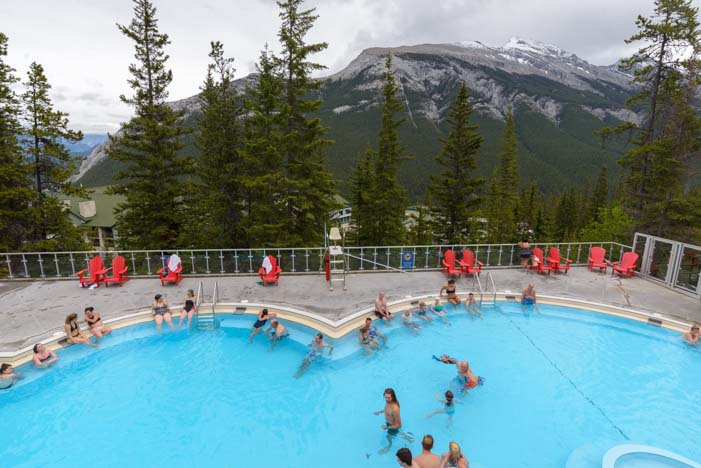
It was late May by now, and we celebrated our 9th anniversary of full-time travel by splashing around in the outdoor hot springs that bring a touch of summer to Canada’s snowy Rockies year round.

Banff Upper Hot Springs Alberta Canada

Banff Upper Hot Springs, Banff National Park, Alberta, Canada.

Visiting Athabasca Falls in Jasper National Park and spending some time in the outdoorsy town of Canmore rounded out our visits to this part of the Canadian Rockies.

Snow Icefields Parkway Jasper National Park Alberta Canada

Beautiful patterns of snow on the mountains near the Columbia Ice Fields.

But there was still more to come with a scenic drive through jaw-dropping Kananaskis Country, where some of the 1988 Winter Olympic events were held.

Sunrise Kananaskis Country Canadian Rockies

Dawn in Kananaskis Country.

Dropping south from there, we visited Waterton Lakes National Park, Canada’s sweet little sister to Montana’s Glacier National Park.

Horseback riders Waterton Lakes National Parks Canada

Waterton Lakes National Park, Alberta, Canada.

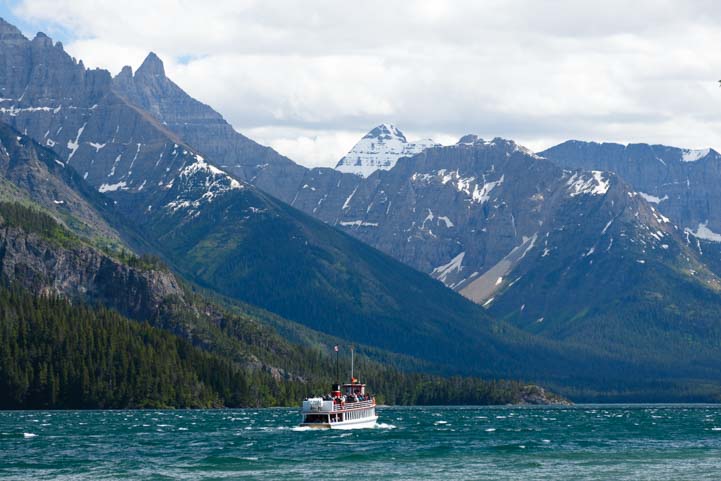
Waterton Lakes National Park is a beautiful jewel in Canada’s National Park system. Taking the Waterton Shoreline Cruise on a historic ship to the southern side of the lake in Montana gave us even more incredible views.

Waterton Shoreline Cruise Waterton Lakes National Park Canada

Waterton Shoreline Cruise in Waterton Lakes National Park, Alberta, Canada

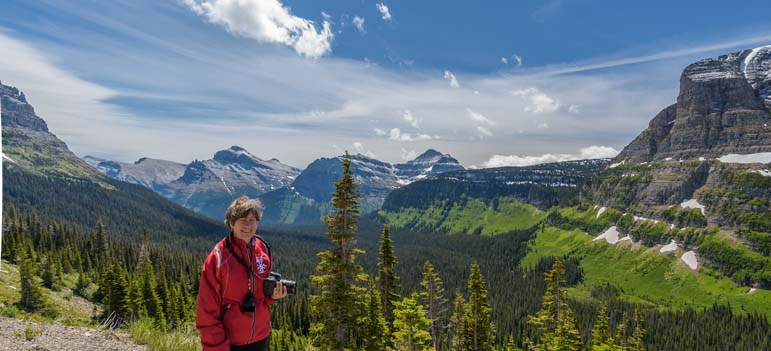
We were now well into June, yet when we arrived in Saint Mary on the east side of Glacier National Park, we were surprised to learn that the Going to the Sun Road that traverses the Park was just opening!

Happy camper Glacier National Park Montana

Going to the Sun Road in Glacier National Park, Montana.

The heat of the summer was on in full force by the 4th of July, and after all those National Parks we were ready to spend some time in quiet, less visited communities. We found just that in pretty Libby, Montana, where we spent happy days watching eagles and hummingbirds.

Lake Koocanusa at sunset Libby Montana

Sunset in Libby, Montana

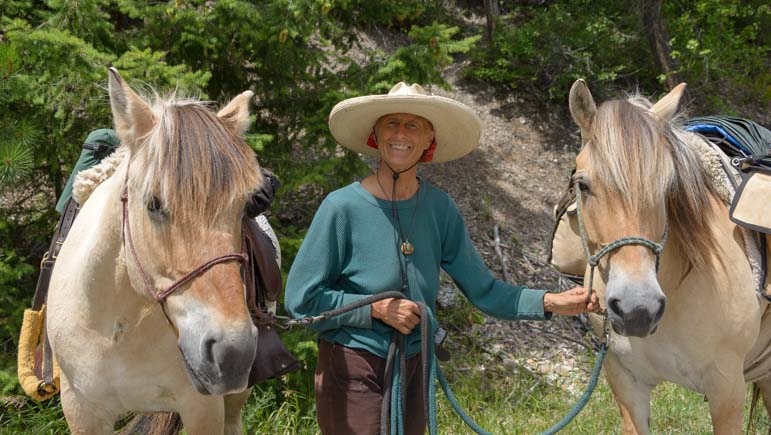
We met some special travelers while we were there: a lady who had traveled cross country by horse for many years and a couple sightseeing by bicycle.

Bernice Ende on 28,000 mile long horse back ride

Long Rider Bernice, and her beloved mares Essie Pearl and Montana Spirit.

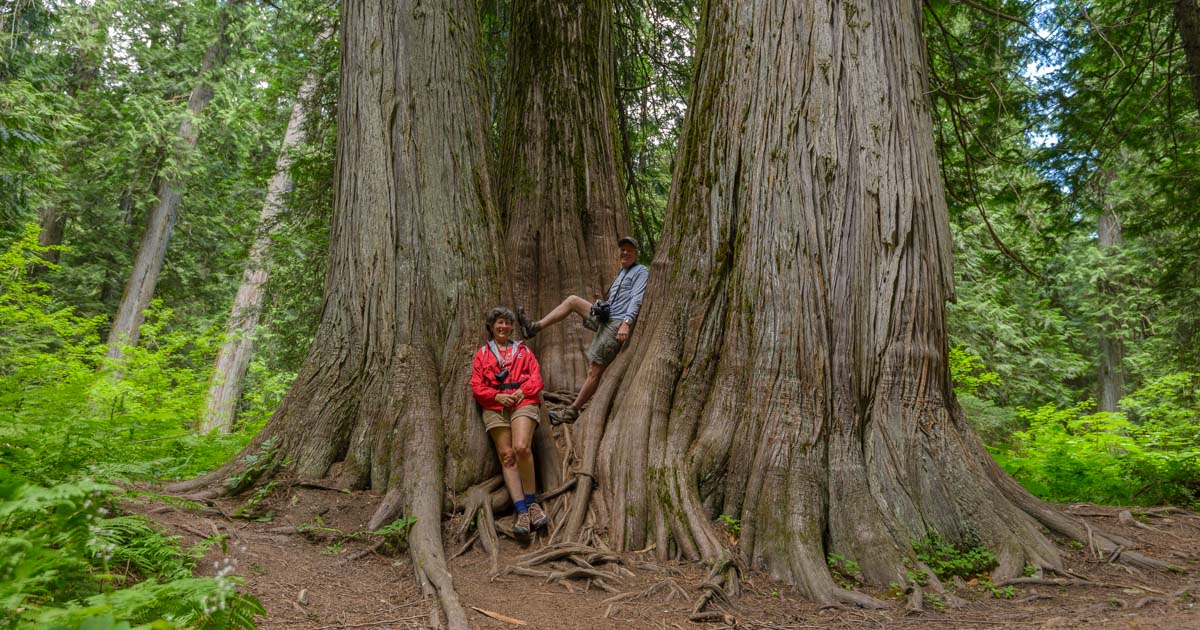
Nearby, we visited Kootenai Falls and Ross Creek Cedars, Montana’s answer to California’s sequoias.

Ross Creek Cedars Scenic Area and Kootenai Falls MT RV trip

Ross Creek Cedars Scenic Area, Montana

As we dropped down along the back roads of Idaho, we visited the charming small towns of Sandpoint, Moscow and McCall.

RV Trip from Sandpoint Idaho to Moscow and McCall on the Little Salmon River

Idaho’s back roads

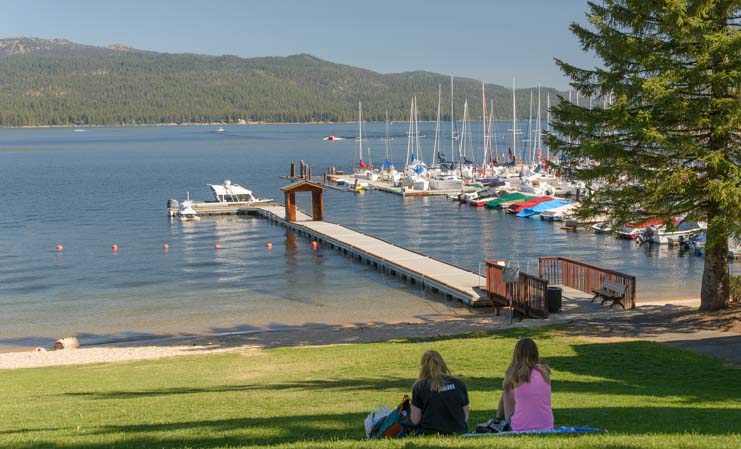
What an absolute delight it was to find a summer beach town in the middle of Idaho’s mountains perched on Payette Lake.

Payette Lake shore near Legacy Park McCall Idaho

McCall, Idaho, is a fantastic beach town!!

Unfortunately, the summer months in America’s west always bring huge wildfires, and we soon found ourselves dodging fires and smoke. We had planned to spend several weeks in beloved Sun Valley Idaho, but were chased away by smoke.

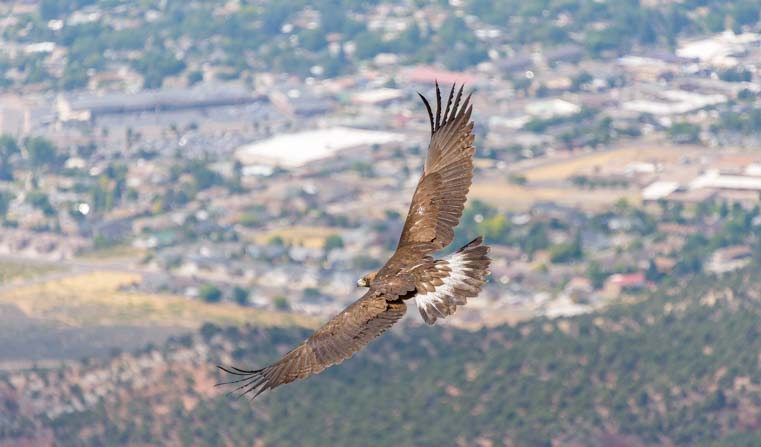
Dashing far down south, we landed in Cedar City, Utah, where we witnessed a most moving event: the release of a golden eagle in honor of America’s First Responders.

Golden eagle release Cedar City Utah Southwest Wildlife Foundation

A rehabilitated Golden Eagle flies to freedom, honoring America’s First Responders.

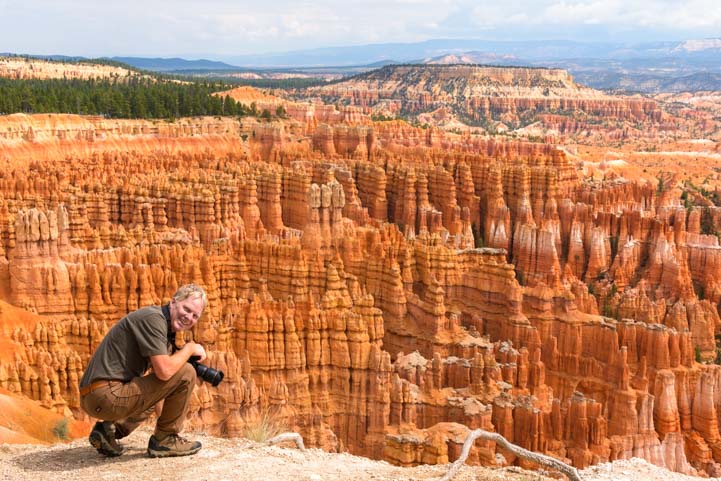
Just like the Banff area in the Canadian Rockies, we were once again situated in a sea of National Parks. Cedar Breaks National Monument is a lesser known gem in the area, but it is Bryce Canyon National Park that really knocked our socks off (as it always does, no matter how many times we see it).

Photography at Bryce Canyon National Park Inspiration Point Utah

Bryce Canyon National Park, Utah

After walking along the Rim Trail with our eyes popping, we then explored special parts of Bryce Canyon we’d never visited before.

Navajo Loop Trail Bryce Canyon National Park Utah

Hiking down into the hoodoos in Bryce National Park, Utah.

We hiked the Fairyland Trail and took our bikes on the newly extended Bryce Canyon Bike Trail.

Windows Fairyland Trail Bryce Canyon National Park Utah

.

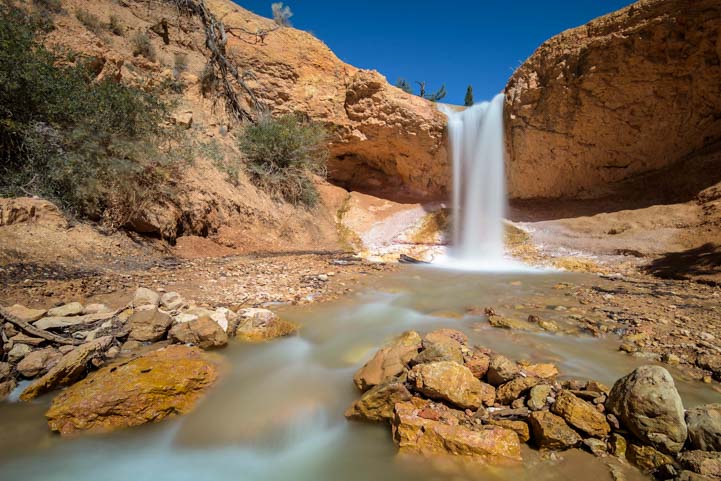
We even discovered a year-round waterfall in the Park.

Mossy Cave Trail Waterfall Mossy Cave Trail Bryce Canyon National Park Utah

Bryce Canyon’s Waterfall.

Mother Nature was in grand form while we were there, letting loose several August hail storms that pelted the area, but rainbows appeared and the sun shone as we wandered among the thousand year old bristlecone pine trees at Rainbow Point.

Bristlecone Pine Shadow Rainbow Point Bryce Canyon National Park Utah

A bristlecone plays with its shadow

Satiated with red rock scenery, we were ready for some fall color, so we spent much of September crossing Utah from west to east. Scenic Byway 12 is a stunning drive, and we stopped along the way to do the wonderful Lower Calf Creek Falls hike.

Sunshine waterfall Lower Calf Creek Falls Grand Staircase Escalante Utah

Lower Calf Creek Falls, Utah.

A little further on, we drove between the towering cliff walls of the Burr Trail.

Red rocks Burr Trail Scenic Byway 12 Utah

Burr Trail, Utah.

Arriving in Colorado in late September, we drove the fabulous San Juan Skyway through the dazzling fall color.

Motorcycle in fall colors San Juan Skyway Colorado Rocky Mountains

Fall colors on the San Juan Skyway, Colorado

A surprise snow storm turned the world into a spectacular landscape filled with orange and yellow and a dusting of snow.

Golden aspen and pine trees San Juan Skyway Colorado Rocky Mountains fall foliage

A dusting of September snow on Colorado’s San Juan Skyway.

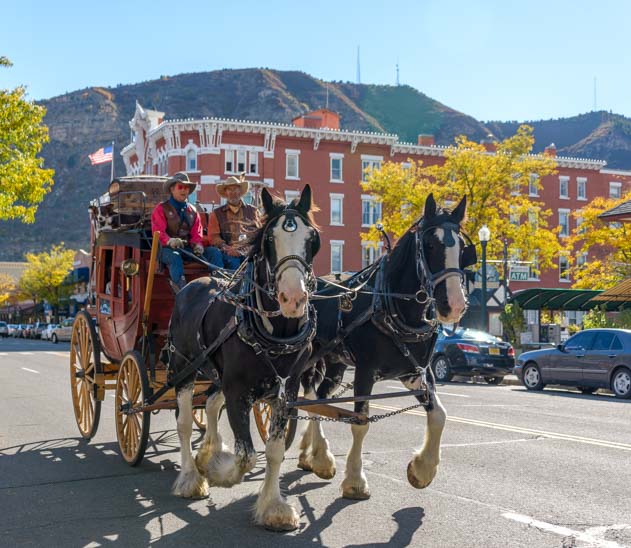
Life in an RV is cold when it snows, so we quickly dropped to Durango at the south end of the San Juan Skyway to enjoy a Cowboy Poetry Gathering.

Horse and carriage Durango Colorado

Durango, Colorado, is the perfect setting for a Cowboy Poetry Gathering.

Heading west across northern Arizona, we drove alongside the Vermillion Cliffs where we took a peek at the “Cliff Dwellers” roadside stop.

02 761 RV travel Vermillion Cliffs National Monument Arizona

Arizona’s Vermillion Cliffs National Monument

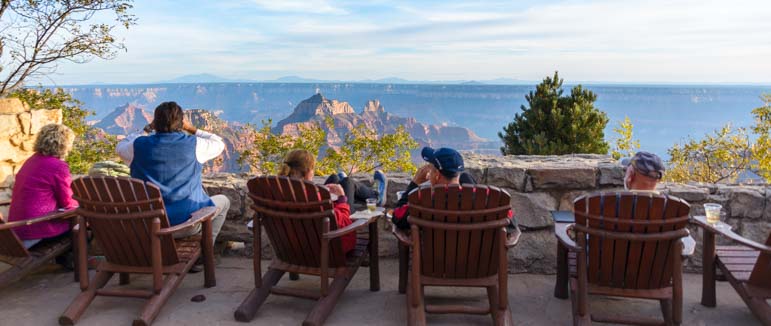
Our “National Parks” travel theme was so well established by now that we just had to make a quickie stop at Grand Canyon’s North Rim to do both day and night photography.

View from deck Grand Canyon Lodge North Rim Arizona

Tourists on the cozy back deck of the North Rim’s Grand Canyon Lodge in Arizona.

Milky Way at the Grand Canyon North Rim Arizona

Full moon and the Milky Way at the Grand Canyon’s North Rim!

Then we continued on to the majestic scenery of Zion National Park.

Virgin River Zion Canyon Zion National Park Utah RV trip

Zion National Park, Utah

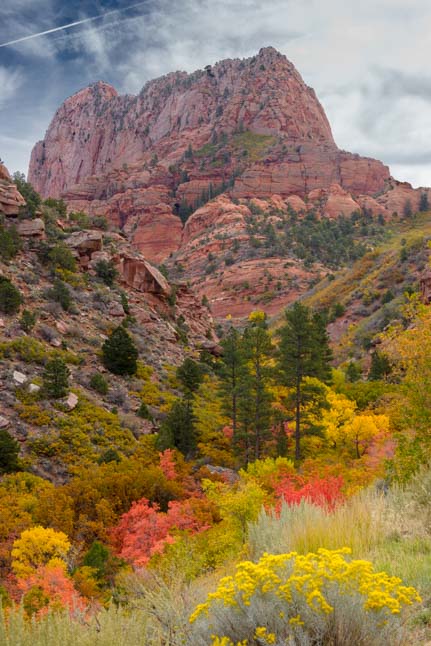
Exploring an area in Zion National Park that we hadn’t visited before, we did a hike into the autumn colors of Kolob Canyons on Taylor Creek Trail.

Autumn Leaves Kolob Canyons Zion National Park Utah

Zion National Park’s Kolob Canyons in Utah.

November and December saw us flitting between Arizona, California and San Luis Rio Colorado Mexico as we made several visits to our dentist and spent time socializing with friends.

Fabulous year of RV travels

What a fabulous year of RV travels!!
Moab, Utah

During 2016 we published quite a few non-travel posts as well. The links are below:

RV Tips, Tricks and Tech Topics:

Truck Related Topics:

RV Warranty & Repairs:

Lifestyle:

Product Reviews:

Dental Care on the Road:

Mexico’s Gold Coast:

An Overview of Our First 10 Years of Full-time Travel + Reflections after 9 Years!

Summaries of Each Year on the Road - All of our travel posts in chronological order:

Subscribe
Never miss a post — it’s free!

Our most recent posts:

More of our Latest Posts are in the MENU.
New to this site? Visit RVers Start Here to find where we keep all the good stuff!!

<-Previous || Next->

Visiting the Dentist in Mexico

Dentistry is really expensive these days, and RVers that make their way south in the wintertime can take advantage of the good quality dental care that is available just over the border in Mexico.

The November/December 2016 issue of Escapees Magazine features our article about some of the great experiences we have had with dentists in Mexico just across the border from Yuma, Arizona, in San Luis Rio Colorado, Mexico.

Mexican Dentistry Escapees Magazine Nov-Dec 2016

Escapees Magazine Nov-Dec 2016
Article by: Emily and Mark Fagan

Escapees has posted the article on their website at this link:

The Affordable Alternative of Mexican Dentistry

Our dentist, Dr. Sergio Bernal, is a general practitioner in San Luis Rio Colorado just over the border from San Luis, Arizona (south of Yuma).

Last year he coordinated and oversaw a root canal I had done in a tooth that already had a crown on it (described in detail here).

Eight years ago, Dr. Bernal put a porcelain crown on a baby tooth of Mark’s that had never fallen out. It was an exccellent crown and very easy procedure.

The crown was fabricated by the lab and ready to be installed within 18 hours of us arriving at Dr. Bernal’s office for the very first time. It fit perfectly and cost just $130.

Mark always said it was the best crown in his mouth.

Unfortunately, the baby tooth under this crown came loose this past October, and Mark was suddenly in a lot of pain. He needed another solution.

Ironically, this happened just as the issue of Escapees Magazine with our article about Mexican dental care was being mailed out to Escapees members.

Because we lived on our sailboat in Mexico for the better part of four years, we have enjoyed top notch dental care all over Mexico, from the Arizona border to the beautiful Bays of Huatulco very near the Guatemala border.

We have always been very satisfied with both the dental care and the price.

With Mark’s tooth aching, we dashed to Yuma and then zipped across the border from San Luis, Arizona, to San Luis, Mexico, on our bikes (you can learn more about doing this as well as walking over the border in our blog post about Mexican dental care here).

Even though dental care in Mexico is excellent, the upscale frills that Americans are accustomed to are not necessarily a part of the deal.

For starters, dentistry in Mexico is usually handled on a walk-in basis rather than making an appointment in advance.

Some people have read my writings about dentists in Mexico and have tried to find these dentists on the internet. Well, most Mexican dentists don’t bother with the expense of setting up a website, as they rely more on word of mouth and patients showing up at the door when they need care.

So, we got psyched up for a day of dentistry, rode the 1/2 block from the border to Dr. Bernal’s office, leaned our bikes against the wall and peered in the door. Unfortunately, he wasn’t there.

Rather than wait, we decided to ride over to visit the endodontist, Dr. Horacio Avila, who had done such an excellent job on my root canal last year. I needed to see him for a follow-up on my root canal anyway, and we figured he might have some thoughts about Mark’s aching baby tooth. We each took a quick turn in his dentist’s chair and looked at our x-rays with him on his computer screen on the wall.

My root canal was doing great, but Mark’s situation was more complex. The adult tooth was present but was lying sideways, which meant there was no option for an implant. Instead, Dr. Avila felt he probably needed a bridge.

Mexican dentist San Luis Rio Colorado Mexico

Mark and Dr. Avila check out his tooth on an x-ray.

Being an endontontist and not a general practice dentist, bridges are not his line of work. So, he handed us the x-rays and sent us on our way.

The bill for our five x-rays at Dr. Avila’s office was $50.

We biked back to Dr. Bernal’s office and found he had returned from his errands and was happy to see us.

Mark got in his dentist chair, and Dr. Bernal had a look at his tooth and Dr. Avila’s x-rays. Of course, Dr. Bernal has an x-ray machine too, but there was no need to duplicate the x-rays. He agreed that an implant was out and that a bridge was probably the best way to go.

He pulled Mark’s tiny baby tooth out of his mouth with a quick yank and explained that a bridge involves grinding down the two adjacent teeth, putting crowns on them, and then suspending a false tooth in between. Egads!!

Sadly, the two teeth on either side of Mark’s (now absent) baby tooth were 100% healthy. Mark felt really badly about grinding those teeth down to support two crowns and suspend a false tooth in between.

Dr. Bernal scratched his head for a while and studied Mark’s teeth for a while and then suggested he consider a different option: grinding a tiny channel on the back side of each of the two healthy teeth and suspending a false tooth in between on wings that were inserted and glued into the channels.

This sounded intriguing.

He suggested that Mark try a temporary solution like that and see how it felt before committing to a permanent solution. So, we hung around San Luis for about three hours while Dr. Bernal’s lab technician across the street fabricated a plastic temporary tooth. In the middle of the afternoon, Dr. Bernal inserted it and off we went back over the border.

He charged us $20 total for all of his work and the lab’s work.

Mexican Dentist San Luis Rio Colorado Mexico

Dr. Bernal goes over Mark’s options with him.

Mark liked the idea of being able to keep his healthy teeth mostly intact and not crown them, so we returned a few weeks later to get the permanent work done. Again, we showed up unannounced around 8:00 in the morning, and by late afternoon Dr. Bernal’s technician had fabricated a permanent false tooth with wings and Dr. Bernal had prepped Mark’s teeth and installed it.

The cost: $250.

Mark absolutely loves this tooth. He’s had it for a few months now and doesn’t even notice it’s there. It chews fine, looks fine, and the teeth on either side of it are totally intact except for a tiny indent in each one to support the wings of the false tooth. A retired dentist friend of ours said similar dental work in the US would have cost over $1,000.

Besides the high quality workmanship and low cost, the best thing about all of this was the back-and-forth conversation we were able to have with Dr. Bernal. Rather than the brusque manner of many dentists, he took the time to consider other options besides a bridge and to listen to our concerns about destroying two perfectly good teeth. I was in the room with Mark the whole time, and I liked the feeling that we were participants in Mark’s dental care rather than being just recipients.

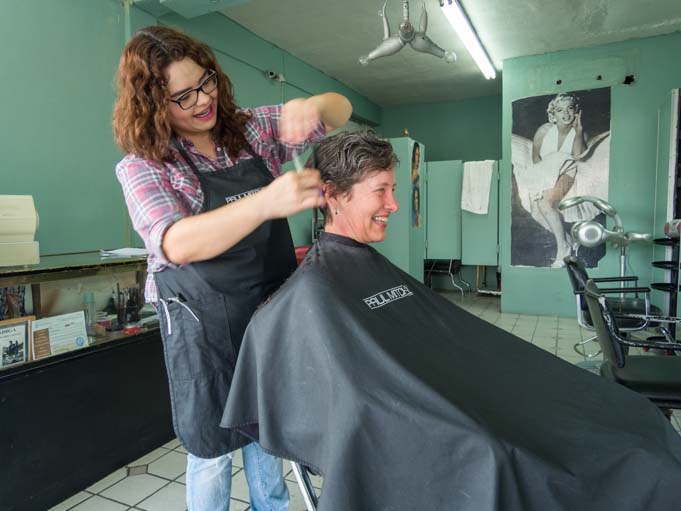
Next door to Dr. Bernal’s office there is a hair cutting salon. Both times we visited Dr. Bernal, we dropped in on the hair cutting salon to get haircuts. The most delightful stylist named Amber works there, and for just $3 for men and $5 for women, she does a great job.

To find her shop: as you walk into the alcove where Dr. Bernal’s office is, the hair salon is on the right side before his office. For both of us, these have been the bests haircut we’ve had in over a year!

Barber next to Mexican dentist San Luis Rio Colorado Mexico

Next to Dr. Bernal’s office there is a great little hair cutting place.

Getting a haircut in San Luis Rio Colorado Mexico

Amber gives me a haircut

Another thing that’s great about going to Mexico for dental care — besides receiving excellent care at a fraction of American prices — is that it’s an excuse to enjoy a daytrip to another culture and eat some really wonderful Mexican food.

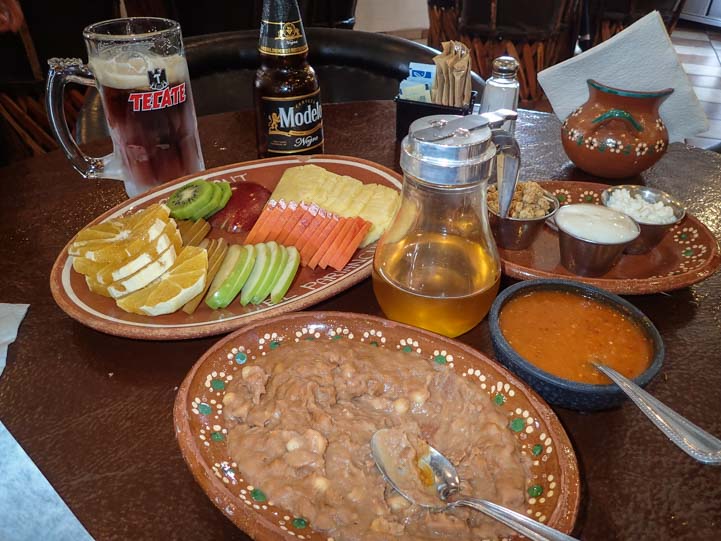
In San Luis there is an absolutely fantastic restaurant called El Parianchi that serves incredible food, complete with fun entertainment. We’ve now eaten several lunches there and a breakfast too, and we have loved the experience every single time.

El Parianchi Meal San Luis Rio Colorado Mexico

The first course of a feast for two for $13 (pancakes and omelette not shown) at El Parianchi restaurant.

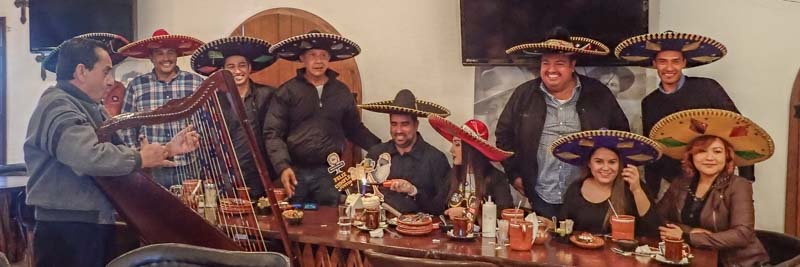
We’ve gotten to know several of the waiters as well as the harpist, Elias. Mexicans enjoy listening to folk songs played by various kinds of musicians while dining, and the harp music adds a special something to the ambiance at El Parianchi.

Mexican restaurant El Parianchi San Luis Rio Colorado Mexico

Elias entertains us with his harp.

El Parianchi also has a stash of huge sombreros, and sometimes the waiters bring them out and put them on their guests as a gag. We ended up wearing these crazy hats on one of our visits for my root canal last year (see this post). On one of our visits this year, a group celebrating a 26th birthday ended up in the hats right behind us!

People in sombrero hats El Parianchi Restaurant San Luis Rio Colorado Mexico

Sombreros for everyone at the birthday party!

For lots more details about dental care in Mexico, including directions to our dentists’ offices, check out this link:

Mexican Dentists – Finding Affordable Dental Care in Mexico

Basic info for our primary care dentist. He’ll set you up with specialists in town as needed:

Dr. Sergio Bernal

Call him directly from the US by dialing this number: 011 52 653 534 6651
Address: First St. #118-9 San Luis Rio Colorado, Mexico

Open Monday-Friday 9-5, Saturday 9-2, Sunday 9-11

For first timers, walk 100 yards from the border to Dr. Bernal’s office (detailed directions at this link), and then take $2-$3 cabs to visit other dental specialists, if needed, and be sure to enjoy a meal at El Parianchi! Here is a map showing the locations we visited:

Locations of Dr. Bernal’s Office, El Parianchi Restaurant and Dr. Avila’s Office – Interactive Google Maps

On the above map, the locations are labeled as:

  • Dr. Bernal = “Calle 1 115”
  • Dr. Avila = GPS 32.477776,-114.766224 (Calle 13 & Madero)
  • El Parianchi is in between them at Calle 10 & Captain Carlos Calles

To get the hours of operation of the San Luis, Arizona, USA / San Luis Rio Colorado, Sonora, Mexico border crossing and other info about the border, call: 928-627-8854

When we crossed the border for our first visit with Dr. Bernal this past October, we were alarmed to see a huge group of illegal immigrants waiting to cross into the US. On our return visit a month later, Mexican authorities had removed them from the sidewalks and placed them in shelters. The sidewalks near the border were empty as they always had been before.

So how do you get hooked up with a good dentist in Mexico?

We first heard about Dr. Bernal from fellow Escapees members at the Escapees Kofa RV Park in Yuma. For new RVers, we highly recommend joining Escapees RV Club, as it is little tidbits like getting the name and address of a trusted Mexican dentist that are the unsung benefits of being part of this club.

Escapees is known for its fabulous magazine, its many member parks, its discounts on RV parks across the country, its workcamping job board, its massive database of boondocking locations, its bootcamp training for new RVers and its incredible mail forwarding service and RV advocacy work.

But sometimes it is the little things that are passed on member to member, like dentist and doctor referrals, that make the club particularly helpful for folks living on the road in their RV. Lots of people go RVing, but there is a comaraderie among Escapees members that is unique.

To learn a little more about the unusual history of Escapees, check out our links:

If you think you might want to join Escapees RV Club, you can become a member at the link below…and if you mention that you heard about Escapees from this blog, Roads Less Traveled, they will put a little something in our tip jar as a thank you (and thank YOU!!):

Join Escapees RV Club

We’ve been members since 2008!!

Subscribe
Never miss a post — it’s free!

Our most recent posts:

More of our Latest Posts are in the MENU.   New to this site? Visit RVers Start Here to find where we keep all the good stuff. Also check out our COOL NEW GEAR STORE!! *** CLICK HERE *** to see it!

<-Previous || Next->

Photography – Cameras, Gear, Tips and Resources

Note: This page was written in 2016 and reflects the gear we used and what was on the market at that time. Our current gear is all professional quality and includes Nikon Z8 and Nikon D850 camera bodies, Nikon lenses, Nikon polarizing filters, Really Right Stuff tripod legs, Benro tripod legs, Sunway Foto table top tripod legs, Really Right Stuff ball heads and Wimberly gimbals, Think Tank camera backpacks, 14 inch Apple Macbook Pros with M2/Max CPU 64 GB memory and 4TB internal drives, and SanDisk G-Raid external hard drives for backups and archiving. We still highly recommend the resources we used for learning photography and post-processing described further down the page.

Since we began our full-time RV travels in 2007, photography has become a huge part of our lives. Photography is an ideal hobby for travelers, and it isn’t hard to learn. Our learning curve has played out on the pages of this website, and it is satisfying to see our improvement over the years. When we first started traveling, we each shot about 6,000 photos per year. Now we each shoot over 35,000 photos per year (a little under 100 per day per person!).

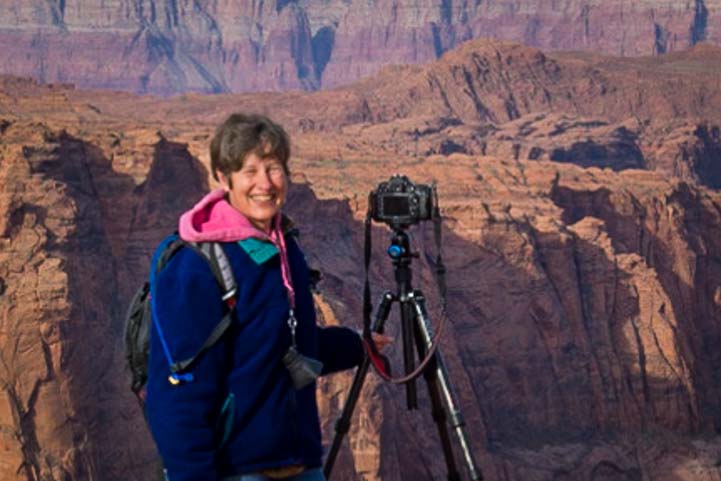
Camera on a tripod - photography

Photography is a lot of fun, and it’s not hard to learn.

People have asked us what cameras and equipment we use, and how we improved our skills. This page presents all of our gear choices over the years, from our camera bodies to our favorite lenses to our filters and tripods to the goodies we use to take our cameras out for a hike to the software we rely on for post-processing.

It also explains how we organize all our photos and lists all the books, eBooks and online tutorials we have studied to learn to take better photos. We are entirely self-taught, and the inspiring resources we reference here lay it all out in plain language.

We’ve invested in our camera equipment because photography is our passion and we do it all day long. What you’ll see here is our progression through good solid “value” gear, from the “entry level” gear we started with to the more professional quality gear we use today.

For easy navigation, use these links:

The best time to buy camera gear is during the lead up to Christmas or when a manufacturer discontinues a camera model. An inexpensive but good quality DSLR is the Nikon D3400 camera which is available in kits with one or two lenses, camera bags, filters, etc., here

CAMERAS and LENSES

Return to top

Our Current Cameras and Lenses

As of 2018, we both shoot with Nikon D810 cameras. This is a professional level, truly awesome, full-frame 36 megapixel camera. We use these primarily for landscape shots.

We also both have Nikon D500 cameras which are crop-sensor 20 megapixel cameras that can shoot 10 frames per second, ideal for fast moving objects like wildlife and our adorable puppy.

Prior to these cameras, we both used Nikon D610 cameras. This is a full-frame, 24 megapixel camera. It is considered a “pro-sumer” camera, not quite professional quality but at the high end of the hobbyist ranks.

Although we have a big collection of lenses, we typically take no more than two apiece with us when we are out and about on foot. It’s just too much stuff to lug around!

I have a Nikon 28-300 mm lens on my camera which I use almost exclusively, simply because I love the flexibility of having both wide angle and zoom options with the twist of my wrist without having to change lenses.

Photographer with camera tripod in the water

When we got into photography, we jumped in with both feet.

Mark likes to pick a lens for the day and work within its limits. His favorites are prime (non-zooming) lenses, and he uses the Nikon 50 mm and Nikon 85mm lenses a lot. These are a lot less expensive than zoom lenses, and they are much faster lenses too (meaning they can be used in lower light). However, they do not have vibration resistance (also known as “image stabilization”), a technology that reduces the inherent wiggle caused by hand-holding a lens.

He also uses the Nikon 24-120 and the Sigma 24-105. These are very similar lenses, and we would have just one of them, but I used to use the Nikon 24-120 all the time before I got the Nikon 28-300, so he got the Sigma 24-105 to have one with a similar range. They’re both terrific lenses, so we can’t decide which one to keep and which one to sell!

We have a Nikon 70-200, which is a truly beautiful lens. For a long time neither of us used it much, but after I commented to that effect when I first published this post, Mark put it into his regular arsenal and uses it frequently now. It is a fabulous lens with excellent color rendition. Another advantage is that the zoom feature doesn’t lengthen or shorten the lens — it is always one length and all the zooming is physically done inside the lens. This means that dust doesn’t sneak into the lens when it is zoomed in and out the way it does with other lenses (like the 28-300, 24-120 and 24-105 mentioned above).

For wide angles, we have a Nikon 16-35 and a Nikon Nikon 18-35 so we can each shoot very wide angles simultaneously. Mark LOVES wide angle photography, and he uses these all the time. The 16-35 is more expensive, and was purchased as an upgrade from the 18-35, but he can’t seem to part with the 18-35 now, so I inherited it.

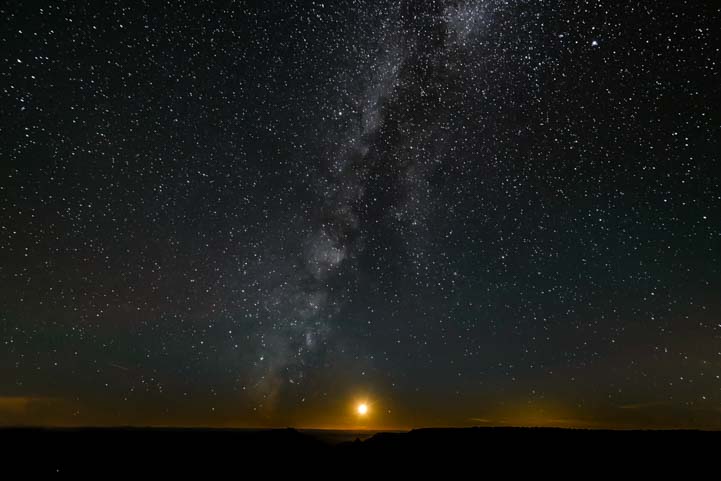
For super wide angles like at Horseshoe Bend in Arizona or for shooting stars at night (like the final image in this post or the first image in this post), we turn to the Rokinon 14 mm lens (with the Nikon focusing chip) or our very cool fisheye lens, the Rokinon 12 mm lens.

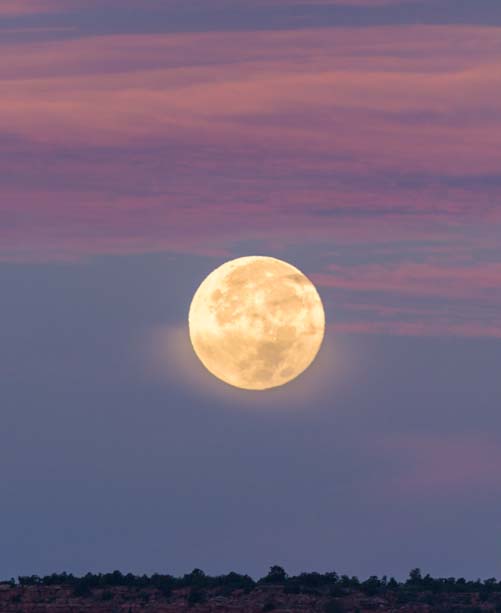
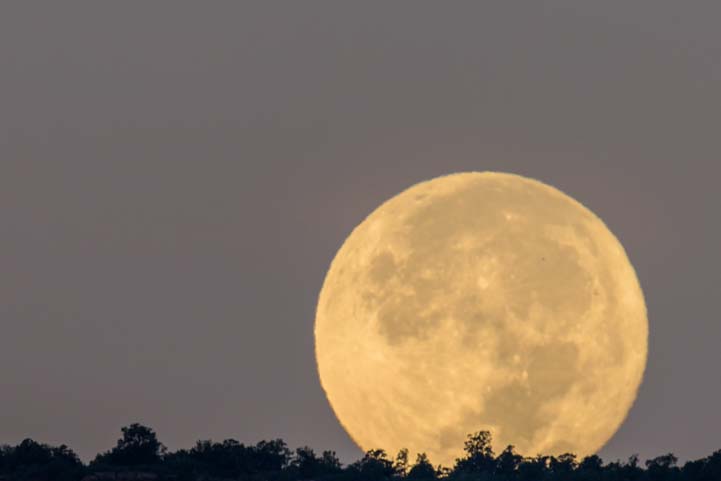
A few years back we bought a Tamron 150-600 mm G1 lens for shooting birds (like wild peach faced lovebirds here) and for wildlife — or even for stationary cacti at a faraway distance as in this image here. We loved this lens so much we bought the upgraded Tamron 150-600 mm G2 lens. While we got lucky with the first one and it worked great right off the bat, we had to send back our first copy of the G2 and get a replacement because it didn’t focus well. Now both lenses are awesome. Frankly, if you are picky about testing the lens to make sure you have a good copy, we find we are getting just as good pics from the older G1 lens as from the newer G2, so you might save a few bucks and get the G1. We used both lenses as well as the Nikon D500 and the Nikon D810 to capture the eagle and moon images in this post: Magical Moments in the RV Life.

An alternative to this lens that is priced similarly is the Sigma 150-600 contemporary series lens. Another awesome option that has become available since our purchase is the Nikon 200-500 mm lens.

What about those third party lenses?? Some are better than others, although Sigma’s Art Series lenses are really great these days (and expensive). When I was casting about for a “do it all” lens, we initially bought a Tamron 28-300 mm lens. It had terrible color rendition and didn’t focus for beans, so we returned it to buy the Nikon 28-300, which I totally love.

Our Past Cameras and Lenses

Do you need all this crazy stuff when you first get started? No!

When we began traveling, we purchased two Nikon D40 cameras, which were 6 megapixel crop-sensor cameras. Each came with a Nikon 18-55 mm lens, and we got a Nikon 55-200 mm lens for distance. This was a great camera model to learn on, and we published five magazine cover photos taken with it.
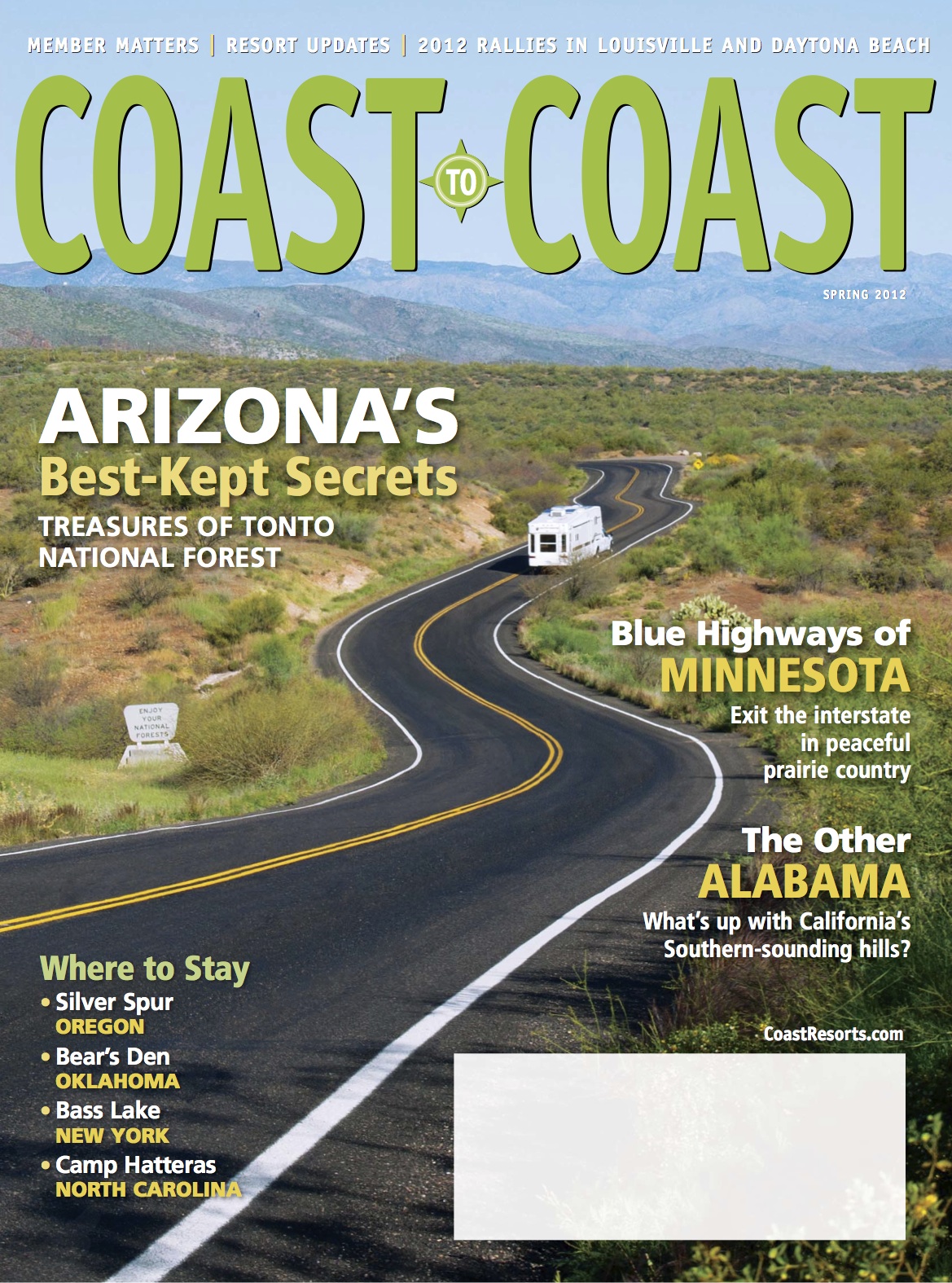
Coast to Coast Cover Spring 2012

Do you need to spend a bundle on a camera? No!
I took this photo with a Nikon D40 that you can buy today (used) for $100.

The Nikon D40 (and its modern day equivalent Nikon D3400) are “crop sensor” cameras (or “DX” in Nikon lingo). This means the sensor is smaller than on a “full frame” camera (like our current Nikon D810 cameras which are “FX” in Nikon lingo). This, in turn, means the image quality is slightly lower and if you blow up the image to poster size it won’t look quite as good up close.

The D40 was discontinued long ago, but can be found on Craigslist and eBay for $100 with two lenses. One that has been lightly used will work just as well now as it did years back.

How do you tell how “used” a used camera is??

If you have a Mac, an easy way to find out how many shutter clicks a camera has is to take a photo, download it to your computer, export it or locate it in the Finder, and open it in Preview by double clicking on it. Then click on Tools > Show Inspector, click the “i” button and then the “Exif” button. The Image Number is the number of shutter clicks the camera has on it. This works only for cameras that have a mechanical shutter, not for pocket cameras with an electronic shutter.

My only frustration with the Nikon D40 was that there was no built-in cleaning system for the camera sensor, so every time we changed lenses the sensor was vulnerable to picking up dust — and it did! We used the Nikon D40 cameras fro 2007 until 2011.

Today’s “equivalent” entry level DSLR is the Nikon D3400. It is a 24 megapixel camera that is far more sophisticated than the D40 and not “equivalent” in any way except the price point. If you want to get it in a kit with multiple lenses, filters, camera bag, tripod, etc., there are lots of kits here.

The Tamron 150-600 lens can be hand held

The Nikon D610 and Tamron 150-600 mm lens.
I’m in camo to keep from scaring the birds away.
Think it will work when I point this huge scary lens at them? Not!!

In 2011, we upgraded to the Nikon D5100, a 16 megapixel crop-sensor camera. Like the Nikon D40, this camera was also a “crop sensor” or “DX” camera. It came with a Nikon 18-55 mm lens. We got a Nikon 55-300 lens, and I ran all over Mexico with both of those lenses, switching back and forth all day long.

In hindsight, I should have gotten the Nikon 18-300 lens and spared myself the hassle of carrying a second lens and switching lenses all the time (I missed so many great shots because I was fumbling with the camera!). But I had read some iffy reviews of the first edition of that lens and decided against it (the current model is its 3rd generation and I’ve met people who LOVE this lens. Oh well!).

The best thing about that camera was the built-in sensor cleaner. Living in the salty and dusty environment of coastal Mexico, this was huge. The other fun thing about that camera was the flip-out display on the back. You could put the camera in Live View, then set it on the ground or hold it overhead and still see your composition on the back of the camera.

We used the Nikon D5100 cameras from 2011 to 2013. The Nikon D5100 has been discontinued. Today’s “equivalent” level DSLR is the Nikon D5300. It is a 24 megapixel camera that, again, is far more sophisticated than the predecessor that we had. This is an outstanding “intermediate” camera and can be purchased in a Nikon D5300 camera and lens bundle.

If you have a few more dollars to spend, the Nikon D7200 is even better. It is still a crop sensor camera, but it is very sophisticated. Like the others, if you are starting out, getting a Nikon D7200 Camera and Lens Kit is very cost effective.

Pocket Cameras

Sometimes carrying a big DSLR camera is inconvenient. We both like having a pocket camera for times when a DSLR is too big.

I use an Olympus Tough TG-4 camera when I ride my mountain bike. I used its predecessor when I snorkeled in Mexico too.

This camera is very rugged. The bruises it has given me on my backside are proof that it holds up a lot better than I do when I fall off my bike and land on it. I like it because the lens doesn’t move in and out when it zooms, and you can drop it and not worry about breaking it. Here are a bunch of photos it took: Bell Rock Pathway in Sedona Arizona.

Mark has a Nikon Coolpix A that he is nuts about because it is just like a mini DSLR. He doesn’t do crazy things like take photos while riding his bike one handed the way I do (and he’s less prone to falling off), so he doesn’t mind having a more delicate camera in his pocket. It is a 16 megapixel camera that has most of the features of a the Nikon D610, except it is a crop-sensor camera that has a fixed 28 mm lens that can’t be changed. It has been discontinued.

Prior to that, he had a Nikon Coolpix P330 (also discontinued). It could shoot in raw format, which was the reason he chose it, but it didn’t produce nearly the quality images of the Coolpix A.

Lots of folks use a smartphone for all their photo ops or as an alternative to their DSLR. We don’t have a smartphone, but we have used a lot of them at scenic overlooks when groups of people pass their cameras around to get pics of themselves. One thing we’ve noticed is that there is a big difference in dynamic range (the rendering of bright spots and shadows) between Androids and iPhones, with iPhones being much better. This is probably common knowledge and not news to you at all, and it may be partly due to which generation of smartphone a person hands us to get their portrait taken.


ADDITIONAL PHOTOGRAPHY EQUIPMENT and ACCESSORIES

Return to top

Batteries – We have two batteries for each of our cameras, so we each always have a fully charged battery on hand besides the one in the camera. We’ve found the Watson batteries are a good alternative to the more expensive Nikon batteries. My Watson battery died shortly after the manufacturer’s warranty expired, and I was impressed that they honored it anyway and replaced it for me. However, note that the Nikon D500 camera can’t use third party batteries, so you have to spend the bigger bucks on a Nikon brand EL-15 battery for that camera.

Memory Cards – We also have two memory cards in each camera (the Nikon D610, D810 and D500 all have two card slots in them). We use Sandisk brand for all our memory cards. We like the SanDisk “Extreme Pro” 95 MB/second SD cards. We like these fast SD cards because when we start shooting in a burst (holding the shutter down and letting the camera take pics as fast as it can — for instance, when a bison jumps over a fence in front of us), the faster the card can be written to, the faster the camera’s internal memory buffer will empty, and the longer the camera can keep shooting at top speed. Faster SD cards are also faster when downloading photos to a computer. Our Nikon D500s use Sandisk XQD cards and our Nikon D810s use Sandisk CF cards.

Every evening we download all our photos onto our laptops and reformat the memory cards in the camera. We’ve heard that this reduces the chance of the card failing and losing all our photos (which happened to me once long ago with a Kingston card – ugh!).

The Hoodman Loupe – A Game Changer! The Hoodman Loupe revolutionized our photography because we were suddenly able to see our photos clearly on the back of our cameras and then retake the photo if necessary. The loupe fits over the LCD screen, blocking the glare and magnifying the image. The lens is adjustable, so no matter how good or bad your eyes are, you can adjust it until you can see the image perfectly clearly. We have the original hard sided loupe. A new model collapses down so it can be stored more compactly. In a lot of the photos of me on this website, you can see my Hoodman loupe hanging around my neck!

Hoodman Loupe on a Nikon D610 Camera

The Hoodman Loupe lets you see the image on the back of the camera clearly, adjusted for your eyes, and without glare.

Battery Grip – Mark occasionally uses a Vello Battery Grip on his camera. This grip can hold extra batteries and also makes it possible to take portrait oriented shots (vertical images) while holding the camera as if it were upright rather than twisting your right arm over your head. Mark absolutely loves his. I use mine only occasionally because I can’t use it with my tripod L-bracket (see below).

Camera Straps – We replaced the standard Nikon camera straps with the Optech Pro Strap. This strap is thick and cushy and is slightly curved to fit the curve of your shoulder. It also has quick release clasps so you can easily unclip it from the camera when you’re using a tripod.


LENS FILTERS

For a long time we preferred the B+W brand for all our filters, although we’ve used a lot of Hoya filters over the years too. We’ve also tried Tiffen filters, but find they are hit-and-miss. Often, if a “lens deal” includes a filter with the lens, it’s not a great one. Most recently, we have begun buying Nikon filters which seem to be the best quality all around. Just be sure you get the right size for your lens (52 mm or 77 mm, etc.).

Camera UV Filter, Polarizing Filter and Neutral Density Filter

UV filter (top), Polarizing filter (left) & neutral density filter (right)

UV Filters – We have UV filters for all our lenses to provide protection for them.

Polarizing Filters – We also have polarizing filters for all our lenses. A polarizer makes it possible to enhance the colors or reduce the glare in certain lighting situations. It is best around midday and has less effect at dawn and dusk. It is wonderful around bodies of water and for removing the dashboard glare on the windshield when taking photos from inside a car. A polarizer adds a lot of contrast to an image, however, so while it can enhance a landscape beautifully, I’ve found it makes street photography of people too contrasty.

Graduated Neutral Density Filters – We occasionally use a graduated neutral density filter when the sky is very pale and the scene we are shooting is dark. This kind of filter is half colored and half clear. By twisting it so the colored part lines up with the sky and the clear part lines up with the darker landscape, the sky and landscape come out more evenly exposed. They are also very helpful for sunrises and sunsets.

Neutral Density Filters – When shooting moving water, a neutral density filter darkens what the camera sees enough so the shutter speed can be increased to show silky movement in the water without it being blown out and all white. These filters are also helpful if you want to use a very big aperture (small “F number”) to blur out a background and the camera’s top shutter speed isn’t fast enough to get proper exposure. These filters come in different degrees of darkness. A 10-stop filter is good for shooting a waterfall in broad daylight while a 4-stop filter is good for the same scene at dawn or dusk. We had fun with moving water photography at Watkins Glen in Upstate New York, the Blue Ridge Parkway in N. Carolina, and Great Smoky Mountains National Park in N. Carolina.

Lee Filter System – Mark also uses a Lee Filter System and loves it. This is a multi-part system of square filters that can be placed on any camera lens. You need the Lee Foundation Kit, an adapter ring sized to your lens and some filters. The advantage of this system is that for graduated neutral density filters you can position the transition point between light and dark. So, if you are shooting a sunset and have very little land and lots of sky, you can darken the sky and lighten the land even if the horizon is just above the bottom of your photo. Likewise if you have a bright sky and a dark hillside – you can rotate the filter so the transition is on an angle and not a horizontal line right through the middle of the photo.


TRIPODS

It is really hard to invest in a tripod after blowing the bank account on a nice camera, a few lenses, spare batteries, memory cards and filters. And you can have loads of fun with photography without getting a tripod. But if you want to play with shooting (and showing) motion (i.e., a car going by with a blurred background, clouds streaking across the sky or silky water flowing) or you want to have perfect exposure in very low light (like a sunset) without a flash, or you want to do some timelapse videos (very cool at sunrise in a big canyon) then a tripod is a must.

Sunwayfoto XB-52DL Ballhead with T2C40C Tripod and DDC-60LR Quick Release Clamp

Sunwayfoto XB52-DL Ballhead with T2C40C Tripod and
Sunwayfoto DDC-60LR Quick Release Clamp

Most people end up upgrading their tripod several times because they just can’t believe, at first, that they have to spend good hard earned money on a tripod, and they go through a bunch of cheap ones before they bite the bullet and get a decent one! We did that, and lots of our friends did too.

The biggest difference between tripods is how much weight they can hold solidly, how easy they are to set up and adjust, and whether things drift or droop a little after you tighten the buttons. I have a Benro carbon fiber tripod that I absolutely love for hiking. The legs slide in and out really smoothly, and the adjustments are easy. I also have a set of super long Really Right Stuff tripod legs and a Wimberly gimbal which is awesome for letting me swing the Tamrom 150-600 lens around smoothly while shooting birds.

Mark has Sunwayfoto tripod legs and smaller ballhead for hiking and bigger ballhead that he loves and he uses a Sunwayfoto GH-01 gimbal head as well. We reviewed them in depth at this link:

Choosing a Tripod – Sunwayfoto Tripod and Ballhead Review

Sunwayfoto GH-01 Ballhead Review – Great Support for a Long Lens

We both have the SunWay Foto L-Bracket that attaches to the camera body and lets us set the camera in the tripod in either Landscape or Portrait orientation very easily. I keep my L-bracket on the camera all the time for simplicity in case I want to grab my tripod quickly, but it means I can’t use my Vello Battery Grip. Mark loves his battery grip, so he has to switch back and forth between the regular tripod bracket that fits on the camera along with the battery grip and the L-bracket that doesn’t.


FLASHLIGHT

We love doing night photography, photographing the milky way and the stars, and doing light painting on old buildings for ghostly effects. At Waterton Lakes National Park we did a timelapse video of the Milky Way.

When we are hiking on a remote trail in the middle of the night, or light painting a building to make it appear visible in a nighttime photo, we find that a good flashlight is essential.

We use the fabulous, super high powered LED flashlight from Lumintop, the Lumintop SD75 4000 lumen flashlight. It is like having a car’s headlight in your hand!
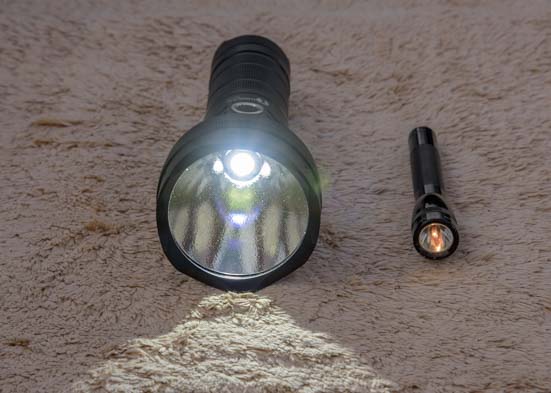
Lumintop SD75 4000 lumen tactical flashlight

Lumintop SD75 4000 lumen tactical flashlight next to a pocket Mag Light

Built with heavy duty aerospace aluminum, it has a military grade hard-anodized aluminum finish and is water resistant to 2 meters. Offering 3 power levels plus a strobe, there’s also an LED tail light that can be used as a night light when we’re setting up our camera gear in the dark. It also has threads on the bottom for mounting on a tripod.

The flashlight batteries are rechargeable and there is a battery level indicator. The flashlight ships with a wall charger and 12 volt car charging cords, and it comes in a suitcase! The batteries are so strong, it can be used to recharge other smaller devices like cell phones via 2 USB ports.

This is not a pocket flashlight, but it has slots in the end for a strap that makes it very easy to carry.

We love this flashlight and just wish we had had it when we cruised Mexico on our sailboat, as it is far more powerful than the emergency floodlight we had for rescuing a man overboard!


HAULING, STORING & MAINTAINING OUR CAMERA GEAR

Return to top

With all this camera stuff, it can be a challenge to figure out how to carry it to scenic spots and where to store it in the RV and truck when we’re not using it. Also, our camera gear takes a lot of abuse from dusty air out west, salty air on the coast, and sunscreen from our faces and hands. So it needs to be cleaned periodically. Here’s where we’re at with all this right now:

Hiking With Camera Equipment

When we go on a hike of a few miles, it is likely to take us four hours or more because we stop to take so many photos. So, we want to have water, snacks, our camera gear, tripods, and possibly a jacket with us. There are a lot of camera-specific backpacks and sling style camera bags on the market, but none we’ve seen is really designed for hiking.

After a lot of searching, we finally decided to use big Camelback hydration packs instead of bona-fide camera bags when we hike with all our photography stuff, and we’ve been really happy with this choice.

I have a Camelback H.A.W.G. and Mark has a Camelback Fourteener. Both can carry 100 ounces of water, and each has enough capacity for the Tamron 150-600 lens along with everything else if need be. (We never take more than two lenses with us — one on the camera and one in the pack).
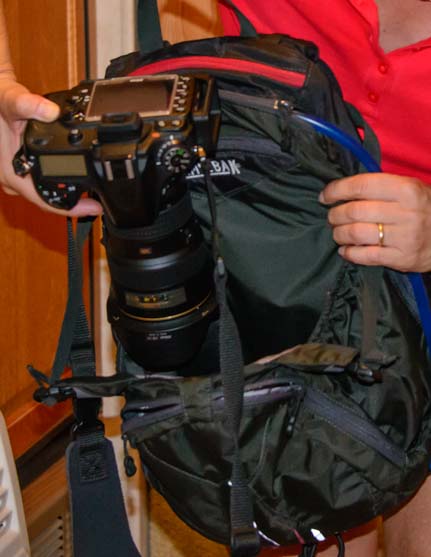
Camelback H.A.W.G. camera bag

The Camelback H.A.W.G. can hold a big camera.

We generally hike with our cameras slung around our necks so we can take photos with them as we walk. I put the Camelback on first and then put the camera on afterwards so the camera straps aren’t trapped under the shoulder straps of the Camelback. There’s nothing like getting caught in the Tourist Tangle!

My main criteria for choosing a Camelback was that I wanted to be able to put my camera (with the 28-300 mm lens attached) inside the Camelback and then close that compartment so I could scramble over something gnarly that required two hands and not worry about the camera slipping out of the pack. And it had to do that with 100 ounces of water in the hydration pack.

My other criteria was that I wanted to be able to hang my tripod on one of the Camelback straps and hike without carrying it in my hand.

The straps on the sides of the H.A.W.G. aren’t designed to carry a tripod, and they may fatigue over time, but I’ve been really happy with how this Camelback has held up on the many hikes I’ve taken with it so far in two years of owning it.

The straps on the sides of the Fourteener are designed to hold ice picks and things like that, so they are probably a little more rugged. If I had known about the Fourteener before I bought my H.A.W.G., I probably would have bought that model instead. Mark has had it almost as long as I’ve had my H.A.W.G., and he is very happy with it as well.

Camelback H.A.W.G. with camera tripod

The tripod fits neatly on the side of the H.A.W.G., and the camera straps aren’t trapped under the Camelback straps.

One really nice feature of both of these Camelback models is that they have a waterproof rain sack that can be pulled out of a hidden pocket and slipped over the whole Camelback, keeping the contents dry if you’re caught in a downpour. This came in super handy at the Duggers Creek Falls on the Blue Ridge Parkway!

One of the tricks with backpacks in general is that, if they have a waist belt, you can loosen the belt a little, slip your arms out of the arm straps and then swing the pack around so it is in front of you. This way you can get something out of it without taking it off and putting it on the ground. This is fantastic when you want to swap filters, grab a snack, or change batteries without taking the whole darn thing off.

Once we get to an area where we’re going to take a lot of photos, we take the tripods off the Camelbacks and we carry them around in our hands until we’re ready to hike out again.

We carry a plastic bag (a shopping bag is fine) in our packs in case it sprinkles and we want to cover our cameras for a short time. We also carry rain ponchos so we can cover ourselves and our Camelbacks in the event of unexpected rain.

Short Walks With Photography Gear

If we are going to spend the day roaming around but not hiking, or if we’re taking photos a short distance from the truck, we don’t take the big Camelbacks. I use a small fanny pack to carry a spare battery and possibly a second lens. Mark likes to wear a photographer’s vest that has lots of pockets for all his goodies. He likes the one he has, but has his eye on the Phototools Photovest 14!

Storing All This Stuff

In the trailer we have Ruggard camera cases and Ruggard backpacks to hold the cameras and lenses. We also have camera cases in the truck. We’ve found good homes for the tripods in the truck too, and they generally stay there so they are with us if we arrive somewhere and suddenly wish we had them with us.

Cleaning

A great way to get the dust off the camera and lenses is to blow it off with the Giotto Rocket Blaster (the largest size is best). The Nikon LensPen Lens Cleaner is good for brushing dust off too. For smudges and smears, we use the Eclipse Camera Cleaning Kit which comes with a cleanser and pads.
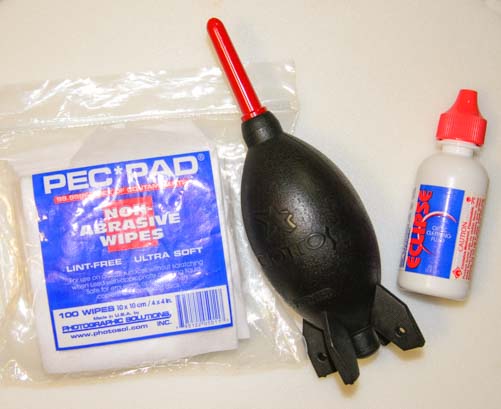
Giotto Rocket Blaster & Camera Cleaning Kit

Giotto Rocket Blaster & Camera Cleaning Kit

Sometimes the camera’s built-in sensor cleaning system doesn’t quite do the trick, and getting debris off the camera sensor can be really intimidating. Rather than paying for an expensive cleaning at a camera shop, we’ve discovered that the Sensor Gel Stick sold by Photography Life does a phenomenal job (don’t get the cheap Chinese imitation ones). Check out the video under the product description here to see how to do it. It’s easy and we have done it many times.


PHOTO ORGANIZATION and POST-PROCESSING TOOLS

Return to top

We each have a plain MacBook Pro (no retina display) with 16 GB RAM and a 1 TB internal drive and slots for CD, SD card, Thunderbolt, etc. (2012-style case). We also each have a 4 TB external hard drive with a Thunderbolt dock that allows multiple drives to be daisy-chained.

We use Adobe Lightroom for most of our post-processing. The easiest way to learn Lightroom is the Julianne Kost Lightroom Videos. Julianne is Adobe’s “Lightroom Evangelist” (what a great title and job!) and her presentations are clear and concise.

Organizing photos is never easy, and everyone has a different method. Lightroom lets only one person work on a catalog at a time, so we each have separate Lightroom catalogs. We make use of the Smart Previews in Lightroom to get access to each other’s photos without transferring all the original photo files between our laptops. All we have to transfer is the catalog, previews and smart previews. It’s clunky — I know they could do better — but it works.

We also have a separate Lightroom catalogs for each year. The older catalogs are stored on external hard drives and the current year catalogs are on our laptops. We try to make sure all our photos are in two places (laptop and external drive or on two external drives). Some of our older photos are in Apple’s Aperture and our oldest are in Apple’s iPhoto, the two post-processing programs we used prior to Lightroom.

I don’t want to have to plug in an external drive every time I go into Lightroom, which is why we keep our current year’s photos and catalogs local to our laptops. We have our previous year’s catalogs and smart previews on our laptops so we can see and work with our older photos. If we need the full image of an older photo, we plug in the appropriate external hard drive, and the catalog on the laptop reconnects with the original images.

We don’t store anything in the cloud.

We organize our photos by location but like to have an overall sense of the chronological order in which we visited places, since that is the way we remember our travels. So, we label our folders with 2 digits followed by the state to bring up the states in the order in which we visited them.

Inside of each state folder, we name every download with a 4-digit date (month/day) followed by the specific location. For photos that aren’t location specific (like photos of our trailer disc brake conversion or fifth wheel suspension failure, we move them after downloading to a MISC folder and name a subfolder within it more appropriately or add them to an existing folder.

Lightroom Folder Organization

2 digits to order the states chronologically, then 4-digit dates on subfolders with the specific location.

We also use PHOTOSHOP for post-processing. The best instruction for learning Photoshop is offered by Brendan Williams. His free online tutorials on his YouTube channel are terrific. However, if your goal is to MASTER Photoghop, buy his video course and go through each of the videos slowly — and practice the techniques he teaches. His course is extremely well done and is worth every penny!

Photomatix Pro is an excellent program for creating HDR (high dynamic range) effects from several identical photos taken at different exposures, and Topaz Adjust and Topaz Detail in the Topaz Suite of software are great for getting a little wild with crazy effects at the click of a button.

For panoramas, we use Panorama Maker to stitch together a series of photos.

We use the X-Rite Color Checker Passport to create custom color profiles calibrated to specific camera and lens combinations. It also comes with a gray card that we sometimes use to set a custom white balance for particular light conditions.


RESOURCES FOR LEARNING PHOTOGRAPHY

Return to top

Photography is something you can spend the rest of your life learning. We’ve been reading and studying photography books and blogs for a few years now, and we have found the following printed books and ebooks and online resources to be really helpful in conquering both the technical aspects of understanding what all those buttons on our cameras do and the artistic aspects of how to capture the essence of what we’re seeing.
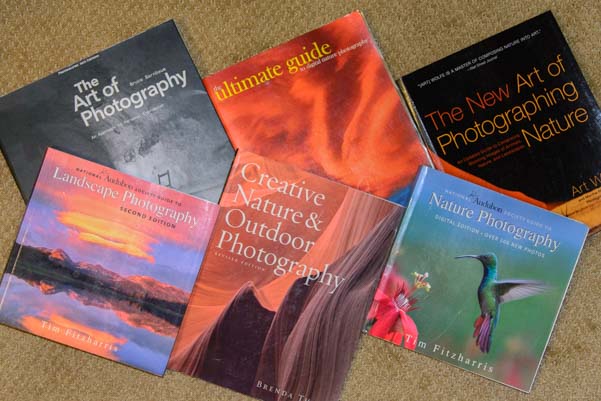
Photography Books

Some of our Favorite Photography Books

BOOKS ON PHOTOGRAPHY


eBOOKS ON PHOTOGRAPHY


ONLINE TUTORIALS

Steve Perry of Backcountry Gallery offers incredibly thorough and detailed camera reviews and photography tutorials on his YouTube channel, Backcountry Gallery. We were very fortunate to meet Steve and photograph prairie dogs and bison with him in South Dakota in 2017. In 2023 Steve was honored as one of the Top 40 wildlife photographers in the world. His eBooks are worth every penny and his videos offer outstanding and easy-to-follow instruction. He also leads wildlife photogrpahy tours to the far corners of the world where the most exotic wildlife live!

The website that taught us the most in the beginning was Photography Life written by Nasim Mansurov and his very talented team. He has super detailed gear reviews and his site is read by many of the top professionals in the photography world. His tutorials are excellent, and he has two pages with links to them all:

We were very fortunate to meet Nasim at his 2012 fall foliage photography workshop in Ridgway Colorado. Those extraordinary three days were a real turning point for our photography.


BLOGS, TIPS and GEAR REVIEWS

The photography blogs we read regularly are these:

  • Nikon Rumors – The latest info about everything related to Nikon cameras: future products, recalls, Nikon deals and specials
  • Photography Life – The most comprehensive camera/lens reviews anywhere and a top team of writers producing tutorials
  • Ken Rockwell – The first online photography resources we found. We’ve been following ever since
  • Ming Thein – Excellent and detailed camera reviews and truly inspiring photographs
  • DigitalRev TV – Hilarious (and very informative) videos on all kinds of photography topics.
  • Thom Hogan – Interesting photography-related essays as well as gear reviews
  • Dreamscapes – Phenomenal, jaw-dropping photography that makes us want to keep learning, plus tutorials & eBooks
  • DxO Mark – A laboratory that uses industrial testing equipment to do comparative camera, sensor and lens ratings


Subscribe
Never miss a post — it’s free!

Our most recent posts:

More of our Latest Posts are in the top MENU above.
New to this site? Visit RVers Start Here to find where we keep all the good stuff!!

Zion National Park “West” RV Trip – Gorgeous Kolob Canyons!

October 2016 – Zion National Park in Utah is one of America’s most beautiful National Parks, and we were loving our RV trip to the main part of the park at Zion Canyon. A side trip to Kolob Canyons at Exit 40 on I-15 took us to a much less visited but equally dramatic area on the west side of the Park.

Kolob Canyons Road Scenic Drive Zion National Park Utah

Kolob Canyons Road is a spectacular scenic drive.

The stunning scenic drive through the Kolob Canyons region of the park is truly breathtaking.

We had been blown away by the fall foliage season on the San Juan Skyway in Colorado in late September where the aspen trees were cloaked in gold. Autumn comes four or five weeks later in Zion National Park, but the colors in the last days of October were wonderful.

Autumn Foliage Taylor Creek Trail Kolob Canyons Zion National Park Utah

The trees were vivid colors.

As we followed Kolob Canyons Road, Taylor Creek accompanied us. Hardwood trees along the edges of this thin trickle of water were resplendent in their fall colors.

Fall Foliage Taylor Creek Trail Kolob Canyons Zion National Park Utah

Fall foliage was at its peak in late October – Wow!

The red rock scenery was awe-inspiring too, with jagged cliffs towering in front of us and then surrounding us.

Fall Foliage Kolob Canyons Zion National Park Utah

Kolob Canyons

Autumn Leaves Kolob Canyons Zion National Park Utah

.

There is no shuttle bus on Kolob Canyons Road, and there is very little traffic, especially in the early morning. We stopped at several pullouts to take a deep breath and savor the incredible views.

Scenic Drive Kolob Canyons Road Zion National Park Utah RV trip

.

Kolob Canyons Visitor Center at the beginning of the scenic drive is at about 5,000′ elevation, and Kolob Canyons Road climbs about 1,000 feet to the Kolob Viewpoint at the end, about 5 miles down the road.

In comparison, Zion Canyon is at 4,000′ elevation.

So, there was a delicious mix of evergreens and deciduous hardwood trees that stand out against the red rock backdrop.

Kolob Canyons Red Rock Fall Foliage Zion National Park Utah

Fall foliage and red rocks – yum!

Red Rock Kolob Canyons Zion National Park Utah

Trees perched on outcroppings of the red rock cliffs.

Kolob Canyons is an awesome area for photography, and our cameras were going wild.

Photography Kolob Canyon Road Zion Canyon National Park RV Trip

.

Some of the best fall colors seemed to be down along Taylor Creek, so we decided to hike the Taylor Creek Trail to see if we could immerse ourselves a little deeper in the fall foliage.

Taylor Creek Trail Kolob Canyons Zion National Park Utah RV trip

The Taylor Creek Trail headed right into the fall color.

Taylor Creek Trail was an easy hike that took us under lovely archways of colorful leaves.

 Fall Color Taylor Creek Hike Zion National Park Kolob Canyons

We walked under an arch of autumn color.

We had the trail almost entirely to ourselves as we walked into a wonderland of fall color.

Taylor Creek Trail hike Zion National Park Kolob Canyons

.

Because the elevation in Kolob Canyons is slightly higher than in Zion Canyon, late October was the ideal time to see the autumn colors along this creek.

Autumn color Taylor Creek Hike Zion National Park Utah

.

Red rocks autumn leaves Zion National Park Kolob Canyons

.

Being there at the right time for beautiful colors was a nice surprise, because, over in Zion Canyon we had found we were just a little bit early. The best time for that part of the park is the first week of November.

Fall Color Taylor Creek Trail Kolob Canyons Zion National Park Utah

.

Fall Foliage Kolob Canyons Zion National Park Utah

.

The red rocks of the surrounding peaks of Kolob Canyons jutted into the brooding sky, adding a wonderful burnt orange to the brilliant shades of the trees around us.

Taylor Creek Hike Zion National Park Kolob Canyons

.

We were just having too much fun with our cameras here!

Photography in Fall Colors Zion National Park Utah

.

As is always the way when we go on a gorgeous hike with our cameras, we soon got separated as we each scrambled off the trail here and there to explore inviting and hidden spots. Mark found himeself surrounded by maple trees and had fun with their bright red leaves.

Maple Leaf and acorn from Zion Canyon

Fall comes to Zion National Park.

Who knew there were maple leaves in the red rock desert canyons of Southern Utah?!

Colorful autumn leaves Zion National Park Utah

.

We spent many hours on Taylor Creek Trail and didn’t even make it to the end of the hike!

Autumn colors Taylor Creek Trail Hike Zion National Park Utah

.

Keeping tabs with each with our two-way radios, we finally made our way back to our truck. When I got there I found Mark had put pretty fall leaves all over my seat!

Autumn leaves in a truck

I came back to our truck to find my seat covered with fall leaves — fun!

It is days like this that make our crazy lives in our trailer so special.

Zion National Park RV Trip Kolob Canyons

.

For RVers heading to Zion National Park, the one hour drive from Zion Canyon around to the west entrance at Kolob Canyons is really worthwhile. There is a campground on the west side of the park that is designed for tent camping and is suitable for truck campers and very short Class C’s.

Camping Zion National Park Utah

A full moon rises at Zion.

There are links with more info and big rig RV parking ideas below.

Subscribe
Never miss a post — it’s free!

More info about Kolob Canyons in Zion National Park:

Blog posts from our RV trips to Zion National Park:

Blog posts from the area near Zion National Park:

Our most recent posts:

More of our Latest Posts are in the MENU.
New to this site? Visit RVers Start Here to find where we keep all the good stuff!!

<-Previous || Next->

Kuat NV Bike Rack Review

Roads Less Traveled

This page is a review of the Küwat NV Bike Rack, a high quality and easy-to-use bike rack that mounts in a hitch receiver.

Nifty new Küwat NV Bike Rack.

This page is a review of the Kuat NV bike rack

The bike rack folds flat against the back of the truck.

A nifty new bike rack from Kuat is easy to use.

The bike rack is folded down and ready for bikes to be mounted.

Kuat

A strap is cinched over the rear

wheel to hold the bike in place on

the rack.

Strap cinching system for Kuat bike rack Kuat rack strap system

A lever arm folds up and down to hold each bike in place.

Lever arm hold bikes in place on Kuat bike rack

The lever arm can extend and

retract with the press of a button.

The lever arm holds the bike in

place on the rack.

Mounted and ready to go.

There is a built-in, retractable bike lock.

The two ends pull out and can be

snaked through the bike(s) to lock them

to the rack.

This image shows the locked lock without a bike.

The Kuat NV bike rack features a built-in bike lock.

One end of the lock inserts into the other.

Bike is mounted and locked to the rack.

The bikes are mounted and run no risk of dragging on the ground if the trailer bottoms out.

Two bikes mounted and locked.

An clever feature is the bike stand.

Insert the stand into this quick release

fitting...

A terrific feature of the Kuat NV bike rack is the built-in bike stand.

The bike rack is folded flush to the back

ot he truck/trailer, the bike stand is

inserted into it and clamped down with a

quick release.

A bike is mounted on the Kuat NV bike stand, ready for bike mechanic work.

Magic!!  A bike stand!!  The bike's wheels and

pedals are free to spin and you can do

whatever bike mechanic work you need to do.

We highly recommend the Kuat bike rack

Two bottoming-out episodes and the round

knob was beginning to look square.

The Kuat NV bike rack is awesome

Jack of JM Welding comes to our rescue.

We get a custom-designed hitch extension made to raise the bikes another 8

He draws the design on the floor using parts he had

available that day.

Designing an extension for the Kuat rack

The pieces are laid out.

We fabricated an extension for our Kuat rack

The hitch extension is welded

and has gussets for added

strength.

Jack powder coats the whole thing.

"I think it's gonna work!"

Awesome hitch extension for the Kuat bike rack

Perfect - the bike rack is raised 8" or so off the

ground.

We lock the bike rack to the hitch

extension.  An internal bolt/nut

attaches the hitch extension to

the hitch receiver and would be

very difficult to undo.

With hitch extension on Kuat NV bike rack bike is well of the ground

Ahhh… the bike is well off the ground.

The bikes are up well off the ground and we are ready to roll!!

Two bikes mounted and ready for their next adventure.

Kuat 2 Bike NV Rack

This is a review of the Kuat NV Bike Rack, a high quality, extremely

easy-to-use bike rack that mounts on a trailer hitch.

For several years we lugged our bikes around on the back of our

trailer using a cheap Swagman bike rack that held 3 bikes.  It held the

bikes by gripping the top tubes in metal jaws.  To mount a bike on the

rack or to dismount it you had to screw or unscrew two long screws

that cinched the rack's jaws closed around the top tube.  There were

several frustrating problems with this rack:

• It was time consuming to mount and dismount the bikes

• The rack's gripping jaws gouged the bikes' top tubes and

chipped off the paint

• The whole rack jiggled wildly in the hitch receiver as we drove,

especially on rough roads

• If the trailer bottomed out in a ditch, the bikes' tires dragged on the ground

• There was no way to lock the bikes onto the rack

• We had to use bungee cords to keep the wheels from spinning as we drove

At the 2011 Interbike bicycle trade show in Las Vegas Mark checked out every bike rack manufacturer for a better solution.  He

finally settled on one made by Küwat, a small company out of Missouri.  This is a slick bike rack.  It is simple, easy to use and

solves almost all the problems we had with the Swagman (see note below).

RACK IS HELD TIGHT IN THE HITCH RECEIVER

The rack cinches into the trailer hitch using a clever expansion

mechanism you control with a round plastic knob at the back of the

rack.  Set the rack into the hitch receiver, tighten the knob until very

tight (or use an allen wrench to get it super tight), and the inner

expansion mechanism holds the rack rock solid in the hitch receiver.

The rack doesn't move at all.

The rack can be folded flush against the back of the trailer (or car/

truck) when not in use.

Then fold it down when you are ready to load some bikes onto it.

EASY MOUNT / DISMOUNT

The rack holds two bikes that face in opposite

directions.  Each bike's wheels rest on a tray.  The front

wheel goes into a rounded tray that keeps it from

rolling.  An adjustable strap loops over the rear wheel to

hold it in place.  Then an adjustable lever-arm is

tightened onto the front wheel next to the fork to keep

the whole bike in place.

So to mount a bike there are three quick steps:

1.  Place the bike's wheels on the rack's tray

2.  Tighten the rear strap around the rear wheel.

3.  Move the lever arm into place on the front tire in front

of the fork and apply pressure to cinch it down.

The bike(s) can be locked using

retractable built-in plastic shielded

cable wires.  One wire comes out of

each end of the rack.  Snake the two

wires through the wheels and frame(s)

of the bike(s), and insert one

connector into the other to lock the

bikes to the rack.  Easy!

To dismount the bikes simply release the rear wheel strap,

press the thumb button on the front wheel lever arm to extend

it and lower it, and lift the bike off the rack.

KUAT NV BIKE RACK BECOMES A BIKE STAND!

As a bonus, the rack includes a built-in bike stand for working

on your bikes.

Simply fold the bike rack up so it is flush with the trailer (or

back of your car/truck).  Insert the bike stand unit using a

quick release lever.

Mount the bike into the stand by its top tube using the quick

release clamps.

Now the pedals and wheels can spin freely and you can do

whatever maintenance your bike needs, from lubing the

chain to replacing the bottom bracket.

ONE PROBLEM - AND A GREAT FIX

Side note: Kuwat does not recommend putting their bike

racks on the backs of trailers due to the long distance

between the rack and the rear wheels of the trailer.  That long

distance puts extra force on the bike rack as the trailer goes

over bumps in the road and makes it possible for the rack to

hit the ground when the trailer bottoms out going through dips

in the road.

The only problem we had with this rack -- one that was

easily remedied -- is that the rack sat quite low to the

ground because the hitch receiver on the back of our

fifth wheel is fairly low, and the rack sticks out quick far

from the back of the trailer.  When the trailer bottomed

our (for instance, entering/exiting some gas stations),

the outer end of the rack dragged on the ground.  We

had two episodes like this, one going in and out of a gas

station and the other doing a u-turn at a National Park

parking lot.  These mishaps scraped the rubber right off

the rack's expansion knob in two places.

While driving through Blanding, Utah, we asked at the

Visitors Center if there was a good welder/fabricator in

town.  We were sent to see Jack Montella of JM

Welding, and in a few hours he created the

perfect solution.

He built an S (or Z) shaped hitch extension that

fits into our trailer hitch receiver and provides a

new higher receiver for the bike rack.

Things like this are available commercially, but when we

priced it out, the cost would have been similar and would

have required waiting for the part to be shipped.  So Jack

made a custom one for us on the spot.

After drawing a picture of the hitch extension on the floor, he quickly cut the

pieces and welded it together.  He put two gussets in the corners to provide

extra strength and powder coated it.  Our only concern with the design was

that this new extension wouldn't fit tightly in the trailer's hitch receiver,

making both the rack and bikes jiggle as we drove.

Jack had a perfect

solution.  He welded a

nut into the inside of the

new hitch extension

where the hitch pin goes through the hitch receiver and the

hitch extension.  Then he fabricated a long bolt that would go

through both the trailer's hitch receiver and the hitch

extension.  As the bolt was screwed into the nut on the inside

of the hitch extension, the hitch extension was cinched up

tightly against the inside of the trailer's hitch receiver.  This

made a rock solid connection.

At the other end of the hitch extension, our bike rack fits into the hitch

extension receiver just as it did into the original trailer hitch receiver,

using Küwat's expansion mechanism inside its tubes.

This has raised the bike rack 8" further off the ground.  Now when we

go through a deep dip in the road, the hitch cable rings (a part of the

hitch receive we don't use or care about) drag on the ground rather

than the bottom of the bike rack.

After we installed the bike rack on the new hitch extension I walked behind the trailer

as Mark drove it over a very rough dirt road.  The rack and the bikes followed the motion of the trailer and nothing more

-- no jiggling whatsoever.

You can purchase the Kuat NV Bike Rack here.

If you have more than two bikes and are mounting the rack on a car or truck (not recommended for an RV),

you can purchase the Kuat NV bike rack extension here.

After a few years wiggles crept in and we started using Hitch Tighteners to make the rack even more stable


The Kuat NV Bike Rack is available at Amazon (left ad), and if you are putting this rack on a car (not an RV), you can add the extension (right ad).

We receive a 4-6% commission from Amazon (at no cost to you) if you use one of our links to get to Amazon, no matter what you buy or when you finalize the sale. This helps us cover our out-of-pocket costs for this site, but doesn’t pay us for our time writing reviews like this.

If you make an Amazon purchase here, please drop us a line to let us know so we can say thank you!


Other RV-related product reviews:

Our most recent posts:

More of our Latest Posts and Quick Pics are in the top MENU above.

Subscribe
Never miss a post — it’s free!


Zion National Park RV Trip – One AWESOME Canyon!

October 2016 – Zion National Park in Utah is filled with towering rock formations that rise up alongside the Virgin River. It’s located in the heart of National Parks country, just 70 miles from Bryce Canyon National Park, 70 miles from Cedar Breaks National Monument and 110 miles from the North Rim of the Grand Canyon.

RV Camping on an RV trip to Zion National Park in Utah

Zion National Park is a fantastic destination for an RV trip

The views in Zion Canyon are utterly breathtaking.

View of Zion Canyon Zion National Park Utah RV trip

Zion Canyon view – spectacular!

We had visited Zion National Park before, both in a tent and also with our first full-time RV. But each of those visits had been more of a survey trip than an in depth immersion. This time we took our time exploring.

The Watchman Zion National Park Utah

The Watchman at sunset

There are many ways to enjoy Zion National Park. One of the most fun ways to get an introduction is to walk along the Pa’rus Trail that goes alongside the Virgin River right from the Visitors Center.

Hiking Pa'rus Trail Zion National Park Utah

We walked the Pa’rus Trail and crossed several bridges over the Virgin River

This is a popular trail both for walking (including dog walking) and for riding bikes as well.

Bike Pa'rus Trail Zion National Park Utah

Biking is a great way to get an overview of Zion National Park, especially on the Pa’rus Trail

We took our bikes on it one day and saw some fabulous views.

Bicycling Pa'rus Trail Zion National Park Utah

Cycling the Pa’rus Trail

Biking in Zion Canyon Zion National Park Utah

Pa’rus Trail – What a ride!

Rock pinnacles thrust up from the earth on all sides, and the trees were changing colors here and there in the cool October air.

The Watchman Zion National Park Utah

The Watchman in fall color.

We saw some little critters. A bird flitted between the branches of a tree and a ground squirrel paused to have a look at us.

Bird at Zion National Park Utah

.

Ground Squirrel Zion National Park Utah

.

The main road through the park is the 9 mile long Zion Canyon Scenic Drive which dead ends in the heart of the main canyon. Cars are restricted on much of this road and are forbidden for the last half of it from Spring to Fall, making it absolutely fabulous for a bike ride.

Bike Zion Canyon Scenic Drive Zion National Park Utah

Cycling Zion Canyon Scenic Drive into the heart of Zion’s main canyon: Zion Canyon

Cyclists share this road with both chartered tour buses and the Park’s free shuttle buses, but the buses are infrequent enough that for most of the ride we had the entire road to ourselves. Awesome!

Cycling Zion Canyon Scenic Drive Zion National Park Utah

We LOVED riding our bikes on Zion Canyon Scenic Drive

The erosive power of the Virgin River is responsible for Zion Canyon, and the stunning scenic drive runs alongside it.

Virgin River Zion Canyon Zion National Park Utah

The Virgin River cuts between the rock walls.

The Virgin River is shallow and filled with small rocks in some places.

Virgin River Zion National Park Utah

.

As we got deeper and deeper into Zion Canyon, the towering rock walls closed in all around us.

Virgin River Zion Canyon Zion National Park Utah RV trip

Tall cliffs and magical light in Zion Canyon

The canyon walls grew steeper and steeper, rising up around us on all sides as we approached the end of the road.

Bike Zion Canyon Scenic Drive Zion National Park Utah

Views everywhere

Early in the morning, much of Zion Canyon was in shade because the rock walls are so high.

Zion Canyon RV trip Zion National Park Utah

Light and shadow change all day long on Zion’s cliffs.

But later in the day the sun rose high enough to light it up. As the sun traversed the sky, the walls on one side of the canyon were lit first. Then they became shaded and the walls on the other side lit up.

Zion Canyon Scenic Drive Zion National Park Utah

A gorgeous view from Zion Canyon Scenic Drive.

Amazingly, Zion Canyon National Park has a brewpub right outside the park. After a day of sightseeing, no one had to twist our arms to join the other happy tourists and find a table with a view to quaff a pint!

Zion Brewery Zion National Park Utah

What a great way to unwind after a day of sightseeing.

Zion Canyon Brewing Company Zion National Park Utah

A brew with a view!

In the late afternoon we watched the full moon rise through the sunset.

Full moon Zion National Park Utah

.

Full moon Zion National Park Utah

.

Zion Canyon is essentially an enormous (and enormously beautiful) box canyon, i.e., a dead end. And Zion National Park is immensely popular. A ranger told me 4 million people had already visited the Park in 2016 when we got there in October.

So, getting all these people in and out of the box canyon is no small trick. Zion National Park has done an amazing job of handling the traffic and the crowds.

For starters, car traffic is highly restricted for all but the Winter season. The parking lot at the Visitor Center fills as early as 8:00 a.m. during the peak season between Spring and Fall.

RV Parking Zion National Park Utah

Forget about parking at the Visitors Center after 8:00 a.m.
Luckily, there is parking in the town of Springdale, especially at the south end of town.

There are two excellent free shuttle systems to ferry people around both the town of Springdale and Zion National Park.

The Springdale Shuttle takes visitors through town and runs all the way to the Zion National Park entrance and visitors center.

The Zion Canyon Shuttle takes visitors from there all the way through the National Park to the end of the box canyon (which is also the start of the very popular Narrows hike).

Shuttle Bus Zion Canyon Scenic Drive Zion National Park Utah

Free Shuttle Buses
The Zion Canyon shuttle (at bus stop #3 above) is efficient and easy to use.
A different shuttle — the Springdale Shuttle — serves the town of Springdale where you can park.
So… Park in town, take the Springdale Line to the Canyon Line which goes into the Park

There are about 9 stops on each route, and each one takes about 40-45 minutes end to end.

Passengers on the Zion Canyon Shuttle get to hear an interesting recording that tells all about the park, both its natural history and its human history. We took both shuttles quite a few times during our stay, visiting various overlooks and doing various hikes, and we found it easy and convenient.

Cars can drive into the park as far as the turn-off onto Route 9 East that goes through the Zion-Mt. Carmel Tunnel. People staying at Zion Canyon Lodge, which is beyond that point, can get a pass to drive as far as the lodge and park their cars there. However, during the peak season when the shuttle runs (Spring to Fall), all cars are forbidden beyond the Lodge. During the Winter, the shuttle runs only on holidays, and at that time cars are allowed to drive the full length of Zion Canyon Scenic Drive.

Anyone entering the canyon with a big dually truck like ours, or towing a trailer or driving a motorhome, will be informed that their vehicle will require a pilot to go through the Zion-Mount Carmel Tunnel on Route 9. There is a fee for this, as traffic in both directions has to be stopped. Years ago, we went through the Zion-Mt Carmel tunnel and drove the wild switchbacks of Route 9 in a minivan, and the drive is out of this world. So, if you have a car, do it!!

South Campground camping Zion National Park Utah

South Campground is right next to the Pa’rus Trail

There are two campgrounds that can accommodate small to mid-size RVs. Both are close to the Park entrance. South Campground is, ironically, the more northerly of the two. Watchman Campground is the more southerly one!

During our stay in October, the leaves were just beginning to change into their autumn colors. The peak for fall color is generally around the first week of November.

Fall color The Watchman Zion National Park Utah

Fall colors peak at Zion in the first week of November (this photo is late October)

RV trip Zion National Park Utah

.

Zion National Park is a world class destination and we absolutely loved our stay this year! We’ll have more blog posts from our time there. In the meantime, we’ve got lots of links below to help you plan your visit.

Zion Canyon RV camping Zion National Park Utah

Zion National Park is an incredible destination

Subscribe
Never miss a post — it’s free!

More info about Zion National Park:

Blog posts from our RV trips to Zion National Park:

Blog posts from the area near Zion National Park:

Blog posts from all our travels to National Parks and UNESCO World Heritage Sites in North America

Our most recent posts:

More of our Latest Posts are in the MENU.
New to this site? Visit RVers Start Here to find where we keep all the good stuff!!
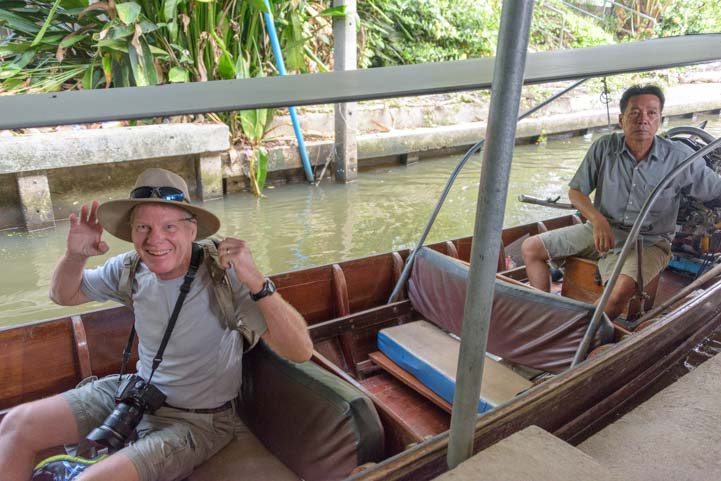
<-Previous || Next->

Grand Canyon’s North Rim – Magnificent & Intimate by Day or Night!

October 2016 – After driving through the red rock wonderland of the Vermillion Cliffs in northern Arizona, we found ourselves at 10,000′ elevation on the Kaibab Plateau in beautiful pine forests. This is the home of the Grand Canyon where the earth seems to have split apart, revealing the massive crimson hued jagged walls that rise up from the Colorado River thousands of feet below.

Red cliffs of North Rim Grand Canyon Arizona

Red cliffs at the North Rim of the Grand Canyon

The Grand Canyon runs east to west for 277 miles and spans as much as 18 miles between its north and south rims.

A huge region towards the middle of the chasm has been set aside as Grand Canyon National Park, and it has two entrances you can drive to, one on the north side of the canyon and one on the south side. At each of those spots you can wander along the rim and peer over the edge to look 6,000′ down.

North Rim Grand Canyon Arizona view through trees

A glimpse of the Grand Canyon through the trees.

The South Rim is much more popular than the North Rim and is quite overrun with tourists, many making a once-in-a-lifetime bucket list trip from far distant corners of the planet. It is wonderful, but it is extremely busy.

Colorful cliffs North Rim Grand Canyon Arizona

View from the North Rim.

The North Rim of the Grand Canyon is a bit out of the way, so far fewer people go there, and most visitors are from the surrounding states. The North Rim sees 10% of the tourist traffic that the South Rim does and is 1,000′ higher in elevation.

Chasm North Rim Grand Canyon Arizon

Looking across the Big Ditch!

The North Rim has a very special lodge that was built by the National Parks Service in 1927. This wonderful and inviting stone building is perched right on the edge of the Grand Canyon, and the huge picture windows look out on a spectacular view.

View from Grand Canyon Lodge North Rim Arizona

The Grand Canyon Lodge at the North Rim – What a view!

There is also a huge dining room where diners can eat dinner while watching the sun cast its golden glow across the ridges of the canyon right next to their table!

Dining Room Grand Canyon Lodge North Rim Arizona

A historic and beautiful spot for a dinner…with a world class view!

Outside the lodge there is a low stone wall and a line of big wooden chairs where you can sit and take in the view over a beer.

View from deck of Grand Canyon Lodge North Rim Arizona

The deck behind the Lodge offers a relaxing spot to enjoy a drink and take a few pics.

What a fantastic place!

View from deck Grand Canyon Lodge North Rim Arizona

Tourists kick back at the North Rim.

There is a feeling of intimacy and wonder on the rim here as strangers chat with each other and snap pics and take in the incredible view, enjoying a unique National Parks experience.

Deck view North Rim Grand Canyon Arizona

.

A short trail leads from the edge of this deck out onto a peninsula that juts into the Canyon and ends at Bright Angel Point.

Hiking to Bright Angel Point North Rim Grand Canyon Arizona

The trail to Bright Angel Point at the North Rim

This is a fun paved path that provides endless opportunities for jumping up on the rock pinnacles on either side to get a better view.

Hke to Bright Angel Point North Rim Grand Canyon Arizona

There are lots of places to scramble a little higher for a better view.

Of course, the best light in the Canyon is early in the morning and late in the afternoon.

North Rim Grand Canyon Arizona View

Late afternoon’s golden light brings out the contours of the jagged cliffs at the Grand Canyon.

The sun was sinking in a very hazy sky when we were there, but the towering walls of the Grand Canyon still radiated a soft light, as if from within.

Golden hour North Rim Grand Canyon Arizona

.

North Rim Grand Canyon Arizona overlook

.

Rock formations North Rim Grand Canyon Arizona

.

Here and there couples and friends staked out a spot on a precipice to watch the sun fade away.

Sunset North Rim Grand Canyon Arizona

Catching the sunset at the North Rim of the Grand Canyon

As the shadows crept up the canyon walls from the bottom, the tips of the craggy peaks held the light the longest.

View of Red cliffs North Rim Grand Canyon Arizona

.

In the final few moments of daylight, a thin ribbon of orange hovered over the Canyon.

Chasm view North Rim Grand Canyon Arizona

.

As the sun sank deeper behind the horizon, the colors in the sky grew ever more rich.

Sunset North Rim Grand Canyon

.

Once the sun was gone from the sky, the contours of the Grand Canyon flattened out, revealing beautiful patterns.

Color Patterns North Rim Grand Canyon Arizona

Patterns in the view at the Grand Canyon after sunset.

Without any shadows to show depth, near and far blended together.

Patterns North Rim Grand Canyon Arizona

.

Cliffs North Rim Grand Canyon Arizona

.

Because of the 10,000′ altitude at the rim, the North Rim of the Grand Canyon is very cold, except in midsummer, and the Grand Canyon Lodge closes October 16. The 45 mile drive on Highway 67 between the hamlet of Jacob Lake and the North Rim remains open but isn’t plowed, and the self-service gas station in the park closes December 1.

In mid-October we shivered in overnight temps that dipped into the 20’s. Nevertheless, we snuck out onto the trail in front of the lodge in the pitch dark, lighting the way with our new and very cool Lumintop flashlight (we reviewed it here) and got set up to take some shots.

Overlook night stars North Rim Grand Canyon

Night photography at the North Rim of the Grand Canyon

Above us, the lodge was well lit and looked very cozy and inviting. Occasionally we heard the excited conversation of revelers out on the deck and saw flashes from their cameras.

Stars over Lodge at North Rim of the Grand Canyon starry night and fifth wheel trailer RV

The Lodge at the North Rim of the Grand Canyon.

Slowly the stars began to shimmer above us, forming a dome full of glitter over the Grand Canyon.

Stars at North Rim Grand Canyon Arizona

Stars began to fill the sky

Both rims of the Grand Canyon are decorated with the skeletons of dead trees whose gnarly branches reach out in all directions. The Milky Way formed a majestic backdrop in the sky.

Tree and Milky Way North Rim Grand Canyon Arizona

.

The moon was setting and slowly sank into the horizon. It was nearly full and glowed orange.

Milky Way at North Rim Grand Canyon Arizona

.

Seeing the moon at the horizon below the Milky Way reminded us of our many nights at sea on the Pacific Ocean. Sailors doing their first overnight passages are often shocked as they fly along in the pitch dark at full speed, squinting hard to distinguish the sky from the ocean, and then suddenly see a very bright light on the horizon right in front of them.

More than a few hearts have skipped a beat, and more than a few frightened sailors have dashed to their radar display in a total panic as they tried to figure out what kind of mammoth ship was about to crash into them.

Then they’ve suddenly collapsed in embarrassed laughter when they realized the enormous ship approaching them was actually the rising moon.

We’d read these stories before our cruise, and of course we knew we were far too smart ever to fall for Nature’s little nighttime tease. So, it was particularly funny when it happened to us too!

Milky Way at the Grand Canyon North Rim Arizona

Good night, Grand Canyon!

If the Grand Canyon is on your horizon for your RV travels, you can camp right on the rim in the campground at the North Rim. How totally cool is that?!

However, you need to have a small to mid-size RV to fit into the campsites and drive the camground loop, and it is best to reserve a spot in advance. There are other RV camping options for slightly bigger RVs in Jacob Lake.

For folks without an RV, the Grand Canyon Lodge has a collection of charming small cabins that surround the main lodge building, and they are just steps from the rim as well.

The North Rim of the Grand Canyon is quite vast, and many of the overlooks require a drive of 50 miles or so round trip to reach them. We breezed through the North Rim on this RV trip because it was late in the season and we couldn’t drive through Jacob Lake on our route from east to west across northern Arizona without dipping down to say “hi” to the Grand Canyon, if only for a moment.

However, like all the National Parks, the Grand Canyon deserves a week or more to enjoy its many nooks and crannies in depth. During our second year of full-time RV adventures, we stayed for a month at the North Rim.

More info and links below.

Subscribe
Never miss a post — it’s free!

Some details about Arizona’s North Rim of the Grand Canyon:

Other blog posts from our RV travels in Northern Arizona:

All of our blog posts from Arizona
National Parks and UNESCO World Heritage Sites we have visited

Our most recent posts:

More of our Latest Posts are in the MENU.
New to this site? Visit RVers Start Here to find where we keep all the good stuff!!
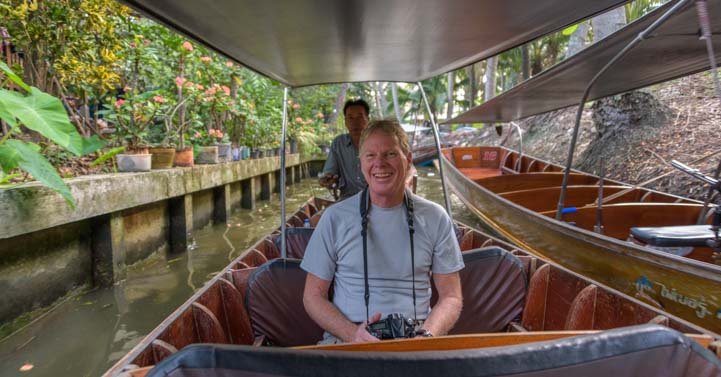
<-Previous || Next->