RV Solar Power Made Simple

Thanks to solar power, we have lived completely off the grid in two trailers and a sailboat full-time since May 2007. Without doubt, our solar power installations have given us more independence and freedom as full-time RVers and sailors than anything else in these lifestyles. It has allowed us to go anywhere at anytime, and has revolutionized our lives.

On this page I describe the two systems we have had on our trailers. These were installed in 2007 and 2008 respectively. Prices for solar power equipment have dropped every year since then, however the prices listed throughout this page are from August 2014:

  • A Small (minimal) RV Solar installation for ~$700 that we used full-time for a year of boondocking in 2007
  • A Full-timer (all you need) RV Solar installation for ~$2,500 that we have used for full-time boondocking since 2008

I also offer a little theory and reveal some of the discoveries we have made along the way. For more info, please see our Solar Power Tutorial pages and our Sailboat Solar Power Installation page.

Links to all of our articles about solar power can be found on our Solar Power For RVs and Boats page.

You can navigate to different parts of this article by using these links:

WHY BOTHER WITH A SOLAR POWER INSTALLATION ON AN RV?

Return to top

The biggest advantage of a solar power system in an RV is that the system works from dawn to dusk, silently, odor free and without requiring any fuel or maintenance, no matter where you are or what you are doing. Towing, parked at the grocery store, or camped, the batteries are being charged. They start getting charged before you finish breakfast, keep charging while you hike or go sightseeing, and continue all day, rain or shine. They don’t quit charging until nightfall. You never have to think about the batteries getting charged. It just happens. In our current rig, I feel like we have electrical hookups all the time — and we never get hookups any more!

Traveling full-time since 2007, we have connected to electrical hookups for a total of about 25 days, and that was during our first 18 months on the road. The last time we got electrical hookups was in October, 2008. Since we began our full-time travels in 2007, as of June 2019, we have boondocked in our RV nearly 3,200 nights. We also lived on solar power on our sailboat for over 900 nights during our sailing cruise of Mexico.

We do carry a Yamaha 2400i generator, but use it only a few days each year, either after a long period of winter storms to give the batteries a boost, or on hot summer days to run our 15,000 BTU air conditioner. We have used it a total of about 20 times since we purchased it in December 2007. We run it every six months or so to flush the gas through the lines. Little as we have used it, we have found the Yamaha to be a fabulous generator. It has always started on the first pull, even after it sat in storage for 20 months when we first moved onto our sailboat!

Our first solar power installation that we used for a year in 2007 was a “small” system that allowed us to use almost every appliance we owned, that is, laptop, TV, hair dryer, vacuum, two-way radio charger, power drill, etc. However, we had to be very conservative with our electrical use during the winter months. A similar “small” RV solar power kit can be found here.

Our second “full-timer” solar power system that we have been using since 2008 is like having full electrical hookups wherever we go. Very little conservation is necessary! On our biggest electrical use day to date, we watched our 26″ LCD TV with its huge surround-sound system and sub-woofer for 15 hours (it was the Olympics!) and ran two 13″ laptops for 7 hours, made popcorn in the microwave and ran several lights for 4 hours in the evening. It was July, and the next day was very sunny and the batteries were fully charged by mid-afternoon. A similar “full-time” RV solar power kit can be found here.

Here are some sample kits, smaller and bigger in size, and their prices. The only trouble with buying a component kit is that if one component fails the whole kit has to be returned. The third item, however, is a portable suitcase kit that does make a lot of sense for someone who doesn’t want to hassle with the installation just yet (you can always sell the portable kit later).

BASIC ELEMENTS OF A SOLAR POWER INSTALLATION

Return to top

BATTERY CHARGING and AC POWER
The basic components of all solar power installations is the same, and is comprised of two major subsystems: BATTERY CHARGING to get the batteries charged up and AC (120v) POWER for appliances that can’t be run on DC (12v) power (i.e., TV, computer, vacuum, hair dryer, etc.).

The BATTERY CHARGING subsystem includes these components:

  • Batteries
  • Solar panel(s)
  • Charge controller to protect the batteries from getting overcharged

The AC POWER subsystem includes this component:

  • Inverter(s) to convert the batteries’ 12 volt DC power to 120v AC power

GET YOUR HANDS DIRTY!

300 watt inverter for an RV solar panel installation

A 350 watt portable inverter
Plug it into a cigarette lighter

It is hard to “play with” the battery charging subsystem of a solar power installation to get a feel for how it works until you actually take the leap and buy a solar panel, charge controller and cables and hook it all up to the batteries. One great option if you don’t want to do any wiring but want some hands on experience is to get a portable solar panel kit. You can sell it later if you want to upgrade to a rooftop system.

You can get the hang of how the AC power subsystem works very easily. Simply run down to Walmart or any auto parts store and pick up a $15-$20 inverter that plugs into a cigarette lighter DC outlet. Plug it into the lighter in your car, turn it on, and then plug your laptop into it or your electric razor or any other small appliance. Now your 12 volt car battery is operating your 120 volt appliance.

Big inverters that can run the microwave, toaster, blender and vacuum cleaner work on exactly the same principal, the difference is just the amount of power the inverter can produce. Big inverters are also wired directly to the batteries rather than plugging into a cigarette lighter.

IS SOLAR POWER EXPENSIVE? SMALL SYSTEMS VERSUS BIG SYSTEMS

The difference between the “small” system we used for one year on our little Lynx travel trailer and our “full-timer” system we have now on our big Hitchhiker fifth wheel is simply the overall capacity of each of the components. That is, the capacity of the battery charging system (solar panels, batteries and charge controller) and of the AC power system (the inverter).

In functional terms this means that the difference between the “small” and “full-timer” systems is threefold:

1) the ability to run more appliances at once (i.e., have two laptops running while the TV and blender are going)
2) the ability to run larger appliances (i.e., using a VitaMix versus a small blender)
3) the ability to run more appliances for a longer time at night without discharging the batteries too much.

So, in a nutshell, the two subsystems — battery charging (batteries + panels + charge controller) and AC power (inverter(s)) — combine to do the same job as plugging a generator into the shore power connector on the side of the rig. The panels and charge controller charge the batteries. The inverter makes it possible to use AC appliances.

The cost of the parts for these installations is:

Small: $700 – Comparable to having a Yamaha 1000i generator
Full-timer: $2,500 – Comparable to having a built-in Cummins Onan 2.5KW generator

With solar power there is no noise, no fuel cost, no maintenance and no smell, unlike a generator. However, it is not possible to run the air conditioning in the summertime on solar power, unless you have a massive system with several hundred pounds of batteries and a roof absolutely loaded with panels. As mentioned before, we use our Yamaha 2400i generator to run our 15,000 BTU air conditioner.


OUR “SMALL” RV SOLAR POWER SYSTEM (~$700 in parts)

Return to top

This setup is a fully functional, inexpensive solar power installation, and is what we used for a 350 nights in our first year in our Lynx travel trailer. It could power a 19″ LCD TV and DVD player, radio, laptop and vacuum as well as charge camera batteries, razor, toothbrush, cordless drill, cell phone, etc.

  • Two 6-volt batteries (wired in series) giving 220 amp-hours of capacity $250

    Ours were Energizers from Sam’s Club

  • 140 watts of solar power $175

    Ours was a Kyocera 130 watt DC panel. Today Kyocera sells the 140 watt panel instead.

  • A charge controller that can support at least 10 amps $90

    Ours was a Morningstar Sunsaver 10 amp charge controller (consider a Sunsaver 20)

  • A portable inverter that can supply 1000 watts of AC power $80

    Ours was a Pro One 800 watt inverter

  • Cables, connectors and mounting brackets $100

Here are the parts for the system (except for batteries and cables) — solar panel, solar charge controller and inverter:

This system is the smallest size system I would consider for an RV if you want to drycamp or boondock for more than a night or two and be comfortable. This setup worked great in the spring, summer and fall when the sun was high in the sky and the days were long. We never thought too much about our power use until the wintertime when the days got short and the nights got long and cold. Then we began to wish for a bigger system.

RV solar panel installation - wiring the panel's junction box

Mark installs our first solar panel on the roof.
He chose a nice spot by the ocean to do it!

On those long cold winter nights we had to conserve our use of lights and the TV to make sure our furnace (which used a lot of battery power) could still run. We used oil lamps a lot in the evenings. If we had stayed in that trailer longer, we would have installed a vent-free propane heater that did not use any battery power (we eventually did that in our bigger trailer the following winter: see our Vent-Free Propane Heater Installation page).

I think every RV should have this kind of a charging system installed as standard equipment, as it is useful even for the most short-term camping, like weekends and week-long vacations during the summer months.

When we installed this “small” system in our little Lynx trailer in June 2007, we were quoted $135-$350 for installation. Mark is very handy (although he is not a Master Electrician), and he found the installation was not difficult at all and completed it in one day.

SOME THEORY – SIZING THE SYSTEM

Return to top

CHARGING & CONSUMPTION

Here is some theory to explain why the above system is “sufficient” but is not great for “full-time” use. When it comes to a solar battery charging system, the concept of power charging and consumption is very simple. The amount of power you can use, or take out of the batteries, is essentially only as much as the amount you can put into the batteries. If you use (or take out) more power than you replace (or charge them with), sooner or later your batteries will be discharged and dead. The batteries are just a temporary storage place for electricity. They act as a flow-through area for the power you are going to use.

The most important part of any solar setup is the amount of charging going on (i.e., the total size, or capacity, of the solar panels), and you want that to be greater than the amount of electricity you use. More must go into the batteries than comes out. You can have an infinite number of batteries and eventually discharge them all completely if you repeatedly use more electricity than your solar panels put in.

We often find people want to add batteries to address their power shortages when what they really need to do is add more solar panels. As a rule of thumb, don’t use more than 1/3 to 1/2 of the total capacity of the batteries in one night. More important, though, is that the bigger the solar power panel array, the better. And lastly, Keep the size and age of all the batteries in the system fairly similar so the strong ones don’t waste their energy helping the weak ones keep up.

AMPS and AMP-HOURS

Appliances use amps to run. Another unit, the amp-hour (abbreviated as “Ah“), refers to the number of amps an appliance uses when it is run for an hour. For instance, an appliance that uses three amps to run will use up three amp-hours when it runs for an hour. These amp-hours will be drawn from the batteries, and the batteries, in turn, will look to the solar panels to recharge the amp-hours they have forked over to the appliance. It is for this reason that you need to know how many amp-hours you will use in a typical day. Ultimately those amp-hours must be replaced by the solar panels, so the size and number of panels you purchase will be determined by how many amp-hours you use in a day.

To estimate how many amp-hours you might use in a day, estimate how many hours each appliance will run and multiply that by the number of amps the appliance uses. We have measured some of the appliances in our trailer, and this is how many amps they use:

Single bulb DC light — 1.5 amps
Dual bulb DC light — 3.0 amps
Dual bulb fluorescent light — 1.5 amps
19″ LCD TV — 5.5 amps
DVD / CD Player — 0.5 amps
13″ MacBook laptop, on & running — 6-8 amps
13″ MacBook, off and charging — 1.6 amps
Sonicare toothbrush charging — 0.1 amps
FM Radio w/ surround-sound — 3.0 amps
12′ string of rope lights — 3.3 amps

We find that we typically use anywhere from 50 to 150 amp-hours per day, most commonly in the 70-90 range.

HOW MANY AMP-HOURS DOES MY FAVORITE GIZMO USE?

Since RV solar power systems are DC battery based, it is helpful to know how many amps (in DC) various appliances use. Multiplying that value by the number of hours the appliance is used each day then reveals how many amp-hours the appliance will require from the battery in the course of a day.

Most DC appliances list their amp usage in the user manual or spec sheet. In contrast, most AC appliances list their wattage in the user manual instead of amperage. So, for AC appliances that are run on an inverter you have to do some math to get their equivalent DC amperage rating.

You can get a rough estimate of the number of amps that an AC device will use on an inverter simply by dividing the wattage by 10.

Why is that?

Here’s one way to look at it: Technically, Watts = Volts x Amps. AC circuits run at ~120 volts. DC circuits run at 12 volts. An AC appliance will use the same number of watts whether running on a DC or AC. On a DC circuit (using an inverter so it can run), that AC appliance will use 10 times as many amps as it will on an AC circuit (that is, 120/12 = 10).

Here’s another way to look at it: Watts / Volts = Amps. So, to determine most precisely how many DC amps an AC appliance will use when running on an inverter, start by dividing the number of watts it uses by 12 volts to get its Amps DC. HOWEVER, keep in mind that inverters are not 100% efficient. Typically they are only about 85% efficient. That is, an inverter loses a bunch of watts to heat as it runs — about 15% of the watts it needs to run get dissipated into heat. So, it takes more watts to get the required amps out of the inverter, the exact figure being 1 / 85%. This means that after you divide the appliance’s Watts by its Volts (Watts / 12, as I mentioned above), then you have to divide that result by 0.85. This is messy.

Rather than dividing watts first by 12 and then again by 0.85, you can simply divide the watts by 10 and get a pretty close estimate. (That is, (1/12)/0.85 = 0.1)

Our AC 19″ LCD TV is rated at 65 watts. How many amps is that DC? 65/10 = 6.5 amps DC. We measured the TV at the volume we like to hear it and it was using 5.5 amps. If we cranked up the volume, the meter went up to 6.5 amps.

Likewise, our old white MacBook Pro laptop was rated for 65 watts. As we opened and closed files and started and stopped various programs, the meter zoomed all over the place between 3 amps and 8 amps. When we ran Adobe Lightroom, which is very disk and memory intensive, the readings hovered in the 7-8 amp range. So on average you could say it uses about 6.5 amps DC.

When we shut down the laptop and left it plugged in and charging, the meter dropped to 1.6 amps. This is important if you are trying to conserve electricity! Run your laptop on its own battery until the battery is depleted. Then turn it off and let it charge from the inverter while you do something else!

HOW DO YOU MEASURE THE POWER USAGE OF A DEVICE?

If you have nothing running in the rig (no computers running, no TV, no vacuum or toaster, etc.), you can measure the current a device is drawing from the batteries using a clamp-on meter around one of the battery cables. To measure the AC current of a small device, you can use a Kill-a-Watt meter. Simply plug it into an AC outlet and plug your device into it.

WHERE DO THE BATTERIES FIT IN?

Battery storage capacity is measured in amp-hours (Ah), and more is better. As a starting point, most new RVs come equipped with one 12-volt Group 24 battery which will give you about 70-85 Ah of capacity. Assuming the sun has charged the batteries completely by nightfall, and sticking to the rule of using only 1/3 of your total battery capacity each night, you will have only 25 Ah available each evening. That isn’t very much!

What is the best upgrade strategy?

Upgrading to two 12-volt Group 24 batteries (wired in parallel) will give you 140-170 Ah of capacity.

However, a 6-volt golf cart style battery has the same footprint as a Group 24 12-volt battery (although it is about 3″ taller), and a pair of them wired in series will give you about 210-240 Ah of capacity.

So, rather than buying a second 12-volt Group 24 batteries and getting just 140-170 Ah of capacity out of the pair, why not sell the 12 volt battery and buy to two 6-volt golf cart style batteries for 210-240 Ah of capacity? That’s what we did on our first trailer. Just make sure that you have enough height in the battery compartment for the taller golf cart batteries.

WHAT ABOUT BATTERY MAINTENANCE?

So far I’ve been talking about wet cell batteries, and these kinds of batteries need to be maintained. Wet cell batteries are made with thick metal plates and liquid between them. Over time the liquid evaporates and needs to be replaced with distilled water. Also, over time, sulphite builds up on the plates and needs to be removed by “equalizing” the batteries.

Hydrometer Reading on Battery

Use a hydrometer to check each battery cell.

Before we upgraded to AGM batteries, Once a month Mark would check the liquid levels in each cell of each battery and pours in a little distilled water wherever needed. He also checked the condition of each battery cell using a hydrometer. This little device indicates whether a cell is functioning at full capacity. Then he equalizes the batteries by programming our charge controller to raise the voltage on them to one volt higher than their normal charging voltage for five hours. Last of all, he re-checks the liquid level in each battery cell and adds distilled water as needed and re-checks each cell with the hydrometer. Usually any cells that had a poor reading before equalizing now give a good reading.

This maintenance stuff can be avoided by buying AGM batteries which are maintenance free. However, AGM batteries are really expensive. One big advantage of AGM batteries for sailors and for people with tight battery compartments is that they operate fine in any position, that is, they can be installed on their sides and will operate when a sailboat is heeling. We had them on our sailboat.

On our trailers, we initially opted for wet cell batteries. We had Trojan 105 wet cell batteries for the first five years on our fifth wheel. Then we replaced them with cheaper Costco batteries from Interstate (Johnson Controls).

The Trojans worked very well, but replacing them with cheapo batteries was a mistake. The cheap batteries failed completely within 14 months.

We now have four Trojan T-105 Reliant AGM batteries which are truly awesome. They are a little more money than the T-105 wet cell batteries, but they are superior and, in our minds, worth the extra little bit of cash.

For price comparisons: Trojan Reliant AGM (single), VMaxTanks AGM (set of 4 & free shipping), Trojan T105 Wet Cell (single):

To learn more about our new batteries, why we chose them, and how we upgraded the power plant on our trailer in April 2015, visit:

Wet Cell vs. AGM Batteries – Why We Upgraded to AGM Batteries PLUS Wiring Tips!
RV Electrical System Overhaul

To learn more about batteries and what “single-stage” and “multi-stage” battery charging is all about, visit:

RV and Marine Battery Charging Basics

AND HOW ABOUT THE SOLAR PANELS?

Battery capacity is only part of the story. The ultimate limiting factor is how many amp-hours the solar panels can put into the batteries during the day. If the solar panels are sized too small to charge the batteries sufficiently each day, you will eventually discharge the batteries over a series of days and they will be dead.

Solar panels are rated in terms of Watts. The relationship between the amp-hours that the panel can store in a battery and the panel’s watts rating is not straight forward. Suffice it to say that a 130 Watt panel produces 7.5 amps in maximum sunlight when the panel is exactly perpendicular to the sun, and both of those numbers are available in the specs for the panel. What isn’t stated, however, is how many amp-hours a panel will produce in a given day. That is because it varies by what latitude you are at, what angle the sun is to the panel (which changes all day long), how brightly the sun shines, how many clouds go by, etc.

We have found that each of our 120 watt and 130 watt panels typically produces between about 8 Ah and 40 Ah per day depending on the season, weather, latitude, battery demands, etc. Most commonly, they produce around 25-30 Ah per day each.

If you have the time and inclination (who’s got that stuff?), you can figure out how many amp-hours you use each night. Make sure that that number is less than 1/3 of your total battery capacity AND make sure your panels can provide that many amp-hours of charging each day.

But all that sounds very difficult.

Solar panels also come in a variety of flavors, including rigid or flexible and monocrystalline or polycrystalline as seen below:

To learn more about SOLAR PANELS, see our detailed review of the pros and cons of the different types of panels available today:

Solar Panel Selection – Flexible or Rigid? 12 volt or 24 volt? Monocrystalline or Polycrystalline?

NEVERMIND THE THEORY – JUST TELL ME WHAT SIZE STUFF I NEED!

As I have mentioned before, we changed how we lived when we had a small solar power installation and again when we got a big one. You can opt to live with very little electricity or not.

We met a couple living on their 27′ sailboat on its trailer in the desert in Quartzsite, Arizona (they were on their way to launch it in the Sea of Cortez). They were using just 6 amp-hours per day because they had a tiny solar panel. Lord knows, I never saw their lights on at night!

In our little Lynx travel trailer we used about 25-35 amp-hours per day. We relied on kerosene lamps for much of our lighting at night in the winter.

In our Hitchhiker fifth wheel we use an average of 60-120 amp-hours per day and we do not conserve electricity.

So as a rule of thumb, here is the number of amp-hours you might consume per day:

• 6 Ah = living ultra-conservatively
• 35 Ah = living very modestly
• 120 Ah = living much the way you do in your house

The amp-hour capacity of your battery bank should be three (to four) times your typical daily amp-hour usage.

A popular rule of thumb is to match (roughly) the amp-hour capacity of the batteries to the watts capacity of the solar panels. So, 140 Ah of battery capacity “goes with” 140 watts of solar power. 440 Ah of batteries “goes with” 440 watts of solar power.

However, having more solar capacity than that is not a problem, as it gives you much more flexibility in case you have cloudy days, the panels aren’t oriented well towards the sun, or you have periodic shading during the day from buildings or trees.

Side note: The average American house uses about 30 kilowatt-hours (kWh) of electricity per day (see here), whereas we use anywhere from 0.6 to 1.2 kWh per day in our RV. This is because houses are much bigger and more complex and have much larger appliances and systems that run on electricity (refrigerator(s), stove/oven, hot water heater, heat and air conditioning, etc.).

It is also interesting to note that the ~1 kWh of power that our fifth wheel requires to recharge its batteries every day is approximately the same amount of energy that is required to recharge the batteries of a Tesla Model S after it is driven three miles (see here). Charging a frequently driven Tesla’s batteries exclusively with solar power would require an immense solar panel array.


OUR “FULL-TIMER” RV SOLAR POWER SYSTEM (~$2,500 in parts)

Return to top

Fifth wheel trailer solar power 681

In a nutshell, in order to run your RV with the same level of comfort as a house, using all of your appliances whenever you feel like it without thinking about conserving at all, you will need at least the following:

  • Four or more 6-volt batteries giving you at least 440 amp-hours of capacity

    We have four 6-volt batteries (2 pairs of batteries in series to make two 12-volt equivalent batteries, and then those 2 twelve volt equivalent batteries placed in parallel with each other). We had Trojan 105’s for the first five years, and after that we’ve had batteries from Costco, ~$480, which we soon replaced with Trojan T-105 AGM Reliant batteries, $1,200 (see note below).

  • 500 or more watts of solar power (preferably 600-800 watts)

    We have three 120-watt Mitsubishi panels and one 130-watt Kyocera panel, for a total of 490 watts of solar power, `$1,140

  • A charge controller that can support 40 amps or more (preferably 60 or 80 amps)

    We have an Outback FlexMax 60 60 amp charge controller (consider the FlexMax 80) $565
    For more info see our page: Solar Charge Controllers – Optimizing RV Battery Charging

  • A true sine wave inverter that can supply at least 1000 watts of AC power (preferably 2000 or 3000 watts)

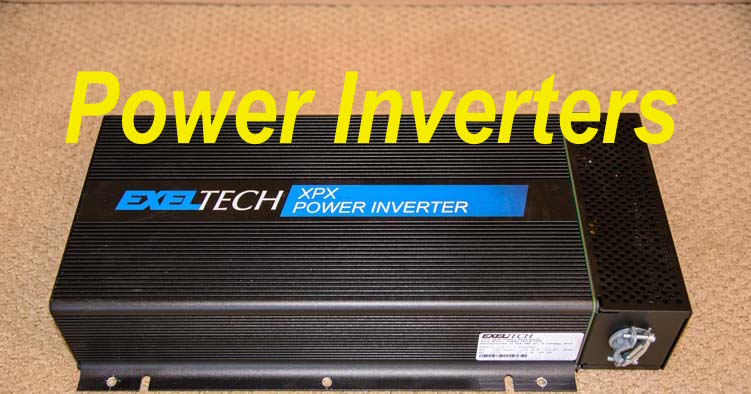
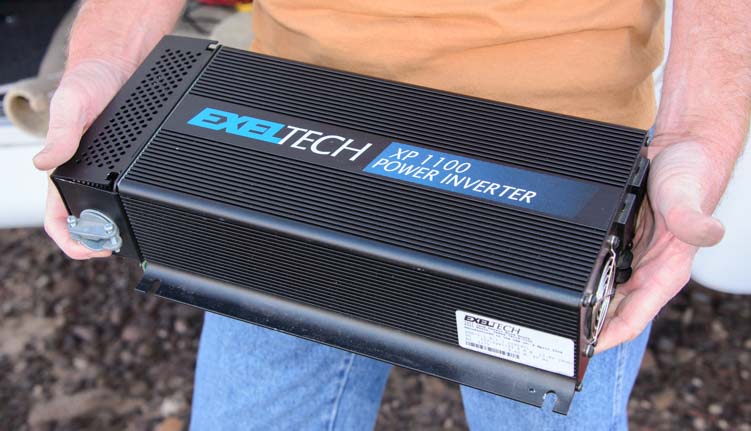
    For 7 years we had an Exceltech XP 1100 watt true sine wave inverter $600.

PLEASE NOTE: In April, 2015, we upgraded to Trojan 105 Reliant AGM batteries ($1,200) and an Exeltech XP 2000 watt true sine wave inverter ($1,700). See our post RV Electrical Power System Overhaul to learn more.

This system will power everything except the air conditioner, regardless of weather or season. My notes indicating “preferably” larger sizes for everything reflects the fact that our installation is now quite old and component parts costs are half what they were when we were buying. More is definitely better.

I’ve never heard anyone say they wished they had less solar power!

Mark did the installation of this solar power system on our Hitchhiker fifth wheel. My rough guess is that the installation might have cost $700-$1,500 if done by an experienced installer. It took him three partial days, largely because we were boondocked in the woods about 15 miles from Home Depot, and I had to keep running back and forth to get little things for him!

NOTES and LESSONS LEARNED

Return to top

More and more solar power equipment manufacturers are selling complete kits for RVs, boats and cabins. Here is an example full-timer kit from Go Power, and a slightly smaller full-timer system from Renogy. Here is a small solar power kit from Go Power for “weekender/vacation” use and another small solar kit using Renogy panels.

Also, if you don’t want the hassle of doing an installation, here’s a nifty portable solar panel kit that folds into an easy-to-carry suitcase!!


INVERTER and CONVERTER CONFUSION

If you are like me, the terms “inverter” and “converter” are confusing. They sound so similar it seems they must be one and the same thing. They are actually two very different components with very different missions in an RV.

CONVERTERS

A converter takes the AC power coming in from the shore power cord (via electrical hookups or a generator) and gives power to all the DC appliances in the rig so the batteries can take a break. It essentially does what the batteries do, but does it only when there is shore power.

The DC converter in an RV also charges the batteries while connected to shore power. Some converters have sophisticated multi-stage charging mechanisms, and others simply provide a trickle charge.

For more about single-stage versus multi-stage charging, click here.

The DC converter is not involved in the solar power system. In our “full-time” solar setup, the DC converter is actually unplugged because our inverter powers all the AC outlets in the rig. Because of our converter’s design, when it is plugged in it senses when there is AC power available and automatically turns on. This would impose a huge demand on our batteries whenever we turned on the inverter.

Once in a while, when the skies have been overcast or stormy for a few days, we fire up our trusty Yamaha 2400i generator to bring the batteries up to full charge. We plug our shore power cord into the generator, unplug the inverter and plug in the converter. Now the converter is charging the batteries.

The converter that came with our rig was a single-stage trickle charge Atwood 55 amp converter. This was very inefficient for use with the generator because it charges at such a slow rate that we had to run the generator for hours and hours to get the batteries charged up.

In April, 2015, we replaced that converter with a slick new Iota DLS-90 / IQ4 converter. This converter can put as much as 90 amps into the batteries and has a true multi-stage charging algorithm. To see our introductory post about our big electrical system upgrade, see this post: RV Electrical Power System Overhaul

For more about converters, visit: RV Converters, Inverter/Chargers & Engine Alternator Battery Charging Systems

Almost all trailers and many smaller motorhomes have a converter installed at the factory.

INVERTERS

An inverter takes the DC power from the batteries and converts it to AC power so you can run things like TVs, computers, vacuum cleaners, hair dryers, toasters, etc., and also charge things like your phone and camera batteries. Turn on the inverter, plug an AC appliance like an electric razor or TV into it, and poof, the razor or TV works.

Inverters come in two flavors:

True Sine Wave (or Pure Sine Wave) which means the AC power signal coming out of the inverter is identical to the power signal of a wall outlet in a house (a smooth sine wave).

Modified Sine Wave which means the waveform is clipped at the top and bottom and is stair-stepped in between rather than being a smooth sine wave.

It is easier to convert DC power to a square-type wave than a smooth sine wave, so modified sine wave inverters are much cheaper. However, some sensitive AC appliances don’t work with a modified sine wave inverter.

We purchased a high-end true sine wave inverter for our “full-time” solar setup, because it matched the quality of the system and our particular unit was noted for its ruggedness (we run it 15 hours a day, sometimes 24). Our Exeltech true sine-wave inverter is designed to operate medical equipment, so it provides exceptionally clean and stable AC power.

See our story “How Much Inverter Is Enough?” to learn about what happened to us when we accidentally “blew up” our fancy Exeltech true sine wave inverter and had to live on a tiny cheapo 350 watt modified sine wave inverter while waiting for the parts to fix it!

Ironically, some RV parks have unstable AC power that can damage AC appliances in an RV. Our inverter power from our Exeltech is cleaner and more reliable (Exeltech inverters are designed to power sensitive medical equipment)! Desktop computers, laser printers, TV and stereo equipment and Sonicare toothbrushes are the most likely appliances to have trouble with modified sine wave inverters. However, when we used modified sine wave inverters exclusively with our small solar power setup on our Lynx travel trailer, we never had a problem with any of our appliances. Modified sine wave inverters often have loud fans, and Mark did have to put some WD40 on our Radio Shack inverter twice when the fan quit working unexpectedly.

INVERTER/CHARGERS

To add to the confusion about inverters and converters, some inverters combine a little of the functionality of both an inverter and a converter. These are called inverter/chargers and have two independent functions: (1) convert the batteries’ DC power to AC (inverter), and (2) use the AC power from the shore power cord (connected to electrical hookups or generator) and charge the batteries.

These are pricey pieces of equipment and many higher end motorhomes come with them. Our sailboat came with both a 600 watt pure sine wave inverter (which we used for everything on the boat except the microwave) and a 2500 watt modified sine wave inverter/charger (which powered the microwave and charged the batteries when we plugged into shore power).

NOW THAT IT’S ALL CLEAR, THE MANUFACTURERS MESS US UP!

The distinction between inverters and converters is pretty easy, isn’t it? However, recently when I was in an auto parts store I noticed a box labeled “POWER CONVERTER” and the picture and description were very clearly that of an INVERTER! So, maybe the distinction is going to get all muddied up after all.

For more about inverter/chargers, visit: RV Converters, Inverter/Chargers & Engine Alternator Battery Charging Systems

AN IMPORTANT NOTE ON RV REFRIGERATORS

Return to top

Because conventional propane RV refrigerators are inefficient and are (shockingly) expected to fail within ten years of service (see our blog post about that here), the current trend in full-time RVs is to manufacture them with residential AC refrigerators. These RVs are built with an inverter large enough to power the refrigerator while the RV is in transit. This is great for folks that are going to plug into electrical hookups 100% of the time. However, the electricity required to run a refrigerator, whether AC or DC, and no matter how Energy Star Efficient it is rated to be, is astronomical.

A typical 10 to 12 cubic foot Energy Star refrigerator will use over 300 kilowatts per year, or 822 watts per day. There is some energy lost when running on an inverter, so this will be roughly 822 Watts / 10 Volts = 82 amp-hours per day. To keep this fridge operating during the short days of winter when the sun is low in the sky, you will need 400+ watts of solar panels and 200+ amp-hours of battery capacity in addition to whatever you will need to run the rest of the household.

If you plan to boondock a lot, and you don’t want to run your generator 24/7, be prepared to outfit your rig with over 1,000 watts of solar panels and close to 1,000 amp-hours of battery capacity to power a residential refrigerator.

Non-Energy Star compliant DC electric refrigerators are even worse. Our sailboat had a 3.5 cubic foot DC refrigerator (“counter height” or “dorm size”) that was built for RV use. It did not have a freezer compartment. We had 710 amp-hours of AGM batteries and 555 watts of solar power. Granted, we were living in the tropics and the ambient cabin temperature was generally 85 degrees. The refrigerator compressor ran about 50% of the time and our solar power system was pushed to the max to keep the batteries topped off every day.

We had a separate standalone 2.5 cubic foot DC freezer on our sailboat. If we turned the freezer on, the solar panels could not keep the batteries charged without supplemental charging from the engine alternator every third or fourth day.

Residential refrigerators have vastly improved in recent years, running on a mere 25% of the electricity they used to use in 1986, and they are only getting better. For more information about refrigerator energy use and energy saving tips, see this resource: How Much Electricity Does My Refrigerator Use?

I have corresponded at length with a reader who has been boondocking 95% of the time for 6 months in a 40′ Tiffin Phaeton motorhome. He has a Whirlpool 22 cubic foot residential refrigerator, 1,140 watts of solar panels on his roof and 940 amp-hours of battery capacity in his basement. His fridge is powered with a dedicated Xantrex pure sine wave 2,000 watt inverter that is wired through a transfer switch to both his shorepower line and his generator, just in case the inverter fails (he had a 1,500 watt modified sine wave inverter that literally burnt up and started smoking).

So it can be done, but it will be easier in a motorhome that has a big payload capacity than in a fifth wheel or travel trailer that has a smaller payload capacity due to the weight of the batteries required. Even though we had to replace our RV refrigerator in its 8th year of service, we do not want double our battery bank and solar panel array just to power a residential fridge. I would rather put that extra 275 lbs into other things we need in our mobile lifestyle.

PHEW! THAT WAS A LOT OF INFO. WHAT NOW?

Still confused about the components and operation of an RV solar power system? See our four part RV SOLAR POWER TUTORIAL series where these concepts are re-introduced and discussed in greater detail:

Learn more about the different kinds of solar panels on the market:

Solar Panel Selection – Flexible vs. Rigid, 12 volt vs. 24 volt, Monocrystalline vs. Polycrystalline – PLUS Wiring Tips!!

Get the quick-and-dirty shopping list of things to buy for your solar power installation:

Three RV Solar Power Solutions: Small, Portable, and Big!

Want to learn more about BATTERIES and understand how battery charging works at a deeper level? Our Intro to Battery Types and our four-part tutorial series covers all the details involved in charging RV and marine batteries and takes a close look at a variety of specific charging systems, from converters to inverter/chargers to engine alternators to solar charge controllers. It also reveals how these systems work together:

Curious about the solar power installation we did on our sailboat? See our page: SAILBOAT SOLAR POWER INSTALLATION.

In April, 2015, we overhauled our electrical power plant on our trailer. See the introductory post about this upgrade here:
RV ELECTRIC POWER SYSTEM OVERHAUL

Subscribe
Never miss a post — it’s free!

Where do you buy solar panels, charge controllers, inverters and such? Surprisingly, Amazon offers solar power kits and more. Click the following links for a wider selection of:

If you click through to Amazon from anywhere on this website, anything you put in your shopping cart or wish list immediately after that results in a small commission to us at no cost to you, no matter what you search for and no matter when you finalize the purchase. This is a wonderful way that you can "help us help you" with detailed and carefully researched articles. Thank you!


We offer all the information on our website free of charge in hopes of helping help our fellow RVers and cruisers. We have been alarmed and saddened to find portions of the copyrighted material on this page plagiarized in ebooks that are sold for profit, but so it goes. Imitation is the sincerest form of flattery. Good luck with your solar power installation — we hope our articles on this website are useful to you!

Below are some of our most POPULAR POSTS (also in the MENUS above)

Buddy - A Journey in Spirit - The story of an event that changed our lives forever.

ARTICLE INDEXES
  • RV Tech Tips Articles - A one page index of links to all our RV Tech Tips, RV Upgrades & RV Maintenance articles.
  • RV Lifestyle Tip Articles - An index of links to all our RV Lifestyle Tips (finances, boondocking, major repairs, work/jobs, etc.)
  • Solar Power Articles - Overview and tutorial articles for how to design and install solar power on an RV or boat
  • Product Reviews - An index of links to all of our Product Reviews
RV UPGRADES, SYSTEMS & TIPS MONEY FULL-TIME RV LIFESTYLE GEAR STORE
  • Gear Store - A list of the goodies, equipment and gear we've found useful in our RV lifestyle!
 

Our most recent posts:

More of our Latest Posts are in the MENU.   New to this site? Visit RVers Start Here to find where we keep all the good stuff. Also check out our COOL NEW GEAR STORE!! *** CLICK HERE *** to see it!

What’s A Girl To Do at the RV Dump Station?

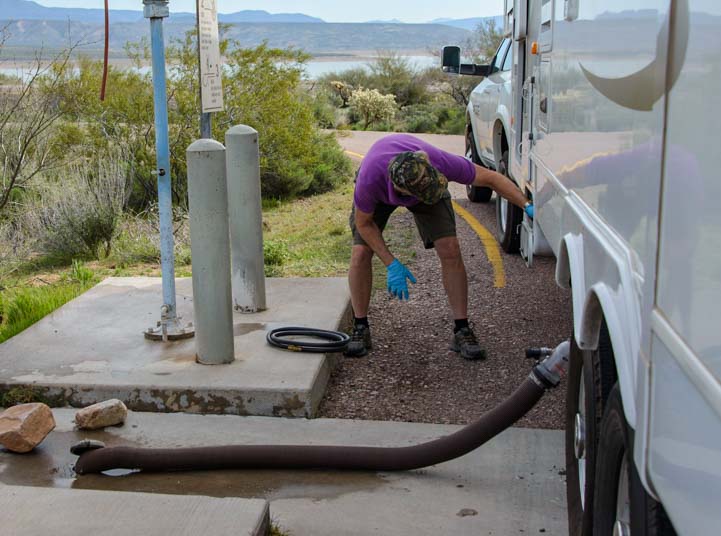
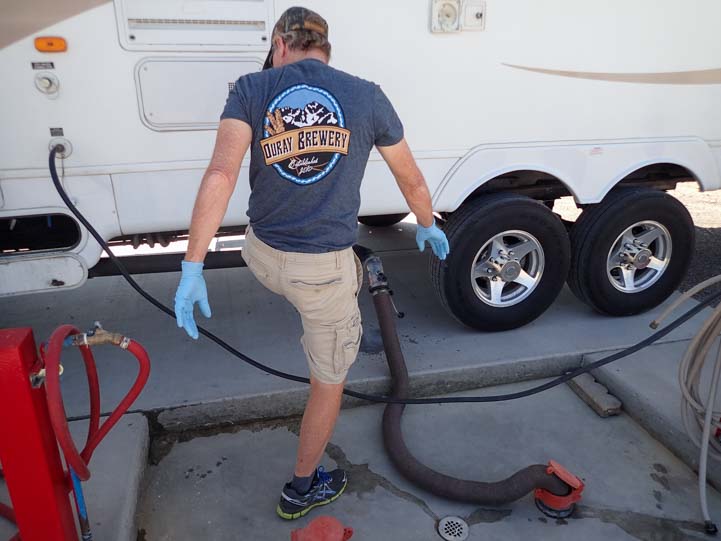
Dumping the RV holding tanks is a nasty little job, but it’s part of the fun of traveling around in an RV, and we’ve all gotta do it. It’s really not all that bad when it’s a shared job, but of course that’s easy for us gals to say, because it’s usually our male partners-in-love-and-life who get to do the bulk of the dirty work.

RV dump station tips for women RVers-2

Despite lots of progress over the years for the types of work women can do, emptying an RV’s waste water holding tanks is a job many women are just as happy to leave to their better half.

Sometimes, when we go to an RV dump station, I am amazed to see a woman remain in the passenger’s seat of her truck or motorhome for the whole duration of the job. I’m not sure how these women have negotiated that arrangement with their significant other, but I figure they must be incredibly good cooks to be able to chat with a friend on the phone or check the latest on Facebook while their hubby is grinding it out with the sewer hose, the splashing water, and all that muck and mire.

RV dump station tips for RVing women

Mark looks like he’s having so much fun. Can I get away with doing nothing?

I wish my skills were so awesome in the kitchen that I could be exempt from doing anything at the RV dump station. But alas, in our marriage, I need to be a participant in this dirtiest of deeds to win brownie points for other aspects of our life together. Nonetheless, it took me a few years to find things to do while we were at the RV dump station that were truly useful and helpful.

We have a full set of “blue” RV dump station procedural tips below — but they don’t say much about the “pink” side of the job:

Dirty Little Secrets from the RV dump station

Too often at the beginning of our RVing lives I found my best efforts to help with setting up the RV sewer hose or screwing in the water hose ended up with me underfoot and in the way of the general flow of things. Mark had his methods, and I couldn’t read his mind as to what came next.

Few people are in truly sunny and radiant moods when they don their rubber gloves at the RV dump, and too often I found that my most valiant attempts to be helpful resulted in tensions rising between us.

RV dump station tips for women RVers

I think he’s trying to tell me something.

Then one day I discovered a way that I can be of significant help and get some important jobs done at the same time.

GIVE THE BLACK TANK A BOOST FLUSH

For starters, I fill two 5-gallon water buckets with water and carry them into the rig to dump them down the toilet after the black tank has been emptied. Even if an RV has a black water flush system like ours does, it is still surprising just how many little bits of gunk and human waste solids get flushed out when two 5-gallon buckets of water are poured down the toilet.

I fill the buckets while Mark gets the sewer hose out and attaches the clear elbow so he can see when the holding tanks are fully drained. Then I can scoot out of the way and carry the buckets around to our RV’s door before he begins attaching the black water flush hose between the rig and the water spigot. This way we don’t end up stepping on each when we first start working at the RV dump station.

RV dump station tips flushing black tank with buckets of water in toilet

We have two buckets and I fill each one with water to give the toilet and sewer pipes an extra flush.

The buckets are heavy to carry around to our trailer’s front door, but I don’t mind a little bit of a shoulder and arm workout, and I take them one at a time. Maneuvering a heavy bucket of water up stairs is excellent exercise for both balance and strength.

I grab the inside of the doorway with my left hand for extra balance, tighten my abs so I don’t throw my back out with the uneven weight distribution of carrying a heavy bucket, and I leverage myself up and set the pails down inside in the kitchen.

RV dump station tip flush black tank with buckets of water in toilet

The buckets are heavy, but I take my time and grab the door frame to keep my balance as I go up the stairs.

For those who can’t carry the buckets, your partner will likely be happy to carry them for you since this really helps ensure the black tank and toilet get a complete flush. Also, filling the buckets only half way or three quarters of the way can help not only lighten the load but keep the water from splashing all over the place and all over you.

CLEAN THE BATHROOM

The other task I tackle is cleaning the toilet room from top to bottom and cleaning the bathroom vanity and kitchen sink. I figure that if my sweet hubby is dealing with the darker side of RVing outside at the RV dump station, I can deal with the same stuff on the inside..

This insures the bathroom gets cleaned on a regular basis and also means that when we arrive at our next campsite not only are the holding tanks empty but our bathroom is sparkling clean and smells fresh.

So, once I get the water buckets inside the rig, I begin assembling the things I will need to clean the toilet and the bathroom. When I hear Mark’s knock on the wall, I know he has finished emptying the black tank and it is time to dump the buckets of water down the toilet.

RV dump station tips flush black tank

I pour one bucket at a time and Mark watches the flow in the sewer hose to make sure the water eventually runs clear.

Since the buckets are just inside the RV door, it takes me a minute to grab one and empty it. Then it takes a few minutes more to go grab the other one and empty it too. Having a few minutes between flushes is helpful because then Mark can monitor whether the water from the second bucket is running clear or is still flushing solids out. If there are still chunks coming out, then, depending on whether anyone is waiting to use the RV dump after us, I’ll fill another bucket or two with water and dump them down the toilet.

Sometimes I have the water pump turned on as I dump the buckets of water down the toilet and sometimes it’s turned off. Having it turned on means even more water flushes down, which is great, but it also uses up water from the fresh water tank. So, whether or not I have the water pump turned on depends on whether there are people waiting behind us at the dump station, as it will take a little longer for us to fill the fresh water tank if we flush a few extra gallons down the toilet as part of the dumping process.

Now that the black tank is completely flushed, Mark begins emptying our kitchen gray tank. We have two gray tanks, one for the kitchen and one for the shower. We empty the kitchen tank first because it is dirtier and has more things in it (like broccoli bits) than the shower gray tank which is just sudsy water.

While he works on emptying the two gray tanks, I get to work cleaning the toilet.

RV dump station tip woman cleans toilet and bathroom

If Mark is mucking around in gross stuff outside, the least I can do is muck around in gross stuff inside. This also gives us a clean bathroom when we set up camp.

Since we have a hatch in the toilet room that we leave open a lot, the toilet lid and the floor often get dusty in just a few days. So I remove everything from the toilet room and clean everything, including the floor.

Over the years we’ve found that the toilet bowl — more so than the black tank itself — can be a big source of foul odors. Unlike household toilets, RV toilet bowls are basically dry except during flushing, so urine can end up drying in the bowl and producing an odor.

Also, the flow of the flushing water doesn’t necessarily rinse every inch of the bowl, so some areas simply don’t get rinsed all that well, even when using the toilet’s spray nozzle. So, I go to town on the inside of the bowl as well as everything else.

We use two enzyme/bacteria based RV holding tank treatment products: Happy Campers RV holding tank treatment has worked best for us in extreme temperatures (very cold and very hot) and for controlling tank odors. RV Digest-It holding tank treatment has worked best for us in moderate temperatures to break down the solids in the tank.

Because these are both basically solutions of living critters, the toilet cleaning products we use can’t be too toxic or the colonies of feces-eating bacteria can’t get established and become self-perpetuating. I’ve been using Murphy’s Oil Soap for the last few years with good results.

This is the soap that is recommended for cleaning the rubber roofs on the tops of RV’s, which is why we had it on hand to try on the toilet a few years ago. In addition to being biodegradable, what we like about it for cleaning the toilet is that it assists in keeping both the seals in the toilet bowl and on the black holding tank valve lubricated. I used white vinegar for cleaning the toilet for a while, and after a few months the black tank valve got really sticky. Since switching to Murphy’s Oil Soap a few years ago, that valve hasn’t gotten gummed up.

Periodically, we’ve found the seals in the toilet bowl have stopped holding water which meant the bowl drained completely dry between flushes. This allowed foul odors to come up from the black water tank. This problem is usually due to mineral and gunk build-ups on the seal.

So, I give that seal a really good cleaning too. The critical areas are on both the top and bottom surfaces of the rubber seal, that is, between the seal and the toilet bowl (the top side) and underneath the seal where the dome flapper (the “waste ball”) closes up against it.

RV toilet assembly and flapper valve installation

A disassembled RV toilet shows what the rubber toilet seal looks like without the toilet bowl sitting on it. To prevent it from leaking and draining the toilet between flushes, I scrub both top and bottom of the rubber seal.

I make sure the water pump is off at this point and hold the toilet flush lever down so I can get at the underside of the seal.

Often, the build-up is due to having hard water in the fresh water tanks which is very common in Arizona and other western states where the fresh water comes from deep, mineral rich aquifers.

RV toilet flapper cleaning tips

The seal needs to be completely free of mineral deposits on both the top and bottom, so I clean the area between the seal and the bowl on the top (red arrow) and below the seal on the bottom (the backside of the seal in this view).

At this point, depending on what Mark is up to outside, I’ll move on to other cleaning projects. If we have nearly emptied our fresh water tanks prior to coming to the RV dump station, it may take 10 minutes to refill them. Also, sometimes the potable water spigot is a little ways beyond the waste water dump area, requiring Mark to move the whole rig a few feet forward.

So, if there is time, I will clean the bathroom vanity sink and then move on to the kitchen sink. Depending on our plans for the next few days and depending on how much time I have at the RV dump, I may also add the holding tank treatment to the black tank, via the toilet, and add it to the gray tanks via the bathroom sink, shower and kitchen sink.

Sometimes, however, I prefer to wait two or three days until those tanks have some liquids in them before adding the holding tank treatment. And sometimes I add just a half tank’s worth of holding tank treatment at the RV dump station and then add the other half a few days later once the holding tanks have become partially full.

Of course, we add a capful of bleach to our fresh water tanks every few months, and that totally obliterates any colonies of anything that have started to grow in any of the holding tanks (including the fresh water tank) as the bleach water works its way through our plumbing system from the fresh water tank to the gray and black waste water tanks.

So, for us, creating fully self-sustaining communities of healthy organisms in any waste water tank is not 100% doable. But by using non-toxic cleansers we can help them along in between bleach blasts.

So, all in all, there is a LOT a girl can do at the RV dump station. We find we are both much happier about the whole process when we each have a set of tasks to do when we get there that are not only similarly grungy but are equally important and that take place in different parts of the RV.

The best part is that when we leave the RV dump station to go set up camp in a new, beautiful location, not only do we have empty waste water tanks but our bathroom is clean and fresh too.

Happy cleaning!!

Subscribe
Never miss a post — it’s free!

Goodies I use for my jobs at the RV Dump Station:

More RV tips and Tricks:

Our most recent posts:

More of our Latest Posts are in the MENU.
New to this site? Visit RVers Start Here to find where we keep all the good stuff!!

Hitch Tighteners – Anti-Rattle Hitch Clamps Stop the Creaks & Wiggles!

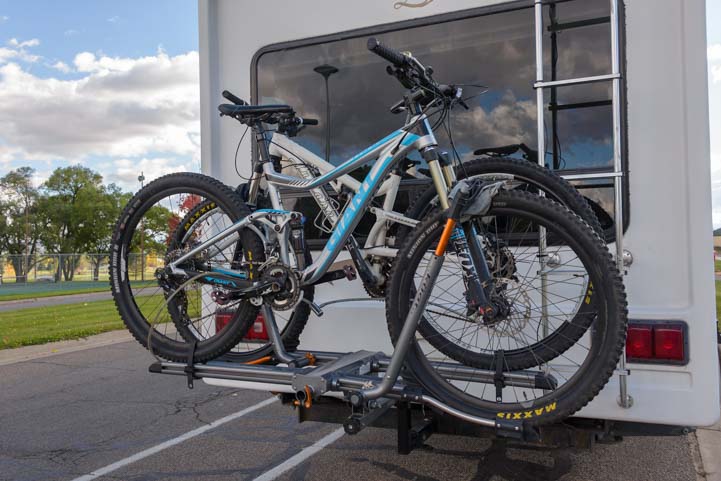
We carry our bicycles on the back of our 36′ fifth wheel trailer with a Kuat NV bike rack inserted into the trailer’s hitch receiver (we reviewed the Kuat bike rack here). We installed this bike rack in 2012 and it has been great for the past five years of our full-time RV travels.

Kuat NV Bike Rack on back of fifth wheel trailer RV

We carry our mountain bikes on the back of our 5th wheel with a Kuat NV Bike Rack

To keep the bike rack from dragging on the ground in crazy places like steep gas station ramps or deep gulleys on small roads, we had a “Z” shaped “hi-low” hitch riser made. This raises the rack up quite high, so now the first thing to hit the ground is the hitch receiver itself rather than the bike rack.

Hitch extension with Kuat NV bike rack

A “Z” shaped “hi-low” hitch riser raised the bike rack so it can’t drag on the ground in a gully or dip.

As is often the case with hitch receivers, the bike rack isn’t a perfectly tight fit in the hitch receiver riser, and the bottom of the riser isn’t a perfect fit in the trailer’s hitch receiver either. So, the whole bike rack tends to wiggle.

We’ve used various shims to make it all tight, but too often they would wiggle loose over time, and eventually the bikes would be jiggling all over the place on the rack again.

Using a shim in a bumper hitch

We wedged shims in to tighten things up, but it wasn’t an ideal solution

Last fall we stopped in at JM Custom Welding in Blanding, Utah, to talk with Jack, the man who had made our “Z” hitch riser (more info about it here). We wondered if he had any tricks up his sleeve for making our bike rack arrangement less wobbly.

JM Custom Welding Blanding Utah

Mark and Jack of JM Custom Welding in Blanding, Utah

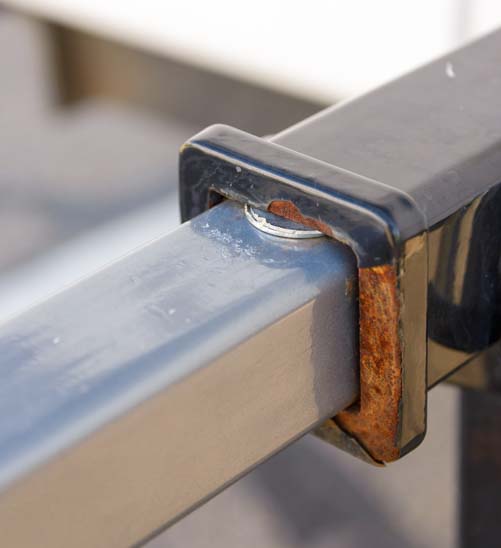
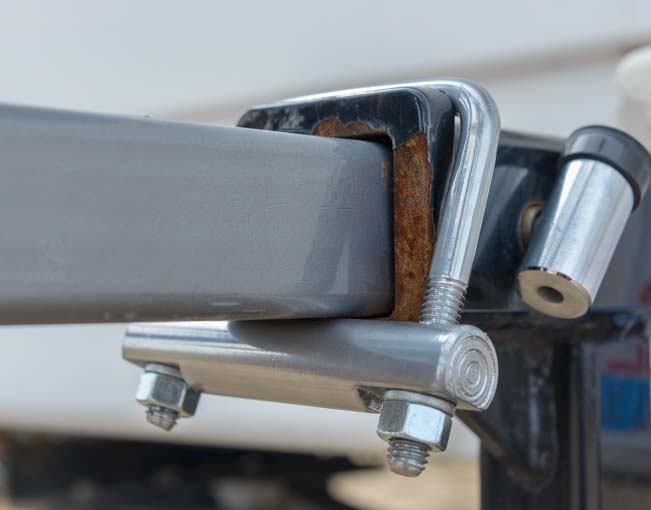
It turns out that he had solved this very problem for other customers by making a hitch tightener. This is essentially a hitch clamp that fits over the end of the hitch receiver and snugs up whatever is inserted into the receiver with some lock washers and nuts.

Bumper hitch tightener for car or RV hitch

Jack put this nifty hitch tightener on our hitch receiver.

Bumper hitch tightener for bike rack

.

So, we got two of them, one for the top and one for the bottom of our “Z” shaped hi-low hitch riser extension.

Hitch tightener on RV for bike rack

He put a second hitch tightener on the trailer’s receiver as well.

The difference in the amount of movement of the bikes was absolutely astonishing. They were rock solid now!

Hitch tightener for bike rack mounted in bumper hitch

Looking down at both hitch tighteners on our hitch extension.

After installing the hitch tighteners, which was just a matter of tightening the nuts, Mark drove the rig around the JM Custom Welding dirt lot while I walked behind and watched the bikes, and they were steady as could be.

Hitch tighteners on bumper hitch mounted bike rack

Hitch tighteners at the top and bottom of the hi-low hitch riser extension.

Hitch tightener for bike rack mounted in bumper hitch

.

But unlike the shim solution we’d used before, these hitch tighteners have stayed tight without needing any adjusting or fuss for several months and several thousand miles of driving on all kinds of roads.

Kuat NV BIke rack and bike rack extension and hitch tightener

The whole system is completely rigid now and has not needed any adjustments in six months of use.

The hitch tighteners do make for some extra steps if we want to move the bike rack from the hitch receiver on the trailer to the hitch receiver on our truck. However, we’ve started hauling our bikes in our truck in a different way using a furniture blanket, so there’s no need to take the bike rack off the trailer any more.

Mountain bikes on truck rather than a bike rack

An easy way to get the bikes from the trailer to the trail head!

Jack makes these hitch tighteners in batches, so if you are passing through Blanding, Utah, perhaps on your way to or from the beautiful Natural Bridges National Monument, just a mile or so south of Blanding you can stop by JM Custom Welding and pick one up! In 2016 the were $38 apiece.

We discovered later that hitch tighteners of various kinds are also commercially available. So, if Blanding, Utah, isn’t in your sights, you can choose from many different kinds of hitch clamps online.

However, a visit to Jack’s welding shop is very worthwhile, especially if you need any kind of custom metal fabrication done on your RV. He is very creative and does excellent work.

While we were in Jack’s office, we noticed a display of his for a folding storage solution for the beds of pickup trucks he’s created that fits right behind the truck cab. He calls it the “Jack Pack” and it is essentially a framed canvas storage bag the width of the truck bed that is easily opened to throw your bags of groceries into and then easily folded away when you need to haul lumber or fill the truck bed with something else.

If we didn’t have that part of our truck filled up with extra water jugs, we would have snagged one of those from him at the same time!

We’ve got a few more links below.

Subscribe
Never miss a post — it’s free!

Info on hitch tighteners and hitch clamps:

There are many brands of hitch tighteners on the market. These are a few:

There’s also a “Z” shaped hi-low hitch riser available:

If you need custom metal fabrication work done:

Related Posts:

Our most recent posts:

More of our Latest Posts are in the MENU.   New to this site? Visit RVers Start Here to find where we keep all the good stuff. Also check out our COOL NEW GEAR STORE!! *** CLICK HERE *** to see it!

Photography – Cameras, Gear, Tips and Resources

Note: This page was written in 2016 and reflects the gear we used and what was on the market at that time. Our current gear is all professional quality and includes Nikon Z8 and Nikon D850 camera bodies, Nikon lenses, Nikon polarizing filters, Really Right Stuff tripod legs, Benro tripod legs, Sunway Foto table top tripod legs, Really Right Stuff ball heads and Wimberly gimbals, Think Tank camera backpacks, 14 inch Apple Macbook Pros with M2/Max CPU 64 GB memory and 4TB internal drives, and SanDisk G-Raid external hard drives for backups and archiving. We still highly recommend the resources we used for learning photography and post-processing described further down the page.

Since we began our full-time RV travels in 2007, photography has become a huge part of our lives. Photography is an ideal hobby for travelers, and it isn’t hard to learn. Our learning curve has played out on the pages of this website, and it is satisfying to see our improvement over the years. When we first started traveling, we each shot about 6,000 photos per year. Now we each shoot over 35,000 photos per year (a little under 100 per day per person!).

Camera on a tripod - photography

Photography is a lot of fun, and it’s not hard to learn.

People have asked us what cameras and equipment we use, and how we improved our skills. This page presents all of our gear choices over the years, from our camera bodies to our favorite lenses to our filters and tripods to the goodies we use to take our cameras out for a hike to the software we rely on for post-processing.

It also explains how we organize all our photos and lists all the books, eBooks and online tutorials we have studied to learn to take better photos. We are entirely self-taught, and the inspiring resources we reference here lay it all out in plain language.

We’ve invested in our camera equipment because photography is our passion and we do it all day long. What you’ll see here is our progression through good solid “value” gear, from the “entry level” gear we started with to the more professional quality gear we use today.

For easy navigation, use these links:

The best time to buy camera gear is during the lead up to Christmas or when a manufacturer discontinues a camera model. An inexpensive but good quality DSLR is the Nikon D3400 camera which is available in kits with one or two lenses, camera bags, filters, etc., here

CAMERAS and LENSES

Return to top

Our Current Cameras and Lenses

As of 2018, we both shoot with Nikon D810 cameras. This is a professional level, truly awesome, full-frame 36 megapixel camera. We use these primarily for landscape shots.

We also both have Nikon D500 cameras which are crop-sensor 20 megapixel cameras that can shoot 10 frames per second, ideal for fast moving objects like wildlife and our adorable puppy.

Prior to these cameras, we both used Nikon D610 cameras. This is a full-frame, 24 megapixel camera. It is considered a “pro-sumer” camera, not quite professional quality but at the high end of the hobbyist ranks.

Although we have a big collection of lenses, we typically take no more than two apiece with us when we are out and about on foot. It’s just too much stuff to lug around!

I have a Nikon 28-300 mm lens on my camera which I use almost exclusively, simply because I love the flexibility of having both wide angle and zoom options with the twist of my wrist without having to change lenses.

Photographer with camera tripod in the water

When we got into photography, we jumped in with both feet.

Mark likes to pick a lens for the day and work within its limits. His favorites are prime (non-zooming) lenses, and he uses the Nikon 50 mm and Nikon 85mm lenses a lot. These are a lot less expensive than zoom lenses, and they are much faster lenses too (meaning they can be used in lower light). However, they do not have vibration resistance (also known as “image stabilization”), a technology that reduces the inherent wiggle caused by hand-holding a lens.

He also uses the Nikon 24-120 and the Sigma 24-105. These are very similar lenses, and we would have just one of them, but I used to use the Nikon 24-120 all the time before I got the Nikon 28-300, so he got the Sigma 24-105 to have one with a similar range. They’re both terrific lenses, so we can’t decide which one to keep and which one to sell!

We have a Nikon 70-200, which is a truly beautiful lens. For a long time neither of us used it much, but after I commented to that effect when I first published this post, Mark put it into his regular arsenal and uses it frequently now. It is a fabulous lens with excellent color rendition. Another advantage is that the zoom feature doesn’t lengthen or shorten the lens — it is always one length and all the zooming is physically done inside the lens. This means that dust doesn’t sneak into the lens when it is zoomed in and out the way it does with other lenses (like the 28-300, 24-120 and 24-105 mentioned above).

For wide angles, we have a Nikon 16-35 and a Nikon Nikon 18-35 so we can each shoot very wide angles simultaneously. Mark LOVES wide angle photography, and he uses these all the time. The 16-35 is more expensive, and was purchased as an upgrade from the 18-35, but he can’t seem to part with the 18-35 now, so I inherited it.

For super wide angles like at Horseshoe Bend in Arizona or for shooting stars at night (like the final image in this post or the first image in this post), we turn to the Rokinon 14 mm lens (with the Nikon focusing chip) or our very cool fisheye lens, the Rokinon 12 mm lens.

A few years back we bought a Tamron 150-600 mm G1 lens for shooting birds (like wild peach faced lovebirds here) and for wildlife — or even for stationary cacti at a faraway distance as in this image here. We loved this lens so much we bought the upgraded Tamron 150-600 mm G2 lens. While we got lucky with the first one and it worked great right off the bat, we had to send back our first copy of the G2 and get a replacement because it didn’t focus well. Now both lenses are awesome. Frankly, if you are picky about testing the lens to make sure you have a good copy, we find we are getting just as good pics from the older G1 lens as from the newer G2, so you might save a few bucks and get the G1. We used both lenses as well as the Nikon D500 and the Nikon D810 to capture the eagle and moon images in this post: Magical Moments in the RV Life.

An alternative to this lens that is priced similarly is the Sigma 150-600 contemporary series lens. Another awesome option that has become available since our purchase is the Nikon 200-500 mm lens.

What about those third party lenses?? Some are better than others, although Sigma’s Art Series lenses are really great these days (and expensive). When I was casting about for a “do it all” lens, we initially bought a Tamron 28-300 mm lens. It had terrible color rendition and didn’t focus for beans, so we returned it to buy the Nikon 28-300, which I totally love.

Our Past Cameras and Lenses

Do you need all this crazy stuff when you first get started? No!

When we began traveling, we purchased two Nikon D40 cameras, which were 6 megapixel crop-sensor cameras. Each came with a Nikon 18-55 mm lens, and we got a Nikon 55-200 mm lens for distance. This was a great camera model to learn on, and we published five magazine cover photos taken with it.

Coast to Coast Cover Spring 2012

Do you need to spend a bundle on a camera? No!
I took this photo with a Nikon D40 that you can buy today (used) for $100.

The Nikon D40 (and its modern day equivalent Nikon D3400) are “crop sensor” cameras (or “DX” in Nikon lingo). This means the sensor is smaller than on a “full frame” camera (like our current Nikon D810 cameras which are “FX” in Nikon lingo). This, in turn, means the image quality is slightly lower and if you blow up the image to poster size it won’t look quite as good up close.

The D40 was discontinued long ago, but can be found on Craigslist and eBay for $100 with two lenses. One that has been lightly used will work just as well now as it did years back.

How do you tell how “used” a used camera is??

If you have a Mac, an easy way to find out how many shutter clicks a camera has is to take a photo, download it to your computer, export it or locate it in the Finder, and open it in Preview by double clicking on it. Then click on Tools > Show Inspector, click the “i” button and then the “Exif” button. The Image Number is the number of shutter clicks the camera has on it. This works only for cameras that have a mechanical shutter, not for pocket cameras with an electronic shutter.

My only frustration with the Nikon D40 was that there was no built-in cleaning system for the camera sensor, so every time we changed lenses the sensor was vulnerable to picking up dust — and it did! We used the Nikon D40 cameras fro 2007 until 2011.

Today’s “equivalent” entry level DSLR is the Nikon D3400. It is a 24 megapixel camera that is far more sophisticated than the D40 and not “equivalent” in any way except the price point. If you want to get it in a kit with multiple lenses, filters, camera bag, tripod, etc., there are lots of kits here.

The Tamron 150-600 lens can be hand held

The Nikon D610 and Tamron 150-600 mm lens.
I’m in camo to keep from scaring the birds away.
Think it will work when I point this huge scary lens at them? Not!!

In 2011, we upgraded to the Nikon D5100, a 16 megapixel crop-sensor camera. Like the Nikon D40, this camera was also a “crop sensor” or “DX” camera. It came with a Nikon 18-55 mm lens. We got a Nikon 55-300 lens, and I ran all over Mexico with both of those lenses, switching back and forth all day long.

In hindsight, I should have gotten the Nikon 18-300 lens and spared myself the hassle of carrying a second lens and switching lenses all the time (I missed so many great shots because I was fumbling with the camera!). But I had read some iffy reviews of the first edition of that lens and decided against it (the current model is its 3rd generation and I’ve met people who LOVE this lens. Oh well!).

The best thing about that camera was the built-in sensor cleaner. Living in the salty and dusty environment of coastal Mexico, this was huge. The other fun thing about that camera was the flip-out display on the back. You could put the camera in Live View, then set it on the ground or hold it overhead and still see your composition on the back of the camera.

We used the Nikon D5100 cameras from 2011 to 2013. The Nikon D5100 has been discontinued. Today’s “equivalent” level DSLR is the Nikon D5300. It is a 24 megapixel camera that, again, is far more sophisticated than the predecessor that we had. This is an outstanding “intermediate” camera and can be purchased in a Nikon D5300 camera and lens bundle.

If you have a few more dollars to spend, the Nikon D7200 is even better. It is still a crop sensor camera, but it is very sophisticated. Like the others, if you are starting out, getting a Nikon D7200 Camera and Lens Kit is very cost effective.

Pocket Cameras

Sometimes carrying a big DSLR camera is inconvenient. We both like having a pocket camera for times when a DSLR is too big.

I use an Olympus Tough TG-4 camera when I ride my mountain bike. I used its predecessor when I snorkeled in Mexico too.

This camera is very rugged. The bruises it has given me on my backside are proof that it holds up a lot better than I do when I fall off my bike and land on it. I like it because the lens doesn’t move in and out when it zooms, and you can drop it and not worry about breaking it. Here are a bunch of photos it took: Bell Rock Pathway in Sedona Arizona.

Mark has a Nikon Coolpix A that he is nuts about because it is just like a mini DSLR. He doesn’t do crazy things like take photos while riding his bike one handed the way I do (and he’s less prone to falling off), so he doesn’t mind having a more delicate camera in his pocket. It is a 16 megapixel camera that has most of the features of a the Nikon D610, except it is a crop-sensor camera that has a fixed 28 mm lens that can’t be changed. It has been discontinued.

Prior to that, he had a Nikon Coolpix P330 (also discontinued). It could shoot in raw format, which was the reason he chose it, but it didn’t produce nearly the quality images of the Coolpix A.

Lots of folks use a smartphone for all their photo ops or as an alternative to their DSLR. We don’t have a smartphone, but we have used a lot of them at scenic overlooks when groups of people pass their cameras around to get pics of themselves. One thing we’ve noticed is that there is a big difference in dynamic range (the rendering of bright spots and shadows) between Androids and iPhones, with iPhones being much better. This is probably common knowledge and not news to you at all, and it may be partly due to which generation of smartphone a person hands us to get their portrait taken.


ADDITIONAL PHOTOGRAPHY EQUIPMENT and ACCESSORIES

Return to top

Batteries – We have two batteries for each of our cameras, so we each always have a fully charged battery on hand besides the one in the camera. We’ve found the Watson batteries are a good alternative to the more expensive Nikon batteries. My Watson battery died shortly after the manufacturer’s warranty expired, and I was impressed that they honored it anyway and replaced it for me. However, note that the Nikon D500 camera can’t use third party batteries, so you have to spend the bigger bucks on a Nikon brand EL-15 battery for that camera.

Memory Cards – We also have two memory cards in each camera (the Nikon D610, D810 and D500 all have two card slots in them). We use Sandisk brand for all our memory cards. We like the SanDisk “Extreme Pro” 95 MB/second SD cards. We like these fast SD cards because when we start shooting in a burst (holding the shutter down and letting the camera take pics as fast as it can — for instance, when a bison jumps over a fence in front of us), the faster the card can be written to, the faster the camera’s internal memory buffer will empty, and the longer the camera can keep shooting at top speed. Faster SD cards are also faster when downloading photos to a computer. Our Nikon D500s use Sandisk XQD cards and our Nikon D810s use Sandisk CF cards.

Every evening we download all our photos onto our laptops and reformat the memory cards in the camera. We’ve heard that this reduces the chance of the card failing and losing all our photos (which happened to me once long ago with a Kingston card – ugh!).

The Hoodman Loupe – A Game Changer! The Hoodman Loupe revolutionized our photography because we were suddenly able to see our photos clearly on the back of our cameras and then retake the photo if necessary. The loupe fits over the LCD screen, blocking the glare and magnifying the image. The lens is adjustable, so no matter how good or bad your eyes are, you can adjust it until you can see the image perfectly clearly. We have the original hard sided loupe. A new model collapses down so it can be stored more compactly. In a lot of the photos of me on this website, you can see my Hoodman loupe hanging around my neck!

Hoodman Loupe on a Nikon D610 Camera

The Hoodman Loupe lets you see the image on the back of the camera clearly, adjusted for your eyes, and without glare.

Battery Grip – Mark occasionally uses a Vello Battery Grip on his camera. This grip can hold extra batteries and also makes it possible to take portrait oriented shots (vertical images) while holding the camera as if it were upright rather than twisting your right arm over your head. Mark absolutely loves his. I use mine only occasionally because I can’t use it with my tripod L-bracket (see below).

Camera Straps – We replaced the standard Nikon camera straps with the Optech Pro Strap. This strap is thick and cushy and is slightly curved to fit the curve of your shoulder. It also has quick release clasps so you can easily unclip it from the camera when you’re using a tripod.


LENS FILTERS

For a long time we preferred the B+W brand for all our filters, although we’ve used a lot of Hoya filters over the years too. We’ve also tried Tiffen filters, but find they are hit-and-miss. Often, if a “lens deal” includes a filter with the lens, it’s not a great one. Most recently, we have begun buying Nikon filters which seem to be the best quality all around. Just be sure you get the right size for your lens (52 mm or 77 mm, etc.).

Camera UV Filter, Polarizing Filter and Neutral Density Filter

UV filter (top), Polarizing filter (left) & neutral density filter (right)

UV Filters – We have UV filters for all our lenses to provide protection for them.

Polarizing Filters – We also have polarizing filters for all our lenses. A polarizer makes it possible to enhance the colors or reduce the glare in certain lighting situations. It is best around midday and has less effect at dawn and dusk. It is wonderful around bodies of water and for removing the dashboard glare on the windshield when taking photos from inside a car. A polarizer adds a lot of contrast to an image, however, so while it can enhance a landscape beautifully, I’ve found it makes street photography of people too contrasty.

Graduated Neutral Density Filters – We occasionally use a graduated neutral density filter when the sky is very pale and the scene we are shooting is dark. This kind of filter is half colored and half clear. By twisting it so the colored part lines up with the sky and the clear part lines up with the darker landscape, the sky and landscape come out more evenly exposed. They are also very helpful for sunrises and sunsets.

Neutral Density Filters – When shooting moving water, a neutral density filter darkens what the camera sees enough so the shutter speed can be increased to show silky movement in the water without it being blown out and all white. These filters are also helpful if you want to use a very big aperture (small “F number”) to blur out a background and the camera’s top shutter speed isn’t fast enough to get proper exposure. These filters come in different degrees of darkness. A 10-stop filter is good for shooting a waterfall in broad daylight while a 4-stop filter is good for the same scene at dawn or dusk. We had fun with moving water photography at Watkins Glen in Upstate New York, the Blue Ridge Parkway in N. Carolina, and Great Smoky Mountains National Park in N. Carolina.

Lee Filter System – Mark also uses a Lee Filter System and loves it. This is a multi-part system of square filters that can be placed on any camera lens. You need the Lee Foundation Kit, an adapter ring sized to your lens and some filters. The advantage of this system is that for graduated neutral density filters you can position the transition point between light and dark. So, if you are shooting a sunset and have very little land and lots of sky, you can darken the sky and lighten the land even if the horizon is just above the bottom of your photo. Likewise if you have a bright sky and a dark hillside – you can rotate the filter so the transition is on an angle and not a horizontal line right through the middle of the photo.


TRIPODS

It is really hard to invest in a tripod after blowing the bank account on a nice camera, a few lenses, spare batteries, memory cards and filters. And you can have loads of fun with photography without getting a tripod. But if you want to play with shooting (and showing) motion (i.e., a car going by with a blurred background, clouds streaking across the sky or silky water flowing) or you want to have perfect exposure in very low light (like a sunset) without a flash, or you want to do some timelapse videos (very cool at sunrise in a big canyon) then a tripod is a must.

Sunwayfoto XB-52DL Ballhead with T2C40C Tripod and DDC-60LR Quick Release Clamp

Sunwayfoto XB52-DL Ballhead with T2C40C Tripod and
Sunwayfoto DDC-60LR Quick Release Clamp

Most people end up upgrading their tripod several times because they just can’t believe, at first, that they have to spend good hard earned money on a tripod, and they go through a bunch of cheap ones before they bite the bullet and get a decent one! We did that, and lots of our friends did too.

The biggest difference between tripods is how much weight they can hold solidly, how easy they are to set up and adjust, and whether things drift or droop a little after you tighten the buttons. I have a Benro carbon fiber tripod that I absolutely love for hiking. The legs slide in and out really smoothly, and the adjustments are easy. I also have a set of super long Really Right Stuff tripod legs and a Wimberly gimbal which is awesome for letting me swing the Tamrom 150-600 lens around smoothly while shooting birds.

Mark has Sunwayfoto tripod legs and smaller ballhead for hiking and bigger ballhead that he loves and he uses a Sunwayfoto GH-01 gimbal head as well. We reviewed them in depth at this link:

Choosing a Tripod – Sunwayfoto Tripod and Ballhead Review

Sunwayfoto GH-01 Ballhead Review – Great Support for a Long Lens

We both have the SunWay Foto L-Bracket that attaches to the camera body and lets us set the camera in the tripod in either Landscape or Portrait orientation very easily. I keep my L-bracket on the camera all the time for simplicity in case I want to grab my tripod quickly, but it means I can’t use my Vello Battery Grip. Mark loves his battery grip, so he has to switch back and forth between the regular tripod bracket that fits on the camera along with the battery grip and the L-bracket that doesn’t.


FLASHLIGHT

We love doing night photography, photographing the milky way and the stars, and doing light painting on old buildings for ghostly effects. At Waterton Lakes National Park we did a timelapse video of the Milky Way.

When we are hiking on a remote trail in the middle of the night, or light painting a building to make it appear visible in a nighttime photo, we find that a good flashlight is essential.

We use the fabulous, super high powered LED flashlight from Lumintop, the Lumintop SD75 4000 lumen flashlight. It is like having a car’s headlight in your hand!

Lumintop SD75 4000 lumen tactical flashlight

Lumintop SD75 4000 lumen tactical flashlight next to a pocket Mag Light

Built with heavy duty aerospace aluminum, it has a military grade hard-anodized aluminum finish and is water resistant to 2 meters. Offering 3 power levels plus a strobe, there’s also an LED tail light that can be used as a night light when we’re setting up our camera gear in the dark. It also has threads on the bottom for mounting on a tripod.

The flashlight batteries are rechargeable and there is a battery level indicator. The flashlight ships with a wall charger and 12 volt car charging cords, and it comes in a suitcase! The batteries are so strong, it can be used to recharge other smaller devices like cell phones via 2 USB ports.

This is not a pocket flashlight, but it has slots in the end for a strap that makes it very easy to carry.

We love this flashlight and just wish we had had it when we cruised Mexico on our sailboat, as it is far more powerful than the emergency floodlight we had for rescuing a man overboard!


HAULING, STORING & MAINTAINING OUR CAMERA GEAR

Return to top

With all this camera stuff, it can be a challenge to figure out how to carry it to scenic spots and where to store it in the RV and truck when we’re not using it. Also, our camera gear takes a lot of abuse from dusty air out west, salty air on the coast, and sunscreen from our faces and hands. So it needs to be cleaned periodically. Here’s where we’re at with all this right now:

Hiking With Camera Equipment

When we go on a hike of a few miles, it is likely to take us four hours or more because we stop to take so many photos. So, we want to have water, snacks, our camera gear, tripods, and possibly a jacket with us. There are a lot of camera-specific backpacks and sling style camera bags on the market, but none we’ve seen is really designed for hiking.

After a lot of searching, we finally decided to use big Camelback hydration packs instead of bona-fide camera bags when we hike with all our photography stuff, and we’ve been really happy with this choice.

I have a Camelback H.A.W.G. and Mark has a Camelback Fourteener. Both can carry 100 ounces of water, and each has enough capacity for the Tamron 150-600 lens along with everything else if need be. (We never take more than two lenses with us — one on the camera and one in the pack).

Camelback H.A.W.G. camera bag

The Camelback H.A.W.G. can hold a big camera.

We generally hike with our cameras slung around our necks so we can take photos with them as we walk. I put the Camelback on first and then put the camera on afterwards so the camera straps aren’t trapped under the shoulder straps of the Camelback. There’s nothing like getting caught in the Tourist Tangle!

My main criteria for choosing a Camelback was that I wanted to be able to put my camera (with the 28-300 mm lens attached) inside the Camelback and then close that compartment so I could scramble over something gnarly that required two hands and not worry about the camera slipping out of the pack. And it had to do that with 100 ounces of water in the hydration pack.

My other criteria was that I wanted to be able to hang my tripod on one of the Camelback straps and hike without carrying it in my hand.

The straps on the sides of the H.A.W.G. aren’t designed to carry a tripod, and they may fatigue over time, but I’ve been really happy with how this Camelback has held up on the many hikes I’ve taken with it so far in two years of owning it.

The straps on the sides of the Fourteener are designed to hold ice picks and things like that, so they are probably a little more rugged. If I had known about the Fourteener before I bought my H.A.W.G., I probably would have bought that model instead. Mark has had it almost as long as I’ve had my H.A.W.G., and he is very happy with it as well.

Camelback H.A.W.G. with camera tripod

The tripod fits neatly on the side of the H.A.W.G., and the camera straps aren’t trapped under the Camelback straps.

One really nice feature of both of these Camelback models is that they have a waterproof rain sack that can be pulled out of a hidden pocket and slipped over the whole Camelback, keeping the contents dry if you’re caught in a downpour. This came in super handy at the Duggers Creek Falls on the Blue Ridge Parkway!

One of the tricks with backpacks in general is that, if they have a waist belt, you can loosen the belt a little, slip your arms out of the arm straps and then swing the pack around so it is in front of you. This way you can get something out of it without taking it off and putting it on the ground. This is fantastic when you want to swap filters, grab a snack, or change batteries without taking the whole darn thing off.

Once we get to an area where we’re going to take a lot of photos, we take the tripods off the Camelbacks and we carry them around in our hands until we’re ready to hike out again.

We carry a plastic bag (a shopping bag is fine) in our packs in case it sprinkles and we want to cover our cameras for a short time. We also carry rain ponchos so we can cover ourselves and our Camelbacks in the event of unexpected rain.

Short Walks With Photography Gear

If we are going to spend the day roaming around but not hiking, or if we’re taking photos a short distance from the truck, we don’t take the big Camelbacks. I use a small fanny pack to carry a spare battery and possibly a second lens. Mark likes to wear a photographer’s vest that has lots of pockets for all his goodies. He likes the one he has, but has his eye on the Phototools Photovest 14!

Storing All This Stuff

In the trailer we have Ruggard camera cases and Ruggard backpacks to hold the cameras and lenses. We also have camera cases in the truck. We’ve found good homes for the tripods in the truck too, and they generally stay there so they are with us if we arrive somewhere and suddenly wish we had them with us.

Cleaning

A great way to get the dust off the camera and lenses is to blow it off with the Giotto Rocket Blaster (the largest size is best). The Nikon LensPen Lens Cleaner is good for brushing dust off too. For smudges and smears, we use the Eclipse Camera Cleaning Kit which comes with a cleanser and pads.

Giotto Rocket Blaster & Camera Cleaning Kit

Giotto Rocket Blaster & Camera Cleaning Kit

Sometimes the camera’s built-in sensor cleaning system doesn’t quite do the trick, and getting debris off the camera sensor can be really intimidating. Rather than paying for an expensive cleaning at a camera shop, we’ve discovered that the Sensor Gel Stick sold by Photography Life does a phenomenal job (don’t get the cheap Chinese imitation ones). Check out the video under the product description here to see how to do it. It’s easy and we have done it many times.


PHOTO ORGANIZATION and POST-PROCESSING TOOLS

Return to top

We each have a plain MacBook Pro (no retina display) with 16 GB RAM and a 1 TB internal drive and slots for CD, SD card, Thunderbolt, etc. (2012-style case). We also each have a 4 TB external hard drive with a Thunderbolt dock that allows multiple drives to be daisy-chained.

We use Adobe Lightroom for most of our post-processing. The easiest way to learn Lightroom is the Julianne Kost Lightroom Videos. Julianne is Adobe’s “Lightroom Evangelist” (what a great title and job!) and her presentations are clear and concise.

Organizing photos is never easy, and everyone has a different method. Lightroom lets only one person work on a catalog at a time, so we each have separate Lightroom catalogs. We make use of the Smart Previews in Lightroom to get access to each other’s photos without transferring all the original photo files between our laptops. All we have to transfer is the catalog, previews and smart previews. It’s clunky — I know they could do better — but it works.

We also have a separate Lightroom catalogs for each year. The older catalogs are stored on external hard drives and the current year catalogs are on our laptops. We try to make sure all our photos are in two places (laptop and external drive or on two external drives). Some of our older photos are in Apple’s Aperture and our oldest are in Apple’s iPhoto, the two post-processing programs we used prior to Lightroom.

I don’t want to have to plug in an external drive every time I go into Lightroom, which is why we keep our current year’s photos and catalogs local to our laptops. We have our previous year’s catalogs and smart previews on our laptops so we can see and work with our older photos. If we need the full image of an older photo, we plug in the appropriate external hard drive, and the catalog on the laptop reconnects with the original images.

We don’t store anything in the cloud.

We organize our photos by location but like to have an overall sense of the chronological order in which we visited places, since that is the way we remember our travels. So, we label our folders with 2 digits followed by the state to bring up the states in the order in which we visited them.

Inside of each state folder, we name every download with a 4-digit date (month/day) followed by the specific location. For photos that aren’t location specific (like photos of our trailer disc brake conversion or fifth wheel suspension failure, we move them after downloading to a MISC folder and name a subfolder within it more appropriately or add them to an existing folder.

Lightroom Folder Organization

2 digits to order the states chronologically, then 4-digit dates on subfolders with the specific location.

We also use PHOTOSHOP for post-processing. The best instruction for learning Photoshop is offered by Brendan Williams. His free online tutorials on his YouTube channel are terrific. However, if your goal is to MASTER Photoghop, buy his video course and go through each of the videos slowly — and practice the techniques he teaches. His course is extremely well done and is worth every penny!

Photomatix Pro is an excellent program for creating HDR (high dynamic range) effects from several identical photos taken at different exposures, and Topaz Adjust and Topaz Detail in the Topaz Suite of software are great for getting a little wild with crazy effects at the click of a button.

For panoramas, we use Panorama Maker to stitch together a series of photos.

We use the X-Rite Color Checker Passport to create custom color profiles calibrated to specific camera and lens combinations. It also comes with a gray card that we sometimes use to set a custom white balance for particular light conditions.


RESOURCES FOR LEARNING PHOTOGRAPHY

Return to top

Photography is something you can spend the rest of your life learning. We’ve been reading and studying photography books and blogs for a few years now, and we have found the following printed books and ebooks and online resources to be really helpful in conquering both the technical aspects of understanding what all those buttons on our cameras do and the artistic aspects of how to capture the essence of what we’re seeing.

Photography Books

Some of our Favorite Photography Books

BOOKS ON PHOTOGRAPHY


eBOOKS ON PHOTOGRAPHY


ONLINE TUTORIALS

Steve Perry of Backcountry Gallery offers incredibly thorough and detailed camera reviews and photography tutorials on his YouTube channel, Backcountry Gallery. We were very fortunate to meet Steve and photograph prairie dogs and bison with him in South Dakota in 2017. In 2023 Steve was honored as one of the Top 40 wildlife photographers in the world. His eBooks are worth every penny and his videos offer outstanding and easy-to-follow instruction. He also leads wildlife photogrpahy tours to the far corners of the world where the most exotic wildlife live!

The website that taught us the most in the beginning was Photography Life written by Nasim Mansurov and his very talented team. He has super detailed gear reviews and his site is read by many of the top professionals in the photography world. His tutorials are excellent, and he has two pages with links to them all:

We were very fortunate to meet Nasim at his 2012 fall foliage photography workshop in Ridgway Colorado. Those extraordinary three days were a real turning point for our photography.


BLOGS, TIPS and GEAR REVIEWS

The photography blogs we read regularly are these:

  • Nikon Rumors – The latest info about everything related to Nikon cameras: future products, recalls, Nikon deals and specials
  • Photography Life – The most comprehensive camera/lens reviews anywhere and a top team of writers producing tutorials
  • Ken Rockwell – The first online photography resources we found. We’ve been following ever since
  • Ming Thein – Excellent and detailed camera reviews and truly inspiring photographs
  • DigitalRev TV – Hilarious (and very informative) videos on all kinds of photography topics.
  • Thom Hogan – Interesting photography-related essays as well as gear reviews
  • Dreamscapes – Phenomenal, jaw-dropping photography that makes us want to keep learning, plus tutorials & eBooks
  • DxO Mark – A laboratory that uses industrial testing equipment to do comparative camera, sensor and lens ratings


Subscribe
Never miss a post — it’s free!

Our most recent posts:

More of our Latest Posts are in the top MENU above.
New to this site? Visit RVers Start Here to find where we keep all the good stuff!!

Power Inverters – Exeltech’s Pure Sine Wave Excellence

An inverter, sometimes called a “power inverter,” is a piece of electronic gear that converts DC power to AC power, and it is what enables RVers to use regular household appliances in an RV without hookups to an RV park power pedestal relying on a generator.

The September/October 2016 issue of Escapees Magazine features our detailed article about inverters: what they are, how they are sized, what flavors they come in and how to wire one into an RV.

Power inverter for an RV - an Exeltech XPX 2000 watt inverter

.

For RVers who enjoy dry camping in public campgrounds or boondocking on public land, an inverter is the key piece of the puzzle that gives their RV traditional 110 volt AC power — like the power in the wall outlets of a house — without plugging the RV into a power pedestal at an RV park or a noisy gas-hungry generator.

WHAT IS AN INVERTER?

For beginning RVers, it is easy to confuse a converter with an inverter, because the words are so much alike. The difference is actually very straight forward:

  • A converter converts the 110 volt AC power coming out of a wall outlet, RV park power pedestal or generator into 12 volt DC power, and charges the RV’s 12 volt battery bank.
  • An inverter converts the batteries’ 12 volt DC power into 110 volt AC power so household appliances like the TV, blender, microwave and vacuum can run.
Exeltech XPX 2000 watt pure sine wave inverter living off the grid in an RV

Our “house” inverter – an Exeltech XPX 2000 watt inverter.

RV FACTORY INSTALLED CONVERTERS

Most trailers and some smaller motorhomes come with a factory installed converter. Frequently, these factory installed converters are inexpensive units that are not multi-stage chargers. So, for RVers who want to dry camp a lot and keep their batteries in tip-top shape, or charge them up efficiently with a generator while dry camping, it is a good idea to replace the factory installed converter with a better quality converter (we did).

More info on upgrading an RV power converter here: Converters and Inverters in an RV

RV FACTORY INSTALLED INVERTERS and INVERTER/CHARGERS

A few high end trailers and most higher end motorhomes come with a factory installed inverter.

In many cases, especially high end trailers, the inverter is dedicated to powering a residential refrigerator that runs exclusively off of 110 volt AC power (unlike an RV refrigerator that can run on propane). The inverter is there so the fridge can continue to run off the batteries while the rig is being driven from one RV park to another without a connection to 110 volt AC electricity. This inverter is sized to support the refrigerator and is not intended to be used for any other purpose in the rig.

So, for most trailer owners that want to do a lot of camping without hookups, an inverter is an extra piece of gear that must be installed.

In contrast, many higher end motorhomes come with a factory installed inverter/charger that can do two things: 1) provide the RV with household 110 volt AC power at the wall outlets via the batteries while dry camping and 2) charge the batteries when the RV is getting its 110 volt AC power from an RV park power pedestal or a generator. These inverter/chargers essentially do the work of both a converter (charging the batteries from shore power) and an inverter (providing AC power via the batteries while dry camping).

So, for folks with a higher end motorhome, an inverter is usually already installed in the motorhome at the factory in the form of an inverter/charger, and it does not need to be added later. However, it may not be a pure sine wave inverter (see below).

INVERTER SIZES

Inverters come in all shapes and sizes and all price ranges too, from little biddy ones that cost a few bucks to big beefy ones that cost a few thousand dollars.

They are rated by the number of watts they can produce. Small ones that can charge a pair of two-way radios or a toothbrush are in the 150 watt range. Huge ones that can run a microwave and hair dryer are in the 3,000 watt range.

  • Small inverters (400 watts or less) can be plugged into a cigarette lighter style DC outlet in the rig. Mark has one that he uses for his electric razor every morning.
  • Larger inverters (500 watts are more) must be wired directly to the batteries and require stout wires that are as short in length as possible.

Our RV has a “house” inverter that is 2,000 watts. It can run our microwave and hair dryer and vacuum comfortably (we don’t run those appliances all at the same time, however, as that would overload it). Our small portable inverter lives in our bedroom and gets used for a few minutes every day before we head downstairs:

RV power inverter with electric razo

Mark uses this small inverter to power his electric razor every morning!

MODIFIED SINE WAVE vs. PURE SINE WAVE INVERTERS

Inverters also come in two flavors:

Modified sine wave inverters are cheaper than pure sine wave inverters and are the most common type of inverter sold in auto parts stores, Walmart and truck stops. Many inverter/chargers on the market are modified sine wave inverters.

Our sailboat came with a 2,500 watt inverter/charger that produced a modifed sine wave. It was wired into the boat’s wall outlets, including the microwave outlet. We used this inverter when we wanted to run the microwave but not for anything else (we preferred using a pure sine wave inverter instead).

Some vehicles now ship with an inverter installed in the dashboard. Our truck has a small modified sine wave inverter in the dashboard, and I use it all the time to plug in our MiFi Jetpack and get an internet signal for my laptop as we drive.

Exeltech XP 1100 Inverter

Our first pure sine wave inverter: an Exeltech XP 1100 watt inverter. We keep it now as a backup.

WIRING AN INVERTER INTO AN RV – DC SIDE

As mentioned above, small inverters can plug into a DC outlet in the RV wall (these outlets look like the old cigarette lighters found in cars).

Large inverters must be wired directly to the batteries. The wire gauge must be very heavy duty battery cable and short to support the big DC currents that will flow through it. If possible, the length should be less than four feet. A wire gauge chart gives the correct gauge of wire to use for the current that will flow and the length the wire will be.

To determine the maximum possible DC current that might flow through these wires, simply divide the maximum wattage the inverter is rated for by the lowest voltage the inverter can operate at. In our case, we divided our inverter’s maximum 2,000 watts by the minimum 10.5 volts it will operate at before it shuts off. This yields 190 amps DC. Our cable connecting our inverter to the batteries is 2 feet long. So the proper wire size is 2/0 gauge (“double ought”) and can be purchased here: High quality Ancor Battery Cable.

Heavy duty battery cable on Exeltech XPX 2000 inverter in an RV

We used 2/0 Gauge Ancor Battery Cable to wire the DC side of our inverter.

WIRING AN INVERTER INTO AN RV – AC SIDE

All inverters have at least one household style female 110 volt AC outlet. Usually they have two. These outlets look like ordinary household wall outlets.

One very simple way to wire the AC side of the inverter is to plug an appliance directly into it, for instance, plug the power cord of the TV into the inverter. We did this with a 300 watt inverter and our 19″ TV in our first trailer. The inverter was plugged into a DC outlet on the trailer’s wall, and the TV was plugged into the inverter right behind where it sat on our countertop.

If you want to plug more than two appliances into the inverter at once, then plugging a power strip into one or both of the inverter’s AC outlets is one way to go. We did this on our sailboat. We had a 600 watt pure sine wave inverter on the boat. Plugged into one of the inverter’s AC outlets, we had a power strip supporting our TV and DVD player. Plugged into the other AC outlet, we had a power strip supporting everything else: two-way radios, toothbrush, and laptop charging cords and camera battery chargers.

Exeltech XPX 2000 inverter and Trojan Reliant AGM Batteries in an RV

Our inverter is placed as close to the batteries as possible by being suspended above them.

Obviously, you have to be careful not to run too many things at once, or they will overload the inverter. Most inverters will shut down when overloaded or sound a beeping alarm if your appliances demand more from it than it can give. We ran into that a lot when we lived on our portable inverter for a few days while our house inverter was being repaired.

A more sophisticated way to wire an inverter’s AC side so it supplies power to all the wall outlets in the RV is to wire it into the rig’s AC wiring using a transfer switch.

WHICH INVERTER TO BUY for a BIG INSTALLATION?

Because we live off the grid and never plug our RV into a power pedestal (we’ve lived this way for nine years and hope to do so for many more), we rely on our trailer’s house inverter to run all of the AC appliances we own, every single day.

For this reason, we invested in the highest quality inverter we could find on the market: an Exeltech XP 2000 watt pure sine wave inverter. This is a very pricey unit, but it is our sole source of AC power day in and day out. It is the brand that was selected for both the American and Russian sides of the International Space Station, and its signal is pure enough to run extremely sensitive medical equipment.

Exeltech power inverter manufacturing

We visited the Exeltech manufacturing plant in Texas and saw first-hand how meticulously these inverters are made and tested prior to shipping.

Exeltech is a family run company with electrical engineering PhDs heading up their R&D department. All manufacturing is done in-house at their headquarters in Fort Worth, Texas. They have phenomenal tech support and an excellent warranty.

When our beautiful new Exeltech XP 2000 inverter was inadvertently blown up by a welding snafu at a trailer suspension shop during our trailer’s suspension overhual (the plastic sheathing on a bundle of AC wires got melted onto the trailer’s frame, bonding the wires to the frame and creating an electrical short — ouch), they got it repaired and back to us very quickly.

And thanks to our RV warranty, our failing suspension was rebuilt completely at no cost to us, and has worked flawlessly for 12 months now.

Power inverter

This high quality Exeltech inverter is a serious piece of electronic gear!

Many RVers like the Magnum brand of inverters. These inverters have a built-in transfer switch which makes them easy to wire into the RV’s AC wiring system.

There are many other brands on the market from Schneider Electric / Xantrex to Go Power, Power Bright and others. If you are going to dry camp a lot, then installing a high quality and expensive pure sine wave inverter makes sense. But if you are going to dry camp for just a few days, week or month here and there, then a cheaper one may make more sense.

MORE INFO ABOUT INVERTERS and SOLAR POWER

All of this info and more is covered detail in our feature article in this month’s Escapees Magazine. We also have loads of other info about inverters, converters right here on our website. Links to our many RV electricity related articles are at the bottom of this page.

ESCAPEES MAGAZINE and RV CLUB

RV Power Inverters

Inverters – AC Power from DC Batteries
Escapees Magazine Sep/Oct 2016
By Emily Fagan

Our five page article on inverters in this month’s issue of Escapees Magazine is typical of the kind of detailed technical articles the magazine publishes.

I have been publishing articles like this in Escapees Magazine since 2008, and I have written about anything and everything we’ve learned in our full-time RVing lives, from solar power to photography to batteries to the importance of fulfillling our dreams.

What makes Escapees Magazine unique is that it is written by RVers for RVers.

The magazine article topics come from real life experiences that RVers have encountered in their lives on the road.

Just as my article in this issue of Escapees Magazine is about what we’ve learned about inverters since we started RVing (and believe me, back in 2007, I was the one asking trailer salesmen what the difference was between inverters and converters, and I got some wacky, wild and very wrong answers!), other RVers write articles for Escapees Magazine about things they have learned.

When I sat down to read the September/October issue, I was impressed — as I am with every issue — by the quality of both the articles and the presentation.

Besides including some cool travel articles about RVing Alaska via the Alaska Marina Highway ferry system, and visiting the Very Large Array that listens to the cosmos in New Mexico, and traveling on the Natchez Trace in Mississippi, this issue has two wonderful profiles of full-time RVers doing intriguing things as part of their RV lifestyle.

RV by ferry on the Alaska Marine Highway

RV Alaska by Ferry!
Escapees Magazine Sep/Oct 2016

One article this month is about a full-time RVer who lives in an Airstream trailer and has dedicated himself to ensuring that the original silkscreen art prints created by the WPA artists in the 1930’s for the National Parks remain in the public domain, owned by the NPS rather than private collectors. It is a fascinating tale, written by Rene Agredano who has been full-timing since 2007 and writes the very informative blog Live, Work, Dream, a terrific resource for anyone who wants to learn the ins and outs of work camping.

Another article this month shares the stories of three very long term (10+ years) full-time RVers who have flourished as artists on the road. One RVer/artist specializes in watercolors and has held many exhibitions of her work around the country. Another RVer/artist discovered the fun craft of decorating gourds and teaches classes at her home RV park. A third RVer/artist has self-published a photojournal about her travels specifically for her grandchildren. This insipring Escapees Magazine article is written by full-time RVer Sandra Haven who shares the same home base RV park as the artists.

There is also a detailed article written by a lawyer on what it takes to establish a legal domicile and register to vote when you’re a full-time RVer without a sticks-and-bricks home built on a foundation that stays in one place.

These kinds of articles aren’t found in most RV industry publications!

Full-time RV traveler artist

RVers take their art on the road
Escapees Magazine Sep/Oct 2016

And what’s neat for would-be writers and photographers who are Escapees RV Club members is that the magazine’s editorial staff is always eager for new material from members…click here!.

Escapees Magazine is just a tiny part of the overall Escapees RV Club, however.

Founded by full-time RVing pioneers Joe and Kay Peterson, the Escapees Club strives to serve the varied interests of all RVers and to alert RVers to changes in government policies or the RV industry itself that might affect us as consumers of RVs, RV and camping products and RV overnight accommodations.

They also work as tireless advocates on behalf of all RVers at both the local and national levels.

RVers BootCamp at Escapees RV Club

RVers BootCamp – A training program for new RVers

One of the most interesting articles in this month’s magazine alerts members to corporate consolidations in the industry that will affect our choices as RV consumers in years to come. It also reveals that the Escapees advocacy group is investigating possible changes at the Bureau of Land Management that will affect RVers ability to use their RVs on BLM land nationwide.

In addition to the magazine, the Club offers discounts for RV parks, regional chapter groups, national rallies, bootcamp training programs for new RVers, and assisted living for retired RVers who are ready to hang up their keys but not ready to give up living in their RV.

One of the most charming articles in this month’s magazine is about Nedra, a woman in her mid-80’s who was once an avid RVer but now lives at CARE, the Escapees assisted living facility in Livingston Texas. I had the good fortune to meet Nedra when we visited the Escapees headquarters at Rainbow’s End, and she took me on a fun tour of the CARE facilities. Escapees is like a big extended family, and it was very heartwarming to see her story in this month’s issue.

We’ve been members of Escapees RV Club since 2008 and highly recommend joining if you are a current or future RVer, whether you plan to travel full-time or just occasionally. Supporting their advocacy work benefits everyone who owns an RV and ensures we consumers and hobbyists have a voice in this very large industry.

You can join Escapees (or Xscapers, the branch of Escapees dedicated to younger, working age RVers) here:

Join Escapees RV Club

If you mention this blog, Roads Less Traveled, when you join, they put a little something in our tip jar. We began recommending Escapees RV Club to our readers many years ago, and this friendly gesture from Escapees is a brand new development in the last few months. So, this is not a sales pitch from us to earn tips, by any means. We simply believe in the work Escapees RV Club does to support RV consumers and hobbyists and hope you do too!

Subscribe
Never miss a post — it’s free!

SOLAR POWER OVERVIEW and TUTORIAL

BATTERIES and BATTERY CHARGING SYSTEMS

LIVING ON 12 VOLTS

Our most recent posts:

More of our Latest Posts are in the MENU.   New to this site? Visit RVers Start Here to find where we keep all the good stuff. Also check out our COOL NEW GEAR STORE!! *** CLICK HERE *** to see it!

How to Heat an RV in Cold Weather and Winter Snow Storms

Heating an RV in cold weather during the winter, especially in a snow storm, is quite different than heating a house, and it often requires utilizing different kinds of heaters and a little creativity too.

RV camping and travel in snow in winter

Is that SNOW??!! We sure didn’t expect THAT!!!

A few weeks ago, at the end of September, we woke up to find ourselves in a beautiful snowstorm at 10,000′ elevation in Colorado.

We had to pull out all the stops to make sure we were cozy warm in our RV even though overnight lows were in the 20’s and daytime highs didn’t get out of the 40’s for a week.

Bikes on RV bike rack in snow in winter

We looked out our back window and saw snow covering our bikes!

The first order of business was to go outside and build a snowman, and Mark got right to it.

Winter RV tips for staying warm in cold weather

It’s snowing!!! Let’s make a snowman!!!

While he’s busy getting that snowman together, I wanted to share with you the strategies we’ve used for heating our RV without electrical hookups, because we use different heating appliances in different situations.

For “cool” conditions, like December and February in the Arizona desert or May in the Canadian Rockies, when lows are in the 30’s, keeping our buggy warm is a cinch with our blue flame vent-free propane heater that Mark installed back in 2008.

But in in “extreme” conditions, like this recent snowstorm on a mountaintop in Colorado, we use a different strategy and rely more on our RV furnace that was factory installed in our trailer.

We have tried different strategies in very cold weather at very high altitudes like this in the past, and this most recent cold spell was our most comfortable, despite the wet gloppy mess of snowy covered jackets, hats, mittens and boots and the sullen gray skies that persisted for several days. So, we seem to have gotten it right this time.

Of course, “lows in the 20’s” is far from “extreme” for North Americans living in houses with central heating, but it definitely feels extreme when living in an RV off the grid. In reality, RVs are most comfortable in temperatures that stay above freezing.

Winter RVing in the snow

The snowman gets sticks for his arms…

Even though high end RVs are marketed as being “four season” coaches, boasting high R-factors in the walls, ceiling and floor, you just can’t compare 1.5″ styrofoam walls that have a thin layer of gelcoat and wallpaper board to a residential house wall that’s made of 3.5″ fiberglass insulation covered with a half-inch of drywall, half-inch of plywood, Tyvek and exterior siding.

Besides the skimpy walls, we find that the RV windows are the biggest reasons for the poor insulation. The metal window frames are extremely cold to the touch when temps outside are in the 20’s, and all that metal around our many windows conducts the cold right into the rig.

Some folks like to have thermopane (dual pane) RV windows, but if moisture gets between the two panes, which can happen more easily in an RV that rattles down the road all the time than in a house that stands still on its foundation, the moisture is likely to remain there permanently, no matter what the weather does outside or how many years go by.

RV windows don’t seal all that well either. Our top quality, four season fifth wheel trailer is downright drafty inside, with a definite breeze that can, at times, flutter a tissue by the “escape” windows. You don’t notice it so much when it is 70 degrees both outside and inside with no wind blowing. But when it is a blustery18 degrees outside and we are trying to heat the rig to 65 degrees inside, the breeze by those windows is a shock.

The microwave vent is another drafty spot, and if the wind is howling outside and blowing directly on that wall of the RV, it blows right into the kitchen through the vent holes on the top of the microwave. One solution for that, of course, is to tape over the vent on the outside of the rig and not use the microwave for the duration of the cold snap (we haven’t done that, however).

Winter RV trip in the snow

The snowman gets a hat!

So, in our experience, keeping an RV and everything in it toasty warm when it is snowing out can require a little creativity.

Back in our house living days in snow country, we would set the thermostat to our preferred indoor temperature and keep it there 24/7, perhaps raising it slightly at the breakfast and dinner hours and lowering it slightly while we were at work or asleep.

When a blizzard blows into our RV lifestyle nowadays, we can have that kind of stable heat in our rig if we plug into shorepower with access to unlimited electricity. Portable electric heaters can back up the RV furnace, and RVs that have an air conditioner with a heat pump can use that (ours doesn’t).

We have a portable electric ceramic heater for just such an emergency where going to an RV park and plugging in is our best line of defense for weathering a storm.

However, it is possible to stay warm without hookups, even when it starts snowing.

RV in snow in winter

What fun!!

We rely on our vent-free propane heater for 95% of our heat year round. These little heaters use propane very efficiently, don’t need any electricity to run, and can be installed in an RV permanently to run off the RV’s propane tanks.

There are also handy portable models that can be stored in a closet when not in use and then placed anywhere in the rig where you want a little heat. These run on disposable propane bottles, so it isn’t necessary to plumb the heater to the RV’s big propane tanks.

Animal tracks in the winter snow

We found fresh animal tracks in the snow.

We have a detailed article describing the different kinds of vent-free propane heaters on the market, the pros and cons of each type and the type of heat they generate, plus a step-by-step guide for how to install one in an RV at this link:

How to Install a Vent-free Propane Heater in an RV

These heaters heat the rig amazingly quickly. We find that our 20k BTU blue flame heater warms our rig at a rate of about one degree every two minutes. So, in twenty minutes we can warm up our home by 10 degrees, and in an hour we can raise the inside temp by 30 degrees.

The best part is that we can hover over it and warm our hands, bodies and clothes, just like standing in front of a woodstove or fireplace. We do that a LOT and totally love our little heater for the terrific blast of instant hot air it provides!!!

How to heat an RV in winter and cold weather

When you’re chilled, there’s nothing like hovering over this heater!

We use our blue flame heater year round, and we have used it at elevations ranging from sea level to 10,000′.

This past year we traveled primarily in cold places where overnight lows were in the 30’s and 40’s. We went north through Utah, Idaho and Montana in March and April and spent May and early June in the Canadian Rockies. Consequently, we saw quite a bit of snow and hail, and during those months we used our heater almost every day.

Aspen and pine trees in winter snow

The snow in Colorado fell for hours and gave us a beautiful winter wonderland — in September!

Colorful aspens in winter snow storm with pine tree

Fall colors with snow – Magic!

We thawed out in July long enough to get overheated and write a blog post: “How to Beat the Heat in an RV.” Then it was back to the high elevations of Utah and Colorado in mid-August where we saw more hail and overnight lows in 30’s once again.

Our vent-free blue flame heater has been keeping us warm during all four seasons like this since Mark installed it in 2008!!

Snowy road with aspen for an RV in winter

.

Snowy road in winter

It was really cold, but it was so beautiful we didn’t mind!!

The basic difference between an RV furnace and a vent-free propane heater is this:

  • RV furnace – Uses a lot of electricity, uses propane inefficiently, brings fresh air into the rig (because it’s vented)
  • Vent-free propane heater – Doesn’t use electricity, burns propane efficiently, uses up oxygen in the RV

So each has its place under certain circumstances. In a nutshell:

— The ventless propane heater is awesome as long as there is sufficient oxygen for it to run. We like to use it in the mornings and evenings, and since we are in and out of the rig a lot, there is a lot of air exchange inside our RV from opening and closing the front door all day long as well as from all the drafts and breezes that blow in the RV windows and microwave vent.

— The RV furnace is best for other scenarios: in cases where there is a risk of the water pipes freezing (the hot air ducts keep the basement and water lines warm), at very high elevations in extreme cold, and at night, because it is vented and continually circulates the air in the rig. The RV furnace is very loud and tends to wake us up at night, however, so we don’t use it overnight very often.

So, we use our vent-free blue flame heater for 95% of our RV heating, and we turn to our RV furnace on rare occasions.

Aspen and pine trees in snow in winter

Fall colors and snow — a gorgeous combinations!

Dodge pickup truck covered in winter snow

This snowfall was definitely sticking around a while!

Vented vs. Ventless Propane Heaters and Propane RV Stoves & Ovens – Safety Concerns

An RV furnace is a vented system, meaning that it releases warm, moist air from inside the RV to the outside, and it brings cold air from outside to the inside of the rig. This makes it very inefficient in its use of propane, because it is essentially heating the outdoors as well as the indoors. Put your hands by the RV furnace vent outside, and they will get nice and warm and a bit damp too!

While RV furnaces are safely vented yet very inefficient, vent-free gas heaters are very efficient and are required by law to have an automatic shutoff when the available oxygen goes below a certain threshold (there is a built-in sensor that triggers the shut-off). We know when ours is about to shut off because the flame begins to sputter and make noise. Once it has shut itself off, it won’t turn on again until we air out the RV a little by opening the door or windows for a while.

Ironically, propane RV stoves and ovens are not required to shut off automatically when the available oxygen is depleted. To me, this makes them inherently quite a bit more dangerous than vent-free propane heaters.

Of course, an RV fitted with propane tanks is basically a rolling bomb, so it’s a very unsafe place to call home (I say this with a smile, because we wouldn’t trade our 9 years on the road for anything)!

Every time we have seen our blue flame heater shut itself off (probably 30+ times), the RV stove and/or oven has kept right on a-cookin’ without any hint that our supply of oxygen inside the rig was running out. We could easily have baked something in our factory installed propane RV oven and simmered something on our factory installed propane RV stove for hours while camped at 10,000′ with no inkling that the oxygen in our rig had dipped below safe levels!

Winter snow on RV steps

Welcome home…. Brrrrr!

Which Heater is Best Under Which Conditions?

For most of this year as we traveled in cold country, the lowest temperatures we saw were in the low to mid 30’s overnight. Daytime highs were in the mid-60’s to mid-70’s. These kinds of conditions are very similar to what we see in the southwestern deserts in the winter months (except January, which can be colder). These conditions are ideal for a vent-free propane heater.

We usually run our vent-free propane heater every morning until the rig is 60 to 75 degrees inside (depending on our mood) and then again in the evening if the temperature inside has dipped below 65. If the windows have fogged up from condensation (about 5% of the time, usually only in the winter), we run the RV furnace too to help dry the air out.

In general, we don’t heat our RV overnight in this kind of climate. We prefer to bundle up with down comforters instead. If we do run the heat at night, we use the RV furnace and set it to 50 degrees. If outdoor temps drop into the 30’s overnight, the RV furnace will come on once or twice in the pre-dawn hours.

Golden aspen in snow in winter

Golden aspen leaves in snow.

Ironically, if the outside temps dip really low — into the 20’s or teens — and daytime highs don’t get much past 50 degrees, then the RV furnace will start coming on before midnight and will come on every hour for 15-20 minutes as it struggles to keep the rig at 50 degrees.

Since we are light sleepers, this is extremely annoying. So, at the times we would want to run the RV furnace most — overnight when it’s really cold — we opt not to!

On overnights that we don’t heat the rig, when we wake up in the morning our bedroom is around 10-12 degrees warmer than the outside air (bedroom door closed all night) and our living area is around 5-7 degrees warmer than the outside air.

It is routine for us to wake up to temps in our trailer that are between 37 and 42 degrees. For us, that is a small price to pay for living off the grid, however, for many RVers it is good reason to get electric hookups and have more substantial and consistent heat in the rig overnight.

Aspen covered with snow in winter

The colors of Fall in Colorado.

There is a lot of debate about whether you can operate a ventless propane heater at high elevations. By the time we got caught in that September snow storm in Colorado two weeks ago, we had been living at elevations between 8,000′ and 10,000′ for 5 straight weeks, running our vent-free propane blue flame heater every morning and evening without a hitch.

Along with many weeks spent heating our rig at high elevations in previous years, including 8 weeks or so at 6,000′ or higher this past spring, our 5 weeks at 8 to 10 thousand feet this fall kind of proved the point for us: it’s no problem to run a vent-free propane heater at high altitudes in cool weather.

But in sub-freezing overnight temperatures and daytime highs in the 40’s under stormy skies at 10,000′ elevation, we’ve found a vent-free propane heater is best used in combination with the RV furnace.

Bikes on back of RV in snow

Well, we won’t be biking any time soon!!

Until the the snowstorm came to our mountaintop spot in the Colorado Rockies at 10,000′, we hadn’t been using the RV furnace at all. But once the temps dropped to the 20’s (lows) to 40’s (highs) at that elevation, we couldn’t rely on our blue flame heater exclusively any more and had to change our heating strategy for three reasons.

1) There is less available oxygen at 10,000′ than at lower elevations, and once the oxygen in the rig dipped below a certain level, the blue flame heater would shut itself off automatically. Because it was so cold outside, we weren’t thrilled about opening the windows and doors to let in more air just so we could turn on the blue flame heater again. It was time to use the RV furnace.

2) Our RV roof and ladder — along with our solar panels — was covered with snow and ice. Mark wasn’t jumping up and down with excitement to climb up there to clear off the solar panels, and I wasn’t about to get up on that slippery roof either. So, our batteries were no longer getting charged by the sun and wouldn’t have enough juice to run the RV furnace.

3) Vent-free propane heaters emit a lot of moisture. We had just had several days of torrential rain, and everything in our rig was wet. Our shower was filled with raincoats and rain hats hung up to dry, our boots and socks were wet and muddy by the door, our pants were wet and hanging in the bathroom and our bath towels refused to dry. While our blue flame vent-free heater would exacerbate the moisture problem, our RV furnace would help dry out the air inside our buggy.

Doing all these things gave us a nice dry and toasty warm environment to live in during this cold spell in snowy conditions at 10,000 feet.

To implement this heating strategy, we did two things. We stocked up on gasoline and propane and ran our Yamaha 2400i generator and RV furnace a lot. Sometimes we also ran the blue flame heater alongside the furnace.

Yamaha generator in bed of pickup truck in snow

Our Yamaha generator got a good hard workout for over a week.

The generator ensured that the batteries got fully charged. Because we were running our RV furnace so much, which burned up lots of electricity, the batteries were being depleted much faster than normal. So, not only did we need the generator because the solar panels were snoozing under the snow and ice, we also needed it because of running the RV furnace.

RV in snow in winter

A few weeks prior we had been roasting in the summer heat. What a crazy life we live in this RV!!

In general, we ran the RV furnace every morning until the rig was 65 degrees inside and then ran it on and off during the day and in the evening. If the air wasn’t too moist, we also ran blue flame vent-free heater alongside the furnace to warm things up faster. The vent-free propane heater never shut itself off, so the RV furnace was doing its job of circulating the air.

Golden aspen in snow by pond in winter

Getting creative heating our RV made it possible to enjoy views like this as it snowed.

Using the RV furnace also lessened the possibility of the water pipes freezing. The heater is ducted through the belly of the rig, and the warm air passing through the ducts helps warm the nearby water and sewer pipes. If the temps had gotten below 20 degrees, we would have run the RV furnace once or twice overnight as well just to be sure no ice formed in the pipes.

If we had had brilliantly sunny days every day, we may or may not have needed the generator. Our 490 watt solar panel array may have been able to charge the batteries fully, despite the additional load from the RV furnace.

Also, we probably wouldn’t have needed to use the RV furnace so much because the sun would have warmed up our rig and dried it out a bit during the day.

See how flexible and variable all this is??!!

Colorado fall colors after winter snow

This is why we came to Colorado at this season… Wow!!!

We have descended out of the clouds now and have been living at elevations between 5,000′ and 6,500′ for the past few weeks. The RV furnace is back on vacation and our trusty blue flame heater has taken over all the RV heating duties. Our generator is on break for another 6 months or year, and the shore power cord is buried somewhere in the basement once again.

RV in winter snow staying warm in cold weather

Snug as a bug in a rug!!

If you are going to be using your RV in cold weather this winter, we have another post full of tips for keeping warm that you might enjoy:

How to Stay WARM in an RV – Winter RVing Survival Tips

And if you think a vent-free propane heater is something you’d like to get, have a look at our detailed article that discusses the different types of heaters and shows how we installed ours:

Vent-free Propane Heaters (Catalytic, Infrared and Blue Flame) PLUS How to Install One in an RV

Subscribe
Never miss a post — it’s free!

For more images of the Colorado fall colors in the snow, see this post:

Below are some of our most POPULAR POSTS (also in the MENUS above)

Buddy - A Journey in Spirit - The story of an event that changed our lives forever.

ARTICLE INDEXES
  • RV Tech Tips Articles - A one page index of links to all our RV Tech Tips, RV Upgrades & RV Maintenance articles.
  • RV Lifestyle Tip Articles - An index of links to all our RV Lifestyle Tips (finances, boondocking, major repairs, work/jobs, etc.)
  • Solar Power Articles - Overview and tutorial articles for how to design and install solar power on an RV or boat
  • Product Reviews - An index of links to all of our Product Reviews
RV UPGRADES, SYSTEMS & TIPS MONEY FULL-TIME RV LIFESTYLE GEAR STORE
  • Gear Store - A list of the goodies, equipment and gear we've found useful in our RV lifestyle!
 

Our most recent posts:

More of our Latest Posts are in the MENU.
New to this site? Visit RVers Start Here to find where we keep all the good stuff!!

How To Change The Inner Rear Tire on a Dually Truck

One of the first questions we had when we began considering buying a new pickup truck to tow our fifth wheel trailer was: How do you change the inside rear tire on a dually truck? Well, a few days ago we found out!

How to change an inside rear tire on a dually truck copy

We got a flat on our dually’s inside rear tire (passenger side) while towing our trailer — Oof!!.

Our 2016 Dodge Ram 3500 Dually has been a fabulous truck for us since we bought it six months ago, and we’ve now got 9,100 miles on it now, 4,633 miles towing and 4,467 miles driving around without our fifth wheel trailer attached.

A few days ago, we stopped at the Libby Dam on the Kootenay River in Montana to get a photo. As I walked around the back of the truck, I heard a weird hissing noise. I stuck my head into the wheel well, and my heart sank when I saw a huge bolt head on the rear inside tire. I put my finger on it, and the hissing stopped. I lifted my finger and the hissing started again. Oh, no!

I almost didn’t have the heart to tell Mark, but after we’d gotten our photos of the dam, I told him the bad news.

We were in a pretty remote spot, completely out of cell phone and internet range. We hit the nifty “Assist” button on the rear view mirror of the truck to give Dodge a call and ask some questions about changing rear tires, but the call wasn’t able to go through.

Assist button rear view mirror Dodge Ram 3500 truck

Ram trucks have a cool “Assist” button that connects you straight to Dodge…if you’re not in the boonies!

The closest town was Libby, Montana. It boasts a population of 2,700 people, but it was 17 miles down the road.

So much for getting any kind of roadside assistance!

The timing for this little inconvenience wasn’t great. We’d been on the road, towing, for 100 miles, and Mark had just been telling me he was ready to call it quits and take a nap. Oh well. No napping just yet!

Luckily, unlike the last time we’d been stranded on the side of the road — when one of our trailer tires blew out four months ago, shortly after our trailer suspension repair — rather than being on the traffic side of an interstate with cars whizzing by at 75 mph, we were working curbside in a nice big pullout next to an extremely quiet country road where a car would leisurely pass by us every five minutes or so.

We unhitched the truck from the trailer to make it a little easier to get at the rear wheels. Mark got our bottle jack out from its storage spot under the driver’s side rear seat of the truck, and he began setting it up. I grabbed a stool from our fifth wheel basement and laid out some mats on the ground to create a work space for him.

From a lifetime of mechanical work, he learned long ago to protect his hands, so he pulled on a pair of leather work gloves that he keeps in the truck.

The first step for changing the tire was to remove the hubcap.

Remove hub cap on Ram 3500 truck rear wheel

Start by removing the hubcap to reveal the lug nuts.

Then, using a breaker bar, he loosened all of the lug nuts. Doing this with the wheel still on the ground is easier than after it’s lifted, because the wheel can’t spin.

Breaker bar to remove rear wheel on dually truck

Use a breaker bar to loosen the lug nuts while the wheels are still on the ground.

We used to carry a 4-way lug wrench for swapping out flat tires, but one time one of the arms twisted like a strand of licorice as Mark tried to unscrew a stubborn lug nut that wouldn’t budge. It was probably a cheap 4-way lug wrench. Most likely, a better quality 4-way lug wrench wouldn’t have done that, but Mark swore off of those things right then and there, and we’ve been carrying a breaker bar ever since.

The lug nuts on our 2007 Dodge Ram 3500 required a 15/16″ socket. The ones on our 2016 Dodge Ram 3500 require a 7/8″ socket.

Our bottle jack is rated for 12 tons, enough to hold up the axles of either our trailer or truck easily. More important, it’s also tall enough for the axles on our trailer which we raised a few inches higher from the factory standard during our trailer suspension overhaul to help keep our rear end from dragging on steep ramps at gas stations and on uneven dirt roads.

He unscrewed the top of the bottle jack to raise it up.

Bottle jack for fixing a flat tire

Unscrew the top of the bottle jack by hand to raise it.

He placed it under a flat metal piece that was welded onto the axle.

Bottle jack under the rear axle of a dually truck

Place the bottle jack under a solid flat spot on the axle.

The bottle jack comes with a two-part handle. After removing the two plastic end caps, one tube can be fitted into the other to make a long handle and give you some leverage while pumping up the jack.

Bottle jack handle for fixing a flat tire

Remove the plastic endcaps and fit the tubes together to form a long handle.

He pumped the handle up and down to raise the top of the bottle jack and lift the axle slightly so the wheels no longer touched the ground.

Raise the jack under Ram 3500 dually truck rear axle-2

Raise the rear axle of the truck by pumping the bottle jack handle.

With the lug nuts slightly loosened, he now used a Rigid cordless impact driver to remove them completely.

Impact driver to remove lug nuts fix rear flat tire Ram 3500 dually truck

A Rigid 18 volt cordless impact driver makes it a breeze to remove the lug nuts.

We got the impact driver, a cordless drill and a portable radio as part of a terrific kit that included two lithium-ion battery packs. We use the drill every time we raise and lower our fifth wheel’s stabilizer jacks, and we listen to the portable radio all the time!

He collected the lug nuts in the hub cap.

Fixing rear flat on Ram 3500 dually pickup

Collect the lug nuts in the hubcap so they don’t roll away.

Then he pulled off the outer wheel.

How to change a flat tire on a dually pickup truck

Pull the wheel off.

How to change a flat tire on a dually pickup truck

The outer wheel is off, now for the inner wheel…

The wheel studs on a dually are extra long to hold both wheels onto the truck. So, once the outer wheel was removed, he could pull off the inner wheel.

Remove the inner rear tire of a dually truck

Slide the inner wheel off.

And there was the culprit — a big fat self-tapping bolt!

Flat tire on a dually pickup

And there it is — a nasty self-tapping bolt. Arghh!!

Our 2016 Ram 3500 came with a toolkit for raising and lowering the spare tire. It is located behind a plastic trim piece under the passenger’s seat.

Spare tire toolkit in Ram 3500 truck stored under passenger seat

The toolkit for lowering the spare tire is under the passenger’s seat.

He pulled off the plastic trim piece to get the toolkit out.

Spare tire toolkit Ram 3500 pickup truck

Here is the toolkit for lowering and raising the spare tire from its spot under the truck chassis.

Then he pulled the toolkit out from under the passenger’s seat. It is held in place with two knobs, one of which is tightened with a wingnut. When he put the toolkit back in place later, he had to align it before sliding it in, and then tighten the wingnut.

Mounting brackets spare tire toolkit Ram 3500 truck

The toolkit is held in place by these knobs (the left one is a wing nut).

The toolkit has several handle extensions and other goodies in it.

Spare tire toolkit Ram 3500 truck

The toolkit has all kinds of goodies in it, including a lug wrench that Mark opted not to use since it is probably even more flimsy than a 4-way.

One of the goodies is an L-shaped handle, and there are several extensions that interconnect to lengthen the handle as well.

Spare tire toolkip Ram 3500 pickup truck

Two of these tubes fit together to form a long handle that attach to the L-shaped handle.

He assembled two handle extensions to make a long rod and attached the L-shaped handle to the end. Then he inserted this handle into a hole above the license plate bracket. There is a square fitting inside the hole. The end of the handle slipped over the square fitting.

Lowering the spare tire on a Ram 3500 dually truck

The L-shaped handle and extension tubes fit onto the square fitting in the hole next to the license plate bracket.

Then, he rotated the handle slowly.

Lowering the spare tire on a Ram 3500 dually truck

Twist the handle to lower (or raise) the spare tire.

This gradually lowered the spare tire from its storage spot under the chassis of the truck onto the ground

Lowering the spare tire on a Ram 3500 pickup truck

The spare tire is held to the truck chassis by a brace that compresses a spring.

The spare tire is held tight to the underside of the truck with a spring fitting that can be snugged nice and tight.

Spare tire mounting system Ram 3500 pickup truck

Bracket and spring under the spare tire.

Then he mounted the spare tire on the truck to replace the flat tire.

Mounting the spare tire on rear of Ram 3500 dually truck

The spare tire is mounted on the truck.

Next, he slid the outer wheel in place. Using his cordless impact driver, he replaced the lug nuts, tightening them in increments. Starting at the valve stem, he tightened the closest lug nut a bit and then tightened the one that was opposite, then tightened the next one, and then the one opposite that one, etc., working his way around the rim and tightening the wheel equally all the way around. Then he gave each lug nut a final tightening using the breaker bar.

Then he put the hubcap back on. It didn’t pop on really easily using his palm, so he used the top of a rubber mallet to tap it in place.

Replace hub cap on dually truck rear wheel

The hubcap didn’t snap in place using palms only, but the butt end of a soft rubber mallet did the trick.

Interestingly, we could now see exactly how much rubber we had worn off our rear tires in 9,100 miles, because the wheels didn’t hang down evenly.

Spare tire and used tire height difference on Ram 3500 dually truck

The brand new spare and 9,000 mile used tire are different heights.

Using a pocket knife, he got a rough estimate of just how much rubber had been worn off — maybe 1/8″ or so.

Rear tIre wear dually truck 9000 miles

About 1/8″ of rubber has come off of the tire in 9,000 miles of driving.

He raised the flat tire up into the storage spot under the truck chassis where the spare tire had been, and lowered the bottle jack under the axle so the truck was sitting on all four rear wheels again. We hitched the trailer back up and started to drive.

This little hiccup in our RVing lifestyle had taken about 30 minutes.

Our fancy new truck has a cool display (the DID, or Driver Information Display) that shows the air pressure in each of the six tires on the truck (this is the TPMS, or Tire Pressure Monitor System). We were both really alarmed when the spare tire reported that it had 17 lbs. of pressure while the other three rear tires all had 63 to 65 lbs. What the heck??

Tire pressure dashboard readout Ram 3500 truck

The tire pressure for the spare is 17 lbs. Yikes!! (huh????)

The dealership where we bought the truck had told us they’d aired up the spare when we bought the truck new six months earlier. Even though Mark usually uses a tire gauge to measure the air in the spare, he hadn’t this time because it was a brand new tire that seemed perfectly good, had the right sound when he thumped it, and bounced nicely on the ground.

But we grew ever more alarmed as the dashboard display showed 15 lbs., then 13 lbs., and then went to dashes. The road was super quiet, so while driving the 17 miles to get to the Les Schwab tire place in Libby, we pulled over several times to check that the tire wasn’t heating up… It wasn’t.

Tire pressure dashboard readout Ram 3500 truck

Now the tire pressure is dashes. What does THAT mean??

We made it to Les Schwab, and they put a terrific new kind of patch on the tire that mounts from the inside. It has a big round rubber flange that mounts inside the tire with a plug that fills the hole.

The spare turned out to have 65 lbs. of air pressure, just the way it should have. So, we all scratched our heads for a while about the weird air pressure numbers we’d seen on the dashboard.

Then our service guy suddenly brightened up. “I know what it was!” he said. “The spare tire doesn’t have a sensor in it to report its tire pressure to the truck, but the original tire did!”

So, as the original tire was being carried under the chassis of the truck, where the spare usually sits, it was transmitting its decreasing tire pressure to the console on the dashboard, and the dashboard was dutifully displaying the numbers as coming from the right inside rear tire even though the tire was no longer in that position. Eventually the tire pressure got so low it was below the minimum, so the display showed dashes.

It turns out that that option for the spare tire to have a sensor on the valve stem is only available on Premium models of Ram trucks. We never saw that option in any dealer option lists.

I just showed this post to Mark to see what he thought, and he looked at me in astonishment and said, “When did you take all these photos? This is great!”

“When you were changing the tire!” I explained. “I’m sneaky!” (And I’d MUCH rather write about changing a tire than do it myself!)

Subscribe

Never miss a post — it’s free!

Other blog posts about trucks and trailer towing:

Our most recent posts:

More of our Latest Posts are in the MENU.   New to this site? Visit RVers Start Here to find where we keep all the good stuff. Also check out our COOL NEW GEAR STORE!! *** CLICK HERE *** to see it!

RV Tips and Tricks – Make RVing EASY and FUN!

There are a million RV tips and tricks to make the RV life easier, and this page offers some little jewels we’ve discovered since we started RVing full-time in our fifth wheel trailer in 2007. We’ve broken them down into:

RV Tips and Tricks for making RVing and the RV Life easy

.

OUTDOOR RV TIPS and TRICKS

High Powered “Search” Flashlight

We often camp in areas that are quite remote, and getting to and from and around the rig at night is much easier with a very high powered flashlight!

Lumintop SD75 LED flashlight

Lumintop SD75 Flashlight compared to a pocket Maglite

We have a Lumintop SD75 Flashlight which is downright phenomenal. We have hiked Bryce Canyon and the Grand Canyon at night to photograph the stars and the Milky Way, and this flashlight is literally like holding a car headlight in your hand.

Here is more info about this flashlight:

Lumintop SD75 Flashlight Review

Getting Parked Without Damaging Anything

The most basic element in RVing is learning to hitch up and unhitch, whether you are driving a car pulling a popup, a diesel truck towing a fifth wheel or a Class A motorhome towing a car. Of course, lots of people have loads of fun in their motorhomes without towing a car behind, but getting hitched up and unhitched is part and parcel of the RV lifestyle for an awful lot of us.

The most important thing for the driver and the person standing outside of the rig is to stay in eye contact with each other. This is entirely up to the person running around outside. If you can see the driver’s face in the rear view mirrors, you are golden. If you can’t, then any kind of gesture you make, including jumping up and down and waving your arms because the driver is about to drive the rig right off a cliff, will never be seen.

We use two-way radios to give us a way to talk to each other and to lessen the impact if I inadvertently end up in a position where Mark can’t see me in the rearview mirror. We use the longest distance radios we can get, to make sure the signal is decent. Right now we have 36 mile GMRS radios, which are realistically good to about 3-5 miles. We used these on our boat (a godsend when anchoring) and we’ve used them ever since we started RVing. We’ve gone through three sets so far, because the salt air ate up two pairs during our cruising years.

Two-way radios for backing up an RV

We use our two-way radios all the time…

Besides the radios, it’s really helpful to have good hand signals. I indicate the distance until disaster by spreading my arms wide and then bringing my hands closer and closer together until I give a “halt” sign (palms forward). Shaking my head and waving my hands and giving a few slices to the neck can help too if it starts to look really bad.

Midland 36 mile GMRS radios

36 mile GMRS radios

It is royally embarrassing to make all these gestures when you’ve got an audience of people watching, but I’ve learned that there’s no ego in getting the rig parked well. Every RVer who has been around a while has made a huge blunder of some kind while parking, and they’ve all lived through it. So a few members of your giggling audience will probably be very sympathetic to whatever mistakes you have up your sleeve.

My worst gaffe was in front of two very special friends we hadn’t seen since we’d moved into our fifth wheel a year earlier. They had come out to camp with us, and we were all excited. I had just finished telling them (with great pride) that we didn’t need their help parking because we parked our rig all the time, we had a system, and we had gotten pretty darn good at it.

Mark began to back up as our friends watched, and I began to warn him that he needed to go more towards the driver’s side to avoid a tree. He adjusted, but again, I told him, he needed to go more towards the driver’s side! I kept repeating my instructions louder and louder as our good friends watched in bewilderment. When Mark was just about to cream the tree, we all started shouting STOP!!! Mark got out of the truck, calmly assessed the situation, and then said to me: “Ahem…. which side does the driver sit on?”

Our friends smiled weakly and I looked for the nearest rock to crawl under…

So, don’t be embarrassed and don’t be shy. Make your gestures big and strong, and remember which side of the rig the driver sits on!

Hitching and Unhitching a Fifth Wheel Trailer

Some folks drive their RVs solo, and although I can’t say much about hitching and unhitching a motorhome and car combo, our good friend Bob has found a great way to hitch and unhitch a fifth wheel trailer solo. He marked the front landing leg that’s near the extend/retract button at regular intervals all the way up and down the leg.

Fifth wheel landing leg marked with hash marks

Hash marks on a landing leg help get the rig back to the right height before hitching up.

Then he numbered each hash mark. He keeps a pad and pen in the hatch near the landing legs button. When unhitching, once he’s raised the trailer to where he can drive the truck out from under it, he jots down the hash mark number that is visible on the leg. Then he drives out, parks, and returns to the trailer and raises or lowers the landing legs as necessary to get the trailer level.

When he hitches up again to leave, he adjusts the trailer height to the exact position where he unhitched. That way, when he gets in the truck to hitch up, he knows the trailer will be at the correct height as he backs the truck up into the hitch pin (and he doesn’t have to get in and out of the truck several times to check and adjust the height of the trailer).

We marked our landing legs at 1.5″ intervals and have not numbered them. There are only 6 hash marks, and I make a mental note of what mark we were at when we unhitched. Frequently, by the time we leave, I’ve forgotten where we were at before we leveled the trailer, but I’ve developed a good eye for knowing how much to raise or lower the rig as Mark backs the truck towards the trailer.

We also marked the centerline of the fifth wheel pin box and pin plate so it is easy for Mark to line up the hitch with the pin box and king pin when he is backing the truck into the trailer.

Leveling the Trailer

There are many methods for getting a trailer level, and hydraulic leveling is a blessing that takes all the excitement out of it. For those without hydraulic leveling, we found in our early years that with two 5′ lengths of 2″x8″ board and one 5′ length of 1″x8″ board we could always find a combination that worked to get the trailer level from side to side. A 5′ board is relatively easy to drive onto and provides a solid platform for the trailer’s wheels.

We store the boards in the bed of the pickup. When using two boards, we stagger them a few inches so the trailer is driven first onto one level and then up a step to the next. We have to remember to back up when coming off stacked boards or the upper one will tip up and hit the bottom of the trailer while driving off it (think of a sailor walking the plank).

Leveling boards fifth wheel RV trailer

This was an extremely unlevel spot where we used quite a few boards and strips of horse stall mat.

If you don’t like the idea of hauling long boards around in your truck, there are nifty plastic leveling board kits (here’s another type) that are very popular.

We also use plastic wheel chocks whenever we park on a steep incline to prevent the trailer from rolling, especially while unhitching and hitching up.

Our friend Ken introduced us to using a sliced up horse stall mat rather than pine boards. We cut a 4’x6′ sheet of horse stall mat into five 1×5 strips and four 1×1 squares, and those have worked really well for us. They hold up to the elements really well and they roll along with the contour of whatever crazy surface we might park on. It is also possible to drive off of them either forwards or backwards because they don’t slap the underside of the trailer.

The only disadvantage is that they are much heavier than pine boards, but we can drag them around and they don’t disintegrate. We use the 1’x1′ squares under the landing legs and scissor jacks for cushioning.

We also have four large blocks made of three 1′ lengths of 2″x8″ boards screwed together. We put handles on the ends to make them easy to lug around. In a really unlevel site in the Smoky Mountains we had to stack them on top of each other AND extend the jack legs all the way!

RV fifth wheel landing legs

A very unlevel spot that required two blocks plus all the leg length.

What Is Level and How Do You Know?

Determining what constitutes “level” inside an imperfectly constructed RV is an interesting trick. We used a carpenter’s level on our kitchen floor, in several directions, and on our table, and on the bedroom floor. Of course, none agreed! But we found a good compromise and then mounted some RV levels on the outside of the rig to give us a reasonable guess when we’re setting up.

There are two different types of levels: Bubble Levels that have an air bubble that floats to the high side, and Ball Levels that have a ball that drops to the low side. Bubble levels are more responsive (the bubble moves more quickly as the RV moves). Ball levels take a few seconds to react. If you use both types, you can get confused because they move in opposite directions.

We have a large Level Master level on the fifth wheel pin box that is easy to see from inside the truck. We also have two small bubble levels on the trailer on the corner by the landing jack power button, one facing forward (for left to right leveling) and one facing sideways (for front to back leveling).

RV Fifth wheel hitch level and center mark

The ball style level (visible from inside the truck) shows which side of the rig is low.
We painted a line on the pin box to help with hitching up.

Our pin box mounted Level Master, a ball level, is easy to see from inside the truck. When the trailer is higher on one side than the other, the Level Master ball falls to the low side.

Our smaller levels on the front corner of the fifth wheel are bubble levels, so the one on the front of the rig showing the side-to-side level has a bubble that rises to the high side. This is the opposite of the ball level on the pin box, and sometimes, when we are struggling with white line fever from hours on the road, this messes us up.

RV bubble levels on a fifth wheel trailer

Small bubble levels show left/right and front/rear level near the landing jack power button on our fifth wheel.

I’d recommend sticking to either ball levels or bubble levels and not mixing and matching like we did! A good solution might be to mount a ball level like this on both the pin box and on the front of the trailer near the landing jack power button.

Why do you need two side-to-side levels? When I’m running around placing the boards in line with the wheels for Mark to drive onto, I want to see a level on the fiver easily myself, and the front of the pin box is impossible to see from the side of the truck when we’re hitched up.

However, lots of folks rely on a single pin box mounted level that has both side-to-side and forward-back levels in it. There are a few from Camco and Hopkins that are very popular.

You can forego all this nonsense with a slick hydraulic leveling system. However, this does introduce a complicated and expensive system into your life, and we’ve heard many stories of the jacks falling down while driving, or not retracting properly and systems failing in other ways. On the plus side, though, you can easily jack up the trailer to change a flat!


Cordless Drill for Easy Jack Setup

We don’t have electric stabilizer jacks on our fifth wheel trailer (nor did we on our travel trailer). However, we use an 18 volt cordless drill, and it’s very easy.

Cordless drill set up for RV stabilizer jacks

Ready for action with the drill, extension and socket for the stabilizer jacks

We use the following setup to crank the scissor jacks:

We keep the 1/4″ Hex to 3/8″ Socket Adapter in the drill. Mark glued the extension and 3/4″ socket together with JB Weld, making it ultra easy to grab the extension, jam it in the drill and go.

18 volt cordless drill, 8" extension and socket for RV scissor jacks

18 volt cordless drill, extension, socket and adapters for RV scissor stabilizer jacks

This setup worked on both the four stab-jacks on our travel trailer and the two rear scissor jacks on our fifth wheel. We keep the drill right inside a basement hatch door so it’s easy to find during both setup and breakdown of the trailer.

RV stabilizer jacks with cordless drill

Raising and lowering the jacks takes 2 seconds!

Rigid Drill Set Radio

This goofy radio is in the Rigid Drill Kit (along with an impact driver & regular drill & lithium ion batteries and charger). We love it even more than the other stuff!

Camco makes a special Leveling Scissors Jack Socket that replaces those three pieces, but there is no 8″ extension. Personally, I like the long extension because you don’t have to crawl in so far to make contact with the scissor jacks.

Last year we bought a Rigid drill kit which includes a regular 18 volt drill, an impact driver (awesome for the lug nuts when changing a tire) and a radio as well as two rechargeable lithium-ion batteries and a charger.

After going through three different 18 volt drills during our years of RVing and sailing, we’ve been really impressed with this Rigid kit. The Lithium-Ion battery charges up in about 15-20 minutes and it’s good for a really long time.

The kit comes with two batteries, so we use one for the drill and one for the radio. And what a hoot it is to have a portable radio. In this day and age of slick electronics, we’ve gotten such a kick out of this thing…


Cleaning the RV

No matter where we park, the slide roofs need attention before we bring them in. Either they are dusty, in the desert, or they are covered with twigs and leaves, in the woods, or they are wet from rain. Slide toppers might help with this, although I have heard that they tend to make noise in high winds, sag over time, and sometimes end up with leaves and twigs trapped underneath.

Mark has a long handled squeegee he uses to get the water off, a broom for the leaves and branches, and a California Duster and/or broom for the dust. Getting up on the roof is also useful for checking out all the rooftop items like hatches, TV antenna, solar panels and wiring. His favorite cleaning tool for all this is a telescoping scrub brush that we used for cleaning our boat.

Scrub brush on RV roof

Our telescoping brush from our boat is a favorite for cleaning the rig.

He just loves this soft bristled brush. Murphy’s Oil Soap mixed with water is a good solution to wash the roof. To get rid of black scuff marks on the outside of the rig, he uses Mr. Clean Magic Eraser sponges.

Telescoping Ladder

Telescoping ladder on an RV

A second ladder is really helpful!

Telescoping ladder

.

The first trailer we lived in full-time didn’t have a walk-on roof, and the signature of an RV without a walk-on roof is that it doesn’t have a built-in ladder.

We got a telescoping ladder so we could get up on the roof, and we have kept that ladder and used it ever since, even though our fifth wheel has a built-in ladder.

You may not think you need a second ladder when you’ve got one on the rig already, but polishing the front cap is one job where you do.

Washing or working on any part of the rig that is high up and out of reach of the ladder on the back is much easier with a second ladder, including the high corner of the rear end opposite the built-in ladder!


RV Patio Mats

A beautiful patio mat extends your living space and defines your outdoor area in an elegant way, and we love ours.

RV Patio mat defines outdoor space while camping

A classy patio mat extends your living space into the outdoors.

But they can be pricey if you’re just getting started with weekend RVing. An alternative is to get some green indoor/outdoor carpeting. We had this with our popup tent trailer, and it fit the bill perfectly (and our friends who now own our popup still use it!).

Popup tent trailer indoor-outdoor carpet patio mat

Save a few bucks and use green indoor/outdoor carpeting!

Waxing the Fifth Wheel Cap

Unfortunately, there’s no quick fix for getting the fifth wheel cap to have a deep shine. It’s made of ABS plastic and shows every swirl mark of a first-pass at waxing. The only way to bring back the luster it had when it was new is to use an orbital buffer and fiberglass polish and a whole lot of elbow grease.

Polished front cap on RV fifth wheel trailer

An orbital buffer and 3M Marine Cleaner Wax give the front cap a nice shine
but leave Mark’s shirt speckled with white spots!

Mark likes the 3M Marine Cleaner & Wax that we used on our sailboat. Unfortunately, you’ve gotta do this a bunch of times, and the worse condition the front cap is in, the more times it takes. But eventually you can get the shine back. Just be sure you keep the buffer moving lightly across the surface at all times so you don’t dig a hole in the plastic!

We have more cleaning tips for giving an RV that extra shine while boondocking here: Tips for Washing an RV While Boondocking


Truck Overloads

Timbren SES Suspension System for truck

Timbren SES Suspension

Our 14,000 lb. fifth wheel was right at the weight limit of what our 2007 Dodge 3500 could tow, and the pin weight of the trailer along with all the things we carry in our truck loaded down the bed of that truck quite a bit.

When hitched up, although the rig looked quite level, the truck sagged a bit, leaving the front wheels a little light and giving the truck a tendency to wander.

To alleviate this, we installed a Timbren Suspension Enhancement System between the axles and leaf springs of the truck. These are solid rubber donuts (not airbags) that fit between the axle and the leaf springs. That made the truck sit better and wander less.

We had that setup for eight years. In 2016 we purchased a 2016 Dodge Ram 3500 dually truck which had a much higher weight capacity in the truck bed and could handle the pin weight of the trailer along with the additional weight of the water jugs and leveling boards we carry in the bed of the truck much better.

How to Put Diesel Exhaust Fluid (DEF) in a Truck

Our 2016 Dodge Ram 3500 has a five gallon Diesel Exhaust Fluid tank which needs to be refilled every thousand miles or so. We’ve got some tips for where to get this stuff cheap and how to get it in the truck without spilling here:

How to Put Diesel Exhaust Fluid (DEF) in a Truck and Which Brand is Cheapest

How to put Diesel Exhaust Fluid (DEF) in a truck without spilling

Putting DEF in a diesel truck is a new necessary evil, but there are tricks to make it cheap and easy…

RV Grill Operating on the RV’s Propane Tanks

Mark loves to barbecue, and ever since our first popup trailer, we’ve had a wonderful, small RV barbecue, the “RV sidekick grill.” It comes with a mounting kit to hang it on the side of an RV. Flipped sideways, this same kit becomes legs so the grill can stand up off the ground.

RV grill attached to fifth wheel trailer

The RV sidekick grill is designed to hang on the side of an RV or stand on its own.

We had this grill installed on the side of both our popup tent trailer and travel trailer, but with the fifth wheel, Mark installed an extra gas line and valve coming from the RV’s propane tanks so it can run from them. A quick disconnect LP gas hose goes from the grill to this gas line.

RV grill gas pipe connection

An extra gas line and valve lets the grill runs from the trailer’s propane tanks.

We’ve had this little grill since 2005 and it still makes a great meal!


RV Water Toys – Water Spigot Connections

In many dry camping campgrounds where there are water spigots available but no water hookups at the campsites, the water spigots don’t have threads. We’ve found a water bandit makes it possible to thread our water hose onto the spigot so we can fill up with water easily.

Water Bandit spigot adapter for RV fresh water at campgrounds

The water bandit makes it possible to connect a fresh water hose when there are no threads on the spigot.

In cases where we get water hookups and leave the water hose connected to the trailer, we screw a 90 degree elbow onto the trailer so the hose can hang straight down rather than come out of the our city water connection horizontally and then droop down towards the ground, putting pressure on the connection and potentially causing drips. We discovered this nifty little elbow when we lived on our boat in a marina before our cruise.

In addition, a water pressure regulator keeps the water pressure down to a level inside the rig that prevents any unexpected damage or leaks. A quick release makes it easy to connect and disconnect the fresh water hose. Mark also keeps a Y valve in his water hose arsenal. This is handy if the rig is connected to city water and we want to fill pails with water for washing the truck, or if an RV dump station has only one water spigot and we want to fill our fresh water tanks and run the black water flush at the same time.

Lots of folks like to attach a water filter as well. We used various filters at first, but no longer use any, although we periodically add a cap full of bleach to the fresh water tank. When we got a new fresh water tank, we were surprised that there was no sludge of any kind inside the old tank, even after 7 years of use.

Changing the Inner Rear Tire on a Dually Truck

We have a Dodge Ram 3500 dually truck with a B&W fifth wheel hitch, and wouldn’t you know it, the first time we had to change a tire on it, it was the inner rear tire. Ugh!

We had always wondered exactly how you went about doing this, and we found out. Here is a blog post that explains the entire process:

How to Change the Inner Rear Tire on a Dually Truck


INDOOR RV TIPS and TRICKS

Creating STORAGE SPACE with Seating for Four in the Dinette

We replaced the two chairs in our dining area with two wonderful storage ottoman benches, and this has increased our storage space by quite a bit. The storage ottomans we chose have a nice faux leather padded top that is really comfy to sit on, and they have voluminous storage space inside.

Storage benches in RV dinette

Our dining area – lots of storage and seating for four.

We have his-and-hers benches, and we keep our camera gear in them. The great thing is it got rid of all our clutter and gave us a place that is low down in the trailer and slightly ahead of the trailer’s axles (a smoother ride) where we could make custom padded storage for this delicate gear.

For more info and more pics of our benches, see this blog post about our setup: Making STORAGE SPACE in an RV.

You can buy the storage ottomans we purchased HERE, and you can get ideas of other brands and sizes of storage ottomans on the market HERE.

Protecting the Carpets Under the Slide-Outs

The carpets take a beating as the slide-outs roll in and out. Some slide-outs aren’t quite square and one wall or the other presses particularly hard on the floor while driving. You can buy fancy carpet protectors that fit under the slides. We went a cheaper route and bought a package of four flexible plastic cutting boards.

RV tips - cutting boards under RV slide-out

Flexible cutting boards taped together protect the carpet under the slide-outs.

We used packing tape to tape two of these together, end-to-end, and each pair fits under the slide-out walls perfectly yet are thick enough to protect the carpets. I keep one pair under one slide-out wall while driving, because that slide is crooked and its one wall gets wedged against the floor pretty tightly. The other slide-out walls hover above the carpet as we drive, so I pull the plastic cutting boards out from under them so they don’t get lost underneath while in transit.

Keeping the Cabinets Closed

After having a cabinet door fly open while driving over a bumpy road, causing two unbreakable Corelle bowls to fly across the trailer and break in half, we now latch every cabinet door with 6″ bungee balls. For drawers we use mini 10″ bungee cords with a hook at each end, hooking the top and bottom drawer handles.

RV tips bungee balls and bungee cord on RV cabinet doors and drawers

Bungee balls and bungee cords ensures the cabinets and drawers all stay closed.

Rolled up Carpets

We have a large pots-and-pans drawer that occasionally likes to open. We roll up our throw rugs and place them so they can’t unroll in front of the drawer to keep it closed.

How to keep RV drawer closed in kitchen

Rolled up throw rugs keep this big pots and pans drawer closed while driving.

Rubber Shelf Liners

Rubber Shelf liners are invaluable, keeping everything in its place on each shelf as we travel. We try to make sure no plates, mugs or glasses are touching each other when we set out.

Shelf liner for RV shelves

Shelf liner keeps things in place when we drive

Closet Organization with Plastic Drawers

Our bedroom has a marvelous 8′ wide closet with sliding doors on it, but the interior is just open space with a rod for hangers. We don’t use it as a hanging closet (we have a different closet for that). Instead, we put stacked plastic drawers inside to give us more drawer space as well as a horizontal surface on the top.

RV closet plastic drawer organizer

We created more drawer space in one closet with lightweight, inexpensive plastic drawers.

These drawers don’t latch closed, so Mark drilled a hole through each drawer and the frame, and we simply slip a screw through each hole to keep it closed as we drive.

How to keep RV drawers closed

A screw through each drawer keeps it from opening in transit

Book Organization with Special Bins

We like to keep our heaviest items, like books, on the floor, as shelving in an RV tends to be quite flimsy. I found an awesome line of Rubbermaid “All Access” bins that have a clear plastic latching door on the front. Ours fits neatly under our desk (which we never use as a desk, so it’s wasted space). We can move the whole thing easily, can load it from the top easily and can get at the books from the front easily.

Rubbermaid All Access storage in RV

Rubbermaid’s “All Access” bins have clear front opening doors!

Dish Drying Mat

We do several small loads of dishes everyday, and I just love our little dish drying mat. It soaks up all the water, and once I move the dishes off of it I can hang it up to dry. Every so often I throw it in the laundry with the dish towels, and it comes out just fine.

RV dish drying mat

A dish drying mat sops up water, can be hung out to dry and thrown in the laundry.

How to Defrost an RV Refrigerator in 20 Minutes!

Propane RV refrigerators build up a lot of frost very quickly. After trying many different methods for defrosting our fridge over the years, we’ve outlined the steps we use to get this job done quickly:

How to Defrost an RV Refrigerator in 20 Minutes!

How to defrost an RV refrigerator

Defrosting the fridge doesn’t have to be a big nasty chore…

LED Wax Pillar Candles

I love romantic lighting, and there’s nothing like candles for that. But having an open flame isn’t great. Sailing friends of ours introduced us to pillar shaped LED candles made of real wax, and they are delightful. We’ve had ours for five years now, and we’ve had to change the batteries just once. They are wonderful for dim lighting in the pre-dawn hours or late at night, and they are a nice light around the rig when we watch a movie. The best part is they really look and feel like real candles, but you don’t have the risk that comes with an open flame.

RV tips LED flameless wax pillar candles in RV

LED pillar candles add warmth and create romantic mood lighting

Departure Checklist

RV Departure Checklist

All our mistakes on one page
with the worst ones underlined!

We thought we could memorize all the things that need to be done when we pack up the rig for towing, but a few mishaps taught us otherwise.

We now have a checklist taped inside the same cabinet that houses the main slide-out controls.

A quick glance before we leave ensures us that indeed all the hatches are closed, the shower door is latched, the window-mounted hummingbird feeder is not stuck on a window somewhere, etc.

This list is a comedy of errors made over several years of RVing. I’m sure more items will be added in the future!


Simmons Beautyrest Mattress

An RV can be outfitted with ordinary residential furniture, and we have upgraded our recliners to comfy La-Z-Boys.

More important for full-time RVers, there is no need to sleep on some funky RV mattress every night. We upgraded our mattress to a Simmons Beautyrest and just love it.

One important note is that many RV mattresses are non-standard sizes. An “RV Queen” is shorter than a standard Queen, and an “RV King” is narrower than a standard King. Here’s a chart showing the differences:

Standard “RV” Size
Queen 60″ x 80″ 60″ x 74″
King 76″ x 80″ 72″ x 80″
Simmons Beautyrest Plush Pillowtop mattress for RV

A good night’s rest…

In most rigs that have a Queen bed, the floorplan clearly states whether it is an RV Queen or a regular Queen. However, in virtually all RVs that have a king bed, it is an RV king. If you are buying an RV with a king bed and think you might want to upgrade to a residential mattress someday, make sure there are 4″ of extra width on the sides so the mattress can fit, even if it hangs over a little.


Laptop Lap Insulator

I mentioned that we don’t use our desk, and that’s because we use our dining room table for writing things out by hand and we use our laptops on our laps in our recliners. To keep from frying our legs with our laptops, we each have a laptop sized thin piece of foam that was part of the packaging of a solar panel. If you don’t have that handy, there are laptop lap insulators that can do the trick.

Laptop on thin foam insulation

A thin piece of foam keeps our legs from cooking under our laptops

Cleaning the Ceiling

We have a fabric ceiling liner and twice we’ve had to clean a stain from it. Each time we used spray bleach and the results were miraculous. You couldn’t see where the stain had been. Just make sure you cover everything nearby before spraying bleach in the air or you’ll have not just a clean ceiling but white spots on the rugs and upholstery too.


HEALTH and COMFORT in the RV LIFE

Living in an RV is not all that different than living in a stick-built house, so anything you enjoy in a conventional life is more than likely going to be something you can enjoy in your RV life. Here are some goodies that we use everyday, that have made a significant difference in our lives, and that we will continue to use daily no matter what kind of home we live in:

Amazing Grass

Amazing Grass powdered wheat grass drink

Helps keep fair haired people with thin skin from bleeding!

Mark has found that when he works around the rig, it is really easy for him to get little cuts and blood spots on the backs of his hand his hands. This turns out to be common with fair haired (red haired) formerly freckle-faced guys over 50. After some research, we found that the remedy is bunches of Vitamin K, and it turns out that wheat grass is loaded with Vitamin K! It has lots of other beneficial nutrients as well.

As long as Mark drinks a small dose of wheat grass everyday, his hands are as tough as when he was 20. But miss that wheat grass for a few days, and the next time he does any work around the rig, the slightest flick of his hand against something breaks the skin and he’s bleeding again. The best brand we’ve found is Amazing Grass.

Sound weird or too good to be true? We’ve suggested this crazy remedy to formerly red-haired friends, and they are now big believers and wheat grass connoisseurs too. Mark mixes it with fruit juice and actually loves the flavor! For those who don’t like veggies, the claim is that a spoonful of this wheatgrass powder is akin to a bushel basket of veggies. I don’t believe that myself, and I keep putting broccoli on our plates, but I think this stuff is worth its weight in gold when it comes to toughening up thin skin.

Hand-held Electric Massager

As former athletes, we’ve both spent a lot of time looking for ways to soothe aching muscles. We’ve owned a lot of different hand-held massaging tools over the years, including the very popular massager, and they’ve all been okay. But many of them ultimately wound up in yard sales because they had bad habits of pinching skin or were awkward to use.

 electric massager

electric massager

We’ve found that the hand-held massager is really fantastic. Because it has just one ball head on it (rather than the more common and goofy twin ball heads), you can place it over any sore spot and get instant relief. Rub it slowly on your leg muscles after a hike or bike ride or rub it on that weird spot in your neck after you sleep funny and wake up unable to turn your head, and you’ll feel better right away.

This massager was a lifesaver for me after a bad cycling accident I had years ago that messed up my shoulders and collar bone for a very long time, and Mark recently relied on it heavily when he wrenched his back. We’ve never had it pinch our skin at all.

The neat thing about these massagers is that they increase the blood and fluid flow in the sore area, which is really helpful for getting nutrients into the injured spot and getting waste fluids out. You don’t need to press hard on it — just place it on the sore area and you’ll feel the muscle relax instantly.

We have had ours for four years now, and we used it both on the boat and in our RV. It’s amazing just how kinked up you can get living in a small space, and it is so helpful to be able to get unkinked in a matter of minutes. We keep it in our living room so it’s always handy.

Sonicare Toothbrush

Sonicare toothbrush

Sonicare toothbrush

If only these Sonicare toothbrushes (and toothbrush heads) had been around when we were kids! It may seem ridiculous to spend a bunch of money on an electric toothbrush, but brushing your teeth with one of these makes your mouth feel like you just came from a cleaning at the dentist’s office. I’ve used a Sonicare toothbrush for 13 years now, and what a difference it has made in the overall health of my teeth.

One note for boondockers and off-the-grid RVers living on solar power, Phillips, the manufacturer of Sonicare toothbrushes has noted that the rechargeable batteries do not like modified sine wave inverters very much. I read this years ago, and have always charged ours on our pure sine wave inverter. Perhaps the batteries are better in newer models, I don’t know.

Also, for tech junkies who like to collect tech goodies, the magnet inside the Sonicare toothbrush heads is incredibly strong. Mark has saved a few of the magnets from our discarded Sonicare toothbrush heads and has found all kinds of interesting uses for them, including gluing one onto a long stick to retrieve tiny metal objects from hard to reach spots in the bowels of something.

Other RV Tips & Tricks

We have loads of other tips and tricks for RVers on this website. Many of the links can be found here:

RV Tech Tips and Product Reviews

A small sampling is below:

A wonderful website dedicated to RVing tips and tricks is RVtravel.com

Subscribe
Never miss a post — it’s free!

Our most recent posts:

More of our Latest Posts are in the MENU.   New to this site? Visit RVers Start Here to find where we keep all the good stuff. Also check out our COOL NEW GEAR STORE!! *** CLICK HERE *** to see it!

Below are some of our most POPULAR POSTS (also in the MENUS above)

Buddy - A Journey in Spirit - The story of an event that changed our lives forever.

ARTICLE INDEXES
  • RV Tech Tips Articles - A one page index of links to all our RV Tech Tips, RV Upgrades & RV Maintenance articles.
  • RV Lifestyle Tip Articles - An index of links to all our RV Lifestyle Tips (finances, boondocking, major repairs, work/jobs, etc.)
  • Solar Power Articles - Overview and tutorial articles for how to design and install solar power on an RV or boat
  • Product Reviews - An index of links to all of our Product Reviews
RV UPGRADES, SYSTEMS & TIPS MONEY FULL-TIME RV LIFESTYLE GEAR STORE
  • Gear Store - A list of the goodies, equipment and gear we've found useful in our RV lifestyle!
 

One Ton Towing Machines and 75 Years of Trailer Life

The July 2016 issue of Trailer Life Magazine is featuring our article about what it takes for a One Ton Truck to be a true heavy duty towing machine. We are incredibly proud to have been asked to write this article about diesel trucks for Trailer Life, and especially that it appears in this month’s very special edition: Trailer Life’s 75th Anniversary Issue.

Trailer Life Magazine Choosing a Truck for Heavy Duty Towing

Trailer Life Magazine – July 2016
Article by: Emily Fagan. Photos by Mark & Emily Fagan
You can read the article here: One Ton Towing Machines

Trailer Life Magazine has been reviewing trucks and giving readers insights and pointers for towing trailers since 1941. As they note on the cover, Trailer Life is “North America’s oldest and most-read magazine for RV enthusiasts.”

Besides our 7 page article about selecting a diesel pickup truck for towing a heavy trailer, this issue looks back at 75 years of RV history and has some wonderful articles on the evolution of RVing.

2016 Dodge Ram 3500 Dually truck in Valley of the Gods Utah

Trucks and trailers have gone through a huge evolution in the past 75 years!

From the Bowlus Road Chief aluminum sided trailers that resembled an upside down boat and inspired the Airstream, to the Shasta trailers that my hubby Mark remembers from his boyhood camping days with his family, to the iconic Winnebago bread box motorhomes with the big “W” on the side that we still see people driving all over the country, this issue of Trailer Life takes us back in time.

1937 Bowlus Road Chief

A 1937 Bowlus Road Chief — precursor to the Airstream Trailer!

1954 Shasta Travel Trailer

1954 Shasta Travel Trailer – Mark camped in one of these as a kid!

In this issue, they also talk about the resurgence of interest in retro trailers — we see so many retro trailers on the road as we travel! — and they also have a biographical article about the “Godfather” of Trailer Life Magazine, Art Rouse.

1950 Chevy and 1947 Tear Drop Trailer

We spotted a 1950 Chevy and 1947 Tear Drop Trailer in Sun Valley Idaho

1959 Streamline Trailer

We met up with owners/restorers of a 1959 Streamline Trailer in Lost Dutchman State Park, Arizona

It is really exciting for our contribution about 2016 diesel trucks to be published this month right alongside such a fun and detailed retrospective look at the RV industry’s history.

Americans — and the world — have taken to RV living in trailers and motorhomes with great gusto for many years. We first got a true feeling for this long history when we visited the RV/MH Hall of Fame Museum in the heart of the RV industry — Elkhart, Indiana — back when we traveled through that area in 2010.

A Visit to the RV/MH Hall of Fame Museum

Besides being able to go into the museum library and peruse yellowed copies of Trailer Life, Escapees Magazine and Motorhome Magazine, as well as many others, from decades ago (the advertisements are hilarious and say so much about American culture in each era!), we also took a walk back in time along their winding indoor “Road Back in Time” exhibit. This took us past and through small and classic RVs from every decade.

RV-MH Hall of Fame Museum Road Back in Time

The “Road Back in Time” at the RV/MH Hall of Fame Museum in Elkhart, Indiana

Some of the craziest and earliest trailers of nearly 100 years ago were just a canvas tent on wheels (some even had wooden wheels!). The museum also displays Mae West’s House Car and other exotics, as well as a few Shasta, Mallard and Coachmen trailers and Winnebago motorhomes from the 50’s to the 70’s.

1967 19' Winnebegao Motor Home

a 19′ 1967 Winnebegao Motorhome on the “Road Back in Time”

But the cool thing is to see these oldies-but-goodies out on the road and still in use as we travel, and to meet people who have bought brand new retro style trailers too. You can get the old fashioned look but have all brand new appliances with the latest technology. How fun!

Modern retro trailer RV

We had a chance to peek inside a brand new retro-style trailer in City of Rocks. NM – Wonderful!

Retro trailer RV

This fantastic retro trailer was pulled by a Honda Element… perfect!

Trailer Life Magazine has been celebrating their 75th anniversary all year long with some really intriguing online articles about the RV industry’s history. Here a link to a few delightful ones:

75 Years of Trailer Life – Online Article Index

For anyone contemplating the RV life or currently enjoying it, Trailer Life Magazine fills a special educational and inspirational niche. It is available both as a glossy print magazine and in digital form online.

After being subscribers ourselves for many years, we began publishing travel destination and technical features in their pages a few years ago (a sampling can be read here), and we still find something new and valuable in every issue. You can subscribe to Trailer Life’s print magazine or digital edition here:

Subscribe to Trailer Life Magazine

We love vintage trailers and get such a kick out of seeing them on the road. We’ve had a few fun enounters with owners of special trailers who have lovingly restored them:

As for buying a big ol’ truck to tow a modern monster fifth wheel trailer, there are some important things to take into account, as not all One Ton trucks are created equal, by a long shot. We talk about a few of those “must have” features in this blog post:

What to Look For When Choosing a Truck for Heavy Duty Towing – Tips for Truck Buyers

There are also quite a few other articles about trucks and towing on this blog as well:

Blog posts about trucks and trailer towing:

Subscribe
Never miss a post — it’s free!

Our most recent posts:

More of our Latest Posts are in the MENU above.

5th Wheel Trailer Suspension Failure – Replaced with our RV Warranty!

You never know what might break on an RV, and during our RV travels back in 2015, going from Arizona to Nova Scotia and back, we faced four major repairs on our then 8 year old fifth wheel trailer, all in four short months. Ouch.

The last breakdown — the failure of our fifth wheel trailer’s suspension — ended up being the most expensive repair of them all, because the entire trailer suspension had to be replaced. We were so miserable about the whole situation as it unfolded last fall in Phoenix, Arizona, that the last thing I wanted to do was to write about it on this blog.

So, the story has waited five months until now when our spirits are high and we’re camped near a stunning lake in the Canadian Rockies!

Bow Lake Jasper Ice Fields Banff National Park Alberta Canada

Repairs aside, this is why we RV!

2015 was a phenomenal year of travel for us, but it could have been a financial disaster.

$7,420

That was the scary total cost of all our RV repairs in 2015. Yikes!!

Fortunately, our out of pocket cost was just $1,045, because we had an extended RV warranty for our trailer.

Here's a summary of what our four year RV warranty through Wholesale Warranties cost, what our repairs WOULD HAVE cost, and what our warranty reimbursements have been to date:

Cost of Warranty $1,904
Total Cost of Repairs we've had done $7,834
Total Out of Pocket Costs for those repairs $1,145
Repair Reimbursements:
Trailer Axle Replacement $1,036
RV Refrigerator Replacement $1,647
Plumbing Issues & Window Leak $1,142
Suspension Replacement $2,550
RV Toilet Replacement $314
Total Repair Reimbursements $6,689

Our trailer warranty has paid for itself 3.5 times over!
Confused about the nitty gritty fine print buried in RV Extended Warranties? Here's an excellent detailed explanation!!

As reflected on our RV budget and expenses analysis page, our combined maintenance and repair costs on our truck and trailer averaged $106 per month for our full-time travels between May, 2007, and August, 2015.

Life was good back then. Maintenance was easy and the unexpected repairs were small and manageable. Anything that went wrong was something Mark could fix (he’s an extremely gifted mechanic).

But 2015 unfolded very differently than prior years. This was mostly due to our trailer now being eight years old and also because we spent a month spent driving the rough back roads of Nova Scotia.

What is an RV Warranty and should you have one?

We weren’t sure at first, but after 4 expensive repairs in 4 months in 2015, we now know the answer is YES!!!

So, how did this all transpire?

When we were in Nova Scotia, we bent a spindle on the rear axle of our trailer. We limped to Bangor, Maine, and got a new axle installed.

Old trailer axle new fifth wheel RV axle

We had to replace a trailer axle after driving the rough back roads in Nova Scotia

Besides damaging a trailer axle while we were in Nova Scotia, we also sprang leaks in both our fresh water tank and in our big rear window. The underbelly compartment of our trailer was filling with water whenever we filled our fresh water tank, and our rear window was leaking water all over our living room carpet whenever it rained (and it rains a lot in the northeast). Ugh!

Sadly, large fresh water tanks are not a commodity item, because they come in all shapes and sizes.

So, rather than waiting for two months for a new fresh water tank to come to the repair shop in Maine, we decided to do both of these water-related repairs (as well as a bunch of other smaller repairs) in Chanute, Kansas, at NuWa Industries, the factory repair facility where our trailer was originally manufactured.

NuWa claimed to have a fresh water tank for our trailer model in stock (this proved not to be the case, but that is another story), and they had an appointment available in two months (and no sooner!).

We could live with the leaks and other small problems, so this gave us two months to get from Maine to Kansas. We moseyed west and enjoyed a fabulous stay in Maysville, Kentucky.

Unfortunately, within 24 hours of leaving there, our RV refrigerator died. Good grief — While en route from a trailer axle repair in Maine to a bunch of plumbing related repairs in Kansas, we had to get a new RV fridge somewhere near western Kentucky. Not many places stock 8 cubic foot Dometic RV refrigerators! We scrambled and got our RV refrigerator replaced outside Indianapolis.

RV Refrigerator replacement under warranty

We had to replace our RV refrigerator after 8 years (the typical lifespan for a fridge, we found out!)

Luckily, the refrigerator replacement at Camping World went really well.

Once we got to Chanute, Kansas for our new fresh water tank, window repair, toilet repair, faucet replacement and a few other things, our buggy had to stay in the shop for three days!!

RV fresh water holding tank replacement

We had to replace our fresh water tank and do many other plumbing and leak-related repairs.

We were not allowed to stay in our rig while it was in the shop in Kansas. Fortunately, the trailer warranty reimbursement for those three days of repairs included our two nights at a motel. Thank goodness for that warranty once again!

Back on the road after our plumbing and water leak repairs were completed in Kanses, we ventured onward to Phoenix, Arizona.

Sadly, our saga of trailer repairs was not over yet.

TRAILER SUSPENSION FAILURE

Since we had left Maine (where we had gotten our new trailer axle installed), we had watched with alarm as the two wheels on our trailer’s tandem axles had gotten progressively closer and closer together. The frame of our trailer, built by Lippert Components, had always had very narrow spacing between the two wheels.

When we had upgraded from the factory installed E-rated (10 ply) tires to the higher profile G-rated (14 ply) tires a few years prior, I could squeeze two fingers between the tires. After our trailer axle replacement and new tire purchase in Maine, I verified that this was still the case.

5th wheel trailer suspension tire spacing is okay

Spacing between the wheels is two finger widths.

However, by the time we got to Phoenix, I could barely get the tip of my pinky finger between them and I could not slide my whole pinky in.

Fifth wheel trailer tires 1-4 inch apart

My pinky finger can squeeze only partway in between the tires!

The spacing was down to less than 1/4 inch.

Fifth wheel trailer tires 1-4 inch apart

Sagging suspension made our wheels dangerously close together.

Something was very wrong.

We took the trailer to Straight Line Suspension in Mesa, Arizona, a repair shop that had a newly outfitted facility that does a lot of contract suspension maintenance work on fleets of school buses and commercial trucks.

After careful inspection, their consensus was that we needed to revamp the trailer’s suspension completely. Something was failing, and whether the culprit was the leaf springs, or the equalizer between the springs or the axles themselves, no one could determine exactly.

Fifth wheel trailer RV at suspension shop for service

Our buggy goes into the repair shop for a new suspension.

And this is where we were glad not just to have any old extended warranty contract on our trailer but to have one purchased through Wholesale Warranties.

THE IMPORTANCE OF HAVING AN ALLY

Unlike most RV warranty brokers, Wholesale Warranties is heavily invested in the relationship between their clients and the warranty providers they represent. They want to be sure that their customers’ claims are properly handled by the warranty companies. So, they are more than happy to get involved in their clients’ claims to facilitate and make sure there are no misunderstandings.

This level of commitment to their products and belief in them is truly astonishing. And it makes all the difference in the world.

When the service provider (Straight Line Suspension) first called our warranty provider (Portfolio Protection), the warranty company was understandably reluctant to cover the repair without knowing the root cause of the failure. They pressed the shop to determine which specific part had caused the failure. Was it the shocks? The leaf springs? The axles? They wanted to replace only the component(s) that failed and nothing more. That makes sense!

However, the suspension experts had no idea which part had failed, and they said there was no easy way to figure that out. So, we called Wholesale Warranties and had a long conversation with John Wise. We described to him the gradual failure we had witnessed and the difficulty of pin-pointing exactly which component(s) had failed and in what order the failure(s) had occurred.

I emailed him photos of our wheel spacing both before and after the failure. Thank goodness I take so many photos and had both “before” and “after” photos to send him!

He then called our warranty company, Portfolio Protection, and reviewed the photos with them. He explained that the suspension mechanics were not sure exactly what had caused the failure but that the suspension was not functioning properly and needed to be replaced.

In the end, Portfolio Protection agreed to replace the springs, equalizers and shocks and also to correct the insufficient spacing between the leaf spring hangers, placing them further apart so that even if some components failed or sagged in the future, there would no risk that the wheels would touch.

If it weren’t for Wholesale Warranties coming to our aid to act as a liaison and facilitator and to help explain our breakdown in a way that the warranty provider could understand, this vital repair would not have been covered.

Of course, the role of Wholesale Warranties is strictly as a facilitator. They can’t force the provider to reimburse a repair that is not covered by the contract. We have called Wholesale Warranties for liaison assistance several times now, and they have been very up front when our repair was outside the limits of our contract.

However, being able to call them and describe the problem and get their input is extremely helpful. This is particularly true in cases like our trailer axle repair where both our RV insurance plan AND our RV warranty contract could be used to pay for the repair, but one was financially preferable to the other due to differing deductibles and different kinds of coverage.


FIFTH WHEEL TRAILER SUSPENSION REPLACEMENT

The first step in our trailer suspension replacement was to jack up the trailer and remove the two axles. We had just done a fabulous trailer disc brake conversion eight months earlier, and this was the THIRD time the hydraulic lines had been tampered with due to removing the axles or the belly pan from the frame. How frustrating!

Fifth wheel trailer axles hangers ready to be removed

The trailer axles are removed from the trailer.

Once the axles were off the trailer, the next step was to remove the leaf spring hangers.

Fifth wheel trailer axle hangers

The hangers must be cut off the frame.

The sparks flew like mad as each of the six hangers was cut off the frame using a torch.

Sparks fly as fifth wheel trailer leaf spring hangers are cut off

Sparks fly as the old trailer leaf spring hangers are cut off

Cutting off trailer leaf spring hangers

.

The mechanics wanted to ensure the new springs were strong enough, so they chose 8,000 lb. American made springs from Rockwell American, even though we had just 7,000 lb. axles and only 11,250 lbs. sitting on the pair of axles (as of our most recent RV weighing by the Escapees Smartweigh program).

New 8000 lb fifth wheel trailer leaf springs

New 8000 lb American made leaf springs from Rockwell American

They pointed out to us the difference between Chinese made springs and American made springs. Chinese steel is notorious for being inferior to American steel, and the overall fabrication quality of the springs, especially at the eye, was not as good.

American made leaf springs

The eye of the American made leaf springs looks clean and well made.

Chinese leaf springs

Not so much for the Chinese made leaf springs

Our trailer’s original Chinese springs had come with nylon bushings inside the eye, but they had been upgraded to brass bushings. When the old springs were removed from the trailer, we saw the brass bushings inside were worn out. The curvature of the spring from the eye was also flat, an indication that the spring itself was worn out.

Worn out bushings in trailer axle leaf spring

Worn out bushings and the spring is flat — no curvature left!
(compare to above pics!)

The mechanics fabricated a new leaf spring hanger system that had three hangers welded onto a bar. These hangers would space the axles further apart than they originally had been.

New custom trailer leaf spring hanger

New custom trailer leaf spring hangers

The bar was then welded onto the underside of the trailer frame.

New trailer tandem leaf spring hanger ready to be installed

The new trailer leaf spring hanger bar is positioned so it can be welded onto the frame.

After welding on the new hanger bar, new equalizers were bolted onto each center hangers.

New trailer tandem axle equalizer

.

Then the leaf springs were bolted onto the outer hangers.

New fifth wheel trailer leaf spring hangers leaf springs and equalizer

Springs and equalizers in place — all set to reinstall the axles.

The axles were installed using new U-bolts. The mechanics also made a brace to span the width of the trailer between the two hanger bars to add some rigidity to the suspension system.

New support for trailer tandem axle suspension

A brace running across the width of the trailer makes the system stronger and more sturdy.

New trailer leaf spring and leaf spring hangers

.

Then they welded new shock mounts on the frame and installed new Monroe Gas-Magnum RV shock absorbers.

New shock absorbers on tandem trailer axle suspension

.

The final result — our wheels were a fist’s width apart!!

Proper spacing tandem axle fifth wheel trailer RV

The trailer axles are spaced a lot better now.

SUSPENSION REPAIR COST BREAKDOWN

Here are the costs for the suspension replacement and our out of pocket costs as a result of our extended trailer warranty:

Parts: $1,119.83
Labor: $1,440.00
Tax: $90.15
Total: $2,649.98
Reimbursement: $2,549.98
Out of Pocket (deductible): $100.00

COMPLICATIONS

Unfortunately, in the world of repairs, sometimes fixing one thing breaks another.

After our trailer suspension replacement was completed, we towed our trailer out into the parking lot and went inside to get organized to leave for our next destination.

As always, we were not connected to electrical hookups, so we turned on our new Exeltech XPX 2000 watt pure sine wave inverter that we had installed as part of our overall RV electrical system overhaul so we could generate 120 volt AC power from our batteries and run our microwave and computers.

Instantly an alarm went off.

What???

We flew to turn off the inverter and then began troubleshooting segments of our AC wiring to try to figure out the problem.

Suddenly, we heard a huge loud POP. And that was the end of the inverter.

Good heavenly days.

Luckily, the inverter was still under its manufacturer’s warranty. Exeltech is phenomenal about caring for their equipment out in the field. They provide inverters to NASA and their equipment is on both the American and Russian sides of the International Space Station. They take great pride in their equipment and have an excellent warranty repair process.

Mark undid the really nice inverter installation job he’d done for our Exeltech, boxed it up, and shipped it to Exeltech’s Ft. Worth, Texas, facility.

Exeltech 2000 watt pure sine wave inverter installed above Trojan Reliant AGM batteries in fifth wheel RV

Geez… Our beautiful inverter (the suspended black box) had been working flawlessly!
(To keep the inverter cool and well clear of the batteries, yet still close, it is securely suspended above)

In the meantime, we spent a day troubleshooting our wiring to try to understand what had gone wrong. It wasn’t clear to us how the trailer suspension replacement might have impacted our trailer wiring, and the mechanics were certain that the two were unrelated.

After many hours of crawling under the trailer, and removing the belly pan section by section, and running our fingers along the frame and shining a flashlight into the unreachable depths, we found a spot where the AC trunk line was resting on the frame.

Well, it wasn’t exactly resting any more. The heat from the cutting and welding torches had melted the cable’s insulation onto the frame!

Mark carefully incised the casing, separated the hot and neutral lines, re-wrapped them in new insulation and affixed the cable firmly to the underside of the plywood flooring well away from the frame.

How had this happened?

Sadly, Straight Line Suspension did not check the frame sufficiently in the areas where they would be welding before they started torching the hangers off of it and welding on the new hanger system. Of course, this is a difficult thing to do because a plastic corrugated sheeting covers the entire underbelly of the trailer, protecting the tanks and wiring from road grime.

In order to inspect the frame before taking a torch to it, this corrugated sheeting must be removed, and any wiring in the area where the welding will take place must be located to ensure that it is not touching the frame.

RV manufacturers should enclose all wiring in conduit, or at least tack it to the underside of the plywood flooring, rather running it along the I-beams. However, that was not the case in our trailer. The wiring was tacked up to the flooring in some places, but there were extensive gaps that sagged, and this one portion sagged enough to be touching the frame right where the cutting and welding took place.

We live off the grid in our RV on solar power, so our inverter is our sole source of AC power. Losing it was a huge inconvenience!

While we waited for ten days or so for our inverter to make it to Ft. Worth, undergo diagnosis and repair then be shipped back to Phoenix, Mark installed our old Exeltech XP 1100 inverter in its place. Thank goodness we hung onto it after our upgrade from the 1100 watt to the 2000 watt version of the inverter!!

Straight Line Suspension paid for the expedited shipping and insurance for our inverter, and eventually, the happy day came when our inverter arrived and Mark got it put back in place.

For folks who want to get work done on their trailer in the Arizona area, we had our trailer suspension further upgraded with a MORryde SRE 4000 equalizer that was installed by the excellent mechanics at Rucker Trailer Works in Mesa, Arizona. Their workmanship was top notch and the MORryde has made a huge difference. Read our blog post about that installation here.

Exeltech XPX 2000 watt pure sine wave inverter living off the grid in an RV

The Exeltech XPX 2000 watt pure sine wave inverter has been repaired and is ready to be reinstalled.

Needless to say, this was an ordeal that was not fun to live through and one that I waited a long time to write about. However, it is an amazing illustration of just how valuable an RV warranty can be, especially if you get one from a broker that stands behind their customers during the claims process. It’s also an important reminder that if someone is going to take a torch to your RV frame, they should check the nearby wiring first!

We weren’t sure just how worthwhile an RV Warranty would be when we got ours, but 2015 would have been an extremely expensive year for us without it. It’s bad enough to be stuck on the side of the road. But having to pay through the nose for the nasty surprise of a major repair makes the ordeal even worse.

Trailer on side of interstate with bad wheel bearing

What’s worse than being dead on the side of the road? Knowing it’s gonna cost ya!

Wholesale Warranties loves our repair stories, and they have offered our readers a $50 discount on their RV warranty (for a trailer or motorhome) if you mention our website, Roads Less Traveled, when you set it up. The discount will come off the quoted price at the time of purchase (remind them before you sign if you don’t see it — it’s not automated!!). Here is the link to get a quote for a warranty on your particular RV:

Wholesale Warranties Quote Page

Or you can call them at (800) 939-2806 and ask for our contact, Missi Emmett, or email her at missi@wholesalewarranties.com.

FURTHER READING:

Articles Related to Finances in the RV Lifestyle:

Our Personal Case History of RV Warranty Repairs:

More blog posts about our fifth wheel trailer suspension:

Subscribe
Never miss a post — it’s free!

Our most recent posts:

More of our Latest Posts are in the MENU above.