Canyon de Chelly – Breathtaking Views Under Vibrant Skies

April 2017 – We left the wondrous Petrified Forest National Park with its incredible hikes and nearby Route 66 nostalgia and headed due north from Holbrook, Arizona, on Route 77 towards Canyon de Chelly National Monument.

Route 77 in the Navajo Nation Arizona

Wide open lands on Route 77 in the Navajo Nation, Arizona

This interesting (although occasionally bumpy) rural road goes through the vast Navajo Nation. We were mesmerized by the classic southwestern vistas that filled our views for the first twenty miles or so. My long lens was in the trailer (sigh), so I didn’t get good shots of the amazing rock formations we passed.

A few years back we made a similar trek on the parallel Indian Route 12 and really enjoyed it. So, again, we decided to forego the more major highway (US Route 191) and take another scenic route instead.

Little did we know it was going to snow on us as we got into the higher elevations!

Snow on road Navajo Nation Arizona

When we climbed from 5,000′ to 6,500′ elevation, we got a spring snow storm!

This was our third trip to Canyon de Chelly (pronounced Canyon d’Shay), but like all of the National Parks and National Monuments, there always seems to be something new to see.

In past visits we explored the overlooks along the northern scenic rim road through the park and hiked to the jaw-dropping White House Ruin. So, this time we decided to explore a few spots along the southern rim road.

Tunnel Overlook Canyon de Chelly National Monument Arizona

Tunnel Overlook, Canyon de Chelly

Canyon de Chelly is a massive canyon formed by uplifts and the relentless flow of water, and today the sheer red rock canyon walls tower 700 feet above the lush green valley floor.

Far below us we saw trucks bashing through the water from recent rains.

Tsegi Overlook Canyon de Chelly National Monument Arizona

Tsegi Overlook.

The only way to see the valley of the canyon is to take a private guided tour offered by the Navajo who live on the reservation that surrounds Canyon de Chelly National Monument. However, the North and South Rim Drives are open to everyone to enjoy for free without a paid guide.

Car driving in wash at Tsegi Overlook Canyon de Chelly National Monument Arizona

The only way to get into Canyon de Chelly is on one hiking trail (White House Trail) or on a commercial tour.

As we zipped in and out of the overlooks, the skies began to brood…

Tsegi Overlook Canyon de Chelly National Monument RV trip Arizona

The clouds were moving fast at Tsegi overlook.

…and the red rock cliffs seemed to swirl around each other in fabulously exotic shapes.

Junction Overlook Canyon de Chelly South Rim Road Overlook Arizona

The rocks formed beautiful shapes that were so much fun to climb on.

Sliding House Ruin Overlook at Canyon de Chelly National Monument Arizona

Sliding House Ruin Overlook

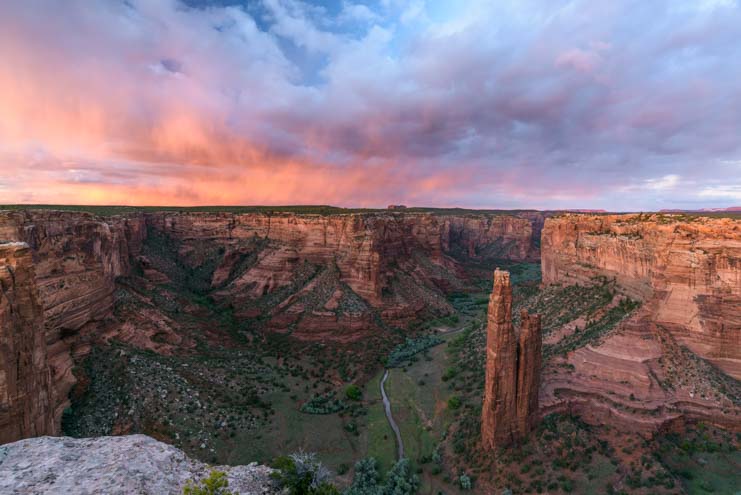
Eventually, we made our way to Spider Rock Overlook, one of the iconic images of Canyon de Chelly. We reached the overlook right at the golden hour before sunset when the rock itself was lit in rich burnt orange hues.

Spider Rock overlook Canyon de Chelly National Monument Arizona

Spider Rock.

The day had been very cloudy and windy, but as if by magic, right as the sun began to set, we were blessed with the most astonishing display of colors in the sky.

Sunset spider rock Canyon de Chelly National Monument Arizona

As the golden light faded on Spider Rock and the red rock cliffs, the sky began a light show of its own.

We each ran back and forth on the rim, unsure where to get the best views and which part of the sky would light up next.

Sunset at Spider overlook Canyon de Chelly National Monument Arizona

Mark lines up his shot on the next rock outcropping (upper right corner).

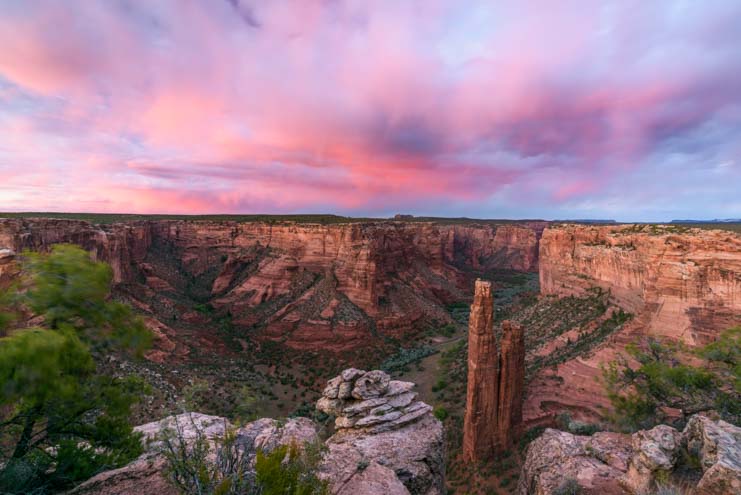
Spider rock lost its glow but the fire in the heavens was just getting started.

Spider Rock sunset Canyon de Chelly National Monument Arizona RV trip

Sunset’s brilliant display begins at Spider Rock.

Once the drama had played itself out in shades of orange, the skies turned vivid pink.

Pink sunset Spider Rock Canyon de Chelly National Monument Arizona

.

The light show intensified and our two-way radios crackled as we called each other from opposite ends of the overlook.

“Did you see THAT??!!”

Colorful sunset Spider Rock overlook Canyon de Chelly National Monument Arizona

.

That sunset was breathtaking, but when morning came the next day and we ventured back out on the south rim drive, the drama in the sky was gone. We returned to Sliding House Ruin overlook because there is such a huge area to prowl around there, and looking down into Canyon de Chelly was as astonishing as ever.

Valley at Sliding House Ruin Overlook Canyon de Chelly National Monument Arizona

Sliding House Ruin Overlook.

At Sliding House Ruin overlook there are endless stretches of flat and undulating boulders that head out in all directions on a promontory. Before we knew it, we had been there for hours running around on the tops of these cliffs and peering down into the tree-filled valleys below.

Of course, if you get too close to the edge in a place like this, it’s all over. A sign near the rim was a good reminder!

Sheer cliff warning sign Canyon de Chelly National Monument Arizona

.

Red rock cliffs and green valley floor Sliding House Overlook Canyon de Chelly National Monument Arizona

It’s a long way down…but what a view!

When I finally had gotten my fill of staring at the immense views in front of me, I glanced down at my feet and was taken with the rich hues and artistic patterns of the colorful lichen that was growing in and around the creases in the rocks.

Nature's artwork Canyon de Chelly National Monument Arizona

Nature’s artwork on the rocks.

Standing back and surveying the vast flat lichen covered boulders that stretched in all directions around me, I felt like I was looking at a modern art painting. Perhaps this is where Jackson Pollack got his inspiration!

Lichen on red rocks Jackson Pollack painting Canyon de Chelly National Monument Arizona

Jackson Pollack — Or colorful lichen on red rocks?

A little movement in the corner of my eye caught my attention, and I turned to see a lizard scampering past. He stopped and stared at me as I snuck closer and clicked my camera’s shutter.

Lizard Canyon de Chelly National Monument Arizona

A lizard looks over at me as he runs by.

The spring wildflowers had started blooming, and Mark found a beautiful bouquet of Indian Paintbrush flowers.

Indian Paintbrush Canyon de Chelly National Monument Arizona

A dash of scarlet…

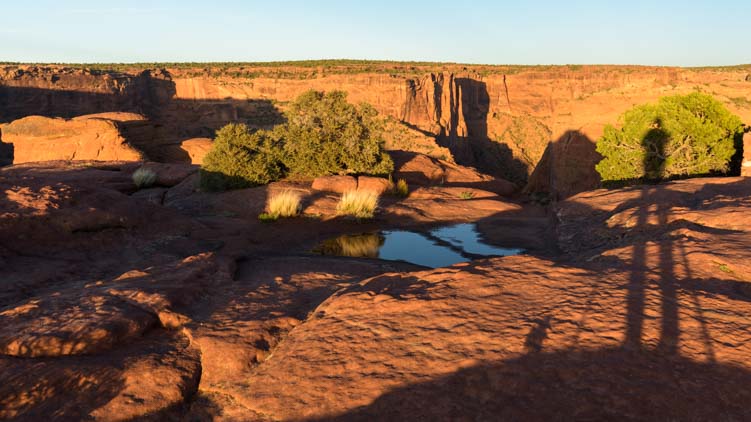
We stuck around and soon the sun was sinking low in the sky, and the shadows were growing long and deep.

Shadows at sunset Canyon de Chelly National Monument Arizona

Long shadows made for a surprise selfie at Sliding House Overlook.

The clear sky meant there were no colorful theatrics in the sky for our sunset at Sliding House overlook, but the sun gave me a coy wink for a split second before it slipped out of sight.

Starburst sunset Sliding House Ruin Canyon de Chelly National Monument Arizona

A fleeting starburst at sunset…

It was hard to set the alarm for a pre-dawn hour the next day, but we bundled into our truck with hot tea and coffee in hand and drove out to Sliding House overlook once again where Mark caught the sun giving us a wink on its way up.

Sunrise Sliding House Ruin Overlook Canyon de Chelly National Monument Arizona

…and another at dawn.

Canyon de Chelly is a special place deep in the heart of the immense Navajo reservation. There is a dry camping campground in the town of Chinle that is run by the Navajo, and a few sites are big enough for a big RV.

Subscribe
Never miss a post — it’s free!

More info about Canyon de Chelly:

Other blog posts from the beautiful red rock country of America’s southwest:

Our most recent posts:

More of our Latest Posts are in the MENU.
New to this site? Visit RVers Start Here to find where we keep all the good stuff!!

<-Previous || Next->

Blue Mesa Trail – Lavender Beauty in Petrified Forest National Park

April 2017 – When we visited Petrified Forest National Park a few weeks ago with our RV, we discovered two true jewels in the park: Jasper Forest and Blue Mesa Trail.

Ready to hike Blue Mesa Trail Petrified Forest National Park Arizona

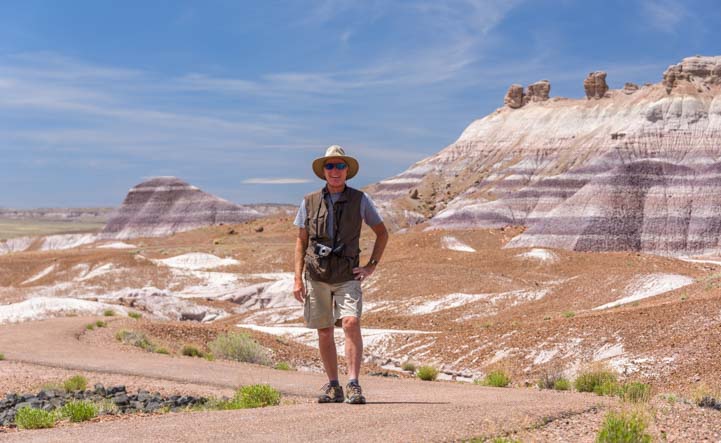
Ready to hike Blue Mesa Trail in Petrified Forest National Park, Arizona

It is really easy to blast through Petrified Forest National Park at 50 mph and miss it all, and we’ve made that mistake in the past. We’ve also done the less spectacular hikes and later wondered where all the petrified wood was! How funny!

As seen in our last post about Jasper Forest, there are some breathtaking landscapes where petrified logs are in stunning abundance.

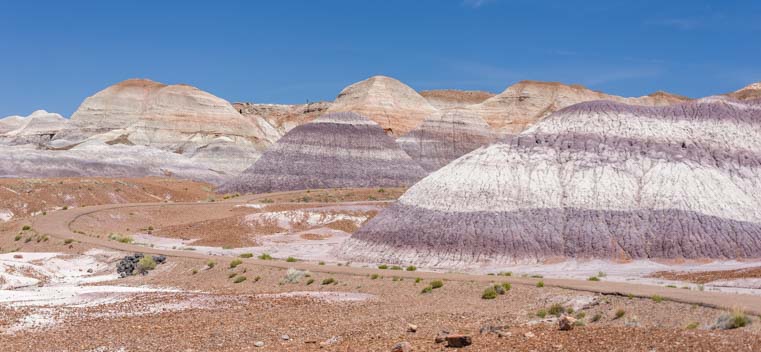
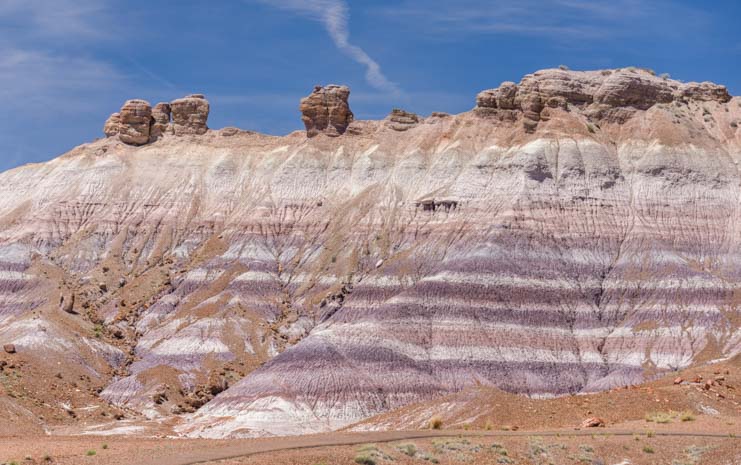
Blue Mesa is another fabulous region in the National Park where rolling hills are beautifully striped in shades of purple and lavender. There is a wonderful and very easy hike on a paved path at Blue Mesa that wanders through all these hills.

Blue Mesa Overlook Petrified Forest National Park Arizona

The overlook at Blue Mesa in Petrified Forest National Park

At the start of the hike, high up on a plateau overlooking a vast expanse of exotic beauty, we saw a pretty spray of yellow spring flowers and spent a few minutes admiring them.

Yellow wildflowers Blue Mesa Trail Petrified Forest National Park Arizona

A vibrant sign of spring greeted us right away.

Mark took advantage of the “Color sketch” option in his Nikon camera to get a very cool effect from this photo:

Color sketch Yellow wildflowers Blue Mesa Trail Petrified Forest National Park Arizona

The “color sketch” option is available in most Nikon DSLR’s. Fun!

The Blue Mesa trail begins with a wonderful plunge down to the valley floor, and we got a few shots of the spectacular purple/blue landscape as we descended.

Descending on the Blue Mesa Trail Petrified Forest National Park Arizona

Blue Mesa trail took us down to the valley floor right away.

As we made our way along the pretty, winding trail, the breathtaking views of these colorful hills surrounded us.

Blue and purple on Blue Mesa Trail Petrified Forest National Park Arizona

The purple stripes were magnificent!

Rock striations Blue Mesa Trail Petrified Forest National Park Arizona

Nature has a wonderful artistic flair!

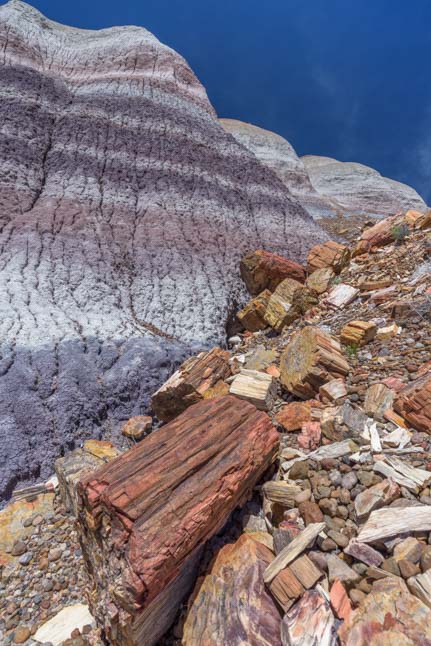
But where was all the petrified wood? It didn’t take long for us to find the gorgeous rock logs spilling down the gullies between the hills.

Falling petrified logs Blue Mesa Trail Petrified Forest National Park Arizona

Did a woodsman just cut down a tree?
No! Nature did this over 200 million years ago!!

Every crevice between the hills was loaded with perfectly hewn petrified logs. Incredible!

Petrified log pile Blue Mesa Trail Petrified Forest National Park Arizona

Solid rock logs that look for all the world like they are wood!

Petrified logs Blue Mesa Trail Petrified Forest National Park Arizona

Every crevice between the hills was filled with stone logs.

We couldn’t help but scurry up a ways to get different perspectives on these logs. Suddenly, I lost my balance and slipped. I brushed myself off and looked around, a little embarrassed and wondering if anyone had seen me fall. Luckily I was the only witness.

That is, I was the only witness until I saw what my camera did when my finger hit the shutter button on my way down!

Falling on hiking trail at Blue Mesa Petrified Forest National Park Arizona

Oops!

I don’t think I could have staged that shot more perfectly!

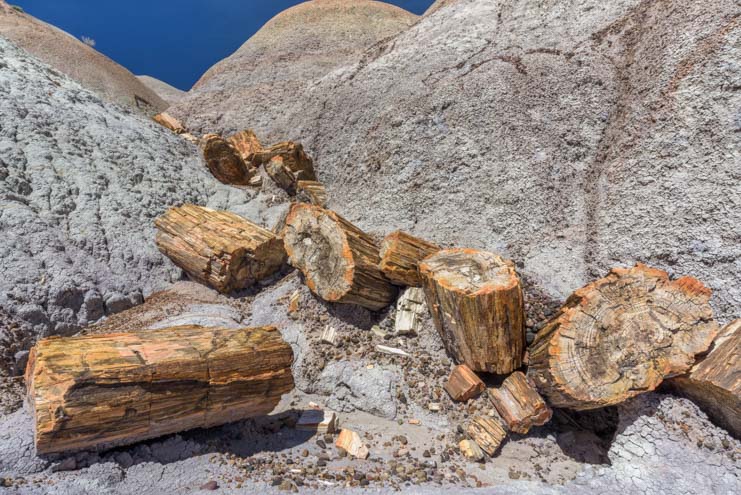
Blue Mesa trail was largely surrounded with waves of gravelly hills that are horizontally striped in lavender hues. But a few of the hillsides and cracks were gray, and these were strewn with exquisite crystallized tree stumps too.

Tumbling petrified logs Blue Mesa Trail Petrified Forest National Park Arizona

.

Pile of petrified wood logs Blue Mesa Trail Petrified Forest National Park Arizona

.

Surprisingly, even though this was peak season for visiting Petrified Forest National Park, with absolutely perfect sunny, dry, warm weather, there were very few people on the Blue Mesa trail. Every so often, though, we caught sight of someone in the distance.

Tumbling logs Petrified Forest National Park Arizona Jasper Forest

We shared Blue Mesa with very few other hikers.

Petrified Forest National Park has several “Off the Beaten Path” hikes, and there is one that originates at Blue Mesa trail and heads out to the Tee Pees formations. I had hoped to hike at least some of that trail because we had enjoyed the Off the Beaten Path trail at Jasper Forest so much.

Hiking Blue Mesa Trail Petrified Forest National Park Arizona

.

But I was so caught up in admiring the awe-inspiring views surrounding us on all sides that I forgot to double check the page of notes the ranger had given us to see where the gravel trail intersected the paved trail we were on. I think I’d kind of expected it to be obvious when we got there.

Hikers and petrified logs on Blue Mesa Trail Petrified Forest National Park Arizona

.

The National Park Service is a little coy with these special Off the Beaten Path hikes.

First, I’d only learned about them when I asked a ranger to recommend some areas for photography and then watched wide-eyed as he pulled a huge 3-ring binder full of photocopied trail notes off a low shelf behind the counter. More importantly, though, the trail intersection itself isn’t marked with a sign!

Blue skies on the Blue Mesa Trail Petrified Forest National Park Arizona

Somewhere out here there’s a neat unpaved hiking trail!

I learned later that the intersection is to the right of the one plaque that is out on the paved trail at Blue Mesa, and unfortunately, we’d walked right by it. Argh!

Purple striations at Blue Mesa Trail Petrified Forest National Park Arizona

Lavender shades all around.

Oh well, it’s a good reason for us to come back to Petrified Forest National Park another time!

Hiker Blue Mesa Trail Petrified Forest National Park Arizona

Purple haze…

If you take your RV to Petrified Forest National Park, don’t miss the Blue Mesa trail, and keep an eye out for that plaque and head out on the adjoining “Off the Beaten Path” hike! I suspect there are some cool views back there.

RV at Blue Mesa Overlook Petrified Forest National Park Arizona

A cute teardrop trailer at the top of the Blue Mesa overlook.

Subscribe
Never miss a post — it’s free!

More info about Petrified Forest National Park:

Other blog posts from our travels in Northeastern Arizona:

National Parks and World Heritage Sites – by RV, sailboat, and airplane!

Our most recent posts:

More of our Latest Posts are in the MENU.
New to this site? Visit RVers Start Here to find where we keep all the good stuff!!

<-Previous || Next->

B&W Companion Hitch Performance in a Fifth Wheel Trailer Rollover Accident

The April 2017 issue of Trailer Life magazine featured our article on the new Companion OEM fifth wheel hitch from B&W Trailer Hitches. Ironically, just as that issue came out, a reader emailed us the harrowing tale of his recent fifth wheel trailer rollover accident.

Trailer Life Magazine Latch and Release B&W Companion OEM Fifth Wheel Hitch article

Trailer Life Magazine, April 2017.
Text and photos by Emily Fagan.
Installation by Mark Fagan and Mark Graika.

Like most RVers, we installed our hitch without giving much thought to rollover accidents, and we have been very happy with it.

The B&W Companion OEM fifth wheel hitch is special because it is designed to fit into the new puck sytems that the diesel truck manufacturers are now making available in the beds of their pickup trucks.

This makes it easy to install the hitch in the truck without having to take the truck to a shop.

Mark was able to install it in our truck with a friend’s help in about an hour, using minimal tools, and that included opening the boxes and reading the instructions. A step-by-step guide for how to install the B&W Companion OEM hitch are at this link:

B&W Companion OEM Hitch Installation Guide

The other fabulous thing about the B&W Companion OEM hitch is that not only is it easy to install but it is easy to remove from the truck.

Anytime you want to use the bed of your truck to haul something big like lumber, fire wood or furniture, it is a very straight forward process to take the hitch out of the truck.

The best part is that there are no hitch rails in the bed of the truck, so once the hitch is removed, the bed of the truck is totally flat.

These features are not part of the design of conventional fifth wheel hitches, like the conventional rails-based B&W Companion hitch (not an “OEM” model), so it’s a worthwhile to consider buying a truck with the optional puck system on it if you are considering buying a late model diesel truck.

When buying a truck/trailer combination, not only are the quality of the truck and trailer important, but the hitch is really important too, and not just for its ability to tow a heavy load…

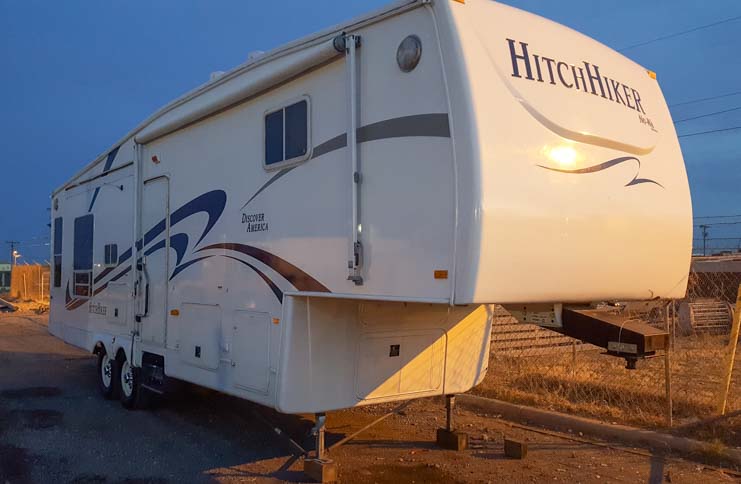
We were shocked when full-time RVers Mark and Doran Gipson sent us photos of their terrifying rollover accident with their fifth wheel. They were towing their home, a 2007 32′ Hitchhiker Discover America fifth wheel, with a 2008 Dodge Ram 2500, and they were hitched together with B&W Companion hitch.

While driving at 60 mph on I-10 outside in El Paso in February, two very inconsiderate drivers suddenly cut them off in a series of swerves right in front of them.

Here is Mark’s description of what happened:

“We were going 60 mph and were cut off by two vehicles who decided to not exit on loop 375. They dove back into our lane within 2 car lengths. With no time to brake, I swerved to the inside lane only to have the second vehicle also move into that lane as well. I lost the trailer when I swerved back to miss the concrete median.”

The result was that the trailer went over on the driver’s side at 60 mph, slid 150 feet and hit its roof on the concrete median.

Hitchhiker trailer wheel trailer RV rollover accident

The Hitchhiker fifth wheel hit the pavement at 60 mph and slid 150 feet.
Most trailers would have splintered on impact.

Fortunately, as the trailer went over on its side, the B&W hitch — which comes in two pieces: a base on the bottom and a coupler on the top — separated in two. The coupler stayed attached to the trailer’s king pin as the trailer toppled over while the base stayed in the bed of the truck, allowing the truck to remain upright.

Hitchhiker fifith wheel trailer rollover accident with B&W fifth wheel hitch coupler still attached

The upper half of the fifth wheel hitch — the coupler — remained attached to the trailer
as it rolled over on the driver’s side.

So, while Mark and Doran came to a skidding stop in their truck, sitting upright in their seats, the trailer rolled over, detached and slid to a stop on its side.

Truck damage from fifth wheel trailer rollover accident

As the trailer went over, the fifth wheel overhang crushed the driver’s side of the truck bed.

If the truck had rolled over too, Mark and Doran could have easily been very badly injured or even killed. However, because the truck stayed upright, they walked away unscathed. Thank heavens!!

With the truck badly damaged and the trailer on its side on I-10, Mark called for help and a wrecking crew arrived. As he wrote to me:

“The wrecker driver came with two trucks and a trailer because he had not gotten to a 5th wheel rollover without the truck also on its side and the trailer in pieces. He said that it would collapse when he tried to pick it up. But he put it on its wheels and towed it to his shop and still can’t believe how well built it was.

“Things were tumbled around inside but we virtually lost none of our possessions.”

Fifth wheel trailer damage from RV rollover accident with Hitchhiker 5th wheel trailer

The wrecking crew righted the trailer and were amazed that it stood up just fine on its own wheels.
The damage to the trailer was cosmetic except for a roof rafter.

“We tested the slides and everything worked. The major damage was cosmetic on the side that slid and possibly a broken roof rafter where the AC unit came against the concrete barrier. Though everything was scrambled inside, nothing was broken. We lost almost nothing of our possessions including TV and computers.”

My husband Mark and I saw a trailer accident on the highway once, and the entire trailer was in splinters. That is what usually happens in trailer accidents and that’s why the wrecker driver arrived at the accident scene prepared to pick up a million pieces off the highway.

Hitchhiker fifth wheel trailer sustained little damage in 5th wheel trailer rollover accident

The wrecking crew expected the trailer to fall apart when it was righted, but it stood right up.
They towed it away on its own wheels just fine.

It is quite a testament to the way the Hitchhiker Discover America trailers were built that one could fall over on its side at 60 mph and still be intact with the slide-out mechanisms still functioning and only cosmetic damage on the side that skidded on the asphalt.

Unfortunately, Hitchhiker (NuWa Industries) stopped building fifth wheel trailers in 2013, but used models of all ages can still be found. Our blog posts from our visits to NuWa in Chanute, Kansas, can be found at the following links:

B&W Trailer Hitches is located just a few miles away from the NuWa plant (NuWa is now called Kansas RV Center) in Humboldt, Kansas, and we enjoyed a wonderful factory tour and a unique American heartland small town celebration that was sponsored in part by B&W Trailer Hitches two years ago (blog post here).

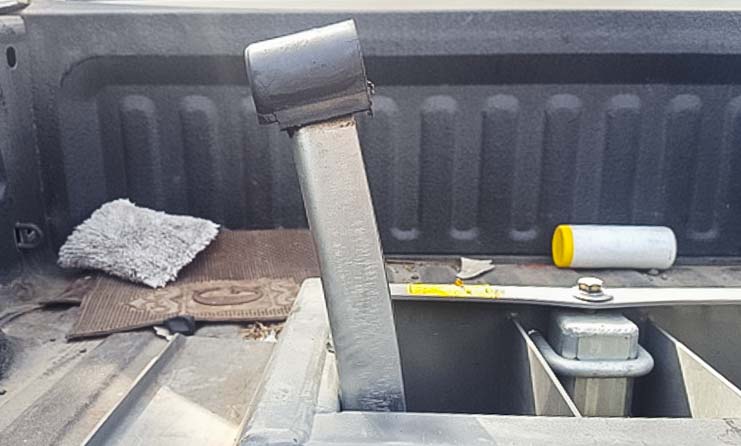
For Mark and Doran, the key to their truck staying upright during their rollover accident was the way the pivot arm on the base of the B&W Companion hitch bent sideways and let the coupler break free as the trailer toppled over.

Bent pivot arm on B&W fifth wheel hitch after 5th wheel trailer rollover accident

Looking forward towards the cab of the truck, the pivot arm on the driver’s side bent outwards allowing the coupler to break free (with some small broken parts inside) while the entire hitch base stayed planted in the bed of the truck. This kept the truck upright.

B&W fifth wheel hitch bent pivot arm after 5th wheel trailer rollover accident

Bent pivot arm on the fifth wheel hitch base.

It is impressive that the B&W hitch allowed for the hitch coupler and hitch base to separate completely once one of the pivot arms on the hitch base began to bend as the trailer went over. As the wrecker driver noted, usually both the truck and the trailer roll over together because once the trailer starts to go over the hitch forces the truck over too.

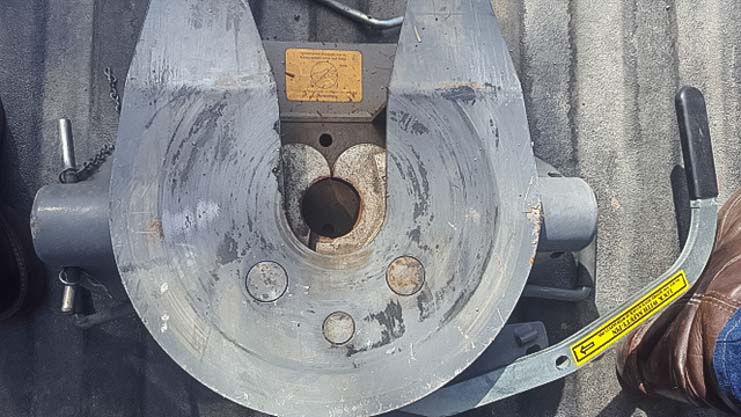
B&W Fifth wheel hitch coupler after trailer rollover accident

The coupler stayed attached to the trailer’s king pin.
In this photo it has been removed from the king pin and laid in the bed of the truck for inspection.

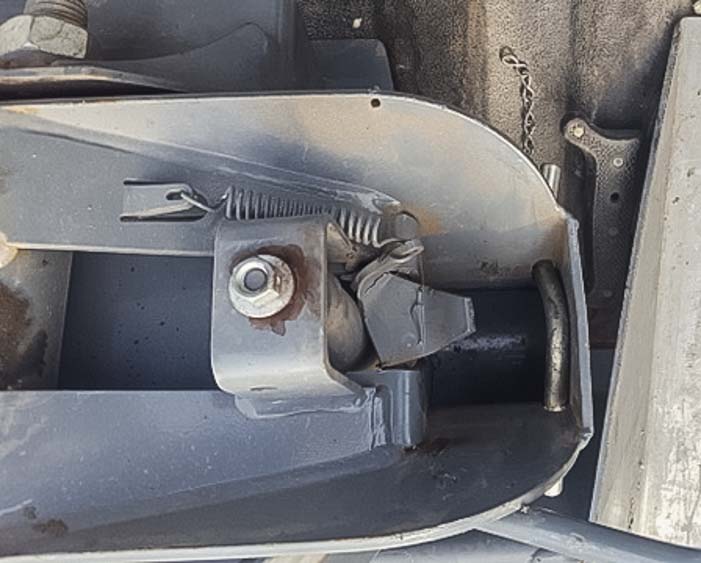
B&W Companion hitch coupler after rollover accident broken pieces inside

The coupler is flipped upside down here to reveal the broken pieces inside.

Broken pieces inside the B&W Companion fifth wheel hitch after a rollover accident

.

In the end, Mark and Doran decided to replace both their truck (a 2008 Dodge Ram 2500) and their trailer (a 2007 32′ Hitchhiker Discover America) as well as their slightly damaged B&W Companion hitch with a new set: a 2012 3500 Ram dually truck, 2012 36′ Hitchhiker Discover America and a new B&W Companion hitch!

We feel very blessed to have towed our fifth wheel trailer so many tens of thousands of miles and seen so many beautiful places in nearly 10 years of full-time travel. We’ve had our share of near misses, especially in our trip back east two years ago where traffic is blindingly fast on very crowded and confusing highways, and we’ve seen our share of accidents too.

One RV upgrade we did that has made a massive difference for us in dealing with sudden stops at high speed while towing our 36′ 14k lb. fifth wheel trailer was a trailer disc brake conversion where we upgraded from standard trailer drum brakes to electric over hydraulic disc brakes. This is a pricey upgrade, but one we highly recommend doing.

Hitchhiker fifth wheel RV with B&W Companion OEM fifth wheel hitch under sunny skies

RVing in a fifth wheel trailer is so much fun, especially in gorgeous places far from the open road.
But accidents do happen and good equipment — from truck to trailer, hitch and brakes — can make a huge difference in the outcome when things go wrong.

Subscribe
Never miss a post — it’s free!

Dodge Ram Truck Owners — Please note:
Late model Dodge Ram 1500, 2500 and 3500 trucks have been recalled (beginning 6/23/17) for side airbag problems in a rollover accident. See this article for details: Dodge Ram Side Airbag Recall

More about B&W Trailer Hitches:

Other blog posts about trucks, trailers and hitches:

More about Trailer Life Magazine:

Our most recent posts:

More of our Latest Posts are in the MENU.   New to this site? Visit RVers Start Here to find where we keep all the good stuff. Also check out our COOL NEW GEAR STORE!! *** CLICK HERE *** to see it!

Petrified Forest National Park RV Trip – Magic in Jasper Forest

April 2017 – One of the highlights on Route 66 is the Petrified Forest National Park where the enormous trunks of 200 million year old trees have turned to stone.

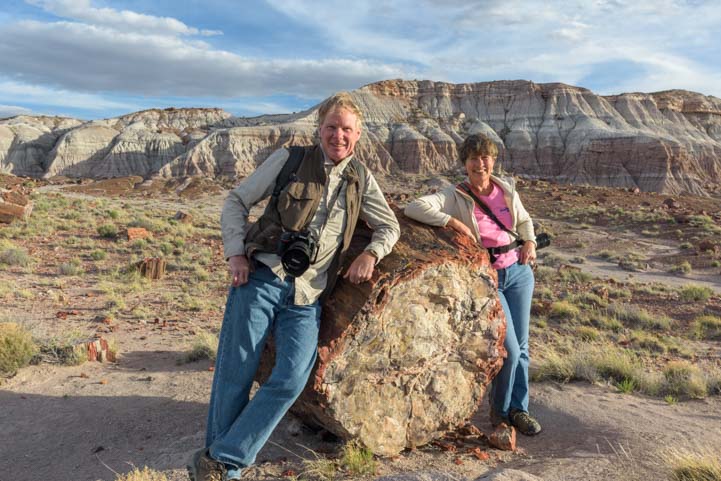
Photography at Petrified Forest National Park Arizona Jasper Forest

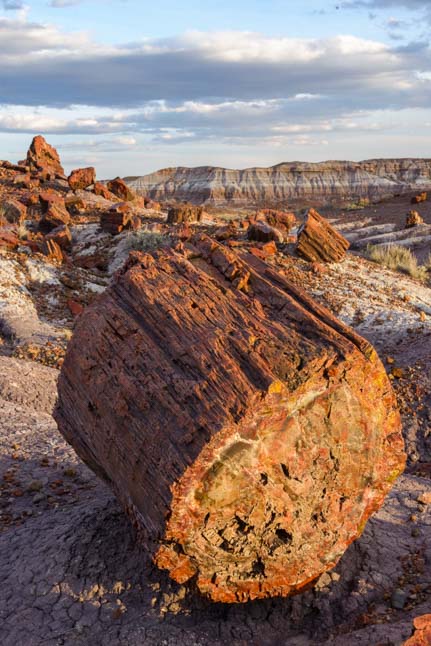
The solid stone tree stumps at Petrified Forest National Park are truly impressive!

We have been to Petrified Forest National Park twice before, but it was on this trip that we finally found the true magic there.

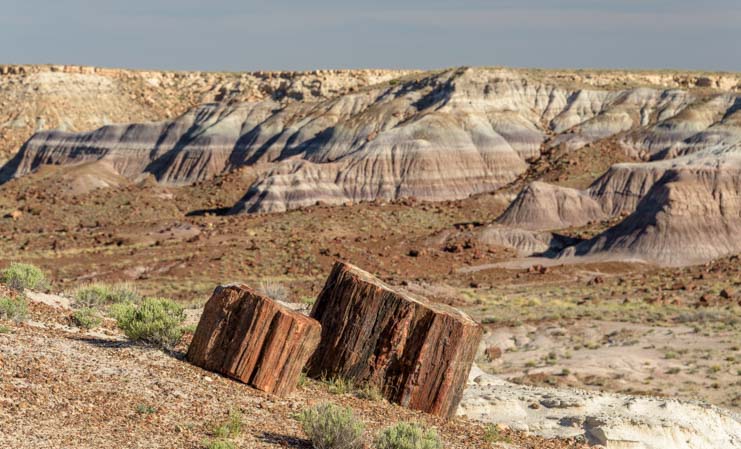
Stumps Petrified Forest National Park Arizona Jasper Forest

Those tree stumps are solid rock, through and through!

We knew that the best way to see Petrified Forest National Park, like all the National Parks, is to get out on the hiking trails away from the crowds.

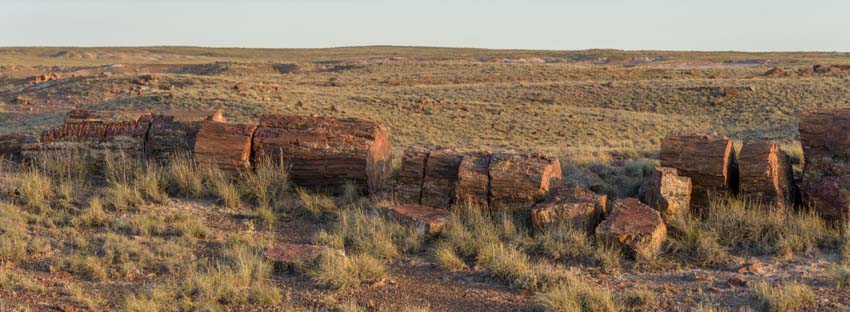
Jasper Forest petrified logs Petrified Forest National Park Arizona

We loved seeing how the logs split over millenia, due to the pressures of moisture and ice,
and revealing the tree rings — still perfectly intact — inside.

But it wasn’t until this visit that we discovered which hiking trails are the most stunning.

Logs Petrified Forest National Park Arizona Jasper Forest

Was the woodsman just here with his ax?

On our first foray into the Park on this trip we explored the area called Crystal Forest.

Logs Petrified Forest National Park Crystal Forest

The logs were scattered everywhere. But there wasn’t a living tree to be seen anywhere!

In every direction we saw the enormous trunks of trees that had been growing millions of years ago.

These trees had toppled over during torrential rains millenia ago, and had floated downstream only to end up in a deep and muddy logjam where they slowly and very gradually crystallized.

Over time, the pressure of moisture and ice within the logs broke them into segments.

Out on the vast treeless plain, we saw countless tree trunks that looked like a lumberjack had just sliced them up with a chainsaw in preparation for splitting them into firewood!

Petrified log Petrified Forest National Park Crystal Forest

We saw many 50+ foot long logs lying on the grass and split into sections.

Here and there, the stump of a tree trunk stuck up from the ground and looked for all the world like the tree had just been felled.

Wildflowers with petrified wood tree stump Petrified Forest National Park Arizona Jasper Forest

A rock and a wildflower.

All the tree rings were perfectly visible in a rainbow of crystalline colors.

Tree rings Petrified Forest National Park Jasper Forest

Brilliantly colored minerals have crystallized the tree rings in this ancient tree.

The logs lay scattered all over the place, and in between were beautiful shards of petrified wood.

Colorful agate Petrified Forest National Park Jasper Forest

There were exquisite shards of rock EVERYWHERE as far as the eye could see in all directions.


Some logs had been split so the tree rings were visible while others had been severed lengthwise showing vertical striations from the interior of the log.

Colorful agate Petrified Forest National Park Jasper Forest-2

.

In one area the shards that surrounded the logs look like woodchips. It was as if the lumberjack had just laid down his ax! These pale wood chips were very thin, just like ordinary wood chips, but these slivers of rock tinkled like a bell when dropped on each other!

Petrified wood chips at Petrified Forest National Park Jasper Forest

The light colored “wood chips” on the ground were brittle rock shards that sounded like bells
when they fell on each other.

We had wandered out at the “golden hour” about an hour before sunset, and as the sun sank below the horizon we were blessed with a beautiful sunset over these exotic rocks.

Sunset at Jasper Forest Petrified Forest National Park Arizona

Sunset in Petrified Forest National Park.

Even better than Crystal Forest, however, is Jasper Forest which is just a little further north. The overlook takes in a sweeping view.

Jasper Forest Overlook Petrified Forest National Park Arizon

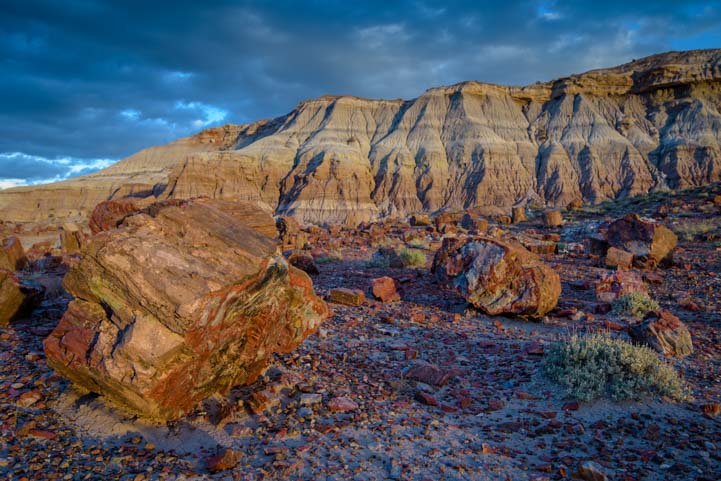
Jasper Forest overlook has an incredible view — see the logs below? — and the trail to the plain below took us down among thousands of logs.

In the distance, far below the Jasper Forest overlook, boulders and petrified logs intermingled.

Overlook at Jasper Forest Petrified Forest National Park Arizona

Huge waves of eroded rock formations were littered with tumbled boulders and petrified logs.

When we stopped at the Visitors Center to find out where the best collections of petrified wood were in the Park, the ranger took out a large 3-ring binder labeled “Off The Beaten Path Trails.” He took out the trail directions, complete with photos, for a few trails and handed them to us. One set was for Jasper Forest.

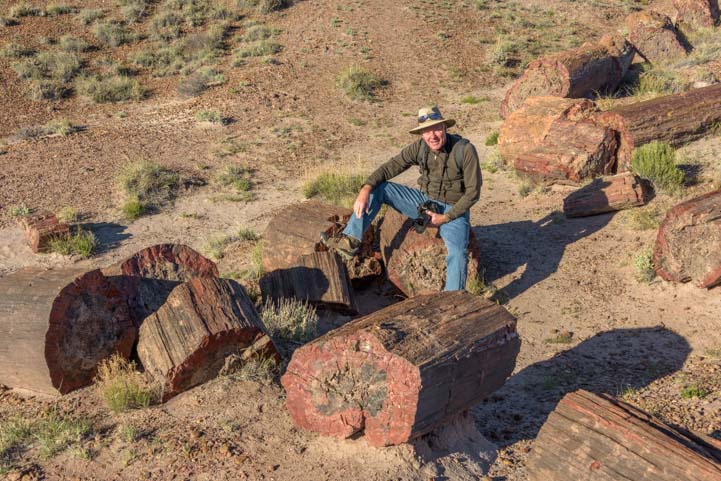
Sitting on petrified logs Petrified Forest National Park Arizona Jasper Forest

Down among the petrified logs at Jasper Forest.

The trail directions were a bit confusing, but they are actually very easy:

  • Go to the north end of the Jasper Overlook parking lot and look for a narrow trail heading north from the last parking space in the lot.
  • Follow this trail north and then west onto the wide plain that stretches out below the Jasper Forest overlook.
Petrified logs Petrified Forest National Park Arizona Jasper Forest

Two faces from the same log reveal gorgeous tree rings.

From there you can go in any direction you want, and we quickly ran off in opposite directions!

Log with a knot Petrified Forest National Park Arizona Jasper Forest

The “bark” on this 200 million year old log even had a knot in it.

We were there in the harsh light of noon, so even though the rock logs were mind boggling, we knew they would be even more beautiful in the rich light of late afternoon.

Petrified logs Petrified Forest National Park Arizona Jasper Forest

.

Petrified wood logs Petrified Forest National Park Arizona Jasper Forest

.

So, we returned a little later with our cameras, and suddenly the logs came alive in vivid shades.

Petrified tree stump Petrified Forest National Park Arizona Jasper Forest

At the “golden hour” an hour before sunset,
all the logs began to glow.

The skies were darkly overcast but the sun snuck through underneath and cast a brilliant light on all the stone tree logs.

Storm clouds Petrified Forest National Park Arizona

Storm clouds darkened the skies while the sun peeked through.

Golden light at Jasper Forest Petrified Forest National Park Arizona

Looking at the tree root ends of the logs — in rich light.

As the sun sank towards the horizon, we were in awe of the beauty around us. We were also frantically running around trying to capture it as best we could while the sun teased us mercilessly!

At one moment the sun would pierce through the clouds and light everything up in bright orange and yellow, and at the next moment it would disappear all together behind the clouds!

Petrified logs at Jasper Forest Petrified Forest National Park Arizona

.

The clouds were flying across the sky, making an ideal opportunity to use long shutter speeds to make them blur dramatically just as the sun set in a starburst.

Sunset at Jasper Forest Petrified Forest National Park Arizona

Drama in the sky above an ancient world of stones.

Wild skies at Jasper Forest Petrified Forest National Park Arizona

.

Dramatic clouds at Jasper Forest Petrified Forest National Park Arizona 2

.

Petrified Forest National Park is a great place to go with an RV, and it is surrounded by many of the most spectacular natural wonders of America’s southwest.

RV motorhome in Petrified Forest National Park Crystal Forest

A motorhome passes the Crystal Forest turnoff.

Subscribe
Never miss a post — it’s free!

More info about Petrified Forest National Park:

Other blog posts from our travels in Northeastern Arizona:

National Parks and World Heritage Sites – by RV, sailboat, and airplane!

Our most recent posts:

More of our Latest Posts are in the MENU.
New to this site? Visit RVers Start Here to find where we keep all the good stuff!!

<-Previous || Next->

Getting Our Kicks on Route 66 by RV in AZ – Cool Springs, Winslow & Holbrook

April 2017 – Back in the 1930’s to the 1960’s, Route 66 was a 2,448 mile long road from Chicago, Illinois, to Los Angeles, California, that passed through Missouri, Kansas, Oklahoma, Texas, New Mexico and Arizona. It was established in 1926 but was gradually replaced with the US Interstate highway system starting in 1956.

RV on Route 66 Arizona

We’ve been getting our kicks on Route 66!

Portions of it still remain, and we have been bumping into it in our RV travels through Arizona.

RV on Route 66 Arizona

Cool Springs Station Museum on Route 66 between Kingman and Oatman

Route 66 is memorialized in all kinds of songs and folklore, and one of the most iconic songs was (Get Your Kicks) on Route 66 written by Bobby Troup in 1946.

Cool Springs cabins antique Mobil gas station Route 66 in Arizona

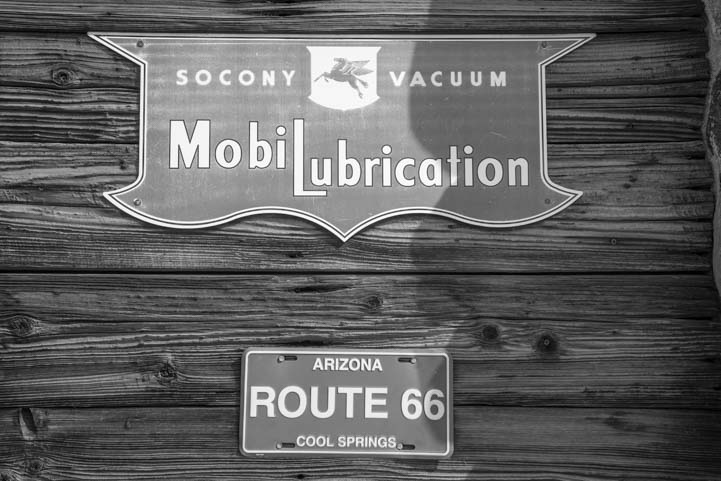
Antique gas pumps and an old Mobil Oil sign at Cool Springs Station Museum near Kingman

We’ve been getting our kicks on Route 66 lately starting with a stop we made at the Cool Springs Station Museum between Kingman and Oatman, Arizona last fall.

Antique Mobil Gas station Route 66 in Arizona

What luck – A retro Royal Enfield motorcycle pulled in and parked next to the antique gas pumps while we were there!

This is a cute stone building that has big antique gas pumps out front that will be familiar to our older readers and Mobil Oil signs that were familiar to us from our childhoods.

Inside we found all kinds of charming memorabilia from decades ago, and outside we saw several antique cars that at one time might have rolled down this famous American highway.

Mobil Lubrication or Mobil Oil Antique wooden sign Route 66

.

Route 66 chair in Arizona

.

Antique car on Route 66 in Arizona

Ready to roll…in a bygone era

Cool Springs Station is in the northwest part of Arizona near Kingman. Way over on the northeast side of the state we stopped in at the town of Winslow in northeastern Arizona a few weeks ago.

Standin' on the corner in Winslow Arizona Route 66

Route 66 goes through Winslow Arizona

Winslow sits on old Route 66 but it is much more famous for the song Take It Easy, which was written by Jackson Browne and Glenn Frey and recorded by the Eagles, and features the very memorable lyrics:

Well, I’m a standing on a corner
in Winslow, Arizona,
and such a fine sight to see:
It’s a girl, my Lord, in a flatbed
Ford slowin’ down to take a look at me.

Standin' on the corner in Winslow Arizona Route 66

Winslow has memorialized the Eagles song “Take It Easy.”

Standin' on the corner in Winslow Arizona Route 66

A painted mural reflection and the real thing:
“It’s a girl, my Lord, in a flat bed Ford, slowing down to take a look at me!”

This corner is now a favorite tourist attraction. Every year the town hosts a huge “Standin’ on the Corner” festival. This year’s event is on May 6, 2017 (link at the bottom of the page).

Five years ago on our way back to our boat in Chiapas Mexico we zipped through Winslow and got a selfie at the corner. This year the corner was a little busy with other people getting selfies, so we’ll just go with the old pic!

Standin' on the corner in Winslow Arizona

From the archives back in 2012!

Nearby, Mark found an electric guitar…

Route 66 Guitar corner Winslow Arizona

.

The opposite corner is dressed up with a vintage coffee and soda shop that has old fashioned seating on stools at the counter inside.

The other corner Route 66 Standin' on the corner in Winslow Arizona

.

This building won the Good Job Award in 2004. I like a town that gives out Good Job Awards!

Good Job Award sign Standin' on the corner in Winslow Arizona

The world needs more Good Job Awards!

Although Winslow sits on Route 66 it was also an important train depot for the Santa Fe Railroad.

Eagle on Route 66 sign Winslow Arizona

.

Wandering around town, we came across La Posada Hotel and Gardens which is a meticulously and lovingly restored Grand Hotel from the heyday of the railroad era, built by Fred Harvey for Santa Fe Railroad and designed by Mary Colter.

Entrance La Posada Hotel Winslow Arizona Route 66

La Posada Hotel and Gardens in Winslow, Arizona

Built in 1929 to the tune of $60 million (in today’s dollars), La Posada Hotel and Gardens gave tourists a reason to take the train to Winslow. They could stay in an elegant hotel home base and visit Arizona’s many very cool sights that lie within a day’s chauffeured drive from town.

Balcony La Posada Hotel Winslow Arizona Route 66

La Posada was southwestern elegance at its best in the 1930’s and 40’s.

The hotel was beloved by the well-to-do from its opening in May of 1930 until it closed in 1957. When it closed, all of the museum quality furnishing were sold off, and the building was turned into offices for the Santa Fe railroad. Over the next 40 years it was slated to be demolished several times.

La Posada Hotel Winslow Arizona Route 66

The restoration has been lovingly done.

Chessboard table La Posada Hotel Winslow Arizona

Visitors can watch a fantastic video that explains the details of the original design and restoration.

Fortunately, when the Santa Fe Railroad planned to abandon the hotel, news of the its uncertain fate made its way to Allan Affeldt. After three years of negotiations with the railroad, in 1997 he moved in with his wife, Tina Mion and they began a $12 million restoration.

Hallway La Posada Hotel Winslow Arizona Route 66

.

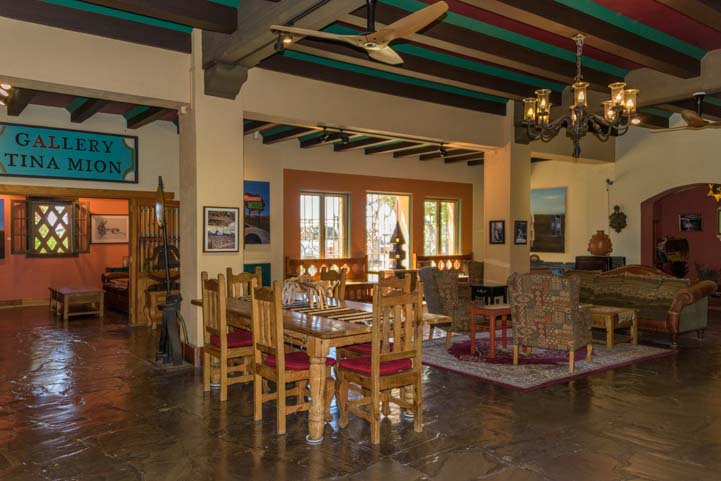
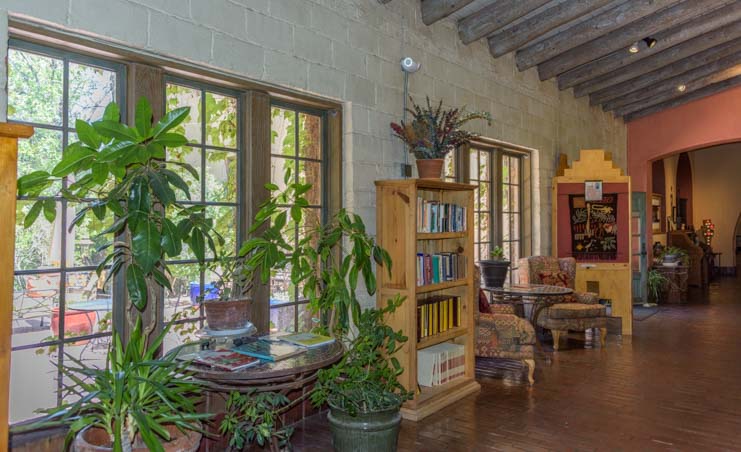
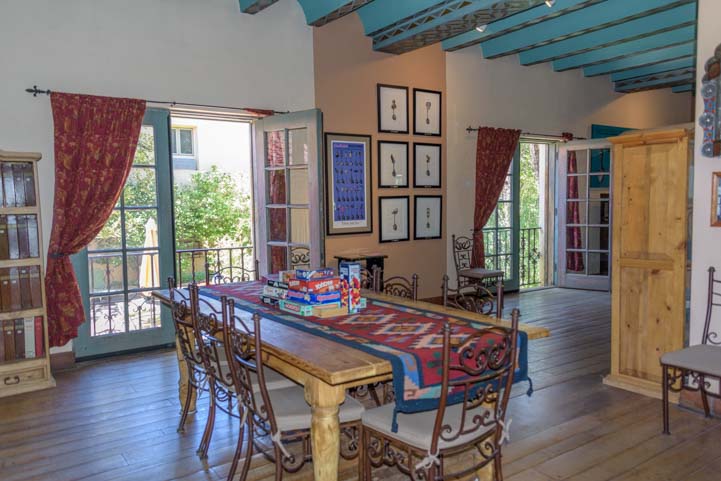
We knew none of this when we walked in the door, but we were smitten with the beautiful renovations and artsy decorations in every room.

Elegant La Posada Hotel Winslow Arizona

There are endless common areas where guests can relax and socialize.

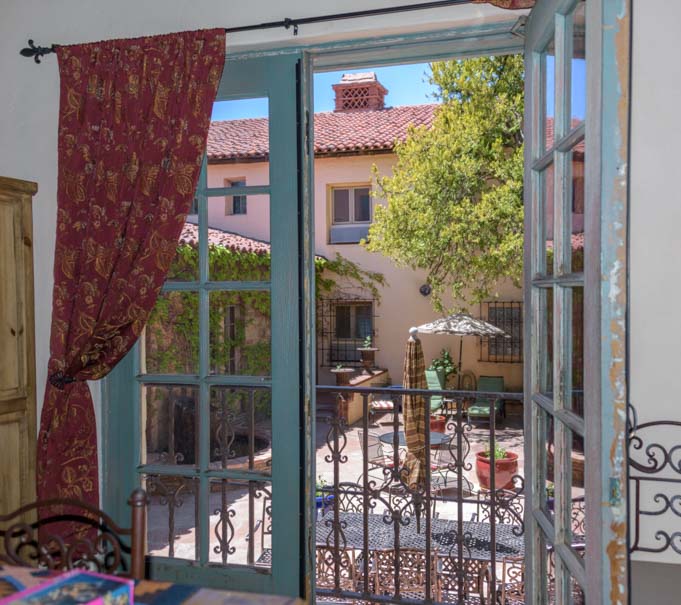
The windows and French doors were thrown wide in every room, letting the warm air from outside flow in, and we wandered around the property enchanted by all we saw.

Room with a view La Posada Hotel Winslow Arizona

Room with a view.

Balcony overlooking courtyard La Posada Hotel Winslow Arizona Route 66

Let the outside in!

La Posada Hotel and Gardens is a fully functioning hotel today and there is a very popular restaurant that was packed to the gills when we stopped by. We didn’t stay to eat, but unusual goodies drew us to every corner of every room in the hotel.

Piano in La Posada hotel Winslow Arizona Route 66

.

Turning a corner, we came across a “hall of mirrors” which is part of the hotel’s gift shop.

Hall of Mirrors La Posada Hotel Winslow Arizona Route 66

Beautiful mirrors are for sale in the gift shop.

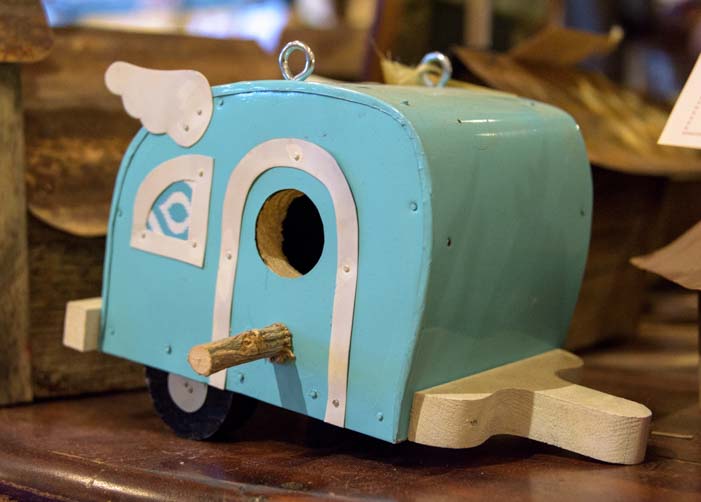
The gift shop had all sorts of things for sale, but the ones that really caught our eye were the adorable antique trailer bird houses!

Trailer bird house

A bird house for the RV crowd!!

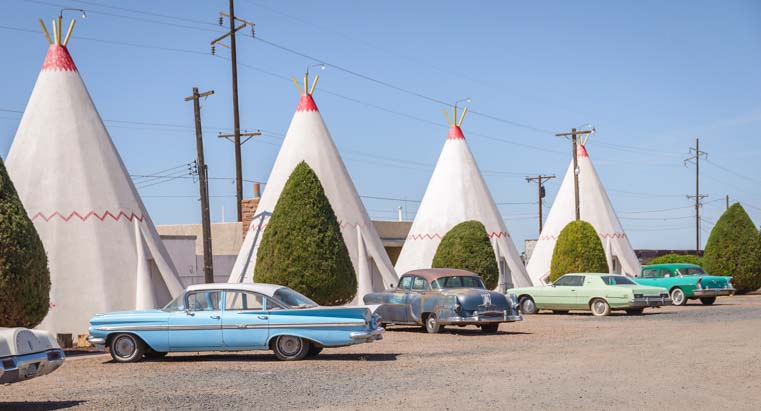
Not far from Winslow, Arizona, we drove through Holbrook, Arizona, and just had to stop at the Wigwam Motel.

Wigwam Motel Route 66 Holbrook Arizona

Wigwam Motel in Hobrook Arizona – A Classic Route 66 stopover.

Unlike the very upscale La Posada Hotel and Gardens in Winslow, this is a fabulous Route 66 motel that reflects the funky and slightly cheesy tourist traps that filled Route 66 in its day.

Wigwam Motel antique cars Route 66 Holbrook Arizona

Have you slept in a wigwam lately?

The wigwams still rent out each night, and we saw people loading and unloading their bags for a night’s stay.

Antique cars and tee-pees at Wigwam Motel Holbrook Arizona Route 66

Modern travelers come in modern cars, but antique cars were parked in front of each wigwam!

The motel’s owners have parked antique cars in front of each wigwam, lending an authentic air to this classic Route 66 stopover.

Antique cars Wigwam Motel Holbrook Arizona Route 66

.

Wigwam and antique cars Wigwam Motel Hobrook Arizona Route 66

.

Antique car Wigwam Motel Holbrook Arizona Route 66

.

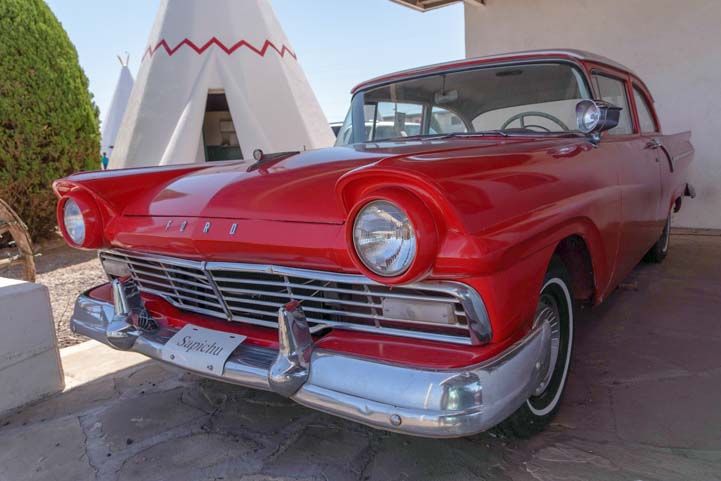
Of course, there’s plenty of room for Wigwam Motel guests to park their modern cars by the front office, but part of the mystique of sleeping in one of these wigwams is the fun historical context of being immersed in early American car travel on old Route 66.

Antique Ford at Wigwam Motel Holbrook Arizona Route 66

.

Studebaker truck at Wigwam Motel Holbrook Arizona Route 66

.

If you are traveling east-west in northern Arizona, in the neighborhood of I-40, take a detour off the freeway to one of these stops near Kingman, Winslow and Holbrook and get your kicks on Route 66!

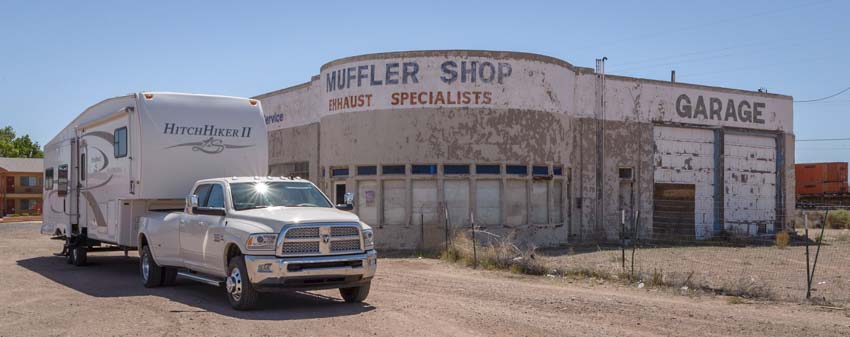
RV on Route 66 in Holbrook Arizona

A service shop from yesteryear… Luckily we didn’t need a new muffler or garage mechanic!

Subscribe
Never miss a post — it’s free!

More info about Route 66, Cool Springs Station, Winslow, La Posada Hotel & Gardens and Wigwam Motel:

Other blog posts from the vicinity:

Our most recent posts:

More of our Latest Posts are in the MENU.
New to this site? Visit RVers Start Here to find where we keep all the good stuff!!

<-Previous || Next->

RV Camping with the Rock Art Petroglyphs in Gila Bend, AZ

For years we’ve driven back and forth between San Diego and Phoenix on I-8, zipping by the exit for Painted Rock Petroglyph Site. I’d always look out the window thinking wistfully, “Oooh, that must be so interesting!” but it is a ways off the interstate and we were always on a mission to get wherever we were going and didn’t have time to stop.

Painted Rock Petroglyphs Gila Bend Arizona

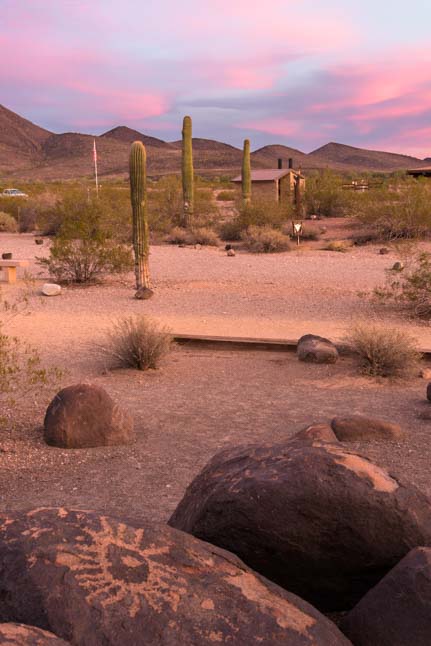
Sunset at Painted Rock Petroglyph Site near Gila Bend in Arizona

On a recent trip we decided to make Painted Rock Petroglyph Site our destination, and we scooted off the freeway onto a paved side road that wandered off into the desert.

Painted Rock Petroglyphs Gila Bend Arizona

Petroglyphs cover all the rocks and boulders at this site.

In a few short miles we arrived at the site and were delighted with what we found.

Painted Rock Petroglyphs Gila Bend Arizona

Some images are recognizable like the double parallel squiggly lines that probably indicate there’s water nearby.

The sun was setting and it cast a wonderful pink glow across the desert and the pile of rocks that is the centerpiece of the site.

Painted Rock Petroglyphs Gila Bend AZ

Sunset on a sun rock!

Following a trail around the rock pile, we found that petroglyphs literally covered almost every boulder, rock and small stone.

Unlike so many petroglyph sites where the rock art is located high up on a wall or far across a canyon, these petroglyphs were right there in plain site at our feet.

Painted Rock Petroglyphs Gila Bend Arizona

.

On one side of the huge rock pile there’s a dry camping campground with lovely widely spaced sites. A few of the campsites are right alongside the trail where campers can have a view of petroglyph covered rocks right from the RV window!

The next day we wandered further and were amazed at the wide variety of patterns, designs and images we saw on these petroglyph adorned rocks.

Patterns Painted Rock Petroglyphs Gila Bend Arizona

A saguaro cactus stands watch over some petroglyphs.

Some of the designs were easy to decipher, like parallel squiggly lines that surely describe the water sources that can be found nearby in the Gila River.

Painted Rock Petroglyphs Gila Bend Arizona

.

Others were just crazy designs that seem indecipherable.

Painted Rock Petroglyphs Gila Bend Arizona

Crazy patterns!

Almost every face of every rock had at least one design on it.

Pattern Painted Rock Petroglyphs Gila Bend Arizona

.

There were also lizards with tails — very similar to the little guys we saw scurrying between the rocks — and some images of people too.

Bullseye Painted Rock Petroglyphs Gila Bend Arizona

.

Bullseye Painted Rock Petroglyphs Gila Bend Arizona

A lizard and a bullseye.

It was also intriguing that there were quite a few bullseye types of designs. Some were concentric rings.

Man and Bullseye Painted Rock Petroglyphs Gila Bend Arizona

.

Bullseyes and animals Painted Rock Petroglyphs Gila Bend Arizona

Concentric circles form two bullseyes.

And some were spirals. Was this accidental or did the two styles of circular designs have different meanings? Or were these things just random doodles after all?

Spiral Painted Rock Petroglyphs Gila Bend Arizona

A spiral pattern.

It is thought that these petroglyphs were pecked out of these rocks by the Hohokam people who lived in this area between 350 AD and 1400 AD, the same time frame spanning the Mayans in Central America and the ancient Khmer in Cambodia and Thailand.

There are ancient dwellings and rock art sites all over the southwest and they are impossible to protect from roaming vandals. Sometimes they bear scars from bullets or spray paint and sometimes an over eager collector has cut the entire face of the rock off to take elsewhere.

Navajo pattern Painted Rock Petroglyphs Gila Bend Arizona

A cool and complex pattern defaced with bullet marks.

Stealing defacing petroglyphs Painted Rock Petroglyphs Gila Bend Arizona

Someone chiseled the whole surface of the rock off to take elsewhere.

But there are still thousands of pristine images carved on rocks all over this area that have survived as much as 1,000 years or more in the hot desert sun. Staring at them stirred my imagination as I pondered what motivated the ancient people to leave this legacy of art work strewn across the massive expanse of barren and inhospitable landscapes that makes up this part of the Sonoran desert.

If you find yourself traveling on I-8 with your RV about 18 miles west of Gila Bend, Arizona, take a detour off the highway and check out the Painted Rock Petroglyph Site!

More links below.

RV camping boondocking Arizona

Painted Rock Petroglyph Site is a little gem for RVers about 90 miles southwest of Phoenix, Arizona!

Subscribe
Never miss a post — it’s free!

More info about Painted Rock Petroglyph Site near Gila Bend, Arizona:

Other blog posts about rock art, petroglyphs, pictographs and other ancient glyphs:

More great campgrounds we’ve loved:

Our most recent posts:

More of our Latest Posts are in the MENU.
New to this site? Visit RVers Start Here to find where we keep all the good stuff!!

<-Previous || Next->

Is RV Solar Affordable? 3 Solar Power Solutions for RVs and Boats

Is RV solar power affordable? Or is installing a solar power system on a motorhome or trailer — or even on a sailboat — just too darn expensive to be cost effective? We never thought this question would be hard to answer until recently.

This article outlines three different RV solar power solutions and lists all the parts (and costs) of everything you need to buy:

1. A Small, Expandable Rooftop RV Solar Power Solution – For weekends and vacations
2. A Portable RV Solar Power Solution – To get you up and running effortlessly
3. A Big Rooftop RV Solar Power Solution – For full-time RVing

Solar panels on a fifth wheel trailer

Can a solar power installation on an RV or sailboat pay for itself?

Ever since we installed our first (very small) solar power system on our first full-time RV nearly ten years ago, we’ve been excitedly telling people it is a very affordable do-it-yourself project for anyone with some mechanical and electrical knowledge. And for those who can’t turn a wrench, it shouldn’t be that much more.

Our first 130 watt solar power system cost us about twice as much as the same system would today, but even at that high price, we felt it was dollar-for-dollar an equal value to buying a Yamaha or Honda 1000 generator. Best of all, once a little system like that was installed, it was a whole lot less noisy, expensive to operate and complicated to use than a generator would be.

At today’s super cheap solar prices, that little solar power system is even more valuable compared to one of those nice Japanese portable gas generators than it was 10 years ago!

Installing solar panels on a motorhome RV

Installing solar power can be a DIY project if you’re handy.

Recently, however, we’ve heard some crazy prices being quoted for installing solar power systems on RVs. We met one couple with a gorgeous brand new DRV Suites fifth wheel who were quoted $13,000 for a solar power installation. Not long after that, we read an article in a popular RV magazine describing a $12,000 solar power installation on a fifth wheel.

Yikes!! These are outrageous prices!!

We sure hope no one is finding they have to spend that kind of crazy money to get a solar power system installed on their trailer or motorhome or sailboat.

We’ve got oodles of articles on this website that go into the nitty gritty details of things to consider when designing and installing a solar power system on an RV or a boat (located HERE). However, all that theory aside, it’s not all that complicated.

Here are three solar power “packages” — with approximate prices — that will do the trick whether you’re a part-timer or full-time RVer.

Although it is possible to buy “pre-packaged RV solar power kits” online, we suggest hand selecting the components you want so that just in case any individual item has a problem it can be returned easily.

We’ve heard of cases where people bought a pre-packaged solar power kit online and then had problems returning a broken part because they had to return the entire kit — solar panels, charge controller, cables and all — just because the one item wasn’t working right.


SMALL ROOFTOP RV SOLAR POWER SYSTEM – 150 WATT SYSTEM

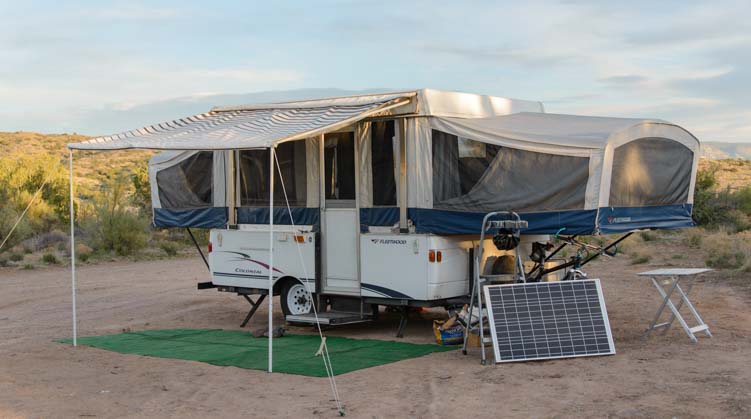
Affordable solar panel with a popup tent trailer

For part-time RVers, installing solar on the roof isn’t a requirement.

The following is essentially what we put on our roof and what we camped with off the grid every night for a year when we started.

The brands are not exactly the same, but these components are highly rated and will do the trick for anyone that wants a roof-mounted solar power system on their motorhome or trailer.

This kit includes both a solar battery charging component and an 110 volt AC power component provided by an inverter. If you don’t understand the distinction, please see our post: RV Solar Power Made Simple.

The simplest inverter installation is to connect the inverter to the batteries using heavy duty cables and then to run an ordinary (but long) power strip (or two) from the inverter to somewhere convenient inside the rig.

Rather than using the wall outlets in the rig, just plug the AC appliances into the power strip as needed, taking care not to operate too many things at once and overload the inverter.

Prices always change, so check the links to see the current prices.

The nice thing about this kit is that it is easily expandable. If a second or third solar panel is eventually desired (to double or triple the size of the system to 300 or 450 watts, for another $200 or $400), those panels can be purchased at a later date. At that point the solar charge controller can also be replaced with a bigger and more sophisticated charge controller (for $600).


PORTABLE FOLDING SOLAR POWER KIT SUITCASE – 120 WATT SYSTEM

Portable folding solar panel suitcase for RV and motorhome use

A portable solar power kit that folds up and can be carried like a suitcase is an awesome solution for weekenders, vacationers and seasonal RVers.

A really nifty alternative for anyone that isn’t super skilled with tools or that’s a bit spooked by electrical things, is a portable solar power kit that folds into a suitcase. These come with two matching solar panels, battery cables with alligator clips, and a panel-mounted solar charge controller. The solar panels are hinged together and can be folded towards each other. A handle on the side of one of them makes the whole thing easy to carry and store like a suitcase.

These portable folding suitcase solar panel kits come in all sizes. A good size is anywhere from 120 to 200 watts:

The advantage of a portable suitcase solar kit like this is that it is self-contained. If you think you might upgrade to a different RV soon, then there’s no loss in investment when one RV is sold and another is purchased. Also, if you decide to install a roof-mounted system at a later date, the suitcase solar panel kit can be sold to another RVer.

As for the inverter, heavy duty cables and power strip, they are included here just to round out the package so you have AC power in the rig as well as the ability to charge the batteries just like the “small solar power kit” described above.


Affordable solar power on a motorhome

Installing solar panels on tilting brackets is popular, but only necessary in mid-winter. We’ve never done it.

With a big RV solar power installation, it is likely that the RV’s house battery bank will need to be upgraded or replaced too, so this package includes a “replacement” AGM battery bank.

The Magnum inverter is an inverter/charger that has a built in transfer switch, making it very straight forward to wire the inverter into the house AC wiring system so you can use the standard wall outlets in the rig rather than plugging things into a power strip.

We’ve been living exclusively on solar power since we started this crazy traveling lifestyle in 2007, and this system is larger than any system we’ve ever had on a boat or trailer. So it ought to work just fine for anyone who wants to RV full-time and do a lot of boondocking.


INSTALLATION COSTS

If you are not a DIY RVer, you’ll need to budget for the installation labor too. As a very rough estimate, I would allow for $500-$1,000 for a small system installation and $1,500-$2,500 for a big system installation. The variations in labor costs will depend on how difficult it is to work in your rig, how hard it is to mount the various components and run the wires from roof to basement, and whether or not you choose to have the batteries upgraded or replaced.


RETURN ON INVESTMENT

RV park and campground prices are all over the map, but assuming that the average cost is $25 per night for a site with hookups if you don’t take advantage of monthly discounts or $15 per night if you do, these systems can pay for themselves in anywhere from 18 camping days to 14 months, depending on what size system you buy, whether or not you do the installation yourself, and how you typically camp. Of course, this assumes the rig is equipped with a refrigerator that can run on propane and that if air conditioning is needed an alternative power source like a generator is used.

As with everything in the RVing world, starting small and cheap is the best way to go.


BIG and COMPLEX SOLAR POWER INSTALLATIONS

Solar panel arch with solar panels on sailboat transom

Installing solar power on a sailboat has its own set of challenges.

We have installed three different RV solar power systems and one solar power system on a sailboat.

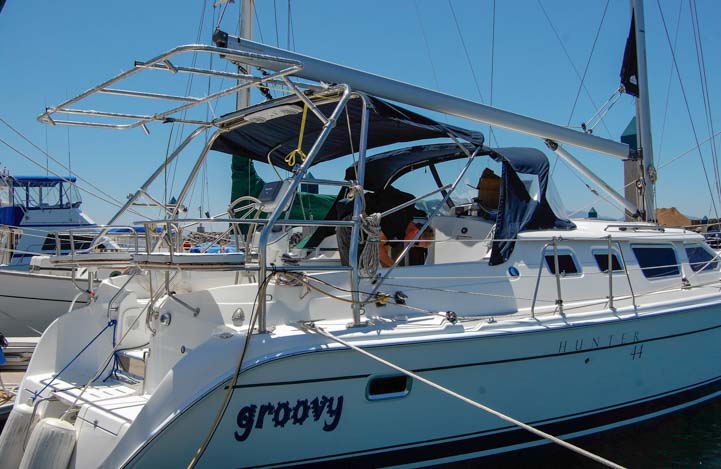
We published an article in the February 2017 issue of Cruising World Magazine (one of the top magazines in the sailing industry) describing the solar power system we installed on our sailboat Groovy back in 2010. This system gave us all the power we needed to “anchor out” in bays and coves away from electrical hookups in marinas for 750 nights during our cruise of Mexico.

Cruising World has posted the article online here:

Sunny Disposition – Adding Solar Power – Cruising World Magazine, February, 2017

Installing solar power on a sailboat is very similar to installing it in an RV, but there is an added complexity because there isn’t a big flat roof to lay the panels on. Instead, we had to construct a stainless steel arch to support the panels. Fortunately, our boat, a 2008 Hunter 44DS, had a factory installed stainless steel arch over the cockpit already. So, we hired a brilliant Mexican metal fabricator named Alejandro Ulloa, to create our solar panel arch in Ensenada, Mexico.

Solar power installation on sailboat Hunter 44

We turned to Alejandro Ulloa of Ensenada, Mexico, for our solar panel arch
He can be contracted the=rough Baja Naval.

Solar panel arch installation on Hunter 44 sailboat

Alejandro is an artist. He wrapped the arch in plastic to prevent scratches until it was permanently mounted on our boat!

Solar panel arch on sailboat Hunter 44

The arch went back to Alejandro’s workshop for tweaking after this measuring session.

Solar panel arch on sailboat Hunter 44 installed by Alejandro Ulloa

Dimensions now perfect, Alejandro mounts the arch permanently.

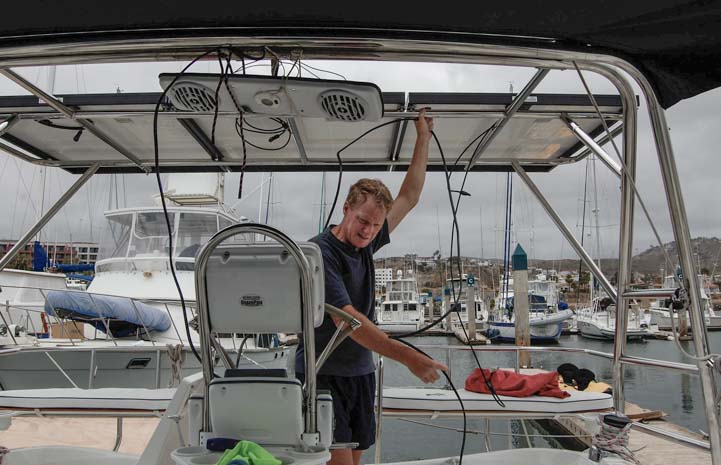
Getting the 185 watt 24 volt solar panels up onto the arch was a challenge. Getting solar panels up onto an RV roof is tricky too!

Affordable marine Solar panel installation on sailboat Hunter 44

Getting the solar panels onto the roof of an RV or up onto this arch takes two people (at least!)

Installing solar panels on an arch on sailboat (Hunter 44) with Alejandro Ulloa Baja Naval Ensenada Mexico

The second of the three panels gets installed.

The solar panel arch was going to double as a “dinghy davit” system with telescoping rods that extended out over the transom. These davits supported a pulley system to hoist the dinghy up out of the water. So once the solar panels were mounted on the arch, we had to be sure it could handle the weight of the dinghy.

Our dinghy weighed a lot less than the combined weight of Mark and Alejandro!

Strong solar panel arch and dinghy davit extension

Alejandro and Mark test the arch to be sure it can support the dinghy (which weighed half what they do).

The solar panels were wired in parallel because they would be subjected to shade constantly shifting on and off the panels at certain times of the day as the boat swung at anchor.

Wiring solar panels on a sailboat (Hunter 44) marine solar power installation

Mark wires up the panels in parallel.

Affordable solar panel installation on a sailboat

.

Solar panel arch with dinghy davit extension supporting affordable solar power on sailboat

A beautiful, clean installation with wire loom covering the exposed cabling and the rest snaked down inside the tubes of the Hunter arch. The davit extensions for hoisting the dinghy are clearly visible under the panels.

Solar panels installed on arch on Hunter 44 sailboat

Nice!

Down below the cockpit inside a huge locker in the transom, Mark mounted a combiner box that brought three cables in from the three panels and then sent out one cable to the solar charge controller.

Emily and Mark Fagan aboard sailboat Groovy

The transom locker in our Hunter 44DS sailboat was very large!

Combiner box for solar panel parallel wiring on a sailboat

A combiner box brings the wires from the three panels together before a single run goes to the solar charge controller (this is optional and not at all necessary).

The solar charge controller was installed in the cabin inside a hanging locker in the master stateroom.

Xantrex solar charge controller installed in sailboat locker

We have an Outback FlexMax charge controller on our trailer but chose a Xantrex controller for our boat because there were no moving parts. We compare the two HERE.

The solar charge controller was located about 8 feet from the near end of the battery bank which spanned a ~14 foot distance under the floorboards in the bilge.

Two 4D AGM batteries in bilge of sailboat

We had four 160 amp-hour 4D AGM batteries for the house bank and a Group 27 AGM start battery installed under the floorboards in the bilge.
One 4D house battery and the Group 27 start battery are seen here

This 555 watt solar power system, which charged a 640 amp-hour house bank of 4D AGM batteries, supplied all of our electrical needs, including powering our under-counter electric refrigerator.

Usually our engine alternator provided backup battery charging whenever we ran the engine. However, at one point our alternator died, and we were without it for 10 straight weeks while we waited for a replacement alternator.

Why such a long wait for a simple replacement part? Getting boat parts in Mexico requires either paying exorbitant shipping fees and import taxes or waiting for a friend to bring the part with them in their backpack when they fly from the US to Mexico.

During that long wait our solar power system supplied all our electricity without a backup while we were anchored in a beautiful bay. Diesel engines don’t require an alternator to run, so we moved the boat around and went sailing etc., and lived our normal lives during our wait.

Solar panel arch and dinghy davit extension with solar panels installed on sailboat

View from the water — cool!

The dinghy davit extensions on the solar panel arch made it easy to raise and lower the dinghy from the water and also to raise and lower the 6 horsepower outboard engine.

Solar panel arch and dinghy davit extension on sailboat

A pulley system on the davit extensions made hoisting the outboard and dinghy a cinch for either of us to do singlehandedly.

Solar panel arch and solar panels on sailboat transom

For 7 months we left our boat at the dock in Chiapas, unplugged from shorepower, and let the solar panels keep the batteries topped off. Everyday during that time they put 19 amp-hours into the batteries which was essentially the power required to operate the solar charge controller!

At anchor, sometimes the solar panels were in full sun all day long if the current and wind and the pattern of the sun crossing the sky allowed the boat to move around without the sun coming forward of the beam of the boat.

However, whenever the sun was forward of the beam, the shadow of the mast and the radome fell on the panels. We could watch the current production from the panels go from full on, to two-thirds, to one-third and back again as the shadow crossed one panel and then two at once, and then one and then none, etc, as the boat swung back and forth at anchor.

Mast and radome cast shade on solar panels on sailboat

RV solar installations have to avoid shade from air conditions and open vent hatches.
On boats the shade from the mast and radome is often unavoidable.

Mast and radome cast shade on pair of sailboat solar panels

When the shadow fell across two 185 watt panels at once, it knocked both of them out of the system so only one of the three solar panels was actually producing power.

The coolest and most unexpected benefit of having our solar panels mounted on an arch over the cockpit was the shade that they provided. The sun in Mexico is very intense, especially out on the water, and it was wonderful to have two huge forward facing jump seats at the back of the cockpit that fully shade as we sailed!

Under the shade of solar panels and a solar panel arch on a sailboat

Made in the shade — What a life that was!!

We have more solar power related articles at these links:

SOLAR POWER OVERVIEW and TUTORIAL

BATTERIES and BATTERY CHARGING SYSTEMS

LIVING ON 12 VOLTS

Our technical articles in Cruising World magazine can be found here:

Do We Miss Our Boat “Groovy” and Sailing?

We describe our thrilling — and heart wrenching — first and last days on our wonderful sailboat in the following posts. It is very true that the happiest days of a boater’s life are the day the boat is bought and the day it’s sold!

Our most recent posts:

More of our Latest Posts are in the MENU.   New to this site? Visit RVers Start Here to find where we keep all the good stuff. Also check out our COOL NEW GEAR STORE!! *** CLICK HERE *** to see it!

Subscribe
Never miss a post — it’s free!

Ta Prohm Temple – Exotic Ancient Ruins at Angkor Wat Cambodia

February 2017 – When we began planning our trip to Thailand, our friend that inspired us to go sent me an email saying, “As long as you’re going that far, make sure you go see Angkor Wat in Cambodia.”

As soon as I saw images of the fabulous and mysterious ancient Khmer ruins that dot the landscape deep in the jungle at this breathtaking UNESCO World Heritage Site I was hooked and made plans for us to fly from Bangkok, Thailand, to the town of Siem Reap in Cambodia.

When we arrived in Siem Reap we were astonished by what we found.

Tuk-tuk driver with passengers at Angkor Wat in SIem Reap Cambodia

A tuk-tuk driver takes tourists to the ancient Khmer ruins at Angkor Archaeological Park in Cambodia.

Siem Reap hums with life and the streets are filled with people on motorbikes and tuk-tuks going about their daily business. We took a walk to the heart of town from our hotel and couldn’t believe the crazy traffic in the street as one motorbike or tuk-tuk after another whizzed by.

Motorbikes in Siem Reap Cambodia

Families scoot around town on their motorbikes.

Whole families climbed aboard their motorbikes to get around town, often with mom, dad, the kids, and maybe even the baby all hanging on as the family zipped around town doing their errands. Sometimes even a teddy bear got to come along for the ride!

Family on motorbike with teddy bear Siem Reap Cambodia

Even Teddy gets a ride on the back!

Cars mingled with the busy two-wheeled traffic, and we saw little buggies of all kinds that weren’t familiar to us. We couldn’t stop our cameras from clicking constantly as we tried to capture the wild scene.

Little minibus Siem Reap Cambodia

We saw some cool vehicles we don’t see back home.

Standing on an insanely busy street corner where four streets came together and crammed themselves into one before going over a bridge, I took my camera down from my face and closed my eyes to listen. Small engines and narrow tires whooshed past in a constant stream, but the air was filled with life and there was a peacefulness to it, a happiness and contentment I couldn’t put my finger on.

Tuk-tuk drivers in Siem Reap Angkor Cambodia

Tuk-tuk drivers and motorbikes in Siem Reap, Cambodia

The rare toot of a horn was just a notice of “I’m here,” rather than an angry honk yelling “You’re in my way!” and everyone seemed to zig-zag around each other and get to where they needed to be without pushing or shoving or being mean.

Tuk-tuks and motorbikes Siem Reap Cambodia

The traffic was insanely busy and non-stop.

I looked over at Mark to say something about this to him, and noticed he was no longer taking photos either and was in the same kind of trance I was in. “It’s like flowing water,” he said, mesmerized.

We began to stroll along the river and suddenly saw bunches of schoolkids walking home from school, smartly dressed and carrying huge backpacks on their backs. A group of boys raced each other and bounced around on the sidewalk, laughing and teasing each other, and then they swung themselves into a tree to dangle from the thick vines in total glee.

What a cool place and what a great vibe!

Cambodian school children playing in Siem Reap

Schoolkids walking home from school stopped to take a quick swing on the vines.

The traffic of motorbikes and tuk-tuks continued to flow past us endlessly, and we saw vendors going about their business selling their wares from bikes and carts.

Bicycle with a heavy load in Siem Reap Cambodia

.

Rolling cart in Siem Reap Angkor Cambodia

Junior gets a ride underneath!

And if anyone had a heavy load to carry but relied on a motorbike to get around town, well they just strapped it onto the back of the bike! Where there’s a will there’s a way!

Motorbike carrying a large cannister Siem Reap Angkor Cambodia

Wide load!

Our friend who had suggested we go to Siem Reap and Angkor Wat had emailed me the most enchanting story of when he had hired a tuk-tuk driver to take him around town and show him the sights. I loved this idea and hunted around online for a tuk-tuk driver.

I found the website of a very sincere sounding young man of 25 that had started his own tuk-tuk business by investing in one of these unusual rigs and hanging out his shingle online as a driver (website here).

Tuk-tuk driver in Angkor Wat Siem Reap Cambodia

Mark with our tuk-tuk driver Pisal Rom.

His name was Pisal, and I emailed him a few weeks before our trip. I was tickled to get an email right back with a quote for his services. It would be about $20 a day to have him chauffeur us around town and take us to any of the temples we wanted all day long. Signing up with him was a no brainer, and a few email exchanges later we had worked out the days and times and which temples we would go see.

Siem Reap tuk-tuk driver for Angkor Wat in Cambodia Pisal Rom

Being a tuk-tuk driver is an entrepreneurial and independent business venture in Siem Reap, Cambodia.

He even came to the airport to greet us, and because I had sent him a link to our website he recognized us right off the bat! This was very handy because at least 50 cab drivers and tuk-tuk drivers greeted our plane holding up signs with names on them. All of us tourists were in a daze after going through customs and getting fingerprinted electronically (thumb and then all four fingers of each hand), and we stood there lamely trying to find our names in the sea of signs!

Tuk-tuk driver in Angkor Wat Siem Reap Cambodia Pisal Rom

Pisal picked us up at the airport when we arrived and took us to our hotel.

The next morning he picked us up at our hotel and took us to the Visitors Center where we bought tickets to the Angkor Archaeological Park. Just like the very formal process we had gone through at the airport where we had been fingerprinted in order to obtain printed visas in our passports to enter the country, our one day tickets to Ankor Archaelogical Park were adorned with our mug shots!

Angkor Wat National Park entrance tickets Cambodia

Our one-day tickets for the Angkor Archaeological Park had our photos on them!

We hopped in the back seat of the tuk-tuk and enjoyed a quick ride to our first temple of the day. Almost all the vehicles on the road were tuk-tuks like ours with tourists sitting in the back. In various spots we saw groups of tuk-tuks parked, waiting to take someone for a ride.

Hammock in a tuk-tuk at Angkor Wat temple Siem Reap Angkor Cambodia

One tuk-tuk driver we saw had an ingenious way to relax between customers!

And then we arrived at Ta Prohm temple, a magnificent group of structures built in 1186 by the ancient Khmer king Jayavarman VII.

Entrance to Ta Prohm temple Siem Reap Angkor Cambodia

Entrance to Ta Prohm temple

Like most of the ancient Khmer ruins, the buildings are carefully positioned and laid out. Ta Prohm has entrance gates facing in each direction of the compass.

Ta Prohm ruins Siem Reap Angkor Cambodia

.

I hadn’t fussed over the history of these ruins before our arrival, preferring instead to let the experience of seeing them wash over me as if I were an archeologist discovering them for the first time.

Courtyard Ta Prohm temple Siem Reap Angkor Angkor Cambodia

.

As we looked down a hallway with columns on one side opening into a courtyard, I was struck by how the shape of the arches was identical to that of the Mayan ruins we had visited at Palenque in Chiapas, Mexico.

The ancient Khmer temples were built about three hundred years after the Mayan empire fell, so who knows! Certainly, many aspects of the ruins reminded me of the Mayan ruins at Yaxchilan.

Hallway in Ta Prohm Angkor Wat ancient Khmer ruins Siem Reap Angkor Cambodia

The shape of these arches reminded us of the arches in the Mayan ruins in Mexico.

Doorway Ta Prohm Temple Angkor Cambodia

.

We found all kinds of nooks and crannies to explore.

Ta Prohm temple columns Angkor Siem Reap Cambodia

.

One of the things that is most impressive at Ta Prohm temple is that almost every stone used in its creation was carved with decorations. The carvings are on doorways, lintels, windows and in every corner.

Dancers stone carvings Ta Prohm temple Siem Reap Angkor Cambodia

Almost all the stones on the walls, windows and doors were carved with wonderful sculptures.

I wandered down one hallway and found myself standing next to a wall that was intricately carved with a floral pattern from floor to ceiling.

Intricate stone carving Ta Prohm ruins Siem Reap Angkor Cambodia 2

This pattern was repeated, floor to ceiling and a few feet wide. Ancient wall paper!

Stepping outside, I noticed that the outer wall of one building had carved sculptures inset into the entire length of the wall.

Wall carvings Ta Prohm Angkor Siem Reap Cambodia

The outer walls had statuary built in.

Stone carving Ta Prohm Angkor Siem Reap Cambodia

The ancient Khmer people were Hindus when the temples were built and later changed to Buddhism.

Stone carving Ta Prohm Angkor Siem Reap Cambodia

.

The more we looked, both outside and inside, the more carvings we saw.

Elaborate carving at Ta Prohm Angkor Siem Reap Cambodia

Every inch has elaborate carvings!

The doorways — and there were dozens — were truly ornate.

Ta Prohm ancient Khmer ruins Siem Reap Angkor Cambodia

The dozens of doorways were all similar but no two were exactly the same!

Oddly, the entire Ta Prohm temple ruin was strewn with enormous boulders that had once formed the walls and ceilings and floors of rooms that were no longer standing.

Doorway and fallen blocks Ta Prohm temple Angkor Siem Reap Cambodia

Both outside and inside the temple buildings were rubble piles of large stones that had fallen. These piles were often waist high or more!

Ta Prohm temple ruins Angkor SIem Reap Cambodia

Wonderful columns — and lots of rubble, including a column piece to the left.

Rubble at Ta Prohm Temple Ruins Angkor Siem Reap Cambodia

Beautiful – but what a mess!

Looking closely at the rubble, we could see stones that had been carved.

Carvings on blocks at Ta Prohm temple Siem Reap Angkor Cambodia

Many stones in the rubble had carvings on them.

It was like an enormous jigsaw puzzle that just begged to be put back together again.

Ruins and fallen blocks at Ta Prohm temple Siem Reap Angkor Cambodia

Sometimes it was easy to see how the stones had gone together before the wall or roof collapsed.

Carved stone rubble Ta Prohm ruins Siem Reap Angkor Cambodia 2

.

But what Ta Prohm temple is actually known for is the gargantuan trees that have enveloped the ruins with their roots. It is known as a “Jungle Temple” because it has truly been engulfed by the jungle.

Walking along the outer wall of the temple, we saw the most incredible tree and root system snaking over the wall.

Giant tree roots engulf wall at Ta Prohm temple Siem Reap Angkor Cambodia

Ta Prohm temple is known for the Invasion of the Giant Trees.

If this looks like a modest tree and a knee high wall, look again:

Enormous tree covers wall at Ta Prohm temple Siem Reap Angkor Cambodia

Yes… the Giant Trees!

Trees like this were all over the place, their gnarly roots reaching out across the walls and buildings.

Tree roots covering wall at Ta Prohm temple Siem Reap Angkor Cambodia

.

Huge tree roots engulf wall Ta Prohm ruins Siem Reap Angkor Cambodia 2

.

Jungle temple Ta Prohm Angkor Siem Reap Cambodia

.

In some places it seemed like the roots were flowing from the tree down across the temple buildings.

Tree roots on doorway Ta Prohm Angkor Siem Reap Cambodia

A waterfall of roots!

Roots on wall at Ta Prohm Angkor Siem Reap Cambodia

.

I turned one corner and noticed the head of a sculpture peeking out at me from between the tree roots!!

Face in tree Ta Prohm Angkor Siem Reap Cambodia

Hey… there’s a face in there!

Everywhere we turned, the trees and roots had taken over the temple.

Tree and roots engulf ruins at Ta Prohm Angkor Siem Reap Cambodia

.

The temple of Ta Prohm was used as a location in the movie Tomb Raider starring Angelina Jolie, and some of the places were recognizable to tourists and were favorite spots for selfies.

Tourists at jungle temple Ta Prohm Angkor Siem Reap Cambodia

.

Ta Prohm is undergoing renovation and construction to put various bits back together again and to make it easier for tourists to get around, and we saw construction crews here and there with hard hats and cranes.

Reconstruction at Ta Prohm ruins Siem Reap Angkor Cambodia 2

Construction workers in hard hats watch a stone being lifted to the roof.

Eventually we wound our way back to the entrance gate where the crowds were growing ever bigger.

Tourists at entrance to Ta Prohm Angkor Siem Reap Cambodia

When we returned to the entrance there were lots of tourists coming in.

We spotted a sign suggesting we slow down a bit.

Cambodia sign to Slow Down

Cambodian letters are not from the Roman alphabet.
But they’re not Thai letters either!


Nearby we saw lots of tourists who had been approaching Temple Sightseeing Overload (which is easy to do in this part of the world where Ta Prohm is just one of dozens of exotic ruins). They were taking a load off in the shade.

Resting at Ta Prohm Angkor Siem Reap Cambodia

Time for a break!

But we were still fired up. We found Pisal waiting for us and hopped in the back of his tuk-tuk for more temple adventures!

Fabulous ancient Khmer ruin Angkor Siem Reap Cambodia

This area is so rich with ancient Khmer ruins it would take many months to see them all.

We’ve seen quite a few ancient ruins in our travels now, and I found it fascinating to put together a timeline of who was building and living in which places at various times in history.

The meso-American ruins of Mexico and Central America predate all the others by a few hundred years. Interestingly, the ancient Khmer temples and kingdoms of southeast Asia were built about the same time as the cliff dwellings of America’s southwest!

  • 600 BC – 850 AD – Monte Alban – Zapotec step pyramids near Oaxaca, Mexico
  • 100 – 650 AD – Mitla – Zapotec ruins close to Monte Alban near Oaxaca, Mexico
  • 359 – 808 AD – Yaxchilan – Mayan pyramids on the river between Mexico and Guatemala
  • 431 – 800 AD – Palenque – Mayan pyramids in Chiapas, Mexico. One of Central America’s major Mayan sites
  • 580 – 800 AD – Bonampak – Mayan site in Chiapas, Mexico, with truly evocative fresco paintings depicting battles and coronations
  • 921 AD – Koh Kher – Ancient Khmer temples (upcoming post)
  • 1113 – 1145 AD – Angkor Wat – Ancient Khmer temples (upcoming post)
  • 1182-1225 AD – Wupatki Pueblo – Sinagua People multistory stone dwellings north of Flagstaff, Arizona
  • 1186 AD – Ta Prohm – Ancient Khmer temple described on this page
  • 1190-1300 AD – Mesa Verde Cliff Dwellings – Ancestral Puebloan cliff dwellings in southwestern Colorado
  • 1200 AD – Angkor Thom – Ancient Khmer temple (upcoming post)
  • 1330-1450 AD – Tonto Cliff Dwellings – Salado People in central Arizona

Subscribe
Never miss a post — it’s free!

More info about Ta Prohm, our tuk-tuk driver and our accommodations:

Other blog posts from our travels in Thailand:

More Glimpses of National Parks through our eyes:

National Parks and UNESCO World Heritage Sites – North America and SE Asia

Our most recent posts:

More of our Latest Posts are in the MENU.
New to this site? Visit RVers Start Here to find where we keep all the good stuff!!

<-Previous || Next->

Spring in Sarasota FL + Bryce Canyon’s Night Skies – in Trailer Life

We are very proud to announce that the March 2017 issue of Trailer Life Magazine features our article about beautiful Sarasota, Florida, plus a back page column about hiking Bryce Canyon National Park under the stars.

Sarasota's Three-Ring Circus Trailer Life Magazine

Trailer Life Magazine, March 2017
Text by Emily Fagan, Photos by Emily & Mark Fagan

Sarasota, Florida, is a fabulous place to visit in April, and we enjoyed five wonderful weeks there. For RVers that are heading north these days from the hotter parts of southern Florida, a stopover in Sarasota is a true delight.

Venice Beach Sarasota Florida

Venice Beach just south of Sarasota, Florida.

We have been fortunate to visit tropical beaches all over the world, most recently in Thailand but also in many parts of southern Mexico, Hawaii and the Caribbean. Frankly, not one of them has sand that is quite as pure white and fluffy soft as Siesta Beach in Sarasota. It is the texture of confectioner’s sugar! And the turquoise water is ever so inviting too.

Siesta Beach Sarasota Florida

Siesta Beach — Where the sand is like confectioner’s sugar!

But what surprised us was the many other things Sarasota has to offer. A century ago it was just a small fishing village, but the Ringling Brothers decided to settle in the town and make it the home base for their circus, and that changed it forever.

The Ringling mansion Sarasota Florida

The Ringling – Former home of the founders of the circus

Now, The Ringling is a fabulous museum that offers so much for tourists to see that you can get a three day pass — and you need it if you want to see it all.

Ringling Mansion Ca-Dzan Sarasota Florida copy

Ornamentation galore!

The Ringling estate’s mansion is a phenomenal building that is loaded with decorative arches, fanciful cornices, and an altogether fairy tale type of air.

Tourists at The Ringling mansion Sarasota Florida

The Ringling is a “do not miss” Sarasota excursion!

Out front there is a fabulous and enormous rock tile deck that looks out on Sarasota Bay. Standing there I tried to imagine what it was like back in the day when John and Mabel Ringling held parties there. Oh my!

Tile deck at The Ringling mansion Sarasota Florida

Even the deck is absolutely stunning, with inlaid colorful stone tiles.

The Ringling also has a museum that houses the stunning collection of European art that John Ringling collected. Mondays are “free admission day,” and when we got inside we were blown away by this immense art collection.

The Ringling Art Museum Sarasota Florida

The Ringling art museum is free on Mondays and is home to a stunning collection of European masters.

Out back there is a rose garden that was the pride and joy of Mabel Ringling as well as a gargantuan banyan tree.

Banyan tree The Ringling gardens Sarasota Florida

Out back we found a massive banyan tree shading a very cool bar!

Sarasota is one place where it would take a whole season of outings to run out of things to do. One excursion we really enjoyed was going to Jungle Gardens.

This is a zoo of sorts whose welcoming committee is a flock of pink flamingos who go out of their way to say, “Hello!”

Flamingo and photographer Jungle Gardens Sarasota Florida

At Jungle Gardens they hire pink flamingos to be the greeters!

They are extremely friendly birds, and even though they had plenty of natural spaces to stand around and do their flamingo thing in the water and under the tropical trees, one flamingo took a particular liking to Mark and rubbed his beak all over him!

Flamingo Jungle Gardens Sarasota Florida

True love… for the flamingo at least!

Jungle Gardens also has a wonderful bird show, and we were delighted by the antics of the various parrots. One parrot, a 79 year old cockatoo named Snowflake, was a seasoned professional when it came to performing. He was so old that he had appeared on the Ed Sullivan Show before I was born!

He can still do great tricks, though, and we watched him ride a bike on a tightrope while a buddy macaw perched on a swing and went for a free ride below him.

Snowflake rides a unicycle with Andy riding underneath copy

Snowflake’s still got it at 79 years old!

There are lots of parks in the Sarasota area, and we got a huge kick out of watching native birds fishing, swimming and flying by us in some of these parks.

Great Blue Heron Sarasota Florida

The native wild birds are a sight to behold in many parks around town.

Sandhill cranes like Sarasota as much as people do, and to our utter delight and complete surprise, a pair of sandhill cranes had a nest with two eggs near a pond at a strip mall.

Sandhill crane with chick in nest Sarasota Florida

A sandhilll crane mom checks on her brand new chick.

On the day that they were due to hatch a large group of fascinated birders and photographers gathered near the nest and began to watch the arrival of the baby chicks through huge telephoto lenses and binoculars.

Sandhill chick and egg in nest Sarasota Florida

“Yawn…It was a lot of work getting out of that egg!”

This little guy was absolutely adorable.

Sandhill crane with chick in nest Sarasota Florida

“Oopsie!”

And the first little one was soon joined by its sibling while the parents pushed the egg shells aside.

Two sandhill cranes in nest Sarasota Florida

“Are you my brother?!”

Sarasota has lots of quirky charm, and there is a mascot that adorns many homes and businesses around town. Nicknamed the Tube Dude, this guy can be seen holding a toothbrush in front of the dentist’s office, wearing a baker’s hat in front of the bakery and sitting in a Kayak at the local surf and kayak shop. What fun!

The Tube Dude in Sarasota Florida

The Tube Dude at a coffee shop with a water bowl for his dog.

Trailer Life has posted our article on their website and you can read it here:

Sarasota’s Three-Ring Circus – Trailer Life Magazine, March 2017

Flipping to the back of the March issue, there is a photo of a wonderfully starry night taken from the Mossy Cove trail at Bryce Canyon National Park. We spent quite a bit of time at Bryce Canyon last summer, which gave us a chance to get out on the trails in the dark several times.

Stars over Fairytale Canyon Bryce Canyon National Park

Hiking Bryce Canyon under the stars is very rewarding.

It is a little eerie hiking in the pitch dark with a flashlight, but we managed not to fall over the edge and we saw some really cool skies.

Fairy Tale Canyon Bryce Canyon National Park Night Stars

.

Bryce Canyon doesn’t have super dark skies, so there is always a big of a glow on the horizon from nearby towns, but even so, the stars jumped out of the heavens.

Fairy Tale Hike Bryce Canyon National Park Night Stars

We ventured out into Fairytale Canyon

We were there fairly late in the season, in September, so catching the Milky Way was a little tricky as we had to get out into Bryce Canyon’s amphitheater of hoodoos in order to look back up towards the rim to see it. But we caught it sailing across the sky on several occaisions between 3:00 and 5:30 in the morning.

Milky Way Bryce Canyon National Park Fairytale Canyon

The Milky Way is easiest to see in late spring and early summer.

Milky Way and tree silhouette Bryce Canyon National Park

.

Milky Way Bryce Canyon National Park

.

Of course, we stayed out so long on these crazy midnight hikes that by the time we got back to our trailer the morning sky was just beginning to lighten into rich shades of blue. And sure enough, there was the Orion constellation hanging over our rig!

Orion constellation over RV Utah

Orion sails high above our trailer.

Trailer Life is an excellent magazine, and we were subscribers for years before we became writers and photographers for them. Whether you are a new RVer or have many years under your belt, if you own a towable RV like we do, you might enjoy subscribing for a year. You can subscribe to Trailer Life here:

Trailer Life Subscription

It’s not expensive, and what I like is that it is professionally edited by terrific editors and it is professionally laid out by a graphic artist which gives it a polish in the print edition that just doesn’t exist online, whether on magazine websites or on folksy blogs like this one.

Subscribe
Never miss a post — it’s free!

Interested in visiting Sarasota? Here are our blog posts from our stay there:

More Blog Posts from Florida

Curious about Bryce Canyon and/or Hiking Under the Stars? Check out these posts:

Night Skies in Waterton Lakes + All Night Timelapse of the Milky Way07/31/16

A Few of the Other Articles We’ve Published in Trailer Life:

Trailer Life Articles by Emily & Mark Fagan

Our most recent posts:

More of our Latest Posts are in the MENU.
New to this site? Visit RVers Start Here to find where we keep all the good stuff!!

RV Solar Power Made Simple

Thanks to solar power, we have lived completely off the grid in two trailers and a sailboat full-time since May 2007. Without doubt, our solar power installations have given us more independence and freedom as full-time RVers and sailors than anything else in these lifestyles. It has allowed us to go anywhere at anytime, and has revolutionized our lives.

On this page I describe the two systems we have had on our trailers. These were installed in 2007 and 2008 respectively. Prices for solar power equipment have dropped every year since then, however the prices listed throughout this page are from August 2014:

  • A Small (minimal) RV Solar installation for ~$700 that we used full-time for a year of boondocking in 2007
  • A Full-timer (all you need) RV Solar installation for ~$2,500 that we have used for full-time boondocking since 2008

I also offer a little theory and reveal some of the discoveries we have made along the way. For more info, please see our Solar Power Tutorial pages and our Sailboat Solar Power Installation page.

Links to all of our articles about solar power can be found on our Solar Power For RVs and Boats page.

You can navigate to different parts of this article by using these links:

WHY BOTHER WITH A SOLAR POWER INSTALLATION ON AN RV?

Return to top

The biggest advantage of a solar power system in an RV is that the system works from dawn to dusk, silently, odor free and without requiring any fuel or maintenance, no matter where you are or what you are doing. Towing, parked at the grocery store, or camped, the batteries are being charged. They start getting charged before you finish breakfast, keep charging while you hike or go sightseeing, and continue all day, rain or shine. They don’t quit charging until nightfall. You never have to think about the batteries getting charged. It just happens. In our current rig, I feel like we have electrical hookups all the time — and we never get hookups any more!

Traveling full-time since 2007, we have connected to electrical hookups for a total of about 25 days, and that was during our first 18 months on the road. The last time we got electrical hookups was in October, 2008. Since we began our full-time travels in 2007, as of June 2019, we have boondocked in our RV nearly 3,200 nights. We also lived on solar power on our sailboat for over 900 nights during our sailing cruise of Mexico.

We do carry a Yamaha 2400i generator, but use it only a few days each year, either after a long period of winter storms to give the batteries a boost, or on hot summer days to run our 15,000 BTU air conditioner. We have used it a total of about 20 times since we purchased it in December 2007. We run it every six months or so to flush the gas through the lines. Little as we have used it, we have found the Yamaha to be a fabulous generator. It has always started on the first pull, even after it sat in storage for 20 months when we first moved onto our sailboat!

Our first solar power installation that we used for a year in 2007 was a “small” system that allowed us to use almost every appliance we owned, that is, laptop, TV, hair dryer, vacuum, two-way radio charger, power drill, etc. However, we had to be very conservative with our electrical use during the winter months. A similar “small” RV solar power kit can be found here.

Our second “full-timer” solar power system that we have been using since 2008 is like having full electrical hookups wherever we go. Very little conservation is necessary! On our biggest electrical use day to date, we watched our 26″ LCD TV with its huge surround-sound system and sub-woofer for 15 hours (it was the Olympics!) and ran two 13″ laptops for 7 hours, made popcorn in the microwave and ran several lights for 4 hours in the evening. It was July, and the next day was very sunny and the batteries were fully charged by mid-afternoon. A similar “full-time” RV solar power kit can be found here.

Here are some sample kits, smaller and bigger in size, and their prices. The only trouble with buying a component kit is that if one component fails the whole kit has to be returned. The third item, however, is a portable suitcase kit that does make a lot of sense for someone who doesn’t want to hassle with the installation just yet (you can always sell the portable kit later).

BASIC ELEMENTS OF A SOLAR POWER INSTALLATION

Return to top

BATTERY CHARGING and AC POWER
The basic components of all solar power installations is the same, and is comprised of two major subsystems: BATTERY CHARGING to get the batteries charged up and AC (120v) POWER for appliances that can’t be run on DC (12v) power (i.e., TV, computer, vacuum, hair dryer, etc.).

The BATTERY CHARGING subsystem includes these components:

  • Batteries
  • Solar panel(s)
  • Charge controller to protect the batteries from getting overcharged

The AC POWER subsystem includes this component:

  • Inverter(s) to convert the batteries’ 12 volt DC power to 120v AC power

GET YOUR HANDS DIRTY!

300 watt inverter for an RV solar panel installation

A 350 watt portable inverter
Plug it into a cigarette lighter

It is hard to “play with” the battery charging subsystem of a solar power installation to get a feel for how it works until you actually take the leap and buy a solar panel, charge controller and cables and hook it all up to the batteries. One great option if you don’t want to do any wiring but want some hands on experience is to get a portable solar panel kit. You can sell it later if you want to upgrade to a rooftop system.

You can get the hang of how the AC power subsystem works very easily. Simply run down to Walmart or any auto parts store and pick up a $15-$20 inverter that plugs into a cigarette lighter DC outlet. Plug it into the lighter in your car, turn it on, and then plug your laptop into it or your electric razor or any other small appliance. Now your 12 volt car battery is operating your 120 volt appliance.

Big inverters that can run the microwave, toaster, blender and vacuum cleaner work on exactly the same principal, the difference is just the amount of power the inverter can produce. Big inverters are also wired directly to the batteries rather than plugging into a cigarette lighter.

IS SOLAR POWER EXPENSIVE? SMALL SYSTEMS VERSUS BIG SYSTEMS

The difference between the “small” system we used for one year on our little Lynx travel trailer and our “full-timer” system we have now on our big Hitchhiker fifth wheel is simply the overall capacity of each of the components. That is, the capacity of the battery charging system (solar panels, batteries and charge controller) and of the AC power system (the inverter).

In functional terms this means that the difference between the “small” and “full-timer” systems is threefold:

1) the ability to run more appliances at once (i.e., have two laptops running while the TV and blender are going)
2) the ability to run larger appliances (i.e., using a VitaMix versus a small blender)
3) the ability to run more appliances for a longer time at night without discharging the batteries too much.

So, in a nutshell, the two subsystems — battery charging (batteries + panels + charge controller) and AC power (inverter(s)) — combine to do the same job as plugging a generator into the shore power connector on the side of the rig. The panels and charge controller charge the batteries. The inverter makes it possible to use AC appliances.

The cost of the parts for these installations is:

Small: $700 – Comparable to having a Yamaha 1000i generator
Full-timer: $2,500 – Comparable to having a built-in Cummins Onan 2.5KW generator

With solar power there is no noise, no fuel cost, no maintenance and no smell, unlike a generator. However, it is not possible to run the air conditioning in the summertime on solar power, unless you have a massive system with several hundred pounds of batteries and a roof absolutely loaded with panels. As mentioned before, we use our Yamaha 2400i generator to run our 15,000 BTU air conditioner.


OUR “SMALL” RV SOLAR POWER SYSTEM (~$700 in parts)

Return to top

This setup is a fully functional, inexpensive solar power installation, and is what we used for a 350 nights in our first year in our Lynx travel trailer. It could power a 19″ LCD TV and DVD player, radio, laptop and vacuum as well as charge camera batteries, razor, toothbrush, cordless drill, cell phone, etc.

  • Two 6-volt batteries (wired in series) giving 220 amp-hours of capacity $250

    Ours were Energizers from Sam’s Club

  • 140 watts of solar power $175

    Ours was a Kyocera 130 watt DC panel. Today Kyocera sells the 140 watt panel instead.

  • A charge controller that can support at least 10 amps $90

    Ours was a Morningstar Sunsaver 10 amp charge controller (consider a Sunsaver 20)

  • A portable inverter that can supply 1000 watts of AC power $80

    Ours was a Pro One 800 watt inverter

  • Cables, connectors and mounting brackets $100

Here are the parts for the system (except for batteries and cables) — solar panel, solar charge controller and inverter:

This system is the smallest size system I would consider for an RV if you want to drycamp or boondock for more than a night or two and be comfortable. This setup worked great in the spring, summer and fall when the sun was high in the sky and the days were long. We never thought too much about our power use until the wintertime when the days got short and the nights got long and cold. Then we began to wish for a bigger system.

RV solar panel installation - wiring the panel's junction box

Mark installs our first solar panel on the roof.
He chose a nice spot by the ocean to do it!

On those long cold winter nights we had to conserve our use of lights and the TV to make sure our furnace (which used a lot of battery power) could still run. We used oil lamps a lot in the evenings. If we had stayed in that trailer longer, we would have installed a vent-free propane heater that did not use any battery power (we eventually did that in our bigger trailer the following winter: see our Vent-Free Propane Heater Installation page).

I think every RV should have this kind of a charging system installed as standard equipment, as it is useful even for the most short-term camping, like weekends and week-long vacations during the summer months.

When we installed this “small” system in our little Lynx trailer in June 2007, we were quoted $135-$350 for installation. Mark is very handy (although he is not a Master Electrician), and he found the installation was not difficult at all and completed it in one day.

SOME THEORY – SIZING THE SYSTEM

Return to top

CHARGING & CONSUMPTION

Here is some theory to explain why the above system is “sufficient” but is not great for “full-time” use. When it comes to a solar battery charging system, the concept of power charging and consumption is very simple. The amount of power you can use, or take out of the batteries, is essentially only as much as the amount you can put into the batteries. If you use (or take out) more power than you replace (or charge them with), sooner or later your batteries will be discharged and dead. The batteries are just a temporary storage place for electricity. They act as a flow-through area for the power you are going to use.

The most important part of any solar setup is the amount of charging going on (i.e., the total size, or capacity, of the solar panels), and you want that to be greater than the amount of electricity you use. More must go into the batteries than comes out. You can have an infinite number of batteries and eventually discharge them all completely if you repeatedly use more electricity than your solar panels put in.

We often find people want to add batteries to address their power shortages when what they really need to do is add more solar panels. As a rule of thumb, don’t use more than 1/3 to 1/2 of the total capacity of the batteries in one night. More important, though, is that the bigger the solar power panel array, the better. And lastly, Keep the size and age of all the batteries in the system fairly similar so the strong ones don’t waste their energy helping the weak ones keep up.

AMPS and AMP-HOURS

Appliances use amps to run. Another unit, the amp-hour (abbreviated as “Ah“), refers to the number of amps an appliance uses when it is run for an hour. For instance, an appliance that uses three amps to run will use up three amp-hours when it runs for an hour. These amp-hours will be drawn from the batteries, and the batteries, in turn, will look to the solar panels to recharge the amp-hours they have forked over to the appliance. It is for this reason that you need to know how many amp-hours you will use in a typical day. Ultimately those amp-hours must be replaced by the solar panels, so the size and number of panels you purchase will be determined by how many amp-hours you use in a day.

To estimate how many amp-hours you might use in a day, estimate how many hours each appliance will run and multiply that by the number of amps the appliance uses. We have measured some of the appliances in our trailer, and this is how many amps they use:

Single bulb DC light — 1.5 amps
Dual bulb DC light — 3.0 amps
Dual bulb fluorescent light — 1.5 amps
19″ LCD TV — 5.5 amps
DVD / CD Player — 0.5 amps
13″ MacBook laptop, on & running — 6-8 amps
13″ MacBook, off and charging — 1.6 amps
Sonicare toothbrush charging — 0.1 amps
FM Radio w/ surround-sound — 3.0 amps
12′ string of rope lights — 3.3 amps

We find that we typically use anywhere from 50 to 150 amp-hours per day, most commonly in the 70-90 range.

HOW MANY AMP-HOURS DOES MY FAVORITE GIZMO USE?

Since RV solar power systems are DC battery based, it is helpful to know how many amps (in DC) various appliances use. Multiplying that value by the number of hours the appliance is used each day then reveals how many amp-hours the appliance will require from the battery in the course of a day.

Most DC appliances list their amp usage in the user manual or spec sheet. In contrast, most AC appliances list their wattage in the user manual instead of amperage. So, for AC appliances that are run on an inverter you have to do some math to get their equivalent DC amperage rating.

You can get a rough estimate of the number of amps that an AC device will use on an inverter simply by dividing the wattage by 10.

Why is that?

Here’s one way to look at it: Technically, Watts = Volts x Amps. AC circuits run at ~120 volts. DC circuits run at 12 volts. An AC appliance will use the same number of watts whether running on a DC or AC. On a DC circuit (using an inverter so it can run), that AC appliance will use 10 times as many amps as it will on an AC circuit (that is, 120/12 = 10).

Here’s another way to look at it: Watts / Volts = Amps. So, to determine most precisely how many DC amps an AC appliance will use when running on an inverter, start by dividing the number of watts it uses by 12 volts to get its Amps DC. HOWEVER, keep in mind that inverters are not 100% efficient. Typically they are only about 85% efficient. That is, an inverter loses a bunch of watts to heat as it runs — about 15% of the watts it needs to run get dissipated into heat. So, it takes more watts to get the required amps out of the inverter, the exact figure being 1 / 85%. This means that after you divide the appliance’s Watts by its Volts (Watts / 12, as I mentioned above), then you have to divide that result by 0.85. This is messy.

Rather than dividing watts first by 12 and then again by 0.85, you can simply divide the watts by 10 and get a pretty close estimate. (That is, (1/12)/0.85 = 0.1)

Our AC 19″ LCD TV is rated at 65 watts. How many amps is that DC? 65/10 = 6.5 amps DC. We measured the TV at the volume we like to hear it and it was using 5.5 amps. If we cranked up the volume, the meter went up to 6.5 amps.

Likewise, our old white MacBook Pro laptop was rated for 65 watts. As we opened and closed files and started and stopped various programs, the meter zoomed all over the place between 3 amps and 8 amps. When we ran Adobe Lightroom, which is very disk and memory intensive, the readings hovered in the 7-8 amp range. So on average you could say it uses about 6.5 amps DC.

When we shut down the laptop and left it plugged in and charging, the meter dropped to 1.6 amps. This is important if you are trying to conserve electricity! Run your laptop on its own battery until the battery is depleted. Then turn it off and let it charge from the inverter while you do something else!

HOW DO YOU MEASURE THE POWER USAGE OF A DEVICE?

If you have nothing running in the rig (no computers running, no TV, no vacuum or toaster, etc.), you can measure the current a device is drawing from the batteries using a clamp-on meter around one of the battery cables. To measure the AC current of a small device, you can use a Kill-a-Watt meter. Simply plug it into an AC outlet and plug your device into it.

WHERE DO THE BATTERIES FIT IN?

Battery storage capacity is measured in amp-hours (Ah), and more is better. As a starting point, most new RVs come equipped with one 12-volt Group 24 battery which will give you about 70-85 Ah of capacity. Assuming the sun has charged the batteries completely by nightfall, and sticking to the rule of using only 1/3 of your total battery capacity each night, you will have only 25 Ah available each evening. That isn’t very much!

What is the best upgrade strategy?

Upgrading to two 12-volt Group 24 batteries (wired in parallel) will give you 140-170 Ah of capacity.

However, a 6-volt golf cart style battery has the same footprint as a Group 24 12-volt battery (although it is about 3″ taller), and a pair of them wired in series will give you about 210-240 Ah of capacity.

So, rather than buying a second 12-volt Group 24 batteries and getting just 140-170 Ah of capacity out of the pair, why not sell the 12 volt battery and buy to two 6-volt golf cart style batteries for 210-240 Ah of capacity? That’s what we did on our first trailer. Just make sure that you have enough height in the battery compartment for the taller golf cart batteries.

WHAT ABOUT BATTERY MAINTENANCE?

So far I’ve been talking about wet cell batteries, and these kinds of batteries need to be maintained. Wet cell batteries are made with thick metal plates and liquid between them. Over time the liquid evaporates and needs to be replaced with distilled water. Also, over time, sulphite builds up on the plates and needs to be removed by “equalizing” the batteries.

Hydrometer Reading on Battery

Use a hydrometer to check each battery cell.

Before we upgraded to AGM batteries, Once a month Mark would check the liquid levels in each cell of each battery and pours in a little distilled water wherever needed. He also checked the condition of each battery cell using a hydrometer. This little device indicates whether a cell is functioning at full capacity. Then he equalizes the batteries by programming our charge controller to raise the voltage on them to one volt higher than their normal charging voltage for five hours. Last of all, he re-checks the liquid level in each battery cell and adds distilled water as needed and re-checks each cell with the hydrometer. Usually any cells that had a poor reading before equalizing now give a good reading.

This maintenance stuff can be avoided by buying AGM batteries which are maintenance free. However, AGM batteries are really expensive. One big advantage of AGM batteries for sailors and for people with tight battery compartments is that they operate fine in any position, that is, they can be installed on their sides and will operate when a sailboat is heeling. We had them on our sailboat.

On our trailers, we initially opted for wet cell batteries. We had Trojan 105 wet cell batteries for the first five years on our fifth wheel. Then we replaced them with cheaper Costco batteries from Interstate (Johnson Controls).

The Trojans worked very well, but replacing them with cheapo batteries was a mistake. The cheap batteries failed completely within 14 months.

We now have four Trojan T-105 Reliant AGM batteries which are truly awesome. They are a little more money than the T-105 wet cell batteries, but they are superior and, in our minds, worth the extra little bit of cash.

For price comparisons: Trojan Reliant AGM (single), VMaxTanks AGM (set of 4 & free shipping), Trojan T105 Wet Cell (single):

To learn more about our new batteries, why we chose them, and how we upgraded the power plant on our trailer in April 2015, visit:

Wet Cell vs. AGM Batteries – Why We Upgraded to AGM Batteries PLUS Wiring Tips!
RV Electrical System Overhaul

To learn more about batteries and what “single-stage” and “multi-stage” battery charging is all about, visit:

RV and Marine Battery Charging Basics

AND HOW ABOUT THE SOLAR PANELS?

Battery capacity is only part of the story. The ultimate limiting factor is how many amp-hours the solar panels can put into the batteries during the day. If the solar panels are sized too small to charge the batteries sufficiently each day, you will eventually discharge the batteries over a series of days and they will be dead.

Solar panels are rated in terms of Watts. The relationship between the amp-hours that the panel can store in a battery and the panel’s watts rating is not straight forward. Suffice it to say that a 130 Watt panel produces 7.5 amps in maximum sunlight when the panel is exactly perpendicular to the sun, and both of those numbers are available in the specs for the panel. What isn’t stated, however, is how many amp-hours a panel will produce in a given day. That is because it varies by what latitude you are at, what angle the sun is to the panel (which changes all day long), how brightly the sun shines, how many clouds go by, etc.

We have found that each of our 120 watt and 130 watt panels typically produces between about 8 Ah and 40 Ah per day depending on the season, weather, latitude, battery demands, etc. Most commonly, they produce around 25-30 Ah per day each.

If you have the time and inclination (who’s got that stuff?), you can figure out how many amp-hours you use each night. Make sure that that number is less than 1/3 of your total battery capacity AND make sure your panels can provide that many amp-hours of charging each day.

But all that sounds very difficult.

Solar panels also come in a variety of flavors, including rigid or flexible and monocrystalline or polycrystalline as seen below:

To learn more about SOLAR PANELS, see our detailed review of the pros and cons of the different types of panels available today:

Solar Panel Selection – Flexible or Rigid? 12 volt or 24 volt? Monocrystalline or Polycrystalline?

NEVERMIND THE THEORY – JUST TELL ME WHAT SIZE STUFF I NEED!

As I have mentioned before, we changed how we lived when we had a small solar power installation and again when we got a big one. You can opt to live with very little electricity or not.

We met a couple living on their 27′ sailboat on its trailer in the desert in Quartzsite, Arizona (they were on their way to launch it in the Sea of Cortez). They were using just 6 amp-hours per day because they had a tiny solar panel. Lord knows, I never saw their lights on at night!

In our little Lynx travel trailer we used about 25-35 amp-hours per day. We relied on kerosene lamps for much of our lighting at night in the winter.

In our Hitchhiker fifth wheel we use an average of 60-120 amp-hours per day and we do not conserve electricity.

So as a rule of thumb, here is the number of amp-hours you might consume per day:

• 6 Ah = living ultra-conservatively
• 35 Ah = living very modestly
• 120 Ah = living much the way you do in your house

The amp-hour capacity of your battery bank should be three (to four) times your typical daily amp-hour usage.

A popular rule of thumb is to match (roughly) the amp-hour capacity of the batteries to the watts capacity of the solar panels. So, 140 Ah of battery capacity “goes with” 140 watts of solar power. 440 Ah of batteries “goes with” 440 watts of solar power.

However, having more solar capacity than that is not a problem, as it gives you much more flexibility in case you have cloudy days, the panels aren’t oriented well towards the sun, or you have periodic shading during the day from buildings or trees.

Side note: The average American house uses about 30 kilowatt-hours (kWh) of electricity per day (see here), whereas we use anywhere from 0.6 to 1.2 kWh per day in our RV. This is because houses are much bigger and more complex and have much larger appliances and systems that run on electricity (refrigerator(s), stove/oven, hot water heater, heat and air conditioning, etc.).

It is also interesting to note that the ~1 kWh of power that our fifth wheel requires to recharge its batteries every day is approximately the same amount of energy that is required to recharge the batteries of a Tesla Model S after it is driven three miles (see here). Charging a frequently driven Tesla’s batteries exclusively with solar power would require an immense solar panel array.


OUR “FULL-TIMER” RV SOLAR POWER SYSTEM (~$2,500 in parts)

Return to top

Fifth wheel trailer solar power 681

In a nutshell, in order to run your RV with the same level of comfort as a house, using all of your appliances whenever you feel like it without thinking about conserving at all, you will need at least the following:

  • Four or more 6-volt batteries giving you at least 440 amp-hours of capacity

    We have four 6-volt batteries (2 pairs of batteries in series to make two 12-volt equivalent batteries, and then those 2 twelve volt equivalent batteries placed in parallel with each other). We had Trojan 105’s for the first five years, and after that we’ve had batteries from Costco, ~$480, which we soon replaced with Trojan T-105 AGM Reliant batteries, $1,200 (see note below).

  • 500 or more watts of solar power (preferably 600-800 watts)

    We have three 120-watt Mitsubishi panels and one 130-watt Kyocera panel, for a total of 490 watts of solar power, `$1,140

  • A charge controller that can support 40 amps or more (preferably 60 or 80 amps)

    We have an Outback FlexMax 60 60 amp charge controller (consider the FlexMax 80) $565
    For more info see our page: Solar Charge Controllers – Optimizing RV Battery Charging

  • A true sine wave inverter that can supply at least 1000 watts of AC power (preferably 2000 or 3000 watts)

    For 7 years we had an Exceltech XP 1100 watt true sine wave inverter $600.

PLEASE NOTE: In April, 2015, we upgraded to Trojan 105 Reliant AGM batteries ($1,200) and an Exeltech XP 2000 watt true sine wave inverter ($1,700). See our post RV Electrical Power System Overhaul to learn more.

This system will power everything except the air conditioner, regardless of weather or season. My notes indicating “preferably” larger sizes for everything reflects the fact that our installation is now quite old and component parts costs are half what they were when we were buying. More is definitely better.

I’ve never heard anyone say they wished they had less solar power!

Mark did the installation of this solar power system on our Hitchhiker fifth wheel. My rough guess is that the installation might have cost $700-$1,500 if done by an experienced installer. It took him three partial days, largely because we were boondocked in the woods about 15 miles from Home Depot, and I had to keep running back and forth to get little things for him!

NOTES and LESSONS LEARNED

Return to top

More and more solar power equipment manufacturers are selling complete kits for RVs, boats and cabins. Here is an example full-timer kit from Go Power, and a slightly smaller full-timer system from Renogy. Here is a small solar power kit from Go Power for “weekender/vacation” use and another small solar kit using Renogy panels.

Also, if you don’t want the hassle of doing an installation, here’s a nifty portable solar panel kit that folds into an easy-to-carry suitcase!!


INVERTER and CONVERTER CONFUSION

If you are like me, the terms “inverter” and “converter” are confusing. They sound so similar it seems they must be one and the same thing. They are actually two very different components with very different missions in an RV.

CONVERTERS

A converter takes the AC power coming in from the shore power cord (via electrical hookups or a generator) and gives power to all the DC appliances in the rig so the batteries can take a break. It essentially does what the batteries do, but does it only when there is shore power.

The DC converter in an RV also charges the batteries while connected to shore power. Some converters have sophisticated multi-stage charging mechanisms, and others simply provide a trickle charge.

For more about single-stage versus multi-stage charging, click here.

The DC converter is not involved in the solar power system. In our “full-time” solar setup, the DC converter is actually unplugged because our inverter powers all the AC outlets in the rig. Because of our converter’s design, when it is plugged in it senses when there is AC power available and automatically turns on. This would impose a huge demand on our batteries whenever we turned on the inverter.

Once in a while, when the skies have been overcast or stormy for a few days, we fire up our trusty Yamaha 2400i generator to bring the batteries up to full charge. We plug our shore power cord into the generator, unplug the inverter and plug in the converter. Now the converter is charging the batteries.

The converter that came with our rig was a single-stage trickle charge Atwood 55 amp converter. This was very inefficient for use with the generator because it charges at such a slow rate that we had to run the generator for hours and hours to get the batteries charged up.

In April, 2015, we replaced that converter with a slick new Iota DLS-90 / IQ4 converter. This converter can put as much as 90 amps into the batteries and has a true multi-stage charging algorithm. To see our introductory post about our big electrical system upgrade, see this post: RV Electrical Power System Overhaul

For more about converters, visit: RV Converters, Inverter/Chargers & Engine Alternator Battery Charging Systems

Almost all trailers and many smaller motorhomes have a converter installed at the factory.

INVERTERS

An inverter takes the DC power from the batteries and converts it to AC power so you can run things like TVs, computers, vacuum cleaners, hair dryers, toasters, etc., and also charge things like your phone and camera batteries. Turn on the inverter, plug an AC appliance like an electric razor or TV into it, and poof, the razor or TV works.

Inverters come in two flavors:

True Sine Wave (or Pure Sine Wave) which means the AC power signal coming out of the inverter is identical to the power signal of a wall outlet in a house (a smooth sine wave).

Modified Sine Wave which means the waveform is clipped at the top and bottom and is stair-stepped in between rather than being a smooth sine wave.

It is easier to convert DC power to a square-type wave than a smooth sine wave, so modified sine wave inverters are much cheaper. However, some sensitive AC appliances don’t work with a modified sine wave inverter.

We purchased a high-end true sine wave inverter for our “full-time” solar setup, because it matched the quality of the system and our particular unit was noted for its ruggedness (we run it 15 hours a day, sometimes 24). Our Exeltech true sine-wave inverter is designed to operate medical equipment, so it provides exceptionally clean and stable AC power.

See our story “How Much Inverter Is Enough?” to learn about what happened to us when we accidentally “blew up” our fancy Exeltech true sine wave inverter and had to live on a tiny cheapo 350 watt modified sine wave inverter while waiting for the parts to fix it!

Ironically, some RV parks have unstable AC power that can damage AC appliances in an RV. Our inverter power from our Exeltech is cleaner and more reliable (Exeltech inverters are designed to power sensitive medical equipment)! Desktop computers, laser printers, TV and stereo equipment and Sonicare toothbrushes are the most likely appliances to have trouble with modified sine wave inverters. However, when we used modified sine wave inverters exclusively with our small solar power setup on our Lynx travel trailer, we never had a problem with any of our appliances. Modified sine wave inverters often have loud fans, and Mark did have to put some WD40 on our Radio Shack inverter twice when the fan quit working unexpectedly.

INVERTER/CHARGERS

To add to the confusion about inverters and converters, some inverters combine a little of the functionality of both an inverter and a converter. These are called inverter/chargers and have two independent functions: (1) convert the batteries’ DC power to AC (inverter), and (2) use the AC power from the shore power cord (connected to electrical hookups or generator) and charge the batteries.

These are pricey pieces of equipment and many higher end motorhomes come with them. Our sailboat came with both a 600 watt pure sine wave inverter (which we used for everything on the boat except the microwave) and a 2500 watt modified sine wave inverter/charger (which powered the microwave and charged the batteries when we plugged into shore power).

NOW THAT IT’S ALL CLEAR, THE MANUFACTURERS MESS US UP!

The distinction between inverters and converters is pretty easy, isn’t it? However, recently when I was in an auto parts store I noticed a box labeled “POWER CONVERTER” and the picture and description were very clearly that of an INVERTER! So, maybe the distinction is going to get all muddied up after all.

For more about inverter/chargers, visit: RV Converters, Inverter/Chargers & Engine Alternator Battery Charging Systems

AN IMPORTANT NOTE ON RV REFRIGERATORS

Return to top

Because conventional propane RV refrigerators are inefficient and are (shockingly) expected to fail within ten years of service (see our blog post about that here), the current trend in full-time RVs is to manufacture them with residential AC refrigerators. These RVs are built with an inverter large enough to power the refrigerator while the RV is in transit. This is great for folks that are going to plug into electrical hookups 100% of the time. However, the electricity required to run a refrigerator, whether AC or DC, and no matter how Energy Star Efficient it is rated to be, is astronomical.

A typical 10 to 12 cubic foot Energy Star refrigerator will use over 300 kilowatts per year, or 822 watts per day. There is some energy lost when running on an inverter, so this will be roughly 822 Watts / 10 Volts = 82 amp-hours per day. To keep this fridge operating during the short days of winter when the sun is low in the sky, you will need 400+ watts of solar panels and 200+ amp-hours of battery capacity in addition to whatever you will need to run the rest of the household.

If you plan to boondock a lot, and you don’t want to run your generator 24/7, be prepared to outfit your rig with over 1,000 watts of solar panels and close to 1,000 amp-hours of battery capacity to power a residential refrigerator.

Non-Energy Star compliant DC electric refrigerators are even worse. Our sailboat had a 3.5 cubic foot DC refrigerator (“counter height” or “dorm size”) that was built for RV use. It did not have a freezer compartment. We had 710 amp-hours of AGM batteries and 555 watts of solar power. Granted, we were living in the tropics and the ambient cabin temperature was generally 85 degrees. The refrigerator compressor ran about 50% of the time and our solar power system was pushed to the max to keep the batteries topped off every day.

We had a separate standalone 2.5 cubic foot DC freezer on our sailboat. If we turned the freezer on, the solar panels could not keep the batteries charged without supplemental charging from the engine alternator every third or fourth day.

Residential refrigerators have vastly improved in recent years, running on a mere 25% of the electricity they used to use in 1986, and they are only getting better. For more information about refrigerator energy use and energy saving tips, see this resource: How Much Electricity Does My Refrigerator Use?

I have corresponded at length with a reader who has been boondocking 95% of the time for 6 months in a 40′ Tiffin Phaeton motorhome. He has a Whirlpool 22 cubic foot residential refrigerator, 1,140 watts of solar panels on his roof and 940 amp-hours of battery capacity in his basement. His fridge is powered with a dedicated Xantrex pure sine wave 2,000 watt inverter that is wired through a transfer switch to both his shorepower line and his generator, just in case the inverter fails (he had a 1,500 watt modified sine wave inverter that literally burnt up and started smoking).

So it can be done, but it will be easier in a motorhome that has a big payload capacity than in a fifth wheel or travel trailer that has a smaller payload capacity due to the weight of the batteries required. Even though we had to replace our RV refrigerator in its 8th year of service, we do not want double our battery bank and solar panel array just to power a residential fridge. I would rather put that extra 275 lbs into other things we need in our mobile lifestyle.

PHEW! THAT WAS A LOT OF INFO. WHAT NOW?

Still confused about the components and operation of an RV solar power system? See our four part RV SOLAR POWER TUTORIAL series where these concepts are re-introduced and discussed in greater detail:

Learn more about the different kinds of solar panels on the market:

Solar Panel Selection – Flexible vs. Rigid, 12 volt vs. 24 volt, Monocrystalline vs. Polycrystalline – PLUS Wiring Tips!!

Get the quick-and-dirty shopping list of things to buy for your solar power installation:

Three RV Solar Power Solutions: Small, Portable, and Big!

Want to learn more about BATTERIES and understand how battery charging works at a deeper level? Our Intro to Battery Types and our four-part tutorial series covers all the details involved in charging RV and marine batteries and takes a close look at a variety of specific charging systems, from converters to inverter/chargers to engine alternators to solar charge controllers. It also reveals how these systems work together:

Curious about the solar power installation we did on our sailboat? See our page: SAILBOAT SOLAR POWER INSTALLATION.

In April, 2015, we overhauled our electrical power plant on our trailer. See the introductory post about this upgrade here:
RV ELECTRIC POWER SYSTEM OVERHAUL

Subscribe
Never miss a post — it’s free!

Where do you buy solar panels, charge controllers, inverters and such? Surprisingly, Amazon offers solar power kits and more. Click the following links for a wider selection of:

If you click through to Amazon from anywhere on this website, anything you put in your shopping cart or wish list immediately after that results in a small commission to us at no cost to you, no matter what you search for and no matter when you finalize the purchase. This is a wonderful way that you can "help us help you" with detailed and carefully researched articles. Thank you!


We offer all the information on our website free of charge in hopes of helping help our fellow RVers and cruisers. We have been alarmed and saddened to find portions of the copyrighted material on this page plagiarized in ebooks that are sold for profit, but so it goes. Imitation is the sincerest form of flattery. Good luck with your solar power installation — we hope our articles on this website are useful to you!

Below are some of our most POPULAR POSTS (also in the MENUS above)

Buddy - A Journey in Spirit - The story of an event that changed our lives forever.

ARTICLE INDEXES
  • RV Tech Tips Articles - A one page index of links to all our RV Tech Tips, RV Upgrades & RV Maintenance articles.
  • RV Lifestyle Tip Articles - An index of links to all our RV Lifestyle Tips (finances, boondocking, major repairs, work/jobs, etc.)
  • Solar Power Articles - Overview and tutorial articles for how to design and install solar power on an RV or boat
  • Product Reviews - An index of links to all of our Product Reviews
RV UPGRADES, SYSTEMS & TIPS MONEY FULL-TIME RV LIFESTYLE GEAR STORE
  • Gear Store - A list of the goodies, equipment and gear we've found useful in our RV lifestyle!
 

Our most recent posts:

More of our Latest Posts are in the MENU.   New to this site? Visit RVers Start Here to find where we keep all the good stuff. Also check out our COOL NEW GEAR STORE!! *** CLICK HERE *** to see it!