May 2019 – Sedona, Arizona, is a hiking and biking paradise, and during our stay we set our alarm for an early hour on many mornings so we could hit the hiking trails before the crowds.
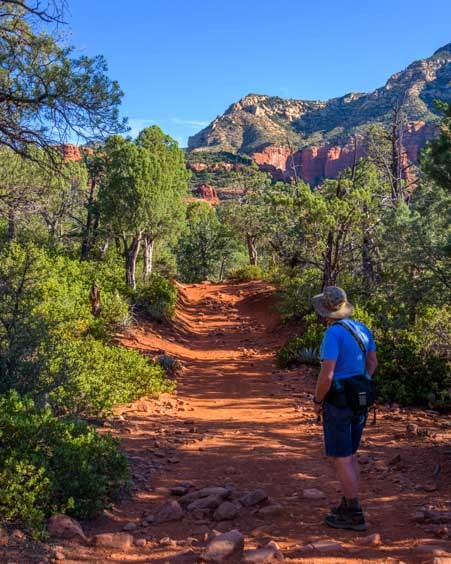
The National Forest surrounding the Sedona area is filled with a fabulous network of trails, and each morning we started at a different trailhead to explore and experience the beauty for a few hours.
Two great hikes in Sedona Arizona: Little Horse to Chicken Point and Templeton Trail around Cathedral Rock.
The Little Horse trailhead lies a few miles south of downtown Sedona and made a wonderful jumping off point to get into the incredible red rock views, but we weren’t sure at first if this trail would look its best as the sun rose.
An early morning hike on Sedona’s Little Horse Trail
The trail wandered east through scrubby woods for a while and the red rock formations ahead of us were backlit as the sun rose, so it seemed we wouldn’t get the spectacular images that Sedona is famous for.
However, the red rock slabs and sand under foot made a great canvas for playing shadow puppets once the sun rose a little way. We looked down off a ledge and saw a cartoon caricature of ourselves!
Who’s that down there?!
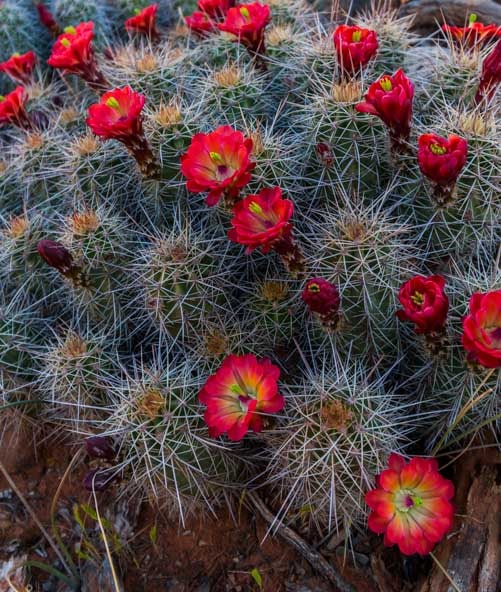
Cactus flowers were blooming everywhere. Most were pink or yellow, but as we turned a corner we found a gorgeous clump of red ones.
.
Above them rose an equally stunning clump of red rock spires!
A beautiful bouquet of red cactus flowers against a regal red rock backdrop
The Little Horse trail goes to the Chicken Point Overllook, and when the trail opened up at this glorious spot it seemed like the views went on forever.
View from Chicken Point Overlook
Chicken Point is the glorious highlight of several trails
Chicken Point Overlook is one of the most popular destinations in the Sedona area, but for 20 minutes we had the whole place entirely to ourselves because it was still very early in the morning. We wandered all around the massive red rock slabs taking photos.
Without a soul in sight we lined up all kinds of interesting images
Suddenly, as I lined up a shot, a pink jeep on the first Pink Jeep Tour of the day on the Broken Arrow Trail appeared out of nowhere. The driver backed the jeep up to a precipice and teased the passengers in the far back seat who were perched right over the edge.
The first Pink Jeep tour of the day rolls into view.
Within minutes two more pink Jeeps were parked nearby and the place was crawling with excited tourists.
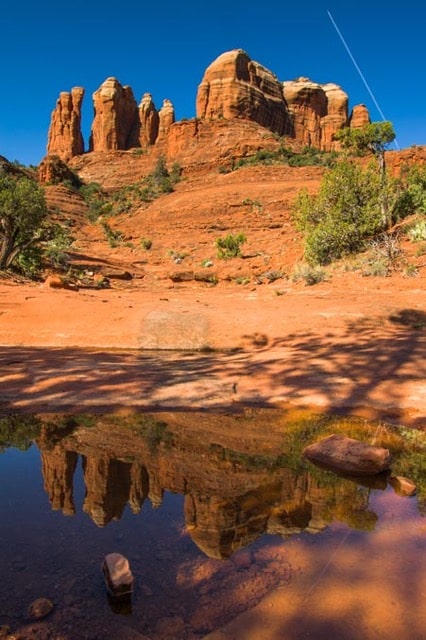
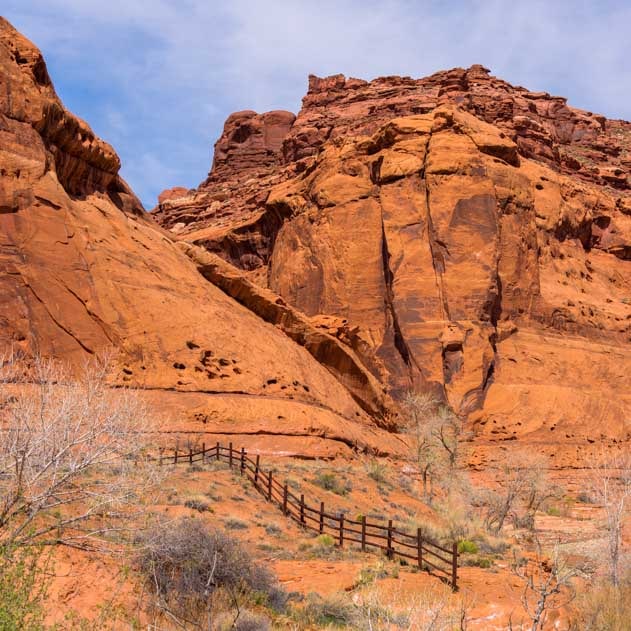
On another morning we set out on the Cathedral Rock trail in the early morning hours. This trail climbs up a series of stair steps from the Cathedral Rock trailhead and delivers you to the base of Cathedral Rock where there is a fabulous view of Nature’s wondrous cathedral and of the surrounding landscapes as well. At this point the trail intersects with the Templeton Trail.
A beautiful day dawns
Again, our early start put us on the trail two hours before anyone else, and when we arrived at the wide “slickrock” slabs in front of Cathedral Rock we had acres and acres of red rock playground to ourselves.
When I saw the sun beginning to light up the spires on Cathedral Rock I frantically hunted around for a beautiful foreground to go with it. I couldn’t find anything handy right away, but then I noticed Buddy sitting right in front of me, perched perfectly still as he watched Mark in the distance. Nice!
Puppy Chow made a lovely foreground when the sun suddenly lit up Cathedral Rock
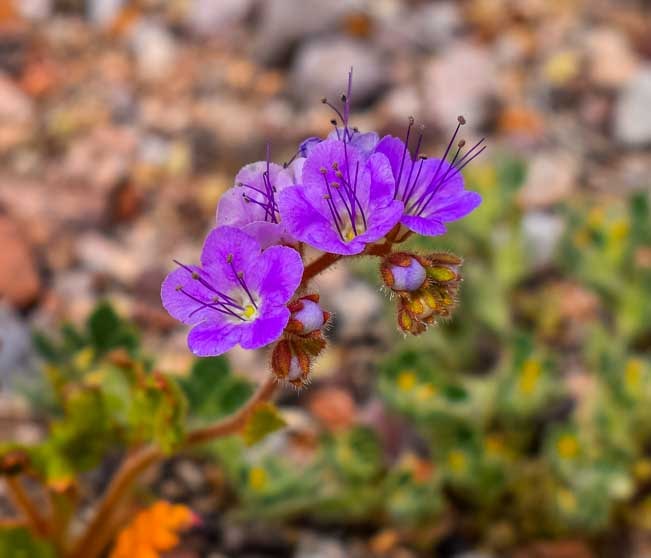
As the sun glowed on Cathedral Rock I continued hunting and finally stumbled on a gorgeous bed of delicate lavender flowers.
.
The air was very chilly, and balloon enthusiasts in the distance were taking advantage of the cool air to fly their balloons. One rose over the landscape. What a wonderful way to enjoy Sedona’s incomparable views by floating just slightly above the land in silence except for the occasional noise of the heater to heat the air in the balloon.
A balloon soars on the morning thermals in the distance
We followed the Templeton Trail to the east around the base of Cathedral Rock. The trail took us into the woods where we had lovely views through the trees.
Morning light on the Templeton Trail
After about a mile and a half we turned around. Now the red rock landscape was bathed in beautiful bright sunshine and the air was delightfully warm.
.
The Templeton Trail goes along a ribbon of flat sandstone at the bottom of Cathedral Rock.
Templeton Trail is a super popular mountain biking trail, and we rode it a few years ago. It is a challenging trail with lots of rocky obstacles, but the slickrock portion that goes around the base of Cathedral Rock is flat and smooth and fun.
We still hadn’t seen a soul on the trail, either hiking or on mountain bikes, even after two hours of hiking. We rounded a bend and Cathedral Rock soared back into view.
Cathedral Rock.
Approaching Nature’s stunning cathedral
What a place to hike!
An evening primrose in the shadow of a tree at Mark’s feet caught his eye, and a lovely blue flower dancing before the red rock cathedral caught mine.
Four white hearts with a pretty yellow center
Flowers bask in the sun in front of the cathedral
The patterns in the red rock slabs were wonderful. In some places the rock was stained with white and in others there were interesting cracks and crevices.
There are very cool patterns on the ground.
When we got back to the intersection of Templeton Trail and Cathedral Rock Trail we finally heard some distant voices. Hikers were coming up the trail from the trailhead parking lot.
When we met up with them they said they were going to head west on Templeton trail where it goes around the other side of Cathedral Rock and down towards Oak Creek. We’ll have to go that way next time!
We loved this hike and will do it again heading the other way!
Wildflowers lined the trail
We roamed around some more and found some wonderful puddles reflecting the beauty of Sedona.
Mirror image in a puddle
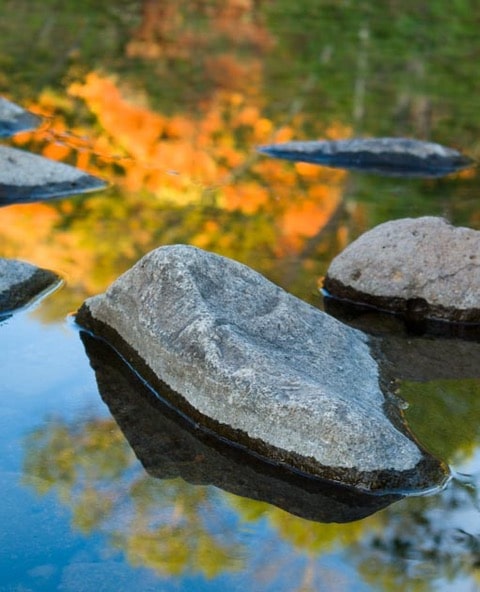
We just love these kinds of reflections
.
Sedona, Arizona, is a nature lover’s paradise! If you haven’t been there, put it on your itinerary. If you have been there, then you know it’s worth many return trips!
More of our Latest Posts are in the MENU.
New to this site?
Visit RVers Start Here to find where we keep all the good stuff. Also check out our COOL NEW GEAR STORE!!*** CLICK HERE *** to see it!
April 2019 – We’ve visited Sedona, Arizona, many times, not only as full-time RVers but also before we started this crazy lifestyle, back when we were living a workaday life and looking for a getaway vacation. The scenery around Sedona is absolutely stunning, and we are always thrilled by the beauty.
.
Sedona is an outdoor lovers paradise, and whether hiking, mountain biking or off-road Jeep/ATV riding is your thing, there are hundreds of breathtaking trails crisscrossing the Coconino National Forest all around town.
Somehow, though, in all our visits to Sedona, we’ve never done many of the “signature” hikes. So on this trip we decided to check out Brins Mesa Trail, a top rated beauty that appears in many Sedona hiking trail lists.
Buddy sniffs the start of the Brins Mesa Trail
Twenty years ago, Sedona was a small town, but today it is not only a huge sprawling community but it plays host to gazillions of tourists all year long. April is one of the most popular months to visit, so we knew that if we wanted to have any kind of solitude on the trail, we’d have to be up at the crack of dawn.
The air was cool when we started, and we were glad we always carry light wind breakers in our truck, because the heat wave that had swept the area lately had left us so hot the night before, it never occurred to us that it might be chilly at 6:00 a.m. when we started hiking. So, we’d arrived in shorts!
What a glorious start. The air was wonderfully crisp and clear — and cool!
Brins Mesa Trail is 3.6 miles long and goes between the Brins Mesa Trailhead at the northwest end and the Jordan Road Trailhead at the southeast end.
There are three trails that originate at Jordan Road Trailhead: Brins Mesa Trail, Cibola Pass Trail and Jim Thompson Trail. Brins Mesa Trail intersects with other trails along its route, so you can hike for miles and miles if you like.
Our plan was to hike out a ways from the Jordan Road Trailhead and then turn around and hike back. We hadn’t thought much about where the turnaround point would be and we hadn’t read about the trail, so we had no idea what to expect.
We hit the trail at 6:05 a.m.
Ours was the first vehicle in the parking lot, and we had Brins Mesa Trail to ourselves. To our surprise, a runner passed us almost as soon as we started, but he quickly vanished ahead of us, and the only sounds we heard after that were chirping birds.
Buddy was in heaven and he ran in happy circles around us.
Buddy waits for us partway up a series of red rock stairs
The sun began to light the sky behind the craggy red cliffs on our right, and we climbed up a series of natural red rock stairs. The scenery was lovely.
Buddy checks in with Mark about the route.
This way.
At our feet we noticed little bouquets of flowers perched here and there as if Mother Nature had set out vases along the trail.
Wildflowers were blooming in delightful little bouquets along the trail.
Mother Nature had taken some time to get her flower arranging just right.
A thorny cactus had a single flower on the end of one branch.
A single cactus flower.
The trail opened up on the left side to a fabulous red rock mound that begged to be explored. We wandered around for quite some time, admiring the wide flat swoopy rocks that looked a little like dough overflowing a pan, and we poked our noses into the woods here and there too.
Suddenly, we realized we’d lost track of the trail. We conferred with each other and with Buddy about where we were and where the trail had disappeared to.
Buddy is a good listener, but when it comes to route finding, he’s top notch and we find it’s best if we do the listening!
Buddy listens well, but we listen to him too!
Buddy explains to Mark which way the route goes.
“Hey you guys, it’s this way”
As we backtracked to the main trail, the sun crested the distant peaks and swept across the rocks all around us, transforming them from cool shade to warm sun in an instant. Mark caught a starburst through a hole in the branch of a dead tree.
A ray of golden sun.
Sunshine warmed the trail ahead of us and lit the distant peaks.
Sunshine warms Brins Mesa Trail
We decided we’d gone far enough, even though it was just 1.2 miles or so, and we started back down to the trailhead. We knew there were some great 360 degree views somewhere, but the day was heating up and we weren’t sure how much further we had to go to see them.
.
As we hiked back, we met five or six couples coming up the trail from the trailhead, and we discovered from one couple who does this hike often that if we’d gone just another quarter mile we would have seen the fabulous views. Oh well — next time (and maybe we’ll do it in the afternoon when the cliffs to the east aren’t backlit)!
When we got back to the parking lot it was around 8:00 a.m. there were only two or three parking spaces left. We were glad we’d gone early. What a lovely morning walk that was!
.
This visit to Sedona was also the first time we’d had our off-road buggy to take us on motor vehicle-friendly trails to remote spots.
The sun sets in splendor after a fun day of RZR riding.
We took the RZR on a joy ride through some rather boring flat countryside and rode it to the end of a road where a sign stopped us: “No motorized vehicles beyond this point.” We noticed the trail continued, though, so we hopped out and hiked a little further on a woodsy trail.
As we turned a corner, we suddenly heard the trickle of water ahead of us, and then we found ourselves in the middle of a little desert oasis!
Buddy admires the colorful reflections in a surprise little watering hole.
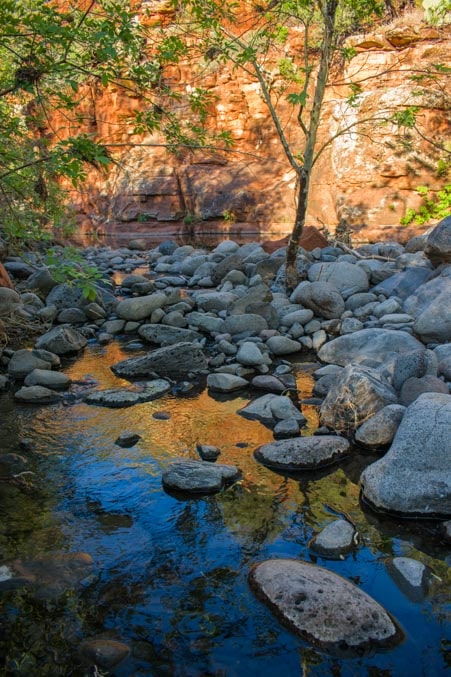
Glassy water reflects the red rocks.
We arrived at the golden hour in the late afternoon when the red rock cliffs, blue sky and green trees were reflecting in the mirror-like water. Our jaws dropped. What a fabulous surprise!
We were astonished by this fun little discovery.
.
.
Sedona has quite a few creeks and springs, and there are beautiful hikes to reach them. We loved hiking the West Fork Trail and doing The Crack at Wet Beaver Creek hike. Both hikes led to gorgeous oases in the red rock desert.
.
.
The afternoon was downright summery with a high temp in the high 80s, and that water in front of us was just too tempting not to jump in! Mark took off his shirt and tip-toed in. “Brrrr!” He shouted as he splashed his hands in the water. “It’s COLD!”
But it didn’t take long for his legs to numb up so he could go in the rest of the way!
“Come on in, the water’s fine!”
.
I finally put down my camera and joined him!
Buddy waded along the edges of the water, got a big drink, and then leapt back on the rocky shore to chase lizards.
The heat wave in the Sedona area brought fabulous stormy skies each afternoon with Arizona-monsoon-like clouds. The sunsets were just divine.
A classic Arizona sunset over a lonely stretch of road.
We had planned to stick around the area for two weeks or so, but the heat was getting intense and the winds began to pick, making the dust fly. So, our planned list of things to do in Sedona will probably have to be shelved until our next visit!
More of our Latest Posts are in the MENU.
New to this site?
Visit RVers Start Here to find where we keep all the good stuff. Also check out our COOL NEW GEAR STORE!!*** CLICK HERE *** to see it!
April 2019 – The travel stories on this blog often present the fantastic new discoveries we’ve made in our travels, but sometimes our life on the road progresses uneventfully. And so it has these past weeks.
Revisiting and staying in a place we know know and love, we’ve found that each day has slipped into the next without fanfare or breathtaking thrills. Life has been moving at a sweet and gentle pace!
Sunset in eastern Arizona.
Camping under the stars.
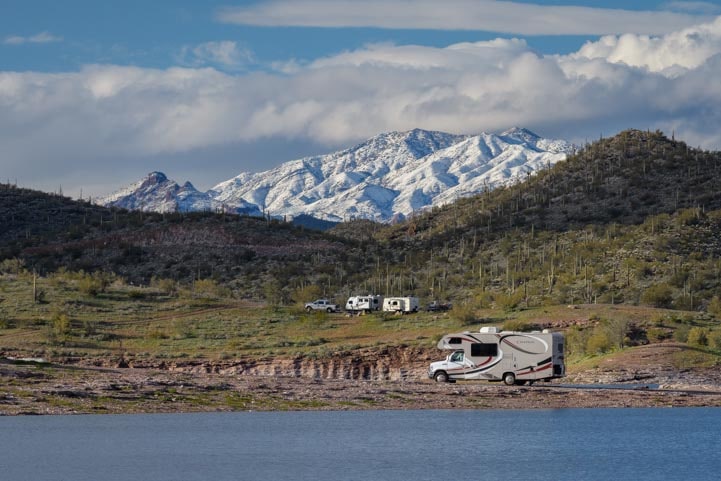
After exploring a little bit of eastern Arizona, we made our way to Roosevelt Lake where Spring was in full bloom.
Roosevelt Lake
The water level in the lake had been at 49% when we’d visited in January, and was shockingly low. Many former coves and bays had been filled with trees.
Now the lake had swollen to 84% of full volume and showed few signs of slowing down. Lots of hiking trails and dirt roads we’d explored in January were now under 20′ of water!
Swollen banks and submerged trees!
Roosevelt Lake is the first lake in the chain of dammed lakes in the Salt River as it flows downstream, so this fast rise in the lake’s water level was due to rain and snow-melt upstream rather than the simple opening of floodgates in a dam. How wonderful to see the desert get such a nice big drink from Mother Nature!
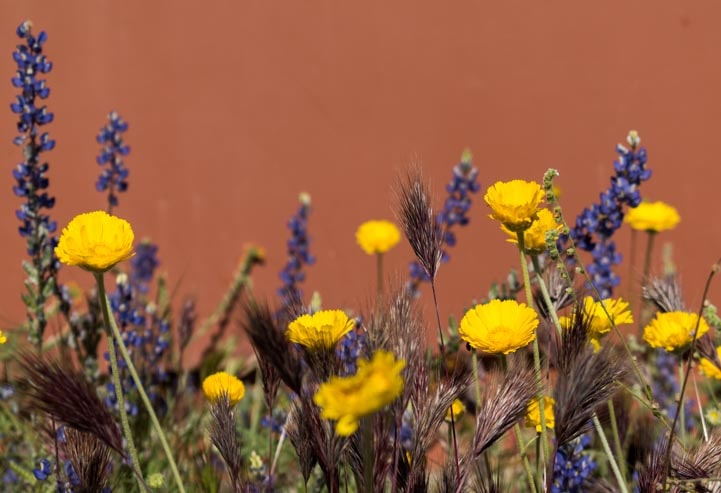
Yellow flowers dance above the shores of Roosevelt Lake
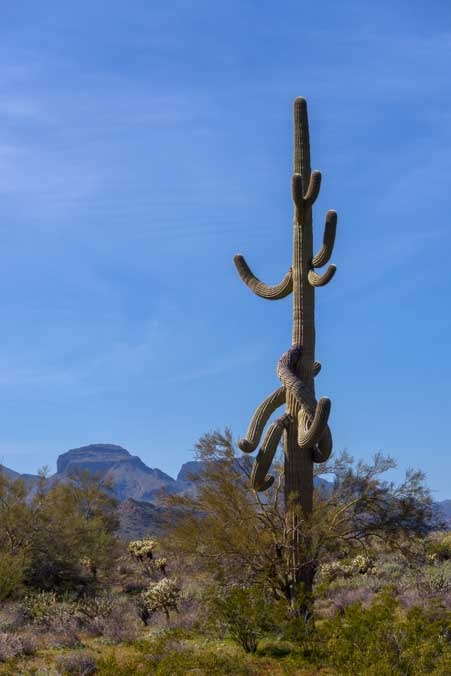
Yellow, pink and purple wildflowers were in bloom in every nook and cranny of the desert. They craned their faces towards the sun. Some of the cactus varieties had begun to bloom too. Their flowers were big and vibrant, bursting out of the nasty thorny cactus arms in a gorgeous display. It was as if Nature were saying through these blossoms, “Never judge a book by its cover!”
The prickliest cactus bear the most beautiful flowers.
For the 50 weeks a year that these flowers aren’t blooming you’d never guess what those other 2 weeks are like!
We took our new little RZR out on the roads through the desert to see if we could find more flowers. It wasn’t hard!
.
Every now and then we’d get a whiff of a flowery fragrance wafting through the air. Buddy rode with his nose twitching eagerly.
Buddy sniffs the air as we drive in the RZR.
For some reason some of the best wildflower displays seem to be along the edges of big paved roads and surrounding parking lots. We found some glorious bunches of flowers in and around Tonto National Monument.
The wildflowers were most plentiful along the paved highways!
And around Tonto National Monument too!
A few years ago we’d visited the Boyce Thompson Arboretum which specializes in Sonoran Desert plants, but the flowers blooming in the parking lot had soaked up all our energy and after two hours of roaming around the parking lot and filling our cameras with photos we’d had almost no energy left to see whatever was on display inside the Arboretum!
So it was here. Tonto National Monument has a delightful picnic area that is rarely used, but the wildflowers around the artfully situated picnic ramadas are lovely!
.
.
We couldn’t get over the rise in the lake’s water level, and we wandered down to the water’s edge many times to monitor its progress as it rose each day. Sunny hot days soon gave way to blustery cold days. The waves took on a menacing look and the patterns in the sky were beautiful as the dark clouds raced across the heavens.
Wind whipped the waves on the shore.
An unusual curvy cloud and tree trunk.
Storm clouds by the shore.
Every single boat ramp around the lake was open, something we haven’t seen in years, and along with that, many campground loops near the boat ramps that had been closed for a long time were now open as well.
The flip side of that, though, was that one of the lowest lying boat ramps — the one that never has to close, even when the lake level drops super low — was almost completely submerged.
Not only did you have to walk uphill onto the floating dock, the entire boat ramp was under water (left), all the way up to the tippy top!
Mark drove the RZR through the water at the top of the boat ramp and had fun making waves.
Mark had fun splashing in the water at the top of the boat ramp.
Weeee!
As Easter Weekend approached, more and more people came out to enjoy the lake. Hundreds of boats filled the parking lots and fishermen were eagerly casting.
The anglers were out in droves, both on shore and in fishing boats.
Buddy’s favorite part of these peaceful days was lizard hunting. His preferred method of going after these lightning fast creatures is to leap in the air and pounce. We spent many happy hours watching him and trying to catch him in the act on our cameras. But it’s not so easy!
Leaping for lizards!
.
While he chased the lizards and occasional jack rabbits we savored the brilliant colors of spring.
.
.
.
.
.
One evening the sky gave us an especially dramatic sunset. Above the horizon a huge cloud swirled and rolled over and around itself like a ball of pink cotton candy in the sky.
Cotton candy!
Sunset across the lake brought some lovely reflections.
.
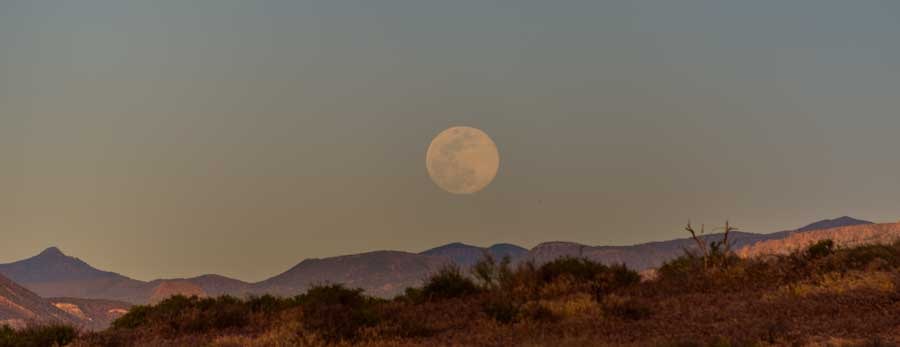
And a full moon rose over the desert.
Full moon rising
Sometimes the best times in our travels are the quiet languid days when we slow down and bask in a beloved place once again!
More of our Latest Posts are in the MENU.
New to this site?
Visit RVers Start Here to find where we keep all the good stuff. Also check out our COOL NEW GEAR STORE!!*** CLICK HERE *** to see it!
Exploring Arizona’s Black Hills Back Country Byway.
The most extraordinary display of wildflowers covered the hillsides at the base of the Salt River Canyon, and we can’t recommend highly enough making a trek there to see the flowing blankets of yellow poppies and purple lupine that ripple between the towering canyon walls at the peak of spring.
Unfortunately, now that we drive The Train, we weren’t able to stop and savor the views. The pullouts are plenty big enough for a rig like ours if it’s the only thing parked there, but each one was filled with cars and happily gawking tourists who were gazing at the wonder.
Next time!
Buddy romps in a blanket of wildflowers.
But once we set up camp, our RZR got us out into the desert and we saw some beautiful wildflowers.
Spring flowers! (Sneeze!)
One day we decided to take the RZR on the Black Hills Back Country Byway, a dirt road that was first built by settlers in the 1800s as a route connecting the flat farmlands around Safford with the mining communities in the hills around Morenci.
There are picnic areas and plaques explaining the local history along the Black Hills Back Country Byway. After Buddy was done reading the plaque, he rested in the cool shade below it.
This dirt road is about 21 miles long and it winds up into the junipers and back down into the desert on its journey.
Black Hills Back Country Byway
Arizona’s Black Hills Back Country Byway
The views were very nice, but what caught our attention were the many different kinds of wildflowers tucked into nooks and crannies here and there.
Delicate and sweet.
Before and After (if you can believe it!).
.
.
These things are huge and were in bloom all over the place.
From tiny purple flowers wriggling in the breeze to pretty yellow poppies dancing in the sunlight, we saw all kinds of flowers brightening this otherwise relatively drab landscape.
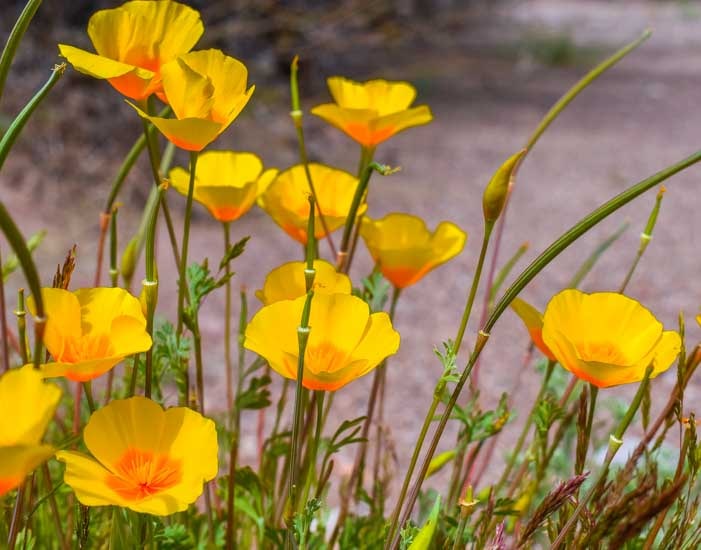
Yellow desert poppies.
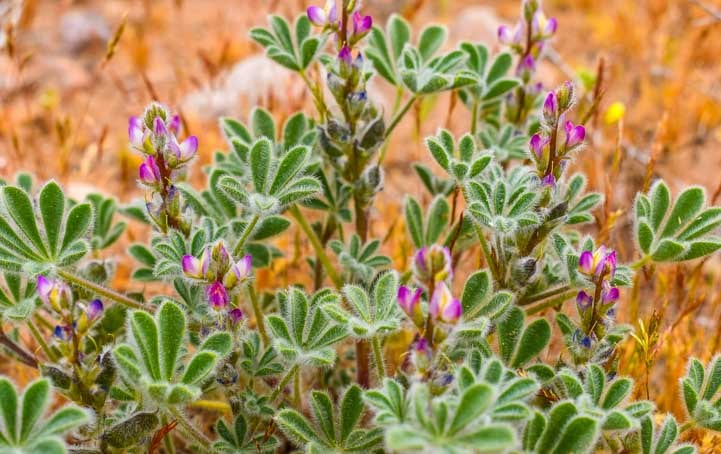
Fuzzy leaves and pretty blossoms.
So cheery!
Little pink stars.
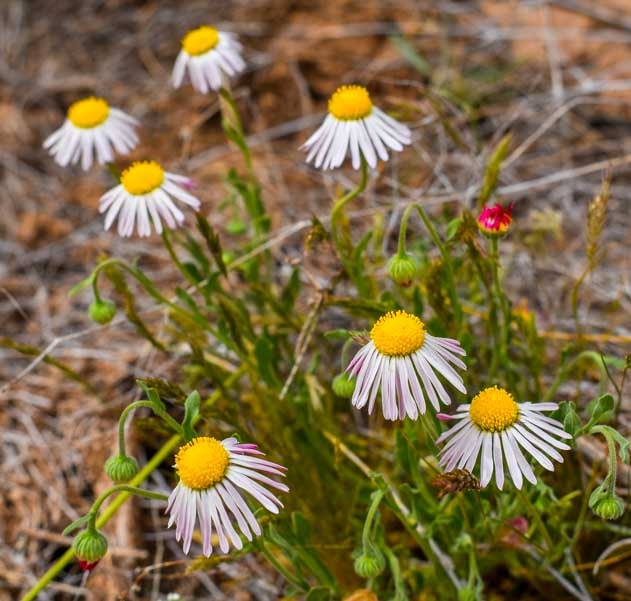
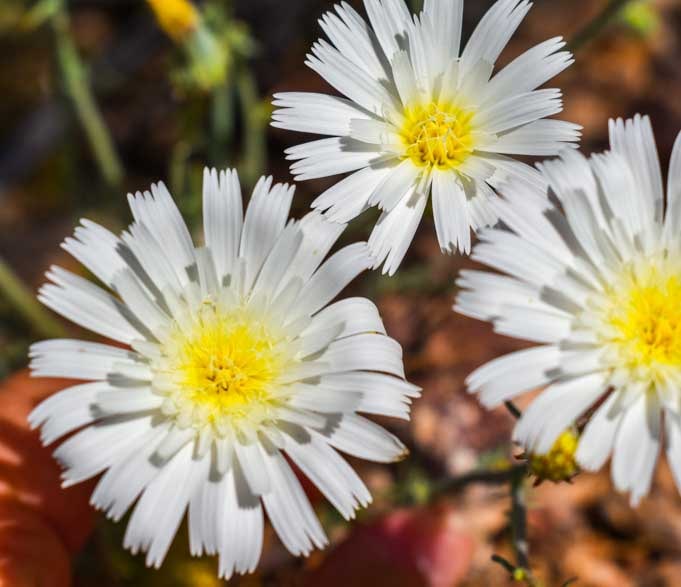
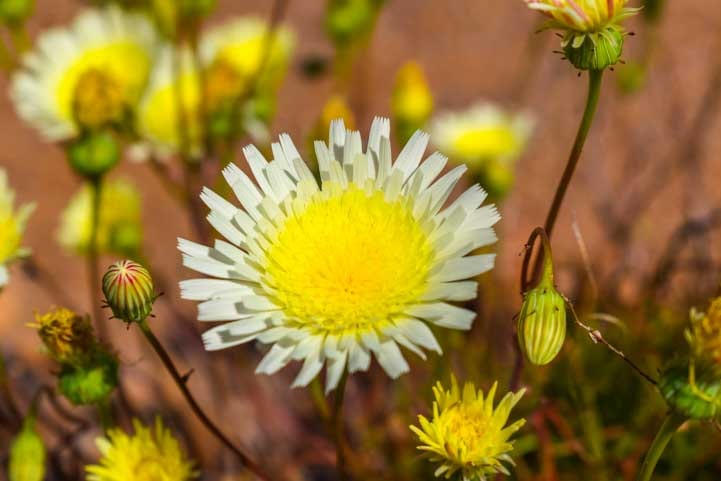
Desert daisies.
Surely in the dandelion family!
The fun thing about doing this drive with the RZR is it was easy to hop in and out of it every few miles to poke around and take pics. It was a balmy Thursday, and in our three hours on the road (we go slowly!) we saw only one other vehicle, a motorcycle.
.
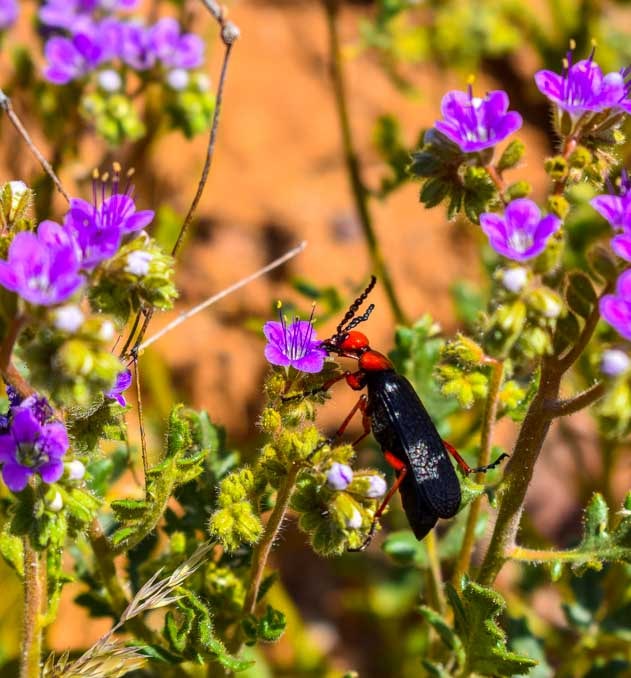
Buddy sniffed the flowers now and then, but he was more interested in the little critters that make this area home. We had seen two red-headed bugs with antennae flying while linked together. It was spring, and they were doing what the birds and the bees tend to do in springtime!
Then I noticed a patch of purple flowers that was loaded with these red headed bugs!
A bush full of purple flowers was also full of red-headed bugs!
Buddy has discovered the joys of lizard hunting, and he chased quite a few on our excursion. He loves the chase, and on rare occasions he actually catches up to one too. They’re clever though, and they play dead to make him stop chasing!
A lizard plays dead at Buddy’s feet.
Buddy found this guy who was actually already quite dead and stiff!
There are several picnic areas along this route with views that look out into the hills. These rest areas have picnic tables and ramadas covered with copper roofs and lots of information about the history of the area.
Black Hills Back Country Byway at the Phelps Dodge Copper Mine Overlook
One of the most amazing views is of the Phelps Dodge copper mine in Clifton-Morenci. This is one of the largest copper mines in the world and has been extracting copper from the hills for almost 150 years.
The Phelps Dodge copper mine in Morenci Arizona has been extracting copper since 1872.
Arizona schoolkids learn that Arizona is known for the five C’s – Cattle, Copper, Cotton, Climate and Citrus. We saw two of the C’s together while driving the Black Hills Back Country Byway!
Two of Arizona’s “Five C’s” in one photo – Cattle and Copper!
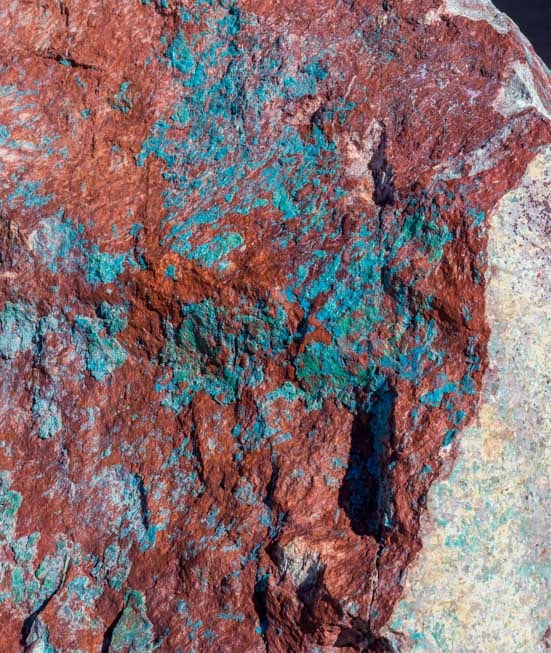
At the mine overlook there were several big boulders with copper embedded in them along with detailed descriptions of how the copper is extracted.
Copper waiting to be extracted. It looks a little like lichen!
It was fun at another point on this drive to see tall red penstemon flowers against the backdrop of a boulder filled with lichen.
Pensetemon flowers with a lichen covered boulder in the background.
Another thing Arizona is known for is sunsets. The word doesn’t start with a C, but reliably dramatic sunsets definitely make Arizona a very a special place!
The sunsets in Arizona are hard to beat!
Lakeside sunset overlooking Four Peaks.
Flower Power!
As we’ve continued experimenting with triple towing, we’ve learned a few more things in recent weeks. One of the attractions of a toy hauler is the very cool back patio deck most have, and I’ve been drawn to several units that had side patios too.
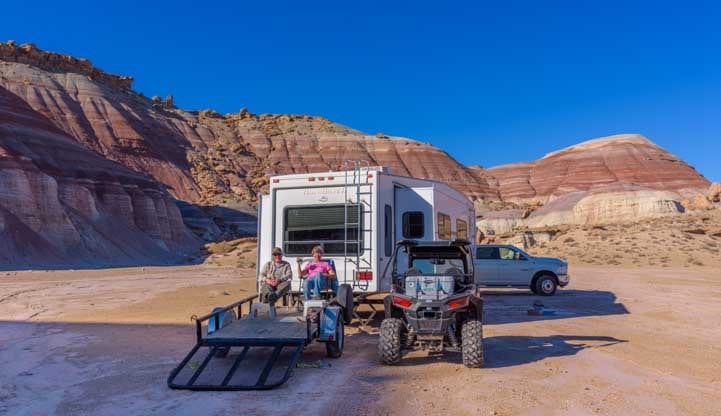
Well, one afternoon I looked at our utility trailer and realized it would make a wonderful little raised patio!
If the rig is positioned right, the whole rear wall of the trailer can shade the patio, and by being up off the ground you don’t get that bitter cold breeze from under the trailer that you do when you hang out on camp chairs at ground level.
The utility trailer makes a nifty raised patio!
A nice spot to share a sundowner… at the risk of someone saying: “You know you’re a redneck when your back patio is a trailer!”
Another thing we’ve learned is that when you make a super tight turn, depending on the design of the utility trailer, it may be possible for a front corner of the utility trailer to make contact with the back of the fifth wheel trailer.
So, if you are getting set up to triple tow, you might consider taking your rig to a huge and vacant parking lot to try a few slow sharp u-turns to see just how tightly your rig can turn before contact is made between the two trailers.
Sunset in Arizona
Arizona is a beautiful state and we’re looking forward to watching Springtime continue to unfold here.
More of our Latest Posts are in the MENU.
New to this site?
Visit RVers Start Here to find where we keep all the good stuff. Also check out our COOL NEW GEAR STORE!!*** CLICK HERE *** to see it!
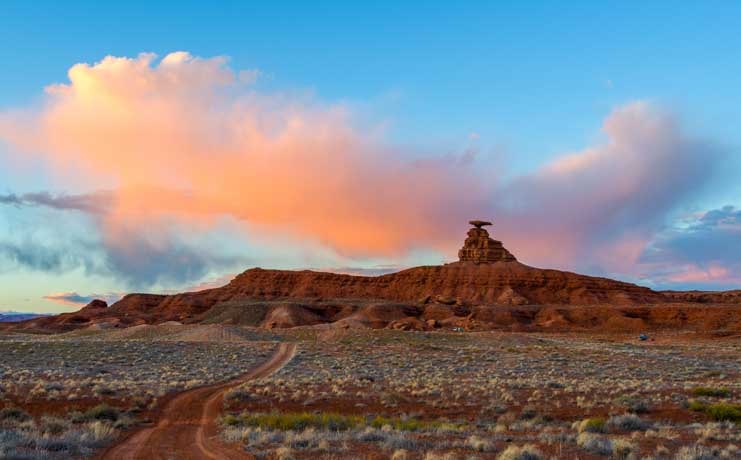
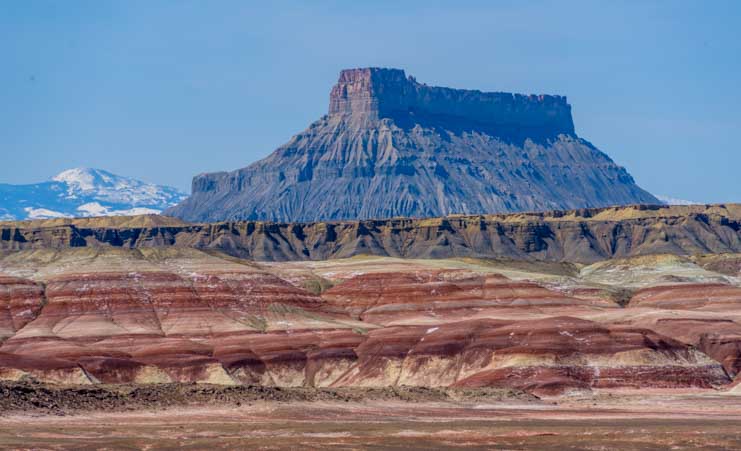
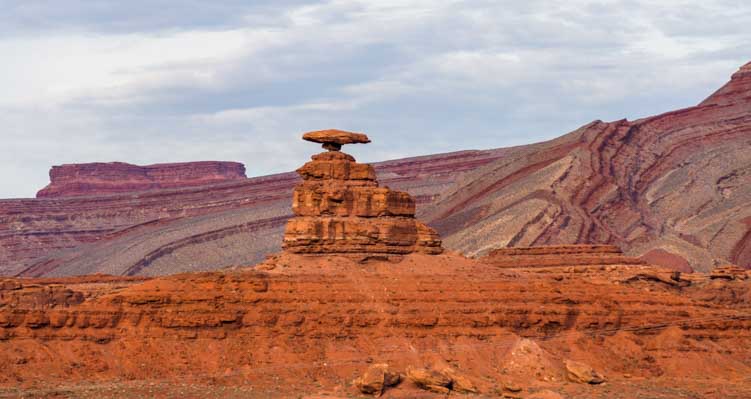
March 2019 – The Utah red rocks are full of whimsical formations that are easily recognizable. One of the most charming is Mexican Hat, a rock formation that unmistakeably resembles a sombrero.
A Mexican sombrero caps off the landscape in Utah.
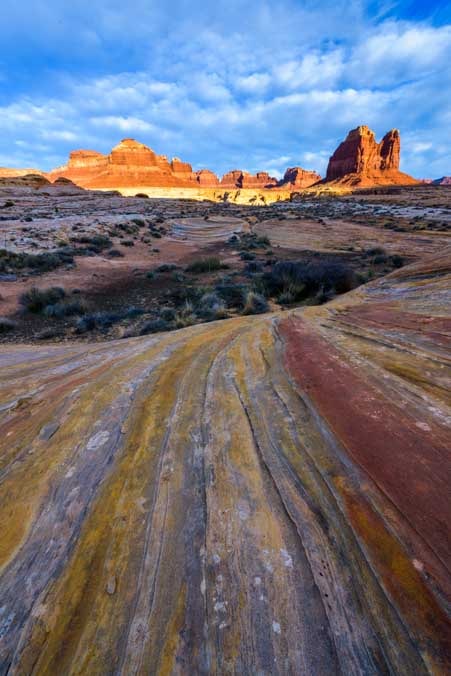
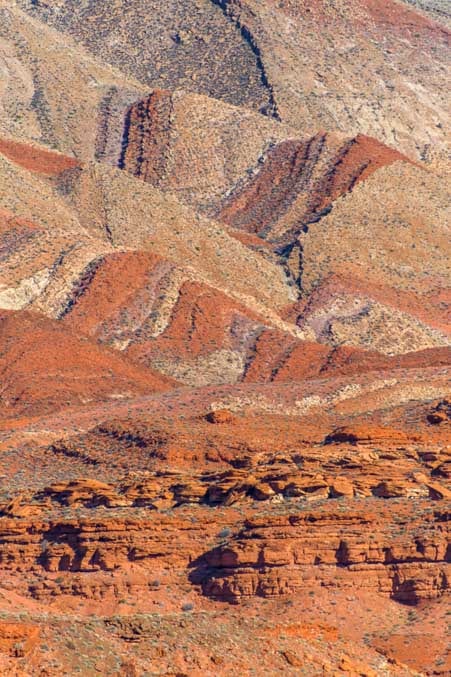
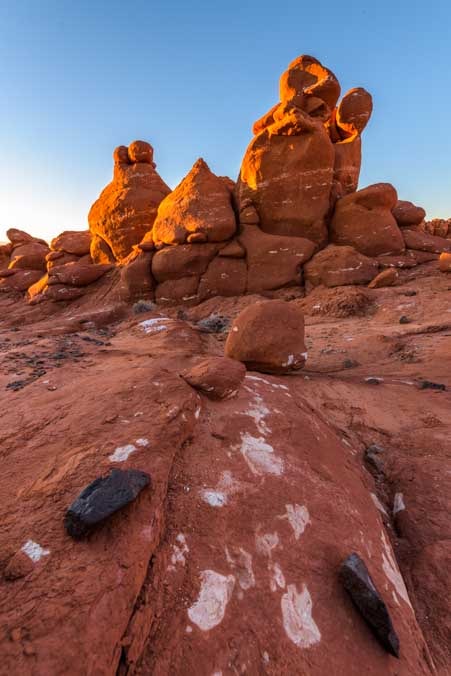
We were traveling through southeastern Utah with our RV, and before we arrived at this fantastic stone hat we found some wonderful patterns in the red rocks. We spent a little time doing some wide angle photography, playing with the colorful lines in the sandstone.
.
As the golden hour unfolded before sunset, I was astonished to look down at my feet and see a rainbow of colors!
So much color right at my feet!
The red, yellow, orange and gray stripes were beautiful, and we explored these unusual patterns at dusk and again at dawn.
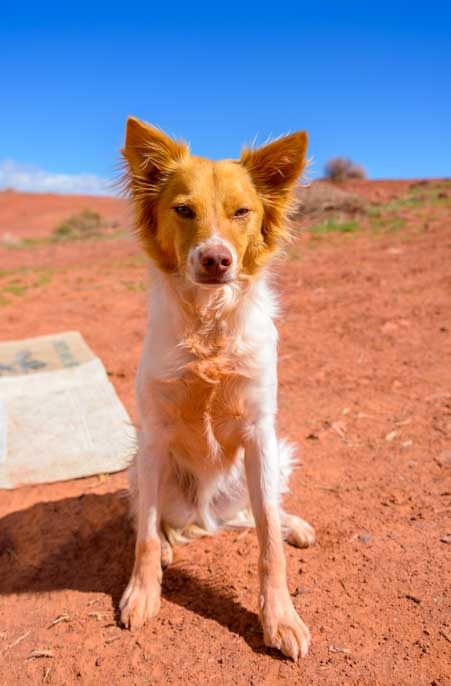
Buddy watched the sunrise with us.
In some cases we focused our photos on the tiny patterns at our feet, but the size and scale of these immense rock landscapes was mind boggling.
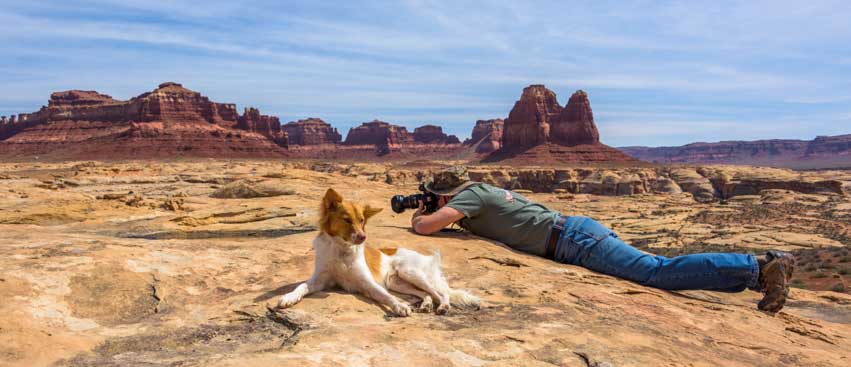
Huge landscapes dwarf Mark and Buddy on a rock outcropping.
In many places the sandstone was solid underfoot, but in other places it gave way to patches of red beach sand and small dunes.
Ancient sand dunes turned to stone — lines and patterns everywhere.
Buddy loved lying in the hot sand in the heat of the day and rubbing himself in its toasty warmth.
He also got a kick out of chasing the lizards and birds that live in this exotic land. Of course, the bigger birds just stood their ground when they saw the excited puppy coming.
One crow began to tease him, flying just out of reach and squawking. Buddy took the bait and tore after the crow, running and jumping as the bird swerved and dipped his wings near him.
Suddenly Buddy took a big leap, eyes focused intently on the crow. He misjudged the uneven ground beneath him, lost his footing, and crashed into the sand chest first in a cloud of red dust.
When he stood up and shook himself off he was wearing a pink bib and gloves!
Buddy sports a peach bib and gloves after taking a flying leap after a bird and crash landing in the sand.
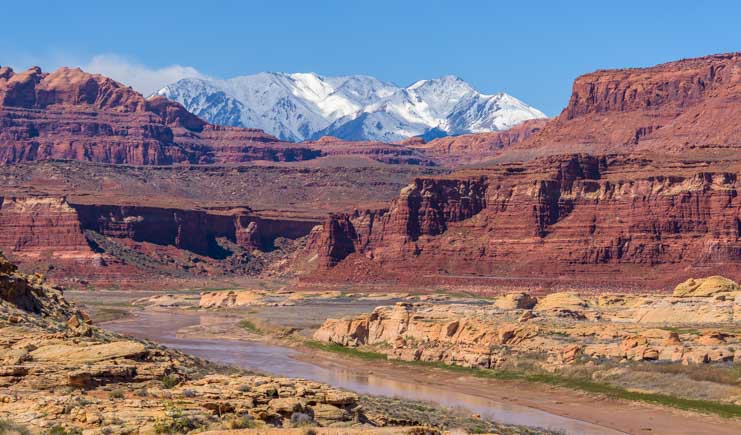
Rivers and waterways are responsible for the fantastic landscapes in this area, and when we drove over a bridge crossing the Colorado River we loved the contrast of the crimson cliffs and snowy mountains in the background.
Snowy mountains and red rock cliffs.
The landscapes were filled with color and vibrance.
Vivid colors at the golden hour.
We crossed the San Juan River at the town of Mexican Hat. After driving over a hundred miles through vast empty landscapes, this village perched above the river was a fun surprise, and we got out to explore a bit.
The village of Mexican Hat is perched along one side of the river.
Someone had put a three-legged chair in a spot with a great view of the village on the opposite bank. You never know what you’ll find out here!
Have a seat — but don’t fall over!
We continued on and the skies clouded over. Storms brewed in the distance while the sun lit portions of the land here and there. What a magical place.
Storm clouds and rain drift across the red rock landscape.
The rain never made it to us, but what a wonderfully brooding sky this was!
The village of Mexican Hat is named for the fun rock formation that looks like a Mexican sombrero. It was easy to spot and made us smile. What a perfect name for this formation and the village nearby!
Mexican Hat is impossible to miss!
Buddy decided to try it out and see how it fit.
Buddy tries the hat on for size.
Catching it from different angles and zooming in, the hat really dose look like a sombrero.
It’s a true sombrero from this angle!
Just how big is this rock formation? Enormous! There were some hikers standing at its base…
It doesn’t look that big until you notice the hikers!
As the afternoon wore on, the hat cast its shadow across the valley below.
In the late afternoon Mexican Hat cast a shadow across the valley.
And as the sun set it became a silhouette against the sky.
.
And then it grew wings.
With colorful flying clouds!
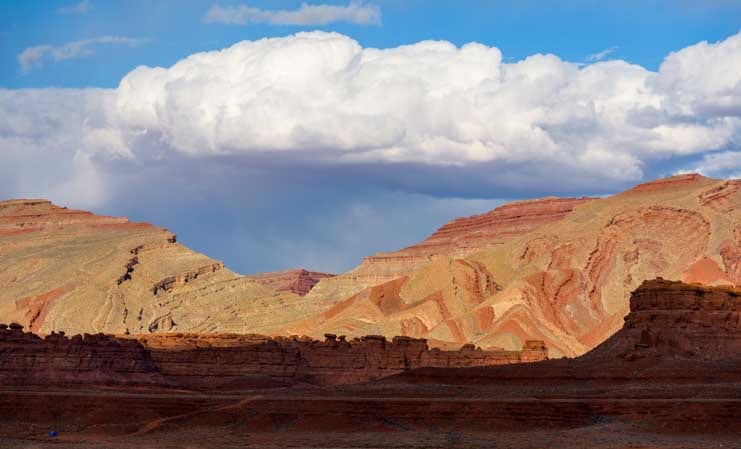
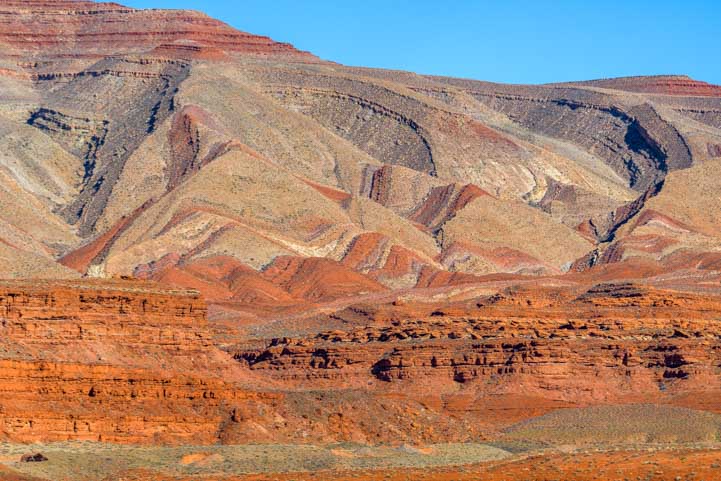
Continuing on, we saw incredible wavy patterns in the red rocks.
We noticed vivid patterns in the distant hills.
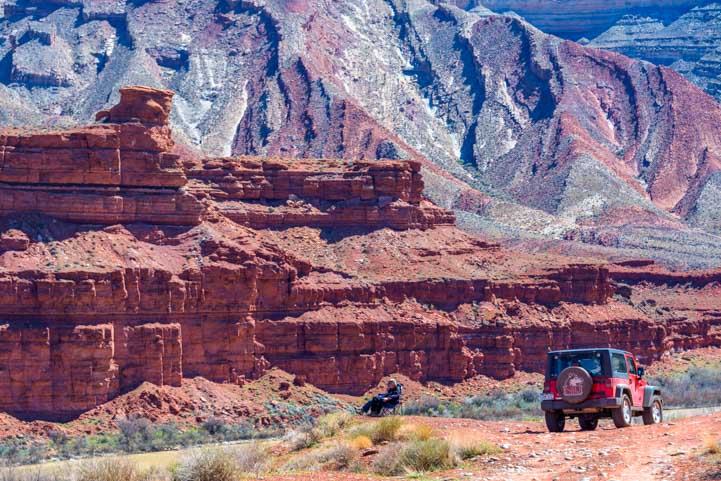
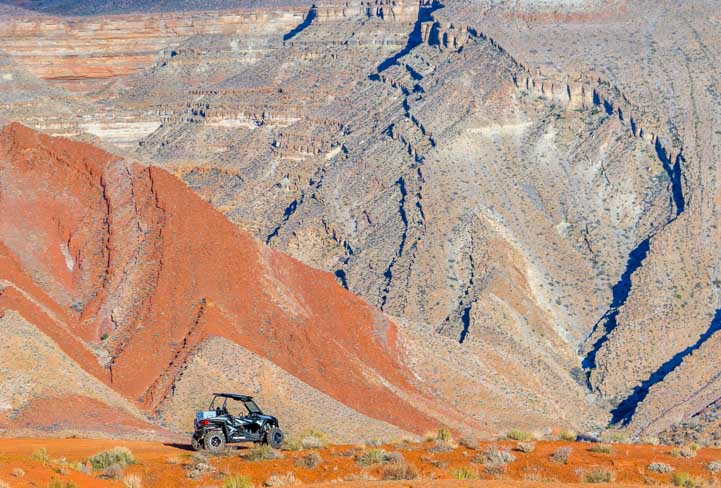
We hopped in the RZR to drive into the landscape a little further. We rounded a bend and found a couple taking a break from their Jeep ride to enjoy a quiet moment in their camp chairs with a fabulous view.
We followed a jeep road into the landscape.
A couple relaxes in their camp chairs in the middle of their Jeep ride!
These landscapes just begged us to head off into the red rocks to take photos.
Mark heads out to take some pics.
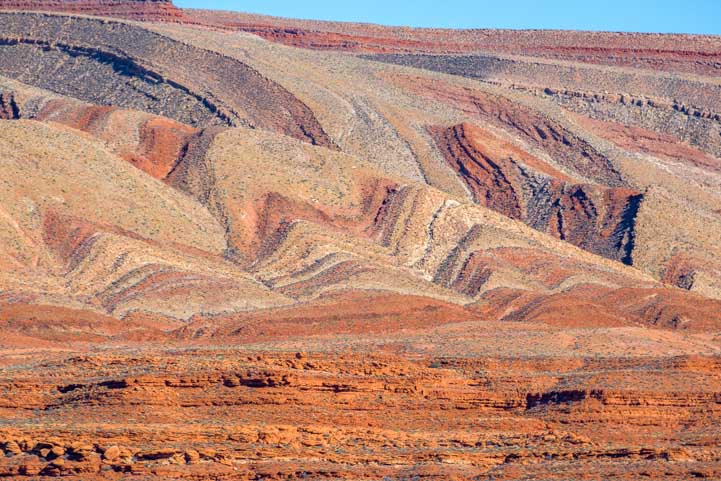
We were drawn to the swirling patterns on the hillsides and couldn’t stop our cameras from clicking away.
Triangular patterns swirled across the base of the mountains.
Red rock waves.
An undulating landscape.
Just how big are these wavy patterns? I had wandered around on foot exploring and then I looked up and noticed our RZR leaning up against this jaw-dropping landscape. Wow!
How big are those patterns? Pretty big!
With that in mind, here are a few more images taken as clouds rolled in overhead.
Approaching clouds played with the light.
.
We wanted to stay longer, but it was still quite cold in this part of Utah. Our fingers and toes were tired of being numb! We had been in long pants and jackets for too long and we were ready to get back to central Arizona where the temps were hovering in the high 70s. Ahhhh….!
More of our Latest Posts are in the MENU.
New to this site?
Visit RVers Start Here to find where we keep all the good stuff. Also check out our COOL NEW GEAR STORE!!*** CLICK HERE *** to see it!
March 2019 – Over the years we’ve been asked how we plan our travels, and we’ve usually said that we move on or stay put on a whim. But it might be more accurate to say that we generally follow the weather, staying put when it’s nice and moving on when ugly conditions are expected.
This has made for some hasty departures with rain, sleet or snow looming, but until this past week we have never been stuck right where we were because of deep mud!
Hitting the road is easier when you don’t have to drive through a foot of mud
The Utah desert is filled with sandstone, sand and silty stuff, and when it is dry it hardens to something like concrete with a soft layer of dust around the edges. But when it rains for 48 hours, as it did while we were camping, the water soaks into the silty sand and makes a very squishy mud.
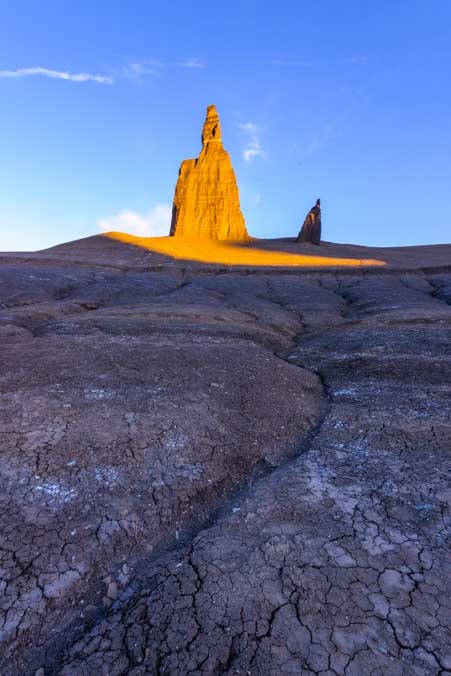
An immense tower rises out of Utah’s red rocks courtesy of rain, wind and sometimes drippy muddy conditions
As we drove to and from our campsite every other day or so, our truck swam through portions of the road, even in 4×4 low gear at 5 mph. There was no way we could tow our 14k lb. trailer out of there.
So, we stayed put and we waited for the mud to dry!
While we were waiting for the mud to dry we practice the near-far composition techniques we’d learned in our photography workshop the week before.
We kept busy practicing the wide angle photo techniques we had just learned. The key to putting some real zing into this kind of photography is having a fabulous sky and a fabulous foreground right at your feet. Finding those things is no small trick, though, even in this wonderfully scenic part of Utah.
The near-far wide angle view is a new way of seeing for us, but we’re starting to get the hang of it!
We spent hours scouring the area looking for engaging backdrops in the distance and fascinating foregrounds at our feet while hoping we’d get a jaw-dropping sunrise or sunset to top it off.
The sky didn’t cooperate, but we did find some lovely places and really enjoyed the search.
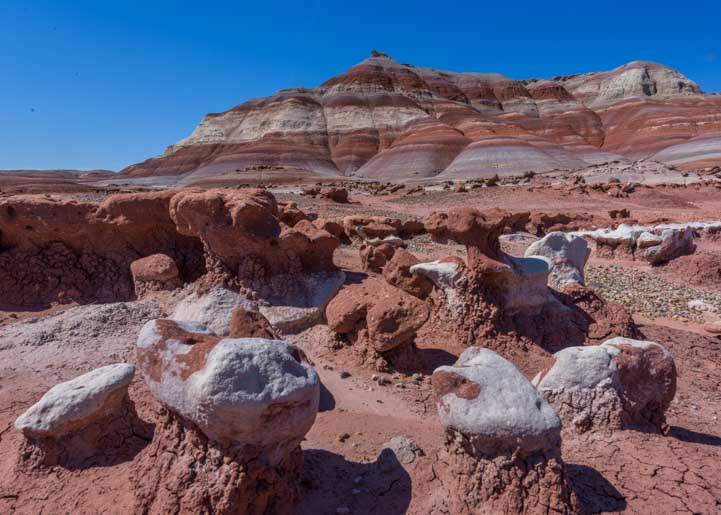
Low toadstool hoodoos and softly rounded mountains
Of course, what’s funny about doing this kind of photography with our pooch Buddy along is that he has a habit of photo-bombing our shots. We’d get everything set up just so, and then Buddy would suddenly wander right through the middle of the photo, sniffing around and curious about what we were up to.
Buddy stops by right in the middle of things to say hello!
While I was crawling around on my hands and knees to try and capture these ground level images, Mark hiked up onto the colorfully striped mounds in the distance and took some stunning pics of the softly rounded shapes from eye level.
Up close, the softly rounded mounds were very beautiful
The hills were a wide variety of earth tone colors
Natural patterns
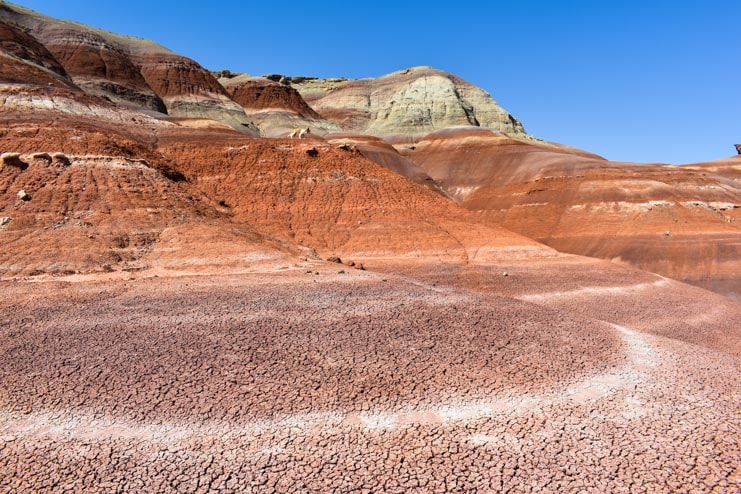
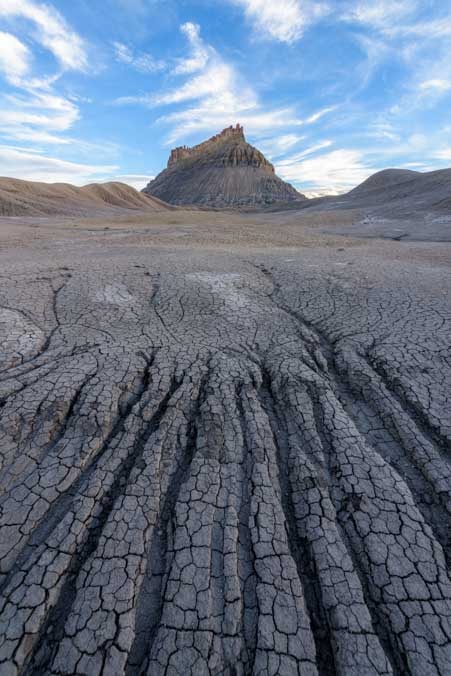
Slowly, the mud slowly began to dry everywhere, and it made pretty patterns of cracks as it shrank. Mark noticed the pattern of a tree in one set of cracks.
The image of a tree appeared in the cracking mud
With the mud quickly drying, we realized our escape from our campsite had to be timed so that the mud on the road was sufficiently dry but the predicted strong winds hadn’t yet begun whipping dust around. Everyday we surveyed the mud and it seemed like our leave-taking was still a few days away.
But Mother Nature has her own sense of timing and her own schedule.
One day, just as we were returning from a walk down the road and agreeing that we should give it another day or two, the predicted winds suddenly arrived and kicked up some huge clouds of dust.
Yikes!
Buddy squints his eyes as he makes his way through a swirling dust cloud. Wild dust storms are the desert West’s answer to the hot and muggy stickiness of mid-summer in the East!
When the desert becomes enveloped in dust storms you can get white-out conditions, and that thin layer of silt finds its way onto everything in the camper, even with the doors and windows closed. Just one swirl as you open the door and dash inside can be enough to coat the counters and table with grit.
It was time to leave!
Within an hour we were swimming down the muddy section of the road, but we had just enough traction to make it out.
Once the tires hit the pavement we heaved a huge sigh of relief!
We headed south on US-95 which is also known as the Bicentennial Highway because it was completed in 1976. It is one of Utah’s most spectacular scenic drives with occasional pull-outs where you can stop to take a photo or rest a bit. After driving for a while we pulled over to stretch our legs.
The beautiful scenery on the Bicentennial Highway was a welcome sight after our great escape!
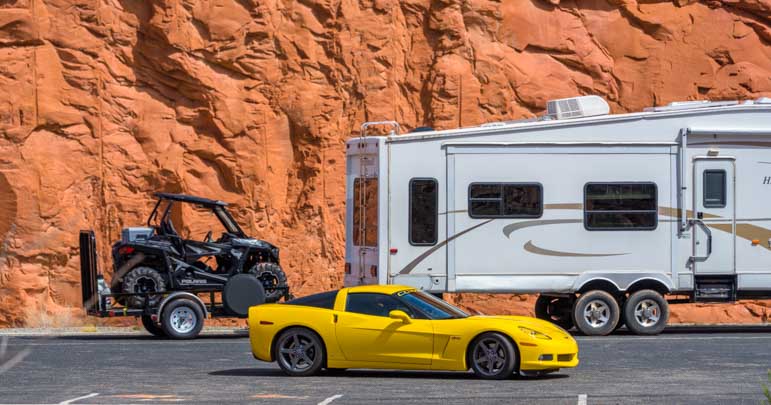
A gorgeous yellow Corvette had stopped too. We’ve often said that if we ever stop traveling by RV we might start traveling by sports car and motel. Wouldn’t that be fun! What better way to see America’s incomparable scenic drives that in a zippy and maneuverable Porsche?! We had the chance to do just that in Colorado a few years ago, and what a blast that was! (Blog post here).
There are many ways to travel and they’re all fun!
We wandered through the brush by the side of the road and crossed a narrow stream and found ourselves in a shallow cave. Such wonders. Our spirits soared as we roamed around.
Mark takes a pic from the floor of the cave
One of the things I love most with Utah’s red rocks is the “desert varnish” on the surface of many cliff faces. It appears as though the gods have taken cans of paint and spilled them over the edges. Jackson Pollack may have made human drip painting famous, but for me, these paintings made by Mother Nature have him beat.
Nature’s drip paintings on towering red rock cliffs.
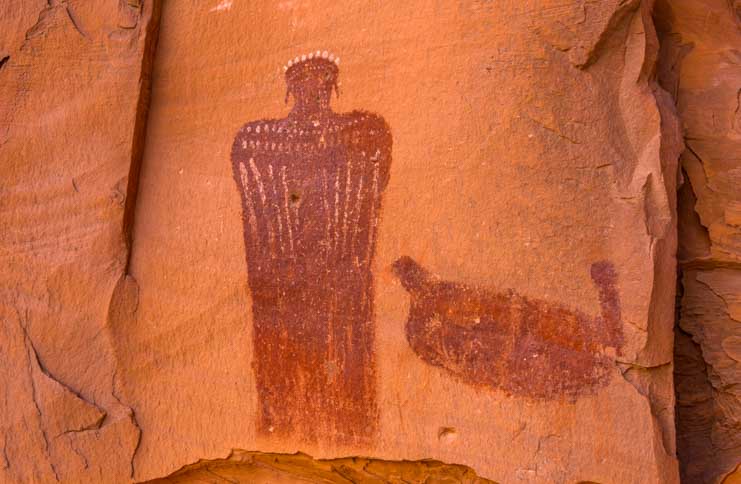
Artistic expression fill human history back to prehistoric times, and the ancients who lived in Utah thousands of years ago were no different. Using some kind of method to impregnate the smooth cliff walls with various colors, they created pictographs that remain to this day.
Buddy came across an especially beautiful one.
“Look what I found!”
It was about five feet tall and seemed to depict a person wearing a crown of some kind, along with decorations across the neck and shoulders as well as earrings. The figure appeared to have bird wings with long flight feathers, or perhaps it wore a cape that concealed its arms.
I have no idea what the thing next to this being was. But surely the person who meticulously created this image eons ago knew exactly what it was. If only it were possible to know the origins of the artwork in the context of the culture that created it.
Gazing at this image of a very specific something — human? god? — I remembered my astonishment when we watched a school field trip of young kids visiting the evocative ancient pyramid ruins at Monte Alban near Oxaca in southern Mexico.
As the kids sat attentively listening to a guide teach them about some huge stone carvings the Zapotecs had made, he pointed to various images in the stone sculptures and asked the kids if they recognized who they were.
With each question, a few kids’ hands shot up and they answered eagerly. They had studied the ancient mythology that had its roots right where they were sitting.
This intricately detailed pictograph is about five feet tall and appears to be a person wearing a crown and ornaments around the neck and shoulders, and it seems to have either an elaborate cape or wings.
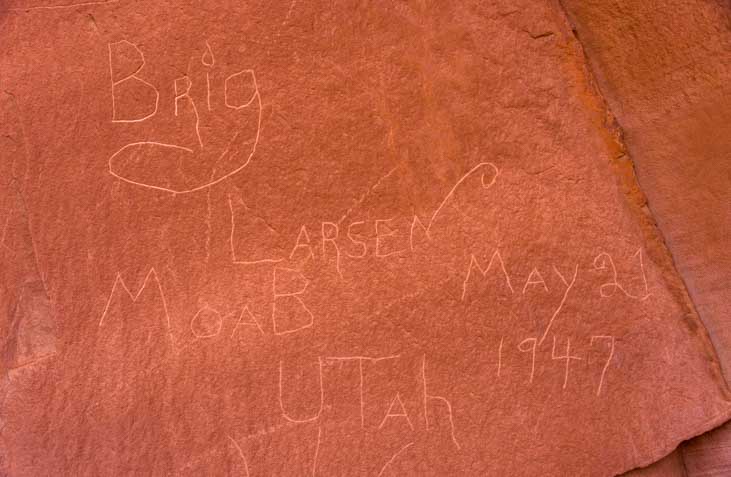
Not too far from this incredible pictograph we found some more recent petroglyphs. The difference between pictographs and petroglyphs is that the pictographs are made by impregnating pigments into the rock face while petroglyphs are made by pecking out an etching.
It’s not so easy to make images by pecking, and in many places we’ve seen poor modern attempts to scrape the rock alongside the expertly made petroglyphs that are hundreds or thousands of years old. However, in this spot some enterprising people whose petroglyph efforts are now fading into recent history did a pretty good job of making a lasting impression.
These petroglyphs dated back as far as 1941 which was long before the Bicentennial Highway was built in 1976 and also before Glen Canyon was dammed to form Lake Powell in 1963.
In the 1940s there was just a rough 4×4 road that, legend has it, a local miner had built between Hanksville and Hite using a borrowed bulldozer!
“Roy Despain + Madeline II – September 1, 1941”
Roy and Madeline covered some rugged terrain to put their mark on these rocks. I wonder if they are still around and if they ever return to see their names on the cliff wall.
Nearby Brig Larsen left his or her name and listed the town of Moab, Utah (his/her hometown?) and the full date of May 21, 1947.
“Brig Larsen – Moab Utah – 1947”
In 1946, a year prior to Brig pecking out his petroglyph, a geological survey described the concept of a future road going between the mining town of Hite (now submerged under Lake Powell) and the Mormon farming town of Hanksville. A quote from that geological survey says:
“Plans are being considered for a road across the Colorado River at Hite and eastward… At the present time (1946) the road follows the bottom of North Wash and a cable-barge ferry is maintained for crossing the river. In time, no doubt, an improved road will be built that avoids the canyon bottom and crosses the river by bridge, probably near the mouth of the Dirty Devil river. Such a road would be one of the most scenic highway in America.”
How right they were as they looked 30 years into the future!
Nearby a Mr. (or Ms.) S. Allan also made a petroglyph with the date “41.” Was he (or she) traveling with Roy and Madeline in 1941? Maybe they all reached this spot together and decided to put their names on the rock much as the Mormon pioneers had done at the Mormon register which is now inside Capitol Reef National Park.
Ironically, someone named Lockyer visited to the same spot in 1978 after the Bicentennial Highway was fully built and paved with asphalt. I wonder if he intended to write over S. Allan’s date or if he realized only after he got going with his rock pecking that he hadn’t allowed enough room for his name.
“S. Allan 41” and “Lockyer 78”
Either way, I’m just assuming that the numbers “41” and “78” refer to years these people were here in the 1900s. But who knows, they could be their birth years or they could be numbers from their high school varsity sports jerseys!
So it goes with the masterful guesswork of archaeology, whether studying the artistic footprints left 80 years ago or 800 years ago or more.
One thing we’ve noticed in the shifting sands of time here in southeastern Utah is that it is not so easy to leave an indelible footprint. We’ve been here only two weeks, yet the footprints and tire tracks we first put down two weeks ago have almost disappeared. The rain and wind have all but erased them from ever being.
Even the muddy tracks on the dirt road had already begun to flatten out.
More of our Latest Posts are in the MENU.
New to this site?
Visit RVers Start Here to find where we keep all the good stuff. Also check out our COOL NEW GEAR STORE!!*** CLICK HERE *** to see it!
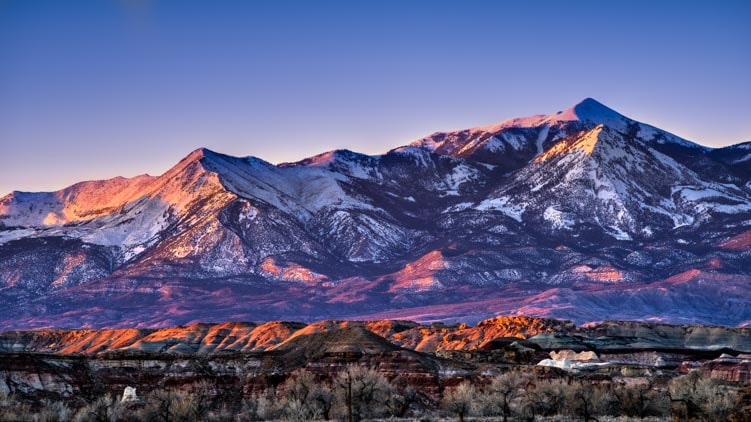
March 2019 – We arrived in southeastern Utah just as snow flurries were abating. It was unseasonably cold, but at twilight the Henry Mountains were utterly radiant, a visual gift that was a happy exchange for having to run around in hats and mittens in mid-March!
Henry Mountains at dusk
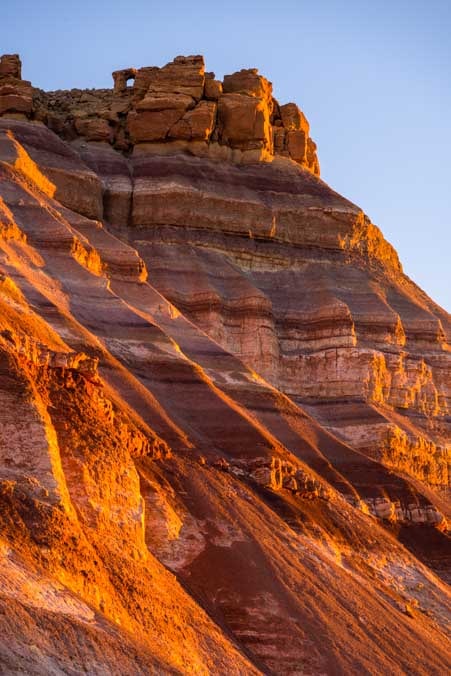
We snuck out at the first light of dawn and found the red rocks were glowing with an inner beauty.
Radiant red rocks at dawn
When a thick blanket of clouds filled the sky and chased the sun away for a few days, we could see the myriad of colors that are hidden in many of the exotic rock formations.
Lots of earth tone colors in the rocks
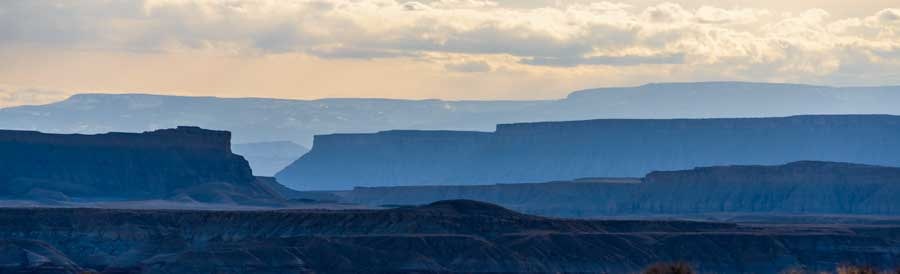
Off in the distance the classic desert mesas led the way to the horizon in receding layers.
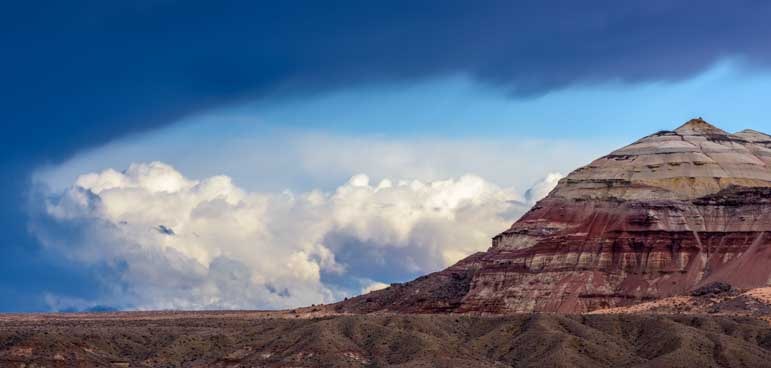
Mesas on the horizon
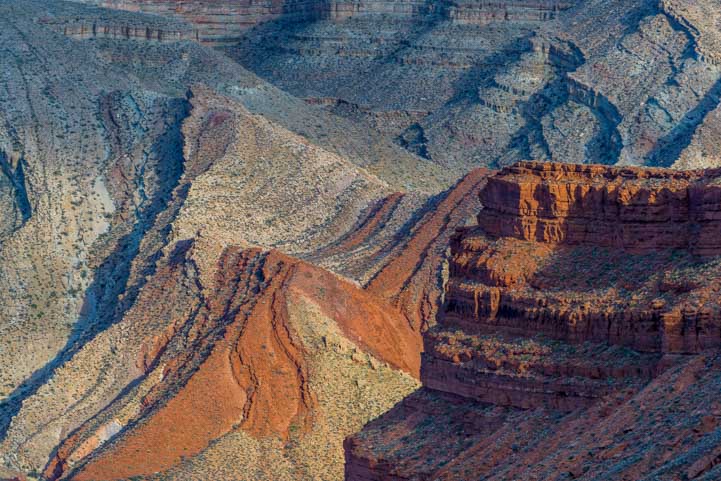
An excursion to the Dirty Devil River revealed an immense canyon reminiscent of tributaries within the Grand Canyon.
Dirty Devil River and Canyon
We got a few sunny days, and with the ground still damp from the recent rains, we enjoyed some dust-free rides on our Polaris RZR.
“Are we going for a ride? Yippee!”
“I want to run alongside for a while.”
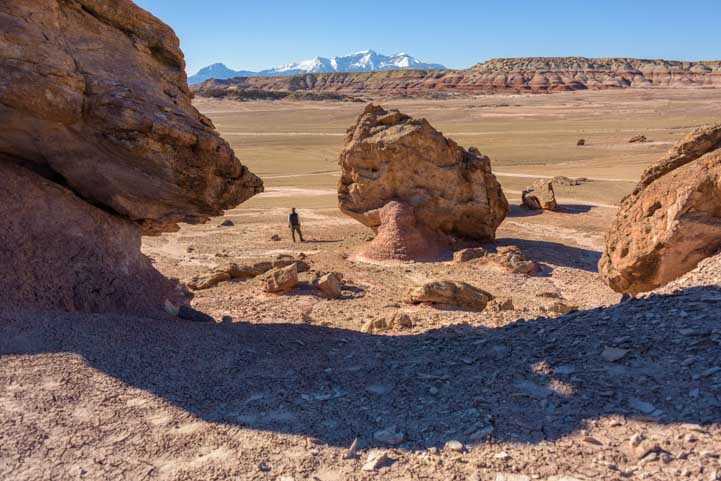
These UTV rides took us into the back country of Southeastern Utah where we went from one jaw dropping landscape to another. In some places the desert was flat and wide with immense jagged boulders balancing on the soft soil here and there.
It’s easy to get lost in these rocks!
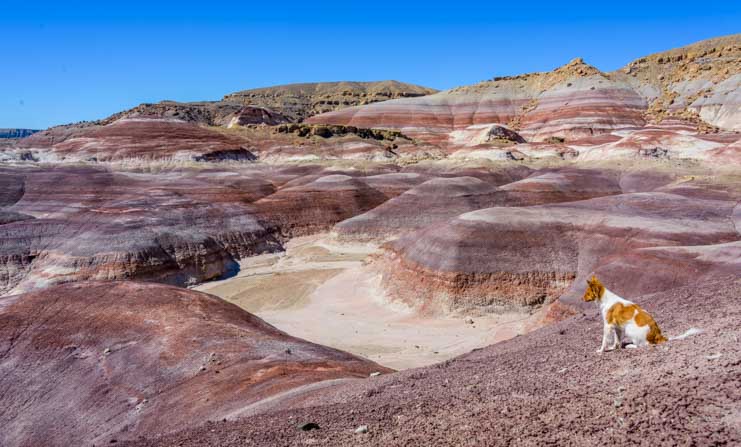
In other places vividly striped mounds formed a gently rolling landscape.
Buddy checks out the rounded mounds of purple, pink and deep brown rocks
Moonscape
“It feels like we’re on another planet!” We kept saying to each other!
This land is so photogenic it’s hard not to take a photo with every step. And it is so whimsical and cheery you just have to strike a pose in a lot of shots too!
Buddy watches Mark pose praising the heavens under a jagged spire.
Utah’s breathtaking and otherworldly landscapes are beloved worldwide, and lots of folks from all over the place come to visit in large numbers between Spring and Fall.
A huge labyrinth of a layer cake.
When we arrived in Hanksville, a massive and sweeping public land bill had just become Federal law with enthusiastic support from almost everyone in Congress.
We hadn’t known anything about it, but as we talked with the locals we soon discovered they weren’t too pleased. They were frustrated that motorized and mechanized vehicle access to some of the most popular places nearby will be prohibited because they’ll be designated “Wilderness” areas. Also, the locals hadn’t been notified of the bill until three days before it was voted on, so their views were never heard.
With those conversations still ringing in our ears, we were astonished to take our RZR around a corner on a well trodden road on the Bureau of Land Management’s vast square miles of open public land and suddenly see a sign planted in the ground that said:
“The Mars Society. Private Property. No Entry Please.”
Mars…or BLM land in Utah?
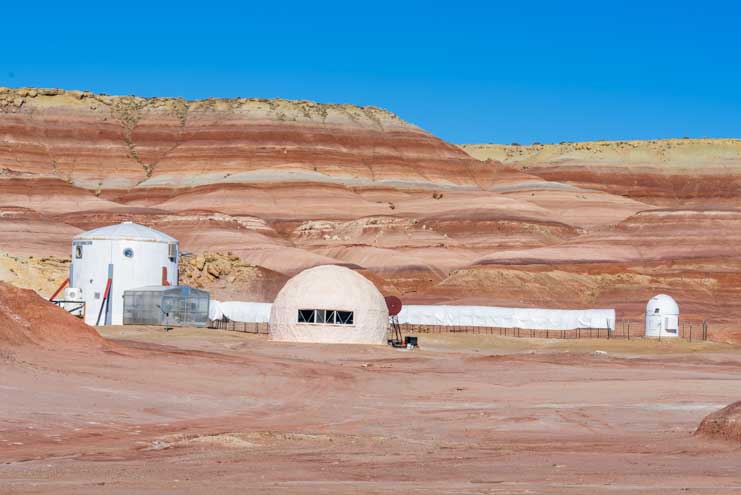
We stood by the sign and stared at the buildings lined up against the striped red rock mounds in the distance. There was a collection of what can only be described as Mars Pods along with a large solar panel array installed on the ground nearby.
We looked at each other in amazement. What in the world was this?
A Mars colony
We heard voices yelling in the distance and saw the door of the main pod opening and closing repeatedly as young, energetic people ran in and out the door. The yelling didn’t sound like English.
I cupped my hand to my ear to see if I could figure out the language they were speaking, but I couldn’t tell. My first guess was Spanish, and then I thought I heard some French.
There was lots of commotion in a foreign language.
Suddenly, a side-by-side four wheeler came driving out from the pods towards us. There was no engine noise. It looked to be a Polaris Ranger UTV that had been converted to run on an electric engine.
Then two more Mars Rover side-by-sides appeared behind it.
The three vehicles zoomed passed us in a flash and disappeared down the road. One had the word “Opportunity” across the front hood, and they all had a pair of young folks in the seats.
Three UTVs converted to electric engines zipped by
We decided to head into the compound and see if we could learn a little more about what this place was. Driving a short distance, we arrived at the main pod and were greeted by a friendly dog and a young man.
“What is this place?” I asked him.
“Private property.” He said with a strong accent.
“I thought this was BLM land. Public land.” I said.
“We’re borrowing it.” He told me.
Mars Desert Research Station
I asked if he meant they were leasing the land from the BLM, rather than borrowing it, and he nodded, and then I asked where he and his friends were from, and he said Peru.
He went on to explain that international groups of kids visit this place on two week rotations to live in the Utah desert and drive around in electric UTVs so they can get the feeling of what it would be like to land in a desolate landscape on Mars and establish a human colony.
We later learned that one of their current tasks is to fly teams of 8 drones at a time over the Utah landscape to make digital image maps.
We also learned from some Utah Capitol Reef area tourist literature that describes this Mars colony that whenever the kids step out of the pods into the Utah landscape they are supposed to be wearing space suits just as they would on Mars.
Curiously, we did not see a single space suit on any of the kids going in and out of the pods or driving the UTVs across the desert. They were in street clothes and they looked no different than any other ATV/UTV owners who like to cruise around on dirt roads and go exploring.
Future Mars colonists drive off into the desert in their UTVs to map the desert by flying teams of 8 drones at a time! Despite claims they wear space suits, they actually wore street clothes and looked no different than any other ATV/UTV group playing in the desert.
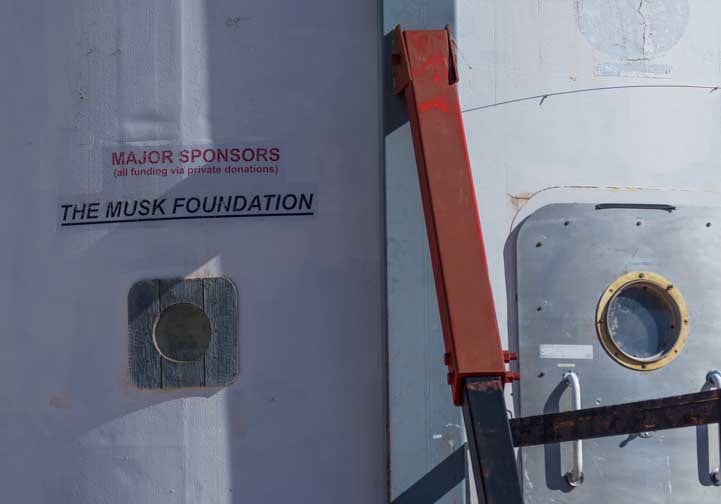
When we left, we saw a large sign on one of the building pods that said, “All funding by private donations. The Musk Foundation.”
Major Sponsors (all funding via private donations) The Musk Foundation
As I’ve said many times before, the public land debate is immense and complex and there is a lot more to it than meets the eye.
We continued on our own little safari at a modest 18 mph down the dirt road, lost in our own thoughts.
Suddenly, a huge SUV came up behind us from the direction of the Mars colony at about 40 mph and swerved around us, narrowly missing the left side of our little open air buggy. The driver hadn’t beeped to let us know he was coming, and we were left in a cloud of dust.
Yikes! That was close!
We had come Utah very early this spring to attend a photography workshop with Ian Plant that soon got underway. It was focused on how to take wide angle images that emphasize near-far contrasts.
This was fascinating to study, and we had some outstanding experiences both in the classroom and out in the field.
It will take us a while for us to master the techniques we learned, but we had a lot of fun starting to retrain our eyes to look for interesting patterns at our feet and combine them with interesting things in the distance.
We practiced near-far compositions that go from the shapes at your feet to shapes on the horizon
More practice with some red rock hoodoos at dawn.
Early morning light envelops a distant pinnacle.
There are quite a few slot canyons in the area, and these proved to be wonderful for wide angle photography and playing with the shapes created by shafts of light.
Beautiful light inside Leprechaun Canyon
At one point our instructor, Ian, walked towards Mark as he was taking a photo. The light hit Ian perfectly and suddenly he looked like he was receiving a message from God or being beamed up to the USS Enterprise!
The ghost of our instructor
Mark also got a fantastic selfie at a slot canyon opening.
Mark took a selfie.
There are sand dunes in the area too. Talk about an other-worldy landscape!
Maybe this really is Mars
After the workshop was over, the rain and snow returned. We watched in awe as banks of black clouds came in.
An approaching storm
The snow-covered Henry Mountains were suddenly surrounded by swirls of clouds that changed shape with every passing minute.
Clouds surrounded the Henry Mountains
Late afternoon light on the clouds and snow on the Henries
Snow-capped peaks above and red rocks below – Magic!
The mountain was whisked away by the clouds…!
.
There is so much to see in southeastern Utah that we feel like we’ve barely scratched the surface despite several return visits. We think we’re headed back south to Arizona now to finish up a few things there, but the lure of these exotic red rocks and spectacular vistas will probably keep us here a little while longer!
More of our Latest Posts are in the MENU.
New to this site?
Visit RVers Start Here to find where we keep all the good stuff. Also check out our COOL NEW GEAR STORE!!*** CLICK HERE *** to see it!
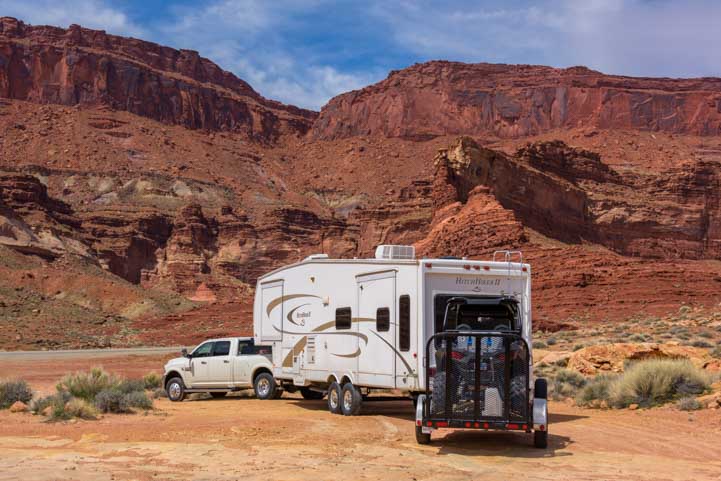
March 2019 – What with triple-towing and having a new Polaris RZR side-by-side these days, we had decided not to travel long distances in 2019. But when I got an email announcing that a photographer we admire, Ian Plant, was hosting a four day workshop in southeastern Utah, we decided to make a run for it and take our RV on a nearly 500 mile adventure ride past stunning scenery between Phoenix, Arizona, and the tiny village of Hanksville, Utah.
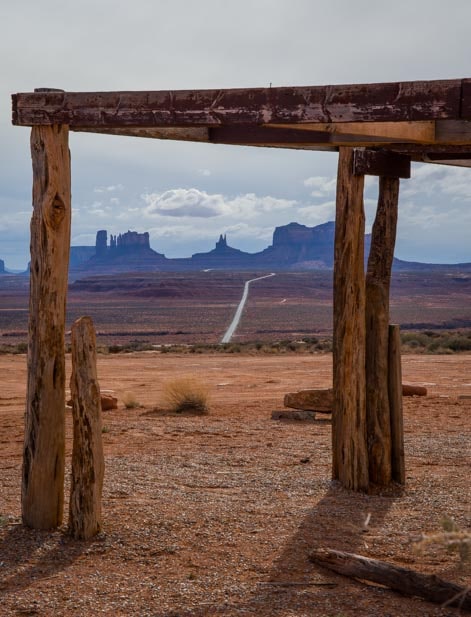
Monument Valley framed by a Navajo Jewelry stand.
After a crazy cold winter in the Arizona deserts, the temps had just started to warm up in the Phoenix area. But we we hightailed it north for Utah’s higher elevation (and colder) red rock and snowy mountain scenery anyway. Brrr!
What were we thinking?
Just as we crossed through the Navajo Nation into Monument Valley on the border of Utah, the navigation screen on our truck began to flash a Severe Winter Storm Warning for the area!
Monument Valley skyline
Despite (or because of) the incoming storm, the towering rock formations that form the gateway to Monument Valley stretched across the horizon in dramatic fashion, and we just had to get out and hike down one of the dirt roads to get a better look at them.
It was time to stretch our legs — whether we had four to stretch or just two.
The clouds intensified as we walked. Every once in a while the sun swept across the vast landscape with the dark storm clouds in hot pursuit. Um… in cold pursuit!! Over on the other horizon a row of red rock cliffs lit up as the sun brightened.
In another direction a line of red rock cliffs glowed for a brief moment in the distance.
Turning back towards the monuments we noticed a cool cloud had formed above them in the sky.
An unusual cloud drifts by in the sky.
We hopped back in our truck for another twenty miles or so and were pelted with rain. But when we turned the corner at Mexican Hat the rain abated just long enough for us to get out again and have a look around.
The Mexican Hat rock formation is very easy to spot!
There’s no doubt how the town of Mexican Hat got its name!
Just south of Blanding, Utah, we turned west onto US-95, also known as the Bicentennial Highway, and plunged down lots of 8% to 10% switchbacks to the desert floor far below. This is a fantastic scenic drive that leaves our jaws agape every time we drive it. Even this time in the rain and fog — and snow in the mountains we were passing! — it was still a glorious drive.
How funny, though, in the middle of all that majestic scenery to see an old dilapidated Winnebago sitting in the middle of nowhere. Mark hit the brakes so he could run back for a shot!
It might be a little drafty sleeping in there!
Some of the best views on this drive are when it descends into Glen Canyon. I fondly remember how the first time we drove it I was so excited by the beauty that I sat in the window of the passenger’s seat snapping pics as Mark drove!
This time we were driving in rain and mist, but as we pulled into the Hite Scenic Overlook the sun made a valiant effort to push its way out from behind the heavy blankets of clouds.
The Hite Scenic Overlook is well worth a stop.
The view from the overlook was out of this world.
What a view. That is Lake Powell down there!
What a spot for photography!
Mark sets up a shot of the valley (he’s on the far left side with Buddy!)
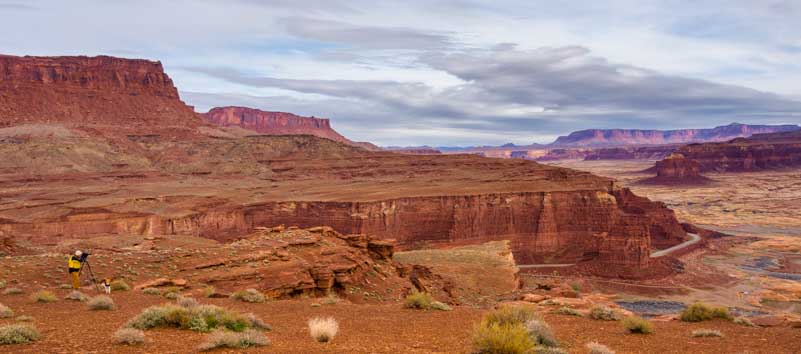
We hung around for several hours taking photos. We were standing on a peninsula with views in every direction, and the views went on forever.
The massive stone towers on the desert floor below us looked like they had strayed from Monument Valley.
The tiny ribbon of US-95 snaked around in front of the enormous stone towers.
Dazzling scenery, even in mist and fog.
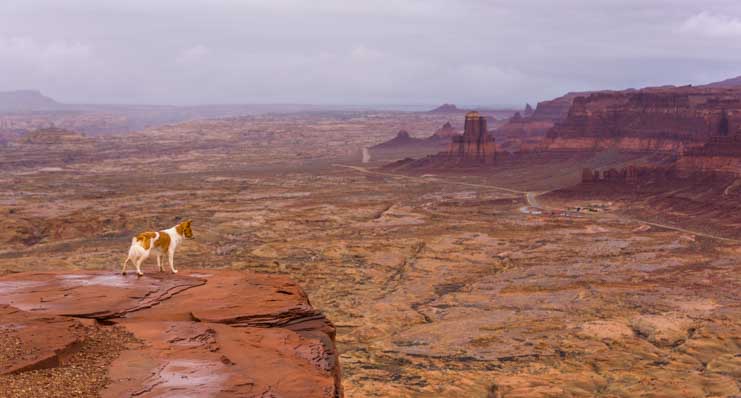
Even Buddy seemed to appreciate the view. He was very cautious looking down over the edge too, holding his weight back as he craned his neck forward to look down at the flat land below.
.
Behind us a row of red rocks that stood cheek-by-jowel like city buildings overlapped snowcapped mountains in the distance.
No wonder we were in jackets and hats — there were snowy mountains right there!
The skies finally began to clear and the last miles of the Bicentennial Highway were flanked with red rock cliffs as we approached the village of Hanksville.
Once the rain cleared I got a few pics of the gorgeous winding road that is US-95 The Bicentennial Highway.
All of the land in the lower half of Utah is spectacular beyond words.
Views on the Bicentennial Highway (US-95).
Hanksville is home to about 250 people, and its two gas stations, restaurants and motels are all clustered around the intersection of US-24 and US-95. Most of the back streets in town are dirt. We went exploring and came across the ruins of an old stone homestead. We learned later that this is part of the Giles Ghost Town.
Someone put some care into building this solid home.
Those stone walls were pretty thick!
This is part of the Giles Ghost Town
All around the area there were lots of exotic rock formations. Some formed beautiful patterns…
.
And others made recognizable shapes!
Pinocchio!
.
We’ll be in this area for another week, improving our photography by day and fending off sub-freezing temps by night!
More of our Latest Posts are in the MENU.
New to this site?
Visit RVers Start Here to find where we keep all the good stuff. Also check out our COOL NEW GEAR STORE!!*** CLICK HERE *** to see it!
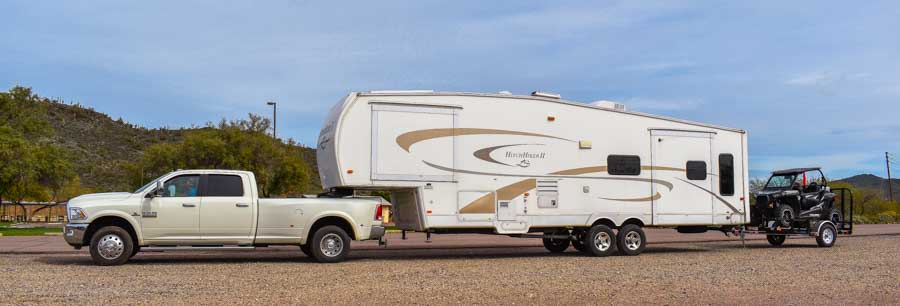
We have spent the last two years going back and forth about whether to move into a new fifth wheel trailer or a new toy hauler as we look forward to our second dozen years of non-stop travel and full-time RV living. We’ve been to tons of dealerships and did a bunch of toy hauler factory tours in the Elkhart area of Indiana as well as in Missouri and Oklahoma (there’s more about those tours is in the 2nd half of this article).
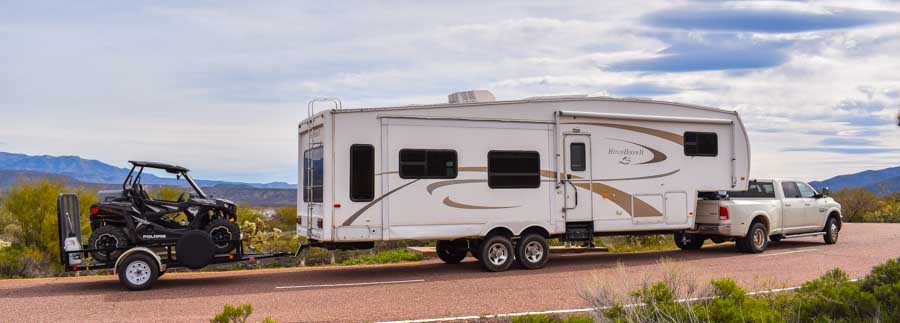
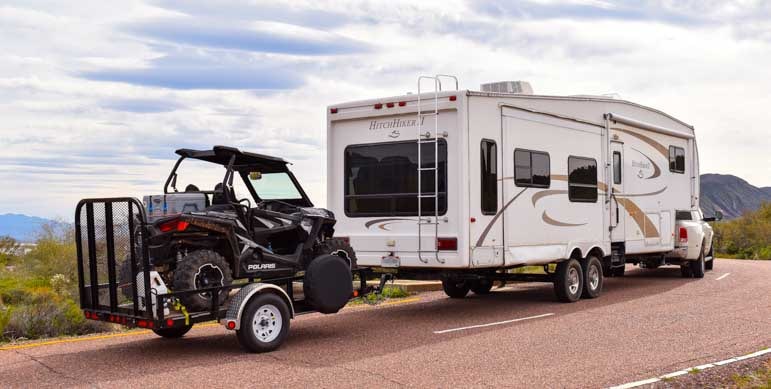
As I’ve mentioned a few times over the past few months since we started this experiment, triple towing is working out a whole lot better that we expected!
This may be in large part because the utility trailer is only 5′ wide compared to the 8′ width of our fifth wheel trailer, so even on a tight U-turn, the wheels on the fifth wheel carve a tighter turn than the wheels on the utility trailer. So, if there’s something we don’t want to roll over or hit, the vehicle at risk is the fifth wheel, just as it has always been!
The utility trailer just cruises along behind. It’s a little caboose!
When we’re triple towing we notice a lot more chucking action than when we don’t have out caboose connected. This is due to the accordion and jerking action of the three vehicles moving apart and back together as they rumble down the road. It’s not a violent sensation, but we can definitely feel it.
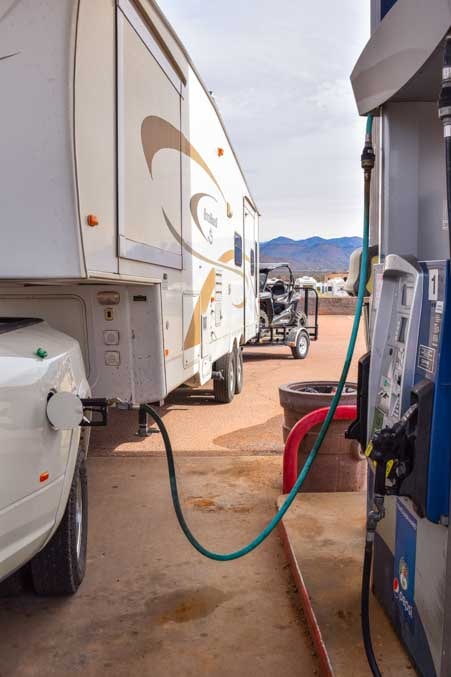
We’ve been to a few gas stations… yikes!
We have been to several gas stations fully hooked up as The Train. Even though The Train is quite long and winds up curved far behind us as we turn in to the pump, as long as the gas station is large enough and there aren’t too many customers, it all works out.
That RZR sure is a long ways from the pump!
We have also been to several RV dump stations with The Train, and again, as long as the approach and exit to the dump station aren’t too narrow or laid out in a tight turn, we can align the fifth wheel sewer hose and other goodies with the RV dump station while the truck and utility trailer sit in a curve ahead of and behind the dump station sewer.
We’ve been to a few RV dump stations.
We’re okay dumping our tanks as long as it’s fairly long!
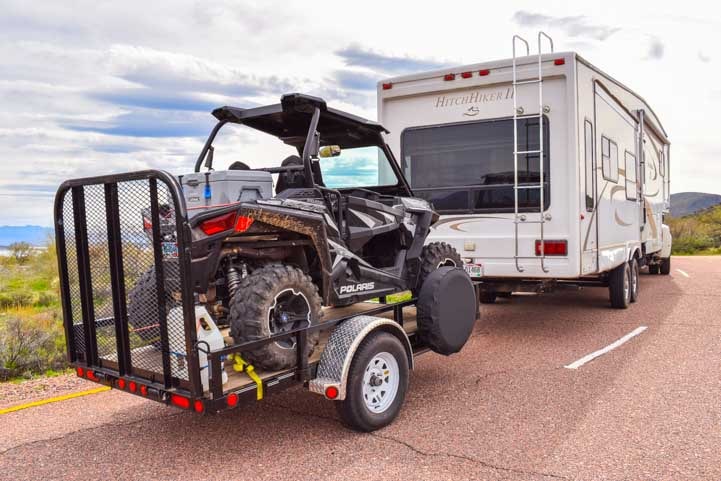
We set up the utility trailer with a spare tire and tire cover just in case that trailer gets a blowout. At this point we don’t have a backup camera to watch the utility trailer while we’re towing. That may come in the future but will take some research as we figure out which model and where to place the monitor in the already full cockpit of the truck.
Unfortunately the utility trailer is too small to carry our bikes as well. A 12′ long trailer would be long enough, but our RZR came with this trailer so it’s a natural starting point. So, for the moment, we have left the bikes behind at a friend’s house.
We’re leaving the bikes out of the equation for the moment.
When loading the RZR onto the utility trailer, Mark drives the RZR’s front wheels flush up against the front of the trailer which leaves enough room behind it for two 5 gallon gas tanks lashed down on the utility trailer.
With the wheels flush against the front railing there’s room for two 5 gallon gas tanks in back.
Before hitching up The Train the very first time, we had to sort out the different heights between the tongue of the utility trailer and the hitch receiver on the back end of the fifth wheel.
Our fifth wheel trailer now sits some 6 to 8 inches higher than it did when we first bought it. After our fifth wheel got a desperately needed suspension overhaul when the suspension failed (blog post here), the fifth wheel sat higher than it had originally. Then, when we installed the MORryde SRE4000 equalizers, it sat even higher.
This is awesome for those pesky gas station ramps and other sharp dips in the road that are so steep they cause the back end of the fifth wheel trailer to drag on the asphalt. It’s also great for bumping over washes and other things on gnarly dirt roads.
However, all that good drag-avoidance stuff got thrown out the window with the decision to triple tow!
The utility trailer has 15″ tires and sits quite low, and in order to keep that trailer relatively flat instead of nose-up while towing, we had to put a 10″ drop hitch mount on the fifth wheel trailer’s hitch receiver to reach down to the utility trailer’s level.
We needed a 10″ drop hitch mount to reach down to the utility trailer
We use a receiver hitch tightener to eliminate any possible rattling in the connection between the receiver hitch and the hitch mount, and an electric plug ensures the lights on the utility trailer are powered and light up at night as well as when Mark hits the brakes.
The hitch tightener keeps things from rattling and the electric plug lights up the lights on the utility trailer
To learn more about hitch tighteners, see our blog post HERE:
If you stand behind The Train at night and have someone tap the brakes in the truck, it’s quite a light show because not only do the lights on the fifth wheel light up, but the ones on the utility trailer do too. We almost never tow at night but it’s good to know The Train is so visible on dark and stormy travel days.
It was a dark and stormy morning…
We’re really glad we decided to jump in with both feet and buy a RZR before we figured out how to transport it because there is nothing like hands-on experience to figure out what works and what doesn’t.
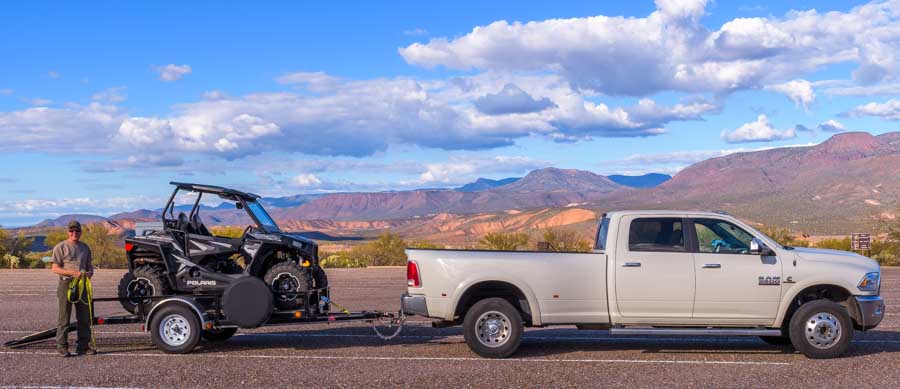
The biggest surprise we’d never thought of before is that it is super handy to have a utility trailer to tote the RZR behind our truck when we’re going to a trailhead that is a long distance from our campsite.
There’s an advantage to being able to tow the RZR to a distant trailhead.
Although our RZR can go 70 mph and is licensed for the road, driving it on the highway is not what we got it for. We’d rather drive 25 or 50 miles to a trailhead in the comfort of our truck and then arrive with the RZR gas tank full of gas so we can enjoy our off-road adventures without worrying about carrying spare gas.
The RZR has a 10 gallon fuel tank and gets about 15 mpg. So far, none of our adventures has been more than about 40 miles, so we don’t foresee a need to carry gas with us on the RZR any time soon.
At the end of a day of off-road adventure, after the sun has set, we find it’s much safer to drive our truck on the highway than to be out there in a little open air buggy that sits a lot lower on the road than most cars and trucks.
The RZR rolls on and off the trailer ramp.
Lastly, we’ve wanted to ensure that Buddy loves the RZR. For us and our lifestyle there’s no reason to own a RZR if our puppy doesn’t want to come along. We’ve integrated him into our lives so he doesn’t spend any time in our fifth wheel by himself. If we’re going to have RZR adventures, he’s going to be a part of them.
When we’re in the RZR, Buddy sits on my lap. I don’t want to go more than about 35 mph with him sitting in there. He’s not too keen on the loud noise of the RZR engine on the highway and of vehicles passing us, and I have to say, neither am I.
His favorite thing riding in the RZR is to sniff the air when we’re off-road, watch for rabbits, and to stare down at the dirt road going by just below RZR door. All that is lots of fun at 10-15 mph, our typical dirt road speed.
Mark has mastered driving the 56″ wide RZR onto the 60″ wide trailer!
We have a B&W Stow & Go hitch on the back of our truck, and the utility trailer hitches up to the truck very easily. After one or two tries loading the RZR, Mark has figured out how to align it so it drives in without rubbing the wheels on the railings at all even though the railings are 60″ apart and the RZR is about 56″ wide.
.
When we arrive at a trailhead, Mark drops the ramp door of the utility trailer, hops in the RZR, and backs it down the ramp. The driver’s door on the RZR swings out above the railing on the utility trailer, so he can get in and out of the RZR easily when it’s on its trailer.
.
.
.
The RZR came with a windshield, roof and a fancy stereo that the previous owner had installed, and this XC EPS edition of the RZR 900 includes upgraded wheels, wider fender flares, a hitch receiver and the Polaris Ride Command navigation system.
However, the trunk is just a shallow open area at the back, not the best place to store stuff if you don’t want it to get dirty.
We tossed around ideas and finally bought a Lifetime 55 quart cooler that sits very nicely on an old welcome mat in the back of the RZR. It is lashed down to keep it in place.
We use a Lifetime 55 quart cooler for easy flip-top trunk system.
What we love about this cooler is that we can keep all the little essentials we always want with us — emergency water, toolbag, flat repair & spare air kit, first aid kit — in the bottom of it at all times, and we can throw things like jackets, hats, cameras and snacks on top as we need them for each ride.
The flip top lid makes it super easy to access everything in the cooler, and it has an excellent seal when it is closed which keeps everything inside dust free. We’ve also put a long shank padlock on the cooler to keep the less determined thieves out. Of course, anyone that really wanted that cooler and its contents could simply carry it away.
Another great feature of the cooler is that the things in the bottom of it don’t get overly hot. The engine sits right below the RZR’s trunk area, but since this little “portable trunk” is actually a cooler, there’s lots of insulation between the contents of the cooler and the engine below.
You can see a hilarious video of a grizzly bear trying to get into one of these coolers here.
We’ve found that the multi-use trails that allow motorized vehicles are not only lots of fun for riding but are also great for running and hiking too. Sometimes Buddy and I hop out to run while Mark drives.
Unlike yours truly, Buddy can easily keep up with the RZR and loves chasing it at top speed. But after he’s done a 5 minute mile with some surges to 3 minute mile pace thrown in, he’s usually ready to ride again, and he happily jumps back in.
Need a ride?
Come on in!
Easy!
We’ve experimented with quite a few scenarios for arriving at a campsite and unhitching the bits and pieces of The Train.
The utility trailer has to be hitched up to something — either the truck or the fifth wheel trailer — in order to drive the RZR on or off of it. Otherwise, once the RZR wheels roll on or off the ramp the tongue of the utility trailer will fly up in the air.
So, at campsites where we want to use the utility trailer with the truck to take the RZR somewhere, we have to move the utility trailer from its caboose position at the end of The Train to a place where it can be hitched to the truck, and then we reverse its location before we leave.
We can move the utility trailer around small distances by pushing or pulling it ourselves. However, if the RZR is on the trailer, neither is going anywhere until the utility trailer gets hitched to either the truck or fifth wheel.
The RZR has a hitch receiver on it, and we purchased a ball mount for it, so the RZR can tow the utility trailer around if needed. This is handy in small campsites since the big long bed dually truck isn’t very maneuverable in tight spaces.
Luckily the RZR can also do the job of towing the utility trailer, if needed.
.
Again, we learned a few things that we hadn’t thought of before.
First, although it seemed daunting to back the fifth wheel to the utility trailer to hitch it on when it’s already got the RZR loaded on it, it’s not all that bad. Using our two-way radios as Mark backs up the fifth wheel and I stand at the tongue of the utility trailer, and then using our feet to shove the tongue of the utility trailer the final inch or two, we can get it done quite easily.
Second, if the utility trailer is already hitched to the fifth wheel but is at an angle to the fiver and not aligned straight behind it, there is a lot of lateral force on the fifth wheel’s stabilizing jacks and the front landing legs when the RZR drives onto the trailer.
If the utility trailer is aligned with the fifth wheel, the fiver takes the impact much better (I’ve stood inside the fifth wheel and felt it both ways!).
Mark has sorted out how best to tie down the RZR on the utility trailer.
The ramp door folds up.
Tying down a side-by-side either on a flatbed trailer or inside an enclosed trailer can be super easy or relatively difficult and frustrating.
At first, we did it the hard way by using traditional ratchet straps. Unfortunately, the straps would loosen easily as we traveled. So, we had to stop and check the straps, often several times if we were traveling 100 miles or more in one trip.
Then Mark discovered CargoBuckle Retractable Ratchet Tie-downs. These are a total game changer. They mount permanently onto the frame of the flatbed trailer. To tie down the RZR, simply pull the strap out of the CargoBuckle, hook it to an attachment point on the RZR and ratchet it down. To unload the RZR, just loosen the hook and let the strap retract into the CargoBuckle. We use four of them, one for each corner of the RZR. To learn more, read our post HERE:
We are liking this triple towing thing and may stick with it. We’ll see. If we do, then our new home search will be focused on conventional fifth wheel trailers rather than fifth wheel toy haulers.
There are pros and cons to both conventional fifth wheels and toy hauler fifth wheels. Here are a few we’ve come up with:
Conventional 5th Wheel
Toy Hauler 5th Wheel
More Living Space
Less Living Space
More Closet Space
Less Closet Space
More Cabinets
Fewer Cabinets
Bigger Kitchen
Smaller Kitchen
Recliners + Sofa + Dining Table
Pick any two
Generally, bed in slide w/ windows each side
Generally, bed not in slide & window on one side & small wardrobe on other
Back Deck AND Possible Side Patio (always includes 2nd bath)
Tow RZR to trailhead behind truck
Drive RZR on highways to trailhead
Triple tow not legal in some states
Always a legal beagle
Can travel w/o caboose
Full length toy hauler is always with you (47′ in some cases!)
TRAILER LIFE ARTICLE – SHORTCUT to TOY LAND!
The March issue of Trailer Life Magazine features an article I wrote surveying some of the 2019 offerings in the toy hauler market. I chose four different toy haulers to highlight in that article and included another dozen models in the lineup.
Our personal favorites for sheer innovation and cleverness and/or ruggedness are the Aluminum Toy Hauler fifth wheel and the Keystone Raptor 427.
Aluminum Toyhauler Company (ATC) has been making stackable car haulers for the high end racing car set for ages. They build an incredibly strong and durable toy hauler. Unfortunately, they don’t have any models with slide-outs yet, but their toy haulers are built like tanks and can haul 9,700 lbs. of stuff in a trailer that has a GVWR of 21,000 lbs. Unbelievable!
The Keystone Raptor 427 is a fabulous new entry into the garage-under-the-master-bed style of toy hauler. Montana and Grand Design have these floor plans too: the Montana High Country 380TH and Grand Design Momentum 376TH (and formerly the Grand Design Solitude 374TH which was discontinued a few months ago).
All of these manufacturers place the bedroom in the rear of the trailer and put a small garage big enough for bikes or a motorcycle under the bed itself. A workbench could fit in this garage. The bed above the garage raises and lowers if you need full standing height in the garage.
Montana and Grand Design place the kitchen in the middle of the rig. Montana has a beautiful open L-shaped kitchen with counters along two walls, a style that I like, and Grand Design has an island kitchen that is very popular. Both put the living room in the fifth wheel overhang.
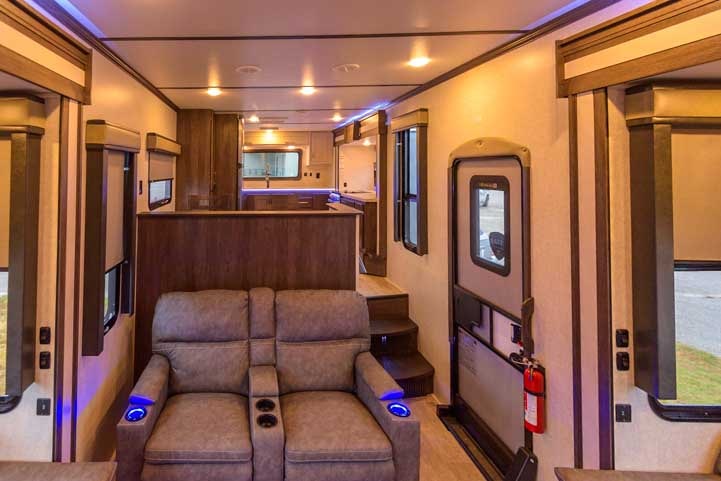
The clever idea in the Raptor 427 is that the kitchen, which doesn’t need vaulted ceilings, is smartly placed in the part of the trailer where high ceilings can’t exist: the fifth wheel overhang. I don’t know what the headroom is there, probably around 6′ 4″ or higher, but it was more than sufficient for cooking, dining and even entertaining a cocktail party or buffet crowd! And there’s a window in the front cap so you can see out in all directions.
The kitchen is truly vast, and there is a side-by-side dinette for two that overlooks the living room. We just loved the design. For us, though, it’s too long a trailer since we’d have to tow our RZR behind (it’s 44′ long), and we’d prefer hydraulic slides to cable slides in the bigger slide-outs. Our two hydraulic slide mechanisms and single worm-gear electric slide mechanism on our current trailer have pushed our slides in or out an estimated 2,000 times so far.
The Keystone Raptor 427 has an immense kitchen in the front of the trailer.
The counter space is incredible (although I could do without the purple lights)
Seating for two overlooking the rest of the trailer – very cool!
Opposing loveseats in the slides plus dual recliners facing the TV (not seen in this pic).
Looking back up into the kitchen above the recliners
The bike or motorcycle sized garage is under the bed. The ceiling raises and lowers.
The March issue of Trailer Life happens to include two other articles of mine with photos by both of us: a feature article about RVing in the Canadian Rockies and my back page column about lovely Maroon Bells in Colorado!
Another outstanding RV magazine and RV advocacy group and discount camping membership club and mail forwarding service, among many other things, is Escapees RV Club which we highly recommend joining.
IMPRESSIONS from VISITING the TOY HAULER FACTORIES
When were in Elkhart, Indiana, last fall (2018), we visited several RV manufacturing plants. We hadn’t done a factory tour in Elkhart since the spring of 2009 when the industry was in the midst of collapse.
The consolidation in the RV industry since the beginning of the recession of 2008 has been staggering and has whittled the list of RV manufacturers down to three conglomerates: Thor, Forest River and Winnebago. It has also reduced the list of major component suppliers down to two, Lippert Components and Furrion. Mom-and-pop shops making fifth wheel trailers independently of these conglomerates like Aluminum Toy Hauler, New Horizons and Space Craft and smaller component suppliers like MORryde are exceedingly rare.
The fraternity of talent at the top of the RV industry is very close knit and goes back many decades. If you follow the mergers and acquisitions back to the 1960s and 70s, the same names appear over and over in the executive suites of each company. The brothers who founded Keystone together with another executive who oversaw its huge growth sold it to Thor which itself was the result of the acquisition of failing Airstream from Beatrice Foods. After the three held top executive positions at Thor, these three men went on to found Grand Design and oversee its growth and sale to Winnebago. One of the partners sat on the Board of Directors over at Lippert Components, and after the sale to Winnebago another of the partners left the RV industry to start a pontoon boat company in partnership with Lippert Components.
The advantage to the rise of the conglomerates is wonderful economies of scale, but the flip side for the brands under these corporate umbrellas is the loss of the wild frontier style innovation that made early RVs so fun and funky as well as the forced adoption of quality standards that may not match the standards these brands had back when they were independent companies.
A Dishwasher = “That True Residential Feel”
Perhaps the most shocking thing for us was to discover how few people in the RV industry actually own and use RVs. I asked the general manager of one brand and a national sales rep of another what kind of RVs they owned, and the answers were, “I’m too busy to vacation in an RV” and “My wife likes hotels.”
This lack of personal RV experience has caused a disconnect between the manufacturers and their customers’ needs.
A perfect example was when a top executive at one brand told me that full-timers want a true residential feel to their fifth wheels, so every unit in his line of full-timer fifth wheels would be shipped with a dishwasher in it starting in 2019.
Now, of course, lots of full-timers want a dishwasher in their RV, but a lot of full-timers don’t want one.
Another executive at a different company told me, “Well, the dishwasher is a great place to store your dishes in an RV.”
It is? I’m not keen on mixing my clean and dirty dishes in the same storage place!
.
Check out our reactions to LIVING in a toy hauler HERE!
A National Sales Rep proudly showed me the outdoor kitchen on his toy hauler. He was so excited about it when he pulled it out, “Emily, you’re going to love this!” But when he pulled it out, it came to shoulder level on me. I’m 5′ 4″. I raised my arm and made a stirring motion with my hand in front of my chin and said, “I can’t cook like this.” He was crestfallen.
I began asking the executives we were meeting how they get their feedback from customers, and it seemed that they rely on a combination of the orders placed by the dealership buyers and by talking to people at trade shows.
So, it turned out that because 95% of the units of the one brand had been ordered with dishwashers in 2018, it was obvious there was a massive demand for dishwashers. So that’s why all units will have dishwashers going forward.
Similarly, since the sales rep with the outdoor kitchen had seen only grins and enthusiasm when he showed it to folks dropping by the booth at trade shows, he thought his outdoor kitchen was something his customers loved.
Ironically, doesn’t it make sense for dealers to put predominantly fully decked out units on their lots to show customers what can be ordered? And when you’re gallivanting around at an RV trade show and having a ball dancing in and out of tons of brand new units, are you really going to tell that smiling and friendly sales guy that his outdoor kitchen would never work for you?
The takeaway we got from all this is not to be shy and to find out who the buyer is at your local dealership and to tell them what you like and don’t like about the units on their lot. It seems that the closest the residents of the RV manufacturers’ executive suites come to their customers is the contact they have with the folks ordering their units in their dealer network.
ESCAPEES RV CLUB and WINNEBAGO
Fortunately and fabulously, Escapees RV Club and Winnebago have begun working together to get real feedback from real RVers into the design process. This project is in its earliest phase right now, but the emails I’ve received from Escapees about it are very encouraging. It is because of this kind of innovative and forward thinking at Escapees that we keep recommending our readers join Escapess!.
Escapees RV Club was founded by Kay and Joe Peterson and it has been led by three generations of family members who have spent years on the road living in their RVs. They are the real deal when it comes to understanding the RV lifestyle. In July 2024, Harvest Hosts purchased Escapees RV Club.
TRAILERS BUILT by the AMISH
On a completely different note, some folks feel that a trailer built by Amish hands is of better quality than one made by other hands. It certainly makes for great marketing, especially for the companies that are in the heart of Amish country and employ lots of Amish people. We saw Amish workers in some of the plants, both men and women, but we didn’t see how their work could be substantially different than the work done by anyone else on the same assembly line.
The Amish really do work at the RV factories. They do the same jobs as other assembly line workers.
The factory workers are given jobs to do and are told how to do them. The quality standards and aseembly techniques are determined by corporate goals in areas like profitability, target market share, and unit build time to completion.
While a conscientious individual might put tremendous thought and care into a backyard project at their own home, the work they do on the assembly line at their job for an employer will be done the way management demands and not necessarily in a way that they would choose for their own personal project at home.
Before I tell you, take a quick guess at how long it takes to build a 44′ toy hauler fifth wheel. A month? A week?
At the Raptor plant we were told it takes 3 days. At the KZ plant it is 2.5 days. They have a ton of hands working simultaneously, and they all get the job done as quickly as possible.
INDEPENDENT MANUFACTURERS – ATC, Sundowner, Luxe, Space Craft, New Horizons
Independent RV manufacturing plants like ATC and Sundowner (another new entrant into the toy hauler market coming frome the horse trailer industry) take a few days longer to build their units than the bigger mass market brands. This partly because fewer people work on each trailer at a time, and partly because they start from scratch and build their own frames, doors and ramps rather than buying a ready-made frame, door and ramp.
Both ATC and Sundowner looked appealing to us, and we toured each plant. ATC is near Elkhart in Nappannee and Sundowner is in Oklahoma.
Unfortunately, without any slideouts we couldn’t fit our lives and belongings into an ATC fifth wheel toy hauler, and although the Sundowner toy haulers are an aerodynamic two feet shorter than standard fifth wheel toy haulers and are built with a fifth wheel gooseneck hitch which makes a fabulouos connection to the truck and completely frees up the truck bed when you’re not towing, they are also built with a very small bedroom because of the short gooseneck overhang.
However, for folks who have other lifestyle needs than ours, both the ATC and Sundowner deserve a good long look as they are sturdy, well built and rugged trailers that can be modestly customized on order and that have an intermediate price point between the mass market trailers and the high end custom units (New Horizons, Luxe and Space Craft). We visited Luxe and went to Space Craft a second time but will get into that in another post.
ALTERNATE SUPPLIERS – MORryde, Dexter
I mentioned the RV parts manufacturer MORryde, and as we studied toy haulers it seemed to us that there are two components in toy haulers these days where the MORryde version is superior to the competition: the ramp door and the stairs. Likewise, the Dexter brand of axles is considered to be superior to the competition (although the axle brand is a moot point if you plan to upgrade to the MORryde IS suspension which replaces the axles completely).
When our second factory-installed axle failed on our current trailer after our first axle failed and was replaced under our extended warranty, we replaced both axles with Dexter brand at our own expense (not under warranty) and have been very pleased.
So, in our evaluation of toy haulers during our own personal search for ourselves, the brands we focused on came with these MORryde and Dexter components. Generally, if a brand doesn’t specify in its marketing literature that it has a MORryde or Dexer branded component, then it doesn’t have it. There is marketing value in advertising that your trailer includes these brands, and the RV manufacturers call it out in their literature.
One of the side benefits (or disadvantages, depending on your point of view) of massive industry consolidation is that a hugely dominant parts supplier can strong arm its customers into buying its products by bundling them or offering other perks as part of the deal, something like: “If you buy our doors and windows we’ll throw in our stairs for free,” or “If you buy our stairs and ramp door we’ll warranty the frame for three years.”
MORryde Zero-G Ramp Door
Check out this video comparing the deployment of the MORryde Zero-G ramp door and the Lippert ramp door:
MORryde StepAbove
We like the old fashioned flip down front stairs on our fifth wheel, but that design is antiquated these days. The MORryde stairs called the “StepAbove” deploy easily.
FINAL TID-BITS
One of the interesting fallouts from the wholesale decimation of the RV industry that began in 2008 and went on until 2013 or so is that the smaller companies that survived the downturn did so because they engaged in some true soul searching and revised their self-image.
The folks at B&W Trailer Hitches began making farm fencing, and they had enough cash flow to pay their employees to work for the town where they are headquartered, providing groundskeeping and other municipal services. This not only kept everyone employed but it heightened their pride in their town and their loyalty to their company. Amazing and very smart. The folks at MORryde also branched out into non-RVing related products in a similar way.
The management at ATC took a long hard look at how to motivate their assembly line workers to make the best product possible. Rather than providing incentives based on the number of units produced, which is a common metric, they offered incentives that focused on quality control and reducing mistakes and system failures. ATC has the longest and deepest warranty of all the fifth wheel toy hauler manufacturers.
PHEW — THAT WAS LONG!
We’ve got more thoughts to share as we ponder this fork in our less traveled road. At the moment we’re leaning towards a new traditional fifth wheel trailer because the triple-towing seems okay, but who knows what the coming months will bring as we travel further afield and encounter a wider variety of situations with our rig.
Stay tuned!!
.
Note added later: After several years of triple-towing, in the middle of Covid, we bought a house and ended our full-time traveling lifestyle. We bought a truck camper for weekend getaways for a while, towing our RZR on its flatbed trailer behind. We weren’t happy with that arrangement for a variety of reasons (explained in detail here).
However, the travel bug was still biting us, so we decided to spend our summers RVing — in a toy hauler! It is a 2022 Genesis Supreme 28CRT.
This is an OPEN BOX toy hauler where there is a bedroom/bathroom upstairs but the entire downstairs area is a cavernous room with the kitchen at one end, a ramp door at the other and moveable furniture in between. The RZR rolls into that “garage” room when we get ready to tow. When we set up camp, the RZR rolls out and that huge room becomes our living area.
It is an ideal rig for our seasonal travels (4-5 summer months). I’m not sure if we’d want to live in an open box toy hauler full-time, however.
More of our Latest Posts are in the MENU.
New to this site?
Visit RVers Start Here to find where we keep all the good stuff. Also check out our COOL NEW GEAR STORE!!*** CLICK HERE *** to see it!
March 2019 – Our new little RZR adventure buggy has been giving us loads of fun in the Arizona desert, introducing us to lots of pretty places and even taking us there in the pre-dawn hours so we can catch the sunrise as it happens.
.
From lakes to streams to riverbeds and washes we’ve been seeing lots of new and beautiful places.
Ticket to great rides.
Desert meets water.
Where the Agua Fria River (“Cold Water River”) became a manmade lake.
The triple towing is working out well, and we’ll have an article on that soon as we gather more photos. It is quite a train!
It’s not fully hitched up in this pic, but this is The Train!
Arizona has seen some crazy weather this winter with a huge snowstorm blowing through last week. Before the snow arrived we caught a glimpse of the full moon balanced on a cactus.
A cactus catches the full moon as it sets.
But dark clouds and a rainbow in the distance signaled the storm that was to come. That evening’s sunset was out of this world!
Rainbow and storm clouds over Pleasant Harbor.
A wild sunset before the storm.
The next morning there was snow on the mountains. Kids in the Phoenix schools had enough snow to make snowballs, and the mountains looked a lot more like Montana than Arizona!
Is this the Arizona desert or somewhere far north?
Snow on the mountains behind Scorpion Bay Marina
Lots of rain and a little snowmelt up north made the water level in Lake Pleasant begin to rise. What a surprise it was when we headed down one road and found the tide coming in!
The lake got so full it began to cover the roads!
One sunny warm day we took the RZR down Castle Hot Springs Road. This is a dirt road that goes off into remote parts of the Sonoran Desert between northwestern Phoenix and Wickenburg.
A spur off of Castle Hot Springs Road
This road can be driven with a regular passenger car, but it was especially fun in the open air RZR. The road heads past some beautiful craggy mountainsides that are covered with saguaro cacti. Just magnificent!
Beautiful desert scenery
Crazy cactus!
Wild burros live out this way, and we saw a small group watching us closely when we hiked into the brush a ways.
Wild burros
They wandered around but kept an eye on us as we approached them.
.
.
They weren’t sure what to make of Buddy, but when they’d decided he was close enough one gave chase and he ran as fast as his little legs could carry him.
Buddy loves to be chased and he was grinning ear to ear.
15 years ago, before we started RVing full-time we drove this same road in a car and stopped at the boarded up Castle Hot Springs resort to look around.
Castle Hot Springs first opened in 1896 for city folk and out of state visitors who wanted a genuine taste of the Sonoran Desert in a very remote setting. It was a high end resort and the owners had planted rows of Mexican palm trees all around it.
Castle Hot Springs Road was under water in places, but it wasn’t too deep.
When we visited all those years ago the resort had been closed for quite some time. The palm trees were still tall and healthy and standing in rows, but the buildings were a little worse for wear. It seemed such a shame that a beautiful property like that would be left to disintegrate in the hot Arizona sun.
Well, much to our surprise, someone has bought it and is doing an unbelievable renovation. The whole thing is now enclosed behind a solid rock wall and an elegant front gate.
Castle Hot Springs has been purchased and is in the last stages of an enormous renovation.
Castle Hot Springs was first opened in 1896
There is a lush green lawn and we could see the main lodge in the distance. It was a little funny to be blocked from accessing the building, because we had wandered all over the property before and remembered that yellow building well.
Lush green lawns and elegant buildings.
The palm trees look fantastic and there is a sparkling swimming pool surrounded by lounge chairs and colorful umbrellas. Amazing!
The rows of palm trees were as beautiful as ever.
There’s a gorgeous pool back there.
A guard at the gate told us the property was purchased by the owner of Sun State Equipment, a construction equipment rental company. Just the right folks to buy a property that needed an overhaul!
And the price per night to stay here… Well… For the budget conscious there are rooms in the less fancy dwellings for $800 a night. If you aren’t so concerned about expenses, the upscale rooms go for $1,200 a night.
Rooms are $800 to $1,200 a night, meals, guided hikes and other activities included.
The old barn is being turned into a restaurant. Construction on that hasn’t really started, but when it opens it will be open to the public. So, if you have a RZR (yes!) or if you don’t mind a long bumpy ride on a dirt road, you’ll be able to get a taste of the good life in the restaurant!
Of course, some guests come in by helicopter.
We got so busy in our conversation with the guard that we didn’t notice Buddy had already found his own way in. He stood on the other side of the gate staring at us as if to say, “What are you waiting for? Come on in!”
“Never mind that guard. Let’s check out the resort!”
Unfortunately, without a room reservation we couldn’t get past the gate. So we jumped back in the RZR and continued on.
As we rode along we noticed a huge wash alongside the road. Curious, we just had to get out and explore. There was a trickle of water running in the middle of the wash and we saw some little footprints in the mud.
We traipsed down this wash for a while.
Footprints from something that is probably very cute!
We loved the patterns the mud made as it flowed over the pebbles. It looked a lot like chocolate covered nuts of some kind!
Mud…or chocolate covered nuts?
Back at Lake Pleasant we caught a few beautiful sunsets. The sky and water were filled with pastel shades.
.
.
.
.
.
We captured a few sunrises too, and they were worth getting out of bed and going hiking for!
Mark sets up a photo while Buddy looks back at me.
Definitely worth rising early and hiking in the dark!
More of our Latest Posts are in the MENU.
New to this site?
Visit RVers Start Here to find where we keep all the good stuff. Also check out our COOL NEW GEAR STORE!!*** CLICK HERE *** to see it!