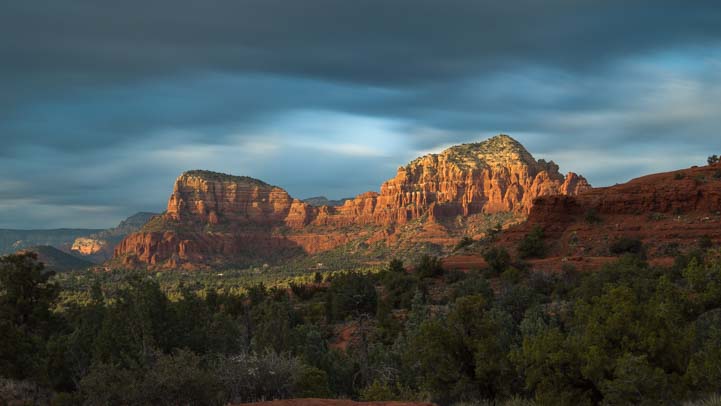
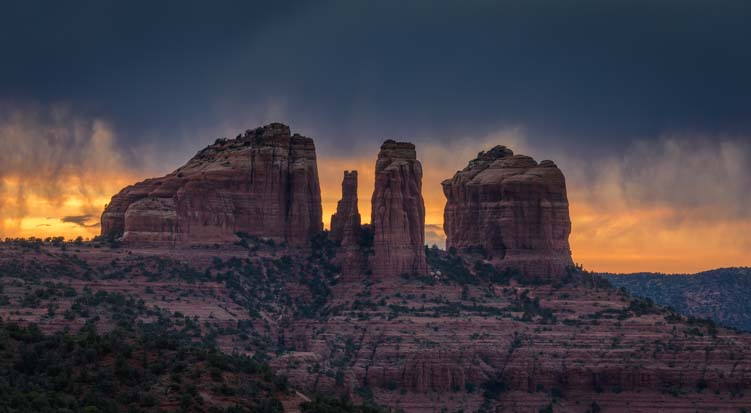
Canyonlands National Park Utah – Hiking in the Needles District!

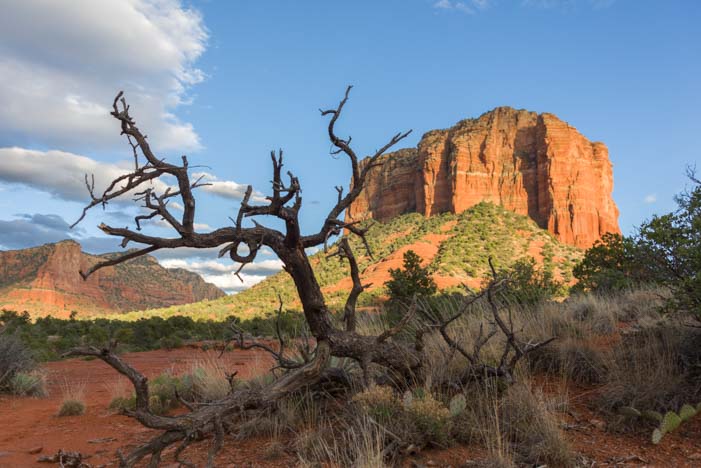
March 2016 – Canyonlands National Park is a stunning and massive National Park full of red rock hoodoos and towering red rock cliffs and wonderful hikes.

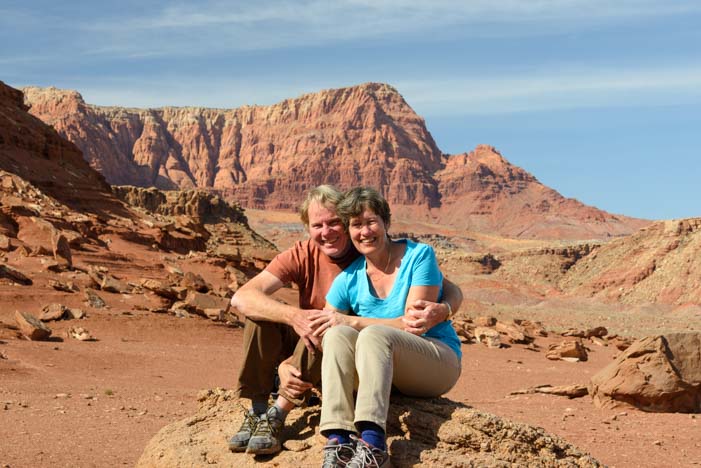
Happy Hikers Canyonlands National Park Needles District Utah

We’d often heard about Canyonlands National Park and were excited to get here at last.

There are three districts within the Park, two of which can be accessed by car on a paved road: the Needles District in the south and the Island in the Sky District a 100 mile drive around the park to the north. After our brief stop at Newspaper Rock outside Monticello, Utah, we continued on the same road about 25 miles further north to the Canyonlands southern entrance at the Needles District.

Red Rocks Canyonlands Needles District Utah

Just standing in the parking lot at the trailhead our cameras began to click!

As we stopped at the entrance station to flash our pass and get maps, Mark joked with the attendant who had been making change and issuing passes to a line of cars all day long.

“So, this is what a degree in Forestry gets you…” Mark winked. “You might as well be working at fast food joint!”

The ranger gave him a wry smile. “Actually, it’s even better than that.” He said. “I have a master’s degree in Geology.”

We both got a chuckle out of that, but we understood exactly what he meant when went on, “All my colleagues are in Houston making six figures. But guess who’s jealous of whom?!”

Log Canyonlands Needles District Utah

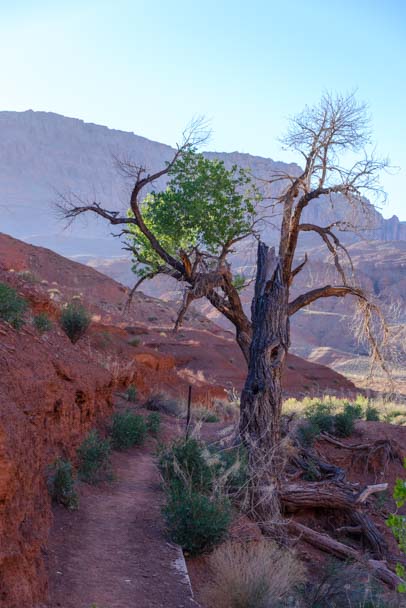
All along the trail there were fabulous gnarled limbs and logs that were bleached by the sun.

We found out later that this ranger does a Night Sky lecture that is really awesome, but we were there for a daytime hike. He recommended we do the Chesler Park hike, and before we even got the truck parked at the trailhead, we were already immersed in red rock beauty.

This is a 6 miles out-and-back hike that is loaded with fabulous scenery right off the bat, so whether you go the whole distance or do just a small bit, it is really rewarding.
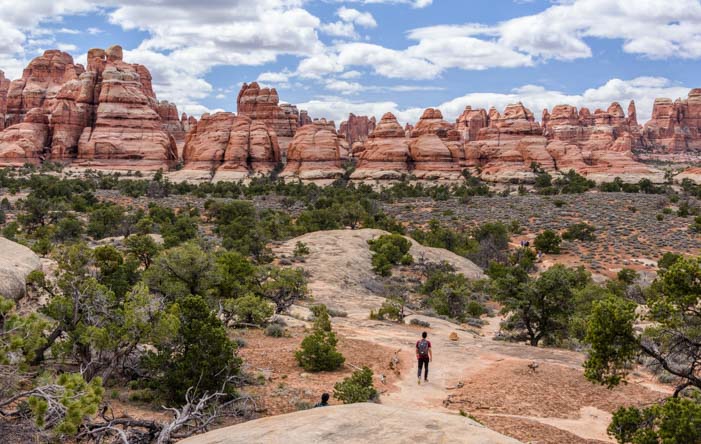
Needles District Canyonlands National Park Utah

On the Chesler Park hike, the scenery is awe-inspiring as soon as you begin.

Right from the get go, after a fairly steep bit of climbing, we were within range of the “needles” red rock formations that give this area its name. Along with the spiky needles, we were surrounded by cool rock formations of all kinds, and it was really tempting to stop hiking and just play in the rocks.

Playing in Canyonlands Needles District Utah

So many cool rock formations lured us off the trail, we found it impossible to stay on the trail!

The sandy dirt trail is very clear and easy to find in spots.

Hiking Trail Canyonlands Needles District Utah

In places the trail was a thin ribbon of sand.

But in other places it wanders off across vast flat rocks. Fortunately it is very well marked with little rock pile cairns.
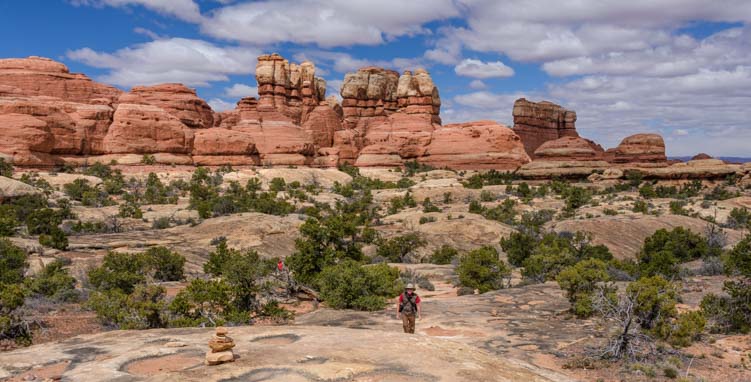
Chesler Park Hike Canyonlands Needles District Utah

The trail wandered off over the boulders, kept in check only by the rock cairns rangers had built for hikers.

The fun thing is that there are hundreds of places to sneak off the trail and explore.
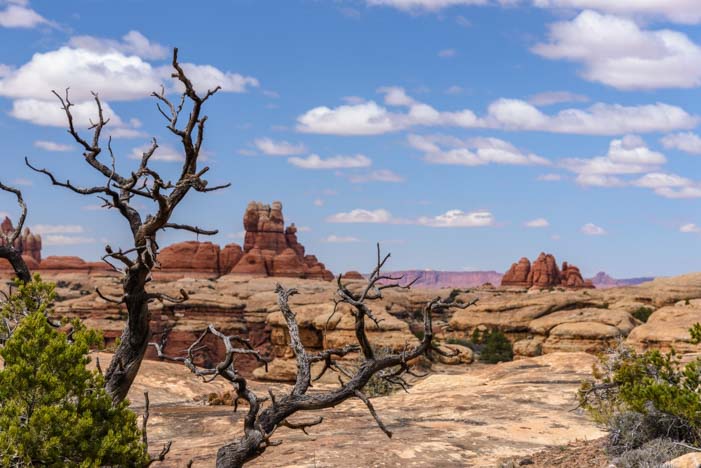
Gnarly Tree Chesler Park Hike Canyonlands National Park Needles

The views were inspiring in every direction.

As we followed the trail, continuously tempted by things that were off the trail, it occurred to me that you could do this hike a dozen times and have a totally difference experience each time.

Hiking Canyonlands Needles District Utah

Some rock formations resembled spires.

The “needles” stand in neat rows, and some rows are more needle-like than others.
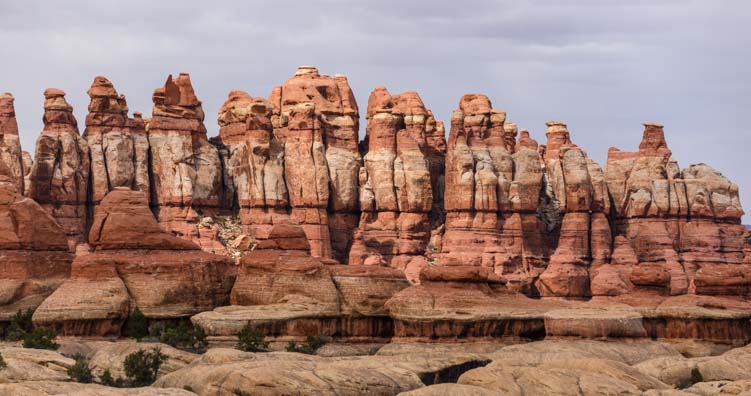
The Needles Canyonlands National Park Utah

Suddenly we found ourselves standing among the needles themselves.

Canyonlands National Park Needles District Utah

The needles rose up hundreds of feet in the air.

The sky was filled with clouds, and the sun played with the rock formations, alternately shading them and lightening them up.

Trail to Chesler Park Needles Canyonlands National Park Utah

The entrance to Nature’s Cathedral…

Chesler Park Hike Canyonlands National Park Utah

.

I was caught up by the incredible vistas of rock formations standing all around us, but Mark looked down at his feet and noticed some beautiful wildflowers.

Wildflowers Canyonlands National Park Utah

While I gazed at the mammoth rock faces, Mark noticed the little smiling faces of wildflowers at his feet.

We had been enjoying all kinds of different scrambles here and there as the trail wandered in and around the rock formations. Then, suddenly, the trail descended into a slot.
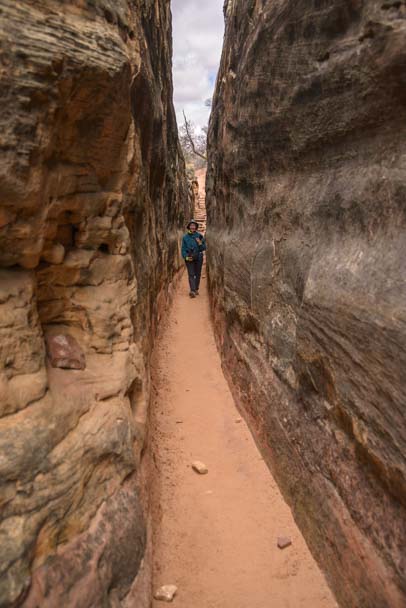
Skinny slot Canyonlands National Park Needles Utah

We shimmied through a skinny slot.

It was just wide enough to fit a person. We love little slots like this.

Slot Canyon Chesler Park Hike Canyonlands National Park Needles District Utah

This was fun!

It wasn’t very long, though, and soon we were out at the other end. We took a break under an overhang.
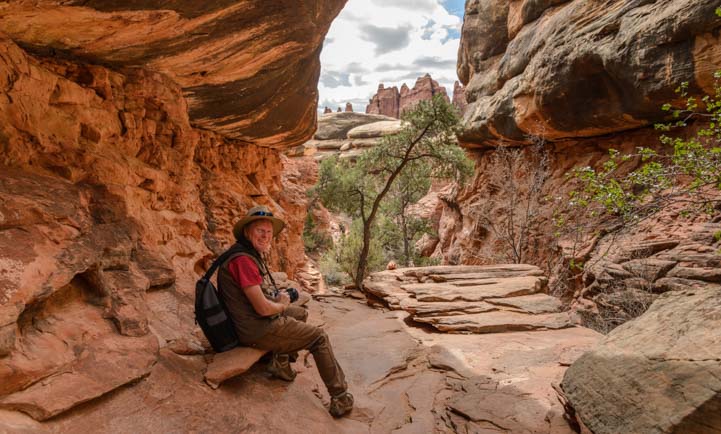
Resting on Chesler Park Trail Canyonlands National Park Needles District

At the other end of the slot a huge rock overhang stretched over us.

We were both going crazy taking photos. Back in the rig, Mark played with one of his in black and white. Cool!

Old time photo Canyonlands National Park Needles District Utah

.

We turned around to retrace our steps and saw the needles from another vantage point. What a spectacular area.
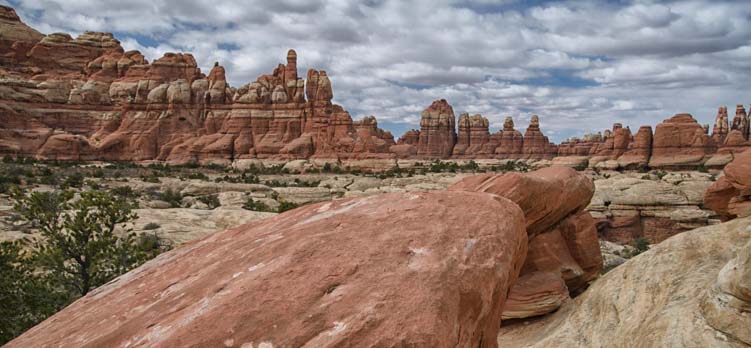
Red Rocks Needles Canyonlands National Park Utah

.

This is a popular hike, and as we walked back we saw dozens of people of all kinds starting out. It’s a great hike for all ages. Lots of families had brought little kids who ran around on the trail, and older couples came with hiking sticks. We even saw a young couple doing the hike as a trail run. Wow!

Chesler Park Hike Canyonlands National Park Needles District

Hikers of all ages love the Needles!

When we passed a woman carrying a little while pooch with pink and purple ears, we knew we’d seen it all.

Dog on hiking trail Canyonlands National Park Utah

Even stylish pooches enjoy an outing on this red rock trail.

The Needles District of Canyonlands is stunning, and there are hikes galore. Lots of families were camping there for Spring Break (and more than a few mentioned having been caught in the snow in their tents a few nights back like we were).
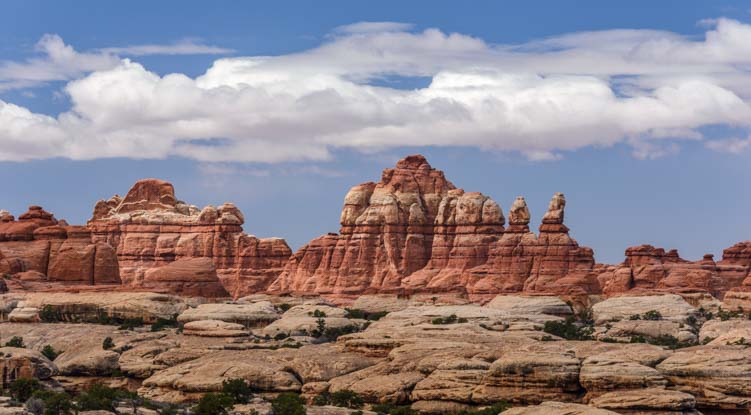
Needles Red Rocks Canyonlands National Park Utah

The Needles District is said to be the more beautiful and less touristy side of Canyonlands National Park.

On the way in and out of Canyonlands National Park, there is a tiny homestead on the west side of the road that begs for exploration.

Tiny house homestead Canyonlands National Park Needles District Utah

We found an abandoned cabin just outside the park. Our “tiny house” on wheels is bigger than this!!!

This little cabin couldn’t have been much more than 250 square feet. We couldn’t resist poking around for a bit.

Tiny house antique homestead Canyonlands National Park Needles District Utah

I could barely stand up straight inside!

“Tiny houses” are very popular these days, and lots of people want to downsize into minimal square feet, whether on a foundation or on wheels. Imagine living in this wee cabin, miles from nowhere, during the winter. To stay cool in summertime, it even had an outdoor fireplace!

Tiny house outdoor fireplace hearth Canyonlands Needles Utah

The summertime fireplace was just beyond the front door.

If your RV travels take you through southeastern Utah, it is well worth the detour to visit both Newspaper Rock and Canyonlands, to check out the intriguing sites in between, and especially to do the Chesler Park hike into the Needles red rock formations!

More info and links below.

Subscribe
Never miss a post — it’s free!

More info about Canyonlands National Park:

Other blog posts from our RV travels in Southeastern Utah:


Our most recent posts:

More of our Latest Posts are in the MENU above.

<-Previous || Next->

Edge Engine Tuner => Max Truck Power!! (Escapees Mag Feature!)

A few years ago we installed an Edge Evolution diesel tuner in our truck to give it a little more power in the mountains and to increase our fuel economy a bit when not towing. This super easy DIY project turned out to be really worthwhile. We picked up 1-2 miles per gallon in fuel efficiency, and we got some extra horsepower and torque when climbing the Rockies and the Smokies with our trailer in tow.

Escapees Magazine Engine Tuners Mar-Apr 2016 Emily Fagan

Escapees Magazine – March/April 2016 Issue
Article: Engine Tuners by Emily & Mark Fagan

The March/April issue of Escapees Magazine features our article about the Edge Evolution Diesel Tuner. We have also written extensively about our Edge Tuner on this website, and you can read our blog post about it here:

Edge Evolution Diesel Engine Tuner – Peak Truck Performance!

Engine tuners (or “programmers”) are electronic components that modify the input parameters for an engine’s on-board computer. An engine tuner makes it possible to operate the truck with settings that are optimized for specific driving conditions.

So, whereas the factory settings on a Dodge Cummins engine in a Ram 3500 truck make the engine run pretty well in all conditions (towing, not towing, highway driving, mountain driving, etc.), an engine tuner will operate the engine with settings that are optimized for just one of these situations at a time.

If you will be towing a heavy trailer in the Rockies, you can program the tuner specifically for that kind of driving. If the truck won’t be towing anything for a while, you can program the tuner to maximize fuel economy.

We have used just two of the modes on our Edge engine tuner, Level 1 (“Economy”) and Level 2 (“Towing”).

In both cases we have seen an improvement in miles per gallon. In the towing mode, we’ve also found the increased power is significant. On the freeway this means it is easier to get up the speed to pass a slower moving vehicle. In the mountains it means the truck can get up steep inclines more easily.

There is a mode on the Edge Tuner that puts the truck into “stock” mode, effectively changing all the engine’s input parameters back to their factory default settings. It is also easy to disconnect the tuner all together. So, installing an Edge engine tuner is a non-destructive upgrade. The tuner is there for you if you want to use it, but you can easily opt not to use it too.

When we bought our the simplest programmable model, our 2007 Dodge Ram 3500 single rear wheel long bed truck had 85,000 miles on it. We drove the truck 20,000 miles with the tuner installed, and we were very happy with the performance. This past December we upgraded to a 2016 Dodge Ram 3500 Dually long bed truck, and we have just installed an Edge tuner on it as well.

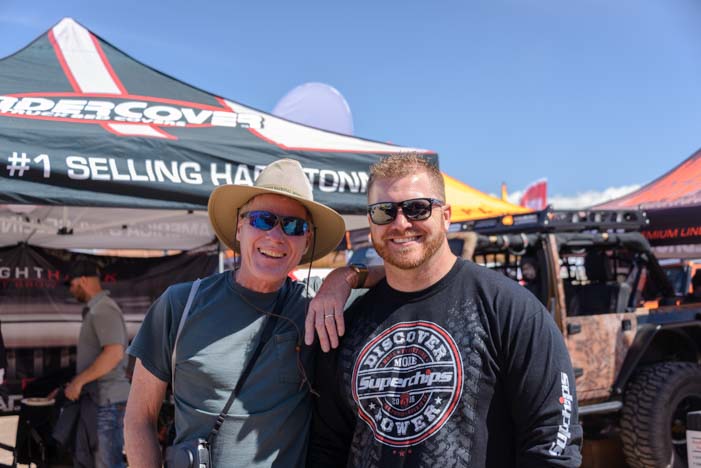
We recently bumped into the Jeep Safari Week in Moab, Utah, and while we were wandering around the booths looking at all the cool gear for Jeeps, we suddenly saw the Edge Products trade show booth. We went over to chat with the team and tell them about our installation. We met Jared Venz, one of their marketing guys. How cool is that?!

PowerTeq Edge Products tradeshow booth at Moab Jeep Safari event

Mark found a fellow diesel motorhead buddy in Jared Venz of Edge Products when we bumped into
the Edge Products / Superchips team at the Moab Jeep Safari event!

When we got our first Edge tuner, we chose the simplest programmable model, because we weren’t sure if a tuner would be a worthwhile upgrade. This time around we got a more sophisticated model. With all the products laid out on their table in boxes in front of us, Jared helped us understand the overall product line. Here it is in a nutshell:

There are three types of Edge tuners:

Insight – The most basic model that simply displays the engine data that is coming from the engine computer’s outputs. It does not have the ability to change the engine’s parameters or program it in any way .

Evolution – This model can modify the input parameters to the engine’s computer and also displays key data like the Transmission Fluid Temperature and Engine Coolant Temperature. It also indicates when the truck has gone into a “Regen” to burn off the particulates that have built up in the engine’s particulate trap (part of the “Blue Tech” 2010 EPA requirements for diesel engines).

Knowing the truck is in a Regen is especially useful, because the coolant and fluid temperatures increase, and there is a slight loss of power, but there is no indicator on the truck dashboard to show when one is happening. We found it very helpful with our old Edge Tuner to know exactly when a Regen was going on.

The Edge Evolution tuner uses the truck engine’s input port to modify the engine’s input parameters. So, the installation is very easy. A single cable plugs into that input port (the OBD II port on Dodge Ram trucks). However, in order to change from one programming mode to another (for instance, from Level 1 (Economy) to Level 2 (Towing), the truck must be parked and you have to go through a series of steps that take a good 5 to 10 minutes.

Juice with Attitude – This top of the line model has an additional computer module (the “juice”) that makes it possible not only to adjust the input parameters on the truck’s on-board engine computer, but also allows you to change modes on the fly. So, rather than having to stop and reprogram the tuner to change from Level 1 to Level 2, you can hit a button and make the switch instantly. For instance, if you are towing and want to unhitch to go drive somewhere without the trailer, you can change modes simply by pressing a button.

However, the installation is more complex, because the “juice” computer that is part of the tuner must be wired into the truck engine’s on-board computer via two wiring harnesses.

There are also two display options for each Edge tuner model:

The smaller and more simplistic display has a monitor screen that is 2.4 inches wide. The Edge tuner models that use this smaller screen have “CS2” in the model name.

The larger, more sophisticated and detailed display has a monitor screen that is 4.3 inches wide. The Edge tuner models that use this bigger screen have “CTS2” in the model name.

The final two digits in the model number distinguish between the various truck makes, models and years.

The Juice with Attitude model is available only in the large monitor screen size.

The basic model breakdown is:

  • Insight (Data Display Only – no engine programming capability):
    Insight CTS2 (large screen) vs. Insight CS2 (small screen)

  • Evolution (Engine programming, easy install, manual mode switching):
    Evolution CTS2 854xx (large screen) vs. Evolution CS 851xx (small screen)

  • Juice with Attitude (engine programming with mode switching on the fly and more complex installation):
    Juice with Attitude (large screen only)

Because each diesel truck manufacturer uses a different engine (Dodge has Cummins, GM products have Duramax and Ford has Ford built engines), the tuners come in different models for each truck engine. There is some variation between truck model years as well.

We’ve chosen the Edge Juice with Attitude engine tuner for our 2016 Ram 3500.

Our article, “What Puts You in the Driver’s Seat? Engine Tuners!” is the latest feature article of many that we have contributed to the Escapees RV Club member magazine since 2008. Escapees is a very varied RV and travel club that touches on all the possible concerns and interests that full-time and seasonal RVers have.

Back when the club was first started in 1978, there were no RV clubs that catered specifically to the needs of full-time and extended-travel RVers. Escapees began as a simple bi-monthly newsletter to bring full-time RVers together and to give them a place to share ideas and pass on information.

Today, the bi-monthly Escapees Magazine is one of the most informative and fun to read magazines in the RV industry.

Escapees Magazine covers

Escapees Magazine covers on display in the mail sorting facility at Escapees HQ in Livingston, Texas

We became Escapees members a few months after we started full-time RVing, and we feel that anyone interested in using their RV for extended periods of time should consider becoming a member too. Besides receiving the wonderful magazine for free, members receive discounts of up to 50% at participating RV parks.

In addition, Escapees RV Club offers a wide range of overnight parking options at its own various RV parks, from overnight accommodations to seasonal stays to long term leases to ownership, and they offer a list of boondocking locations via the Days End Directory subscription.

Escapees also hosts a very informative online forum, RVnetwork.com. The participants in this forum are often very experienced RVers, and although non-members can read the forum, only Escapees members can join in the conversation or ask questions. For new RVers, Escapees hosts Boot Camp events where folks learn All Things RV, and each year Escapees puts on a huge rally called Escapade where members from every corner of the country come to share experiences, socialize and learn from each other. Younger Escapees also gather at Xscaper Convergences.

This coming summer, from July 24-29, there will be an Escapade Rally and Xscapers Convergence in Essex Junction, Vermont. Just before that, from July 21-23, there will be an Escapees Boot Camp for New RVers.

To learn more about Escapees and perhaps join the club (we highly recommend it), you can click here:

Join Escapees RV Club

Subscribe
Never miss a post — it’s free!

More info:

Related posts about our truck and trailer upgrades:

Our most recent posts:

More of our Latest Posts are in the MENU.   New to this site? Visit RVers Start Here to find where we keep all the good stuff. Also check out our COOL NEW GEAR STORE!! *** CLICK HERE *** to see it!

Newspaper Rock Utah – Petroglyphs and Rock Art from the Ancients

March 2016 – The one thing about desert camping is that it can get very dusty when the wind blows. And out in the desert, once the wind picks up, there is little to stop if from howling. A rule of thumb we’ve heard is that if it is windy one day, it will be windy for three days.

During our stay in the Valley of the Gods and Goosenecks State Park region of southeastern Utah the clouds gathered steadily each day, and then the wind pick up. Oh my, how the dust was flying. It was in our eyes and our noses and in everything in our rig. We packed it up and hightailed it out of there to the north as fast as we could.

Of course, every region has their own manifestation of bad weather, and the dusty wind storms in Valley of the Gods morphed into threatening dark storm clouds outside of Monticello.

Storm Clouds in Utah

Dust storms give way to menacing storm clouds as we climb in elevation.

Temps plummeted from 80’s in the desert to the 40’s near Monticello and were rapidly dropping as we climbed in elevation to the pine forests. Storm clouds were gathering overhead and the world suddenly looked very ominous.

We looked around, and suddenly, in unison, we both blurted out: “It looks like it’s gonna snow!”

We laughed at this absurd nortion, but I checked the weather forecast on my laptop anyway. My eyes flew open when I pulled up the forecast for Monticello, Utah.

“It IS gonna snow…in the next hour!!!”

Snow on RV in Canyonlands National Park Utah

OMG – It’s snowing!

And snow it did. As the skies turned black and the wind picked up and the temperature fell further, we found a place to hide for the night.

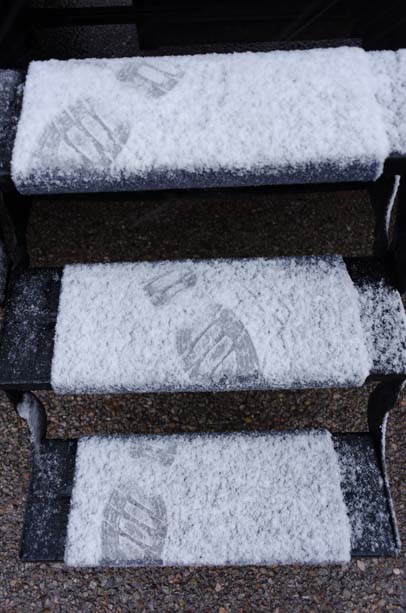
What a shock it was to see the snow flying thickly around us. It began to pile up on everything, from the trees and leaves to our bike seats on the bike rack on the trailer to our front door steps.

Snow on RV steps in Utah

One small step for an RVer…

The next morning we were in an icy winter wonderland!

Fifth wheel RV in snow in Utah

Who ordered this? I don’t know, but if you can stop shivering it’s very pretty!

It didn’t last, though. In no time at all the snow melted and we were on our merry way. We had come into the high country of eastern Utah to visit Newspaper Rock, a fabulous rock art panel that appears to be just what its name implies.

Newspaper Rock is an enormous slab of rock covered in natural “desert varnish,” which gives it a dark, smooth surface, perfect for pecking out images. It stands under a natural rock overhang, just like a huge sheltered bulletin board, out in the middle of nowhere surrounded by woods and other rock cliffs.

Newspaper Rock Indian Rock Art Petroglyph Panel Utah

Newspaper Rock is the Facebook of the Ancients!

The slab is absolutely covered with ancient Indian petroglyphs and rock art.

Newspaper Rock Ancient Indian Petroglyph Rock Art Panel in Utah

What a cacophany of conversations!

Apparently, the older art on Newspaper Rock is attributed to ancient Puebloan Indians who lived in the area for 1,600 years, from 100 B.C. to 1540 A.D. The more recent rock art on the panel is thought to have been created by the ancestors of the Ute people who still live in the area.

Newspaper Rock Art petroglyph panel Utah

If you look closely, there are all kinds of crazy and fun images here.

We were mesmerized by all the different images. They are packed in tightly, with animals and odd looking creatures and images of hands and feet and geometric shapes all crammed together. There’s barely an open inch anywhere on the panel.

Another woman and I excitedly pointed out various images and even possible stories to each other. There was the weird snake charmer guy who wore a fancy horned headdress and fringe leggings and had a very curvy snake crossing right over his neck. All around him were frolicking horned animals, bison, a four toed foot and another guy with a horned headdress.

Ancient Indian Petroglyphs Newspaper Rock Utah Mixture

With horns on his head and fringe on his legs, this guy has a snake winding across him!

In another area there was a very clear image of a hunter shooting an elk or a deer. He had a bow and arrow and the animal had a huge rack of antlers on its head.

Right above this image there were two odd looking space alien creatures. Each had horns, of two different types, and one had four fingers on each hand while the other had only three. Their bodies (or clothes) were very boxy and they had impossibly short legs with no feet.

Hmmm…

Around them were images of feet with only four toes as well as a spoked circle that looked like a wagon wheel.

Petroglyphs Newspaper Rock Utah Elk hunt and people with horns

A hunter on horseback aims at an elk, but who are those chunky guys with horns on their heads?

I find this three, four and five finger and toe thing fascinating. Some rock art depicts the modern day number of human fingers and toes and some just doesn’t. I doubt these people had trouble counting. Scientists working with African Grey parrots have proven they can count to seven very easily. I think there must have been another reason they omitted the toes and fingers — but what was it?

The amazing thing about petroglyphs like these is that they are pecked out of the rock. It isn’t easy to peck this rock. All over the American Southwest there is rock art that has been vandalized with graffiti in the last 200 years, and none of the graffiti comes close to the quality of the original rock art.

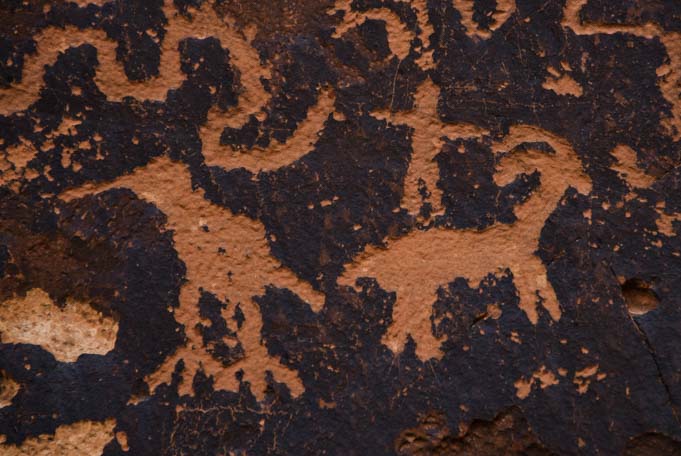
In another part of the panel four horned animals are marching in a row. Three are alike, but the one behind them is bigger and looks like it might have been created at a different time. They look a little like Santa’s reindeers!

Next to them is a flying squirrel caught mid-flight. I discovered Northern Flying Squirrels can be found in the conifer forests in Utah, so there he is on the rock art panel!

Petroglyphs Rock Art Newspaper Rock Utah Herd of deer

A deer track and then a line of deer like Rudolph, Dasher, Prancer and Vixen.
Graffiti in the upper left area barely penetrates the “desert varnish” of the rock.

Two other images of flying squirrels are prominant on this panel. One has a Superman S on him and the other has three fingers on each hand!

I imagine the flying squirrel had significance to the ancient people who pecked these images on the rocks. I couldn’t find any Ute or western Indian references to flying squirrels, but several eastern Indian tribes have flying squirrels in their folklore.

Beneath them is the ever-present foot — with 5 toes.

Newspaper Rock Petroglyph rock art Flying Squirrels Utah

Flying squirrels, one with a Superman S on his chest and the other with 3 fingers on his little hands.

Hands and feet are everywhere on this panel of rock art petroglyphs, and in one section it is a veritable track of two people wallking up the rock, a larger person on the left and a smaller person on the right. Some have four toes, some have five and a Very Large Person to their left sometimes has six!

A graphic artist or characature style hand outline also appears above some feet.

Feet and hand petroglyphs Newspaper Rock Utah

Tracking the human race with a bigger person and a smaller person together and a Very Big Person to the left.
What about that cool hand?!

Nearby there are two very cute and small deer, each with a very elaborate pair of antlers on his head.

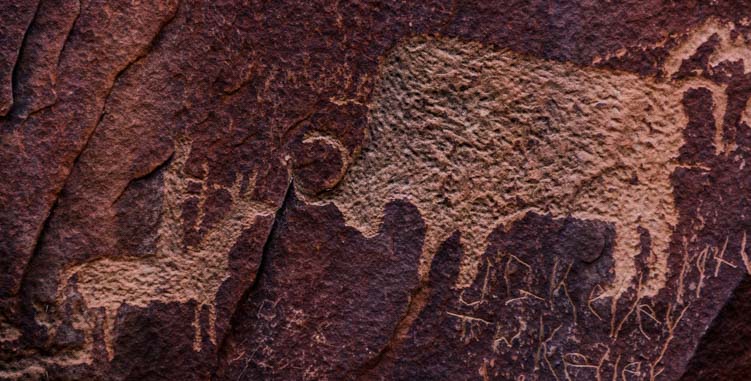
Below them is a bison that has the same outline styling as the hand in the previous image.

Rock Art Newspaper Rock Utah with deer, foot and bison

A slick bison outline and two deer with very intricate and mature antlers

Bison are very popular on the Newspaper Rock art panel. One image near the bottom of the panel shows a hunter on horseback with a bison. This image is in the lighter color that the Bureau of Land Management says is more recent rock art dating to some time after 1500 AD.

Buffalo roamed all over the North American continent for thousands of years, and many Indian tribes were totally dependent on them.

In 1840 there were 60 million free roaming bison thundering across America. By 1886, 46 years later, there were fewer than 100. They all died at the hands of hunters who were encouraged by the US Army, as they knew the extermination of the buffalo would be the end of the Indians. Buffalo hide also became more popular than cowhide in the eastern states and in Europe, and an average hide hunter could kill 60 bison in a day.

Newspaper Rock Art petroglyph Utah horseback hunter and bison

Buffalo hunting was essential to the Indians.

One bison is depicted with cloven hooves, and it’s little details like these that make these images resemble children’s drawings where one feature or another is drawn with careful detail at the expense of other details that sometimes go missing all together.

Along with bison, those animals with the curved horns are really popular images at Newspaper Rock. They are commonly referred to as Big Horn Sheep, but as I noted in another post about rock art in Arizona’s Saguaro National Park, the horns don’t resemble big horn sheep horns at all. Oh well. They are a mystery bovine!!

There is also a creature with a wide tail, perhaps a beaver, and animal which was once abundant throughout Utah.

Petroglyph rock art at Newspaper Rock Gazelle, bison and beaver tadpole

This buffalo has cloven hooves, and is that a beaver near him, or something else?

There is also a very cool bird with a long beak standing near a horned animal and a very small person.

Bird petroglyphs Newspaper Rock Utah

A very birdlike bird, a horned bovine and a small person here.

Some of the imagery is geometric and some is, well, who knows what it is. There’s also a difference in pecking skill when it comes to creating these images on the rock panel.

Rock art Newspaper Rock Utah Deer, feet geometric designs

Some images are obvious while others a little obscure.

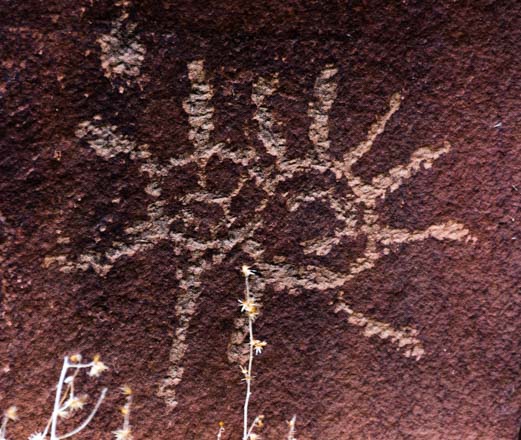
Down near the grass there’s an intriguing double sun that appears to have something inside it.

Newspaper Rock Art Utah Twin Sun Design

A double sun. There is something wonderfully mystical about this.

I loved studying all these crazy images. What do they mean and why were they on this particular rock? There are millions of square feet of smooth flat rock walls covered in desert varnish throughout Utah where there are no petroglyphs. And then there’s a place like this that is packed to the gills with images from different people of different eras.

A newspaper indeed!

One of my favorite images was one I spotted just before leaving. It is a ladder with three fingered hands at the top. What the heck?! Nearby is a guy with his three fingered hands in the air. He sports a tail and horns.

There are also some deer tracks marching right throught the image from bottom to top, and a doodle that looks like a flying saucer or satellite.

Petroglyphs Newspaper Rock Utah Ladder with hands

A ladder with hands, some bizarre shapes, a few feet, and deer tracks running through it all.

In the bottom right is a very elaborate paw print, complete with claws. There are an aweful lot of toes on that paw. Maybe it’s a flower!

Newspaper Rock is a fantastic roadside stop for RVers and other travelers heading into the southern Needles District of Canyonlands National Park. It is right on the way in to the National Park, and it is without doubt the best rock art we’ve seen anywhere.

When we were there after a snowstorm in late March there was hardly anyone there because it was absolutely freezing. But I imagine in warmer seasons the place can get insane because the parking lot is not very big and there are signs up and down the sides of the road before and after the site saying, “No Parking.”

Note: Newspaper Rock is within the boundaries of the 3,000 square mile parcel of land that the Navajo Indians and 25 other tribes have asked the public land agencies to convert into Bears Ears National Monument. It is currently a State Historical Monument managed by the BLM. More info at this link.

Subscribe
Never miss a post — it’s free!

More info:

Related posts from our travels about the Rock Art of the Ancients:

Our most recent posts:

More of our Latest Posts are in the MENU above.

<-Previous || Next->
Valley of the Gods & Goosenecks State Park, Utah – Beautiful!

March 2016 – Just over the border of Utah and Arizona at the eastern edges of the two states, a few miles north of Monument Valley, lies a fabulous scenic drive through an area called the Valley of the Gods.

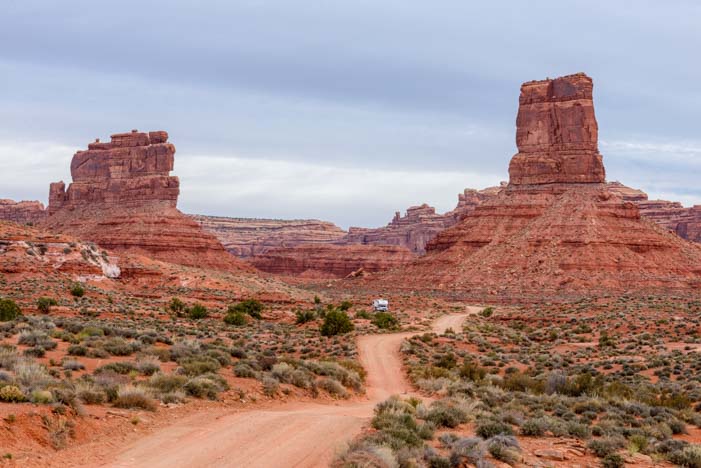
RV motorhome at Valley of the Gods Utah

Many RVers explore the Valley of the Gods on their way through the eastern AZ/UT region.

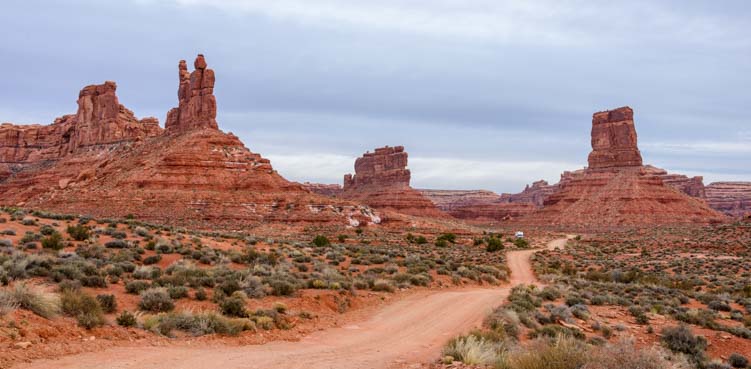
This is a 15 mile or so dirt road that winds through incredible rock formations.

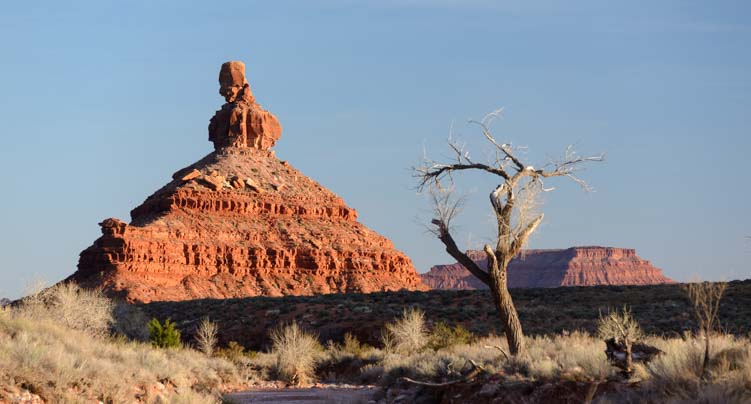
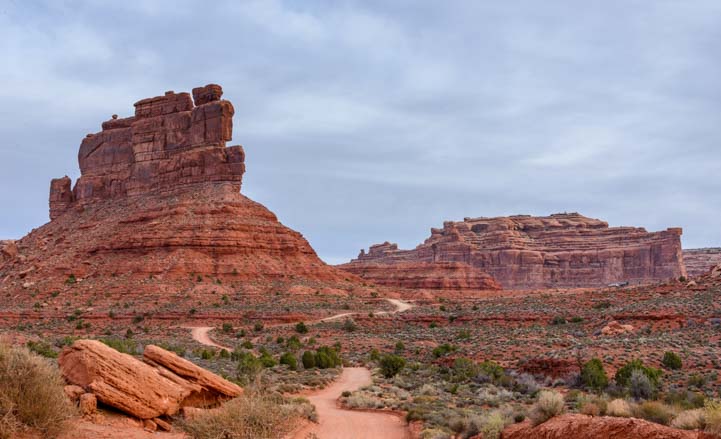
Valley of the Gods rock formations Utah

The “golden hour” before sunset is a wonderful time for photography here.

Some of the rocks formations are reminiscent of the famous ones at Monument Valley, but this area is much smaller and much less visited.

Red rock formations Valley of the Gods Utah

A hand with a thumb similar to the more famous rock formations of Monument Valley!

It is a wonderful drive to do at any time of day, but sunrise and sunset are when the colors really jump out.

Tree at Valley of the Gods Utah

.

When we were there in late March, we had the whole place to ourselves as the sun was dropping low in the sky.

Camping at Valley of the Gods Utah

What fun!!

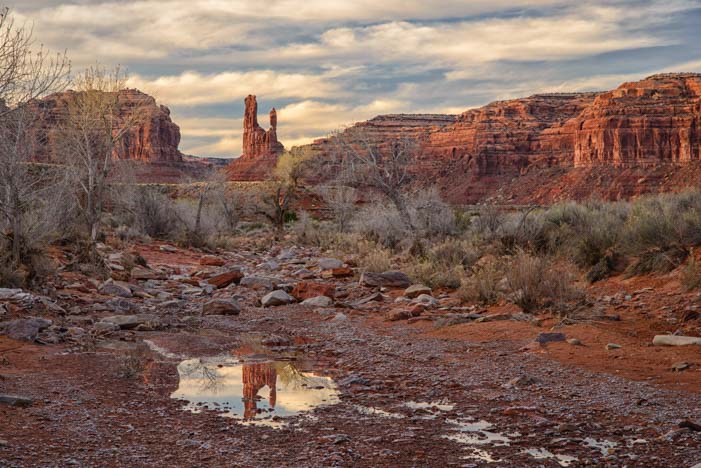
This is a parched desert land, but it had rained in the past few days and there were still puddles on the ground that made for some fun reflection photography.

Tree and rocks Valley of the Gods Utah

Recent rain left puddles that were lots of fun to photograph.

Reflections at Valley of the Gods Utah

.

Puddle Reflections Valley of the Gods Utah

.

We were hoping for a colorful sunset, but the skies darkened before any pink or red hues had a chance to form.

Truck at Valley of the Gods Utah

No sunset, but very cool anyway!

Early the next morning, we did the drive again (it is well worth driving through Valley of the Gods more than once!).

Valley of the Gods Scenic Drive Utah

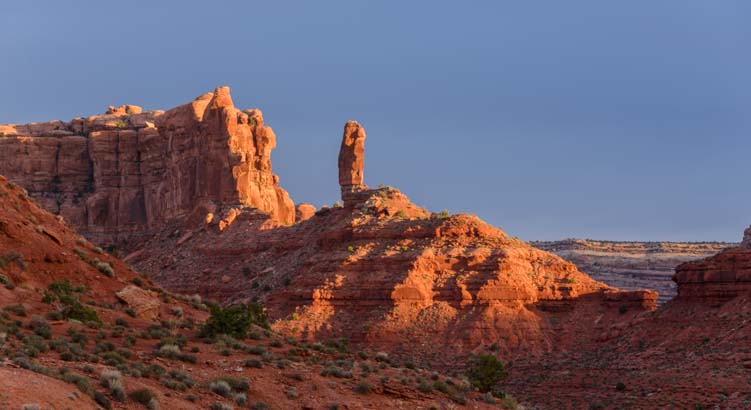
At dawn, the sun played with its shadow.

For brief periods, the sun penetrated the overcast skies and played with its shadow on the rock formations.

Sunrise Valley of the Gods Utah

The rock formations were filled with vibrant colors in the morning sun.

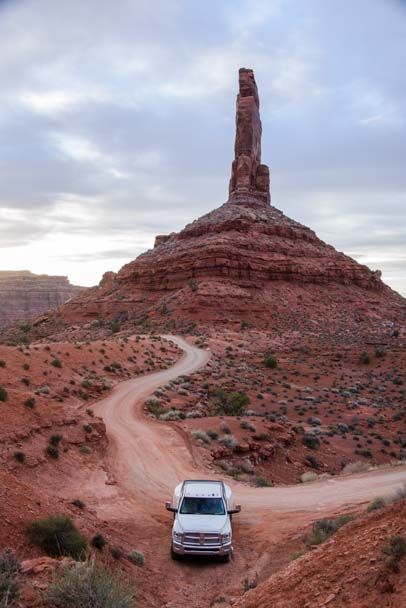
The most beautiful part of this drive is a two to three mile section in the middle where it makes a series of s-curves between the rock formations.

Road through Valley of the Gods Utah

I love curvy roads!!

Each formation is lovely, and even though the sun decided to call it quits for the day, the muted light showed off the majestic scenery without the glaring brightness and shadows cast by sunny skies.

Truck at Valley of the Gods rock formations utah

.

RV camping at Valley of the Gods utah

The sun didn’t stay out for long, but the colors were still beautiful.

Valley of the Gods Utah Scenic Drive

This is a jaw-dropping drive!

Not far from the Valley of the Gods is a phenomenal road that climbs through a series of very tight and steep switchbacks up to lofty heights. It’s called the Moki Dugway. This road was built in 1958 to move uranium ore from the Happy Jack mine to Fry Canyon.

Moki Dugway Valley of the Gods Utah

The Moki Dugway is a hair-raising drive up steep switchbacks on a dirt road. But what a view!

We climbed up the switchbacks and 10% grades in our truck. At a viewpoint part way up we watched a Class C motorhome making its way along this insanely steep road. What a brave driver!

Class C motorhome climbs the Moki Dugway in Utah

A Class C motorhome braves the Moki Dugway

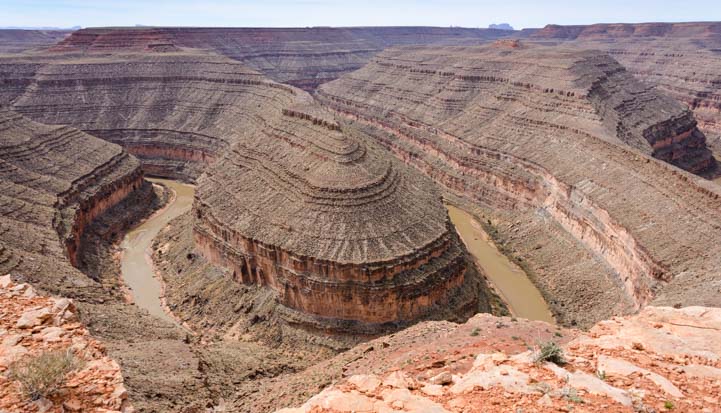
On another day we took a daytrip to Goosenecks State Park. This park is basically an overlook with sweeping views of a tight turn in the San Juan River, reminiscent of Horseshoe Bend in Arizona.

Goosenecks State Park Utah

Goosenecks State Park is a bend in the San Juan River, much like Horseshoe Bend near Page, Arizona.

I had always thought these two places were one and the same, but they are actually very different.

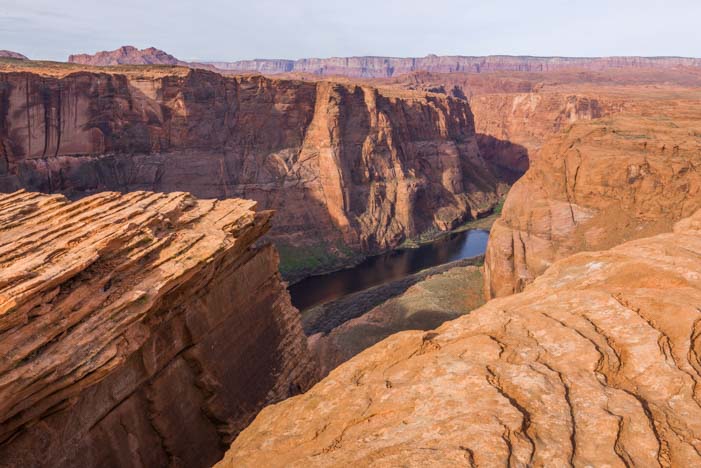
Horseshoe Bend has vast stretches of red rock sandstone slabs at the top of the rim> The Colorado River far below is blue, because at that point in its journey it has just emerged from the dam at Lake Powell. Goosenecks State Park has more of a crumble rock surface at the rim and has lots of vegetation on the canyon walls. At the bottom, the San Juan RIver is muddy and brown.

Overlook Goosenecks State Park Utah

Goosenecks State Park overlook.

Someone had placed a bunch of stones in spiral near the edge.

Rock Circles Goosenecks State Park Utah

What is this? Some strange meditation ring? A tourists’s artistic contribution to the state park?

Unlike the National Park Service’s Horseshoe Bend, which is overrun with thousands of international tourists and is free, Goosenecks State Park is $5 for day visitors, and $10 a night for camping on the rim, and there is hardly anyone there. When we stopped by, I doubt the daily fees were covering the salary of the gal sitting in the guard shack at the entrance!

Truck Camper Goosenecks State Park Utah

Goosenecks State Park has a handful of dry camping sites right along the rim of the canyon.

There were a few RVs parked along the rim. Some were camped in a cluster near the entrance, but one had claimed a spot far in the distance along the rim. What an incredible view out your RV window!

RV camping Goosenecks State Park Utah

Now here’s a fun spot to camp — with a view!

One RVer was enjoying the morning from his camp chair right at the edge of the overlook. How cool is that?!

RV camping on the rim Goosenecks State Park Utah

Now THAT’s a spot to put your camp chair!!

All three of these places — Valley of the Gods, Moki Dugway and Goosenecks State Park — are at the very southern end of the 3,000 square miles of Utah land that the Navajo and other Indian tribes are asking President Obama to set aside to become Bears Ears National Monument. This will protect their many ancestral archaeological sites that are scattered throughout the region. Currently, these areas fall prey to desecration and to mining and oil drilling activities.

National Monuments are under the jurisdiction of the National Park Service whose mission is the protection of national treasures. In line with their charter, the NPS usually takes a hard stance against free wheeling recreation, and they control access and use with an iron fist.

However, the land in question is currently managed by the Bureau of Land Management, the US Forest Service, and even Utah State Parks, each of which has its own unique mission, from resource extraction to recreational use to tourism.

So, this unusual proposal will require these public land management agencies to cooperate in a way they never have before. With any luck, if Bears Ears National Monument is created, recreational use like scenic driving, hiking, biking and camping will still be possible.

Subscribe
Never miss a post — it’s free!

More info about Valley of the Gods, Goosenecks State Park and Moki Dugway:

Other blog posts from our RV travels in Southeastern Utah:

Our most recent posts:

More of our Latest Posts are in the MENU above.

<-Previous || Next->

Go Cheap, Go Small, Go NOW!! Have Fun & LEARN in a Small RV

A few weeks ago we camped in Sedona, Arizona, with two good friends who own popup campers. We were reminded how much fun these little trailers can be and how much we learned in the two years we owned ours before we started RVing full-time in our first big trailer.

If you are thinking about RVing full-time sometime down the road, a year or more from now, the most valuable thing you can do in the meantime is buy a little rig and go play. There is no better way to learn about RVing than to go out and do it, and a small RV provides an awesome introduction.

You can trade in the little rig for a bigger one when you are ready to take the plunge and go full-time.

RV camping in Sedona Arizona

We camped in our fifth wheel with good friends who have two different styles of popup campers.

We owned our popup for two years and spent every possible weekend and vacation in it before we started full-timing. We towed it all over the place. It was routine for us to travel 300 miles with it for a long weekend or to tow it 1,500 miles on a week’s vacation.

Popup camper tent trailer RV

A popup tent trailer folds up small and opens up to be a nice sized rig with beds on each end.

Before we even knew what full-time RVing was, we had already learned a lot about the RV lifestyle from camping in our popup.

We dry camped in it most of the time, so we learned little things like exactly how much water we typically used in a day, and how to take a one gallon shower. We made all kinds of classic rookie mistakes as we tried to keep our battery charged, and we figured out how to “live small” and cook in a dollhouse sized kitchen.

The surprising thing is that our popup camper had many of the same basic systems as our current fifth wheel trailer that we now live in year round. It had DC lights, a propane RV fridge, 26 gallons of water, including a 6 gallon propane hot water heater, a water pump and a propane furnace. It had a shower and a two burner propane stove, and it could hook up to shore power for electricity and to a city water connection for water.

Popup tent trailer RV and campfire

Home sweet home!

It even had one thing our current RV doesn’t have: a king size bed!

There were two things it didn’t have. One was a toilet. When we bought it, we knew we’d be camping in campgrounds, and they always have toilets, so we decided that rather than give up precious space in the trailer for a toilet and have to deal with dumping it, we’d just use the campground toilets instead

It also didn’t have an air conditioner. We knew we’d be camping in places where we wouldn’t need one, so why pay for something we wouldn’t need?!

Toyota Tundra towing a popup camper

A popup trailer is small and easy to tow and fits in the garage!

The fun thing about running around in a little RV is that you can can go almost anywhere the Big Rigs go and get a taste of living a nomadic lifestyle without spending a fortune.

We took our popup camper to some wonderful RV parks and hooked up to electricity and water just like the big fifth wheels and motorhomes. We stayed in RV parks in San Diego (right on the water – wow!), and the Bay Area in California (in a cool wooded area not too far from the city), in the Moab Utah area where we bicycled in the red rocks, and in New Mexico, where we bicycled in the mountains.

Chalet and Popup tent trailer RV

Our friends have two styles of popup: an A-frame (smaller & lighter) and a tent trailer (big beds on each end)

Camping in these RV parks gave us a chance to wander around the loops and meet people that were experienced RVers. We’d talk with them about their rig, find out what they liked and didn’t like about it, and we’d get their advice for what to look for if we ever wanted a bigger RV (we had NO idea we ever would!) and we’d get suggestions for where to travel with our little popup.

We learned about full-timing, and we learned about work camping, and we discovered a world we’d never known anything about. We supplemented that education with online research and magazine subscriptions, but there is no better way to understand an RV’s systems than to use them, and no better way to understand the RV lifestyle than to live it.

Chalet folding trailer RV

This is a Chalet A-frame, and it has a twin bed, a dinette that folds into a full size bed and kitchen.
The beauty of an A-frame is it’s light enough to be towed easily by a minivan.

Lots of people email me expressing interest in going full-time and some express interest in boondocking too. These are big steps, and having as much first-hand experience as possible before you jump in is a really good idea. Online resources are great, but they are limited and only go so far.

If you haven’t done much tent camping, and you dream of camping in the wild, learning how to dry camp in a cheap, small, rolling box is a wonderful way to start. It’s a lot of fun, and it will teach you what to look for when you buy a bigger rig, and more importantly, it will help you decide if it’s something you enjoy before you make a big commitment and turn your life upside down.

Boondocking is basically glorified tent camping in a fancy rolling box.

If you are interested in solar power, you can learn all about it for just a few hundred dollars with a folding solar panel kit and an inverter. The batteries on a popup are right there on the trailer tongue. So, it’s easy to see what’s going on!

Before you go full-time, you can sell the solar panel the kit, either with the little trailer or without!

Popup Camper Moab Utah

Here’s a pretty campsite in Utah’s red rocks.

The transition to full-time RVing is a lot less stressful if you are an experienced RVer already. It’s not a requirement, and plenty of people jump right into living in an RV without ever having used one before, but I think that having hands-on experience is the best way to go.

The wonderful thing about getting a little “starter” RV and playing with it for a while before going full-time — besides all the fun you’ll have — is that the mistakes you make don’t cost much, and you haven’t got a lot at risk.

Popup camper Cape Breton Island Nova Scotia

Here’s another a great camping spot — on Cape Breton Island in Nova Scotia

If you don’t like it, you can sell it.

If you DO like it but have some unexpected repairs, they won’t break the bank and you won’t be trying to live in it while it’s being fixed.

Best of all, you can go home after every excursion and take a long hot shower, wash your clothes in your own washing machine, and you can savor your photos and your memories in the comfort of your big living room, all things that will no longer be possible once you commit to the RV lifestyle full-time.

Another great thing about a little RV is that if you have a small budget you can use it to live your full-time travel dreams.

A few weeks ago we camped next to a couple in their early 40’s who are a river rafting and white water kayaking guide (him) and a mountain biking guide (her). They live in a 17′ travel trailer, and they absolutely love it.

They boondock full-time with the seasons as their jobs move between Colorado and Arizona. The trailer is a huge upgrade for them. They lived in a tent for a few years until this past October when they bought the trailer.

Summerland Travel Trailer by Springdale

A river rafting guide and mountain biking guide love living in this 17′ travel trailer.

We’ve known a lot of 40-somethings over the years who lived in much fancier digs, with granite counter tops and sleek cars in the driveway. But they weren’t happy with their lives. It was enlightening and motivating and inspiring to spend time with these two people who had decided fifteen-plus years ago, right out of college, that they wanted to spend their days doing what they loved, even if it meant having a very simple home.

We’ve also met people living in a popup tent trailer and a half-ton pickup camper.

So, for those who think a nomadic lifestyle is out of reach financially, it just depends on how you want to live.

Our friends Rich and Mary bought our popup camper from us when we went full-time nearly nine years ago. While Rich was setting up camp, he let me take pics of the process so I could show you just how easy it is to set up a popup tent camper.

Here are the steps:

First you crank it up with a cranking tool that comes with the trailer.

Cranking up a popup tent trailer at campsite

First, crank up the roof all the way.

Popup tent trailer roof cranked up for camping

The roof is fully raised but the bed slides are still inside the trailer.

Then you pull out the bed slides on either side. Each slide locks into place in the open position.

Sliding out a bed slide in popup camper trailer RV

Pull out the bed slide at each end. In many models one or both beds is a King.

Then you put the support struts in place. While traveling, these are latched under the bed sllides. Once the bed slide is opened, just hook the end onto a latch on the frame.

Support struts for bed slide in popup camper RV

Attach the supports for the bed slide.

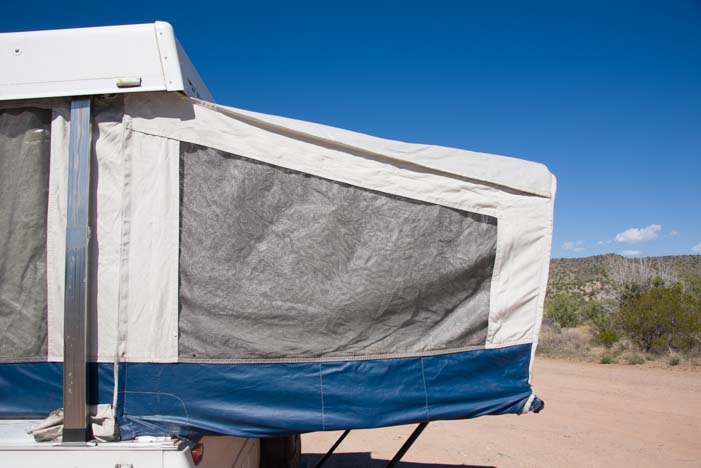
Popup tent trailer roof bed slide out for camping

The bed slide is in place but the canvas tent isn’t propped up yet.

Then go inside and remove anything that’s hogging up space. Rich stores his solar panel inside while traveling, so he takes it out at this point.

Popup tent trailer RV solar panel

Bring out whatever is stored inside: solar panel, camp chairs, patio mat, etc.

This popup camper — a 2005 Fleetwood Colonial — has a slick lower half door that folds down to become the entrance step. There are lots of designs out there, but this is common in the old Fleetwood lineup.

Setting up the door in a folding tent trailer RV

Fold down the entry step.

Popup camper trailer RV Setting up the door

.

Now remove the door from its travel spot where it is suspended from the ceiling and put it in place using the velcro strips on either side. The door and its frame are one unit, so the hinging is solid, but it stands upright in place using latches and velcro.

Door in place folding tent trailer RV

Lower the door from the ceiling and press it into place along the velcro strip on the canvas.

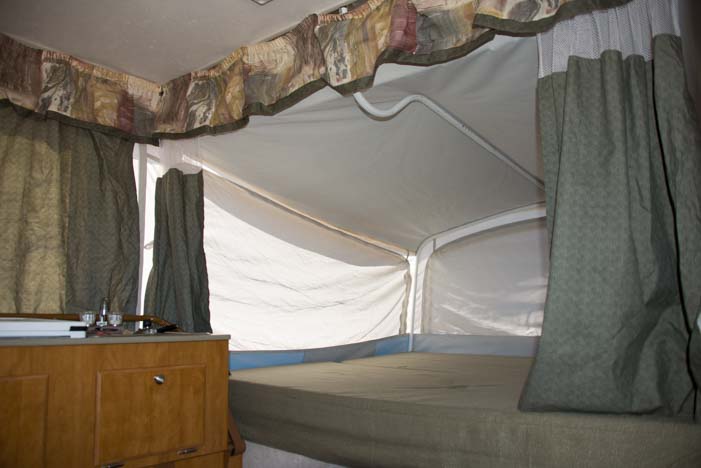
Now open up the canvas above each bed. There is a special support rod that hooks in place that holds up the center of the canvas roof over the bed and gives it its shape.

Inside popup tent trailer RV queen size bed slide

Prop up the canvas over each bed with the support rod
You can hang things from the loop – a lantern, fruit basket, whatever.

Popup tent trailer RV queen size bed slide

The canvas over the bed slide is fully opened.

Now crank down the landing jacks. These give the camper floor a bit of rigidity as you move around inside. The interior isn’t huge — it’s just a 10′ by 8′ box or so — but you can walk around. Having the landing legs down keeps the floor solid.

Cranking down the stabilizer jacks in popup camper trailer RV

Lower the landing jacks.

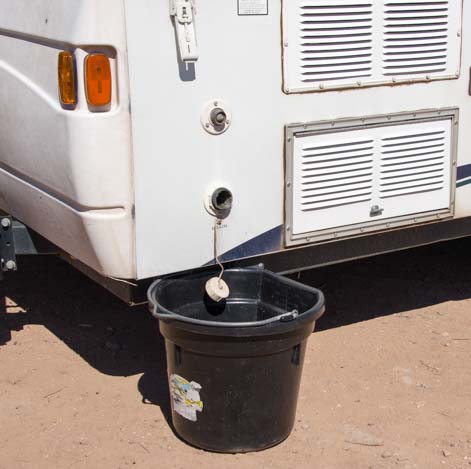
Last of all, set up the gray tank. This is a bucket outside the back of the trailer! If you want to see exactly how much water you use to wash dishes, there it is!

Popup camper gray water tank

Set up the gray water tank (this popup camper doesn’t have a toilet).

The shower is a shower wand on the back of the popup camper. We just wore bathing suits and stood on interlocking rubber mats. If you are more modest than that, you can set up a shower enclosure.

We didn’t have any kind of solar gear when we owned our popup. We used a battery charger in our garage to charge the batteries before we’d go on a trip, and that was it. We learned really quickly how to be conservative with electricity.

Rich decided to install a second battery on the trailer tongue. He also bought a solar panel and had it wired so it could be connected to the batteries easily.

Another super easy alternative is to get one of the portable suitcase solar panel kits that is designed for RV use.

You can also run heavy gauge wire from the batteries to an 800 or 1,000 watt inverter located inside the popup and then run a power strip from the inverter to a handy place in the rig so you can charge your phone or laptop or run a small appliance.

Popup tent trailer with RV solar power

Put out the patio mat, raise the awning and set up the solar panel. Done!

What a fabulous rig!!

If you are looking forward to having big RV adventures on the road someday in the future, make that “someday” be today! Go out and get a cool little RV and have a blast.

Popup tent trailers like ours are a little heavier (the GVWR is 3,000 lbs.), so both we and Rich bought Toyota Tundra pickups to tow it. An A-frame popup is lighter, because there are no bed slides, so our friend Mark tows his with a minivan.

More info and links for specific popup camper manufacturers below.

Subscribe
Never miss a post — it’s free!

Related posts about small RV living:

Popup Camper Manufacturers:

Popup Tent Trailers:

A-Frame Trailers:

Other RVing tips and tricks:

Our most recent posts:

More of our Latest Posts are in the MENU.   New to this site? Visit RVers Start Here to find where we keep all the good stuff. Also check out our COOL NEW GEAR STORE!! *** CLICK HERE *** to see it!

Navajo National Monument, Monument Valley and Bears Ears

March 2016 – The Northeastern quadrant of Arizona and a bit of southeastern Utah is the Navajo Nation, an Indian reservation that is over 27 thousand square miles. It is larger than the state of West Virginia (~24k sq. mi.). It is also larger than the states of Massachusetts, New Hampshire, Rhode Island and Delaware combined, with enough left over to add in the southern half of Vermont.

Just under 175,000 people call it home.

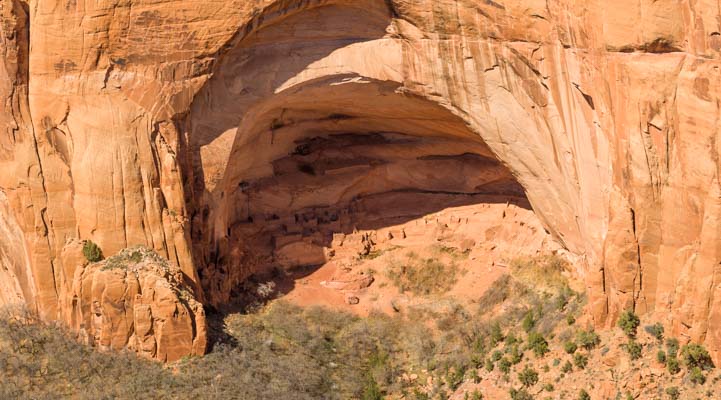
Within the borders of the northern part of the Navajo Nation, the National Park Service manages the Navajo National Monument, an area where there are some ancient Indian cliff dwellings and ruins.

Hiking at Navajo National Monument Arizona

Navajo National Monument is home to ancient Indian cliff dwellings.
One is in a cave across the canyon.

After visiting stunning Horseshoe Bend and Lees Ferry near Page, Arizona, we drove our truck and trailer across the northern part of the Navajo Nation to see Navajo National Monument.

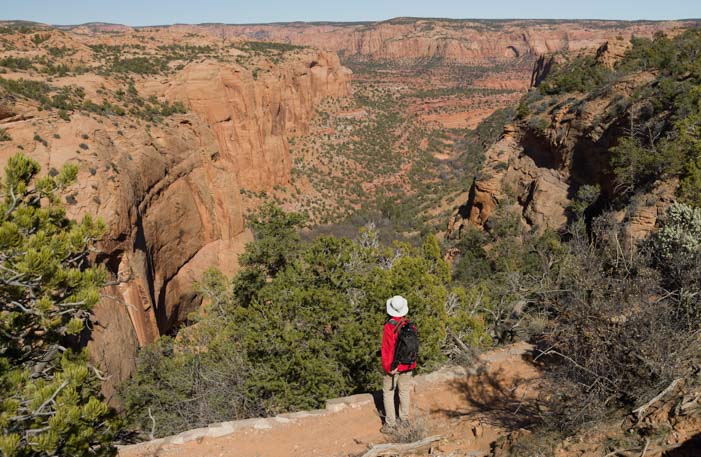
There are three short hikes at Navajo National Monument, each one progressing along the canyon rim and offering views down into the canyons. We started with the Sandal Trail which was an easy stroll on a paved path to a viewpoint at the end which looked across the canyon at the Betatakin Ruin.

Navajo National Monument Arizona

The Sandal Trail took us along the edge of the canyon to an overlook facing the Betatakin Ruins

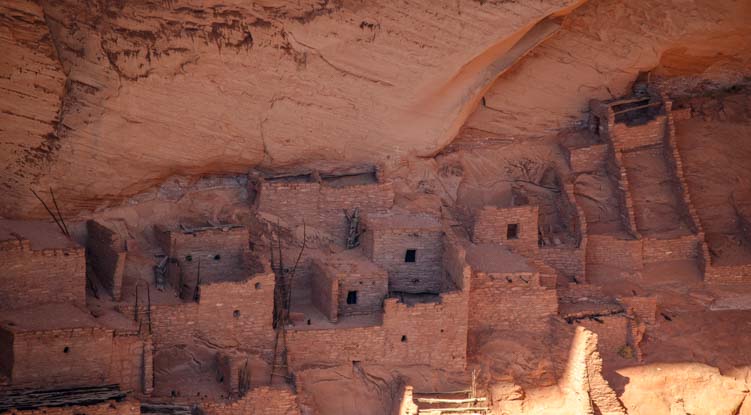
In the summers there are guided tours of these ruins, but they don’t start until May 29th, and we were there in mid-March. But the view of the ruins — with binoculars or our long telephoto camera lens — was wonderful.

Betatakin Ruins Navajo National Monument

The Betatakin ruins are in the back of this cave.

Ruins at Navajo National Monument Arizona

In the summer months you can take a guided tour of these ruins. We were there too early!

The Canyon View Trail hike gave us views of this same canyon, although there were no Indian ruins to be seen.

Navajo National Monument canyon view

The Canyon View Trail gave us different views of the same canyon.

Unlike the first two “mesa top” hikes, the Aspen Trail hike descended down into a canyon and gave us a terrific stair-stepping workout going down and then climbing back out.

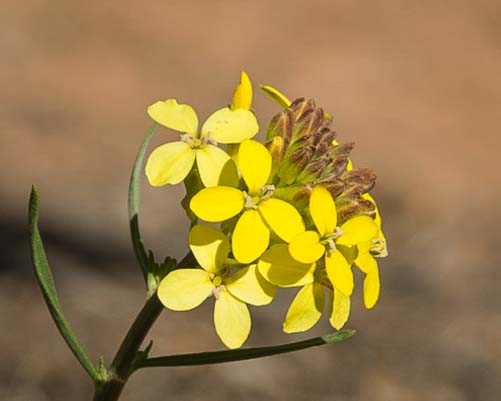
We were definitely missing the “prize” at this park since we couldn’t do any tours of the ruins themselves, but spring was in the air and wildflowers were just starting to bloom.

Spring flower Navajo National Monument Arizona

Pretty wildflowers on the trail.

There are two dry camping campgrounds at Navajo National Monument, and they are free. Only one campground was open (and only two campsites were being used!), and with some jockeying a bigger rig could fit during seasons where there is little traffic. The signs give RV size limits of 25′ to 32′, depending on the sign, not just in the campground but on the road leading to Navajo National Monument, but in reality a 35′ fifth wheel could manage in one or two of the campsites we saw (with patience). Busy summer weekends might be more hair-raising with a big rig.

This is high desert country (7,300′) so it was quite cold during our stay, but we saw a beautiful sunset.

Sunset starburst Arizona

Remote and quiet in March, we had the sunset to ourselves.

Sunset Navajo National Monument

Sunset at Navajo National Monument

Traveling northeast from there, we passed through Monument Valley, which sits on the Arizona and Utah border. This ia a vast flat plain that is dotted with towering rock formations.

The most dramatic rock formations of Monument Valley are in the Monument Valley Navajo Tribal Park in the Navajo Nation, a four mile detour east of US-191, the road we were on. We decided to save a trip there for another time, but stopped in at a Welcome Center to get some info.

At least, the building had a sign on it that said “Welcome Center!”

When I walked in the door, I expected to see racks of literature and a helpful person behind a desk. Instead, I found myself staring at the backs of several rows of people in folding chairs listening to a man giving a speech. His voice was low, melodic and wistful. And the language he was speaking was Navajo!

Monument Valley Arizona

Monument Valley is dotted with enormous rock formations

I wasn’t sure if I should back out quietly or stick around and see what this was all about. Suddenly, a woman approached me and whispered and gestured towards some pamphlets on a table. She wanted me to sign a petition.

“What’s it for?” I whispered.

“It’s a petition to create Bear’s Ears National Monument,” she said. She handed me a map and a glossy brochure.

Monument Valley selling Indian crafts Arizona

Indians sell crafts from stands on the side of the road.

It turned out that the Navajo Nation (together with 25 other Indian tribes) has approached the federal public land agencies for help protecting their artifacts, relics and ruins. They have been struggling with preventing the desecration of archaeological sites (ancient ruins and petroglyphs), and they want to phase out mining too.

The Navajo have never sought this kind of help before, but apparently they simply don’t have the manpower or the authority to protect the unique archaeological sites. So they are proposing to convert 1.9 million acres of land (about 3,000 square miles) into a National Monument.

Monument Valley Arizona

Towering rock formations in this part of the country often hide Indian archaeological treasures

The parcel of land is enormous. It is the size of Delaware plus half of Rhode Island.

It is a triangle that stretches, more or less, from a bit SW of Moab, Utah, in the north, down about 90+ miles to the Utah/Arizona border in the south, and westward about 50 miles to Glen Canyon, and then about 80+ miles back up on a diagonal along the Colorado River towards Moab.

The popular landmarks and destinations of Natural Bridges National Monument, the Valley of the Gods, Goosenecks State Park, Newspaper Rock and Manti La-Sal National Forest would all be enclosed inside the boundaries of the new National Monument land.

Canyonlands National Park and Glen Canyon National Recreation Area would border it to the west and south. The north-south highway of US-191 would be outside the eastern boundary but would more or less parallel the eastern border of the National Monument between the Moab area and the Arizona/Utah border.

You can see a map here:

Map of Proposed Bears Ears National Monument in Utah

RV at Monument Valley Arizona

This whole area is extremely popular with RVers and other travelers

This proposal is unique because it requires cooperation between several different agencies that manage public land, including the US Forest Service, Bureau of Land Management, and National Park Service, all of which manage portions of the land parcel already (most of the land is currently under BLM management).

The organization that is behind this and that was making presentations and gathering signatures to present to President Obama when I walked in the door is called Utah Diné Bikéyah. “Diné” is the Navajo word for the Navajo people.

I spoke briefly with Gavin Noyes, the Executive Director. He explained that this has been in the works for a few years and that the hope is that Bears Ears National Monument will be created by President Obama before his presidency is over.

He explained that in many ways the process is being modeled on Grand Staircase Escalante National Monument, another ~3,000 square mile public land conversion in southern Utah that was designated a U.S Presidential National Monument under the Antiquities Act of 1906 by President Bill Clinton.

Grand Staircase Escalante was created to preserve unique natural treasures (like red rock formations). Bears Ears National Monument will be created to preserve Native American cultural and archaeological treasures (ruins and petroglyphs and ceremonial sites).

RV at Monument Valley in Utah

The landscapes in this corner of the world are stunning.

I asked what the impact would be on recreational use of the land, like dispersed camping, hiking, mountain biking, rock climbing, etc. Gavin explained that the intention was for better management of the archaeological artifacts and that recreational use would still be allowed, just as it is still allowed in Grand Staircase Escalante National Monument.

Photos in the proposal’s brochure show situations where people have attempted to remove petroglyphs from rock faces by cutting them out with high powered saws. They also show images of mining and other commercial land use. These are the things that this proposal is seeking to eradicate.

Of course, even presidential protection doesn’t guarantee anything. In 1955 President Eisenhower protected a four square mile portion of Tonto National Forest in Arizona, making it off limits to all future mining. In late 2015, that was overturned by the National Defense Authorization Act, signed into law by President Obama, enabling the very same National Forest public land to be sold to a private, for-profit Australian and British mining operation. Eventually, this mine will destroy a beloved recreation area once used by campers and rock climbers that at least one president sixty years ago thought was worth hanging onto. (More info here).

An editorial in the LA Times by former Secretary of the Interior (1993-2001), Bruce Babbitt, spells out all the political back and forth that is going on behind the scenes. Just like the situation that arose in Tonto National Forest where foreign copper mines have trumped recreational use of America’s public land, mining seems to be playing a central role here as well.

Monument Valley reflected in fifth wheel trailer RV

Monument Valley reflections on our RV

All of this was news to me, and perhaps it is news to you too. I am sharing it here because the recreational use of public land is a large part of what this website is about.

Further questions can be directed to Gavin Noyes, Executive Director of Utah Diné Bikéyah by phone: (801) 521-7398 or by email: gavin [at] xmission.com

For more information about the proposed Bears Ears National Monument, see these links:

Further info:

Subscribe
Never miss a post — it’s free!

Things We’ve Learned About Public Land Management Since We Began Full-time RVing:

Other posts from our RV travels to Indian Ruins and to Indian Country:

Our most recent posts:

More of our Latest Posts are in the MENU above.

<-Previous || Next->

Lees Ferry & Marble Canyon AZ + Pretty Paria River Hike

March 2016 – Arizona boasts lots of incredibly scenic drives, and one beauty is Routes 89 and 89A which double back on themselves between Page and Lees Ferry in the northeast corner of the state. This is a portion of the Vermillion Cliffs Scenic Byway, an area that is great for RV travel. After our wonderful visit to the Horseshoe Bend overlook in Page, we drove to Marble Canyon and Lees Ferry.

RV at Lees Ferry Arizona red rocks

Lots of RVs drive the Vermillion Cliffs Scenic Byway

At Marble Canyon, the Navajo Bridge spans the Colorado River. It was built in 1929 and was an important bridge because it made it possible to cross the moody Colorado River without taking the more antiquated cable ferry across at nearby Lees Ferry.

Cars were new in those days, and the ferry system wasn’t great for carrying cars across the river. In 1928 the ferry sank, killing three men, so the bridge, known then as the Grand Canyon Bridge, was a huge improvement.

Today the original bridge is a walking bridge that runs parallel to the newer highway bridge that was opened in 1997.

Navajo Bridge Marble Canyon Arizona

The old Navajo Bridge (left) is now a footbridge. Highway traffic takes the bridge on the right.

Sheer cliffs plunge down to the Colorado River on either side.

Navajo Bridge Lees Ferry Arizona

The Navajo Bridge crosses the Colorado River

We enjoyed a stroll on the walking bridge. The river is a looooong way down!!

Navajo Bridge Overlook Marble Canyon Arizona

The river is way down there!!

We had loved our stay in the red rock country of Sedona, Arizona, a few weeks earlier, but that little town is just the beginning of the southwest’s explosion of orange and pink color in northern Arizona and southern Utah. Spring was just beginning, and we saw bunches of tiny purple wildflowers here and there.

Wildflowers in Lees Ferry Arizona

Wildflowers were just starting to bloom.

The road that winds from Marble Canyon into Lees Ferry is lined with dramatic red rock cliffs, and it is a jaw-dropper of a drive.

Scenic drive to Lees Ferry Arizona

The drive into Lees Ferry is gorgeous.

The towering red walls are still eroding, and in one area there is a massive debris field of enormous boulders that have broken away from the cliffs and rolled downhill. From a distance they look like gravel, but up close these boulders are gargantuan.

Huge red rock boulders Lees Ferry Arizona

Boulders strewn like gravel around the cliffs are actually really massive!!

We meandered among them and took a breather on a rock, totally awed by the sheer scale of Nature’s handiwork.

Hiking the red rocks at Lees Ferry Arizona

We love red rock country!

The forces of wind and water shaped these rocks, and we saw a jagged tributary leading to the Colorado River where a stream carved a zig-zag pattern through the rocks.

Lees Ferry Arizona crack in the earth

A tributary makes its way to the Colorado River

Prior to the Navajo Bridge, Lees Ferry was home to a cable ferry that was originally built by John Lee in 1873. It was the only place travelers could take their horses and wagons and themselves across the tempestuous Colorado River safely.

At the river’s edge there is a boat launch now, and this is a popular put-in spot for river rafters heading down the Colorado River through the Grand Canyon. Two groups of rafters were launching their rafts when we were there. One group was starting a 24 day voyage down the river and the other was starting a 16 day trip. What fun!

Colorado River Rafters headed to Grand Canyon

Lees Ferry is the start of the Grand Canyon, both geologically and for river rafters too.

Just downstream from the boat launch we found the Paria Riffle and white sand Paria Beach where the Paria River joins the Colorado River. This is a really beautiful spot with turquoise water and pink boulders. For those wondering, Paria is pronounced “PaREEa” and not like the word “pariah.”

Paria Riffle and Paria Beach Lees Ferry Arizona

The Paria Riffle and the white sand Paria Beach are very inviting

John Lee’s homestead is now owned by the National Park Service, and we roamed around a little bit. There is an orchard, and visitors can pick the apples and other fruit for free during the fall harvest. We found an old wagon sitting nearby and chatted a bit with an NPS worker who was tending the trees in the orchard.

Old wagon at Lees Ferry Arizona

We roamed around the grounds of the old homestead at Lees Ferry

The farm house itself is off-limits to visitors, and the National Park Service has an engraved padlock keeping folks out.

NPS Padlock Lees Ferry Arizona

No Admittance.
(What a nice padlock!)

The last family to work the farm and live in these buildings left in the 1960’s when the National Park Service bought the property. We wandered out beyond the farmhouse along the dirt road that passes the old farm fields, and we found an old Chevy dually truck sitting out there. As I looked at it, I couldn’t help but think of the day the first owner proudly put the key in the ignition and drove it home. What kind of deal had he struck with the salesman, and what did his wife think of their new wheels?

Antique Chevy truck Lees Ferry Arizona

The last family that lived in the homestead moved out over 50 years ago and left some things behind.

The dirt road that goes by the Lees Ferry Homestead (the homestead is called Lonely Dell Ranch) is the start of the Paria River Trail hike, and we followed the trail for a mile or so along the river.

Paria River Trail Hike Lees Ferry Arizona

From Lonely Dell Ranch, we walked along the Paria River towards Paria Canyon.

The red rock cliffs glowed a deep orange in the afternoon sun, and the cottonwood trees glowed green. What a spot!

Paria River trail hike Lees Ferry Arizona

How beautiful!

Paria River Trail hike Lees Ferry Arizona

Who knew this gorgeous canyon was back here behind Lonely Dell Ranch?!

There was a corral and cattle chute in a more distant farm field. I think farming and ranching would be a pretty enjoyable activity in a setting like this!!

Cattle chute Lees Ferry Arizona

We found a corral and cattle chute out beyond the farm fields.

We walked back towards the farmhouse and caught some trees shimmering in the sun.

Artsy trees Paria River Trail hike Arizona

.

The Paria River trail at Lees Ferry is actually the end of the 40+ mile Paria Canyon trail that starts at the White House Trailhead and goes through Buckskin Gulch and the Wire Pass Slot Canyon. As we were walking, we met two hikers that were wrapping up a three day hike through Paria Canyon. They were tired and had sore feet, but they said it had been a glorious hike. That multi-day hike is said to be one of Arizona’s best.

Hikers on Paria River Trail Buckskin Gulch Lees Ferry Arizona

We met a pair of hikers doing the last mile of their 3 day Paria Canyon hike. Wow!

If it is anything like the mile or so we walked at the south end, it must be truly stunning. We were catching the late afternoon sun on the eastern red rock canyon walls, but glancing at the shaded cliffs to the west, we could see that they must light up in spectacular color in the mornings…

Dirt road Paria River Trail Lees Ferry Arizona

The golden hour just before sunset lit the red rocks beautifully

We didn’t stay long at Lees Ferry, but we got a taste that will bring us back. This is the edge of the Vermillion Cliffs National Monument, and the whole area is ripe for exploring.

Road at Marble Canyon Arizona

Rush hour on the Vermillion Cliffs Scenic Byway

If you are taking your RV through northeastern Arizona from Page westward towards Jacob’s Lake and the North Rim of the Grand Canyon and Kanab, Utah or north towards Natural Bridges, the detour to Lees Ferry is really worthwhile. The combination of red rock canyons and riverside scenery is hard to beat!

RV camping Lees Ferry Arizona

Red rock country knocks our socks off every time we visit.

Subscribe
Never miss a post — it’s free!

Our most recent posts:

More of our Latest Posts are in the MENU above.

More info about this cool area:

More posts from our RV travels to NE Arizona and SE Utah:

Wire Pass Trail Slot Canyon – A FABULOUS hike further north in Paria Canyon
Two Gorgeous Paria Rimrocks Hikes – Easy to reach (and do) hikes at the far north end of the Paria River

<-Previous || Next->

Horseshoe Bend Overlook – Page, Arizona – Stunning!

March 2016 – Horseshoe Bend is a jewel of spot just a few miles south of Page, Arizona, that’s easy to access and is a fabulous place to spend a few hours or more, especially for RVers headed through northeastern Arizona. As we brought our truck and trailer up from Sedona, Arizona, we stopped at Horseshoe Bend in the afternoon.

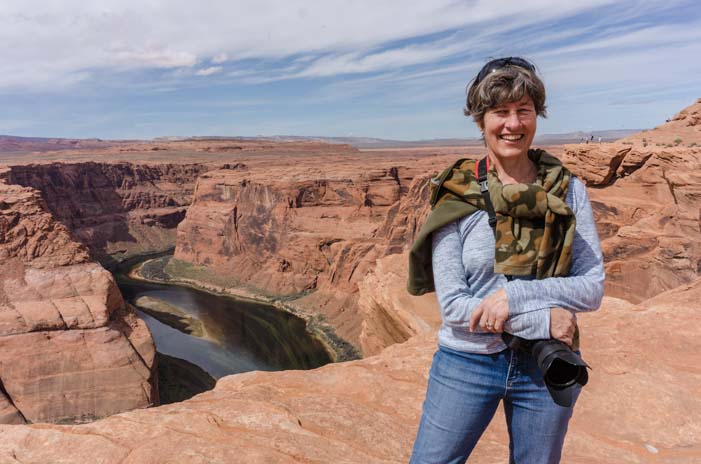
All smiles at Horseshoe Bend Arizona

At the Horseshoe Bend overlook it’s easy to be all smiles!

From the parking lot there is a 3/4 mile walk up and over a rise to get to the Horseshoe Bend overlook. Hundreds of people were on this trail going in both directions.

As we crested the rise and began the descent on the other side, we could see people scattering like ants as they approached the Horseshoe Bend overlook.

Walking towards Horseshoe Bend Arizona

Horseshoe Bend is extraordinarily popular, and swarms of tourists roam along the rim all day long.

This is a Very Cool Place. Even though we were there with throngs of other people, we felt a rush of excitement as we neared the edge. Everyone else seemed to feel the same way, and the unprotected rim of the overlook was jammed with tourists peering over the edge.

People at Horseshoe Bend Arizona

Tourists were fearless at the edge.

Far down below, rafters were making their way along the Colorado River. The mighty Colorado has carved Horseshoe Bend over millenia, and it is staggering to think of the force necessary to dig this huge ditch through sandstone rock, especially with the river looking so meek and mild down there.

Colorado River rafters Horseshoe Bend Arizona

1,000 feet below, rafters were floating on the Colorado River

This is a great place for selfie shots too!

At the rim of Horseshoe Bend Arizona

I wasn’t the only one who wanted a pic of themselves at this overlook.

Selfie sticks were held high aloft all around us.

Taking selfies at Horseshoe Bend Arizona

Selfie sticks were everywhere!

Taking selfies at Horseshoe Bend Arizona

No selfie stick? Use a folded up tripod!

Some folks were pretty creative getting photos of themselves. Others just laid on their bellies to get a shot of the incredible bend in the river a thousand feet down below.

Taking selfies at Horseshoe Bend Arizona

Hmmm…. should I take a photo of me or a photo of that incredible view out there??

Some were brave and crept far out on a precipice for a very dramatic photo of themselves.

Horseshoe Bend Arizona Sitting on the RIm

The more daring the photo the better!

I’m not sure how many people had noticed the sign on the way in saying that the sandstone is crumbly and the overhanging edges have a tendency to break off…!

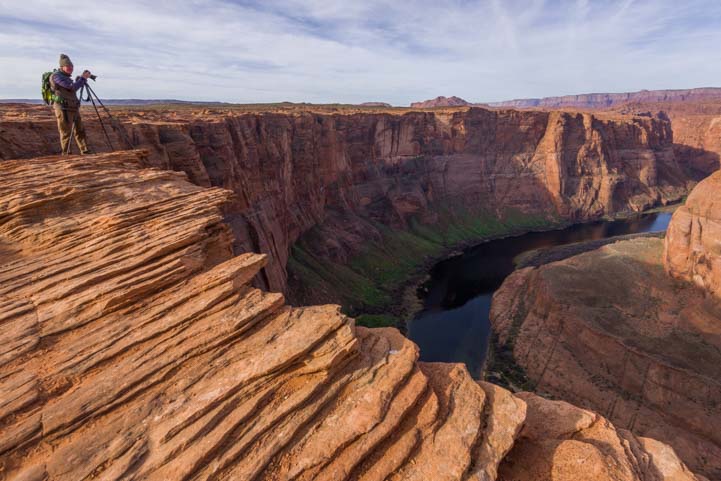
Photographer Horseshoe Bend Arizona

Everyone liked to be right on the edge.

As the afternoon wore on, the crowd swelled as people came in to get a shot of the sun setting over the bend in the river.

Photographers at Horseshoe Bend Overlook Arizona

Photographers lined up on the rim with their tripods.

The rim was packed with photographers getting set up for this special moment. Finding a place to squeeze in along the rim wasn’t so easy!!

Photographers Horseshoe Bend Arizona

We waited patiently for the sun to go down.

The excited discussion between everyone standing on the rim alternated between what kind of photography gear they had and speculation about whether we’d all have a chance to go for a starburst shot at the moment the sun vanished from the sky on the far side of the canyon. One woman said she had gotten a doozy of a starburst photo two nights before. We all crossed our fingers.

But Mother Nature had other plans for us that afternoon, and the sun slipped behind the horizon with nary a wink.

It was still very special!

Horseshoe Bend Sunset Arizona

We didn’t get a starburst, but the sunset was beautiful.

I had an 18-35 mm lens, but the best images were a little wider. Mark whipped out his favorite trusty 14 mm lens and got a fabulous image.

Horseshoe Bend Arizona sunset photo

Mark was able to get a beautiful and slightly wider shot at 14 mm.

As we watched the clouds drift across the sky in shades of orange and yellow, suddenly the river down below began to reflect the color. How cool!

Sunset at Horseshoe Bend Arizona

For a split second, the river reflected pink and orange back at the sky.

We left Horseshoe Bend on a total high, absolutely exhilarated by Nature’s show. If the sunset could be that magical, we thought, then what might be in store at sunrise?

The next morning we were on the trail before dawn. There were three cars in the parking lot, including ours, and a young couple was just ahead of us on the trail, weighed down with some serious looking photography gear.

I got chatting with Brittany as we trudged along the trail in the dark, and I discovered that she and her companion, Justin, were professional videographers with their own video production company, Chiet Productions. They had just landed a gig for a regular show on PBS about a nightclub in Washington, DC, that will begin airing in April. It’s called “Live at 9:30.”

They were here at Horseshoe Bend for pleasure, however, and they were planning to shoot the sunrise using timelapse photography.

Timelapse photography Horseshoe Bend Overlook Arizona

A pair of professional videographers set up three cameras on the rim for a timelapse video of the sunrise.

Mark and I went for stills, however, since that was where our heads were at this morning. it was too early to think clearly enough to figure out everything we’d need to do to set up a timelapse, although I LOVED the idea!!

The sunrise was lovely.

The funny thing is that the sunrise wasn’t all that different than the sunset the night before. The sun had set over the horizon in the distance in front of us, but the sun rose behind us, so it would seem the canyon would look quite different. However, the colors we saw at sunrise filled the sky opposite the sun as it rose, casting a soft light across the horizon front of us.

Sunrise Horseshoe Bend Arizona

This morning’s sunrise was just as lovely as last evening’s sunset.

A little while later, the sun lit up the top of the peak in front of us. As the sun rose higher and higher, the shadow on the cliff slipped lower and lower.

Horseshoe Bend Arizona between the cliffs

As the sun rose it lit more and more of the cliffs across the canyon, while the shadow crept slowly downwards.

When the big show was over, we found Justin and Brittany where we had left them with all their gear on the edge of the canyon. They had done three timelapse videos, one on a GoPro, one on a Sony mirrorless camera and one on a cell phone. Brittany showed me the one she’d done on her cell phone. She had caught the sun lighting the top of the pinnacle in the canyon and had captured the shadow slipping down its front as the sun rose higher. Wonderful!!

Videographers at Horseshoe Bend Arizona

Brittany and Justin captured some great timelapse video of the sun rising in the canyon.

The morning wasn’t over yet, though. In fact, the day was just beginning. Where there had been just four of us on the rim at sunrise, we could now see a steady stream of people pouring down the trail, cameras and tripods in hand. The rim slowly became crowded with photographers and tourists once again!

Photographers with tripods at Horseshoe Bend Arizona

After sunrise, we were joined by lots of photographers at the rim.

Curious about some rock formations nearby, we headed off to the right (north). Leaving behind the growing rush of visitors arriving at the rim, we walked out into these cool rocks.

Lines in the rocks Horseshoe Bend Arizona

Away from the fray, to the north, we found some wonderful rock formations.

There were lots of curvy lines and ripples in the sandstone.

Patterns and Lines Horseshoe Bend Arizona

The curving lines and formations in the rocks were beautiful.

Rock crevices Horseshoe Bend Arizona

What magical shapes and formations!

We were both really intrigued by the contours of this fantastic land, and we roamed around this spot for quite some time.

Rock patterns Horseshoe Bend Arizona

The lines and patterns in the rocks drew us in.

If your RV travels take you to Page, Arizona, a stop at Horseshoe Bend is a must.

A few tips:

To avoid the crowds, the best time to get there is early in the morning.

If you are driving your RV, your best chance for finding a place to park it in the parking lot is early morning, not too long after dawn. There is turnaround room (big buses come and go regularly all day long), but it seemed to me that on weekends at peak season, especially holidays, this parking lot probably fills early and would be nearly impossible for an RV. We were there midweek in mid-March, and the number of tourists was mind boggling. The numbers intensify in the afternoon, especially near sunset.

Rock lines Horseshoe Bend Arizona

Horseshoe Bend is an overlook that deserves more than a fleeting glimpse over the edge

As you hit the walking trail to Horseshoe Bend, there’s a sign that says this is a Fee Area managed by the National Park Service. Interestingly, no money was being collected and no one asked to see our Federal Interagency Pass. The National Park Service could be making a small fortune here, as I’m sure several thousand people visit every day.

Subscribe
Never miss a post — it’s free!

More info about Horseshoe Bend:

National Park Service Website – Official description of Horseshoe Bend
Allstays – RV Parks near Page, AZ
Location of Horseshoe Bend – Google Maps (it is mis-labled “Houseshoe” and called a “chapel” – funny!)

Other blog posts from our RV travels in northeastern Arizona:

Our most recent posts:

More of our Latest Posts are in the MENU above.

<-Previous || Next->

How to Defrost an RV Refrigerator in 20 Minutes!

Defrosting an RV refrigerator is a surprisingly easy job. We’ve been living with a propane RV refrigerator for many years now, and they always need defrosting after a few weeks or months. Being meticulous about not leaving the refrigerator door open unnecessarily can help, but when you find yourself living in a hot and humid environment or if you have the refrigerator side of your trailer or motorhome facing the blazing hot summer sun all afternoon, the frost is going to build up over time.

All you need to defrost an RV refrigerator is:

Over the years, we’ve tried several different techniques for defrosting our RV fridge, and in the old days this was a big job that, with some methods, could take well over an hour. We now have it down to a super fast method that makes this pesky job a cinch. The last time we did it, I made a note of the time on the clock as we went through each step. From start to finish, it took 20 minutes.

The first step is to turn off the refrigerator and empty the contents of the freezer into cooler bags or a cooler of some kind. Since these things will be out of the freezer for just 20 minutes, they won’t defrost and the ice cream won’t melt. If your RV is hot inside, covering the cooler bags with blankets for extra insulation can help.

Defrost RV refrigerator remove food from freezer

9:17 a.m. – Turn off fridge and unload freezer into cooler bags

We used to unload the whole refrigerator and empty it out completely, but that isn’t necessary and it takes a lot of time. An awful lot of what is in the refrigerator can handle warming up slightly as you keep the refrigerator door open to defrost it.

Instead, just unload the most temperature sensitive items — milk, yogurt, lunch meats, mayonaise, etc., into an insulated cooler bag or a cooler. Most of the fruits, veggies, bread, cheese, condiments, etc., can remain right where they are in the fridge for the 20 minutes it takes to defrost it.

How to defrost an RV fridge with food in cooler bag

Set the cooler bags aside. Covering them with blankets will keep everything even cooler.

Next, put a super absorbant chamois towel in the bottom of the freezer compartment to absorb the water from the melting ice, and use a hair dryer to thaw the walls of the freezer.

Defrosting RV refrigerator hair dryer on freezer with towels

9:22 a.m. – Use a hair dryer to thaw out the freezer.

We live exclusively on solar power, and our 2,000 watt pure sine wave inverter is what powers all our AC appliances, including the hair dryer. So, we have a low wattage travel hair dryer that draws just 800 watts (available here).

We put it on the high setting and keep a distance of about 8″ between the hair dryer and the walls of the freezer. A higher wattage hair dryer may need to be put on the low heat setting. Hold your hand about 8″ from the hair dryer and see how hot it feels.

Be sure you keep the hair dryer from heating up the plastic walls or they will crack from being cold and then getting hot. Keep the hair dryer moving and test the temp of the plastic walls with your hands.

After thawing the walls of the freezer a little, move down to the cooling fins in the refrigerator compartment. Keep the hair dryer in constant motion, sweeping it back and forth from side to side.

Defrost RV refrigerator hair dryer on cooling fins

Slowly wave the hair dryer in front of the cooling fins.

Alternate working on the freezer compartment and the refrigerator compartment.

How to defrost an RV refrigerator hair dryer in freezer

Alternate between the cooling fins in the refrigerator compartment and the freezer compartment.

Defrosting RV refrigerator hair dryer on fridge cooling fins

At the beginning, when the cooling fins are caked in ice, the hair dryer can be closer to them.

Little ice sheets will begin to fall off the refrigerator cooling fins into the drip tray underneath. As the thawing process continues, increase the distance between the hair dryer and the cooling fins.

How to defrost an RV fridge melting ice with hair dryer

As ice drops and the cooling fins thaw, move the hair dryer back a little.

Don’t chisel the ice off the fins or the freezer walls with a tool. If you pierce the metal base behind the cooling fins or the walls of the freezer, the refrigerant (ammonia) will leak out. We don’t use any chiseling device. We simply assist the thawing process with the hair dryer.

Check beneath the cooling fins and you’ll see the bits of ice dropping into the drip tray.

How to defrost an RV refrigerator ice dropping from fridge cooling fins

Check below the cooling fins where the ice drops off in chunks.

If you go outside, on the back of the RV you’ll see water seeping out of the refrigerator vent.

How to defrost an RV fridge water dripping from refrigerator vent on outside of trailer

Outside the rig, water will be seeping from the refrigerator vent.

How to defrost an RV refrigerator water dripping down fridge vent outside trailer

A little trickle of water flows down.

Once all the ice has fallen off the cooling fins, pull out the drip tray and dump the ice in the sink.

Ice in RV refrigerator drip tray

9:34 a.m. – Once all the ice has dropped off the cooling fins, empty the tray of ice into the sink.

Up in the freezer compartment, the chamois towel is now fairly wet with water that has dripped down off the walls. Wring it out and use it to wipe down the freezer and the fridge.

Wet Chamois towel from defrosting RV refrigerator

9:35 a.m. – The chamois towel in the freezer is pretty wet. Use it to wipe down the fridge and freezer.

Load the food from the cooler bags back into the refrigerator and freezer compartments, and you’re done! Put the fridge at max temp for a few hours to help it cool back down, and then set it to the temperature setting you normally use.

Defrosted RV refrigerator

9:37 a.m. – After loading the food back in the refrigerator, turn it back on. Done!

Other RV Refrigerator Tips

The key to having an RV refrigerator work optimally is having the air circulate inside well. Overstuffing the fridge with food makes this difficult for it. We have used a little RV refrigerator airator fan that’s designed to keep the air flowing. We’ve had mixed results with this, and when it died we didn’t replace it. I think this would work well if there were space between all the food, but our fridge is usually packed (the turf wars between the beer and the veggies can be brutal…sometimes we can hear them battling it out in there!).

As a maintenance item, we keep the door seals clean, wiping them down periodically.

We use simple refrigerator thermometers to monitor the temperatures in the fridge and freezer. It has a built in hook, and we hang it from one of the rungs in the top shelf in the refrigerator. The one in the freezer rests against one wall.

We were surprised to learn that RV refrigerators have an expected lifespan of about 8 to 10 years. A classic sign of impending failure is the appearance of yellow dust in the refrigerator vent area behind the fridge (go outside and take the vent cover off and look around with a flashlight). Click the following link to read the funny story of our RV refrigerator replacement and see how an RV fridge replacement is done.

Because of the shorter lifespan, higher price, and use of propane in RV refrigerators, many (most) “full-time” level fifth wheels and motorhomes are now being built with residential refrigerators that run on AC power only (a dedicated inverter is installed so it can run from the batteries while in transit). For folks that have plans to dry camp and boondock a lot in their RV life, a residential refrigerator will require a much bigger battery bank and solar panel array than would otherwise be needed. We discuss that in more detail at this link in our introductory solar power article.

If our hair dryer method of defrosting an RV fridge seems unorthodox to you, believe me, we have tried many other methods. We tried opening the fridge and freezer doors and letting the fridge thaw out on its own. We tried doing that and “helping it along” by chiseling the ice off with a small plastic scraper. We tried putting a bowl of hot water in the fridge to help it warm up.

All of these methods were adequate, but they were time consuming. We’ve been using our current method with the mini travel hair dryer for a few years now and really, really like it.

Subscribe
Never miss a post — it’s free!

Below are some of our most POPULAR POSTS (also in the MENUS above)

Buddy - A Journey in Spirit - The story of an event that changed our lives forever.

ARTICLE INDEXES
  • RV Tech Tips Articles - A one page index of links to all our RV Tech Tips, RV Upgrades & RV Maintenance articles.
  • RV Lifestyle Tip Articles - An index of links to all our RV Lifestyle Tips (finances, boondocking, major repairs, work/jobs, etc.)
  • Solar Power Articles - Overview and tutorial articles for how to design and install solar power on an RV or boat
  • Product Reviews - An index of links to all of our Product Reviews
RV UPGRADES, SYSTEMS & TIPS MONEY FULL-TIME RV LIFESTYLE GEAR STORE
  • Gear Store - A list of the goodies, equipment and gear we've found useful in our RV lifestyle!
 

Our most recent posts:

More of our Latest Posts are in the MENU.   New to this site? Visit RVers Start Here to find where we keep all the good stuff. Also check out our COOL NEW GEAR STORE!! *** CLICK HERE *** to see it!

Sedona Arizona – Brooding Skies at Sunset in the Red Rocks

March 2016 – During our RV travels to Sedona, Arizona, we were eager to capture a gorgeous sunset over the red rocks. We had seen some lovely sunsets, and we had enjoyed lots of time hiking and biking in the red rocks, so it only made sense that we should be able to get some photos of a magical sunset casting a pink and orange glow across the unique Sedona landscape.

We checked what time sunset was, got all our photography gear together, and headed out at the Golden Hour just before the sun went down.

Golden hour Bell Rock Pathway Sedona Arizona

The “Golden Hour” (an hour before sunset) on Bell Rock Pathway in Sedona AZ

We had everything we needed to capture the ethereal light of sunset. We hiked well out onto the Bell Rock Pathway to the big flat boulders in the middle where you get a wonderful 360 degree view of the majestic red rocks all around you.

Bell Rock Pathway Golden Hour Sedona Arizona

Would the brooding sky grace us with a beautiful sunset tonight?

Well, a daytime sky full of clouds doesn’t always translate into an evening sky full of pink and orange colors.

Golden sky Bell Rock Pathway Sedona AZ

Dark gray and pure white clouds striped the sky.

I had found an awesome spot to capture a vividly colorful sky with a craggy old tree framed by the red rocks, but as the minutes ticked by after the sun was gone from the sky, we both finally had to admit that this evening’s sunset was a total dud. Oh well.

Bell Rock Pathway views Sedona Arizona

Despite all the good looking prospects beforehand, the sunset never materialized.

We packed up our gear and went home. As we drove, we bolstered our rather dejected spirits with hopes for a stunning sunset tomorrow. After all, Nature would have to put on a vivid display the next night. There couldn’t be two dud sunsets in a row, could there?

So, after a day of other activites and much anticipation, we packed up our camera gear once again, hopped in the truck, and drove out to the Bell Rock Pathway for the Golden Hour a second time, our spirits high and hopeful.

Photography in Sedona Arizona

Tripods at the ready, we had everything we needed for a great sunset, provided Nature cooperated!

We had expected to see big crowds at the trailheads at sunset, but instead there were just a few vehicles. Some kids in a rental RV were climbing on the roof to get a shot of Bell Rock. They flashed peace signs at me and gave me a thumbs up.

RV motorhome at Bell Rock Sedona Arizona

Some Asian kids with a rental RV get shots of Bell Rock from the roof.

Just behind us, a girl in a beautiful pink gown was posing for a photographer. How fun!!

Photo shoot at Bell Rock Overlook Sedona Arizona

A pink gown and Sedona’s red rocks — what a great combo!

Mark posed for me too, although his outfit wasn’t quite as stunning, and the skies began to go gray above us. We stared at the darkening, mottled sky wondering how this sunset would go. Hmmm.

Bell Rock Pathway dark sky Sedona AZ

Mark models for me before we head out on the
Bell Rock Pathway trail.

Well, maybe a sunset would develop. We hoisted our tripods over our shoulders and trekked out onto Bell Rock Pathway once again.

To get a good sunset, there has to be some kind of small opening in the sky at the horizon where the sun can shine through and light up the clouds as it slips away. We watched with disappointment as the entire horizon filled with dark, dense, gray clouds, obliterating any chances the sun might have had to peek through.

Night sky Sedona Arizona

Very cool clouds, but no sunset.

We had our trusty radios with us, and we kept each other entertained with banter while we waited, even though we were on opposite sides of the huge rocks.

Eventually, the clouds and nighttime won, and the last shafts of light from the sun flashed across the sky. The sky went black, and our spirits went the same way. We couldn’t believe our luck. Two days in a row!

Stubbornly, we stayed put out on the trail until the trail itself was impossible to see, as if by remaining out there we could make the last half hour replay itself, this time with bright color and a vivid sunset.

Cathedral Rock light in the sky Sedona AZ

The sun splashed across the clouds for a split second before darkness fell.

We were very quiet in the trailer that night as we sorted through our photos. Would we give it a try again tomorrow? The third time’s a charm… but then, bad things come in threes. Oh goodness.

The thing was that these nights were COLD. We each wore three jackets when we hiked out onto the trail, and the wind always found its way through our clothes, even when we snugged our hats and hoods around our ears while waiting for the sun to do its magic.

Cold nighttime photography Sedona Arizona

Staying warm at sunset in Sedona in early Mark takes a lot of layers!!

On the third day there were puffy little idyllic happy clouds in the sky all day long. Huge platoons of them marched across the sky, and they promised us they’d still be marching come nightfall so we could photograph glorious shades of magenta and orange suspended over the red rocks.

But no.

Cathedral Rock stormy sky Sedona Arizona

Clouds streak over Cathedral Rock.

By sunset the clouds had banded together into massive blankets of gray that streaked across the sky.

Wild Skies at Cathedral Rock Sedona Arizona

The streaks over Cathedral Rock take on a wild look.

They swam from horizon to horizon, and even when the sun was able to cast its warming glow for a split second, the clouds hung heavy and dark.

Views from the Bell Rock Pathway Sedona Arizona

Sun lights the sky for a fleeting moment.

Mark got creative, though, and caught them in the act of coming directly towards him over the cliffs in the distance.

Bell Rock Pathway night views Sedona AZ

A spray of clouds.

But the color just wasn’t happening. The gods of the Sedona skies had decided not to give us any orange or pink brilliance for the third night in a row.

Suddenly, just as we were giving up hope and talking about packing it up so we could go home and get warm, we turned around and saw fire lighting the sky beneath the dramatic clouds hanging over Cathedral Rock.

Cathedral Rock at sunset Sedona Arizona

The sky is on fire at the base of Cathedral Rock.

“Holy cow. Do you see THAT?” I called on the radio.

“YES!” Mark answered. And we both leaped into action.

Sunset Cathedral Rock Sedona Arizona

Wow!

At last we had our colorful sunset skies over the red rocks in Sedona.

If you are traveling in your RV to Arizona’s red rock country in Sedona, try to get out on a hike during the golden hour for sunset. Even if you don’t get a wildly colorful sky, you will still see a lot of beauty. And who knows, at the very last moment the sun might do something magical!

Subscribe
Never miss a post — it’s free!

Each of the three nights we ventured onto Bell Rock Pathway from a different access point. The three trailhead parking lots can be found on Google Maps at this link.

Our most recent posts:

More of our Latest Posts are in the MENU above.

More info and blog posts from our RV Travels in Sedona:

<-Previous || Next->