It IS Rocket Science at White Sands Missile Park in NM

November 2015 – In our RV travels across New Mexico, we made a fun pit stop at White Sands Missile Range where there is a unique outdoor Missile Park. But before I show you some of the missiles of yesteryear, I have a few more photos to share from our stop in the metal art haven of Tatum, New Mexico.

After 8 months of RVing in the eastern states, it was here that we saw our first really huge, colorful and expressive skies that are so common in the west. Sunsets filled the sky from corner to corner, leaving no part of it untouched by vibrant color…

Sunset in Tatum New Mexico

Vivid color fills the sky at sunset

…on another day, the brooding skies of an incoming storm filled the air with an eerie feeling and then brought a deluge of rain.

Brooding skies in Tatum New Mexico

Dark and mysterious clouds blanket the heavens

And then there were the fun metal art signs, two of which stand on opposite sides of Eubanks Street in Tatum. In the first, a cowboy approaches his mule with a friendly greeting in hopes of getting some cooperation from the stubborn beast…

Metal art sign Eubanks St Tatum New Mexico

Howdy Y’All

In the second, the mule kicks him clear over the moon!

Metal art street sign Eubanks St Tatum New Mexico

Whooops!!

The metal art in Tatum was such fun. When we drove out of town, we noticed the back of the “Welcome to Tatum New Mexico” sign bidding us goodbye in Spanish:

Hasta Luego metal art sign Tatum New Mexico

See ya later, Tatum!

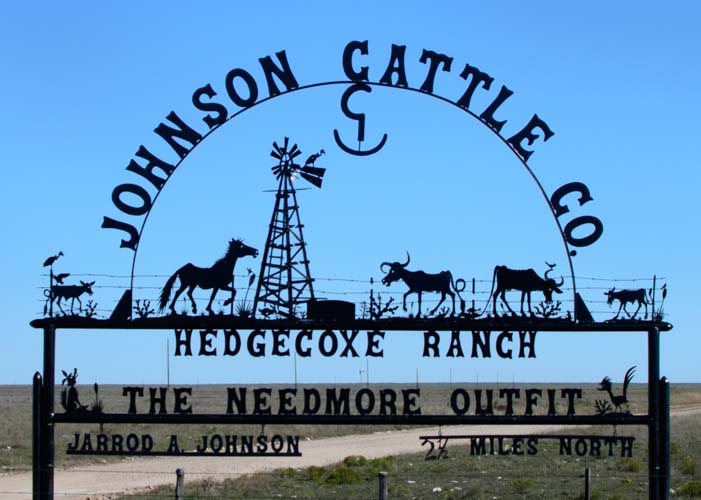
Driving along US-380 we saw lots of ranches with cool metal art signs at the entrances. The Johnson Cattle Company has everything from a turkey vulture sitting on a windmill to Wiley Coyote and The Roadrunner on opposite sides of “The Needmore Outfit.”

This ranch was so big that there were several similar signs at different mile markers along the edge of their property.

Johnson Cattle Ranch metal art Sign New Mexico

.

Another biggie was for LA Ranch:

Carpenter Graham LA Ranch metal art sign New Mexico

The roundup…

As we approached the mountains, we discovered that the rain that had drenched us in the flatlands had dumped a bunch of snow in mountain peaks. This was the first snowfall of the season and looked very dramatic in the distance at the end of our rippling road.

New Mexico snow capped mountains US-380

A first snow covers the mountains

Soon we were passing White Sands where the drifts of sand looked like snow.

Fall color on US-380 New Mexico

The sand at White Sands (is it snow?)

We noticed a sign for White Sands Missile Range and decided to drive down that road, not knowing quite what to expect.

White Sands Missile Range Logo

.

What fun it was to discover that there is an outdoor missile park at the White Sands Missile Range. Missile testing has gone on at this range for decades. Set out on pads, as if in a rock garden or on a pin cushion, a bunch of old, outdated missiles aim at the sky.

Missile Park White Sands Missile Range Museum

The White Sands Missile Park is a playground full of old missiles that were once tested here.

There are missiles of all kinds, dating from the 1950’s to the 1990’s.

Missile at White Sands Missile Park New Mexico

Missiles come in all shapes and sizes. Some are square and boxy….

White Sands Missile Range Missile Park New Mexico

…others are tall and skinny!

You can walk freely among them, and there is a plaque next to each one explaining what it was and when it was tested at White Sands.

Tank Missile Park White Sands Missile Range Museum

Some have moveable launch pads

White Sands Missile Park New Mexico

And some have sizable fins

Missiles with familiar names like Pershing and Patriot are on display here, along with lots of lesser known missiles. There is a museum too, but we happened to have come on a Sunday which is the only day that the museum is closed. Oh well…Next time!

White Sands Missile Park New Mexico

Yes, it IS Rocket Science here at White Sands Missile Range!

Whenever we visit New Mexico, we always see unusual things, whether it’s exotic rock formations or alien visitors or funky metal art or white sand beaches. The Missile Park fit right into that crazy theme.

But even better was the usual City of Rocks that lay just ahead…

Subscribe
Never miss a post — it’s free!

Other posts from our RV travels in New Mexico:

<-Previous || Next->

Our most recent posts:

More of our Latest Posts are in the top MENU above.

Motorhome Magazine Feature – Arizona’s Wild Side!

The November 2015 issue of Motorhome Magazine features our article about beautiful central Arizona entitled Arizona’s Wild Side.

Arizona's Wild Side Motorhome Magazine November 2015

Motorhome Magazine November 2015 Issue
Article by: Emily Fagan
Photos by: Emily and Mark Fagan

Motorhome Magazine posts links to most of their destination articles on their website, and when one appears for this article we will link to it here.

Motorhome is an excellent monthly magazine for all RVers, whether you are excited newbies or seasoned pros who’ve been at it for decades.

But is there really a place for a professionally written and edited RV magazine in this era of online blogging? I think so.

Motorhome Magazine offers loads of tech tips, and the beauty of their technical articles is that they are read and edited by a number of experienced RV techs before publication, something that doesn’t happen with an ordinary RV blog (including this one!).

Even better, Motorhome offers oodles of mouth watering travel destination articles suggesting fun places to take an RV roadtrip all over North America.

In our household (and probably many others), whenever the various RV magazines we subscribe to arrive, Mark jumps on the tech articles and I run off to read the travel articles!

You can subscribe to Motorhome Magazine here.

I know you’re being inundated with great Christmas gift ideas right now (as we are), but in truth, a magazine subscription does make a wonderful gift. We’re giving quite a few RV magazine subscriptions as Christmas gifts this year in hopes of inspiring our friends to take their RVs out for a spin and to share a taste of this crazy lifestyle we live (Santa spoiler alert, Mom!).

As for Arizona in winter, it is a glorious place to take your RV during the coldest months and explore some exotic scenery. Lots of snowbird RVers choose the southwestern deserts as a warm winter destination. As described in our magazine article, central Arizona is among the best places to visit.

Anchored by the massive, sprawling city of Phoenix, there are loads of things to do, no matter what your interests are. We lean towards outdoor activities — hiking, biking and photographing Nature at her best — and central Arizona is filled to overflowing with places to enjoy these activities.

All of our blog posts from our RV travels to central Arizona can be seen here: Central Arizona RV Travel Adventures. A few of our favorites posts from Arizona are listed below, grouped by topic:

Knock-Your-Socks-Off Scenic Drives:

Fun and Exotic Flora and Fauna:

Places to See Spectacular Sonoran Desert Scenery:

Gorgeous Hikes:

Enjoy these articles, and if you have the time, brush the snow off your RV and come on down!!

Like many websites, this site is an Amazon Affiliate. During the upcoming rush of online shopping, we profoundly appreciate anything purchased through any of our Amazon links (feel free to bookmark this one!). We blog out of passion and as a hobby, but it is massively motivating to know our readers appreciate our efforts. Your enthusiasm encourages us to bring you the highest quality writing, photos and info that we can. Happy Thanksgiving!!

Subscribe
Never miss a post — it’s free!

Our most recent posts:

More of our Latest Posts are in the top MENU above.

Tatum, New Mexico – Metal Art Magic

October 2015 – After landing in Paris, Texas, we dodged some serious rain storms as we made our way across the state. All thoughts of dallying in the area evaporated when the world’s strongest hurricane, Patricia, showed up on Mexico’s Pacific coast and decided to join forces with another storm so they could march together across the southern states. We alternated between hunkering down and sprinting until we finally got out of harm’s way in New Mexico. There, the fringe edges of the storm created some spectacular sunrises and sunsets.

New Mexico sunset

What a sunset!

Years ago, when we first started RVing full-time, we crossed New Mexico from east to west on US-380 on our first journey after picking up our new trailer outside Dallas. This road is a wonderful alternative to either I-40 or I-10, and it lies right between them, passing through miles and miles of wide open ranch land.

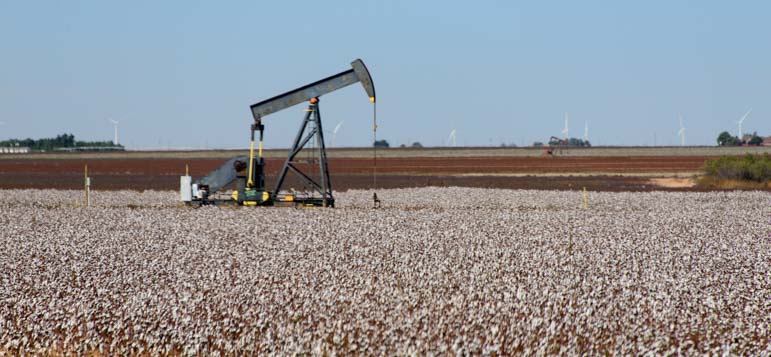
Cotton growing and oil drilling in New Mexico

New Mexico has miles of cotton above ground and oil below as well as wind farms in the distance.

What struck me back then was that almost every ranch had a beautiful sign over the gate that was crafted in sheet metal. Each one depicted various scenes from the region, and they gave the landscape a humorous and artsy touch.

When we decided to travel this route once again, I vowed to capture some of these creative metal art signs with my camera as we passed. Unfortunately, the ranch gates come up so fast that after each shot I was moaning, “Darn, this one’s blurry too!” (or cut off, or indistinguishable against the background).

Then we arrived in Tatum, New Mexico.

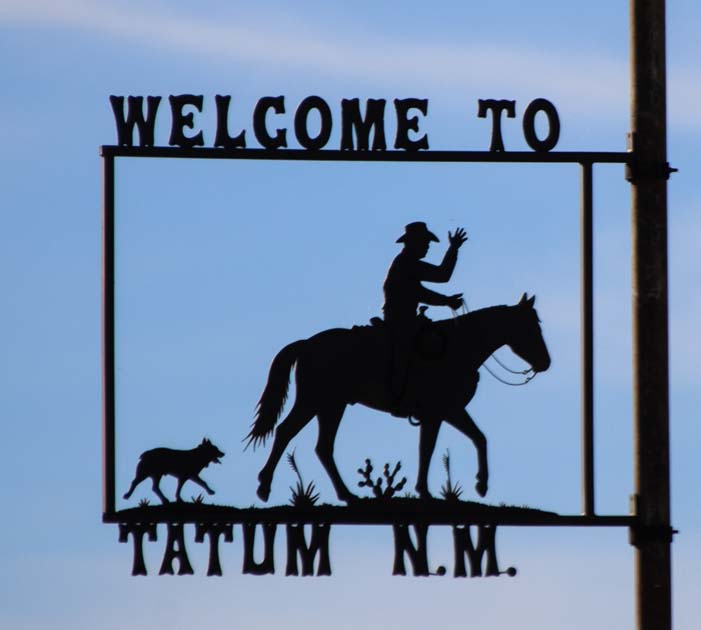
Welcome to Tatum New Mexico metal art sign

.

As we slowed down going through town, we noticed that every single street was adorned with a wonderful metal art sign.

Eagle and cactus metal art Tatum New Mexico

Every street in Tatum has a cool metal sign at the corner.

How cool is that?! We climbed out of the RV and began walking around town, admiring the fantastic variety of metal street signs on every street corner.

Howling coyotes metal art sign Tatum NM

Desert sounds…

Some were images of classic desert creatures and plants, with flying eagles, cholla cactus and howling coyotes featured prominently as they did what desert creatures do in New Mexico. But other signs humorously depicted people living their lives and doing what people do.

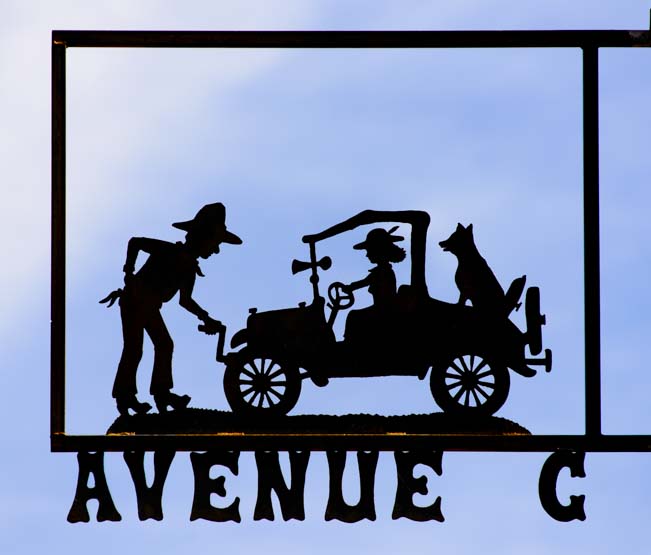
Antique car and family metal art Tatum New Mexico

Lemme get this cranked up for ya

Metal art street sign oil drilling in New Mexico

These little dipper oil drills are very important to life here in New Mexico

I was captivated by the clever street signs and got a huge kick out of walking up and down every street in town to see what kind of image was on display at the next corner.

Donkey and cowyboy with cactus metal art street sign

Taking a break in the shade of a cactus while his mule smells the flowers

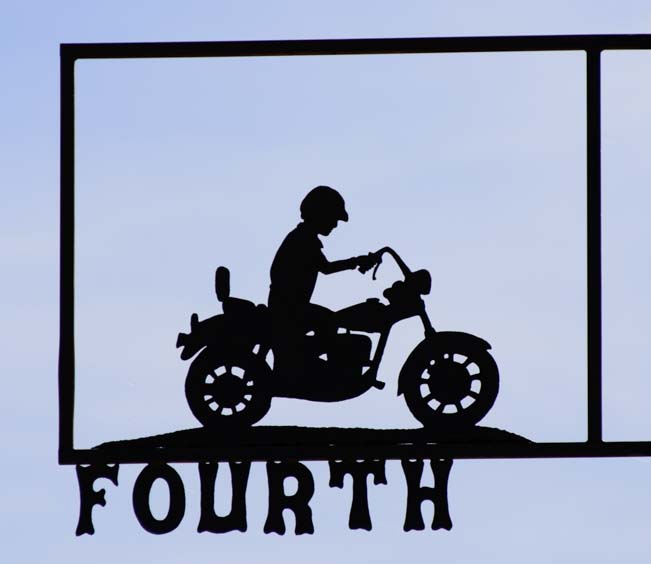
Motorcycle metal art street sign in Tatum New Mexico

When your mule won’t go, take the bike!

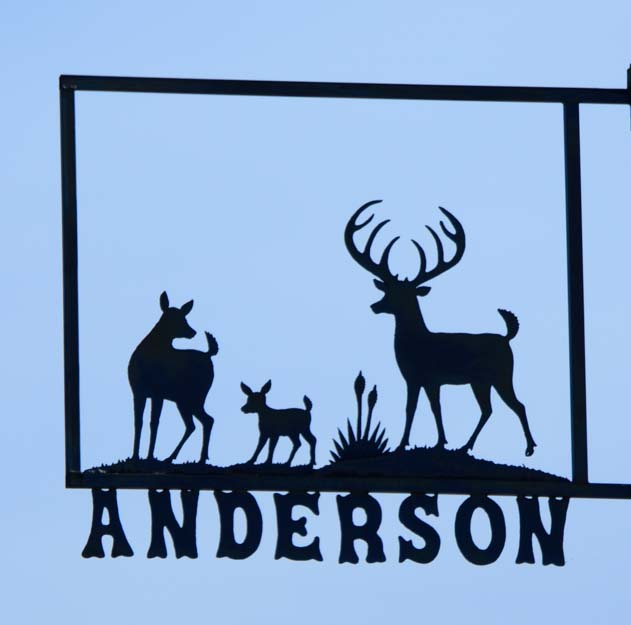
Deer metal art street sign on Anderson St Tatum NM

A desert deer family on Anderson Street

US-380 goes right through town, but the townsfolk know the road locally as “Broadway,” and a buffalo marked one corner of this important street in town.

Buffalo metal art Broadway St Tatum New Mexico

A bison guards Broadway

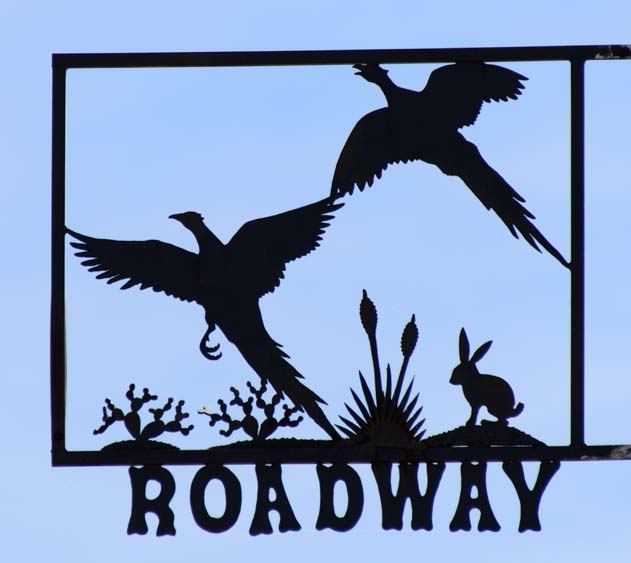
Turning to face another corner on Broadway, I was bemused to see that the letter B had vanished from the sign, and below the flying birds the sign now read, “Roadway.” I looked for the B on the ground all around the sign, thinking that it might have blown off in a windstorm, but it was nowhere to be found.

Birds flying metal art street sign Tatum New Mexico

When you lose your B, you get Roadway

Ths fun metal artwork isn’t limited to street signs. As I walked further afield, I discovered several inviting park benches, each decorated with a different western theme as well.

Metal art on park bench Tatum New Mexico

There were park benches all around, each one unique.

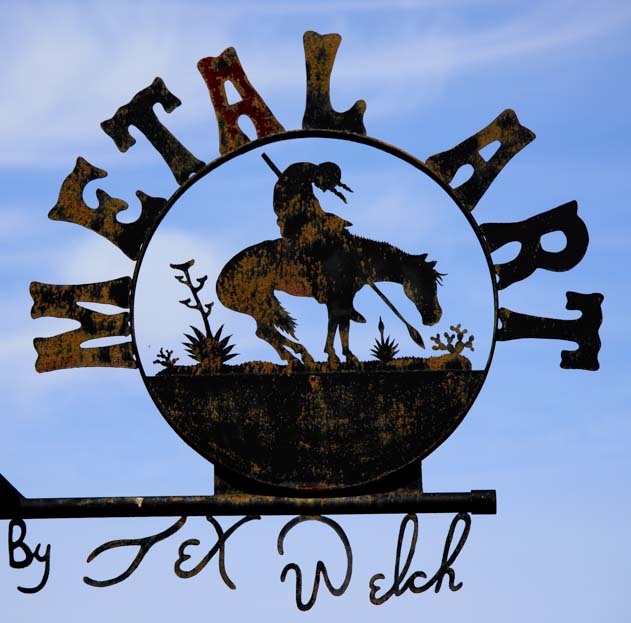
I love it when a town has a theme and has invested in decorating itself with art of some kind or another. But who was responsible for all this funky metal art in this tiny town of 839 people in New Mexico? At the far west end of town, we began to get some clues. We found a big building surrounded with metal art of all shapes and sizes. A sign above the building said, “Metal Art by Tex Welch.”

Metal Art workshop sign by Tex Welch Tatum New Mexico

Tex Welch was the original Metal Art Man in town

I really wanted to meet this guy, Tex, and ask him about the street signs and find out if he was the one who’d made them, and if perhaps he had made the many fabulous arches at the entrances to the ranches we had just passed. Unfortunately, his workshop was closed. We wandered back to his shop a little later, and it was still closed.

Little did we know that winds of change have come to the lively metal art scene in Tatum, New Mexico.

Metal art wind vane Tatum New Mexico

.

Down at the opposite end of town, at the far east end, I came across a huge American flag made of painted stones set in the ground. Four flags were flying next to it – the New Mexico and Texas state flags, the American flag and the POW flag. Each was made of sheet metal and flew in a perfect ripple. In front of the flags, a group of soldiers were planting an American flag in the ground, reminiscent of Iwo Jima, and beneath their feet were the words: Support Our Troops.

Wow!

Poor Boy's Metal Art American tribute Tatum New Mexico

A beautiful patriotic display right on the main drag at the east end of town

Behind this nifty scene there was a building surrounded by metal cactus, crosses, cowboys and turkey vultures. A sign on the building said, “Poor Boy’s Metal Art.”

Poor Boy's Metal Art Workshop Juan Manuel Carbajal Tatum New Mexico

Poor Boy’s Metal Art is the new game in town.

I tromped around a little bit, hoping to find someone working outside, when I heard happy whistling coming from behind the building. I went around back, and there was a guy hovered over a workbench, whistling to his heart’s content, as happy as a man can be.

I called out to him, and he introduced himself as Juan Manuel Carbajal. That’s a mouthful! I had him repeat it and spell his last name until I could say it right, rolling “r” and all.

“Let me show you my current project,” he said with a huge grin as he gestured towards his workbench. “This is a little finer than the street signs… it’s more indoor art than outdoor.” The bench was covered with smaller pieces. He picked one up and I couldn’t resist taking a photo. He absolutely radiated happiness as he showed off his artwork.

Juan Manuel Carbajal metal artist Tatum New Mexico

Juan Manuel Carbajal was a sheer delight to talk to.

He told me he was originally from the city of Cuatémoc in Chihuahua, Mexico, but had lived here for decades. He reminded me of our friend Alejandro Ulloa in Ensenada, Mexico, who had done the extraordinary metal fabrication on our boat, creating our solar panel arch with polished welds. He, too, was truly passionate about his work. It isn’t often that you find people who genuinely loves what they do. Juan and Alejandro are two of the lucky ones.

“I apprenticed under Tex,” Juan explained to me when I asked about the metal art workshop at the other end of town. “He’s the one who made all the street signs here. Unfortunately, he hasn’t been well,” he said with a sigh.

I asked Juan if he’d made any of the signs around town, and he said he’s done a few, “And I donated my display with the flags and the troops out in front to the town, so Tatum will have it no matter what happens to me.” How wonderful for the town to be gifted such a unique, patriotic work of art.

Tatum Community Center Metal Art sign Tatum New Mexico

.

Juan went back to his workbench, and I continued roaming around town. He had said to check out the metal art built into the metal fencing nearby, and there were some terrific images there.

Bronco wrought iron fence metal art Tatum New Mexico

Ride ’em, Cowboy!

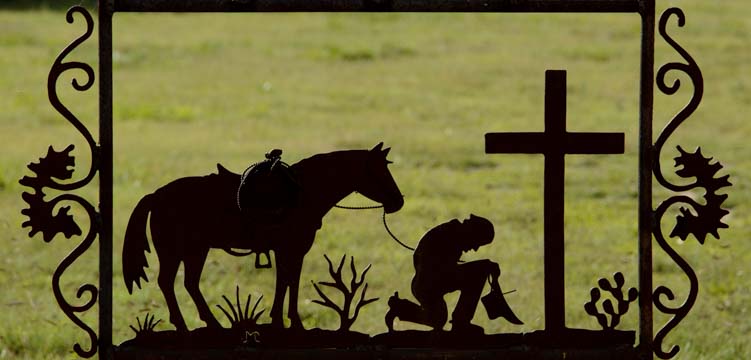
Cowboy horse and cross metal art fence Tatum New Mexico

Paying respects…

Horses metal art fence Tatum New Mexico

A-prancin’ and a-dancin’

I think he also has done some of the painted metal art that appears around town.

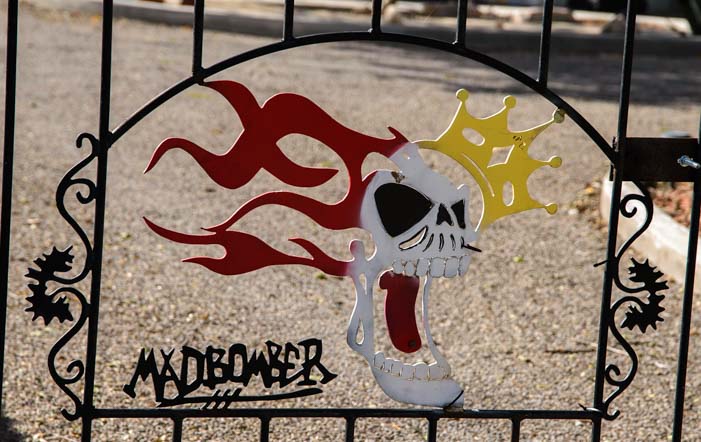
Mad bomber metal art fence Tatum New Mexico

It’s the Mad Bomber!

Military helicopter metal art fence Tatum New Mexico

.

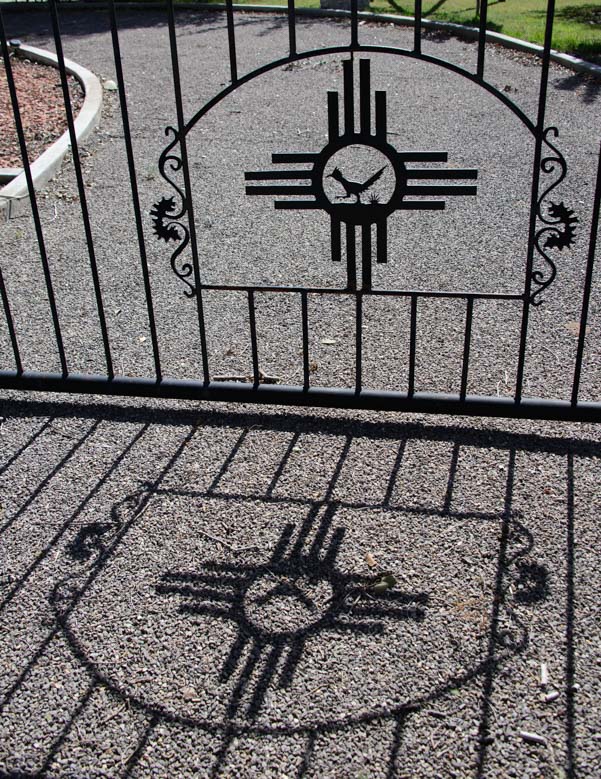
Roadrunner metal art fence gate Tatum New Mexico

New Mexico flag with a roadrunner on a gate

I just love it when we come across unusual people and places like this! I had hoped simply to get a few fly-by images of ranch gates as we traveled on US-380 from Texas to Arizona, but instead we found the heart of the metal art magic in this region and had a chance to talk with one of the artists.

RV and sunset in New Mexico

Tatum, New Mexico, is a cool town to visit for RVers heading east-west through New Mexico

Subscribe
Never miss a post — it’s free!

Some other towns with themes that we’ve enjoyed in our RV and sailing travels:

Our most recent posts:

More of our Latest Posts are in the top MENU above.

Here’s a little more about Tatum, New Mexico:

<-Previous || Next->

Welch OK is A-Okay for a Fun Fall Fair in Oklahoma

October 2015 – After enjoying the wonderful Biblesta celebration in Humboldt, Kansas, we continued our RV travels south and west. We had been hoping to catch some fall colors in Oklahoma, and deliberately took some off-the-beaten-path scenic roads, but our timing was off and we were just a little bit early for the peak.

Oklahoma RV camping and travel

Oklahoma

However, we still saw a magical sunrise in Grove, Oklahoma!

Sunrise in Oklahoma

Oklahoma sunrise

Even though it was fall, and not spring, two northern flickers started doing a fabulous courtship type of dance in the grass right outside our trailer door. They jumped around with wonderfully bouyant movements, showing off their flashy yellow feathers under their wings and tails.

Northern Flickers courting in Oklahoma

A pair of flirting flickers!

Northern Flickers courting

Doing the Lindy Hop!

Sometimes people wonder how we go about choosing our travel destinations, and the truth is that we stumble into most of them. We don’t do a lot of planning. We prefer, instead, simply to be out there in the world and to see what kinds of adventures are waiting for us.

I had just answered such a query one morning when, a few hours later, as we were driving down the road with our rolling home trailing along behind us, we glanced down a street and saw a fall festival in full swing right in the middle of the road. What luck!

Pumpkins at Welch OK Fall Harvest Days_

Signs of fall in Welch, OK — pumpkins and hay bales.

We were in Welch, Oklahoma, and the town was in the middle of its Welch OK Harvest Days celebration. Mark quickly found a place to park the RV, and we walked back to see what was going on.

Welch OK Harvest Days Fall Festival pumpkins and hay bales

Happy Fall, Y’All!

It was a cold, gray day, but the spirit was warm and friendly as we walked around the various booths. There was a table of cozy looking knitted goodies, and there were pumpkins and hay bales stacked up for decoration.

Welch Oklahoma Fall Harvest Days Festival

Wonderful hand knitted and crocheted goodies at the Welch Harvest Days fair

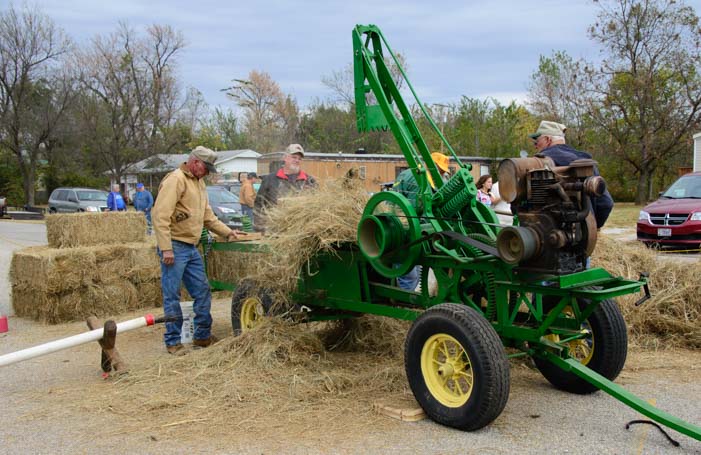
In the middle of the street a bunch of guys were making hay bales the old fashioned way. The whole time we walked around the fair, these guys were stabbing a big pile of hay with pitchforks and loading it into the machine. One by one, the machine created rectangular hay bales. Nowadays, massive combines scour the farm fields, spitting round hay bales out the back as they drive down the rows.

I’m sure there was a time when this antique hay baler was a back saving godsend, but compared to modern farm equipment, this rickety old antique was downright quaint.

Haying with antique farm equipment Welch Fall Harvest Days Oklahoma

A group of guys show us how haying used to be done.

Nearby, there was a ring toss going on with a bunch of pop bottle as the target.

Ring toss Welch Oklahoma Fall Harvest Days

Nice throw!

In one booth, a local vintner was selling bottles of fine OK wine.

Welch OK Fall Harvest Days Wine Seller

OK wine is fine wine!

All the store fronts in town were dressed up for the festivities

Welch Oklahoma storefront for Fall Harvest Days

.

When we peeked in one window, we saw a cat lounging on a workbench. Cute!

Cat inside a Welch OK storefront

Time for a snooze.

Right in the middle of it all there were pony rides. One little girl enjoyed her ride so much that after she got off the pony she walked with it around the ring a few times.

Pony ride Welch OK Fall Harvest Days

Riding the pony was fun, but walking alongside is even better.

While the litle girl walked her pony, a little boy was having a ball playing on an antique tractor. He climbed all over it and seemed ready to hit the farm fields — if only he could get it started.

Antique tractor Welch Fall Heritage Days Oklahoma

.

As we walked around, all of a sudden we could hear the familiar and unintelligible patter of an auctioneer. Drawing closer, we saw that there was an auction going on. He was auctioning off cakes and pies, and the bids were coming in fast and furious.

Taking care not to make the wrong gesture, or inadvertently raise my hand the wrong way (or I’d end up with a fancy cake!), I got a brief video clip so you can hear what this sounds like:

This part of the world is tornado country, and one vendor had a neat selection of storm shelters for sale. These things were like rugged closets you install in the ground. They were fun for the kids to play in too!

Storm shelters for Oklahoma tornados

These sturdy storm shelters make fun play houses.

We were lured to one edge of the fair by the yummy smell of a barbecue, and it turned out that Smokin’ Brothers Barbecue was grilling up some delicious things on one of their cute little farmhouse style grills. These guys build their own grills, and as long-time Traeger Grill owners, they say they have bested the Traeger design at a fraction of the cost. I don’t know a lot about high end grills, but I sure loved the little red “barn-b-que”!

Welch OK Smokin Brothers BBQ Grills

A unique barbecue by Smokin’ Brothers!

After enjoying Welch Harvest Days for a few hours, we moseyed on down the road, traversing Oklahoma from north to south.

Ruby daisies Welch Fall Heritage Days Oklahoma

.

Eventually we landed in Paris, Texas, where the Eiffel Tower stands proud, wearing a red Texas cowboy hat on top!

Eiffel Tower Paris Texas

A poignant image from Paris, Texas, in the wake of recent events in this town’s namesake city.

We had no idea at the time how much our thoughts would be turning towards Paris, France, as world events unfolded in the next few weeks…

Subscribe
Never miss a post — it’s free!

Our most recent posts:

More of our Latest Posts are in the top MENU above.

Here’s some more info about this corner of Oklahoma:

Other posts from our RV and sailing travels where we’ve bumped into cool things going on:

<-Previous || Next->

RV Solar Power Installation Tips – Escapees Magazine

RV Solar Power Installation Tips

Escapees Magazine Nov/Dec 2015 Issue
Article by Emily and Mark Fagan

The Nov/Dec 2015 issue of Escapees Magazine is featuring our article about installing solar power on an RV.

For us, solar power is by far the most valuable upgrade we have done to our rig, as it has given us unlimited freedom and spontaneity in our travels.

This article is the second part of a two-part series on solar power systems we wrote for Escapees (the first, RV Solar Power, appeared in the May/June 2015 issue.

There are a lot of little bits and pieces that go into a solar power installation but none of them are hard to understand.

This article presents a general overview of some of the things to consider when you tackle a solar power installation, including how many panels to buy, which sizes and types make the most sense, how to wire the panels on the roof to the batteries in the basement, where to place the batteries in the rig and how to wire the batteries to the solar charge controller.

The editors at Escapees Magazine have generously allowed us to share the article here:

RV Solar Power – The Installation Process

WHAT ARE THE BEST COMPONENTS FOR AN RV SOLAR POWER INSTALLATION?

Many people wonder which specific components they should buy for an off-the-grid RV or marine electrical setup, and there are many great systems and choices on the market, from pre-designed kits to individual parts.

For beginners, weekenders and vacationers, a portable solar power kit may be all you need to get started without taking on the challenge of a full-blown installation. I sure wish there had been such a system when we first started living full-time in our 27′ travel trailer.

For full-time RVers looking for a solution that has been pre-designed, a kit from Go Power or Renogy may work well.

We have been very happy with polycrystalline rigid panels, and would go with 24 volt panels on any future installations, however folks with space constraints or rounded roofs might prefer panels that are 12 volt and/or flexible.

We offer more details on the ins and outs of choosing solar panels in this post:

Which Solar Panels to Buy – Flexible or Rigid? 12 or 24 volt? Mono- or Polycrystalline?

We love our Outback solar charge controller, although our Schneider Electric (Xantrex) unit on our boat was fine, just less sophisticated. The Morningstar (TriStar MPPT) solar charge controller is also very popular and has an enthusiastic following.

For batteries, AGM is definitely preferable to wet cell (flooded) batteries in many ways, although they are much more expensive. Our Trojan Reliant AGM batteries have performed well. There is more info on choosing batteries here:

Wet Cell vs. AGM Batteries + Wiring Tips

Our Exeltech inverter is a work of art designed by the manufacturers of the inverters that power the International Space Station. Exeltech inverters generate the best regulated sine wave output over the widest DC input of any inverter on the market today, and they are often used to power sensitive medical equipment. An Exeltech inverter is far more expensive than many other brands of pure sine wave inverters, but because it is the heart of the AC electrical system when dry camping, it is a worthwhile investment for anyone tha plans to boondock a lot.

Magnum inverter/chargers are also very well thought of, and the installation is a cinch. Since our Exeltech inverter does have a built-in battery charging component, we rely on an Iota Converter and Charger on the rare occasions that we pllug into shore power via our portable gas generator or electrical hookups.

For further reference, we have lots of articles related to solar power and RV / marine battery charging on this website:

OVERVIEW and INTRODUCTORY ARTICLES

ARTICLES ABOUT OUR INSTALLATIONS

BATTERY CHARGING TUTORIAL

SOLAR POWER TUTORIAL

ESCAPEES RV CLUB

Escapees Magazine is published by the Join Escapees RV Club, a unique club dedicated to the needs of full-time and long-term RVers. Founded in 1978 by pioneering full-time RVers Joe and Kay Peterson, this unusual organization serves all RV travelers with a top quality mail service, a network of discounted RV parks, a variety of methods for campsite ownership and long term rental, special interest groups, training events, rallies, travel excursions (RV and otherwise), adult day care, insurance guidance, a directory of boondocking sites and more.

We are proud to be counted among the regular contributors to this outstanding magazine. If you’re a SKP and have never seen Rainbow’s End, the national headquarters for the Escapees RV Club located in Livingston, Texas, check out our blog post from our visit there last year:

Rainbow’s End – Escapees RV Club Headquarters

Subscribe
Never miss a post — it’s free!

Our most recent posts:

More of our Latest Posts are in the top MENU above.

“America’s Heartland” – Is it in Kansas?

October 2015 – We left our dreams of a beautiful new custom made Spacecraft fifth wheel trailer behind in Missouri and made our way to Chanute, Kansas, where we got a slew of plumbing related RV repairs done at the NuWa Service Center.

Kansas RV Camping and travel

.

Luckily, life wasn’t all work and no play. We visited beautiful Tuttle Creek State Park in Kansas which is built around a small lake.

Camping sunrise Tuttle Creek State Park Kansas

Campsite at sunrise in Tuttle Creek State Park, Kansas

Mark snuck out early one morning and got some wonderful sunrise photos.

Sunrise at Tuttle Creek State Park Kansas

A magnificent sunrise at Tuttle Creek State Park near Manhattan, Kansas

Sunrise Tuttle Creek State Park Kansas

.

Boat dock Tuttle Creek State Park Kansas

.

He even caught a turkey vulture staring back at him from a tree. These guys sure aren’t very good looking, but they’re still cool to photograph.

Turkey vulture in a tree

A face only a turkey vulture mother could love!

170 miles southeast of Tuttle Creek State Park, the town of Humboldt, Kansas, hosts a very special and unusual celebration every fall, called Biblesta, and we were in town on the big day.

Kiddie train Biblesta Humboldt Kansas

The kiddie train at the Biblesta celebration in Humboldt, Kansas

The main event is a big parade, and folks come from all over to watch this unique procession.

Biblesta Parade Humboldt Kansas

The Biblesta Parade in Humboldt, Kansas, draws crowds from far and wide.

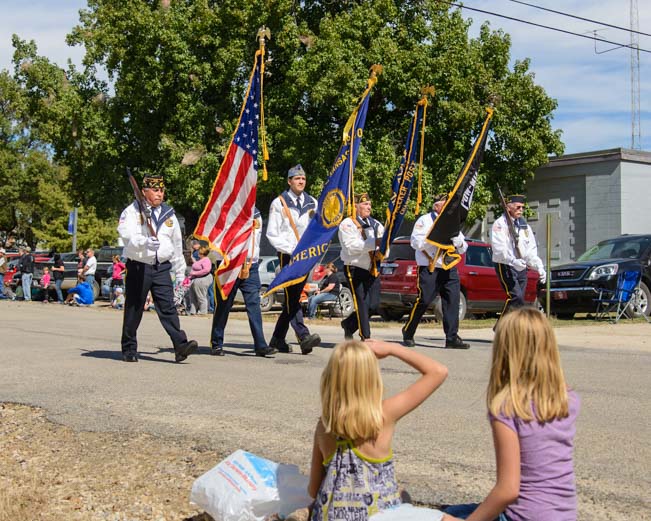
When the parade started, a cute little girl in front of us spontaneously saluted the veterans.

Girls at Humbolt Kansas Biblesta Parade

.

What makes Biblesta unique is that it is a celebration of Christianity sponsored by both businesses and churches from all over the area around Humboldt, Kansas. Each organization puts together a parade float that depicts a different story from the Bible or a special Bible verse.

B&W Trailer Hitches Moses Float Biblesta Parade Humboldt Kansas

The birth of Moses

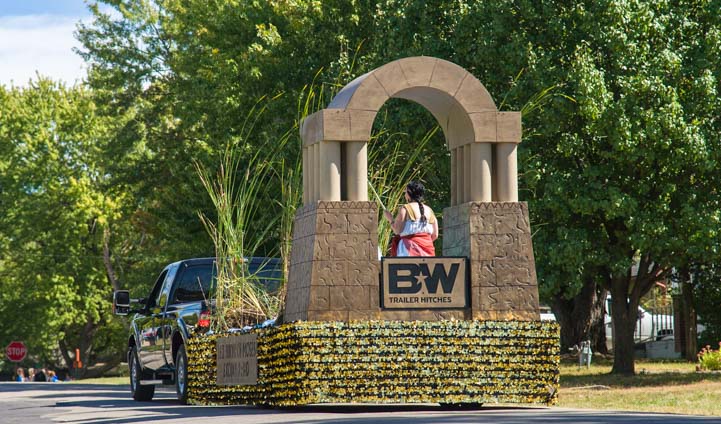
One of the first floats to go by was the Birth of Moses sponsored by B&W Trailer Hitches whose manufacturing plant is in Humboldt. These are the folks who make the top rated B&W fifth wheel trailer hitches!

B&W Trailer Hitches Float Biblesta Parade Humboldt Kansas

B&W Trailer Hitches sponsored the Birth of Moses float. Every church in the region had a float too.

Another float was the Revenge of Sampson. I was floored when a cluster of little kids sitting near me started telling each other the various Bible stories. They knew the tales well, and they each had their favorite characters and stories.

Biblesta Revenge of Sampson Humboldt Kansas

The Revenge of Sampson

Jonah and the Whale came by, and Jonah’s legs were kicking madly from deep inside the whale. The kids around me giggled and pointed.

Jonah and the whale Biblesta Humboldt Kansas

Jonah and the Whale

Biblesta began in Humboldt, Kansas, in 1957 as a Bible Story Parade to share and teach the Bible’s great stories. In 1959 the town held a contest to name their special event, and the winning entrant suggested combining the words “Bible” and “Fiesta” into the word “Biblesta.” It has been celebrated every year since.

Little kids enjoying the parade at Biblesta in Humboldt Kansas

.

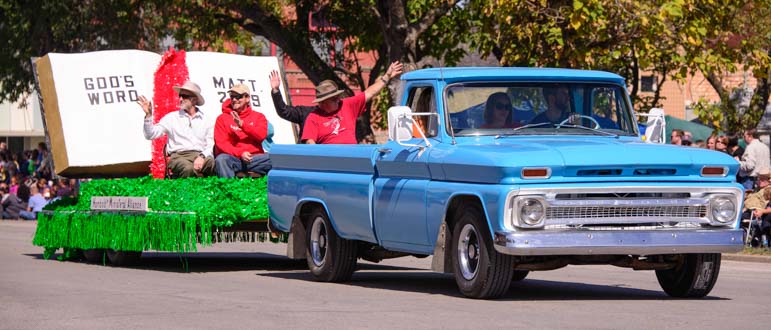
What struck me more than the floats themselves was that this celebration even exists today. Living in a time in history when America often seems apologetic for its religious and historical roots, it was refreshing to find a town that openly and unabashedly celebrates its beliefs.

God's Word at Biblesta in Humboldt Kansas

.


The crowds lining the parade streets were thick. This celebration is a very big deal here. A group of judges sat at a street corner judging each float, and an announcer told each Bible story as the floats went by.

When Christ appeared on foot carrying the cross, there was a somber note of reverence in the air.

Christ carrying cross Biblesta Parade Humboldt Kansas

Christ carries the cross

This wasn’t a Bible thumping or evangelical gathering. It was simply a sharing and retelling of age old stories that are imbued with valuable life lessons, and have been passed down from generation to generation for eons.

As I glanced around, I thought about the term, “America’s heartland,” a term that vaguely refers to some place in the Great Plains states that is tucked away on small town streets between quaint red farm houses and endless waving rows of corn. A place that values tradition and is impervious, or even oblivious, to external pressures to change.

It would be easy to say that American’s Heartland was here, at Biblesta, in Humboldt, Kansas, and perhaps it is. But as I watched this very unique celebration — one that seemed to include absolutely everyone in town — it seemed to me that such a simplistic label would be missing the more precious and intimate story of cooperation and respect that was happening here.

Blood moon lunar eclipse Tuttle Creek State Park Kansas

A lunar eclipse and Blood Moon in America’s Heartland

Without worrying about whether it was politically correct to say “In God We Trust,” or if it would be okay to allow prayers at school, or whether it might offend someone to express a belief in a supreme being or in Christ, this town simply made it a point to get together every year and share the great stories of the Bible right out in the open on the town streets, with every church from every denomination in the region participating.

How cool is that?! And in its own dignified way, how very American too!

Subscribe
Never miss a post — it’s free!

Here is a little more info about Tuttle Creek State Park, Humboldt and Biblesta:

Our most recent posts:

More of our Latest Posts are in the top MENU above.

<-Previous || Next->

How To STAY WARM in an RV – Survival Tips for Winter RVing!

Winter RVing is loads of fun, but figuring out how to stay warm in an RV on those chilly winter mornings and long cold dark evenings makes all the difference between having a great time and wishing you were in a house. Going to a southern state is a good start, but it may not always fit with your overall full-time RVing itinerary. You might get caught in an early winter storm, like we did in one year in Colorado’s Rocky Mountains. Or you might get whipped by a blizzard on your way south, as has happened to some of our snowbirding friends who wanted to celebrate the holidays at home in Montana before trekking south to Arizona in January.

Here are some tips for ways we’ve found to stay warm in our RV in winter…

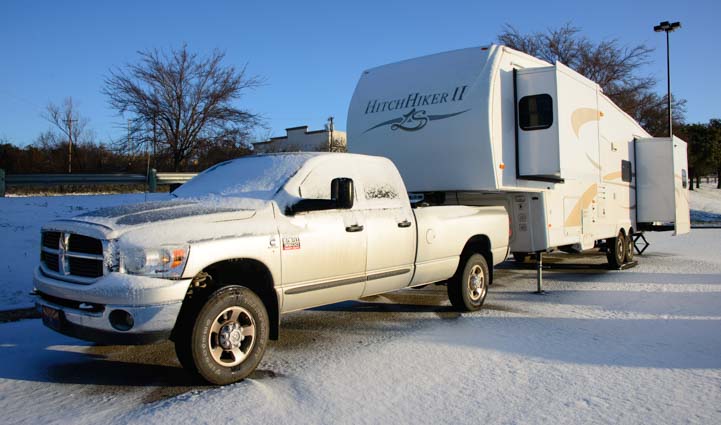
Winter RVing Tips How To Stay Warm in an RV

Brrr…How do you stay warm inside of this??

WINTER RV TIP #1 – STAY IN BED UNDER THE COVERS TIL SPRING!

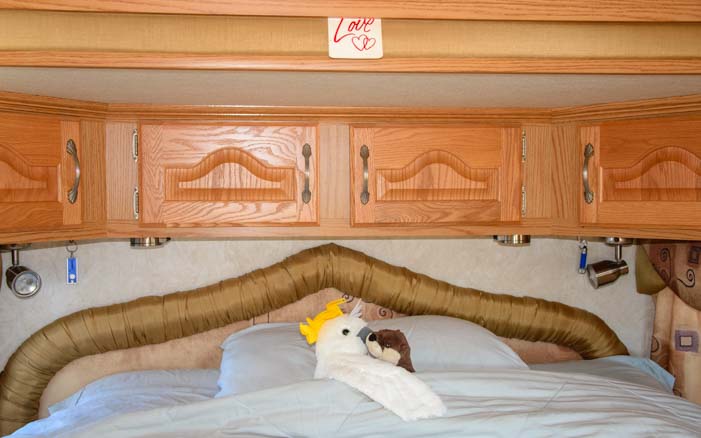
One winter RVing tip is to go to bed and stay in bed until the spring wildflowers begin to bloom. Our two little RV companions, Chrissy the cockatoo and Weazie the ferret (named for former beloved pets) seem to have decided to go that route this year.

Winter RVing how to keep warm in an RV

One solution – jump under the covers and stay there until Spring!!

WINTER RV TIP #2 – GET AN EFFICIENT SPACE HEATER!

A better option is to get a good and efficient heater. The factory installed propane furnaces that come with most RVs is very inefficient. The blower uses a lot of electricity. What’s worse, the heater goes through a lot of propane, because much of the hot air is exhausted outside the RV (just go outside on a cold day and put your hands by the RV furnace vent — they’ll be warm in a jiffy!).

If you will be plugging into electric hookups a lot, and staying for just a few days at a time in most of the places you travel to (with no metering on the electricity and unlimited power built into the overnight camping fee), then it makes sense to get a really great electric space heater.

WINTER RV TIP #3 – INSTALL A VENT-FREE PROPANE HEATER!

If you are going to be boondocking (or dry camping), out in the southwestern deserts — or even in Florida or Texas — then you will need an RV heater that is efficient both in its use of electricity and its use of propane. The best option is a vent-free propane heater.

Winter RV tips vent-free blue flame propane heater

We LOVE our vent-free propane heater.

We have been using ours since Mark installed it in 2008, both during the winter and the summer, and we love it. We have a whole blog post explaining how this kind of heater works, what the technologies are behind the different styles of vent-free propane heaters on the market, what kind of heat each type of heater produces, and how to install one here:

Choosing and Installing a Vent-Free Propane Heater in an RV

We have used this heater from sea level to 10,000′ altitude year round, and we share some tips for heating strategies we’ve used when we’ve camped on a lofty mountaintop as temps plummeted and a snowstorm rolled in:

How to Heat an RV in Cold Weather and Winter Snowstorms


WINTER RV TIP #4 – GET A PORTABLE VENT-FREE PROPANE HEATER!

Mr Buddy Portable Propane Heater Staying warm in an RV

A portable vent-free propane heater is an easy way to go.

If you love the idea of using an efficient propane heater that doesn’t use any electricity, but you’re not keen on doing a permanent installation, another great option is to get a portable propane heater.


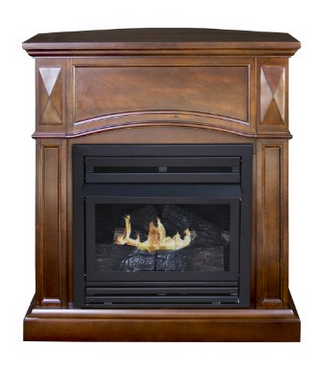
WINTER RV TIP #5 – INSTALL A VENT-FREE PROPANE FIREPLACE!

Pleasant Hearth Vent-Free Propane Fireplace 35 inch

How about a vent-free propane FIREPLACE?!!

On the other hand, if you are outfitting the RV of your dreams for a life of full-time RV travel or of winter snowbirding RV adventures, then you might consider installing a vent-free propane fireplace that is built into an elegant mantel. These heaters give off the same incredible heat as the more industrial looking vent-free propane heaters, but they have the cozy and inviting appearance of a fireplace and produce a beautiful (and mesmerizing) flame. What a great addition to an RV!!


WINTER RV TIP #6 – SHRINK-WRAP YOUR RV SCREEN DOOR!

One of the easiest ways to winterize an RV is to shrink-wrap the screen door. By covering the screen door with a thin layer of plastic, you can keep the big RV door open all day long, close the screen door, and let the sunshine fill your rig with light and warmth. It is really surprising that just a thin layer of plastic on the door is all it takes to keep the cold air out and let the warm air in (if you aren’t in sub-freezing temps!!).

Winter RVing Tips Shrink-wrap RV screen door

Shrink-wrapping our RV screen door keeps the cold air out and lets the sun shine in!

We learned this trick from our RVing mentors, Bob and Donna Lea, in our first winter of RVing back in 2007-08. The beauty is that the installation of the shrink-wrap is less than a one hour job, and you can remove it in the springtime in just a few minutes.

Winter RVing how to stay warm in an RV use Window Shrink Film

Window shrink-film kit

We love having shrink-wrap on our screen door so much that we’ve gone through quite a few summers without removing it. Up in the mountains, it can be chilly in the summertime, with a brisk breeze blowing into the rig in the mornings, so the shrink-wrap can work its magic there too, and it also keeps the dust out.

This year, however, we took the shrink-wrap off our screen door when we got into the heat and humidity of the northeastern states in August, so we had to reinstall it just a few weeks ago.

To get started, all you need is

  1. Pair of scissors
  2. Razor blade (or boxcutter or sharp knife)
  3. Hair Dryer
  4. Window Shrink Film kit
Winter RVing Tips - Tools to Shrink-wrap RV screen door

All the tools we used to shrink-wrap our screen door.

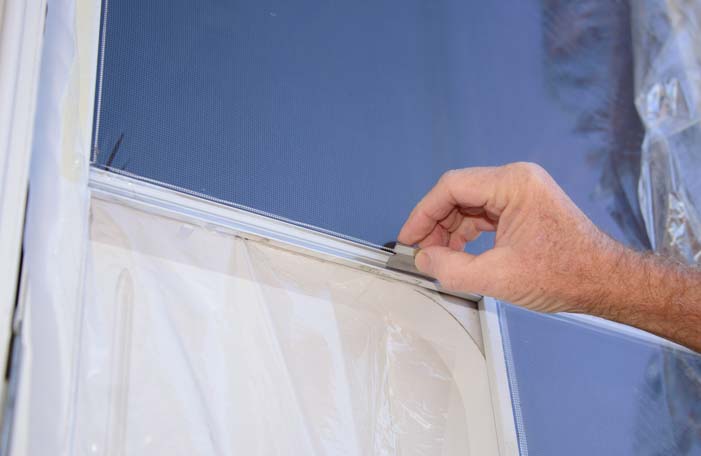
The window shrink film kit comes with double-sided tape, and all you have to do is outline the door with the tape, remove the backing, press the plastic onto the tape, trim off the excess and then heat it up with a hair dryer to make the plastic taught. It is best to clean the frame of the door with alcohol or film remover first so the tape adheres well.

Winterize an RV screen door attach double-sided tape

Press the double-sided tape along the frame of the door, going around the plastic sliding insert
by the door handle.

Go around the little slider opening for the door handle, because you need to be able to slide this open and closed (the shrink-wrap is covering only the screened parts of the door!). Then peel the backing off the tape all the way around the door.

Winter RVing winterize screen door remove tape backing

Remove the backing from the tape.

Press the plastic onto the sticky tape around the door frame.

Winter RV Tips - Winterize screen door and hang plastic shrink film

Hang the shrink wrap around the door frame.

Then use a razor blade to trim off the excess all the way around the door. Get the plastic as taught as you can. It doesn’t have to be perfect, though, because all the wrinkles will be taken care of in the next step.

Winterize RV screen door - trim off excess plastic shrink film

Use a razor blade or box cutters to trim off the excess plastic.

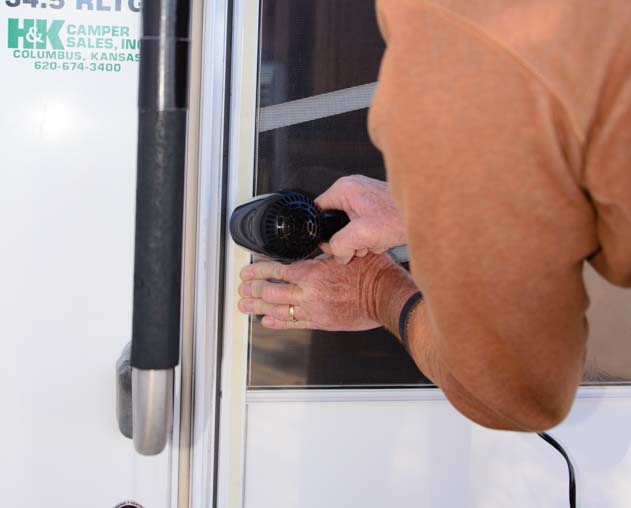
Using the hair dryer on the high setting, wave it gently back and forth over the edges of the door. The plastic will miraculously shrink up and become taught.

Shrink-wrap RV screen door and use hair dryer to shrink plastic film

Use a hair dryer on the high setting to shrink up the plastic along the door frame.

Once you’ve gone around the frame of the door, wave the hair dryer across the middle to tighten that up too. Keep the hair dryer moving so it doesn’t melt the plastic in one spot.

Shrink-wrap RV screen door and shrink plastic film with hair dryer

Keep the hair dryer moving and wave it across the plastic to tighten it up.

If it’s cold out, you can always give yourself a blow dry too!

That hot air feels good!

.

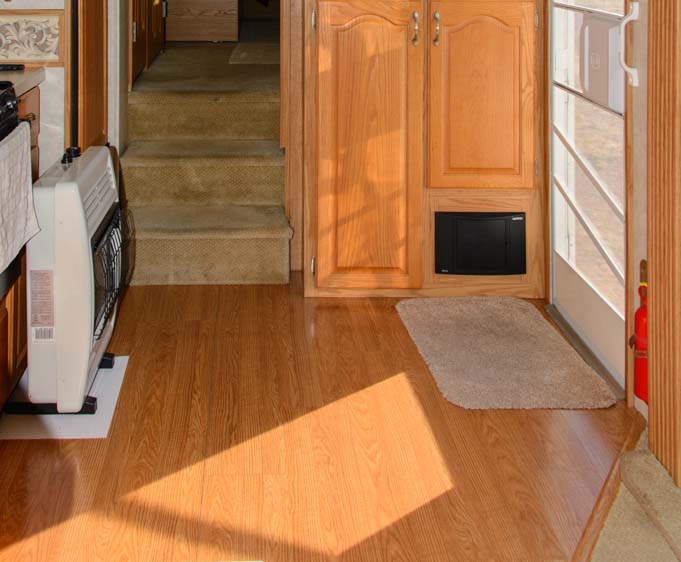
Once it is done, open the outer RV door open and close the screen door. The warm sun will pour in, but the cool breezes will stay outside!

Winterize RV screen door sunshine comes in

Morning sunshine fills our kitchen

Note: Since publishing this post, we have refined our shrink-wrap system even further. We have found that it is easy to make this into a Dual Pane system but adding a second layer of shrink-wrap film on the INSIDE of the RV door. What a world of difference this second layer makes!!


WINTER RV TIP #7 – ORIENT THE RV WINDOWS (and DOOR) TOWARDS THE SUN

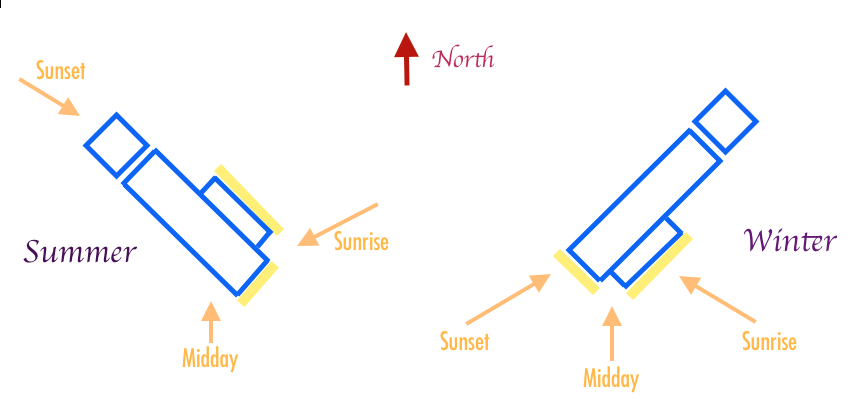
Every RV floorplan is different, with the largest windows and the door placed in various locations, depending on how long it is and whether it’s a trailer or a motorhome. Take a look at where your biggest windows are, and try to orient the rig so those windows are in the sun for most of the day.

Our biggest windows are in a big slideout on the curb side (passenger side) of the trailer and also in the rear of the coach. So, in the wintertime we are best off orienting our rig with the truck headed northeast. This places our biggest windows towards the southeast and southwest.

In the summertime, the opposite is true as we try to avoid having our windows facing the sun. Our best orientation in the summertime is for the truck to be headed northwest. This way, although we get blasted with some sun in the morning, our biggest windows are blissfully shaded during the long hours of blazing hot sun as it shines from the south and sets in the northwest.

This does place our RV refrigerator in direct sunlight during the hottest hours of the day in the summer, but we’ve never had trouble keeping our food cold with the fridge on the highest setting during those hot months (of course, our fridge died recently, but we discovered that that was to be expected because of its age!).

How to stay warm in an RV Orient the RV windows towards the Sun

For our rig, it’s best to orient the truck to the northwest in summer and the northeast in winter.

Note that the sun doesn’t travel the same arc in the sky in the summer months as it does in the winter, as shown by the orange arrows in the graphic above.

In the dead of summer, the sun rises in the northeast and sets in the northwest. During the day it is high in the sky, almost directly overhead. In mid-winter, the sun rises in the southeast and sets in the southwest, traversing a very low arc in the sky. At its highest, the sun is only halfway up the sky. These low angles are advantageous for keeping an RV warm in winter, however, as the sun shines directly in the windows into the center of the coach.

WINTER RV TIP #8 – INSULATE THE HATCH VENTS

The RV roof may have some fabulously high R-rating that the manufacturer proudly touted when you bought it, but that applies only to the parts of the roof that are solid. Most RV vent hatch covers are thin pieces of plastic, and they don’t have much of an R-factor at all.

You can give the vent hatch covers a hand by using a hatch vent insulator. These have reflective insulation on one side to make them even more effective.

How to keep warm in an RV Hatch vent insulating pillow

A hatch vent insulator really helps!.

Another option is to cut styrofoam to the exact dimensions of the hatches. When we bought our fifth wheel trailer from the manufacturer NuWa Industries, we asked them to cut four pieces of the Blue Dow insulating styrofoam that they used in the walls to the exact dimensions of our four roof hatches.

The great thing about having insulation on the hatches is that they work both summer and winter. We often use ours in the summertime when we leave the rig for the daytime hours.

Another helpful benefit is that they block out all light. So, if you are parked under a bright light or there is a full moon that wakes you up as it shines right in your eyes, you can block out the light with an insulator in the bedroom hatch.

How to stay warm in an RV hatch vent insulation

We use Blue Dow foam from the fifth wheel walls cut to the dimension of our hatches


WINTER RV TIP #9 – DEALING WITH CONDENSATION!

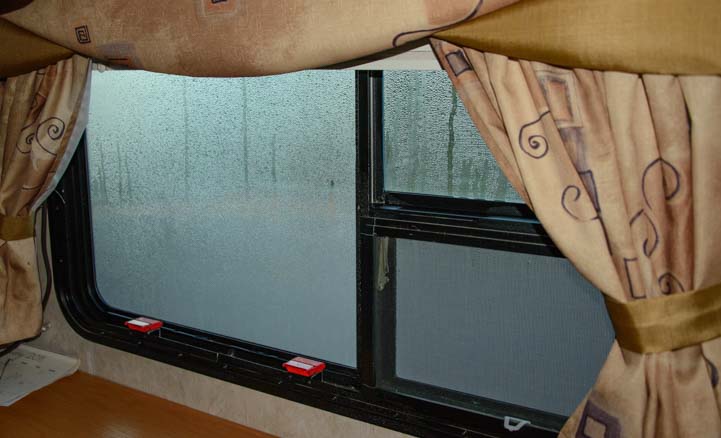
One of the biggest annoyances in cold, winter weather in an RV, is condensation. If you run a vent-free propane heater while boondocking, whether it’s a portable heater or one that is permanently installed, condensation will build up on the insides of the windows when the dew point is at a certain level.

Condensation on an RV window in winter

Insulation on our windows – ugh!

You can minimize the condensation build-up by running the RV furnace for a while to blow out the moist air. You can also open a window a crack, or open the RV door for a bit.

Absorber XL towel wipe away condensation

Absorber towels sop up moisture with ease.

The fastest way to deal with the condensation is simply to wipe it off with an Absorber towel. As the name implies, these towels are incredibly absorbant. They are most effective when they are damp, so they come with a little plastic container that will keep them damp for months.

Simply wipe the window and then wring out the towel. And repeat. Once the window is dry, give it a final swipe with a soft microfiber towel. This gets rid of any streaks.

To make your life easier during the winter condensation season, remove the window screens and put them in a closet. This way, you aren’t fighting with the screens every time you wipe down the insides of the windows.

How much do we love our Absorber towels? We have two — blue for him and red for me!


WINTER RV TIP #10 – INSULATE THE WINDOWS AT NIGHT

Like the big roof insulation R-factor that doesn’t account for the hatch vents, the well advertised high R-factor in the walls doesn’t account for the windows, which is where much of the heat in a rig escapes, especially at night. Closing the blinds makes a difference. When we’re in a remote area with no one around, we prefer to keep the blinds open so the first light of morning fills the rig. But we can’t do this in the wintertime unless we want to wake up to a rig that is 5 degrees cooler than it could be.

Likewise, on the worst of the cold winter nights, covering the windows with Reflectix insulation makes a big difference. This aluminum foil insulation comes in a big roll, and you can cut it to the exact dimensions of each window. Just use a marker to write on each one which window it’s for.

To put one of these window insulators in place, simply hold it against the glass and then lower the blinds over it. In the case of our biggest one in the back of the rig, we rest the bottom of it on a spare pillow so it doesn’t slip down.

Reflectix insulation keeps heat from escaping out an RV window

The window-sized piece of Reflectix Insulation is held in place by the window shade.

We keep all of them rolled up together in a closet and use them both summer and winter. In the summertime, they help immensely with keeping the heat out during the day.


WINTER RV TIP #11 – USE THE OVEN

One of our favorite ways of warming up the inside of our buggy is by baking. Mark is the Resident Baker in our household, and there is nothing like a batch of yummy muffins or a fresh loaf of banana bread coming out of the oven to warm us up inside and out!

How to stay warm in an RV baking muffins

On a brisk morning, there’s nothing like a fresh loaf of banana bread coming out of the oven!

After the baking is done and the oven is off, we keep the oven door open for a while so we can enjoy the residual warmth as it cools down. By the way, we recently discovered Chiquita banana bread mix, which is absolutely delicious and tastes just like a loaf made from scratch. It requires two bananas, and lately Mark has been adding raisins to it too.

On a cold afternoon, we’ll bake something in the oven for dinner. The longer it takes, the warmer the buggy will get during the baking process! Anything from frozen pot pies or lasagna to a whole chicken does the trick nicely.


WINTER RV TIP #12 – DO SOME EXERCISES

As soon as we wake up in the morning, we do some modest exercises. We might be shivering when we first turn on the vent-free heater, but a quickie round of 25 sit-ups and pushups always gets the blood flowing, and by the time we get in a few rounds with the hand weights, we’re sweating and turning the heater off!

This is also a great way to work off those extra calories from the tasty muffins, sweet breads and pies that keep coming out of our oven!

Exercise to keep warn in an RV in winter

One way to take the chill off — do a set of sit-ups. Still cold? Roll over and do a set of push-ups!


WINTER RV TIP #13 – PLAY THE FIREPLACE DVD

Fireplace DVD How to stay warm in an RV

Fireplace video.

This may sound a little goofy, but a video of a fire burning in a fireplace is really fun and makes the rig cozy. The video simply shows logs in a fireplace burning down to embers, accompanied by the crackling sound a fire makes. It is surprisingly realistic, and quite funky. The crazy thing is that whenever we play it, the person sitting in the recliner closest to the TV always feels a little warm on the side by the fire!


WINTER RV TIP #14 – INSULATE THE HOT WATER HEATER and HOT WATER PIPES

To conserve propane, we always heat the water just once a day, right before we take our showers. After we’re done, we have warm water for dishes, etc. By insulating the hot water heater, the water stays warmer longer. We also put insulating pipe foam on the hot water pipes that run from the heater to the shower and the vanity and kitchen sinks.

Taking a shower in an RV in the winter can be a numbing experience if temps got to freezing the night before, no matter how hot the water is in the hot water heater, because the cold water has to run through the pipes before the hot water reaches you in the shower.

If we are conserving water, we’ll bring a small cooking pot into the shower and run the cold water into it. Then we’ll warm that water up on the stove later for dishes or whatever. Even though it’s less than a quart of water, this way it’s not wasted on our bodies as we hop around in the shower shouting expletives and soaping up our goose bumps!

For more tips on heating an RV, see these articles:

How to Heat an RV in Snow Storms and at High Elevations

How to Install a Vent-Free Propane Heater in an RV

 
Thank you for using any of our links to Amazon to shop online. When you access Amazon this way, anything you put in your shopping cart right after that results in a small commission to us at no cost to you (no matter what you buy) and helps us keep our site online.
It’s a true win-win — THANKS!

Below are some of our most POPULAR POSTS (also in the MENUS above)

Buddy - A Journey in Spirit - The story of an event that changed our lives forever.

ARTICLE INDEXES
  • RV Tech Tips Articles - A one page index of links to all our RV Tech Tips, RV Upgrades & RV Maintenance articles.
  • RV Lifestyle Tip Articles - An index of links to all our RV Lifestyle Tips (finances, boondocking, major repairs, work/jobs, etc.)
  • Solar Power Articles - Overview and tutorial articles for how to design and install solar power on an RV or boat
  • Product Reviews - An index of links to all of our Product Reviews
RV UPGRADES, SYSTEMS & TIPS MONEY FULL-TIME RV LIFESTYLE GEAR STORE
  • Gear Store - A list of the goodies, equipment and gear we've found useful in our RV lifestyle!
 

Subscribe
Never miss a post — it’s free!

Our most recent posts:

More of our Latest Posts are in the MENU.   New to this site? Visit RVers Start Here to find where we keep all the good stuff. Also check out our COOL NEW GEAR STORE!! *** CLICK HERE *** to see it!

Space Craft RV Factory Tour – Custom 5th Wheels Made To Order!

October 2015 – During a wonderful 8 month season of RV travel that had taken our fifth wheel trailer 10,000 miles from Arizona to Big Bend Texas to Florida’s Gulf Coast and up through the Smokies via the Blue Ridge Parkway to Nova Scotia and then over to Acadia National Park in Maine and west through New York’s Finger Lakes, culminating with a fabulous stop in Maysville, Kentucky, we had not only seen some beautiful sights, but we had visited several RV and trailer repair shops on the way.

Custom fifth wheel trailer RV by Space Craft Manufacturing

How about a new custom fifth wheel trailer from Space Craft Manufacturing?!

After installing disc brakes in our trailer in Texas, an upgrade we have been grateful for every single day since, we replaced a bent trailer axle in Maine, followed by swapping out a dead RV refrigerator in Indiana.

In Kansas, we tackled a slew of plumbing repairs, from a new fresh water tank to a new kitchen faucet, rebuilt toilet, new black tank sensors, new black tank sewer valve, and a repaired window leak, among many other things. And our trailer still has suspension issues.

Besides being grateful for our RV warranty, we began to wonder: at what point do you give up on an aging RV and get a new one?

Space Craft Manufacturing custom fifth wheel trailer RV

A newly completed Space Craft 30.5 fifth wheel trailer

On our way from our refrigerator repair to our plumbing repairs, we stopped in to visit the unusual custom fifth wheel builder, Space Craft Manufacturing. We have known about this company for a long time, and were thrilled to be able to take a peek at their facility.

Space Craft’s primary market is the carnival and circus industry. These traveling folks work full-time and are very hard on their trailers. One client, we learned, lives with his leopard and his chimpanzee in his fifth wheel. He came to Space Craft looking for a design that could give both of his companions a comfortable home in his trailer — along with a little space for him too!

Maple kitchen Space Craft Manufacturing 5th wheel trailer RV

Inside the 30.5 – beautiful custom built maple cabinets

Circus folk don’t have the time to fuss with repairs. They need rugged trailers that hold up to big cats and great apes! Out in Space Craft’s used trailer lot, we saw a bunch of 2014 and 2015 top-of-the-line fifth wheel trailers that had been traded in for Space Crafts after just one season on the road, because they weren’t up to the job.

The beauty of getting a Space Craft is you can have anything you want. They build trailers from 30′ to 57′ long, and they outfit them with whatever kinds of cabinets you want, whatever floorplan suits your fancy, whatever paint job you think is cool and whatever appliances and components you deem vital to your personal happiness on the road in an RV.

Have It Your Way!

RV bedroom Space Craft Manufacturing custom fifth wheel trailer

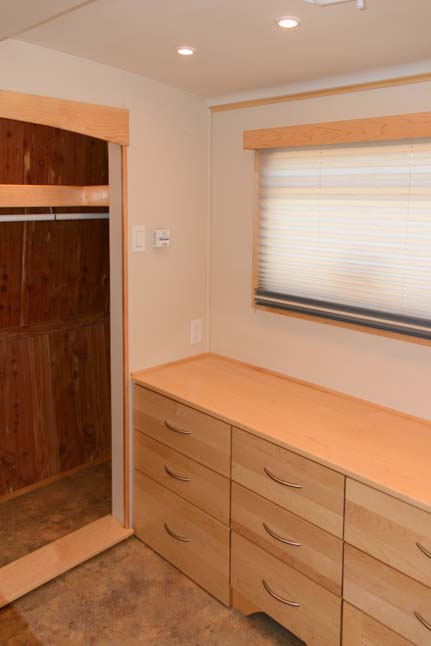
Cedar closets and a beautiful maple dresser. The furnace blows from under the dresser rather than floor ductwork.

In town, we chatted with a gal that has lived in Concordia, Missouri, home of Space Craft Manufacturing, all her life. She says the locals there are all accustomed to Space Craft’s unusual customers who swing through now and then for repairs or to upgrade to new units. Space Craft is located right behind a rest area on I-70, though, and interstate travelers are often shocked when they see an elephant or a giraffe grazing in the grass just beyond the trees!

When we first poked our heads in the door of a finished Space Craft 30.5 fifth wheel trailer, we were astonished by the quality. Every inch of the trailer radiated hallmarks of rugged construction. Frankly, all other fifth wheels we’ve been in (including our home and other popular and expensive units) are weekend toys by comparison!

RV living room Space Craft custom fifth wheel trailer

This buyer wanted house-like painted walls rather than wallpaper fiberboard

Space Craft is a family owned business run by Marsha Trautman and her son Wyatt. They don’t bother with marketing, because they just don’t need to do it, although they do take a trailer showcasing unique design features to the Tampa RV show most years. They build 10 to 15 units a year, and right now, they are booked with orders for a full year in advance. To get in line, just put down a 25% deposit on your new trailer.

Outer wall of an RV slide-out room

The frame of the outer wall of a slide-out room

Space Craft does everything in-house. They build their own frames and pay extraordinary attention to details that most manufacturers overlook. Rather than focusing on a standardized fleet of sexy floorplans with luxurious furnishings and fixtures, they ensure the underpinnings of each trailer are top notch, something buyers often forget to think about when they are seduced by a beautifully appointed RV living room at a dealership.

Tiny details like the superior construction of slide-out rooms are a given. Most manufacturers build slide-out rooms with multiple joints and rows of screws holding things together, making them prone to leaks. At Space Craft, every slide-out room is built with a single sheet of fiberglass covering the roof and sides, with nary a screw to be found.

Seamless slideout customer 5th wheel trailer Space Craft Manufacturing

Seamless slide-out construction – no chance of leaks

Underneath, their trailers are equally uncluttered, and there is no flimsy corrugated plastic screwed to the bottom. Just pure, fine lines and solid construction.

Space Craft manufacturing clean underbelly custom fifth wheel trailer

Even the underbelly has fine lines and no dangling parts or corrugated plastic sheeting.

Space Craft builds what you request, and they have blueprints for hundreds of different designs they’ve built already to give you ideas.

When I chatted with Wyatt, Space Craft’s designer, about what he feels is important in fifth wheel construction, he made it plain that easy access to all components and leak-proof, solid construction were his first priorities. Whereas many other brand new full-time fifth wheel trailers place important systems and components in out-of-the-way places, Wyatt puts every system in a spot where it will be easy to service or replace.

Electrical compartment Space Craft custom fifth wheel RV

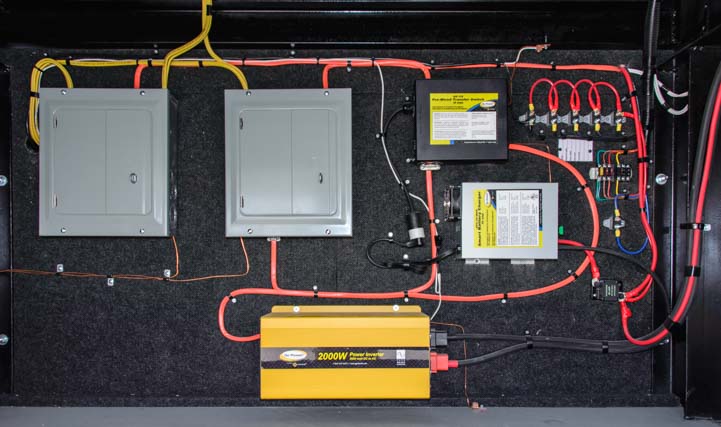
Now THIS is a well dressed RV electrical installation!

The DC and AC wiring in the basement of a Space Craft is a sight to behold. Beautifully done!

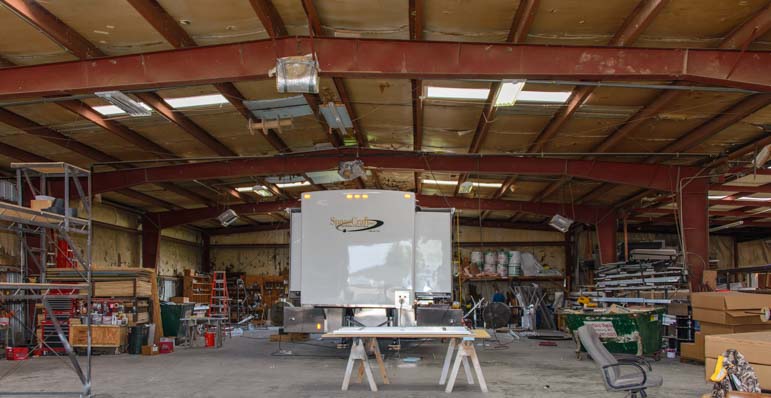
Only one Space Craft trailer is built at time by a handful of loyal and skilled employees. While we were there, a 53′ two bedroom, two bathroom model was in the finishing stages on the line.

Space Craft Manufacturing custom 2 bedroom 2 bathroom trailer

Space Craft produces one meticulously built trailer at a time.

Many of the Space Craft trailers are two bedroom, two bathroom luxury models, designed for carnival and circus owners. Many others are “bunkhouse” units that have four to six entrance doors on one side going to individual bedrooms to house employees on tour.

Space Craft Manufacturing custom 53' fifth wheel trailer RV_

During our visit, a 53′ two bedroom two bath model was on the line.

However, Space Craft has built loads of smaller fifth wheels for full-time RVers, although Wyatt said with a smile that none of their buyers are first-time owners. Afterall, it is impossible to know what custom options you’ll want or need in a full-time rolling home before you’ve been on the road a little while.

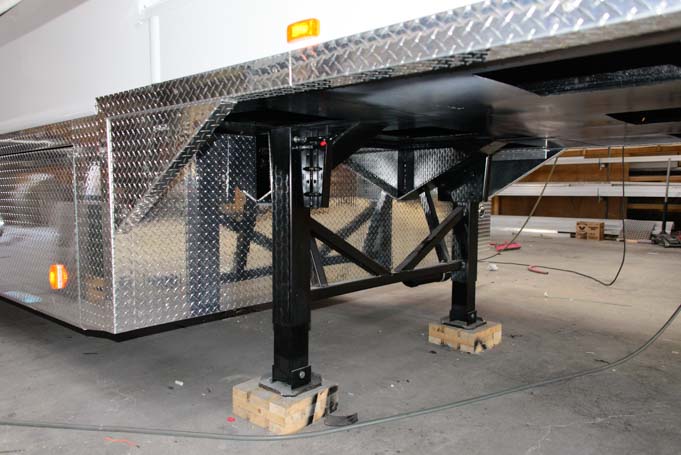
Space Craft Manufacturing custom fifth wheel RV landing legs

Ummmm…our landing legs don’t look anything like that!

What does one of these babies cost? I was astonished to discover that a 37-38′ fifth wheel would come in around $125k to $150k, depending on options like hydraulic leveling, disc brakes, pre-installed solar power, generator, etc.

Solar panels on a Space Craft custom fifth wheel RV

This buyer wanted two 100 watt solar panels. They’ll install whatever you ask for!

That is very comparable to the MSRP on Continental Coach (Forks RV), DRV (Thor), Luxe (Augusta RV) or New Horizons semi-custom fifth wheels. The nice thing is that if you want a top quality unit that doesn’t have an island kitchen and is in the mid-30′ range, a nearly extinct mass-market design, Space Craft can engineer and build it for you. They can even build in a beautiful vent-free propane fireplace with real flames and a wooden mantel as a cozy centerpiece for those cold winter nights!

Space Craft Manufacturing custom kitchen 53' fifth wheel trailer RV

Custom kitchen built to the buyer’s specs

If you travel with unusual pets, no matter how big or how exotic, Space Craft will surely take it in stride and will build the rolling home of their (and your) dreams!

Space Craft Manufacturing Logo

.

Subscribe
Never miss a post — it’s free!

More info about Space Craft:

Related Posts – Cool Factory Tours and Different Kinds of Trailers:

Our most recent posts:

More of our Latest Posts are in the top MENU above.
New to this site? Visit RVers Start Here to find where we keep all the good stuff!!

<-Previous || Next->

Thanks for the Great Times, Maysville KY!!

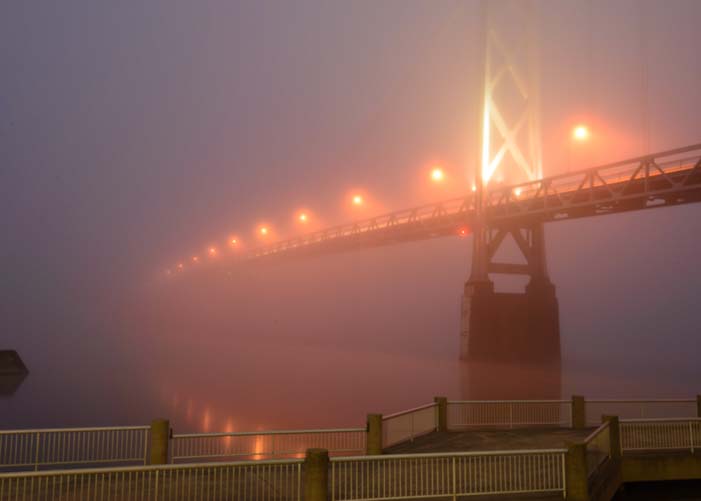
September 2015 — It’s been well over a month since we left Maysville, Kentucky, but our travels there were so special that we have a few more tales to tell and photos to share in one last blog post here. For starters, Mark got up early one morning and caught the town’s classic suspension bridge lit up in the mist just before dawn. What a beautiful sight!

Misty Lights Simon Kenton Memorial Bridge Maysville Kentucky

Lights in the mist at the Simon Kenton Memorial Bridge in Maysville Kentucky

During our stay in Maysville we happily became regulars at O’Rourke’s Neighborhood Pub. Every afternoon we joined a special group of newfound friends for a pint. We ended up meeting lots of people and got caught up in conversation whenever we stopped in.

One particularly hot and sultry afternoon, as we were relaxing over a pint on the patio, Mark noticed that his buddy sitting next to him, Jeff, was all suited up for a running race. “When’s the race?” Mark asked him. “In about an hour!” Jeff said, grinning, “You should do it!”

O'Rourke's Pub Maysville Kentucky

In two short weeks, we became regulars here at O’Rourke’s Neighborhood Pub

To my complete astonishment, after Mark polished off his Guinness, he got up from the table and took off to put on his running gear too. I felt like a total bump on a log, but I was glued to my chair and couldn’t possibly imagine doing a 5k run at race pace right about now!

In no time, Mark returned in his running shorts and shoes and headed down the street to the registration table at Limestone Landing. It’s a good thing he had all that hydration in him, even though it was beer, as this particular afternoon was truly sweltering with 95 degrees heat and 95% humidity to boot! I was dripping with sweat just sitting in a chair in the shade!

As I followed him to the starting line, I saw a whole slew of young kids lined up for a photo op. How fun! The heat wasn’t fazing them one bit. They were raring to go!

5k running kids Maysville Kentucky

Kids pose before the start of the 5k race

Suddenly, the race started and they were off. A whole pack of people of all ages ran past me and vanished down the road.

The finish line was in front of the bar (perfect!), so, with nothing to do while they were gone, all of us bumps-on-logs went back to enjoying our beers and chatting on the back porch of the pub. I felt a little guilty for not doing the race too, but not that guilty!!

After a while we saw some heads bobbing in the distance, and along they came.

Finishing the 5k race in Maysville Kentucky

From bar stool to finish line in record time

Mark sprinted over the finish line looking much too fresh for all that exertion, but he admitted he was pretty pooped. The kids, however, were just getting started. As a band played in the streets, they jumped up on the picnic tables and began to boogie, to everyone’s delight!

Kids dancing on the table Maysville Kentucky

The running race sure didn’t wear out these kids…they were dancing on the tables and ready for more!

Parties in the streets, dancing on the tables, and live music all seemed like such a natural part of day-to-day life here in cute and historic Maysville. If there wasn’t an event going on outside on the brick streets, then there was usually something going on inside somewhere.

Historic alley Maysville Kentucky

No dancing in the street right now, but just wait!

We took in a terrific photography exhibit at the Cox Building one afternoon. Photographer Rad Drew had taken most of the photos with a DSLR camera, but they had all been processed on an iPhone using iPhone apps. The results were gorgeous!

Maysville has its own Opera House which has recently been renovated from top to bottom. This wonderful theater hosts all kinds of performances throughout the year, and we were lucky to catch a fabulous show there.

Maysville Kentucky Opera House

The Washington Opera House in Maysville

We had seen posters around town for a free Elton John tribute concert at the Opera House, and as we sat in the seats of this beautifully restored building, we were transported to a different time and place as performer Lee Alverson channeled the rock star on stage.

Besides his great renditions of old favorites, what amazed us was when an announcer hopped up on stage and listed all the upcoming performances at the Opera House. Not only did the theatrical group the Maysville Players have a major production planned for every other month during the winter, but a medalist in the International Franz Liszt Piano Competition was on tap to perform a few days after we left. This is one busy stage!

Elton John Concert Maysville Kentucky Opera House

Elton John comes to life on stage at the Opera House

There were other kinds of free music being played around town too, and we enjoyed listening to a band at the St. Patrick’s Fall Festival at the historic St. Patrick’s Church in town .

St Patrick's Fall Festival Maysville Kentucky

Playing great tunes at the St. Patrick’s Fall Festival

Just outside of town we found even more things to do. Before Maysville came into being, the village of Washington was settled just a few miles away. The area was first explored by Simon Kenton, and when the town was later formed, one of the trustees was Daniel Boone.

A mural on the flood wall in Maysville shows how the earliest travelers came down the Ohio River on flat boats in the 1700’s. When they built their homes, they dismantled the flat boats and used the boards to build their houses.

Maysville Kentucky floodwall mural early settlement

The Maysville flood wall tells the history of the area, including the arrival of settlers in flat boats on the Ohio River

One such house in Old Washington was built by George Mefford. Those early settlers were made of some pretty tough stock. He lived here with his wfe and thirteen children!!

Washington Kentucky 1790's Settlement near Maysville_

Cozy living: a family of fifteen lived under this roof. Wow!

Another fun building in town is the old post office. Established in 1789, it was the first post office west of the Appalachian Mountains, and it served settlers all the way out to Wisconsin and Minnesota.

Washington Kentucky Post Office near Maysville

The historic post office in Old Washington

The town was also the site of a slave auction that was witnessed by Harriet Beacher Stowe when she was visiting a friend there. That scene later played an important part in her famous book, Uncle Tom’s Cabin.

We were surprised to learn that during the Civil War, Kentucky did not side strongly with either the North or the South, instead finding itself split in its allegiance. Ironically, the little village of Washington was the birthplace of two Civil War generals, one who fought for the Union and one who fought for the Confederacy.

Kentucky was so torn by the war that, at times, the merchants in Maysville were unsure which currency to use to pay their laborers, knowing that if they paid them in the wrong currency it would have no value when the war was over.

One afternoon, we watched a World War II ship sail down the Ohio River. Like so many unexpected events we stumbled into, this one spread by word of mouth around town, and by the time the ship floated past, the banks were full of spectators cheering as the crew yelled out, “Hello Kentucky!” (They yelled “Hello Ohio” to the crowd on the other side!)

US Navy WWII Ship Maysville Kentucky

Sailors on a US Navy ship from WWII shout “Hello Kentucky” as they float by on the Ohio River

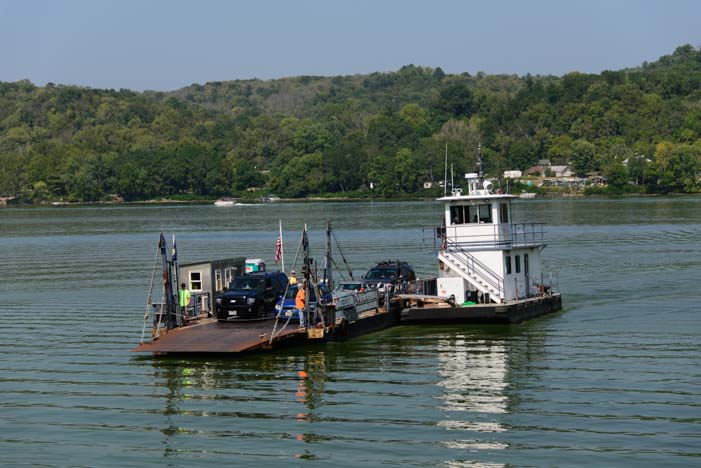
Just a few miles away in the town of Augusta, the Augusta Ferry is a really fun way to get out on the Ohio River. The ride is free for foot traffic and is $5 per car. It takes just a few minutes to cross the river, and it goes back and forth all day long.

“What’s on the other side?” I asked the boatman as I took a spot by the rail.

“Ohio!”

Oh gosh, ask a silly question, get a silly answer! There’s no town on the other side, just a ramp and a dock, so we didn’t get off. But it was fun to see how the cabin compartment of the ferry swiveled around the barge as it turned to go back towards Kentucky.

Augusta Ferry Ohio River Kentucky

The Augusta Ferry offers a free ride to Ohio

We happened to be in Augusta for Augusta Heritage Days, a fall festival featuring a truly awesome car show. Antique cars were driving all over this tiny little village, and they lined up in the grass on the banks of the Ohio.

Augusta Heritage Days car show Kentucky

An antique truck parks on the main drag in Augusta

A trolley shuttled people between Augusta’s main drag and the big park where the cars were on display.

Trolley ride Augusta Kentucky Heritage Days

We hopped on a trolley to go between the town’s main street and the car show at the riverfront park

Mark was in seventh heaven talking to all the car owners, peering under hoods, and admiring glistening paint jobs on sporty cars from every era. As we drove back to Maysville, we found ourselves behind a really cute little yellow convertible. That’s the way to go!

Antique Car Augusta Kentucky

Now, THIS is the way to enjoy the riverside drive between Maysville and Augusta

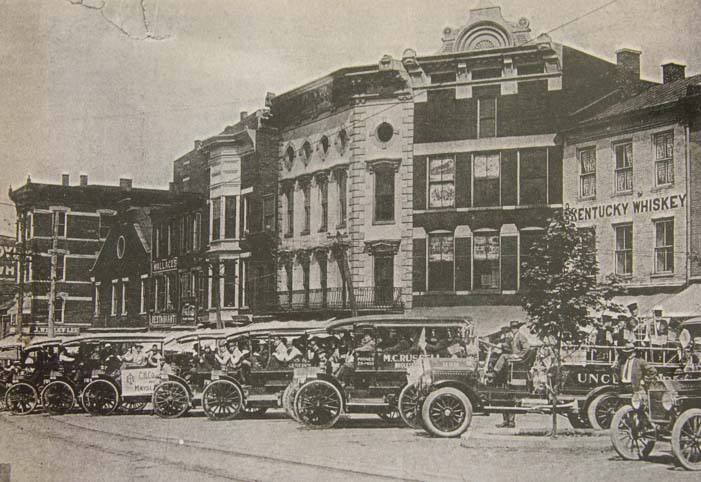
Maysville is steeped in history, and I just loved a photo we saw of Market Street filled with antique cars back when they were the hip new thing to own. We had been in Maysville long enough that I could now recognize not only Market Street but also the buildings that were still standing and the few that were no longer there.

Market Street Maysville Kentucky early 1900's

Antique cars — when they weren’t antique — on Market Street in Maysville

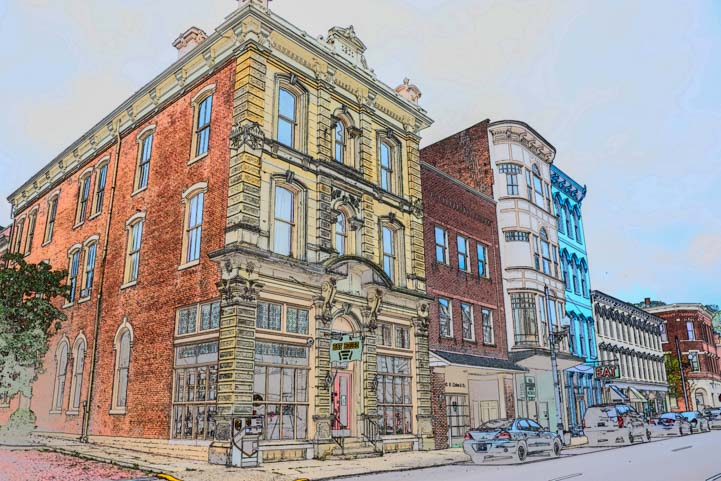
As our happy days in town began to wind down, we ran around getting final shots of the lovely downtown area. We had fun giving them an artsy look.

Maysville Kentucky Historic Town

Historic buildings downtown offer an antique flair in modern times.

Pretty buildings and beautiful renovations aside, it is the people that ultimately make Maysville special. The warmth, hospitality and friendship we found in this small river town will forever touch our hearts, and we can’t say thank you enough to everyone for letting us feel like locals for a while.

Thank you City of Maysville Kentucky

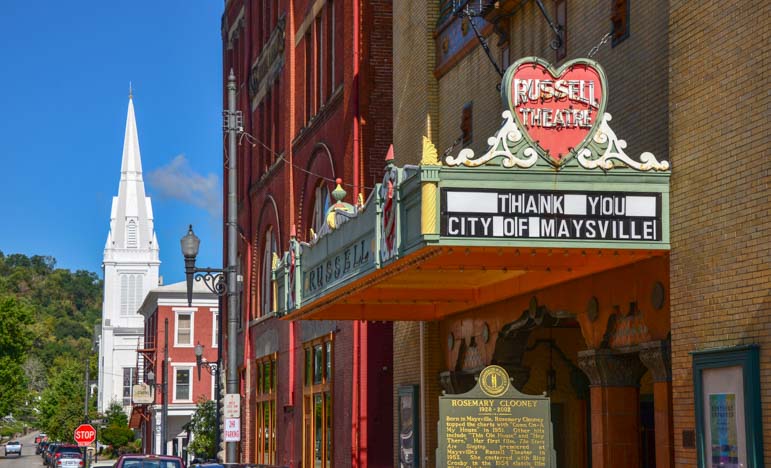
Like the sign on the Russell Theater says… Thanks!

Subscribe
Never miss a post — it’s free!

Here are some links with more info about Maysville, Kentucky:

Other posts from our RV travels to Maysville, Kentucky:

<-Previous || Next->

We were deeply saddened to learn about a devastating fire in a Maysville apartment building last week that took the lives of a family and their neighbor. Our hearts go out to everyone, and we hope these glimpses of our special days in town last month bring a smile.

Our most recent posts:

More of our Latest Posts are in the top MENU above.

RV Solar Panels – Flexible or Rigid? 12 or 24 volt? Mono or Poly? Yikes!

There are a lot of decisions to make when you install solar panels on an RV or boat. Some of the most basic are: what size solar panels to buy, whether to go with flexible solar panels or aluminum framed rigid panels, whether the solar cells should be monocrystalline or polycrystalline, and whether to install nominal 12 volt or 24 volt panels.

We have done several RV and marine solar panel installations, and we have used not only 12 volt and 24 volt panels of various sizes but we have also used both aluminum framed rigid solar panels and the newer semi-flexible solar panels. We have also worked with both monocrystalline and polycrystalline solar panels. This article outlines the pros and cons of the various types and sizes of solar panels and offers some things to think about when you are deciding which solar panels to buy for your RV or boat.

RV solar panel selection

.

Our article RV Solar Power Made Simple explains how to determine the overall wattage for an RV solar power installation. In general, a weekend / vacation RV can get by with 200 watts or less while a full-time solar power system is best with 500 watts or more.

SOLAR PANEL SIZE and PLACEMENT

Once you decide on overall capacity for your solar panel array, the next thing to think about is solar panel placement and wiring. The panels should be a matched set of identical or nearly identical panels. If you have a lot of real estate on the RV roof, then you can get a few big panels. If you have a truck camper or your RV roof is cluttered with a lot of things on it already (hatches, vents, antennas, etc.), then you may need to go with smaller panels that can be squeezed in and around everything else.

Solar panel installation on a ffith wheel RV

Our fifth wheel trailer is powered by four 120 & 130 watt 12 volt rigid polycrystalline solar panels wired in series

WHAT VOLTAGE IS THAT SOLAR PANEL?

Solar panels are constructed internally with DC wiring, and they are sized to work on 12 or 24 volt circuits. So, they are commonly referred to as 12 or 24 volt solar panels. What’s confusing is that while the nominal voltage of a solar panel may be 12 or 24 volts, the open circuit voltage is higher. So, for a nominal 12 volt solar panel that is 100 watts, the open circuit voltage (“Voc“) will be 17 or 18 volts. Likewise, for a nominal 24 volt panel, the Voc will be 34 to 36 volts.

Also, smaller solar panels (both physically and in terms of watts) are typically nominal 12 volt panels while larger panels are typically 24 volts. Solar panels under about 150 watts in size are usually 12 volt panels. Solar panels over about 150 watts are usually 24 volt panels.

Solar panel installation on a sailboat

For nearly four years, we sailed our boat on Mexico’s coast relying on three 185 watt 24 volt
polycrystalline rigid solar panels, wired in parallel, for all our electrical needs.

Solar panels work best when they are a matched set. The electrical characteristics of all the solar panels in the array need to be very similar, preferably identical. When upgrading a solar power array this can make things complicated as you try to mix and match old small panels with new big ones.

One technique for upgrading is to wire two 12 volt solar panels in series to work on a 24 volt circuit. For instance, if you have two 100 watt 12 volt panels and you are buying a 200 watt 24 volt panel, you can wire the two 100 watt panels in series and then wire that pair in parallel with the new 200 watt solar panel.

This will work as long as the electrical characteristics of the pair of solar panels in series match the electrical characteristics of the single panel that is wired in parallel with them.

THE EFFECT OF SHADE ON SOLAR PANELS

Shade is the biggest enemy of any solar power installation. Unbelievable as it seems, a tiny bit of shade will effectively shut down a solar panel. The impact is dramatic: a few square inches of shade can drop a solar panels current production down from 8 amps to 2 amps. A few more square inches of shade can drop the current production to 0.

Before deciding on the size of the panels, it is worthwhile to take some time to study the various things that might cast shade across them once they are in place. A closed hatch may cause little shade, but when it is open on a hot day, depending on where the sun is in the sky, it might cast a big shadow across a nearby solar panel. Satellite dishes, air conditioners and even holding tank vents can cast sizable shadows as well.

We put a book in one corner of a 120 watt 12 volt panel and discovered that even though it was a small percentage of the surface area of the panel, that 8.5″ x 11″ book was enough to knock down the current production of a 120 watt solar panel by 80%. Rather than producing 7 amps, it produced a measly 1.4 amps. Egads!
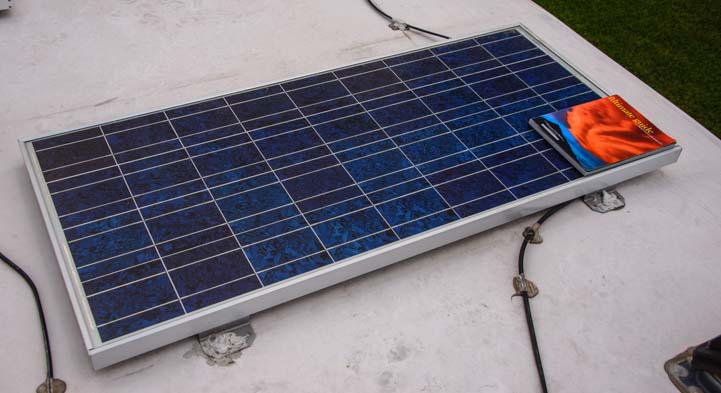
Shade on one corner of solar panel

Just 8.5″ x 11″ of shade from this book reduced current production by 80%!

Similarly, shade wreaked havoc on our three185 watt 24 volt panels on our sailboat. The shade from our mast traveled across the panels as the boat swung at anchor, and the current production dropped by 1/3 and then by 2/3 as the shade first crossed one of the three panels and then straddled two of them. It did this over and over, with the current rising and falling repeatedly, as the boat slowly swung back and forth at anchor.
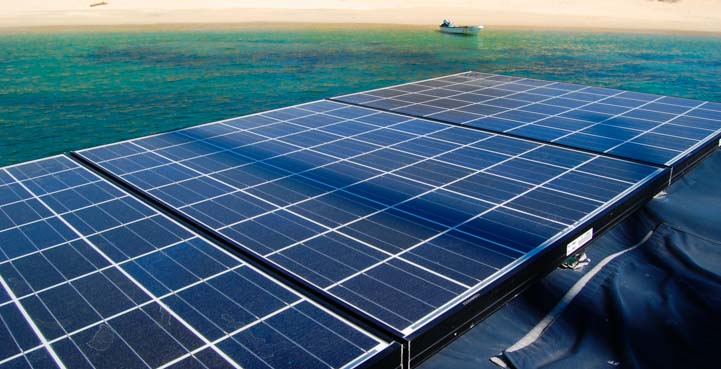
Effect of shade on solar panels installed on sailboat

A line of shade from the mast on our sailboat reduced our solar panel array to 65% and then 35% of its capacity as it traveled across the panels and occasionally straddled two of them.

Shade is a huge concern in the solar power industry, and there are several white papers (here’e one) about the impact of shade on commercial solar panel installations. The gist is the importance of spacing the rows of commercial solar panel arrays in such a way that one row of panels doesn’t accidentally shade the bottom inch or so of the next row behind it when the sun is low in the sky.

If it does, the second row of panels shuts down. If there are rows and rows of solar panels spaced like this, none of the panels except the ones in the first row can function until the sun rises a little higher in the sky.

Solar panels are most sensitive to shade along the longest part of the panel, so in the case of our sailboat, when the sun was over our bow, the mast would shade the panels in a strip that had a maximum impact on current production (as you can see in the above photo)!

For RVers, besides rooftop obstructions, shade comes into play primarily if you park near a building or trees. Snowbirds boondocking in the southwest deserts of Arizona and California during the wintertime have little concern with shade from trees and buildings. But summertime RV travelers who boondock in wooded areas need to be cognizant of where the shade from the trees will fall during the course of the day.

WIRING SOLAR PANELS IN PARALLEL vs. IN SERIES

One of the big decisions for a solar power installation on an RV or boat is whether to wire the solar panels in series or in parallel. There are several things to consider when making this decision.

When the solar panels are wired in series, then the developed voltage across all the panels is additive while the current remains constant from panel to panel. That is, if there were four 120 watt 12 volt panels producing 7 amps each, then the developed voltage across all the panels would be 48 volts (12 x 4) while the current would be just 7 amps.

In contrast, when the solar panels are wired in parallel, then the voltage of the panels remains constant through the circuit while the current is additive from panel to panel. For instance, for those same four panels, the developed voltage across them would be 12 volts but the current would be 28 amps (7 x 4).

The solar charge controller takes care of balancing everything out by ensuring the circuit between it and the batteries is 12 volts. In the case of the above solar panels wired in series, the solar charge controller steps down the voltage from 48 volts to 12 volts (if they are 12 volt batteries). The current then increases from 7 amps to 28 amps in the wire run going between the solar charge controller and the batteries.

In the case of the above solar panels wired in parallel, the voltage is already 12 volts, so the solar charge controller does not need to step it down for the batteries.

SHADE EFFECTS on SOLAR PANELS WIRED IN SERIES vs. WIRED IN PARALLEL

When solar panels are wired in series, if shade hits one panel and shuts it down (caused by that solar panel’s internal circuitry building up a massive amount of resistance), then the entire string of solar panels shuts down. For instance, if a tree shaded 1/3 of one solar panel in the string of four panels given above, wired in series, the current production of the entire array of four panels would be reduced to to 0 amps, even though the three other solar panels were in full sun.

In contrast, if the panels are wired in parallel, when shade knocks one panel out, the other panels are unaffected. So, even if 1/3 of one solar panel were shaded, reducing it to 0 amps of current production, the other three would be working just fine. The total current production would be 3/4 of what it could be if that one panel were in full sun (in this case, 21 amps), rather than 0 amps.

So, it would seem that the best way to wire solar panels is in parallel.

Unfortunately, it’s not that easy, and here’s why:

CURRENT and WIRE SIZE in a SOLAR PANEL INSTALLATION

The more amps of current there are flowing in a circuit, the thicker the wire needs to be to ensure that no energy is lost to heat. Unfortunately, thicker, heavier gauge wire is a pain to work with. It’s stiff and doesn’t bend around corners easily. It is hard to tighten down in the solar charge controller connections and it’s hard to crimp ring terminals onto. It is also more expensive per foot.

So, when the solar panels are wired in series, a thinner gauge wire can be used for a given distance than when they are wired in parallel.

Of course, the thickness of the wire is also dependent on the length of the wire. The longer a wire is, the more energy is lost along its length. So, if you are installing the solar panels high on an arch off the aft end of a 50′ sailboat and the batteries are located at the bottom of the hull over the keel, the wire must be a lot heavier gauge than if you are installing the panels on an RV roof directly above the battery compartment.

What is the price difference in the cable? We like to use Ancor Marine Cable because it is tinned and it is very supple (the copper is fine stranded). Here are the price differences for 25′ of 2 gauge wire as compared to 25′ of 10 gauge wire.

Ultimately, there is a dilemma: Is it better to go for thinner, cheaper wire and an easier installation, and wire the panels in series, risking that the whole array will shut down whenever a corner of one panel is shaded by a nearby tree? Or is it better to pay the extra bucks for heavier gauge wire and endure a more challenging installation but have a system that will be more tolerant of partial shade?

What to do?

SOLAR PANEL VOLTAGE and WIRE SIZE

Luckily, there is another option: higher voltage solar panels can be wired with thinner gauge wire. Remember, Watts = Current x Voltage. So, for the same number of watts in a panel, a higher voltage panel will produce a smaller amount of current.

Rather than using four 120 watt 12 volt panels wired in parallel that would produce 28 amps at 12 volts, you can use two 240 watt 24 volt panels wired in parallel that produce 14 amps at 24 volts. The net effect on the battery bank will be the same, but the bigger panels can be wired with smaller gauge wire.

As mentioned above, the wiring that is most affected by these solar panel choices is the wiring that runs from the solar panels to the solar charge controller. The wiring from the solar charge controller to the batteries is the same in either configuration, as the same amount of current will be flowing in that wire regardless of how the solar panels are wired. In the case of solar panels wired in parallel, the voltage will be stepped down in the solar charge controller. So, in our example, the solar charge controller will step down the voltage from 48 volts to 12 volts, ensuring that the circuitry between the solar charge controller and the batteries is at operating at 12 volts.

CHOOSING THE OPTIMAL WIRE GAUGE

The thickness of the wire, or wire gauge, depends entirely on how long the wire is going to be. That is, the wire gauge is determined by how far apart the solar panels and the solar charge controller and the batteries are.

Why is this? The more current that flows in a wire, the more the conductor in the wire will warm up. The more it warms up, the more energy is lost to heat. Eventually, this becomes measurable as a voltage loss between the two end points.

When wiring solar power circuits, you can choose how much voltage loss you are willing to have. Somewhere between 2.5% and 5% is typically considered okay. There are voltage loss tables that will help you decide on the proper wire gauge size for the distance you are spanning between the solar panels and the solar charge controller and between there and the batteries. Here’s a good one:

AWG Voltage Loss Table

An Example: 480 watts of solar power located 27′ from the batteries

  • Say we have four 120 watt 12 volt panels wired in series. If the distance is going to be 27′, then by looking at the third chart at the above link (the 12 volt chart) and going to the line for 8 amps flowing in the wire, it shows a wire run of up to 27′ can be done with 10 gauge wire.
  • Now, imagine putting those same panels in parallel. 32 amps will flow at 12 volts. For that same 27′ distance you’ll need 2 gauge wire.
  • Lastly, instead of using four 120 watt 12 volt panels, use two 240 watt 24 volt panels wired in parallel. For this you use the 2nd chart down (24 volt chart). There will be 16 amps flowing in the wire at 24 volts. You will be able use 8 gauge wire.

Of course, due to the nature of multi-stage battery charging and the changing position (and angle) of the sun in the sky, the solar panels will be operating at full tilt for a very short time each day. They may produce max current for 30 minutes near noon as they wrap up the Bulk Stage, however, as the Absorb stage takes over and continues in the afternoon, the solar charge controller will gradually hold the panels back so they produce far less than max current.

With less than peak current flowing in the wires, less energy will be lost to heat.

If this is confusing, see our articles:
RV and Marine Battery Charging Basics
How Solar Charge Controllers Work

So, although it may seem dire that you’re wiring is on the hairy edge size-wise, it is only that way for a little while each day. Depending on the overall size of the solar power array, the size of the battery bank, and the state of discharge when the batteries wake up in the morning, your system may not even hit the theoretical maximum current production or even come close.

MULTIPLE SOLAR CHARGE CONTROLLERS

Another method of keeping the wire size down is to install more than one big solar charge controller. For instance, you might install several smaller charge controllers for each pair of panels wired in series, or perhaps even one for each panel. Of course, this adds complexity and expense, and you will probably buy less sophisticated solar charge controllers that have fewer programming options than a single big one.

You must run more wires between the RV roof and the location in the coach where the solar charge controllers are installed (preferably next to the batteries), and so you must not only pay for additional solar charge controllers, but you must buy more wire and install it all. However, this design option does deserve mention and consideration.

TILTING THE SOLAR PANELS

Solar panels perform a whole lot better in the summer than in the winter. This is because the sun rides much higher in the sky and its rays hit the panels at a nearly perpendicular angle in the summertime. The days are also a whole lot longer. In the winter, the sun’s rays hit the panels at an angle and the sun is only out for a short while.
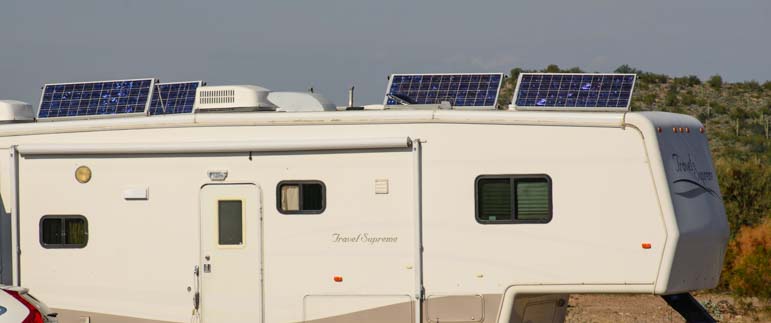
Solar panels on a fifth wheel RV roof

Tilting solar panels in winter can improve current production by 30%
Or…install more panels and save yourself from climbing up and down the RV ladder!

To get around this, rather than using ordinary Z-brackets to mount their solar panels on the roof, many RVers use tilting brackets. By tilting the panels towards the sun at about a 45 degree angle (technically, at the angle of your latitude), then the sun’s rays hit the panels at a nice 90 degree angle if they are oriented to face south. This can increase the overall power production by about 30% on a sunny winter day.

The only problem is that you have to climb up on the roof to tilt the panels each time you set up camp and then climb up again later to lay them flat when you are packing up before you drive away. We’ve seen many a winter snowbird driving their RV around with the solar panels still raised.

An alternative is simply to install more solar panels and to keep them lying flat all the time. This is easy for a big RV that has a huge roof but is not so easy for a little trailer with a small roof. We have not installed tilting brackets on our trailers.

MONOCRYSTALLINE vs. POLYCRYSTALLINE SOLAR CELLS
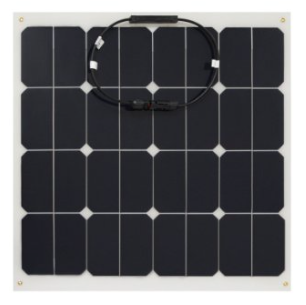
Monocrystalline solar panel

Monocrystalline
solar panel

There are lots of different kinds of solar panels on the market today. There are two primary types of solar cells used in the manufacture of solar panels: monocrystalline and polycrystalline.

Monocrystalline solar panels are more efficient and more expensive, but they are also extremely intolerant of shade. Polycrystalline panels are slightly less efficient and less expensive, but they handle partial shade just a smidge better.

The way to tell if a solar panel is monocrystalline or polycrystalline is to look at the pattern of rectangles on the panel itself.

If the circuitry between the rectangles has large silver diamond shapes, it is monocrystalline. If the pattern of rectangles is just intersecting lines, it is polycrystalline.

Polycrystalline solar panel

Polycrystalline
solar panel

Examples of popular monocrystalline solar panels are here:

Examples of popular polycrystalline solar panels are here:

RIGID ALUMINUM FRAMED SOLAR PANELS vs. SEMI-FLEXIBLE SOLAR PANELS

Flexible solar panel

Flexible solar panel

Solar panels can also be rigid or flexible.

Rigid panels are built with an aluminum frame surrounding tempered glass that covers the solar cells.

Flexible solar panels are built with the solar collecting material impregnated into a thin mylar film that is affixed to an aluminum substrate.

Flexible solar panels are not flimsy, they are simply bendable up to about 30 degrees.


There are a number of manufacturers selling flexible solar panels:

FLEXIBLE SOLAR PANEL ADVANTAGES

Flexible solar panels have several advantages over rigid panels. They are a little lighter than framed solar panels and you can glue them onto an RV roof using Dicor Lap Sealant, or something similar. This saves you from the complexity of drilling holes into a perfectly watertight roof and risking creating leaks. This is especially helpful with a fiberglass roof. It takes just a few minutes with a caulk gun to attach these panels to the RV roof.

Another nice feature is that on a rounded roof, like an Airstream travel trailer or Casita travel trailer, the panels can bend to follow the contour of the roof.

Installing solar panels on a motorhome roof

Mark uses Dicor Lap Sealant to affix flexible solar panels to a friend’s fiberglass roof.

One of the most important things for solar panels to work well is heat dissipation. Rigid aluminum framed solar panels stand up off the roof of the RV by about an inch, allowing air to flow underneath and for heat to dissipate. Air can’t flow underneath flexible solar panels. The aluminum substrate serves to dissipate the heat instead. This may or may not be as efficient a method of heat dissipation, and I have heard of a case where all the flexible solar panels on a sailboat had to be replaced after two years because they did not dissipate the heat sufficiently in the tropics and the panels self-destructed.

FLEXIBLE SOLAR PANEL CONSTRUCTION and INSTALLATION

Our RVing friends Dick & Katie asked us to install six 100 watt 12 volt flexible solar panels made by Eco-Worthy on the roof of their motorhome, along with all the other projects involved in an RV solar power installation. Ironically, the hardest part of the entire installation was removing the plastic protection from the aluminum substrate of each panel (it kept ripping!). We all ended up working on this together.

Flexible solar panel installation on an RV

We had a tough time getting the plastic off the back of the Eco-Worthy flexible solar panels
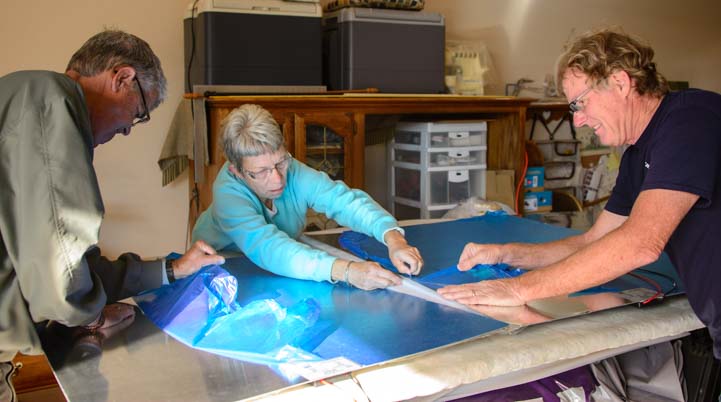
Removing plastic from flexible solar panel

With all of us working together, we got the job done!

Once we got up on the roof, and got past a cute warning from Winnebego, the installation was straight forward.
Warning slippery roof on RV

Hmmm…I wonder what sage advice the manual suggests for this problem?
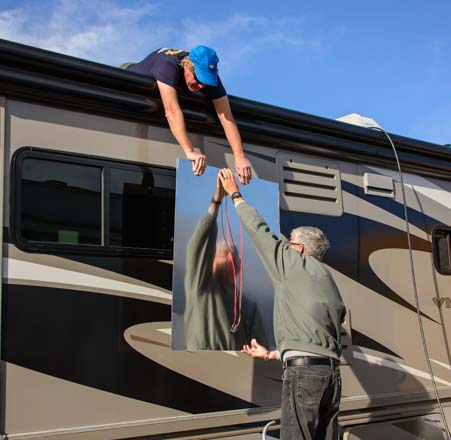
Solar panel installation on a motorhome RV

Flexible solar panels are lighter than their rigid counterparts

The plastic protection needed to be removed from the face of the panels as well. Interestingly, at one point Mark found himself picking at the corner of the mylar that has the solar collection circuitry embedded in it and almost began to peel that whole layer off the aluminum substrate! But once he got a hold of just the most superficial layer of plastic, it came off easily.
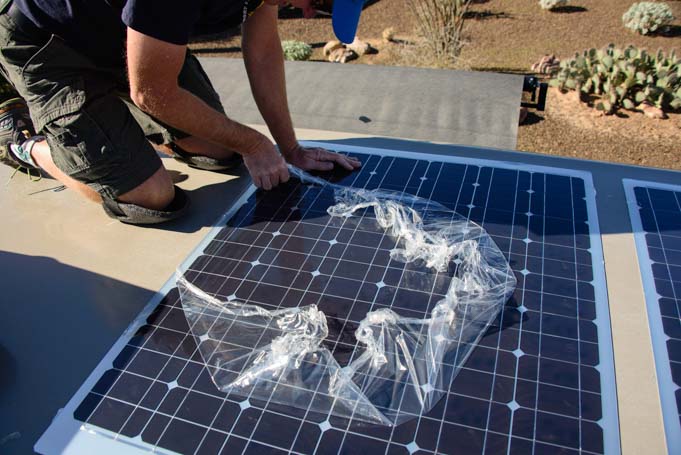
Removing plastic from flexible solar panel

Mark removes the plastic from the face of the flexible solar panels

He used Dicor Lap Sealant to tack down the corners of the panels and then ran a bead around each side of each panel.

FLEXIBLE SOLAR PANEL DISADVANTAGES

Flexible solar panels are less efficient than rigid aluminum framed solar panels, which means you may want to get a few more total watts of solar panels than you would if you were buying framed panels. Bendable panels also can’t be installed on tilting brackets. So, again, buying more total watts may be the best solution.

Flexible solar panels are not as rugged as rigid aluminum framed solar panels built with tempered glass. Overhanging branches can scratch them. This is important for anyone that will be boondocking or dry camping a lot on public lands and in rustic public campgrounds, as it is often impossible to get in or out of a site without ducking under some low lying tree branches.

Some RVers have found that flexible solar panels installed on flat motorhome roofs tend to pool water when it rains. This can lead to debris building up and taking root and damaging the panels.

Perhaps for all these reasons, flexible solar panels are sold with a much shorter warranty than rigid solar panels. Whereas many solar panel manufacturers warranty their tempered glass aluminum framed rigid solar panels for 25 or 30 years, bendable solar panel manufacturers generally warranty their panels for 5 years or less.

This may or may not be relevant for RVers, as the fine print in almost every solar panel manufacturer’s warranty states that their solar panels are not warrantied for use on mobile vehicles.

Also, there has been a huge problem across the entire solar power industry with rigid solar panels failing prematurely in large numbers in big commercial installations (see a May 2013 NY Times article here). Apparently, just because those lovely rigid solar panels are warrantied for decades doesn’t mean they will last that long. We have already had a failure of one of our framed solar panels that was warrantied for 25 years, and we discovered the manufacturer’s warranty did not apply to RV installations.

However, as a general rule, when manufacturers warranty a product for 5 years versus 30 years, it says something about how they think their product will hold up over time.
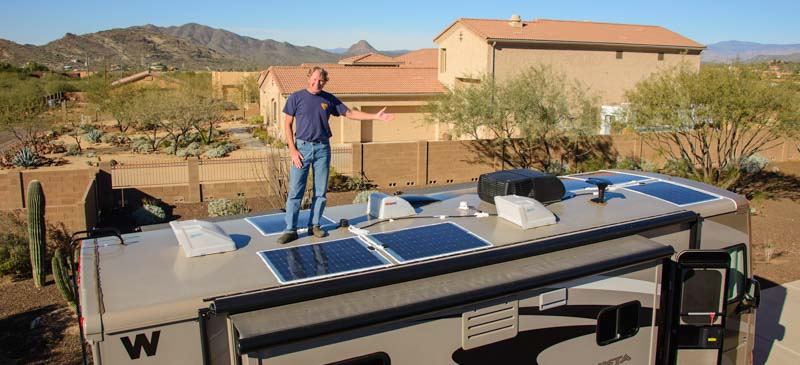
Flexible solar panels installed on a motorhome RV roof

Nice job! (but don’t fall off that roof!)

CONCLUSION

There are many ways to go about installing solar power on an RV roof, and the solar panels that work best in one installation may not be the same as those that are best for another. Not only is every RV roof different, but every RVer’s needs are different.

If you have loads of space on a big motorhome roof or fifth wheel trailer roof, and you are setting it up for full-time use, you may be best off with three or four 200+ watt 24 volt rigid solar panels wired in parallel. If you have a little tear drop camper you use on weekends and store in the garage, a single flexible 100 watt 12 volt panel may be just the ticket for you.

Subscribe
Never miss a post — it’s free!

Related articles about Solar Power on RVs and Boats:

Related articles about Batteries and Battery Charging:

Our most recent posts:

More of our Latest Posts are in the top MENU above.

RVers Jason and Nikki Wynn have written about the condition of their flexible solar panels after a year of use HERE