Going full-time RVing is a blast. The exhilaration of hitting the open road and discovering the hidden jewels the lie just over the horizon is a peak life experience, and living this way day after day, year after year, is deeply fulfilling. But how do you transition from a conventional life to living in an RV full-time? It’s quite a leap of faith, and the process of going full-time RVing can have its ups and downs. There are some pitfalls to avoid and things to consider as you go through the planning process. Just for starters, which RV is best for living and traveling in?
This is the second article in our three-part series on full-time RVing and it explores some of the issues involved in getting from here to there. The other two articles are: Working and Living in an RV and Full-time RVing Tips – Mail, Domicile, Insurance, Saving $$?
For easy navigation on this page, and to read a little now and come back for more later, click on these links:
- How Do Full-time RVers Travel?
- Making the Transition to Living On the Road in an RV
- Which RV Makes the Best Full-time Rig?
Links to the entire series and its various chapters are here: Full-time RV Lifestyle Tips
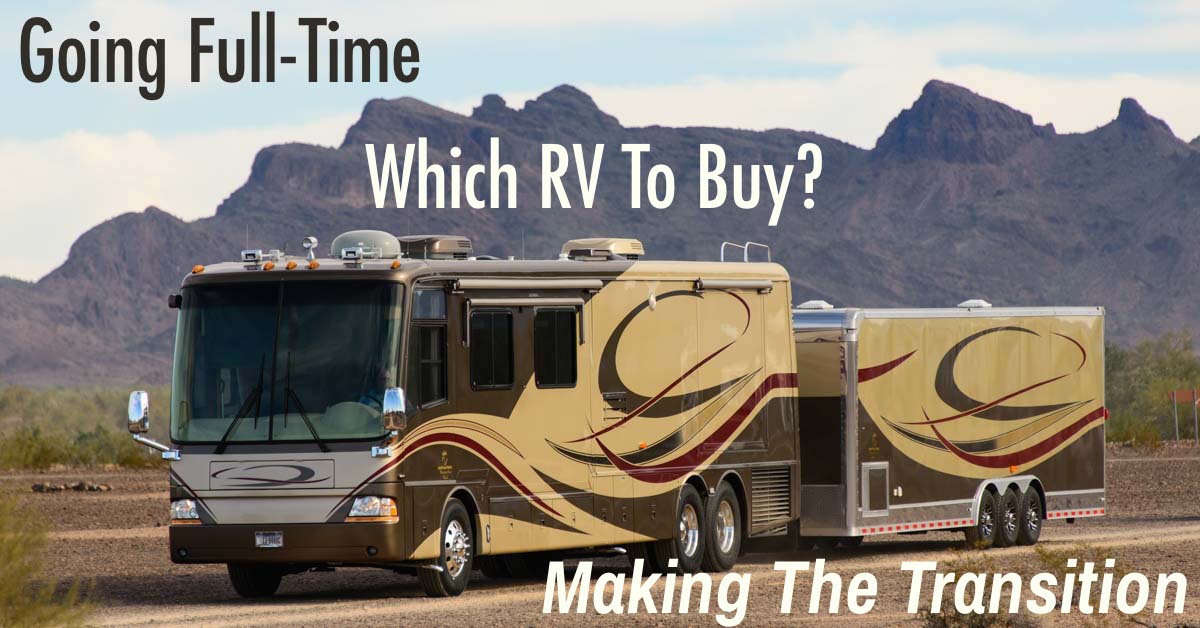
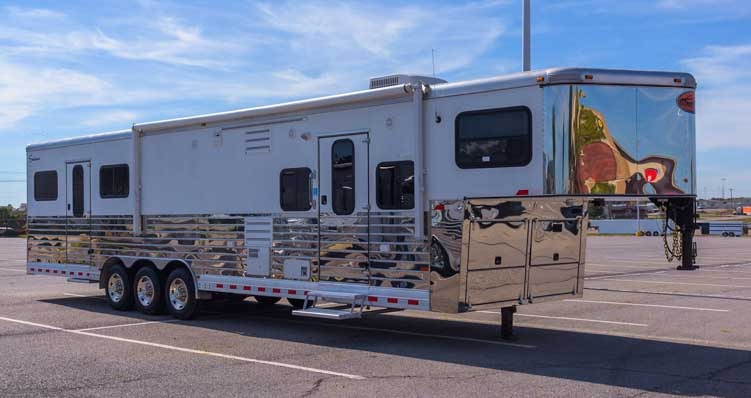
A classy Class A motorhome tows a matching utility trailer in the Arizona desert
HOW DO “FULL-TIME” RVers TRAVEL?
Full-time RVing includes a wide range of lifestyles, from folks who travel a lot to folks who stay home.
Part-time RVers
Many “full-time” RVers are technically “part-timers,” living in their rig for a few months a year and maintaining a home somewhere. This is a great way to go if you can afford to have both a house and an RV, especially if you can leave your home under the watchful eye of a friend.
For most of these RVers, the travel routes are pretty much north/south. After spending the first months of our first winter in southern Arizona, meeting people from Idaho and Montana, we were amused to go to South Padre Island Texas and discover many of the RVers were from Wisconsin and Minnesota. Everyone we’ve met in Florida seems to be from Michigan or the Northeast!
As a side note, if you are looking to simplify your life as well as travel, splitting your time between two homes like this can be a little complicated, as you have either a house or an RV that is always vacant and will need some TLC when you leave it and return to it.

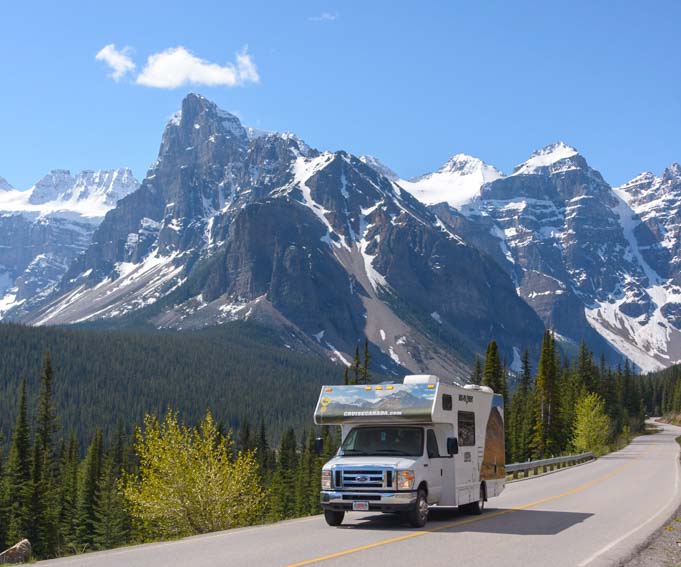
There’s nothing like hitting the open road!
Full-time RVers With a Home Base
A lot of full-timers don’t actually travel 12 months a year. Some rent or own a site in an RV park somewhere for part of the year, using this location as a home base and roaming around as the spirit moves them.
Seasonal RV park rates are reasonable, and some parks include a storage area for boats and ATVs or even an alternate RV like a “weekending” or “summer travel” truck camper. Some of these parks also allow you to spread out to do repairs on the RV and clean it up after a season of travel.
Some full-timers split their time between two RV parks where they have sites they rent or own. Many RVers work camp in a northern location in the summer and in a southern location in the winter. These types of full-timers have a strong sense of home and community because they return to the same places year after year.
Full-time RVers Who Travel All the Time
Many full-time RVers wander all over the place, more or less in perpetual motion. Some camp in state parks and forest campgrounds or boondock most of the time, and others stick to RV parks which have more amenities. Some belong to campground membership programs, giving them a primary resource for finding places to stay, and also giving them a rich social life as they make friendships within the programs and plan their stays to coincide with their friends’ stays.
Full-time RV Residents
Some full-time RVers stay in one park year-round. A few of these folks are retirees who no longer wish to travel but want to remain in their RV. Others are younger working people that have a full-time job in the area that keeps them rooted in one spot.
WHAT DOES IT MEAN TO GO FULL-TIME? TRANSITIONING TO A LIFE ON THE ROAD
Starting a full-time RV lifestyle is an absolute thrill. Leaving the bonds of a conventional life to live in total freedom made both of us feel vibrantly alive. Years ago I wrote a blog post about why we decided to go full-time, called Why Do It? I outlined the many reasons we decided to leave our old lives behind and try a life of adventure on the road.
Going full-time sounds great, but there can also be some bumps in the road on the way to your dream RV lifestyle, and that’s to be expected. The whole process may go swimmingly and you may live happily ever after. But more than likely you will experience some heartache on the way. We did. It’s part of what happens when you deal with important things like Lifelong Dreams, Personal Growth, Enrichment and Fulfillment.
Downsizing
The downsizing process can be intense, especially if you are emptying a large house that you have lived in for years. Keeping your dream alive and priorities straight during this (sometimes) stressful time is really important. When we downsized a second time as we moved off of our boat and back into our RV, I wrote a post On the Road to Your Dreams, Stay the Course to help me keep the big picture in mind.

Ready for adventure!
For a lot of people, downsizing all the way into an RV is a really liberating experience. After the hard part of sorting through everything, there is an uplifting sense of relief and unburdening that happens when you let most of it go.
Retiring and Going Full-time Simultaneously
Many people begin full-timing at the start of retirement. This means they are going through two major life transitions at once. Simply changing from the workaday life to one of an agenda-free retirement is a shock to the system. Downsizing into an RV and moving away from old friends and life structures at the same time can become a little overwhelming.
Retiring early is a super idea, but there is no badge of honor for going full-time. In some cases it might make sense to enjoy retirement for a little while first. Going on some shorter duration RV travels before you jump ship all together might accomplish the same travel and freedom goals without giving up the security of everything you know right away.

Life Partners
At the same time as all of this, you are dealing with your life partner in a whole new way. You are together much more than you used to be and are suddenly dependent on each other in ways you’ve never been before. Learning how to operate the systems in the RV, navigating unfamiliar roads in a hugely oversized vehicle in traffic, and getting in and out of RV sites with an audience watching can put a lot of stress on a relationship.

What a marvelous night for a moondance…
To diffuse the tension a little, revel in acquiring new skills, whether it’s learning to read a map or learning to take directions from your spouse as you drive. Respect and patience go a long way as you both adjust to new daily patterns, and in the darkest hours, remembering why you fell in love in the first place always helps. Any scratches that appear on the RV as a result of your joint learning curve can always be repaired!
Build Up and Let Down
There is a huge build-up to the Day of Retirement, and even if you are 30-something and are starting full-timing, there is an even bigger build-up to the Day of Driving off to a New Life in an RV. Some kind of let-down is only natural.
There is also the shock of reality. The RV life depicted in blogs (including this one), books and magazines (including articles I’ve written) may not reveal some of the more mundane and even yucky aspects of life on the road. For us, this lifestyle is almost entirely one of wine and roses, but roses do have thorns and you have to learn to deal with them.
You may be ecstatic when you cast off in your new life, and you may be Living The Dream right from the get go. But if not, don’t panic. There’s an adjustment phase and a learning curve that most new full-timers go through.
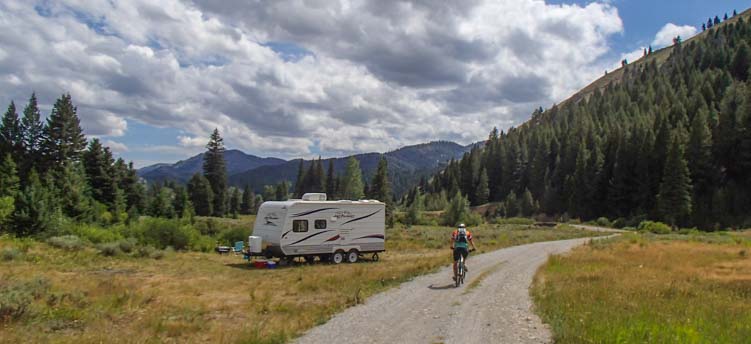
It takes time to figure out your travel style and what works best for you.
Pacing Your Travels
It’s really common for new full-timers to drive thousands of miles to dozens of destinations at a breakneck pace the first year. We sure did. Heck, you’re excited! You’re free! You run around like crazy! And then you drop from exhaustion.
Learning to slow down and to alternate the sightseeing days with the chore days takes time. Allowing yourself to have a few down days of doing nothing so you can absorb all the thrills you just had during some exciting sightseeing days may make you feel guilty at first. But a life of full-time travel can’t be lived like an endless vacation. You’ll wear yourself down to a frazzle!

Embracing A Hobby
It can be exhausting to spend all day everyday either reading travel literature, sightseeing, or writing in your journal or on your blog about all you did and saw. There needs to be something more to life than scrambling from one tourist destination to the next.
Picking up a hobby can help immensely. Our travel lives changed dramatically when we decided to learn photography and learn to write and maintain a website. These are activities that are beautifully linked to our travel adventures, but they are hobbies in their own right too.
Making music, bicycling, hiking, geocaching, running, yoga, kayaking and learning to make videos are other hobbies that fit a traveling lifestyle well and will ensure you feel like you are living a life that is bigger than just being a tourist.
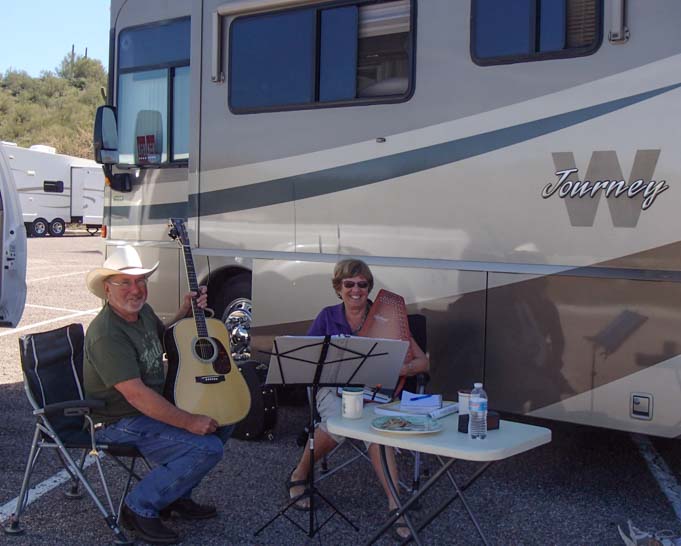
Making music is a fabulous pass-time on the road
What If It Doesn’t Work Out?
Even after dodging that mini minefield of possible obstacles on your way to living the RV Dream, you may decide the lifestyle just isn’t for you. What then? Is the fear that this might happen enough to keep you from giving it a try? I hope not!
You already know how to live a conventional life, and that life will always be available to you. There may be expenses involved in returning to it, but at least you won’t look back later and say, “I shoulda…I coulda…I woulda” Instead, you’ll say, “I did it! I lived my dream, even though it turned out not to be a dream I wanted.” More than likely, the experience will lead you to a dream you do want.
Jumping in with both feet
The most important thing to keep in mind throughout the whole transition process is that this is just a phase of your life. It is definitely not for the rest of your life Without a doubt, your full-timing adventure will end some day, and you will probably move on to another lifestyle that doesn’t include living in an RV.
So, set aside any fears you have, and live your dream. The full-time RV lifestyle may not last forever, but the memories will.
WHICH RV MAKES THE BEST FULL-TIME RIG?
The most popular full-time rigs are Class A motorhomes and fifth wheels. Class C’s, Class B’s and travel trailers are less common. However, it is possible to travel fulltime in just about anything. Some of the happiest people are those that are debt-free in a smaller rig.
All that really matters when you select an RV for full-timing is that it feels like home to you.
The first time we boondocked in Quartzsite Arizona, we found we were neighbors with 150 Alpine motorhomes (worth as much as $400K) on one side, and a guy living out of the back of his pickup truck on the other side.
Outside of Phoenix we met a couple who were living in a tiny truck camper with no slideouts on the back of a half-ton gas pickup. They had lived in it for two years and they were loving their simple life.

Do you need a huge Class A to have fun full-timing?
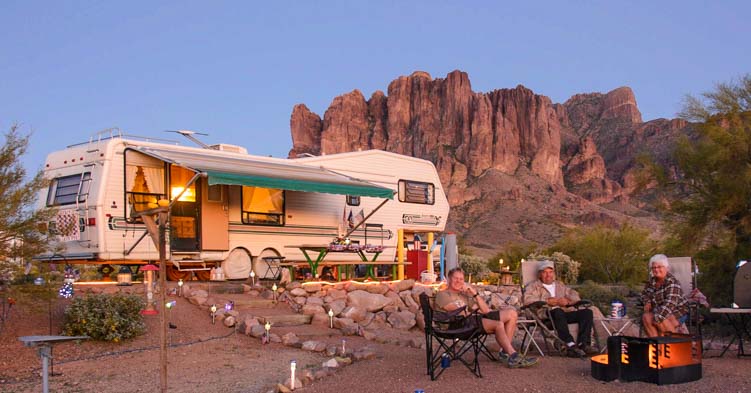
Heck no! For two years this has been home for one couple we met.
In Florida we spent some time with a couple in their sixties who had sold their house and been happily touring the country fulltime for the past four years in a popup tent trailer.
The most seasoned veterans on the road have owned a variety of rigs. The average owner keeps an RV for just three years, and, having purchased three rigs in our first four years of RV ownership ourselves, we were ahead of the curve for a while!
If you haven’t done much RVing yet, a great way to get your feet wet and figure out what kind of RV you like and what features are important to you is to get a small and inexpensive one and take it on some long road trips:
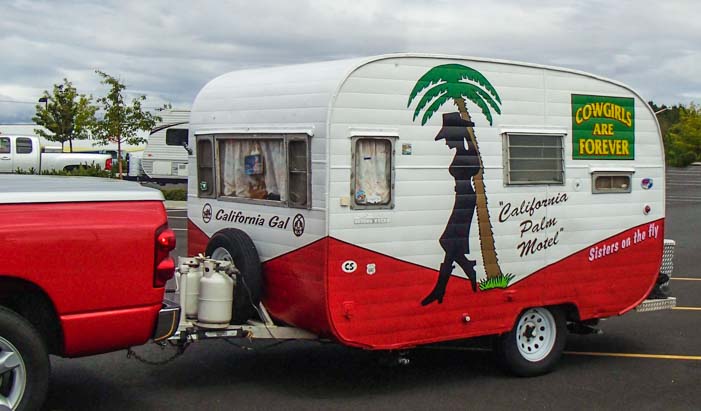
Go Cheap, Go Small, Go NOW! Have FUN and Learn the RVing Lifestyle in a Little RV
However, rather than buying and registering various RVs, a much cheaper and easier way to sort out what you really want in your full-time rig is to do one or more RV rentals for a few days or a week. This will help you narrow down which features are most important to you and which ones you can live without.
In the end, the bottom line for buying your new rolling home is:
When you walk inside, do you smile and say, “Ahhhh…home sweet home!!” ?
Also, keep in mind that your first full-time RV probably won’t be your last. You can see our progression of trailer upgrades and truck upgrades throughout our full-time RV travels here:
The Rigs We Have Used for our Full-time RV Lifestyle
Some thoughts about different styles of RVs for use in long term travel:
Both motorhomes and trailers have their pros and cons, and certainly either one makes a fantastic home. These notes are intended to give you some food for thought if you haven’t developed a preference yet. They are not meant to imply that one style of RV is superior to another.
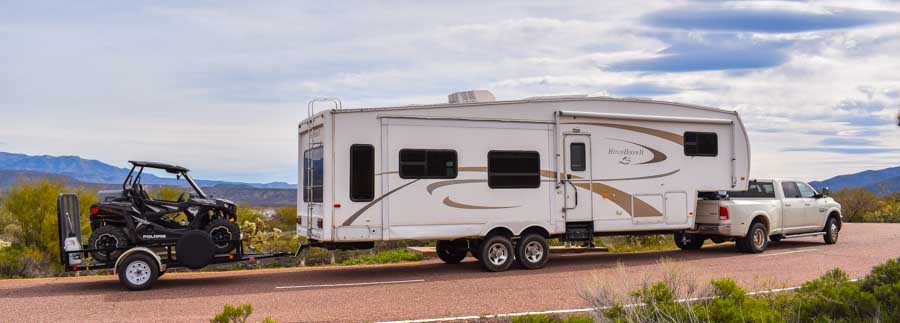
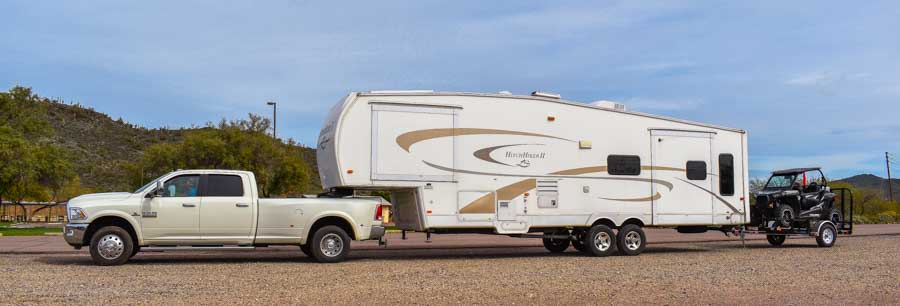
We lived in a fifth wheel trailer and have always owned trailers, because we like the look and feel of them, they are simple in their design, and they are fairly easy to understand and repair. After all, a trailer is just a box on wheels. We towed our trailer with a big beautiful Ram dually truck. Our hitch is a B&W Companion OEM 5th Wheel Hitch that uses the new in-bed puck system from Dodge Ram (we have a pictorial installation guide for the B&W hitch here).
Motorhomes are inherently more complicated than trailers because they combine the propulsion and the living quarters all in the same vehicle. Higher end Class A motorhomes also feature more complex systems in an effort to make them more like a residential house. Trailers, even high end fifth wheels, are usually outfitted with simpler systems.

There’s a big beautiful world out there… Honestly, any rig will be fun!
We have not lived in a motorhome, but our 44′ sailboat was very similar with a combined propulsion/house design and many of the exact same components as are found in a Class A diesel pusher.
Simplicity equates to less time spent on maintenance and repair and less overall expense for everything from initial purchase to insurance and motorhome warranty, to registration to maintenance and repair.

Small rigs:
- Popup tent trailers are easy to tow, they fit in the garage, and they offer a lot of space for a small package. However, they can’t easily be used to stop for lunch at a rest area or overnight at a Walmart
- Truck campers and vans make for tight living but can be parked anywhere, from National Park campgrounds to tiny urban roads in the congested northeast.
Travel Trailers and Fifth Wheels:
- Travel trailers are cheap but can require a bigger truck than you might think to tow efficiently in the mountains (ours did).
- Fifth wheels are easier to back up and hitch up than travel trailers but generally require a big diesel truck.
- Fifth wheels are a lot taller and heavier than travel trailers (so you get fewer miles per gallon), and it’s easy to swipe everything off the roof by accident when driving under a low overhang.
Fifth Wheels and Motorhomes:
Driving
- The comfort and view from the driver’s and passeneger’s seats in a big Class A motorhome are far better than in a truck.
- Tooling around town in a car and getting parked is much easier than in a big ol’ long bed truck.
- If you are driving a motorhome and need something in “the house,” the passenger can just walk back and get it.
- Sometimes the huge windshield and large interior space of a Class A motorhome can make for hot driving and you need to run the generator and house air conditioning while driving to cool it down.
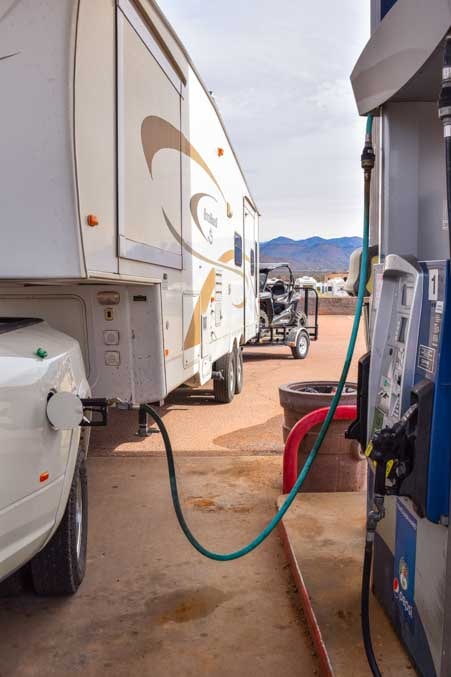
- Gas stations are tough to maneuver in with any large RV. You can gas up a truck when it is unhitched from the trailer. Motorhomes don’t have that option but do have bigger tanks and need gas less frequently.
Fuel Mileage
- Gas mileage on a truck towing a trailer may be slightly better than on a large motorhome towing a car (especially if the truck has an engine tuner)
- Gas mileage around town on a car (if traveling with a motorhome) is better than on a big truck (if traveling with a trailer)
- Depending on how much you drive hitched up versus unhitched, the total fuel bill for a motorhome-car combo may be the same as for a fifth wheel-truck combo (our driving split is 50-50, towing vs. not towing)

To get around town, most full-timers tow a car or “toad” behind their motorhome.
Sometimes the toad becomes a handsome prince and is towed on a trailer rather than its own four wheels.
Maintenance and Repair
- Larger Motorhomes require a “toad,” or car towed behind, if you want to get around town easily. That’s two engines to maintain — motorhome and car — and the car tires wear as they are towed.
- Motorhomes are more more complex vehicles than fifth wheel trailers, so they take more time and expense to maintain and repair.
- A truck with a dead engine can stay overnight in the repair shop while you live in your healthy trailer somewhere else. A dead motorhome engine may leave you looking for a hotel room and eating out if the repair shop won’t let you stay in it there.
- With a truck and trailer combo, the propulsion part of it (the truck) is mass produced. There are dealerships in every town, and it fits in any repair bay at any shop, including Jiffy Lube.
- You can change the tires on a truck and trailer with a jack stand and tire iron but will need to call someone for help to change the tires on a big motorhome
Cost:
- A truck-and-trailer combo of the same quality, size and age as a motorhome-car combo is generally about 1/2 to 2/3 of the price all together. Insurance, warranty and registration costs are less too.
- Truck and trailer tires are much cheaper than larger motorhome tires.
- Oil changes are cheaper, although more frequent, on a truck than on a motorhome
Storage and Living:
- A large motorhome will likely have a much bigger payload capacity ( > 5,000 lbs.) than a fifth wheel (< 4,000 lbs.) which is important for full-timers carrying a lot of stuff with them. Lots more info on that here: Choosing a Trailer for Full-time RVing – Payload
- Bikes can be stowed inside a large motorhome bay, or in the hatchback of a “toad” with the back seat removed, or in truck with a cap towing a travel trailer, but they mostly likely have to be left outside on a truck and fifth wheel.
- While at a campsite, the area under a fifth wheel can provide shade for camp chairs and protection from rain for outdoor goodies.
- Almost all motorhomes come with a built-in generator which means that air conditioning is available at the push of a button, something solar power can’t easily do.
- If you love your house but hate how it drives (or it has chronic engine/drive-train problems) or if you love the drive but the house has lost its luster, you can upgrade your truck or trailer independently of one another.
- There is an urban myth that a motorhome is more appropriate for shorter stays and a fifth wheel is better for longer stays. This year alone, in 8 months on the road, we have stayed at 75 different locations for an average of 3 nights each. We’ve had a ball and it has been easy. We set up and break down in about 10 minutes. I’m baffled by that urban myth, have no idea where it came from, and can only say that it doesn’t apply to us and our fifth wheel! (Wait, what kind of “pacing your travels” was that?! Well, this wild road trip was preceded by 4 months of staying put in Phoenix AZ and included a one month stop in Sarasota, FL)
For a detailed review of what to look for in a full-time 5th wheel trailer, check out this article: Most Important Features in a Full-time Fifth Wheel Trailer
A few things we have learned about buying an RV:
If you are willing to buy used, there are a lot of great deals to be found. RVs depreciate really fast. In five years an RV will be worth 50% to 70% of what it was new. In 10 years it will be worth 40% of its purchase price or less.
Negotiate hard. Mass-market brand “vacation” quality RVs often sell for 25-35% less than MSRP and higher-end “full-time” brands often sell for 20-30% less than MSRP, depending on the manufacturer. The NADA Guide gives the values of used RVs.
If you are buying a trailer, look at the sticker at the hitch end of the trailer on the driver’s side. This will show when the trailer was built. If it has been on the dealer’s lot for a while, sitting in the elements (snow, rain, mud, etc.) and enduring lots of foot traffic from customers, there may be a lot of nit-picky problems when you first move in.
The sticker will also give you the payload capacity of the trailer. Many “full-time” trailers are built with a payload capacity of less than 3,000 lbs. In our experience, that will not be enough in the long run. Our fifth wheel trailer has a payload capacity of 3,300 lbs and I sure wish it were closer to 5,000. Here are some thoughts on trailer cargo carrying capacity.
Climb up on the roof of the unit you are buying to see what condition it is in. While you’re up there, check out the other roofs in the lot. You’ll be able to tell which units are the newest ones at the dealership by the condition of the roofs!
We’ve posted a very detailed article that will give you some ideas of what to look for in a full-time fifth wheel trailer. Even if you are planning on buying a motorhome instead of a trailer, many of the same principles still apply. Check it out here!
Visit lots and lots of dealerships and talk to lots and lots of salesmen. The more time you spend shopping the better purchase you will make. Besides, it’s fun!
Here is a video with tips for choosing an RV dealership and an RV salesman: RV Sales Tactics – Understand What You Sign and Don’t Hesitate to Walk Away!.

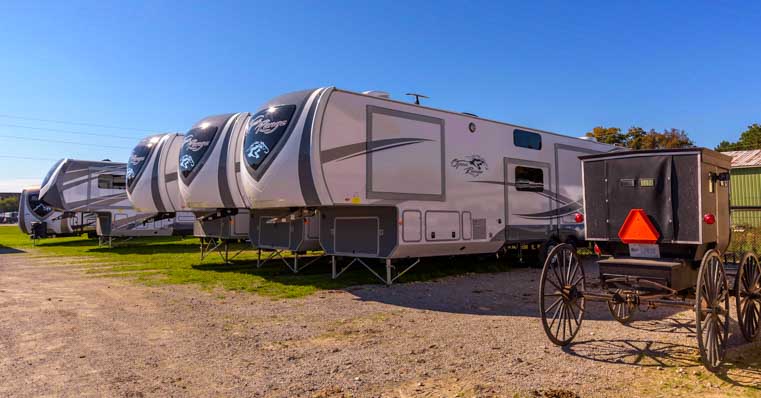
A line of beautiful new Tiffin Allegro motorhomes for sale

Further Reading:
This was the second part in our 3-part series on full-time RVing. You can read the whole series or skip to its various chapters via these links:
Part 1 – Living and Working in an RV:
- Who Lives the Full-time RV Lifestyle?
- What's the Best Way to Learn About RVing Full-time?
- What Does Full-time RVing Cost and How Do You Make Money On The Road?
- Work Camping - What Is It and How Do You Find Job Openings?
Part 2 – Going Full-time: Transitioning to Full-time RVing & Which RV to Buy
- How Do Full-time RVers Travel?
- Making the Transition to Living On the Road in an RV
- Which RV Makes the Best Full-time Rig?
Part 3 – Selecting a Domicile, Mail Forwarding, Insurance & Money Saving Tips
- Selecting a Domicile: Taxes, Mail Forwarding and Vehicle Registration
- Full-time RV Insurance and Extended Warranties
- Saving Money On RV Overnight Costs
Subscribe
Never miss a post — it’s free!
Below are some of our most POPULAR POSTS (also in the MENUS above)
Buddy - A Journey in Spirit - The story of an event that changed our lives forever. ARTICLE INDEXES- RV Tech Tips Articles - A one page index of links to all our RV Tech Tips, RV Upgrades & RV Maintenance articles.
- RV Lifestyle Tip Articles - An index of links to all our RV Lifestyle Tips (finances, boondocking, major repairs, work/jobs, etc.)
- Solar Power Articles - Overview and tutorial articles for how to design and install solar power on an RV or boat
- Product Reviews - An index of links to all of our Product Reviews
- Basic RV Tool Kit - What tools do RVers need? Here's a list of essentials, from tire changing to electricity, plumbing & more
- RVing Tips & Tricks - Tips and tricks to make RVing easy
- Reese Goose Box - Reclaim your TRUCK BED with air ride smooth towing + How to hitch and unhitch!
- RV Heater Installation - Step-by-step guide for how to select and install a vent-free propane heater
- CargoBuckle Ratchet Straps - These retractable straps make it a CINCH to tie down a side-by-side, motorcycle or ATV
- How to change a dually truck's inner rear tire - Tips for changing the inner rear tire on a dually truck.
- EASY SOLAR POWER UPGRADE - We TRIPLED our factory installed solar power output for CHEAP
- B&W Fifth Wheel Hitch - Why we chose this hitch for our fiver plus an easy 5th Wheel Hitch Installation Guide.
- Demco 21k Recon Fifth Wheel Hitch - This fifth wheel hitch mounts on a gooseneck ball in the truck bed!
- Increase Your RV Storage Space - Add precious storage space at the RV dinette with storage benches!
- Buying a Truck - Which options turn an ordinary diesel pickup into a massive TOWING MACHINE?
- Battery Charging Primer - The low-down on RV and marine batteries and how to charge them effectively.
- Which Solar Panels are Best? - Which is better: FLEXIBLE or RIGID?? 12 or 24 volt?? monocrystalline or polycrystalline???
- RV Solar Power Made Simple - An overview of how solar power works on an RV
- Trailer Disc Brake Conversion - Massively improve trailer stopping power with electric over hydraulic disc brakes
- Truck Engine Upgrade - How we improved performance, towing power and fuel economy with an engine tuner
- How to Defrost an RV Refrigerator in 20 Minutes - It is actually a cinch to defrost an RV fridge!
- Solar Charge Controllers - Understand and OPTIMIZE your RV / marine battery solar charging
- Wet Cell vs. AGM Batteries - Which is better, why we upgraded, PLUS wiring tips to optimize battery life
- Suspension Overhaul on a 5th Wheel - A Total Re-design for our Suspension: Hangers, springs, shocks & more!
- Can you run SOLAR POWER and SHORE POWER together? - What happens when you're on solar and you plug in?
- Converters, Inverter/Chargers and Engine Alternators - How do these battery charging systems REALLY work?
- RV Budget, Costs and Expenses - A detailed analysis of RVing expenses over 7 years of RVing full-time
- RV Extended Warranties - Is an RV warranty a good investment or a waste of money? Our personal case history.
- Working and Living on the Road - How do you make money on the road and who lives this nomadic lifestyle?
- Sell or Lease the House? - Is it better to SELL or LEASE your house when you start a life on the road?
- Mexican Dentists - Are the Dentists in Mexico any good? Just how cheap are they? Here are our PERSONAL experiences.
- How An RV Warranty Saved Our Bacon - Literally! - One repair on our RV practically paid for our RV Extended Warranty
- Still Smiling After 3 Days at the RV Repair Shop - Why? Our RV Warranty put us $2,000 ahead of the game!
- 5th Wheel Suspension Replacement - When our trailer's suspension failed, we $aved $$$ Thousands getting it replaced.
- RV Toilet Replacement - Our RV toilet quit flushing (ugh!) but our RV warranty saved us again. Now we're $6,700 ahead!
- RV Boondocking - Tips for how to live in an RV off the grid
- Which RV Is Best for Full-Time Living? - Transitioning from a house to an RV - Which RV makes the best home?
- Truck Camper Pros and Cons - The GOOD, the BAD and the UGLY!
- Full-time RV Lifestyle Tips - Full-time RVing Logistics - Mail, Domicile, Insurance, Warranties, Saving Money at RV Parks
- Toy Hauler Life - What's it like to live in an OPEN BOX Toy Hauler?
- What are the MOST IMPORTANT FEATURES in a Full-time Fifth Wheel? - For anyone planning to live in an RV!
- Internet & Phone Access for RVers - An inexpensive, minimalist solution for internet access on the road
- RV Dump Stations & Composting Toilets - How to do the dirty deed at the RV dump PLUS RV Composting Toilet tips
- Choosing a Trailer for Full-time RVing - Why the payload capacity is so important
- Learn RVing the Fun Way!! - Go Cheap, Go Small, Go NOW and have a blast in little RV!
- Free RV Campsites - Resources for locating campsites for boondocking
- Glimpses of the Full-time RV Life - Anecdotes from the road and essays about living the RV dream.
- Travel Photography Tips! - All the cameras, gear, books, blogs and tools we used to learn to take great pics!
- Gear Store - A list of the goodies, equipment and gear we've found useful in our RV lifestyle!
Our most recent posts:
- Buckskin Mountain State Park – Fun on the Colorado River! 01/31/26
- How to Install Starlink Gen 3 in an RV? Use the Speedmount! 08/07/25
- Escape to Paradise – Rocky Mountain Magic! 08/01/25
- Is Forest River a Good RV? Well Built? Here’s Our Experience 06/20/25
- Sunset Crater Nat’l Monument – Lava & Camels at Bonito CG! 06/06/25
























 As responsible RVers, I think it is in all of our best interests if we use chemicals that won’t pollute our ground water supply.