RV / Marine Battery Charging – Solar & Shore Power Combined!

What happens when two RV or marine battery charging systems attempt to charge the batteries at the same time? The interactions between solar charge controllers, converters, inverter/chargers and engine alternators can be complex, and in our lives off the grid in a sailboat and RV, we have observed them working together in many different kinds of circumstances.

This page offers some insights into what goes on when two battery charging systems operate simultaneously, specifically: solar power and shore power, and solar power and an engine alternator. It is the fourth post in our series on RV and Marine Battery Charging Systems. The previous articles in this series are:

  1. RV and Marine Battery Charging Basics
  2. Converter, Inverter/Charger and Engine Alternator Battery Charging Systems
  3. Solar Charge Controllers – Optimizing Battery Charging from the Sun

This is a long post and you can navigate to the various sections using these links:


WHAT HAPPENS WHEN TWO CHARGING SYSTEMS OPERATE AT ONCE?

Return to top

When two battery charging systems are working side by side simultaneously, each follows its own internal algorithms to get the job done. However, when this happens, and the two charging systems measure the battery voltage to determine which charging stage they should each be in, they don’t see a “real” value. They see an artificially elevated battery voltage due to the presence of the other charging system. This can throw one or the other or both systems off of their normal Bulk-Absorb-Float cycle.

Because solar charging systems operate 24/7, the most common scenario in which two charging systems work simultaneously is solar charging and some form of artificially powered charging, either a converter or inverter/charger when the RV or boat is plugged into shore power or the generator is turned on, or an engine alternator when the boat or motorhome is under way.

The bottom line with two charging systems working simultaneously is that each will do a little work, but one will do more work than the other. Higher end solar charge controllers are designed to ensure that the batteries are never overcharged. As explained in the previous post about solar charge controllers, they are the gate keepers for the solar panels and will reduce the current coming in from the panels to 0 amps if need be.

There are many factors to consider when running an artificially powered charging system alongside a solar charging system. And in reality, just letting the two systems do their thing without worrying about how they get along is probably fine. But for those who want to ponder the relationships, here are some things we’ve learned.

SETTING COMMON BASELINE CHARGING STAGE VOLTAGES

Return to top

In order for all the charging systems on an RV or boat to work together truly harmoniously, it is helpful for the voltages at which the systems change charging stages to be the same across all the systems. For instance, each charging system should be set up with one common set of voltages similar to the following:

  • Bulk 14.7 volts
  • Absorb 14.7 volts
  • Float 13.5 volts

If these terms are confusing, have a peek at Battery Charging Basics.

Obviously, these voltages should be whatever values you have determined are optimal for your battery type. Unfortunately, some charging systems don’t allow you to enter specific voltages, so you may be stuck with whatever defaults the manufacturer chose or whatever “set” of voltages they provide that is closest to the values you want.

Flexible solar panels on a motorhome RV roof

Soaking up the sun:
600 watts of flexible solar panels we installed on a friend’s motorhome roof.

As you can see, if one system has an Absorb target voltage of 14.7 volts and another has an Absorb target voltage of 14.1 volts, there is going to be a conflict. What will happen is that the system that is aiming for the higher voltage will win out and raise the batteries to or towards the higher voltage. The reaction of the other system will depend on how it was designed to handle a situation where the battery voltage is higher than the stage it was in. This is true for all the target voltages (Bulk, Absorb and Float).

Similarly, all the charging systems on the RV or boat should be set up with the same algorithm for switching from one stage to the next. However, as shown in the posts about converters, inverter/chargers and engine Alternators and about solar charge controllers, this is not possible, because every product made by the many manufacturers who build these things has a unique charging algorithm.

There are some similarities, however. All multi-stage charging systems remain in the Bulk stage, pouring the maximum current they can into the batteries, until the Bulk voltage is reached. Then they switch to the Absorb stage. However, no two charging systems use the same criteria to exit the Absorb stage to go into Float. The Float stage is also handled differently by different chargers and manufacturers.


EFFECTS OF VOLTAGE LOSS IN THE WIRING

Return to top

Every RV and marine battery multi-stage charging system monitors the battery voltage to decide which stage to be in. How and where this voltage is measured and how each device is internally calibrated can make quite a difference.

For instance, the solar charge controller in a sailboat may be located as much as 20′ from the battery bank if the batteries are strung out from bow to stern in the bottom of the bilge and the charge controller is mounted in an aft compartment. Unless the charge controller is connected to the batteries with fairly beefy wires, there will be some voltage loss between the batteries and the charge controller, and the charge controller will get inaccurate readings of what the battery voltage actually is.

This can happen even if the distance is just 10′ but the wire used is too small for that distance. It can also happen if the engine alternator or the converter or the inverter/charger is a long distance from the batteries. Wire gauge sizes, distances and percentages of voltage lost are given in the following chart:

Wiring Gauge vs. Voltage Loss Chart

EFFECT OF DIFFERENCES IN CALIBRATION

Higher end solar charge controllers are complex pieces of electronic engineering that are likely to be calibrated pretty well coming out of the factory. However, a cheapie single stage converter, like the factory installed units that come with so many RVs, may not be calibrated as well, and may be off in its measurement of the battery voltage by a tenth of a volt or more. Likewise with a simplistic engine alternator.

It was a big surprise to me to read in the user manual for our boat’s engine alternator/regulator (a Balmar ARS-4 multi-stage regulator) that the voltages may be off by +/- 3%. That means that a target Bulk voltage of 14.4 volts could vary between 14.0 volts and 14.8 volts. Hmmm. Not a lot of precision there!
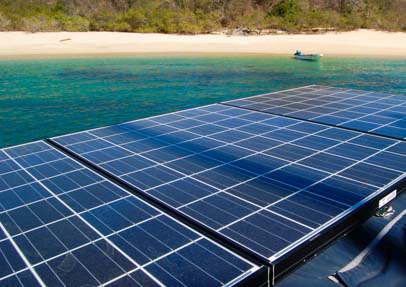
Solar panels on a sailboat

Our solar panels catch some tropical rays on the back of our sailboat during our cruise in Mexico.

If the two charging systems that are working simultaneously are detecting different voltages on the batteries — for instance, the solar charge controller is measuring the batteries to be 14.5 volts while the converter is measuring them to be 14.7 volts — they will each react according to their own internal charging algorthims.

For instance, say both the solar charge controller and converter are in Bulk mode, trying to attain a voltage of 14.7 volts before switching to Absorb. When the batteries reach 14.7 volts according to the converter, the converter will think they have achieved the Bulk voltage already and will switch to the Absorb stage, while the solar charge controller will remain in the Bulk stage because it sees only 14.5 volts, and it will continue aiming for 14.7 volts, according to its internal measurements and algorithm.

What does this mean? It simply means that the solar charge controller will continue to let as much current in from the solar panels as they can produce while the converter will already be backing off how much current it puts into the batteries to hold them steady at what it perceives to be 14.7 volts (and which the solar charge controller sees as 14.5 volts). Not a big deal. The solar charge controller will keep pushing while the converter keeps backing off, and the job will eventually get done.


LESSONS LEARNED FROM OUR ENGINE ALTERNATOR AND SOLAR CHARGE CONTROLLER

Return to top

The most challenging relationship we’ve had between charging systems was on our sailboat, and it was the one that forced me to investigate this whole business more deeply and to learn how to program a solar charge controller — and to discover, in the process, the value of programming one!

The two systems were our Balmar ARS-4 engine alternator/regulator and our Xantrex XW-MPPT-60-150 solar charge controller. The charging algorithms for these systems are described in detail here (for the alternator) and here (for the solar charger).

When I first observed them working together, I noticed two things right away.

1) Whenever we turned on the engine, the solar charge controller went into the Float stage soon afterwards.

2) Once the solar charge controller was in the Float stage, if we turned the engine off, it remained in the Float stage, even if the batteries hadn’t been fully charged by the engine alternator.

For instance, if the solar charge controller had been in the Absorb stage when we turned the engine on, and then we ran the engine for just 15 minutes and turned it off (not nearly long enough to charge the batteries), the solar charge controller would wind up in the Float stage and remain there for the rest of the day, depriving the batteries of a proper charge.

Engine Alternator Causes the Solar Charge Controller to Switch from Absorb to Float

The thing about batteries in a complex vehicle like a motorhome or a boat is that they are running many different systems that are continually turning on and off. In the case of our boat, when we were underway, any or all of our big systems might be in use at any one time: fridge and freezer compressors, radar, chartplotter, autopilot, anchor windlass, and even the microwave.

Marine diesel engine alternator Balmar ARS-4 100 amp

100 amp Balmar diesel engine alternator

Worst case, all of those things might be on at once for several minutes as we raised or lowered 200′ of stainless steel anchor chain with a 60 lb. anchor attached to the end of it (well, maybe not the microwave!).

Plus, there was no guarantee we’d run the engine long enough for the alternator to go through its Bulk and Absorb stages and charge the batteries completely.

We might run it for as little as a few minutes while moving from one anchoring spot to another, or for half an hour while we motored out of the bay to go daysailing.

We wouldn’t want to idle the engine at anchor just to charge the batteries, because the engine RPMs have to be fairly high for the alternator to generate a good charging current. These high RPMs happen naturally while driving the boat, but unfortunately, conventional wisdom says that revving the engine to high RPMs while not in gear (i.e., without a load on it) risks glazing the cylinder walls.

Besides it being random as to how long we might run the engine, it was also random as to what state the solar charge controller would be in when we started the engine up.

We might start the engine in the dark to raise the anchor, and in that case the solar charge controller would be asleep. Or we might do it early in the morning when the solar charge controller was in the Bulk stage and gamely trying to get whatever current it could from the wimpy sun on the horizon. Or we might do it later in the day when the solar charge controller was in the Absorb stage and cranking away.

We used a clamp-on ammeter to find out exactly what was going on at various points in the system. We put it around the alternator’s battery cable to see how much current the alternator was putting into the batteries. We also used it on the solar charge controller’s battery cable to verify that the current it displayed on its LCD screen was correct (it was).

Sperry Clamp-On Ammeter measures current from engine alternator

The alternator is pouring 77.9 amps into the batteries – WOW!!

Whenever we turned on the engine, regardless of what the solar charge controller was doing, the engine alternator would immediately go into the Bulk stage and dump as much current into the batteries as they needed to reach the alternator’s Bulk voltage.

If the solar charge controller had been in the Bulk stage already, its job would suddenly become much easier as it got a huge boost from the alternator.

If it had been putting 21 amps into the batteries and had been slowly raising the voltage towards 14.4 volts (the setting we had for the boat’s batteries), the engine alternator might contribute another 40 amps for a while, getting the batteries up to the Bulk voltage a whole lot faster than if the solar panels had continued working by themselves.

If the solar charge controller had been in the Absorb stage already, putting something like 18 amps into the batteries to hold the Absorb voltage of 14.4 volts, the engine alternator would begin its own Bulk stage regardless, and it would remain in the Bulk stage for 36 minutes as it followed its own internal algorithm.

The solar charge controller would react by backing off and delivering less current.

To make things more complicated, as these two systems worked through their charging stages, the loads on the batteries would be fluctuating widely as Mark and I went about our business of living on a boat.

If the fridge and freezer compressors were both running, and the autopilot was maintaining our course and the radar and chartplotter were on and we were making burritos in the microwave, the batteries would need a lot of current.

However, if neither compressor was on and someone was hand steering the boat, etc., then the batteries would need a whole lot less current. During those lulls in current demand, the solar charge controller would suddenly scale things way back and put just 8 or 9 amps from the panels into the batteries.

As soon as that happened, the solar charge controller would suddenly switch to the Float stage!

Huh?!

After some sleuthing, as described in the previous post, I realized that the charge controller was switching from Absorb to the Float stage because the current needed to maintain the Absorb voltage had dropped below 2% of the capacity of the battery bank.

2008 Hunter 44DS Sailboat Groovy in Tangolunda Bay Huatulco Mexico

In Tangolunda Bay (Huatulco, Mexico) we motored back and forth across the bay every few days to anchor out of the swell as it changed its flow.

Since I had entered the true value of the battery bank (710 amp-hours), the controller switched from Absorb to Float when the current dropped below 14 amps (2% of 710).

So, I lied to the controller and told it the battery bank was just 250 amp-hours. Then it would remain in Absorb down to 5 amps.

What I found (by trial and error) was that the solar charge controller pretty much always needed more than 5 amps when it was in Bulk or Absorb.

I don’t know why the alternator didn’t produce that last 5 or so amps on its own, but I suspect it was because the alternator’s Absorb voltage was set to 14.2 volts while the solar charge controller’s Absorb voltage was set to 14.4 volts (the alternator had “sets” of values for the three target voltages, and 14.2 volts for Absorb was in what I felt at the time was the most appropriate set).

The Solar Charge Controller Gets Stuck in the Float Stage

The second problem I encountered was that in the event that the solar charge controller went into the Float stage prematurely, then, after the engine was turned off it would remain there until the next morning.
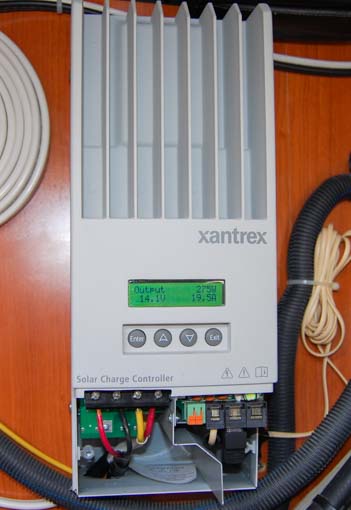
Xantrex XW MPPT 60-150 Solar Charge Controller

Xantrex solar charge controller
(bottom plate removed)

Yet the batteries may not have been fully charged by the alternator, and they may have really needed to remain in Absorb with the solar panels charging them at a fast clip for another hour or two.

In this case, the solar charge controller needed either to resume the Absorb stage or cycle back through the Bulk stage as soon as the engine was turned off.

The only way the Xantrex XW MPPT 60-150 would cycle back through the Bulk stage is if the battery voltage dropped below a certain level.

I experimented with different voltages. The Float voltage was 13.4 volts, so if I set the “ReBulk” voltage to be 13.5 volts or higher, then the charge controller would never get into the Float stage at all, because it would keep cycling back to Bulk.

According to the user manual, this is actually a valid way to operate this solar charge controller, and they even provide a programming parameter that sets the charge controller up to be a “two stage” charger that has no Float stage and has just the Bulk and Absorb stages.

I wasn’t comfortable with not having a Float stage (although in hindsight that probably would have been just fine given the intermittent heavy loads that were on the batteries all day long). In the end, I settled on a ReBulk value of 12.9 volts.

So, if the solar charge controller was in the Float stage after the engine was turned off, and a big load came on some time afterwards that drew the battery voltage down from 13.4 volts to below 12.9 volts (microwave plus fridge and freezer, for instance), then the solar charge controller would cycle back through the Bulk stage and start the charging cycle all over again.

Programming For Storage

Periodically, we left the boat for a month or several months at a time when we traveled inland or went back to our RV for hurricane season. Since the fridge and freezer would be turned off, and there would be no loads on the batteries at all, I would undo these two programming changes. I would reprogram the solar charge controller with the true size of the battery bank so it would switch from Absorb to Float at 14 amps rather than 5, and I would change the “ReBulk” voltage back to 12.5, the factory default.


SOLAR CHARGING AND ELECTRIC HOOKUPS

Return to top

Sometimes There Are Good Reasons Not To Plug In!

Solar power is free, however, the electricity from shore power hookups may not be. If your shore power electricity is “free” (i.e., built into the overnight fee you are paying for your RV site or boat slip), then it doesn’t really matter which charging system is dominant.

If you have metered electricity (a common situation if you are renting your RV site or your boat slip on a monthly, seasonal or annual basis), and you are paying for your electricity, then you may want to ensure that your solar charger is running the show and doing the bulk of the work while your converter or inverter/charger is playing second fiddle.

One easy way to do this is just to flip off the electric switch on the shore power post. Flip it on only as needed when the batteries get low and need a boost.

We did this a lot when we lived on our sailboat. We lived at a slip in Paradise Village Marina in Puerto Vallarta, Mexico, as well as at slips at Hotel Coral and at Cruiseport Marina in Ensenada Mexico for months at a time without plugging in the shore power cord at all. During hurricane seasons, we also left our boat in a slip in Marina Chiapas for seven months without plugging it into shore power.

It was nice when we settled up the bills for these places at the end of each stay to have a big ol’ “$0” on the line item for electricity.

What Happens If You DO Plug In?

If your RV or boat is plugged into shore power, and the switch at the post is turned on, it is hard to get the solar power system to be dominant because its power source is flakey (as explained here).

We plugged our sailboat into shore power for several months while we lived aboard at Kona Kai Marina in San Diego at the end of our cruise.

Schneider Electric 2500 watt inverter charger Xantrex

Schneider Electric (Xantrex)
2500 watt Freedom inverter / charger

Our Xantrex inverter/charger went through the Bulk and Absorb stages the first time we plugged in, and then it remained in the Float stage forever after (except when we unplugged to go day sailing and plugged back in again upon returning)!

Each morning when our Xantrex solar charge controller woke up, it zipped through the charging stages and went into the Float stage after just a few minutes, because it saw the batteries were already fully charged.

In our RV, we plugged into shore power for 48 hours during rainy and stormy skies while we stayed at Narrows Too RV Resort in Maine. It was overcast when we plugged in. Our Outback solar charge controller was in the Bulk stage putting about 6 amps into the batteries at around 13.9 volts (it was aiming for 14.7 volts).

Ordinarily, since we live a solar power only lifestyle, our Outback solar charger is set up with Bulk and Absorb values of 14.7 volts, a minimum Absorb time of 2 hours and a maximum Absorb time of 4 hours. However, our Iota DLS-90 / IQ4 Converter has a fixed (non-modifiable) Bulk voltage of 14.6 volts and Absorb voltage of 14.2 volts and Absorb time of 8 hours.

I temporarily changed the solar charge controller to have Bulk and Absorb voltages that matched the converter, and minimum and maximum Absorb times of 0 hours so it would remain in Absorb only as long as it took to get to Bulk (the charging algorithm of the Outback solar charge controller is explained in detail here).
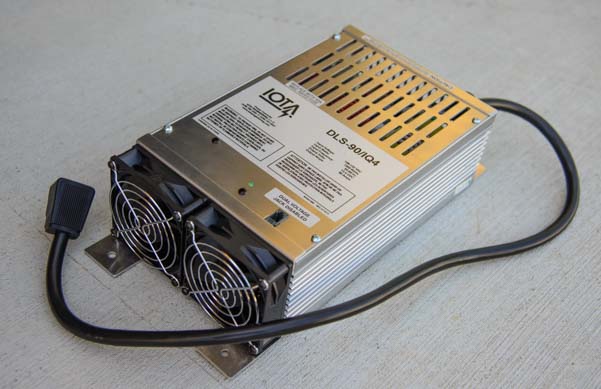
Iota DLS 90 IQ4 Converter and smart charger

Iota DLS 90 IQ4 Converter and smart charger ready for installation in our RV

As soon as we plugged in, the converter began dumping 49 amps into the batteries which zoomed the battery voltage up to the converter’s Bulk stage value of 14.6 volts. Then it backed way off to 30 amps, then 20, then 15 as it held the converter’s and solar charger’s Absorb voltage of 14.2 volts (our new Trojan Reliant AGM 6 volt batteries charge up extraordinarily quickly!).

The Outback solar charge controller responded by putting in a few amps at first, but then it displayed “Bat Full” and went to sleep!

From there, the Outback solar charge controller went through its usual Sleeping and ZZZZ stages as the Iota DLS-90 / IQ4 Converter quietly slipped from Absorb (14.2 volts) to Float (13.6 volts). When the Outback solar charge controller went through its wakeup sequence after being in the ZZZZ stage for 3 hours, it saw the batteries were fully charged, so it rolled over and went back to sleep in the ZZZZ mode.

Outback FlexMax 60 Solar Charge Controller

We catch our RV’s solar charge controller sleeping on the job at midday!
The solar panels are in full sun and are at 68 volts
The converter is in control and has elevated the batteries to 13.5v
But the controller sleeps soundly as 0 amps go from the panels to the batteries!

In fact, the whole rest of the time we were plugged into shore power, the Outback solar charger stayed in the ZZZZ mode, even in bright afternoon sunshine. Every 3 hours it would lazily open its eyes, yawn, look at the state of the batteries, see that they were fully charged and go right back to dreamland in the ZZZZ mode.

To summarize, these are two examples of how different solar charge controllers handled the presence of full-time shore power:

Do The Different Charging Voltages Have To Match?

No. On another occasion, while getting repairs done at an RV dealership, we plugged in our trailer for an afternoon while it was out on the lot next to the building on a cloudy day. The solar charge controller was putting in 6 amps at 13.8 volts in the Absorb stage (trying to keep the batteries at 14.7 volts) at mid-afternoon.

As soon as the shore power cord was plugged in, the converter began dumping 55 amps into the batteries and the battery voltage zoomed to 14.6 volts. The solar charge controller kept putting in around 6 amps.

For the next few minutes, the total current going into the batteries dropped from 61 amps to 33 amps and then settled there. If the solar charge controller could put in 8 amps, as the sky lightened, the converter put in 25 amps. If the solar charge controller could put in only 2 amps as the sky darkened, the converter put in 31 amps.

Suddenly, the converter switched to its Absorb stage where it holds the batteries at 14.2 volts, and the total current going into the batteries dropped to 20 amps. The solar charge controller was still in its own Absorb stage where it wanted to hold the batteries at 14.7 volts, so it kept putting in as much current as it could (5 to 8 amps and even as high as 12 when the sun came out for a few minutes) while the converter made up the difference, keeping the total at around 20 amps.

We didn’t stay plugged in long enough to see the solar charge controller switch to Float (the converter stays in Absorb for 8 hours), but at that point the converter would have held the batteries at 14.2 volts while the solar charge controller wanted them at 13.5 volts. It also would have been dark, so the converter would have been in complete control and the solar charge controller would have gone to sleep.


GETTING THE MOST OUT OF A BACKUP GENERATOR

Return to top

If you are using a generator to give the batteries a boost of charge because you’ve been in cloudy conditions or don’t have enough solar power to run everything on board indefinitely, then you’ll want the generator to charge the batteries as quickly as possible, saving you a few dollars in fuel (gas or diesel) and saving yourself from the loud noise and obnoxious fumes of the generator itself.

Yamaha 2400i Portable Gas Generator

Yamaha 2400i generator — our backup

In essence, the goal with a generator is to run it for as short a time as possible to get the batteries charged up.

With solar power, at the end of the day, before nightfall, the batteries are in their most charged state.

During the evening and into the darkest hours of the night, the batteries get depleted from running the lights, the TV, the computers, the microwave and whatever else your household uses until bedtime.

By dawn, the batteries are at their lowest state of charge. This is also a time when the sun is low in the sky and the solar panels are operating weakly and producing minimal current.

Early morning is the ideal time to turn on the generator!

An Example of Generator Use at Midday versus Dawn

The first time we fired up our generator to charge our batteries via the Iota DLS-90 / IQ4 converter, we’d had several overcast days in a row. It was mid-afternoon, and the batteries were fairly depleted from days of cloudiness. However, they had already gotten about 25 amp-hours of charge during the morning and noon hour, so they weren’t as depleted as they had been at dawn.

The solar panels were limping along in the Bulk stage with the batteries at about 13.5 volts. The solar charge controller was aiming at a Bulk voltage of 14.7 volts and the panels were valiantly trying to produce enough current to get there, but all they could muster was about 6 amps. It wasn’t likely the batteries would reach the Float stage before dark.

As soon as we turned on the generator, the the Iota converter went into the Bulk stage and began delivering about 60 amps to the batteries. It quickly got them up to 14.6 volts and switched to Absorb, dropping to about 20 amps. Great! But this converter is capable of putting 90 amps into the batteries, so why run it when Bulk mode delivers just 20 amps?

Solar panels on a fifth wheel RV roof

We let the solar panels do their job during the day.

We decided turn off the generator and let the solar panels do whatever they could for the rest of the day.

Early the next morning when the batteries were depleted from several days of inadequate charging plus a night of activity in the RV (they were down to about 12.3 volts), we fired it up again.

I did not modify the settings on the Outback solar charge controller to match those of the converter because we were just going to run the generator for a few hours and probably wouldn’t need it again for a few months.

This time the converter rolled up its sleeves and got to work, pumping 67 amps into the batteries as it aimed for its target Bulk voltage of 14.6 volts. The solar charge controller was in Bulk mode too and was busy putting in 1-2 amps of its own (it was early morning), and with the converter’s assistance, it briefly hit 14.7 volt Bulk target and switched to Absorb.

With both the converter and solar charge controller operating in the Absorb stage, the converter dropped the current to maintain the target Absorb voltage. The solar charge controller could still bring only 1-2 amps to the party due to the low light, so the converter was in control and doing virtually all the work.

We shut off the generator off after about two hours and let the solar charge controller take over. Now that the batteries were partially charged up, the solar charge controller was able to get the batteries up to its Absorb voltage target and finish the job, even in the overcast conditions, getting the batteries through its Absorb stage and going into the Float stage for the first time in a few days.


FINAL NOTES

Return to top

So, you can see, there are many ways to charge RV and boat batteries and many things to consider. Of course, it’s easy enough to leave the various charging systems at their factory settings after installing them, and there is nothing wrong with that!

But if you want to understand your system and get the most out of it — especially if you are using solar power and end up running a second charging system in conjunction with your solar power system — you may want to dig into the nitty gritty details buried in the user manuals and figure out what the charging algorithms are and how to program each system with the parameters that make the most sense for you.

All battery charging systems for mobile installations like RVs and boats have become increasingly more sophisticated over the years. A quick review of the older systems described in detail in the previous posts here and here show how the engineers designing these systems have become more and more knowledgeable about the real world applications of their products and what conditions they might encounter as they interact with other charging systems.

As the years go by from here forward, more and more solar charge controllers, inverter/chargers, converters and engine alternators will be designed with the understanding that they may not be the only charging system operating in the RV or boat.
 

This was the last article in our series on RV and Marine Battery Charging:

Related posts about batteries, solar power and living off the grid in an RV or boat:

Subscribe
Never miss a post — it’s free!

Our most recent posts:

More of our Latest Posts are in the top MENU above.

More of our Latest Posts are in the MENU.   New to this site? Visit RVers Start Here to find where we keep all the good stuff. Also check out our COOL NEW GEAR STORE!! *** CLICK HERE *** to see it!

Lubec & Campobello Island – Fantastic Lighthouses!

June 2015 – After a really happy visit to Acadia National Park, the nearby Schoodic Peninsula and the crazy mail boat daytrip out to the Cranberry Islands, we headed further downeast to the easternmost point in America: Lubec, Maine.

Mainers have a slightly different sense of direction than most, and “Downeast” in these parts actually means “Northeast.” If someone says they went “down” to someplace, it’s best to check a map before assuming they went south. In all likelihood, wherever they went “down to” is north of where they are standing now!

The reason for this is simple: the prevailing wind on the Maine coast blows out of the southwest and towards the northeast. So, sailors going “up” the Maine coast to the northeast sail “downwind” to get there!

Selfie at Lubec Maine

We’re waaaaay downeast!

This whole coast is strewn with craggy shores and quaint lighthouses to warn mariners about dangerous rocks, and we had gotten a kick out of seeing the Bass Harbor Head Lighthouse on Mt. Desert Island. But further downeast they get even better!

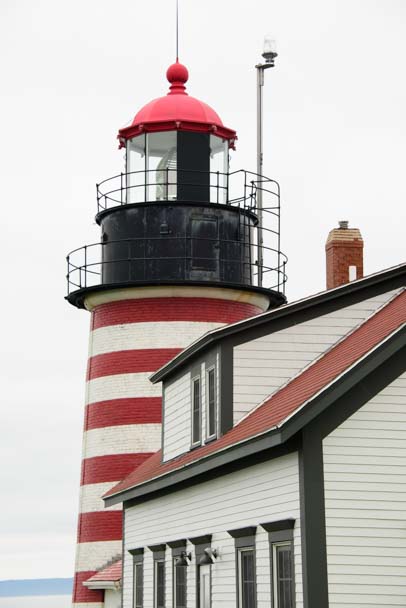
Lubec (“Loobeck”) is home to one of the most striking lighthouses in Maine: the West Quoddy Head Lighthouse. This candy-striped beauty is very accessible, and despite the overcast skies when we were there, we were not alone enjoying a picnic on one of the tables nearby.

West Quoddy Head Lighthouse Lubec Maine

A dad gets a pic of his wife and daughter at the West Quoddy Head Lighthouse

This fun lighthouse made me think of Pippi Longstocking!

West Quoddy Head Lighthouse Lubec Maine

West Quoddy Head Lighthouse

Nearby, the tiny village of Lubec has a cute main street with multi-colored buildings.

Storefronts in Lubec Maine

Lubec’s main street is very colorful

Like all towns on the coast in downeast Maine, lobstering is the way of life here, and lobstering motifs were everywhere, even on the side of a gift shop building.

Lubec Maine Gift Shop Building

When we walked up one street, we were surprised to see a most unusual motorhome. It was an Airstream 350LE. Airstream is best known for its travel trailers, but how cool it was to see one of their unique motorhomes out on the road!

Cool RV in Lubec Maine

Hey – it’s an Airstream motorhome!

Lubec faces a very pretty harbor, and the benches overlooking the bay can be very romantic!

Romance at Lubec Harbor Maine

Lubec is for Lovers

Across the thin strip of water on the other side of the harbor opposite Lubec is Campobello Island which has a lighthouse that shines back towards Lubec.

5th wheel RV at lighthouse Campobello Island New Brunswick

Campobello Island has a small lighthouse overlooking Lubec

Lighthouse at night in Lubec Harbor Maine

Campobello Island is actually in New Brunswick, Canada, and after admiring the small part of it we could see from Lubec, we decided to take a daytrip to the island. We got up early one morning, dashed down to the docks to see the boats in the early morning light for a moment, and then drove over the bridge that goes onto the island.

Lobster boats at dawn Lubec Maine

Downeast Maine at dawn.

You need a passport to cross into Canada, but other than that it is a super easy border crossing. We were the only ones at the bridge, and in no time we were driving in another country.

This was a wonderful little warmup for going into Canada “for real” a few days later when we would cross into the mainland part of New Brunswick at Calais, Maine. But for now, we were just daytripping. Even so, the first sign we saw made us do a double-take!

Stop sign in Canada

Ahem… we really are in a different country!

We admired Lubec across the water. It is such a sweet little town!

Town docks Lubec Maine

Lubec looks very pretty across the way

The ocean was like a lake in the early morning sun, and we watched the lobster boats out doing their rounds to all their traps.

Lobster boats Campobello Island New Brunswick Canada

Lobstering is a way of life on both sides of the border.

As we drove to the far end of the island, we marveled at the pristine forest and ultra clear water. We could see every detail of the seaweed waving under the surface.

Campobello Island New Brunswick Canada

The woods and water seemed virgin here.

We climbed down a steep path towards the water and I spotted a sea urchin shell in the grass. I don’t know how it got up there, but I put it on an evergreen tree branch between the pine cones. What a neat contrast — the woods meeting the sea.

Sea urchin on spruce tree branch Campobello Island

From the forest to the ocean

Campobello Island’s sister lighthouse to the West Quoddy Head Lighthouse in Lubec is the East Quoddy Head Lighthouse! It sits at the far north end of Campobello Island, and it is equally stunning.

East Quoddy Lighthouse Campobello Island New Brunswick Canada

Our first glimpse of East Quoddy Lighthouse

It peeked out at us from behind the trees at first, but we found a woodsy trail that goes out a ways on a small peninsula where we were able to see it in its full glory. Rather than being candy-striped, this lighthouse has a huge red cross on its front.

East Quoddy Head Lighthouse Campobello Island New Brunswick Canada

You can walk out to this lighthouse to see all its outbuildings up close for two hours before and after every low tide. The tides are immense here, however, and the water moves really quickly. So, you have to time your visit to the lighthouse very carefully!!

A sign near the trail that heads out to the lighthouse explained why:

Beach Sign

The tides are gargantuan here.
At low tide you can walk to the lighthouse — if you dare!

It would be another few hours before the tide’s window of opportunity opened up for us, so we contented ourselves with getting pics of this beautiful lighthouse from across the water. What a stunner!

East Quoddy Lighthouse Campobello Island New Brunswick Canada

East Quoddy Lighthouse — very regal!

This little one-day introduction to Canada’s east coast was a really great appetizer for us and got us in the mood to do some more exploring north of the border.

Subscribe
Never miss a post — it’s free!

Our most recent posts:

More of our Latest Posts are in the top MENU above.

More info about the area:

Other blog posts from Downeast or with similar themes:

Boquillas del Carmen – A daytrip to Mexico from Big Bend, Texas

<-Previous || Next->

Taking the Mail Boat Ferry to Maine’s Cranberry Islands

June 2015 – So far our travels in downeast Maine and Acadia National Park had far exceeded our expectations. The sights, the smells, the cute towns and the beautiful coast had all been intoxicating, and we were sure it couldn’t get any better. But it did!

Maine coast harbor at dawn

The Maine coast at dawn – magical!

The best way to see the northern Maine coast is by boat, and I had been scouting around for ways to get us out on the water. The colorful sailboats looked so inviting in the early morning light. The water beckoned, and I wanted so much for Mark to experience Maine from the water on a boat, because it is nothing at all like Mexico or the west coast where we had done all our sailing together.

Sailboats at dawn in Maine harbor

Elegant and pretty…

There are all sorts of tourist boat rides available, from whale watching tours to schooner rides to cruises.

Dawn in Maine harbor with boats

What a spot…!

But when I saw that the local mail boat takes passengers to two of the tiny islands just off Mt. Desert Island, I knew I’d found just the thing. This mail boat is exactly that, a small boat that delivers the mail to the folks who live on nearby Cranberry and Islesford islands. It also picks up and delivers all kinds of other things too, including people.

Mail boat ferry to Cranberry Island and Islesford Maine

Beal & Bunker’s “Double B” Mail Boat

We hopped aboard with a small rag-tag group of people in the early morning and stood in the back watching the shore disappear. Once the boat got a ways from shore, Ted, the ticket man, whipped out a smartphone and ran our credit card for our tickets. “I can’t get a signal on shore, but I can get one out here,” he said, handing us back our card. How funny!

We passed some beautiful sailing yachts bobbing on their moorings and we passed some lobster boats as well. The wind felt fresh in my hair and cold on my cheeks. Ted told us how this ferry, the Double B, runs every day of the year. In many ways it is a lifeline between the people on these two small islands and the rest of Maine.

I hadn’t really noticed that we were surrounded by men on the boat who were carrying lunch pails, but when we got to our first stop, Cranberry Island, everyone around me suddenly piled off the boat and up the steep stairs onto the dock. Every single one was a fellow heading to work with a lunch box. How cool is that!

Workers get off Beal & Bunker mail boat ferry Double B on Cranberry Island Maine

Workers get off the boat to climb up onto the docks…

No sooner had they all gone up the stairs than a group of schoolkids came down the stairs!

Everyone on the mail boat knew each other, and the adults on the boat welcomed the kids eagerly. Each child had a backpack and was dressed for school — and each was wearing a lifejacket too. Ted and the other adults checked that all the kids they expected to see were aboard, and then the schoolbus / mail boat headed back out to sea. These kids live on Cranberry Island but go to school on the island of Islesford!

“If there’s a kid missing,” Ted said, “We have all the parents’ phone numbers!”

Schoolkids board Double B mailboat ferry on Cranberry Island Maine

Schoolkids come down to the mail boat to head to school on Islesford

Ted explained that no matter what the conditions, the “Double B” mail boat ferry runs — unless it is just too dangerous. This past winter was a doozy, and he described one day where the ocean spray was huge as the boat pounded through the surf, and the water froze in mid air. It built up on the boat’s windows so fast that the captain couldn’t see a thing and had to turn around.

Lobster boat docking at Cranberry Island Frenchman Bay Maine

A lobsterman comes into the dock at Islesford

But this boat is a vital link for these islands, and when we landed in Islesford, we were amazed to see a brand new washing machine on the dock waiting to be loaded onto the mail boat. We weren’t sure why a brand new washing machine would be leaving the island instead of arriving, but maybe it had to be returned!

How do these folks do their shopping, I asked a local woman on the dock. “We live and die by Amazon,” she joked.

Wharf in Islesford Maine

Islesford wharf

Islesford is a tiny island with just a handful of inhabitants. As we walked up off the docks, we were greeted with a sign that made two things clear: 1) The mosquitos are so fierce that they carry people away, and 2) the speed limit for cars on the island is 15 mph!

Mosquitos and 15 mph speed limit on Islesford Maine

This is a low key and slow paced kinda place…
if the mosquitos don’t carry you away!

Actually, a bumper sticker made a third thing clear:

10 771 I'd rather be on Islesford bumper sticker

This is a very quiet island, and after the school kids and their teachers had disappeared from view, we wandered around the docks and then up the street a bit.

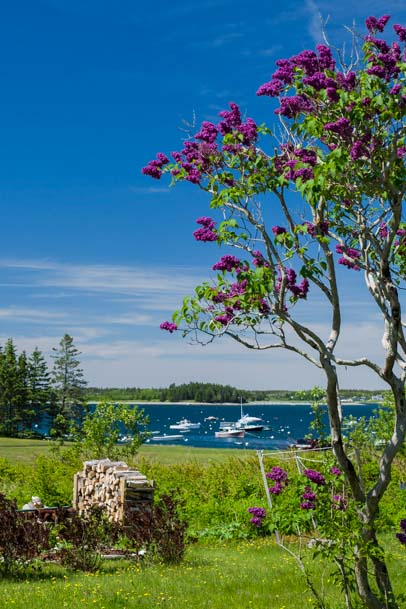
Lilacs arching over Maine harbor

Islesford is a jewel of an island.

There isn’t really a town center, but we passed the tiny Islesford post office and Islesford Market, which share a small store front.

Then we came across a welcoming building that had a sign over the door, “Neighborhood House.” There were picnic tables out front, and since we’d gotten an early start to the day, and our tummies were rumbling, and neither of our moms was around to say we had to wait, we sat down and ate our picnic lunch despite it being barely 10:00 a.m.

Neighborhood Center Islesford Maine

This village has a Neighborhood House — neat!

We continued our stroll after lunch and found ourselves in front of a sign that said, “Islesford Artists.” This was a gallery dedicated to artists from the island, and the the curator, Katy Morse Fernald, showed us some beautiful paintings. Upstairs there was a loft room that once housed her husband’s lobster traps and line and buoys. He was a sixth generation lobsterman from the area!

Islesford Artists Gallery Mt. Desert Maine

The upstairs gallery room at Islesford Artists used to be storage for lobster traps and bouys.

We got chatting with her about the lobster industry, and we were very surprised when she said it is currently fluorishing in Maine. She attributes this primarily to the overfishing of the predator fish as well as to the increase in the minimum sizes for lobsters so they are a little older when they’re caught and have had a chance to reproduce more. I hadn’t realized that lobsters have predators. I guess I just never imagined a large fish chomping away on a crunchy lobster, shell and all!

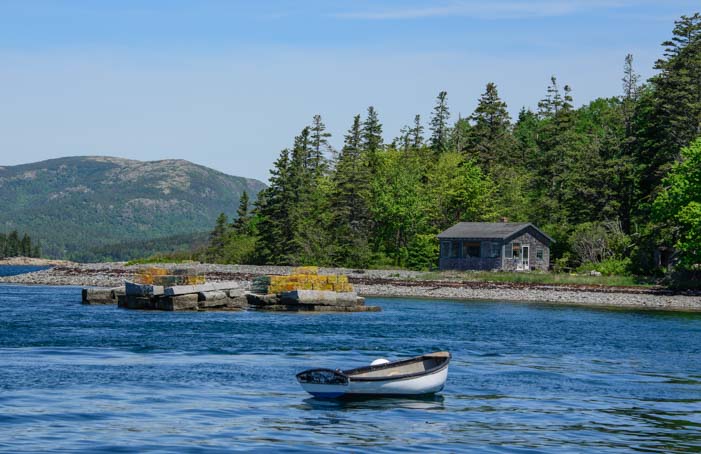
Dinghy on a mooring ball Frenchman's Bay Maine

Life is quiet out here

After a few hours on Islesford, the mail boat came back on its rounds and we caught a ride to Cranberry Island. The mail boat goes round and round between Mt. Desert Island, Islesford and Cranberry Island all day long, and a passenger ticket is good for as many rides between the destinations in one day as you wish to take!

Cranberry Island (“Great” Cranberry) is a little bit bigger than Islesford (“Little Cranberry”), but not much. The Cranberry General Store was at the top of the dock and had a restaurant where people were having lunch.

Cranberry Island General Store Maine

Cranberry Island General Store — just a bit bigger than the one on Islesford!

Walking the quiet roads on Cranberry Island, we passed several pretty homes and quite a few stands of purple lupine wildflowers.

House on Cranberry Island Maine

At one house there was a goose who was very enamored with her own reflection in a basement window!!

Goose admires herself in a window

A goose admires herself.

Back at the town dock, we walked for a little ways along a pebble beach that was lined with washed up seaweed.

Pebble beach and seaweed Islesford Maine

Pebble beach near the town dock on Cranberry Island

The mail boat had returned to Cranberry Island by now, and we watched Ted and the captain unloading their deliveries from the roof of the boat. Coolers full of fresh food were destined for Hitty’s Cafe, a popular restaurant that is a few streets back from the town dock. There were also quite a few bags of potting soil and a lot of boxes destined for the post office. A pickup truck was there to pick up a lot of the goodies, and it had a stack of US Mail sorting bins that were headed back to Mt. Desert Island.

It was quite an operation, and one that goes on all day long everyday, year in and year out, as small goods and packages get moved between the islands of Mt. Desert, Islesford and Great Cranberry. We watched a larger commercial boat delivering a big heavy construction vehicle onto another dock. The “Double B” is too small to carry vehicles, but it seems that vehicles are delivered one at a time here!

Loading and unloading Bunker & Beal Double B Mail Ferry boat in Cranberry Island Maine

Unloading deliveries for the folks who live on Cranberry Island

Soon it was our turn to climb aboard. We stood to the back watching other people come onto the boat, and we recognized some of the people we had seen in the morning.

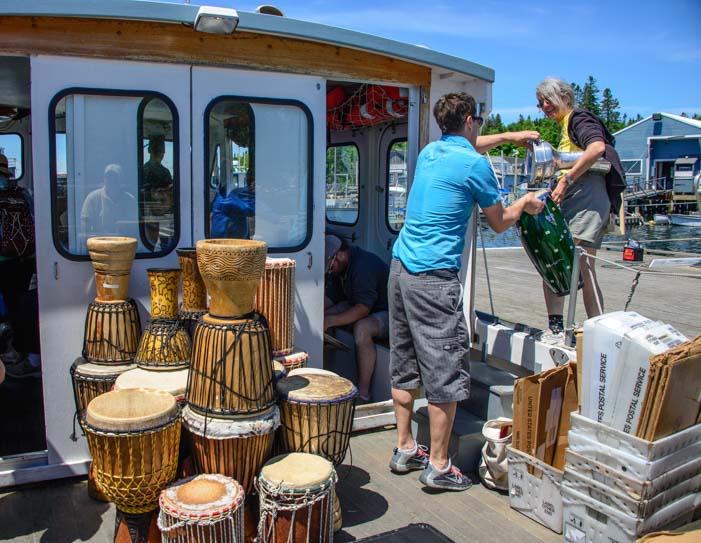
Then, we looked up and noticed a guy with a long beard walking down the dock carrying a big drum. Next to him was a young boy with an equally big drum. They set them down in the boat and then disappeared. Then some more people came with similar drums and then more and more. Soon there was a huge stack of these drums right in front of us on the boat!

The stack kept growing! At long last the boat was loaded, drums stacked high, and then a fellow in a blue shirt jumped in. It turned out it was Beau Lisy, the school music teacher on Islesford, and he had just finished teaching the kids a segment on west African music. He lived on Mt. Desert Island and commuted via this mail boat out to Islesford School once a week to teach music to all the kids.

Bongo drums loaded onto Double B mail boat on Cranberry Island

Of all crazy things — the boat gets loaded up with African bongo drums!

Beau was a professional musician, and he performed in Northeast Harbor and in other venues in the Mt. Desert Island area in Maine in addition to giving private music lessons and teaching music at this little island school.

He was a super guy to talk to, and as he described bringing out professional music friends of his to introduce the kids to various styles of music — a classical music trio and rock musicians and west African drummers and more — how cool for these island kids!

Bongo drum music teacher on Double B Islesford Mail Ferry Boat

Islesford School’s creative and adventurous music teacher,
Beau Lisy!

The funny thing is that all of Beau’s musician friends had to carry their instruments on the mail boat too, even in January!!

This wonderful excursion on the Double B mail boat was a true highlight in our visit to Mt. Desert Island. If you travel to Mt. Desert, whether by RV or by other means, plan a day trip out to the Cranberry Islands via the mail boat. You’ll be traveling the way the locals do, right alongside the mail, the small packages, the food coolers, and maybe even the bongos too!

Captain of Beal & Bunker ferry Double B pilots to Cranberry Islands Maine

The Cranberry Islands were lovely, but the mail boat rides were the highlight of the day!

The Double B mailboat sails out of Northeast Harbor. Our tickets were $32 apiece for one day of unlimited rides between the islands. Each leg is roughly 15 to 30 minutes. Before getting off at each stop, check with Ted or the captain for the times for the next ferry. They don’t always go around in a circle but double back once or twice during the day between Islesford and Cranberry Island.

You can take bicycles for an additional small fee, and we watched two French Canadians loading and unloading their bikes on one leg of our trip — easy! However, we found that the islands were small enough to get a flavor of each one on foot.

One other tip — dress in layers, as it can be chilly out on the water and quite warm as you walk around inland in the sunshine. There are places to get lunch on Cranberry Island.

Subscribe
Never miss a post — it’s free!

Our most recent posts:

More of our Latest Posts are in the top MENU above.

A few helpful links for the Cranberry Islands:

Related blog posts from our travels

Small ferry boat travel in the Caribbean’s Grenadine Islands! – A fun way to scoot between these jewels of the Caribbean

<-Previous || Next->

Coast to Coast Magazine Cover & Utah RV Roadtrip Article!

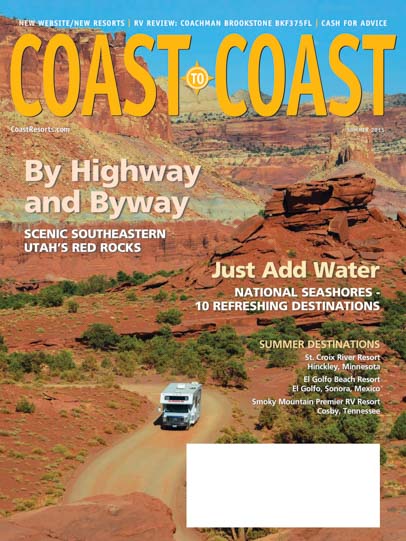
Cover Photo Coast to Coast RV Magazine Summer 2015 Emily Fagan

Summer 2015 issue
Article: A Utah Roadtrip – Driving Amid the Red Rocks
Cover Photo by Emily Fagan

The 2015 summer issue of Coast to Coast Magazine has a fun photo of mine on the cover, and inside there’s a feature article I wrote with pics from both of us about the wonderful sights we saw along a scenic drive through southeastern Utah.

Although we have loved all of our RV travels, we still both agree that Utah is our favorite state to visit. The red rocks blow us away every time we see them, and we find ourselves going back again and again to enjoy the dramatic landscapes.

One of the best things about Utah is the scenic drives, and the state boasts quite a few. Almost every road in Utah is a jaw-dropper, especially in the southern half of the state.

Although a few of Utah’s scenic drives are rightfully ranked among the nation’s best, there is one, the Bicentennial Highway, in the southeastern part of Utah, that gets little attention and very litlte traffic.

A road trip that includes this route is a stunner, and following it with a turn onto the Capitol Reef Scenic Byway really got our juices flowing.

From the three unique red rock bridge formations in Natural Bridges National Monument to the miracle of Glen Canyon to the incomparable beauty of Capitol Reef National Park, these roads take you through eons of rock ages into recent centuries of human habitation.

When we drove our buggy along this route, I found myself sitting in the window of our truck taking pics as we went along because it was just that spectacular!!

Our many blog posts from our RV travels in Utah can be found HERE.

Our blog posts from the southeastern part of the state and driving directions are here:

Coast to Coast Magazine is published by Coast Resorts, an RV park membership program. Similar to a timeshare in the way it works, members buy into a home RV park and then enjoy very inexpensive stays at member parks. There are rules for how long you can stay at each park and requirements for staying outside the network after spending time within the network parks, but if you like to plan ahead and stay at higher end parks, it is a great way to go.

Full-time RVing friends we met in our first year on the road had been enjoying their Coast to Coast membership for several years when we met them, and they were very happy to be able to stay at these parks for just a few dollars a night.

The editors of Coast to Coast Magazine have given me permission to share this article about Utah here:

A Utah Roadtrip – Driving Amid the Red Rocks

For more of our published work, visit our Press Room page.

Subscribe
Never miss a post — it’s free!

Our most recent posts:

More of our Latest Posts are in the top MENU above.

Beauty in the Mist – Bass Harbor Head Lighthouse, Maine

June 2015 – There’s an old saying in New England that if you don’t like the weather, just wait a minute. Well, so it was for us during our RV travels in northern Maine. For the most part, we were blessed with wonderfully sunny and warm weather as we explored Acadia National Park and its Carriage Roads, but we woke up one morning to total fog and drippiness.

Lobster boats in fog in Maine

A foggy morning in Maine

Luckily, coastal Maine is one of those places that has its own special beauty when the sky is grey. There’s a mysteriousness to the fog that sweeps across the harbors. We had enjoyed the Schoodic scenic drive east of Mt. Desert Island so much that we decided to take a drive down the western lobe of the island to check out Southwest Harbor and Bass Harbor, despite the wet weather.

Fog Southwest Harbor Maine

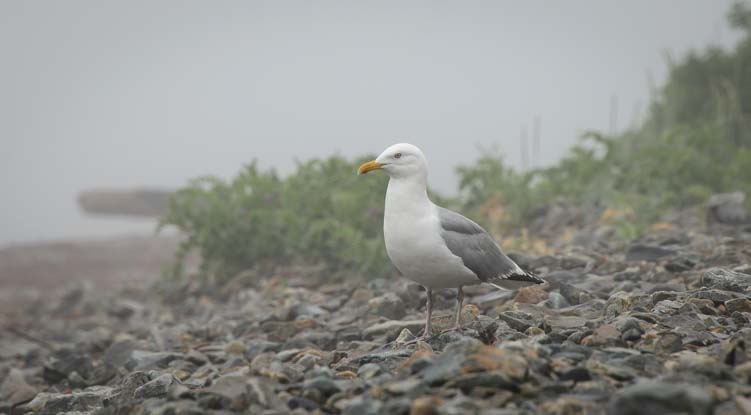
The fog was thick, but the seagulls didn’t mind.

Seagull in the mist and fog in Maine

This guy’s no stranger to drippy weather!

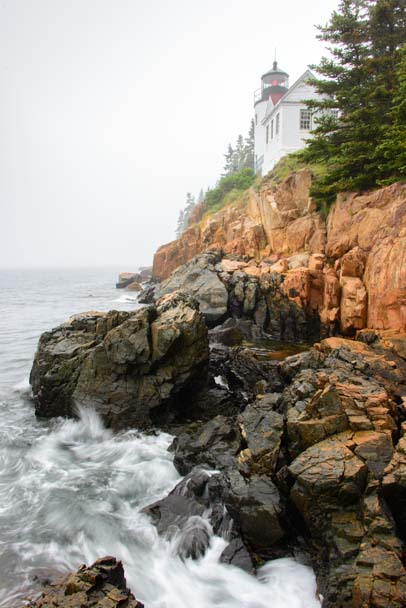
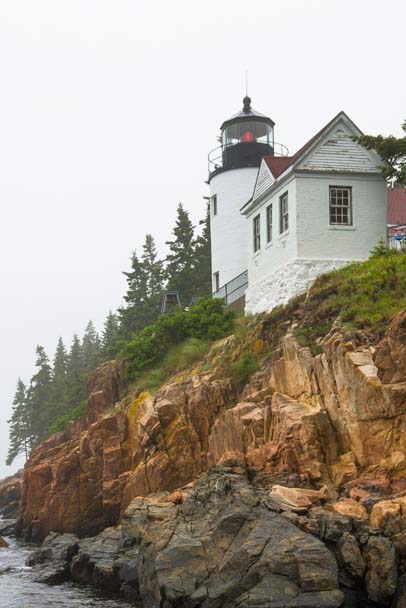
Lovely Bass Harbor Head Lighthouse is featured on lots of Maine tourist literature and calendars, and we scrambled out on the rocks to have a look at it. The granite boulders were fairly slick in the drizzling rain, but there were still quite a few people out lighthouse-peeping along with us.

Climbing on the rocks at Bass Harbor Lighthouse Mt. Desert Island Maine

Scrambling around the rocks at Bass Harbor Head Light.

We had to climb out on the rocks pretty far to get a good view of the lighthouse, but it was well worth the slipping and sliding!

Bass Harbor Head Lighthouse Penobscot Bay Maine

Bass Harbor Head Lighthouse

Mark was totally in his element taking photos in front of me, and he was very cute in his yellow fisherman’s hat. Funny thing is that we bought two of those hats for our cruise in Mexico but had occasion to wear them only once for about 10 minutes! It just doesn’t rain very often in Pacific Mexico. However, since we’ve been RVing in the east, they have come in very handy and we’ve worn them quite a few times!

Taking photos of Bass Harbor Lighthouse Mt. Desert Island Maine

Even though it was drizzling our cameras didn’t stop!

Bass Harbor Lighthouse Maine

Bass Harbor Head Lighthouse

The short trail that goes out to the Bass Harbor Lighthouse meanders through the woods, and on our way back we got waylaid by the prettiness of this little bit of forest. I just loved the thick carpet of soft moss that surrounded some of the trees.

Moss in the woods Bass Harbor Lighthouse trail Maine

We found wonderfully soft and velvety moss along the trail to the lighthous.

Raindrops covered all the leaves on every bush, and each leaf looked like it was covered with glistening jewels.

Diamond raindrops on leaves_

All the leaves were decked out in their finest jewelry.

Raindrops on leaves Maine

Raindrops created little pearls of all sizes

Raindrops on a leaf in the woods

A line of precious gems on a small leaf in the woods

The fog lay heavy on everything, and as we wandered back into Bass Harbor, a soft haze hovered over the fields of wild lupine flowers.

Wild lupine in the fog Mt. Desert Island Maine

The wild lupine looked lovely in the mist.

We stopped to enjoy the misty beauty, and when we looked at the purple flowers up close, we saw that each one was filled with tiny diamonds!

Jewel raindrops on lupine flower Maine coast

Glittering diamonds on a wild lupine – even on top!

There wasn’t a lot of action on the waterfront. It just wasn’t a day that encouraged people to play outdoors.

Low tide at Southwest Harbor Maine

A rainy day down on the docks still has its color

But there was a peacefulness in the air.

Fog at a dock in Maine

The fog got so thick at times that everything in the distance disappeared.

This is another side of Maine — cold and damp…and a little bit dreamy too.

Foggy day at Bass Harbor Maine

Things were very quiet on the docks.

Foggy dinghy dock Bass Harbor Maine

Peace!

When you go RVing in Maine and get a day of bad weather, spend a little time on the shore and experience Maine’s mystical side…!

Subscribe
Never miss a post — it’s free!

Our most recent posts:

More of our Latest Posts are in the top MENU above.

A little more about this part of Mt. Desert Island:

Other blog posts from our travels in Maine:

<-Previous || Next->

Acadia National Park’s Carriage Roads in Maine – Thanks, Rockefeller!

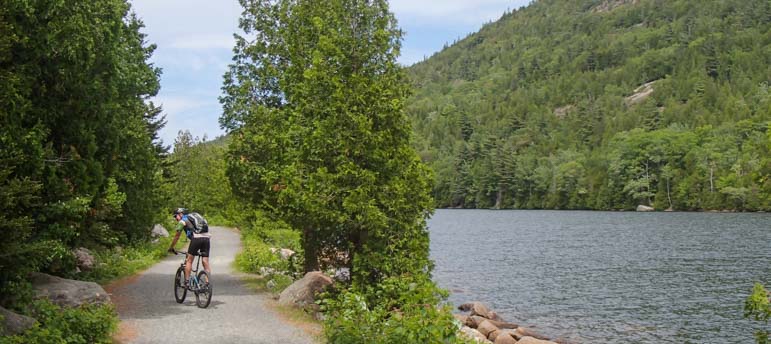
June 2015 – One of the great treasures of Acadia National Park is the Carriage Road system. These roads, which are open only to non-motorized traffic, run all through the interior of the park for a total of nearly 50 miles, traveling through the woods, passing by lakes and ponds, and skipping over streams on beautiful old stone bridges.

We loved taking our bikes out on these roads during our RV travels to Maine.

Bicycling the Carriage Roads in Acadia National Park Maine

Heading onto the Carriage Roads in Acadia National Park

While we were there, we discovered that, like many of America’s national parks, we have the Rockefeller family to thank for this unusual road system. It turns out that the history behind the Carriage Roads is quite a tale.

Back at the turn of the 20th century when cars were first coming into use, the folks that lived on Maine’s Mt. Desert Island had a bit of a class war over whether or not automobiles would be allowed on the island’s roads.

The wealthy people who owned the summer estates (Pulitzers, Vanderbilts and others of their ilk) wanted Mt. Desert Island to be a rural getaway where they could travel about by horse and carriage and leave the hustle and bustle of the city and its newfangled automobiles behind.

The locals who called the island home all year long wanted the ability to get from town to town easily, and these newfangled automobiles were just the ticket.

Riding the Acadia National Park carriage roads in Maine

These wonderful roads pass several ponds and lakes.

The state of Maine left it up to the local communities to decide for themselves whether or not automobiles would be legal on each town’s roads. The upscale towns of Bar Harbor and Northeast Harbor, where the summer residents socialized and moored their yachts, voted to outlaw automobiles on their roads. The more working class towns, like fishing village Southwest Harbor, voted to allow automobiles on their roads.

In the end, after some human road blocks and a few arrests of automobile drivers caught flamboyantly breaking the law and driving on the wrong roads, by 1913 all the towns had agreed that cars were okay.

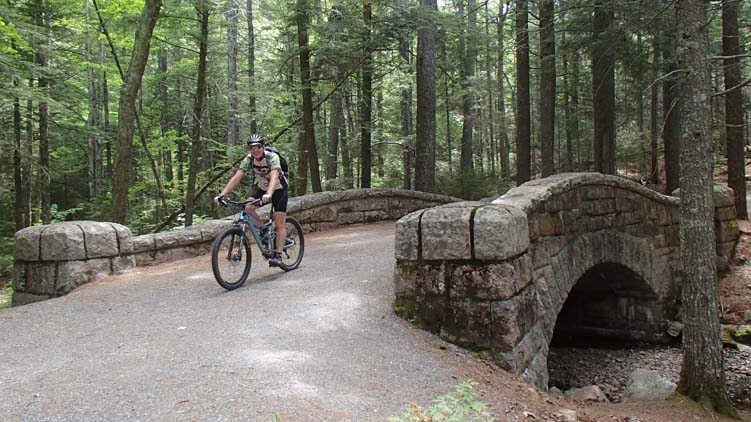
Biking under a stone bridge Carriage Road Acadia National Park Maine

Rockefeller hired masons to construct beautiful stone bridges.

I’m not sure where the Rockefellers stood on this issue — they lived in Seal Harbor at the south end — but John D. Rockefeller, Jr., decided to build a Carriage Road system just for horses and buggies. These roads went around the interior of the island and were available for everyone to use. This gave all visitors and residents of Mt. Desert a way to enjoy the peaceful inland forests up close, without a car.

John D., Jr., was an expert horseman and an experienced road builder, and he built lots of lovely roads and beautiful stone bridges. He kept buying up parcels of land and extending his road system until he had almost 50 miles of roads throughout the island.

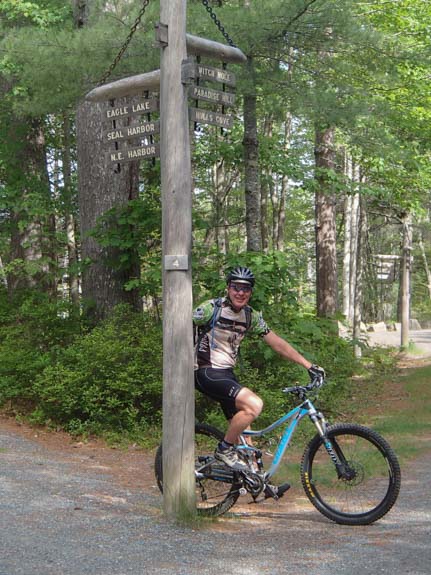
Carriage Road signs Acadia National Park Maine

The trails are extremely well marked,
but carrying a map is a good idea!

In the 1930’s, the National Park Service began putting together the foundations of what would become Acadia National Park, and Rockefeller ultimately donated all of these land holdings — with their new road system — to the National Park Service to become part of the new park.

Riding bikes on Acadia National Park carriage roads in maine

What a wonderful way to experience the Maine woods.

I never knew much about the Rockefellers, but they are an incredible family. John D. Rockefeller, Sr., founded Standard Oil in 1870. By the end of his life in 1937 he had created a staggering personal net worth of $339 billion (in 2007 dollars).

It is impossible to compare wealth across the centuries accurately, but to try to put his riches in perspective, he was worth a whole lot more than the top 3 of the world’s wealthiest people today combined.

Bill Gates ($79 billion), Carlos Slim ($73 billion and Warren Buffet ($72 billion) are worth $224 billion all together. That’s $115 billion short of Mr. John D! Even adding in Mark Zuckerberg ($35 billion) leaves a gap of $56 billion.

To think of it another way, Rockefeller was worth 4.3 times what Bill Gates is worth. Imagine someone with assets and/or income 4.3 times more than yours. Or imagine someone with assets and/or income that is one quarter of yours. That’s the difference between John D. Rockefeller, Sr., and Bill Gates. Nevermind the difference between Rockefeller and the rest of us!

Horse drawn wagon on the Carriage Roads at Acadia National Park Maine

If you’re not into biking, there are other ways to experience the Carriage Roads!

What is more, somehow John D. Rockefeller managed to pass on an incredible sense of personal motivation and high standards to his children. And they somehow passed that on to their children too.

How common it is for the people who make the deepest impact on the world to have kids who flake out. Nevermind the flakey kids — who ever hears from the grandkids? In so many cases, the kids, grandkids and great-grandkids of the biggest movers and shakers of this world all float on their predecessor’s money with little motivation or interest in doing something remarkable.

Large turtle by the bike path

There’s lots of wildlife out here — this female turtle was busy laying eggs.

However, while John D. Rockefeller, Sr., was a ruthless, cut-throat, and not necessarily fair playing owner of a total monopoly in the skyrocketing oil industry, at the end of his life he turned his efforts towards philanthropy, and that is where his kids picked up the ball and where his grandkids carried it forward.

A snake next to a shoe

Just after seeing the turtle, we rode past a small snake.

John D. Rockefeller had seven grandkids, five boys and two girls. One of these grandchildren, David, is still alive. Reading a little bit about David Rockefeller, I learned he was a highly accomplished man who stepped out of the shadow of his dad and granddad and made his own indelible mark on the world.

He celebrated his 100th birthday a week before our visit to Acadia National Park, and the Park Service rangers were all abuzz with excitement because he had just donated a huge parcel of land adjacent to the park for public use in perpetuity.

Apparently David Rockefeller is quite a spry 100-year-old. A ranger told me she’d seen him cruising around on these Carriage Roads his father built in a horse drawn carriage!

Acadia National Park bridge on a carriage road

This bridge was a fun spot to take a short break.

The Rockefellers acquired and gave away massive tracts of land all over the place to preserve the most beautiful landscapes and make them available for everyone to enjoy.

When we were in Great Smoky Mountains National Park, we learned that half of the land that was donated and half of the money that was raised to create that park had come from the Rockefellers. The other half was provided by local landowners, residents and the National Park Service.

Half! That’s incredible!

The Rockefellers had a major role in the creation or growth of many other national parks too, including Shenandoah, Yosemite, Yellowstone, Grand Teton, Mesa Verde, Redwoods and the Virgin Islands.

Bike riding over a carriage road bridge in Acadia National Park Maine

We just loved these old stone bridges.

It is really easy to bash the ultra rich, or be envious, or question how they got their money, and on and on. But if it weren’t for the Rockefeller family using their staggering wealth to preserve these unique tracts of land, they would have fallen prey to development.

And the amazing thing is that the Rockefellers didn’t have to do any of it.

In the case of the Tetons, John D. Sr., had to put up quite a fight to get the National Park Service to take his land. The process was a bit of a nightmare, and he could have thrown up his hands and quit. But he didn’t.

So, we have the Rockefellers to thank for choosing (and sometimes fighting) to spend their money on us and on future generations of humanity.

Kayak on Jordan Pond Acadia National Park Maine

A kayaker at Jordan Pond.

David Rockefeller, who just gave away all that land on Mt. Desert Island a few weeks ago, is worth only $3 billion now, a mere fraction of what Bill Gates, Carlos Slim and Warren Buffet are worth. Obviously, he could be worth a lot more if the family had kept their money to themselves.

Perhaps with a nod to the example set by the Rockefellers, Bill Gates is busy giving away his fortune to fight disease and poverty in third world countries,. Three years ago, Warren Buffet gave each of his kids $1 billion with the requirement that they, in turn, give it away.

Lunch at Jordan House Acadia National Park Maine

The Jordan House is a great place to stop for lunch.

This is all very heady stuff, but the Rockefellers have been on my mind a lot since we started traveling, because their name keeps coming up at so many of the national parks we visit. The depth of caring in that family for the beautiful places in America seems to have extended through the generations.

Bicycling in Acadia National Park Maine

A wonderful spot for a bike ride!

We recently watched a thought provoking movie called America: Imagine The World Without Her. It’s a documentary made by a man who was born and raised in India, and it is fascinating to see this country through the eyes of someone who is not a product of it.

It’s a highly political film. However, it is well worth watching, because it makes you think about the origins and spirit of this country.

One of the most interesting points it makes is that after the American Revolution ended, and after General George Washington managed to wrest control of the locals away from the Brits, he broke with historical tradition.

Unlike all the leaders in human history up until that very moment, he did not proclaim himself King of this new country and give himself and his heirs absolute power and authority over the populace until the next overthrow.

He could have.

Jordan Pond Acadia National Park Maine

Jordan Pond is such a nice surprise in the middle of all these woods.

Since then, America has been a place of many kinds of firsts. Setting aside public land in the form of national parks was one, and the very first national park in the world was Yellowstone, created in 1872. Countries around the world have followed suit and preserved their natural treasures with gorgeous national parks that are open to the public. What a blessing for everyone alive today and for all that follow in the future, worldwide.

Bicycle at Bubble Pond Acadia National Park Maine

The Carriage Road at Bubble Pond.

It is highly ironic that the polluting combustion engine, fueled by oil drilled from nasty, dirty wells, created the fabulous wealth of the Rockefellers who then turned around a generation and more later and poured their profits into the national parks.

It’s ironic, too, that the family that benefited the most by the invention of cars and the related explosion in demand for oil was behind the creation of the unique Carriage Road system at Acadia National Park where the only legal traffic is human or horse powered.

Bicycling carriage roads under a stone bridge at Acadia National Park Maine

The Carriage Roads are very special!

I guess a leisurely ride or stroll on this special road system through the woods inspires a bit of reflection. It did for me.

If you do some RV travel in Maine, or if you visit Acadia National Park by some other means, make sure you spend a little time out on the Carriage Roads in Mt Desert Island’s forests. You may find new thoughts, ideas and musings stirring within you.

Subscribe
Never miss a post — it’s free!

Our most recent posts:

More of our Latest Posts are in the top MENU above.

For more info on all this, check out these links:

Related posts on similar themes:

More from our visit to Mt. Desert Island in Maine:

<-Previous || Next->

Hydraulic Disc Brake Conversion – In Escapees Magazine!

Hydraulic Disc Brake Conversion Escapees Magazine Jul-Aug 2015

Escapees Magazine Jul/Aug 2015
Article & Photos by Emily & Mark Fagan

The July / August 2015 issue of Escapees Magazine is featuring our article about upgrading our 36′ fifth wheel trailer with a disc brake conversion.

Now that we have taken our RV onto the congested, fast-moving and rather scary roads of the northeast, we are relying on our rig’s braking system like never before. We are so glad we have truly outstanding brakes!!

It seems that on a daily basis, whether in Virginia, New York, Maine or Nova Scotia, we are finding ourselves in heavy traffic. Too often we’re getting cut off by zippy little cars and/or coming down big blind, curving descents to be jolted to a stop by a red light. Slamming on the brakes while towing is just part of the deal out here.

Before we came out to the eastern states, we upgraded our trailer’s brakes from factory installed electric drum brakes to electric over hydraulic disc brakes. It’s not a cheap upgrade, but it is very worthwhile.

With permission from the editors at Escapees Magazine, you can read the article here:

Hydraulic Disc Brake Conversion

For anyone that tows a trailer, especially a fairly hefty one, this is an upgrade well worth considering. We have lots more details and a boatload of photos of our installation on this page:

Trailer Disc Brake Conversion – Electric Over Hydraulic Disc Brakes – WOW!

Escapees Magazine is published six times a year by Escapees RV Club, an unusual and very valuable club for anyone who owns (or would like to own) an RV. The club provides a myriad of services for RVers, from mail forwarding to discounts at RV parks to specialized RV weighing services to assisted living for elderly RVers to social groups, rallies, training for newcomers and travel caravans to Mexico and other exotic places.

A few months ago we took a trip to the Escapees RV Club Headquarters in Livingston, Texas, and despite being there during a deluge of rain, we had a wonderful time. See our blog post about their unusual headquarters campus here.

Recently, we were honored to become featured bloggers on the Escapees website. If you are looking for inspiration or information from RVers who are out here living the RV lifestyle, check out the Escapees featured bloggers page. Members who have registered and logged into the website can click here to see the full suite of the latest blog posts as well as create their own blogs to share their travels and tips.

Subscribe
Never miss a post — it’s free!

Our most recent posts:

More of our Latest Posts are in the top MENU above.

To see more of our published work, visit our Press Room

Schoodic National Scenic Byway – Downeast Maine at its best!

June 2015 – While we were in one of the Maine visitors centers getting info about Mt. Desert Island and Acadia National Park, I noticed a tiny brochure entitled, “Schoodic National Scenic Byway.” We love scenic drives, and any drive that has been designated as a National Scenic Byway is always really outstanding.

I tucked that little pamphlet into my stack of literature with a happy smile, and one sunny morning we took off on what turned out to be a truly inspiring tour.

Schoodic Point Scenic Drive Mt Desert Island Maine

Coastal views on the Schoodic National Scenic Byway

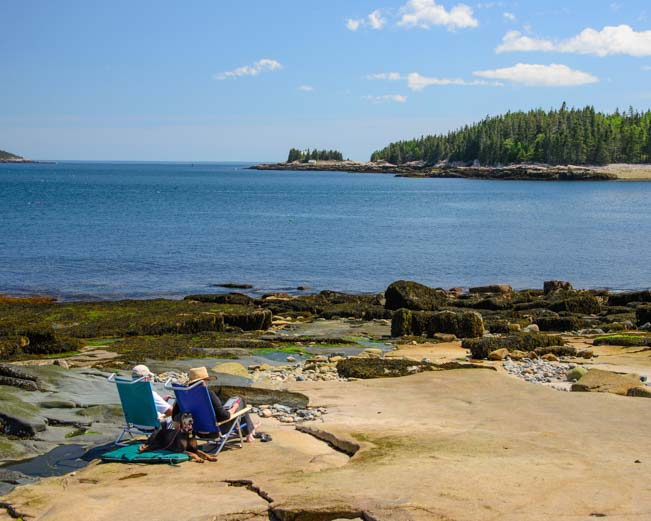
This short drive takes in some of the best scenery that northern Maine has to offer, and what’s even better is that we saw almost no other tourists all day long. This was quite a contrast to Acadia National Park and all of Mt. Desert Island which were teeming with visitors.

Rocky beach coast of Maine Acadia National park

Pebble beach and rocky shoreline in Maine

We were loving the raw and rugged coastline that we found in this part of Maine, and at one point we stopped to watch the waves crashing on the granite boulders.

Crashing waves northern Maine coast

Fantastic!

At the tiny hamlet of Wonsqueak Harbor we found a gem of a little cove and stopped for pics.

Wonsqueak Harbor Maine near Acadia National Park and Schoodic Point

Picture perfect Wonsqueak Harbor


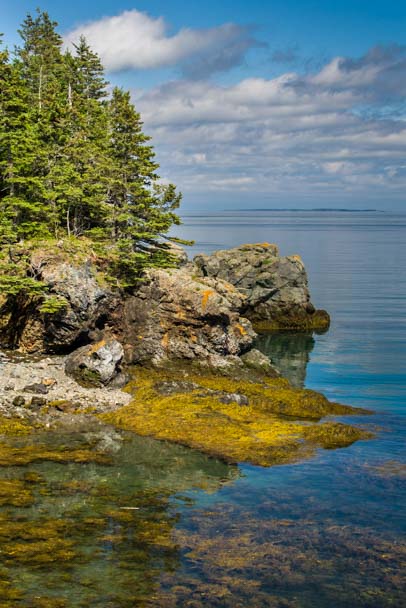
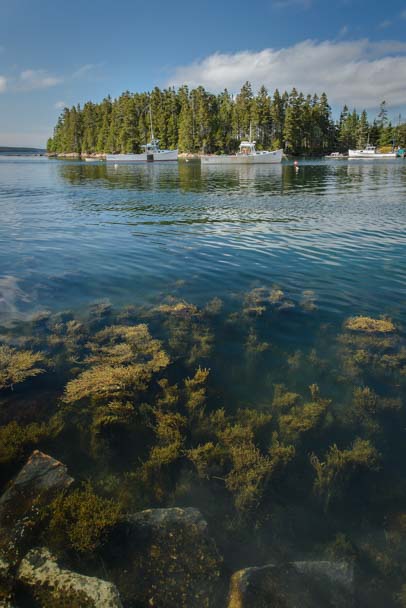
The water was wonderfully calm in the many bays that we passed, and it was crystal clear. It was so clear in Winter Harbor that Mark got an awesome photo of the swaying seaweed beneath the water with a classic pine covered shore in the distance.

Underwater seaweed Schoodic Point Maine

Above and below — talk about clear water!

Acadia National Park has a little branch on Schoodic Point that is isolated from the rest of the park over on Mt. Desert Island, and as we passed through the heavily wooded shoreline, we were engulfed in the most delicious smell of pine. I don’t know if it was the damp morning air or what, but we breathed deeply and felt so refreshed. Mark later bought a bag of crushed Balsam Fir needles so we could enjoy it in the rig wherever we parked!

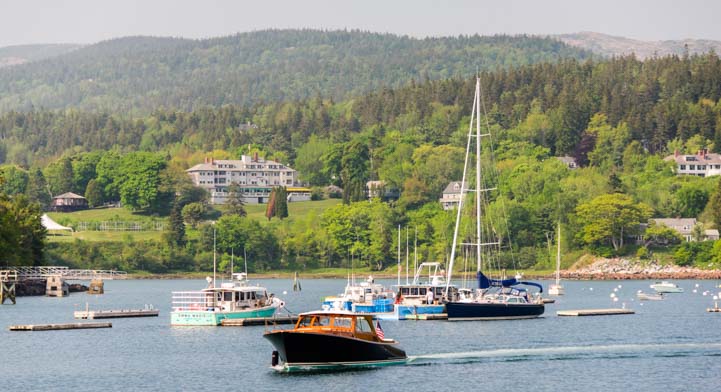
Passing the tip of Schoodic Point, we came to the most engaging part of the tour: Prospect Harbor.

Prospect Harbor Maine

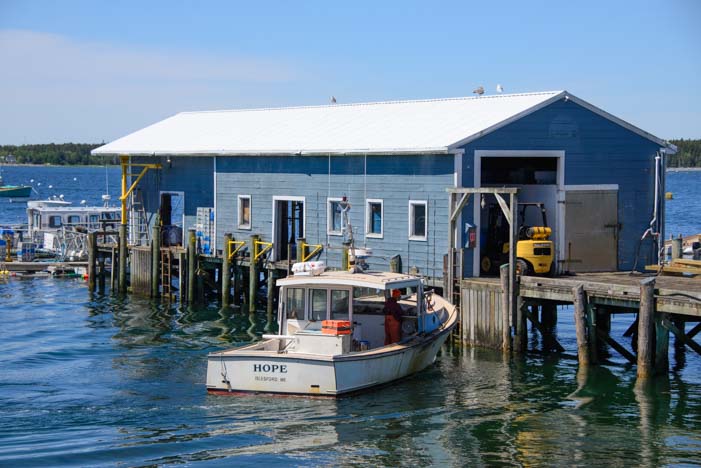
Lobster boats in Prospect Harbor

This harbor oozes downeast Maine charm. It is filled with lobster boats, and on the far shore you can see Prospect Head Light.

Prospect Harbor Point Lighthouse Maine

Prospect Harbor Point Lighthouse

Nearby we found some wild irises growing by a small pond.

Wild irises northern Maine coast

What are these doing here? How pretty!

Next to those were some wild lupines.

Wild lupine northern Maine coast

Pink, purple and blue wild lupines were everywhere!

But it was the pretty Maine scenery of the waterfront communities that really caught our eye. The tides are big here, so there are tall ladders that go from the docks down to the water.

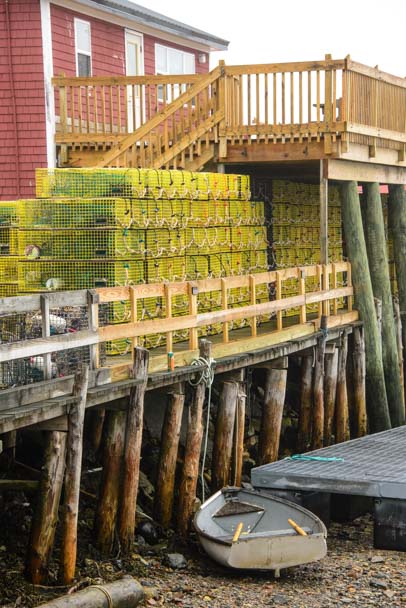
Lobster pots Prospect Harbor Maine

Classic Maine lobster dock with traps stacked six high.

Out in the water, dinghies waited patiently for their owners to return from a day of lobstering.

Row boats Prospect Harbor Maine

Beautiful Prospect Harbor

What we loved about this area is that it is very real and not a fake put-on like so many seaside villages that are decorated with cutesie lobsters, bouys and traps.

This whole region is a true working community of active lobstermen. Evidence of the lobster trade was everywhere. We saw lobster pots stacked high all over the place.

Skiff and lobster pots Prospect Harbor Maine

Lobster pots and a skiff
These aren’t props, but they do make for great photos!

The lobster boats in the harbor sat peacefully in the morning sun.

Prospect Harbor Maine

Scenic quaintness aside, this is a working harbor.

Most of the homes in the area are owned by working lobstermen, and we passed one house after another that had a huge stack of lobster pots in a side yard or even in the driveway. On top of the stack would be a neatly coiled pile of rope and a big collection of identical bouys strung together.

After seeing so many seaside towns that use old bouys with all different color schemes and patterns as colorful ornaments, I was fascinated as we passed one house after another, each with its own colored bouys adorning a neat stack of pots. One house had all white bouys with a blue stripe. The next had all orange bouys with a white stripe. And so on. I was so caught up in musings about these folks and their lifestyle that I totally forgot to take any photos! This stuff was real. I loved it!

Down on the wharfs and the docks, things were a little more chaotic. Little coils of rope were all over the place, and a scramble of different bouys was scattered about.

Lobster pots and line on the docks at Prospect Harbor Maine

Coiled rope, lobster pots and bouys on the dock at Prospect Harbor.

13 701 Lobster pots Prospect Harbor Maine

We wandered around the docks and watched a lobsterman with a big bushy beard coming up from his boat at a brisk pace. His step was nimble and quick, and his smile was big and warm.

He stopped for a moment when we greeted him, and in no time we fell into conversation. We discovered he was going to be 82 years old in August, and he’d been fishing and lobstering since he was 7 years old. “I’ve been doing it all my life,” He said. “My grandfather took me out to the Grand Banks to fish when I was 9!”

Now that is the real deal.

My own great-grandfather was a lobsterman, and counting out the years, I realized both his grandfather and my great-grandfather would have been out on the sea working their trade in the same era in the early 1900’s. We laughed that both of our ancestors had used boats powered only by oars and sails.

True Maine Lobersterman Prospect Harbor Maine

We meet a true Maine lobsterman who’s been at it for 75 years.

As he drove off in his pickup, he didn’t tip-toe away. He peeled out and squealed the tires! I hope we live with such gusto when we’re 82!

At Prospect Harbor we’d reached the end of the Schoodic Scenic Byway, and we turned around to go back. Retracing our steps a little ways, we came across a huge field of wild lupines.

We learned later that these gorgeous flowers that blanket every corner of the coast in rich shades of purple, pink and blue are actually invasive in Maine. Admiring them and sitting among them, it was hard to imagine them having any kind of evil intent. Something that cheers up the countryside so much just can’t be called an invader. I think they should be called guests!

Snuggling in the wild lupine flowers northern Maine

These big Maine lupines make wonderful company!

Further on, we took a slight detour off the Schoodic Scenic Byway and stopped at Grindstone Neck, a beautiful outcropping of vast granite slabs that stretch out to the sea just west of Winter Harbor.

Couple at Grindstone Neck Winter Harbor Maine

Scenic Grindstone Neck

We romped across this rocky shoreline for a long time, exploring the nooks and crannies and tidepools along the way.

Grindstone Neck Winter Harbor Maine

Craggy rocks at Grindstone Neck

Tidepool Grindstone Neck Maine Acadia National Park

A tidepool at Grindstone Neck.

We finally tore ourselves away from the water and were just getting back in our truck when who should pull up but one of those adorable Ford Model A cars that was part of the big rally we’d seen back in Mt. Desert Island!

Ford Model A car parked at Schoodic Point Maine Acadia National Park

Hey, it’s one of those Ford Model A’s!!

We had no sooner gotten a pic of this pretty car posing for us when another one arrived and parked right next to it.

Two Ford Model A cars parked at Grindstone Neck Maine

And another one!!

Then suddenly two more came along and pulled in right alongside. How cool!

Four Ford Model A cars Grindstone Neck Winter Harbor Maine

What a handsome line up!!

This beautiful sunny day was a real high point in our visit to Maine. If you have an RV road trip planned to the northern coast of Maine, be sure to spend a day enjoying this wonderful drive.

The route for the Schoodic National Scenic Byway begins on coastal Route 1 a little southeast of Ellsworth in the town of Hancock, and heads southeast from there. Even though you’re going southeast, though, technically you’re northbound on Route 1. It is New England, after all!

After a few miles, turn right on Route 186 South and follow the coastline around Schoodic Point on up to Prospect Harbor. That is the official end of the drive, but continuing on to Corea is a special treat. Finish by looping back via Route 195 to Route 1, or turn around, as we did, and retrace your steps. See the map link below.

UPDATE: The new Schoodic Woods Campground managed by the National Park Service is opening on September 1, 2015. Here is a newspaper article about the opening. The land was donated by a family foundation. Undoubtedly the family name begins with the letter R, since that family has been extremely active and generous with their land holdings on Mt. Desert Island for nearly a century.

Subscribe
Never miss a post — it’s free!

Our most recent posts:

More of our Latest Posts are in the top MENU above.

More info about this terrific daytrip:

Other posts from our RV trip to Downeast Maine:

<-Previous || Next->

Fireworks for Canada Day and the 4th of July – EXPLOSIVE!!

We have been enjoying Nova Scotia for the past 10 days or so, and yesterday we found ourselves caught up in the thrill of Canada Day celebrations in the small town of Antigonish on the northern coast.

Nighttime comes late in these parts in the summertime, but as daytime began to fade away, around 9:30 p.m., we suddenly found ourselves quickly becoming surrounded by Canada Day revelers.

It turned out that we were in the ideal viewing spot for the town’s fireworks display!

Fireworks

We grabbed our tripods and got set up, and in no time the show began.

And what a great show it was!! Here are some of our favorite pics — enjoy!!

Fireworks

Fireworks

Fireworks

Fireworks

Fireworks

Fireworks

Fireworks

Fireworks

Fireworks

Fireworks

Fireworks

Fireworks

Subscribe
Never miss a post — it’s free!

Our most recent posts:

More of our Latest Posts are in the top MENU above.

Other blog posts from our RV travels in Nova Scotia:

Acadia National Park – Alluring Beauty on the Maine Coast

June 2015 – Maine’s Mt. Desert Island (pronounced “dessert” despite the spelling!) is home to several small harbor-front towns as well as lovely Acadia National Park. We made a beeline for the trendy and chic seaside town of Bar Harbor as soon as we got there.

Two old cannons face the water in the middle of town, aimed almost directly at a pretty schooner in the harbor. Mark decided to have a look down the barrel of one!

Cannons and schooner Bar Harbor Maine

Boom!

It was early in the morning, well before the crowds of tourists began to fill the streets, and we enjoyed the quiet and peaceful feeling of the place. This is an upscale town loaded with high end galleries and boutique shops, and it was nice to walk the main street and window shop completely by ourselves for a while.

Boutique shops Bar Harbor Maine

Shops on the main drag in Bar Harbor

Another wonderful small waterfront town is Northeast Harbor (whose sister town, Southwest Harbor, lies across the bay). All of these towns made for fun excursions during our stay, and we spent many a happy hour walking along the docks and watching the boats in the harbor.

Boats in Northeast Harbor Maine

Scenic Northeast Harbor

A lot of Maine harbors are geered primarily towards the lobster boat fleet, but Northeast Harbor is also home to many beautiful sailboats — and some unusual looking ones too!

Antique ketch Northeast Harbor Maine

Northeast Harbor has sleek fancy yachts and cute antiques too

Mt. Desert Island is shaped something like a lobster claw with a pair of wide pincers hanging down. Acadia National Park takes up most of the eastern lobe and much of the western lobe too. In the eastern portion — the main part of the park — there is a Loop Road that passes the major sights.

The eastern 2/3 of this road is one way, and in our excitement to see it all on our first day in Acadia, we blew right by the visitors center, missed some key signs and wound up at the far end of the loop road facing the wrong way, trying to figure out how to see the park. Oops!

Scenic drive Acadia National Park Maine

The drives around Mt. Desert Island are wonderful

We got ourselves sorted out the next day and, map in hand, drove the loop clockwise as you are supposed to! Stopping at some of the viewpoints, we were quickly swept up in the beauty of the craggy shorline.

Crashing surf Acadia National Park Maine

Crashing surf on Maine’s rugged coast.

There were wonderful, huge granite boulders, and some of them even held tidepools. I love these northeast tidepools. There are whole ecosystems of algae, seaweed, periwinkels and limpets living in them, and many are lined with an ultra soft and rich red velvet that is some kind of algae.

Tidepools in rocks Acadia National Park Maine

We found lots of pretty tidepools

Rocky coast Acadia National Park Maine

We LOVED the mix of pine trees and jagged granite boulders on the coast.

I wandered way off so I wouldn’t keep getting in Mark’s photos, and around the bend I saw a lobsterman busy hauling his traps. I took a bunch of photos of him and then noticed that he waved to me. I took my camera down from my face to wave back. When I raised it again, I saw through the telephoto lens that he hadn’t been waving — he’d been holding up a wriggling lobster for me!

Unfortunately, he dropped the lobster into his bucket before I realized what he was doing, and I missed the shot.

Darn! The one that got away…

The one that got away!

I didn’t realize he was showing off a lobster for me to photograph until too late!

One of the most popular attractions at Acadia National Park is Thunder Hole, an opening in the rocks where the waves crash in and out, sending up a huge spray of water. To see the biggest spray, you have to catch it as the tide is coming in. The tide was going out when we swung by, but it was still neat to hear the gurgles, gulps and belches booming between the rocks far below as the waves washed in and out.

Thunder Hole - cool sounds on an outgoing tide and huge splashes on an incoming tide

Thunder Hole – Booming sounds on an outgoing tide plus huge splashes on an incoming tide.

This shoreline is very alluring, and we had such fun scrambling over the rocks.

Rock crevice Acadia National Park Maine

I swear, these kinds of big boulders bring out the kid in me.

These are SO MUCH FUN to run around on!

What a coastline! If you don’t want to run and jump on the rocks, Thunder Hole has a solid railing…

Dramatic sky Acadia National Park Maine

A touch of drama in the sky.

Acadia National Park is a very popular place, and the park was very busy even though we had arrived ahead of the summer crowds (New England public schools were still in session because they’d had so many snow days during the endless winter blizzards). The roads are narrow and winding, and some crazy people like to bomb down them like they’re a racetrack.

One group of travelers, however, was enjoying every minute of slow driving on these roads — a Ford Model A club! They were so cute that none of the other drivers objected to their pace. Some 170+ Model A’s attended this rally, and everywhere we went we ran into little groups of them.

Seeing them out on the roads was lilke stepping back in time.

Antique Model A drives up Cadillac Mountain Acadia National Park Maine

A Ford Model A rally took us back in time.

This group was having a ball, and the weather was perfect for them, so they drove around with the tops down and their beautiful leather suitcases strapped on the back bumpers.

Happy driver of a Ford Model A

Those guys were having too much fun!

Enjoying a fabulous road trip!

Enjoying a fabulous road trip!

Ford Model A cars lined up

These guys were all over the park. What fun!

Another Acadia National Park favorite is to take a drive to the top of Cadillac Mountain, the highest point in the park. We zoomed up the mountain, watching the views grow ever larger around us. And who was waiting for us at the top? A bunch of those Model A’s!!

Ford Model A parked on Cadillac Mountain Maine

View from the Top

The views were truly beautiful — you can see the many islands of Frenchman Bay in the distance — but we got the biggest kick out of watching these cute Model A’s drive down these wonderful roads. They had come to Acadia National Park from all over the country, most making the trip on their own four wheels. One club member even hailed from Australia, although he’d left his Model A at home.

Ford Model A car drives down Cadillac Mountain Acadia National Park Maine

What a classic image descending Cadillac mountain!

Two Ford Model A cars descend Cadillac Mountain Acadia National Park Maine

.

If you take your RV to Mt. Desert Island, unless it is fairly short in length and short in stature, you’ll be happiest leaving it behind as you tour the park. The scenic viewpoint parking is not RV friendly and there are bridges on the Loop Road as low as 11′ 8″. We enjoyed a fabulous stay at Narrows Too RV Resort, about 7 miles north of the north entrance to the park.

Subscribe
Never miss a post — it’s free!

Our most recent posts:

More of our Latest Posts are in the top MENU above.

For More Info:

Other blog posts from our RV travels in Downeast Maine

Here are some of our blog posts with similar themes!

<-Previous || Next->