Rainbow’s End – Escapees RV Club Headquarters!

March, 2015 – We have been members of Escapees RV Club since our first year of RVing full-time, and we have always wanted to visit the Escapees headquarters in Livingston, Texas, just north of Houston.

After visiting the stunning Caverns of Sonora in south-central Texas and getting a disc brake conversion done on our trailer in Forth Worth, we scooted east, stopping at the Casita Travel Trailer factory for a quickie tour, before spending five days at the Rainbow’s End RV Park on the huge Escapees campus.

Sharing the RV Lifestyle Escapees RV Park Livingston Texas

Escapees RV Club headquarters in Livingston, Texas

Escapees RV Club is an amazing organization that is as varied as any club could possibly be. Drawing together RVers of all shapes and sizes and ages and interests, Escapees provides a huge range of services for all of us, from bootcamp training sessions for new RVers to specialized RV weighing stations to overnight RV accommodations of just about every variety (ownership, long and short term RV site rentals, cheap dry camping, park model rentals, etc.), assisted RV living for the elderly, mail forwarding services, an RV magazine, and on and on.

Rainbow's End RV Park at Escapees Headquarters

Rainbow’s End RV Park in Livingston, Texas

When we arrived at the Livingston, Texas, headquarters, the annual Escapees rally called Escapade was taking place in Tucson, Arizona. At that event, an exciting new facet of Escapees was introduced — Xscapers — a new branch of the club that is dedicated to younger RVers.

This is an exciting development in a very dynamic club that has always sought to find new and creative ways to support the RV lifestyle.

Arriving Escapees Rainbow's End RV Park Livingston Texas

We arrive at the park.

Escapees was founded by Kay and Joe Peterson, a couple that was among the pioneers of the full-time RV lifestyle many decades ago. They were avid “boondockers,” and they overnighted in their RV without hookups to electricity or water on a regular basis.

With boondocking in its roots, most Escapees RV parks offer dry camping sites, usually for $5 per night (a little more for non-members). We were delighted to find that the Escapees Rainbow’s End RV Park in Livingston has three wonderful dry camping sites to choose from. After we walked to each site to check it out (none were in use — and we were told they rarely are!), we settled on a nice, big site called “Dry Camp A.” Unlike the smaller full hookup sites, this site was big and had a great feeling of privacy with lots of trees bounding two sides.

Escapees RV Park boodocking Rainbow's End Livingston Texas

Dry Camp A — a super deal at $5/night!

Ironically, the heavens did nothing but pour pitchforks on us for our entire stay. After taking one sunny pic of our RV set up in its Rainbow’s End RV Park home, we saw nothing but driving rain for five more days! Mark started calling our site “Wet Camp A.”

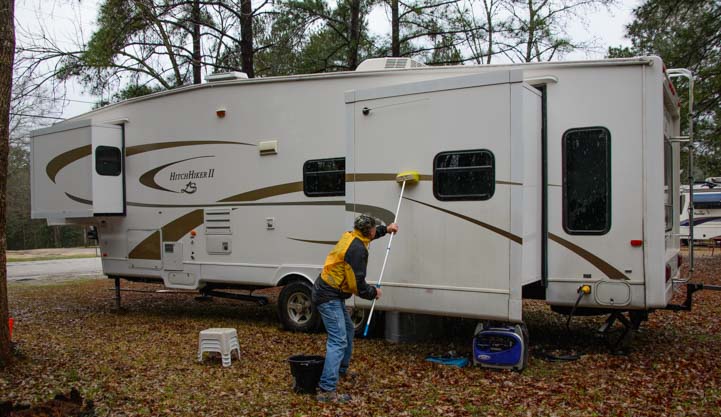
If nothing else, at least all that rain gave us great opportunity to use soft rainwater to wash our buggy and clean off the road grime from the nasty ice storm we’d driven through!

Redbud tree blooming in Livingston Texas

The redbud trees were in bloom all around the Escapees campus

The Escapees compound in Livingston is enormous. Not only is there the expansive Rainbow’s End RV Park, but there are park model homes and stick-built homes on sites scattered all around the outskirts of the park, plus the CARE RV-based assisted living center and its affiliated RV sites at one end, and, of course, company headquarters and offices at the mammoth mail sorting facility.

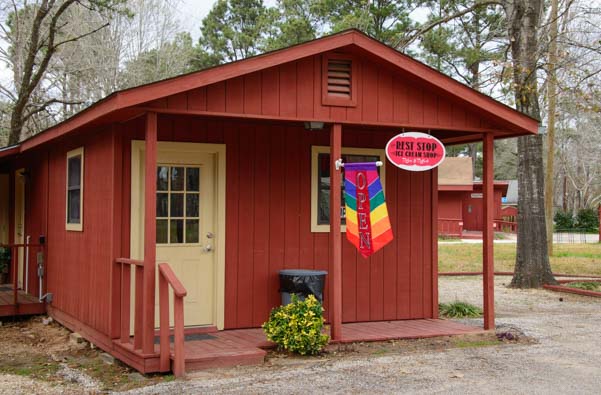
Smack in the middle of all this is a tiny ice cream shop called the Rest Stop.

Rest Stop Ice Cream Shop Escapees Rainbow's End RV Park Livingston Texas

The Rest Stop Ice Cream Shop is in the middle of it all.

We had assumed that everyone on the Escapees property was an RVer, so it was a big surprise to find that quite a few people live there in houses without RVs. We got chatting with Theresa at the Rest Stop as she scooped our ice cream, and discovered that although she has dreams of casting off in an RV someday, for right now she enjoys living in a house in the community and hearing the travel tales from RVers who stop in for ice cream. She warmly recounted meeting an RVing family with lots of kids who came by.

Rest Stop Ice Cream Shop

Theresa gave us a warm welcome and yummy ice cream at the Rest Stop

Escapees Corporate Headquarters was just steps from our site, “Wet Camp A,” and we stopped in for a tour. Because almost the entire Escapees staff was at the Escapade rally in Tucson at the time, there was just a skeleton crew working, but the group taking the tour numbered 12 or so people anyway! These free tours are offered twice a week.

Escapees RV Club Headquarters in Livingston Texas

Escapees RV Club Headquarters

One of the most impressive aspects of the tour was seeing the Escapees mail sorting facility. Escapees forwards such a large volume of mail to its mail forwarding clients everyday that a US Mail semi-tractor trailer truck has to deliver it all. Escapees even has their own zip code, and they get more mail than the post office in Livingston! Everyday, the mail truck backs up to the sorting facility, triggering a daylong flurry of activity for some 20 people.

We watched an enormous machine presort the mail and then walked through a big room filled with filing cabinets where each client has a folder holding their mail. It was a very impressive operation!

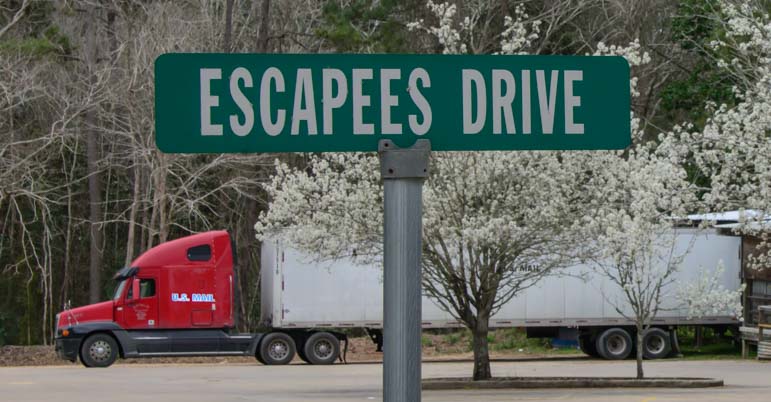
US Mail truck at Escapees RV Club mail sorting facility Livingston Texas

A US Mail semi trailer rolls up with the day’s mail.

We learned that Escapees will soon be offering a service where clients can view a scanned image of each envelope they receive and then opt to have it opened or shredded. This could come in very handy for time-sensitive or important documents that you’re waiting to receive.

The Escapees community tour usually includes a trolly ride all around the campus, but the trolley driver was at Escapade, so we didn’t see that part of the tour. Next time!!

Rainbow's End painting wtih tour bus trolley

A cute trolley takes visitors on tours of the Escapees Rainbow’s End campus

But we did see the plaque honoring founders Joe and Kay Peterson when they were voted into the RV / MH Hall of Fame in 2001. We had seen this plaque at the RV / MH Museum in Elkhart, Indiana, where all the leaders and innovators in the RV industry are honored (if you are ever near Elkhart, a stop at that museum to see the vintage trailers on their Road Back in Time is a must! Our blog post is here).

Joe and Kay Peterson RV - MH Hall of Fame

Joe and Kay Peterson, founders of Escapees, were honored by the RV / MH Hall of Fame

Out in the lobby, our guide showed us two really fun little sticky note pads that used to be included in new members’ packets. These were mini invitations to “Friendship Hours” that you could fill out and stick on your RV neighbors’ doors to invite them to a potluck or other gathering. What a neat idea that was!!

Escapees RV Club Friendship Hour Pad

Sticky notes to invite friends over…

Escapees RV Club Friendship Hour Pad 2

…the modern day equivalent is RVillage.com

Nowadays RVers rely on social media to reach out to both nearby neighbors and RVing friends many miles away. But there was something very homey, cozy and friendly about those little sticky note pads, and I wasn’t the only one in the group who said, “Wow… Where can I get some?” Unfortunately, Escapees doesn’t make them any more.

Up on a wall in the main mail sorting room there is a wonderful display of dozens of issues of Escapees Magazine, and I was proud to see a few of our covers in the mix.

Escapees Magazine covers

Escapees Magazine covers on display in the mail sorting facility

Escapees Magazine is written by members for members, and the editors are always looking for beautiful photos and technical “How To” types of articles to include. If you are an Escapees member, and you’ve learned something on the road that you want to share, write it up and send it in!

Escapees RV Club Magazine Covers

We saw a few of our cover photos in the mix

I wandered down to the CARE facility one afternoon, curious to learn more about this unique program. “CARE” stands for Continued Assistance for Retired Escapees. Participants in CARE live in their own RV in a site next to the big CARE clubhouse, and for $874 a month they get an RV site, help with dumping and propane tanks, three meals a day, housekeeping and laundry services, transportation to doctor’s appointments in town and weekly transportation to grocery shopping as well. What an amazing deal!

Escapees Care Center Livingston Texas

Escapees CARE Center

The clubhouse is the hub for CARE participants, and when I poked my head in one room, a group was enjoying watching a live concert being streamed in from the Grand Ole Opry in Nashville, Tennessee, on a huge flat screen TV. I was told that CARE will be offering adult daycare to elderly residents in the general Livingston area soon too.

Many of the RVs in the CARE RV sites have big, beautiful, permanent porches built out front. One of these with two huge wooden rocking chairs really got my attention. It just looked so inviting!

Travel Trailer with beautiful porch Escapees Care Center Livingston Texas

Many RVs in the CARE center have beautiful big porches built out front

As I was admiring it, an elderly woman came out on the porch in a bright red sweater and waved to me. Her name was Nedra, and we ended up chatting for quite some time. I asked her about CARE and she said, “Come on, I’ll give you a tour of the clubhouse!” and off we went. She proudly showed me the dining hall, which is a big, open, cheery room. She told me the food was wonderful! Visitors can enjoy an inexpensive meal there too if they let the dining room know by 10:30 a.m.

Dining Room Escapees Care Center Livingston Texas

The Dining Room at the Escapees CARE clubhouse

RVers can workamp at CARE as well, and I talked with several RVers who really enjoy helping out this way, either in the dining hall or driving residents around town. Couples work together in teams, and in exchange for a minimum one month commitment to work 28-36 hours a week (per person), you get a free RV site at Rainbow’s End (with metered electricity) and you also get three free meals a day at CARE. If you work in the summertime, you receive a stipend to cover electricity for air conditioning.

Workampers can also work at the other end of the Escapees campus at the Rainbow’s End RV park. I was told that if you work at least 20 hours a week for a month or more, you receive a certificate good for a free night’s stay at any Escapees Rainbow RV Park for every 20 hours you work. We chatted with an RVing couple who really enjoyed defraying their travel costs this way, working at three or four different Escapees RV parks each year.

Kay and Joe Peterson Escapees RV Club

Kay and Joe Peterson’s immense creativity has built an incredible company that caters to the many unusual and unique needs of RVers

We really enjoyed our stay at Rainbow’s End, and after spending some time in Livingston, Texas, we came away even more impressed by the diversity of the Escapees RV Club than ever. Thank you, Kay and Joe, for creating a special virtual home — and a true community — for all RV travelers!!

Subscribe
Never miss a post — it’s free!

More info about Escapees:

  • Join Escapees RV ClubAnd say you were referred by “Roads Less Traveled” (if the spirit moves you!)
  • Escapees CARE Program (Continued Assistance for Retired Escapees)
  • Xscapers – Escapees resources for young RVers
  • Kay Peterson – The Inspiring Life Story of a Full-time RVing pioneer & the Co-founder of Escapees

<-Previous || Next->

Our most recent posts:

More of our Latest Posts are in the top MENU above.

Caverns of Sonora – Enchanting Caves in Texas

March, 2015 – Continuing our RV travels east from Big Bend National Park, we were headed to Fort Worth, Texas, to do a disc brake conversion on our trailer that would truly transform our driving experience and put a huge grin on Mark’s face. But first we decided to make a brief stop at the sensational Caverns of Sonora, a massive cave system that is considered to be one of the most beautiful caves in the world.

Caves at Sonora Caverns Texas

Entering the Caverns of Sonora, we cross the mammoth pit that took 50 years to conquer.

Fortunately for us, and for all RVers, Sonora is right on I-10, just a little north and east of Big Bend National Park, and the caves are just 8 miles west of Sonora. The tours run every 2 hours or so, and when we arrived there was no one signed up for the next tour. By the time it started 50 minutes later, there was a group of about 12!

Cave Tour Sonora Texas

Navigating the cave is easy with a tour guide, electric lights and solid surfaces under foot!

This is a “warm” cave, and we were advised to shed our jackets and sweatshirts because the temperature is generally in the low 80’s in the cave. I was a little reluctant — after all, central Texas was in the throes of ice storms — but once we got into the cave, I was glad I did.

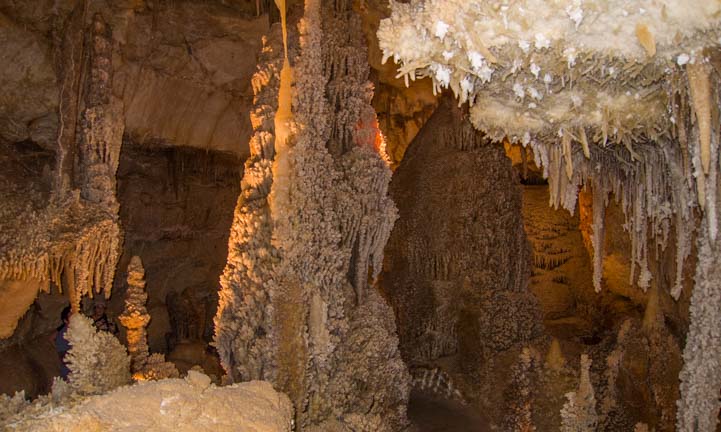
Caverns of Sonora Crystal Palace Tour_

The lighting in the caves is artistic and well crafted, and it makes the calcite formations glow.

The Caverns of Sonora are on ranch land that was owned by Bill Mayfield at the turn of the last century, and they were first discovered when a rancher’s dog chased a raccoon into a hole.

Crystal Palace Cave Tour Caverns of Sonora Texas

We had to walk carefully so we didn’t bump the “cave coral” all around us.

Explorers quickly found out that after about 500 feet of scrambling along a narrow passage from the entrance, there was a massive pit that opened up and blocked the way completely. It took about 50 years for anyone to make it past the pit. It was a daredevil feat for the ones who did, because they had to climb way above the pit, with scant and dim sources of light!

Crystal Palace Caverns of Sonora Texas

The formations in this cave are exquisite — stalactites and stalagmites everywhere!

These early explorers discovered that the cave is about 7 miles long and is filled with exotic and intricate calcite deposits and designs created by water filled with minerals dripping from the ceiling of the cave to the floor. There were no signs of human presence at any time, and no animals either. That huge pit by the entrance kept everyone out!

Sonora Caverns Texas stalactites

Everywhere we turned there were exotic and fragile formations.

The Mayfield family has operated the cave as a commercial tourist enterprise since July, 1960, and they have done a terrific job of preserving the cave while making it available to the public to enjoy.

Cave coral coralloid formations Caverns of Sonora Texas

“Cave coral” or “coralloid” formations — it looks like an underwater world of coral!

As we walked, the drip formations on the ceilings, walls and floor of the cave became ever more elaborate.

Stalactites Caverns of Sonora Texas

Stalactites form icicles.

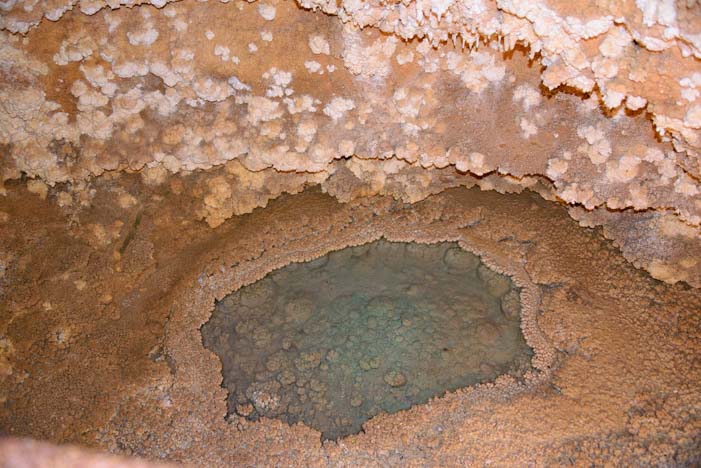
In places there were “icicles” hanging from the ceiling and “columns” growing up from the floor. There were even some pools of very clear water. Ironically, tourists from decades ago liked to throw pennies into one “wishing well,” and now the water is tinged green from all the copper. So another area has been established for tossing pennies (for those that must) where there won’t be any environmental impact.

Mineral pool in Caverns of Sonora Texas

We passed several pools of water.

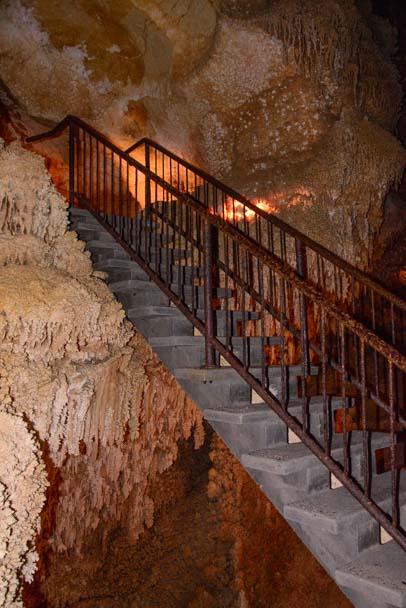
Wonderful staircases and a concrete path took us from one gorgeous “room” to the next, and it was impossible to imagine just how challenging this cave was for the early cavers that tried to map it out and discover its depths.

Stairway on Crystal Palace Tour of caves in Sonora Texas

Stairway to another world…

All the different formations have names, like “cave curtains” and “cave coral” and “dogtooth spars.”

Cave curtains crystallized minerals Sonora Caverns Texas

“Cave curtains” are thin films of calcite. Some are translucent.

The cave is beautifully and creatively lit throughout. The guide turned on the lights ahead of us as we progressed down the path, and then turned out the lights behind us.

Descending the Caverns of Sonora Texas

This cave is very beautiful. What a treat to see it lit so creatively.

The lights were set behind various formations, making them glow as if lit from within.

Cave lighting Crystal Palace Tour Caverns of Sonora Texas

Our path winds through the Crystal Palace.

The most ornately decorated “room” is the Crystal Palace, and when we got there we all stopped in awe.

Touring Crystal Palace Caverns of Sonora Texas

The Crystal Palace is just that!

It was filled with delicate stalactites and stalagmites. We were reminded that the “c” in stalactite is for “ceiling,” which helps you remember that these formations grow down from the ceiling while stalagmites grow up from the bottom of the cave!

Crystal Palace Tour Caverns of Sonora Texas

The Mayfield family not only owns and operates this cave, but they also fund all the current
explorations of its far corners as well.

The tour was over in just under two hours, and before we knew it, we were climbing the many stairs out of the cave. I was surprised to learn that the Mayfield family has had to ward off oil drilling interests that are insistently drilling and testing every inch of soil outside the boundary of the cave. They are hoping explorers find the cave is even bigger than they currently think it is — to help keep the oil drillers at bay.

Cave coral Crystal Palace Tour Caverns of Sonora Texaa

Stairway to Heaven!

The last bit of the tour took us through the “whalebone room” where the walls were rounded and smooth, as if made of whale bones.

Whale bone formation Caverns of Sonora Texas

In the whale bones…

What a neat little excursion this was!

If you are rattling across west Texas on I-10 in your RV, and you are looking for a really fun break from driving, check out the Caverns of Sonora. Besides all the pretty calcite formations in the cave, there is a small RV park right there next to the caverns.

Subscribe
Never miss a post — it’s free!

Our most recent posts:

More of our Latest Posts are in the top MENU above.

More info about this cool cave:

Related posts:

<-Previous || Next->

Boquillas del Carmen – A Taste of Mexico in Big Bend TX

March, 2015 – In the Big Bend area of Texas, the Rio Grande River separates the United States from Mexico, and during our stay in Big Bend, we decided to slip across the border to visit the quiet Mexican village of Boquillas del Carmen on the other side.

Back when we cruised Mexico on our sailboat, we saw lots of travel literature that talked about finding the “Real Mexico.” There seemed to be an idea that border towns and tourist beach towns somehow aren’t “Real” or aren’t really Mexico.

Yet we found that no matter where we went in Mexico, the culture was distinctly “Mexican,” and I think it was very real to the locals who called these places home.

Bienvenidos a Boquillas del Carmen Mexico

We’re in Mexico (with Aussie/British friends Amanda and David)!!

Even so… Would we find the “Real Mexico” we had grown to love so much here in a little village sandwiched between two huge national parks on either side of the border? The answer turned out to be a resounding Yes!

The border crossing is as formal as any, and going into Mexico here felt more formal than the last time we entered Mexico at the gargantuan border crossing between San Diego and Tijuana, especially since we were just leaving the US to visit Mexico for a few hours!

Once we passed out of the US gate, we walked down a dirt path. Suddenly we looked up to see a group of Mexican men hanging around on the far side of the river, the Sierra del Carmen mountains towering behind them.

Looking across the Rio Grande from Big Bend National Park to Boquillas del Carmen Mexico

Our Mexican hosts wait — and sing — for us on the other side of the Rio Grande.

As soon as they spotted us, one man began singing a Mexican folk song in a very full voice that rang out with wonderful clarity across the river.

Ahhh, Mexico!! How this culture loves music!

A young man was rowing a boat towards us and we hustled down to the water’s edge.

Ferry across Rio Grande from Big Bend National Park to Boquillas del Carmen Mexico

We take the ferry across the border.

We hopped in the boat, and as our ferry captain rowed, the welcoming sounds of our greeter’s wonderful song filled the air from the far shore. In just a few strokes of the oars we were disembarking on the other side.

Ferry Terminal Boquillas del Carmen Mexico

At the Ferry Terminal we meet Victor, our singing host, and pay for our round trip ferry ride.

The Ferry Terminal consisted of a cable spool on its side, a folding table and a cut-off plastic milk jug for money. The singer (and ticket agent), whose name was Victor, and several other men that we later found out were personal guides were waiting for us. We paid $5 for the round-trip ferry ride and were offered three ways to get to town a mile away: by burro ($5) or by taxi ($5) or walking (free).

The burros looked really fun…

Burros waiting in Boquillas del Carmen Mexico

Burros wait to take visitors into town.

Other visitors chose to take the burro ride that day. But we opted to stretch our legs and walk.

Riding a burro to Boquillas del Carmen Mexico near Big Bend National Park Texas

We decided to walk, but other travelers had fun on the burros!

We weren’t sure what to expect when we got to town. We were traveling with our EarthRoamer RVing friends David and Amanda, and the only thing we had all planned on doing was having a Mexican lunch with Coronas and/or Margaritas. So I asked our guide where a good place was for that, and he said “José Falcon’s Restaurant.”

Jose Falcon's Restaurant Boquillas del Carmen Mexico

José Falcon’s Restaurant is the biggest game in town.

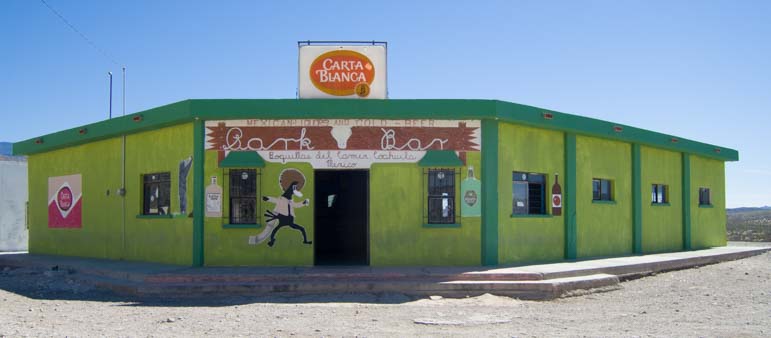
Sure enough, when we got to town, it was the biggest and brightest building on the street — and was one of just a handful of buildings all together! A few doors down on the other side of the street was the other popular cantina.

Bark Bar Boquillas del Carmen Mexico

Another option for a beer and genuine Mexican food.

Before we could start exploring, however, we made a quick stop at the trailer that houses Mexico’s Customs and Immigration office, and we filled out tourist permit forms and got our passports stamped and were issued short term visas that we returned when we checked out at the end of the day.

Formalities, done, we wandered outside and suddenly heard music and singing again. We walked a few paces to find an old man in a wheel chair, his faithful dog at his side. He was strumming a guitar and singing for all he was worth.

Street musician Boquillas del Carmen Mexico Big Bend National Park Texas

A street musician entertains us.

We had to smile as we watched this musician, because funny as it sounds, this was the real deal. Street musicians give Mexico’s culture a special twist, and we’ve seen them everywhere. They’ve serenaded us on the beach, in out-of-the-way bars, even on the bus, of all places! And now here.

He paused for a moment to tell us he was 85 years old. “Born in 1930?” I asked in halting Spanish. “Yes!” He said, his eyes lighting up. He had just lost his wife a few months ago.

We wandered down the dirt road a little further and looked up to see two men coming into town riding horses. Was that classic, or what?!

Horesback riders in Boquillas del Carmen Mexico_

Right out of a movie!

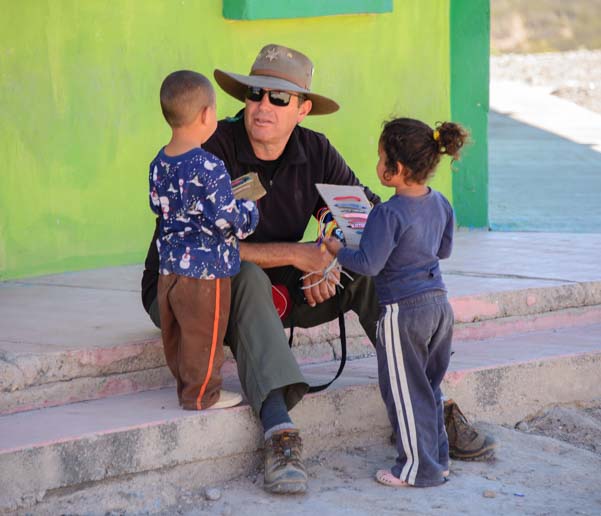
A couple of little kids were running around with bracelets for sale. The little girl said her name was Maria, but even though she repeated her friend’s name three times, I never quite understood what she said! Our friend David managed to have quite a conversation with both of them!

Little Mexican kids Boquillas del Carmen Mexico

Our friend David finds new friends in town.

Throughout all our wanderings, our guide, Fermin (pronounced “Fair-MEEN”), never strayed too far. The guides aren’t formally assigned to visitors, but all the gringos in town for the day were walking with one. He gave us insights into life in this tiny rural village, showing us the hospital where there are two doctors on staff.

Mexican guide at Boquillas del Carmen

Our guide Fermin shows us the local hospital.

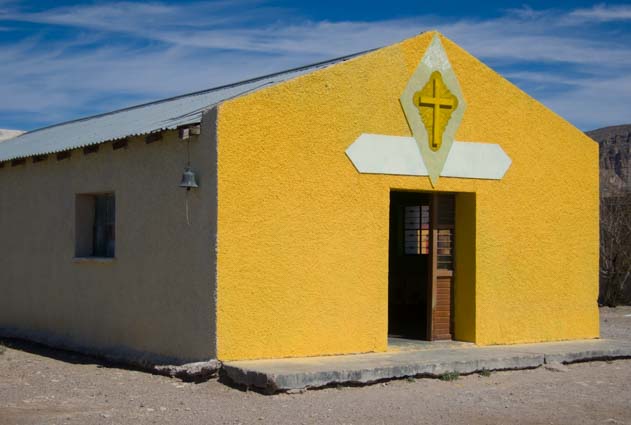
The village church was painted a wonderful bright yellow…

Church in Boquillas del Carmen Mexico

We’ve seen vivid yellow cathedrals in other parts of Mexico, so why not a yellow chapel here?

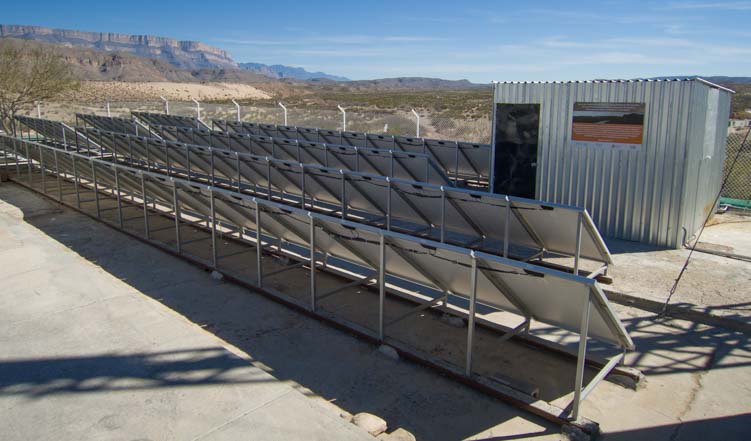
And we were very impressed that the town operates on solar power!

Solar power Boquillas del Carmen Mexico

Solar panels power this town.

Tourism is really important to Boquillas, and the villagers participate on many levels. One woman makes hand towels and tablecloths that she displayed with clothes pins on a fence.

Towels and tablecloths on clothesline

Embroidered towels and tablecloths for sale.

We returned to José Falcon’s restaurant and took a peek out back on the deck that overlooks the Rio Grande. This river is called the Rio Bravo by the Mexicans.

Jose Falcon's Nest Boquillas del Carmen Mexico near Big Bend Texas

The “Falcon’s Nest” overlooks the Rio Grande.

Rio Grande River (Rio Bravo River) Boquillas del Carmen Mexico

Mexicans call the Rio Grande the “Rio Bravo.”

Much to my surprise, as we kicked back in the sun and chatted over lunch, I noticed a person at another table who’s face I had seen only in photos online. I did a double-take when I looked at his wife, as I now realized with certainty that they were Ray, who writes the wonderful blog Love Your RV, and his wife Anne, who teaches photography at Anne McKinnell Photography. Who woulda thunk? I swung by their table to say “hello” and introduce myself. We were all so surprised to bump into each other here in Boquillas, Mexico, of all places!

But that’s the kind of fun and magic that makes this traveling lifestyle so special. Settling back with our friends Amanda and David, we savored the afternoon and were very reluctant to leave. This was such a perfect spot to wind up a very relaxing and pleasant day.

Lunch deck Jose Falcon's Boquillas del Carmen Mexico Big Bend National Park Texas

What a delightful day this turned out to be!

As we hung out in the warm sunshine, unwinding in the familiar plastic chairs that are the standard decor in every outdoor cantina across Mexico, we felt ourselves happily transported.

If this wasn’t the “Real Mexico,” then I really don’t know what is. Other than having a different view, the feeling and vibe were exactly the same as we found when we traveled through stunning Guanajuato, exotic Palenque, idyllic Huatulco and laid back Zihuatanejo, and each of those places was a true five-star highlight in our journey so far.

If you are going to Big Bend National Park in Texas, don’t forget your passport, and make sure you treat yourself to a few hours in Boquillas del Carmen where the sweet taste of Mexico is very real.

Subscribe
Never miss a post — it’s free!

Our most recent posts:

More of our Latest Posts are in the top MENU above.

<-Previous || Next->

More info about Boquillas del Carmen:

Related pages about Mexico:

Related posts about Big Bend:

Trailer Disc Brake Conversion – Electric Over Hydraulic Disc Brakes – WOW!

There are several types of braking systems available on bumper pull travel trailers and fifth wheel trailers today. Two of the most common are electric drum brakes, a less expensive system, and electric over hydraulic disc brakes which are a bit more costly. We recently converted our 36′ fifth wheel trailer’s braking system from factory installed electric drum brakes to electric over hydraulic disc brakes. What an incredible improvement this upgrade has made in our stopping power and personal safety. The difference is like night and day!!

This page outlines our reasons behind doing this upgrade and the components we chose for our brake conversion. It also gives a pictorial overview of the installation process.

Trailer hydraulic disc brake and caliper installed on an RV wheel

The disc (or rotor) and caliper with red brake pads peeks out from inside our trailer wheel.

This is a long post. You can skip down to the different sections using the following links:

HOW TRAILER BRAKES WORK

Return to top

Electric drum trailer brakes and electric over hydraulic disc brakes function very differently.

To engage electric drum brakes in a trailer, when the driver depresses the brake pedal in the tow vehicle, an electrical signal is sent to the trailer’s brakes via a brake control unit in the truck. The brake control may be factory installed or it may be an external unit that is installed by the owner. The electrical signal engages an electromagnet on the trailer’s wheels that expands the brake shoes as the current gets stronger, creating friction on the wheel and slowing it down.

Brake Pedal -> Electrical Signal via Brake Control -> Trailer Brakes

To engage electric over hydraulic disc brakes on a trailer, when the driver depresses the brake pedal in the tow vehicle, an electrical signal is sent to a brake actuator unit in the trailer via the brake control unit in the truck. The brake actuator in the trailer then pumps hydraulic disc fluid through a line to the disc brake calipers on the trailer’s wheels. The build-up of fluid pressure actuates the brake calipers which, in turn, squeeze the brake pads against the disc, slowing the trailer down.

Brake Pedal -> Electrical Signal via Brake Control -> Brake Hydraulic Fluid Pumped by Brake Actuator -> Trailer Brakes

Drum brakes are an older technology. However, RV trailer manufacturers continue to install electric drum brakes to this day because it is far less expensive than installing electric over hydraulic disc brakes. The highest end full-time fifth wheel trailers are frequently offered with an option for electric over hydraulic disc brakes, but they are rarely provided as standard equipment.

Besides greatly increasing overall braking power, one of the biggest advantages of hydraulic brakes is that it is much easier to modulate the brakes for smoother stopping. In contrast, electric drum brakes on trailers can be very jerky, as the brakes are either ON or OFF. We often used to feel the trailer bump into the back of our truck as we stopped, hitting us with a jolt.

TRAILER ELECTRIC OVER HYDRAULIC DISC BRAKES versus CAR HYDRAULIC BRAKES

Cars are manufactured with hydraulic brakes, sometimes with disc brakes in the front and hydraulic drum brakes in the back. Many high end bicycles are even built with hydraulic disc brakes! Electric over hydraulic trailer disc brakes are slightly more complex than car hydraulic brakes, but they provide trailers with the same smooth stopping power that we enjoy in our cars.

The difference between the way hydraulic disc brakes on cars and electric over hydraulic disc brakes on trailers function is that there is no electrical signal involved in a car’s braking system. This is because the car is a single vehicle. No signal needs to be passed from one vehicle to another, as it does with a truck and trailer combo. The tricky part about a truck/trailer is that the brake pedal is in the front of the truck by the driver’s foot while the trailer’s brakes are way behind the driver at the back end of the trailer. Also, in a car, the hydraulic fluid is located under the hood in a master cylinder which performs the same function as the brake actuator that is located in the trailer.

Again, in a car, when the brake pedal is depressed, hydraulic fluid flows directly to the brakes to engage them. In a truck and trailer combo, an electrical signal has to be passed from the truck to the trailer to activate the hydraulic disc brakes in the trailer via the brake actuator.

ON THE ROAD COMPARISON OF TRAILER BRAKING SYSTEMS:
Electric Drum versus Electric Over Hydraulic Disc Brakes

Our fifth wheel trailer, a 36′ 2007 NuWa Hitchhiker II, came with factory installed electric drum brakes. We towed it, with that braking system, behind our 2007 Dodge RAM 3500 truck for the first six years we owned it, for a total of about 40,000 miles. When we upgraded to electric over hydraulic disk brakes, we were stunned by what a massive improvement in braking power and safety that simple upgrade provided!

We have now towed our trailer over 1,200 miles since the brake system upgrade, traveling on interstate freeways, maneuvering around tight gas stations and campgrounds, and driving in gnarly stop-and-go-traffic in slick, rainy weather. All we can say is:

“We should have done this a long time ago — probably on Day 1!”

The differences we experienced between the electric drum brakes and the electric over hydraulic disc brakes can be summed up as follows:

DRIVING AND STOPPING COMPARISON

Electric Drum Brakes Electric over Hydraulic Disc Brakes
The truck felt like it was stopping the trailer The truck and trailer stop together evenly without one stopping the other
Braking was either ON or OFF, resulting in a jerky motion Braking is proportional to your speed and is very smooth
Had to mess with the brake control every time we changed between highway and gas station speeds Haven’t touched the brake control since the upgrade was installed
As brakes age, braking power decreases As brakes age, braking power does not change


MAINTENANCE COMPARISON

Electric Drum Brakes Electric over Hydraulic Disc Brakes
Have to remove wheel and brake hub to inspect brake pads
  • Easy to inspect disc pads without removing the wheels to see if they are worn (use a mirror if they are hard to see)
  • Periodically have to adjust the drums Never have to adjust the discs
    Have to have drums turned OR replace the drums and backing plate with magnet, shoes, springs and cables Easy to replace brake pads with standard GM brake pads from an auto parts store if rotors are okay
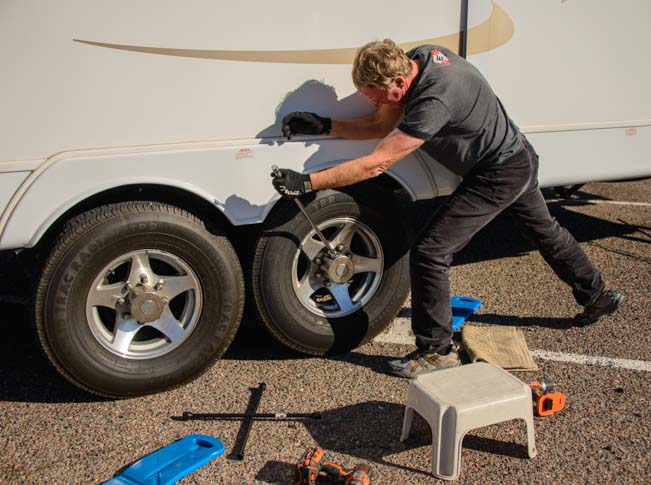
    Removing trailer tires to grease the wheel brearings

    Mark removes the trailer wheels to grease the wheel bearings.


    DECIDING TO UPGRADE THE TRAILER BRAKING SYSTEM

    Return to top

    We decided to do this brake system upgrade after Mark inspected the condition of the electric drum brakes that had been factory installed on our fifth wheel when we bought it new seven years ago. He was greasing the trailer’s wheel bearings, and while he had one of the wheels disassembled, he inspected the brake assemby inside.

    Greased wheelbearings on a trailer

    Mark used a Zerk gun to grease the trailer’s wheel bearings.

    He was dismayed to find that both the magnet and the braking surface were basically shot. He completed the wheel bearing lube job, but after he got the wheels mounted back on the trailer, we weighed our options for the brakes.

    Inside a trailer brake drum

    The inside of the trailer wheel and electromagnet at the bottom.

    Electromagnet inside an RV trailer brake drum

    Lots of wear on the electromagnet that controls the electric drum braking mechanism.

    As mentioned above, besides providing inferior braking power all together, one of the disadvantages of electric drum brakes is that, as the brakes age, the braking power gets progressively worse. Not only does the braking surface wear down but the electromagnet gets worn as well.

    In recent months, Mark had been noticing that the trailer brakes were not working as well as when the trailer was new, although he was shocked to see just what poor shape they were in when he disassembled the wheels!

    It is possible to have trailer brake drums turned. “Turning” involves putting the brake drums on a lathe and grinding the surface down to get rid of ridges and make it smooth. However, while a car’s drum brakes can be turned at an auto parts store, trailer brakes need to be taken to a machine shop. This is because they have to be turned not only on the braking surface that the brake pads ride on, but on the electromagnet surface as well. One of the disadvantages of turning the drums, however, is that it makes the braking surfaces thinner and weaker.

    When we began investigating the cost of having the drums turned, we found that it would not be that much less than the cost of replacing the brakes all together which would be somewhere in the neighborhood of $500.

    An alternative to turning the drums or replacing the brake assemblies would be to upgrade the trailer’s entire braking system to electric over hydraulic disc brakes. This is an expensive endeavor, on the order of $3,200, but the more we thought about our personal safety on the road, the more it seemed like it was a wise choice to do the brake conversion.

    THE COMPONENT PARTS OF AN ELECTRIC OVER HYDRAULIC DISC BRAKE SYSTEM

    There are three components involved in the installation of electric over hydraulic disc brakes:

    • Brake Control in the truck
    • Brake Actuator in the trailer
    • Hydraulic Disc Brakes on the trailer wheels

    In between these components there is both wiring and high pressure line:

    • The Brake Control must be wired into the truck (late model trucks have factory-installed brake controls).
    • The Brake Actuator must be wired into the 7-pin connector on the trailer that the truck plugs into.
    • High pressure lines must be installed between the Brake Actuator and the Disc Brake assembly on each wheel

    Our first job was to determine which components to install. Reading many reviews and talking at length with each manufacturer and visiting several booths at the Quartzsite Arizona RV Show, we chose:

    Kodiak Hydraulic Disc Brakes

    The heart of the electric over hydraulic disc brake system is the disc brake assembly itself, and Kodiak makes superior quality brakes.

    Kodiak has been making disc brake assemblies for over twenty years and is very highly regarded. Kodiak originated as a parts manufacturer for boat trailers, and their brakes are extremely popular in the boat trailer market.
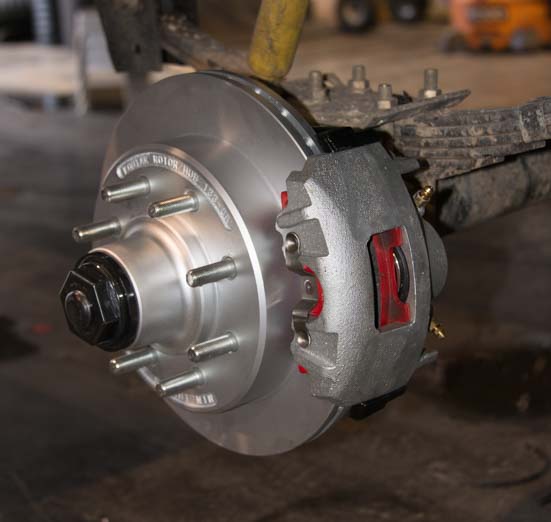
    Kodiak dIsc brake rotor and caliper assembly for RV electric over hydraulic disc brakes

    Kodiak disc brake assembly
    Rotor and caliper installed on the axle.

    Since many boaters launch their boats in the ocean, Kodiak hydraulic disc brake assemblies are offered with dacromet coating and stainless steel options so they can withstand the continuous and highly corrosive drenching they get when boaters launch their boats on and off their trailers in salt water.

    Kodiak disc brakes are also very popular in the horse trailer industry, especially on the largest, heaviest horse trailers that carry multiple horses and have living quarters as well.

    To see the parts included in a Kodiak disc brake assembly, click here.

    Hydrastar Brake Actuator

    The brake actuator is the key middleman in the trailer braking system, and the Hydrastar Electric over Hydraulic Disc Brake Actuator from Cargo Towing Solutions has an excellent reputation as being extremely durable and rugged, even when mounted on the tongue of a travel trailer.

    The role this unit plays is vital, as it is the part of the system that receives the electrical signal coming from the brake control in the truck and, in turn, pumps the hydraulic fluid out to the disc brakes on the trailer’s wheels.

    Hydrastar electric over hydraulic disc brake actuator from Cargo Towing Solutions

    Hydrastar electric over hydraulic disc brake actuator.

    Like Kodiak, the the Hydrastar electric over hydraulic brake actuator is engineered for the salt water boat trailer market where water and corrosion are everyday challenges. The Hydrastar brake actuator is sealed extraordinarily well so it can be mounted on the tongue of a travel trailer. The whole circuit board is covered in epoxy and can function perfectly well when submerged under water. One of their most popular trade show demonstrations is to show the Hydrastar brake actuator working while suspended inside an aquarium full of water.

    Prodigy P3 Brake Control

    We have had an older generation Prodigy brake control in our truck since we purchased our first 27′ 2007 Fleetwood Lynx Travel Trailer, however, it does not work with electric over hydraulic disc brakes. We were delighted to find that there is a much better Prodigy brake control on the market now.

    Prodigy P3 Brake Controller

    Tekonsha Prodigy P3 Brake Control

    The Prodigy P3 is portable and has been designed for people who use many different tow vehicles to tow many different trailers. Not only can it be moved from truck to truck easily, it can memorize its programmed settings for different trailers. It can even be programmed for one trailer that has different characteristics at different times, for instance, a 7-horse trailer that may be loaded with 7 horses or may be empty.

    Best of all, we could swap out the old Prodigy for the new P3 easily because the new unit used the same wiring harness as the old one.


    INSTALLING ELECTRIC OVER HYDRAULIC DISC BRAKES ON A TRAILER

    Return to top

    Mark was confident he could do the upgrade himself. However, he was not sure he wanted to tackle running the high pressure hydraulic lines. He did that kind of work when we installed the engine-driven ocean water desalination system on our sailboat, and it was challenging getting the lines cut and getting the fittings installed on the cut line. He decided he would prefer to have professionals install this system, and we did a search to find a company that has done hundreds of trailer brake system upgrades.
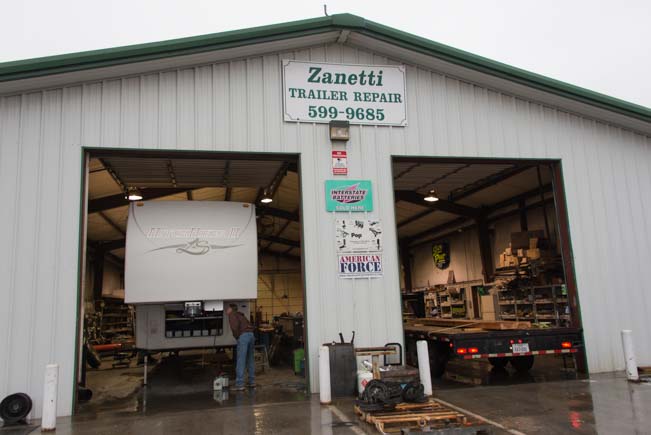
    Trailer brake upgrade at Zanetti Trailer Repair

    Our buggy gets set up in a repair bay at Zanetti Trailer.

    Zanetti Trailer Repair is located just west of Fort Worth, Texas, in the town of Weatherford, and they do this kind of brake conversion frequently. Considered a horse trailer guru, Pete Zanetti started the company in 1980, and it is still a family operated business.

    Texas doesn’t have the best winter weather, and when we arrived after driving through the remnants of a horrific ice storm, our trailer was covered with a thick layer of road grime, but our gleaming new parts were ready and waiting.

    Electric over hydraulic disc brake upgrade parts

    The disc brakes, brake actuator and brake control are ready to be installed on our trailer.

    A team of three mechanics jumped on the job. To our amazement, within three hours they had completed the entire installation!

    Below is a summary of the steps they took to do the brake system upgrade.

    First, after jacking up the trailer, the wheels were removed.
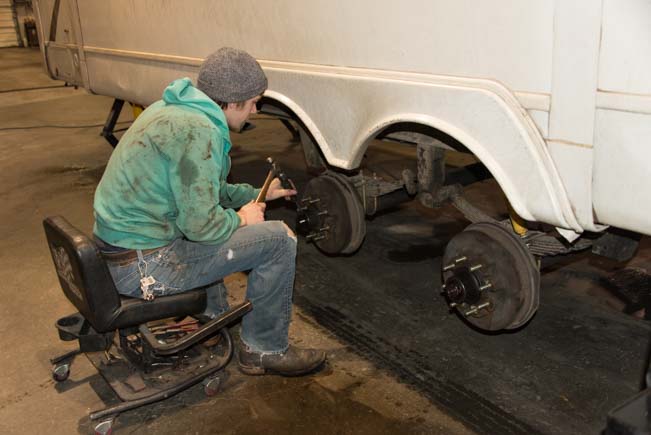
    Removing wheels from a 5th wheel trailer

    Our buggy’s wheels are removed once again.

    Wheels removed from fifth wheel trailer RV

    Right down to the axles and spindles.

    Then the backing plates for the disc brakes were installed on the axles.
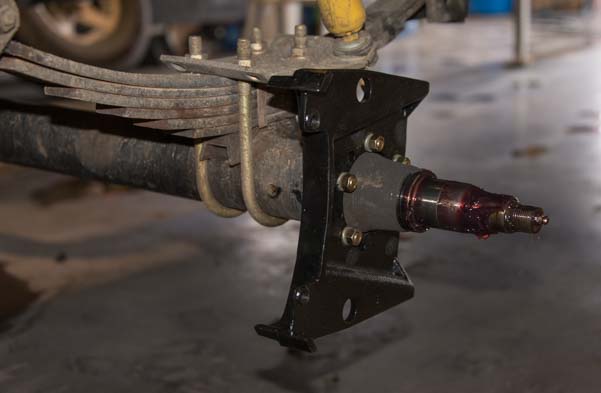
    Disc brake backing plate on a trailer axle and spindle

    The disc brake backing plate is mounted on the axle.

    On a table to the side, the four sets of brake assemblies and bearings were laid out, ready to be greased and put together.

    Hydraulic disc brake components- calipers, rotors and bearings

    The four rotors and calipers will be put together in assembly-line fashion.

    Here’s a closeup of the brake calipers with the red brake pads inside. The red brake pads will need to be replaced when the indented brake surface material wears away.

    Kodiak disc brake caliper with brake shoes

    The Kodiak disc brake caliper.

    Kodiak trailer disc brake caliper with brake shoes

    The brake pads are red, and when worn down to the indent, they will need replacing.

    The wheel bearings and seals were laid out, ready to be inserted in the brake rotor.

    Wheel bearings for Kodiak trailer disc brakes

    New wheel bearings ready to be lubed up and installed.

    Mark had just finished greasing the old wheel bearings on our trailer using a zerk gun. What a surprise it was to see a huge trash barrel filled with wheel bearing grease!

    Barrel of wheel bearing grease

    A Barrel O’ Grease — wow!
    They used an extremely sticky grease.

    The rotors were greased and then the new bearings were pressed in.

    Greasing the rotor on RV hydraulic disc brakes

    Greasing the inside of the rotor.

    Pressing the wheel bearings into the rotor on trailer disc brakes

    Pressing grease into a wheel bearing.

    Then the brake rotors were installed on the axles, and the brake calipers were installed on the rotors.

    Trailer disc brake rotors installed

    The brake rotors are installed on the axles. A brake caliper waits its turn on the ground.

    Kodiak dIsc brake rotor and caliper assembly for RV electric over hydraulic disc brakes

    Kodiak disc brake assembly with rotor and caliper mounted on the trailer’s axle.

    Outside (in the rain!) the old brake hubs had been discarded.

    Old trailer electric drum brakes in the trash heap

    We won’t need these any more!

    Meanwhile, the installers got busy installing the Hydrastar brake actuator in the trailer and wiring it to the fifth wheel pin box. To test the installation, they used a special electronic unit to simulate a person pressing on the brake pedal in the truck.

    Installing the Hydrastar brake actuator on a fifth wheel trailer

    Wiring the Hydrastar brake actuator into the
    fifth wheel pin box.

    Then they unrolled and straightened the stainless steel brake line tubing…
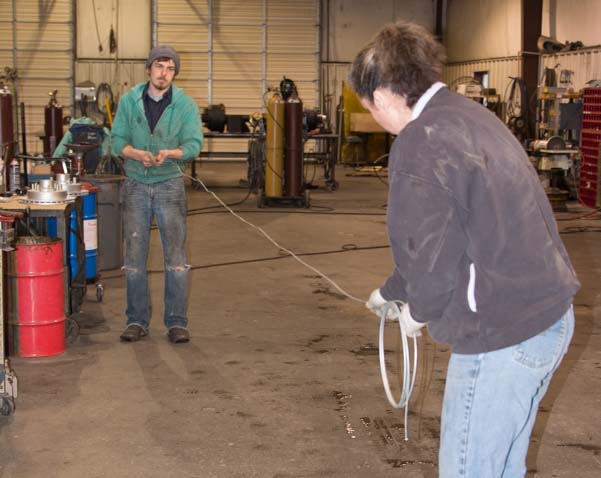
    Measuring and cutting electrical wire for trailer disc brake actuator installation

    Unrolling and straightening the stainless steel brake line tubing.

    … and ran the electrical wires from the pin box into the fifth wheel basement

    Wiring in electrical cable for disc brake actuator in a 5th wheel trailer RV

    Feeding the electrical wire through to the fifth wheel basement.

    The Hydrastar brake actuator unit found a home just inside one of the basement side access doors.

    Hydrastar disc brake actuator from Cargo Towing Solutions

    Hydrastar disc brake actuator installed in the fifth wheel basement.

    Hydrastar hydraulic trailer disc brake actuator from Cargo Towing Solutions

    The Hydrastar disc brake actuator is close to a side hatch for easy access.

    On the underside of the trailer and along the trailer axles, they did a superior job of dressing the hydraulic brake line and connections.

    Hydraulic brake line dressed on bottom of RV

    Looking up at the bottom of the trailer, the hydraulic lines run underneath the trailer, neatly dressed.

    And then they bled the brake lines.
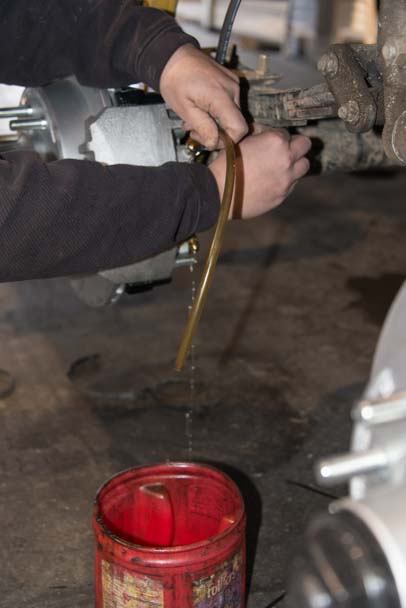
    Bleeding the hydraulic brakes on an RV

    Bleeding the hydraulic brakes. A special box simulated a person depressing the brake pedal in the truck.

    Then it was time to put the Prodigy P3 Brake Control into the truck. This is a portable unit that comes with a carrying pouch. We have only one truck, so we won’t be carrying the brake control from one truck to another. Mark later found the little pouch was perfect for his pocket camera!
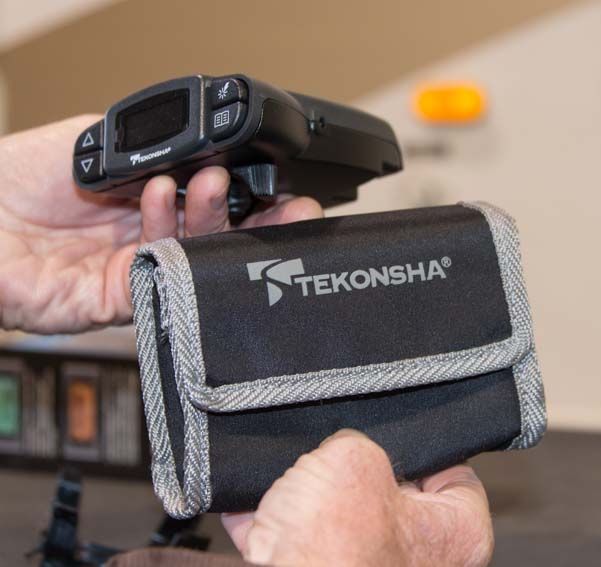
    Prodigy P3 Brake Control from Tekonsha

    The Prodigy P3 Brake Control is a nifty portable unit that can be moved
    from one tow vehicle to another.

    The brake control is on the lower right side of the dashboard under the steering wheel.

    Prodigy P3 Brake Control installed on a Dodge RAM 3500_

    Prodigy P3 Brake Control mounted below our Dodge RAM 3500 dashboard

    We were astonished that all this had taken just under three hours, and the installers were almost finished. Wrapping up the job, the wheels were mounted back on the trailer and the trailer was taken off the jacks.
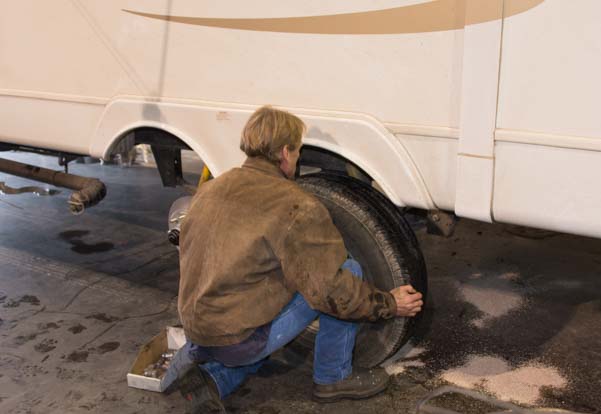
    Replacing the wheels on a fifth wheel trailer

    The wheels get mounted back on the trailer axles.

    The new disc brakes looked very spiffy peeking through our dirty wheels!

    Dirty Wheels and new electric over hydraulic trailer disc brakes

    Oh gosh — sure wish we’d cleaned those wheels before this installation!
    But the brand new disc and caliper look great in there…

    It was time to hitch up the trailer and hit the road with our new brakes. I loved the little painted stone outside the office door.
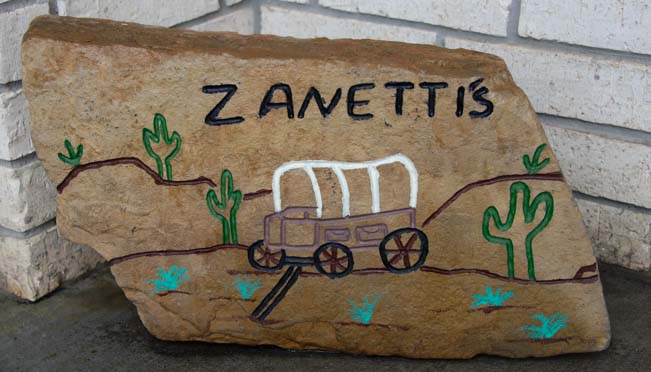
    Zanetti Trailer - We'll Fix Your Wagon

    Zanetti Trailer’s motto is “We’ll Fix Your Wagon” !!


    SUMMARY

    Return to top

    Mark was blown away when we got the trailer out on the highway. On the Prodigy P3 Brake Control, he experimented with a few settings and settled on a boost of “B2” and 8.5 volts. As we eased onto the highway, he commented, “It feels like I’m driving a car!”

    During the next three weeks we made our way from central Texas to the Florida coast, driving in all kinds of conditions, from remote back roads, to many miles on the I-10 Interstate freeway. We sat for hours in massive stop-and-go traffic jams around big cities, and Mark coped with tricky driving situations on small downtown city roads with lots of stop lights.

    In the past, if a traffic light turned yellow at the wrong moment as we approached, we just had to keep going and cross our fingers that it wouldn’t turn red while we were crossing the intersection, because we just couldn’t stop the trailer in such a short distance. No more!! On many occasions, as we came to an intersection, the light turned yellow on our approach, and Mark was able to stop the truck and trailer in time in a nicely controlled manner.

    In Fort Worth, TX, and again around Baton Rouge, LA, we found ourselves in amazingly congested traffic. Mark was able to relax in the heat of the battle, completely confident that he could stop the trailer in a very short distance if need be.

    Fifth wheel trailer RV in Florida at sunset

    Sometimes the best improvements are not something you can see on the surface!

    When we got into Sarasota, Florida, we came across some astonishingly aggressive drivers. One driver cut us off with just an inch to spare, instantly coming to a complete stop directly in front of us. It was a heart stopping moment that all RVers dread. Mark slammed on the brakes with a force I have never seen him use, either in a car or in our truck pulling our home.

    All the tires of the truck and trailer squealed as we came to a shockingly abrupt stop, leaving lots of rubber on the road behind us. We were both stunned that the trailer stopped in such a short distance. There is no doubt that if we had had our old electric drum brakes, we would have rear-ended the car in front of us and had a really bad — and possibly life threatening — accident.

    Believe me, the irony that we had just replaced our brakes, and had jokingly said we needed to test just how good they were, was not lost on us. But we never would have lurched our house like that just to see if the brakes worked!!

    This brake conversion is an upgrade that Mark dreamed of doing for ages, ever since our RVing mentors Bob and Donna Lea had told us about how differently their electric over hydraulic disc brakes performed on their 33′ fifth wheel compared to the electric drum brakes they’d had on other trailers.

    In the end, it was totally painless and very easy to do, and looking back, we realize we should have just bitten the bullet the first year we owned our trailer and gotten it done right away.

    Subscribe
    Never miss a post — it’s free!

    More info and links:

    Related posts about our TRUCK and TRAILER upgrades:

    Below are some of our most POPULAR POSTS (also in the MENUS above)

    Buddy - A Journey in Spirit - The story of an event that changed our lives forever.

    ARTICLE INDEXES
    • RV Tech Tips Articles - A one page index of links to all our RV Tech Tips, RV Upgrades & RV Maintenance articles.
    • RV Lifestyle Tip Articles - An index of links to all our RV Lifestyle Tips (finances, boondocking, major repairs, work/jobs, etc.)
    • Solar Power Articles - Overview and tutorial articles for how to design and install solar power on an RV or boat
    • Product Reviews - An index of links to all of our Product Reviews
    RV UPGRADES, SYSTEMS & TIPS MONEY FULL-TIME RV LIFESTYLE GEAR STORE
    • Gear Store - A list of the goodies, equipment and gear we've found useful in our RV lifestyle!
     

    Our most recent posts:

    More of our Latest Posts are in the MENU.   New to this site? Visit RVers Start Here to find where we keep all the good stuff. Also check out our COOL NEW GEAR STORE!! *** CLICK HERE *** to see it!

    Terlingua, Texas – A Living Ghost Town in Big Bend

    March, 2015 – After many days of hiking and photography during our visit to Big Bend National Park in Texas, we took a wonderful excursion to the little town of Terlingua, just few miles west on Route 170 outside the west end of the park.

    This is a historical mining ghost town that has been brought back to life with a hippie vibe. When we arrived we saw a group of folks —all skeletons — having a party in a big ol’ bus heading for Miami Beach.

    Terlingua skeletons in a bus

    A Hippie Bus of skeletons heads for Miami Beach from the Great Beyond…

    As we drove further into town, we looked over and saw the masts of a ship. What?? We backed up and looked again. Yup! Apparently someone was dreaming of the sea when they built their home in Terlingua!

    Passing Wind ship in Terlingua Texas in Big Bend

    Wait, is that a ship?! Yes, it is — and it’s Passing Wind.

    The town has its origins in the 1880’s when cinnabar was discovered. Cinnabar, we found out, is not a candy bar version of the cinnabun. It’s a metal from which mercury is extracted. The Chisos Mining Company set up shop shortly after the discovery, and immigrant miners from Mexico soon began working the mine. We found it fascinating to wander around the old cemetery. All of the deceased had been Mexicans, it seems, and the style of the cemetery was distinctly Mexican.

    Terlingua Ghost Town Cemetery in Texas

    Terlingua has a wonderful ghost town cemetery.

    Terlingua Texas ghost town cemetery Big Bend Texas

    The style of the graves was distinctly Mexican.

    There are all kinds of headstones and graves in the cemetery. Many graves are marked with a simple wooden cross. But some are quite elaborate. Many of them have a small stone shrine that shelters trinkets of various kinds.

    Shrine in Terlingua Ghost Town Cemetery Big Bend Texas

    A shrine in the ghost town cemetery

    We heard that the Mexican “Day of the Dead” celebration (the day after Halloween) is quite an event here in the Terlingua Ghost Town Cemetery!

    Skull in a cemetery shrine

    I would love to see the Day of the Dead celebration here!

    Nearby there are ruins of the homes the miners lived in. We felt like explorers as we prowled around some of the different buildings. There are lots and lots of buildings, and they are in various stages of decline.

    Ruins in Terlingua Ghost Town Texas

    Some of the ruins are in better shape than others, but all make great photo ops!

    None of them have windows or doorways that are intact, but there were some pretty views from where the buildings were situated.

    Looking out a ruined doorway in Terlingua Texas

    The homes might have been small but they had great views.

    Inside a ruin in ghost town Terlingua Big Bend Texas

    What stories could these walls tell?

    The Chisos mine was at its heyday in the early part of the last century, because Mercury was in high demand during WWI. However, even though there were hopes that there would be another boom cycle for mercury during WWII, it never materialized. So in 1946 the mine was abandoned.

    Rusty car and old building in Terlingua

    Remnants of bygone times.

    Today, people have moved back in and started making use of the ruins, breathing life back into them and incorporating the ruins into their homes and businesses.

    Mining ruins incorporated into modern houses in Terlingua Texas

    New homes and business rise up among the ruins.

    There is a sense of history all around town.

    Old stone building Terlingua Texas

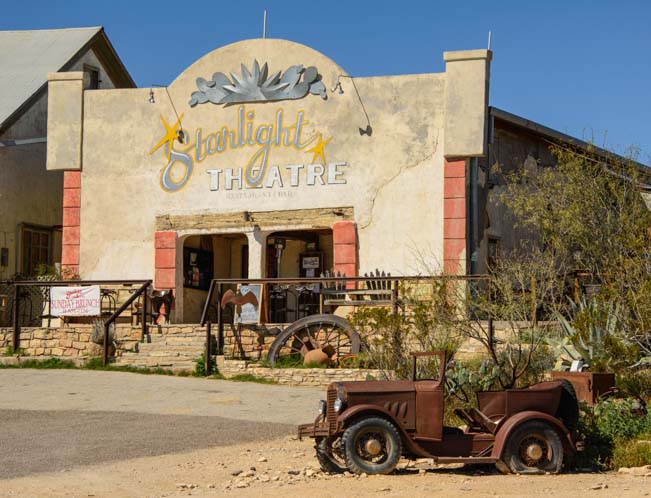
    The old movie theater is now a restaurant and bar with the rusting relic of an antique car out front.

    Rusty antique car and old theater building in Terlingua

    The movie theater was called the “Chisos Theater” in the 30’s. Now it is a restaurant and bar.

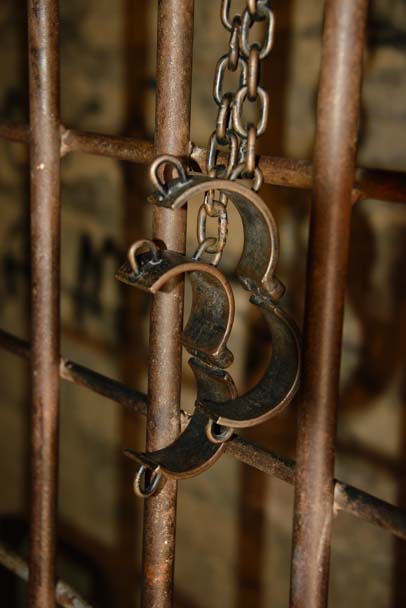
    Nearby is the jail, with antique handcuffs hanging from the bars!!

    Antique handcuffs in Terlingua Texas

    Tools to keep the town tame!

    This is a town that is just a little offbeat, and a local artist has created some intriguing metal sculptures. One is a very large flying bug!

    Flying bug in Terlingua Texas

    Buzzzzz…

    There are several places to get a bite to eat sitting outside on a deck. The Boathouse looked like an intriguing place but wasn’t open…

    Boathouse in Terlingua Texas

    Next time…

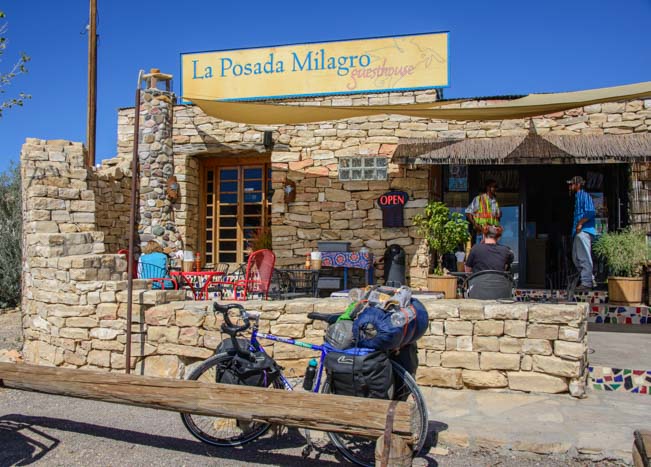
    But a little B&B, called La Posada, had wonderful Mexican food and four rooms to rent. A pair of long distance cyclists were staying there, and they were poring over maps.

    This seemed to be the place the locals liked to come and hang out in the mornings, and we met a man in his 80’s who walked 3 miles each way from his home to get a coffee and chat with his friends here every morning! He wore a crisply pressed shirt and jeans with a big cowboy belt buckle and cowboy hat, and he said he just loved living in Terlingua.

    La Posada Milagro cafe in Terlingua Texas

    La Posada is a cute place for a meal or an overnight, and it’s where the locals hang out over coffee.

    If you are heading to Big Bend, and you’ve gotten your fill of nature in the National Park, a side trip to Terlingua can make for a really fun change of pace!

    Subscribe
    Never miss a post — it’s free!

    Our most recent posts:

    More of our Latest Posts are in the top MENU above.

    More Info about Terlingua

    Related posts:

    <-Previous || Next->

    Boondocking at Big Bend National Park – Cheap & Scenic RV Camping

    How to “Boondock” at Big Bend National Park

    Big Bend in Texas is an unusual park in the National Park System because they offer a few inexpensive RV dry camping sites scattered about the park grounds. It isn’t really “boondocking” like you’d find on other government public land managed by the US National Forest Service and the Bureau of Land Management. However, it is a very inexpensive and scenic alternative to staying in a conventional RV park or campground. For first-time boondockers, it can offer a great introduction to dry camping amid nature and solitude in your RV.

    Big Bend National Park assigns these campsites on a first-come first-serve basis, as if the entire National Park were one huge campground. The sites that are big enough for large RVs are very few and are tightly controlled, and the system for obtaining a “Backcountry Camping Permit” to stay in one can be confusing. Here is what we learned about the system when we took part in it a few years back.

    RV Boondocking and camping in Big Bend National Park Texas

    “Boondocking” at Big Bend National Park

    All five of the Visitors Centers in the park have computer access to a database of dispersed campsites throughout the park. You can obtain a permit and reserve a site in person from a ranger at one of these Visitors Centers 24 hours ahead of your stay. The permit is $10 and you can reserve up to 14 consecutive nights in specific campsites on a single permit, reserving as many different sites as you like and as are available.

    An important point is that the permit is good only for the actual nights and sites you reserve through the ranger when you purchase the permit. If you want to extend your stay or change your campsite after you buy your permit, you have to cancel the remaining nights on your permit and buy a new one. Also, you can’t obtain a permit to reserve a site without appearing at a Visitors Center in person.

    As a courtesy to other campers: if you don’t use all the nights on your permit (the weather might turn and send you scurrying, as it did to us), be sure to cancel the remaining nights on your permit by stopping in at the Visitors Center or calling them. Otherwise, the site will sit vacant while other RVers are wishing they could use it.

    Big Bend National Park Texas RV boondocking_

    “Boondocking” at Big Bend National Park

    Many RVers have small driveable rigs and there is no evidence they are using a site during the day while they are out hiking, so unless you tell the Park Service you are vacating your site, they will have no way of knowing that you left early.

    Our Experience Getting a Permit

    From what we observed, there is one computer at each Visitors Center that has access to the backcountry camping permit database, so a line for permits forms during popular times. We stood in line at the Panther Junction Visitors Center in the middle of the park for 30 minutes on a Saturday morning when the weather for the next few days was predicted to be sunny and in the high 70’s.

    The other people in line were primarily backpackers and car/tent campers getting permits either to do extended overnight hikes across the park or to camp in remote dispersed campsites we could never reach with our truck and trailer. We were the only RVers in line waiting for a site big enough for a big rig.

    Each person spent about 5 minutes with the ranger, first reviewing the map of the National Park to pick out a campsite and to learn from the ranger what the site was like, and then filling out the permit application, and lastly listening to the ranger read the camping rules aloud.

    Big Bend National Park RV camping and boondocking in Texas_

    Hannold Draw

    When our turn came, we were advised against staying in a particular site that we later found out would have been perfectly fine. However, an RVer had complained at one time that the site was unlevel, so this particular ranger decided not to present that site as a viable option to other RVers with big rigs.

    It is wise to study the National Park map (click here and go to “View Park Map” — the campsites are the light colored tents) and even to drive to the various dispersed campsites to assess whether or not your rig will fit and whether you might enjoy camping there. In general, rigs under 30-35 feet in total length end-to-end (hitched up) would fit in most sites along the main roads.

    One of the rules that appears to be enforced is that you are not allowed to run a generator in backcountry camping sites. We overheard two rangers discussing a tent camper who had hidden a generator in his tent! If you don’t have solar power installed on your RV, a small portable solar power kit may be the way to go.

    amping in Big Bend National Park in an RV in Texas

    “Government Spring” site at Grapevine Hills

    RV Camping Strategies at Big Bend

    It is common to find that all the campsites are booked for the first few days after you arrive. So, plan to stay elsewhere at first and keep checking back until a site opens up.

    The campground at Rio Grande Village on the far eastern end of the park has both full hookup sites that can be reserved online and dry camping sites that are first-come first-serve.

    The other two campgrounds inside Big Bend National Park — Cottonwood, towards the southwest near the Santa Elena Canyon hike, and Chisos Campground, up in the mountains near the Lost Mine and Window Trail hikes (review of those hikes here) — have smaller sites that may not accommodate bigger rigs. However the Big Bend Resort & Adventures RV Park in Terlingua-Study Butte just outside the western boundary of the park offers full hookups and advanced reservations.

    Each of the “boondocking” campsites we saw in Big Bend has pros and cons. One strategy for tackling Big Bend National Park with an RV is to spend a few days camped on the western side at Big Bend RV Adventures, a few days of “boondocking” in the dispersed campsites in the middle and a few days in Rio Grande Village at the eastern end of the park, as there are outstanding things to see and do in each of these locales. Camping near your planned activiites will cut way down on the commuter driving you do across the park!

    For those with more rugged rigs, there are some fabulous sounding campsites that will get you deep into nature. We didn’t camp at or even see these locations, but friends with an Earth Roamer RV enjoyed some true backcountry camping experiences in their rig.

    RV camping boondocking in Big Bend National Park Texas

    Grapevine Hills

    Summary of the Larger Backcountry RV Campsites in Big Bend:

    Grapevine Hills

    There are three campsites on this dirt road that goes 6 miles out to the Grapevine Hills hike with the balancing rock. The first is 0.3 miles in on the left side and is suitable for a big rig. This particular site is also known as “Government Spring” and can accommodate a big rig and a smaller one comfortably if friends are traveling together.

    Campsites two and three are 3.7 miles down the road on the right hand side and they are essentially a double site. The views of the Chisos Mountains are lovely, however this is a very busy road with lots of people flying by at wild speeds to get to and from the hiking trail at the end, so it can be very dusty.

    Paint Gap

    There are three campsites on the first part of this dirt road. The first at 0.9 miles would be suitable for a rig of 35′ or less end-to-end. The second and third are 2.1 miles in and are good for a trailer of 25′ or so. We weren’t sure we could have squeezed our 36′ fiver in there. See the comment from Robin below who had a great time there with a 24′ travel trailer.

    Croton Springs

    There are two campsites in a huge open area at the end of this dirt road down about 0.5 miles. Probably 3 or 4 big RVs could fit if friends were traveling together. This is the site that one RVer apparently felt was too unlevel for a big rig, but when we drove down here we thought it would have been an awesome place to stay and just wished the ranger had mentioned it as an option.

    K-Bar

    This is a very rough dirt road that has a small site for a small trailer, van or truck camper at 1.1 miles. Further on, at 1.5 miles, there is a little more room, but it would take some jockeying for a big rig to get set up. See the comment below from Robin who said they loved the second site and got their 24′ travel trailer into it just fin!

    Hannold Draw

    This is a highway maintenance yard about 0.1 miles down a dirt road that has a huge site big enough for several RVs and even has a horse corral. The entrance is quite steep and we used 4×4 Low Gear to climb out. The enormous trash heaps are a little off-putting as you drive in (“Are we going camping in a junkyard?” we asked each other!), but there is a berm on the west side that provides wind protection (if it’s from the west), and the mountain view is beautiful.

    Dust on the road camping in Big Bend Texas

    Dust can be a problem at some sights (this is Grapevine Hills).

    Notes

    • The busy seasons at Big Bend National Park are Thanksgiving, Christmas and Spring Break in March.
    • There is water at the Panther Junction VIsitors Center (limit: 5 gallons per person per day)
    • There are RV dump stations at Big Bend Adventures RV Park outside the western boundary of the park and at Rio Grande Village at the eastern end of the park.
    • Cell phone and cellular based internet access is acceptable at the boondocking sites with a WiFi booster and antenna. WiFi is sometimes available at Rio Grande Village, however when we were there we heard it had been turned off because someone had been abusing the priviledge.


    Subscribe
    Never miss a post — it’s free!

    More info from the National Park Service website:

    Related Posts about Big Bend National Park:

    Related Posts about Solar Power and Boondocking:

    Other great RV camping areas:

    Our most recent posts:

    More of our Latest Posts are in the top MENU above.

    Big Bend National Park – Mountain, River & Desert Hikes

    February, 2015 – Big Bend National Park in Texas has a really varied landscape. It is possible to go from a river habitat to a desert habitat to a mountain habitat without ever leaving the park! There are lots of hiking options in each of these terrains, and we enjoyed sampling the different locales, sticking to lower elevation hikes on cold days and higher elevation hikes on hot days.

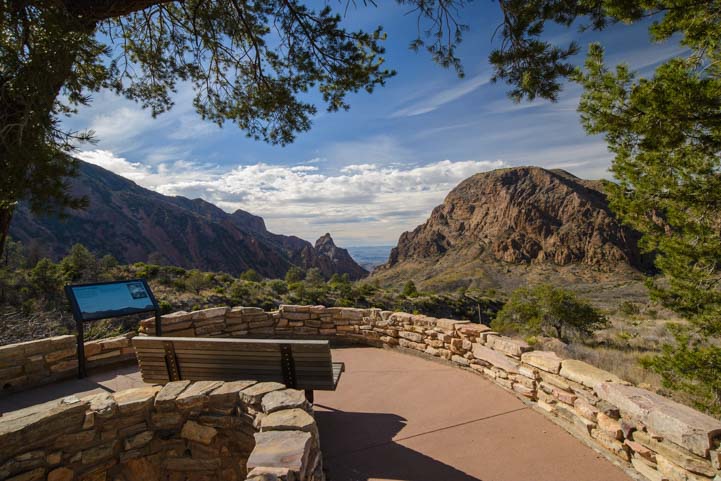
    The heart of the park is the Chisos Mountains, a range that juts up from the desert floor (down around 1,800 feet elevation), and soars to heights of over 7,800 feet. A quick walk out to an overlook gave us some beautiful views.

    Overlook at Big Bend National Park Texas

    An overlook in the Chisos Mountains.

    We hiked the Window Trail one day, an easy 5.6 mile round trip hike from the central lodge. Because of the huge variations in elevation in this park, any mountain hike like this one is good for a warmer day.

    Window Trail Hike in Big Bend National Park Texas

    Beginning the Window Trail hike.

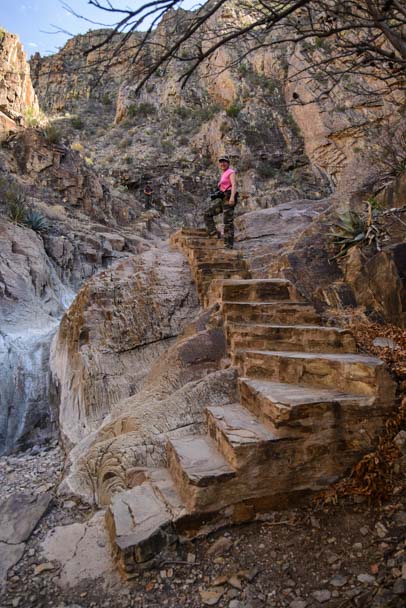
    We expected to find a “window” somewhere along this hike. Descending a scenic dirt path, we were amazed when we suddenly found ourselves in a fun little canyon that was lined with large, flat and smooth rock that had been worn down over the ages by Oak Creek. The rangers have carved some really neat stairways through this part to make the hiking super easy.

    Window Trail Hike Big Bend National Park Texas

    Stairs make this hike even easier!

    We were still on the lookout for that “window” as we made our way across the cool, shaded rocks. What we found, however, was not a window so much as vast opening in the canyon walls that peeked out at the desert floor in the distance. It was very dramatic — but quite slick too. Our intrepid RVing friend, Amanda, braved the slippery slope and went out for a closer look.

    The Window on the Window Trail Hike in Big Bend

    At last… a glimpse of the “window.”


    The Santa Elena hike is down at the desert floor level of the park at the southwest end, and it follows the Rio Grande river into another stunning canyon. The scenic drive to get there warmed up our camera shutter fingers, and when we arrived at Santa Elena we found people out enjoying the warm sunshine on the banks of the river. Farmilies played on the edge of the water, and other folks kicked back for a little relaxation in the sun.

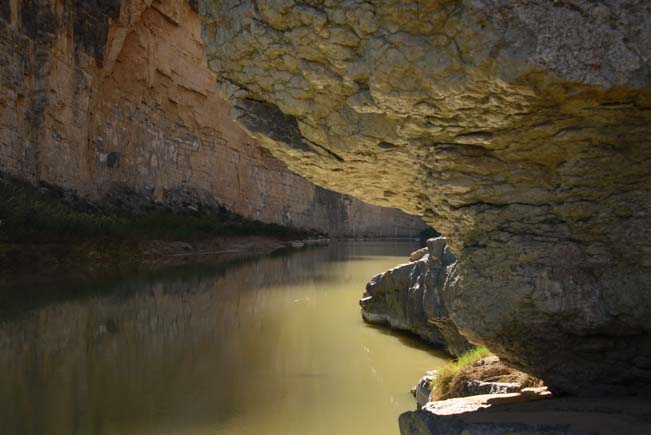
    This 1.7 mile hike involves a lot of climbing, twisting and turning through a series of switchbacks at the beginning. At one switchback I noticed a beautiful glow coming from behind the rocks out on a ledge. I left the trail to go see what I could see, and soon found myself precariously tip-toeing along a steep rock face with the Rio Grande twinkling up at me from many feet below. I managed to get past the spooky part and found a huge rock overhang that was beautifully lit in the late afternoon light.

    On the beach Santa Elena Canyon Big Bend Texas

    Santa Elena Canyon has a beach in front of it!

    Santa Elena Canyon Big Bend National Park Texas

    A nice place to kick back and get some sun.

    At Santa Elena Canyon in Big Bend Texas

    Views at the beginning of the hike

    Light glowing under rocks in Big Bend National park Texas

    Late afternoon light glowing behind a rock overhang lures me off the trail.

    Once I got back on the trail, I realized I had totally lost track of Mark (and we’d forgotten to bring our trusty two-way radios…darn!). I kept asking hikers that were on the return trip if they had seen a guy in a gray shirt taking lots of photos. I got plenty of reassurances that he was ahead of me — and that all the climbing was well worth the views at the end!

    Hikers descend on trail in Santa Elena Canyon Big Bend National Park Texas

    Hikers returning down the trail ahead of me.

    We had chosen to do this hike in the afternoon, and that turned out to be a great time to go, as the sun had finally penetrated the depths of the canyon. Photographers who were there in the morning said the light hadn’t been great — but the shade would be a welcome respite at a hotter time of year!

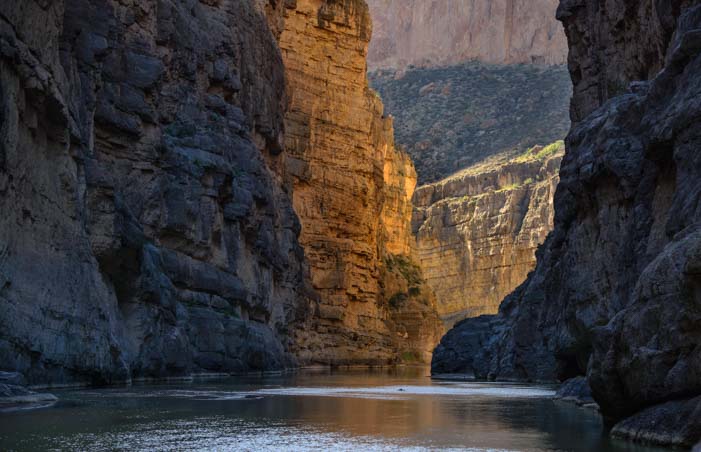
    When I finally caught up with Mark, the trail was empty, and we were the only ones in the wonderful big open area at the end of the trail. Huge boulders begged to be climbed on, and a fabulous view between the lofty canyon walls opened up to the sunset-lit cliffs beyond.

    Rio Grande at Santa Elena Canyon iin Big Bend Texas

    The Rio Grande laps boulders on its way out the canyon.

    Big Bend National Park looking into Santa Elena Canyon in Texas

    Santa Elena Canyon

    After enjoying the cool rock walls carved by creeks and canyons that we saw on the Window Trail and Santa Elena hikes, we then sampled a true desert hike out in abundant sunshine: the Grapevine Hills hike. This hike was at the desert floor altitude, but instead of finding ourselves surrounded by sheer rock cliffs that had been formed by a flowing river or stream, we passed through a wide open area that was rimmed with wonderful rock hoodoos.

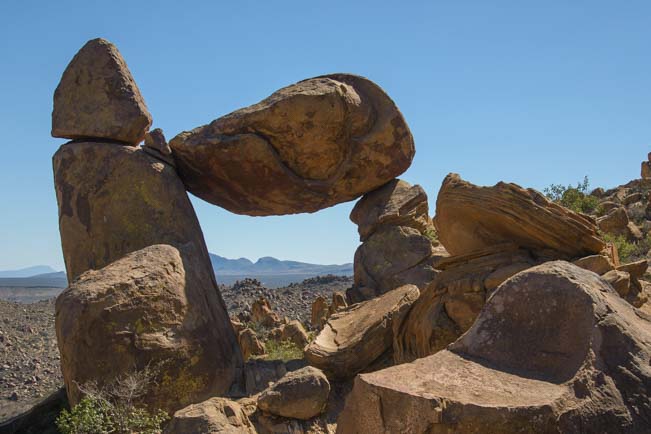
    The further we went on the trail, the more fun this hike became, as it twisted and turned its way into the rock hoodoos. This was like a kid’s playground. We scampered all over the rocks, feeling very much like kids, and at the end of the hike we found the signature rock formation — a balancing rock.

    Balancing Rock Big Bend National Park Texas

    The Balancing Rock at the end of the Grapevine Hills Hike.

    Under the balancing rock in Big Bend National Park Texas

    Looking through the balancing rock.

    Grapevine Hills hike to Balancing Rock in Big Bend Texas

    Having fun crawling around on the boulders.

    Grapevine Hills Balancing Rock hike in Big Bend Texas

    Nature in balance.

    The wonderful thing about Big Bend National Park is that you can pick your destinations within the park to suit the climate of the day. We saw both hot, dry weather and freezing cold, wet weather during our two week stay, and we were grateful that during the heat we could play outside in the mountains and during the cold spells we could hang out at the lower elevations.

    We also saw a very unexpected weather pattern that we’ve never experienced before: a thermal inversion between the desert floor and the mountains. For quite a few days it was 15 degrees warmer in the Chisos Mountains than it was at the lower elevation parts of the park thousands of feet below!

    Lost Mine Hike Big Bend National Park Texas

    Ascending the Lost Mine Trail.

    Another very popular hike is the Lost Mine trail. This 5.1 mile hike took us on a steady climb through woods and trees, opening up after a while to huge views. We did the hike in the afternoon, so the mountains that filled our views as we hiked were shaded and not as dramatic as they could be.

    As we approached the summit, the trail took a turn, and the golden light of late afternoon lit up the distant mountains in spectacular color. Like the other hikes, this end point was a true playground, with boulders to climb on and spots to perch and enjoy a snack with a view.

    At the summit of the Lost Mine Hike Big Bend National Park

    The summit opens up dramatic views in the late afternoon sun.

    Tree at the top of Lost Mine Hike Big Bend Texas

    I just LOVE that tree!!

    Big Bend is a hiker’s paradise, and many people we met were embarking on multi-day backpacking hikes across the park. We stuck to short day hikes, but found them all very fulfilling.

    RV Camping at Big Bend National Park Texas

    Goodnight, Big Bend!!

    Backpacking is great, but there is something about having a warm, soft bed and no twigs or rocks in your back at night that we really like, especially when you have a beautiful view!! (Here are some details about boondocking and RV camping in Big Bend).

    Subscribe
    Never miss a post — it’s free!

    Our most recent posts:

    More of our Latest Posts are in the top MENU above.

    More info about day hikes in Big Bend National Park (from the US National Park Service):

    Related posts:

    <-Previous || Next->

    Big Bend National Park TX – Vast and Varied with Views!

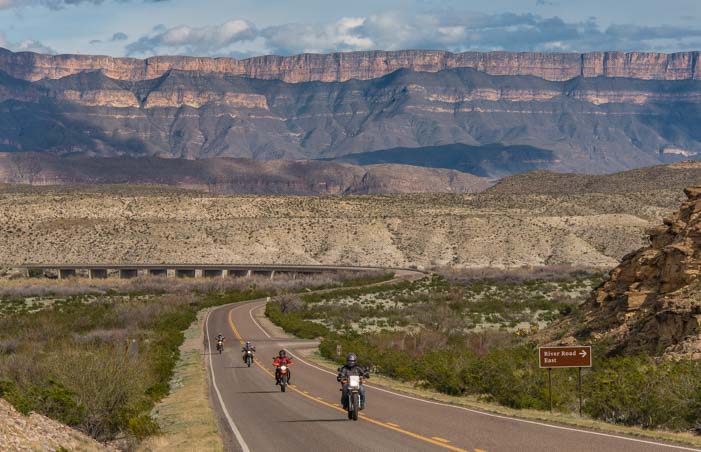
    February, 2015 – The first thing we noticed about Big Bend National Park is the sheer size of the park. Everything is bigger in Texas, of course, and this park is no exception. Simply driving from one area to another covers many many miles. But the great thing about these drives is that they pass some wonderful scenery!

    Big Bend National Park and Sierra del Carmen mountains in Texas with motorcycles

    Sweeping views in Big Bend National Park!

    Big Bend scenic roads with a tunnel

    Don’t worry, RVs fit through this tunnel!

    Big Bend National Park Texas

    The Sierra del Carmen mountains peek from behind a ridge.

    The terrain is really varied in Big Bend National Park, and that is one of the magical things about this place. There’s the Rio Grande river that snakes along the south end of the park, the Chisos Mountains that tower at great heights in the middle, and the desert lands in between.

    The Sierra del Carmen mountains at the far eastern edge of the park form a dramatic landmark that is easily visible from 21 miles away in the center of the park. These mountains sport horizontal stripes, and they turn gorgeous shades of pink at sunset. They also mark the location of Boquillas, the tiny Mexican village that sits on the other side of the Rio Grande.

    Sierra del Carmen mountains in Big Bend National Park Texas

    The imposing Sierra del Carmen mountains can easily be seen from miles away.

    Sierra del Carmen mountains in Big Bend

    These are at the east end of the park by Rio Grande Village and the Mexican town of Boquillas.

    One of the loveliest drives is the Ross Maxwell Scenic drive that goes from the center of the park to the southwest corner. This drive winds up and down through craggy mountains that made us feel like we were back in Arizona. In the late afternoon, on our return, the mountains lit up bright orange.

    Scenic drives in Big Bend National Park Texas

    The Chisos Mountains tower over the center of the park

    Mountain scenery in Big Bend

    Returning on the Ross Maxwell Scenic drive in late afternoon…

    We were there in late February, and spring was already in the air. The Texas state flower is the lovely bluebonnet, and they were in full bloom everywhere. They love the roadsides, and all over the park we passed areas that were blanketed with them.

    RV surrounded by Texas bluebonnet flowers

    Spring arrives in February, heralded by abundant bluebonnet flowers.

    When we rounded one corner, we found a natural rock garden that was littered with a wonderful combination of bluebonnets and yellow flowers that looked absolutly vibrant against the jagged rocks.

    Spring in Big Bend bluebonnets blooming

    After a swoopy turn on the Ross Maxwell Scenic drive, we found a huge
    bluebonnet rock garden planted by Mother Nature.

    Birds sang in the trees, and we even saw a bird’s nest in a cactus. This seemed like a precarious place to put a home, but I guess it works! Cactus of all types are prolific in Big Bend National Park, especially prickly pear cactus. We saw many varieties. Some have no thorns, and some have very long sharp ones.

    Bird on a twig

    This little guy kept an eye on me.

    Bird nest in a cactus in Big Bend Texas

    Not far away was a well protected nest.

    Prickly pear cactus

    Prickly pear LOVE Big Bend and come in many varieties.

    Big Bend can deliver all kinds of crazy weather, and we saw it all during our two week stay. When we first arrived the temps were warm and the air was dry and clear. It was perfect. But Texas is one of those places where if you don’t like the weather (or even if you do!), just wait a minute, and it will change.

    All of a sudden one night the temps plummeted into the 20’s, and we woke up to a winter wonderland of ice covering all the desert plants. If the scenic drive up to the Chisos Mountains was pretty before, now it was absolutely stunning.

    Snow and ice in Chisos Mountains Big Bend National Park Texas

    Texas can deliver some crazy weather, and Big Bend is no exception.

    Century plant with snow in Big Bend Texas

    The ice on the century plants was very cool.

    Snow on plants in Big Bend

    Ice in the desert!

    Ice on the trees in Chisos Mountains of Big Bend National Park Texas

    The drive into the Chisos Mountains was even more thrilling with all the lower elevation plants laced in ice.

    Luckily, this round of ice melted quickly and we were able to enjoy a few hikes which I’ll cover in the next post!
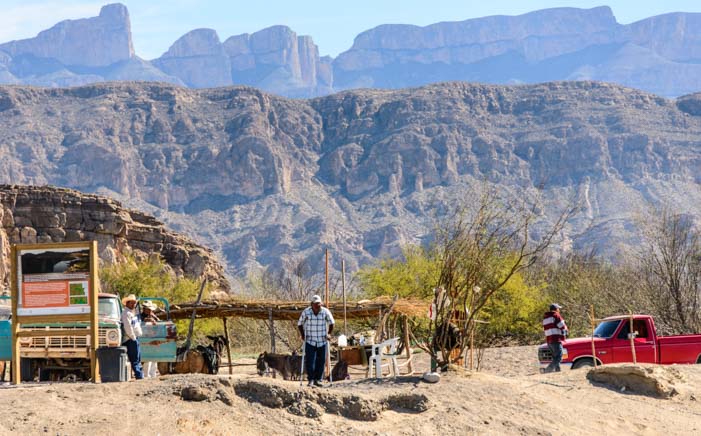
    ______________

    Subscribe
    Never miss a post — it’s free!
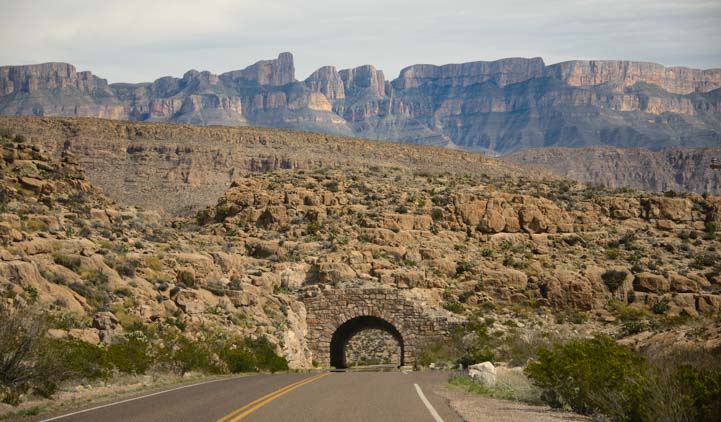
    Our most recent posts:

    More of our Latest Posts are in the top MENU above.

    More info about Big Bend National Park:

    Related Posts:

    <-Previous || Next->

    RSS Subscription Change – A New Feed Address for RLT

    There are a few small changes coming up for subscribers to Roads Less Traveled…

    If you subscribed to receive email updates from this blog, you don’t need to do anything. You’ll probably notice that the emails you receive will have a slightly different format, and at the bottom of each email there will be links for changing your subscription email address and for unsubscribing.

    If you subscribed to this blog via an app or reader service, the RSS feed will have a new address which is:

    feed://roadslesstraveled.us/feed/

    This new RSS feed address will become live on Sunday, March 15, 2015, as soon as I wake up and flip the switch. You will need to update your app or reader with the new feed address to receive future updates after that.

    This announcement is the last post that is going out on our old Feedburner RSS feed.

    As always, if you have any problems or questions, you can email me directly at emilyfagan1 {at} gmail {dot} com.

    To all our subscribers:

    We just want you to know that being able to share our pics and stories with you and pass on whatever tips we’ve learned via this website is immensely satisfying.

    Thank you, most profoundly, for the encouragement you have given us over the years and for the warm appreciation you have expressed for our photos and stories. Thank you especially for the pat on the back you have given us by signing up to see more!

    We truly value the insightful and thoughtful questions you have posed to us, and we hope that this corner of the web lights a trail of inspiration and ideas for you.

    Thank you for joining us in our travels and thanks for reading!

    — Emily & Mark

    Mark and Emily at Crater Lake Oregon

    Happiness Is… Crater Lake!

    Our most recent posts:

    More of our Latest Posts and Quick Pics are in the top MENU above.

    What To Do in the Rain while Boondocking? Wash the RV!!

    Did I mention that Texas has been giving us extreme weather lately? First she tried to freeze us out, covering our buggy in ice.

    Icicles on our fifth wheel RV

    Icicles on our rig – wow! And look at that layer of grit and grime!

    Then Texas dumped a bunch of snow on us. We opened the RV door one morning to find ourselves surrounded by the white stuff!

    Looking outside our RV door at snow

    We woke up to snow one morning

    Snow on our RV steps

    Right up to our door!

    Snow on our RV in Texas

    You never know what you’ll get for winter weather in Texas!

    This eventually turned to rain, and we drove a few hundred miles on roads that spat all kinds of miserable black grime all over the rig. When we finally stopped in Livingston (for a few days of drizzle and fog!), our beautiful home was a dirty mess!! Of course, it began to rain again and then it began to pour.

    What to do while boondocking in the rain rather than just forlornly wishing you could play outside? Clean the rig !! After all, the pre-rinse had already been done, and all the sticky things (like bugs!) were nicely unstuck by now.

    Mark got out his favorite telescoping brush that did us such great service on the boat, and he spent two hours in the pouring rain sudsing up the truck and trailer and letting the soft rain water rinse it all off. Clever!

    Washing our RV in the rain

    Mark takes advantage of the rain water for an easy rinse cycle…

    After the rain stopped (not that it was sunny… just not raining), the rig dried off and now sported a wonderful shiny luster, thanks to a wax job we got back in Florence, AZ. We were very happy campers, especially Mark, who had worked so hard and gotten so drenched in the rain.

    But then it was time to move on. Our aim was to get out of Texas and go east. But this crazy state wouldn’t have any of that. While the rest of the country basked in clear skies, Texas persuaded her neighboring states to the east to join her in taking a good long bath.

    Texas Rain

    Not Fair!!

    Good grief! We waited for a few days for a weather window, and it finally seemed to come. At least, it came long enough for us to escape a little ways east of Houston. So we ran for it.

    Big mistake! Out on I-10 the skies began to spit. We slipped into the first rest area we could find. Mark was crestfallen as he inspected the RV in the drizzle. The whole thing was covered in a thin layer of road grit. His wonderful washing job was history. Ugh!

    What to do while waiting for the rain to stop? Aw, heck — wash the RV!

    We didn’t have a water source, so we put our two buckets behind the back of the fifth wheel to catch the rainwater that was falling in a steady stream from the gutters. They filled up in no time. We also didn’t need any soap. The dirt was primarily on the bottom half and was already streaming down the sides of the trailer!

    Buckets catch rain from the RV roof

    Our buckets were soon overflowing with rain water!

    We try to avoid dividing the labor in our buggy into pink and blue jobs as much as possible, preferring to find some shade of lavender for all the chores that need to be done. So, now it was my turn to get wet. Out I went into the drizzle to bring a little shine back to our RV and to try to put a smile on Mark’s face.

    It didn’t take much effort, just a little elbow grease and a nice upper body workout. Then our truck and trailer were sparkling clean again.

    Mark absolutely loved it. He got to enjoy the whole process with a beer in hand, and he didn’t have to lift a finger. Ha! He sure gets a kick out of watching me work!!

    Using rain water to wash the RV

    I get the new layer of road grit off the rig while Mark enjoys a beer and a laugh!

    As I mentioned above, the great thing about rain water is that it is soft water and it doesn’t spot. There’s no need to wipe down the windows! The key, though, is to wash the rig before it stops raining so you get a good natural rinse.

    Next morning the roads were dry, and our clean truck and trailer hit the road once again.

    If you find yourself sitting in the rain in a soggy, dirty buggy, and you want to play outside and knock out a chore at the same time, throw a bucket or two under the RV’s gutters, and give your baby a wash!

    Subscribe
    Never miss a post — it’s free!

    Our most recent posts:

    More of our Latest Posts are in the top MENU above.

    Related posts: