Valley of the Gods & Goosenecks State Park, Utah – Beautiful!

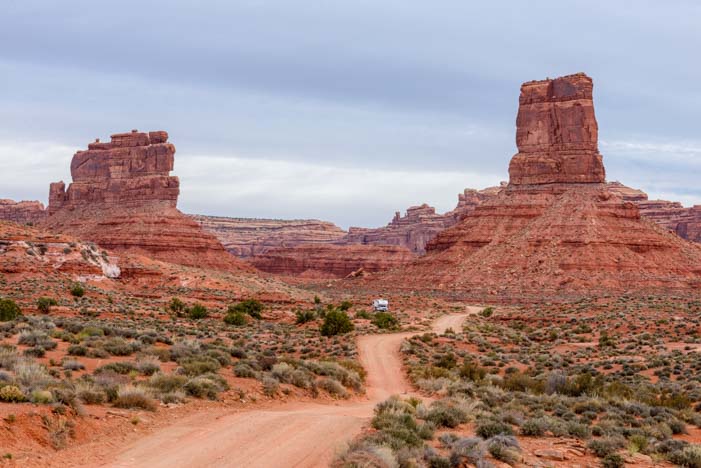
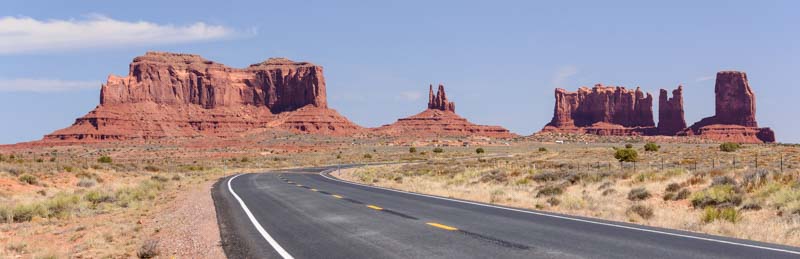
March 2016 – Just over the border of Utah and Arizona at the eastern edges of the two states, a few miles north of Monument Valley, lies a fabulous scenic drive through an area called the Valley of the Gods.

RV motorhome at Valley of the Gods Utah

Many RVers explore the Valley of the Gods on their way through the eastern AZ/UT region.

This is a 15 mile or so dirt road that winds through incredible rock formations.

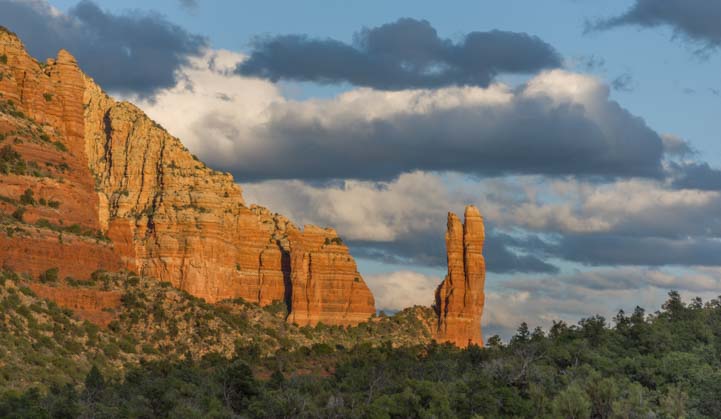
Valley of the Gods rock formations Utah

The “golden hour” before sunset is a wonderful time for photography here.

Some of the rocks formations are reminiscent of the famous ones at Monument Valley, but this area is much smaller and much less visited.

Red rock formations Valley of the Gods Utah

A hand with a thumb similar to the more famous rock formations of Monument Valley!

It is a wonderful drive to do at any time of day, but sunrise and sunset are when the colors really jump out.
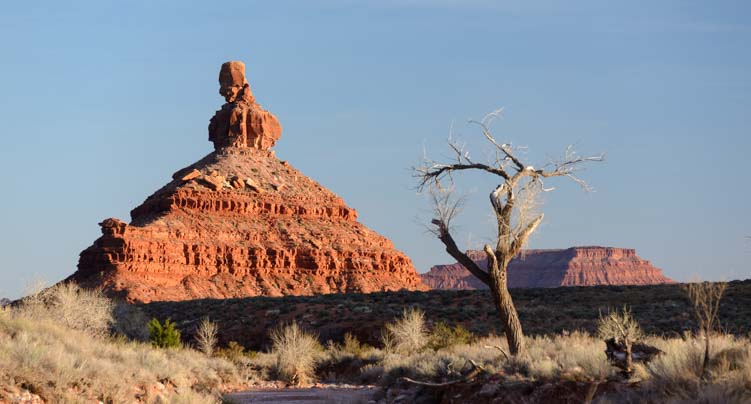
Tree at Valley of the Gods Utah

.

When we were there in late March, we had the whole place to ourselves as the sun was dropping low in the sky.

Camping at Valley of the Gods Utah

What fun!!

This is a parched desert land, but it had rained in the past few days and there were still puddles on the ground that made for some fun reflection photography.

Tree and rocks Valley of the Gods Utah

Recent rain left puddles that were lots of fun to photograph.
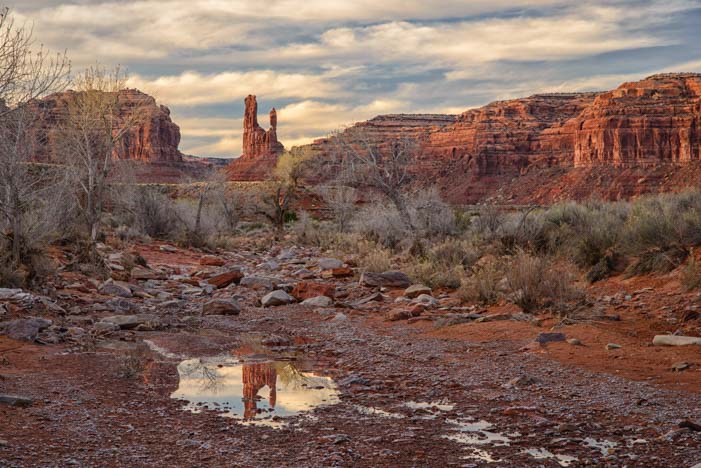
Reflections at Valley of the Gods Utah

.

Puddle Reflections Valley of the Gods Utah

.

We were hoping for a colorful sunset, but the skies darkened before any pink or red hues had a chance to form.
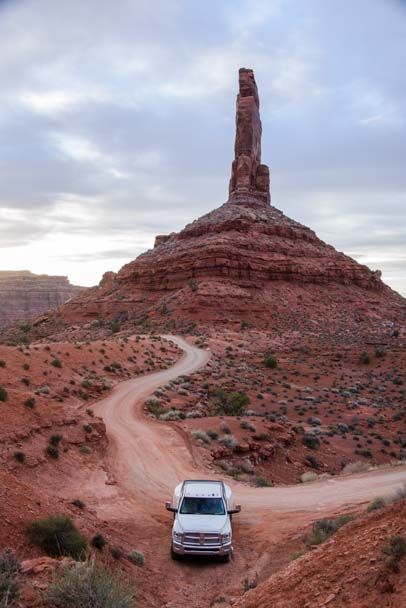
Truck at Valley of the Gods Utah

No sunset, but very cool anyway!

Early the next morning, we did the drive again (it is well worth driving through Valley of the Gods more than once!).

Valley of the Gods Scenic Drive Utah

At dawn, the sun played with its shadow.

For brief periods, the sun penetrated the overcast skies and played with its shadow on the rock formations.
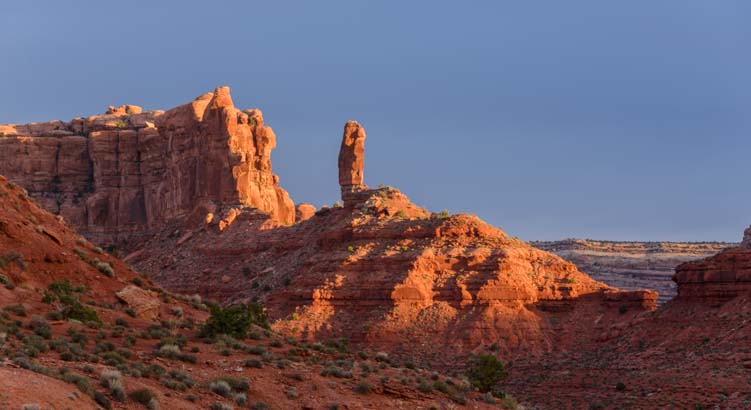
Sunrise Valley of the Gods Utah

The rock formations were filled with vibrant colors in the morning sun.

The most beautiful part of this drive is a two to three mile section in the middle where it makes a series of s-curves between the rock formations.
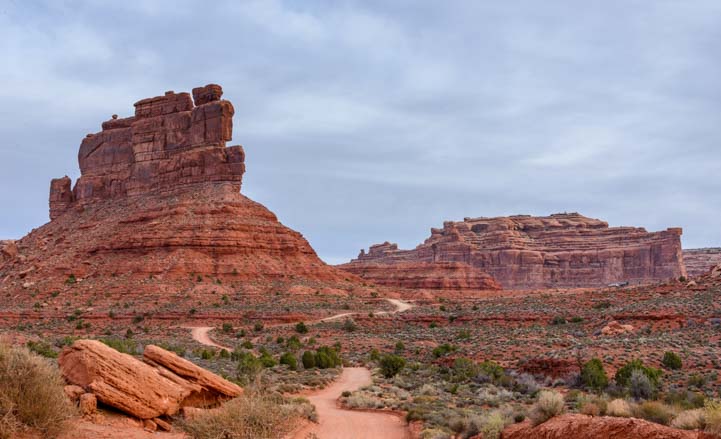
Road through Valley of the Gods Utah

I love curvy roads!!

Each formation is lovely, and even though the sun decided to call it quits for the day, the muted light showed off the majestic scenery without the glaring brightness and shadows cast by sunny skies.

Truck at Valley of the Gods rock formations utah

.

RV camping at Valley of the Gods utah

The sun didn’t stay out for long, but the colors were still beautiful.
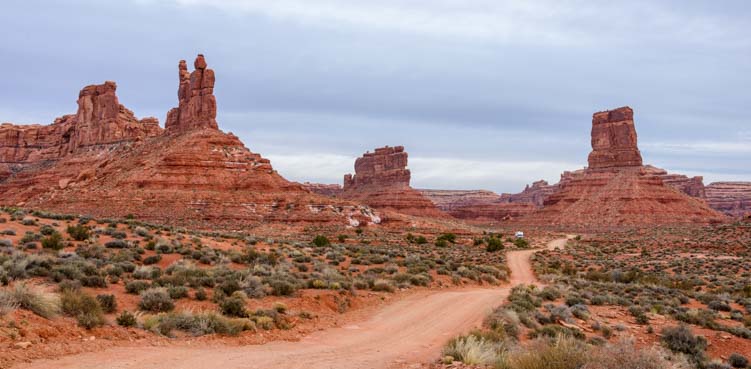
Valley of the Gods Utah Scenic Drive

This is a jaw-dropping drive!

Not far from the Valley of the Gods is a phenomenal road that climbs through a series of very tight and steep switchbacks up to lofty heights. It’s called the Moki Dugway. This road was built in 1958 to move uranium ore from the Happy Jack mine to Fry Canyon.

Moki Dugway Valley of the Gods Utah

The Moki Dugway is a hair-raising drive up steep switchbacks on a dirt road. But what a view!

We climbed up the switchbacks and 10% grades in our truck. At a viewpoint part way up we watched a Class C motorhome making its way along this insanely steep road. What a brave driver!

Class C motorhome climbs the Moki Dugway in Utah

A Class C motorhome braves the Moki Dugway

On another day we took a daytrip to Goosenecks State Park. This park is basically an overlook with sweeping views of a tight turn in the San Juan River, reminiscent of Horseshoe Bend in Arizona.

Goosenecks State Park Utah

Goosenecks State Park is a bend in the San Juan River, much like Horseshoe Bend near Page, Arizona.

I had always thought these two places were one and the same, but they are actually very different.

Horseshoe Bend has vast stretches of red rock sandstone slabs at the top of the rim> The Colorado River far below is blue, because at that point in its journey it has just emerged from the dam at Lake Powell. Goosenecks State Park has more of a crumble rock surface at the rim and has lots of vegetation on the canyon walls. At the bottom, the San Juan RIver is muddy and brown.
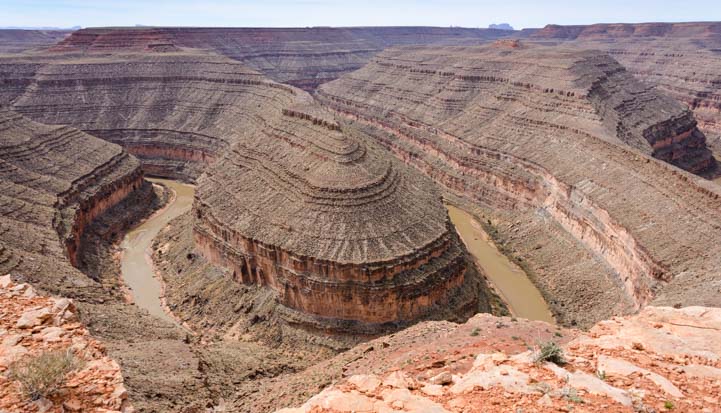
Overlook Goosenecks State Park Utah

Goosenecks State Park overlook.

Someone had placed a bunch of stones in spiral near the edge.

Rock Circles Goosenecks State Park Utah

What is this? Some strange meditation ring? A tourists’s artistic contribution to the state park?

Unlike the National Park Service’s Horseshoe Bend, which is overrun with thousands of international tourists and is free, Goosenecks State Park is $5 for day visitors, and $10 a night for camping on the rim, and there is hardly anyone there. When we stopped by, I doubt the daily fees were covering the salary of the gal sitting in the guard shack at the entrance!

Truck Camper Goosenecks State Park Utah

Goosenecks State Park has a handful of dry camping sites right along the rim of the canyon.

There were a few RVs parked along the rim. Some were camped in a cluster near the entrance, but one had claimed a spot far in the distance along the rim. What an incredible view out your RV window!
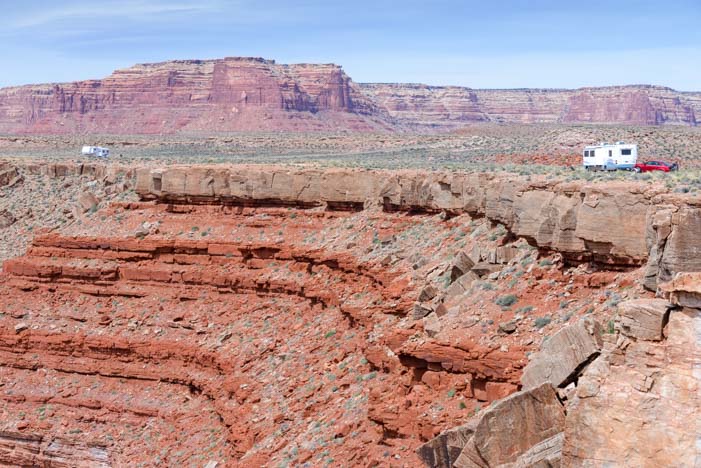
RV camping Goosenecks State Park Utah

Now here’s a fun spot to camp — with a view!

One RVer was enjoying the morning from his camp chair right at the edge of the overlook. How cool is that?!

RV camping on the rim Goosenecks State Park Utah

Now THAT’s a spot to put your camp chair!!

All three of these places — Valley of the Gods, Moki Dugway and Goosenecks State Park — are at the very southern end of the 3,000 square miles of Utah land that the Navajo and other Indian tribes are asking President Obama to set aside to become Bears Ears National Monument. This will protect their many ancestral archaeological sites that are scattered throughout the region. Currently, these areas fall prey to desecration and to mining and oil drilling activities.

National Monuments are under the jurisdiction of the National Park Service whose mission is the protection of national treasures. In line with their charter, the NPS usually takes a hard stance against free wheeling recreation, and they control access and use with an iron fist.

However, the land in question is currently managed by the Bureau of Land Management, the US Forest Service, and even Utah State Parks, each of which has its own unique mission, from resource extraction to recreational use to tourism.

So, this unusual proposal will require these public land management agencies to cooperate in a way they never have before. With any luck, if Bears Ears National Monument is created, recreational use like scenic driving, hiking, biking and camping will still be possible.

Subscribe
Never miss a post — it’s free!

More info about Valley of the Gods, Goosenecks State Park and Moki Dugway:

Other blog posts from our RV travels in Southeastern Utah:

Our most recent posts:

More of our Latest Posts are in the MENU above.

<-Previous || Next->

Navajo National Monument, Monument Valley and Bears Ears

March 2016 – The Northeastern quadrant of Arizona and a bit of southeastern Utah is the Navajo Nation, an Indian reservation that is over 27 thousand square miles. It is larger than the state of West Virginia (~24k sq. mi.). It is also larger than the states of Massachusetts, New Hampshire, Rhode Island and Delaware combined, with enough left over to add in the southern half of Vermont.

Just under 175,000 people call it home.

Within the borders of the northern part of the Navajo Nation, the National Park Service manages the Navajo National Monument, an area where there are some ancient Indian cliff dwellings and ruins.

Hiking at Navajo National Monument Arizona

Navajo National Monument is home to ancient Indian cliff dwellings.
One is in a cave across the canyon.

After visiting stunning Horseshoe Bend and Lees Ferry near Page, Arizona, we drove our truck and trailer across the northern part of the Navajo Nation to see Navajo National Monument.

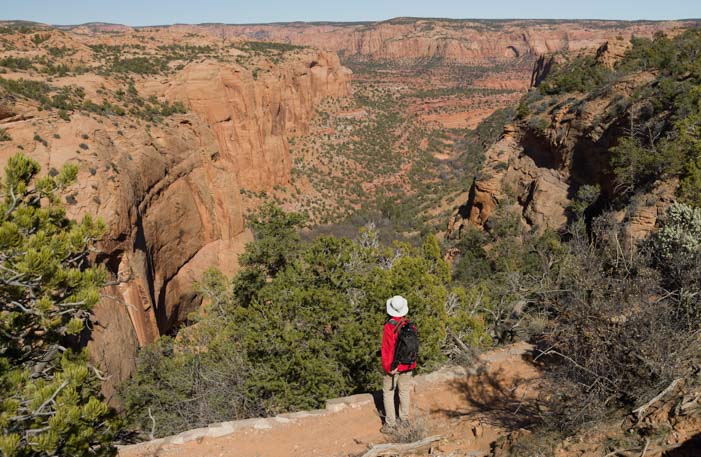
There are three short hikes at Navajo National Monument, each one progressing along the canyon rim and offering views down into the canyons. We started with the Sandal Trail which was an easy stroll on a paved path to a viewpoint at the end which looked across the canyon at the Betatakin Ruin.

Navajo National Monument Arizona

The Sandal Trail took us along the edge of the canyon to an overlook facing the Betatakin Ruins

In the summers there are guided tours of these ruins, but they don’t start until May 29th, and we were there in mid-March. But the view of the ruins — with binoculars or our long telephoto camera lens — was wonderful.

Betatakin Ruins Navajo National Monument

The Betatakin ruins are in the back of this cave.

Ruins at Navajo National Monument Arizona

In the summer months you can take a guided tour of these ruins. We were there too early!

The Canyon View Trail hike gave us views of this same canyon, although there were no Indian ruins to be seen.

Navajo National Monument canyon view

The Canyon View Trail gave us different views of the same canyon.

Unlike the first two “mesa top” hikes, the Aspen Trail hike descended down into a canyon and gave us a terrific stair-stepping workout going down and then climbing back out.

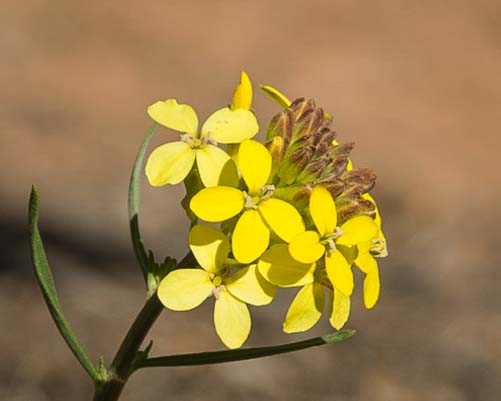
We were definitely missing the “prize” at this park since we couldn’t do any tours of the ruins themselves, but spring was in the air and wildflowers were just starting to bloom.

Spring flower Navajo National Monument Arizona

Pretty wildflowers on the trail.

There are two dry camping campgrounds at Navajo National Monument, and they are free. Only one campground was open (and only two campsites were being used!), and with some jockeying a bigger rig could fit during seasons where there is little traffic. The signs give RV size limits of 25′ to 32′, depending on the sign, not just in the campground but on the road leading to Navajo National Monument, but in reality a 35′ fifth wheel could manage in one or two of the campsites we saw (with patience). Busy summer weekends might be more hair-raising with a big rig.

This is high desert country (7,300′) so it was quite cold during our stay, but we saw a beautiful sunset.

Sunset starburst Arizona

Remote and quiet in March, we had the sunset to ourselves.

Sunset Navajo National Monument

Sunset at Navajo National Monument

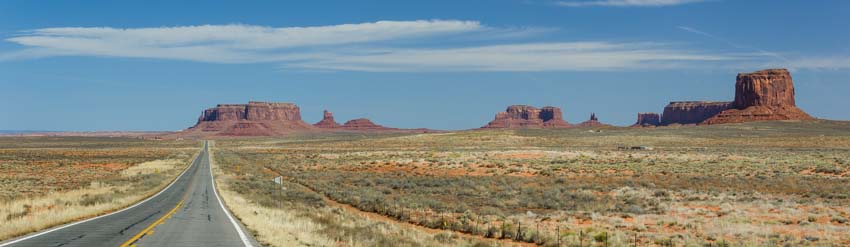
Traveling northeast from there, we passed through Monument Valley, which sits on the Arizona and Utah border. This ia a vast flat plain that is dotted with towering rock formations.

The most dramatic rock formations of Monument Valley are in the Monument Valley Navajo Tribal Park in the Navajo Nation, a four mile detour east of US-191, the road we were on. We decided to save a trip there for another time, but stopped in at a Welcome Center to get some info.

At least, the building had a sign on it that said “Welcome Center!”

When I walked in the door, I expected to see racks of literature and a helpful person behind a desk. Instead, I found myself staring at the backs of several rows of people in folding chairs listening to a man giving a speech. His voice was low, melodic and wistful. And the language he was speaking was Navajo!

Monument Valley Arizona

Monument Valley is dotted with enormous rock formations

I wasn’t sure if I should back out quietly or stick around and see what this was all about. Suddenly, a woman approached me and whispered and gestured towards some pamphlets on a table. She wanted me to sign a petition.

“What’s it for?” I whispered.

“It’s a petition to create Bear’s Ears National Monument,” she said. She handed me a map and a glossy brochure.

Monument Valley selling Indian crafts Arizona

Indians sell crafts from stands on the side of the road.

It turned out that the Navajo Nation (together with 25 other Indian tribes) has approached the federal public land agencies for help protecting their artifacts, relics and ruins. They have been struggling with preventing the desecration of archaeological sites (ancient ruins and petroglyphs), and they want to phase out mining too.

The Navajo have never sought this kind of help before, but apparently they simply don’t have the manpower or the authority to protect the unique archaeological sites. So they are proposing to convert 1.9 million acres of land (about 3,000 square miles) into a National Monument.

Monument Valley Arizona

Towering rock formations in this part of the country often hide Indian archaeological treasures

The parcel of land is enormous. It is the size of Delaware plus half of Rhode Island.

It is a triangle that stretches, more or less, from a bit SW of Moab, Utah, in the north, down about 90+ miles to the Utah/Arizona border in the south, and westward about 50 miles to Glen Canyon, and then about 80+ miles back up on a diagonal along the Colorado River towards Moab.

The popular landmarks and destinations of Natural Bridges National Monument, the Valley of the Gods, Goosenecks State Park, Newspaper Rock and Manti La-Sal National Forest would all be enclosed inside the boundaries of the new National Monument land.

Canyonlands National Park and Glen Canyon National Recreation Area would border it to the west and south. The north-south highway of US-191 would be outside the eastern boundary but would more or less parallel the eastern border of the National Monument between the Moab area and the Arizona/Utah border.

You can see a map here:

Map of Proposed Bears Ears National Monument in Utah

RV at Monument Valley Arizona

This whole area is extremely popular with RVers and other travelers

This proposal is unique because it requires cooperation between several different agencies that manage public land, including the US Forest Service, Bureau of Land Management, and National Park Service, all of which manage portions of the land parcel already (most of the land is currently under BLM management).

The organization that is behind this and that was making presentations and gathering signatures to present to President Obama when I walked in the door is called Utah Diné Bikéyah. “Diné” is the Navajo word for the Navajo people.

I spoke briefly with Gavin Noyes, the Executive Director. He explained that this has been in the works for a few years and that the hope is that Bears Ears National Monument will be created by President Obama before his presidency is over.

He explained that in many ways the process is being modeled on Grand Staircase Escalante National Monument, another ~3,000 square mile public land conversion in southern Utah that was designated a U.S Presidential National Monument under the Antiquities Act of 1906 by President Bill Clinton.

Grand Staircase Escalante was created to preserve unique natural treasures (like red rock formations). Bears Ears National Monument will be created to preserve Native American cultural and archaeological treasures (ruins and petroglyphs and ceremonial sites).

RV at Monument Valley in Utah

The landscapes in this corner of the world are stunning.

I asked what the impact would be on recreational use of the land, like dispersed camping, hiking, mountain biking, rock climbing, etc. Gavin explained that the intention was for better management of the archaeological artifacts and that recreational use would still be allowed, just as it is still allowed in Grand Staircase Escalante National Monument.

Photos in the proposal’s brochure show situations where people have attempted to remove petroglyphs from rock faces by cutting them out with high powered saws. They also show images of mining and other commercial land use. These are the things that this proposal is seeking to eradicate.

Of course, even presidential protection doesn’t guarantee anything. In 1955 President Eisenhower protected a four square mile portion of Tonto National Forest in Arizona, making it off limits to all future mining. In late 2015, that was overturned by the National Defense Authorization Act, signed into law by President Obama, enabling the very same National Forest public land to be sold to a private, for-profit Australian and British mining operation. Eventually, this mine will destroy a beloved recreation area once used by campers and rock climbers that at least one president sixty years ago thought was worth hanging onto. (More info here).

An editorial in the LA Times by former Secretary of the Interior (1993-2001), Bruce Babbitt, spells out all the political back and forth that is going on behind the scenes. Just like the situation that arose in Tonto National Forest where foreign copper mines have trumped recreational use of America’s public land, mining seems to be playing a central role here as well.

Monument Valley reflected in fifth wheel trailer RV

Monument Valley reflections on our RV

All of this was news to me, and perhaps it is news to you too. I am sharing it here because the recreational use of public land is a large part of what this website is about.

Further questions can be directed to Gavin Noyes, Executive Director of Utah Diné Bikéyah by phone: (801) 521-7398 or by email: gavin [at] xmission.com

For more information about the proposed Bears Ears National Monument, see these links:

Further info:

Subscribe
Never miss a post — it’s free!

Things We’ve Learned About Public Land Management Since We Began Full-time RVing:

Other posts from our RV travels to Indian Ruins and to Indian Country:

Our most recent posts:

More of our Latest Posts are in the MENU above.

<-Previous || Next->

Lees Ferry & Marble Canyon AZ + Pretty Paria River Hike

March 2016 – Arizona boasts lots of incredibly scenic drives, and one beauty is Routes 89 and 89A which double back on themselves between Page and Lees Ferry in the northeast corner of the state. This is a portion of the Vermillion Cliffs Scenic Byway, an area that is great for RV travel. After our wonderful visit to the Horseshoe Bend overlook in Page, we drove to Marble Canyon and Lees Ferry.

RV at Lees Ferry Arizona red rocks

Lots of RVs drive the Vermillion Cliffs Scenic Byway

At Marble Canyon, the Navajo Bridge spans the Colorado River. It was built in 1929 and was an important bridge because it made it possible to cross the moody Colorado River without taking the more antiquated cable ferry across at nearby Lees Ferry.

Cars were new in those days, and the ferry system wasn’t great for carrying cars across the river. In 1928 the ferry sank, killing three men, so the bridge, known then as the Grand Canyon Bridge, was a huge improvement.

Today the original bridge is a walking bridge that runs parallel to the newer highway bridge that was opened in 1997.

Navajo Bridge Marble Canyon Arizona

The old Navajo Bridge (left) is now a footbridge. Highway traffic takes the bridge on the right.

Sheer cliffs plunge down to the Colorado River on either side.

Navajo Bridge Lees Ferry Arizona

The Navajo Bridge crosses the Colorado River

We enjoyed a stroll on the walking bridge. The river is a looooong way down!!

Navajo Bridge Overlook Marble Canyon Arizona

The river is way down there!!

We had loved our stay in the red rock country of Sedona, Arizona, a few weeks earlier, but that little town is just the beginning of the southwest’s explosion of orange and pink color in northern Arizona and southern Utah. Spring was just beginning, and we saw bunches of tiny purple wildflowers here and there.

Wildflowers in Lees Ferry Arizona

Wildflowers were just starting to bloom.

The road that winds from Marble Canyon into Lees Ferry is lined with dramatic red rock cliffs, and it is a jaw-dropper of a drive.

Scenic drive to Lees Ferry Arizona

The drive into Lees Ferry is gorgeous.

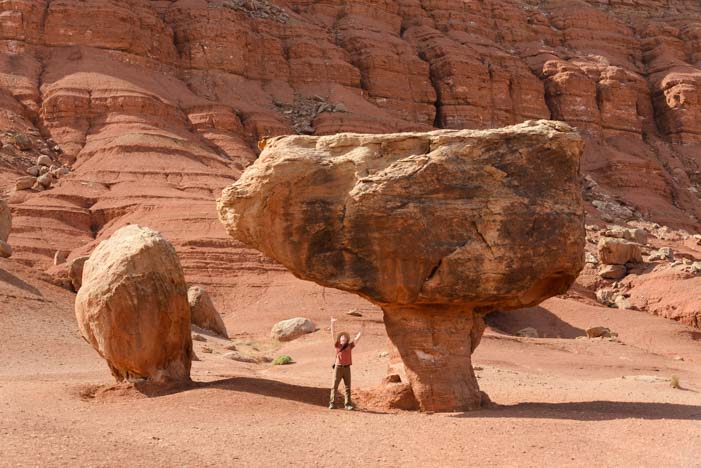
The towering red walls are still eroding, and in one area there is a massive debris field of enormous boulders that have broken away from the cliffs and rolled downhill. From a distance they look like gravel, but up close these boulders are gargantuan.

Huge red rock boulders Lees Ferry Arizona

Boulders strewn like gravel around the cliffs are actually really massive!!

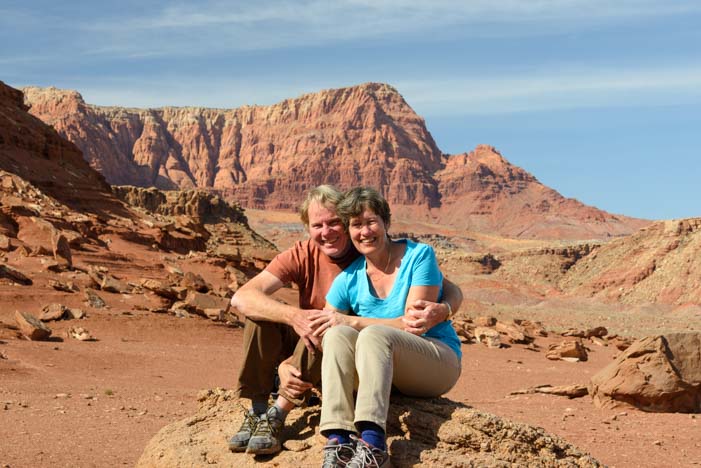
We meandered among them and took a breather on a rock, totally awed by the sheer scale of Nature’s handiwork.

Hiking the red rocks at Lees Ferry Arizona

We love red rock country!

The forces of wind and water shaped these rocks, and we saw a jagged tributary leading to the Colorado River where a stream carved a zig-zag pattern through the rocks.

Lees Ferry Arizona crack in the earth

A tributary makes its way to the Colorado River

Prior to the Navajo Bridge, Lees Ferry was home to a cable ferry that was originally built by John Lee in 1873. It was the only place travelers could take their horses and wagons and themselves across the tempestuous Colorado River safely.

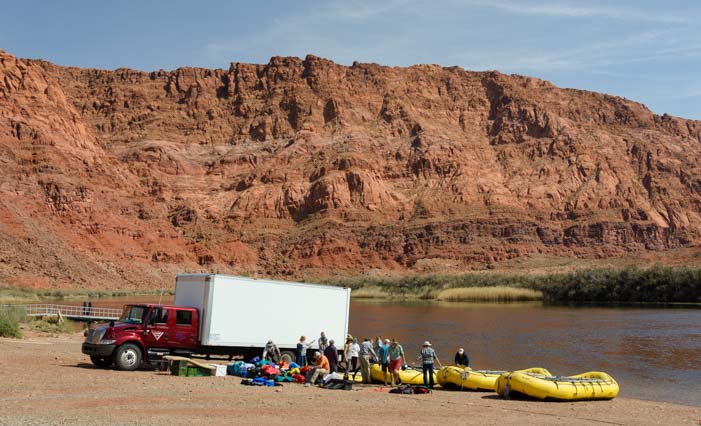
At the river’s edge there is a boat launch now, and this is a popular put-in spot for river rafters heading down the Colorado River through the Grand Canyon. Two groups of rafters were launching their rafts when we were there. One group was starting a 24 day voyage down the river and the other was starting a 16 day trip. What fun!

Colorado River Rafters headed to Grand Canyon

Lees Ferry is the start of the Grand Canyon, both geologically and for river rafters too.

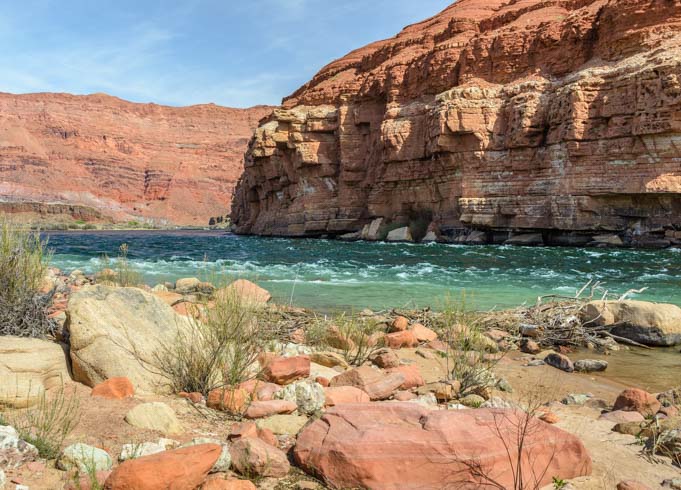
Just downstream from the boat launch we found the Paria Riffle and white sand Paria Beach where the Paria River joins the Colorado River. This is a really beautiful spot with turquoise water and pink boulders. For those wondering, Paria is pronounced “PaREEa” and not like the word “pariah.”

Paria Riffle and Paria Beach Lees Ferry Arizona

The Paria Riffle and the white sand Paria Beach are very inviting

John Lee’s homestead is now owned by the National Park Service, and we roamed around a little bit. There is an orchard, and visitors can pick the apples and other fruit for free during the fall harvest. We found an old wagon sitting nearby and chatted a bit with an NPS worker who was tending the trees in the orchard.

Old wagon at Lees Ferry Arizona

We roamed around the grounds of the old homestead at Lees Ferry

The farm house itself is off-limits to visitors, and the National Park Service has an engraved padlock keeping folks out.

NPS Padlock Lees Ferry Arizona

No Admittance.
(What a nice padlock!)

The last family to work the farm and live in these buildings left in the 1960’s when the National Park Service bought the property. We wandered out beyond the farmhouse along the dirt road that passes the old farm fields, and we found an old Chevy dually truck sitting out there. As I looked at it, I couldn’t help but think of the day the first owner proudly put the key in the ignition and drove it home. What kind of deal had he struck with the salesman, and what did his wife think of their new wheels?

Antique Chevy truck Lees Ferry Arizona

The last family that lived in the homestead moved out over 50 years ago and left some things behind.

The dirt road that goes by the Lees Ferry Homestead (the homestead is called Lonely Dell Ranch) is the start of the Paria River Trail hike, and we followed the trail for a mile or so along the river.

Paria River Trail Hike Lees Ferry Arizona

From Lonely Dell Ranch, we walked along the Paria River towards Paria Canyon.

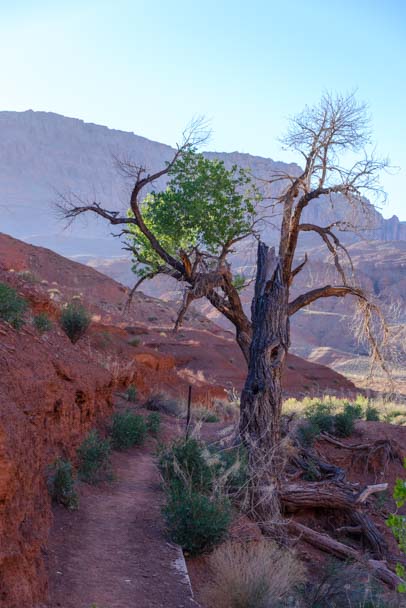
The red rock cliffs glowed a deep orange in the afternoon sun, and the cottonwood trees glowed green. What a spot!

Paria River trail hike Lees Ferry Arizona

How beautiful!

Paria River Trail hike Lees Ferry Arizona

Who knew this gorgeous canyon was back here behind Lonely Dell Ranch?!

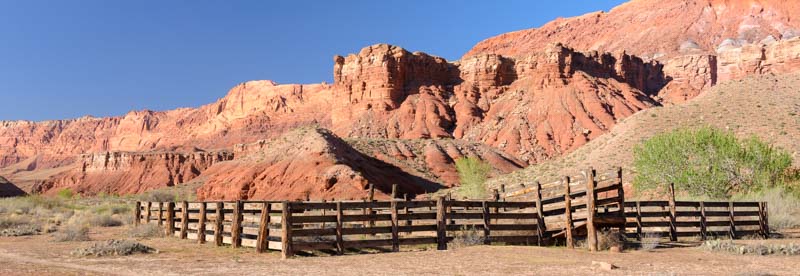
There was a corral and cattle chute in a more distant farm field. I think farming and ranching would be a pretty enjoyable activity in a setting like this!!

Cattle chute Lees Ferry Arizona

We found a corral and cattle chute out beyond the farm fields.

We walked back towards the farmhouse and caught some trees shimmering in the sun.

Artsy trees Paria River Trail hike Arizona

.

The Paria River trail at Lees Ferry is actually the end of the 40+ mile Paria Canyon trail that starts at the White House Trailhead and goes through Buckskin Gulch and the Wire Pass Slot Canyon. As we were walking, we met two hikers that were wrapping up a three day hike through Paria Canyon. They were tired and had sore feet, but they said it had been a glorious hike. That multi-day hike is said to be one of Arizona’s best.

Hikers on Paria River Trail Buckskin Gulch Lees Ferry Arizona

We met a pair of hikers doing the last mile of their 3 day Paria Canyon hike. Wow!

If it is anything like the mile or so we walked at the south end, it must be truly stunning. We were catching the late afternoon sun on the eastern red rock canyon walls, but glancing at the shaded cliffs to the west, we could see that they must light up in spectacular color in the mornings…

Dirt road Paria River Trail Lees Ferry Arizona

The golden hour just before sunset lit the red rocks beautifully

We didn’t stay long at Lees Ferry, but we got a taste that will bring us back. This is the edge of the Vermillion Cliffs National Monument, and the whole area is ripe for exploring.

Road at Marble Canyon Arizona

Rush hour on the Vermillion Cliffs Scenic Byway

If you are taking your RV through northeastern Arizona from Page westward towards Jacob’s Lake and the North Rim of the Grand Canyon and Kanab, Utah or north towards Natural Bridges, the detour to Lees Ferry is really worthwhile. The combination of red rock canyons and riverside scenery is hard to beat!

RV camping Lees Ferry Arizona

Red rock country knocks our socks off every time we visit.

Subscribe
Never miss a post — it’s free!

Our most recent posts:

More of our Latest Posts are in the MENU above.

More info about this cool area:

More posts from our RV travels to NE Arizona and SE Utah:

Wire Pass Trail Slot Canyon – A FABULOUS hike further north in Paria Canyon
Two Gorgeous Paria Rimrocks Hikes – Easy to reach (and do) hikes at the far north end of the Paria River

<-Previous || Next->

Horseshoe Bend Overlook – Page, Arizona – Stunning!

March 2016 – Horseshoe Bend is a jewel of spot just a few miles south of Page, Arizona, that’s easy to access and is a fabulous place to spend a few hours or more, especially for RVers headed through northeastern Arizona. As we brought our truck and trailer up from Sedona, Arizona, we stopped at Horseshoe Bend in the afternoon.

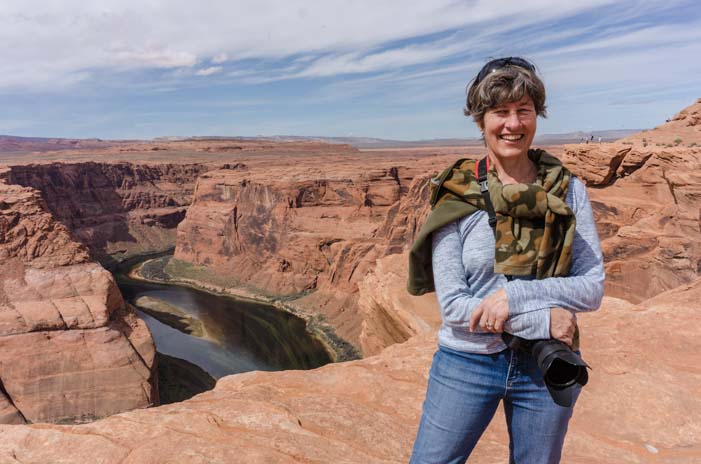
All smiles at Horseshoe Bend Arizona

At the Horseshoe Bend overlook it’s easy to be all smiles!

From the parking lot there is a 3/4 mile walk up and over a rise to get to the Horseshoe Bend overlook. Hundreds of people were on this trail going in both directions.

As we crested the rise and began the descent on the other side, we could see people scattering like ants as they approached the Horseshoe Bend overlook.

Walking towards Horseshoe Bend Arizona

Horseshoe Bend is extraordinarily popular, and swarms of tourists roam along the rim all day long.

This is a Very Cool Place. Even though we were there with throngs of other people, we felt a rush of excitement as we neared the edge. Everyone else seemed to feel the same way, and the unprotected rim of the overlook was jammed with tourists peering over the edge.

People at Horseshoe Bend Arizona

Tourists were fearless at the edge.

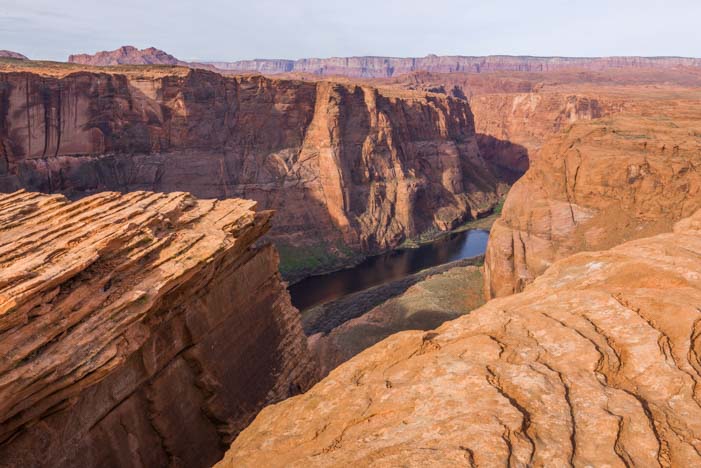
Far down below, rafters were making their way along the Colorado River. The mighty Colorado has carved Horseshoe Bend over millenia, and it is staggering to think of the force necessary to dig this huge ditch through sandstone rock, especially with the river looking so meek and mild down there.

Colorado River rafters Horseshoe Bend Arizona

1,000 feet below, rafters were floating on the Colorado River

This is a great place for selfie shots too!

At the rim of Horseshoe Bend Arizona

I wasn’t the only one who wanted a pic of themselves at this overlook.

Selfie sticks were held high aloft all around us.

Taking selfies at Horseshoe Bend Arizona

Selfie sticks were everywhere!

Taking selfies at Horseshoe Bend Arizona

No selfie stick? Use a folded up tripod!

Some folks were pretty creative getting photos of themselves. Others just laid on their bellies to get a shot of the incredible bend in the river a thousand feet down below.

Taking selfies at Horseshoe Bend Arizona

Hmmm…. should I take a photo of me or a photo of that incredible view out there??

Some were brave and crept far out on a precipice for a very dramatic photo of themselves.

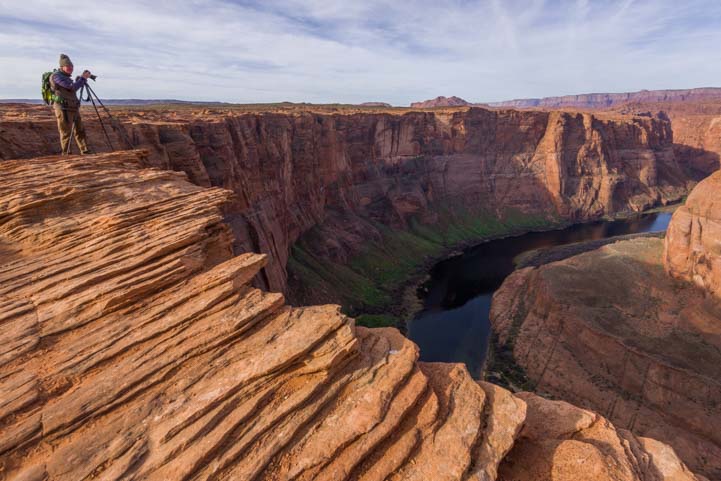
Horseshoe Bend Arizona Sitting on the RIm

The more daring the photo the better!

I’m not sure how many people had noticed the sign on the way in saying that the sandstone is crumbly and the overhanging edges have a tendency to break off…!

Photographer Horseshoe Bend Arizona

Everyone liked to be right on the edge.

As the afternoon wore on, the crowd swelled as people came in to get a shot of the sun setting over the bend in the river.

Photographers at Horseshoe Bend Overlook Arizona

Photographers lined up on the rim with their tripods.

The rim was packed with photographers getting set up for this special moment. Finding a place to squeeze in along the rim wasn’t so easy!!

Photographers Horseshoe Bend Arizona

We waited patiently for the sun to go down.

The excited discussion between everyone standing on the rim alternated between what kind of photography gear they had and speculation about whether we’d all have a chance to go for a starburst shot at the moment the sun vanished from the sky on the far side of the canyon. One woman said she had gotten a doozy of a starburst photo two nights before. We all crossed our fingers.

But Mother Nature had other plans for us that afternoon, and the sun slipped behind the horizon with nary a wink.

It was still very special!

Horseshoe Bend Sunset Arizona

We didn’t get a starburst, but the sunset was beautiful.

I had an 18-35 mm lens, but the best images were a little wider. Mark whipped out his favorite trusty 14 mm lens and got a fabulous image.

Horseshoe Bend Arizona sunset photo

Mark was able to get a beautiful and slightly wider shot at 14 mm.

As we watched the clouds drift across the sky in shades of orange and yellow, suddenly the river down below began to reflect the color. How cool!

Sunset at Horseshoe Bend Arizona

For a split second, the river reflected pink and orange back at the sky.

We left Horseshoe Bend on a total high, absolutely exhilarated by Nature’s show. If the sunset could be that magical, we thought, then what might be in store at sunrise?

The next morning we were on the trail before dawn. There were three cars in the parking lot, including ours, and a young couple was just ahead of us on the trail, weighed down with some serious looking photography gear.

I got chatting with Brittany as we trudged along the trail in the dark, and I discovered that she and her companion, Justin, were professional videographers with their own video production company, Chiet Productions. They had just landed a gig for a regular show on PBS about a nightclub in Washington, DC, that will begin airing in April. It’s called “Live at 9:30.”

They were here at Horseshoe Bend for pleasure, however, and they were planning to shoot the sunrise using timelapse photography.

Timelapse photography Horseshoe Bend Overlook Arizona

A pair of professional videographers set up three cameras on the rim for a timelapse video of the sunrise.

Mark and I went for stills, however, since that was where our heads were at this morning. it was too early to think clearly enough to figure out everything we’d need to do to set up a timelapse, although I LOVED the idea!!

The sunrise was lovely.

The funny thing is that the sunrise wasn’t all that different than the sunset the night before. The sun had set over the horizon in the distance in front of us, but the sun rose behind us, so it would seem the canyon would look quite different. However, the colors we saw at sunrise filled the sky opposite the sun as it rose, casting a soft light across the horizon front of us.

Sunrise Horseshoe Bend Arizona

This morning’s sunrise was just as lovely as last evening’s sunset.

A little while later, the sun lit up the top of the peak in front of us. As the sun rose higher and higher, the shadow on the cliff slipped lower and lower.

Horseshoe Bend Arizona between the cliffs

As the sun rose it lit more and more of the cliffs across the canyon, while the shadow crept slowly downwards.

When the big show was over, we found Justin and Brittany where we had left them with all their gear on the edge of the canyon. They had done three timelapse videos, one on a GoPro, one on a Sony mirrorless camera and one on a cell phone. Brittany showed me the one she’d done on her cell phone. She had caught the sun lighting the top of the pinnacle in the canyon and had captured the shadow slipping down its front as the sun rose higher. Wonderful!!

Videographers at Horseshoe Bend Arizona

Brittany and Justin captured some great timelapse video of the sun rising in the canyon.

The morning wasn’t over yet, though. In fact, the day was just beginning. Where there had been just four of us on the rim at sunrise, we could now see a steady stream of people pouring down the trail, cameras and tripods in hand. The rim slowly became crowded with photographers and tourists once again!

Photographers with tripods at Horseshoe Bend Arizona

After sunrise, we were joined by lots of photographers at the rim.

Curious about some rock formations nearby, we headed off to the right (north). Leaving behind the growing rush of visitors arriving at the rim, we walked out into these cool rocks.

Lines in the rocks Horseshoe Bend Arizona

Away from the fray, to the north, we found some wonderful rock formations.

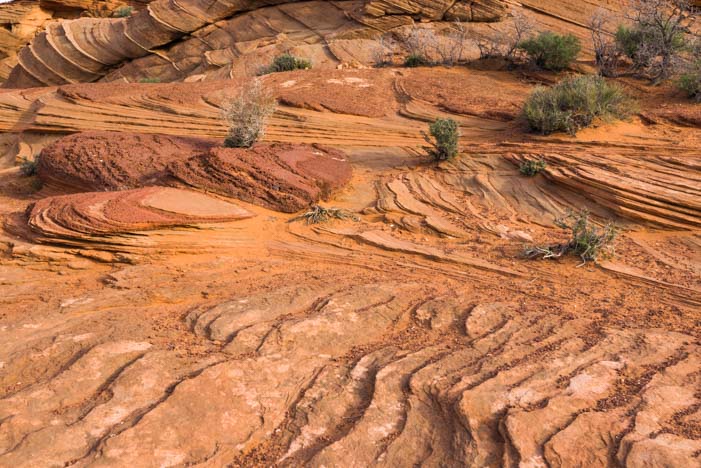
There were lots of curvy lines and ripples in the sandstone.

Patterns and Lines Horseshoe Bend Arizona

The curving lines and formations in the rocks were beautiful.

Rock crevices Horseshoe Bend Arizona

What magical shapes and formations!

We were both really intrigued by the contours of this fantastic land, and we roamed around this spot for quite some time.

Rock patterns Horseshoe Bend Arizona

The lines and patterns in the rocks drew us in.

If your RV travels take you to Page, Arizona, a stop at Horseshoe Bend is a must.

A few tips:

To avoid the crowds, the best time to get there is early in the morning.

If you are driving your RV, your best chance for finding a place to park it in the parking lot is early morning, not too long after dawn. There is turnaround room (big buses come and go regularly all day long), but it seemed to me that on weekends at peak season, especially holidays, this parking lot probably fills early and would be nearly impossible for an RV. We were there midweek in mid-March, and the number of tourists was mind boggling. The numbers intensify in the afternoon, especially near sunset.

Rock lines Horseshoe Bend Arizona

Horseshoe Bend is an overlook that deserves more than a fleeting glimpse over the edge

As you hit the walking trail to Horseshoe Bend, there’s a sign that says this is a Fee Area managed by the National Park Service. Interestingly, no money was being collected and no one asked to see our Federal Interagency Pass. The National Park Service could be making a small fortune here, as I’m sure several thousand people visit every day.

Subscribe
Never miss a post — it’s free!

More info about Horseshoe Bend:

National Park Service Website – Official description of Horseshoe Bend
Allstays – RV Parks near Page, AZ
Location of Horseshoe Bend – Google Maps (it is mis-labled “Houseshoe” and called a “chapel” – funny!)

Other blog posts from our RV travels in northeastern Arizona:

Our most recent posts:

More of our Latest Posts are in the MENU above.

<-Previous || Next->
Sedona Arizona – Brooding Skies at Sunset in the Red Rocks

March 2016 – During our RV travels to Sedona, Arizona, we were eager to capture a gorgeous sunset over the red rocks. We had seen some lovely sunsets, and we had enjoyed lots of time hiking and biking in the red rocks, so it only made sense that we should be able to get some photos of a magical sunset casting a pink and orange glow across the unique Sedona landscape.

We checked what time sunset was, got all our photography gear together, and headed out at the Golden Hour just before the sun went down.

Golden hour Bell Rock Pathway Sedona Arizona

The “Golden Hour” (an hour before sunset) on Bell Rock Pathway in Sedona AZ

We had everything we needed to capture the ethereal light of sunset. We hiked well out onto the Bell Rock Pathway to the big flat boulders in the middle where you get a wonderful 360 degree view of the majestic red rocks all around you.

Bell Rock Pathway Golden Hour Sedona Arizona

Would the brooding sky grace us with a beautiful sunset tonight?

Well, a daytime sky full of clouds doesn’t always translate into an evening sky full of pink and orange colors.

Golden sky Bell Rock Pathway Sedona AZ

Dark gray and pure white clouds striped the sky.

I had found an awesome spot to capture a vividly colorful sky with a craggy old tree framed by the red rocks, but as the minutes ticked by after the sun was gone from the sky, we both finally had to admit that this evening’s sunset was a total dud. Oh well.

Bell Rock Pathway views Sedona Arizona

Despite all the good looking prospects beforehand, the sunset never materialized.

We packed up our gear and went home. As we drove, we bolstered our rather dejected spirits with hopes for a stunning sunset tomorrow. After all, Nature would have to put on a vivid display the next night. There couldn’t be two dud sunsets in a row, could there?

So, after a day of other activites and much anticipation, we packed up our camera gear once again, hopped in the truck, and drove out to the Bell Rock Pathway for the Golden Hour a second time, our spirits high and hopeful.

Photography in Sedona Arizona

Tripods at the ready, we had everything we needed for a great sunset, provided Nature cooperated!

We had expected to see big crowds at the trailheads at sunset, but instead there were just a few vehicles. Some kids in a rental RV were climbing on the roof to get a shot of Bell Rock. They flashed peace signs at me and gave me a thumbs up.

RV motorhome at Bell Rock Sedona Arizona

Some Asian kids with a rental RV get shots of Bell Rock from the roof.

Just behind us, a girl in a beautiful pink gown was posing for a photographer. How fun!!

Photo shoot at Bell Rock Overlook Sedona Arizona

A pink gown and Sedona’s red rocks — what a great combo!

Mark posed for me too, although his outfit wasn’t quite as stunning, and the skies began to go gray above us. We stared at the darkening, mottled sky wondering how this sunset would go. Hmmm.

Bell Rock Pathway dark sky Sedona AZ

Mark models for me before we head out on the
Bell Rock Pathway trail.

Well, maybe a sunset would develop. We hoisted our tripods over our shoulders and trekked out onto Bell Rock Pathway once again.

To get a good sunset, there has to be some kind of small opening in the sky at the horizon where the sun can shine through and light up the clouds as it slips away. We watched with disappointment as the entire horizon filled with dark, dense, gray clouds, obliterating any chances the sun might have had to peek through.

Night sky Sedona Arizona

Very cool clouds, but no sunset.

We had our trusty radios with us, and we kept each other entertained with banter while we waited, even though we were on opposite sides of the huge rocks.

Eventually, the clouds and nighttime won, and the last shafts of light from the sun flashed across the sky. The sky went black, and our spirits went the same way. We couldn’t believe our luck. Two days in a row!

Stubbornly, we stayed put out on the trail until the trail itself was impossible to see, as if by remaining out there we could make the last half hour replay itself, this time with bright color and a vivid sunset.

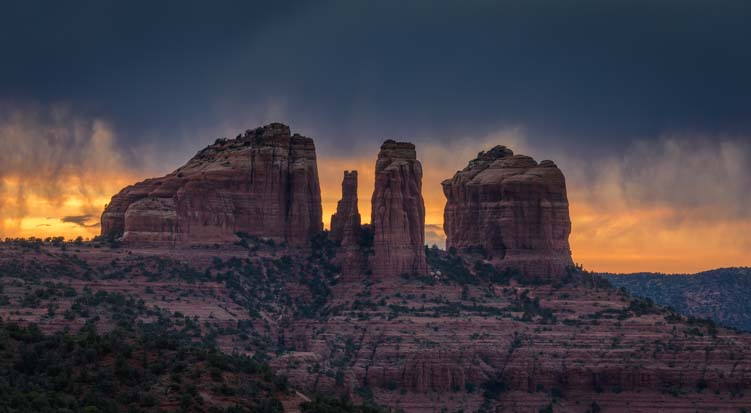
Cathedral Rock light in the sky Sedona AZ

The sun splashed across the clouds for a split second before darkness fell.

We were very quiet in the trailer that night as we sorted through our photos. Would we give it a try again tomorrow? The third time’s a charm… but then, bad things come in threes. Oh goodness.

The thing was that these nights were COLD. We each wore three jackets when we hiked out onto the trail, and the wind always found its way through our clothes, even when we snugged our hats and hoods around our ears while waiting for the sun to do its magic.

Cold nighttime photography Sedona Arizona

Staying warm at sunset in Sedona in early Mark takes a lot of layers!!

On the third day there were puffy little idyllic happy clouds in the sky all day long. Huge platoons of them marched across the sky, and they promised us they’d still be marching come nightfall so we could photograph glorious shades of magenta and orange suspended over the red rocks.

But no.

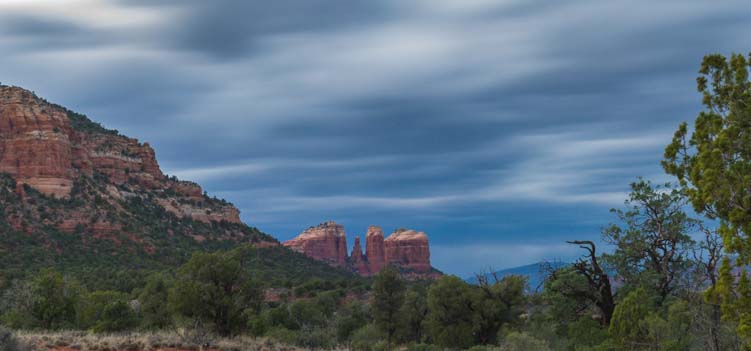
Cathedral Rock stormy sky Sedona Arizona

Clouds streak over Cathedral Rock.

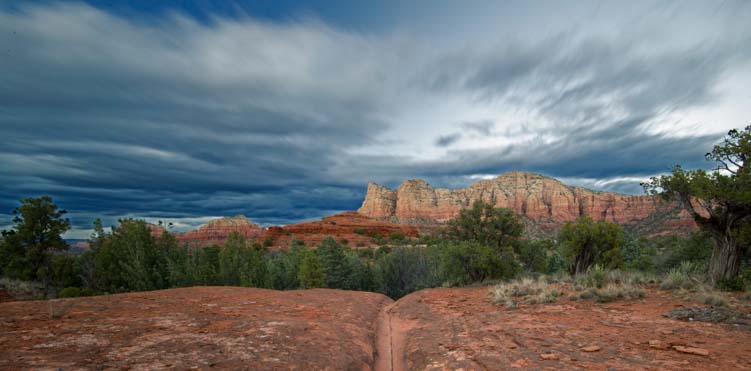
By sunset the clouds had banded together into massive blankets of gray that streaked across the sky.

Wild Skies at Cathedral Rock Sedona Arizona

The streaks over Cathedral Rock take on a wild look.

They swam from horizon to horizon, and even when the sun was able to cast its warming glow for a split second, the clouds hung heavy and dark.

Views from the Bell Rock Pathway Sedona Arizona

Sun lights the sky for a fleeting moment.

Mark got creative, though, and caught them in the act of coming directly towards him over the cliffs in the distance.

Bell Rock Pathway night views Sedona AZ

A spray of clouds.

But the color just wasn’t happening. The gods of the Sedona skies had decided not to give us any orange or pink brilliance for the third night in a row.

Suddenly, just as we were giving up hope and talking about packing it up so we could go home and get warm, we turned around and saw fire lighting the sky beneath the dramatic clouds hanging over Cathedral Rock.

Cathedral Rock at sunset Sedona Arizona

The sky is on fire at the base of Cathedral Rock.

“Holy cow. Do you see THAT?” I called on the radio.

“YES!” Mark answered. And we both leaped into action.

Sunset Cathedral Rock Sedona Arizona

Wow!

At last we had our colorful sunset skies over the red rocks in Sedona.

If you are traveling in your RV to Arizona’s red rock country in Sedona, try to get out on a hike during the golden hour for sunset. Even if you don’t get a wildly colorful sky, you will still see a lot of beauty. And who knows, at the very last moment the sun might do something magical!

Subscribe
Never miss a post — it’s free!

Each of the three nights we ventured onto Bell Rock Pathway from a different access point. The three trailhead parking lots can be found on Google Maps at this link.

Our most recent posts:

More of our Latest Posts are in the MENU above.

More info and blog posts from our RV Travels in Sedona:

<-Previous || Next->

The Crack at Wet Beaver Creek (Bell Trail Hike), Sedona, AZ

March 2016 – We really enjoyed mountain biking the Bell Rock Pathway during our RV travels to Sedona, Arizona, and one day we got chatting with young neighbors in an RV nearby about where the good mountain biking and hiking spots were around Sedona. They knew the area really well and asked if we’d ever been to The Crack at Wet Beaver.

Mark raised an eyebrow.

“No, no, not that!” They said. “It’s a really cool gorge on Wet Beaver Creek. It’s a great hike, and if you take your bathing suits you can swim there!”

Bell Trail Hike to Wet Beaver Creek The Crack Sedona Arizona

“The Crack” at Wet Beaver Creek

The next morning dawned sunny and warm, so we took off on the Bell Trail to hike into the Wet Beaver Creek Wilderness to find this infamous Crack.

Beginning Bell Trail Hike Sedona AZ

The beginning of the Bell Trail hike into the Wet Beaver Creek Wilderness goes through open grassland.

The Bell Trail is named for Charles Bell who built the trail in 1932 for moving cattle, and a sign at the trailhead indicates it is still used for that purpose today. It is about 3.5 miles from the trailhead to The Crack. The trail goes deeper into the Wilderness, but we figured 7 miles out and back was plenty for one day.

At the beginning, we hiked through open grasslands and under a canopy of trees alongside Wet Beaver Creek. After about two miles, we came across a red rock cliff soaring into the sky with a tree on top.

Hiking the Bell Trail Hike Sedona AZ

A red rock cliff with a tree on top juts into the sky

For the next mile or so we walked through gorgeous red rock scenery as the trail hung onto the edges of bright orange hillsides and zig-zagged under exotic red rock formations.

Hiking Bell Trail Sedona Arizona

How’s that for a cool trail?!

We were hiking in the morning, and the sun felt good on our skin, but later in the day this desert landscape would become very hot.

Bell Trail Hike Sedona Arizona

Desert plants, like ocotillo cactus and prickly pear, abound.

We could hear the sound of rushing water ahead of us, and soon we saw the creek splashing noisily over river rocks to our right. What a nice spot for a picnic!

Bell Trail Hike to Wet Beaver Creek Sedona Arizona

We stopped for lunch in a quiet spot where the water rushed over river rocks.

The whole area was filled with leafless deciduous trees that must bring true magic to the landscape in the fall. And what a great spot to do some flowing water photography!

Bell Trail Wet Beaver Creek Sedona Arizona

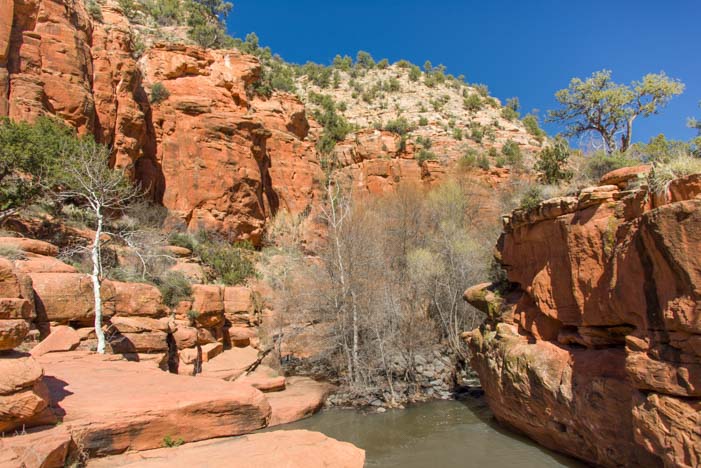
Wet Beaver Creek polishes the rocks in its path.

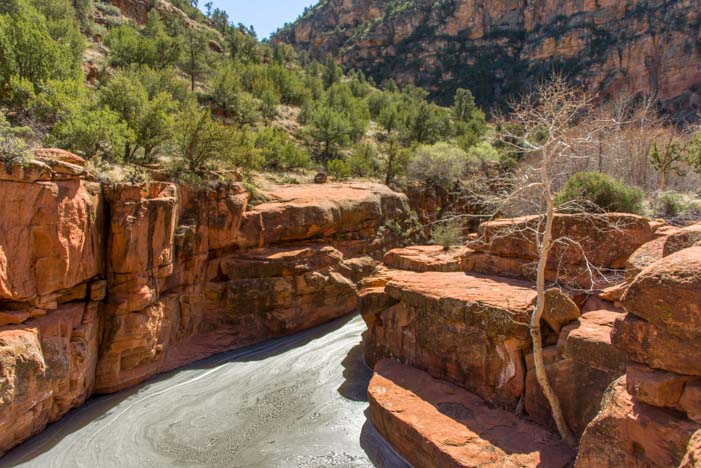
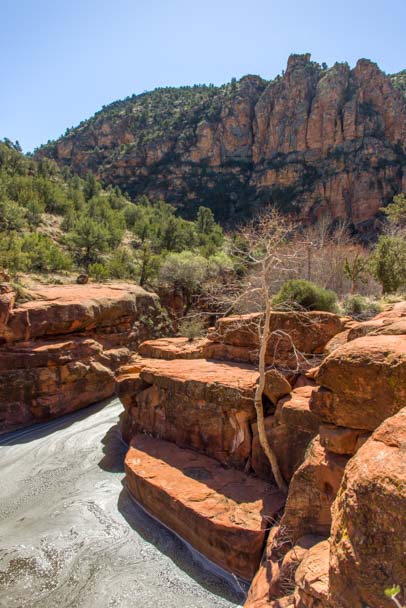
We hiked just a little futher on and suddenly the landscape opened up to massive shelves of boulders stepping down to sheer cliffs that plunged into the water below. This was The Crack!

View Wet Beaver Creek The Crack Sedona Arizona

“The Crack” is like a red rock quarry with huge flat slabs of sandstone and water far below.

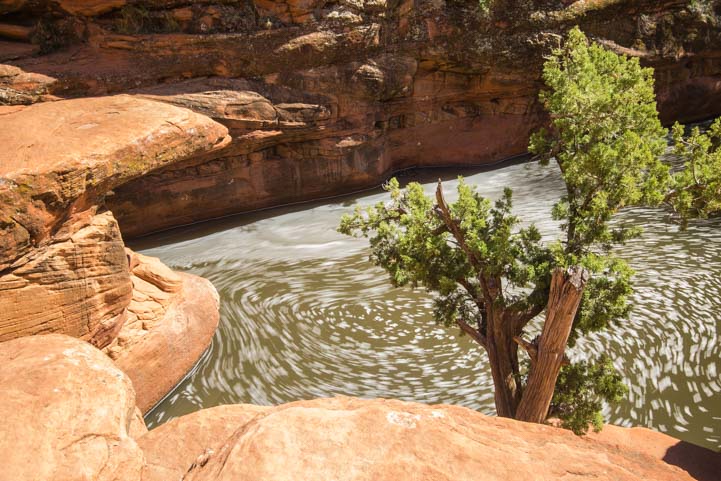
Our friends had described crystal clear water that was a lovely shade of blue, but the creek was running fast from the snow melt and had swelled so much that lots of debris had been stirred up as the water tumbled down from the mountains. The water was murky and filled with foam from the crashing waterfalls upstream.

This made for some neat slo-mo photos!

Swirls Wet Beaver Creek The Crack Sedona Arizona

The fast moving water from the snow melt created cool foam swirls

The Crack is a stunning spot that is so unexpected in the dry dusty desert.

Hike to Wet Beaver Creek The Crack Sedona AZ

The canyon walls were steep and the surface of the water was foamy!

The huge flat boulders are really inviting, and we scrambled around on them for quite a while.

Wet Beaver Creek The Crack Sedona AZ

I just love that tree growing out of the crack in the rocks.

Photography at Wet Beaver Creek The Crack

This little oasis was such a surprise after the dusty, dry hike to get here.

We had the place to ourselves. Other than the distant sound of rushing water, it was quiet and still.

Hike to Wet Beaver Creek The Crack Sedona Arizona

We had the place to ourselves…for the moment!

I ventured out onto a cool looking precipice hanging out over the water and Mark got my photo.

Diving platform Wet Beaver Creek The Crack Sedona Arizona

Little did I know that this is a favorite diving platform!

Suddenly, we heard voices coming down the trail. Two young couples appeared and set up beach towels right on that same rock precipice I’d been standing on and then stripped down to their bathing suits to get a tan.

“Are you going to jump in?” One girl in a bikini asked me.

I looked down at the murky water doubtfully. Diving into the its depths had not been on my agenda today!

Sunbathing Wet Beaver Creak The Crack Sedona Arizona

Sunbathers stretch out on the diving rock.

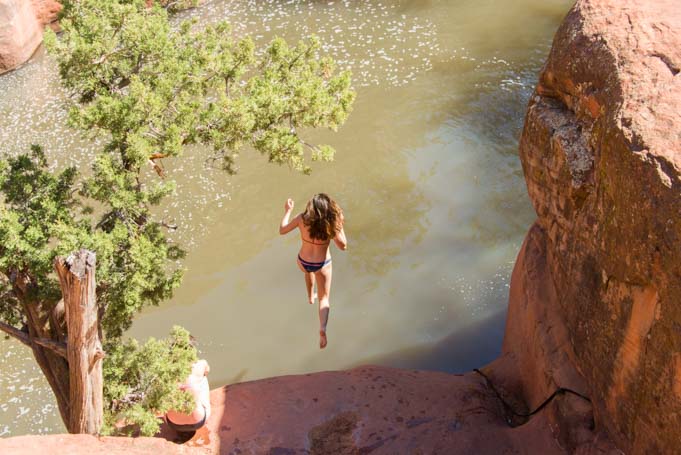
Then, I watched in amazement as she made her way down to a lower rock and jumped in. Brrr!! Then the other girl did the same.

“The water’s great!” They yelled out to me.

Well, I was happier taking photos of them than swimming, so I let them have all the fun in the water while I stayed warm and dry on shore.

They debated jumping off the rock precipice where they’d laid their beach towels, but because they couldn’t see the bottom — which they said you usually can — they decided not to. You never know what kind of submerged log might be lurking just below the surface.

Flying leap Wet Beaver Creek The Crack Sedona AZ

The water was too murky to dive from the upper rock, but this intrepid gal jumped in from lower down.

The bathing beauties climbed out of the water using a rope that someone had secured in the rock, and they settled in on their beach towels for a while.

We left them and began to make our way back along Bell Trail. The trail had gotten really busy, and we were amazed that the silence of the early morning was completely gone now, shattered by the continual voices and footsteps of other hikers making their way to The Crack on this warm Friday afternoon.

A snort and a whinny up ahead alerted us to horseback riders coming down the trail. What a neat sighting at the end of a very enjoyable hike.

Horseback riding Bell Trail Sedona Arizona

A pair of horseback riders greeted us on the trail going back.

If you spend some time in Sedona, whether you travel there by RV or some other means, a hike on Bell Trail to The Crack at Wet Beaver Creek is a really nice change of pace. More info and links below.

Subscribe
Never miss a post — it’s free!

More info about Bell Trail and The Crack at Wet Beaver Creek:

Other fun hiking and biking trails we’ve found in our RV travels:

More posts from our RV adventures in Sedona, Arizona:

<-Previous || Next->

Our most recent posts:

More of our Latest Posts are in the MENU above.

Sedona, Arizona – Great Beer, Coffee, Red Rocks & Psychics!

March 2016 – When we brought our RV to Sedona, Arizona, even though we had been there many times before, we still hung our heads out the windows of the truck saying, “omg omg omg OMG!!!” We’d forgotten just how stunning the towering red rocks cliffs are.

RV travel to Sedona Arizona red rock country

Driving into town, we were totally awed by the red rock scenery.

We were utterly mesmerized as the road carved beautiful sweeping turns through these monoliths. We just drove around for a while, taking it all in, and marveling at the views out the windows.

RV road trip and scenic drive Sedona Arizona

Anywhere you drive in Sedona, the landscapes are breathtaking.

RV adventure in Sedona Arizona and scenic drives

.

White flowering trees were in bloom all around town too. What a great combination these made with those incredible cliffs behind!

Sedona Arizona red rocks and flowers

White flowering trees were in bloom.

Sedona Arizona rock cliffs and white flowers

.

Sedona is a funny mix of dramatic natural landscapes, upscale trendy shops, and outdoor pursuits, all overlaid with a mystical, New Age flair. The Hyatt Regency has a fancy resort hotel in the middle of it all, while the main drag is dotted with psychic readers, mountain bike shops, art galleries, hiking stores, elegant bistros and souvenir shops.

Restaurants Galleries Shops Sedona Arizona

For many, Sedona is all about shopping, artsy stuff, and eating great food.

It is a vacation playground for people from “The Valley of the Sun” (Phoenix) about 100 miles away. Bustling shops selling homemade ice cream cones are lined up against a breathtaking backdrop of bright orange cliffs where tourists go on joy ride jeep tours into the rugged pink and orange desert landscapes.

Uptown Sedona Arizona

Gorgeous natural landscapes beckon just outside of town.

And every few minutes a snazzy sports car or vintage car rolls by.

Sports car in Sedona Arizona town center

Some folks travel here in style.

Fancy vintage car in Sedona Arizona

Exotic car sightings are the norm in Sedona.

It’s a fabulous town to stroll around, and we love the sculptures that grace the sidewalks.

Horse statue Sedona Arizona

Sedona is an artsy town with creative sculptures decorating the sidewalks.

Sedona Arizona T-shirts

No problem finding a souvenir t-shirt in this town!

The town was founded in 1902, and camera buffs have been stopping in at Rollie’s Camera Shop for camera gear and supplies since it opened in 1961. We dropped by three times to visit our friend Tom Kelly who works there and also sells his beautiful photographs.

How funny it was when a pair of tourists came into the shop to buy film. “Fuji Film or Kodachrome?” Tom asked them. They took the Fuji Film, but gosh, I never thought I’d hear those words again!

Rollies Camera Sedona Arizona

The back door of Rollies Camera where photographers have bought gear since 1961.

Of course, part of vacationing in a place like Sedona is relaxing with a glass of wine or a good microbrew beer after the sun has crested its peak in the sky. Sometimes you can have too much of a good thing, though, and partiers occasionally wind up regretting last night’s wild party the next morning. We passed a hilarious sign showing a fish that…well… drinks like a fish…

Murphy's Country Store Sedona Arizona

.

And where do you find the biggest selection of beer — at the best prices — in this oh-so-trendy and pricey town? At the Chevron station in the Village of Oak Creek!

Really!!

They have shelves and shelves of unusual microbrew beers, all at very modest prices, and best of all, you can build your own six pack. On Thursdays they knock even more off the price of the build-your-own-six-packs. So, if you plan your week out right, Thursday is the day to go stock up on beer.

At Chevron!

Chevron Station Village of Oak Creek Sedona Arizona

This place has the best selection of craft beer (and at the best prices) in town!

Why does a gas station have the best beer selection in a fancy dancy town like Sedona? Because it’s run by a very cool guy. Tony Pugliano is a young, entrepreneurial mountain biker who owns not just this Chevron but a 76 station over in Cottonwood too. His gas station in Cottonwood is even better. It has craft beers on tap!!

Now that’s the way to bring customers in and make them happy at your gas station!

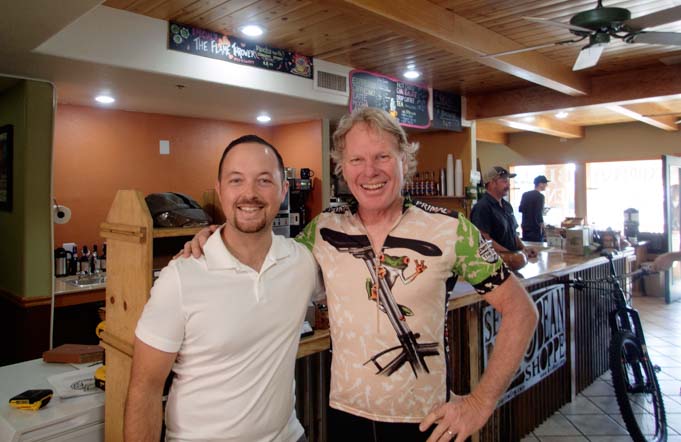
We met Tony two years ago when we brought our RV to Sedona, and this year, while stopping at the Sedona Bike and Bean bike shop to get a part for Mark’s mountain bike, who walked in but Tony! He was picking up some parts for his bike too.

Sedona Bike and Bean Sedona Arizona

Mark recognized Tony at Sedona Bike & Bean right away. What a perfect place to run into each other!

While we chatted, I got a latte. And why not? This bike shop is the Sedona Bike and Bean, afterall. When you walk in the front door of the shop, the first thing you notice — before the bikes, and bike jerseys and bike repair stands — is the huge coffee bar where you can order any kind of fancy coffee drink you can imagine.

That’s the way Sedona is. It is a haven for lovers of gourmet coffee, great beer, and the outdoors. If you are clairvoyant and/or rich, you’ll fit right in too!

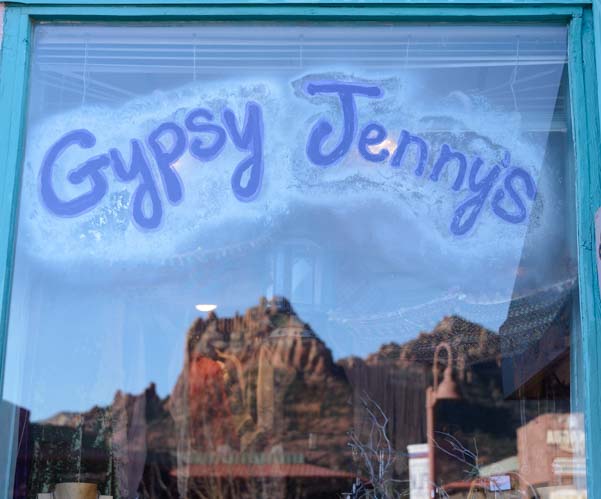
Gypsy Jenny's Sedona Arizona

Sedona is a great place for reflections — in store windows and introspectively too!

Another fun place to go for a beer is at the Oak Creek Brewery. The brew master was busy making one of our all time favorite beers when we stopped by, their Nut Brown Ale.

Oak Creek Brewing Company Sedona Arizona

The Nut Brown Ale is as fresh as it can be at the Oak Creek Brewery in Sedona.

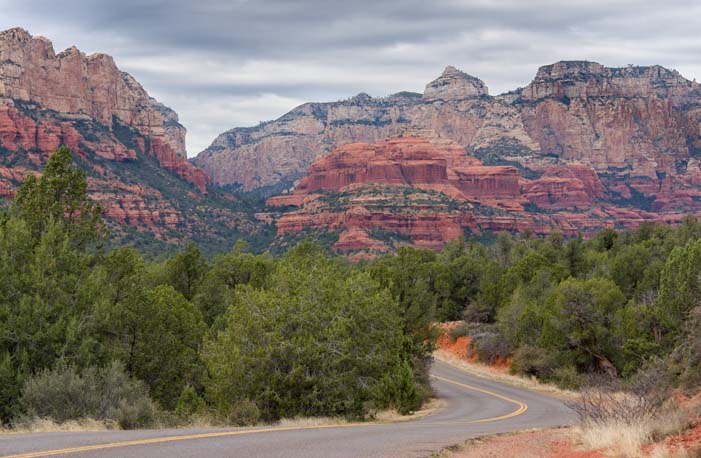
When we cruised out of Sedona to the west, we found even more stunning scenery.

Red rock scenery in West Sedona Arizona

Even under cloudy skies, the scenic drives in West Sedona are jaw-droppers.

Pink Jeep West Sedona Arizona

Pink Jeep Tours are everywhere. What a fun way to get into the more rugged areas out of town.

The red rocks and towering mountains just don’t quit!

West Sedona Arizona scenic drives in the red rocks

Sedona is in the heart of Arizona’s red rock country!

Sedona is an awesome place for RVers to settle in for a week or two.

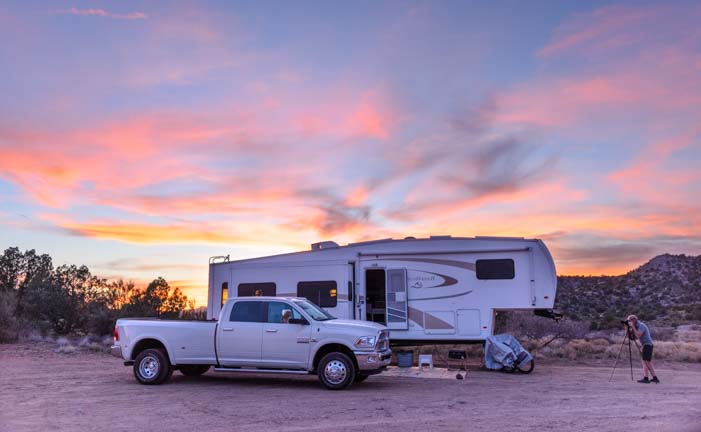
Truck and fifth wheel trailer RV at sunset

Mark catches a pink sunset over our truck.

If you have a hankering for an RV roadtrip to red rock country, Sedona is one gorgeous spot, and the climate is ideal in spring and fall! There are more tips and links and info about Sedona below.

Subscribe
Never miss a post — it’s free!

More info about Sedona Arizona:

Related posts from our RV travels in Sedona, Arizona:

<-Previous || Next->

Our most recent posts:

More of our Latest Posts are in the MENU above.

Bell Rock Pathway, Sedona AZ – Hiking & Biking the Red Rocks

February 2016 – We packed up our RV in Tucson, Arizona, when the daytimes highs began to creep over 90 degrees, and hightailed it back through Phoenix and on up to Sedona where the 4,000′ elevation makes the climate about 10 degrees cooler than down in the Sonoran Desert regions of the state.

We hadn’t been in the red rocks in over two years, and when we first caught sight of the towering red cliffs and rock formations that envelop the town of Sedona, we were almost breathless with excitement. We couldn’t wait to hit the trails, and one of the best places to immerse yourself in red rock scenery is right in the heart of it all on the Bell Rock Pathway.

Bell Rock Pathway Sedona Mountain Biking

Within a few moments of getting on the Bell Rock Pathway, hikers and bikers are immersed
in the best of Sedona’s red rock scenery

We were joined by special friends, and we set off on our mountain bikes.

Ready to ride bikes on Bell Rock Pathway Sedona AZ

Our friends Rich and Mark join us to ride the red rocks!

Bell Rock Pathway is one of the most popular hiking and biking trails in the area, and it is inundated with bus loads of tourists every day. But we were on the trail fairly early on a weekday morning, and there were just a few hikers here and there.

Hiking and biking Bell Rock Pathway Sedona Arizona

Bell Rock Pathway is shared by walkers, joggers and mountain bikers,
but there’s plenty of room for everyone.

The magic of the Bel Rock Pathway is that you don’t have to go very far to be totally wowed by the scenery. In fact, we always find we get swept up in the stunning scenery right in the parking lot, and many of the bus loads of tourists never make it past the asphalt!

Bell Rock Pathway Mountain biker and jogger Sedona AZ

What a place to go for a run — or a bike ride!

Bell Rock Pathway is beloved by walkers, joggers, and mountain bikers, and the path is wide and relatively smooth and extraordinarily scenic.

Jogger and biker Bell Rock Pathway Sedona Arizona

The views are great in every direction!

The Bell Rock Pathway parallels the main road, and there are three parking lots that give you access to the two ends as well as the middle of the trail. We started at the southern end, and the trail climbed steadily for about a mile. But the jaw-dropping vistas were worth every huff and puff as we went along.

Mountain bike Bell Rock Pathway Oak Creek Arizona

As soon as we got a little distance from the parking lot we had the trail to ourselves.

Bell Rock Pathway is a very easy mountain biking trail and is ideal for beginners. Yet there are just enough little challenges here and there to keep more advanced riders on their toes. The views become more and more spectacular with every pedal stroke.

Mountain bike Bell Rock Pathway Sedona Arizona

I couldn’t stop taking pics of Mark as he rode ahead of me!

After the first mile, the terrain goes up and down and sweeps around twists and turns qutie a bit. And then suddenly it opens up to this fantastic area of wide, flat rocks.

Bikers Bell Rock Pathway Sedona Arizona

After a mile or so the path opened onto wide flat rocks with outstanding views all around us.

Standing in the middle of this wide open area, there are eye-popping views every way you turn. It literally doesn’t matter which direction you look, you are surrounded by majestic, towering red rock formations.

Flat rocks MTB Bell Rock Pathway Arizona

These flat rocks are an ideal spot to take a breather and look around!

And then the trail takes off again, descending through wide turns.

Mountain bikers on Bell Rock Pathway Sedona Arizona

The middle portion of the trail sweeps through turns and rolls up and down small hills.

Bell Rock Pathway is a trunk route that has lots of little off-shoots, and all of those other trails are more difficult. We simply rode it to the end, about 3.5 miles from our strating point, and turned around to retrace our route.

Mountain biking Bell Rock Pathway Sedona Arizona

The Bell Rock Pathway is about 3.5 miles long one way.

The beauty of this hiking and biking trail is that the views on the way back are completely different than the views on the way out, and the lighting on the rock faces changes constantly.

Bell Rock Pathway Mountain Biking Sedona AZ

Weeeee! Bell Rock Pathway is easy and fun.

Riding behind Mark, I couldn’t stop clicking the camera, framing him inside of one magnificent view after another. Holding the camera up and riding one handed is a little dicey, though, and always makes for a rather exilharating ride!

Mountain Bikers Bell Rock Pathway Sedona Arizona

The return trip has all new views for us!

Mountain biker Bell Rock Pathway Sedona Arizona

Bell Rock Pathway is worth doing over and over again — it’s easy and it is stunning!

We enjoyed our bike ride on the Bell Rock Pathway so much that we came back to do it again a few days later.

Mountain bike Bell Rock Pathway Sedona Arizona

One very happy camper!

Mountain bike on Bell Rock Pathway Sedona AZ

We enjoyed riding our bikes on the Bell Rock Pathway, but most of the people out there were walking…

For RV travelers in search of a good way to get out into the Red Rocks without doing a strenuous hike or challenging bike ride, the Bell Rock Pathway is an ideal trail.

RV camping under the stars in Sedona Arizona

At the end of the day we all put our feet up under the stars…

Feeling a little rusty bike-wise? It might be time to get back on it again! Two years ago our 76 year old friend Marcel showed us that mountain biking is the Fountain of Youth (blog post here). Now 78, he’s still shredding the gnar out there, and all winter long he’s been mountain biking in Arizona!

More info and links for Sedona’s Bell Rock Pathway below.

Subscribe
Never miss a post — it’s free!

More info about the Bell Rock Pathway:

There are three trail head parking lots, and each one requires a parking pass, either the Red Rock pass or a Federal Interagency Pass (the old “National Park Pass” or Senior Pass). And be sure to get there early, especially on a beautiful sunny weekend.

Other posts from our RV travels featuring hikes and bike rides in red rock country:

Fun things to see and do while RVing in Sedona

Our most recent posts:

More of our Latest Posts are in the MENU above.

<-Previous || Next->
Arizona-Sonora Desert Museum – Wild Animals in Tucson AZ

February 2016 – During our RV travels in Tucson, we visited the Arizona-Sonora Desert Museum which is located in Saguaro National Park. This really fun “museum” is really more of an outdoor nature walk and zoo that lets you see all the creatures native to the Sonoran Desert up close in their natural environment.

Big horn sheep Arizona Sonoran Desert Museum

The great thing at this “museum” is that the animals don’t run away!

The Sonoran Desert spans the states of Arizona on the US side of the border and Sonora on the Mexican side of the border, and it is an ecosystem and habitat that we just love. But the most exotic birds and animals are a bit reclusive, and the iconic creatures aren’t so easy to find while out hiking in the desert.

So it was just fabulous to see a big horn sheep sitting up on a rocky hill and to be able to admire him will he slowly turned his head this way and that in the morning sun.

Big horn sheep Arizona Sonoran Desert Museum

Within moments of entering the park, we saw a big horn sheep sunning himself.

The Arizona-Sonora Desert Museum has several habitats for the animals of the different regions of the desert, with a mountain habitat for the animals that like the cooler climes amid big rocks and trees, and open grasslands for the creatures that prefer those areas.

Fox Arizona Sonoran Desert Museum

A cute little fox walks by

We haven’t ever seen a fox or a wolf while out hiking, but we got see both here at the Arizona-Sonora Desert Museum. A beautiful wolf who was pacing in his enclosure, no doubt looking for Little Red Riding Hood.

Wolf Arizona Sonoran Desert Museum

A wolf on the prowl — looking for Little Red Riding Hood!

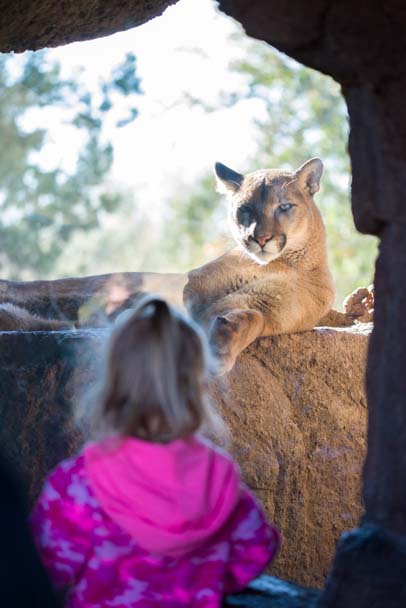
Little did he know that Little Red Riding Hood was actually over at the mountain lion enclosure!

Mountain lion Arizona Sonoran Desert museum

A little girl checks out a mountain lion… or vice versa!

You can watch the mountain lion on two sides of her enclosure. There is a plexiglass window in one corner where the little girl was, or you can stand on a slightly elevated viewing area on the opposite side of the enclosure for another view down into her mini canyon.

Mountain Lion Arizona Sonoran Desert Museum

What a beautiful cat.

This lioness kept everyone guessing and on the run. First she’d hang out by the window, but when the crowd got thick, she’d move around the corner out of sight. Then the crowd would trot around on the path to try and see her from the open viewing area on the other side.

What a hoot! As this enormous cat leaped effortlessly between the rocks by the window and the big open gully around the corner, all of us tourists ran back and forth on the path outside her enclosure, cameras and cell phones at the ready!

Mountain lion Arizona Sonoran Desert Museum Saguaro National Park Tucson

This mountain lion kept all the tourists on the run!

The trick to getting the most out of this museum is to arrive a little before the place opens at 8:30 a.m. When we arrived at 8:32, the parking lot was quickly filling and there was a line for tickets at the door already. The thing is, the animals are fed at opening time, so if you hustle down the path to the ones you want to see, you’ll catch them as they eat their breakfast.

Within an hour, most of the animals were settling in for a nap, and many of them were hard to spot!

We caught a fleeting glimpse of an absolutely gorgeous ocelot. What a fur coat!!

Ocelot Arizona-Sonora Desert Museum

The ocelot ran past so fast she was just a blur.

But after that out-of-the-corner-of-our-eyes peek at her, she was gone for the day in a quiet corner where we could just see her head moving as she licked her paws…

But we did see the bobcats. They were snoozing under a rock!

Bobcats Arizona Sonoran Desert Museum

Bobcats catnap under a rock

The Arizona-Sonora Desert Museum is artfully laid out, with paved and dirt walking paths that intersect and wind through the property. In some higher areas there are lookouts, and we loved the gnarly shade shelter that protected one of them.

Lookout Area Arizona Sonoran Desert Museum

A fun and crazy awning over a viewing platform.

There are lots of more common animals too, and we got a kick out of the javelina, an animal we have spotted many times in the desert.

Javelina Arizona Sonoran Desert Museum

Arizona’s desert “pig” – a javelina (pronounced “havaleena”

A little squirrel was busy scratching…

Squirrel Arizona Sonoran Desert Museum

I’m not sure if this guy was on display or just stopped by for the free food.

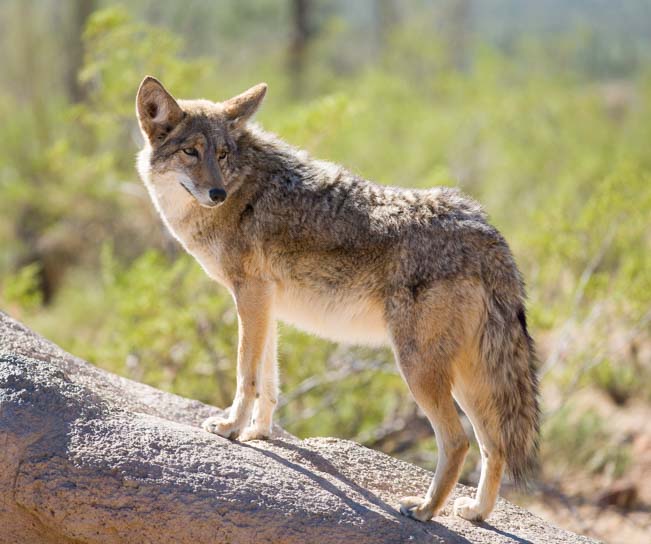
And a coyote posed for several minutes while a crowd of camera shutters clicked away.

Coyote Arizona Sonoran Desert Museum

A coyote strikes a classic pose.

We even spotted a deer back in the brush.

Deer Arizona Sonoran Desert Museum

We saw deer through the trees.

One of the big highlights of a trip to the Arizona-Sonora Desert Museum is the Raptor Free Flight presentation which happens twice a day at 10:00 and 2:00 all winter long. Again, even though we were there on a mid-week school day, the crowds were thick. Everyone stands along the walking path in one area and then a presenter begins to talk about the various birds that will be flying by.

Raptor Free Flight demonstration_

The highlight of a visit to the Arizona-Sonora Desert Museum is the raptor free flight show.

There are two trainers who have yummy dead animal pieces in their pockets, and they go into the various bird enclosures and ask the birds if anyone wants come out and fly around and get a snack.

They bring out only those birds that are in the mood, so there is no guarantee who will be flying on the day you are there!

The first bird we saw was a raven. These guys love the western National Parks, and we’ve seen them many times, but it was still a thrill to see one swoop over our heads and land on the trainer’s hand.

Ravens and crows are extraordinarily smart birds, and I’ve read of a study of a flock of crows where one member of the flock was taken away for seven years and then brought back. The flock went wild upon his return, obviously recognizing their long lost buddy.

Free Flying Raptor Exhibit Arizona Sonoran Desert Museum

A raven flies to the trainer for a snack.

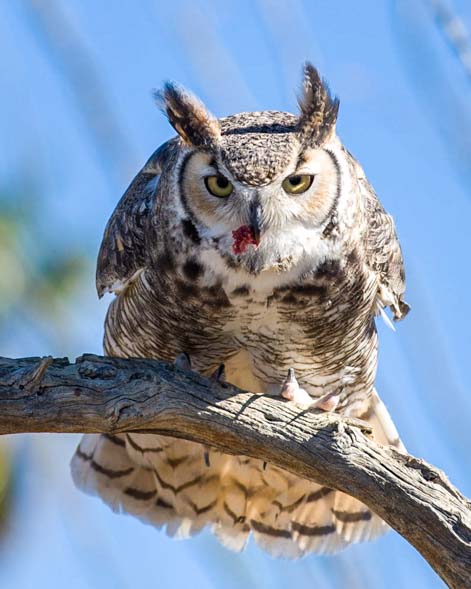
Perhaps most thrilling was the great horned owl. I have a super sweet spot for owls (we had a wonderful encounter with some adorable wild burrowing owls just a little southeast of Phoenix last year and watched a wild great horned owl at the sandhill crane roosting area in southeastern Arizona too).

Great horned owl Arizona Sonoran Desert Museum

A great horned owl came out to see the crowd.

To keep all these free flying birds within reasonable range, the trainers pulled bloody bits of thawed quail out of their pockets every so often and lure the birds over. (These weren’t pieces of the southwest’s sweet Gambel’s quail, thank goodness, but were commercially grown to feed raptors). Mark got an awesome shot of the great horned owl downing a bite!

Great horned owl Arizona Sonoran Desert Museum

Mmmm, mmm, good!!

What a beautiful bird!!

Great horned owl Arizona Sonoran Desert Museum

.

Last up was a peregrine falcon, and it was really wonderful to see a falcon flying without the leather hood that falconers usually put on them. This guy zipped around and did some fabulous dives.

Peregrine Falcon Arizona Sonoran Desert Museum

A peregrine falcon comes in for a landing.

Arizona was once home to a parrot species too. The Thick Billed Parrot lived all over the American southwest and was last seen in the Arizona’s Chiricahua Mountains in the 1930’s. They were reintroduced to the wild in Arizona in the 1980’s, but the effort was a tragic failure, in part because of predators, like hawks, and also due to releasing adults that had lived in cages for too long and had lost their street smarts.

The Arizona-Sonora Desert Museum had two thick billed parros on display, and they were making a wonderful racket!

Thick Billed Parrot Arizona Sonoran Desert Museum

A pair of thick billed parrots squawked happily

There are two big walk-through aviaries in the Arizona-Sonora Desert Museum — one for bigger birds and one for hummingbirds.

What we’ve discovered in our RV travels around the southwest is that hummingbirds of all varieties are super easy to attract with a hummingbird feeder hung outside the rig, or mounted an RV window, and filled with a concoction of four parts water and one part table sugar.

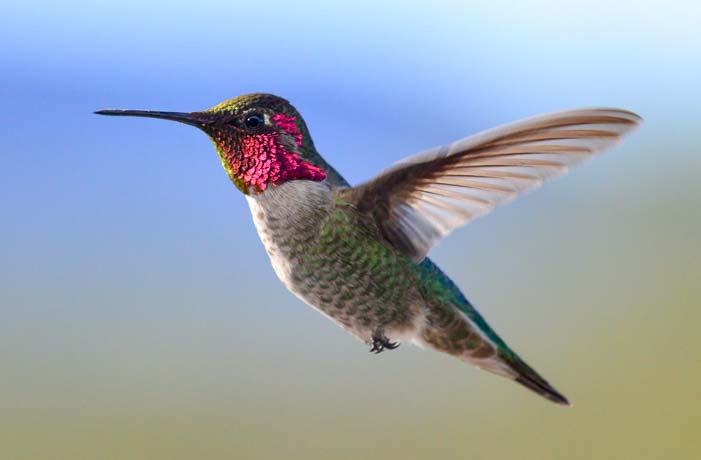
Hummingbirds

Hummingbirds are easy to attract and fun to photograph from an RV if you’ve got a feeder.

Hummingbird hand-feeding kit

A hand-feeding kit!

Even better — and a reader just alerted us to this — get a hummingbird hand-feeding kit. Doesn’t that look like fun?! We’ve just ordered one ourselves!

Another great way to attract both birds and other small animals is to put out a dish of water a little ways from the rig. We’ve used a big upside down frisbee with great results. Several birds at a time, including cardinals, will stand in and around the frisbee, taking baths and drinking.

The Sonoran Desert spans the Sea of Cortez too. This is an unusual eco-region because the creatures that live in or near the water have to contend with the very cold Pacific Ocean temps and climate that sweep up from the open ocean and the very hot desert climate and water temps that develop each summer.

The Arizona-Sonora Desert Museum has a tropical fish display that shows some of the fish of the area.

Fish Arizona Sonoran Desert Museum

The Sonoran Desert includes Baja California and the Sea of Cortez where tropical fish abound.

A trip to the Arizona-Sonora Desert Museum is a really fun excursion, especially for RV snowbirds looking for a neat daytrip during their stay in Tucson. Be sure to get there early so you can catch the animals as they chow down their breakfast!!

There’s more info at the links below…

Subscribe
Never miss a post — it’s free!

More info about the Arizona-Sonora Desert Museum:

Other fun animals sightings we’ve enjoyed in our Arizona RV travels:

<-Previous || Next->
Our most recent posts:

More of our Latest Posts are in the top MENU above.

Peach Faced Lovebirds in Phoenix, AZ – Parrots in Cactus!

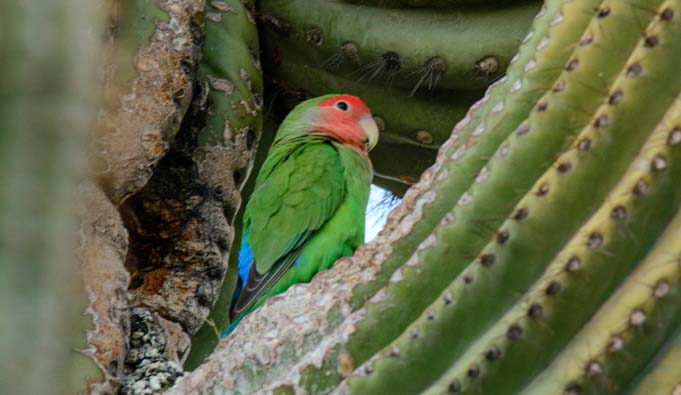
If you are walking down the city streets of Scottsdale or Mesa in the greater Phoenix, Arizona, area, you are bound to hear the squeaks of little green peach faced lovebirds as they fly between the trees and cactuses.

Peach faced lovebird parrot saguaro cactus Scottsdale Arizona

A peach faced lovebird perches on a saguaro cactus.

They nest in the holes in the saguaro cactuses that have been made by other birds (mostly woodpeckers and flickers), and they are just as adorable as can be when they peek out of these nesting holes and look down at you.

Peach faced lovebird in a saguaro cactus Scottsdale Arizona

A peach faced lovebird peeks out of a saguaro cactus

I have wanted to get a photo of one of these little cuties sitting in a saguaro for ages, and I had the chance a few days ago when we were visiting with our friend John Sherman, a professional wildlife and bird photographer who shoots for Arizona Highways. He knew of a saguaro cactus nearby where the peach faced lovebirds hang out in the late afternoons. 

Peach faced lovebird in saguaro cactus nest in Scottsdale Arizona

.

He is a full-time RVer who lives in a wonderful custom built Class C motorhome, and he has a mouthwatering collection of photography gear.  He very kindly he let me borrow his humongous 150-600 mm Tamron lens (that I have been lusting after) to take a bunch of shots.

Wow, what a lens, and WOW what a fun experience! (And thanks, John, for the inspiration to buy one a few months later!).

Peach faced lovebird parrot saguaro cactus Phoenix Arizona

.

I’m not used to lenses that hang out nearly a foot from the camera body, so it took me a while to wrestle the thing into submission and make it stay still in my hands. But the little birds in the arms of the saguaro cactus waited very patiently as I got myself sorted out, and once I started shooting, they seemed happy to pose.

What a surprise it was to see one lovebird in the flock that was a blue mutation!

Peach faced lovebird parrot blue mutation Scottsdale Arizona

A blue mutation of a peach faced lovebird!!

Peach faced lovebirds are not native to Arizona. They are actually native to southwestern Africa! However, over the years escaped pet birds have established themselves in the urban Sonoran Desert, and they have become naturalized citizens of the state.  All the flocks in the desert areas here are descendants of escaped pet birds.

Peach faced lovebird parrot blue mutation saguaro cactus Scottsdale Arizona

Pretty in pink…and pretty in blue!

They love the dry desert heat of the Sonoran Desert because it is just like their ancestral home across the ocean in southwestern Africa! They are savvy to bird feeders, and they make the most of whatever offerings they can find in residents’ back yards.  Wisely, they seem to have developed a palate for yummy Sonoran Desert goodies too.

Peach faced lovebird parrot Mesa Arizona

.

Not all “introduced” species are appreciated, and certainly not all of them have endearing little personalities like these guys.  This part of Arizona seems to attract special feral animals, though, and last year I wrote about the wonderful wild horses we found living just beyond the Phoenix city limits.  Arizona’s wild parrots have been enjoyed for many years (here is an article about them.

Peach faced lovebird parrot in Mesa Arizona

.

Wild parrots can be found all over the country, and a few years back we bumped into a wonderful documentary about a flock of wild parrots that has taken up residence in San Francisco.  This is charming movie, Wild Parrots of Telegraph Hill, is one of our favorites (blush), and we have watched it time and again, as it always makes us smile.

Peach faced lovebird parrot in a palo verde in Mesa Arizona

.

Where do these peach faced lovebirds live around Phoenix? Check out the streets between 52nd and 64th Street and Cactus Road to Thunderbird Road in Scottsdale. They can also be seen in the trees between Albertson’s and the Shell station across the parking lot at McDowell Road and Power Road in Mesa, here.

Peach faced lovebird parrot on saguaro cactus Scottsdale Arizona

You’ll hear these guys’ high pitched squeals long before you see them!

Subscribe
Never miss a post — it’s free!

Other fun bird sightings from our Arizona RV travels — and on our boat in Mexico:

Our most recent posts:

More of our Latest Posts are in the MENUS.