Blue Ridge Parkway Highlights (Virginia) – Mills, Music & Farms!

May, 2015 – As our RV travels along the Blue Ridge Parkway took us north from North Carolina over the border into Virginia, we stopped at the Mabry Mill. This beautiful old mill was built by one Edwin Mabry who used it to grind corn and saw lumber for his neighbors in the early 1900’s.

RV and Mabry Mill Blue Ridge Parkway Virginia

A motorhome passes the Mabry Mill in Virginia

We arrived in in the third week of May, just as the rhododendrons began blooming. There is something about an old wooden building like this with flowers and a paddle wheel outside that just begs to be photographed. Especially when water is splashing off the paddle wheel!

Mabry Mill Blue Ridge Parkway Virginia

The rhododendrons were just coming into bloom

We found out that this mill is one of the most photographed buildings on the whole Blue Ridge Parkway! So, we we had to add ours to the mix…

Mabry Mill selfie Blue Ridge Parkway Virginia

A serene setting…

Mabry Mill Virginia Blue Ridge Parkway

Inside the mill, an old fellow showed us how a very long lever arm is used to start and stop the flow of water over the paddle wheel. This effectively turns on and off the power that the wheel generates. It also explained why, when we were outside taking pics, the paddle wheel would periodically turn and dump some water and then stop spinning and sit still for a while. The guy inside was showing people how it turned on and off!

Inside Mabry Mill generating power

A long lever arm controls the water flow to the paddle wheel.

Edwin Mabry used the power from the mill to do all kinds of things that electricity would do today

Visiting places like this always makes me marvel at how easy so many things are today. What a huge effort it was to grow grains, harvest them, separate out the seeds to be ground, take a bag of them to your neighbor’s mill to get it ground, and then go home and bake some bread. I would cherish every slice of that loaf!

Mill saw inside Mabry Mill Virginia on the Blue Ridge Parkway

The old mill saw — powered by the paddle wheel!

As we drove on the Blue Ridge Parkway, we found that much like the Smoky Mountains a little further south, the views out across the mountains and valleys form layers that fade into the distance. “Smoky” and “Blue” are very apt names!

Blue Ridge Mountains on the Blue Ridge Parkway in Virginia

Blue RIdge Mountains

Just a bit south of the Mabry Mill on the Blue Ridge Parkway, we visited the Blue Ridge Music Center. This fantastic little museum is maintained by the National Park Service, and it explains the history of bluegrass and mountain music. We discovered that bluegrass is an amalgam of all the musical traditions from the people that were living in these mountains over a century ago.

I had never known this, but the banjo is an instrument that was brought over from Africa! The lyrics, patter and general style of bluegrass music can be traced to traditional Irish folk songs. And the purely vocal harmonizing has its roots in German liturgical music. All of these different kinds of musical traditions blended together here in the Appalachian mountains, and over a period of time, bluegrass music emerged.

Old photo of blacks playing banjo and guitar

The banjo came from Africa!

The best part of the Blue Ridge Music Center is that it’s not just a museum. It’s a place for enjoying music! Every afternoon from noon until 4 pm, musicians perform for free in the breezeway which is a big open room right next to the museum. It has a large barn door that can be left open to make the room airy and breezy or can be closed. It’s very informal. Folding chairs are set up in front of the performers, and people come and go, enjoying the music all afternoon.

Live bluegrass music at Blue Ridge Music Center_

Scott Freeman & Willard Gayheart perform bluegrass music for tourists courtesy of the National Park Service. Different musicians play for free for 4 hours every day!!

We saw Scott Freeman & Willard Gayheart while we were there, and we were floored by their wonderful playing. For those who want more music, the Blue Ridge Music Center hosts a complete outdoor summer concert series that takes place on a stage in front of a big lawn.

Just 40 miles away in the town of Floyd, we found that there is all kinds of blue grass and old time music going on for free, or close to free, in the Floyd Country Store (blog post here) — and what a great time we had there!

Republic of Floyd Virginia

Quietly defiant Floyd Virginia hosts free bluegrass concerts. They sometimes spill out onto Main Street, even though it’s a major state thoroughfare!

We traveled on the Blue Ridge Parkway itself a little, but we did most of our driving on the roads that criss-cross the parkway and run parallel to it. This is an extraordinarily hilly area, and we found ourselves constantly driving either up a steep grade or down one, which made us very happy we had done the disc brake conversion upgrade on our trailer a few months ago in Texas.

It seemed to be a daily occurrence that Mark suddenly blurted out, “I love these new brakes!”

As we approached Hillsville, Virginia, on Memorial Day Weekend, we found ourselves not only in the hills but caught up in some really crazy traffic as the whole town put an enormous yard sale as part of their Memorial Day Flee Market!

Traffic and hills in Hillsville Virginia

Crazy traffic and steep hills on Memorial Day in Hillsville Virginia

But as we ventured north, taking in some of the highlights of the Blue Ridge Parkway, whenever we got away from the cities and towns, the countryside became wonderfully rural, and we passed one beautiful farm after another.

Farm in southwestern Virginia near Blue Ridge Parkway

We saw lots of farms as we drove around.

Virginia farms

Picturesque farms in the countryside

We even passed an old RV parked next to some very tidy rows of vegetables.

RV on a farm in Virginia

A vintage RV with new crops coming up.

This is a pretty part of the country!

10 771 Farm in southern Virginia

Virginia farm near the Blue Ridge Parkway

More lovely Virginia farms…

16 701 Blue RIdge Parkway area farm in Virginia

If you take your RV to the Blue Ridge Parkway, you’ll find mills, music, farms and much much more!

Subscribe
Never miss a post — it’s free!

Our most recent posts:

More of our Latest Posts and Quick Pics are in the top MENU above.

More info from this part of the Blue Ridge Parkway:

Related posts:

<-Previous || Next->

Waterfalls of the Blue Ridge Parkway (North Carolina)

May, 2015 – The Blue Ridge Parkway is 469 miles long, and it creates a link between Great Smoky Mountains National Park down south in North Carolina with Shenandoah National Park up north in Virginia. It’s a very skinny road, and private land abuts it on both sides, so most of the attractions are just off of it to one side or the other.

There is so enormously much to see and do along this long stretch of road that we decided we’d shape our Blue Ridge Parkway adventures by having a theme: waterfalls.

We’d had a lot of fun exploring some of the waterfalls in Great Smoky Mountains National Park, so we started hunting for more waterfalls as we traveled northeast along the parkway. The first one we went to was Soco Falls. It’s fairly close to Cherokee, North Carolina, where we’d been staying for a while.

SOCO FALLS

Soco Falls Blue Ridge Parkway North Carolina

Soco Falls near the Blue Ridge Parkway in North Carolina

The hike down to Soco Falls is steep but quite short. There is a viewing platform partway down, but the real beauty of the falls lies well below that at the very bottom of the falls.

We had to scramble a little bit on the slick muddy trail to get down to the bottom. Luckily, there was a strong rope strung between some trees to give hikers a handhold in the steepest parts. Once we got down to the bottom, the view looking back up at the falls was spectacular.

Soco Falls Blue Ridge Parkway North Carolina

Soco Falls

Soco Falls Blue Ridge Parkway North Carolina

Hiking below the viewing platform takes you to the best views!

Soco Falls Blue Ridge Parkway North Carolina

Looking up at the falls from the bottom

A group of local kids was down at the bottom of the waterfall too, fishing. “Look, we’ve caught 8 fish!” one of them told Mark excitedly, holding up a small canvas bag in his grubby hand. Mark asked what they planned to do with them. “Eat them, of course!” the kid said, giving Mark a funny look.

The kid vanished lower down the falls, and then came back up again a little while later. “What are you doing?” he asked Mark as he stared at his camera and tripod. When Mark said he was taking pictures, the kid asked what for. “To look at, of course!” Mark said. This time he gave the kid a funny look!

Soco Falls Blue Ridge Parkway North Carolina

What a beautiful place…

Whether you come to these falls to fish or to take photos to look at later, they’re wonderful. The hike to the bottom is well worth the little bit of extra scrambling to get all the way down, even if it’s muddy.

DUGGERS CREEK FALLS

The next waterfalls we wanted to see were Linville Falls and Duggers Creek Falls which are both reached from the same trailhead parking area. At the Linville Falls Visitors Center, we saw a breathtaking photo of Duggers Creek Falls and decided to do that hike first.

The skies were getting dark, however, and we joked with the ranger that we really ought to buy two of the rain ponchos they had for sale, just in case. But we didn’t. In fact, Mark even left his rain jacket in the truck.

Linville Falls VIsitor Center Blue Ridge Parkway North Carolina

Mark feeds a raccoon on a painting at the Linville Falls Visitors Center.

The hike to Duggers Creek Falls isn’t very long, and we had just gotten to the bridge down near the waterfall when the skies opened up. We hid out under a rock outcropping for a little bit, but the rain went from simply pouring to coming down in torrents. In no time, we were drenched, especially Mark without his jacket. We decided to make a run for it back to the visitors center.

Linville Falls hike to Duggers Creek Falls

Duggers Creek Falls is beside that bridge

As soon as we walked in the door of the visitors center, Mark grabbed two rain ponchos off the shelf and slapped them down next to the cash register. Water was dripping from his soaking wet hair right down his nose as he handed the clerk his credit card. How funny!

Of course, after about half an hour or so the sun came out. So, down the trail we went once again. This time we were not only both wearing our rain jackets but we had our nifty new rain ponchos tucked into our packs too. Surely, that guaranteed the sun would stay out!

Duggers Creek Falls Blue Ridge Parkway North Carolina

A view of Duggers Creek Falls from the bridge

We took the shortcut hike from the far end of the parking lot this time, and when we got down to the bridge, the view of the waterfall was lovely. But the falls are set far back from the bridge, and they weren’t nearly as dramatic as the photos we’d seen.

Then we realized that the best spot to see these falls was from under the bridge! Mark waded out into the water with his tripod.

Duggers Creek Falls Linville Falls Blue Ridge Parkway North Carolina

The better view of the falls was from under the bridge — and out in the water!

He got some beautiful photos.

Duggers Creek Falls

Duggers Creek Falls

Suddenly, he jumped. “Ow!” He said. “I’m getting bitten!” He slapped something off his leg. It was a little lobster looking creature — a crayfish, or a crawdad thing with claws. It had crawled up his leg and nipped him! Yuck!! But the beautiful photos were worth it.

Duggers Creek Waterfall Blue Ridge Parkway North Carolina

Duggers Creek Falls

We were both playing with using long shutter speeds to make the water smooth, and soon we noticed that the foam and bubbles at the bottom of the waterfall were drifting downstream and making wonderful patterns on the surface of the water in our photos.

Waterfall foam streaks water at Duggers Falls

We got a kick out of playing with the foam patterns.

The foam streaked past us in all kinds of interesting lines and shapes. At one point it even flowed in a circle, and I just happened to catch that moment with my camera.

Duggers Creek Waterfall Swirling Water

I got a shot where the foam went in a circle. Cool!

We ended up enjoying Duggers Creek Falls so much — and for so long — that we never made it to Linville Falls. Oh well. Next time!

CRABTREE FALLS

The last waterfall we visited on the North Carolina end of the Blue Ridge Parkway was Crabtree Falls.

Crabtree Waterfall Blue Ridge Parkway North Carolina

Crabtree Falls – North Carolina

The hike down was pretty easy (although the return trip was a bit of a workout), and the waterfall was a fabulous and dramatically steep cascade over lots of big rocks.

Crabtree Falls Blue Ridge Parkway North Carolina

Crabtree Falls is a neat cascade that goes over lots of different rocks on its way down

A closeup of a tree in front of the falls made for a beautiful, mystical shot right out of a Tolkien fantasy.

Crabtree Falls Blue Ridge Parkway North Carolina

A world apart

While I had been busy getting my mystical closeup of the tree against the waterfall, I discovered that Mark had been busy taking photos of a cute blonde girl sitting on a rock with the waterfall as a backdrop. Hey! Granted, she’d asked him to take her pic, and sure, she was thrilled to get the photo for her facebook friends. But…

Soon she disappeared up the trail, and we posed ourselves on the same rock to get a nice selfie. How lucky we were to be enjoying another gorgeous waterfall!

Crabtree Falls Blue Ridge Parkway North Carolina

We were loving these waterfalls on the Blue Ridge Parkway!

There are dozens and dozens of waterfalls along the Blue Ridge Parkway, especially at the southern end. These three — Soco Falls, Duggers Creek Falls and Crabtree Falls — are all stunning waterfalls that are easy to reach.

If you take an RV roadtrip along the Blue Ridge Parkway — whether driving the RV directly on it or driving on the roads nearby — any one of these waterfalls makes for a really fun excursion.

Subscribe
Never miss a post — it’s free!

Our most recent posts:

More of our Latest Posts and Quick Pics are in the top MENU above.

Here’s a little more about each waterfall:

Other posts from this general area:

<-Previous || Next->

Blue Ridge Parkway (North Carolina) – Wildflowers Everywhere!

May, 2015 – The south end of the Blue Ridge Parkway is in Cherokee, North Carolina, right next to the Newfound Gap Road that traverses Great Smoky Mountains National Park, and we enjoyed some wonderful views at the beginning of this scenic drive.

Blue Ridge Parkway North Carolina

The Blue Ridge Parkway in North Carolina (see the motorcycle on the road?!)

Blue Ridge Parkway North Carolina

Pretty views from the Parkway

Motorcycles were everywhere, but this is a road that would be great for cycling too because, even though there’s no shoulder, there’s very little traffic.

Cyclist on Blue Ridge Parkway

There are so few vehicles on this road, it makes for good cycling.

Two tunnels at the south end make it best for tall RVs to find an alternate route, but they are neat to drive through in something smaller!

Tunnel on Blue Ridge Parkway North Carolina

The first few tunnels are a little low for an RV

Tunnel View on Blue Ridge Parkway North Carolina

Spring was in full bloom and we saw lots of wildflowers. White trillium and huge bright orange azaleas were blossoming on either side of the road, as well as some pretty pink flowers. Down at our feet, while tromping around at an overlook, we spotted a big yellow butterfly. He flew off when a matching butterfly landed nearby.

Trillium

Trillium

Azalea flower Bllue Ridge Parkway North Carolina

Wild azaleas

Pink wildflower

Pretty in Pink

Butterfly or moth

We watched several of these guys flying around…and this one landed by our feet.

The Blue Ridge Parkway was built between 1935 and 1983 to give people a way to travel along the crest of the Blue Ridge mountains and enjoy their ethereal beauty without interruption between Great Smoky Mountains National Park to the south, in North Carolina, and Shenandoah National Park to the north, in Virginia. It is a narrow ribbon of protected land that threads its way across these two states, from the southwest to the northeast.

Motorcycles on the Blue Ridge Parkway North Carolina

A Path Between the Trees

Ironically, because much of the road is lined with tall trees, it is often impossible to see across the valleys! At many overlooks the trees have grown so tall since the time the overlooks were constructed that you can’t see the view at all. Looking past the sign that says “Overlook” all you see is trees! But every once in a while the vistas open up, and the views are lovely.

Blue Ridge Parkway mountain views

Although many overlooks have no view, occasionally a stunning one opens up.

Oddly, driving through all these twists and turns under an endless archway of trees can get a little tedious after a while, since the views rarely change (in the fall, however, I imagine the colors are extraordinary). So, we hopped on and off the Blue Ridge Parkway as we snaked our way north, enjoying the activities, small towns and hum of life that goes on alongside it.

Even though the Blue Ridge Parkway is part of the National Park System, just like Great Smoky Mountains National Park, there is no fee to enter or drive on it. It intersects other roads frequently, and in many places the locals use it as a shortcut from here to there.

At one point in our travels on and off the parkway we found ourselves on I-40 just west of Asheville, North Carolina. We were zooming along on the freeway when we suddenly saw a massive field of wildflowers at the side of the road. Mark slammed on the brakes (yay for our new trailer disc brakes!) and pulled off the highway.

Wildflowers I-40 Asheville North Carolina

Driving on I-40, west of Asheville, we see a meadow full of colorful wildflowers

The wildflowers were just stunning. We’ve seen so many photos of fields of wildflowers over the years, and we’ve always dreamed of taking wildflower shots where the land was blanketed in color. But where are those photos taken? We just don’t see fields of wildflowers in our travels like some people manage to get in their photos.

wildflowers

All shades of pink and red!

Well, I guess one huge field of wildflowers can be found on the eastbound side of I-40 just west of Asheville, North Carolina!

Wildflowers I-40 Asheville North Carolina_

There were even a few blue flowers in the mix!

Wildflowers on the freeway Asheville North Carolina

We were thigh deep in flowers and loving it!

I don’t know what kinds of flowers these were, but they were blooming in all shades of pink, red, white and peach.

Wildflowers on the Interstate North Carolina

As the cars flew by us on the highway, all in a rush to get somewhere else, we stayed in this spot for over an hour enjoying this glorious display of Nature’s handiwork.

Wildflower Blue Ridge Parkway North Carolina

Spring wildflower

Many people drive the Blue Ridge Parkway to enjoy the vivid display of rhododendrons that happens every spring. But we discovered that spring is a great time for flowers in other places in North Carolina too, even out in the wilds of I-40!

RV in wildflowers I-40 Asheville North Carolina_

If you want your rig surrounded by wildflowers, the Blue Ridge Parkway is nice — but try I-40 too!

Subscribe
Never miss a post — it’s free!

Our most recent posts:

More of our Latest Posts and Quick Pics are in the top MENU above.

More info about the Blue Ridge Parkway in North Carolina:

Related posts about the Blue Ridge Parkway and the Smokies:

<-Previous || Next->

Solar Charge Controllers – Optimizing RV Battery Charging

The solar charge controller is the heart of any solar power installation on an RV or boat. It is the gatekeeper between the solar panels and the batteries, and it determines how much of the sun’s energy that is available to the solar panels will actually be converted into electrical current to charge the batteries.

Because solar power is a “set it and forget it” type of system, it is not “mission critical” to understand the inner workings of these complex pieces of gear. However, if you want to get the most out of your solar panels, you may want to fine tune your system to increase its battery charging capacity by programming the solar charge controller for optimal performance.

This page gives the low-down on how solar charge controllers work, presents ideas for how to size them, and explains what the typical input parameters are and how they affect performance. It then explores three specific charge controllers made by three different manufacturers, and compares the unique ways that each manufacturer has tackled the challenge of multi-stage charging via the sun.

Since we started traveling full-time in 2007, as of June 2019, we have used, worked with and lived with these particular units for over 4,000 nights of living off the grid in our RV and sailboat.

1200 Solar Charge Controllers and RV Battery Charging

An in depth look at solar charge controllers

This is the third part of our 4-part series on RV and marine battery charging systems.

So far in this series, we have reviewed the basic concepts involved in charging RV and marine batteries, including an in-depth review of multi-stage charging, and we also have looked at how “artificially powered” charging systems like converters, inverter/chargers and engine alternators go about the process of battery charging. The other parts in this series are:

This is a long post and you can read it in stages and navigate to the different sections by clicking on the links below:


SOLAR CHARGE CONTROLLER OVERVIEW

Return to top

Solar charge controllers are a lot more complex than all of the charging systems described so far in this series (converters, inverter/chargers and engine alternators), and they offer a lot more flexibility for programming too, usually through a menu driven screen interface. What makes these systems so complicated?

— The sun not a consistent power source like the local power plant or an engine

“Artificially powered” chargers like converters, inverter/chargers and engine alternators have unlimited power backing them, either from electricity at a power plant or an engine. This allows them to perform optimally no matter what the circumstances are. In contrast, solar charge controllers are dealing with a very flaky power source.

The sun — flaky? Yes! The energy available from the sun varies all day long. At noon when the sun is high in the sky there’s a lot more energy available than in the morning and evening when it is low. The sun also gets covered by clouds now and then, and sometimes it goes away all together or never comes out all day.

Storm clouds swirl above our RV

The solar panels COULD be working, but…

In summertime, the days are long and the sun is out for many hours. In winter, the days are short and the sun is out very little (if at all — think Alaska). And every night all year long the sun vanishes for hours. Trees and buildings can cast shadows on solar panels, affecting their ability to generate current. For boats at anchor, sometimes the mast or boom will shade the solar panels every few minutes as the boat swings back and forth, making the current coming in from the panels rise and fall repeatedly.

— Solar panels can’t always do the job at hand

The batteries on an RV or boat are charged by the sun as long as it is light, regardless of what kinds of electrical appliances you are running inside. Sometimes there’s enough extra energy from the sun that the panels can do two jobs: charge the batteries AND support things like hair dryers and microwaves. But at certain times of the day, the solar panels may not be able to produce enough current to power those appliances AND charge the batteries at the same time by holding them at their target Absorb or Float voltage.
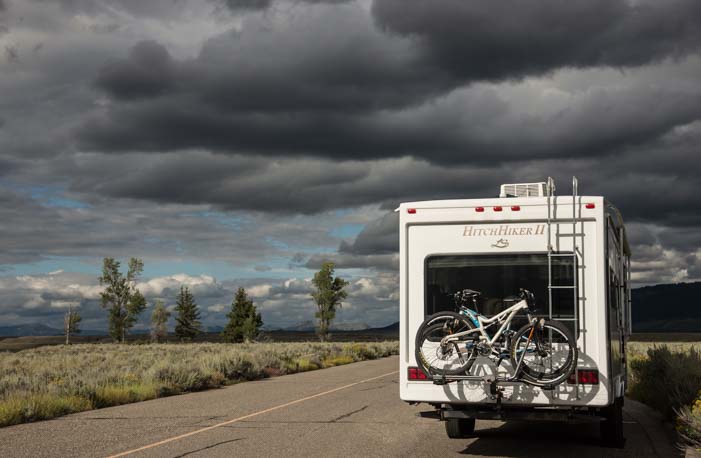
Solar power is difficult when cloudy

The solar charge controller keeps busy as the sun comes and goes

The net effect may be that the batteries are actually be being discharged while those loads are running, even though the solar panels are actively charging them. Sure, the sun mitigates the discharge rate, but overall the batteries are giving up more current than they are receiving from the solar panels. This temporary period of discharging means the solar charge controller will need to keep the batteries in the charging state a little longer to make up for the lost charging time.

— Solar charge controllers operate 24/7

Another difference between artificially powered and naturally powered charging systems is that solar charge controllers do not get turned on and off or plugged in and unplugged. Solar charge controllers operate 24/7, and they are busy communicating with the solar panels all the time to see how the sun is affecting them. At night, solar charge controllers stop talking to the panels quite so frequently since they know the sun won’t shine again for many hours. They “sleep” for a few hours, waking up periodically to see if the sun has risen yet.

Because there is no on/off switch, there isn’t necessarily an easy way for a solar charge controller to be forced into Bulk mode other than by virtue of the “wake-up” phase first thing in the morning. If, for instance, you want to force a solar charge controller into the Bulk stage at 2:00 in the afternoon, you may or may not be able to, depending on the unit.

— No two solar charge controllers are alike

Each solar charge controller manufacturer has a different way of dealing with the inconsistencies of solar power production. Some are easy to program and some are more difficult. Some have many adjustable input parameters and some have just a few. Some can be forced to start a Bulk charge at any time, and some can’t.


CHARGING FROM THE SUN AS IT RISES AND FALLS

Return to top

Generally, a solar charge controller wakes up and immediately puts the batteries in the Bulk stage. Sounds great! However, the Bulk stage in low light may mean the batteries are getting just a trickle charge of an amp or two, because the solar panels can’t produce any more than that.

This means that frequently, for much of the morning, even though the solar charge controller is in Bulk and you’d expect the batteries to be getting blasted with current (which would be happening with an “artificially powered” charging system), the batteries are actually getting just a few anemic amps while the sun is slowly rising in the sky.

Depending on their state of charge at dawn and the size of the solar panel array, this trickle charge might actually be enough for the batteries to reach the Bulk voltage sometime before lunch. They will then switch out of the Bulk stage and into the Absorb stage before the sun has actually reached its peak in the sky where it can produce max energy.

Isn’t it ironic that by the time the solar panels are able to operate at full power, the batteries may not need it any more?!

However, having the batteries out of Bulk and into the Absorb stage during the hours that the sun is highest in the sky is actually optimal. The current delivered by the solar charge controller can slowly taper off as the sun falls lower during the afternoon. Once the Absorb stage is done, and the solar charge controller is operating in the Float stage, the low angle of the sun and the panels’ reduced ability to produce current is not a problem because the charge controller now wants to deliver less to the batteries anyway.

All this is great for sunny days… but not everyday is sunny!

On the other hand, it may be a cloudy morning until noon, or the RV may be in the shade of a mountain until noon, so by the time lunch rolls around, the batteries are still just as discharged as they were at breakfast — or even more discharged because you spent the morning playing on the computer or watching TV.
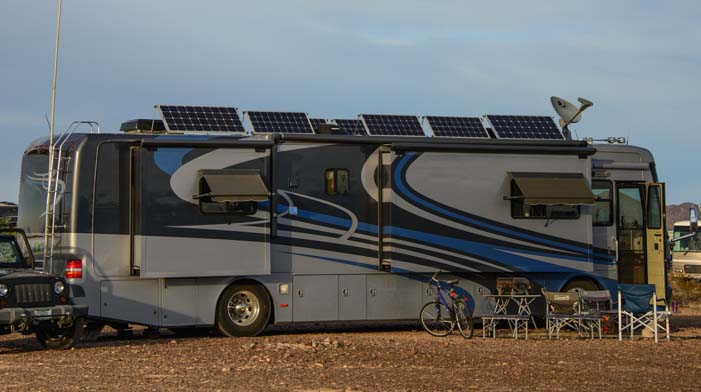
Lots of solar panels

Lots of solar panels

Now, when the sun comes out or the mountain’s shadow moves off the RV’s panels, the solar charge controller is still in Bulk mode. Suddenly the panels can run full blast and operate as close to their rated output current as possible (how close they can operate to their rated maximum depends on how close they are to being perfectly perpendicular to the sun’s rays).

In this case, having a bigger solar panel array is helpful because now it becomes a race with the clock to get the batteries through the Bulk stage and through the Absorb stage before the sun gets too low in the sky in the late afternoon.

And of course there are those cloudy days, or rainy days, and/or short winter days, when, try as they might, the solar panels just can’t produce the current needed to get the batteries through the Bulk and Absorb stages completely by the end of the day. On these days, you hope for more sun the next day or, if you get a bunch of these days in a row, eventually you turn to an artificially powered charging system like a converter or a inverter/charger ((via a portable gas generator or an onboard generator or shore power electricicity) or an engine alternator to finish the job.


SIZING A SOLAR CHARGE CONTROLLER

Return to top

The rule of thumb for sizing solar charge controllers is not the same as for sizing artificially powered chargers. Remember, in Part 1 of this series, we mentioned there is a rule of thumb that says a battery charging system’s max output current should be roughly 25% of the capacity of the battery bank. This means that, in very approximate terms, a 440 amp-hour battery bank needs a 110 amp charging system.

However, solar charge controllers are generally sized to a solar panel array rather than to a battery bank. The sizing parameters for a solar charge controller are the maximum number of watts coming in from the solar panel array and the maximum current going out to the batteries. Add up the total watts in the solar panel array and the maximum amount of current the array can produce, and make sure those numbers are within the specs of the solar charge controller.

The traditional rule of thumb for sizing a solar panel array to a battery bank is that the total watts should be more or less equivalent to the amp-hour capacity of the battery bank.

Conventional Rule of Thumb:

Total solar panel array watts = Total battery amp-hours

However, this may end up under-sizing the solar panel array just a bit. As an alternative, you might start by sizing the solar charge controller to the battery bank using the 25% rule of thumb for sizing battery chargers to batteries:

1 – Solar charge controller output current = 25% Total battery amp-hours

THEN size the solar panel array so it maxes out the total watts and total open circuit voltage specified for the solar charge controller.

2 – Total solar panel array watts = Maximum input watts for Solar charge controller

Here’s an example using a 435 amp-hour battery bank of four Trojan T-105 Reliant AGM golf cart style batteries as a starting point. This is our battery bank and is the maximum amount of battery capacity our 36′ fifth wheel trailer can carry comfortably due to weight and space constraints.

Using the Conventional Rule of Thumb above, the total wattage of the solar panel array would be approximately 450 watts. This is sufficient in the summer months in North America and might be sufficient at the equator or in the Land of the Midnight Sun in the winter months, but in our experience, our 490 watts of solar panels on our RV roof is inadequate during winters in the southern US when the sun is low in the sky, the days are short and winter storms create overcast skies for days on end.

Using the Two Step sizing method above instead, you would choose a solar charge controller that has a maximum current output of 25% of 435 amps = ~108 amps. The Outback FlexMax 80 is an 80 amp solar charger (relatively close to the 108 we’re looking for). It can support up to 1,000 watts of 12 volt solar panels (and more watts for higher voltage panels). Note that to get 80 amps of current, you’d need to have the solar panels facing 90 degrees to the sun, and the solar charge controller would need to be operating in the Bulk stage.

Sizing the solar charge controller this way, we are now looking at 1,000 watts of solar panels instead of the 450 watts that the Conventional Rule of Thumb came up with — twice as much!

This sizing method is probably overkill. However, it might make sense to size the panels and controller both ways and choose something in between. As I’ve said, in our case, 600 to 800 watts lying flat on our RV roof without tilting would be nice in winter.
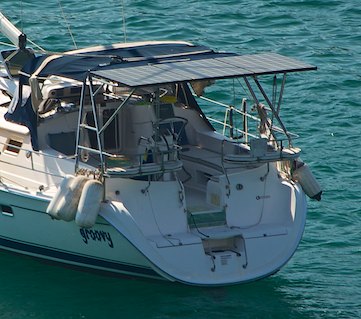
Boat solar power installation

Our sailboat had 555 watts of solar power.
Note the shade on the panels from the mast and spreaders.

For us, on our boat (710 amp-hour battery bank) we could have used a 750 watt to 1,000 watt solar panel array instead of the 555 watts we had to run the systems we had on board, despite having ample sunshine throughout our cruise.

All of this is given here as food for thought. Sizing panels and batteries and solar charge controllers is all very flexible. More of everything is better, but the reality is that there are roof space constraints for the panels, and there are both weight and space constraints for the batteries, and those limitations will ultimately dictate your particular options for panels and batteries.

A truck camper and a Class A diesel pusher (or a Catalina 27 sailboat and a Nordhavn 62 trawler) obviously have different constraints and needs.

In very general terms, anything from a 450 amp-hour / 500 watt system to a 900 amp-hour / 1,200 watt system is fine for both boats and RVs that are used to boondock or anchor out for months on end, depending on whether you run electric refrigeration and how much you stay up at night watching TV with the lights on and/or stay home during the day using computers, electric appliances and power tools.


OUTBACK MX60 MPPT SOLAR CHARGE CONTROLLER

Return to top

Now that we’ve seen the challenges that solar charge controllers face, let’s look at a specific example.

We installed an Outback MX60 MPPT solar charge controller in our fifth wheel trailer. It’s been in operation all day everyday that we’ve been in our trailer since we purchased it new in 2008. Since then, the Outback MX60 model has been discontinued and replaced by the new and improved Outback FlexMax 60 solar charge Controller.

The Outback FlexMax 60 MPPT Solar Charge Controller has the following algorithm:

BULK: Deliver maximum current until the Bulk voltage is reached.

ABSORB: Deliver as much current as necessary for the batteries to maintain the Absorb voltage. Transition to the Float stage when one of the following things happens:

  • The charger has been in the Absorb stage for as long as it took for the batteries to reach the Bulk voltage.
  • The current coming from the batteries has dropped below a certain level

If the sun fades and the controller can’t deliver enough current to keep the batteries at the Absorb voltage, extend how long the batteries stay in Absorb by the length of time the voltage fell below the Absorb voltage.

FLOAT: Deliver enough current to keep the batteries at the Float voltage.

EQUALIZE: Equalization voltage and time parameters are programmable, and equalizing can be done automatically or started manual. If Equalizing can’t be completed in one day, the batteries will resume equalizing the next day until the equalizing time has been completed.

Everything in the Outback MX60 charge controller (and the Outback FlexMax 60/80 Solar Charge Controllers) is programmable on a four-line LED menu driven display. You enter the battery type (Flooded, Gel, AGM) and that gives you default values for Bulk, Absorb and Float voltages. You can then override those values with values of your own if you wish.

So, how does this solar charge controller compare to a converter, inverter/charger or engine alternator?

If you compare the Outback MX60’s charging algorithm shown above to that of any of the artificially powered charge controllers described in the previous article, you can see just how very much more complicated this solar charge controller is. Here’s a little more detail:


SWITCHING FROM ABSORB TO FLOAT BASED ON TIME

Return to top

The key part of any multi-stage charging algorithm is when to switch from the Absorb stage to the Float stage. (If you are unclear about those stages, read more here: RV and Maring Battery Charging Basics). All charging systems use TIME as a basic criteria. The question is how long?? Should the batteries stay in Absorb for 2 hours or 4 hours? Should it always be the same amount of time?

To be most amenable to the batteries’ needs, the state of charge of the batteries when they first start charging must be taken into account. If the batteries are nearly fully charged when charging starts, why keep them in Absorb for three hours? That’s like forcing down extra helpings of pie after a big Thanksgiving dinner. Maybe just a small piece is enough on a full stomach.

On the other hand, if the batteries are deeply discharged when the charging begins, they should stay in Absorb longer to make sure they really get full. If you didn’t nibble on hors d’oeuvres before dinner and you skipped lunch and breakfast, then extras helpings of everything at the Thanksgiving table might taste and feel great.

Outback tackles this conundrum by looking at how long it takes the batteries to reach the Bulk voltage. If they are well charged already, they’ll zip to the Bulk voltage quickly. In that case, they don’t need to stay in the Absorb stage for very long. On the other hand, if they are deeply discharged, it will take a long time for them to reach the Bulk voltage. In that case, they should hang out in Absorb for a long time until they are really and truly fully charged.

The way the Outback charge controllers accomplish this flexibility in the length of time of the Absorb stage is that they make the Absorb stage last for the same length of time as the Bulk stage did. If Bulk took 2 hours, then Absorb will last for 2 hours. If Bulk took 3 hours, Absorb will be 3 hours. Clever!


WHAT IF THE TARGET VOLTAGES CAN’T BE MAINTAINED?

Return to top

Unfortunately, the sun isn’t all that consistent for such a basic algorithm, and there is more to it than just a simple one-to-one relationship between Bulk and Absorb. What makes this business tricky is that the sun may not allow the charger to hold the batteries at the Absorb target voltage once they begin Absorbing. For instance, in the middle of the Absorb stage, the sky might cloud over. The charge controller will respond by instantly opening the floodgates for the batteries so it can get the necessary current from the panels to keep the batteries at the Absorb voltage. But if the panels can’t deliver, there’s nothing the solar charge controller can do, and the battery voltage will fall below the Absorb voltage.
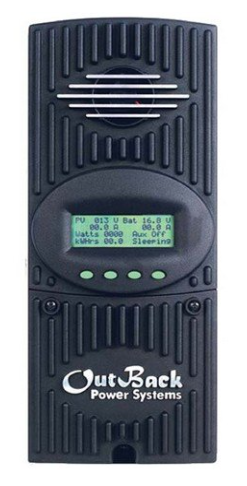
Outback FlexMax 60 MPPT Solar Charge Controller

Outback FlexMax 60 MPPT Solar Charge Controller

In another scenario, someone in the RV or boat might turn on an electrical appliance that draws a lot of current — more than the panels can deliver — and this will temporarily lower the battery voltage below the target voltage. Running the vacuum or a hair dryer in addition to whatever else is running in the RV or boat might be just enough to draw more current from the batteries than the sun on the panels can produce.

In these cases, the solar charge controller will try to keep the batteries in the Absorb stage, but it’s failing. The thing is, if there isn’t enough current to keep the batteries at the Absorb voltage, are they really Absorbing? Not exactly. They’re getting as much current as possible, but the voltage has dropped below the Absorb stage threshold.

The Outback charge controllers view this as a kind of “timeout” period. So, for every minute of this “timeout,” they tack on a minute of extra time that the batteries must stay in Absorb before they switch to float.

For instance, if the batteries have been in Absorb for 53 minutes when the sky suddenly clouds over, the Outback charge controller will start counting how long the batteries stay below the Absorb voltage. If they stay below for 14 minutes, then once the sun comes back out and they get back to the Absorb voltage, they will need to stay in Absorb for an extra 14 minutes on top of the time period they were planning on (which is either the length of time that the Bulk stage took that day or a minimum amount of time programmed by the user). When they resume Absorbing, the Outback will resume counting from 53 minutes with a new target time that is 14 minutes longer than before.

This problem of the solar panels not being able to deliver enough current to keep the batteries at the target voltage exists in the Float stage as well as the Absorb stage. However, in the case of the Float stage there is no time consideration. Once they get into Float, the batteries will stay there (or attempt to stay there) until dark.

If you are confused, here is a real live example:

One day around noon our batteries had reached the Float stage (we’d gone to bed early the night before, so the batteries had charged up quickly). They were humming along getting about 4 to 10 amps or so to maintain a 13.5 Float Voltage with whatever stuff we had running in the RV (laptops, etc.).

I got out the vacuum, and when I turned it on, the charge controller jumped into high gear, demanding max output from the solar panels. The panels could deliver 25.6 amps, but that wasn’t enough to maintain the Float voltage of 13.6, and the battery voltage dropped to 13.1 until I finished vacuuming. Then everything went back to where it had been.

Lesson learned: use a broom not a vacuum!

You can see the display from the Outback charge controller here:

Outback MX60 Solar Charge Controller

Outback MX60 Charge Controller display at midday with vacuum & computers running.
Note the batteries have dropped to 13.1 volts (below Float) and the current coming from the panels to the batteries is a huge (for “Float”) 25.6 amps to support the load in the RV. “F-MPPT” means “I’m in the Float Stage but I need max power ’cause I can’t maintain the Float Voltage.”

Even if the sun is out all day long and the batteries reach the Float stage, at the end of the day when the sun begins to set, the charger will no longer be able to hold the Float voltage. As it gets darker and darker, the charger will try valiantly to hold the Float voltage, but the battery voltage will drop lower and lower while the charge controller delivers less and less current.

Eventually, when it gets completely dark outside, no current will be going to the batteries at all. If the batteries were in Float before the sun went down, they will settle out at 12.7 volts, fully charged. If they never reached the Float stage, however, you’ve gotta cross your fingers for good sunshine tomorrow!


SWITCHING FROM ABSORB TO FLOAT BASED ON CURRENT

Return to top

As I mentioned in the previous article in the description of the Xantrex Freedom 25 Inverter/Charger, a rule of thumb is to switch from Absorb to Float when the current that the batteries need to remain at the Absorb voltage drops below 2% of the amp-hour capacity of the battery bank.

For a 450 amp-hour battery bank, this would be 9 amps. For a 750 amp-hour battery bank, this would be 15 amps. So, for a 450 amp-hour battery bank, a reasonable time to switch from Absorb to Float is when the current drops below 9 amps. For a 750 amp-hour battery bank it is when the current drops below 15 amps.

The Outback FlexMax 60 (and 80) allow you to enter whatever number of amps seems right to you, whether it is 2% of your battery bank or some other number that you prefer.

Why is it important to switch from Absorb to Float when the amount of current the batteries need to remain at the Absorb voltage drops below a certain level?

The batteries may be nearly fully charged, but if the charging algorithm forces them to stay in Absorb for a set period of time — three hours for instance — they may need just 1 or 2 amps to maintain the Absorb voltage. It might be better for the batteries if they were allowed to slip back to the Float voltage at that point rather than forcing them to stay at 14.7 volts while accepting a minuscule amount of current until the 3 hours is up.

However, the reverse may also be true. There may be situations where you don’t want the batteries to be in the Float stage even though the charging current has dropped below 2% of the battery bank capacity. More on that further down.


WHAT HAPPENS AT NIGHT?

Return to top

Because solar charge controllers operate 24/7, there are three more states that the Outbacks can be in:

  • SNOOZING: The voltage of the solar panels is greater than the voltage of the batteries but there is no current coming in from them
  • SLEEPING: The voltage of the solar panel array is less than the voltage of the batteries
  • ZZZZZ…: The solar charge controller has been in the SLEEPING state for 3 hours or more

The controller has an algorithm for waking up as well. As the sun rises, once the voltage of the solar panels is more than 2 volts higher than the voltage of the batteries (i.e., the panels are at 14.7 volts or more if the batteries are fully charged at 12.7 volts), it looks for current coming in from the panels. If the current is still near 0, it SNOOZES in 5 minute intervals while it waits for the current to reach about an amp. Then it goes into Bulk and starts its work for the day. This happens each morning as the sky becomes light and the solar panel voltage rises from 0.


LOW LIGHT — FULL MOON and STREET LAMPS

Return to top

It doesn’t take much light to bring a 400+ watt 12 volt solar panel array up to 15 volts. A full moon with clear skies may raise the voltage on the panels to this level, and parking under a bright street light will definitely do it. This is not enough light for the solar panels to generate current, but it can sometimes be enough to fool the charge controller that the sun might be about to rise and give it a sleepless night.

We have seen our solar charge controller pull an all-nighter as it alternated between SNOOZING and WAKE-UP all night long because the solar panel array was steady at 15 volts from a street light overhead while the batteries were at 12.7 volts.

The charge controller couldn’t start the real SLEEPING phase because the panel voltage was higher than the battery voltage. But there wasn’t enough light to generate any current either. So, the controller would WAKE-UP, discover there was no current coming in from the panels, and then it would go back to bed and SNOOZE a little longer. It would repeat this unfortunate cycle all night long, never getting into the really good 3 hour long ZZZZ… sleep stage (poor thing!).

On the other hand, while staying in the Catskill Mountains about 120 miles from New York City, I crept out at 2:00 in the morning to see how the charge controller was doing. The city lights kept the sky from being very dark, and the panel voltage was elevated slightly to 9 volts rather than the usual 0 volts we see in more rural areas. However, the batteries were more than 2 volts higher than that at 12.7, so the charge controller was well into its REM sleep phase, dreaming of sunny days. (Mark crept out to photograph the fireflies…a much better reason to climb out of bed at 2 am!!)
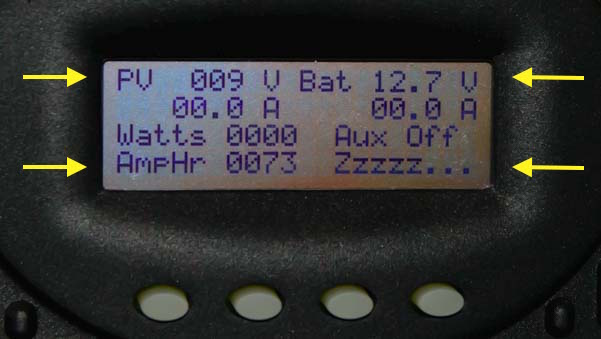
Outback FlexMax solar charge controller sleeping near NYC

At 2:00 a.m. in the Catskills, the lights of NYC reflecting off low clouds raise the Panel Voltage to 9 volts. The previous day the batteries got 73 amp-hours of charge, so they are fully charged at 12.7 volts, more than 2 volts higher than the panels. The controller is sleeping soundly for 3 hours when it will check the panel voltage again.


XANTREX XW MPPT 60-150 SOLAR CHARGE CONTROLLER

Return to top

We installed a Xantrex XW MPPT 60-150 Solar Charge Controller on our sailboat. Xantrex is now Schneider Electric, and this unit has been replaced with the Schneider Electric XW MPPT 60-150 solar charge controller. I don’t know if this is just a name change on the unit or if the design of the unit has changed in any way.

This solar charge controller is about the same size as the Outback but has a two line LCD display instead of four, so you have to scroll through the menus a bit to get the same info you can see at a glance on the Outback.

The challenge for us on our boat was that we had a smaller solar panel array than we needed for our typical daily power consumption due to our electric (DC) fridge and standalone freezer. 555 watts of solar power was not enough. So, we needed the charge controller to get the solar panels to provide as much current as possible everyday.

Unfortunately, it took us a while to realize that the factory default settings on the Xantrex charge controller were preventing the solar panels from providing as much current as they could.

The Xantrex charge controller came with a factory default setting to switch from Absorb to Float when the current being delivered to the batteries dropped below 2% of the amp-hour capacity of the battery bank, or 14 amps.

Xantrex XW MPPT 60-150 Solar Charge Controller in a sailboat

Our Xantrex XW MPPT60-150 charge controller on our sailboat

The problem was that once the current going to the batteries dropped below 14 amps, the solar charge controller put them into the Float stage. In the Float stage they needed much less current to maintain the Float voltage, usually around 5 amps. That’s a lot less than the nearly 14 amps they had been getting in Absorb!

What this meant was that even if the sun was shining brightly, the batteries were being given less current than the panels were capable of delivering because the solar charge controller had put them in the Float stage. The gatekeeper had closed the gate most of the way!

We would watch the system go into the Float stage at 1:00 p.m. and waste the best sunshine of the day sitting in the Float stage all afternoon charging the batteries with a lot less current than it would have if the controller were still in Absorb.

So, because the Xantrex charge controller had the programming option available, we programmed it to switch into Float when the batteries needed only 5 amps to maintain the Absorb voltage instead of the 14 amps that was 2% of our battery bank size. This way we were able to charge the batteries up by an extra 25-30 amp-hours each day.

However, the Xantrex controller didn’t make this programming option obvious. Rather than having an input parameter for the current at which to switch from Absorb to Float like the Outback models have, you could enter only the size of the battery bank. The controller would then calculate what 2% of that value was and would use that value to switch from Absorb to Float.

So, we had to fool the controller by saying our battery bank was only 250 amp-hours rather than the 710 amp-hours that it actually was. Then it would switch from Absorb to Float when the current dropped to 5 amps (2% of 250) instead of at 14 amps (2% of 710).

This also could have been alleviated by throwing the system back into a Bulk charge, and in our first days of working with this system, there were many times when I wished there were a setting to force the charge controller to put the batteries back in the Bulk stage whenever I wanted. But unlike the Outback solar charge controllers, this Xantrex model did not have that option.

So, as you can see, the Xantrex XW MPPT 60-150 Solar Charge Controller takes a slightly different approach to the challenges of solar charging than the Outback models do. Here are the details:

The Xantrex XW MPPT 60-150 Solar Charge Controller charging algorithm is the following:

BULK: Deliver the maximum possible current to the batteries until they reach the Bulk voltage

ABSORB: Deliver as much current as necessary for the batteries to maintain the Absorb voltage. Transition to the Float stage when one of the following things happens:

  1. The current necessary to maintain the Abosrb voltage is 2% of the battery bank capacity
  2. The batteries have been in the Absorb stage for 2 hours (modifiable)
  3. The batteries have been at or above the Float voltage for 8 hours

FLOAT: Deliver enough current to the batteries to maintain the Float voltage.

EQUALIZE: The voltage and times for equalizing are user defined.

This charging algorithm is pretty straight forward, except for that odd 3rd way that the controller might switch from Absorb to Bulk. What’s going on there?

— What if the target voltages can’t be maintained — another technique!

That third trigger Xantrex uses for switching from Absorb to Float allows for the situation where the battery voltage has dropped below the Absorb voltage temporarily due to either clouds or shade or big loads in the RV or boat (vacuums or refrigerator compressors) drawing the voltage down for a while because the panels can’t deliver enough current. What it’s doing it that even if the batteries haven’t been at the Absorb voltage the whole time, as long as they have stayed above the Float voltage for at least 8 hours, they are considered ready to leave the Absorb stage and enter the Float stage.

Remember, the Outback solar charge controllers dealt with this same challenge of flaky sunshine by tracking how long the batteries fell below the Absorb voltage and then forcing the batteries to stay in Absorb for that same number of extra minutes to make up the lost time.

The Xantrex method is a little more simplistic than the Outback method, saying that as long as the battery voltage stayed above Float for 8 hours, they have been sufficiently charged and can switch to the Float Stage.

— Programming the charge controller for improved performance

As a recap, our goal was to keep the batteries in Absorb for as long as possible. So, I modified two of the Xantrex solar charge controller’s input parameters to allow this to happen:

  1. Pretend our battery bank was just 250 amp-hours instead of 710 so it would stay in Absorb down to 5 amps (modifying criteria #1)
  2. Increase the Absorb stage time limit from 2 hours to 8 hours (modifying criteria #2)

What these two programming changes ultimately did was they made the batteries stay in the Absorb stage for 8 hours, getting a healthy amount of current from the solar panels, unless the current happened to drop below 5 amps (2% of 250) before 8 hours was up.

This worked really well for 750 nights of anchoring out.


PROGRAMMING THE CHARGE CONTROLLER TO THE BATTERY MANUFACTURER’S SPECS

Return to top

We were extremely cautious with the AGM batteries in our boat and did not want to modify the solar charge controller’s default voltage settings for AGM batteries since AGM batteries are sealed and they can’t be charged at as high a voltage as flooded batteries (this is explained in more detail in Part 1 of this series).

The default charging voltages for AGM batteries on the Xantrex XW MPPT-60-150 Solar Charge Controller are:

  • Bulk: 14.3
  • Absorb: 14.3
  • Float: 13.4

* * * Lesson Learned * * *

Now that we have installed four Trojan T-105 Reliant AGM batteries in our fifth wheel and have been advised by the engineers at Trojan Battery to use Bulk and Absorb voltages of 14.7 volts on their AGM batteries instead of the 14.3 or 14.4 that most charging systems default to, I look back and realize I was probably too conservative with our boat’s AGM batteries.

If we had set the Bulk and Absorb voltage values to 14.7 instead of 14.4 (the setting I chose), then they would have charged faster (received more current from the charge controller) during those stages, and they would have won the daily race against the clock more easily. Obviously, more panels would have done the trick too, but finding unshaded deck space on a sailboat is tricky.

It only makes sense to program a battery charging system to the battery manufacturer’s specifications rather than assuming that the factory defaults on the charge controller are optimal. Afterall, charging system manufacturers — whether solar charge controllers, converters, inverter/chargers or engine alternators — will ALWAYS err far to the conservative side because they they are designing for a wide variety of battery brands and they don’t want to risk frying a customer’s batteries.

However, in the end, this might result in undercharging the batteries! Trojan Battery engineers have found that far more batteries die a slow death of chronic undercharging than a violent death of massive overcharging, so they prefer slightly higher charging voltages for their AGM batteries than are factory standard on many solar charge controllers, converters, inverter/chargers and engine alternators (with a caveat not to go to 14.8 volts or higher).


MORNINGSTAR TRISTAR TS-MPPT-60 SOLAR CHARGE CONTROLLER

Return to top

We recently did a complete full-timer solar power installation on a friend’s motorhome. He specified the Morningstar TriStar TS-MPPT-60 Solar Charge Controller for his installation, so we had a chance to program it and work with it. This solar charge controller uses yet another methodology.

Morningstar TriStar MPPT 60 amp solar charge controller

Morningstar TriStar MPPT 60 amp solar charge controller

This solar charge controller is programmed via dip switches and the charging stages are indicated by LED lights rather than a digital readout. You can also purchase the additional TriStar Remote Digital Meter that has a two line LCD display similar to the 2-line and 4-line displays on the Xantrex and Outback models described above.

Separating the charge controller from the display is a great idea. It allows you to install the display inside the RV or in the boat’s cabin where you can read it easily and mess with its buttons whenever you wish. Yet you can still place the charge controller itself right next to the batteries where it needs to be (the cable going from the batteries to the charge controller must be as short as possible).

Our friend did not purchase the remote meter, but we found the system was easy enough to set up without it. The dip switches were a clunky interface, but that would be improved with the buttons and digital display of the remote meter. The lack of a digital readout made it difficult to know the details about the voltages and currents of the panels and batteries in the system. However, our friend did not plan on programming the solar charger any further, and he already had a battery monitor in his coach, so he had a way to monitor the battery voltage easily.

Here are the details on the charging algorithm:

The Morningstar TriStar TS-MPPT-60 Solar Charge Controller multi-stage charging algorithm is the following:

BULK: Deliver the maximum amount of current possible until the batteries reach the Bulk voltage.

ABSORB: deliver as much current as necessary to keep the batteries at the Absorb voltage until the following thing happens:

  • 2 to 2.5 hours has gone by (depending on battery type)

If the batteries fell below 12.5 volts during the previous night, then extend the Absorb stage by 30 minutes.

FLOAT: Deliver as much current as necessary to keep the batteries at the Float voltage. If the batteries are drawn down below the Float voltage for an hour or more due to big loads in the RV or boat (vacuum, power tools, microwave) or due to sudden cloud cover, the charge controller will switch back to Bulk mode and start the cycle over again. If the batteries fell below 12.3 volts during the previous night, then the solar charger will not enter the Float stage the following day.

EQUALIZE: The voltage and duration of the Equalization stage is determined by the battery type selected and is started manually.

This is yet another creative approach to the various problems caused by the unreliability of sunshine. The idea of setting up the charging parameters today based on the lowest voltage the batteries reached overnight is cool, since that is truly the biggest determining factor for how much charging the batteries need right now.

However, note that there is no criteria for switching from Absorb to Float based on the current falling below a minimum value as with the other charge controllers. There is also no provision for lengthening the Absorb stage if the Absorb voltage can’t be maintained, although there is if the Float voltage can’t be maintained.

The Absorb, Float and Equalize voltages are assigned in this controller when you select the battery type. AGM batteries are assigned:

  • Bulk/Absorb: 14.4
  • Float: 13.7

There seemed to be an option to override those values with custom values, however, it wasn’t clear how to enter the actual voltages using the dip switches. The TriStar Remote Digital Meter might provide more programming flexibility.

The Morningstar does come with PC based software, and it is possible to connect the solar charge controller to your in-house ethernet network via the controller’s ethernet port or to connect it using a wireless router. However, for me, that adds a level of complexity that isn’t really necessary.

There are just a few parameters to enter on any charge controller, and just a few values to monitor, and those only need to be monitored occasionally. Having a menu driven screen interface built into the charge controller rather than getting my computer involved in the action is worth a lot to me.


FINAL NOTES

Return to top

As you can see, there is a significant variation in how the different manufacturers of solar charge controllers tackle the challenge of creating an algorithm to charge the batteries, given the vagaries of sunshine. All of the solar charge controllers described here get the job done, it’s just that the methodology varies and the ease of use and programmability of the units differ.

If you want to get the most out of your solar charge controller, the most important thing is to know what your battery manufacturer’s recommended charging voltages and time limits are, that is, what their preferrred Bulk, Absorb and Float voltages are and how long they want the batteries to remain Absorb. Then program the solar charge controller accordingly.

The reason I chose the Xantrex XW MPPT-60-150 Solar Charge Controller for our boat rather than purchasing another Outback charge controller like the one in our RV (the nice new FlexMax 60 was on the market by then) was that the Outback has a fan in it. I was concerned that in the hot tropical climates where we would be sailing, the fan would likely run a lot and might fail. I didn’t want any moving parts! I chose the Xantrex because it is cooled by large cooling fins instead of a fan.

In hindsight, the Outback charge controllers are rated to operate at up to 104 degrees, and the cabin of our boat never got that high. Probably an Outback charge controller would have held up just fine. The Morningstar with its Remote Digital Meter is a neat idea for separating the charge controller and the digital display. However it does require a few more installation steps to mount the remote meter and run the cable from the charge controller location to the remote meter location. It also has a simpler overall charging algorithm, which could be a pro or a con depending on your preference.

__________________

The next — and final — article in this series takes a look at what happens when two battery charging systems are running simultaneously. That is, what happens if you have solar power and you plug into shore power or turn on the boat engine?

To continue to the next article in this series, click here:

Solar and Shore Power or Engine Alternator Battery Charging Combined

4-Part Series on RV and Marine Battery Charging Systems:

Related posts about batteries, solar power and living off the grid in an RV or boat:

Subscribe
Never miss a post — it’s free!

Our most recent posts:

More of our Latest Posts are in the MENU.   New to this site? Visit RVers Start Here to find where we keep all the good stuff. Also check out our COOL NEW GEAR STORE!! *** CLICK HERE *** to see it!

Smoky Mountain Adventures – Elk, Indians and Waterfalls

May, 2015 – The Smoky Mountains in North Carolina are filled with beautiful streams and rivers, and late one afternoon, we caught the Oconaluftee River glinting orange in the afternoon sun.

River at dusk Smoky Mountains North Carolina

Golden light on the river.

The rhododendrons had begun blooming, and their little purple faces peeked out from the edge of the glowing river water.

Rhododendrons and river reflections Smoky Mountains

Rhododendrons at dusk.

We didn’t have to stray far from the town of Cherokee to become swept up in the vivid green forests of the Smoky Mountains. The Oconaluftee River Trail goes for about 1.5 miles from the Cherokee Welcome Center in town out to the Great Smoky Mountains National Park Oconaluftee Visitors Center. When we tipped our heads back anywhere along this path we saw trees reaching right up to the sky.

Green treetops

The Smoky Mountains woods are very green!!

The Oconaluftee River Trail is ideal for walking, running or biking, and we took a run or rode our bikes on it most mornings during our stay. The ground is soft, and the path is wide, and no one is out there early in the morning.

Biking Oconaluftee River Trail Great Smoky Mountains National Park

The Oconaluftee River Trail is a lovely woodsy path for walking, jogging or biking.

There are signs on the trail that say elk are in the area, but who believes signs like that?

Elk in Great Smoky Mountains National Park North Carolina

Hey, it’s an elk!

Well, believe it! One morning Mark stopped dead in his tracks ahead of me when he saw a bull elk and his harem of females standing hoof deep in the river getting a morning drink. He could practically reach out and touch them!

Elk in Oconaluftee River Great Smoky Mountains National Park

A female elk walks downriver

Where was the camera? Neither one of us had taken a camera on our run. But when we went back on our bikes one morning a few days later, we saw the elk again, and this time I had my trusty pocket camera with me.

Elk and mountain bike on hiking trail

Another elk stands in the trees by the trail (left)

A female elk came right to the edge of the River Trail and hung out for a while, not seeming to be the least bit concerned about me as I laid my bike down and walked over towards her. She nibbled the greenery around her and kept a close eye on me, turning her head this way and that to get a better look.

Elk on Oconaluftee River hiking trail Smoky Mountains

This collared female elk keeps an eye on me.

The elk in the Smoky Mountains were reintroduced in 2001-02, and this one had a collar on her so the rangers could keep track of her movements. The herd has done well, growing from 52 elk back then to 150 elk now.

The elk herd isn’t the only attraction in this part of the park. The Mingus Mill, dating to 1886, is an old grist mill that makes for some fun photo ops. A flume of water flows down to a water-powered turbine to power all the tools in the mill.

Mingus Mill Great Smoky Mountains National Park

The Mingus Mill is a nice spot for artsy photography.

More interesting to us was finding ways to get a creative photo of this aging building. When we heard that Nikon had put on a Smoky Mountains photography workshop and spent some time at this mill, we just had to give this place a try too!

09b 721 Mingus Mill Great Smoky Mountains National Park North Carolina

Art and nature aside, back in town we had fun watching the local Cherokee Indians perform some dances and music on the streets in town. They did an Eagle Dance and a Warrior Dance that delighted everyone watching.

Indian Eagle Dance in Cherokee North Carolina

The Eagle Dance

This was a fun roadside show, and all around town we saw Indians dressed in special warrior and ceremonial outfits, eager to share their history with the tourists.

Cherokee Indians North Carolina

Just don’t scalp me!!

We were really loving the greenery and waterfalls here in the Smokies, and at Deep Creek in the southern part of Great Smoky Mountains National Park, we discovered there are three waterfalls you can see in just one easy hike. The first is Juney Whank Falls. It has a park bench set up right in front of it. Better than watching TV!

Deep Creek Juney Whank Waterfall Great Smoky Mountains National Park North Carolina

Juney Whank Falls at Deep Creek – the woman to the right is on the park bench

The second is Tom Branch Falls, a long skinny waterfall that snakes down out of the woods. There are park benches here too, and we had lunch and watched folks in tubes floating by on the river!

Tom Branch Waterfall Deep Creek Trail Great Smoky Mountains National Park

Tom Branch Waterfall at Deep Creek

Wildflowers were blooming here and there, and we saw lots of Mountain Laurel which are really dainty little flowers that grow in lovely clusters on trees. As I was getting ready to take some pics of the mountain laurel, a couple approached us and said, “Do you write a blog?”

Huh?! Well, yes, I do, I thought, but not that many people know about it!

Mountain Laurel flowers Great Smoky Mountains National Park

Delicate Mountain Laurel flowers

As it turned out, this couple, Dale and Linda, were vacationing in the Smokies and, with plans for more far-flung travel adventures when they retire soon, they had been reading this blog and had just seen my post about the unnamed waterfall we found on the Oconaluftee River, so they knew we were in the area. What are the chances?!! We were totally, blushingly flattered to be recognized out on the trail. Good luck, you two, and thanks for coming over to chat!

Indian Creek Waterfall Deep Creek Hiking Trail Great Smoky Mountains National Park N. Carolina

Indian Creek Falls

A little further down the trail we found Indian Creek Falls, and in looking back at the pics now, it is neat to see that each of these waterfalls is quite different than the others.

Spring flowers

As our travels took us up the Blue Ridge Parkway in the coming weeks, we decided to make waterfalls be our travel theme, and we hiked to quite a few. Every waterfall and every hike was unique, and each was special in its own way — as you’ll see!

RV in Great Smoky Mountains National Park

This is a great area for an RV roadtrip

This first trip we took to Great Smoky Mountains National park was brief and very one-sided, since we stayed on the North Carolina side and didn’t explore the Tennessee side at all. Dale and Linda told us they saw lots and lots of bears and bear cubs on the Tennessee side, especially on the Cades Cove loop, so that is on our bucket list for the next time we point our RV towards the Smokies!!

Subscribe
Never miss a post — it’s free!

Our most recent posts:

More of our Latest Posts and Quick Pics are in the top MENU above.

Here’s more info about this area:

Our blog posts from the Smokies and the Blue Ridge Parkway:

<-Previous || Next->

Great Smoky Mountains National Park – A First Glimpse

May, 2015 – We left the beautiful antebellum estates of Georgia behind us as we took our RV into North Carolina. The land began to undulate beneath us, and the rolling green hills of the Smoky Mountains appeared ahead. What struck us immediately during our first excursion into the park was the constant proximity of rushing water, babbling brooks and waterfalls.

Oconaluftee River Great Smoky Mountains National Park North Carolina

The Oconaluftee River captivated us.

We had a blast playing with our cameras on this beautiful mountain stream, trying to catch its movement as it slipped over rocks and around logs on its way down the mountain.

Oconaluftee River Smoky Mountains North Carolina

Water slides over rocks and past logs as it tumbles downstream.

Newfound Gap Road is the main north/south road across the middle of Great Smoky Mountains National Park. It winds up and over the mountains, and for much of its length we found ourselves shrouded by an archway of vivid green trees.

Newfound Gap Road Great Smoky Mountains National Park North Carolina

Newfound Gap Road, the main road between the north and south sides of the park, winds under a canopy of trees as it goes from North Carolina to Tennessee.

The river was our constant companion, and we stopped frequently to take its photo.

Oconaluftee River Great Smokies Mountain National Park North Carolina

We just couldn’t get enough of all this rushing water!

River Great Smoky Mountains National Park North Carolina

.

After about 10 or so miles and a few switchbacks on Newfound Gap Road, some openings began to appear in the trees and we were able to stop at various overlooks to get a view of the mountains stretching into the distance.

The Smokies N. Carolina

Classic layers of mountain ridges in the Smokies.

We weren’t immune to taking a few selfies along the way!!

Selfie in the Smoky Mountains Cherokee N. Carolina

Everyone was taking selfies at the overlooks, so why not us too?

There was a lot of traffic on this road, and most of it was motorcycle traffic. This seems to be the place for groups of motorcycles to go for a ride. Clusters of them passed us repeatedly.

Motorcycle Smoky Mountains

Probably the best way to enjoy the roads over the Smokies is by motorcycle — and we saw hundreds!

The occasional RV uses this road to get between the Tennessee and the North Carolina sides of Great Smoky Mountains National Park too, but we kept ours on the North Carolina side for this trip.

Motorhome RV Smoky Mountains

A few RVs tackled the twisties too.

Wildflowers were in bloom everywhere.

Wildflowers in the Smoky Mountains N. Carolina

Springtime flowers in the Smokies

We saw trillium flowers here and there, and many other beautiful wildflowers too.

Trilium flower Great Smoky Mountains National Park North Carolina

We spotted little thickets of trillium flowers in a few places.

Wildflower

We found dandelions parading among the lavender wildflowers!

Dandelion and wildflower

Heck, even the occasional brown weed looked good out here in the Smokies!

Weed

We drove out to Clingman’s Dome a few times to see the view from the highest vantage point in the park. There is a wonderful spiral walkway that goes up to a viewing platform, and the view from the top is a full 360.

Clingman's Dome Great Smoky Mountains National Park

Clingman’s Dome is a marvelous ramp that spirals up to a 360 degree overlook.

The layered mountains were mesmerizing at dusk as the sun set.

Smoky Mountains at dusk

Dusk steals over the sky.

Mountain layers in the Smokies

The mountain layers have a mystical air…

Great Smoky Mountains National Park sunset

Sunset in the Smokies!

If you are planning an RV roadtrip to the North Carolina side of the Smokies, there are several RV parks in the Cherokee, North Carolina, area. This gives you access to both the Great Smoky Mountains National Park and the southern terminus of the Blue Ridge Parkway.

We saw lots of big rigs in the area, but we did find that it can sometimes be a little dicey to drive a large RV on these skinny, twisting mountain roads. The Blue Ridge Parkway, in particular, has several low bridges in the first few miles that prevent taller RVs from driving that beginning stretch.

Subscribe
Never miss a post — it’s free!

Our most recent posts:

More of our Latest Posts and Quick Pics are in the top MENU above.

Links for the Smokies in North Carolina:

Related posts:

<-Previous || Next->

Georgia’s Antebellum Trail – Milledgeville, Eatonton & Madison

May, 2015 — As we scouted around for a good route to travel north through the middle of Georgia from Thomasville to North Carolina, we came across the Antebellum Trail. This route passes through several pretty and historic small towns in Georgia that have strong roots from before the Civil War. We were on the hunt for statuesque antebellum mansions, and all the towns on the Antebellum Trail boasted at least a few.

Antebellum mansion with rhododendrons in Madison Georgia

Roses bloom in front of an elegant antebellum house in Madison, Georgia.

There are seven towns and cities on the Antebellum Trail, and we ended up visiting three of them: Milledgeville, Eatonton and Madison. In each of these towns, caring homeowners and historical societies have lovingly preserved these elegant old homes.

Antebellum house in Eatonton Georgia

Matching double-decker rotunda porch wings! (Eatonton, Georgia)

And thank goodness they have, because old wooden homes just don’t stand up to the elements all that well. For every four or five true beauties that we gazed at on these lovely old town streets, we saw a forlorn one that had succumbed to the ravages of time.

Crumbling antebellum house in Milledgeville Georgia

Occasionally we came across crumbling relics.

There is a majesty to the tall columns and proud, imposing front porches of these antebellum mansions, and it seems that the number of columns that lined the front of the house made a statement about the wealth of the people that lived within. We read little signs on plaques that referred to the home being a “four column house,” or a “six column house.”

A four column antebellum mansion in Eatonton, Georgia

A four column mansion in Eatonton, Georgia

And then, of course, there were the people that built their house with columns going all around the outside. Wow!

Stately antebellum mansion in Milledgeville Georgia

Aw, heck, why not have columns on all sides? (Milledgeville)

There were inviting front porches everywhere we turned, and straight-backed rocking chairs adorned many of them. Even the simplest historic homes that just had a few posts holding up the porch roof rather than a row of grecian columns still had a row of rockers out front.

Rocking chairs on a porch in Milledgeville Georgia

Straight-backed rocking chairs grace almost every front porch.

Milledgeville was in high spirits when we visited. We just happened to arrive on First Friday, a big downtown party that takes place on the first friday of every month. Impromptu bands made music in the street, and all the merchants and bistros threw their doors wide open. Throngs of people filled the sidewalks.

A band plays at First Friday in Milledgeville, Georgia

We pulled into Milledgeville on First Friday, and bands were playing on the sidewalks!

If this weren’t enough, there was an antique car show going on at one end of town. As we walked towards it, we heard music coming from the large lawn across the street — the front lawn of the Georgia College and State University campus. We walked over and discovered it was a spring outdoor concert. One group of kids after another got up onto a makeshift stage and played jazz tunes and big band music. What fun!

Georgia Collete & State University

There was an outdoor music concert at Georgia College and State University too!

As we wandered back to the truck, we noticed lots of college students dressed to the nines walking around. It turned out that tonight was their big Senior Formal. The smell of perfume and cologne wafted over us, and we marveled at the shiny shoes, snappy ties and slinky dresses. Oh, to be young and sexy!

College Kids on a roof in Milledgeville Georgia

Hey — what’s going on up there?

Meanwhile, some of the underclassmen seemed to be cutting loose with a prank or two. Many of the old homes around Milledeville are student housing of one kind or another, and I spotted a pair of boys climbing out of a window onto a rooftop. This was going to be quite a night!!

Coming down a few notches to a much lower key, we visited nearby Eatonton, a tiny town with just a few cross streets.

Downtown shops Eatonton Georgia Antebellum Trail

Peaceful Eatonton, Georgia

Exploring the outer edges of town, we went down one side street and noticed we were about to drive under a very low train bridge at just the last second. “Will we make it?” Mark looked at me wide-eyed. I hopped out to see. Just barely!!!

Low bridge in Eatonton Georgia

Going under the limbo stick!

The Civil War is still felt in this part of the south, and we read plaques in every town that talked about General Sherman’s 1864 “March to the Sea” where he barnstormed across Georgia from Atlanta to Savannah, mowing down everything in his path.

Civil War Memorial Eatonton Georgia

A statue commemorating all the Confederate soldiers
that fought in the Civil War

On the other side of the grand Eatonton Courthouse in the middle of town we found a statue of a very different sort: Brer Rabbit!

Brer Rabbit in the Briar Patch Eatonton Georgia

On the flip side — Brer Rabbit!

Eatonton was the birthplace of Joel Chandler Harris who compiled a collection of stories about the wily Brer Rabbit (“brother” Rabbit) whose cunning and wits saved him (usually) from various scrapes. Harris’ stories were told by the fictional Uncle Remus, but he had heard them himself as a boy from the slaves on the plantation where he grew up.

Writer's Museum Eatonton Georgia

How many towns have a Writer’s Museum? Tiny Eatonton does!

Harris wasn’t the only famous writer from this area, and The Writer’s Museum on Eatonton’s town square is dedicated not only to him but to Flannery O’Connor as well. We knew little about either writer when we walked into the museum, but by the time we emerged we just had to check out Flannery O’Connor’s homestead on the outer fringes of Milledgeville.

The narrow road into the estate is so well hidden that we almost missed it, but the home and grounds within told the intriguing story of this young, brilliant writer who succumbed to lupus at age 39 in 1964.

Flannery O'Connor Homestead Milledgeville Georgia

Andalusia Farm — home of 20th century writer Flannery O’Connor

She wrote her most famous works while living at this house between the ages of 27 and 39, and due to her decreasing mobility, she spent much of that time inside where she enjoyed the views from the large windows.

Flannery O'Connor Home in Milledgeville Georgia

Flannery O’Connor suffered from Lupus, and as she became less mobile she stayed indoors more and more.

When we got to the trendy town of Madison, we were most impressed by the dramatic courthouse which stands on a corner facing outwards towards the heart of town.

Courthouse Madison Georgia

Madison has the most flamboyant of the courthouses we saw on the Antebellum Trail

At the visitors center we were told we should visit Madison’s new city park, and when we got there we saw why. It is a beautiful brand new city park for outdoor events and gatherings that was dedicated in 2009 but that looks as though it might have been around when General Sherman came through!

The Town Park in Madison Georgia

Urban revitalization in the small town of Madison — a wonderful new outdoor park that blends right into the historic look-and-feel of the town.

Our stay in Georgia was brief, but we thoroughly enjoyed sampling each of these unique towns and wandering at a leisurely pace along the Antebellum Trail. If you are taking your RV on a north-south route through Georgia, the Antebellum Trail is a wonderful way to go.

Subscribe
Never miss a post — it’s free!

Our most recent posts:

More of our Latest Posts and Quick Pics are in the top MENU above.

More about the Antebellum Trail:

Related posts:

<-Previous || Next->

RV Converter, Inverter/Charger, and Alternator Battery Charging Systems

This article discusses battery charging systems that are “artificially powered” by electricity or an engine (as opposed to sun or wind power) and the methods these systems use to chargeso RV and marine batteries. It is the second post in our four part series on RV and Marine Battery charging systems.

Converter Inverter-Charger Engine Alternator Battery Charging Systems

The first article in the series, RV and Marine Battery Charging Basics, explains how batteries are charged and describes the concepts of single stage and multi-stage charging. The third and fourth articles in this series are:

You can navigate to specific parts of this article with the links below:


“ARTIFICIALLY POWERED” versus “NATURALLY POWERED” CHARGING SYSTEMS

Return to top

There are two basic types of multi-stage chargers for RVs and boats: those that are “artificially powered,” either by electricity, by an engine or by a generator, and those that are “naturally powered” by the sun (or wind). Note: Although this series doesn’t discuss wind charging systems, the same principles apply.

What is the difference?

Ability to Deliver the Maximum Rated Current

The biggest difference between these two types of charging systems is that artificially powered charging systems — converters, inverter/chargers and alternators — can all deliver the maximum amount of current they are rated for as soon as they are turned on. In contrast, “naturally powered” chargers may or may not be able to deliver their maximum rated current when called upon to do so.

Yamaha 2400i portable gas generator

Yamaha 2400i portable gas generator
As long as there’s gas, it’s good to go.

Solar charge controllers can deliver their maximum rated current only if they are connected to a large enough solar power array and that array is exactly perpendicular to full sunshine. Unfortunately, no matter how big the solar panel array is, these charging systems spend most of their time operating in sub-optimal conditions when the sun is low in the sky or filtered by clouds or totally absent because it is nighttime.

In addition, if a big appliance is turned on in the RV or boat while the batteries are being charged, the artificially powered charging systems can meet the challenge and provide the current that is needed (up to their rated current output and up to the limits of the power source) to keep the batteries at their target charging voltage.

Sunshine

The sun’s out — yay!
We can start charging!

However, solar charge controllers may or may not be able to meet the challenge, depending on the time of day and amount of cloud cover. In fact, if the current draw is big enough, not only will the solar charge controller fail to keep up with the sudden demand, but the net effect on the batteries may be that they are temporarily being discharged a little bit rather than charged.

Therefore, solar charge controllers have a lot of extra complexity built into their charging algorithms so they can handle the situations where, for whatever reason (lack of sun and/or too much demand from the appliances in the RV or boat) they aren’t actually charging the batteries but are just slowing down the discharge rate!

Ability to Restart the Charging Process with the Bulk Stage

Artificially powered charging systems can all be turned on or off with the flick of a switch. Most systems will test the battery voltage to see if they should jump into the Bulk stage as soon as they are turned on. This gives you a way to force the batteries into the Bulk stage and start the charging process from scratch.

Solar charge controllers operate 24/7, and they rely on an internal algorithm to determine when it is morning and time to start the Bulk charging stage. Not all solar charge controllers are designed to have an easy way for the user to put the batteries in a Bulk charging stage at any time of day other than dawn.


PROGRAMMING A BATTERY CHARGING SYSTEM

Return to top

Many artificially powered charging systems are programmable, but usually the choices are minimal. If they can be programmed at all, it is generally done with dip switches or simple buttons. In contrast, big solar charge controllers are complex enough and have so many programmable options that they often have a screen display and a menu driven interface.

Some charging systems have preset groups of voltage values, and all you can select is whether your batteries are Flooded, AGM or Gel. The charger then assigns voltage values for the charging stages based on battery type. In this case, the charging system manufacturer is guessing what voltages are appropriate for your batteries. The battery manufacturer may have different specs!

The most sophisticated (and expensive) charging systems allow you to enter any value you want for the individual charging voltages as well as the length of time to remain in the Absorb stage and other values as well.

Even if you don’t study the charging algorithm that is used by the charging systems on your RV or boat, it is worthwhile to find out what the default voltages are for the Bulk, Absorb and Float stages are on each device.


WHAT VALUES DO YOU PROGRAM INTO A CHARGING SYSTEM?

Return to top

There are rules of thumb for what the charging voltages should be for the various battery types, with flooded batteries requiring higher charging voltages than AGM and Gel batteries. The general consensus I found in my research was that flooded batteries preferred a Bulk/Absorb voltage in the range of 14.6 – 14.8 volts while AGM and Gel batteries prefer to be around 14.4 volts.

Because of this general consensus, I set up all the charging systems on our boat with Bulk and Absorb values around 14.4 volts so we wouldn’t fry our four Mastervolt 4D AGM batteries house batteries and our Group 27 start battery.

Needless to say, I was quite surprised when we installed our four new Trojan T-105 Reliant AGM 6 volt batteries in our trailer, that the engineers I spoke with at Trojan Battery recommended we set the Bulk and Absorb stages of our charging systems to 14.7 volts. They said the vast majority of battery failures are from chronically undercharged batteries, so they preferred that their AGM batteries be charged at this higher voltage.

I never spoke with anyone at Mastervolt back in our cruising days, and their documentation didn’t specify charging voltages. In hindsight, perhaps we should have been charging the batteries on our boat to higher Bulk and Absorb voltages. They would have charged faster, which would have been awesome, especially on solar, because our solar panel array was a little small (555 watts), and getting the batteries fully charged by day’s end was a challenge unless we turned off our DC freezer.

Lesson learned: If you can’t find your battery manufacturer’s recommended charging voltages in their documentation, give them a call!

The next sections take a look at a few artificially powered charging devices we have used and the algorithms they employ for battery charging.


CONVERTERS

Return to top

Most trailers are equipped with a converter to charge the batteries from shore power (via electric hookups or a portable gas generator). The shocking thing about these converters is that many of them are just single stage trickle chargers. (Note: if you are confused about what converters and inverters are, click here).

We had never thought much about our converter, because we use it very rarely. We don’t ever get electrical hookups, so our converter is used only when we fire up our gas generator, which happens just a few times a year. We had always assumed that the Atwood SRV 55 amp converter that came with our Hitchhiker II LS fifth wheel was a multi-stage charger. However, we discvoered a few months ago that this converter is actually a single stage trickle charger. It brings the batteries up to 13.4 volts and leaves them there indefinitely, as long as the converter has AC power supplied to it.

This is startling for two reasons.

First of all, since we boondock all the time, this means that whenever we turn on our generator to charge our batteries (after a few days of stormy weather), rather than giving the batteries a fast blast of Bulk charge followed by Absorb and Float, the batteries are immediately put into a Float stage and left there. Rather than getting a quickie does of lots of current and then trailing off to less and less current, the batteries get an anemic amount of current the whole time the generator is running.

What a waste of fuel! And who wants to listen to that noisy thing for that long! Rather than taking an hour or two to charge the batteries completely, it could take 8 hours or more. Ugh!

Secondly, single stage converters like this Atwood don’t exercise the batteries at all when they are left on shorepower via electrical hookups, and the batteries deteriorate more quickly. This is an important consideration for an RV that is plugged into shore power month after month. It is important for batteries to go through the Bulk and Absorb stages periodically.

We decided to replace our factory-installed single-stage Atwood 55 amp converter with an Iota DLS 90 converter / IQ4 smart charger a few months ago so that on the days that we use our generator we could use it for a very short time rather than running it all day.

Besides wanting a true multi-stage charger that could load the batteries up with a lot of current at the beginning of the charge cycle, we also realized our old factory installed converter was too small.

Remember that 25% rule for sizing batteries and chargers from the last post? Our converter had been sized for the two Group 24 12-volt batteries (total capacity 140 amp-hours) that had come with our RV, and we had upgraded to four Trojan T-105 Reliant AGM 6 volt batteries which gives us a total capacity of 435 amp-hours.

Our new Iota DLS-90 / IQ4 is a 90 amp converter which is much more appropriately sized to the new battery bank.

And what a world of difference there is between these two converters!

The Iota DLS 90 / IQ4 is far more sophisticated. It puts the batteries into a true Bulk charge state as soon as AC power is available (for us, that is when we turn on the generator with the shorepower cord plugged into it). Then, after cycling through Absorb to Float, it keeps the batteries in the Float stage for seven days (not applicable to us with our generator, but important for folks who get electric hookups), and then it cycles them through Bulk and Absorb again.

The multi-stage algorithm that the Iota DLS 90 / IQ4 uses is the following:

BULK: Whenver the batteries are below 12.8 volts (i.e., when first plugging into shore power or when a bunch of appliances are turned on in the RV or boat) deliver the maximum current possible (up to 90 amps DC) until the batteries reach a voltage of 14.6 volts, then switch to Absorb. If they don’t reach 14.8 volts within four hours, switch to Absorb anyways.

ABSORB: For eight hours, deliver enough current to hold the batteries at 14.2 volts.

FLOAT: For seven days, deliver enough current to hold the batteries at 13.6 volts. Then go through the Bulk and Absorb stages before resuming the Float stage.

The system is fully automatic and none of these values or times are programmable.

Note: For readers who have studied the spec sheets on the Iota DLS-90/IQ4, this outline differs slightly from what you read. I had a lengthy conversation with an engineer at Iota who explained the details of how this converter works. The documentation refers to the weekly return to Bulk and Absorb as an “Equalization” stage, but the voltages and times are actually those of the Bulk and Absorb stages. As noted in the first post in this series, equalization is generally done at 15 volts or more for less than 8 hours. In addition, the documentation describes the converter’s power supply ramping up to 14.8 volts during Bulk, but doesn’t explain that the actual trigger point that switches the batteries from Bulk to Absorb is 14.6 volts.

Using the Iota DLS 90 / IQ4 The First Time

A few weeks ago we endured several days of gray skies and rain while we were driving from Florida into southern Georgia. Our solar panels were producing very little current, and our new Trojan T-105 Reliant AGM batteries were becoming depleted. There was no sign of sun in sight.

We set up our Yamaha 2400i portable gas generator and plugged our shore power cord into it. We clamped the jaws of our trusty clamp-on ammeter around one of the battery cables and were truly astonished to see 67 amps going into the batteries. Yowza!! Within two hours the batteries had accepted roughly 100 amp-hours of charge and we turned the generator off. Our old converter would have taken about 8 hours or more to do the equivalent.


INVERTER/CHARGERS

Return to top

Many motorhomes and cruising boats are equipped with an Inverter/Charger to charge the batteries when the RV or boat is plugged into shore power. Our Hunter 44DS sailboat was equipped with a Xantrex Freedom 25 inverter/charger which was factory installed in the boat. Xantrex has since become Schneider Electric, and a comparable model being sold today is the Schneider Electric 2500 watt inverter/charger. I haven’t found an online manual for it, so I don’t know if the charging algorithm or programmability of the unit has changed.

Schneider Electric 2500 watt inverter : charger

Schneider Electric 2500 watt inverter/charger
This is the updated model of our Xantrex Freedom 25 Inverter / Charger
(ours was buried under a settee and impossible to photograph!)

Unlike many converters, most inverter/chargers are multi-stage chargers. Our Xantrex Freedom 25 had minimal programming capabilities. You could enter the battery type (Flooded, Gel or AGM), and the voltages for the charging stages were automatically assigned according to the battery type you selected. You could not enter any other values. We had AGM batteries, and the Xantrex inverter/charger assigned them defaults of:

  • Abosrb: 14.3 volts
  • Float: 13.3 volts

If you wanted different voltages, you could select the Flooded or Gel values instead simply by indicating that your batteries were Flooded or Gel, even if they weren’t.

The multi-stage charging algorithm for the Xantrex Freedom 25 inverter/charger is the following:

BULK: Deliver the maximum current possible until the Absorb voltage is reached

ABSORB: For up to 3 hours, deliver as much current as needed to keep the batteries at the Absorb voltage. If the current necessary to keep the batteries at the Absorb voltage drops below 15 amps before the 3 hours is up, stop charging and let the battery voltage settle down to the Float voltage.

FLOAT: Deliver enough current to hold the batteries at the Float voltage., and keep the batteries at the Float voltage indefinitely.

EQUALIZE: Whenever you want to equalize the batteries, you can manually put them into an Equalize charging stage. The inverter/charger will deliver enough current to bring the batteries up to 16.3 volts and will keep them at that voltage for 8 hours.

Notice how different the Xantrex inverter/charger is than the Iota DLS 90 / IQ4 Converter!. Both the voltages and lengths of time are quite different.

Even more interesting, however, is where the heck did that 15 amp thing come from for switching from Absorb to Float?

As a rule of thumb, it is thought that when the batteries need less than 2% of the amp-hour capacity of the entire battery bank in order to maintain the Absorb voltage, then they are pretty close to full charge and can be put in the trickle charge Float stage.

This 15 amp switchover is an attempt at implementing this 2% rule. However, because the 15 amp value is not modifiable, the assumption is that the battery bank is 750 amp-hours (15 is 2% of 750). That’s quite an assumption! More sophisticated charge controllers allow you to program the current at which you want the system to switch from Absorb to Float.

Our boat’s battery bank was 710 amp-hours, so a more accurate number would have been 2% of 710, or 14 amps. 15 amps versus 14 amps — big deal, right? It’s true, for an inverter that is going to be running 24/7 when you are plugged into shore power, that slight difference is not significant.

But if you are using the inverter/charger with a generator (to supplement solar power during stormy days), you might want to stay in the Absorb stage for the full 3 hours rather than dropping into Float as soon as the current dips below 15 amps!

Also, as I’ll show in the next post in this series, 15 amps was still much too high a current — in our case — to switch from Absorb to Float when we charged our boat’s battery bank with our solar charge controller. We wanted the switch-over current from Absorb to Float to be only 5 amps.


ENGINE ALTERNATOR

Return to top

Cruising sailboats and motorhomes are equipped with an engine alternator that charges the batteries. Our sailboat had a 100 amp Balmar alternator with an ARS-4 Smart Charger which was a multi-stage voltage regulator.

Balmar 100 amp engine alternator

Balmar 100 amp diesel engine alternator

The multi-stage charging algorithm the ARS-4 Smart Charger uses is the following:

BULK: For 36 minutes deliver maximum current until the batteries reach the Bulk voltage. If the Bulk voltage is not attained in 36 minutes, then continue delivering that same current for 6 more minutes. If, again, the Bulk voltage has not been reached, continue for 6 more minutes and check again. Repeat this cycle until the Bulk voltage is reached.

ABSORB: For two hours, deliver enough current to keep the batteries at the Absorb voltage. If after two hours the batteries are not at the Absorb voltage (due to large current draws from systems on the boat or RV), check every six minutes until the Absorb voltage is achieved.

FLOAT: For six hours, deliver enough current to keep the batteries at the Float voltage. After six hours, increase the current being delivered to the batteries to bring them up to the Abosrb voltage and keep them at that voltage 36 minutes. Then return to Float for six more hours. Repeat this cycle indefinitely.

EQUALIZE: The equalizing stage is started manually and you can choose the voltage and time limit.

This charging system is quite programmable. The user can enter the length of time of each stage, and all the voltages can be programmed to any value as well. The factory default voltages are:

  • Bulk = 14.1 volts
  • Absorb = 13.9 volts
  • Float = 13.4 volts

Notice that with this particular engine alternator the batteries are not left in the Float stage indefinitely. Instead, they are put into Float for six hours and then in Absorb for 36 minutes, cycling between those two stages indefinitely.

How long is “indefinitely” when it comes to running a boat’s engine, anyway? Well, we had lots of 24 to 55 hour passages on our cruise where the engine ran nonstop. The alternator cycled between Absorb and Float quite a bit during those passages.


SIZING AN ENGINE ALTERNATOR TO A BATTERY BANK

Return to top

One really important aspect of using an alternator to charge a large battery bank, especially if the engine will be running when huge loads are put on the batteries (like the anchor windlass or power winches), is the 25% rule of thumb I mentioned in the first post of this series: the rated output current of a charger should be roughly 25% of the capacity of the battery bank.

Most cruising boats have very large battery banks. Ours was 710 amp-hours, and we knew lots of cruisers with 600 amp-hour banks all they way up to 1,000 amp-hour banks. For us, 25% of our 710 amp-hour battery bank calculates to 177, so our alternator needed to be a 180 amp alternator to be sized correctly.

The problem is that most alternators over 100 amps require a double pulley system on the engine. That’s complicated, and very few cruisers choose to go that route. Instead, they tend to limp along with undersized alternators.

And what is the most common system failure we saw sailors experiencing on their cruising boats? Alternators!

Not only are most cruising boat alternators undersized, most alternators are called upon to power the anchor windlass, lifting a 60 or 70 lb. anchor along with 100 to 300 feet of stainless steel chain from a depth of 20 or 30 feet. Frequently, it does this in pre-dawn hours of the morning, after the sailors have spent an evening with lights and laptops running and maybe watching a movie. The boat’s batteries are depleted and the solar panels are still asleep and aren’t helping out. It’s like asking a weak and starving person to move furniture.


FINAL NOTES

Return to top

The manufacturers of converters, inverter/chargers and diesel engine alternators each approach the methodology of multi-stage charging in unique ways, and the charging systems described on this page are just a few examples from our own personal experience.

If you have the time and the inclination, read the user manuals of the charging systems on your RV or boat, find out what your battery manufacturer gives for recommended settings, and set your charging systems up accordingly.

To continue to the next article in this series, click here:

Solar Charge Controllers – Optimizing Battery Charging from the Sun

4-Part Series on RV and Marine Battery Charging Systems:

Related posts about batteries, solar power and living off the grid in an RV or boat:

Subscribe
Never miss a post — it’s free!

Our most recent posts:

More of our Latest Posts are in the MENU.   New to this site? Visit RVers Start Here to find where we keep all the good stuff. Also check out our COOL NEW GEAR STORE!! *** CLICK HERE *** to see it!

RV and Marine Battery Charging Basics

RV and marine batteries can be charged using many different kinds of charging systems, and understanding the way these chargers work can make a huge difference in whether or not you get the most out of them.

Not only are there differences between single stage charging and multi-stage charging, but in our experience, no two multi-stage chargers use the same charging algorithm. Also, the ability to program the settings on each charging system varies a lot from unit to unit.

Furthermore, some chargers, like converters, inverter/chargers and engine alternators, are powered by a consistent power source that allows them to operate at their maximum ratings at any time of day or night. Others, like Solar Charge Controllers and wind chargers are powered instead by an energy source that comes and goes.

In our eleven years of living off the grid in an eleven years of living off the gridlesstraveled.us/hitchhiker-2/” title=”2007 NuWa Hitchhiker 34.5 RLTG fifth wheel trailer RV” target=”_blank”>RV and a sailboat, we have relied on a wide variety of systems to charge our batteries. At times, we have used a converter, inverter/charger or engine alternator in conjunction with our solar charging system, and we’ve learned a lot about these systems and how to make them work together harmoniously.

The four parts in this series cover the following:

1. Battery Charging Basics – (this article) – Explains single-stage charging and multi-stage charging and explores the ways that certain products implement a multi-stage charging algorithm (no two are alike).

2. Converters, Inverter/Chargers and Engine Alternators – Discusses the differences between converters, inverter/chargers and engine alternators, which I lump together as “artificially powered” charging systems

3. Optimizing Solar Charge Controllers – Examines these “naturally powered” solar charging systems whose power source is the sun, which is very unreliable.

4. Combining Solar Power with Shore Power or an Engine Alternator – Reveals some of the subtleties of solar charging and gives some ideas for how to get the most out of a solar charge controller when it is run alongside a converter, inverter/charger or engine alternator.

This first post in the series has many sections, and you can easily navigate directly to them by using the links below.

WHY IS BATTERY CHARGING IMPORTANT for RVers and CRUISERS?

Return to top

Many people enjoy RVing and cruising without every relying on the house batteries for more than a few hours or an overnight. However, some of the joy of traveling with an RV or boat is being independent and free, and there is no better way to experience that freedom than to spend a few nights on your own, camped on public land or anchored in a quiet cove. Having well charged batteries makes a big difference in how comfortable you’ll be. Also, understanding the gear that charges your batteries can go a long way towards making sure your batteries perform optimally and are in the best condition possible.

In our household, Mark is the one who does the installation work while I (Emily) am the one whose head is in the clouds somewhere thinking about theory and design. When Mark asks me to hand him a box end wrench while he’s peering into some dark corner of our boat or RV, I go rummaging around in all our boxes and stare at all the wrenches and wonder what he wants.

When the installation is finished, however, Mark washes up and washes his hands of all concerns about it. If he flips the switch and it runs, then he’s off the hook. “The factory settings are fine!” He tells me. “Set it and forget it!” But that’s the time when my curiosity just begins to get going. I want to know how it works, what makes it tick, and how it’s designed.

I admire Mark’s carefree and trusting attitude, and truly:

Your batteries will probably be fine if you click off this page right now and go read something more amusing.

But for those folks out there who just can’t pry their minds away from these things, I hope this four-part series will give you some food for thought. I make no claims to be an expert and am simply passing on the things I’ve observed and learned.


HOW BATTERIES ARE RATED

Return to top

In order to have a consistent standard for rating how much power a battery can store, manufacturers indicate how many amps of current draw it takes to drain their battery to 80% discharge (down to 1.75 volts per cell, or 10.5 volts for a 12 volt pattery) over a given time period. For “deep cycle” batteries this time period is 20 hours, and it is called the 20 hour amp-hour rating.

Batteries are also manufactured in standard sizes, including Group 24, Group 27, Group 31, 4D and 8D, for 12-volt deep cycle batteries, and GC2 for 6-volt batteries that power golf carts. The ratings are given in the manufacturer’s specs for the batteries and is often shown on a sticker on the battery itself.

These Amp-Hour ratings can range from about 70 amp-hours for a single 12-volt Group 24 battery to 220 amp-hours for a pair of 6-volt GC2 batteries to 230 amp-hours for a single 12-volt 8D battery.

Wait, what was that about a PAIR of 6-volt batteries??

When batteries are wired in series, the current draw remains the same while the voltage of the pair of batteries doubles. For this reason, when a 6-volt golf cart battery is rated with a 220 Amp-Hour capacity, wiring it to a second 6-volt battery to create a virtual 12-volt pair does not double its Amp-Hour capacity. Those two 6-volt batteries wired in series have the same old 220 Amp-Hour capacity that the single battery did.

The physical size of these battery types varies too, with a Group 24 12-volt battery weighing as little as 47 lbs and an 8D 12-volt battery weighing as much as 160 lbs. 6-volt golf cart batteries are the same width and depth as 12-volt Group 24 batteries, however they are a little taller and heavier, and they offer a lot more storage capacity per pair than a single 12-volt Group 24 battery does.

RVs are typically sold with Group 24 or Group 27 size batteries, either a single battery or two.

To beef up an RV’s battery bank, the easiest and most effective upgrade is to replace the single 12-volt battery with two 6-volt golf cart batteries wired in series. This will typically increase the battery capacity from about 70 amp-hours to 220 amp-hours.

An alternative upgrade option, if there isn’t enough height in the battery compartment for 6-volt batteries, is to add a second 12-volt Group 24 battery (if the first battery is new) or to replace the single 12-volt battery with two 12-volt batteries for an overall capacity of around 140 amp-hours.


HOW BATTERIES ARE CHARGED

Return to top

In essence, discharged batteries are a lot like hungry people. If you’re super hungry, you’ll dive into a big dinner with gusto. If you eat too much too fast, you’ll get sick! If you eat at a normal pace, you’ll slow down as the meal progresses, and eventually you’ll be full and you won’t want any more food.

Batteries are very similar. The food they want is current (amps), but if you feed them too much they get damaged!

Discharged (hungry) batteries can accept a lot of charge (current) at first. However, as they become more and more charged, they accept less and less current. A fully charged battery is around 12.7 volts. A fully discharged battery that still has enough life in it to be able to be fully charged again is around 11.6 volts. RV and marine house batteries will last longest if they are always kept above 12.0 volts, preferably above 12.1 volts.

The way a battery is charged is that some external charging device temporarily forces the battery to a higher voltage than its “fully charged” voltage of 12.7 by feeding it lots of current.

The fastest way to charge a battery is to put as much current into it as possible. As long as the charger is delivering lots of current, the battery’s voltage will rise. The charger itself must be at a higher voltage than the batteries to do this. If the charger is around 13.5 volts, it can force a modest amount of current into the batteries. If it is around 14.5 volts, it can force in a lot more current.

During charging, the battery voltage will rise into the high 12 volt range, then it will move into the 13 volt range, then 14, and so on. It takes time for the battery’s voltage to rise as it is fed current. A more deeply discharged battery will take longer to reach a given voltage than a minimally discharged battery will.

If the charger is turned off so no current is going into the battery, the battery will gradually fall back to is own “internal” voltage. This may take 15 minutes or more. If it has been charged for a while, this voltage will be near or at the “fully charged” value of 12.7 volts. If it hasn’t been charged long enough, the battery’s internal voltage will be lower than that.

For instance, if a battery is partially discharged to 12.4 volts, the way to get it charged back to 12.7 volts is for a charging system to give it a bunch of current and temporarily force it up to some higher voltage in the 13 to 15 volt range. The charging system itself will need to be at a higher voltage than whatever voltage it is trying to get the battery to.

After a while, when the charging system is turned off and the battery is allowed to settle back down to its own internal voltage, it may drop back to 12.7 volts, in which case the battery is fully charged. However, the battery may settle back down a little lower — perhaps to 12.5 volts — which means it could use a little more charging to reach a fully charged state.

BATTERY CHARGE STATES

Return to top

The following chart shows the different voltages batteries have when they are charged or discharged. If you have nothing running in the rig (no computers running, no TV, no vacuum or toaster, etc.), you can measure the battery voltage using a hand-held voltmeter in DC volts mode by placing the two probes on the two battery terminals. This is what we do. You can also install a simple volt meter on the wall of your coach or install a fancier battery monitor.

Battery charge state chart

Data from Trojan Battery, rounded to tenths for easy memorizing.
Note that the values decrease by 0.1 volt for each 10% drop until 60%.

If the battery has just finished charged for a few hours, there will be a surface charge on the metal plates inside of it which will raise the voltage by a tenth of a volt or so. Running an appliance for a few minutes in the RV or boat will remove that surface charge so you can see the battery’s true internal voltage.

On the other hand, if a lot of appliances are running in the rig, current will be being drawn out of the battery and the battery’s voltage will be lower than its true internal voltage. Turning everything off and waiting a few minutes will bring the battery back to its true internal voltage.

UNDERCHARGING, OVERCHARGING and EQUALIZING

Return to top

Batteries are filled with thin metal plates and battery acid (electrolyte). As a battery’s voltage is raised, the internal chemical reactions inside the battery make the electrolyte heat up. If the voltage is raised high enough for long enough, the acid begins to release gases (like hot water beginning to steam), and eventually the acid begins to boil.

Trojan Reliant 12 volt AGM battery metal plates inside

Looking down into the battery cells of four 12 volt Trojan flooded batteries
before the electrolyte is poured in.

Raising a 12 volt battery to a voltage in the high 14’s or more for a few hours is enough to make the batteries begin to start gassing. Reducing the voltage to the mid-13 volt range stops the gassing.

Some trickle chargers don’t allow the battery voltage to rise above the mid-13 volt range to avoid having the batteries begin gassing. However, the less a battery’s voltage is raised, the less current will go into it and the less the battery will be charged after a given number of hours. It is possible for the battery to become fully charged at a lower voltage, but it will take much longer.

The engineers at Trojan Battery have told us that almost all the dead batteries they have studied over the years have been chronically undercharged. Overcharging is a much less common problem.

When batteries are chronically undercharged, they develop lead sulfate crystals on the lead plates inside the battery. This is called sulfation. This material reduces the battery’s capacity, and it can even form a bridge from plate to plate, creating an internal short and rendering the battery useless.

With flooded (wet cell) batteries, raising the battery voltage very high (15 volts or more) for a few hours heats up the electrolyte until it gasses and boils and sloughs the sulfate material off the metal plates. The material then settles on the bottom of the battery underneath the plates where it doesn’t risk forming a bridge between the plates. This process is called Equalizing.

Equalizing is done only on wet cell (flooded) batteries. Gel and AGM batteries are sealed and cannot release gasses, so they can actually be damaged by charging them at a very high voltage in this manner.

There is no definitive moment when a battery is fully charged. It is similar to feeling full at the end of a meal. After a great dinner, you can usually find room for a yummy sliver of pie, or maybe just one bite of your spouse’s pie, but you can definitely leave the table feeling full without having any pie at all. RV and marine batteries are much the same in that they can usually accept another fraction of an amp of current from a charger even though they are essentially full charged.


LEAVING A BATTERY DORMANT – “LOT ROT”

Return to top

Batteries need to be used, and the worst thing that can happen to a battery is that it doesn’t go through regular discharging and charging cycles. Like a person who needs to exercise to to burn calories and give them a good appetite so they can consume some nutrition, batteries need to be used (discharged) and then charged up again to maintain peak health.

RVs and boats that are stored without being plugged in to shore power for long periods of time will slowly have their batteries discharge completely over a period of months. That’s not good! There’s nothing like coming back to the RV or boat to find dead batteries. However, if the RV or boat is left plugged into shore power to avoid this problem, even though the batteries will be fully charged at the end of a few months, they may still die a premature death due to not getting enough exercise and not being used.

For RVs and boats left on a charger for months at a time, whether or not the owners are living on board, a charger that periodically raises the battery voltage above a trickle charge will help prolong the battery life. Occasionally unplugging from shore power and running some appliances for a few hours will give them a good workout too.

The engineers at Trojan Battery have spent years studying car batteries that have died. The most common failure they find is what they call “Lot Rot” caused by cars that are used infrequently and drive only short distances.

SIZING A CHARGER to a BATTERY BANK

Return to top

Battery chargers come in all sizes with maximum current output ratings that range from a few amps to hundreds of amps. One rule of thumb for sizing a battery charger to a battery bank is for its maximum current output rating to be roughly 25% of the amp-hour capacity of the battery bank.

RVers and sailors that plan to boondock or anchor out a lot tend to replace the factory installed battery banks with bigger ones. In this case, it is worthwhile to review the sizes of the factory installed charging systems to make sure they will be big enough to charge the new battery bank efficiently.

For instance, an RV or boat shipped with two Group 24 12 volt batteries that have a combined amp-hour capacity of 140 amps wil be fine with its factory installed 55 amp charging system. But if those batteries are upgraded to four 6 volt golf cart batteries with a combined capacity of 450 amp-hours, a larger charging system will perform better.

SINGLE STAGE CHARGING

Return to top

A single stage charger will deliver enough charge to keep the batteries at a set charging voltage indefinitely. At first, the batteries will require a fair amount of current to be able to maintain that voltage. But as time goes on they will need less and less current to maintain that voltage. If the charging system is turned off, they will drop down to their own “internal” voltage. If that internal voltage is 12.7 volts, then they are fully charged. If not, they need to be put back on the charger!

This kind of single stage charging system works okay, but it is inefficient and risks undercharging or overcharging the batteries.

Automotive battery chargers generally charge the batteries at a high voltage (in the mid-14 volt range). This is fine for a while, but the batteries can’t be left on this kind of charger for very long or they will overcharge. An alternative is a single stage trickle charger that charges the batteries at a modest voltage (in the mid-13 volt range). This is how a lot of cheaper RV battery chargers (converters) work.

The problem with a single stage trickle charger is that it takes a very long time for the batteries to reach full charge. That’s okay if you are plugged into shore power for a few days, but if you are running from a generator, do you really want to run it for 12 hours just to get the batteries charged?

Also, a single stage charger never pushes the batteries up to a higher voltage, something that is considered helpful for prolonging battery life.


MULTI-STAGE CHARGING

Return to top

A more efficient charging system is to give the batteries a lot of current at first, while they are most depleted, and then to back off, forcing less current into them once they are fairly well charged up. This is what multi-stage charging systems do.

Multi-stage chargers generally have three stages: Bulk, Absorb and Float.

Bulk Stage

In the Bulk stage, the battery is given as much current as the charging system can deliver. As the batteries accept this charging current, their voltage slowly rises. Eventually the batteries reach the “Bulk Voltage” which is something in the range of 14.3 to 14.8 volts, depending on the charger, the battery manufacturer’s recommendations and/or your own personal choice.

Absorb Stage

At this point the multi-stage charger switches tactics. Rather than giving the batteries as much current as the charger can deliver, the charger instead gives them only as much current as it takes to keep them at a particular voltage known as the “Absorb Voltage” (which is also usually between 14.3 and 14.8 volts). While the batteries are held at the Absorb voltage, they are in the Absorb stage (this is called the “Accept” stage by some manufacturers, but is more commonly known as the Absorb or Absorption stage).

The idea in the Absorb stage is that rather than force feeding the batteries all the current the charging device can deliver, the batteries are given just enough to keep them at the Absorb voltage. At first, this is pretty much the same amount of current they were getting in the Bulk stage. But after a while, the batteries don’t need as much current to be able to maintain the Absorb voltage. So, over time during the Absorb stage, the multi-stage charger delivers less and less current to the batteries, and the batteries just “hang out” at the Absorb voltage, getting force-fed a steadily decreasing amount of current.

Float Stage

At the end of the Absorb stage (and what defines “the end” of the Absorb stage is one of the areas where manufacturers and devices differ the most), the multi-stage charging system switches tactics again. Now, rather than holding the batteries at the relatively high Absorb voltage of 14.3 to 14.8 volts, the charger will hold the batteries at a much lower Float voltage in the range of 13.3 to 13.6 volts.

Of course, the batteries will require a lot less current to maintain this lower voltage, so the charger will now be delivering a much lower current. And again, as time progresses, the amount of current that the batteries need to maintain the Float voltage will diminish. At first, the batteries will need a fair bit of current to maintain the Float voltage, but as the hours go by they will require less and less. As with the Absorb stage, the batteries will just “hang out” at the Float voltage during the entire Float stage.

When the batteries reach the Float stage they are considered to be pretty nearly fully charged. If the charger is turned off at this point, the batteries will eventually settle down (after a few minutes) to their own internal voltage, and that voltage will be around 12.7 volts, indicating that they are fully charged.


PREMATURELY TURNING OFF A MULTI-STAGE CHARGER

Return to top

Of course, the multi-stage charger could be turned off at any time during the charging process, before the batteries are fully charged. Why? Well, during Bulk or Absorb or Float you might unplug the shore power cord so the RV or boat can go somewhere, or you might turn off the generator for quiet hours in the campground, or the sun might set, making the solar panels ineffective, or an engine with a built-in engine alternator might be turned off when the sails are raised on a sailboat or the motorhome is parked, etc.

These are all arbitrary events that could happen at any point in the multi-stage charging process.

When this happens, the batteries are more charged than they were, but they aren’t necessarily fully charged. In other words, if the multi-stage charger is turned off before the batteries are fully charged, the batteries will gradually settle down to their own internal voltage, whatever it is at that point. It might be 12.4 volts or 12.6 volts — who knows! Obviously, it should be a higher voltage than when the multi-stage charger first started charging the batteries.

For most mutli-stage chargers, when they resume charging the batteries, they begin the process all over again, first going through the Bulk stage, and then the Absorb stage, and then the Float stage. But again, different manufacturers and different products handle this scenario various ways.

EQUALIZING – A FOURTH CHARGING STAGE

Return to top

Most multi-stage chargers have a fourth charging stage which is intended to help wet cell (flooded) batteries last longer. This stage is not needed or used by Gel or AGM batteries. In the “equalize” stage, the charger raises the batteries to an even higher voltage than the Bulk or Absorb voltage for a few hours (generally in the mid-15 volt to low 16 volt range). During this time the battery acid (electrolyte) inside the battery will heat up and begin to boil, sloughing the sulfation off the metal plates in the battery and letting it drop down to the bottom of the battery underneath the plates.

Outback MX60 Solar Charge Controller in Equalization Stage

Here, our Outback solar charge controller has held the batteries at 15.8 volts for 47 minutes during an Equalize stage. At this moment it required 17.4 amps to keep the batteries at 15.8 volts.


LEAVING A MULTI-STAGE CHARGER ON INDEFINITELY – MANAGING THE FLOAT STAGE

Return to top

Converters and inverter/chargers on RVs and boats that are plugged into shore power all the time charge the batteries 24/7 and never stop. The way that multi-stage chargers manage their Float stage is one of the big differences between them.

Some chargers keep the batteries at a Float voltage all the time, forever, until they are turned off. Some periodically “reboot” automatically and go back through the Bulk and Absorb stages. A few provide you with a way to force the charger back into the Bulk stage to start the charging process over again manually if you need to.

Periodically leaving the Float stage and going into Bulk and Absorb will help prolong the battery ilfe.


WAIT – WHAT’S THE DIFFERENCE BETWEEN BULK and ABSORB AGAIN?

Return to top

Generally, the Bulk voltage and the Absorb voltage are the same value, or very close, so the only difference between the Bulk stage and the Absorb stage is how much current the batteries are receiving.

In Bulk, the charger is delivering its maximum amount of current to the batteries to raise them up to the Bulk voltage. A small charger’s maximum current will be less than a large charger’s maximum current is, so a small charger will get the battery up to the Bulk voltage more slowly than a big one will. Either way, the chargers are working at their peak in the Bulk stage, pouring as much current into the batteries as possible.

In Absorb, the goal is to keep the batteries fixed at the Absorb voltage, so the batteries are given only enough current to keep them there. The amount of current they need to do this drops off over time.

So, in the first case the batteries are ramping up to the Bulk voltage due to receiving as much current as the charger can deliver, while in the second case the current going to the batteries is steadily decreasing because they are being given only enough current to keep them at the Absorb voltage.

CONCLUSION

These are the basic concepts involved in charging RV and marine battery banks. I’ve mentioned a few times how manufacturers and charging systems vary, and in the following posts I will be showing what those variations are.

To continue to the next article in this series, click here:

RV Converters, Inverters and Engine Alternators

Here are links to the each article in this four part series:

Subscribe
Never miss a post — it’s free!

For more info:

Related posts about batteries, solar power and living off the grid in an RV or boat:

Our most recent posts:

More of our Latest Posts are in the MENU.   New to this site? Visit RVers Start Here to find where we keep all the good stuff. Also check out our COOL NEW GEAR STORE!! *** CLICK HERE *** to see it!
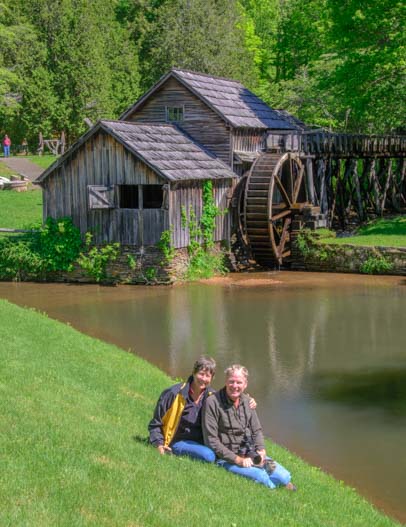
Thomasville, Georgia – Antebellum Elegance

April, 2015 – Florida was heating up fast and Sarasota had become a veritable sauna, so it was time to pack up the RV and head north to cooler climes. Before long we were in Thomasville, Georgia. What a delightful change it was to go from the vacation spirit of beachfront Florida to the stately antebellum elegance of mansions with columns set back from beautiful tree-lined streets.

Antebellum mansion in Thomasville Georgia

We hopped out of the truck for a walk — and found this!
Check out that double rotunda porch!!

We parked our truck near a cool looking church and just started walking. We had no idea we’d planted ourselves on one of the most elegant historic streets in town at first, but the rows of gorgeous old homes captivated us.

We were on Hansell Street in the Tockwotton district, and as we walked down these shady, wide streets, we were instantly transported back in time to an era long ago. I could just imagine myself sweeping out onto one of the broad porches in long, flouncy gown, entertaining my gentleman callers!!

Antebellum mansion in Thomasville Georgia

These grand antebellum mansions evoke another era
— and another life!

These graceful houses here were built in the early 1800’s, prior to the Civil War (which is what “antebellum” means). Wealthy northerners looking for a respite from winter found Thomasville was the perfect place to escape the snow and cold back home.

If these were their winter getaway cottages, then what did their “real” homes up north look like?!

Antebellum home in Thomasville Georgia

A place to sip mint juleps in a graceful gown.

These homes take a lot of work to maintain, and several landscaping crews were busy in the yards on this street. We saw a young fellow with a hedge trimmer in his hand, and I ran over to ask him for directions to the visitors center. I was really taken aback when he addressed me as “ma’am.” I turned around to see if he was talking to someone behind me!

Antebellum house Thomasville Georgia

These houses were winter “getaway” homes for northerners!

But that was the norm throughout our stay in southern Georgia. We had suddenly risen to the status of Ma’am and Sir, despite running around town in t-shirts and shorts, and the people we met couldn’t have been more friendly.

Front staircase of antebellum house Thomasville Georgia

“Come on in, Ma’am” !!!

Thomasville’s historic districts are delightful, and we found more lovely homes on Dawson Street. Massive live oak trees spread their branches wide across the streets, and some of them are draped with parasitic frilly plants.

Tree-lined streets in Thomasville Georgia

Enormous trees arch over the historic streets.

We were just over the border from Florida, and in many ways the climate and vegetation felt like north Florida. We just loved the huge trees.

Tree-lined streets in Thomasville Georgia

Aren’t these trees great?!!

One family had hung an old tire swing from one of the tree branches hanging over their yard. I so wanted to try it out!

Tire swing on a live oak in Thomasville Georgia

How inviting!

The young landscaper with the hedge trimmer had told us to head over to check out The Big Oak. When we got there, we found it took up an entire house lot site. It was just enormous — and very ancient. It’s limbs span over 165 feet and it’s over 68 feet tall. More impressive, it is around 335 years old. It was a sapling back in the 1680’s!

Under the Big Oak in Thomasville Georgia

The Big Oak was a sapling when America was first being colonized.

Thomasville, Georgia, is known for its expansive rose garden. We arrived just two days after the end of their annual springtime Rose Festival and the roses were at their peak.

Thomasville Rose Garden in Georgia

The Thomasville Rose Garden

This garden has many different varieties of roses, and we really enjoyed the lovely shapes and heavenly scents of each variety.

Thomasville Rose Garden Georgia

We just missed the annual Rose Festival by two days…

rose

“A rose by any other name would smell as sweet,” Shakespeare’s Juliet said of Romeo…

Roses in Thomasville Rose Garden Georgia

Even the petals that fell on the ground around the rose bushes were lovely.

Rose petals in Thomasville Rose Garden Georgia

Rose petals beneath a rose bush that had already come and gone.

Spring was springing all around us, and huge magnolia trees were in full blossom too. What a handsome flower they have!!

Blooming Magnolia flower blossom

Magnificent maganolia!

Not far from the Rose Garden is a pretty park with a big pond and a peaceful air called Cherokee Lake Park. We wandered along the water’s edge and watched some young goose families make their way across the vast lawns.

Geese with goslings

A little goose family trucks across the lawns at Cherokee Lake Park in town.

These guys were just too cute. They reminded us of the little sandhill crane chicks we had seen back in Sarasota Florida a month earlier. (And we’ve heard from our friend there, by the way, that they have been spotted again and are now half the size of their parents and are doing very well!).

Gosling in the grass

A little gosling rests in the grass.

Our stay in Thomasville was just a few days, but it was a great first stop in Georgia, and is one of the towns we enjoyed most on our all-too-brief tour of this pretty state.

Songbird at Thomasville Rose Garden Georgia

Thomasville was a wonderful introduction to Georgia for us.

Subscribe
Never miss a post — it’s free!

More info about Thomasville, Georgia:

Other blog posts with similar themes:

Our most recent posts:

More of our Latest Posts are in the top MENU above.

<-Previous || Next->