Solar Charge Controllers – Optimizing RV Battery Charging

The solar charge controller is the heart of any solar power installation on an RV or boat. It is the gatekeeper between the solar panels and the batteries, and it determines how much of the sun’s energy that is available to the solar panels will actually be converted into electrical current to charge the batteries.

Because solar power is a “set it and forget it” type of system, it is not “mission critical” to understand the inner workings of these complex pieces of gear. However, if you want to get the most out of your solar panels, you may want to fine tune your system to increase its battery charging capacity by programming the solar charge controller for optimal performance.

This page gives the low-down on how solar charge controllers work, presents ideas for how to size them, and explains what the typical input parameters are and how they affect performance. It then explores three specific charge controllers made by three different manufacturers, and compares the unique ways that each manufacturer has tackled the challenge of multi-stage charging via the sun.

Since we started traveling full-time in 2007, as of June 2019, we have used, worked with and lived with these particular units for over 4,000 nights of living off the grid in our RV and sailboat.

1200 Solar Charge Controllers and RV Battery Charging

An in depth look at solar charge controllers

This is the third part of our 4-part series on RV and marine battery charging systems.

So far in this series, we have reviewed the basic concepts involved in charging RV and marine batteries, including an in-depth review of multi-stage charging, and we also have looked at how “artificially powered” charging systems like converters, inverter/chargers and engine alternators go about the process of battery charging. The other parts in this series are:

This is a long post and you can read it in stages and navigate to the different sections by clicking on the links below:


SOLAR CHARGE CONTROLLER OVERVIEW

Return to top

Solar charge controllers are a lot more complex than all of the charging systems described so far in this series (converters, inverter/chargers and engine alternators), and they offer a lot more flexibility for programming too, usually through a menu driven screen interface. What makes these systems so complicated?

— The sun not a consistent power source like the local power plant or an engine

“Artificially powered” chargers like converters, inverter/chargers and engine alternators have unlimited power backing them, either from electricity at a power plant or an engine. This allows them to perform optimally no matter what the circumstances are. In contrast, solar charge controllers are dealing with a very flaky power source.

The sun — flaky? Yes! The energy available from the sun varies all day long. At noon when the sun is high in the sky there’s a lot more energy available than in the morning and evening when it is low. The sun also gets covered by clouds now and then, and sometimes it goes away all together or never comes out all day.

Storm clouds swirl above our RV

The solar panels COULD be working, but…

In summertime, the days are long and the sun is out for many hours. In winter, the days are short and the sun is out very little (if at all — think Alaska). And every night all year long the sun vanishes for hours. Trees and buildings can cast shadows on solar panels, affecting their ability to generate current. For boats at anchor, sometimes the mast or boom will shade the solar panels every few minutes as the boat swings back and forth, making the current coming in from the panels rise and fall repeatedly.

— Solar panels can’t always do the job at hand

The batteries on an RV or boat are charged by the sun as long as it is light, regardless of what kinds of electrical appliances you are running inside. Sometimes there’s enough extra energy from the sun that the panels can do two jobs: charge the batteries AND support things like hair dryers and microwaves. But at certain times of the day, the solar panels may not be able to produce enough current to power those appliances AND charge the batteries at the same time by holding them at their target Absorb or Float voltage.

Solar power is difficult when cloudy

The solar charge controller keeps busy as the sun comes and goes

The net effect may be that the batteries are actually be being discharged while those loads are running, even though the solar panels are actively charging them. Sure, the sun mitigates the discharge rate, but overall the batteries are giving up more current than they are receiving from the solar panels. This temporary period of discharging means the solar charge controller will need to keep the batteries in the charging state a little longer to make up for the lost charging time.

— Solar charge controllers operate 24/7

Another difference between artificially powered and naturally powered charging systems is that solar charge controllers do not get turned on and off or plugged in and unplugged. Solar charge controllers operate 24/7, and they are busy communicating with the solar panels all the time to see how the sun is affecting them. At night, solar charge controllers stop talking to the panels quite so frequently since they know the sun won’t shine again for many hours. They “sleep” for a few hours, waking up periodically to see if the sun has risen yet.

Because there is no on/off switch, there isn’t necessarily an easy way for a solar charge controller to be forced into Bulk mode other than by virtue of the “wake-up” phase first thing in the morning. If, for instance, you want to force a solar charge controller into the Bulk stage at 2:00 in the afternoon, you may or may not be able to, depending on the unit.

— No two solar charge controllers are alike

Each solar charge controller manufacturer has a different way of dealing with the inconsistencies of solar power production. Some are easy to program and some are more difficult. Some have many adjustable input parameters and some have just a few. Some can be forced to start a Bulk charge at any time, and some can’t.


CHARGING FROM THE SUN AS IT RISES AND FALLS

Return to top

Generally, a solar charge controller wakes up and immediately puts the batteries in the Bulk stage. Sounds great! However, the Bulk stage in low light may mean the batteries are getting just a trickle charge of an amp or two, because the solar panels can’t produce any more than that.

This means that frequently, for much of the morning, even though the solar charge controller is in Bulk and you’d expect the batteries to be getting blasted with current (which would be happening with an “artificially powered” charging system), the batteries are actually getting just a few anemic amps while the sun is slowly rising in the sky.

Depending on their state of charge at dawn and the size of the solar panel array, this trickle charge might actually be enough for the batteries to reach the Bulk voltage sometime before lunch. They will then switch out of the Bulk stage and into the Absorb stage before the sun has actually reached its peak in the sky where it can produce max energy.

Isn’t it ironic that by the time the solar panels are able to operate at full power, the batteries may not need it any more?!

However, having the batteries out of Bulk and into the Absorb stage during the hours that the sun is highest in the sky is actually optimal. The current delivered by the solar charge controller can slowly taper off as the sun falls lower during the afternoon. Once the Absorb stage is done, and the solar charge controller is operating in the Float stage, the low angle of the sun and the panels’ reduced ability to produce current is not a problem because the charge controller now wants to deliver less to the batteries anyway.

All this is great for sunny days… but not everyday is sunny!

On the other hand, it may be a cloudy morning until noon, or the RV may be in the shade of a mountain until noon, so by the time lunch rolls around, the batteries are still just as discharged as they were at breakfast — or even more discharged because you spent the morning playing on the computer or watching TV.
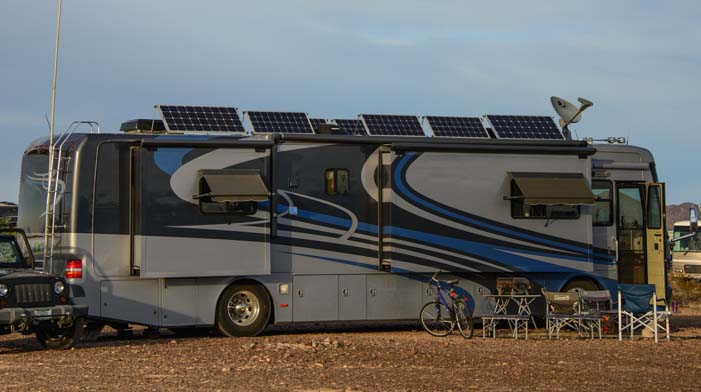
Lots of solar panels

Lots of solar panels

Now, when the sun comes out or the mountain’s shadow moves off the RV’s panels, the solar charge controller is still in Bulk mode. Suddenly the panels can run full blast and operate as close to their rated output current as possible (how close they can operate to their rated maximum depends on how close they are to being perfectly perpendicular to the sun’s rays).

In this case, having a bigger solar panel array is helpful because now it becomes a race with the clock to get the batteries through the Bulk stage and through the Absorb stage before the sun gets too low in the sky in the late afternoon.

And of course there are those cloudy days, or rainy days, and/or short winter days, when, try as they might, the solar panels just can’t produce the current needed to get the batteries through the Bulk and Absorb stages completely by the end of the day. On these days, you hope for more sun the next day or, if you get a bunch of these days in a row, eventually you turn to an artificially powered charging system like a converter or a inverter/charger ((via a portable gas generator or an onboard generator or shore power electricicity) or an engine alternator to finish the job.


SIZING A SOLAR CHARGE CONTROLLER

Return to top

The rule of thumb for sizing solar charge controllers is not the same as for sizing artificially powered chargers. Remember, in Part 1 of this series, we mentioned there is a rule of thumb that says a battery charging system’s max output current should be roughly 25% of the capacity of the battery bank. This means that, in very approximate terms, a 440 amp-hour battery bank needs a 110 amp charging system.

However, solar charge controllers are generally sized to a solar panel array rather than to a battery bank. The sizing parameters for a solar charge controller are the maximum number of watts coming in from the solar panel array and the maximum current going out to the batteries. Add up the total watts in the solar panel array and the maximum amount of current the array can produce, and make sure those numbers are within the specs of the solar charge controller.

The traditional rule of thumb for sizing a solar panel array to a battery bank is that the total watts should be more or less equivalent to the amp-hour capacity of the battery bank.

Conventional Rule of Thumb:

Total solar panel array watts = Total battery amp-hours

However, this may end up under-sizing the solar panel array just a bit. As an alternative, you might start by sizing the solar charge controller to the battery bank using the 25% rule of thumb for sizing battery chargers to batteries:

1 – Solar charge controller output current = 25% Total battery amp-hours

THEN size the solar panel array so it maxes out the total watts and total open circuit voltage specified for the solar charge controller.

2 – Total solar panel array watts = Maximum input watts for Solar charge controller

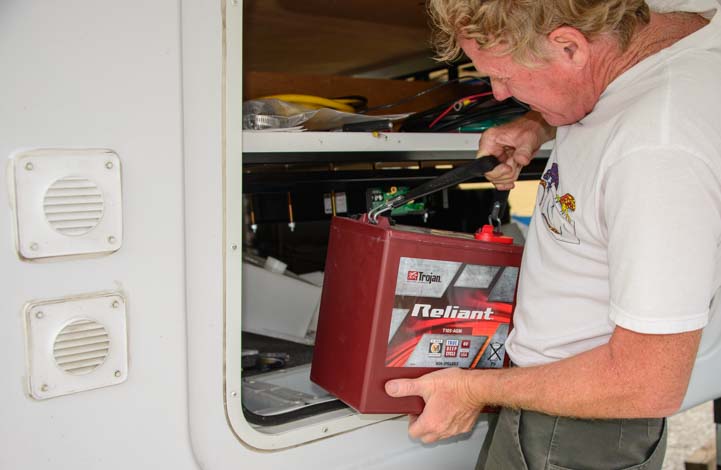
Here’s an example using a 435 amp-hour battery bank of four Trojan T-105 Reliant AGM golf cart style batteries as a starting point. This is our battery bank and is the maximum amount of battery capacity our 36′ fifth wheel trailer can carry comfortably due to weight and space constraints.

Using the Conventional Rule of Thumb above, the total wattage of the solar panel array would be approximately 450 watts. This is sufficient in the summer months in North America and might be sufficient at the equator or in the Land of the Midnight Sun in the winter months, but in our experience, our 490 watts of solar panels on our RV roof is inadequate during winters in the southern US when the sun is low in the sky, the days are short and winter storms create overcast skies for days on end.

Using the Two Step sizing method above instead, you would choose a solar charge controller that has a maximum current output of 25% of 435 amps = ~108 amps. The Outback FlexMax 80 is an 80 amp solar charger (relatively close to the 108 we’re looking for). It can support up to 1,000 watts of 12 volt solar panels (and more watts for higher voltage panels). Note that to get 80 amps of current, you’d need to have the solar panels facing 90 degrees to the sun, and the solar charge controller would need to be operating in the Bulk stage.

Sizing the solar charge controller this way, we are now looking at 1,000 watts of solar panels instead of the 450 watts that the Conventional Rule of Thumb came up with — twice as much!

This sizing method is probably overkill. However, it might make sense to size the panels and controller both ways and choose something in between. As I’ve said, in our case, 600 to 800 watts lying flat on our RV roof without tilting would be nice in winter.
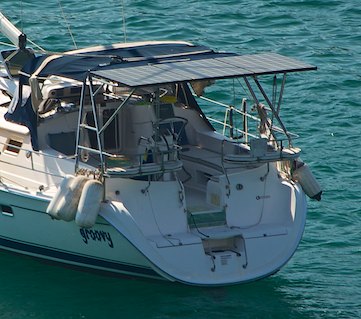
Boat solar power installation

Our sailboat had 555 watts of solar power.
Note the shade on the panels from the mast and spreaders.

For us, on our boat (710 amp-hour battery bank) we could have used a 750 watt to 1,000 watt solar panel array instead of the 555 watts we had to run the systems we had on board, despite having ample sunshine throughout our cruise.

All of this is given here as food for thought. Sizing panels and batteries and solar charge controllers is all very flexible. More of everything is better, but the reality is that there are roof space constraints for the panels, and there are both weight and space constraints for the batteries, and those limitations will ultimately dictate your particular options for panels and batteries.

A truck camper and a Class A diesel pusher (or a Catalina 27 sailboat and a Nordhavn 62 trawler) obviously have different constraints and needs.

In very general terms, anything from a 450 amp-hour / 500 watt system to a 900 amp-hour / 1,200 watt system is fine for both boats and RVs that are used to boondock or anchor out for months on end, depending on whether you run electric refrigeration and how much you stay up at night watching TV with the lights on and/or stay home during the day using computers, electric appliances and power tools.


OUTBACK MX60 MPPT SOLAR CHARGE CONTROLLER

Return to top

Now that we’ve seen the challenges that solar charge controllers face, let’s look at a specific example.

We installed an Outback MX60 MPPT solar charge controller in our fifth wheel trailer. It’s been in operation all day everyday that we’ve been in our trailer since we purchased it new in 2008. Since then, the Outback MX60 model has been discontinued and replaced by the new and improved Outback FlexMax 60 solar charge Controller.

The Outback FlexMax 60 MPPT Solar Charge Controller has the following algorithm:

BULK: Deliver maximum current until the Bulk voltage is reached.

ABSORB: Deliver as much current as necessary for the batteries to maintain the Absorb voltage. Transition to the Float stage when one of the following things happens:

  • The charger has been in the Absorb stage for as long as it took for the batteries to reach the Bulk voltage.
  • The current coming from the batteries has dropped below a certain level

If the sun fades and the controller can’t deliver enough current to keep the batteries at the Absorb voltage, extend how long the batteries stay in Absorb by the length of time the voltage fell below the Absorb voltage.

FLOAT: Deliver enough current to keep the batteries at the Float voltage.

EQUALIZE: Equalization voltage and time parameters are programmable, and equalizing can be done automatically or started manual. If Equalizing can’t be completed in one day, the batteries will resume equalizing the next day until the equalizing time has been completed.

Everything in the Outback MX60 charge controller (and the Outback FlexMax 60/80 Solar Charge Controllers) is programmable on a four-line LED menu driven display. You enter the battery type (Flooded, Gel, AGM) and that gives you default values for Bulk, Absorb and Float voltages. You can then override those values with values of your own if you wish.

So, how does this solar charge controller compare to a converter, inverter/charger or engine alternator?

If you compare the Outback MX60’s charging algorithm shown above to that of any of the artificially powered charge controllers described in the previous article, you can see just how very much more complicated this solar charge controller is. Here’s a little more detail:


SWITCHING FROM ABSORB TO FLOAT BASED ON TIME

Return to top

The key part of any multi-stage charging algorithm is when to switch from the Absorb stage to the Float stage. (If you are unclear about those stages, read more here: RV and Maring Battery Charging Basics). All charging systems use TIME as a basic criteria. The question is how long?? Should the batteries stay in Absorb for 2 hours or 4 hours? Should it always be the same amount of time?

To be most amenable to the batteries’ needs, the state of charge of the batteries when they first start charging must be taken into account. If the batteries are nearly fully charged when charging starts, why keep them in Absorb for three hours? That’s like forcing down extra helpings of pie after a big Thanksgiving dinner. Maybe just a small piece is enough on a full stomach.

On the other hand, if the batteries are deeply discharged when the charging begins, they should stay in Absorb longer to make sure they really get full. If you didn’t nibble on hors d’oeuvres before dinner and you skipped lunch and breakfast, then extras helpings of everything at the Thanksgiving table might taste and feel great.

Outback tackles this conundrum by looking at how long it takes the batteries to reach the Bulk voltage. If they are well charged already, they’ll zip to the Bulk voltage quickly. In that case, they don’t need to stay in the Absorb stage for very long. On the other hand, if they are deeply discharged, it will take a long time for them to reach the Bulk voltage. In that case, they should hang out in Absorb for a long time until they are really and truly fully charged.

The way the Outback charge controllers accomplish this flexibility in the length of time of the Absorb stage is that they make the Absorb stage last for the same length of time as the Bulk stage did. If Bulk took 2 hours, then Absorb will last for 2 hours. If Bulk took 3 hours, Absorb will be 3 hours. Clever!


WHAT IF THE TARGET VOLTAGES CAN’T BE MAINTAINED?

Return to top

Unfortunately, the sun isn’t all that consistent for such a basic algorithm, and there is more to it than just a simple one-to-one relationship between Bulk and Absorb. What makes this business tricky is that the sun may not allow the charger to hold the batteries at the Absorb target voltage once they begin Absorbing. For instance, in the middle of the Absorb stage, the sky might cloud over. The charge controller will respond by instantly opening the floodgates for the batteries so it can get the necessary current from the panels to keep the batteries at the Absorb voltage. But if the panels can’t deliver, there’s nothing the solar charge controller can do, and the battery voltage will fall below the Absorb voltage.

Outback FlexMax 60 MPPT Solar Charge Controller

Outback FlexMax 60 MPPT Solar Charge Controller

In another scenario, someone in the RV or boat might turn on an electrical appliance that draws a lot of current — more than the panels can deliver — and this will temporarily lower the battery voltage below the target voltage. Running the vacuum or a hair dryer in addition to whatever else is running in the RV or boat might be just enough to draw more current from the batteries than the sun on the panels can produce.

In these cases, the solar charge controller will try to keep the batteries in the Absorb stage, but it’s failing. The thing is, if there isn’t enough current to keep the batteries at the Absorb voltage, are they really Absorbing? Not exactly. They’re getting as much current as possible, but the voltage has dropped below the Absorb stage threshold.

The Outback charge controllers view this as a kind of “timeout” period. So, for every minute of this “timeout,” they tack on a minute of extra time that the batteries must stay in Absorb before they switch to float.

For instance, if the batteries have been in Absorb for 53 minutes when the sky suddenly clouds over, the Outback charge controller will start counting how long the batteries stay below the Absorb voltage. If they stay below for 14 minutes, then once the sun comes back out and they get back to the Absorb voltage, they will need to stay in Absorb for an extra 14 minutes on top of the time period they were planning on (which is either the length of time that the Bulk stage took that day or a minimum amount of time programmed by the user). When they resume Absorbing, the Outback will resume counting from 53 minutes with a new target time that is 14 minutes longer than before.

This problem of the solar panels not being able to deliver enough current to keep the batteries at the target voltage exists in the Float stage as well as the Absorb stage. However, in the case of the Float stage there is no time consideration. Once they get into Float, the batteries will stay there (or attempt to stay there) until dark.

If you are confused, here is a real live example:

One day around noon our batteries had reached the Float stage (we’d gone to bed early the night before, so the batteries had charged up quickly). They were humming along getting about 4 to 10 amps or so to maintain a 13.5 Float Voltage with whatever stuff we had running in the RV (laptops, etc.).

I got out the vacuum, and when I turned it on, the charge controller jumped into high gear, demanding max output from the solar panels. The panels could deliver 25.6 amps, but that wasn’t enough to maintain the Float voltage of 13.6, and the battery voltage dropped to 13.1 until I finished vacuuming. Then everything went back to where it had been.

Lesson learned: use a broom not a vacuum!

You can see the display from the Outback charge controller here:

Outback MX60 Solar Charge Controller

Outback MX60 Charge Controller display at midday with vacuum & computers running.
Note the batteries have dropped to 13.1 volts (below Float) and the current coming from the panels to the batteries is a huge (for “Float”) 25.6 amps to support the load in the RV. “F-MPPT” means “I’m in the Float Stage but I need max power ’cause I can’t maintain the Float Voltage.”

Even if the sun is out all day long and the batteries reach the Float stage, at the end of the day when the sun begins to set, the charger will no longer be able to hold the Float voltage. As it gets darker and darker, the charger will try valiantly to hold the Float voltage, but the battery voltage will drop lower and lower while the charge controller delivers less and less current.

Eventually, when it gets completely dark outside, no current will be going to the batteries at all. If the batteries were in Float before the sun went down, they will settle out at 12.7 volts, fully charged. If they never reached the Float stage, however, you’ve gotta cross your fingers for good sunshine tomorrow!


SWITCHING FROM ABSORB TO FLOAT BASED ON CURRENT

Return to top

As I mentioned in the previous article in the description of the Xantrex Freedom 25 Inverter/Charger, a rule of thumb is to switch from Absorb to Float when the current that the batteries need to remain at the Absorb voltage drops below 2% of the amp-hour capacity of the battery bank.

For a 450 amp-hour battery bank, this would be 9 amps. For a 750 amp-hour battery bank, this would be 15 amps. So, for a 450 amp-hour battery bank, a reasonable time to switch from Absorb to Float is when the current drops below 9 amps. For a 750 amp-hour battery bank it is when the current drops below 15 amps.

The Outback FlexMax 60 (and 80) allow you to enter whatever number of amps seems right to you, whether it is 2% of your battery bank or some other number that you prefer.

Why is it important to switch from Absorb to Float when the amount of current the batteries need to remain at the Absorb voltage drops below a certain level?

The batteries may be nearly fully charged, but if the charging algorithm forces them to stay in Absorb for a set period of time — three hours for instance — they may need just 1 or 2 amps to maintain the Absorb voltage. It might be better for the batteries if they were allowed to slip back to the Float voltage at that point rather than forcing them to stay at 14.7 volts while accepting a minuscule amount of current until the 3 hours is up.

However, the reverse may also be true. There may be situations where you don’t want the batteries to be in the Float stage even though the charging current has dropped below 2% of the battery bank capacity. More on that further down.


WHAT HAPPENS AT NIGHT?

Return to top

Because solar charge controllers operate 24/7, there are three more states that the Outbacks can be in:

  • SNOOZING: The voltage of the solar panels is greater than the voltage of the batteries but there is no current coming in from them
  • SLEEPING: The voltage of the solar panel array is less than the voltage of the batteries
  • ZZZZZ…: The solar charge controller has been in the SLEEPING state for 3 hours or more

The controller has an algorithm for waking up as well. As the sun rises, once the voltage of the solar panels is more than 2 volts higher than the voltage of the batteries (i.e., the panels are at 14.7 volts or more if the batteries are fully charged at 12.7 volts), it looks for current coming in from the panels. If the current is still near 0, it SNOOZES in 5 minute intervals while it waits for the current to reach about an amp. Then it goes into Bulk and starts its work for the day. This happens each morning as the sky becomes light and the solar panel voltage rises from 0.


LOW LIGHT — FULL MOON and STREET LAMPS

Return to top

It doesn’t take much light to bring a 400+ watt 12 volt solar panel array up to 15 volts. A full moon with clear skies may raise the voltage on the panels to this level, and parking under a bright street light will definitely do it. This is not enough light for the solar panels to generate current, but it can sometimes be enough to fool the charge controller that the sun might be about to rise and give it a sleepless night.

We have seen our solar charge controller pull an all-nighter as it alternated between SNOOZING and WAKE-UP all night long because the solar panel array was steady at 15 volts from a street light overhead while the batteries were at 12.7 volts.

The charge controller couldn’t start the real SLEEPING phase because the panel voltage was higher than the battery voltage. But there wasn’t enough light to generate any current either. So, the controller would WAKE-UP, discover there was no current coming in from the panels, and then it would go back to bed and SNOOZE a little longer. It would repeat this unfortunate cycle all night long, never getting into the really good 3 hour long ZZZZ… sleep stage (poor thing!).

On the other hand, while staying in the Catskill Mountains about 120 miles from New York City, I crept out at 2:00 in the morning to see how the charge controller was doing. The city lights kept the sky from being very dark, and the panel voltage was elevated slightly to 9 volts rather than the usual 0 volts we see in more rural areas. However, the batteries were more than 2 volts higher than that at 12.7, so the charge controller was well into its REM sleep phase, dreaming of sunny days. (Mark crept out to photograph the fireflies…a much better reason to climb out of bed at 2 am!!)
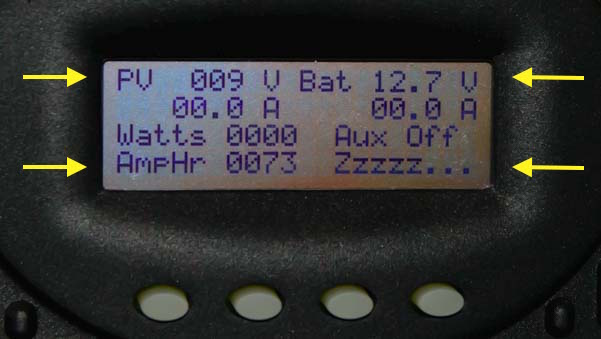
Outback FlexMax solar charge controller sleeping near NYC

At 2:00 a.m. in the Catskills, the lights of NYC reflecting off low clouds raise the Panel Voltage to 9 volts. The previous day the batteries got 73 amp-hours of charge, so they are fully charged at 12.7 volts, more than 2 volts higher than the panels. The controller is sleeping soundly for 3 hours when it will check the panel voltage again.


XANTREX XW MPPT 60-150 SOLAR CHARGE CONTROLLER

Return to top

We installed a Xantrex XW MPPT 60-150 Solar Charge Controller on our sailboat. Xantrex is now Schneider Electric, and this unit has been replaced with the Schneider Electric XW MPPT 60-150 solar charge controller. I don’t know if this is just a name change on the unit or if the design of the unit has changed in any way.

This solar charge controller is about the same size as the Outback but has a two line LCD display instead of four, so you have to scroll through the menus a bit to get the same info you can see at a glance on the Outback.

The challenge for us on our boat was that we had a smaller solar panel array than we needed for our typical daily power consumption due to our electric (DC) fridge and standalone freezer. 555 watts of solar power was not enough. So, we needed the charge controller to get the solar panels to provide as much current as possible everyday.

Unfortunately, it took us a while to realize that the factory default settings on the Xantrex charge controller were preventing the solar panels from providing as much current as they could.

The Xantrex charge controller came with a factory default setting to switch from Absorb to Float when the current being delivered to the batteries dropped below 2% of the amp-hour capacity of the battery bank, or 14 amps.

Xantrex XW MPPT 60-150 Solar Charge Controller in a sailboat

Our Xantrex XW MPPT60-150 charge controller on our sailboat

The problem was that once the current going to the batteries dropped below 14 amps, the solar charge controller put them into the Float stage. In the Float stage they needed much less current to maintain the Float voltage, usually around 5 amps. That’s a lot less than the nearly 14 amps they had been getting in Absorb!

What this meant was that even if the sun was shining brightly, the batteries were being given less current than the panels were capable of delivering because the solar charge controller had put them in the Float stage. The gatekeeper had closed the gate most of the way!

We would watch the system go into the Float stage at 1:00 p.m. and waste the best sunshine of the day sitting in the Float stage all afternoon charging the batteries with a lot less current than it would have if the controller were still in Absorb.

So, because the Xantrex charge controller had the programming option available, we programmed it to switch into Float when the batteries needed only 5 amps to maintain the Absorb voltage instead of the 14 amps that was 2% of our battery bank size. This way we were able to charge the batteries up by an extra 25-30 amp-hours each day.

However, the Xantrex controller didn’t make this programming option obvious. Rather than having an input parameter for the current at which to switch from Absorb to Float like the Outback models have, you could enter only the size of the battery bank. The controller would then calculate what 2% of that value was and would use that value to switch from Absorb to Float.

So, we had to fool the controller by saying our battery bank was only 250 amp-hours rather than the 710 amp-hours that it actually was. Then it would switch from Absorb to Float when the current dropped to 5 amps (2% of 250) instead of at 14 amps (2% of 710).

This also could have been alleviated by throwing the system back into a Bulk charge, and in our first days of working with this system, there were many times when I wished there were a setting to force the charge controller to put the batteries back in the Bulk stage whenever I wanted. But unlike the Outback solar charge controllers, this Xantrex model did not have that option.

So, as you can see, the Xantrex XW MPPT 60-150 Solar Charge Controller takes a slightly different approach to the challenges of solar charging than the Outback models do. Here are the details:

The Xantrex XW MPPT 60-150 Solar Charge Controller charging algorithm is the following:

BULK: Deliver the maximum possible current to the batteries until they reach the Bulk voltage

ABSORB: Deliver as much current as necessary for the batteries to maintain the Absorb voltage. Transition to the Float stage when one of the following things happens:

  1. The current necessary to maintain the Abosrb voltage is 2% of the battery bank capacity
  2. The batteries have been in the Absorb stage for 2 hours (modifiable)
  3. The batteries have been at or above the Float voltage for 8 hours

FLOAT: Deliver enough current to the batteries to maintain the Float voltage.

EQUALIZE: The voltage and times for equalizing are user defined.

This charging algorithm is pretty straight forward, except for that odd 3rd way that the controller might switch from Absorb to Bulk. What’s going on there?

— What if the target voltages can’t be maintained — another technique!

That third trigger Xantrex uses for switching from Absorb to Float allows for the situation where the battery voltage has dropped below the Absorb voltage temporarily due to either clouds or shade or big loads in the RV or boat (vacuums or refrigerator compressors) drawing the voltage down for a while because the panels can’t deliver enough current. What it’s doing it that even if the batteries haven’t been at the Absorb voltage the whole time, as long as they have stayed above the Float voltage for at least 8 hours, they are considered ready to leave the Absorb stage and enter the Float stage.

Remember, the Outback solar charge controllers dealt with this same challenge of flaky sunshine by tracking how long the batteries fell below the Absorb voltage and then forcing the batteries to stay in Absorb for that same number of extra minutes to make up the lost time.

The Xantrex method is a little more simplistic than the Outback method, saying that as long as the battery voltage stayed above Float for 8 hours, they have been sufficiently charged and can switch to the Float Stage.

— Programming the charge controller for improved performance

As a recap, our goal was to keep the batteries in Absorb for as long as possible. So, I modified two of the Xantrex solar charge controller’s input parameters to allow this to happen:

  1. Pretend our battery bank was just 250 amp-hours instead of 710 so it would stay in Absorb down to 5 amps (modifying criteria #1)
  2. Increase the Absorb stage time limit from 2 hours to 8 hours (modifying criteria #2)

What these two programming changes ultimately did was they made the batteries stay in the Absorb stage for 8 hours, getting a healthy amount of current from the solar panels, unless the current happened to drop below 5 amps (2% of 250) before 8 hours was up.

This worked really well for 750 nights of anchoring out.


PROGRAMMING THE CHARGE CONTROLLER TO THE BATTERY MANUFACTURER’S SPECS

Return to top

We were extremely cautious with the AGM batteries in our boat and did not want to modify the solar charge controller’s default voltage settings for AGM batteries since AGM batteries are sealed and they can’t be charged at as high a voltage as flooded batteries (this is explained in more detail in Part 1 of this series).

The default charging voltages for AGM batteries on the Xantrex XW MPPT-60-150 Solar Charge Controller are:

  • Bulk: 14.3
  • Absorb: 14.3
  • Float: 13.4

* * * Lesson Learned * * *

Now that we have installed four Trojan T-105 Reliant AGM batteries in our fifth wheel and have been advised by the engineers at Trojan Battery to use Bulk and Absorb voltages of 14.7 volts on their AGM batteries instead of the 14.3 or 14.4 that most charging systems default to, I look back and realize I was probably too conservative with our boat’s AGM batteries.

If we had set the Bulk and Absorb voltage values to 14.7 instead of 14.4 (the setting I chose), then they would have charged faster (received more current from the charge controller) during those stages, and they would have won the daily race against the clock more easily. Obviously, more panels would have done the trick too, but finding unshaded deck space on a sailboat is tricky.

It only makes sense to program a battery charging system to the battery manufacturer’s specifications rather than assuming that the factory defaults on the charge controller are optimal. Afterall, charging system manufacturers — whether solar charge controllers, converters, inverter/chargers or engine alternators — will ALWAYS err far to the conservative side because they they are designing for a wide variety of battery brands and they don’t want to risk frying a customer’s batteries.

However, in the end, this might result in undercharging the batteries! Trojan Battery engineers have found that far more batteries die a slow death of chronic undercharging than a violent death of massive overcharging, so they prefer slightly higher charging voltages for their AGM batteries than are factory standard on many solar charge controllers, converters, inverter/chargers and engine alternators (with a caveat not to go to 14.8 volts or higher).


MORNINGSTAR TRISTAR TS-MPPT-60 SOLAR CHARGE CONTROLLER

Return to top

We recently did a complete full-timer solar power installation on a friend’s motorhome. He specified the Morningstar TriStar TS-MPPT-60 Solar Charge Controller for his installation, so we had a chance to program it and work with it. This solar charge controller uses yet another methodology.

Morningstar TriStar MPPT 60 amp solar charge controller

Morningstar TriStar MPPT 60 amp solar charge controller

This solar charge controller is programmed via dip switches and the charging stages are indicated by LED lights rather than a digital readout. You can also purchase the additional TriStar Remote Digital Meter that has a two line LCD display similar to the 2-line and 4-line displays on the Xantrex and Outback models described above.

Separating the charge controller from the display is a great idea. It allows you to install the display inside the RV or in the boat’s cabin where you can read it easily and mess with its buttons whenever you wish. Yet you can still place the charge controller itself right next to the batteries where it needs to be (the cable going from the batteries to the charge controller must be as short as possible).

Our friend did not purchase the remote meter, but we found the system was easy enough to set up without it. The dip switches were a clunky interface, but that would be improved with the buttons and digital display of the remote meter. The lack of a digital readout made it difficult to know the details about the voltages and currents of the panels and batteries in the system. However, our friend did not plan on programming the solar charger any further, and he already had a battery monitor in his coach, so he had a way to monitor the battery voltage easily.

Here are the details on the charging algorithm:

The Morningstar TriStar TS-MPPT-60 Solar Charge Controller multi-stage charging algorithm is the following:

BULK: Deliver the maximum amount of current possible until the batteries reach the Bulk voltage.

ABSORB: deliver as much current as necessary to keep the batteries at the Absorb voltage until the following thing happens:

  • 2 to 2.5 hours has gone by (depending on battery type)

If the batteries fell below 12.5 volts during the previous night, then extend the Absorb stage by 30 minutes.

FLOAT: Deliver as much current as necessary to keep the batteries at the Float voltage. If the batteries are drawn down below the Float voltage for an hour or more due to big loads in the RV or boat (vacuum, power tools, microwave) or due to sudden cloud cover, the charge controller will switch back to Bulk mode and start the cycle over again. If the batteries fell below 12.3 volts during the previous night, then the solar charger will not enter the Float stage the following day.

EQUALIZE: The voltage and duration of the Equalization stage is determined by the battery type selected and is started manually.

This is yet another creative approach to the various problems caused by the unreliability of sunshine. The idea of setting up the charging parameters today based on the lowest voltage the batteries reached overnight is cool, since that is truly the biggest determining factor for how much charging the batteries need right now.

However, note that there is no criteria for switching from Absorb to Float based on the current falling below a minimum value as with the other charge controllers. There is also no provision for lengthening the Absorb stage if the Absorb voltage can’t be maintained, although there is if the Float voltage can’t be maintained.

The Absorb, Float and Equalize voltages are assigned in this controller when you select the battery type. AGM batteries are assigned:

  • Bulk/Absorb: 14.4
  • Float: 13.7

There seemed to be an option to override those values with custom values, however, it wasn’t clear how to enter the actual voltages using the dip switches. The TriStar Remote Digital Meter might provide more programming flexibility.

The Morningstar does come with PC based software, and it is possible to connect the solar charge controller to your in-house ethernet network via the controller’s ethernet port or to connect it using a wireless router. However, for me, that adds a level of complexity that isn’t really necessary.

There are just a few parameters to enter on any charge controller, and just a few values to monitor, and those only need to be monitored occasionally. Having a menu driven screen interface built into the charge controller rather than getting my computer involved in the action is worth a lot to me.


FINAL NOTES

Return to top

As you can see, there is a significant variation in how the different manufacturers of solar charge controllers tackle the challenge of creating an algorithm to charge the batteries, given the vagaries of sunshine. All of the solar charge controllers described here get the job done, it’s just that the methodology varies and the ease of use and programmability of the units differ.

If you want to get the most out of your solar charge controller, the most important thing is to know what your battery manufacturer’s recommended charging voltages and time limits are, that is, what their preferrred Bulk, Absorb and Float voltages are and how long they want the batteries to remain Absorb. Then program the solar charge controller accordingly.

The reason I chose the Xantrex XW MPPT-60-150 Solar Charge Controller for our boat rather than purchasing another Outback charge controller like the one in our RV (the nice new FlexMax 60 was on the market by then) was that the Outback has a fan in it. I was concerned that in the hot tropical climates where we would be sailing, the fan would likely run a lot and might fail. I didn’t want any moving parts! I chose the Xantrex because it is cooled by large cooling fins instead of a fan.

In hindsight, the Outback charge controllers are rated to operate at up to 104 degrees, and the cabin of our boat never got that high. Probably an Outback charge controller would have held up just fine. The Morningstar with its Remote Digital Meter is a neat idea for separating the charge controller and the digital display. However it does require a few more installation steps to mount the remote meter and run the cable from the charge controller location to the remote meter location. It also has a simpler overall charging algorithm, which could be a pro or a con depending on your preference.

__________________

The next — and final — article in this series takes a look at what happens when two battery charging systems are running simultaneously. That is, what happens if you have solar power and you plug into shore power or turn on the boat engine?

To continue to the next article in this series, click here:

Solar and Shore Power or Engine Alternator Battery Charging Combined

4-Part Series on RV and Marine Battery Charging Systems:

Related posts about batteries, solar power and living off the grid in an RV or boat:

Subscribe
Never miss a post — it’s free!

Our most recent posts:

More of our Latest Posts are in the MENU.   New to this site? Visit RVers Start Here to find where we keep all the good stuff. Also check out our COOL NEW GEAR STORE!! *** CLICK HERE *** to see it!

RV Converter, Inverter/Charger, and Alternator Battery Charging Systems

This article discusses battery charging systems that are “artificially powered” by electricity or an engine (as opposed to sun or wind power) and the methods these systems use to chargeso RV and marine batteries. It is the second post in our four part series on RV and Marine Battery charging systems.

Converter Inverter-Charger Engine Alternator Battery Charging Systems

The first article in the series, RV and Marine Battery Charging Basics, explains how batteries are charged and describes the concepts of single stage and multi-stage charging. The third and fourth articles in this series are:

You can navigate to specific parts of this article with the links below:


“ARTIFICIALLY POWERED” versus “NATURALLY POWERED” CHARGING SYSTEMS

Return to top

There are two basic types of multi-stage chargers for RVs and boats: those that are “artificially powered,” either by electricity, by an engine or by a generator, and those that are “naturally powered” by the sun (or wind). Note: Although this series doesn’t discuss wind charging systems, the same principles apply.

What is the difference?

Ability to Deliver the Maximum Rated Current

The biggest difference between these two types of charging systems is that artificially powered charging systems — converters, inverter/chargers and alternators — can all deliver the maximum amount of current they are rated for as soon as they are turned on. In contrast, “naturally powered” chargers may or may not be able to deliver their maximum rated current when called upon to do so.

Yamaha 2400i portable gas generator

Yamaha 2400i portable gas generator
As long as there’s gas, it’s good to go.

Solar charge controllers can deliver their maximum rated current only if they are connected to a large enough solar power array and that array is exactly perpendicular to full sunshine. Unfortunately, no matter how big the solar panel array is, these charging systems spend most of their time operating in sub-optimal conditions when the sun is low in the sky or filtered by clouds or totally absent because it is nighttime.

In addition, if a big appliance is turned on in the RV or boat while the batteries are being charged, the artificially powered charging systems can meet the challenge and provide the current that is needed (up to their rated current output and up to the limits of the power source) to keep the batteries at their target charging voltage.

Sunshine

The sun’s out — yay!
We can start charging!

However, solar charge controllers may or may not be able to meet the challenge, depending on the time of day and amount of cloud cover. In fact, if the current draw is big enough, not only will the solar charge controller fail to keep up with the sudden demand, but the net effect on the batteries may be that they are temporarily being discharged a little bit rather than charged.

Therefore, solar charge controllers have a lot of extra complexity built into their charging algorithms so they can handle the situations where, for whatever reason (lack of sun and/or too much demand from the appliances in the RV or boat) they aren’t actually charging the batteries but are just slowing down the discharge rate!

Ability to Restart the Charging Process with the Bulk Stage

Artificially powered charging systems can all be turned on or off with the flick of a switch. Most systems will test the battery voltage to see if they should jump into the Bulk stage as soon as they are turned on. This gives you a way to force the batteries into the Bulk stage and start the charging process from scratch.

Solar charge controllers operate 24/7, and they rely on an internal algorithm to determine when it is morning and time to start the Bulk charging stage. Not all solar charge controllers are designed to have an easy way for the user to put the batteries in a Bulk charging stage at any time of day other than dawn.


PROGRAMMING A BATTERY CHARGING SYSTEM

Return to top

Many artificially powered charging systems are programmable, but usually the choices are minimal. If they can be programmed at all, it is generally done with dip switches or simple buttons. In contrast, big solar charge controllers are complex enough and have so many programmable options that they often have a screen display and a menu driven interface.

Some charging systems have preset groups of voltage values, and all you can select is whether your batteries are Flooded, AGM or Gel. The charger then assigns voltage values for the charging stages based on battery type. In this case, the charging system manufacturer is guessing what voltages are appropriate for your batteries. The battery manufacturer may have different specs!

The most sophisticated (and expensive) charging systems allow you to enter any value you want for the individual charging voltages as well as the length of time to remain in the Absorb stage and other values as well.

Even if you don’t study the charging algorithm that is used by the charging systems on your RV or boat, it is worthwhile to find out what the default voltages are for the Bulk, Absorb and Float stages are on each device.


WHAT VALUES DO YOU PROGRAM INTO A CHARGING SYSTEM?

Return to top

There are rules of thumb for what the charging voltages should be for the various battery types, with flooded batteries requiring higher charging voltages than AGM and Gel batteries. The general consensus I found in my research was that flooded batteries preferred a Bulk/Absorb voltage in the range of 14.6 – 14.8 volts while AGM and Gel batteries prefer to be around 14.4 volts.

Because of this general consensus, I set up all the charging systems on our boat with Bulk and Absorb values around 14.4 volts so we wouldn’t fry our four Mastervolt 4D AGM batteries house batteries and our Group 27 start battery.

Needless to say, I was quite surprised when we installed our four new Trojan T-105 Reliant AGM 6 volt batteries in our trailer, that the engineers I spoke with at Trojan Battery recommended we set the Bulk and Absorb stages of our charging systems to 14.7 volts. They said the vast majority of battery failures are from chronically undercharged batteries, so they preferred that their AGM batteries be charged at this higher voltage.

I never spoke with anyone at Mastervolt back in our cruising days, and their documentation didn’t specify charging voltages. In hindsight, perhaps we should have been charging the batteries on our boat to higher Bulk and Absorb voltages. They would have charged faster, which would have been awesome, especially on solar, because our solar panel array was a little small (555 watts), and getting the batteries fully charged by day’s end was a challenge unless we turned off our DC freezer.

Lesson learned: If you can’t find your battery manufacturer’s recommended charging voltages in their documentation, give them a call!

The next sections take a look at a few artificially powered charging devices we have used and the algorithms they employ for battery charging.


CONVERTERS

Return to top

Most trailers are equipped with a converter to charge the batteries from shore power (via electric hookups or a portable gas generator). The shocking thing about these converters is that many of them are just single stage trickle chargers. (Note: if you are confused about what converters and inverters are, click here).

We had never thought much about our converter, because we use it very rarely. We don’t ever get electrical hookups, so our converter is used only when we fire up our gas generator, which happens just a few times a year. We had always assumed that the Atwood SRV 55 amp converter that came with our Hitchhiker II LS fifth wheel was a multi-stage charger. However, we discvoered a few months ago that this converter is actually a single stage trickle charger. It brings the batteries up to 13.4 volts and leaves them there indefinitely, as long as the converter has AC power supplied to it.

This is startling for two reasons.

First of all, since we boondock all the time, this means that whenever we turn on our generator to charge our batteries (after a few days of stormy weather), rather than giving the batteries a fast blast of Bulk charge followed by Absorb and Float, the batteries are immediately put into a Float stage and left there. Rather than getting a quickie does of lots of current and then trailing off to less and less current, the batteries get an anemic amount of current the whole time the generator is running.

What a waste of fuel! And who wants to listen to that noisy thing for that long! Rather than taking an hour or two to charge the batteries completely, it could take 8 hours or more. Ugh!

Secondly, single stage converters like this Atwood don’t exercise the batteries at all when they are left on shorepower via electrical hookups, and the batteries deteriorate more quickly. This is an important consideration for an RV that is plugged into shore power month after month. It is important for batteries to go through the Bulk and Absorb stages periodically.

We decided to replace our factory-installed single-stage Atwood 55 amp converter with an Iota DLS 90 converter / IQ4 smart charger a few months ago so that on the days that we use our generator we could use it for a very short time rather than running it all day.

Besides wanting a true multi-stage charger that could load the batteries up with a lot of current at the beginning of the charge cycle, we also realized our old factory installed converter was too small.

Remember that 25% rule for sizing batteries and chargers from the last post? Our converter had been sized for the two Group 24 12-volt batteries (total capacity 140 amp-hours) that had come with our RV, and we had upgraded to four Trojan T-105 Reliant AGM 6 volt batteries which gives us a total capacity of 435 amp-hours.

Our new Iota DLS-90 / IQ4 is a 90 amp converter which is much more appropriately sized to the new battery bank.

And what a world of difference there is between these two converters!

The Iota DLS 90 / IQ4 is far more sophisticated. It puts the batteries into a true Bulk charge state as soon as AC power is available (for us, that is when we turn on the generator with the shorepower cord plugged into it). Then, after cycling through Absorb to Float, it keeps the batteries in the Float stage for seven days (not applicable to us with our generator, but important for folks who get electric hookups), and then it cycles them through Bulk and Absorb again.

The multi-stage algorithm that the Iota DLS 90 / IQ4 uses is the following:

BULK: Whenver the batteries are below 12.8 volts (i.e., when first plugging into shore power or when a bunch of appliances are turned on in the RV or boat) deliver the maximum current possible (up to 90 amps DC) until the batteries reach a voltage of 14.6 volts, then switch to Absorb. If they don’t reach 14.8 volts within four hours, switch to Absorb anyways.

ABSORB: For eight hours, deliver enough current to hold the batteries at 14.2 volts.

FLOAT: For seven days, deliver enough current to hold the batteries at 13.6 volts. Then go through the Bulk and Absorb stages before resuming the Float stage.

The system is fully automatic and none of these values or times are programmable.

Note: For readers who have studied the spec sheets on the Iota DLS-90/IQ4, this outline differs slightly from what you read. I had a lengthy conversation with an engineer at Iota who explained the details of how this converter works. The documentation refers to the weekly return to Bulk and Absorb as an “Equalization” stage, but the voltages and times are actually those of the Bulk and Absorb stages. As noted in the first post in this series, equalization is generally done at 15 volts or more for less than 8 hours. In addition, the documentation describes the converter’s power supply ramping up to 14.8 volts during Bulk, but doesn’t explain that the actual trigger point that switches the batteries from Bulk to Absorb is 14.6 volts.

Using the Iota DLS 90 / IQ4 The First Time

A few weeks ago we endured several days of gray skies and rain while we were driving from Florida into southern Georgia. Our solar panels were producing very little current, and our new Trojan T-105 Reliant AGM batteries were becoming depleted. There was no sign of sun in sight.

We set up our Yamaha 2400i portable gas generator and plugged our shore power cord into it. We clamped the jaws of our trusty clamp-on ammeter around one of the battery cables and were truly astonished to see 67 amps going into the batteries. Yowza!! Within two hours the batteries had accepted roughly 100 amp-hours of charge and we turned the generator off. Our old converter would have taken about 8 hours or more to do the equivalent.


INVERTER/CHARGERS

Return to top

Many motorhomes and cruising boats are equipped with an Inverter/Charger to charge the batteries when the RV or boat is plugged into shore power. Our Hunter 44DS sailboat was equipped with a Xantrex Freedom 25 inverter/charger which was factory installed in the boat. Xantrex has since become Schneider Electric, and a comparable model being sold today is the Schneider Electric 2500 watt inverter/charger. I haven’t found an online manual for it, so I don’t know if the charging algorithm or programmability of the unit has changed.

Schneider Electric 2500 watt inverter : charger

Schneider Electric 2500 watt inverter/charger
This is the updated model of our Xantrex Freedom 25 Inverter / Charger
(ours was buried under a settee and impossible to photograph!)

Unlike many converters, most inverter/chargers are multi-stage chargers. Our Xantrex Freedom 25 had minimal programming capabilities. You could enter the battery type (Flooded, Gel or AGM), and the voltages for the charging stages were automatically assigned according to the battery type you selected. You could not enter any other values. We had AGM batteries, and the Xantrex inverter/charger assigned them defaults of:

  • Abosrb: 14.3 volts
  • Float: 13.3 volts

If you wanted different voltages, you could select the Flooded or Gel values instead simply by indicating that your batteries were Flooded or Gel, even if they weren’t.

The multi-stage charging algorithm for the Xantrex Freedom 25 inverter/charger is the following:

BULK: Deliver the maximum current possible until the Absorb voltage is reached

ABSORB: For up to 3 hours, deliver as much current as needed to keep the batteries at the Absorb voltage. If the current necessary to keep the batteries at the Absorb voltage drops below 15 amps before the 3 hours is up, stop charging and let the battery voltage settle down to the Float voltage.

FLOAT: Deliver enough current to hold the batteries at the Float voltage., and keep the batteries at the Float voltage indefinitely.

EQUALIZE: Whenever you want to equalize the batteries, you can manually put them into an Equalize charging stage. The inverter/charger will deliver enough current to bring the batteries up to 16.3 volts and will keep them at that voltage for 8 hours.

Notice how different the Xantrex inverter/charger is than the Iota DLS 90 / IQ4 Converter!. Both the voltages and lengths of time are quite different.

Even more interesting, however, is where the heck did that 15 amp thing come from for switching from Absorb to Float?

As a rule of thumb, it is thought that when the batteries need less than 2% of the amp-hour capacity of the entire battery bank in order to maintain the Absorb voltage, then they are pretty close to full charge and can be put in the trickle charge Float stage.

This 15 amp switchover is an attempt at implementing this 2% rule. However, because the 15 amp value is not modifiable, the assumption is that the battery bank is 750 amp-hours (15 is 2% of 750). That’s quite an assumption! More sophisticated charge controllers allow you to program the current at which you want the system to switch from Absorb to Float.

Our boat’s battery bank was 710 amp-hours, so a more accurate number would have been 2% of 710, or 14 amps. 15 amps versus 14 amps — big deal, right? It’s true, for an inverter that is going to be running 24/7 when you are plugged into shore power, that slight difference is not significant.

But if you are using the inverter/charger with a generator (to supplement solar power during stormy days), you might want to stay in the Absorb stage for the full 3 hours rather than dropping into Float as soon as the current dips below 15 amps!

Also, as I’ll show in the next post in this series, 15 amps was still much too high a current — in our case — to switch from Absorb to Float when we charged our boat’s battery bank with our solar charge controller. We wanted the switch-over current from Absorb to Float to be only 5 amps.


ENGINE ALTERNATOR

Return to top

Cruising sailboats and motorhomes are equipped with an engine alternator that charges the batteries. Our sailboat had a 100 amp Balmar alternator with an ARS-4 Smart Charger which was a multi-stage voltage regulator.

Balmar 100 amp engine alternator

Balmar 100 amp diesel engine alternator

The multi-stage charging algorithm the ARS-4 Smart Charger uses is the following:

BULK: For 36 minutes deliver maximum current until the batteries reach the Bulk voltage. If the Bulk voltage is not attained in 36 minutes, then continue delivering that same current for 6 more minutes. If, again, the Bulk voltage has not been reached, continue for 6 more minutes and check again. Repeat this cycle until the Bulk voltage is reached.

ABSORB: For two hours, deliver enough current to keep the batteries at the Absorb voltage. If after two hours the batteries are not at the Absorb voltage (due to large current draws from systems on the boat or RV), check every six minutes until the Absorb voltage is achieved.

FLOAT: For six hours, deliver enough current to keep the batteries at the Float voltage. After six hours, increase the current being delivered to the batteries to bring them up to the Abosrb voltage and keep them at that voltage 36 minutes. Then return to Float for six more hours. Repeat this cycle indefinitely.

EQUALIZE: The equalizing stage is started manually and you can choose the voltage and time limit.

This charging system is quite programmable. The user can enter the length of time of each stage, and all the voltages can be programmed to any value as well. The factory default voltages are:

  • Bulk = 14.1 volts
  • Absorb = 13.9 volts
  • Float = 13.4 volts

Notice that with this particular engine alternator the batteries are not left in the Float stage indefinitely. Instead, they are put into Float for six hours and then in Absorb for 36 minutes, cycling between those two stages indefinitely.

How long is “indefinitely” when it comes to running a boat’s engine, anyway? Well, we had lots of 24 to 55 hour passages on our cruise where the engine ran nonstop. The alternator cycled between Absorb and Float quite a bit during those passages.


SIZING AN ENGINE ALTERNATOR TO A BATTERY BANK

Return to top

One really important aspect of using an alternator to charge a large battery bank, especially if the engine will be running when huge loads are put on the batteries (like the anchor windlass or power winches), is the 25% rule of thumb I mentioned in the first post of this series: the rated output current of a charger should be roughly 25% of the capacity of the battery bank.

Most cruising boats have very large battery banks. Ours was 710 amp-hours, and we knew lots of cruisers with 600 amp-hour banks all they way up to 1,000 amp-hour banks. For us, 25% of our 710 amp-hour battery bank calculates to 177, so our alternator needed to be a 180 amp alternator to be sized correctly.

The problem is that most alternators over 100 amps require a double pulley system on the engine. That’s complicated, and very few cruisers choose to go that route. Instead, they tend to limp along with undersized alternators.

And what is the most common system failure we saw sailors experiencing on their cruising boats? Alternators!

Not only are most cruising boat alternators undersized, most alternators are called upon to power the anchor windlass, lifting a 60 or 70 lb. anchor along with 100 to 300 feet of stainless steel chain from a depth of 20 or 30 feet. Frequently, it does this in pre-dawn hours of the morning, after the sailors have spent an evening with lights and laptops running and maybe watching a movie. The boat’s batteries are depleted and the solar panels are still asleep and aren’t helping out. It’s like asking a weak and starving person to move furniture.


FINAL NOTES

Return to top

The manufacturers of converters, inverter/chargers and diesel engine alternators each approach the methodology of multi-stage charging in unique ways, and the charging systems described on this page are just a few examples from our own personal experience.

If you have the time and the inclination, read the user manuals of the charging systems on your RV or boat, find out what your battery manufacturer gives for recommended settings, and set your charging systems up accordingly.

To continue to the next article in this series, click here:

Solar Charge Controllers – Optimizing Battery Charging from the Sun

4-Part Series on RV and Marine Battery Charging Systems:

Related posts about batteries, solar power and living off the grid in an RV or boat:

Subscribe
Never miss a post — it’s free!

Our most recent posts:

More of our Latest Posts are in the MENU.   New to this site? Visit RVers Start Here to find where we keep all the good stuff. Also check out our COOL NEW GEAR STORE!! *** CLICK HERE *** to see it!

RV and Marine Battery Charging Basics

RV and marine batteries can be charged using many different kinds of charging systems, and understanding the way these chargers work can make a huge difference in whether or not you get the most out of them.

Not only are there differences between single stage charging and multi-stage charging, but in our experience, no two multi-stage chargers use the same charging algorithm. Also, the ability to program the settings on each charging system varies a lot from unit to unit.

Furthermore, some chargers, like converters, inverter/chargers and engine alternators, are powered by a consistent power source that allows them to operate at their maximum ratings at any time of day or night. Others, like Solar Charge Controllers and wind chargers are powered instead by an energy source that comes and goes.

In our eleven years of living off the grid in an eleven years of living off the gridlesstraveled.us/hitchhiker-2/” title=”2007 NuWa Hitchhiker 34.5 RLTG fifth wheel trailer RV” target=”_blank”>RV and a sailboat, we have relied on a wide variety of systems to charge our batteries. At times, we have used a converter, inverter/charger or engine alternator in conjunction with our solar charging system, and we’ve learned a lot about these systems and how to make them work together harmoniously.

The four parts in this series cover the following:

1. Battery Charging Basics – (this article) – Explains single-stage charging and multi-stage charging and explores the ways that certain products implement a multi-stage charging algorithm (no two are alike).

2. Converters, Inverter/Chargers and Engine Alternators – Discusses the differences between converters, inverter/chargers and engine alternators, which I lump together as “artificially powered” charging systems

3. Optimizing Solar Charge Controllers – Examines these “naturally powered” solar charging systems whose power source is the sun, which is very unreliable.

4. Combining Solar Power with Shore Power or an Engine Alternator – Reveals some of the subtleties of solar charging and gives some ideas for how to get the most out of a solar charge controller when it is run alongside a converter, inverter/charger or engine alternator.

This first post in the series has many sections, and you can easily navigate directly to them by using the links below.

WHY IS BATTERY CHARGING IMPORTANT for RVers and CRUISERS?

Return to top

Many people enjoy RVing and cruising without every relying on the house batteries for more than a few hours or an overnight. However, some of the joy of traveling with an RV or boat is being independent and free, and there is no better way to experience that freedom than to spend a few nights on your own, camped on public land or anchored in a quiet cove. Having well charged batteries makes a big difference in how comfortable you’ll be. Also, understanding the gear that charges your batteries can go a long way towards making sure your batteries perform optimally and are in the best condition possible.

In our household, Mark is the one who does the installation work while I (Emily) am the one whose head is in the clouds somewhere thinking about theory and design. When Mark asks me to hand him a box end wrench while he’s peering into some dark corner of our boat or RV, I go rummaging around in all our boxes and stare at all the wrenches and wonder what he wants.

When the installation is finished, however, Mark washes up and washes his hands of all concerns about it. If he flips the switch and it runs, then he’s off the hook. “The factory settings are fine!” He tells me. “Set it and forget it!” But that’s the time when my curiosity just begins to get going. I want to know how it works, what makes it tick, and how it’s designed.

I admire Mark’s carefree and trusting attitude, and truly:

Your batteries will probably be fine if you click off this page right now and go read something more amusing.

But for those folks out there who just can’t pry their minds away from these things, I hope this four-part series will give you some food for thought. I make no claims to be an expert and am simply passing on the things I’ve observed and learned.


HOW BATTERIES ARE RATED

Return to top

In order to have a consistent standard for rating how much power a battery can store, manufacturers indicate how many amps of current draw it takes to drain their battery to 80% discharge (down to 1.75 volts per cell, or 10.5 volts for a 12 volt pattery) over a given time period. For “deep cycle” batteries this time period is 20 hours, and it is called the 20 hour amp-hour rating.

Batteries are also manufactured in standard sizes, including Group 24, Group 27, Group 31, 4D and 8D, for 12-volt deep cycle batteries, and GC2 for 6-volt batteries that power golf carts. The ratings are given in the manufacturer’s specs for the batteries and is often shown on a sticker on the battery itself.

These Amp-Hour ratings can range from about 70 amp-hours for a single 12-volt Group 24 battery to 220 amp-hours for a pair of 6-volt GC2 batteries to 230 amp-hours for a single 12-volt 8D battery.

Wait, what was that about a PAIR of 6-volt batteries??

When batteries are wired in series, the current draw remains the same while the voltage of the pair of batteries doubles. For this reason, when a 6-volt golf cart battery is rated with a 220 Amp-Hour capacity, wiring it to a second 6-volt battery to create a virtual 12-volt pair does not double its Amp-Hour capacity. Those two 6-volt batteries wired in series have the same old 220 Amp-Hour capacity that the single battery did.

The physical size of these battery types varies too, with a Group 24 12-volt battery weighing as little as 47 lbs and an 8D 12-volt battery weighing as much as 160 lbs. 6-volt golf cart batteries are the same width and depth as 12-volt Group 24 batteries, however they are a little taller and heavier, and they offer a lot more storage capacity per pair than a single 12-volt Group 24 battery does.

RVs are typically sold with Group 24 or Group 27 size batteries, either a single battery or two.

To beef up an RV’s battery bank, the easiest and most effective upgrade is to replace the single 12-volt battery with two 6-volt golf cart batteries wired in series. This will typically increase the battery capacity from about 70 amp-hours to 220 amp-hours.

An alternative upgrade option, if there isn’t enough height in the battery compartment for 6-volt batteries, is to add a second 12-volt Group 24 battery (if the first battery is new) or to replace the single 12-volt battery with two 12-volt batteries for an overall capacity of around 140 amp-hours.


HOW BATTERIES ARE CHARGED

Return to top

In essence, discharged batteries are a lot like hungry people. If you’re super hungry, you’ll dive into a big dinner with gusto. If you eat too much too fast, you’ll get sick! If you eat at a normal pace, you’ll slow down as the meal progresses, and eventually you’ll be full and you won’t want any more food.

Batteries are very similar. The food they want is current (amps), but if you feed them too much they get damaged!

Discharged (hungry) batteries can accept a lot of charge (current) at first. However, as they become more and more charged, they accept less and less current. A fully charged battery is around 12.7 volts. A fully discharged battery that still has enough life in it to be able to be fully charged again is around 11.6 volts. RV and marine house batteries will last longest if they are always kept above 12.0 volts, preferably above 12.1 volts.

The way a battery is charged is that some external charging device temporarily forces the battery to a higher voltage than its “fully charged” voltage of 12.7 by feeding it lots of current.

The fastest way to charge a battery is to put as much current into it as possible. As long as the charger is delivering lots of current, the battery’s voltage will rise. The charger itself must be at a higher voltage than the batteries to do this. If the charger is around 13.5 volts, it can force a modest amount of current into the batteries. If it is around 14.5 volts, it can force in a lot more current.

During charging, the battery voltage will rise into the high 12 volt range, then it will move into the 13 volt range, then 14, and so on. It takes time for the battery’s voltage to rise as it is fed current. A more deeply discharged battery will take longer to reach a given voltage than a minimally discharged battery will.

If the charger is turned off so no current is going into the battery, the battery will gradually fall back to is own “internal” voltage. This may take 15 minutes or more. If it has been charged for a while, this voltage will be near or at the “fully charged” value of 12.7 volts. If it hasn’t been charged long enough, the battery’s internal voltage will be lower than that.

For instance, if a battery is partially discharged to 12.4 volts, the way to get it charged back to 12.7 volts is for a charging system to give it a bunch of current and temporarily force it up to some higher voltage in the 13 to 15 volt range. The charging system itself will need to be at a higher voltage than whatever voltage it is trying to get the battery to.

After a while, when the charging system is turned off and the battery is allowed to settle back down to its own internal voltage, it may drop back to 12.7 volts, in which case the battery is fully charged. However, the battery may settle back down a little lower — perhaps to 12.5 volts — which means it could use a little more charging to reach a fully charged state.

BATTERY CHARGE STATES

Return to top

The following chart shows the different voltages batteries have when they are charged or discharged. If you have nothing running in the rig (no computers running, no TV, no vacuum or toaster, etc.), you can measure the battery voltage using a hand-held voltmeter in DC volts mode by placing the two probes on the two battery terminals. This is what we do. You can also install a simple volt meter on the wall of your coach or install a fancier battery monitor.

Battery charge state chart

Data from Trojan Battery, rounded to tenths for easy memorizing.
Note that the values decrease by 0.1 volt for each 10% drop until 60%.

If the battery has just finished charged for a few hours, there will be a surface charge on the metal plates inside of it which will raise the voltage by a tenth of a volt or so. Running an appliance for a few minutes in the RV or boat will remove that surface charge so you can see the battery’s true internal voltage.

On the other hand, if a lot of appliances are running in the rig, current will be being drawn out of the battery and the battery’s voltage will be lower than its true internal voltage. Turning everything off and waiting a few minutes will bring the battery back to its true internal voltage.

UNDERCHARGING, OVERCHARGING and EQUALIZING

Return to top

Batteries are filled with thin metal plates and battery acid (electrolyte). As a battery’s voltage is raised, the internal chemical reactions inside the battery make the electrolyte heat up. If the voltage is raised high enough for long enough, the acid begins to release gases (like hot water beginning to steam), and eventually the acid begins to boil.

Trojan Reliant 12 volt AGM battery metal plates inside

Looking down into the battery cells of four 12 volt Trojan flooded batteries
before the electrolyte is poured in.

Raising a 12 volt battery to a voltage in the high 14’s or more for a few hours is enough to make the batteries begin to start gassing. Reducing the voltage to the mid-13 volt range stops the gassing.

Some trickle chargers don’t allow the battery voltage to rise above the mid-13 volt range to avoid having the batteries begin gassing. However, the less a battery’s voltage is raised, the less current will go into it and the less the battery will be charged after a given number of hours. It is possible for the battery to become fully charged at a lower voltage, but it will take much longer.

The engineers at Trojan Battery have told us that almost all the dead batteries they have studied over the years have been chronically undercharged. Overcharging is a much less common problem.

When batteries are chronically undercharged, they develop lead sulfate crystals on the lead plates inside the battery. This is called sulfation. This material reduces the battery’s capacity, and it can even form a bridge from plate to plate, creating an internal short and rendering the battery useless.

With flooded (wet cell) batteries, raising the battery voltage very high (15 volts or more) for a few hours heats up the electrolyte until it gasses and boils and sloughs the sulfate material off the metal plates. The material then settles on the bottom of the battery underneath the plates where it doesn’t risk forming a bridge between the plates. This process is called Equalizing.

Equalizing is done only on wet cell (flooded) batteries. Gel and AGM batteries are sealed and cannot release gasses, so they can actually be damaged by charging them at a very high voltage in this manner.

There is no definitive moment when a battery is fully charged. It is similar to feeling full at the end of a meal. After a great dinner, you can usually find room for a yummy sliver of pie, or maybe just one bite of your spouse’s pie, but you can definitely leave the table feeling full without having any pie at all. RV and marine batteries are much the same in that they can usually accept another fraction of an amp of current from a charger even though they are essentially full charged.


LEAVING A BATTERY DORMANT – “LOT ROT”

Return to top

Batteries need to be used, and the worst thing that can happen to a battery is that it doesn’t go through regular discharging and charging cycles. Like a person who needs to exercise to to burn calories and give them a good appetite so they can consume some nutrition, batteries need to be used (discharged) and then charged up again to maintain peak health.

RVs and boats that are stored without being plugged in to shore power for long periods of time will slowly have their batteries discharge completely over a period of months. That’s not good! There’s nothing like coming back to the RV or boat to find dead batteries. However, if the RV or boat is left plugged into shore power to avoid this problem, even though the batteries will be fully charged at the end of a few months, they may still die a premature death due to not getting enough exercise and not being used.

For RVs and boats left on a charger for months at a time, whether or not the owners are living on board, a charger that periodically raises the battery voltage above a trickle charge will help prolong the battery life. Occasionally unplugging from shore power and running some appliances for a few hours will give them a good workout too.

The engineers at Trojan Battery have spent years studying car batteries that have died. The most common failure they find is what they call “Lot Rot” caused by cars that are used infrequently and drive only short distances.

SIZING A CHARGER to a BATTERY BANK

Return to top

Battery chargers come in all sizes with maximum current output ratings that range from a few amps to hundreds of amps. One rule of thumb for sizing a battery charger to a battery bank is for its maximum current output rating to be roughly 25% of the amp-hour capacity of the battery bank.

RVers and sailors that plan to boondock or anchor out a lot tend to replace the factory installed battery banks with bigger ones. In this case, it is worthwhile to review the sizes of the factory installed charging systems to make sure they will be big enough to charge the new battery bank efficiently.

For instance, an RV or boat shipped with two Group 24 12 volt batteries that have a combined amp-hour capacity of 140 amps wil be fine with its factory installed 55 amp charging system. But if those batteries are upgraded to four 6 volt golf cart batteries with a combined capacity of 450 amp-hours, a larger charging system will perform better.

SINGLE STAGE CHARGING

Return to top

A single stage charger will deliver enough charge to keep the batteries at a set charging voltage indefinitely. At first, the batteries will require a fair amount of current to be able to maintain that voltage. But as time goes on they will need less and less current to maintain that voltage. If the charging system is turned off, they will drop down to their own “internal” voltage. If that internal voltage is 12.7 volts, then they are fully charged. If not, they need to be put back on the charger!

This kind of single stage charging system works okay, but it is inefficient and risks undercharging or overcharging the batteries.

Automotive battery chargers generally charge the batteries at a high voltage (in the mid-14 volt range). This is fine for a while, but the batteries can’t be left on this kind of charger for very long or they will overcharge. An alternative is a single stage trickle charger that charges the batteries at a modest voltage (in the mid-13 volt range). This is how a lot of cheaper RV battery chargers (converters) work.

The problem with a single stage trickle charger is that it takes a very long time for the batteries to reach full charge. That’s okay if you are plugged into shore power for a few days, but if you are running from a generator, do you really want to run it for 12 hours just to get the batteries charged?

Also, a single stage charger never pushes the batteries up to a higher voltage, something that is considered helpful for prolonging battery life.


MULTI-STAGE CHARGING

Return to top

A more efficient charging system is to give the batteries a lot of current at first, while they are most depleted, and then to back off, forcing less current into them once they are fairly well charged up. This is what multi-stage charging systems do.

Multi-stage chargers generally have three stages: Bulk, Absorb and Float.

Bulk Stage

In the Bulk stage, the battery is given as much current as the charging system can deliver. As the batteries accept this charging current, their voltage slowly rises. Eventually the batteries reach the “Bulk Voltage” which is something in the range of 14.3 to 14.8 volts, depending on the charger, the battery manufacturer’s recommendations and/or your own personal choice.

Absorb Stage

At this point the multi-stage charger switches tactics. Rather than giving the batteries as much current as the charger can deliver, the charger instead gives them only as much current as it takes to keep them at a particular voltage known as the “Absorb Voltage” (which is also usually between 14.3 and 14.8 volts). While the batteries are held at the Absorb voltage, they are in the Absorb stage (this is called the “Accept” stage by some manufacturers, but is more commonly known as the Absorb or Absorption stage).

The idea in the Absorb stage is that rather than force feeding the batteries all the current the charging device can deliver, the batteries are given just enough to keep them at the Absorb voltage. At first, this is pretty much the same amount of current they were getting in the Bulk stage. But after a while, the batteries don’t need as much current to be able to maintain the Absorb voltage. So, over time during the Absorb stage, the multi-stage charger delivers less and less current to the batteries, and the batteries just “hang out” at the Absorb voltage, getting force-fed a steadily decreasing amount of current.

Float Stage

At the end of the Absorb stage (and what defines “the end” of the Absorb stage is one of the areas where manufacturers and devices differ the most), the multi-stage charging system switches tactics again. Now, rather than holding the batteries at the relatively high Absorb voltage of 14.3 to 14.8 volts, the charger will hold the batteries at a much lower Float voltage in the range of 13.3 to 13.6 volts.

Of course, the batteries will require a lot less current to maintain this lower voltage, so the charger will now be delivering a much lower current. And again, as time progresses, the amount of current that the batteries need to maintain the Float voltage will diminish. At first, the batteries will need a fair bit of current to maintain the Float voltage, but as the hours go by they will require less and less. As with the Absorb stage, the batteries will just “hang out” at the Float voltage during the entire Float stage.

When the batteries reach the Float stage they are considered to be pretty nearly fully charged. If the charger is turned off at this point, the batteries will eventually settle down (after a few minutes) to their own internal voltage, and that voltage will be around 12.7 volts, indicating that they are fully charged.


PREMATURELY TURNING OFF A MULTI-STAGE CHARGER

Return to top

Of course, the multi-stage charger could be turned off at any time during the charging process, before the batteries are fully charged. Why? Well, during Bulk or Absorb or Float you might unplug the shore power cord so the RV or boat can go somewhere, or you might turn off the generator for quiet hours in the campground, or the sun might set, making the solar panels ineffective, or an engine with a built-in engine alternator might be turned off when the sails are raised on a sailboat or the motorhome is parked, etc.

These are all arbitrary events that could happen at any point in the multi-stage charging process.

When this happens, the batteries are more charged than they were, but they aren’t necessarily fully charged. In other words, if the multi-stage charger is turned off before the batteries are fully charged, the batteries will gradually settle down to their own internal voltage, whatever it is at that point. It might be 12.4 volts or 12.6 volts — who knows! Obviously, it should be a higher voltage than when the multi-stage charger first started charging the batteries.

For most mutli-stage chargers, when they resume charging the batteries, they begin the process all over again, first going through the Bulk stage, and then the Absorb stage, and then the Float stage. But again, different manufacturers and different products handle this scenario various ways.

EQUALIZING – A FOURTH CHARGING STAGE

Return to top

Most multi-stage chargers have a fourth charging stage which is intended to help wet cell (flooded) batteries last longer. This stage is not needed or used by Gel or AGM batteries. In the “equalize” stage, the charger raises the batteries to an even higher voltage than the Bulk or Absorb voltage for a few hours (generally in the mid-15 volt to low 16 volt range). During this time the battery acid (electrolyte) inside the battery will heat up and begin to boil, sloughing the sulfation off the metal plates in the battery and letting it drop down to the bottom of the battery underneath the plates.

Outback MX60 Solar Charge Controller in Equalization Stage

Here, our Outback solar charge controller has held the batteries at 15.8 volts for 47 minutes during an Equalize stage. At this moment it required 17.4 amps to keep the batteries at 15.8 volts.


LEAVING A MULTI-STAGE CHARGER ON INDEFINITELY – MANAGING THE FLOAT STAGE

Return to top

Converters and inverter/chargers on RVs and boats that are plugged into shore power all the time charge the batteries 24/7 and never stop. The way that multi-stage chargers manage their Float stage is one of the big differences between them.

Some chargers keep the batteries at a Float voltage all the time, forever, until they are turned off. Some periodically “reboot” automatically and go back through the Bulk and Absorb stages. A few provide you with a way to force the charger back into the Bulk stage to start the charging process over again manually if you need to.

Periodically leaving the Float stage and going into Bulk and Absorb will help prolong the battery ilfe.


WAIT – WHAT’S THE DIFFERENCE BETWEEN BULK and ABSORB AGAIN?

Return to top

Generally, the Bulk voltage and the Absorb voltage are the same value, or very close, so the only difference between the Bulk stage and the Absorb stage is how much current the batteries are receiving.

In Bulk, the charger is delivering its maximum amount of current to the batteries to raise them up to the Bulk voltage. A small charger’s maximum current will be less than a large charger’s maximum current is, so a small charger will get the battery up to the Bulk voltage more slowly than a big one will. Either way, the chargers are working at their peak in the Bulk stage, pouring as much current into the batteries as possible.

In Absorb, the goal is to keep the batteries fixed at the Absorb voltage, so the batteries are given only enough current to keep them there. The amount of current they need to do this drops off over time.

So, in the first case the batteries are ramping up to the Bulk voltage due to receiving as much current as the charger can deliver, while in the second case the current going to the batteries is steadily decreasing because they are being given only enough current to keep them at the Absorb voltage.

CONCLUSION

These are the basic concepts involved in charging RV and marine battery banks. I’ve mentioned a few times how manufacturers and charging systems vary, and in the following posts I will be showing what those variations are.

To continue to the next article in this series, click here:

RV Converters, Inverters and Engine Alternators

Here are links to the each article in this four part series:

Subscribe
Never miss a post — it’s free!

For more info:

Related posts about batteries, solar power and living off the grid in an RV or boat:

Our most recent posts:

More of our Latest Posts are in the MENU.   New to this site? Visit RVers Start Here to find where we keep all the good stuff. Also check out our COOL NEW GEAR STORE!! *** CLICK HERE *** to see it!

RV Electrical System Overhaul – New Batteries, Inverter & Converter!

April 2015 – For the past ten days we’ve been doing a total overhaul on our RV’s electrical power systems, and we’re really excited about the upgrades. Having installed several RV and boat solar and battery systems to date, both for ourselves and for friends, we’ve gone all out this time, researching, studying, and talking with the engineers at different companies to figure out which components will suit our needs best. Our upgrades include:

  • Trojan Reliant AGM batteries
  • Exeltech 2000 watt pure sine wave inverter
  • Iota 90 amp converter / multistage charger
Trojan Reliant AGM 6 volt battery

We’re getting new Trojan Reliant T105-AGM batteries!

NEW AGM BATTERIES

Since we live on solar and battery power in our RV 100% of the time, having a robust power plant on board makes all the difference. Back in 2008 when we first got our fifth wheel trailer, we asked the RV dealership to install four Trojan T-105 6 volt wet cell batteries for us. These were terrific and served us very well for quite a few years.

However, because we had to leave the trailer in storage for stretches of 12 to 20 months at a time when we cruised our sailboat in Mexico, they deteriorated because no one was there to do the routine maintenance they require.

Wet cell batteries are inexpensive, which is why we chose them at the outset of our RVing life. However, once we started living with higher quality AGM batteries on our sailboat, we found AGM batteries have many advantages over wet cells (our boat had four Mastervolt 4D AGM house batteries and one Mastervolt Group 27 AGM start battery). So we decided to upgrade our RV battery bank to AGM.

Much to our surprise, we managed to time this upgrade really well, because Trojan Battery has revamped, redesigned and re-engineered their AGM battery line completely, and their new Reliant AGM batteries have just hit the market in the last month.

Trojan Reliant AGM 6 volt battery

Our new batteries go into the fifth wheel basement.

The batteries we are installing are their new 6 volt AGM battery called the Trojan Reliant T105-AGM.

Trojan Battery has been at the forefront of battery engineering and technology for decades, and this new AGM version of their ultra popular T-105 6 volt wet cell batteries is a true deep cycle AGM battery, designed to deliver steady power and withstand deep discharging of 50% of the battery’s capacity day after day after day (we plan to discharge them 25%-30% or less each day).

Most AGM batteries are actually dual purpose, designed not only to provide long-term power and deep discharging, but also to pack a high cranking power punch that can get an engine started without discharging the battery much at all. Our boat’s AGM batteries were all dual purpose marine batteries, despite their enormous size.

Obviously, a battery designed specifically for repeated deep discharging is going to be superior as a house battery to one that is designed to be both a deep cycle house battery and a start battery. So these new Reliant AGM batteries should work really well in an RV (or boat!).

The list of advantages of AGM batteries over wet cells is considerable:

  • Maintenance free – no equalizing and no adding distilled water (great if the RV gets stored for months on end)
  • Discharge just 3% per month when they aren’t being used (also important for longer term RV storage)
  • Charge more quickly than wet cell batteries
  • No gasses released during charging, so no special venting is needed in the RV battery compartment
  • Can be installed on their sides or ends since there is no liquid that can spill out

Mark has been very busy revamping our fifth wheel basement battery compartment, and he is taking this opportunity to rewire it entirely, applying all the things we’ve learned in 8 years of living off the grid!

NEW and BIGGER INVERTER

At the same time as our battery upgrade, we also decided to upgrade our inverter. We have loved our Exeltech XP1100 Pure Sine Wave Inverter since we installed it in 2008.

Exeltech makes all the inverters used by NASA, and they supplied all the inverters to both the American and Russian sides of the International Space Station (the two sides run on different voltages and currents, so they need different inverters!).

Exeltech XP 1100 Inverter

Our old Exeltech XP 1100 pure sine wave inverter is getting replaced with the 2000 watt version

Exeltech XPX 2000 watt pure sine wave inverter

Our new Exeltech XPX 2000 watt pure sine wave inverter

The quality of the electrical signal produced by Exeltech inverters is so pure that they are used by field medical units to run sensitive medical equipment. One nice thing about living on inverter power exclusively is that we never have to contend with flakey RV park electricity, and we know our Exeltech inverter is giving us a great signal whenever we turn it on.

Our old Exeltech XP1100 inverter was too small, however. We have a 900 watt microwave, and 1100 watts of inverter power was shaving it just a little too close. A mishap last year made us realize we needed to go bigger. So we are installing an Exeltech XPX 2000 Pure Sine Wave Inverter that will give us 2000 watts of power.

NEW MULTI-STAGE CHARGING CONVERTER

Solar panels charge our batteries almost all the time, but once in a while we get stuck in overcast and stormy conditions for a while. After about 4 days of grey skies, we turn to our trusty Yamaha 2400i portable gas generator to bring our batteries back to full charge. When we run the generator, we plug the generator into our shore power input connector on the side of our trailer so the converter in the fifth wheel basement charges the batteries.

Our fifth wheel trailer came from the factory with an Atwood 32 amp converter which is a single stage battery charger. This is typical of converters installed in RVs. Rather than going through three stages of charging, these simple converters give the batteries a mere trickle charge at a low charging voltage.

RV manufacturers save on costs by installing basic single stage converters rather than robust multistage charging converters, and since most RVs are plugged into shore power all the time, it doesn’t matter if it takes 48 or 72 hours to charge the batteries completely.

Iota DLS-90 Converter

The Iota DLS-90 / IQ4 Converter does true multi-stage battery charging

Sperry Gardner Bender DSA 540A Clamp-On Volt - Amp Meter

Sperry stands behind their gear!

However, the only time our converter is charging our batteries is when we run our generator, and with that thing making noise and burning fuel, we want the batteries to be charged as quickly and efficiently as possible. We don’t want to trickle charge our batteries from the generator!

We are replacing our old converter with an Iota DLS-90 / IQ4 Converter which not only provides three stages of battery charging but will also put the batteries into a true bulk charge state when we first turn on the generator.

So, with all this wiring going on, we’ve been giving our trusty Sperry Clamp-on Amp/Volt Meter a good workout lately. And we’ve had a surprising experience with that little piece of gear.

We bought it back in 2010 when we were wiring up the solar power on our sailboat. But it died 10 days ago, right as we were starting our new RV power upgrade project. Of course, the warranty ran out a long time ago, but we called the company to see if there was anything they could do. We were shocked when they sent us out a replacement unit at no charge!

It is so rare these days for a company to stand behind its products like that, especially something small and inexpensive like a volt meter. Wow!

We’ll be posting much more detailed info about our electrical system upgrade once we’ve finished it all, so stay tuned!

For now, we’re extremely grateful to our good friend “Mr. G” who invited us to shoehorn our rig into his driveway in Sarasota, Florida, and make use of his workbench, tools and fabricating expertise as we tackle this exciting project.

Fifth wheel RV between houses in Sarasota Florida

A great spot to do a little upgrade work on our rolling home!

Want to learn more about all this, check out these informative posts:

Subscribe
Never miss a post — it’s free!

Our most recent posts:

More of our Latest Posts are in the top MENU above.

More info:

Related posts:

Edge Evolution CS Tuner Review – Peak Truck Performance!

The engines in most cars and trucks are computer driven these days, but the installation of an engine tuner puts the driver in the driver’s seat instead. An engine tuner, or programmer, gives the driver the ability to fine tune the engine’s efficiency and performance by manipulating the computer’s input parameters to suit the driving task at hand.

Since 2007, we have lived year-round in a 14,100 lb, 36′ 2007 NuWa Hitchhiker fifth wheel trailer. For eight years, the truck we used to tow this big trailer was a 2007 Dodge Ram 3500 Single Rear Wheel Long Bed truck. Half of our miles driven, we towed the trailer. The other half, we drove it around town with nothing in tow and a few hundred pounds of cargo the bed of the truck. Once in a while we threw in an off-road adventure just for fun.

2007 Dodge RAM 3500

Our 2007 Dodge RAM 3500 single rear wheel truck

When the truck had 85,000 miles on it, we installed an Edge Diesel Evolution CS tuner, and what a world of difference that made to our driving experience, not only when we were towing but also when we were driving the truck around without the trailer attached.

In a nutshell, it has:

  • Increased our truck’s power
  • Improved our gas mileage
  • Given us a readout for the transmission temperature.

And it was an easy installation to boot.

We also installed an optional companion product, the Edge EAS Exhaust Gas Temp sensor which gives us another piece of crucial temperature data when we are towing under heavy load. This is not a mandatory installation.

We couldn’t be more pleased with these upgrades!

Big Bend Texas Bound

Our truck with our fifth wheel trailer attached.

This is a long post, and you can skip down the page to the following sections:

1. Why Install an Engine Tuner?
2. Edge Evolution CS Tuner – Tested and Validated
3. Installing the Edge Tuner
4. More POWER Driving in the Rocky Mountains
5. More TEMP DATA Towing in the Rockies
6. Better MPG – Fuel Efficiency Improvements, Towing and Not Towing
7. Additional Exhaust Gas Temperature Sensor Installation
8. Other features of the Edge Evolution CS tuner

1. Why Install an Engine Tuner?

We first became interested in the idea of installing the Edge Evolution CS tuner when Mark saw an article in the October 2014 issue of Diesel Power Magazine (“Tested, Proven, Validated — Edge’s DPF-On Tuner Walks the Walk”). This article discusses the improvements the tuner had made on our exact model truck (well, a 2009 rather than a 2007, but with everything else virtually the same, including the mileage!).

The Edge Diesel Evolution Tuner works on Ford, GM/Chevy and Dodge RAM.

Edge Evolution CS Tuner mounted on the dashboard of a Dodge RAM 3500 truck

The Edge Tuner is mounted on the windshield, low enough not to restrict visibility but still easy to see.

Why install a tuner? It lets the driver fine tune the engine performance and boost power when needed

The beauty of the Edge programmer is that it doesn’t change anything in the engine permanently. It simply gives the driver the ability to fine tune the engine for its specific job at the moment, whether that is towing a big trailer, carrying a heavy load in the bed, racing off-road, or driving around town.

Light duty diesel trucks (i.e., Ford 250/350, Chevy 2500/3500 and Dodge RAM 2500/3500) are built for many uses, from towing heavy horse and RV trailers, to off-road racing, to driving across town and across country carrying big loads.

The on-board computer of every model truck is programmed at the factory to be able to do each of these things pretty well. However, it is impossible to program the computer to operate the engine at peak performance in all conditions. To make things worse, the truck manufacturers don’t provide the driver with a way to optimize the engine’s performance or to monitor some of the data the computer has already gathered.

Much of the truck computer’s capabilities and data remain inaccessible to the driver.

This is where the Edge tuner comes in, because it allows the driver to fine tune the engine for the immediate job at hand.

The idea behind the Edge tuner is to put the programming power into the hands of the driver, and to provide gauges for monitoring much of the data that the engine’s sensors detect. The Edge tuner can program the truck’s computer to maximize towing power or maximize non-towing fuel efficiency, depending on the kind of driving you are doing that day. It can also set the truck’s computer back to the stock factory settings, which is important if the truck is going into the shop for repair.

Because nothing mechanical is modified or tampered with, this means that nothing whatsoever is lost by installing the Edge tuner, but a whole lot is gained.

Why install a tuner? It gives the driver more detailed engine & transmission temperature data

We were intrigued by the Edge tuner because the installation appeared to be very easy, and the results were absolutely terrific. We tow our big fifth wheel trailer over huge, nasty mountain passes in the western states on a regular basis in the summertime, often tackling 10% and 15% grades on secondary roads. A little more towing power would be awesome!

What’s more, the tuner displays temperature data that the truck’s computer already has but that the truck manufacturer doesn’t display on the dashboard gauges. All this data is readily available via the OBD-II port (“On Board Diagnostic”) under the dashboard, you just have to plug into it. This is what the Edge programmer does — it is totally “plug-and-play.”

Edge Evolution CS Tuner programmer for diesel trucks

In this image, the tuner is set up to display three different types of temperature data:
Engine Coolant Temp (left), Exhaust Gas Temp (middle bar), Transmission Fluid Temp (right).
From the factory, most trucks display ONLY the Engine Coolant Temperature.

So, the Edge tuner would allow us to monitor the transmission temperature as we drove over mountain passes. This is vital data that is not accessible with our standard engine temp gauges.

Installing a companion product, the Edge Products EAS Exhaust Gas Temp sensor would let us monitor the exhaust gas temperature as well. Data from this optional sensor is shown in the middle gauge in the above image.

Having this extra information would allow us take action if something other than the engine coolant temperature overheated. It would also keep us better in touch with what was going on in the engine, in the event that the engine coolant temp was within an acceptable range but some other part of the truck’s propulsion were overheating. That scenario doesn’t seem possible, but read on…

You see, the factory installed engine coolant temp gauge in the truck cab tells only part of the story!

Why install a tuner? It improves the truck’s Fuel Efficiency (MPG)

We’ve always wished for a little better fuel mileage, both towing and when we are driving around town without our house attached. The tuner’s Level 2 programming mode promised improved fuel efficiency in non-towing conditions.

As it turned out, the tuner has increased our truck’s fuel efficiency in all situations.

What about the truck’s warranty?

A tuner (or “programmer”) does not permanently modify the truck’s computer or engine. There are “chips” on the market that make a permanent modification, but tuners and programmers don’t fall into that category.

We have called a few Dodge dealerships, and they have all assured us that if we had a truck that was in warranty (ours is not), they would service the truck even if it had an Edge tuner installed in it. Their recommendation to us was to reset the Edge tuner to “Stock” and then unplug it from the OBD-II port under the dashboard before bringing it in for service so they could properly analyze the engine (they use OBD-II port for their diagnostics).

The dealerships did say that if they found service was needed because of the presence of the Edge tuner (for instance, the tuner failed and shorted something out), they wouldn’t warranty that work, but they said the Edge tuner itself would not void any warranties.


2. Edge Diesel Evolution Tuner – Tested and Validated!

Return to top

It’s easy enough for manufacturers to offer a bunch of sales hype and fake claims about a product like this, but the aspect of the magazine article that really got our attention was that the folks at Diesel Power did a controlled experiment to measure both the horsepower and torque that this tuner generates. First, they put a stock 2009 Dodge RAM 3500 on a dynamometer and took horsepower and torque measurements. Then they installed the Edge tuner on the same truck, put it back on the dynomometer, and did the measurements a second time.

With the Edge tuner set to its lowest setting (Evolution Level 1), the results were:

Stock (no tuner) With Edge Tuner
Horsepower: 321 @ 2,900 rpm 362 @ 2,900 rpm
Torque: 605 ft-lb @ 2,350 rpm 711 ft-lb @ 2,300 rpm
Peak Exhaust Gas Temp: 1,266 degrees 1,200 degrees

So, they saw a jump of 41 hp, 106 ft-lb torque and a drop in peak exhaust gas temperatures. Wow!!

The Edge Tuner suddenly became a “must have” for us.

3. Installing the Edge Evolution CS Tuner

Return to top

The installation took a total of 90 minutes, from opening the box, to sitting down and reading the manual, to getting the unit installed in the truck. Very easy. In fact, it was so darned quick that Mark had completely finished the installation before I got my camera out to get pics of the unit going in.

Edge Products Diesel Evolution Programmer Package Contents

Edge Diesel Evolution Tuner Package Contents

The package contents include:

  • The user manual
  • The display unit
  • A windshield mounting bracket
  • Two wire/plug assemblies
  • Tie wraps

You just mount the display unit on the windshield with the suction cup mounting bracket, plug the unit to the OBD-II port, use the tie wraps to dress it all up, and you’re done. So I guess I didn’t miss much!


4. More POWER!! Driving in the Rocky Mountains

Return to top

15 mph grade in the Colorado Rocky Mountains

The switchbacks are 180 degree
hairpin turns

When we installed the Edge tuner on our truck, we just happened to be staying at the base of one of the biggest mountain passes we have ever traversed with our truck and trailer, the Million Dollar Highway that runs through the Colorado Rocky Mountains between Ouray, Silverton and Durango, on US Route 550.

This hair-raising, 70 mile stretch of road winds through dozens of 10 mph, 15 mph and 20 mph hairpin turns, going up and down grades that the Colorado Department of Transportation rates at “7% or more,” with some folks claiming a few are in the 9% range.

To add a little excitement to the drive, this is a fairly narrow two lane road with steep, unprotected drop-offs.

The views are divine, but it can be a white knuckle ride. The drive begins in Ouray at an altitude of 7,800′ and then climbs and descends over three major passes:

After finishing the Edge tuner installation, we took the truck up and down the first part of this road between Ouray and Red Mountain Pass about a dozen times. Mark set the tuner to Evolution Level 1, and he felt the difference in performance immediately.

He hit the gas pedal on a steep incline and his eyebrows shot up as he said to me, “This feels like a race truck!”

Steep 10 mph switchback on Red Mountain Pass on Route 550 the Million Dollar Highway between Ouray and Silverton Colorado

Steep 10 mph grades climbing Red Mountain Pass


5. More TEMP DATA!! Towing in the Rockies

Return to top

Once he was comfortably familiar with the road and the mountain passes, and once we were ready to leave Ouray, we hitched the trailer to the truck and drove the entire Million Dollar Highway — Route 550 — over those three mountain passes from Ouray through Silverton to Durango.

20 mph grade on the Million Dollar Highway in Colorado's Rock Mountains

20 mph switchback ahead.

Mark was impressed that the truck had plenty of power at all times and made it up and over the passes without straining. He kept the engine torque in its power band of 2,200 to 2,600 rpm, and he never had to depress the gas pedal all the way to the floor to maintain a safe speed.

You can set up the Edge tuner display to show whatever data interests you most.

On the CS model (which we installed), there are two large analog displays with accompanying digital readouts and a smaller digital display in between them.

The CTS model (which is slightly more expensive) has three analog displays with accompanying digital readouts.

Mark had set up our tuner to show the Engine Coolant Temp (ECT) and the Transmission Fluid Temp (TFT) on the two large semi-circular analog gauges to the left and right.

The ECT is a measure of the antifreeze temperature in the radiator, and is the “engine temperature” reading that is given in an analog gauge on the truck’s dashboard. It is also the temperature that most manufacturer’s use to indicate that the engine has overheated, usually displaying a big red light on the dash.

Fifth wheel trailer in the Colorado Rocky mountains_

Despite the hairpin turns and sheer drop-offs, semi-tractor trailers and RVs traverse this highway all the time.

The TFT is a measure of the transmission fluid temp, and it is not a value that is tied into any of the dashboard instrumentation on most trucks.

In general, both the ECT and TFT temps should be kept below 225 degrees, although newer trucks can run slightly hotter than older trucks.

The digital readouts on the Edge tuner display unit are big numbers that are easy for both the driver (and passenger) to read.

Getting into the Red Zone

What a shock it was to begin our first big ascent on Red Mountain Pass and to see that while the Engine Coolant Temp was in the normal range, according to both the factory-installed in-dash gauge and the Edge tuner (which showed 215 degrees), the Transmission Fluid Temp went into the red zone, climbing past the safe zone of 225 degrees up to 237 degrees.

The ascent was almost over when we hit this max, and both temps quickly dropped back down as we descended towards Silverton. The ECT cooled down to 198 degrees and the TFT cooled way down to 163 degrees.

On the next ascent, Molas Pass, (10,970′), the Engine Coolant Temp climbed back up to 215 degrees (still in the safe zone) while the Transmission Fluid Temp topped out at 244 degrees.

Edge Diesel Evolution CS Tuner showing high transmission fluid temperature

The truck’s temp gauge (and Edge ECT data) said we were not overheating, but
that’s just the antifreeze. The transmission fluid temp (right) was 19 degrees too high.

In the next valley, the temps dropped back down again, and on the last ascent, Coal Bank Pass (10,640′), the temps climbed again, but this time the Transmission Fluid Temp stayed below 235 degrees.

Insights

We were both amazed that the truck never overheated, according to the dashboard Engine Temp gauge, but in fact, the transmission had exceeded its limits by as much as 19 degrees, or 8%. We never would have known that without the Edge tuner, and it made us wonder just how hot the transmission fluid would be in the event that the engine coolant temp actually went into red alert.

If the transmission stays over 225 degrees for too many minutes, the transmission fluid breaks down permanently, and the transmission can be irreparably damaged.

10 mph grade on steep Red Mountain Pass switchback on Route 550 the Million Dollar Highway in Colorado

Steep grade ahead — prepare for a 10 mph turn

You can set up alerts in the Edge tuner display so that buzzers sound and/or the display flashes when any of the data being monitored exceeds its maximum. However, by default, the alert system is turned off. This makes sense, as it could be annoying to have a buzzer going when you are already nervously looking for a way to safely pull over to let the engine cool.

For anyone installing the Edge tuner, just keep the magic number 225 in mind, and you will easily see when you have exceeded that value on the tuner’s display, as the numbers are nice and large. There is also a “red zone” on the analog display, but we found it was so faint that we did not notice it until we studied our photos of the gauge afterwards!


6. Better MPG – Fuel Efficiency Improvements

Return to top

When we tow, we set the Edge tuner to Level 1.
When we are not towing, we set the Edge tuner to Level 2.

Increased MPG – Towing – Improves by 2 MPG!

Before we installed the Edge tuner, we typically got somewhere between 9.7 and 10.5 mpg while towing for long distances, according to the electronic gauge in the truck. This gauge has its limitations, because it is somehow averaging the most recent miles driven, but I have not been able to find exactly how the average is calculated or how many miles back it goes — is it the most recent 100 miles? 500? 1,000?

Measuring the MPG from one full tank of diesel to the next is a more accurate method, but it is still fallible because one tank may be filled slightly more than another, and if the tank of gas includes both towing and non-towing miles, then the numbers are thrown off.

So, I can’t offer scientifically collected numbers here, but I can say that after we installed the Edge tuner, the gauge in our truck now typically shows numbers between 11.7 and 12.5 when we are towing consistently for distances of 250 miles or more.

In essence, the truck is saving 2 miles per gallon while producing more power. Very impressive!

Increased MPG – Not Towing – Improves by 3 MPG!

Our truck always used to get somewhere in the 16-18 MPG range when we weren’t towing, better on highways and less in town.

Now, if we travel 100 miles or more without the trailer, we see an MPG in the 19-21 range. That is an improvement of 3 MPG!

What a shock it was the first time we drove 130 highway miles at 65 mph and saw 21.6 MPG on our truck’s mileage gauge!!

Return on Investment

If this fuel savings alone were used to justify the cost of a new Edge Evolution tuner, how many miles would we have to drive for the unit to pay for itself?

If we assume the tuner costs ~$450 and diesel costs ~$3/gallon (both rough but reasonable estimates given prices in the last year), and we assume a conservative savings of 2 MPG, whether towing or not, and we tow for half the total miles driven, we will have saved approximately $450 in fuel once we have driven about 15,500 miles.

Of course, the tuner does a lot more than save a little fuel…


7. Additional Exhaust Gas Temperature Sensor Installation

Return to top

A month after installing the Edge Evolution CS tuner, Mark installed a companion product, the Expandable Accessory System (EAS – product #98603) Exhaust Gas Temperature sensor. This product measures the temperature of the exhaust gases in the exhaust manifold, giving the driver yet more insight — beyond just the antifreeze temp and the transmission fluid temp — into how hot the engine is running.

This was an optional installation, but after seeing the value of knowing the transmission fluid temperature, we wanted to be able to monitor our exhaust gas temperature readings as well.

This installation was quite a bit more complicated than the Edge programmer, as the probe had to be inserted into the exhaust manifold. This required drilling a hole in the exhaust manifold, tapping the hole, screwing the probe into the newly tapped hole, and running the wires through the engine firewall back to the Edge Evolution tuner where they plugged into the back of the display unit.

The hardest part of this installation was drilling and tapping the hole, in part because the exhaust manifold is not super easy access to with a large drill, and in part because the metal of the exhuast manifold is very thick and hard.

The instructions in the manual called for:

The most important thing is that the tap handle be big and solid to give you lots of leverage, because the solid cast iron on the exhaust manifold is very thick and very hard. This will make the difference between an easy installation and a miserably hard one.

As always, Mark got the project underway before I got my camera going, so I don’t have a “before” photo. However, the “after” photo below shows what you’re gunning for and what stands in the way between you and the exhaust manifold.

Edge Products Evolution Programmer Installed on a 2007 Dodge RAM 3500 truck

Completed installation with only the braided stainless cable for the probe showing.

First, unscrew the bolt holding the two black tubes in place so they can be pushed aside.

Remove the bracket for access to the exhaust manifold

Remove the bolt to free up the tubes that are blocking the exhaust manifold

The probe will be inserted here.

Location for inserting the Edge Products EAS Exhaust gas temperature probe in the exhaust manifold

Location for the Edge Products EAS Exhaust gas temp probe in the exhaust manifold

Space is tight, so a 90 degree right angle drill is necessary. Drill a pilot hole first. Then drill the real hole for the probe.

In order to avoid getting metal filings in the wrong places, grease the drill bit first. Drill a little, then wipe the drill bit down, re-grease it, and drill a little further. Do this for both the pilot hole and the real hole.

Use a 90 degree right angle drill

Use a 90 degree right angle drill

Hole drilled in the exhaust manifold

Hole drilled in exhaust manifold

Now the hole is ready to be tapped. Grease or oil the tapping tool well, and work it in and out a quarter turn at a time. As before, after a few turns, back it all the way out and wipe off the metal filings, and re-grease it.

As mentioned above, a small tap handle will not give you enough leverage for the thick, hard cast iron of the exhaust manifold.

Preparing to tap the hole in the exhaust manifold

An undersized tap handle will make the job very difficult. Get a big, sturdy one!

Once the hole is drilled and tapped, the probe can be screwed in. Grease the probe’s threads with <strong>Permatex Anti-Seize Lubricant first. Then, a cable connecting the probe to the Edge tuner is run from the exhaust manifold back through the engine firewall between the engine and the cab, and on up to the tuner.

Edge Products EAS exhaust temperature probe screwed into the exhaust manifold

Edge Products EAS exhaust temperature probe screws into the exhaust manifold

Wires run through the engine firewall between the engine compartment and the truck cab

Wires run through the engine firewall between the engine compartment and the truck cab


Mark opted to put the display for the exhaust gas temperatures in the middle display area between the Engine Coolant Temp and the Transmission Fluid Temp. Of course, you can choose to display any data in any of the three display areas, and Mark experimented a little before settling on ECT on the left, EGT in the middle and TFT on the right.

Edge Evolution CS Tuner programmer for diesel trucks

Engine Coolant (left), Exhaust Gas (middle bar), Transmission Fluid (right)

The more expensive Edge Evolution CTS tuner has three large displays with both analog and digital readouts rather than the two large displays and one small one on the Edge Evolution CS tuner.

Results

We installed the Exhaust Gas Temperature probe after we had done all of our mountain driving for the season, so we have yet to test it in the mountains. The “overtemp” magic number for the EGT is 1350. Typical temps we have seen driving around town are in the mid-900’s, and climbing a long 5% grade while towing our fifth wheel, we’ve seen the mid-1100’s. However, these have just been the long, gradual grades of Arizona and not the steep switchbacks typical of Rocky Mountain passes.

We will report our findings about the exhaust gas temperature readings once we have taken our RV over a big mountain pass!


8. Other Features of the Edge Tuner

Return to top

The Edge tuner has a ton of other things it can do, because it essentially opens up the truck’s computer so the driver can access the data and temporarily modify the input parameters for the current driving conditions. (Obviosuly, you must be parked to mess with the menus on the tuner.)

Our only interest in the tuner has been the improved power while towing, improved fuel economy while not towing and the additional temperature data that is made available when towing over big mountain passes.

Maintenance and Diagnostic Trouble Codes

There is a Maintenance Manager mode where you can establish a reminder system for standard maintenance items like changing the transmission fluid, checking the trans case fluid level, inspecting the brake pads, lubing the tie rod ends and rotating the tires. Simply get it started with your current odometer reading, and the reminders will alert you at your chosen intervals.

If you are really concerned about fuel economy, there is a Mileage Coach that can show you how to vary your foot’s pressure on the gas pedal to maximize fuel economy as you drive. You can also find out the fuel cost per mile of a particular trip if you enter the price of the fuel you buy!

In addition, the Edge tuner can reveal the Diagnostic Trouble Codes that are present when the truck’s Check Engine light goes on. Most codes can be looked up on the internet, so this might save some head scratching before heading off to a mechanic to get the problem looked at.

For racers

We have used only Levels 1 and 2 (for towing and around town driving), however there are two more levels beyond that for increased power performance, if you find your truck on the starting line of a racecourse. These modes adjust the fuel injection and timing to be more aggressive. In addition, the CTS model can be interfaced to a backup camera and it can also monitor the pitch, roll and G-forces!! For those with racing in mind who find themselves at a drag strip, there are also 0 to 60 mph performance tests and quarter mile tests, and the record highest values of these tests are maintained.

Studying the Data

You can also connect the Edge tuner to a computer using the USB port. You can retrieve all the data from the Edge programmer into an Excel-readable .csv file. using the downloadable Windows software called MyStyle (instructions given in the manual).

For us, however, we are content with just the basics!

Product info:

For fun:

After 20,000 very happy miles with this engine tuner, we replaced our ’07 Dodge Ram 3500 with a 2016 Ram 3500 dually. A detailed description of our buying process and options on the new truck can be found here: Which Are the BEST Ram 3500 Options for Towing a 14K lb. 5th Wheel Trailer? A fun story is that rocker Alice Cooper Sold Us Our Truck! For those that are curious, we put a fabulous “puck” based B&W Fifth Wheel Hitch in the bed of our new truck, and we’re getting another Edge tuner!

Subscribe
Never miss a post — it’s free!

Below are some of our most POPULAR POSTS (also in the MENUS above)

Buddy - A Journey in Spirit - The story of an event that changed our lives forever.

ARTICLE INDEXES
  • RV Tech Tips Articles - A one page index of links to all our RV Tech Tips, RV Upgrades & RV Maintenance articles.
  • RV Lifestyle Tip Articles - An index of links to all our RV Lifestyle Tips (finances, boondocking, major repairs, work/jobs, etc.)
  • Solar Power Articles - Overview and tutorial articles for how to design and install solar power on an RV or boat
  • Product Reviews - An index of links to all of our Product Reviews
RV UPGRADES, SYSTEMS & TIPS MONEY FULL-TIME RV LIFESTYLE GEAR STORE
  • Gear Store - A list of the goodies, equipment and gear we've found useful in our RV lifestyle!
 

Our most recent posts:

More of our Latest Posts are in the MENU.   New to this site? Visit RVers Start Here to find where we keep all the good stuff. Also check out our COOL NEW GEAR STORE!! *** CLICK HERE *** to see it!

How much inverter is enough?

Living totally off the grid on battery power in an RV or sailboat requires a good sized inverter to power the AC appliances like TVs, laptops, microwave, camera and cell phone chargers, hair dryers and vacuum cleaner.

But what is “good sized?”  How much is too much — or not enough?  What happens if you go over the limit? A recent mishap when we first returned to living in our trailer a few months ago sent us back to the basics and reminded us about limits, living skinny and living large while boondocking and living on a small inverter.

Exeltech XP1100 Power Inverter in the basement

Our Exeltech XP 1100 watt pure sine wave inverter lives in the
fifth wheel basement.

Figuring out the math behind the theory — the amps, volts, watts and conversions between them — and doing that for each appliance while guessing how much time each one will be used every day is downright daunting.

What’s worse — for people like I once was who are dealing with this stuff for the first time when they contemplate full-timing — just the terms “inverter,” “converter,” and “inverter/charger” leave us scratching our heads in bewilderment.  Techie phrases like “modified sine wave” and “pure sine wave” made my head spin when we first started out.

If that is the case for you too, have a look at our multi-part Solar Power Tutorial series where those terms (and many more) are explained in plain words.

As for inverter capacity, it is given in watts, and after living on several different sized inverters and inverter/chargers for almost seven years in two trailers and a sailboat, we have gotten a pretty good feel for what our moveable household of two people requires.  But that doesn’t mean we are immune to slipping up!

When we bought our full-time fifth wheel trailer in 2008, like most trailers, it did not have a factory installed inverter.  It had a 55 watt converter, and that was it.  (Most motorhomes have a factory installed inverter/charger that is wired to the AC outlets instead of a converter.)  So, we installed a pure sine wave Exeltech XP 1100 watt inverter

This is a top quality inverter that is built to such high standards that it can run very sensitive medical equipment off the grid. Exeltech inverters are used on the International Space Station to provide AC power to both the American and Russian sides of the station!

Sinergex Pure Sine Wave 600 watt inverter

This 600 watt pure sine wave inverter powered almost all
of our activities on the boat.

We chose that size because there was a huge increase in pure sine wave inverter prices once you got over about 1100 watts, and we had no single appliance on board that required more than that.  (In 2014 prices, the XP1100 inverter is ~$600 while the XP2000 inverter is ~$1,300).

The trailer’s microwave is 900 watts, and everything else we use (except the air conditioning which requires a generator anyways) is much less than that.  As long as we used only one big appliance at a time, all would be well.

The only real conflict that ever came up was when we used the microwave.  We had to be sure the TV was off and the laptops were running on battery power for the few minutes we used the microwave.  No big deal.

The sailboat we bought and moved aboard a few years after the trailer came with two factory installed inverters: a 2500 watt Xantrex Freedom 25 modified sine wave inverter/charger and Sinergex 600 watt pure sine wave inverter. The big inverter/charger was wired to all the AC outlets on the boat.  However, the little 600 watt pure sine wave inverter had been installed exclusively for the entertainment system: the two AC outlets on the inverter had two ordinary extension cords that went directly to the TV and the Bose 3-2-1 surround sound system.  This little inverter was independent of the boat’s AC wiring system.

The big modified sine wave Freedom 25 2500 watt inverter powered the microwave and vacuum.

The big modified sine wave Freedom 25 2500 watt inverter
powered the microwave and vacuum.

Because we had used a pure sine wave inverter in our trailer for a few years (and liked the idea of feeding our expensive computers a good quality signal), and because we assumed the big Xantrex inverter/charger would use a fair bit of power just to run in a “no load” state, we decided to rearrange the extension cords on the small pure sine wave inverter and use it as our primary inverter instead, running our laptops and charging up all our small appliances on it.

So, effectively, the only time we ever turned on the Xantrex inverter/charger was to use the boat’s 500 watt microwave that the factory had wired into the AC system, and to use our little dirt devil vacuum cleaner.  Everything else — 22″ LED TV, 13″ MacBook laptops, cameras, portable GPS/VHF radio, GMRS walkie/talkie radios, toothbrush, etc. — got plugged into a power strip coming from the 600 watt pure sine wave inverter’s AC connector.

Mark inspects inverter

Mark inspects the Exeltech inverter

This worked really well for us for the 3.5 years we lived off the grid on the boat.

However, when we moved back into our trailer, we were still living in the mindset we’d had on the boat, which made us careless with the microwave.  Whereas, on the boat, the 500 watt microwave was on a very big standalone inverter and we could use it without thinking, in the trailer, our 900 watt microwave shares the 1100 watt pure sine wave inverter with everything else on board.

One day, shortly after we moved back into the trailer, Mark popped some potatoes into the microwave for a few minutes.  We were deep in conversation as he puttered around the kitchen and I messed around with photos on my laptop.

I thought it was odd when I noticed the charging light on my laptop go out, and he thought it was odd when he went to hit the button on the microwave for the next round of potato-cooking to find that none of the buttons on the microwave worked.

What the heck?

Exeltech Exeltech XP 1100 inverter opened up

Well, at least nothing is visibly smoking!

We checked the usual things, and then went outside and around to the basement to see what the inverter was up to.  Eventually, we realized that the inverter had just died.

Yikes!!  This little black box is our life blood!  And it would be a pricey devil to replace.

After a rather solemn dinner with almost-cooked potatos, Mark removed the inverter from the basement and opened it up to have a look inside.

Ouch.  All four slow-blow fuses had blown.  But thank heavens the rest of it was fully intact and there were no charred marks or burnt looking things anywhere.

The trailer repair gods were definitely smiling on us.  We called Exeltech the next day to find out the fuse sizes (there were no sizes printed or etched on the blown fuses), and they were kind enough to put a few sets of fuses in the mail for us (free of charge!) to replace the four dead ones and to give us some spares in case of future mess-ups!

08 Exeltech XP1100 inverter slow blow fuses 451

Wait, what’s up with the four “slow blow” fuses?

However, we had a five day wait until the replacement fuses arrived.  It turns out that the size of these things is unique (35 amp slow blow). A sweep of the local auto parts stores turned up a few 30 amp slow blow fuses, which Exeltech said would work in a pinch, but Mark didn’t want to do the repair twice.

We liked our boondocking spot and didn’t feel like moving just to get electrical hookups, so, for the next five days we lived on a 350 watt modified sine wave inverter.

Sound crazy?  Well, it CAN be done!  We didn’t have to sacrifice too much.  We just had to pay attention.

We aren’t big TV watchers unless the Olympics or Tour de France is on, but we use our two laptops for hours every day.

In the good old days of 2007, this little inverter of ours could power our white 13″ MacBook without a hitch, no matter what application we ran or how discharged the laptop was.

Slow blow 35 amp slow blog fuses

All four “slow blow” 35 amp fuses are blown

However, we soon discovered that today’s 13″ MacBook Pro’s (2011 and 2012 vintage, non-retina display) — and today’s software (2014 vintage) — all use a lot more power.  Plus, we now have two laptops instead of one, which is more than the 350 watt inverter can handle.  So, we had to devise a sharing scheme.

There are a few tricks to this.

The power required to charge a laptop varies depending on the laptop’s state of charge and the way in which it is being used:

  • A laptop that has discharged batteries (nearly dead) requires more power to get charged up than one that’s 90% charged already.
  • A laptop in use, especially if it is running disk-access intensive programs (like photo manipulation software), requires more power to charge than one running something tiny like a plain text editor (think Mac TextEdit or Windows Notepad).
  • A sleeping laptop requires less power to charge than one that is in use
  • A laptop that is completely shut down requires the least power of all to charge

I don’t have any firm numbers, but my hunch numbers are that it takes about 5-10 times more power to charge a laptop that is nearly discharged and is humming away on a bunch of really big photo manipulation programs (or moving lots of files around on disk) than it does to charge a laptop that is near full charge already, is shut down and is simply plugged into AC power.

With all these things in mind — and since our laptop use was our biggest power use in the trailer (we didn’t even try running our 26″ TV with surround sound on the 350 watt inverter) — this was our daily strategy:

350 Watt Inverver

This 7-year-old 350 watt modified sine wave inverter powered our lives for five days.

First thing in the morning, we would run the laptops from their own internal batteries until they were about 50% discharged (about an hour or two). If we weren’t done on the computers at that point, one of us would connect to the little inverter while the other continued on battery power.

After an hour or so, we would usually want to get outdoors. We would turn both laptops off and connect the most discharged on to the inverter to get charged up.

We’d return home later and either begin charging the other laptop up, or, if we both wanted to get back on our computers, we would alternate use of the inverter and go through the cycle again.

As for the Exeltech XP1100 inverter repair, as soon as we got the replacement fuses, Mark popped them into the inverter, installed it back in its home in the basement, and life was good and AC power was abundant in our home once again.

Boondocking in North Phoenix Arizona 521

We were in a good spot. Why leave if we could make things work
for a while with a small inverter?

What did we learn from all this?

We can live simply when we need to!

Also, I’m really glad I asked the NuWa factory to install a cigarette lighter style DC outlet in the living room part of our trailer behind the TV (it came with one in the bedroom already).  This makes it easy to use a small portable inverter in a pinch.  In all honesty, I had questioned my sanity in asking the factory for this upgrade until this episode!

Then — on our next trailer (not that we’re getting a new one, but it’s always nice to think about that dreamy “next one”) — we will get a bigger inverter.  There is nothing wrong with 1100 watts, as long as we think for a moment before flipping the switch on the microwave.  However, in the next installation, we will be much more willing to spend double to get Exeltech’s 2000 watt pure sine wave inverter instead of their 1100 watt version.  A bigger inverter will also allow us to use our Vita-Mix (1600 watts) which has been waiting in storage until we finish this crazy off-the-grid traveling lifestyle (which isn’t happening any time soon!).

Lastly… we learned that the Exeltech XP1100 inverter is well protected from absent-minded users with four wonderfully precious slow blow fuses. Very fortunately for me, it was an easy fix for Mark to do. But it seems that it is a fix that anyone who dares open the inverter case could accomplish. They were inline buss fuses and they didn’t even require a fuse puller — just a screwdriver to lift them out.

Note: We installed an Exeltech XP 2000 inverter in April, 2015, and what an incredibly worthwhile upgrade that has been.

Learn more at our page: RV Electrical Power Overhual: New Batteries, Inverter and Converter

Related posts:


Subscribe
Never miss a post — it’s free!

Our most recent posts:

More of our Latest Posts are in the MENU.   New to this site? Visit RVers Start Here to find where we keep all the good stuff. Also check out our COOL NEW GEAR STORE!! *** CLICK HERE *** to see it!

RV Tips – Cleaning Tips for Washing your RV

RV in a car wash

The simplest method to wash the grime off your RV: take it to a car wash with a big bay!

The easiest way to clean your rig is to pull it into a car wash that has an RV bay and go for it. But sometimes car washes with RV bays are hard to find, and moving around on a ladder to get to the high spots is tricky. If you boondock all the time, like we do, and don’t stay in RV parks and don’t ever go home to a house with a driveway and hose, you also don’t have access to handy water spigots.

RV boondocking wash Foam Away

No water needed

So Mark has found some creative ways to keep our rig clean while boondocking.

For a quick job on the truck — if it’s just dusty and not dirty with caked-on mud — he likes to use Turtle Wax Foam Away, a dry wash that doesn’t require water.

Spray it on and wipe it off, and your truck is nice and clean. Sadly, this product isn’t available any more, but another great alternative is Dri Wash ‘n Guard Waterless Car Wash.

RV boondocking RV wash Zip Wax

Add a spritz to 2-3 gallons of water

RV boondocking wash and wax meguiars quik detailer

Shine up the rig

For more stubborn dirt and stains, like the bugs that splatter on the front cap of the fifth wheel and the hood of the truck, or for a more thorough wash, Mark makes up a bucket of sudsy water using a couple of gallons of water and Turtle Wax Zip Wax Ultra Concentrate

He washes down one area at a time and then wipes it dry. No rinsing necessary.

Mr Clean Magic Eraser Scrub Pads

Mr Clean Magic Eraser Scrub Pads

The neat thing about boondocking is that you have tons of space around your rig, so he drives the truck around the fifth wheel, lining it up to reach the highest spots on the trailer.

A ladder works too, but the truck gives him a much wider lateral reach as he walks along the side of the truck bed. It’s a little acrobatic, but that’s makes the job more exciting!

One awesome product Mark discovered is Mr. Clean Magic Eraser Pads. These things do an amazing job of getting rid of the scuff marks on the fiberglass front cap on our fifth wheel.

Boondocking RV wash use the truck

Better than a ladder…

RV boondocking uv protect all

Sunscreen for the plastic parts

For quick waxing he prefers Meguiar’s Quik Detailer (others like Mr. Clean’s Spray Wax work too). This is a polish detailer that gives the truck and trailer a nice shine and leaves the fifth wheel front cap and truck hood so smooth the bugs don’t stick (at least not for a while).

To get a little UV protection on rubber seals and plastic (like the translucent plexiglass hatch covers, a/c unit and fridge vent) he uses Protect All, a UV protectant. He has also used 303 Aerospace Protectant, which seems to work equally well. And of course the truck windshield gets a dose of Rainex every so often.  Rainex makes rain on the windshield bead up and slide off more easily so the wipers can be used a little less — although we’ve found it seems to be most effective at preventing rain from falling all together, that is, until the Rainex has worn off and the windshield needs another coat!

Boondocking RV wash Meguiars paste wax

For a more thorough wax job

Once a year Mark uses Meguiar’s Gold Class Paste Wax on the both the truck and trailer to give them a deeper finish and prevent oxidizing. If there is oxidation or stuck on bug pieces that just won’t come off, he uses Meguiar’s Cleaner Wax, a cleaner/polisher that has a mild abrasive in it.

Over the years Mark has tried lots of different cleaning and polishing products, and they all get the job done. Far more important than using a particular product is just getting out there and applying some elbow grease with whatever you have on hand. Doing a little bit more frequently is easier than doing a big job all at once…!

California Duster

California Duster

When the rig just needs a quick dusting (the truck especially), Mark turns to his trusty California Duster.

This thing is amazing because it picks up all the dust and can later be shaken out with a few quick twists of the wrist.

And that’s all there is to it. Easy peasy — especially for me, since on those rig washing days I always find I am suddenly very busy doing something else!!

And, ironically, after each of the photos of our buggy getting a bath on this page was taken — in a car wash in Montana and while boondocking in Colorado — it rained for 3 days in each place.  So go ahead — do the RV rain dance and help end the drought!!

___________________________________

New to this site?  Check out the RVing Lifestyle and Tech Tips in the MENUS at the top of the page for detailed info about installing solar power, installing a vent-free propane heater, living the full-time RV lifestyle, how to go boondocking, how to find free campsites, the costs of full-time RVing and more.  Please visit our Home page and Welcome page for RVers to learn more about us and discover all the other good stuff available to you on this blog.

____________________________________