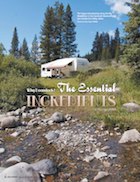
Escapees Magazine features our story, “Boondocking Essentials” – Jan/Feb 2012

escapees-magazine-boondocking-essentials-jan-feb-2012

Posted: January 1, 2012

Escapees Magazine’s January/February 2012 issues features our story, “Boondocking Essentials.”  We boondock nearly every night, and we have learned a few tips and tricks about how to find beautiful places on this country’s spectacular public lands.  This areticle shares those tips, most important of which is to have a sense of adventure!


Sailboat Solar – Installing Solar Power & a Solar Panel Arch on a Boat

This page describes our solar panel installation on our sailboat, a Hunter 44DS.  This setup has allowed us to anchor out almost exclusively.

Groovy's solar panels.

Boat solar panel arch installation

Happy panels in full sun, Sea of Cortez.

Marine solar mount installation

Full sun & no shade (3 panels working):   22.5 amps

Boat solar mount

One panel partially shaded (2 panels working):  15 amps.

Boat Solar panel partial shade problems

Shade straddles two panels (only 1 panel working):  9.5 amps.

Boat solar arch for panels

Polished welds and drilled/tapped/screwed joints.

sv Groovy's solar panel arch welds. sv Groovy - sailboat solar panel arch.

Liquid Metal

boat solar power mount on a sailboat

Comparison: Factory weld on our Hunter arch.

Sailboat solar panel arch

The arch extension arrives for a fitting.

marine solar panel mount extension.

Alejandro tie-wraps it in place.

Sailboat solar panel installation

Mark helps hold it up.

Boat solar power Marine solar installation

The extension is in place -- without its legs yet.

Boat solar mount installed on a sailboat

Jose checks if it's level.

Sailboat solar arch extension

The arch extension returns -- now with support legs.

Marine solar panel arch support

It's maneuvered into place.

Boat Solar arch on a sailboat Telescoping davits on a solar panel arch

Telescoping davit arm (marine solar panel arch)

Boat solar installation with solar panel arch.

Held in place with tie-downs.

Boat solar power arch installation

Looking good!

Marine solar power

Alejandro drills and taps holes in the arch.

The boat's solar panels are ready!

The solar panels are ready!

Boat's solar panel arch extension removed while Alejandro taps and drills.

Arch extension removed from Groovy while Alejandro drills

and taps the arch on the boat.

Installing solar panels on a sailboat

Heave ho!!

Installation of marine solar power system Marine solar power system installation

The second panel is installed.

Boat solar installation with solar arch

Three panels - yay!

Sailboat Solar power setup

Alejandro and Mark test the strength of the arch extension.

Boat solar powert

Mark begins the big job of wiring it all up.

Marine solar power system diagram

Component layout:  3 panels, combiner

box, controller & 4 batteries

Sailboat solar power design

Combiner box (upper left) and controller (lower right).

Boat solar power design and installation

Wiring the panels.

Sailboat solar panel system design and installation

All done.

Solar panels on our Hunter 44DS Groovy.

In use 18 months later in Puerto Vallarta.

Marine solar power system and design

Sailing in Huatulco.

Sailboat Solar Power & Solar Panel Arch Installation

This page describes the solar power setup we installed on Groovy, our Hunter 44DS

sailboat.  This was our third solar installation.  Our two RV solar installations are described

here: RV Solar Installations, and we have a boatload of info here: Mobile Solar Power

.

We learned a lot from those installations, and have written lots of details about solar power on

this website, including a multi-part Solar Power Installation Tutorial for beginners. Going

into far more detail, we have a 4-part primer on battery charging which includes:

-- The basics of multi-stage charging

-- How converters, inverter/chargers and engine alternators REALLY work

-- How to optimize a solar charge controller

-- What happens when TWO systems (like solar/alternator) operate at once?.

The company Kyocera

Solar liked our solar

panel installation so

much, they featured

Groovy on their website.

OVERVIEW

For comparison, our solar power installations have consisted of

the following:

Lynx Travel Trailer

(1) 130 watt/12 volt Kyocera solar panel

(1) Morningstar 10 amp charge controller

Various 150 watt to 800 watt portable and

semi-portable modified sine wave inverters

(2) Energizer 6 volt batteries in series (220 amp-hours).

Hitchhiker Fifth Wheel

(1) 130 watt/12 volt Kyocera and (3) 120 watt/12 volt Misubishi solar panels (490 watts total), wired in series

(1) Outback 60 amp MPPT charge controller

(1) 2,000 watt pure sine wave inverter permanently mounted

(4) Trojan 105 6 volt batteries wired in series and in parallel (440 amp hours).

Hunter 44DS sailboat

(3) 185 watt/24 volt Kyocera solar panels (555 watts total), wired in parallel

(1) Combiner box (combines 3 panel wires into 1 going to the charge controller)

(1) Xantrex 60 amp MPPT charge controller

(1) 600 watt pure sine wave inverter

(1) Xantrex 2500 watt modified sine wave inverter/charger

(4) Mastervolt AGM 4D batteries, (1) Group 27 AGM battery (710 amp-hours)

Notes:  (1) Our odd collection of panels on the Hitchhiker was due to the Kyocera 130 panels not being available at the time of

our installation (we brought one over from the Lynx).  (2) Our switch from the Outback to the Xantrex charge controllers between

the Hitchhiker and the boat was due to the Xantrex being cooled by non-moving fins rather than a fan.  In hindsight I would

probably use the Outback charge controller in the future only because it displays more information on its screen rather than

having to scroll through multiple screens to get the voltage, amperage, watts and charging stage.  (3) Our Group 27 start battery

on the boat is isolated from the set of 4D house batteries only when the voltage of the bank drops too low.

The boat has a DC refrigerator and a DC freezer which together eat up some 100-130 amps or more every 24 hours, depending

on ambient temperature.  In addition we listen to music on the stereo with multiple speakers and a large subwoofer, we watch

DVD's many nights on a 22" TV, we use two laptops for several hours everyday.  We also have a water pump, electric flush

heads and VHF radio which we use at anchor.  Our cabin lighting is a combination of fluorescent and LED, and our anchor light is

LED.  So our typical daily amperage use at anchor is between 180 and 250 amps.

In December, around the winter solstice, on the southern mainland of Mexico (Zihuatanejo) our solar setup collected about 170

amp-hours per day.  In June, around the summer solstice, in the middle of the Sea of Cortez (San Carlos) our solar setup

collected about 250 amp-hours per day.  In hindsight, it would be nice to have at least 750 watts of solar power to meet our

power demands in winter.

PARTIAL SHADE KILLS SOLAR POWER PRODUCTION

The biggest problem with installing solar power on a sailboat is accidentally getting a little shade on the panels.  While swinging at

anchor, the mast, boom, radome and other things high up all conspire to throw pockets of shade on the solar panels and make

them quit working.  It is quite shocking to find out just how little shade is needed to reduce the panels to zero output.  We had

experimented a bit with partial shading issues on our fifth wheel solar installation (see bottom of Solar Setup), but we never park

near shading objects so it is not a problem on that moveable home.  A sailboat is a whole different story.

An interesting paper Shade Effects on Conventional PV (5th article down) from the Physics Department at the University of

Arizona describes how shading just half of one row of "squares" on a solar panel -- as often happens in the morning or afternoon

hours on a commercial installation if the rows of panels are placed too close together -- the panels shut down or reduce their

output significantly.  The opening sentence says it all:  A panel that is 8% shaded loses 94% of its productivity."  Deep down in the

meat of this paper the math lost me (sigh), but for a layman's explanation of just how devastating shade can be on solar panels,

this website delivers the skinny.

We placed our panels as high and as far back from the boom as we could.  We also pull the boom aside while at anchor, but the

panels still get shaded by the mast/forestay/radome when the sun is forward of the shrouds and they get shaded by the sails

when sailing.  As an experiment, we took some notes about how partial shade affects our panels.  This data was taken on

February 3rd at 10:00 a.m.  The shade was caused by the mast, forestay and radome (affixed to the front of the mast).  The

shade moved slowly back and forth across the panels as the boat swung at anchor.

Panels in full sun:

22.5 amps

One panel partly shaded:

15.5 amps

Two panels slightly shaded:

9.5 amps

As another experiment we sailed and noted the amperage

produced by the solar panels as we sailed on two different

tacks.  On one tack the mainsail shaded one entire end panel

and half of the middle panel.  On the other tack the boat was

heeled away from the sun but there was no shade on any of

the panels.  It was far better to be heeling away from the sun

than to have the panels shaded.  This data was taken at 11

a.m. on January 31.

1½ panels fully shaded by sails:

10 amps

No shade, tilted away from sun:

24.5 amps

So it seems to me that shade is the number one enemy of solar panel power production on a sailboat, and orientation towards

the sun is a lot less important.  If the solar panels are installed in such a way that a nearby radome or wind generator is always

partly shading one panel in the array, as too often happens in solar panel installations on sailboats, the result will be dramatically

reduced power production.

THE ARCH EXTENSION

Our boat came with a fantastic arch that supports the traveler.  We used it as a base for an elegant stainless steel extension that

supports the three panels.  We hired Allejandro Ulloa of Ensenada, Mexico to create this arch extensions.  Alejandro is an artist

and a master craftsman.  And he is extremely professional.  We gave him a sketch of what we were looking for, he responded

with a written quote for half of what it would have cost in San Diego, and we were off and running.

Alejandro prides himself on the beauty of his work.  He polishes the welds and installs tubing that

seems to flow like liquid metal as it rounds corners and changes thicknesses.  In our opinion, his

arch extension dramatically increased the esthetics of our boat.  It also added functionality

besides just supporting the panels.  It makes a great spot for hanging on when you're sitting in

the rear jump seats, it has a

telescoping davit system,

and the panels provide

much needed shade.

If you need to have an arch

or any kind of stainless steel

structure fabricated for your

boat and you are heading to

Mexico from the US or

Canada, spend some time in

Ensenada and look up

Allejandro Ulloa (email:

alejandrossw [at] hotmail [dot] com,

Mexican phone: (646) 171-5207).  He can

be contacted through the excellent Baja

Naval boatyard as well.  There are other

stainless steel fabricators in Mexico but we

haven't seen anyone nearly as skilled or

as professional in their approach.

Alejandro built the extension in his workshop and then brought it

to the boat to size its supporting legs.  This was a thrilling process

for us, as we began to see it taking shape on the boat.  The entire

arch extension was wrapped in plastic for this phase to protect

the finish.

Mark helped wherever he could and I took endless photos.

Alejandro returned on another day with the finished arch extension.

Now it had tabs for the solar panels, and the supporting legs had

been cut and welded at the right length.

We wanted the arch extension to double as a davit system.

Alejandro designed clever telescoping tubes that snap into place in

an extended or contracted position, and he fabricated two beautiful

cleats.  We have found that we use the davits in the contracted

position most often because they hold the porta-bote tight to the

swim platform where it fits perfectly into the swim step cutout in the

transom.

We anticipated

mounting the solar

panels ourselves,

as the quote

Alejandro provided

was for building

and installing an

arch extension,

not for installing

panels.  We

weren't sure how

we'd get them mounted, but we knew

we'd figure it out.

Meticulously adhering to the

"measure twice cut once"

philosophy, Alejandro

dismantled the whole thing

for some adjustments and

then mounted it one last

time for the final installation,

tapping and drilling and

screwing each of the arch's

feet into place in a bed of

3M-4200.

Then, to our amazement,

Alejandro and his assistant

began mounting each of

the panels.  Mark quickly

jumped in.  These are not

light panels, and it was

quite a stretch to get them

in position.  Alejandro was

concerned about possible

corrosion due to the

dissimilar metals of the

panels' aluminum frames

and the stainless steel arch

extension, so he placed a

plastic insulator in each

attachment point.

When it was all

finished, Alejandro

wanted us to be

confident that the arch

could support a dinghy

and engine.  He and

Mark swung from the

davits.  Both are

lightweights, but they

were still twice the

weight of our

dinghy and

outboard.

WIRING

Alejandro's work was done, but we still had a big project ahead.  We ran the wiring

inside the arch so it wouldn't show (it wasn't easy snaking it through!!), and we placed

the combiner box and charge controller in a transom locker.

The installation

looked beautiful

and it worked, but it did not work as efficiently as it

could have.  The whole system produced about

20% less power each day than it was capable of

doing.  We learned we'd made two vital mistakes.

One advantage of using 24 volt solar panels is that

we had half as much current in the wires as we

would have had if we'd used 12 volt panels.  Rather

than 36 amps (at 12 volts) at peak production we

had just 18 amps  (at 24 volts).  This allowed for a

smaller wire size, which is much easier to work with

as it is a lot more pliable, and it's cheaper to boot

(marine grade electrical wire is exorbitant).  Our

salesman at Northern Arizona Wind and Sun had recommended we use 10

gauge wire throughout the system.  This turned out to be inadequate

because the distance between the panels and the batteries is so long --

about 50'.  For wire gauge sizes, amps and

distances, see this chart.

Our second mistake was placing the charge

controller in an aft transom locker.  Our batteries

are next to the centerline of the boat at the lowest

point above the keel in the main salon.  The

charge controller needs to be close to the batteries

as possible.  The distance from the charge

controller in the transom locker to the batteries

was about 30' -- too far.    The combiner box was

fine back there, but the charge controller had to be

moved.

Although most of our circuit runs at 24 volts -- from

the panels to the combiner box to the charge

controller -- allowing for smaller wire, the portion

between the charge controller and the

batteries runs at 12 volts.  Therefore, the

cable between the charge

controller and the batteries

needs to be not only as short as

possible but very large as well.

We moved the charge controller

into the cabin in a hanging

locker about 10' from the

batteries and and switched to 8

guage wire to connect it, and we

saw a dramatic improvement.

When the distance between the

charge controller and the

batteries was 30' and we were

using just 10 gauge wire, the

resulting resistance in the wire created a large

voltage drop between the charge controller and the

batteries, artificially raising the voltage at which it

thought the batteries were operating.  The charge

controller would see the batteries at 14.4 volts whereas when we measured the batteries with a volt meter

they were actually at 13.2 volts.  This threw everything in the system way off, and ultimately resulted in a

daily loss of some 10-30 amp-hours that never made it from the panels to the batteries.  Once we moved the

charge controller to within 10' of the batteries and installed bigger wire, the resistance dropped.  The

controller saw the batteries within 0.2 volts of their actual voltage, and our daily power production increased.

Note: In three years of cruising Mexico, our boat was plugged into shore power for a total of 6 weeks

while it was in in-water storage in San Carlos. It was never plugged in while we lived aboard (even during

the 3 months we stayed at Paradise Village Marina in Puerto Vallarta).


Subscribe
Never miss a post — it’s free!

In addition to living off the grid on solar power on our sailboat, we have also lived on solar power in our RV since 2007. As of February, 2016, we have now installed solar power on two trailers and a motorhome as well as our sailboat, as described here. We have a huge library of solar power and battery charging articles on this website that draw on all of our experience:

SOLAR POWER OVERVIEW and TUTORIAL

BATTERIES and BATTERY CHARGING SYSTEMS

LIVING ON 12 VOLTS

The solar power setup aboard Groovy has inspired stories and articles all over the internet.  Here are a few of the websites and online magazines that have featured stories about Groovy and our marine solar power installation:

Where do you buy solar panels, charge controllers, inverters and such? Surprisingly, Amazon offers solar power kits and more. Click the following links for a wider selection of:

If you click through to Amazon from anywhere on this website, anything you put in your shopping cart or wish list immediately after that results in a small commission to us at no cost to you, no matter what you search for and no matter when you finalize the purchase. This is a wonderful way that you can "help us help you" with detailed and carefully researched articles. Thank you!


New to this site?  We have more info on Solar Power and tons of other great stuff for cruisers. Please check out our Home page and our Intro Page for Cruisers to learn more about us and discover what’s where on our site.

Our most recent posts:

More of our Latest Posts are in the top MENU above.

2005 Fleetwood Colonial Popup Camper

Our first trailer: a Fleetwood Colonial Popup tent trailer with our Toyota Tundra pickup We loved our first RV - a Fleetwood Colonial popup tent trailer (folding tent trailer)

Closer view of the buggy itself.

Our little popup trailer was the ideal starter RV. We put our buggy's name on the license plate of our popup tent trailer.

We got a license plate with the buggy's name on it.

Here's a photo of the Floorplan of the Fleetwood Colonial popup tent trailer (folding tent trailer)

Luvnest Floorplan

2005 Fleetwood Colonial Popup

We used our popup for three years of vacation travel from 2004-2007, and we named it the Luvnest because it was so darned

cute and so much fun.  Whenever we spent time in it, even just a weekend in a local campground, we fell in love all over again.

We took it out whenever possible.  In the first two years we spent 157 nights in it.

We bought it after a trip to Bryce Canyon National Park (Utah) in a tent.  The rain was relentless.  While we drove around looking

for warm coffee shops and cozy places for lunch and dinner we noticed that all the people in RVs at the campground were

happily playing board games and reading, snug inside their trailers.  All the tenters packed up and left.  When we got home we

went shopping for a popup.

The 2005 Fleetwood Colonial Folding Tent Trailer is 12' long

end-to-end, including the hitch.  It has a 10' x 8' box containing

the dinette, sink, cupboards and some nice shelving and gives

150 square feet of living space.  There is a King bed at the

hitch end and a Double bed at the other end, We had a

furnace and outside shower which both came in very handy.

We never camped anywhere that required air conditioning, but

we often had chilly nights and ran the furnace.  When we got

hookups we would use a Holmes ceramic space heater

instead, as heating the trailer with the furnace used a lot of

battery power.

It had 26 gallons of fresh water (including the 6 gallon hot

water tank).  There was no holding tank and no toilet.  We

kept two small sets of Rubbermaid drawers in the trailer.

One set contained our toiletries and the other had all those

miscellaneous things you need like scissors, string, tape,

stapler, pens and pencils, pads, sewing kit, etc.

We pulled the popup with a 2004 Toyota Tundra pickup truck

(4.7 liter engine).  It was a perfect combination for towing.  The

trailer was easily within the truck's capabilities and there was

plenty of storage under the cap of the pickup for all the things

that wouldn't fit in the trailer.

We purchased a bike rack for the roof, as this particular

model did not include a roof rack.  It was a little awkward to

get the bikes on the roof, because the rack system required

strapping the bikes down in addition to using Bike Tites to

clamp the fork to the roof, but it gave us more room in the

truck.

The beauty of a popup is that it is light and easy to tow, can fit

in almost any campsite at any campground and can be

parked in the garage.  Most have a king bed.  The

disadvantage is that the canvas sides don't provide any

insulation and you can't easily overnight in a Walmart or eat

lunch at the dinette while stopped at a rest area.

A popup offers a fantastic introduction to RVing.  We learned all about the basic RV systems: batteries, gas fridge, gas hot water

heater, furnace, etc., with the popup.  We also learned how to conserve water with our showers and how to conserve battery

use.  We did not have solar, but we could spend about a week in this rig without charging the batteries.  We often used candles

at night to extend our stay.  The furnace was very effective but used a lot of battery power.  I nicknamed it the Fire Breathing

Dragon, because it was quite loud and would make the buggy so hot I'd have to unzip the canvas near my nose to get some

fresh air!  We found that if we were staying several days in a place where temperatures got into the 30's at night we were

happier with hookups so we could run our electric heater all night long.  The lowest temperature we ever camped in was 28

degrees in Moab, Utah, in March.  We like to be warm and we don't camp in humid areas, so we have never had a need for air

conditioning in any of our rigs -- except when we were east of central Texas.

Long-term travel in a popup can be done, but it is the exception.  We met a couple in their mid-sixties that has full-timed in a

Fleetwood Niagra popup for four years.  They had a bumper sticker, "Life is better outdoors," and they were grinning ear to ear.

We also met a couple in their twenties that was spending six months in their Fleetwood Santa Fe touring the country and

peforming music in local bars as they searched for a community they liked enough to settle in.

It was hard to give up our first Luvnest when we purchased our Lynx travel trailer.  However, our good friends Rich and Mary are

now the proud owners of this rig, and we have had a ball camping with them, seeing our old Luvnest in a nearby campsite.


What’s It Like to RV Full-time? – A Snapshot of Pure Joy (as the banking world collapsed)

What's it like to live in an RV full time? Here is a peek at one month of RVing adventures.

Mountaintop meadow where our

month started in Parowan, UT

Full-time RV - Tractor show in Parowan, UT where we boondocked in our fifth wheel RV.

Tractor show, Parowan, UT

Full-time RV - John Deere Memorabilia, Parowan, UT where we boondocked in our fifth wheel RV.

John Deere rules

RV full-time - Iron County Fair rides, Parowan, UT where we boondocked in our fifth wheel RV.

County fair in Parowan, UT

RV full-time - Iron County Fair balloons, Parowan, UT where we boondocked in our fifth wheel RV.

Kids love clowns and

balloons

RV full time - Boondock site, Parowan UT in our fifth wheel RV.

Boondocking by a babbling brook

(brook not shown!)

RV Full time - Budweiser Clydesdales, Cedar City, UT where we boondock in our fifth wheel RV

Budweiser Clydesdales at the Cedar City western rodeo

RV Full time - Cedar City Western Rodeo, UT where we boondock in our fifth wheel RV

Lil' cowboy

RV Full time - Pioche, NV ore bucket where we boondock in our fifth wheel RV

Ore bucket in

Pioche, NV

full time RV - Pioche, NV where we boondock in our fifth wheel RV

Pioche, NV, ghost town, living history

and fading memories

full time RV - Pioche Nevada Overland Hotel where we boondock in our fifth wheel RV

One remaining saloon

out of 80 that once

thrived in Pioche, NV

full-time RV - Pioche Nevada jailhouse where we boondock in our fifth wheel RV

The jailhouse in Pioche,

NV

Full time RV - Pioche Nevada Cathedral Gorge State Park where we boondock in our fifth wheel RV

Cathedral Gorge outside

Pioche, NV

RV Full-time - Pioche Nevada Cathedral Gorge State Park where we boondock in our fifth wheel RV

Moonscape at Cathedral Gorge

RV full time - Pioche Nevada Cathedral Gorge State Park where we boondock in our fifth wheel RV

Cool shadowing cliffs at

Cathedral Gorge

Full time RV - Colnago bicycles at Interbike Las Vegas NV Boondocking in our fifth wheel RV

Pricey Italian Colnagos lined up for test

rides at the Interbike Outdoor Demo.

Full time RV - Shelter Island Harbor San Diego where we boondock in our fifth wheel RV

Sailboats in San Diego Harbor

RV full time - Cruise ships San Diego where we boondock in our fifth wheel RV

Cruise ship dwarfs the San Diego skyline

RV full time - Shelter Island Harbor San Diego where we boondock in our fifth wheel RV

Local sport fisherman shows off his shark

before tossing it back to the sea

full time rv - Shelter Island Harbor San Diego where we boondock in our fifth wheel RV

San Diego skyline at sunset

Full time RV - Mission Bay San Diego boondock in our fifth wheel RV

Sailboat headed out to catch the breeze

RV full time - Mission Bay San Diego where we boondock in our fifth wheel RV

A day of fun in the sun on Coronado

Beach in San Diego

RV full time

Scenic road through Red Rock Canyon, NV

What's It Like to RV Full-time?? A Free Spirited Month of Pure Joy (as the banking world collapsed)

What is it like to travel fulltime in an RV?  It is a total blast.  We have a sense of freedom and independence that we have not felt

since childhood.  But the wonderful difference between living like this and being a kid is that there are no grownups around to tell

us what to do.  Each day -- every moment -- we do whatever we feel like.  And we never know what will happen next.  We

structure our overall movements by seasons:  we'll spend spring here, summer there, and by fall we should be over there.  We

structure our daily movements by how much we like a place, what chores need to be done, and the weather.  Sometimes we

arrive in a town to discover there is an event going on, and we get caught up in the local excitement.  Sometimes the highlight of

a day is the hours at the laundromat: we have met some great people while folding

clothes.  Sometimes we have a totally quiet day, filled with reading, writing, napping and

talking with each other.  However we spend our days, by the end of each one we almost

invariably look back and say, "What a great day!"

For me, the best part of this lifestyle is the

unpredictability.  I like not knowing what I am going to

do after breakfast.  I like not knowing anything about

a town until I get there.  I like studying maps and

wondering about the views from the tiny squiggly

roads leading into the hinterlands.

ONE MONTH IN THE LIFE

During September, 2008 we had a series of outstanding adventures.  Those few weeks form a perfect snapshot of what it's like,

how repeatedly stumbling into unexpected good times can be so much fun.

We had spent the summer near Bryce Canyon, Utah where we had settled into

one idyllic location for a month.  Gorgeous as it was, while August began to wind

down we felt like we were growing roots and were beginning to itch for new

scenery.  Our overall goal was to get to Las Vegas, Nevada, by September 23rd

for the annual bike industry trade show, Interbike.  Then we would meet up with

family in San Diego on the 30th.  In between, we had a month to kill and very little

geographic distance to cover.  That month held the essence of all that is great

about this crazy, traveling lifestyle.

County Fair in Parowan, Utah

We arrived in Parowan, Utah, September 1st.  Missing the turn to our planned campsite, we stopped

in the visitors center for directions.  While there, we discovered the town was hosting a huge Labor

Day county fair, complete with a 5K running race, in just a few days.  Mark signed us up for the race,

and suddenly we were immersed in the fair's rides, kettle corn, crafts display and tractor show.  We

saw a terrific seminar on local raptors, ran the race, talked at length with various residents, and

watched the parade.  During the days of the fair we camped in a mountaintop meadow near a

beautiful reservoir, at 9,000 feet elevation amid aspen and tall pines.  When the morning air got too

cool we found another spot at the base of the mountains, at a warmer elevation of 6,000 feet, where

we settled in next to a babbling brook, just a mile from town.

New Friends

After the fair ended, we were doing our laundry, pondering what

might come next in our lives when, between washing and

drying, we met a delightful couple from Arizona who live in their 24' fifth wheel in a local

mobile home park every summer.  They invited us to stop by, get water for our trailer, and

visit a while.  What a glorious afternoon!  Their fifth wheel had a stunning view of the nearby

mountains, and they were full of tales of their lifetime of international travel adventures.

Great American Stampede in Cedar City, Utah

Still caught up in their stories, we packed up the trailer and moved

a few miles south to Cedar City.  We decided to stay in the Home Depot parking lot which put us close

to a lot of shopping that we needed to do, and allowed Mark easy access to Home Depot for purchases

and returns as he embarked on a trailer project.  After six weeks in remote areas, it was fantastic to get

22 high definition digital channels on TV, so we sat in front of the boob tube for a few days, nursing our

sore running muscles and resting up after all the excitement of the fair.

We discovered the town was hosting a

western rodeo show over the weekend, so

once again we found ourselves caught up

in the small town celebrations of a rural

lifestyle neither of us has ever known.  We

spent many hours with the Budweiser Clydesdale horses and

handlers before and after the parade, learning all about the recent

purchase of Anheuser-Busch by InBev, and learning about the life of

these magnificent horses and their dedicated caretakers.

More New Friends

While admiring the horses we ran into a friend we had met at the tractor show in Parowan, and he

invited us to stay a night in his driveway nearby.  First we needed to watch the parade and sample a

little more kettle corn, but soon we found ourselves camped out in our new friend's driveway, learning

even more about tractors.  He is an avid John Deere collector, and besides his many tractors, he has

a house filled with John Deere memorabilia: lunch boxes, quilts, vests, curtains, table cloths, coffee

mugs, you name it.  His wife is a collector too, and our eyes were saucers when he swung open the

door to a bedroom that was filled, floor to ceiling, with Pepsi memorabilia.  Posters, trays, cans from

every era, pens, mugs, buttons, statuettes, hats, clothing.  Neither of us is a collector, and last year

we emptied our lives of almost all our worldly possessions.  How amazing to stand in this house that is

a shrine to all things John Deere and Pepsi.

Pioche, Nevada - Living History

Talking a mile a minute about these amazing collections, we

made our way to Pioche, Nevada, a town of 700 where the

nearest grocery store is an hour's drive away.  The town is so

far off the beaten path that their city RV park is free.  Pioche,

NV, we discovered, is a living ghost town that is filled to

overflowing with real-life memorabilia of the town's rugged,

wild-west, mining past.  As we pulled into town, we had to drive

under the ore-bucket tramway that was stilled 75 years ago

but still has buckets swinging in the breeze.  Without the

slightest nod to tourism, this town is the real deal, authentic in

its living history and dying population.  The caretaker of the

historical museum and courthouse has so many stories to tell,

of living citizens and long-dead historical figures, that I wished I had a

notebook to take notes as I listened to her.  For three days we pondered

the brutal lives of the nineteenth century silver miners who lived in this

once rocking town of 10,000 where 80 saloons and 20 brothels thrived.

Everywhere we turned in this quiet, peaceful town, we were surrounded

by reminders of its rugged history.

Echo Canyon and Cathedral Gorge - Nature's Treasures

Seeking a little exercise, one day we rode our bikes 15 miles out to Echo

Canyon, a delightful desert oasis complete with herons fishing in the

reservoir and sheer rock cliffs.  Another day we rode fifteen miles in

another direction to Cathedral Gorge.  We hiked among the sandstone

towers, climbing deep into their cool, shadowed crevices, our heads

thrown back as we gazed up the immense, sheer walls.  We would have

stayed in Pioche longer, but Interbike was calling and we needed to get

to Las Vegas.

Bicycle Tours

We started our Las Vegas visit with a few days in Red Rock Canyon

where we enjoyed some gorgeous bike rides on the scenic road that

loops the western end of the city.  The views were right out of a bicycle

touring company catalog.  Once Interbike's Outdoor Demo got

underway, we joined the "Hangover" group ride on a stunning tour of

the eastern suburbs outside the city.  I will never forget the thrill of the

peleton flying down the hill in Henderson, NV, going 40 mph and more,

as the stunning view of the bright blue lake set against the red and

brown mountains opened up before us.

Bike Gear and Lance Armstrong

The Interbike trade show is a five day blitz of shiny bikes, clever gadgets, cycling

celebrities, free beer, and endless free "swag."  We test rode a Co-Motion tandem,

Co-Motion touring bikes with outrageously huge tires, top-of-the-line Lightspeed

titanium bikes (for the 24-mile "hangover" group ride), and an Orbea carbon frame

with the latest Shimano drivetrain.  Mark studied Campagnolo's latest 11-speed

gruppo, and we each ended up with a free pair of Oakley sunglasses.  Mark got

free custom insoles for his running shoes and a free set of Gore cables for his

bike.  The supplements were flowing on every corner, and we left with a year's

supply of electrolyte drink additives and energy bars.  The big surprise was the

night we aimlessly got on the free shuttle bus to go see a cyclocross bike race,

and arrived to find Lance Armstrong on the start line.  He passed us on every lap,

just an arm's length away, close enough to see him grimacing as he fought to stay

in the second pack, a full minute behind the leaders.  Why didn't I bring my

camera?

California Casino Hopping: Tiki Bars, Farmers' Markets and Swimming Pools

Las Vegas is insanely hot in September, and we had a week to kill before meeting Mark's daughter and granddaughters on their

vacation in San Diego.  We wandered into California hoping to find some relief from the heat, but the road from Vegas to San

Diego is mostly through the desert.  So we decided to casino-hop, planning on free overnights in their parking lots and air

conditioning somewhere in their buildings during the days.  We aren't gamblers, but one casino gave us money to play the slots,

so our meager winnings meant we were paid to camp at their place.  Even better was the delightful surprise that many California

casinos are set up as resorts.  We jumped from one casino resort swimming pool to

the next, soaking ourselves in the hot tubs and enjoying the poolside tiki bars along

the way.  What a great way to beat the heat for a few days while making our way

across the desert to the coast.  Between tiki bar hops, we rode our bikes to Old

Town Temecula and happened to hit it on a Saturday, the day of their farmer's

market.  We spent a happy hour talking with a 40-year resident who has been

bringing her homemade wheels of Gouda cheese to this market for 15 years.  She

told wistful tales of riding her horses through the valleys where the freeways and

housing developments now stand.

Waterfront Life in San Diego

Once we got to San Diego we joined the local RV crowd that takes up

residence along the harbor-side streets on Shelter Island and Mission

Bay.  We relaxed on the waterfront, checking out the latest yachts at the

nearby brokers, and watched the pelicans dive for fish while the

thundering Navy jets rumbled our chests on every take-off and landing.

A perfect 80-degree day of play in the sand and sun at Coronado

Beach topped off an incredible month of fulltime RV living.

Couldn't Have Planned It Better...

Looking back, it is amazing to think about the variety of good times we had that month.  I couldn't have planned a more ideal

string of 30 days, yet every great adventure was something we fell into by accident, completely unplanned.  From a 5K running

race to a county fair, western rodeo and parade, to meeting some great people we never would have met at home, to watching

Lance Armstrong race his bike, to sitting in a resort hot tub quaffing drinks from a tiki bar, to body surfing on a white sand beach,

we experienced a little bit of everything.  If I didn't mention any down times, it's because there were so few.  Sure, the drive

towing our 14,000 lb fifth wheel up and down the desert mountains was a white-knuckle affair.  It was almost as scary as the

rush-hour drive down I-15 through Escondido, California, where I prayed nonstop that no one would rear-end us.  The traffic jam

on I-15 between Baker and Barstow, California, really took the cake too, as we sat

motionless in 102 degree heat and wondered if we would ever get the truck out of

Park -- on the freeway.  Sure, it was frustrating to sit in a casino parking lot

with the trailer interior at 95 degrees, unable to use the generator to run the air

conditioning because security forbade it.  And it was a little discouraging to do that

running race knowing that if I were living my old conventional life at home I would be

more diligent about my fitness and would be closer to true "race shape."  But those

are tiny tiny prices to pay for a glorious month of total freedom, unexpected

adventure, and countless great discoveries.

Meanwhile, Back at the Ranch...

During this same month, the US financial markets imploded.  Lehman Brothers filed

for bankruptcy; AIG collapsed into government support; Uncle Sam pointed his

finger at Fannie Mae and Freddie Mac and said "I want you;" Washington Mutual

had a coronary, narrowly revived by a buyout; Wachovia went begging to Citigroup

and Wells Fargo, and everyone born after 1940 was talking "Great Depression."

Taxpayers were hooked for $700 billion to save their own skins when we didn't even

know our skins needed saving.  Cover photos on newspapers showed Wall Street

rank-and-file with their heads in their hands.

What a great time to be meandering happily between historic western towns, exotic

sandstone cliffs, swimming pools, farmers markets, boat-filled harbors and the

ocean, making new friends along the way.

What is fulltime RVing like?  This month says it all:  It's a great life.  We are very lucky to be alive and to be living this way.


Statistics – A Few Stats from our first 18 Months of RVing

Fun Statistics from our full-time RV travels

We keep track of a few things in our full-time RVing and boondocking lifestyle, and they make for some fun statistics.  As these

stats show, we changed our travel style a lot between our beginning in May, 2007 and now in November, 2008.  We covered a lot

of ground and drove a lot of miles at first.  Then we slowed way down, drove less and saw more in each place.

Back in our workaday lives, we easily drove over 4,000 miles per month between our two cars.  When we started traveling that

dropped to 2,000 miles per month as we had just one vehicle to drive.  In the past six months our driving has dropped even

further to less than 1,000 miles per month.

Our nightly camping fees were quite high at the beginning, reaching a peak average of $16.20 per night by July 16, 2007, just 8

weeks into our new traveling lifestyle.  Then we learned about the pleasure and value of boondocking, and we gradually

stopped staying at campgrounds and RV parks.  In this second year of travel we have been paying for camping just 7% of the

time and boondocking or overnighting in quiet public places 93% of the time.

Fuel prices skyrocketed while we were in Florida in the Spring of 2008 and peaked when we got to the North Rim of the Grand

Canyon in July, 2008.  Then they plummeted while we were in California and Arizona in the Fall of 2008.  Now we pay less than

we did when we started 18 months ago.  Last summer it cost up to $183 to fill the diesel tank.  Now it costs as little as $85.

I'd like to think we are riding our bikes more, but despite using our bikes for commuting all over the San Diego waterfront, finding

some great cycling around Bryce, Utah, and riding with a club in Yuma, Arizona, we seem to still be averaging a dismal 225 miles

per month.  There was a time when we did that each week.  Oh well -- we've traded new views on every mile for unchanging

views on a zillion miles.

Year ended

6 months ended

5/21/08

11/20/08

DRIVING RELATED

Total miles driven

25,207

5,432

Total miles towing the trailer

15,937

3,322

Total miles ridden on our bikes

2,500 (each)

1,350 (each)

Cheapest diesel seen

$2.64/gal, TX, May '07

$2.38/gal, Yuma, AZ, Nov '08

Most Expensive diesel seen

$4.79/gal, KS, May '08

$5.34/gal, Grand Canyon, July '08

CAMPING RELATED

Total spent on campgrounds

$3,009

$261

Average cost of camping per night

$8.22

$1.43

Nights in public campgrounds

174

27

Nights in private RV parks

61

3

Nights boondocking

58

99

Nights in friends' driveways

32

1

Nights in rest areas / pullouts

16

20

Nights in casino parking lots

12

12

Nights at Walmart

6

0

Nights in commercial parking lots

3

16

Nights in Visitors Center lots

3

1

Nights in truck stops

1

0

Number of different locations

103

37

Nights with hookups

67

14

Total Nights

366

183

TRAVEL RELATED

States visited

20

7

Locations overnighted

103

37

Most time in one state

Florida, 3 months

AZ, 2 months

Least time in one state

Missouri, a few hours

TX, a few hours

Longest stay in one spot

15 days, RV Park, Florida

29 days, Utah

Mayport Naval Station

Bryce Canyon Area

Worst weather

Golf ball sized hail, KS

Longest time between truck fillups

30 days


2007 Fleetwood Prowler Lynx 27′ Travel Trailer

We lived fulltime in our Fleetwood Prowler Lynx 270 FQS travel trailer, a good RV for fulltiming! The 27' Fleetwood Prowler Lynx 270FQS is a great RV for the fulltime RV lifestyle, even though it's a travel trailer A 27' travel trailer, the Fleetwood Prowler Lynx 270 FQS, has enough space for a part-time RV lifestyle but not enough for fulltiming

This layout is great for two people but is limited for

entertaining.

The Fleetwood Prowler Lynx 270FQS has an open floorplan that we liked for our fulltime RV lifestyle The 27' Fleetwood Prowler Lynx 270FQS travel trailer RV has an open floorplan -- good for fulltime RVers like us

The sofa and dinette are in a big slide

We opened the jackknife sofa all the time in our 27' Fleetwood Prowler Lynx 270FQS when we were living in that RV fulltime

The "jackknife" sofa easily folds out into a double bed. 

The dinette also folds down into a child-size bed.

We used the TV a lot in our Fleetwood Prowler Lynx 270 FQS travel trailer when we lived in that RV fulltime

The TV can be turned to face the bed or the sofa.  There

is a cigarette lighter on the wall that we used for our

inverter so we could watch TV and DVDs while

drycamping.

The kitchen in our 27' Fleetwood Prowler Lynx 270FQS travel trailer was a little small for our fulltime RV lifestyle

This little kitchen produced many great meals.

The 27' Fleetwood Prowler Lynx 270FQS is a smart floorplan that worked well for our fulltime RV lifestyle

Lynx Floorplan

solar panel installation (Kyocera 130 watt) on our 27' Fleetwood Prowler Lynx 270FQS travel trailer, our fulltime RV

Mark installs the solar panel on the roof of the trailer.

This gives us all the electricity we need without having

to hook up.

Solar panel installation (130 watt Kyocera) on our 27' Fleetwood Prowler Lynx 270FQS travel trailer, the RV we lived in fulltime

Getting psyched to start drilling holes in the roof.  Mark

was naturally quite worried about this part of the

installation.

solar panel installation (Kyocera 130 watt) on our 27' travel trailer, a Fleetwood Prowler Lynx 270FQS, our fulltime RV

Westport-Union State Park Campground in California

about 150 miles north of San Francisco was a nice

place to do this installation.

Kyocera 130 watt solar panel on the roof of our RV, a 27' Fleetwood Prowler Lynx 270FQS travel trailer, our fulltime RV home

Finished product, situated between a roof hatch and the

folded down TV antenna.

2007 Fleetwood Prowler Lynx 270FQS

We purchased our Fleetwood Lynx travel trailer as a fulltime RV,

and we lived in it from May, 2007 to May, 2008.  We bought it with

the idea of "Go cheap, go small, go now."  We wanted to use our

existing truck ('04 Toyota Tundra), and this trailer was the largest

size that our truck could handle (theoretically).  We wanted a travel

trailer so we could have a cap on the truck and keep our bikes out

of the elements.  What appealed to us about the Lynx was its very

spacious interior for its length.  It had an open and airy feeling

inside, and had a lot of storage space.  It was the ideal introduction

to larger sized RVs.

The 2007 Fleetwood Prowler Lynx 270FQS is a 29'

travel trailer from end to end, including the hitch, and

is 27' x 8' inside with a 3' x 14' slideout, providing 240

square feet of living space.  It weighs 5,500 lbs dry

and has a GVWR of 7,300 lbs.  It was billed as "half-

ton towable" but we had trouble towing it through the

mountains with our 2004 4.7 liter Toyota Tundra.  We

towed it for about 4,000 miles with that truck and

then replaced the truck with a Dodge Ram 3500

diesel.  The trailer holds 40 gallons of fresh water, 40

gallons of grey and 40 gallons of black.  It has a

15,000 BTU air conditioner and 35,000 BTU furnace.

There is a single slide that is 3' x 14' which contains the dinette and

sofa.  The queen bed on this model was a short queen (74.5" x 60"),

but Mark modified it to be a full quuen (80"x60").  The bed lifts up to

a huge storage area underneath that can be accessed by hatch

doors on both sides of the trailer.  It has a 6 cubic foot refrigerator,

kitchen sink, range, microwave and pantry.  The bathroom has a

shower, toilet and sink.

We used an Equalizer hitch with a 12,000 lb rating.  The hitch broke

twice.  Fortunately we were not hurt either time.  The first time the

welds cracked all around the hitch head.  The second time one of the

two bolts holding the hitch together sheered off when we came down

a driveway leaving a bank parking lot.  Equalizer was very good and

replaced the hitch head when the welds broke.  We replaced the hitch

bolts with #8 rather than #5 bolts (only a few bucks) just a few miles

from where we noticed the one had sheered off.  We got 9-10 mpg

while towing with the Tundra and 11-12 mpg while towing with the Dodge.

This trailer was an ideal starter for fulltime RVing.  In it we learned about

solar power, inverters and boondocking, and it taught us about the things

that were vital and the things that were unimportant in a fulltime rig.  In the

end we realized the Tundra was not strong enough to tow the Lynx and we

upgraded to a long bed, single rear wheel Dodge Ram 3500 one ton.  It was

more truck than the Lynx needed, but we purchased it knowing that one day

we might get a fifth wheel.

By starting with the little Lynx we got on the road sooner rather than later,

and we had time to research alternative big rigs at leisure.  As we traveled

we quizzed everyone we met in a larger trailer to find out what they liked

and didn't like about it.

We visited dealerships in towns from Oregon to Florida and slowly educated

ourselves about the brands, makes and models of the larger rigs.

There is no way that we could have done that kind of research when

we were working.  We finally  decided the Lynx was too small during

the long cold winter nights, and being a lightly built "half-ton towable"

trailer, it was a little fragile for the long term.  We also discovered that

it was very awkward to get into the storage space in the back of the

truck and we decided the bikes didn't really have to be stored out of

the elements.

Our solar setup on this rig was one Kyocera 130 watt solar panel

mounted permanently to the roof (not able to be tilted towards the

sun), and a Morningstar Sunsaver charge controller connected initially

to two 12 volt Nautilus Group 24 batteries.  We upgraded the batteries

to two 6 volt Energizer batteries from Sam's Club after six months.

The first pair of batteries had 140 amp-hours of capacity and the

second pair had 220 amp-hours of capacity.  The solar charging

setup provided about 25-50 amp-hours of battery charging capacity

per day, which meant that we could use about that much battery

power in the trailer each day without running the batteries down.

We had an 800 watt inverter connected directly to the batteries and we

ran a power strip style extension cord from its AC receptacle through

the storage area under the bed and into the trailer.  We had to go

outside to open the storage hatch to turn on this inverter, so we used it

only when we wanted to run the vacuum cleaner (which draws 300-400

watts).

Inside the trailer there was a cigarette-lighter style DC connector for

the antenna boost system on the wall next to the TV shelf.  We kept a

tiny Radio Shack 150 watt inverter on the shelf and turned it on

whenever we wanted to charge the computer, the razor, the camera

batteries or the toothbrush, or whenever we wanted to watch TV or

DVDs.  This little inverter's fan quit once, but Mark lubed it up with

WD-40 and it ran daily for 3-6 hours each day for the year that we

lived in this trailer.  It is amazing that a tiny $60 gadget could give us the ability to run all the AC appliances that we wanted to run

(except the vacuum).  We had never used a microwave much in our house, so we didn't bother getting an inverter large enough

to support the microwave (950 watts).  So we used the microwave as a breadbox.

We drycamped 83% of the time that first year -- 305 nights.  The solar

setup was more than adequate for the entire year except for the cold

winter months, December - February.  Until that time we never paid

much attention to our electrical use.  The four LEDs that showed the

status of the batteries generally had all four LEDs lit whenever we

checket it.  During the winter months the days were short, so the

panel did not have much time to get its charging done; the sun rode

low in the sky, so the panel did not sit at a great angle to the sun; and

the nights were long, so we sat around for hours while it was dark

outside, running the lights and the battery-draining furnace.  To

compensate, we used oil lamps for light at night and we wore a lot of

layers.  This is okay for a "roughing it" vacation, but it wore on our

spirits after a while.  It was clear by the end of the winter that we

needed more solar and battery capacity, a non-battery-draining

heating system, and more seating options in the trailer!

In the end it was hard to let the little Lynx go.  John and Carl at the dealership where we traded it in were very patient as we

continually sang its praises and wondered aloud whether the new huge fifth wheel would measure up.  The Lynx had everything

we needed, and if we had been traveling just 6-9 months a year we never would have given it up.  However, when your only

home is your trailer, little things like comfortable furniture, space to lie down on the floor and stretch, and general ruggedness

become important.  I'm not 100% sure, but I think the fellow that bought the Lynx from the dealership was a man who had just lost

his home -- a 1980's vintage Holiday Rambler travel trailer -- to a tornado that had flattened his town of Pricher Oklahoma.  If that

is the case, then I know the Lynx is very much appreciated by its new owner.


Why Do It? – Why We Left Home to Live in an RV!

Why leave the security of hearth and home and run away in an RV full-time?  We followed our hearts and our dreams to a live full-time RVing lifestyle. The Luvnest is our ticket to freedom, traveling fulltime by RV Fulltiming in our RV means no more fences holding us in We are soaring free in our full-time traveling lifestyle Stunning views are a regular part of the RVing lifestyle. Follow your dreams and start living full-time in your RV! Gorgeous sunsets are a regular sight when living the fulltime RV lifestyle We see gorgeous sunsets all the time in this fulltime RV lifestyle Living fulltime in our RV means having the chance to ponder the more important things in life. Living fulltime in our RV means we have time to stop and smell the flowers Fulltiming in our RV means we have the time to stop and smell the flowers.

Why Do It ?

Why on earth would we give up the security of hearth and home, get rid of all

our stuff, and run away on a traveling adventure?

To go places.

To see new things.

To be together.

To be free.

At 47 and 53, we had reached a point in our lives where certain chapters had

closed, and a new chapter needed to be opened.  We had each left the

corporate world fairly recently and were doing a lot of soul searching as we

considered different possible lifestyles.  We each worked part-time.  We had

cut our expenses way back and learned to live very frugally.  Mark operated

a boutique bicycle shop from our home, and I was a personal trainer at a

small studio.  The arrival of two adorable grandkids and the departure of Mark's son for the Navy planted us in a new position in the

circle of life.  As we contemplated this new phase of life, many memories bubbled up from our pasts.  At the same time, we

watched our parents settling into their late 70's, and realized that in a few short years we would be there ourselves.

Looking back on my life, my most thrilling memories were my childhood summers on the north shore of Massachusetts, travels

through Europe at age twenty-three, a few months in Australia at thirty-one, and the four years I lived on a sailboat in Boston

Harbor in my late thirties.  As one sailor wrote after completing a six-year sail around the world:  "Those memories are in

technicolor.  The rest of my life is in black and white."  His words rang true for me.  Mark's experience is much the same.  He feels

about the woods the way I feel about the sea, and he spent many happy childhood hours in the forest.  Whenever he is in the

woods he comes alive.  He took a motorcycle trip with a friend when he was twenty, going from Detroit through the Upper

Peninsula of Michigan, out west through the Canadian Rockies to Vancouver Island, down the Pacific coast to Tijuana, Mexico and

back to Detroit.  It was five weeks of his life that I heard about many many times.  There were lots of places along that route he

wanted to show me, and I had seen very little of that whole part of the country.  As we kept discussing those happy memories from

years ago, we kept wondering: what was it about those few weeks and months of our lives that made them stand out with such

vivid brilliance?  How was it that whole decades of our lives seemed to merge into indistinguishable years spent working in cubicles,

commuting in traffic and submitting timesheets?  What, exactly, made those other times so special?

Part of it was the excitement of seeing new places and experiencing new things.  Part of it was

meeting new people that weren't from our small circle of friends and family.  Part of it was the

adventures that we stumbled upon.  But those were just the icing on the cake.  As we thought

about and talked about the exhilaration of those memories, it became clear to both of us that the

real joy of those times was the total independence we had, the utter freedom we felt.  There was

nothing in this world quite as satisfying as living without a schedule.

Life in our culture today doesn't allow much freedom.  Too often the focus of our lives seems to be the passage of money through

our fingers.  We try very hard to cup our hands so we don't lose too much, and some have better luck at this than others.  We build

our lives by acquiring things and stashing them around us.  Some people have a huge stash that towers over them and their

friends.  Some don't have a stash at all.  Almost everyone, however, is frantically busy.  Every minute of every day is committed.

Spontaneity is a lost art.  There is no time to think.  No time to be.

The only way to get some time to yourself is to leave your life -- take a vacation, or even a

long weekend.  But too often a shadow hangs over the whole experience.  I left on a Saturday

for a 9-day Caribbean sailing vacation once.  I remember the incredible sadness I felt on the

following Thursday.  I had just started to get into the rhythm of the tropics -- and I was leaving

in three days.

As a child I was blessed to live on a beach in the summertime.  My mom would open the door

in the morning to let me out -- like a cat -- and tell me:  "Don't come in unless it's raining."  I

don't remember any rainy days!  It must have rained.  Massachusetts gets a lot of rain in the

summer.  In fact, I remember distinctly that as soon as I started working full-time as an adult,

it rained all weekend every weekend between Memorial Day and Labor Day.  But during those precious years on the beach it never

rained.  My friend and I played all day long, building things in the sand, splashing in the water until our lips turned blue, and lying on

the hot granite boulders we lovingly called "hot rocks."  The tide gave our days their shape and form.  At high tide there was no

beach, just massive boulders.  As the ocean rolled outwards, a fresh palette of sand laid before us with endless wonders waiting in

the tide pools.  Our rumbling stomachs marked the passage of time.  Lunch drew us home when the fire station whistle blew at

noon, and we went in for dinner when we grew cold from the lengthening shadows on the beach.

Those were days of pure freedom.  I never knew when I woke up in the morning what I would do that day.  But every

day was delicious and fun.  The important things in those days were very tactile:  the warmth of the sun drying the

salt water off my cheeks while hot trickles of water dripped down the rocks I laid on; the sound of the kids' voices on

the more distant beaches, a kind of dim, high-pitched roar; the taste of the salt water on my fingers.  We would

watch the tiny red bugs, no bigger than a grain of sand, that crawled over the rocks, creeping in and out of the

granite crevices.  We would lie on those rocks for hours, feeling the sun slip across our bodies as it moved across

the sky.  We didn't do anything useful.  We didn't do anything productive.  But we were infinitely happy.

I found that kind of open-ended freedom just twice again in my life: when I went to Europe for three months and

when I went to Australia for three months.  During my travels I woke up not knowing what I would do that day, and I

went to bed savoring the memory of whatever had come my way.  Those months of travel were all about freedom.  There was an

overarching structure that held the days together and propelled me from one locale to the next; I planned my course as I heard

about interesting places to visit, and I followed the seasons along north-south routes.  However, my days were unscheduled.  If I

liked a place and wanted to stay an extra few days, I did.  If I looked out the window and didn't like what I saw, I kept going.

Now, in the middle of middle-age, I found myself yearning for that kind of freedom once again.  I had always longed for it, but it

wasn't possible.  I was busy building a stash of stuff around me.  It was what adults in our

culture do.  But now I looked at my stash -- a very small one -- and I realized that it was all

replaceable.  I could buy any of it again.  Very little was unique.  Just my photo albums and a

few mementos.  The rest was meaningless, manufactured and aging.

Mark and I discussed possible scenarios for our lives at great length.  We made up lists of

adventures we wanted to have, researched the logistics online, subscribed to magazines and

talked endlessly.  I found logs of people out adventuring, both online and at the library.  It was

amazing how many people were living really exciting lives, full of travel and independence.

They all shared some common themes.  They found a mode of transportation and housing that they liked and could afford; they

painted the plans for future travels in broad brush strokes with bright colors; and they left the details to be discovered as they went

along.  Some traveled by bicycle, some by sailboat, and some by RV.

These intrepid souls shared something even more fundamental in their new chosen lifestyles: they had given up

their stash of stuff.

We outlined all kinds of adventures we wanted to have.  We wanted to ride our bikes along the Mediterranean

coast from Italy through France to Spain.  We wanted to take our pop-up tent trailer on a tour of the western states

and National Parks.  We wanted to take our bikes from the northern tip of the North Island of New Zealand to the

southern tip of the South Island.  We wanted to spend a few years sailing up and down the Caribbean island chain.

We wanted to sail the great circle route of the Pacific Ocean.

But each of those journeys would take many months, at the very least.  What would happen to our stash of stuff

while we were gone?  The more we got excited about embarking on a new life filled with travel and independence,

the more it seemed in conflict with our stuff.  We were looking for something intangible: a life of freedom.  Our stash of stuff, small

as it was, was tying us down.

As we sat in our little garden that we had lovingly transformed from a barren gravel lot to a

lush flowering arbor, we longed to get away.  I wanted to wake up when my body decided it

was time.  I wanted to read when an easy chair and a good book beckoned.  I wanted what

I had wished for in my journal twenty years ago, "mornings filled with quiet cups of coffee."

I didn't want to wake up to an alarm clock.  I didn't want to answer a phone.  I didn't want to

drive in rush hour traffic.  But I knew that even if I eliminated the alarm clock, the phone and

the traffic, as long as I lived in a community surrounded by people engaged in today's

frantic lifestyle, I would feel their pressure.  True freedom lay out there somewhere, on the

road, away from the push and pull of modern life.

As I read, and thought, and stared at my stuff around me, I slowly realized a simple truth.  The amount of freedom in my life was

inversely proportional to the amount of stuff I had.

My friends who left their home on their bicycles in 2002--and were still out on the road today--unquestionably lived the most freely.

All their worldly possessions fit into the panniers on their bikes.  To date, they have ridden from Arizona through Central America to

the bottom of South America, through China, around Australia and New Zealand.  After six years on the road they are just getting

started.  They anticipate traveling the world by bike for twenty years or longer.

The sailors I have followed in their wanderings around the world are also very free, though not quite as free as the

cyclists because they have a boat and a dinghy to care for.  The most unique might be Lin and Larry Pardee who

have spent the past forty years in a 37' sailboat with no engine.  They have visited over 80 countries.  Living without

an engine gives them more space in a small boat and requires no maintenance.

RV travel offers incredible freedom as well.  Unable to cross oceans easily, RVs are essentially restricted to one

continent or another.  But the basic elements of living without a schedule, having all your possessions within arm's

reach, and wandering from place to place on a whim, are the same.

I have always been intrigued by people who live independently.  I was a teenager during the homesteading movement of the

1970's, and the ideas of subsistence farming and living off the land or the sea have always been deeply appealing to me.  I was

raised in the city and always lived near cities.  I became an engineer and worked in high tech for twenty years.  Those simpler

lifestyles attracted me, but I had never made the opportunity to live that way.  I was an armchair homesteader with dreams of a

small cottage by the sea, or a cabin in the woods, or a sailboat bobbing at anchor in the tropics.  Yet in my current life I had none of

those.

At the same time we felt very restless.  Our travels around Arizona, Colorado, New Mexico and California with the popup had

whetted our appetites.  Whether we took a 12 hour drive to some faraway place for a week-long vacation or dashed 30 minutes to

the campground at the edge of town for a weekend, we always had an adventure and we never wanted to come home.  In our first

two years with the popup we spent 157 nights in it.  And we had barely scratched the surface of the southwest.

Our dream slowly and gradually took shape.  We wanted to be on the move, we wanted to

live simply, and we didn't want to be tied to a schedule.  These little desires burned in our

souls, just a small flame at first, and then a roaring fire.  We bought digital cameras with the

idea that we would be taking photographs as we traveled.  We bought a laptop so we could

communicate with friends and send those pictures to them.  We tossed around ideas of

buying a boat, but couldn't decide which coast to start on and couldn't come up with a good

name for it.  That seemed like an omen, as the popup had taken the name "Luvnest" so

easily.  We toyed with the idea of taking the popup on a summertime jaunt and coming home

in the winter to deal with our stuff.  That darned stuff.  It was a real nuisance.  Cars, furniture,

house, bikes, rental house.  It would take money to maintain it all while we were gone -- and

for what?

Suddenly at the end of April, 2007, Mark put his foot down.  He is a very mild mannered person, and is not one to force his opinion

on anyone.  "I'm tired of scenario building!"  He said.  "I'm putting a sign in the yard tomorrow."  I came home from work to find two

signs in the yard -- "Yard Sale" and "For Sale By Owner."  At 6:00 the next morning the garage door flew open and garage salers

from all over town poured in.  By the end of the weekend we had sold the car, the popup, half our stuff, the house was in escrow,

and we had put a deposit on a trailer -- sight unseen -- in Dallas, 1,000 miles away.  Twenty days later we had sold or given away

just about everything we owned, put the remaining things in a shed in our friends' yard, and found tenants for the house after it fell

out of escrow.  We drove to Dallas with everything we would need in our new lives packed into the bed of our pickup.

Since then we have lived our dream.  Every day is an adventure.  I never know what any

day will bring when I wake up.  Some days it's a beautiful new place; some days it's an

interesting new person; some days we stay in bed until noon talking about our childhoods.

I truly feel like a child again.  Sometimes I lie back and watch the clouds.  We take endless

photographs of flowers and sunsets.  Mark bakes wonderful things in the oven.  I haven't

answered a phone since we left in May, 2007.  Every day, at least once a day, one or the

other of us spontaneously blurts out, "what a great life!"  We live largely on public lands,

boondocking in secluded places away from the fray.  Our solar panels provide all the

electricity we could ever need, and we get water in our jerry jugs whenever we find a spigot

in town.

I haven't missed my stash of stuff for one minute.  Ironically, we have photographs of all our stuff because we sold most of it on

Craigslist.  Sometimes I bump into those photos and I feel as if I still own it all.  It's at home, of course, in the house we live in,

right?  This is just an extended vacation, a very wonderful and very long one, isn't it?  And since I still feel like all my stuff is back

there in my old house, what difference does it make that it isn't really?  Afterall, memories and dreams live and flourish in the same

place -- the imagination.

Our story is hardly unique.  Lots of people are out adventuring.  Most are propelled by

something profound in their lives.  Our motivation was a deep undercurrent of desire that

had flowed in our souls since childhood.  And we wanted to start before time ran out.  It

was hardly a financially prudent move.  Most of our friends are building up significantly

larger retirements and will enjoy far more security in old age.  But I fear that for each year

a dream is postponed, the risk of it never happening jumps exponentially.  We have met

too many people who wanted to go out traveling but waited too long and either traveled

for just a year or two or never made it out at all.  On the opposite side is a couple we met

who started their RV travels because his stressful job had damaged his heart so badly

the doctor gave him just one year to live.  She worried about becoming a widow on the

road, but the doctor said, "either you can stay home and wring your hands while you watch him die, or you can get out there

together and live your dream as long as he lasts."  That was twelve years ago, and he is far healthier today than when they started.

Perhaps the hardest thing is figuring out exactly what your dream is.  Unless it is far more appealing than whatever your life holds

now, why change?  Whenever we drive by beautiful homes in beautiful settings, I wonder if I ever could have left such a place if it

were mine.  Possibly not.  Most people we meet on the road are traveling part-time, three to nine months a year.  In each case they

say that they love their homes too much to give them up for fulltime RV travel.  If we had been able to have our dream home and

have dreamy part-time travels too, then we would probably be among their ranks.  However, without the means to pull that off, it

just took a leap of faith and a bit of soul searching to decide that it was worthwhile to give up the security and familiarity of life at

home for the unknown thrills waiting for us on the road.

Note: I wrote this after our first 14 months of full-time RV travel, in July, 2008

--Emily


Subscribe
Never miss a post — it’s free!

More essays and musings about life on the road as our experiences and reactions to them evolved:

Below are some of our most POPULAR POSTS (also in the MENUS above)

Buddy - A Journey in Spirit - The story of an event that changed our lives forever.

ARTICLE INDEXES
  • RV Tech Tips Articles - A one page index of links to all our RV Tech Tips, RV Upgrades & RV Maintenance articles.
  • RV Lifestyle Tip Articles - An index of links to all our RV Lifestyle Tips (finances, boondocking, major repairs, work/jobs, etc.)
  • Solar Power Articles - Overview and tutorial articles for how to design and install solar power on an RV or boat
  • Product Reviews - An index of links to all of our Product Reviews
RV UPGRADES, SYSTEMS & TIPS MONEY FULL-TIME RV LIFESTYLE GEAR STORE
  • Gear Store - A list of the goodies, equipment and gear we've found useful in our RV lifestyle!
 

Our most recent posts:

More of our Latest Posts are in the MENU.   New to this site? Visit RVers Start Here to find where we keep all the good stuff. Also check out our COOL NEW GEAR STORE!! *** CLICK HERE *** to see it!

Travelers – The Folks That Inspired Us to Take Off!

Travelers That Inspired Us

This page talks about the travelers who inspired us to set off on a full-time RVing and sailing travel adventure.  If you enjoy real-

life adventure stories, have a look at some of these.  Perhaps these voyagers will inspire you to set off on a travel adventure too!

WEBSITES and BOOKS

Tim and Cindie Travis are true adventurers.  They set off on their bicycles from Prescott, Arizona, on March 30, 2002, and have

been riding around the world ever since.  In the first two years they rode through Central America to the bottom of South America.

Then they spent two years riding through China.  From there they rode through Australia and New Zealand, and today tthey are

far from finished.  They plan to travel by bike for another twenty or more years!  They have written two books while on the road,

made videos and maintain a huge website.  Their story is filled with jaw-dropping moments.  One of the most profound for me

was when they arrived in Australia after two years in rural China and stood awestruck in front of a drinking fountain at the airport.

They hadn't seen running water in two years!  Tim's book The Road That Never Ends describes in detail the process they went

through to extricate themselves from their workaday lives.  His tips for preparing financially and emotionally for a life of travel are

very helpful.  Their story is especially meaningful to me because I remember when they used to bring their dilapidated RV down

to Phoenix to join our club's group bike rides on the weekends.  They sometimes talked about their plans to ride off into the

sunset, but it sounded so far-fetched.  Who would really do that?  They did!

My favorite true-life adventure book is Tania Aebi's Maiden Voyage.  At 17, in the late 1980's, she set off from New York City to

sail around the world by herself in a 26 foot sailboat.  She finished just before her 21st birthday, making her the youngest solo

sailor to accomplish a circumnavigation, although a technicality kept her out of the Guinness Book.  Hers is a great coming-of-age

story, beautifully written by Tania and Bernadette Brennan (now Bernon).

Bernadette Bernon must have taken Tania's story to heart when she helped her to write it, because she and her husband

Douglas embarked on six years of sailing in the Caribbean and US East Coast during the early 2000's.  They wrote monthly logs

for Cruising World magazine and maintained a terrific website.  Their favorite places were the San Blas Islands of Panama and

the reefs off Belize, and you will find yourself melting into the sea and sun as they did when you read their descriptions of these

places.

An Embarrassment of Mangos by Ann Vanderhoof is another adventure story that inspired both of us.  This couple sailed their

boat from Toronto out the St. Lawrence Seaway to the Caribbean and back on a two year jaunt.  She loved the local foods, and

she starts every chapter with a recipe she learned from the people on each island.  She has excellent descriptions of their

adjustment to the pace of life in the tropics after taking a sabbatical from their thriving publishing business, and she writes

poignantly about trying to maintain that carefree spirit after they return home.  Her shock upon their return when they threw open

the door of their storage and saw the stacks of stuff they still owned -- and hadn't needed for two years at sea -- is palpable.

Below are links to these travelers' books.  I was riveted by each of these books, and the stories are a large part of what propelled

me off the couch and into the world of full-time travel.  There are two additional books in this list.  The first is by Emillio Scotto,

an amazing Argentinian who took his Goldwing motorcycle on a round-the-world journey to 285 countries over 10 years.  He left

with $300 in his pocket.  I have not read his book yet, but I saw his motorcycle and memorabilia at a terrific exhibit in Don

Laughlin's Riverside Casino's "car show" in Laughlin, Nevada.  The last book in this list (rounding out the requisite six books for

this type of display) is Tolkien's Lord of the Rings.  This is the ultimate fictional travel story, among many other things, and it

changed my life when I was 14.  Like the other tales in this list, it describes ordinary folk leaving home to journey into

extraordinary adventure.

Hunting around the web for someone doing free-spirited RV travel fulltime, I found Tioga and George, a great adventurer whose

footsteps we eventually followed.  There is a good website full of RVers' websites and blogs: RV Resources and another is:

Hitch Up and Go.

During our stay in San Diego in October, 2008, we met Stephen Mann and Kathleen Torres who took their 39' sailboat around

the world via the southern route -- south of the Capes of each continent -- planning just five stops along the way.  They did the

trip in just over 8 months, finishing by June, 2009.  For reference, a "fast" cruise around the world on a sailboat generally takes

2-3 years, and most cruisers take 4-8 years to complete a circumnavigation.  Their blog is on svtawodi.com.  We met them at

their open-boat going away party a few days before they left.

Before we left on our own travels, I wanted to learn more about the equipment and budgets that were required by travelers, and I

found the website of Gilana, a boat sailed by a South African family of four to the eastern coasts of South and North America and

to the Mediterranean and Europe.  This boat is amazingly well built and equipped for this kind of trans-oceanic travel.  The photo

of the battery bank -- ten Trojan 105 6-volt batteries -- is astonishing.  If we were to put that battery bank in our fifth wheel we'd

crush the truck!  Not quite, but it would certainly fill the entire basement compartment.  This website also discusses their budget in

detail, something I found very helpful.  I was amazed when I emailed them with a question and received a reply -- from the middle

of the Atlantic Ocean as they made one of several crossings.

Everyone wants a brand new home to travel in, whether it's a glorious yacht or a mega Class A.  However, it is not necessary.  I

enjoyed the website of the Deckers who set out from San Diego in the early 2000's in an older modest sized mass production

boat they had sailed for years on the Great Lakes.  They loved their boat so much they named it "Limerence" which refers to that

glowing state you feel when you fall in love.  They were also part of the west coast group held together by the magazine Latitude

38 which hosts an annual migration from San Diego to Cabo San Lucas, Mexico, encouraging a "class" each year of people

making their first "puddle jump" from the Americas to the South Pacific.  However, they went to the Caribbean and Meditterranean

after arriving in Cabo rather than heading west.

Maintaining your travel home, whether boat or RV, takes discipline, and I was floored by the detail of the maintenance log that

was followed by the couple aboard Heartsong.  This website is also interesting because they left home with a finite trip of a few

years in mind.  They knew they would be returning to their workaday lives, but they had a blast while they were gone.  Not

surprisingly, they found it agonizing to return home and sell the boat!

RV FORUMS

Among RV travelers I found very few websites that gave the kind of detailed budget and equipment information I was looking for.

Most of those issues are very well addressed in several online forums, however.  These forums are terrific for getting survey

answers to your questions.  Usually the question has already been posed a few times, so a search of the forum will turn up the

answers without your having to post the question yourself.  The only caveat about online forums is that you have no context for

the answers you receive.  Sometimes the answers are written by true experts, and sometimes they are mere guesses written by

others.  Also, the person writing the answer may have the same world view and travel style as you do, or they may not, and this

can skew the value of what they have to say.

My favorite RV forum is the NuWa Owners Forum, and not just because we live in a NuWa product!  This forum is monitored by

the CEO of NuWa, Mike Mitchell.  His presence is felt on every page, and this keeps the forum from deviating into personal rants.

Most of the issues discussed apply to all brands of RVs, as the component parts and appliances in all RVs are the same.  I did not

realize how important this forum is to product development at NuWa until I spent a month in Chanute, Kansas, home of NuWa

headquarters.  While I was there, I spent a lot of time on this forum between factory visits.  I was shocked as heck when I

wandered into the plant and found that all the managers I talked to had read my forum entries.  It seems that even though Mike

was out of town at the time, he monitors the forum and forwards valuable entries to the appropriate managers for their review.

Another great forum is the Arctic Fox & Nash Owners Forum.  This is not monitored by the CEO of Northwood Manufacturing,

but what I like is that most Arctic Fox (and Nash) owners do a lot of drycamping and boondocking, so many issues related to that

kind of travel are discussed.  The Airstream Owners Forum also has some good info.

Escapees has an excellent forum as well.  This forum has an area for people planning their escape into the world of fulltime RV

travel, and they organize themselves in "classes" with graduation dates in upcoming years when their dreams will come true.

The biggest forum is RV.net.  The good thing about this forum is that it is broad in scope, as it is not tied to a manufacturer or

club.  However, the downside is that it is often a place where people get sidetracked into rants.  Emotions run high on this forum,

and good factual information is often lost in the process.

GENERAL TRAVEL WEBSITES

A terrific travel website that offers articles by many writers on destinations around the world is GoNomad.com.  Another excellent

website of cycling adventures worldwide is:  CrazyGuyOnABike.com For cruising blogs, check out: SailAway.us.

For some amazing worldwide adventures, see: Everything-Everywhere.com.