Black Canyon of the Gunnison National Park, CO – Steep and Deep!

Bikes on Castle Creek Road in Colorado

Bicycles on scenic Castle Creek Road

September, 2014 – Maroon Bells may be the most photographed spot in Colorado’s Rocky Mountains, but nearby Castle Creek Road is also very scenic and not nearly as heavily visited.

We drove out one day and passed a steady stream of cyclists enjoying an exhilarating road ride. What a place for a morning workout!

A tiny historic ghost town named Ashcroft lies at the end of the road.

The old buildings were interesting, but we were more intrigued by a row of colorful rugs we saw hanging outside a shop very close by.

Teotitlan de Valle Oaxaca Rug Weavers

The rug weavers of Oaxaca come to Colorado!

Above the shop a sign read: “Welcome to the Catto Center at Toklat.”

We walked past the many rugs, admiring their designs, and then stepped inside.

We were suddenly surrounded by woven wool rugs that looked very similar to the ones we had seen near Oaxaca at Teotitlán de Valle in Mexico a few years ago.

A friendly looking woman was giving a demonstration to several tourists, showing them how the blue dyes were derived from indigo.

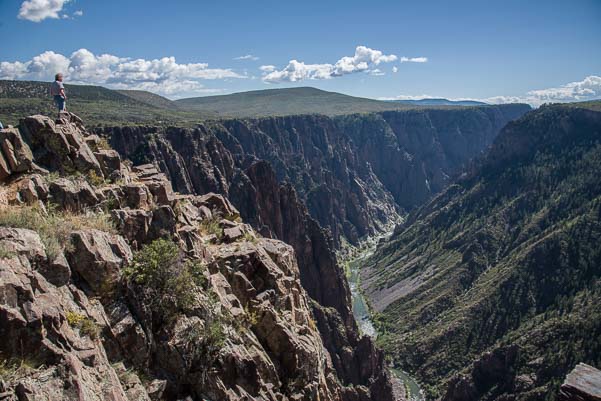
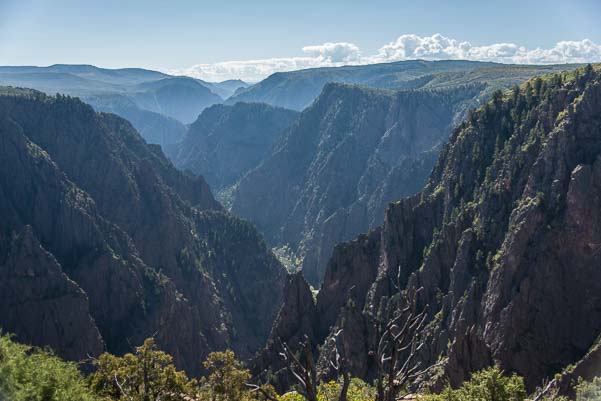
Views at Black Canyon of the Gunnison National Park Colorado

Black Canyon of the Gunnison

Our jaws dropped. That was exactly the same demonstration that we had seen in Teotitlán de Valle!

It turned out that this woman came from a family of rug weavers in that very same Mexican village.

I remembered vividly how our tour guide in Oaxaca had squished a bug in the palm of a girl’s hand to demonstrate how they made their red dyes (see my blog post about it here).

Apparently, the owner of this shop’s building had brought a few Oaxacan weavers to Colorado to promote their craft each summer. How fun!

Black Canyon of the Gunnison Colorado

The chasm is vast and deep

Where Maroon Bells and Castle Creek had shown us Colorado’s Rocky Mountains in the early stages of their fall glory, another land of stunning scenery — Black Canyon of the Gunnison — beckoned.

This canyon’s jagged cliffs are nothing like the soaring Rocky mountains.

Instead of craning our necks to look up at tall mountain peaks, the Black Canyon of the Gunnison is like a massive crack in the earth’s surface, with the sides parted to reveal sheer rock walls plunging nearly straight down to a thin ribbon of river far below.

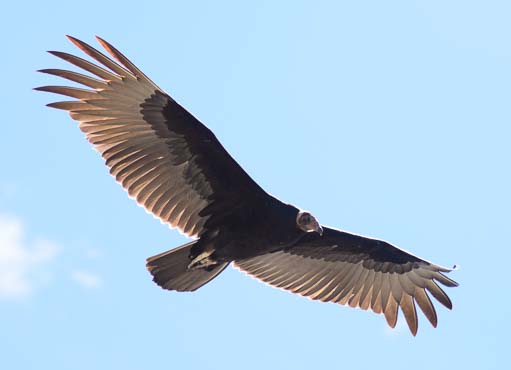
Turkey vulture in flight

A turkey vulture soars past

The canyon wasn’t formed by the walls cracking apart, however. It was formed by the very fast moving Gunnison River cutting through the rock like knife.

The Gunnison River falls from great heights to great depths, dropping an average of 95 feet per mile. This keeps the water moving at quite a clip.

This raging water has cut through the black rock like a laser, deepening the canyon faster than other kinds of erosion can widen it.

Black Canyon National Park Colorado

The canyon is steep and deep!

At its narrowest point, it is just ¼ mile across, and the depths of the sheer walls range from 1,750 to 2,700 feet (by comparison, the Empire State Building is 1,454′ feet tall and would reach just partway up the walls!).

As we approached the rim at an overlook, we saw several turkey vultures circling right overhead. They played with the air currents and dove down into the canyon and rose back out again effortlessly.

What a thrill it would be to fly like that, letting the earth fall away from under you as you flew over the rim of the canyon!

The Black Canyon of the Gunnison fills a huge area along the Gunnison River, and there are two wonderful areas for exploring it: a National Park with an entrance on the south rim and a gorgeous scenic drive that snakes along Route 92 on the north rim.

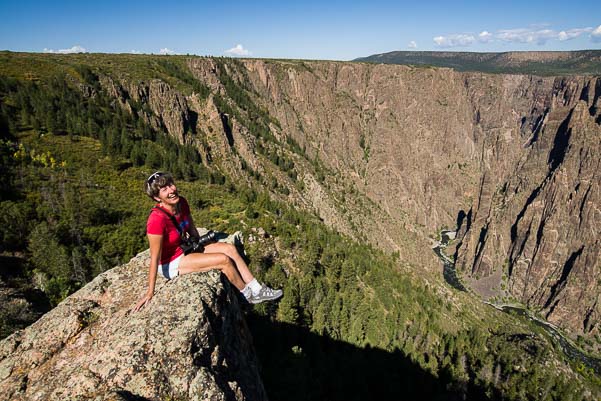
Sitting on the edge of the Black Canyon of the Gunnison in Colorado

I got a kick out of crawling around on the ledges.


At the Visitors Center for the Black Canyon of the Gunnison National Park we noticed a bulletin board covered with little hand written notes.

“Happy Birthday, Wilderness!” a sign said, recognizing 2014 as the 50th anniversary of the Wilderness Act.

We learned that this 1964 Act set aside 110 million acres of land, created the National Wilderness Preservation System, and gave Congress the ability to designate official “Wilderness Areas.”


Craggy crevasse at Black Canyon National Park Colorado_

The “Painted Wall” is one of the most stunning overlooks.

Beneath the sign was a quote from Edward Abbey, novelist, environmentalist, and critic of public land policies.

“Wilderness is not a luxury but a necessity to the human spirit,” he was quoted as saying.

On this bulletin board, the rangers had posed the question, “What does Wilderness mean to you?” The notes tacked all over the board were full of thought-provoking answers:

“Free & Wild!” penned one person, adding a smiley face for emphasis.

Happy campers on the north rim of Black Canyon of the Gunnison Colorado

What a great place to explore!

“A place to discover who/what you are made of/for/by” responded another with a little red heart.

“It humbles me…puts me back in place,” someone had written. Next to that another had scrawled, “DITTO.”

I got a kick out of reading these notes.

In hindsight, it is especially interesting to read them now in light of the recent public outcry against restricting commercial filming in officially designated Wilderness Areas.

People treasure wild land.

Towering peaks at Black Canyon National Park Colorado

To get a feeling for the scale of the place, here’s our truck dwarfed by the peaks!

“Wilderness speaks…to my soul,” one card said.

Wildnerness is “one place in the world where man is insignificant and always will be,” another proclaimed.

The Black Canyon of the Gunnison is a National Park with the usual roads and overlooks. However, portions of it are officially designated “Wilderness.”

Yet, back in 1881-82, over 1,000 immigrants from Italy and Ireland worked in horrible conditions full of rock slides, avalanches, and unreliable explosives to push the Rio Grande narrow gauge railroad through this canyon.

At the base of the cliffs of Black Canyon Colorado

At the base of the cliffs of Black Canyon

It is hard to imagine the harsh working environment these men endured, sleeping and eating in wooden work cars and bedding down on wooden planks.

The Gunnison river at Black Canyon Colorado

We drove along the Gunnison River at the bottom of the canyon.

Staring down into the canyon from the overlooks that have been carefully designed and built by the National Park Service, it is even harder to imagine the raw triumph these men must have felt when the first train puffed its way through the canyon.

The trains and railroad had defeated the wilderness at last.

This railway was touted as the “Scenic Line of the World,” and the trains carried thousands of people and tons of goods and livestock through the canyon.


“Wilderness is my heaven,” says one of the cards at the Visitors Center.

“What a Creator we have! Praise His name!” says another.

Mirrored water in the Gunnison River at Black Canyon Colorado

The sun played on the leaves of the trees as they reflected in the water.

Down at the base of the canyon along the Gunnison River, the sun played with the green leaves of the trees and their reflections in the placid water.

Finding that delicate balance between our urge to conquer and make use of our most beautiful landscapes and our urge to protect them and leave them alone has challenged our leaders and thinkers for nearly two centuries.

Mark and I both read the Autobiography of Ansel Adams and were astonished to learn just how hotly the mission of the National Park Service and other public land agencies were debated in the early 1900’s.

Trees reflect in the Black Canyon's Gunnison River in Colorado

Mirror images in the Gunnison River.

We think of Adams as a photographer, but he was deeply involved in the early development of the Sierra Club, and he had very strong opinions about the National Park Service, most of them far from flattering.

He was fortunate to see these lands at their most untouched, and he felt that in many ways he was documenting a disappearing landscape.

Of course, he was not nearly as comfortable in his tent in the early decades of the 1900’s as we are running around in our luxury fifth wheel today. And that is the deepest irony of what “wilderness” really means.

River's edge Black Canyon of the Gunnison Colorado

At the river’s edge in the bottom of the canyon.

To make wild landscapes easily accessible requires roads, railways and other development. That gives us laymen a chance to get inside the scenery and enjoy the beauty.

But the very presence of those developments changes the landscape forever.

The “wild” in “wilderness” springs from its very inaccessibility. The more accessible it becomes, the less wild it can be, by definition.

Even though much of the Black Canyon of the Gunnison is officially a Wilderness Area, much of it has also been tamed.

Curecanti National Recreation Area

Curecanti National Recreation Area (Blue Mesa Reservoir) is at the east end of the Black Canyon of the Gunnison.

“Earth untouched by man,” is what ‘wilderness’ means to one person who answered the ranger’s query with a card on the wall at the Visitors Center.

Yet that very description is a dream and a fantasy for all but the most intrepid trekkers among us.

That kind of wilderness certainly isn’t a place you can drive by in a heated or air conditioned car, like the beautiful overlooks at the Black Canyon that are the only parts of it most of us will ever reach.

Perhaps the last card summed it up best:

Wilderness means “Hope — even if I never see those places that are truly wild.”

____________________


Although I wouldn’t drive a big RV on scenic Route 92 (where the views of the canyon are truly dramatic), this whole area can be enjoyed using Montrose, Gunnison or the Curecanti National Recreation Area as a home base. Lake Fork Campground is on the water’s edge at Blue Mesa Reservoir and was almost empty when we visited. Check out these links to learn more about:

More blog posts from our RV trips to Colorado:

<-Previous || Next->

RV Heater – How to Install a Vent-Free Propane Heater in Your RV

Installing a vent-free propane heater is one of the best upgrades you can do for your RV if you plan to be spending a lot of time in chilly places. This page reviews how ventless propane heaters operate in comparison to traditional RV furnaces, it discusses the different technologies used in the design of various types of vent-free gas heaters on the market today — including catalytic heaters, ceramic brick and plaque heaters, and blue flame heaters — and it presents a step-by-step guide for installing a vent-free propane heater in your RV or camper.

You can jump to the various sections of this page here:


This post was first written in January, 2009, but was completely overhauled and rewritten in October, 2014.

INTRODUCTION


Warming my hands over a vent-free blue flame propane heater in my 5th wheel camper RV

Happiness is… a vent-free propane heater!

We froze in our trailer during our first winter in Arizona. Morning temperatures in the kitchen were often 40+ degrees F, and although daytime temps could get as high as 70, as soon as evening came, the temps in our trailer dropped into the the 50’s.

Brrr! It’s hard to sit around in the evening in those kinds of temperatures. All modern motorhomes and campers (ours included) come equipped with a propane furnace. However, these loud, inefficient beasts use a lot of electricity, and can drain the batteries in one night.

During that first winter (2007-08) in our 27′ Fleetwood Travel Trailer, we discovered that the more experienced winter desert boondockers (both snowbird RVers and those living the full-time RV lifestyle) installed vent-free propane heaters in their rigs. These are wonderful little appliances that use far less propane than a furnace and no electricity at all. When we upgraded to our 36′ Hitchhiker 34.5 RLTG fifth wheel in May, 2008, we decided we would install one. All summer long we thought about the project, but never found ourselves in a town where there was a good selection of heaters to look at or anyone knowledgeable about installing them in RVs. So we dawdled.

As the nights got colder in late November, 2008, and we relied more and more on our trailer’s electricity-eating furnace, we found ourselves in the warm company of our good friends Bob and Donna Lea Jensen and their vent-free, electricity-free propane heater. Bob has installed quite a few of these little devils over the years, and he gave us some hints and loaned us two critical tools for the project: a pipe cutter and a flaring tool. We learned a lot through this process, and I thought it might be helpful, along with our other RV tips and tricks pages to include some notes here about our project.

There are several types of vent-free heaters on the market, and each has its pros and cons. In the end, we opted to buy a 20,000 BTU thermostatically controlled blue flame heater made by Vanguard. The night before the installation we laughed as we bundled ourselves into our recliners wearing multiple layers, buried under blankets for the last time. Mark’s face peaked out from under his hood as he read. The night after the installation, in shorts and t-shirt, I had to poke my nose out the window to get some cool air. In our excitement, we had inadvertently heated the bedroom to 85 degrees.

We have used and loved this heater year-round ever since, running it near sea-level in the southern states in the winter months and using in the cool mountains during the summer months!


COMPARISON OF RV FURNACES AND VENT-FREE HEATERS

RV PROPANE FURNACES

Propane uses oxygen as it burns and gives off moisture as a by-product. Therefore it has the potential to use up all the oxygen in an enclosed space and kill any living, breathing occupants while creating a layer of condensation on the insides of windows. Yikes! To accommodate these unpleasant aspects of propane heating, conventional RV propane furnaces use a large blower system to bring in outside, oxygen-rich air. In turn, they vent the moist, oxygen-depleted air from inside the rig to the outside. Circulating the air this way keeps the oxygen level in the air fairly constant and significantly reduces the build-up of condensation on the insides of the windows, as the moisture gets blown outside along with the exhausted air.

Atwood RV furnace
However, by blowing all this warm air outside, the furnace is effectively heating the outdoors. If you stand outside an RV next to the furnace vent on a really cold day, you can warm your hands and body quite nicely. Also, this blower requires electricity to run. RV furnaces are DC, so they do not require an inverter or generator in order to operate. However, the amount of power they use is astronomical (our 40,000 BTU furnace uses 11 amps DC). If you are boondocking, or dry camping in the desert as many winter Snowbird RVers do, you are then faced with a choice of either keeping the RV unacceptably cold, or using a generator to keep the batteries charged (even our big solar power installation on the Hitchhiker 5th wheel was not enough to keep up with the furnace blower during the winter).

Besides heating the outside air and running the batteries down, a major disadvantage of a standard RV propane furnaces is that the blower is really loud. There is nothing like being deeply absorbed in a really great movie and listening to some very profound dialog being exchanged in whispers, and having the furnace suddenly roar to life and drown out everything being said. Our furnace blower often woke us up out of a sound sleep too.

VENT-FREE PROPANE HEATERS

In contrast, vent-free propane heaters are silent and provide heat without using any battery power. This is because they rely on you to give them fresh air: you have to crack open a window while they run. All US-made vent-free heaters are built with an internal oxygen sensor that shuts off the heater if the oxygen level in the room becomes too depleted. In addition, most RVs come equipped with an LP gas detector that will sound alarms if the oxygen in the air drops too low or if an LP gas leak is detected and you can install a combo LP/CO detector as well to detect both LP gas and carbon monoxide. You may also need (or choose) to run a small fan to circulate the air. This will use some battery power, but you can decide how much or how little to use the fan.

Living without heat in an RV

Brrr… This was what life was like before we installed our vent-free propane heater!

So, in essence, when using a vent-free heater, you must find a happy balance between several variables. Determine which kind of heater will best suit your needs (see descriptions below), figure out where to place it in the RV, which window(s) to crack open, and how often to run a fan (if at all), and if so, which kind of fan to use (a little DC fan, like one used in a computer, a large AC ceiling fan that will require an inverter or generator to run, or an optional blower fan that can be purchased with the heater).

Heat rises, so in 5th wheel campers the heat tends to gather in the bedroom. Simply close the door to the bedroom, or crack it slightly open to control the movement of the warm air into that space. Likewise, if you use a ceiling fan, you can experiment with running it forward or backward, either to draw air up and move it out along the ceiling or to push the warm air down towards the floor.

Propane has a fixed capacity for providing heat. One gallon of propane contains 92,000 BTUs of potential heat, which means a 40,000 BTU RV furnace running full blast will burn through nearly a gallon of propane every two hours or so. During the coldest periods, it is a real pain in the neck to keep having to refill the propane tanks as you fly through propane trying to heat your rig.

Our Lynx travel trailer came with a 30,000 BTU furnace, and our Hitchhiker 5th wheel came with a 40,000 BTU furnace, both installed at the factory. These were sized appropriately for the square footage of each camper. However, we have found we can easily heat our big fifth wheel to higher temperatures in less time using our 20,000 BTU vent-free propane heater instead of the factory-installed 40k BTU RV furnace. So, a smaller vent-free heater that burns less propane per hour can effectively heat a given space more quickly than a traditional RV furnace that is twice its size.

Because of the inefficiency of RV furnaces in terms of propane use and battery power consumption, when we use the RV furnace alone for heat in 30+ degree F overnight temps and 40+ degree daytime temps, we find we have to keep our trailer at 50 degrees while sleeping at night and at just 60+ degrees during the day. Cold as that sounds, this uses up almost a gallon of propane a day and we can barely keep the batteries topped off using our 490 watts of solar panels alone. Worst of all, living like this is really uncomfortable.

Using our vent-free blue flame heater in the same conditions and burning the same one gallon of propane per day in those conditions, we can easily keep the 5th wheel at 76 degrees all day long. And we use almost no electricity.

To clarify, we have two 30 lb (7 gallon) propane tanks, and when outside highs are in the 50’s and lows are in the 20’s, we go through a tank of propane each week. When outside highs drop below freezing 24/7, we can go through a tank in 3 days.


WHICH IS THE BEST TYPE OF VENT-FREE HEATER?


When choosing a vent-free propane heater, there are a lot of products on the market. Catalytic and ceramic heaters produce infrared radiant heat which heats objects situated nearby much the same way the sun does. They create a warm, baking sensation on your skin, but if you move away (like moving into the shade outdoors), that sensation goes away. The air in the room warms up over time as the objects in the room warm up.

In contrast, blue flame heaters heat the air, rather than the objects in the room, providing a more even, uniform warmth. Gradually, the objects in the room heat up as the overall temperature of the air in the room rises.

All of these heaters come in different sizes, ranging from 5,000 to 30,000 BTUs, which are good for heating 100 square feet up to 1,000 square feet. Small ones can be hung on the wall, out of the way, while big ones that appear modest-sized in the show room suddenly become monster heat sources that dominate the floor space when you get them home to your RV.


CATALYTIC INFRARED RADIANT HEATERS

Olympian Wave-8 Catalytic infrared radiant heater for use in an RV
Catalytic heaters were the original vent-free heaters. The major brand is the Olympian Wave, manufactured by Camco, and their primary models are the Wave-3, Wave-6 and Wave-8 heaters. These provide 3,000, 6,000 and 8,000 BTUs of heat respectively.

Catalytic heaters provide infrared radiant heat by way of a large pad on the surface of the heater. A chemical reaction in the pad causes heat to radiate off the entire pad. If you stand in front of a catalytic heater, your skin will feel a nice baking warmth on it. The closer you sit, the more you will bake. This is a great feeling when you are chilled.

These heaters have been in use for years, and have an enthusiastic following. They are also quite expensive ($300-$430), often as much as double the cost per BTU as the other types of vent-free heaters. They do not have thermostats, just a “high” setting and a “low” setting, so you must manually turn them on and off or to high or low to regulate the temperature in the RV.

If the pad on these heaters becomes dirty, it is possible to replace it for about $100. A friend of ours tried to clean his by vacuuming it, and inadvertently ended up destroying the pad. Because the pads had changed slightly since he bought his unit five years earlier, he could not replace the pad and had to replace the entire heater instead.

You will need a brass elbow fitting from Camco for the installation. You may also want leg stands so the heater can stand on its own two feet and a dust cover to protect the catalytic pads when it is not in use.


CERAMIC (BRICK or PLAQUE) INFRARED RADIANT HEATERS

Mr. Heater Ceramic infrared radiant heater for use in an RV
Ceramic infrared heaters are a slightly newer technology that has been warming RVs for quite a few years. The most popular brand on the market is Mr. Heater. Other brands include Kozy World, Empire and ProCom. These are generally offered in one, two, three and five brick configurations providing 5,000, 10,000, 15,000/20,000 and 25,000/30,000 BTUs of heat.

Ceramic heaters provide the same infrared radiant heat as catalytic heaters. Across the front of the heater there are small ceramic “bricks” or “plaques” that heat up to a glowing orange/red color. Like a catalytic heater, standing in front of a brick (or plaque) ceramic heater will toast your toes to your thighs on the front of your legs. The heat from the bricks interacts with your skin and you will feel a wonderful tingly warmth.

These are extremely popular units and can be quite inexpensive ($130-$350). Most can be purchased with or without a thermostat. One big disadvantage is that the area directly in front of the bricks gets hot enough to burn things. Any flammable items that come too close to the bricks could catch on fire. If a cat or dog wanders past and flicks its tail against the bricks, it might get singed. If a toddler sticks its fingers in there, a trip to the hospital might ensue.


BLUE FLAME HEATERS

Mr. Heater Blue Flame vent-free propane heater for use in an RV
Blue flame heaters are the newest technology and provide a different kind of heat than the catalytic and ceramic heaters. Rather than radiating heat, blue flame heaters operate via convection (the principal that heat rises), drawing cool air in through vents at the bottom of the heater and emitting warm air out the vents in the top. This is a heating method that is much like central heating in a house. Once the air temperature has risen sufficiently, the objects warm up as well. If you keep your RV at a warm temperature all the time (especially at night), the objects in the room will never get cold.

Blue flame heaters draw cool air in from floor level through a row of vents at the bottom, heat it up, and emit the warm air out of vents at the top, relying on convection (the fact that heat rises) to move this air instead of using a blower. You can warm your hands and body by standing in front of one, but it is more of a warming sensation than a baking one. The area in front of the blue flame is covered by fireproof glass (it’s actually a ceramic material) and it is not burning hot. So, there is no risk of items immediately in front of the heater catching fire. Blue flame heaters are a good idea for people with pets or children.

The most popular brand is Mr. Heater. A few others include Empire Heating Systems and ProCom, the same makers of the ceramic brick heaters. These manufacturers produce both blue flame and brick heaters in the same chassis, so other than the appearance of the bricks or the flame, the unit itself has the same look whether it is the brick or blue flame version. The typical BTU range on these heaters is 5,000, 10,000, 20,000 and 30,000.

Blue flame heaters are as popular as the brick ceramic heaters, and are in the same price range of about $130-$350. They can also be purchased with or without a thermostat.

BLUE FLAME FIREPLACES !!

Pleasant Hearth Vent-Free Propane Fireplace 35 inch

.

There are some wonderful blue flame heaters that are designed to look like fireplaces, complete with logs, trim and beautiful wooden mantels. Manufacturers include Pleasant Hearth and ProCom.

These cost about $200-$300 more than the regular blue flame heaters, but what a beautiful addition to your RV. You can sit and watch the yellow flames dancing around the logs and warm your bones at the same time. I saw one of these units in an old travel trailer and was enchanted. The owner had built his own mantel out of an old coffee table, and it was lovely. I wanted one of those units so badly!!

The only place for a unit like that in our rig was along the backside of the “L” in the kitchen counter, which is just a few inches from the wall of the entertainment slide-out when it comes in. If we had the carpentry skills, we probably could have slipped a fireplace in there, recessed under the counter.

The only downside would have been that it might have gotten a little hot under the counter, and we would have had to be extra careful that the heater was fully cooled whenever we brought the slide-out in, or we would have cooked the gelcoat on the outer wall of the slide. Also, as it turned out, that particular location for the heater would not have provided the same warmth when we sat in our recliners as the heater does in its current spot in the kitchen in front of the oven (even though it would have been closer). It’s just the way the air flow circulates in our particular trailer.

PORTABLE HEATERS

Mr Buddy Portable vent-free propane heater

.

If you don’t want to hassle with installing a dedicated gas line for a vent-free propane heater in your RV, you can opt to get a portable unit instead. The portable ventless heaters are all infrared radiant heaters with bricks (plaques) that have air intake vents in the bottom for convection as well. They have built-in blowers that run on a 6 volt a/c adapter (sold separately) or on 4D batteries. They are very popular.

They are manufactured by Mr. Heater (with the brand name “Big Buddy”), and they come in sizes from 4,000 to 18,000 BTU. They run on the small Coleman style portable propane canisters but can also be connected to a larger BBQ style propane tank.

If you plan to run the heater from a large propane tank instead of the little propane canisters, Mr. Heater sells a companion flexible gas hose with a regulator and quick release connector on it for just that purpose. Mr. Heater make nice carrying cases for these heaters as well.


OPTIONAL EQUIPMENT for VENT-FREE PROPANE HEATERS

Thermostat

Usually this option is just $30-$50, and it is well worth the cost if you plan to be in your RV for extended periods of time. A manually controlled heater will have several heat settings (usually three), but you will need to monitor the heat in the room and adjust the settings as you get warmer or cooler. A thermostatically controlled heater will cycle on and off as its sensor detects changes in temperature. Ours typically cycles on and off in 5-10 minute increments, keeping the temperature within 2 degrees.

On our unit, the thermostat has a simple analog dial that can spin from “1” to “5.” These are arbitrary numbers rather than fixed fahrenheit degree markers. However, once you figure out how “1 1/4” or “2 1/2” relates to temperature, you can keep the temperature in the room tightly controlled by turning the dial to the setting you want. This is especially nice if you plan to keep the heater on all night, as the temperature in the RV will remain constant while the outside temperature drops.

Feet

Most units are designed to be hung on a wall, however most also have an optional stand so they can be placed on the floor. Most smaller units include the feet as an option (about $25) while most larger units come with the feet at no extra charge. The great advantage to hanging a unit on the wall is that it is always there, ready for use. If you use your RV during all four seasons, it is nice to know that if you suddenly find yourself in a chilly spot, you can simply flip the switch and have your heater working for you, rather than digging it out of the back of the closet (a lesson we learned after the fact!).

The advantage of having the unit standing on its own two feet is that you can move it around the rig. This is especially true if you don’t use a fan of some kind to move the warm air around the rig. If you go this route, make sure you have plenty of flexible gas hose so you get maximum range for placing the heater in different spots in the rig.

Blower

Most ventless gas heaters can be purchased with an optional blower. As soon as you start blowing the air around the RV, you are signing up to use the batteries to keep the rig warm, something the vent-free solution was aiming to avoid. However, the power consumption should be less overall than a furnace. Some blowers are thermostatically controlled, allowing them to cycle on and off as needed. This is efficient, as the blower and batteries won’t be in use all the time the heater is on. Rather than a built-in blower, many people opt to install a small DC fan which uses very little power. If your rig has a ceiling fan, that can also be an option, although it will require the inverter or generator to be turned on. In our case, our inverter is turned on from the moment we wake up until we go to bed, so running the ceiling fan when the heater is on during the day is no big deal.


HEATER PLACEMENT

When we installed our ventless propane heater, we tried placing it in several locations. We also tried turning our ceiling fan both on and off and running the fan both forwards and backwards (blowing towards the floor and towards the ceiling) before we settled on a final arrangement.

Kozy World Vent-Free Propane Heater connected to flexible gas hose

This ceramic heater has a flexible gas hose that allows it
to be moved around the RV.

We found that the best setup was to place the heater directly below our ceiling fan (in front of the oven at the base of the stairs in the kitchen) and to set the fan to blow towards the ceiling, drawing the warm air up and distributing it outwards throughout the RV. It was astonishing to find what a difference it made as we moved the heater to various places in the trailer and tried each placement with or without the ceiling fan, and blowing up versus blowing down.

Our RV is a “rear lounge” fifth wheel
, and we found that the area around the recliners was a significant cold air pocket. Doesn’t it figure! That’s where we like to be on cold evenings!! There are large windows surrounding the recliners, which make that area cold, while the warm air in the rig congregates high up on the ceiling just in front of the stairs leading to the bedroom (that is, if the bedroom door is closed. Otherwise the warm air settles in the bedroom itself).

We assumed that facing the heater towards the recliners just 5 feet in front of them would warm up this cold pocket. Wrong! No matter how high we set the thermostat, and no matter what we did with the ceiling fan (which is located 10 feet away right in front of the stairs leading to the bedroom), the recliners were still cold.

When we moved the heater to the base of the stairs leading to the bedroom, and turned the ceiling fan on “high” and set it to blow towards the ceiling, we could immediately feel the warm air encircling us as we sat in the recliners. Who woulda thunk??!!

Heater Sizes and Capacities

Most manufacturers state the square footage their various heaters are designed to heat. We decided that we’d rather buy a slightly larger unit (that is, one rated for a larger space than the interior of our fifth wheel), and simply keep the heater on a lower setting than to find ourselves unable to heat the buggy adequately. Our rig is 360 square feet, which put us somewhere between 10,000 and 20,000 BTUs. We ended up buying a 20,000 BTU heater, and we typically keep it set to 50% of maximum during the evenings/mornings and 25% of maximum at night when temps outside are in the 20’s and 30’s. If we had purchased a 10,000 BTU unit instead, I think it would have been cranking at max volume most of the time during the mornings and evenings and on stormy days. As a rough guide:

Vent-free heater BTU ratings and square footage
6,000 Up to 200 sf
10,000 Up to 300 sf
20,000 Up to 700 sf
30,000 Up to 1,000 sf

There are legal ratings for the sizes of vent-free heaters and the rooms they can be operated in. Less than 6,000 BTUs is okay for a bathroom, and less than 10,000 BTUs is okay for a bedroom. These are the ratings that are being referenced when you see a sticker on a larger unit saying “not designed to be used in a bedroom.” The idea is that a large unit operated at max volume in too small a space will use up too much oxygen in the room too quickly. Of course, such a scenario would have the occupants of the room running out the door because it would be way too hot for comfort.


SAFETY OF VENTLESS PROPANE HEATERS

Some people may worry that these kinds of ventless propane heaters aren’t safe, fearing that it might blow up the RV or suffocate them. These heaters are extraordinarily well regulated by various governing bodies, and designers have to meet stringent guidelines and submit their heaters to a battery of very challenging tests before they can be brought to market. Vent Free is the industry organization for all the vent-free gas heater manufacturers. Their website spells out all the testing, guidelines, state by state requirements, laws and safety record for these heaters. Through September 1, 2005, they claim that there had not been a documented death due to a vent-free propane heater (see that claim here). Visit their website at ventfree.org.

In addition, at the factory, RV manufacturers install a LP Gas Detector Alarm system (various brands are used) to detect LP gas leaks in the RV and alert anyone inside. These are installed because many RVs come equipped with propane-based appliances, including things like the stove, oven, hot water heater, refrigerator and RV furnace. All RV owners should be aware of where their LP gas detector is located. It is usually installed near the floor, as LP is a heavy gas that settles down low. Propane is found in highest concentrations near the floor.

Some RVers run their vent-free propane heater overnight as they sleep. We don’t do that. If the overnight low temps will be well below freezing (i.e., 25 degrees F or below), we run our RV furnace, set to 50 degrees, all night long to keep the plumbing from freezing, because the furnace is ducted throughout the basement.


OPERATION AT HIGH ELEVATION

Most of these heaters are sold with an official limit for operating altitude. The problem at higher altitudes is that there is not enough oxygen for the propane to burn properly. Some units are rated for use up to only 3,500 feet, while other manufacturers have a stated limit of as much as 5,000 feet.

Our blue flame vent-free propane heater is rated for use up to 4,500 feet, but we have used it extensively at altitudes up to 8,500 feet and have used three times for two week periods at 10,000 feet.

The key to operation at altitude is the Oxygen Detection Safety-pilot (ODS) sensor which has been standard equipment on all US-made vent-free heaters since the 1980’s. This sensor shuts off the gas to the heater when it detects the oxygen level has dropped to 18% (normal sea-level air is 21% oxygen). We find that whenever the ODS shuts our heater off, our stove and oven continue to run without a hitch. So, in reality, the stove and oven are actually more dangerous, as they do not have built-in ODS units to shut them off when the oxygen in the room gets too low.
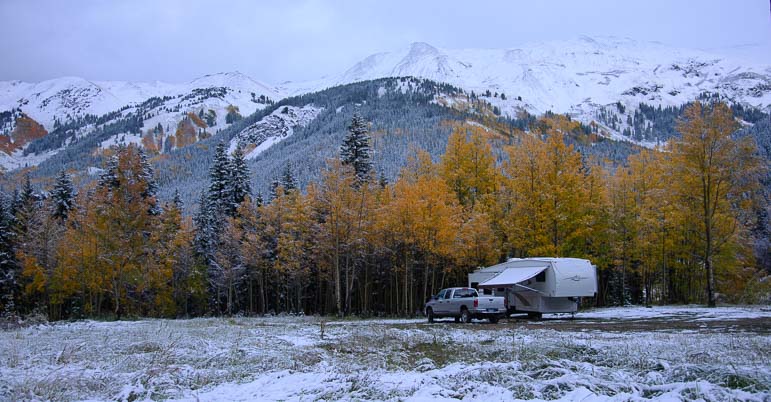
5th wheel camper rv in the snow

A surprise autumn snowstorm at 10,000 feet elevation in Colorado during a two week stay taught us a lot
about how vent-free heaters function at high altitudes.

We use our heater all summer long as we travel through the western mountain states. We find that it works very well at 6,000 to 9,000 feet, taking the chill off cold mornings and raising the temperature inside the RV from a brisk low to mid-40’s to 75 degrees within an hour.

We have spent months at these altitudes. On occasion, if we have been running the stove and oven as well as the heater, the heater will unceremoniously turn itself off. This is no problem. We simply open the RV door to let some oxygen-rich air into the rig.

We have also spent several periods of 10 days to two or three weeks at 10,000 feet. Here we had more difficulty with our vent-free heater when the outdoor temps dropped into the high 20’s overnight (and we got two inches of snow on our roof!) and daytime highs were in the 40’s. The heater needed some coaxing to make it work. We tried two methods of combining the RV furnace and the ventless propane heater at this altitude. Neither was ideal, but this will give you a sense of what to expect and what to try:

1. Run the RV furnace all night long to keep the rig at 50 degrees overnight, and then use the RV furnace to raise the temp to about 60 in the morning. We found that this method used gobs of electricity and propane and didn’t make us very warm. What’s worse, when we tried to use the vent-free blue flame heater after running the furnace, the furnace would not have sufficiently replaced the interior air with exterior oxygenated air, so the vent-free heater could not run very long before it shut off due to having insufficient oxygen around it. So, in essence, using the RV furnace meant we couldn’t use the vent-free heater. We found we could run the RV furnace all day long but the temps in the rig would never exceed 61-62 degrees (the high temps outside were in the 40’s, lows in the mid-20’s).

2. Leave the furnace off overnight and run the ventless propane heater in the morning to warm up the rig. The temps inside our bedroom typically stay about 10 degrees above the outside temps if we don’t heat the RV overnight, so we woke up on some mornings to interior temps in the high 30’s. (We close our bedroom door at night to help keep the bedroom warm). The vent-free heater miraculously heated our indoor RV temps to 70 degrees within an hour of turning it on. At this point, around 70+ degrees, the heater would shut off. We could coax it to run a little more by opening the RV door and fanning the outside air into the rig, but it would shut off again after another 10 minutes or so. So then we would turn on the RV furnace.

Any sensible person would have gone and gotten electric hookups at a campground and run an electric ceramic heater, but we aren’t always very sensible. Camping at 10,000 feet in snowy weather is rather extreme. Most of the boondocking spots we stay at in the summer months are down around 6,000 to 9,000 feet, as I mentioned above, and the heater works beautiful at those altitudes. During the winter months we are typically at elevations of under 1,500 feet and the heater works like a champ without missing a beat.

Note: Since publishing this article, we have enjoyed yet another year of toasty warm heat from our blue flame vent-free heater in the mountains from spring through fall and at low desert elevations in the winter. We were also caught in another even bigger snowstorm on a mountaintop at 10,000 altitude once again and tried a different heating strategy that kept us warmer and dryer. Our article about that experience is here:

How to Heat an RV in Cold Weather and Winter Snowstorms


WHERE CAN YOU BUY A VENT-FREE PROPANE HEATER?

We had the worst time trying to find places to look at these heaters and find people knowledgeable about installing and using them in RVs. In some states it is illegal to sell these kinds of heaters (here’s a link to the state-by-state regulations for vent-free gas heaters from ventfree.org), and in mountain towns they are scarce because of their issues with operating at high altitudes. In four months of summer travel when we were looking to buy, we found just two propane gas companies selling vent-free heaters, one in Jackson, MS and one in Kanab, UT. We ended up learning the most from fellow desert boondockers in Arizona, Nevada and California during the winter months and from salespeople in mom-and-pop hardware and RV parts stores in Yuma and Quartzsite, Arizona.

If you know what you want, you can get a much better deal buying online, and Amazon sells all the major brands and accessories. We paid $290 plus $25 tax for our heater, a Vanguard 20,000 BTU blue flame with a thermostat and no blower (it came with feet). After buying, we found the same unit online with free shipping and no sales tax for $175 (Vanguard heaters are no longer made). Ace Hardware told us they could order a similar unit for us, shipped to their store in a week, for $215. So we paid a premium for our unit, but we did talk to a lot of sales people in the process and we saw a lot of the units (and warmed our hands over them), and knew exactly what we were buying.

Cost of installing a vent-free heater

Our entire project cost $385. The heater was $315 (including tax), and parts totaled $70. We were able to borrow the tools, but found they cost only about $15 to buy. We were quoted between $60 and $100 for the labor for the installation. As stated above, we also could have saved about $140 on the heater if we had purchased it online.


INSTALLATION OF A VENT-FREE PROPANE HEATER IN AN RV

Following is a pictorial step-by-step guide showing how we installed our vent-free propane heater in our RV.

Installing fIttings on the vent-free propane heater

The installation begins with work on the heater itself…

Working under the kitchen cabinets to install the new gas line for the heater

…however, the bulk of the installation involves tapping into an existing copper gas line to connect a new flexible gas line that goes to the heater.

The first step is to do a little work on the heater itself…
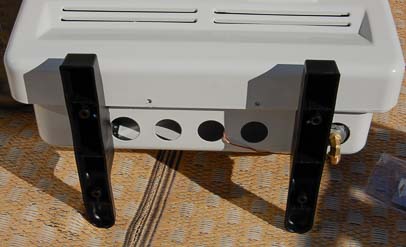
Installing the feet on our ventless blue flame propane heater

Attach the plastic feet so the unit can be freestanding and be moved around the trailer easily.
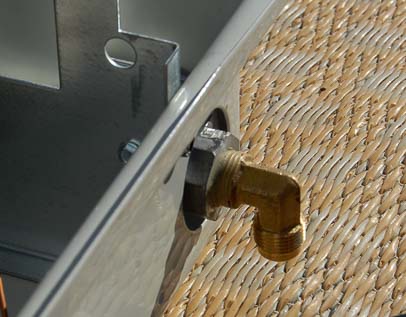
Installing the gas valve on the blue flame heater

Attach a brass elbow fitting at the base of the heater.
A flexible gas hose will eventually connect to this elbow.

Installing the thermometer on our ventless blue flame propane heater

Attach a thermistor (an electrical resistor type of thermometer) for the internal thermostat. This went on the lower back corner of the heater.


Our heater came with feet so it could be freestanding, and it also came with a thermistor, or resistor based thermometer, for the thermostat. These were attached before beginning the actual installation of the new gas line in our trailer.

The brass elbow did not come with our unit, but we found one with the right pitch, thread and diameter at the gas and electric supply store where we bought the other fittings for our project.

Second Step — Turn off the gas and tap into an existing copper gas line

The gas hose for the heater will tap into an existing copper line in a kitchen cabinet

The new flexible gas line for the heater will connect into the existing copper line.

We decided to tap into the copper gas pipe that runs between the refrigerator and the stove at the back of one of our lower kitchen cabinets. Mark measured the pipe and found it was 3/8″.

The goal was to cut the existing pipe and insert a series of fittings that would allow us to attach a flexible gas hose at that point, effectively creating a new leg of flexible gas line. This hose would then run out through a hole drilled at the base of the cabinet and attach to the heater. All of this is low-pressure pipe and fixtures.

Layout of all the gas fittings for installing the vent-free blue flame propane heater in our fifth wheel trailer RV

To create a new leg of flexible hose gas line requires a T-connector (to rejoin the severed pipe), F-F gender changer, On/Off valve and flexible gas hose with a stopper at the other end.

At a gas and electric supply store we picked up a male-male T-connector that would be inserted into the cut copper pipe.

The base of the T would connect to a female-female gender changing connector, and then to an on-off valve (which has male fittings at either end), and finally to a female connector on the end of the flexible gas hose.

Most of the year the heater would not be in use, so we bought a stopper for the end of the hose that goes to the heater.
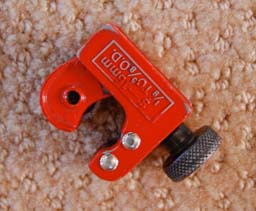
pipe cutter for cutting gas pipe

Specialty tool #1: Pipe cutter

When the heater is disconnected, this stopper would be screwed into the end of the hose and the heater would be put in a closet.

However, we later discovered we wanted easy access to our heater during all four seasons, so the stopper never gets used!
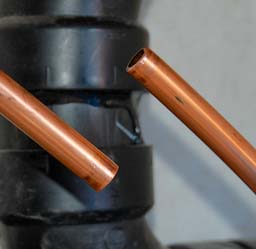
 

The existing gas line is cut

The existing gas line is cut.

A universal gas appliance hookup kit manufactured by Mr. Heater includes all these parts except the T-connector!
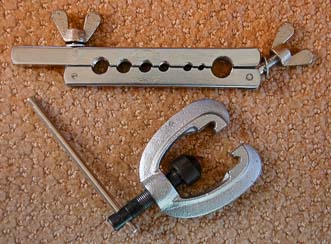
Flaring tool showing both parts

Specialty tool #2: Flaring Tool.

The first step, after turning off the gas, was to cut the pipe. This requires a pipe-cutter, a small, inexpensive tool.

Once the pipe was cut, the next step was to connect the T-connector between the two severed ends of the copper pipe.
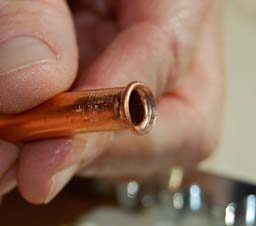
practice flare on scrap piece of copper pipe

Practice flare.

This would be done by first sliding a female connector onto each of the two pipe ends and then flaring the ends of the pipe with a flaring tool so the connectors couldn’t slide back off again.

The female connector is slid onto the pipe before the flare is done

The flare prevents the female connector from coming off the pipe.

The male-male T-connector would be screwed into this (and its companion) female fitting on either end of the pipe, rejoining the pipe and making a new connection available for the gas hose to go out to the heater.
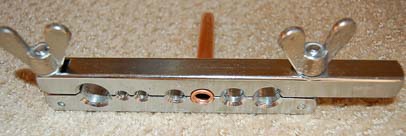
flaring tool for flaring the end of a gas pipe

Flaring tool with scrap practice pipe in it.

Mark had never used a flaring tool to flare a pipe before, so he wanted to practice it first on a scrap piece of pipe.

Flaring the real pipe under the kitchen cabinet

Flaring the real pipe inside the cabinet.

He made the practice flare by inserting the scrap pipe into the appropriately sized hole in the tool and then screwing down both ends of the tool to snug the pipe into it — as if it were a bad guy in the old days having his head and hands put in the stocks in the town square!

One flare finished second flare beginning

One flare done, now do the other.

Then he inserted the pointed end of the flaring tool into the end of the pipe and twisted the crank, slowly flaring the end of the pipe as the point pressed further into it.
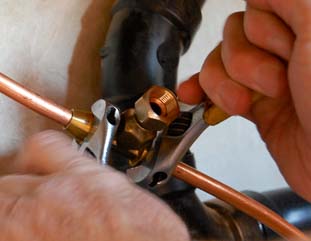
Two wrenches tighten T-connector in place

Tightening the T-connector with two wrenches

He slid the female connector onto a short piece of pipe and felt a snug fit between the pipe and the connector. The flare was just right. Now confident that he could flare a pipe properly, he contorted himself to get the flaring tool set up on the real copper pipe at the back of the cabinet.

T-connector with F-F gender changer

T-connector with F-F gender changer ready for the shut-off valve to be attached.

He began by sliding a female connector onto one end of the severed pipe under the cabinet and flaring the pipe’s end. Then he did the same thing to the other piece of the severed pipe. Then he screwed the male-male T-connector into the two female ends of the pipe to rejoin them, and he tightened the T-connector using two wrenches.

He attached a female-female connector to the base of the T, making it possible to screw the male-male valve into place. This valve would allow the gas to the heater to be turned on and off. After the valve, he attached the female end of the gas hose.

Connecting the flexible gas hose to the shut-off valve

The new flexible gas line connects to the shut-off valve.

Finally, he drilled a hole in the front base of the kitchen cabinet and ran the gas hose through the hole. The other end of the gas hose was attached to the elbow connector he had placed on the bottom of the heater.

Tightening all the connections with wrenches, and turning the gas to the trailer back on, the heater was now ready to be used.

Hole at base of the cabinet for the gas hose

The new flexible gas line will come through this hole and connect to the heater.

Mark checked for gas leaks using a tiny spritzer bottle filled with a few drops of Dawn dish soap and water. Spraying this mixture on each connection, he looked for bubbles to form which would indicate a gas leak.

To give us flexibility in moving the heater around the rig, we originally used two lengths of gas hose: a 3′ length for under the cabinet and a second 12′ length that attached to it with an inline male-male connector.

Vent-free blue flame propane heater installed in a 5th wheel trailer

What a great little heater!!

The idea was that the 12′ gas hose would give us lots of flexibility for moving the heater around the trailer. However, we found that it was too long and too bulky and the best position for the heater was close to the stove anyway. So we replaced the 12′ hose with a shorter 4′ one.

After the installation was finished, it didn’t seem like such a big project after all, and what a thrill it was to toast ourselves in our warm buggy. Our timing was perfect: the next week brought a big cold front, multiple days of rain, lows in the 30’s and highs in the fifties. We were snug as bugs in a rug while the winds howled outside.


There are tons of choices for installing a vent-free propane heater, but these four are among the most popular. If you buy a heater from Amazon, make sure it is PROPANE and not NATURAL GAS, as the pictures look the same. We receive a 4-6% commission for purchases made through any of our Amazon links (at no cost to you) which helps us maintain this site — thank you!

Good luck with your project, and stay warm!

Subscribe
Never miss a post — it’s free!

Disclaimer: This blog post describes our vent-free propane heater installation. We are not responsible for any installation other than the one in our own rig.

Below are some of our most POPULAR POSTS (also in the MENUS above)

Buddy - A Journey in Spirit - The story of an event that changed our lives forever.

ARTICLE INDEXES
  • RV Tech Tips Articles - A one page index of links to all our RV Tech Tips, RV Upgrades & RV Maintenance articles.
  • RV Lifestyle Tip Articles - An index of links to all our RV Lifestyle Tips (finances, boondocking, major repairs, work/jobs, etc.)
  • Solar Power Articles - Overview and tutorial articles for how to design and install solar power on an RV or boat
  • Product Reviews - An index of links to all of our Product Reviews
RV UPGRADES, SYSTEMS & TIPS MONEY FULL-TIME RV LIFESTYLE GEAR STORE
  • Gear Store - A list of the goodies, equipment and gear we've found useful in our RV lifestyle!
 

Our most recent posts:

More of our Latest Posts are in the MENU.   New to this site? Visit RVers Start Here to find where we keep all the good stuff. Also check out our COOL NEW GEAR STORE!! *** CLICK HERE *** to see it!

Romance at Maroon Bells Colorado!

Green River at Flaming Gorge National Recreation Area

We waved “Hello” and “Goodbye” to the vivid Green River at Flaming Gorge.

Grand Teton National Park turned out to be our northernmost stop in our RV travels this summer, and at the end of our second week a cold spell swept through.

It was time to move on — and move south.

We traveled down through Jackson and Pinedale Wyoming and continued onwards south past the stunning Flaming Gorge National Recreation Area that straddles Wyoming and Utah.

We have spent a lot of time there in the past, so we just waved at the brilliant Green River, scooted by, and kept on going.

Read More…

What is happening to our Public Lands?

Fifth Wheel Trailer RV near Vermillion Cliffs National Monument Arizona

Will photos taken on public lands like this beautiful spot on the Utah/Arizona border require an expensive permit in the future?

October 2014 – There have been some interesting and disturbing developments on America’s public lands lately. For the last month, photographers have been up in arms over a proposal put forth by the US Forest Service to charge big fees for permits to take pics on public land.

This news has gone viral since the USFS first announced the proposal in early September, and there have been oodles of irate blog posts and tweets from some of the biggest online news outlets.

Read More…

Grand Teton National Park Wyoming – Rare Sightings!

Fifth wheel RV with bikes and a rainbow

A rainbow appeared off in the distance…

September, 2014 – We had a lot of dark rainy days during our stay at Wyoming’s Grand Teton National Park, and one afternoon we looked out the window to see a very bright rainbow dramatically piercing through the black sky in the distance.

We were waiting for sunset at that particular moment, kind of resting up a bit and relaxing.

We’d been taking so many photos and running around so much that when we saw this stunning rainbow, we greeted it with a shrug.

“It’ll never last,” I said.

Vivid rainbow at Mormon Row Grand Teton National Park Wyoming

This rainbow was so much more intense than most!

“Yeah. It’s way over there, and there’s nothing in the foreground but grass,” Mark added.

If it had been in the opposite direction, over the mountains, we would have leaped into action. But it wasn’t. So why bother?

Talk about blasé!! Our stay in this gorgeous park had totally spoiled us!

“It would look great with the Mormon barns,” I suggested after a while, wishing we were closer to those classic buildings.


rainbow on the Mormon barns at Grand Teton National Park Wyoming

It touched down right between the historic cabins at Mormon Row

But Mormon Row was a good ten minute drive away, and rainbows last just a few minutes, at best.

We went back to doing whatever we were doing — nothing really — while we each secretly kept an eye on this incredibly vivid arc that was flooding the land with light from the heavens.

Finally, we couldn’t take it any longer. We jumped up, grabbed all the camera gear we could find, and dashed out to the truck.

Mark floored it, and we zoomed onto the highway in hot pursuit. Unbelievably, the rainbow just got brighter.

Happy photographer with rainbow at Mormon Row

The rainbow crossed the sky, showing first one side and then the other.

We stopped at the most famous Mormon barn, along a dirt road of century old buildings, but the crowd of swarming photographers was thick. No way!

We raced back to the truck. I was running so fast over the uneven ground that I tripped and fell flat on my face — but I saved the camera!

I got up, brushed myself off, and saw that the rainbow was still there. So I kept running!

A bit further down the road we found some less picturesque but still very cool log cabins, and in this quiet spot we instantly busied ourselves taking a zillion photos.

Rainblow into an outhouse at Grand Teton Wyoming

Right to the pot of gold…in the pot!

We worked frantically at first, and then a little more calmly and with a little more thoughtfulness once we realized that our special rainbow was here to stay.

The sun fell lower in the sky, and the rainbow shifted, showing first one side and then the other, while the sun played with its shadow on the buildings and the land.

Mark cracked a wry smile and lined up the perfect shot, making the rainbow come right down onto an old outhouse.

The Milky Way and stars in the night sky at the Tetons

Starry starry night…

He’d found the true pot of gold at the end of the rainbow — in the pot!

Now that the rain had scrubbed the air clean, the nights became brilliantly clear, and Mark got another stunning shot, this time of stars.

While I snoozed and mumbled something unintelligible into my pillow at two in the morning, he snuck outside with his camera and aimed it at the sky.

A few minutes later he’d caught the Milky Way in its ethereal glow, rising out of a pair of silhouetted trees.

Next time I’ll make a point of joining him. That was much too good to miss!!

Mormon Row Grand Teton

One of the famous barns on Mormon Row

Church Bell Episcopal church in Grand Teton

Since 1925, this church bell has welcomed worshippers to this little log church that looks out at the mountains.

We did end up getting some photos of the classic Mormon barns at dawn, just as the peaks of the Teton Mountains were glowing pink.

The park has lots of other intriguing historical buildings, and one is an Episcopal log church that dates back to 1925.

Services are still held there, and what a heavenly view the congregation has through the windows behind the altar. It’s a wonder anyone ever hears a word of the sermon!

Badger at the Tetons

A badger waddles through the grass.

The Tetons are known for wildlife too, and in between our moments spent in enraptured communion with the landscape, we had quite a few wildlife sightings.

I saw my first badger, a little raccoon-like guy who waddled around in the grasses, perfectly camouflaged.

A red fox crosses the road in the Tetons Wyoming

A fox trots across the road

One day, out on a dirt road somewhere, we suddenly saw a bushy-tailed fox go by.

We weren’t the only car on the road, but the fox didn’t seem to mind.

He trotted right down alongside all the slow-moving cars for quite a distance before he darted into the woods.

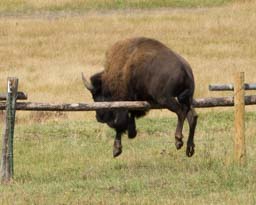
We often saw bison grazing in the distance, and a few times we got hung up in traffic jams when the herd decided to cross the highway.

Bison jumping over fence Grand Teton Wyoming

Can he make it?

The leader of the pack was a huge brute of a beast, and one day Mark saw him take aim and jump over a fence.

Buffalo in Grand Teton National Park

…I think so…

This big guy eyed up that fence for quite some time, pacing back and forth, which gave Mark just enough time to get ready for the shot.

Bison jumping in the Tetons Wyoming

…Yup, he cleared it!!

And then he went for it — and cleared it like an expert high jumper!


Happy campers at Grand Teton National Park in Wyoming

What a beautiful place to spend a little time…

We really wanted to see a moose, and we got word that there was a big one with huge antlers that hung out by the bridge at Moose Junction (how fitting!).

Sure enough, one morning we saw him, just fifty yards from his bridge. He was with another moose friend — perfect!

But we had set our alarm clock so we could wake up before dawn to go take photos of the little log cabin church at sunrise.  Moose weren’t on our agenda!


Teton Mountains in Wyoming at sunset

Sunset at the Tetons

In our sleepy state, somehow we didn’t grasp the gift of the moment, and we kept on driving to the church, totally intent on our mission.

Silly us. The church was there every morning, but the moose in the Tetons play hide-and-seek. Unfortunately, we never saw them again.

Oh well. In the long run, it didn’t really matter. Wyoming’s Grand Teton National Park is a place we’ll return to again and again, and now we have a great reason to go back — to see moose!


Subscribe
Never miss a post — it’s free!

Our most recent posts:

Our other posts from our RV travels to Grand Teton National park:

<-Previous || Next->


New to this site? Visit our Home page to read more about our full-time traveling lifestyle and our Intro for RVers to find out where we keep all the good stuff. If you like what you see, we'd love for you to subscribe to receive our latest posts!


Roads Less Traveled goes mobile (mostly)!

Roads Less Traveled Website on an iPhone Landscape

iPhone Simulation, Landscape

We have made some changes to this site that should make it a little easier to view on mobile devices. Yay!

It was partly “mobile ready” before but there were lots of niggling problems.

The post title overlapped on itself, the header image and comments stuck way out to one side, the menus were goofy and stacked on top of each other. Those and other annoyances have been tidied up.

It’s not perfect, but it’s way better!

Read More…

Grand Teton National Park – 101 Ways to Enjoy The Tetons!

Horseback riders at Grand Teton National Park Wyoming

What a great way to see the Tetons — on horseback!

September, 2014 – The National Park Service has posted some surprising statistics over the years about just how many hours the average visitor spends in each park.

Crazy as it sounds, it is really common for folks to do a quick drive-by, hanging out the car window for some photos to take home, and then checking the park off their bucket list.

Grand Teton National Park often suffers that fate, largely because it is laid out on a north-south highway that runs from Yellowstone National Park to the town of Jackson, Wyoming.


Grand Teton's new paved bike path

A new paved bike path goes nearly 20 miles along the base of the mountains.

A USA Today article from July, 2012, stated that the average time spent in the Tetons is just 6.5 hours!!

While it’s easy to drive through the Tetons really fast, during our two week stay on this visit we discovered there are all kinds of wonderful ways to get to know this park in a much more intimate way.

A fantastic addition to the park that was built since our last visit in 2007 is a nearly 20 mile long paved bike path that runs from the southern entrance of the park to the far north end of Jenny Lake.


Riding a bicycle with a view of the Tetons

The only problem with riding by views like this is keeping your eyes on the road!

We rode portions of it several times, and it took us to quite a few off-the-beaten-path locations within the park that we never would have stopped at if we’d been touring in our truck.

Every mile of this path was filled with families and cyclists of all ages. They were all enjoying a day of riding in the fresh air, with a stunning view the whole way.

We met cyclists from Jackson doing their daily workout ride (lucky them!!), clubs from out of town that had arranged a group ride of the area, and the Backroads Adventure Tour company with paying customers.


A motorcycle rides into Grand Teton NP Wyoming

Seeing the Tetons by motorcycle would be awesome,
especially on the curvy roads.


The roads throughout the park are ideal for scenic driving in a car, but they are probably a whole lot more fun on a motorcycle.

There’s a series of sweeping turns in the northern portion of Teton Park Road that are just too stunning for words, and doing them on a motorcycle would be quite a thrill!

Boating is another great way to go.

One day as we walked along the pebble beach at Jenny Lake, we rounded a point and our jaws dropped when we saw a beautiful sailboat anchored on crystal clear water set against a spectacular mountain backdrop.

A sailboat anchored in Jenny Lake Wyoming

Ahhh… maybe the nicest way to experience the Tetons would be by sailboat.

Kayaks and ferry boats on Jenny Lake in Wyoming

Kayaks and canoes are available for rent.

At the south end of Jenny Lake a small boathouse is home to the ferry boats and rental kayaks and canoes.

Getting out on the water is always a pleasure, especially in a watercraft you can power yourself.

Kayaks on Jenny Lake Grand Teton National Park

These two gals said they were loving their kayak ride as they floated past me.

We saw lots of folks kayaking on the lake, some of whom had brought there own and some of whom were renting them from Jenny Lake Boating.

This company also rents canoes and offers ferry boat rides and scenic boat rides on Jenny lake.

Jenny Lake ferry boat in the Tetons

A quickie ferry boat ride gets you out on the water and across the lake.

Even though we missed the summertime bargain boat fare for this ferry, I ended up scoring a free ride later that morning with some rock climbers who were headed across the lake for a day of climbing.

A kayak at Jenny Lake Wyoming

Now that looks like fun!

Mark had already hiked halfway down the two mile trail that goes from the boathouse to the dock on the far side of the lake, so we chatted on our trusty two-way radios about my good luck and his scenic hike, and later caught up with each other!

If flying across the lake at breakneck speed while hanging onto your hat with both hands isn’t the way you dream of way of seeing the Tetons from the water, a canoe trip is a much more peaceful way to go, and you can share the ride too!

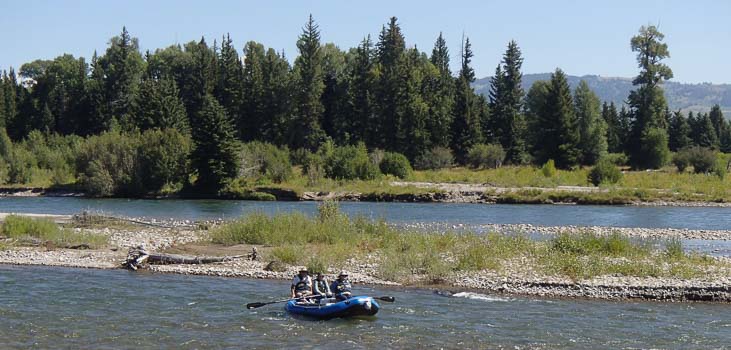
Rafting trip down the Snake River in Wyoming

There are loads of rafting trips, from little rafts like this one to huge ones with 10 people aboard.

Powerboats in Jenny Lake Marina Grand Teton National Park

We were astonished by the size of some of the powerboats. What a spot to keep a boat!

River rafting trips are also extremely popular, and we saw several huge rafts filled with ten or so people. A guide stood up in the middle and used an enormous oar to steer the boat.

There were also smaller rafts of all kinds, each flying down the Snake River at a very fast clip

Fishing on the beach at Jenny Lake

Fishing is a nice quiet way to take in the serenity of the Tetons.

There were powerboats of all shapes and sizes at the marina too.

Artist painting at Phelps Lake Grand Teton National Park WY

This is a place that will get your creative juices flowing!

Of course, nothing says you have to be on some kind of moving vehicle to enjoy the Tetons.

The more stationary pursuits of fishing and artwork are other great ways to soak in the beauty of this magical place.

When we hiked to Phelps Lake, we were delighted to come across an artist working at an easel by the water’s edge.

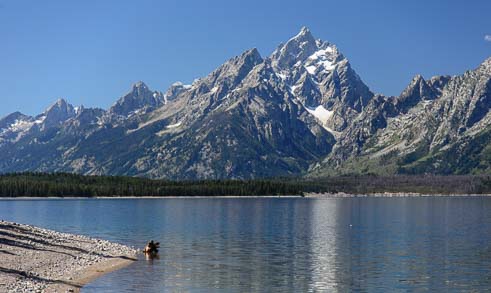
Riding a driftwood see-saw_

Aw heck, when you find a see-saw on the beach you’ve gotta try it out!

Sometimes it’s fun just to be a kid in the presence of these special mountains.

On the shores of Jenny Lake we found a huge driftwood log see-saw, and we promptly jumped on it to give each other a ride.

A motorhome drives in Grand Teton National Park Wyoming

RVs are almost as common as cars in this park.

Of course, the Tetons are RV heaven, with lots of camping options both inside and outside the park.

Every other vehicle on the road was an RV of some sort, and a good percentage of them were rental RVs.

Laurence Rockefeller's audio-visual meditation room at Grand Teton

The Rockefellers built audio-visual (and audio-only) meditation rooms where you can experience nature without the dirt and dust.

For those who don’t want to deal with the grit and effort of hiking and being outdoors, the Rockefeller family (who were responsible for the Park Service’s acquisition of most of the lands in the area), have created a unique “green” building that has several audio-visual meditation rooms.

This might seem goofy, but watching the baby bears climbing trees, the moose lapping water from the lakes and the birds flitting between the trees in larger-than-life scale was actually really cool, especially since we didn’t see those things at close range on any of our hikes.

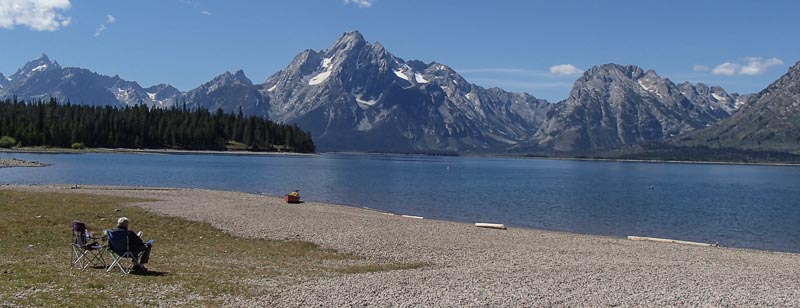
Reading a book on the beach

What a place to relax and unwind for a while!

Perhaps the best way to enjoy the Tetons, though, is just to pull up a chair and kick back in the presence of these magnificent mountains. After taking in the incredible views, it is even permissible to look away from the dramatic landscapes for a while and settle in with a book!

__________________________

Well, that’s not exactly 101 ways to enjoy the Tetons, but it’s a whole bunch!

Grand Teton Lodge Company is the National Park’s concessionaire for the campgrounds, (Colter Bay and Gros Ventre are RV campground options at different ends of the park).  They also offer scenic lunch/dinner cruises on Jackson Lake and river rafting trips.  Jenny Lake Boating offers ferry rides, private boat rentals and kayak and canoe rentals on Jenny Lake. 

Subscribe
Never miss a post — it’s free!

Our most recent posts:

Other blog posts from our RV travels to Grand Teton National park:

<-Previous || Next->


New to this site? Visit our Home page to read more about our full-time traveling lifestyle and our Intro for RVers to find out where we keep all the good stuff. If you like what you see, we'd love for you to subscribe to receive our latest posts!

Grand Teton National Park WY – Mirrored Waters

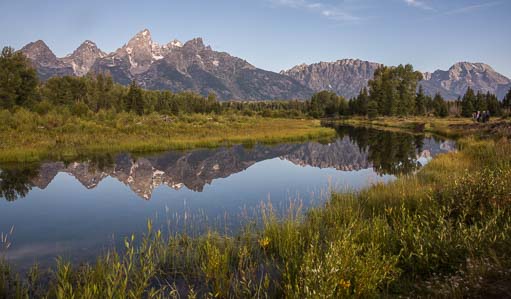
Sunrise at Shwabacher's Landing Grand Teton Wyoming-2

Sunrise at Shwabacher’s Landing.

September, 2014 – The wild skies in Wyoming’s Grand Teton National Park settled down after a while, and clear blue skies began to rein.

We continued our morning ritual of hopping out of bed before dawn to run down to the scenic viewpoints to catch the sunrise.

As the sun rose, pastel shades would silently creep across the sky and then spread across the water below in beautiful mirrored reflections.

The sunrise was different every day, and each one was lovely in its own way.

Teton Mountains at Shwabacher Landing Wyoming

Just before sunrise, mist floats along the base of the Tetons.

Perfect reflections of the Teton Mountains at Shwabacher Landing

At the same place on another day, the mountains blush and check their reflections in the water.

Still water and mountains Shwabacher's Landing Teton Mountains Wyoming

Mirrored reflections of sky and mountains at Shwabacher’s Landing

This business of running around before dawn turned out to be surprisingly popular in the Tetons.

Every morning, headlights pierced the cold black air heading in both directions on the highway, and brake lights lined up at the turn-offs to the viewpoints.

At first we thought the Tetons were full of crazy photographers.

Water reflections Shwabacher Landing in the Teton Mountains-3

Serenity.

But we soon figured out that lots of these people were fishermen, wildlife stalkers and folks getting an early start for their day’s hike.

So much for R&R when you take a vacation to Grand Teton National Park!

What we loved, though, was the stillness of the water and the way its glassy surface mirrored the sawtooth mountain peaks as they changed shades in the morning light.

Placid water at Shwabacher's Landing at the Tetons

Prefect stillness… for a split second!

We returned to Shawbacher’s Landing several times to capture these special moments, and every single time we were teased by the dam-building beavers.

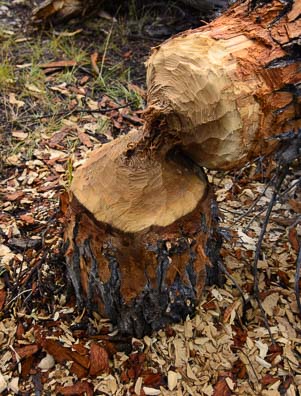
A tree felled by a beaver

Beavers are great lumberjacks. How do they
know when it’s time to bite and run?

Each morning, it was guaranteed that until the sun crested the horizon to the east, the beavers would sit on the tops of their dams, silhouetted perfectly.

They looked so cute and stood so incredibly still as they posed for us, little hunched figures on top of their world.

However, in such hopelessly dim light there wasn’t a chance in heck of getting that dreamed of beaver-sitting-on-his-dam portrait.

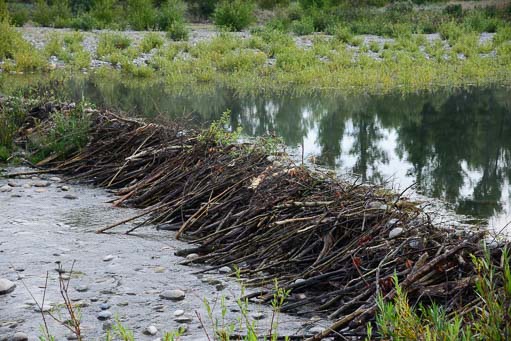
Beaver Dam at Shwabacher Landing Grand Teton Wyoming

A dam built by a beaver, nature’s engineer.

Of course, just as the colorful magic in the sky would begin, the beavers would all jump in the water and swim around, totally messing up the reflections.

They’d drag branches to and fro between their dams, true to their reputation as nature’s industrious little engineers, but they’d leave the water completely rippled, shattering the pink mirrored mountains into a zig-zag pattern of fractured images.

Mirrored reflection across Jenny Lake in Wyoming

The mirrored reflection of the mountains stretched clear across Jenny Lake.

The photographers that were lined up on the shore would moan and grumble to each other about those damn beavers, throwing up their hands in total frustration.

They’d call out to the beavers, telling them to get out of the way, and pleading with them to hold off on construction until the work day actually started in another hour or two.

Sometimes the water would settle for a split second, and then a flurry of shutter clicks would fly.


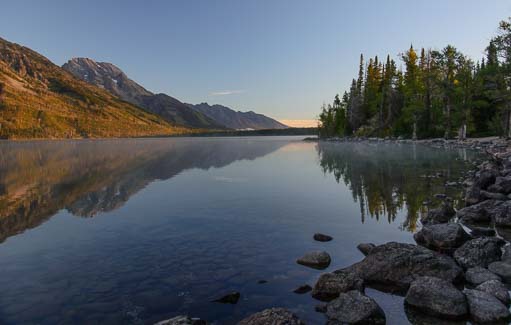
Jenny Lake evergreen trees in morning mist Wyoming

Pines mirrored in the mist at Jenny Lake.

Triumphant grins would flash between us all, only to be followed by another series of loud groans when a fish would snag a bug on the water’s surface, sending out a ring of ripples.

Once the light show was over, of course, and the sun rose high enough to bathe the scene in stark, bright light, the beavers would vanish into thin air, nowhere to be found, and the water would resume its glassy state, a little late.

So it goes with nature photography.


Mirrored mountains Jenny Lake Grand Teton National Park Wyoming

We were captivated by the beauty around us.

Jenny Lake sits in the middle of Grand Teton National Park, and there is a 10 minute ferry ride that shuttles people to the far side where there are several wonderful hikes.

Wandering down to the boathouse one afternoon, we discovered that this ferry ride is $15 per person all day long, but the very first boat ride at 7:00 a.m. is just $5.

Misty morning on Jenny Lake Wyoming

Every way we turned the images were
awe-inspiring.

What a deal! We were there!

So, on yet another ice cold morning, we dashed off in the truck, only to arrive at Jenny Lake and discover that now that Labor Day was behind us, the ferries were on a Fall schedule.

There was no early morning discount deal.

Rising mist on Jenny Lake Teton Mountains

The water was like glass.

In fact, there were no ferries at all until 10:00 a.m.

Argh!!

But this turned out to be a blessing in disguise, as we were now on the shores of Jenny Lake at dawn, a time and place where the Tetons quietly radiate their greatest majesty.

Foggy shores of Jenny Lake Grand Teton Wyoming

Mist rises from Jenny Lake.

The mist was rising off the surface of the water, and we suddenly had nothing to do but wander along the edge of the lake and take in the beautiful scene.

Talk about mirrored reflections on the water!

The whole lake was crystal clear and utterly ripple free!

We picked our way between the rocks on the shoreline, totally captivated by the steaming water and glowing mountains across the lake


Morning mist on the water Jenny Lake Grand Teton National Park

Jenny Lake is a magical spot at dawn.

There was less than a handful of other people down at the lake, and we were all walking around with dreamy smiles on our faces.

Granted, we all needed coffee, and we all had red, runny noses, but we all knew this was life at its finest.

The world was asleep, snug in their sleeping bags or rustic cabins or plush hotels in Jackson Hole, but a breathtaking dawn was silently unfolding around us lucky ones right here.


Mountain reflections in Jenny Lake

The mountains glowed orange.

Time stood still as the mountains gradually glowed fiery orange.

The light intensified for a few moments, stealing over the scene and over us noiselessly, without any kind of announcement or tap on the shoulder saying, “Hey, look at me!”

All this bravado and show was just nature’s way of stretching and shaking off the cold stiffness of the night air before getting up.


Dinghies on the beach at Jenny Lake in Grand Teton National Park

Dinghies and trees on the beach made beautiful patterns.

It was a magic moment that swept us up in its glory, so singular and so special for us that it would stay in our memories forever.

But it happens every day, day after day.

How lucky we felt to have witnessed it. How fortunate we were to be in this spot on this morning to watch the vibrant light grow and fade, to see the mist rise and dissipate from the water.

At the same time, how reassuring it was to know that it is always there for everyone, every morning… Jenny Lake at dawn.


Visit these links for the Official Grand Teton National Park website and Wikipedia’s Grand Teton National Park entry.

Here is a little more about Jenny Lake  and the Jenny Lake ferry.

Subscribe
Never miss a post — it’s free!

Our most recent posts:

Other blog posts from our RV travels to Grand Teton National park:

<-Previous || Next->

New to this site? Visit our Home page to read more about our full-time traveling lifestyle and our Intro for RVers to find out where we keep all the good stuff. If you like what you see, we'd love for you to subscribe to receive our latest posts!


Grand Teton National Park WY – Wild Skies

Rainbow over our fifth wheel in Alpine Wyoming

At the end of the flood…a rainbow!


August, 2014 – After our four days of Noah’s Flood in Alpine, Wyoming, finally ended, we were blessed with a beautiful rainbow right over our little buggy.

The mud around us dried just enough so we could make our way back to the highway and continue our journey north towards Grand Teton National Park.

The deluge wasn’t entirely over, however, and dark gloomy skies filled our views for a few days.


Mist rises at dawn in Grand Teton National Park Wyoming

The Tetons are wreathed in a mysterious mist.


We arrived at the Tetons to find them wrapped in a mysterious mist that rose and fell and enveloped their faces as a cold wind whipped ours.

The clouds moved quickly, coagulating into otherworldly shapes and then dispersing into nothing, as if a magician were shrouding them under a gossamer veil and then laughing with a twinkle in his eye as he pulled it away.


Mountain mist explosion at Grand Teton National Park in Wyoming

The mountains seemed at times to be exploding.


We drove along the highway that runs through this park, awe-struck by the majestic scenery surrounding us.

Wisps of fog reached out along the base of the Teton Mountains and stole up their craggy flanks, giving the regal peaks a mystical air.

Sunlight came and went, teasing us as it lit the jagged faces and then withdrew and left them dark.


RV fifth wheel in Grand Teton National Park Wyoming

Dawn’s light played amid the mountain peaks


We roamed all around, enchanted by this unusual light, until some huge black clouds gathered overhead and gave us a frightening glare.

When they finally burst wide open, we huddled inside the buggy.  Rain pelted our roof, thunder echoed off the jagged peaks and lightning flashed all around us.

At last the rain stopped, and we ran along the Blacktail Pond overlook with vague hope in our hearts that there might be a good sunset.


Storm clouds over our fifth wheel RV

Storm clouds threatened and then burst with fury


We claimed our spots with our tripods and cameras on opposite promontontories, just in case.

I noticed another photographer setting up near me.

“Do you think there’s a chance of a sunset?” I asked him, making a face as I glanced at the grey skies.

“You never know.” He replied. “I’ve been coming here for years, and I’ve seen some incredible sunsets.”


Wild skies in Grand Teton National Park Wyoming

Wild skies at sunset

Just then, we both noticed a faint hint of pink in the sky.

As we stared at it, willing it to grow, the most stunning sunset I have ever seen unfolded.

In moments, the entire sky was on fire, flaming in waves of brilliant pink and orange.

The colors intensified, as if the flames were licking the mountaintops.

A pink glow began to radiate between the peaks.


Sunset in Grand Teton National Park Wyoming

Waves of color formed as the sunset drama played out

I could hear the shutter clicks of my companion and the “oohs” and “aahs” he was muttering.

I was doing the same thing, and hoping feverishly that Mark was as spellbound watching this magical drama over on his precipice as we were on ours.

I turned away from the valley for a moment and was shocked to see the sides of the storm clouds above us had suddenly begun glowing magenta.


Storm clouds and sunset in Wyoming

I turned around and saw the storm clouds glowing, as if from a fire within.

Two trees on the flat plain were silhouetted against this delicious, lugubrious sky.

And then, without a hint of warning, it was over.

Mark and I ran towards each other, bursting with excitement.

“Did you see that?”

“Yes. Did you get it?”

“I think so… Look at this one…”

Pink glow between the Teton Mountain Peaks Wyoming

Vibrant shafts of light radiate between the peaks.

Fire in the sky at Grand Teton National Monument in Wyoming

The gods play with fire in the sky over the Tetons.

Shwabacher Landing Grand Teton National Park before dawn

Before dawn, the misty peaks were reflected in the water.

We traded cameras to see each other’s pics, dashed into the rig and drove off in a flurry, totally flushed with excitement.

The next morning we set the alarm for oh-dark-thirty and snuck down to Shwabacher Landing to see if we might get lucky with a sunrise.

The mountains were shrouded in blue-gray mist.

Only the peaks were visible, but the reflections from the mirror-like water gave the scene an ethereal air.


Sunrise at Shawbacker Landing Grand Teton National Park

But all the sunrise drama was happening behind us!

We set up our tripods for our sunrise shot, totally focused on the mountains and reflecting water in front of us.

Then we turned around and our jaws dropped in astonishment as we watched the most vivid display of pink and orange developing behind us.

We were in total awe. But the cameras were facing in the complete opposite direction!

After a few minutes I finally regained my senses, yanked the camera off the tripod and fired off a few quick handheld shots of this glorious sunrise.

Sunrise lights the peaks in Grand Teton National Park Wyoming

Sunrise lights the tips of the mountains as fog rolls in

No sooner had the color faded in the eastern sky than the rising sun began to light the peaks of the Tetons to the west.

The mist was rising rapidly, leaving just the points of each jagged peak to poke its head above and glow pink for a few seconds.

We caught our images, but our hearts were pounding.

How crazy that a silent sunrise could steal over an entire valley and send us into paroxysms of frustration and thrills: “I’m missing it…No, wait, I’m getting it! I got it I got it!!”
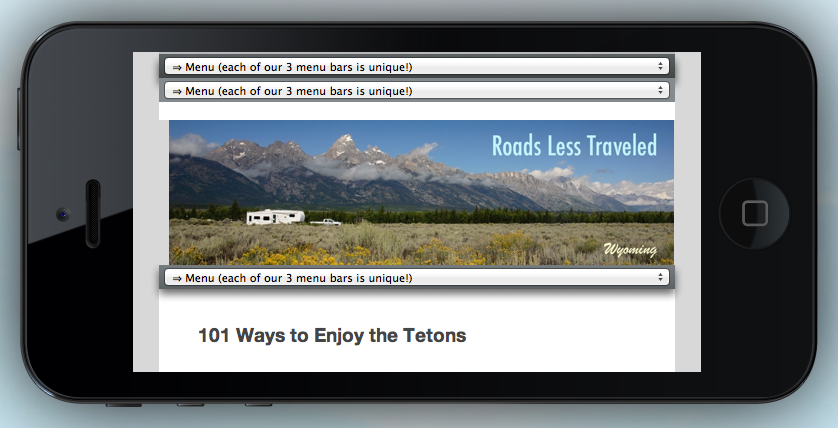
Blushing mountain peaks at Grand Teton Naitonal Park Wyoming

The tips of the mountains catch the sunrise above the mist.

For the next few days we rose with the alarm clock to catch the sunrises over the water.

There were other photographers at every viewpoint, all jumping up and down to keep warm, and blowing into their hands to bring some life back to their fingertips.

We shared stories of missed shots, wrong camera settings, and the ecstasy of catching it just right.

Some photographers had caught The Big Fiery Sunset at Ox Bow and Shwabacher Landing where the theatrics in the sky were doubled by reflections in the water.

Stormy sunrise over an RV

Another stormy sunset fills the sky

Such good fortune!

The stormy skies continued to enchant us, and we were blessed with one stunning sunrise and sunset after another.

After nearly a week of this nonsense of getting out of our warm bed in the ice cold dark and not crawling back into that warm bed until many hours after sunset, we were bleary eyed and tripping over our own two feet.

But the Tetons had gifted us with their magic and we were grateful for every stunning moment.


Glowing with happiness at Grand Teton National Park Wyoming

Glowing with happiness in a truly spectacular place.

Prior to this visit, our RV travels in Wyoming had brought us to this magnificent valley twice. The first time, in our first year of traveling, we had naively rushed through way too fast, and the second, just two years ago, had been devoid of mountain views due to thick wildfire smoke in the air.

This visit, however, was taking us by storm, in the best and most literal sense.

We quickly decided to stick around a while to see what else these mysterious mountains would share with us.

For more information about Grand Teton National Park, click here.

Subscribe
Never miss a post — it’s free!

Our most recent posts:

To see our other posts from our RV travels to Grand Teton National park, see the following links:

<-Previous || Next->

New to this site? Visit our Home page to read more about our full-time traveling lifestyle and our Intro for RVers to find out where we keep all the good stuff. If you like what you see, we'd love for you to subscribe to receive our latest posts!