Rivers of Phoenix – Oases in the Desert!

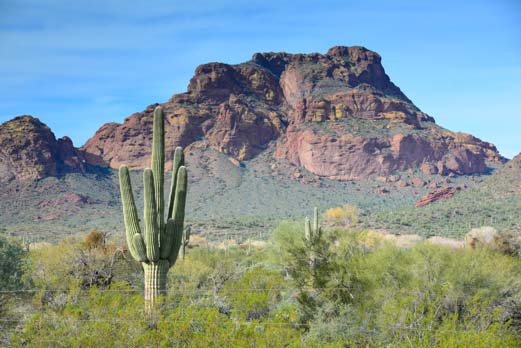
Saguaro in Sonoran Desert

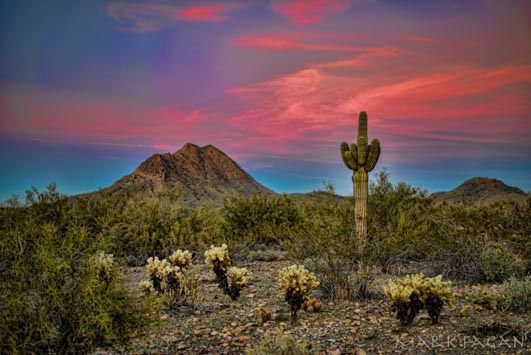
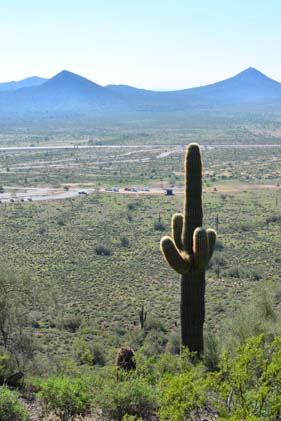
The Sonoran Desert is a special and unique landscape

February, 2014 – We had been living among the saguaro cactus on the outer fringes of Phoenix Arizona for a few weeks, loving life in the sweet Sonoran desert.

Saguaro cactus

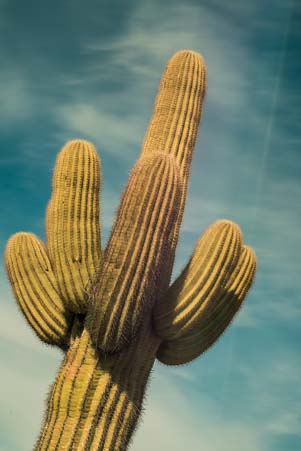
One of the most elaborately shaped
saguaro cactus we’ve seen

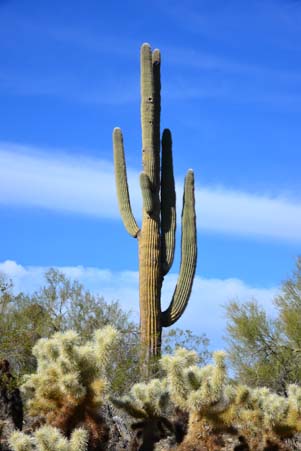
The weather continued to be stunningly warm, with temps in the high 70’s every afternoon, and we hiked and biked all over the place, soaking in the beautiful views of the aged and stately cactus whose personal histories reached back before Arizona achieved statehood in 1912.  Heck, these guys were saplings in the 1800’s!

Red Mountain on the Salt River

Peeking through the trees at the Salt River

While visiting friends in nearby Fountain Hills, we took a bike ride through the Fort McDowell Indian reservation. Poking around the back roads, we took a turn down a lane and suddenly found ourselves standing next to a flowing river.

It’s funny, even though we’ve called Phoenix “home” for a long time, it hadn’t really sunk in for me that there are rivers here that flow year round.

You just don’t notice them as you drive around town.


Verde River Arizona

The Verde River joins the Salt River

These are vibrant riparian habitats where long legged birds go fishing, animals of all kinds come down for a drink of water, and tall reeds grow by the water’s edge.

Several rivers flow through Phoenix, and we spent a few weeks exploring the shores of two of them, the Verde River and the Salt River.

In the Phoenix area the Salt River runs east-west and the Verde runs north-south.

Kayaks on the river

Kayakers fly downstream

Confluence of the Salt River and Verde River

The scenic confluence of the Salt and Verde Rivers

They converge in a corner of the Tonto National Forest tucked between Fountain Hills and Mesa.

This confluence is a very special spot where kayakers paddle up and downstream, fishermen stand patiently by the water’s edge waiting for a catch, and people of all ages picnic and hike along the craggy shoreline.
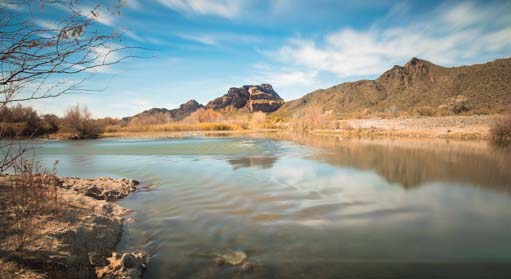


Salt River Phoenix Arizona

What a surprise it is to see a river that flows non-stop through the desert

After being immersed in the Sonoran desert for a few weeks — a landscape rich with flora and fauna that can thrive on just an occasional spritz of dampness — we loved watching the leaves and algae and twigs floating lazily downstream on this steadily flowing body of water.
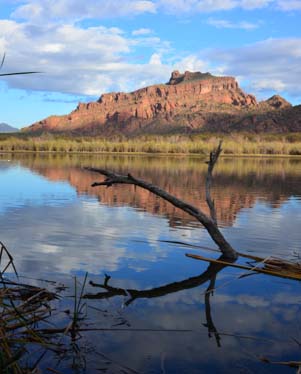
Red mountain with driftwood

Red Mountain forms a beautiful backdrop

Fisherman at the Salt River

Fishermen wait for the catch of the day

Whether stalking that next beautiful photograph with camera and tripod, or riding our bikes on a road that paralleled the flowing water, or hiking along the rocky banks at the river’s edge, we were floored by the change of scenery from the classic Sonoran desert to this watery world, a transformation that takes place in just a few steps.

Fishing on the Salt River

A little girl in pink boots tries her luck with the fishing rod

In the late afternoons the shoreside trees and reeds come alive with the raucous clamor of birds singing and calling each other and deciding who is going to roost where (and with whom!).

Salt River Flow

The Salt River doesn’t flow fast, but it is steady.

Grassy riverbanks

A long legged egret waits for fish among the reeds

“It sounds like I’m in the Amazon,” Mark said to me one afternoon.  We had staked out a spot to catch the late afternoon light, and the shrubs were alive with exotic squeeks and squawks.

There is easy access to the south side of the river, but the north side doesn’t have any roads or trails, so I was surprised when I suddenly heard the loud crunching noises of branches breaking from across the water on the north side of the river.

It sounded like the deliberate movements of something very large that was cracking tree limbs.  I stared into the reeds wondering who the heck was over there.

I couldn’t imagine there could be a person weed-whacking their way through the dense vegetation.  It had to be an animal.

We had heard reports that wild horses had been spotted down by the river, and I studied the shore across the way, hoping for a glimpse of a wild horse.

Cow drinks at rivers edge

A cow comes down to the river’s edge for a drink

After a few minutes, the tall reeds parted and a big brown cow emerged and slowly made its way down to the water.

Well, it wasn’t as cool as a wild horse, but it was still pretty darn cool considering the concrete jungle of freeways and humanity that were the essence of greater Phoenix all around us just a few miles away.

Flipped car

A little reckless driving in the early morning

The cow took a long drink, stared at me for a while, and then dipped its head for another sip before slowly vanishing into the reeds once again.

Riverside starburst at dusk

Dusk on the riverbanks was beautiful and different every evening

This incredibly beautiful and peaceful spot can’t keep the insanity of the city at bay all the time, though, and one day while we were out on a bike ride we saw the bizarre sight of a car flipped upside down on one of the small national forest roads.

Barbecuing dinner

For us these were happy lazy days

We found out a young fellow had come blasting down the tiny, twisty roads of the area at breakneck speeds.

Luckily, he escaped breaking his neck when he lost control of his car.
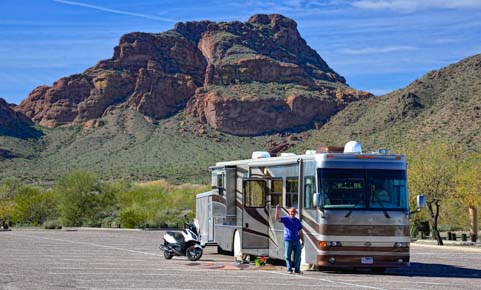
Flying the Koop

Mark took this wonderful photo of our friends Mike & Donna’s rig
and they put it on their blog banner at www.flyingthekoop.com!

He was seen walking off into the desert, although police later found a loaded gun in his car.

Trouble in paradise, I guess!
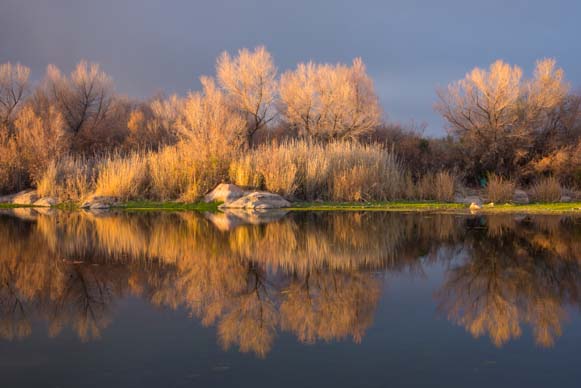
 

Golden hour in the reeds

The Golden Hour on the river

For us, however, life was full of contentment, and we enjoyed a steady stream of quiet, happy days.

Mark got the barbecue going in the evenings, something we had not done in our boating lives and that we had missed sorely, and we met up with new friends of ours, Mike and Donna, whom we had met in San Diego.

They began full-timing last July and have a fun blog, www.flyingthekoop.com, with the delightful motto, “From real estate to wheel estate.”
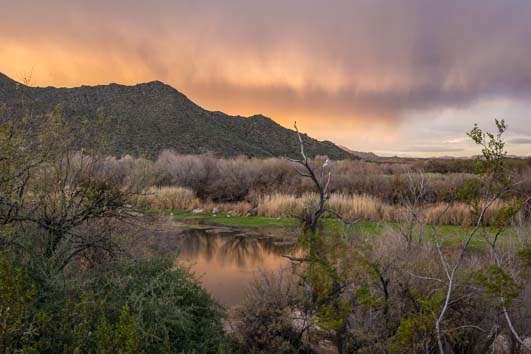
 

Sunset with rain over Fountain Hills

Rain nearby gave us beautiful orange cloud formations

The late afternoons and evenings continued to lure us down to the water’s edge every day, and we were treated to some glorious sunsets.

There is a “golden hour” just before the sun leaves the sky when everything seems to be lit from within with a truly golden glow.

We caught this heavenly light one afternoon when the water was totally still. This created a perfect mirror for everything on shore.

Rain was falling in the distance, and the clouds were streaked and heavy with moisture, creating a mystical air in the twilight.

Golden hour along the Salt River

River reflections

The light turned from a crisp, radiant yellow to a burnt orange and finally to a soft pink blush that lit the river’s edge in a luminous warmth. There was a peace here that soothed our souls.

Mirrored sunset hues

We loved the mirrored hues of late afternoon

Sunset colors along the Salt River in Phoenix

The last blush of sunset

Fisherman in sunset reflections at the Salt River

A fisherman amid sunset reflections in the river

We didn’t realize what an unusual sunset this was until we after we had tried to recapture it every night for a week.

Every afternoon, as the sun began its final descent, we ran down to the water’s edge, tripods in hand, hoping for a repeat of that ethereal light.

However, the special light we saw that night, that warm glow that faded from gold to a pink blush to a lavender mist was never quite the same again.

Many sunsets were spectacular, but that fleeting moment where the whole river seemed to hold its breath as everything shimmered in a rose colored halo had been utterly unique and never happened again.

So it is with nature, and we are learning to savor every day that comes.

<- Previous                                                                                                                                                                                       Next->

Saguaros and Sunsets in Phoenix Arizona

Buggy boondocking in Arizona

The buggy is at home in the desert.

January, 2014 – It was so great to be back in the Arizona desert in Phoenix. Once we got set up and acclimated to life in the rig, we instantly got caught up in the beauty of our surroundings.

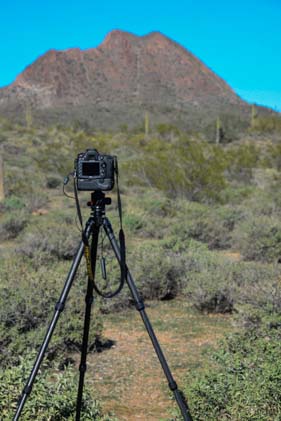
Camera on tripod

The cameras got a workout here!

Whether it was sunrise or sunset or sometime in between, we found ourselves running in and out of the trailer to catch this image or that and then pour over it on the computer.

Evening photo from fifth wheel roof

Some pics are best taken from the roof!


During the last few months we have changed all the tools we use for photography. We moved up from Nikon D5100 cameras to D610’s, and we switched our computer software from Apple’s Aperture to Adobe’s Lightroom.

Mark has loved learning post-processing, that is, working with photos on the computer, and he has become very proficient with Lightroom.

View from our RV at sunset

Fire in the sky! Mark loves creating dramatic effects with Lightroom

I, on the other hand, have spent a lot of time being totally lost!

I could never seem to find the buttons I wanted on the camera, and Lightroom was a vast maze of clickable things that generated totally unexpected results in the images on the computer.

This was the beginning of a very long learning curve — for both of us.

Sunset with our RV

We had a few truly stunning sunsets

Whereas Mark had spent the last few years getting to know the mechanics behind photography in a very intimate way, I had been focused entirely on getting the hang of composition.

And each of us was at sea in the other’s territory.

“What buttons do I push?” I would ask.

“Where do I point my camera?” He would respond.

It was very funny — and very enlightening.

We decided that we needed to teach each other all we knew and learn each others’ skills.

I complained bitterly as I fumbled with the knobs on the tripod and missed shot after shot because I couldn’t get the legs, or the head — or any of it, for that matter — to do what I wanted.

Arizona sunset near Phoenix

An Arizona sunset

I’d look over and he would have gotten set up in an instant. But sometimes he didn’t seem to line himself up to get the most exciting image.

“Try moving over this way a bit more,” I said one time, “and zoom in so you get the saguaro, barrel cactus and the mountain balancing each other.”

“Oh WOW!” He said. “Here I was trying to put that pile of dead roots in the foreground and you’ve got this great image…”

Mark with his tripod

Mark is at ease with his tripod.

Very funny! But I was still flummoxed over my own issues. “How do I get the camera on and off of this thing?” I sighed. I felt so silly asking for the umpteenth time. I vowed I’d remember this time as he showed me yet again.

Saguaro skeleton in the Phoenix desert

We came across an old saguaro skeleton

What a miracle it was to discover that we each had something really valuable to give to the other.

Sonoran desert scenery: saguaro, barrel cactus and a mountain

A big saguaro and a little barrel cactus converse

This became apparent again when Mark ran out to get some night shots one balmy evening. I had had enough trouble with the tripod during the day — and now we were going to do it in the dark? Are you kidding?

Saguaro Pair

BFF’s

Saguaro and moon at dusk in Arizona

Mark captures a saguaro with the moon at dusk

He gleefully set up the camera and promptly got a beautiful shot of a saguaro and the moon before I’d even gotten my camera secured on the tripod and turned it on. He made it look so easy.

On another night he said, “I want to do some star shots,” as he dashed out the door. I hurried behind and watched as he effortlessly got set up and hit a few buttons on the camera.

He played with 30 second exposures and 90 second exposures while I looked on trying to memorize which buttons he’d just hit and why. But the images lacked spunk.


Fifth wheel trailer RV under Orion

The Orion constellation rises behind our buggy

“Hey, let’s try to get Orion rising over the rig!!” I suggested.

“Ooooh! I never thought of that!” He came running around to where I was and helped me get some of the settings going: long exposure, fixed ISO, noise reduction, manual focus, self-timer. Yikes! I took a few shots and finally got a keeper.

Collaborative photography. I love it!

Hiking shoes at RV our door

How many people live here?

The next day we decided to go hiking in the desert.

How funny it is now, after living barefoot on a boat in the tropics for so long (to the point where we forgot what shoes felt like on our feet), to look down and see this pile of hiking, running and cycling shoes at our door.

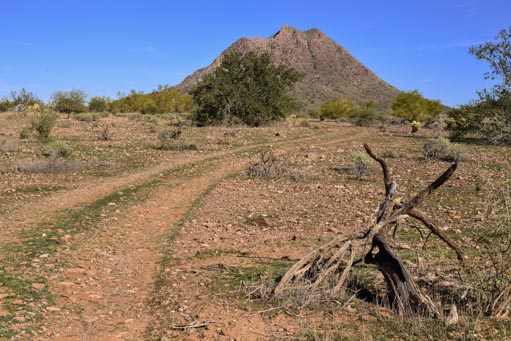
Desert Road near Anthem Arizona


Saguaro conversation

“The trail goes thataway”

We hiked Daisy Mountain trail at the north end of Anthem, a pretty and easy trail that goes through some beautiful desert scenery.

Saguaro cactus in the Sonoran Desert

This is a hold up!

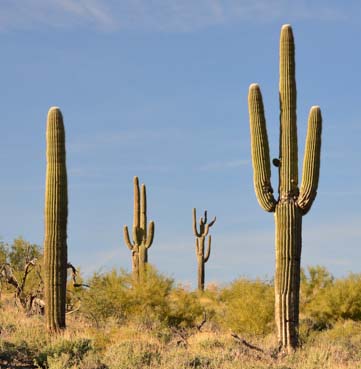
What I love about the Sonoran desert is the crazy saguaro cactus.

Each one has a unique personality, and some seem to be deep in conversation.

As we tromped around, I felt a little like I was eavesdropping on some of these guys, listening in on what they had to say to each other.

Arizona barrel cactus

A male barrel cactus

Of course, nature has its whimsical side too, and Mark was laughing when he came over to show off his picture of a very male cactus.

Cactus needles in hiking shoe

That’s what you get when you stomp around in the desert

It’s a prickly business, walking in the desert, and when I looked at the bottom of my hiking shoes, they were filled with cactus needles.

Saguaro on a tilt

This reminded me of an intriguing woman we had met a week earlier at a supermarket Starbucks one morning.

She was wearing a bulky, navy blue down-filled snow jacket, the northern states kind that you never see in Phoenix, and she had on grubby, mud-encrusted hiking boots. There were mud splatters on her pants, and her eyes were red-rimmed and tired.

Closeup of Arizona saguaro cactus

She approached me and asked in a strong British accent if she could borrow my cell phone.

She gestured helplessly at her phone and sniffed from the cold. “This English phone can’t get a signal…”

Mark lines up a Sonoran desert photo

Mark lines up a photo of a saguaro…

Standing Saguaro in Phoenix

…his favorite shot was from the other side!

Saguaro cactus, master of the Sonoran desert

Saguaros grow all different ways

This made me laugh, and I explained to her that although I’d be happy to lend her my phone, we were the only people on the planet who don’t have one.

She gave me a lopsided smile and sat down with her coffee, clearly savoring the heat and steam coming from the cup.

Sonoran desert cactus

Classic Sonoran desert

She piqued my curiosity. Where was she from and what was she up to? I got up the nerve to ask.

“I’m here for a week,” she said. “I just flew in yesterday afternoon, and I have been out in the desert all night.”

My jaw dropped.

“Yeah, I was walking in the desert all night long.” She said, seeming not to believe it herself. “I don’t normally look like this. I clean up really well! I had a marvelous time out there.”

She went on: “I’m on a spiritual journey, and I had a series of rituals to do during the night. I saw a lot of animals out there, some javelina and jack rabbits. I saw a cat-like animal too. I don’t know what it was. It had rings on its tail…”

I shook my head in amazement as I listened to her. You don’t hear English accents in Phoenix too often, and I’ve never met a desert night wanderer, especially one who’s been out communing with the desert spirits and running into coatimundi in her meanderings.

Curvy saguaro cactus

Probably this guy’s life history wasn’t quite what he expected!

One of my favorite things about our travels is the people we meet, and especially having the time to talk to them.

“I forgot how cold it is in the desert at night!” She was saying. Brrrr. I can only imagine!

Like the saguaros, we are all so unique.

Some of us grow straight and tall, but others of us have special curves and bends, especially as we get older, because oftentimes life doesn’t turn out quite the way we plan.


Sun star burst effect on a saguaro cactus

The sun peeks out from behind a saguaro

Mark set up a gorgeous photo of the sun peeking around a saguaro in a starburst. Wow!

When I saw a beautiful sunset developing I was bound and determined to get a stunning shot of some kind too.

The clouds looked like they were going to explode in color, and I chose a pretty ocotillo that would make a perfect silhouette spray across the red and orange backdrop.

I set up the tripod so the camera was hanging upside down just above the ground, got it all focused, and then stood and waited.

Ocotillo cactus at sunset in Arizona

The much awaited ocotillo sunset shot… oh well.

This is not my way. When the sun hits the “golden hour” just before sunset, I usually run around like a madwoman shooting everything in sight.

But I wanted to learn more technically, so I folded my arms and bit my lip while I saw miracle photo after miracle photo glowing gold all around me. Arghh!

Then, to my horror, I watched my beautiful cloud pattern completely dissipate. The sun went down, and the clouds vanished! Not fair!

I took a few of my upside down ocotillo shots, with one lone cloud hovering to the side. What a disappointment.

Gathering up my gear, and wondering where in the world Mark had disappeared to, I trudged away.

After a hundred yards or so, I looked up and discovered a brilliant sunset had materialized out of thin air, and off in the distance stood the most perfect saguaro!

I ran full speed down to the cactus hoping to catch it in time, my loaded fanny pack, camera, tripod and Hoodman loupe bouncing around as I ran. With the camera still attached to the tripod, I lifted the whole thing into the air to get my shots, laughing along with the chortling cactus wrens that were scurrying around me.

Classic Phoenix - Saguaro cactus at sunset

My impromptu shot taken with the tripod dangling from the camera

This tripod technique is strictly verboten, totally amateurish, and hopefully in the future I’ll learn to react fast enough to get the composition I want with the legs of the tripod still firmly planted on the ground. But, for now, it worked!

In my excitement, I had set my sunglasses down somewhere, and I searched around but never found them. Meanwhile, Mark was calling me on the radio from the trail head wondering what had happened to me.

Home sweet home - our RV at dusk

Home sweet home.

I was totally elated, totally out of breath, and I chatted away on the radio with him the whole way back down the trail as darkness stole over the desert. By the time I saw his flashlight waving at the trail head, the world was pitch dark around me.

The desert is a magical place at night… and I understand its spiritual lure… but it sure was nice to see our cozy warm buggy waiting for us after being chased down that last bit of the trail by the cold, searching fingers of the night’s icy air.

<- Previous                                                                                                                                                                                       Next->

Phoenix Sonoran Preserve – A City Escape

Sonoran Desert Preserve

Apache Wash trailhead at the Sonoran Desert Preserve

Phoenix, Arizona, is a huge sprawling city that seems to creep further out into the desert with every passing day.

Each time we return to our old stomping grounds, we are surprised anew at all the changes.

Saguaro Cactus up close

Every saguaro cactus has its own personality

Roads we used to know like the backs of our hands now leave us utterly lost because we can’t find any of the old familiar landmarks.

With that kind of growth, and with new construction gobbling up the precious Sonoran desert at a scary-fast pace, it often seems that there can’t possibly be any open space left for the leisurely enjoyment of nature.

Before we leave on our hike

We didn’t get far before we stopped to take some photos

Everything within many miles of Phoenix has become either a master-planned community or a strip mall.

So we were utterly astonished when our friends Charlie and Cathie, who spend every free moment riding their bikes around town or hiking the many nearby mountains, asked us if we’d heard about the new road called Sonoran Desert Drive.

Lush Sonoran Desert

The Sonoran desert is very lush with
rich (and prickly) vegetation

New roads go in all the time, but they seemed truly excited about this one.  “It’s eight miles long, has a great bike lane, no traffic, and is surrounded on both sides by open desert as far as you can see.”

In Phoenix?  Impossible! We had to go check it out.

Sure enough, this beautiful, brand new parkway runs between Cave Creek Road and Dynamite on its eastern end and Dove Valley Road and North Valley Parkway to the west, without a hint of housing or development or urban living of any kind except at the cluster of homes tucked into its far western end.

Jumping cholla cactus

A “jumping” or “teddy bear” cholla cactus

For about 8 miles, this parkway bisects a huge, square tract of open desert.  Whoever knew that was there?  When you are scurrying around the housing-lined city streets, zooming up this road and down that one, there’s no way of knowing what’s in back of it all.

Better yet, right smack in the center of this vast piece of land is the brand new Apache Wash trailhead that is now part of the Sonoran Desert Preserve system.

Saguaro with starburst

The sun peaks around a cactus in a starburst

The first time we drove along this parkway and hiked the trail, in December, the trail had been open for just a few weeks.

Groups of people with water bottles, hiking shoes, fanny packs and safari hats stood around in front of the brand new trail maps deciding which of the many choices of routes to try first.

Teddy bear cholla

The hummingbirds need those long beaks to drink the nectar without getting spiked!

Near the shade ramadas, a sun dial looking statue turned out to be a pointer system to the mountains in the distance.

Trail hiking to saguaro cactus

This is a very beautiful trail to hike

The McDowells, Four Peaks and other mountains that surround Phoenix at distances of ten to thirty miles could all be spotted by lining up the pointer.

What a cool park!  And what luck that we happened to visit just after a big rain.  The air was as clear and crisp as could be, and the views to the horizon were haze free.

We set out on one of the trails at random, and of course we didn’t get very far before we had to start taking pictures.

This is a lush part of the Sonoran desert, rich with saguaro cactus, ocotillo and the many scrubby low lying bushes that always blanket the desert in pastel shades of gray and green.

Mountain biker

The trail is open to mountain bikers…

Jumping cholla, or “teddy bear” cholla (pronounced “choy-ya”), are the short, cute, pale, fuzzy many-armed cactus that look so cuddly.

But if you get some skin, or clothes, or hiking shoes anywhere near their barbed needles, they will cling to you for all they’re worth. That’s how they got the reputation of jumping!


Girl mountain biker

…and they were all having a blast on the trail!

If you step on one of their little round balls of needles that they shed so freely all around them, you will need a pair of pliers and a lot of patience to get all the needles out of the soles of your shoes!

I looked up when I heard the sound of wheels crunching the dirt, and suddenly saw a mountain biker barreling down towards us.

The trails are open to mountain bikers, and they all seemed to be loving their ride.

Saguaro cactus

A saguaro tells a funny tale to an audience of barrel cactus

Open sonoran desert

Turning 360 degrees at the summit we saw wide open desert in every direction

Horse hoof prints in the mud

Horse shoe prints in the hardened mud.

Saguaro cactus

Vast openness…
Ahhh… you can breathe!


The trail snaked around the backside of a hill and made a gradual climb.

As we ascended, I was astonished to look out across the valley and see nothing but desert vegetation.

We were in the middle of pristine Sonoran desert, and there wasn’t a home to be seen except right along the edges of the mountains on the horizon.

I heard a bird singing the most beautiful song.


He was just chirping away in the warm morning sun.  I finally spotted him sitting in the branches of a Palo Verde tree on the hillside.

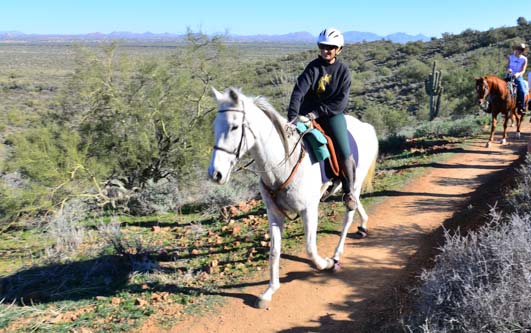
Horseback rider

A horseback rider comes past.

It wasn’t a song I recognized, and I switched lenses really fast hoping to get his picture.

But my rustling around frightened him and he flew off. Or maybe it wasn’t the noise I was making…maybe it was the noise of the horses coming down the path!

We had seen horse hoof footprints in the hardened mud, and we had seen horse trailers down in the parking lot, but it was still pretty exciting when they came walking down the trail and passed us.

What a classic western image it made when they walked along the trail and off into the distance!

Horses on hiking trail

How beautiful to watch the horses walk off the “movie set” scene into the distance!

Closeup of cholla flower

A cholla flower

As we took a different route back and wound our way down the mountain towards the parking lot, I kept thinking how wonderful it is that a place like this has been built.

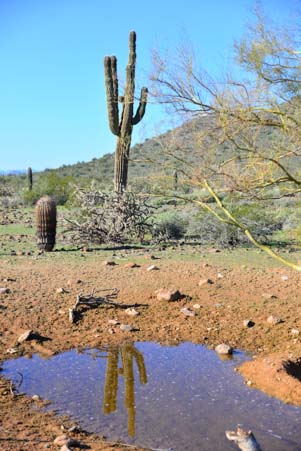
Saguaro cactus reflected in pool

Reflections on a beautiful walk in the desert…

Later, a little online research revealed that this trailhead was funded in part by the neighborhoods that abut the land, and that the Sonoran Desert Preserve is still expanding.  Just a week prior to our first hike there, another 600+ acres had been set aside.

The Sonoran desert is a rare treasure that exists only in Arizona and Sonora, Mexico, and my heart breaks every time I see it being bulldozed for housing.

Bravo to the city planners that decided to create this park, and even better still, to make it open and available to everyone.

We have been enjoying getting reacquainted with the Phoenix area so much this winter — and we have been blessed with such unseasonably warm and sunny weather — that we’ll be sticking around a while and doing more desert explorations!

<- Previous                                                                                                                                                                                       Next->

To Catch a Hummingbird (on camera!)

Our fifth wheel has a hummingbird window feeder

We love watching the hummingbirds come to our window feeder.

One of my favorite things to do when we set up camp is to put out our hummingbird feeder.

Hummingbird window feeder with suction cup

It’s hung with a suction cup – easy!

Hummingbirds always seem to recognize a feeder when they see one, and within a few hours of putting it out, we invariably have a tiny customer sitting on the perch drinking his fill.

There are lots of different kinds of hummingbird feeders on the market, but the one I like most for an RV mounts on the window with a suction cup.


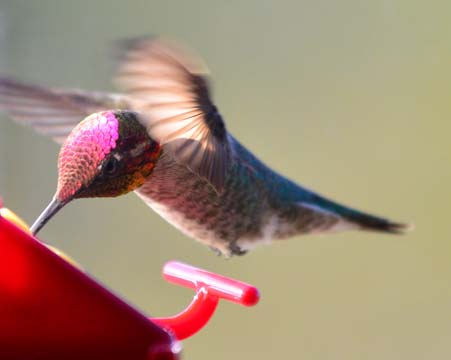
Humminbird at our window feeder at dawn

A hummer visits our feeder at dawn

Humminbird hover

“Hello!”


We first saw one of these feeders when we spent a happy afternoon with our friends Bob and Donna Lea in their trailer during our first year of full-timing ages ago.

The hummers came by their feeder all afternoon, and the best part was that we could see them up close and at eye level while sitting comfortably on the couch.

This kind of feeder can also be a great way to get hummingbird photos, and the other day, while out in the Arizona desert, we decided to try our hand at being wildlife photographers from inside the comfort of our fifth wheel.


Hummingbird lands at our feeder

Swooping down for a drink


A simple concoction of 4 parts water to 1 part sugar (stirred up well to get the sugar to dissolve) is all it takes to lure the little guys to the feeder.

But the thing is, hummingbirds dart about erratically and move really fast.

Sometimes they hover for a while and look at you while they weave their wings back and forth in a figure eight pattern, as if they’re treading water.  But then, suddenly, they turn and disappear in a flash.

Catching one on camera is not such an easy task!


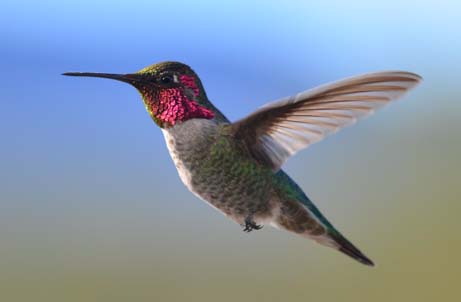
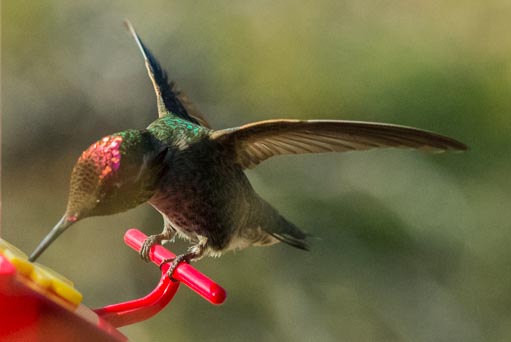
Flying hummingbird

He kindly hummed a little higher to give us a blue sky backdrop

Just as you get the bird in your viewfinder and have lined up the shot the way you want it and are ready to click the shutter — he’s gone.

Plus, the lighting can be tricky. Hummingbirds have irridescent feathers that light up like neon when the sun hits them in a certain way. But at other times their feathers look dull and dark.

Our feeder is often backlit by the sun, since we like to point our wall of windows to the south in the wintertime.  This makes the hummers look like silhouettes, and frequently the lighting is such that their feathers don’t glow. at all


Hummingbird's feathers are dark in this light

Hummingbird feathers appear dark when they aren’t lit up by the sun.

The way we have our trailer oriented right now, though, the hummer looked truly stunning at the feeder when we stood in one particular spot during the early afternoon.

The only hard part was that in this light the hummer had a pretty good view into the trailer from his perch, and our movements inside made him nervous.  So, he wouldn’t stick around, especially when we were aiming a big black thing at him through the window.

To circumvent this, we set up a tripod at that spot with a remote shutter trigger.


Hovering hummingbird

Hovering

Our thinking was that we’d preset the focus to the perch area and then stand away from the window and click the shutter whenever the hummer turned up. A foolproof method, for sure.

The hummer made his appearance on queue and put on a great performance.

He hovered on the other side of the window, peered in at us, decided it was safe, sipped daintily while hovering, settled on the perch to drink a little more deeply, and then took off.

We happily clicked away on the shutter.  How perfect!!  These would be awesome photos!


Hummingbird at our RV feeder

Getting his balance on the perch…

But when we ran through the pics on the back of the camera, it was a disaster!  Every single shot was hopelessly blurry.

Arghh! The 1/125 shutter speed was waaaay too slow.

So we set up at a faster speed, 1/2000, and waited. And waited and waited. We could see him flitting about in the trees, but he was being coy and wouldn’t come anywhere near the feeder.

Mark got bored and sat down to read a book. “That’s why I like landscape photography,” He said.

But I held out.  For a while.  I fidgeted.  I yawned.  And after a while I turned and opened the fridge, figuring I’d pass the time by munching on something.


The Wave

He gives us a big wave!

Just as I got my hands on a snack, I heard Mark mutter, “Your little buddy’s back!”

Oh no!  I dropped everything and dove for the camera remote.

I clicked it just in time to get a shot of the tip of the bird’s tail and his feet as he took off — and totally missed the wonderful images of him hovering just outside of the field of view of the camera.

Darn!

Well, one thing was clear.  The tripod and the remote were awkward to maneuver and were too rigidly fixed to capture this speedy, darting bird.


Both wings going

The wings beat so very fast…

So I put the camera on a monopod with the idea that this time I’d be able to swing the camera around more freely and focus on him wherever he was rather than pre-focusing and hoping he hung out where the camera was focused.  And then I waited,  And waited and waited.

Mark chuckled at me over his book while I stood there.  “Looks like you’ve got it all set up…” He said.

“Yeah.  All I need is a bird!”

But the hummer was playing hard to get.  My feet got tired.  My knees got tired.  I rested my chin on the camera and groaned.  Where was that bird?


Darting hummingbird in a blue sky

Those little wings keep them suspended and stationary in the air

Then he suddenly appeared, and I flew into action.

I’d chosen 3D focus tracking to try to keep the little guy in focus as he moved around.  It was a mode someone had recommended online for bird photography.

As I pressed the shutter button partway down, little focus dots lit up all over the hummer while he was moving about.

It drove me crazy as it focused on his head, his feet, his tail, and his wings, constantly shifting from one part of his body to another.

It was totally distracting, and the result was random body parts being in focus. Ugh! This technique might work for some people, but it definitely wasn’t working for me!


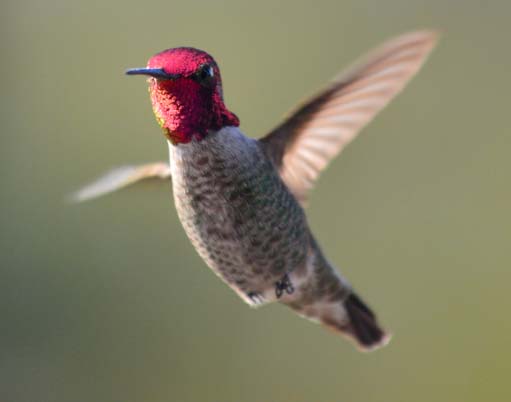
The hummer pauses at the feeder

The colors on his head and neck changed with every move he made.

I’d read that the best animal shots have the eyes in perfect focus.  What good was it if the feathers on the bird’s round little belly were in focus but you couldn’t see his face clearly?

My little visitor disappeared again, and I was disappointed in my photos again.

Besides having great focus on everything but his face, in this group of pictures the dimming afternoon light mixed with the dimming afternoon light had made the ISO climb sky high, so the images were coming out rather grainy.

So it was back to the waiting game with a few more adjustments.  “It will be another 10 or 15 minutes,” Mark said.  “He got a really long drink that time!”


The hummer gives us a wave

Another wave… I like this guy!

Man! I don’t know how wildlife photographers do it.  Here I was in the comfort of my own home, yet I was impatient and bored and uncomfortable standing around waiting.

Imagine being holed up before dawn in some blind you’d built out in the wilds of Africa!  Could any animal shot be worth that kind of effort?

Well, at least I had nothing else really pressing going on.  We could hear the little hummber out in the branches of the trees making his funny little clicking noises.


.

A gambel's quail runs past

While waiting for the hummer, I spotted a Gambel’s quail sauntering by.

Suddenly a Gambel’s quail caught my eye.  He strutted past the window on a mission, his little top-knot feather bouncing up and down as he walked.

I love these little birds too, and I lifted the camera to my face, monopod and all, and stood on my tiptoes to get a shot of him running by.

Just then, the hummingbird was back at the feeder.  And I was out of position!

Mark laughed out loud as I tried to get lined up and refocused while muttering something unintelligible under my breath.

Hummer wings in focus high isd

Eating on the fly!


I jammed the shutter button down for a rapid-fire series of shots.

This time I’d nailed it.  I knew it!  And sure enough, when I looked at the photos a few minutes later the results were terrific and I was triumphant.

I gloated quite a bit as I showed a few of the images to Mark.

Now he was intrigued.  I sat down, my own little mission accomplished, and watched him set up shop.

Hummingbird close-up shot

Picture perfect!

A hummingbird peers in our trailer window

What a handsome little guy!

Ditching the monopod, he placed a tripod on the table and switched out the long 70-200 mm lens I had been using for a fixed length 85 mm.

He was bound and determined to make that remote shutter button work.  I shook my head and said there was no way… but then, after a few attempts, he got some really spectacular shots!

Lately, our little bird friend has been hanging out with a buddy, and they seem to be taking our presence in stride.

I want to take this whole operation outside to get some images of them in the trees, and I had hoped to end this post with an awesome photo from the palo verde tree that’s just outside our trailer.

But our hummer and his friend have been keeping a low profile this afternoon.  So, we’ll just have to wait and see if we can catch them tomorrow!


Love birds and animals?  You might enjoy some of these other posts where we communed with animals during our travels:

Arizona, Here We Come – Space Aliens of All Kinds!

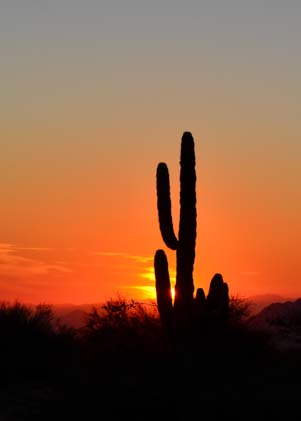
Arizona sunset with saguaro

Arizona’s beautiful scenery beckons us

December, 2013 – After saying goodbye to our sailboat Groovy in San Diego, we pointed our truck towards Phoenix, Arizona. The truck bed was piled high with all of our stuff, and a new life waited for us down the road in our trailer.

We decided to take it slow on our way there.

We were both quiet and lost in thought as we began to climb through the hilly area that separates the moist and green San Diego coast from the flat, brown, dry deserts to the east.

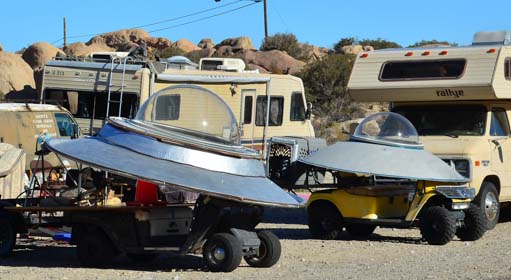
Spaceships and aliens outside San Diego

Strange alien spaceships and motorhomes on I-8

It’s a region of towering hills made of huge boulders that look like a giant bulldozer just dropped its load of rocks.

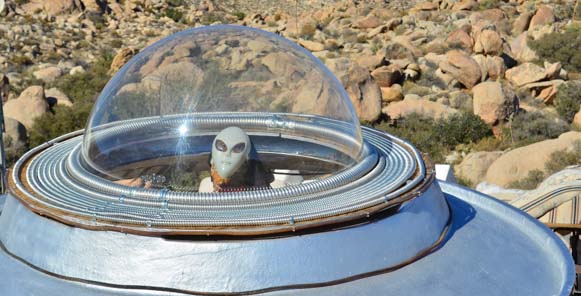
Alien in a space craft

Yup, that’s an alien in there!

We had driven through this area many times, and every time we noticed a very strange collection of aliens, spacecraft and RVs parked off the side of the road.

This time, rather than keep going as usual, Mark decided to pull off the highway.

“I’ve always wondered about this place.”  He said as he parked and reached in the back seat for his camera.  We both hopped out and began to roam around.


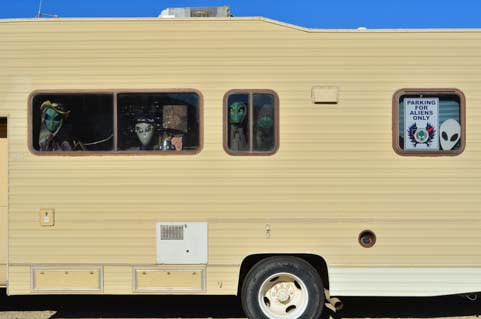
Aliens in a motorhome

Aliens in a motorhome too…

This funny place is a classic little piece of roadside Americana.

Someone has put alien figures inside of spaceships, motorhomes and assorted chairs and cars all along a frontage road.

They’re the kind of aliens that have the slanted, almond eyes and small mouths set in lightbulb shaped heads.  So strange!

We wandered among these weird creatures, mystified.  Who put this here?  And why?  It’s crazy, but it’s fun!


Aliens sitting in chairs near San Diego

And there are some aliens sitting around in chairs!

There’s a tower at the top of the hill that appears to be a museum, but there was a sign saying “Sorry, we’re closed today.”  Oh well, next time!

When we got to Phoenix, we went straight to the storage facility where our fifth wheel had been patiently waiting for us for over a year.

I think it was very excited to see us, but when it saw the load in the back of the truck, its knees appeared to buckle a little.


RV in storage

Our buggy has waited patiently in storage

It was already a fully outfitted home, and now we were bringing endless boxes of stuff back to it that had absolutely nowhere to go.

Yet it was all great stuff that we couldn’t bear to part with.  Ugh!

How do you combine two households into one, especially when the one you’re moving into is 350 square feet?  You’ve gotta make some tough choices.

Mark washes our fifth wheel

The buggy gets a bath

And so it was.  This spatula or that spatula?  This set of socket wrenches or that one?

And what to do with all those awesome but unused stainless steel fasteners and spare parts we’d bought for the boat?  They might prove useful out on some remote road someday.

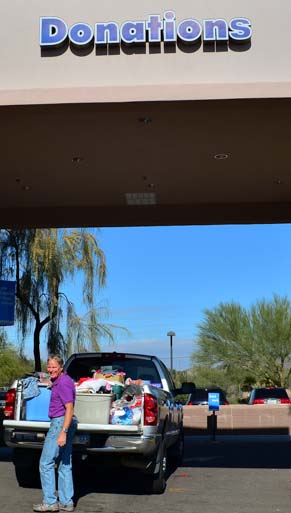
At the Goodwill Donations drop-off

We made many trips to Goodwill!

And all that clothing.  Oh my goodness!  We could have dressed an army — in bathing suits and tank tops!

Over the ensuing weeks we became regulars at the Goodwill drop-off center, and slowly our mountain of bins in the back of the truck dwindled to the point where we could actually find homes for everything inside the trailer.

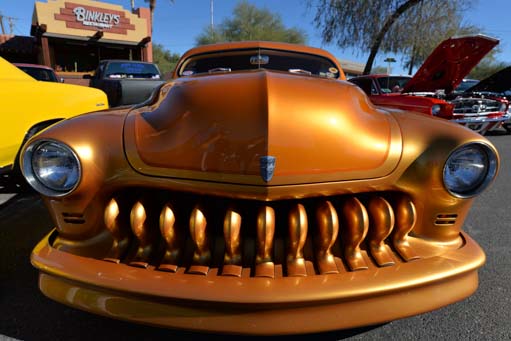
Mercury hot rod

A Mercury bared its teeth at us!

This isn’t the kind of project that makes either of us leap out of bed in the morning with excitement.

So we took our time as the holidays approached and did lots of other things.

While out driving around in Cave Creek one day, we bumped into a car show.


Cool trike on the road in Phoenix

Smooth ride…

Mark can never pass up a chance to mingle with muscle cars, so we stopped to have a look.

Arizona is a mecca for car enthusiasts, whether they are buying new exotics from the row of Maserati, Lotus, Ferarri and other dealerships in Scottsdale, or primping their old cars for shows like this.

There were hot rods and rat rods and souped up cars of all kinds from yesteryear.

There were even some unusual motorcycles, including a few trikes that rumbled down the road.


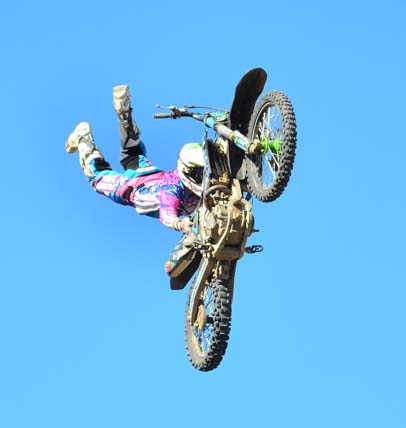
Dirt bike jump acrobatics

A dirt biker does acrobatics over the crowd

What really caught our attention, however, was the dirt bike jumping show.

As the announcer began his patter on the microphone, we looked up to see a dirt bike flying high above the crowd.

Flying dirt bike

Dirt bike somersault

Dirt bike daredevils

Leaping motocross riders

Wow!  Those guys are crazy!!  They were all young boys in their late teens — one was only 16 — and with every jump, they soared higher and higher, doing wild and daring tricks in the air.

I was awestruck.  We’ve seen this kind of stuff on TV, of course, but it was different to be standing so close that when they landed we could reach out and touch them.


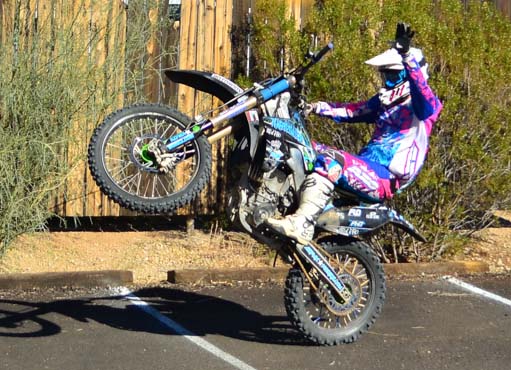
Dirt bike wheelie

These daredevils were amazing

At the end they all did wheelies past the crowd.

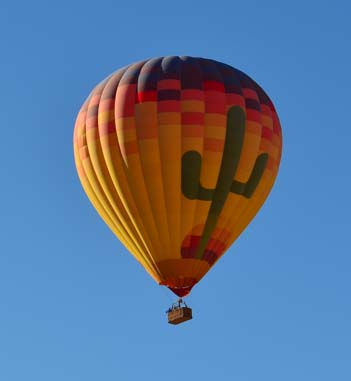
A more peaceful way to take to the skies around Phoenix is to go up in a balloon, and every morning the horizon was filled with them.

Balloons in Phoenix

Balloons soaring…no acrobatics!

Balloon ride over Arizona

With a pretty cactus

Sometimes we could hear the roar of their flame heaters before we saw them.

Balloons in the sky in Phoenix

The balloons make beautiful patterns in the sky

The balloons made wonderful, everchanging patterns in the air.  Floating around in slow motion, they’d move up and down and drift past each other.

We were both so happy to be back in the desert.  There is something about the Sonoran desert that is really appealing.


Sonoran desert sunset in Arizona

We just love the Sonoran desert

The cactus are so stately, and the sunsets are so colorful and varied.

Our son went tent camping at Cave Creek Recreational Area campground, and we spent a few hours with him at his campsite.

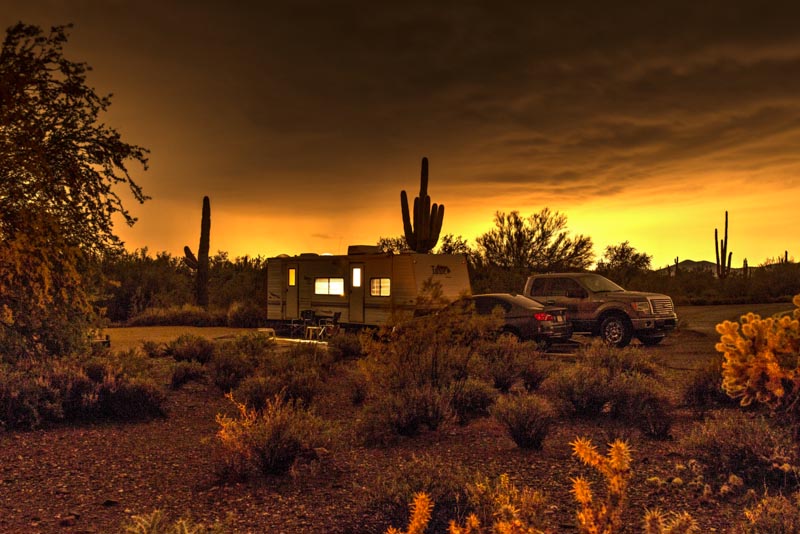
The campground was filled with RVs, and they all looked so snug and homey. Many of them had Christmas lights on.

We hung around the campfire, relishing the smell of mesquite wood that filled the air.

Even a brief downpour didn’t dampen our spirits, although we scampered off into the truck for the worst of it.

RV at campground at night

Cave Creek campground was full of RVs — and they looked so cozy and inviting!

Campfire in Cave Creek Arizona

And what a great campfire too…

We suddenly had such a longing to get back into our fifth wheel.  “Soon, soon!” we told ourselves.

Fake fireplace at Christmas

The little fake fireplace set just the right mood next to the tree…

Santa brings lots of presents

Santa brought joy to everyone

In the meantime, though, the holidays were here and were wonderful. This was the first Christmas we had spent with our family in five years, and the coziness around the little fake fireplace in the living room was just as intimate and heartwarming as the real thing outdoors.

Santa came with a bountiful array of gifts for everyone, and we spent a marvelous holiday season immersed in the world of our young granddaughters, where innocence, iPod games, Wii dancing, pizza and Barbie rule.  Whew!!

Our urge to set up housekeeping in our beloved buggy couldn’t be put off any longer, though, and the arrival of the new year saw us squeezing ourselves into the trailer alongside the last few boxes of unsorted stuff for an overnight, even though it was still parked in storage with no room to open the slides.

RV at sunset - the angels sing!

Our buggy was glowing when it found out we were going out adventuring together.

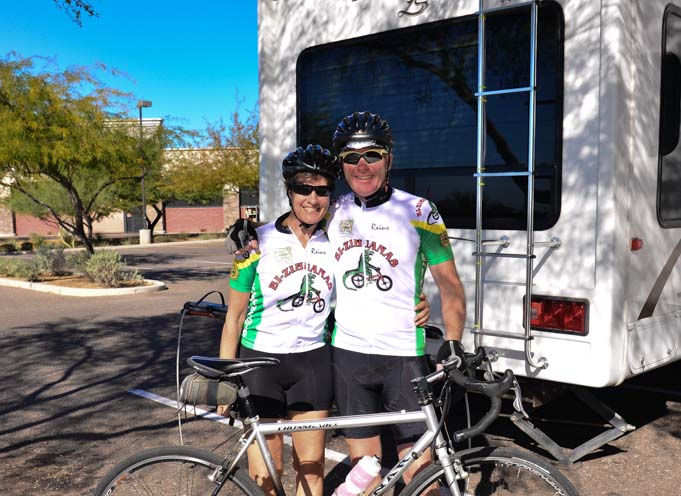
Riding our bikes once again

…and we were glowing too.

Within a few days we were out on our own again, the slides pushed out, the last boxes of things sorted and stored, and our spirits sky high.

We grabbed our bikes, suited up in our new Mexican “Bi-Zihuanas” cycling jerseys — gifts from our friend Alejandro who owns the very cool Bi-Zihuanas bike shop in Zihuatanejo (story here about 1/2 way down the page) — and we set out to ride the fabulous bike lanes of greater Phoenix into the far reaches of the desert.

It was our first real bike ride in ages, and it felt so good.

The wind was at our backs, the sun was on our faces, and we were so thrilled be alive and so excited to be looking down the road towards the fun of travel and exploration once again.


<- Previous                                                                                                                                                                                       Next ->


Are you Ready for An RV Trip of a Lifetime? Enter the Travel Channel Sweepstakes!

This website often brings us intriguing correspondence.  We were recently contacted by the Travel Channel asking if we would let you know about a sweepstakes contest they are running.  We’re always a little skeptical about these things, but we’ve gone back and forth with them quite a bit, and it is legit and sounds like fun.  This is the way their website describes the prize:

Travel Channel and Go RVing are giving away the ultimate Arizona adventure. One lucky winner and a guest will be flown to Phoenix, where they’ll climb on board a Type A Luxury RV and spend an amazing 7 days and 6 nights touring the Sedona Red Stones, Oak Creek Canyon, Bell Rock and Cathedral Rock. The highlight of the trip will be a 9-hour tour of the Grand Canyon, from Flagstaff through the Navajo Nation, and an unforgettable sunset dinner.”

Pretty awesome!!  (Although most RVers, and those familiar with Arizona, may smile at the description).

We’ve never heard the phrase “Type A RV”, although we’ve seen quite a few Type A RVers on the road flying past us at breakneck speeds on the highway.  The Travel Channel is surely referring to a Class A motorhome, which would be an awesome platform for a 7 day vacation.

And the last time we were in Sedona, those big red monolithic formations were locally referred to as “red rocks,” not “red stones.”  But they are so glorious that it doesn’t really matter what they’re called — they are a “must see,” and what a way to see them!

All you need to do to win this cool prize is to know a bit about travel and the Travel Channel itself, as the contest involves answering multiple choice questions about travel and the Travel Channel.  So, if you’re feeling lucky, click here to enter.

Travel Channel Sweepstakes RV Arizona

Arizona is an awesome area for RVing, and we have really enjoyed our travels there.  Even if you don’t win this trip, it is a wonderful place to visit by whatever means.  Among our favorite places are:

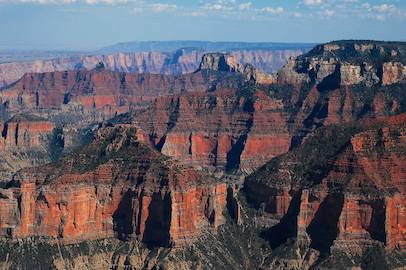
Grand Canyon North Rim Imperial Point

Grand Canyon – North Rim

The North Rim of the Grand Canyon

Only 10% of travelers to the Grand Canyon go to the jaw-dropping North Rim, because it is a 250 mile drive around the famous chasm to get there.  The North Rim is stunningly beautiful.  It has few tourists, fabulous hiking and great cycling.

Walking the gorgeous little paved paths that wind along the rim between the flowers will take your breath away — literally — as the rim sits at almost 9,000 feet elevation, a significant altitude 1,000 feet higher than the more famous South Rim.


Grand Canyon Lodge North Rim

Picnic area outside the Lodge

If you have a small RV, a stay at the North Rim Campground perched on the rim itself is unforgettable.  The Grand Canyon view is right out your window.  We were able to squeeze our 52′ truck and fifth wheel combo into the RV dump station there — just barely!!! — but we were too big to fit into any of the sites.  A 30′ fifth wheel or 25′ travel trailer or 35′ or shorter motorhome would probably fit fine.  Reserve your site early!

If you go there by car, the Grand Canyon Lodge — and the cute little cabins all around it — is a historic landmark unto itself.  Dine indoors or out with that inspiring view as a backdrop…


Navajo Nation – Window Rock – Canyon de Chelly

Canyon de Chelly

Canyon de Chelly

The enormous Navajo Nation takes up the entire northeast corner of Arizona.  The town of Window Rock is the tribal headquarters, and they have a wonderful memorial for the Navajo Code Talkers who played such a vital role in the Allied victory in the Pacific Theater in Word War II.

Window Rock Code Talkers

Window Rock Code Talker Memorial

Nearby is one of the most amazing canyons in the southwest: Canyon de Chelly.  Full of soaring cliffs and vast flat lands that snake between them a thousand feet below, you can spot cliff dwellings tucked into these sheer walls way up in the air.  Huge petroglyphs can be seen from across the canyon.


Sunset Crater National Monument

Sunset Crater National Monument

Flagstaff & Nearby National Monuments

Flagstaff is a wonderful college town that is full of history.  There is no boondocking within an easy bike ride of the town, but Bonito Campground, about 18 miles north of town, is our all-time favorite campground.

Bonito Campground is on the way into Sunset Crater & Wupatki National Monument.  These two jewels in the National Park System are worthy of a visit.  Sunset Crater is a volcano that blew its top about 1,000 years ago, shocking the locals inhabitants of the time.  What is shocking about it today is that the lake-like cinder fields and craggy lava flow looks like the volcano erupted yesterday.

Wupatki National Monument

Wupatki National Monument

The nearby Wupatki ruins were built by the “Sinagua” (“without water”) people a century after Sunset Crater blew its top, when they arrived in the area and discovered the thick layer of ash was good for growing crops.  The collection of pueblo ruins on the 50-mile scenic drive are all fascinating, and the loop road makes a fabulous bike ride.

There is boondocking in the woods across the highway from Bonito and also in the cinders nearby.  It can get dusty, though, especially from ATVs on weekends!


Canyon de Chelly, AZ – A Canyon of Indian Cliff Dwellings

RV blog post - We took the scenic route through Arizona's Navajo Nation to Window Rock and saw the stunning vistas and cliff dwellings of Canyon de Chelly.

Window Rock City Park.

Window Rock, Arizona.

The Window.

The Navajo Tribal Band practices for Oklahoma's Red Earth festival at Window Rock.

The Navajo Tribal Band practices

for Oklahoma's Red Earth festival.

The Navajo Tribal Band practices for Oklahoma's Red Earth festival at Window Rock. Navajo Code Talker statue at Window Rock, Arizona.

Navajo Code Talker.

Show of patriotism at a cemetery outside Window Rock on Indian Route 12, Arizona. Views along Indian Route 12, Arizona.

Scenic Indian Route 12.

Exotic rock formations and colors along Indian Route 12, Arizona.

Two toned rock formations.

Brilliant rock formations along Indian Route 12, Arizona.

A homeowner with a flair for color.

All kinds of colors in the rocks along Indian Route 12, Arizona.

The land was painted pink too!

Cliff views at Canyon de Chelly National Park, Arizona..

Looking down Canyon del Muerto.

Looking down Canyon del Muerto at Canyon de Chelly National Park, Arizona..

Sheer cliffs and lush valleys.

"Where two fell off."

Massacre Cave at Canyon de Chelly National Park, Arizona..

Massacre Cave.

Cave dwelling at Canyon de Chelly National Park, Arizona..

The little cave to the left.

Cliff dwelling at Canyon de Chelly National Park, Arizona.

There's a structure inside!

Expansive views at Chelly National Park, Arizona.

The immensity is hard to capture.

Looking across the canyon at Mummy Cave, Chelly National Park, Arizona.

Tim & Mary Lynn look across at Mummy Cave.

Mummy Cave, Chelly National Park, Arizona.

Mummy Cave housed a small community

in the shadows.

Building inside Mummy Cave, Chelly National Park, Arizona.

The structure inside Mummy Cave.

Navajo Fortress between Canyon del Muerto and Black Rock Canyon, Chelly National Park, Arizona.

The confluence of Canyon del Muerto

and Black Rock Canyon.

Antelope House, Chelly National Park, Arizona.

Antelope House is tucked into the

bottom of this massive cliff.

Close-up of Antelope House, Chelly National Park, Arizona.

Close-up of Antelope House ruins.

Hiking down to White House Ruin, Chelly National Park, Arizona.

Beginning our descent

into Canyon de Chelly.

We hike to White House Ruin, Chelly National Park, Arizona.

Looking down on the lush valley floor.

We hike past crazy swirling rock patterns on our way to White House Ruin, Chelly National Park, Arizona.

Crazy swirling rock patterns.

Rock swirls dwarf the trees on our hike to White House Ruin, Chelly National Park, Arizona.

The swirls dwarf the trees in the middle of the pattern.

Pause in our hike to White House ruin, Chelly National Park, Arizona.

We take a breather from hiking.

The lush valley floor of Canyon del Chelly.

The bottom of the canyon is flat and wide.

White House Ruin, two levels of dwellings, Chelly National Park, Arizona.

White House ruin has two levels:

a ground-level building & a cave dwelling above.

Dramatic pink and orange stripes decorate the front of White House Ruin, Chelly National Park, Arizona.

No architect today could design a

more dramatic front entrance!

Awe-inspiring drippy stripes on the cliffs surround White House Ruin, Chelly National Park, Arizona.

The drippy stripes down the walls

fascinated us.

Wildflowers, Chelly National Park, Arizona.

Flower or origamy?

Wildflowers, Chelly National Park, Arizona. Pictographs, Chelly National Park, Arizona: a person and a roadrunner.

Rock Art:  Roadrunner.

Pictographs at Chelly National Park, Arizona: a scorpion.

Rock Art:  Scorpion.

A hogan stands agains a dramatic backdrop of cliff walls on the lush valley floor of Chelly National Park, Arizona.

A Navajo hogan backed by dramatic cliff walls.

We hike through a tunnel on the White House Ruin hike in Chelly National Park, Arizona.

Canyon de Chelly National Park, Arizona

Early June, 2012 -- Leaving the Petrified Forest, we decided to head north by

Indian Route 12 which, to our surprise, was noted on our tourist map as a

scenic route.  As one-time Arizona residents we had no idea there was a

scenic road through the Navajo Nation way over in the northeastern corner of

the state.  We also wanted to see Window Rock, which lies on that road.  This

town is the Navajo tribal headquarters, and it always turns up in the Phoenix

TV weather forecasts with very cool temps.

We arrived on a warm day, however, and

were immediately drawn to the city park in

front of the big window in the rock.

The tribal band was practicing in

the park, and we watched and

listened for a while.  Chatting with

the band leader during a break,

we found out the band was

headed to Oklahoma City in a

few days for the big Red Earth

arts festival there.  Apparently

this is one of the largest

gatherings of Indian artists and

performers in the country, and

the group was very excited.

The park also features a large

sculpture of a WWII "code talker" in action on his radio.  A nearby plaque

explains how the US Military was struggling to find a way to keep the

Japanese from deciphering their communications in the South Pacific

Theater, and that 29 Navajo marines were recruited to devise a new

code using their native language.  By war's end there were over 400

Navajo Marines serving as code talkers, and the Marine Corps

commanders credited them with saving countless American lives.

Maj. Howard Conner, Signal Officer on Iwo Jima, is quoted as saying,

"Were it not for the Navajos, the Marines would not have taken Iwo Jima."

This impressive history is also the subject of a fictional 2002 movie,

Windtalkers.

Back on Route 12 we saw more patriotism in a cemetery festively filled

with American flags.

The scenery on our route became very dramatic as we drove north of

Window Rock.  Huge red rock cliffs lined the sides of the road.

Suddenly it seemed that God switched paints on his easel, and large

rock formations began to cover the landscape in shades of green as

well as red.

Someone with an artistic eye painted their house a vivid blue,

making a wonderful contrast to the green and red rocks in their

back yard

In one place the

sandstone even had a

pink hue.  It was a

beautiful drive.

Our destination was

Canyon de Chelly

National Park

(pronounced "d'Shay").

This park is at the confluence of three

snaking canyons that are like three fingers of

a hand spreading eastward from where they

all join in the town of Chinle ("pronounced

Chinley").

The stunning thing about Canyon de Chelly

is the immensity of the canyons.  Standing on

cliffs that are 1,000' above the canyon floor,

the walls are very sheer and the views curve

past narrow walls of stone.  At the bottom of

the canyon is a lush, fertile valley floor where

the Navajo developed corn fields and peach

orchards in the 18th and 19th centuries.

In the movies, landscapes like this are always accompanied by the piercing call of a

falcon echoing off the canyon walls.  But here the silence was so noticeable that our ears

hurt.  Scanning the horizon many miles distant, and looking deep into the valley below

us, the only sound was our own breathing.  Even the wind stood still.

In 1805 the Spanish tried to conquer the Navajos.  At the point where I was standing a woman

tried to fend off a Spanish soldier, and in their struggle the two fell off the cliff to their deaths.  In

the distance we could see "Massacre Cave" where the Navajos had hidden out.  In the end, the

Spanish claimed to have killed 90 men and 25 women and children, but the Navajo remember it

differently, saying that all the younger men were out hunting that day and the deaths were strictly

women, children and old men.

Either way, the cave looked tiny in

the distance.  Inside were some

structures that the Navajo hid in.

To the left of the main cave was a

much smaller one and, using the

long camera lens, we could see

another small structure inside there

as well.  It is hard to imagine living

on the edge of a cliff like that for any period of time,

especially with the Spanish after you.

At each viewpoint you get a slightly different view of these

lush canyons, and it was hard to capture the enormity of

the place in a little photograph.  Pan out or zoom in?  How

do you show it all??

At the Mummy Cave overlook we came across a

couple sitting behind a tripod. They were waiting

patiently for the afternoon light to provide its best

illumination of the cave ruins far below.  Waiting

for good light sounded like a great idea, so we hung out and

started chatting with them.  It turned out that they had spent the

last three years traveling the western states in their camper van, living

a lot like we do by boondocking on public lands.

Our eyebrows shot up when they told us they had just come back

from a sailboat charter in the Grenadines in the Caribbean ten days

earlier and were contemplating taking their travels to the sea.  What's

more, we found out Tim's mountain bike on the back of their van was

the same exact model as Mark's on the back of our trailer.  To top it

off, Mary Lynn enjoyed web design too.  What a crazy coincidence!!

Like us, too, they were using a Nikon camera to try to capture this cliff

dwelling in just the right light!

The good light never came, but we managed a few shots

anyways and hoped we'd run into these guys again somewhere.

Meanwhile, the mystery of the cliff dwellings lured us on.  The ancients built their homes in caves on these sheer

canyon cliffs between 700 and 1300 AD.  So these homes were first going up right after the peak of Mayan

remodeling down in Palenque in Chiapas, Mexico.  They may not be as majestic in terms of size or human

construction and engineering skills, but they are incredible for making fantastic use of the landscape.  What a

place to build a house!

Over at Antelope House we looked out across the canyon

at a beautifully striped, back-sloping wall.  Nestled at its

base was a small town made up of crumbling walls,

windows and towers.  You need binoculars or a long

telephoto lens to make out the tiny structures so far

below.  Even then they look like little toy buildings for wee

dolls.  They can't possibly be real.

Archaeologists call these ancient people the Anasazi,

which is derived from the Navajo language and is

variously translated as "Ancient Ones" and "Enemy

Ancestors," due to the subtle word "Zazi" which means

"Non-Navajo" or "enemy."  Also known as the Ancient Puebloans,

from the Spanish word for "townspeople," these long ago people

farmed the valley floor and disappeared around 1300, probably due

to drought.  The Navajo didn't arrive in this area until 1600, and by

then the ruins were long abandoned.

The Navajo flourished here for a while, but in 1864 US Col. Kit

Carson entered the canyon with a group of soldiers and

eventually cornered the Navajo at one end.  Few survived, and

those that did were forced to walk 300 miles to Fort Sumner in

New Mexico and stand trial.  They were allowed to return five

years later.

The most famous of the

ruins is "White House

Ruin," and we decided to

hike down into the

canyon to see it up close.

We hiked along with our

new RVing/sailing friends

who had ended up

camping alongside us overnight.  As with every overlook in the entire

park, the views from the top were so gorgeous I found myself running

and jumping over the rocks trying to get the best angles and trying to

fit it all into the camera frame.  Sigh.  Not possible!

The contours of the rocks are

wavy and rippled, swirling in

enormous and wild patterns.

You can almost feel the power of

the water that etched out its

course along these canyon walls

over the millennia, carving its

path ever deeper into the stone.

After snaking down the edge of the rock face,

we finally arrived at the canyon floor, crossed a

small foot bridge, and arrived face-to-face with

White House Ruin.

Two levels of dwellings were built into the base of the cliff -- one

on the ground level and another one up about 40' off the ground in

a cave.  An orange rainbow of stripes rains down the cliff wall,

painted by a divinely inspired hand -- or the result of a spilled paint

can way up on the top of the canyon.

At our feet we discovered unusual

flowers.  A young Navajo boy showed us

a lovely painting he was working on

featuring the White House ruin and some

of the rock art that we could barely make

out along the rock wall.

In no time at all we climbed back to the top, passing through a wonderful

tunnel on the way.  We would have stayed to see a few more of the

sights this mysterious canyon has to offer, but a massive heatwave was

spreading across the west and we wanted to get to higher, cooler

ground.  We seemed to be on an ancient ruin kick, something we had

started with the Zapotecs and Mayans in southern Mexico several

months back.  So we made our way to Mesa Verde National Park in

Colorado, possibly the best collection of cliff dwellings in the US.


Petrified Forest NP and Mogollon Rim – Cool pines & hot rocks in AZ!

RV blog post - We camped in the cool pines of Arizona's Mogollon Rim and hiked amid the colorful rocks of the Petrified Forest National Park.

Getting to the US required 3 planes.

Tulips bloom in Rochester Hills, Michigan. Tulips bloom in Fraser, Michigan. Bleeding hearts bloom in Fraser, Michigan.

Bleeding Heart.

Saguaro cactus blooms in Scottsdale, Arizona.

Saguaro cactus top in

bloom.

Starling chicks emerge from a fallen saguaro cactus in Scottsdale, Arizona.

Starling chicks in a saguaro nest.

Starling chicks emerge from a fallen saguaro cactus in Scottsdale, Arizona.

Mom takes good care of the babies in their fallen home.

A cardinal enjoys a seed snack on our picnic table at Roosevelt Lake, Arizona.

A cardinal enjoys a

snack on our table.

Looking out over the Mogollon Rim, Arizona.

The Mogollon Rim.

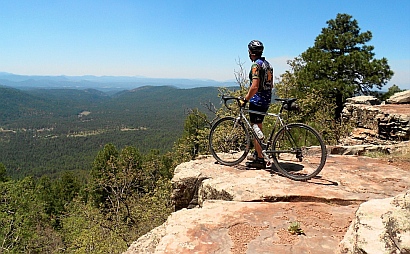
Getting a photo from the scary edge of the Mogollon Rim, Arizona.

It's a little scary right at the edge, but

few can resist a shot.

Smoke from the Gladiator Fire approaches the Mogollon Rim.

Smoke from the Gladiator Fire approaches.

Smoke from wildfires obscures the sun at the Mogollon Rim.

Wildfire smoke obscures the sun.

The paved and scenic Rim Lakes Vista Trail on the Mogollon Rim.

The awesome little paved rimside trail.

Standing on the edge of the Mogollon Rim in Rim Lakes Recreation Area, Arizona.

It's great to be alive.

Looking out at the views from the Mogollon Rim, Arizona

Mogollon Rim.

Spring brings new growth to the Rim Lakes Recreation Area on the Mogollon Rim in Arizona.

Spring - a time for new growth.

Wild lilacs in the Woods Canyon Lake Recreation Area on the Mogollon Rim in Arizona. An elk calf rests in the grass at Woods Canyon Lake Recreation Area, Mogollon Rim, Arizona.

An elk calf in the grass.

We ride our bikes down to Woods Canyon Lake on the Mogollon Rim in Arizona.

Woods Canyon Lake.

Jim Gray's Petrified Wood Company has lots of petrified wood for sale.

Jim Gray's Petrified Wood

Company.

Petrified wood logs ready for splitting at Jim Gray's Petrified Wood Company, Holbrook, Arizona.

Petrified logs ready for splitting.

Geodes at Jim Gray's Petrified Wood Company, Holbrook, Arizona.

Geodes ready for opening.

Dinosaur displays at Jim Gray's Petrified Wood Company, Holbrook, Arizona.

Dinosaur country!

Don't get bitten by a dinosaur at Jim Gray's Petrified Wood Company, Holbrook, Arizona.

They're cute, just don't get bit.

Dinosaur head, Crystal Forest Gift Shop, Arizona. Petrified logs at Petrified Forest National Park, Arizona.

Petrified Forest National Park.

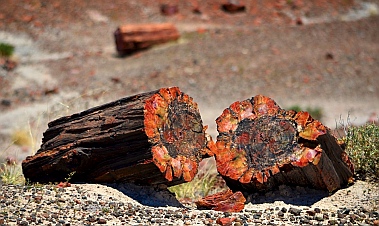
We traveled to see colorful petrified logs at Petrified Forest National Park, Arizona. A single tree trunk split into logs at Petrified Forest National Park, Arizona.

A tree trunk that has cracked into drums.

Agate House at Petrified Forest National Park, Arizona.

Agate House.

We hike down to Agate house at Petrified Forest National Park, Arizona.

They built 'em small in 1200 AD

We hike the Long Logs trail at Petrified Forest National Park, Arizona.

The National Park calls these rock structures "teepees."

We meet a collared lizard on the Agate House hiking trail at Petrified Forest National Park, Arizona.

Collared lizard on a petrified log.

Cows watch us as we drive through Petrified Forest National Park, Arizona.

Cows watch us approach.

We hike to Puerco Pueblo Indian ruins at the north end of the Petrified Forest National Park, Arizona.

Puerco Pueblo housed 1,200 people.

We hike past petroglyphs on Puerco Pueblo trail at Petrified Forest National Park, Arizona.

A stork carrying a baby, for sure!!

The Santa Fe Railroad rumbles beneath us at Petrified Forest National Park, Arizona.

Santa Fe Railroad.

The Santa Fe Railroad disappears in the distance at Petrified Forest National Park, Arizona. A rusting hulk of of a car sitting along historic Route 66 near Petrified Forest National Park, Arizona.

A rusting relic near the old Route 66.

Spectacular views at Painted Desert in Petrified Forest National Park, Arizona.

Painted Desert.

Mogollon Rim & Petrified Forest National Park

April-May, 2012 - It took us a few days to decompress after our awe inspiring three

weeks in inland Chiapas.  We had studied Spanish in colonial San Cristóbal, seen

Mayan ruins in Palenque, Yaxchilán and Bonampak, and visited sparkling waterfalls

at Agua Azul and Misol-Ha.  But we had received alarming news while in the jungle

that Mark's parents had unexpectedly taken very ill.  Their prognosis for survival had

become bleaker by the day.

We scrapped our plans to

sail 200 miles further to El

Salvador where a rollicking

annual rally of 50 boats was

in full swing, and instead

prepared our boat Groovy for a six month wait at Marina Chiapas while

we made a hasty retreat back to Mark's family homestead in Michigan.

It was jarring and disorienting to rejoin

modern American life after months of

immersion in southern Mexican culture.

Far more upsetting, however, was suddenly finding ourselves face-to-face with the specter of

death.  We passionately pursue our dreams everyday, always feeling the immense pressure of

time, but now the grim reaper was at the door trying to collect.  For days we huddled inside the

drab sterile walls of a modern health care facility trying to be positive while pondering the

incomprehensible.

Fortunately, spring was in full bloom outside.  Flowers were bursting with

color everywhere, and flowering trees seemed to grace every front yard.

Every time we stepped outside we were greeted by the cheerful image

of tulips, a heartwarming flower neither of us had seen for years.

Very gradually, and totally miraculously, both of Mark's parents began to

recover and were able to return home.  As they gained strength we did

too, and the dark, raw emotions in our hearts began to ease.  Out in a

friend's garden a cluster of bleeding hearts reminded us that often the

most precious things in life are also the most fragile, and that life itself is

a gift we receive every day.

When we eventually returned to our own hometown in Phoenix, Arizona, we

found spring had sprung there too.  Our beloved saguaro cactuses were

wearing their little springtime crowns of white flowers on every limb.

Just a few weeks earlier an ancient saguaro in a friend's

yard had died and toppled over.  It now held the fledgling

chicks of a starling that had moved into her condo when

the cactus was still upright.

Despite living in a house that was now eight inches from the ground,

not a great spot for a small bird, she bravely got those chicks raised to

adolescence, and in no time they had all moved out.

We got our trailer out of storage, dusted it off, and set up camp at

nearby Roosevelt Lake.  Still recovering from all that had gone on, and

feeling a bit battle weary, we reveled in watching a cardinal come to

our little seed plate every day.  We could have stayed for a month, but unfortunately the desert temps

were climbing and soon became intolerable.

Fortunately, just 80 miles north of Phoenix we found ideal temps

up on the Mogollon Rim (pronounce "Mugeeyone").  At 7500'

we were in the cool pines, and we found a camping spot right on

the edge of the rim with views to the valley floor far below.

The rim is a jagged shelf of flat rocks that stick out in layers.

The views are expansive and the smell of the ponderosa pines

is invigorating.  There is something about the edge of the rim

that is very alluring and draws people to it, even though the

sheer drop-off is a little unnerving.  At all the scenic overlooks

everyone gets out of their cars and walks right out to the edge

to take in the view and get a photo.

While we were there four huge forest fires were

burning in the valley below us.  The Gladiator Fire

made the national news, and we saw the hotshot

firefighting team's base camp nearby.  Firefighters

had been flown in from all over the country to help

out, and some 1,000 people were fighting the

blaze.  The smoke was intense

at one point, and it billowed

over us like a huge wave.

That evening the sun was

almost totally obscured by the

smoke.  But the hotshots

managed to wrestle all the

fires under control, and in just

a few days the air was clear

again.

We discovered a wonderful

paved trail that runs along the

edge of the rim for a few miles.

Luckily for us, it had just been

lengthened by a mile.  The edge of the rim

is magical, and at every rock outcropping

we found ourselves stopping to get another

look.  This same trail also heads into the

forest towards Woods Canyon Lake where

it weaves past several campgrounds.  We

rode our bikes along the trail and savored

the crisp air and pretty views.

Spring was happening up here too.  The

pines were all adorned with their new

feathery soft needles, and we found flowers

that looked like wild irises growing in a

meadow.

We passed a mother elk

sitting under a tree

chewing her cud.  Nearby

her young calf was

hanging out chewing its

cud too.  They were

totally indifferent to our

presence -- or to that of

the cars that had started

to stack up in the road as

everyone grabbed their

cameras and jumped out

for photos.  We stood

there for quite some time

watching the mouths of

these two large animals slowly working around and

around while their gazes wandered calmly between us

and the cars.  It was as if they were kids hanging around

at the street corner, chewing gum, and waiting for

something to happen.

Woods Canyon Lake is cool and serene, surrounded

by pines.  Families were out fishing and an energetic

guy rowed a skull back and forth.

We stayed in this beautiful mountain forest

for two weeks, settling into our homestead

as if it were our own private mountain home.

Every day we ran, biked and walked.  Then

we read, napped, played on the internet and

watched the boob tube, something we hadn't

done for eight months.  Isn't it amazing, we

kept saying to each other, that we can get 12

Phoenix digital TV stations via our antenna

and good internet from our nifty new Verizon

MiFi unit, while we are camped several miles

down a dirt road deep in the woods on the

edge of a cliff?!

It was hard to leave, but once we

got the wheels rolling on our

buggy, we couldn't wait to get out

and see our beautiful country.  Our

first stop was the Petrified Forest

National Park.  Actually, we

stopped just before the National

Park because the guy who owns

the vast acreage next door has

been mining petrified logs from as

deep as 30' down in the ground for

decades, and the collection he has

on display and for sale at his store

"Jim Gray's Petrified Wood Company" is astonishing.

Petrified logs are created when a log gets buried in sediment, preventing rot, and then becomes

infiltrated by silica in the groundwater, replacing its organic material.  This stuff eventually

crystallizes and "petrifies" the whole log.  Over time, as erosion peels the ground out from under

the log, it cracks into short drum-shaped pieces that for all the world look like they are ready for

splitting.

We wandered through the

endless display of petrified logs

and even found a pile of geodes

out back.  This pile stood almost

10' tall and maybe 30' around at

the base.  What a treasure trove!

This is also dinosaur country,

and the local gift shops have all

kinds of fun making crazy

displays for tourists.  Mark found

a few out by the geodes.

Petrified Forest National Park is an easy park to miss

inadvertently because it sits on a road that cuts between an

Arizona highway and an interstate.  We had made that mistake

years ago.  We had driven along at 55 mph waiting to see a

Forest, and we skipped the pullouts because there was no

evidence there was any Forest there.  After an hour we emerged

at the other end of the park having seen nothing but wide plains

and a few scattered logs in the distance.  That goof-up has been

a standing joke between us ever since.

The only way to see this national park is to get out

and do some hikes.  The hilly field behind the

visitors center is strewn with huge logs, many

resting in a row and fitting together to make an

entire tree trunk.  These things are massively heavy

and are 8 times harder to cut than granite.  From a

distance the crystalized bark, knots and tree rings

look lifelike, but up close the agate colors merge

and swirl in non-treelike patterns.

We hiked on the Long Logs trail which features one tree

trunk after another, each one segmented into shorter

logs that lie end-to-end.  Looking around the sweeping,

empty, grassy plains it is hard to imagine that 260 million

years ago this area was a logjam in an ancient riverbed,

back when all the continents were joined and Arizona's

latitude was somewhere around modern day Panama.

13 species of large but extinct pines forested the area.

Out at the Agate House we

found an ancient Indian

pueblo made of petrified

wood pieces.  Archaeologists

believe it was constructed

between 1050 and 1300 AD.

Those guys built very small

buildings.

The trail took us past tall,

horizontally striped "sand

piles" that are now solid

stone.  It looked like a gravel

yard that had been carefully

layered in different types of gravel.  The heights of the

dark stripes matched from one pile to the next.  There is

an otherworldly quality to this landscape.

As we walked back to the

truck Mark spotted a collared

lizard sitting on a hunk of

petrified wood.  His little pink

mouth seemed to be grinning,

and his long skinny tail trailed

almost twice his body length

behind him.

This is cattle ranching country

too, and before we could get

to the petrified log that spans a chasm -- the Agate Bridge -- we had to

get past a group of cows standing in the middle of the road.  These

guys didn't move an inch as we drove past.  Only their heads turned to

watch us as our enormous truck and trailer nearly brushed them when

we drove by.

The Puerco Pueblo hike took us to an ancient Indian settlement built

around 1250 AD.  It was home to some 1,200 people.  6'x8' was a typical

room size, and unlike the mammoth Mayan and Zapotec buildings we'd

seen a few thousand miles to the south, these ruined walls have been

reconstructed to

just a foot in height.

Far more intriguing

for us were the

petroglyphs that the

ancients had

pecked into the nearby rocks.  One showed what

looked to me like a stork carrying a baby.  I'm sure

the archaeologists would disagree about that, but

these images are often a bit like ink blots -- what

you see in them is up to you.

The park road crosses I-40 and deposits visitors in

the middle of the Painted Desert.  But first you get a glimpse of the

Santa Fe railroad and some relics of the old Route 66.  While we

were wandering the hiking trails closest to I-40 we kept hearing

the horns and rumbles of endlessly long trains rolling past.  I

climbed up on a bridge overlooking the tracks and caught a train

as it approached.  Running to the other side I watched it

disappear around the bend.  These tracks date back to 1882

when the Atlantic and Pacific Railroad went through.  Early visitors

to the park arrived by train and took guided tours hosted by the

Fred Harvey company.

Mark was fascinated by an ancient rusting hulk of a car

that had been abandoned long ago on the side of the

old Route 66.  Stretching 2,200 miles from Chicago to

Los Angeles, that historic road passed right through

this area, bringing tourists to the park in their own

private cars instead of by train.  Now this part of Route

66 is overgrown by prairie grasses.

Our final miles along the park road

took us past some incredible vistas

overlooking the Painted Desert.  This is

a colorful area of more gravel-pit

looking solid stone "sand piles," and

we had taken so long

getting through the park

that we arrived while the

late afternoon sun was

lighting the vivid

landscape to its most

brilliant hues.  Gazing out

at this exotic land, the

sun beating down on us

and our sinuses rapidly

shriveling up in the dry air, it was hard to imagine what the ancients or the early

settlers must have thought or how they even survived.  So harsh and yet so

beautiful.

By now our spirits were fully restored.  As we studied our maps we decided to

head north via the tiny squiggle labeled "Indian Route 12" and head towards

Canyon de Chelly National Park.  This road was marked as a scenic route

but despite being Arizona residents before our traveling lifestyle we had never

heard of it before.


Parowan UT, Las Vegas NV, Williams AZ & Sycamore Canyon AZ – Wow!

RV blog post - After brief stops in Parowan, Utah, and Las Vegas, Nevada, we spent some time on Route 66 in Wiliams, Arizona, and hiked Sycamore Canyon.

Wildflowers in Parowan, Utah.

Yankee Meadows Lake, Parowan, UT

Yankee Meadows Lake,

Parowan, UT

Antique Tractor Show Iron County Fair Parowan, Utah

Antique Tractor Show

Miss Iron County and her attendants, Iron County Fair Parowan, Utah

Miss Iron County

and her attendants.

Ukele singers, Iron County Fair Parowan, Utah

Ukele singers.

Over the top Las Vegas glam.

Over the top Las Vegas glam.

Fancy racing bikes at Interbike.

Fancy racing bikes at Interbike.

Mark Cavendish's winning Tour de France ride.

Mark Cavendish's winning ride.

Mark got to pose with George Hincapie.

Mark meets George Hincapie.

Big horn sheep wandered into the Las Vegas suburbs.

A big horn sheep in the Las Vegas suburbs.

Time is on standby in Williams, AZ.

Time passes more

slowly in Williams, AZ.

Elvis in Williams, AZ Car culture, Williams, AZ

One tourist came to town in style.

Cruiser's Cafe Williams, AZ

Cruiser's Cafe 66 has live music in the afternoon.

Route 66 memorabilia Williams, AZ.

Route 66 memorabilia is

everywhere.

A cheery gas station from yesteryear, Williams, AZ

A cheery gas station from yesteryear.

A mannequin looks for patrons at the Red Garter Inn.

A mannequin greets patrons at the Red

Garter Inn.

American Flyer in Williams, Arizona combines coffee and cycling, a great match.

American Flyer is a coffee shop for cyclists.

wildflower in Williams, Arizona Mountain biking Kaibab National Forest. The road to Sycamore Canyon outside Williams, AZ

The road to Sycamore Canyon.

Sycamore Canyon, Kaibab National Forest, Williams, Arizona

After 20 miles of dirt roads, we find Sycamore Canyon.

Sycamore Canyon, Kaibab National Forest, Williams, Arizona Sycamore Canyon, Kaibab National Forest, Williams, Arizona Sycamore Canyon, Kaibab National Forest, Williams, Arizona Sycamore Canyon, Williams AZ Sycamore Canyon, Kaibab National Forest, Williams, Arizona Sycamore Canyon, Kaibab National Forest, Williams, Arizona White Horse Lake, Kaibab National Forest, Williams, Arizona

White Horse Lake

Dam outside Williams, AZ

A dam holds the water back from Williams.

Elk bugling in Williams, AZ

Williams, Arizona

September, 2011 - While exploring the hiking trails at Red Canyon our legs were still

itching to run, so we decided to put them to the test a little further south at Parowan, Utah's

Labor Day Iron County Fair 5K.  We had done this race three years prior, and we toed the

start line alongside the local speedsters from the high

school track team, hoping to match our old times.

By some miracle we both bettered our times, and Mark

left his peers in the dust.  But it was the 80-year-old

Paul Flanagan who completed the 6500' altitude race in

a brisk 25 minutes that really got our attention.  Heck,

he was older than most of the tractors at the fair's

antique tractor show, and he was a whole lot faster.

The Labor Day parade

was much as we

remembered it, showing

off both the young beauty

queens and older ukelele

singers.  The arts and

crafts show was filled with

blue ribbons for Best in

Show of everything from

quilts to apple pies to giant

backyard pumpkins.  And

the ferris wheel was

loaded with people swinging their legs and

eating cotton candy while taking in the

mountain views.

We continued down I-15 on our way to Las

Vegas for the annual bicycle industry trade

show, Interbike.  The glitz and glam of this

crazy, over-the-top city greeted us warmly,

and we were soon immersed in the world of

bikes and cycling.  Vendors showed off the

latest in their lineup of snazzy looking racing

bikes, and crowds formed around Mark

Cavendish's multiple stage winning Tour de

France bike.

Cavendish wasn't on hand himself, but Lance

Armstrong's legendary lieutenant George

Hincapie showed up to add a little star power to

the crowd.

Las Vegas is an enormous spread of urban

sprawl that reaches out into a vast desert, but

sometimes there is a little blurring of the two

worlds at the edges.  As we passed through

one of the Las Vegas suburbs on the interstate

we saw two big horn sheep standing at the

edge of the highway watching the cars go by.

The cars, of course, wanted to watch the

sheep just as much, and a huge traffic jam

soon formed as we stared at each other.

Our final destination for this all-too-brief season of

RVing was Williams, Arizona, about 50 miles south

of the Grand Canyon on I-40.  It is one of the

showcase towns along the old historic Route 66, and

there are fanciful nods to mid-twentieth century car

travel on every corner.

There is a fun, quirky and festive air to this town,

and every afternoon you can hear live music playing

on the patio at Cruiser's Cafe 66 where the local

Grand Canyon Brewery beers are served.

An antique gas

station features a

vintage car sitting at

old fashioned gas

pumps.  Inside there

are all kinds of Route

66 souvenirs and

memorabilia.

The Red Garter Inn

is adorned with a

woman hanging out

of an upstairs window luring

people to pay a visit.

The American Flyer coffee

shop is a bike-and-bean

bistro with creatively

designed coffee tables and

shelves, all made with

bicycle parts.

Williams sits on the edge of

Kaibab National Forest,

and it harbors a special

secret that I suspect many

tourists miss.  Somewhere

in the fine print of a

Williams tourist brochure I

found a tantalizing

description of Sycamore

Canyon, Arizona's second

largest canyon (after the

Grand one).  We had

never heard of it before

and definitely had to go check it out.

Getting to it requires a long

drive on dirt roads through the

woods.  The directions said to

allow 3.5 hours for the trip but I

figured that was only for

slowpokes.  Four hours later,

as we emerged from our

adventure, I realized that being

a slowpoke is the only way to

get through these woods.

The road

wound up and

down and

around, finally

bringing us to a

plateau where

we drove right

out to the edge

of a huge cliff.

The canyon is

rimmed by

gnarly old trees, and it's basin is

lined with a light smattering of

greenery and bushes that soften

its sharp, jagged edges.

Wandering back along the dirt roads through the woods we came

across White Horse Lake and then returned to Williams past a dam

that protects the town from deluge.

Despite the proximity of the interstate I-40 and the town of Williams, the woods in

this part of Kaibab National Forest feel very remote.  One night we heard loud

animal noises, and in our sleepy state we thought we were hearing coyotes.  The

next night the sound was right outside the trailer and we opened the windows to

listen carefully.  It was a nearby elk bugling.  He couldn't have been more than a

few hundred feet from the trailer, but in the moonless pitch dark we couldn't see

him.  Sometimes in the distance we could hear another elk answering.  The next

morning a small elk harem ran past our campsite.  Six females charged by us

followed by a solitary male

in the rear.

It was really hard to say

goodbye to the magic of

summertime in the

ponderosa pine woods, but

the temperatures were

dropping fast and Groovy

was waiting patiently in San

Carlos, Mexico.  We had some chaotic logistics ahead of us to put the

trailer to bed and re-awaken the boat, but we wanted to catch the warm

water in the Sea of Cortez before winter's chilly fingers took it in its grasp.


Wupatki Nat’l Monument – Ancient Indian Ruins & Great Camping in AZ!

Flagstaff's San Francisco peaks seen across the meadow outside Bonito Campground.

Flagstaff's San Francisco peaks seen across the meadow outside Bonito Campground.

Coconino Forest's ponderosa pine woods.

Coconino Forest's ponderosa pine woods.

Wildflowers at Bonito Campground, Flagstaff, AZ

Wildflowers at Bonito.

Sunflowers and San Francisco Mountains, Flagstaff, AZ San Francisco peaks, Flagstaff, AZ

San Francisco peaks.

National Forest Service campground, Bonito Campground, Flagstaff, AZ

Bonito Campground.

NFS Campground, Coconino National Forest, Bonito Campground, Flagstaff, AZ Coconino National Forest, Bonito Campground, Flagstaff, AZ Coconino National Forest, Bonito Campground, Flagstaff, AZ Meadow near Coconino National Forest Bonito Campground.

The meadow that used to be filled with

sunflowers is now parched and cracked.

Sunflowers outside Coconino National Forest Bonito Campground.

Some sunflowers line the road.

Ponderosa Pine outside Coconino National Forest Bonito Campground. Sunset Crater National Monument

Sunset Crater just before a downpour.

Nalakihu Dwellings in Wupatki National Monument.

Looking down at Nalakihu from Citadel Pueblo.

Nalakihu Pueblo in Wupatki National Monument.

Nalakihu Pueblo.

Box Canyon Dwellings in Wupatki National Monument.

Lomaki Box Canyon dwellings.

View from inside Wupatki Pueblo, Wupatki National Monument.

View from inside Wupatki Pueblo.

Lizard spotted at Wupatki National Monument, Flagstaff, AZ Lizard spotted at Wupatki National Monument, Flagstaff, AZ Box Canyon Dwellings at Wupatki National Monument, Flagstaff, AZ

Lomaki Box Canyon dwellings.

Lomaki Pueblo at Wupatki National Monument, Flagstaff, AZ

Lomaki Pueblo.

Window in Lomaki Pueblo at Wupatki National Monument, Flagstaff, AZ

Lomaki Pueblo.

Citadel Pueblo at Wupatki National Monument, Flagstaff, AZ

Looking out at the high desert plains from Citadel Pueblo.

Wupatki Pueblo and Kiva at Wupatki National Monument, Flagstaff, AZ

Wupatki Pueblo and its round Kiva (gathering place).

Wupatki Pueblo at Wupatki National Monument, Flagstaff, AZ

Wupatki Pueblo, home for about 100 people.

Blow hole at Wupatki National Monument, Flagstaff, AZ

Mark plays with the blow hole's breezes.

Imminent thunderstorm and downpour in Coconino National Forest outside Sunset Crater National Monument

Our picnic is cut short by looming black skies.

Lightning in Coconino National Forest outside Sunset Crater National Monument

Lightning!

Bonito Campground & Wupatki Nat'l Monument, Flagstaff, AZ

August, 2011 - We crossed the Sea of Cortez from just north of Bahía Concepción on the Baja side of Mexico to San Carlos on

the mainland side in late June, a 75 mile jaunt.  It was the very best sailing day in our entire seven months spent cruising the

Mexican coast: bright sunny skies, flat seas, and a sprightly wind drawing us along on a close reach.  Our arrival in San Carlos was

the first step of our re-entry into civilization and the US, and each stage of re-entry was a shock.

Perhaps the most jarring

moment in this process was our

first trip to a Super Frys

supermarket in Phoenix.  What a

staggering abundance of

gorgeous produce, so beautifully

presented and in such perfect

condition!  Mark and I stood and

stared in amazement, mouths

open in awe.  "Where's my

camera?" I cried.  Our friends

thought we were nuts.

Getting to Phoenix from San

Carlos required an 11 hour bus ride,

and we then returned to San Carlos by

truck (a mere eight hour drive) to deliver

some things to the boat and relieve the

boat of other things

we didn't need any

more (winter

clothing!).

Then over the next

six weeks we

skidded from being

merely bone tired to

being utterly

exhausted as we ticked off the endless items on our "to do" list of

chores.  We lived as perennial house guests, bouncing between

generous friends' homes.
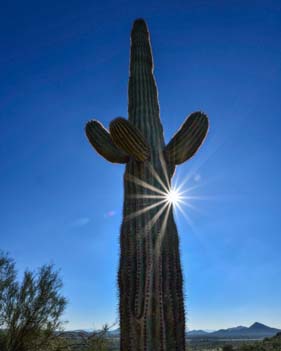
The madness culminated with finding new tenants for our

townhouse.  Sleeping on an air mattress in our empty

townhouse during a frantic week of repainting the interior, we

realized we had come full circle.  Four years of traveling, with

only the briefest visits to Phoenix, and here we were back in

our townhouse again, surrounded by the same smells, the

same noises, the same sensations that had been the essence

of our old home.  What had the last four years meant?  Had we

grown or just taken a big detour through life?  There was no

time to think about that; there were chores to do!

Once our

responsibilities were

behind us, we grabbed

the trailer out of

storage and dashed up

to Flagstaff as fast as

we could go.  We made

a beeline for Bonito

Campground, our all-

time favorite

campground.  Despite

being die-hard

boondockers, we splurged on a weeklong stay there while we re-familiarized

ourselves with the RV lifestyle and restocked the trailer with everything we had

pillaged from it for the boat.

Here at 7000' elevation we finally began to take stock and get some perspective on all

that we'd been through.  When we left Phoenix in 2007, real estate was peaking at

astronomical prices.  Now, on our return, there was a sea of homes in various stages

of financial distress and foreclosure.  Few real estate signs were visible, however.  The

panic was largely on paper and online, and too often was manifested in midnight

moves.  Some of our once-wealthy friends were now scrambling to pick up the pieces

of their lives, while other less well-heeled friends were suddenly able to afford

gorgeous homes.
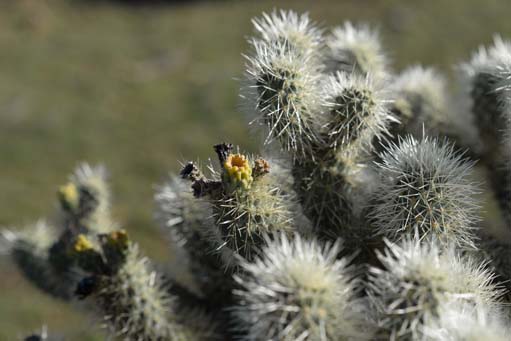
The city's everpresent, massive

expansion into the outlying pristine

desert was temporarily on hold while it adjusted to the new economy.  Our

memories of Phoenix as it once was were overlaid onto Phoenix as it is today,

and there were areas where the images meshed, and areas where they were

like two different places.

Some of the changes were within ourselves as well.  Our souls were the same,

but all this traveling had expanded our knowledge of the lands around us, and

we had come to know ourselves better too.  These thoughts swirled around us

as we rested and strolled about Bonito's pretty grounds.  Life aboard Groovy in

Mexico felt like a far distant dream.

The land surrounding Bonito Campground has changed too.  Last year this part

of Coconino National Forest was devastated by the Schultz wildfire which wiped out some

15,000 acres, mostly on the area's mountain slopes.  Campers at Bonito were evacuated

twice, first to escape the fire and later to avoid the erosion-caused floods.  As a ranger

explained to us, the floods altered the landscape forever and

even moved floodplains.  Many nearby homes were damaged

or lost, a young girl drowned, and the water rose to about 8' in

the campground's amphitheater, leaving the place buried in

sludge.

Knowing some of this before we arrived, it was with trepidation

that we approached the campground.  The meadow that is

usually teeming with bright yellow sunflowers at this time of

year was devoid of blooms and parched and cracked in

places.  But what a thrill it was to see and smell our beloved

ponderosa pine woods.  Bonito's soul is the same, just singed

a bit here and there.  The wildflowers still line the edges of the

roads and promise to return to the meadows.  The

hummingbirds still buzz the campers looking for easy

meals in feeders.  Some ponderosas have blackened

trunks, but the tops are green.

However, the Schultz fire was

nothing compared to the volcano

that erupted at next-door Sunset

Crater around 1050 AD.  Spewing

marble-to-football sized chunks of

rock into the air for a few months

(or possibly several years), the

evacuation of the local farmers

lasted for generations.  The

volcano layered the land for many

miles around in a thick blanket of

cinder.  In its last moments it spat

out a final burst of cinder that was oxidized to a rust color.  This gives the mountain a distinctive

orange-red top to this day, and the sun and shadows spend their days playing with the color.

We took a drive through the

nearby Indian ruins at Wupatki

National Monument.  These

were built 50-100 years after

the eruption by the so-called

Sinagua people who returned

to the area to find that the

blanket of volcanic ash now

helped keep rare moisture in

the soil.  They somehow eked out a farm life, living essentially

"sin agua" or "without water."

The ruins are like tiny dots on vast open plains, each located

several miles apart.  The San Francisco mountains line the

horizon, but there are few trees or other protection between the open lands and the sky.

We opted to start at the far end of the drive, visiting the more remote

ruins first. These were built above small box canyons that are

essentially ditches in the ground bounded on two or three sides by 100'

rock cliffs.  The cliffs provide the only weather protection in the area.

The Sinagua people understood real estate:  location location location.

It was early

morning and utterly

silent.  The

crunching of my

feet on the gravel paths made the cottontail

bunnies run, and lizards of all shapes and

sizes scurried for cover under rocks along

the trail.  We were the only visitors at each

ruin, lending a sense of magic to each

place.

At the biggest ruin, Wupatki Pueblo,

Mark played with the natural

"blow hole" air vent.  The

National Park Service has built

a structure around it, but the

blow-hole itself is the real deal,

blowing air out or sucking it in

depending on ambient

temperatures and air pressures.

As we returned to the

campground the sky turned

black, thunder rolled and

lightning streaked the sky.  For

seven months on the boat in

Mexico we hadn't seen a single

drop of rain.  The deluge that came now was fantastic.

We drove through it

laughing, barely able to

see the road ahead, and

we jumped back in the

trailer, glad to have real

shelter.  It was so great to

be back in our RV lifestyle

again.  The rain pummeled

our roof all afternoon, and

we fell asleep to the plink

plink plink of raindrops

overhead.  Little did we

know the downpours

would continue for several days.  The sun finally returned in full blaze

as we took off to head north to Dixie National Forest in Utah.


Other great RV camping areas:

Our most recent posts:

More of our Latest Posts are in the MENU.
New to this site? Visit RVers Start Here to find where we keep all the good stuff!!