Gulf of Tehuantepec, Mexico – Squeezing in a crossing between blows

Halloween, 2012 – We had enjoyed Marina Chiapas, but now it was time to leave.  However, because this marina borders a fabled body of water — one known for its bad attitude not its beauty — leaving was not such an easy thing to do!

The staccato way Mexicans pronounce “Tehuantepec” (Te-wan-te-PECK) makes it sound almost distasteful — they spit out the ending “Pec” with force.  Among cruisers, the Gulf of Tehuantepec is one of the few places in Pacific Mexico that can strike terror in our hearts.  I’ve heard it pooh-poohed only one time, by a married pair of 20-year veteran single-handers in Zihuatanejo (¼ down page) who were completing their third circumnavigation (aboard separate boats).  They brushed it off, saying, “The Tehuantepec is way overrated!” and promptly set off to sail 500 miles out to sea around it en route to the Panama Canal.  But for most ordinary cruisers, including us, it is a place to be respected and planned for, as it is known for its nasty temper and very big teeth.

Crossing the Gulf of Tehuantepec Mexico between Marina Chiapas and Marina Chahue

From red dot (Marina Chiapas) to blue (Huatulco), this is not a great time to cross the Gulf of Tehuantepec! Wind in light blue is 4-7 mph, wind in dark orange is 39-46 mph.

The Tehuantepec blows and calms down in cycles that depend on the winds in the Gulf of Mexico.  When the wind blows out of the north on the Caribbean side of Mexico, it picks up speed when it hits the Gulf of Tehuantepec and often reaches gale force.  Then it settles down for a few days before doing it all over again.

The goal for sailors is to look for a 3-day or longer period of calm to dash from one side of the Tehuantepec to the other.  There are marinas on either side, Marina Chahué in Huatulco on the west and now the new Marina Chiapas in Puerto Chiapas on the east, but there is nowhere to hide in-between other than the big, smelly industrial port of Salina Cruz that is loaded with freighters and requires the Port Captain’s permission to enter.

Going straight across this gulf is about 210 miles, but that’s a dangerous route because if the Tehuantepec suddenly gets ugly, you are stuck in a storm with hours of miserable sailing to get to safety near shore.  So the recommended course is to hug the coastline the whole way, sailing ¼ mile to ½ mile offshore, where the winds are slightly less and the waves are significantly smaller.  Going this way is 260 miles.  Crossing takes anywhere from 30 to 50 hours, on average.

Golfo de Tehuantepec crossing from Puerto Chiapas to Huatulco during calm

This calm period looks much better, doesn’t it?! Wind in light blue and lavender is 4-12 mph.

Compounding the problem of finding a good weather window to cross, when leaving from Marina Chiapas on a westbound trip, there is the additional hassle of checking out of the port.  Because Puerto Chiapas is on the border of Guatemala, every boat leaving Marina Chiapas for another destination in Mexico is required to pay a personal visit to the Port Captain’s office on the far side of town to purchase the official exit document (about $7 USD).

Also, 2 hours prior to the boat’s departure, you must invite both the Navy and their drug sniffing dog aboard for a final inspection of the boat as well as the Port Captain who comes to the boat for a final review of the paperwork.  You can’t just sneak out when the forecast looks good and the timing feels right!

The Tehuantepec had been blowing full force non-stop since our arrival a week earlier, but we studied Passage Weather (North Pacific->California to Mexico) to determine the best time to cross, and we spotted a slim opening of about 12 hours of calm between two modest blows that would peak about 40 hours apart.  These websites, updated every three hours, seem to be very accurate in their prediction of the weather, but the resolution is small.  A one inch portion of the chart represents the entire 260 mile passage, and the time is given in GMT which was 5 hours earlier than local time in Marina Chiapas.

Some sailors don't like the Gulf of Tehuantepec

Anticipating crossing the Tehuantepec can make you a little crazy.

Studying these websites, I wrote out two pages of notes listing GMT, local time, forecasted wind states and sea states.  As of Monday, it seemed that Wednesday morning at 3:00 a.m. would be the best time to leave.  If we missed that window by 3 hours we would need to stay in port another week.

Marina management instructed Mark to visit the Port Captain right away to complete our exit paperwork.  They told us the exit document had no expiration date — it would be good indefinitely.

This meant that if the weather forecast changed, we could opt not to leave, and we’d still have a good exit document for when we were finally ready to go.  We also planned to hail the Port Captain on the radio about 8:00 Tuesday night to make arrangements for him, the Navy, and their dog to visit our boat around midnight.  We would be required to leave within two hours of that visit — or we’d have to invite them back to repeat the process.
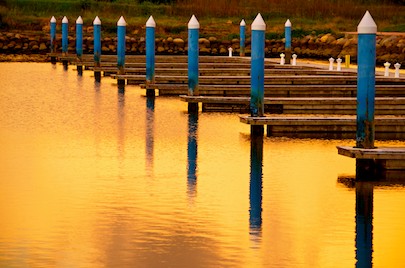
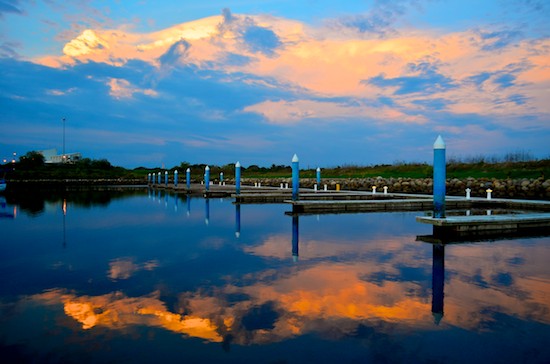
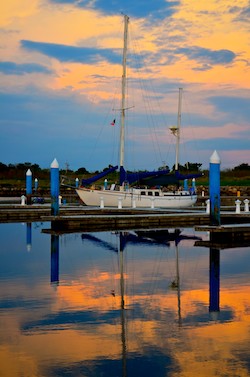
Marina Chiapas slips and docks at sunset

It was hard to leave the safety of pretty Marina Chiapas but the windows for crossing the Tehuantepec were infrequent.

In the backs of our minds we were thinking that if the weather forecast changed on Tuesday and no longer looked good for a crossing, we would stick around the area another week or so and take advantage of the downtime to spend a few days at the coffee plantation Finca Hamburgo which has lovely cabins in the mountains.  They also have an exotic flower nursery, oodles of tropical birds and hiking trails throughout their property.  It sounded delightful.

We awoke Tuesday morning to find the marina’s internet was no longer working, so we couldn’t get a weather forecast.  On top of that, we discovered that marina management at this new marina had not understood all nuances of the rules related to boats leaving Puerto Chiapas.  It turns out that once a boat that is remaining in Mexico obtains its exit document, it must leave within 48 hours of the “leave by” date stated on the document — or return to the Port Captain’s office to obtain new exit paperwork.  So much for our option of easily sticking around for a week and hitting the coffee plantation if the weather forecast turned ugly.  We had to leave by Thursday afternoon, or spend another three hours going to the Port Captain’s office a second time to get a new exit document.

Marina Chiapas Porto Bello Restaurant Mexican Flags

Mexican flags fly at the marina’s new restaurant.

The last weather forecast we’d seen had been 10 hours earlier on Monday night.  So I hustled to nearby Puerto Madero to renew our Telcel USB modem (which provides internet access via the Mexican cell phone system).  When I was finally able to get online and see the forecast, I was horrified.  Everything had changed.  We needed to leave in 90 minutes — at 3:00 p.m. today, Tuesday, 12 hours ahead of our original planned departure time — or not leave for at least a week.

This would have us chasing a receding Tehuantepec blow for the first 18 hours, put us at the apex of the Tehuantepec at 3:00 p.m. Wednesday when it would be calm, and then have us chased by a newly growing Tehuantepec blow for the last 6 hours of our trip, delivering us to Huatulco at 3:00 a.m. Thursday, after 36 hours of sailing.  It would be a tight squeeze with little margin for error.

There was one other window a few days later that might work for very fast boats with very brave crew — but we weren’t in that category.

As Mark and I studied the weather charts, I felt a fear so palpable that my heart raced, palms sweated and mouth went dry.  “Stay or go?” I asked him.  I wanted to stay.  I wanted to run away to the coffee plantation high on that mountain and never come back.  He gave me a big happy smile.  “I have total confidence in you, Sweetie.  If you think this window will work, we’ll be fine.  You’re a great navigator and a great researcher and planner too!  I think we should go.”

Birds at Marina Chiapas

One of the best things about this marina is the constant sound of unusual bird calls.

My eyes were saucers.  He had that kind of faith in me?  What if I were wrong?  What if I’d miscalculated GMT and local time?  What if the weather changed in the next 24 hours before we got to the most vulnerable part of the voyage?  What if he got injured out there because of my decision?  What if the boat were damaged?  What if we had a horrible trip and then found out if we’d waited three days it would have been easy?  What if?  What if?  What if???  I was a mess.

Mark began organizing the boat, and after much consternation I picked up the VHF mic to invite the Port Captain and the Navy to our boat for our exit inspection.  I was intercepted by the marina manager who kindly said all the right things to the Port Captain in Spanish to convince them to come in 20 minutes.  45 minutes later, the Port Captain arrived by car.  But he wouldn’t come down to the boat until the Navy showed up in their launch boat, so he just waved from the parking lot.  Another 20 minutes went by before the launch arrived, complete with pooch.  They tied up at the dock.  The four men ambled onto our boat and took out clip boards, papers and pens while the dog sniffed everything.
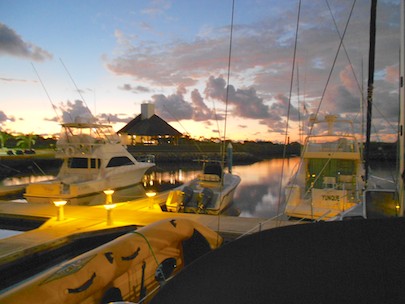
Marina Chiapas at Puerto Madero - evening on the docks

At first we thught we’d leave at 3 a.m. but changed our minds to leave 12 hours earlier.

Mark watched the minutes tick by as they first had me run up to the marina office to make yet another a copy of our passports for them.  Then they struggled to understand what state had the abbreviation “SD” (our domicile) and where it was located.  “What are the border states?” they asked with great, unhurried curiosity.  North Dakota wasn’t a helpful answer, as they didn’t know that one either.  Montana got a nod.  Egads — we needed to leave, and now!!  At last they stood up to go.  Our engine was running almost before the last man stepped off the boat, and we were gone.  It was 40 minutes later than we wanted to leave, but still within the 3 hour window we’d set as our outer limit.

The Tehuantepec was blowing hard ahead of us, but we anticipated 18 hours of smooth sailing before we would get near the bad stuff, and it would be calming down in the meantime.  After an anemic sunset, the full moon we had looked forward to hid behind clouds, leaving us in the dark and making the lights on the row of 16 shrimpers off our port beam look even brighter.  Suddenly an intense white light appeared behind us.  The light grew brighter, and then we could see the red and green running lights of a boat’s bow and blasts of bow spray as it bore down on us at 30 knots or so.

Through the binoculars Mark could see it was a Mexican Navy ship.  “Maybe we’ll get boarded,” he said, shrugging.  The boat was coming straight for us.  Suddenly it swerved to our starboard side and stopped.  After a long pause (verifying our boat name with headquarters at Puerto Chiapas, perhaps?), it pulled around ahead of us and zoomed off into the middle of the shrimping fleet.  Minutes later we heard the Navy captain hailing one of the shrimpers on the radio, informing them that they were going to perform a routine inspection of their boat.  Twenty minutes after that the Navy captain hailed another shrimper for a routine inspection of his boat.  And so it went, the line of shrimpers stopped at a standstill, mid-ocean, awaiting inspections, while we slipped by on their right.

Neither of us likes night sailing at all, and since we are both light sleepers, we have found it very difficult to get good sleep while at sea.  The motion of the boat, slapping of waves on the hull and noise of the wind in the rigging are unsettling.  I tried my best to sleep, but after two hours something got me out of bed.

I found Mark in the cockpit staring into the darkness saying, “What do you make of this?  Watch.  He’s been doing this for 15 minutes…”  As he pointed, suddenly a powerful spotlight — by far the brightest I have ever seen on a boat — lit up our cockpit.  I felt naked.  When the light shifted for a moment we could see the source was a small panga, or outboard-driven open fishing boat, with two men in it.  The light flooded our cockpit again, this time strobing on and off, as the launch approached Groovy at top speed.  Then it swerved away.  The light turned off.  Then on again with another rush at our boat.  Then it was off, and the boat wheeled away from us.  All the blood drained from my face and my throat went dry.

Mark kept studying the boat.  It traveled at our speed for about 20 minutes, staying about half a mile or so behind us, and then made another rush towards us, spotlight strobing.  Finally it swerved away.  Were they trying to tell us something, to warn us about a fishing net?  Did they think we were somebody else?  Were they meeting a boat out there somewhere and we fit the description?  We’ll never know.  A few hours later another similar boat did the same thing, but with less intensity.  Who knows what it was all about.

I laid on my back in the cockpit and studied the sky to calm down.  The full moon now backlit the clouds whenever it was able to penetrate their depths.  For hours a flock of four frigate birds took turns trying to land on the top of our mast.  The mast swung wildly and it was impossible for those big wings and big webbed feet even to think about landing successfully, but they sure had a good time trying.  They easily went 30 miles with us, playing like that.

Gulf of Tehuantepec when it is calm

The Tehuantepec was calm at first

Overnight the conditions were so calm we let the distance grow between us and the shore until we were 15 miles out.  In the morning there was no dawn, just clouds.  But the good news was that a following current pushed us along as we motor-sailed at nearly 8 knots the whole time.  We had more than made up the time we had lost checking out with the officials.  The sooner we could scoot across the gulf the better — unless we went too fast and caught up to the big winds ahead of us before they died down.

The wind began to build, and with it the seas.  We started seeing 22 knots of true wind (30 apparent) and the boat began to slam into the waves.  It would rise into the air, the front half airborne, and then drop onto the water with a loud crash.
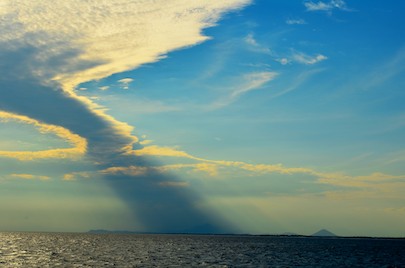
Gulf of Tehuantepec storm clouds on the ocean

Weird storms appeared and disappeared around us.

“Wow, check this out — storm cells on the radar!”  Mark called out excitedly.  Sure enough, two huge 8 mile wide pink blobs blocked our way forward, and up ahead we could see weird clouds with rain streaking out of them.  We dodged one by going towards shore, and then it disappeared, as if laughing at us for changing course to avoid it.  We tried going out to sea to avoid the next one, but it got bigger and bigger and we made no progress against it.  Then the one we had defeated reformed and suddenly we were boxed in by the two systems.  At the time I thought “who needs to see a photo of a chart plotter with two huge pink blobs boxing Groovy in?” but now I wish I could show it to you.

With rain starting and seas growing, the two storm cells suddenly began to flash with lightning.  Thunder rumbled ominously.  According to the forecast, we were supposed to be cruising along in 8 knots of light breeze with no storms, but that’s not what was here.  So it was time to seek shelter and hug the coast.  We made a beeline for shore, and after two long hours of pounding over the waves, we got to the safety zone by the beach — the recommended travel lane — where the depth is a sandy 40′ and the distance to shore is 0.2 miles.  The true wind dropped below 20 knots and the seas went flat.  Amazing!  We zipped along at over 8.5 knots for many hours on end.  It would have been a thrilling ride.  It would have been our best sailing in Mexico to date — after all, how often do you get lively wind on a close reach with flat seas? — but the fear in our hearts dissolved all sense of fun.

Gulf of Tehuantepec salt spray covers our dodger

Groovy got whip-lashed by a few big waves that smacked our dodger and soaked it.

How easy it is to walk on a 6×8 plank sitting on the ground.  Put it 30′ in the air and it’s terrifying, because all you can think of is falling off.  So it is with great daysailing in the Gulf of Tehuantepec.  Even when you get ideal sailing conditions, you keep waiting for the grisly sea monster to rise up and swallow you.

It had been 22 hours since we had last seen a weather forecast on the internet, and the one we’d just heard on the VHF radio rattled off the wind speeds and wave heights for all the regions of Pacific Mexico in Spanish — and in metric — way too fast.

Suddenly a panga with 6 guys in it appeared alongside us.  They circled us, yelling in Spanish.

“You’ve got to get out of here!  There’s going to be a lot of wind.”
“When? When?” I yelled back.  “We’re going to Huatulco!”
They all grinned heartily and gave us the thumbs up: “Mañana!”

We guessed that meant we were okay — we’d be long gone from here by then.  How incredibly kind of them, though, to make a detour to our boat to warn us of the coming weather.  We are always impressed by the thoughtfulness of the Mexicans.

As we approached the apex of the Tehuantepec’s danger zone, the true wind climbed to 25 knots, apparent was into the 30’s, and we were soaring on flat water at 9 knots, watching people flying kites an arm’s length away on the beach.  I held the laptop high overhead and was able to pick up a very faint internet signal from somewhere on shore.  After twenty minutes of standing with the laptop overhead (a great shoulder workout!), I had downloaded a tiny 599KB zip file containing a complete weather forecast from Passage Weather’s low-bandwidth site.  Nothing had changed.  Phew!!!  We were on perfect schedule.  All we had to do was let another 12 or so hours march by.  The only weird thing was we were supposed to be in 8-12 knots of wind at this point, not 25.

As darkness fell, we threaded a path between all the freighters anchored off Salina Cruz.  The coast turned more southward and we now had the wind off our starboard quarter.  The noise and mayhem settled way down as the wind from our own forward motion canceled out some of the wind blowing behind us.  We scooted along, continuing to slice through the water at almost 8 knots.
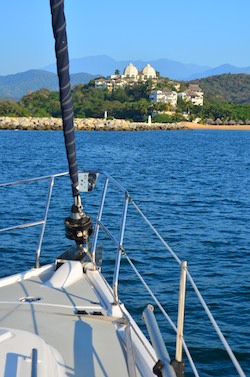
Tangolunda Bay Bahias de Huatulco

The morning after we relax in Huatulco’s beautiful Tangolunda Bay

It was Halloween, and we celebrated this eerie night of goblins and ghouls by watching the nearly full moon rise blood red in the black sky.  We’ve never seen the moon such a rich shade of red.  As it climbed higher, it slowly faded from ruby red to orange, passing through wisps of grey clouds.  What a classic Halloween image.  We tried to capture it with the camera, but the boat was rolling and all we got was blurry red blobs.

In our final hours we felt the winds and seas building again, and knew we had successfully scooted ahead and avoided the rising maelstrom behind us.  At long last, around 2:30 a.m. on Thursday morning after 35 hours and 260 miles (a whopping average (for us) of 7.4 knots, or 8.5mph), we pulled into Tangolunda Bay, a big bay at Huatulco’s south end.  We knew this bay from last year, and it was a relief to retrace our track on the chartplotter and drop the hook right where we had pulled it up eight months earlier.

We sat in the cockpit, securely anchored to the sand beneath us, and stared at the twinkling lights of the many resorts lining the bay.  All the fear and worry of the past two days suddenly fell from our shoulders, and an incredible sense of accomplishment began to take its place.  Our first Tehuantepec crossing last spring had been a breeze, a no-brainer, “pan comida” (a piece of cake), as we’d had a six day window of minimal wind.  We had crossed near the middle, covering 228 miles in 36 hours.

Tangolunda Bay in the Bays of Huatulco

It’s party time in Huatulco’s Tangolunda Bay

Our crossing now had gone equally well, but had been a tactical challenge like none we have ever faced on the water before.  Everything had gone like clockwork: we had arrived at each landmark on schedule or slightly ahead, thanks to a 1 knot favorable current, and the Tehuantepec had cooperated by sticking to its forecasted plan (except for the unexpectedly blustery conditions near the apex).  If we hadn’t been so spooked by the potential for disaster, we might have even enjoyed the ride!

But for now we were excited at the prospect of swimming and snorkeling off the boat the next morning, and waving at the jet skis that would soon circle us from the fancy resorts that surround Tangolunda Bay.  All the resorts were quiet now in these wee hours of the morning, however, and we slept like babies as soon as our heads hit our pillows.

 <- Previous                                                                                                                                                                                      Next ->

Subscribe
Never miss a post — it’s free!

Blog posts from our wonderful stay in Huatulco, Mexico:

Blog posts from our inland trip to the colonial city of Oaxaca, Mexico:

Blog posts from our coastal and inland travels in Chiapas, Mexico:

Our most recent posts:

More of our Latest Posts are in the MENU.
New to this site? Visit Cruisers Start Here to find where we keep all the good stuff!!

Marina Chiapas in Puerto Madero (Puerto Chiapas) Mexico – Sailing near Guatemala

If you are taking your boat to Marina Chiapas, please visit our Marina Chiapas Cruising Guide for waypoints and travel ideas!

October, 2012 – As we watched New Mexico’s unique Bisti Badlands disappearing in our rearview mirror, we began to focus all our energy on exchanging our US land travels by RV for our Mexico travels by sailboat.

Phoenix Hermosillo Mexico City Flights - Mexico Map

Our route: Phoenix – Hermosillo – Mexico City – Tapachula (Marina Chiapas)

standin on a corner in winslowe arizona

There’s a girl, my Lord, in a flat bed Ford…

We breezed through Winslow, Arizona, just 24 hours after the conclusion of their big “Standin’ on a Corner in Winslow Arizona” festival, but we stopped long enough to stand on that special corner ourselves.

Javalina in Fountain Hills Arizona

Mark spots a javalina near a friend’s house in Arizona

Several weeks vanished in a flurry of visits with friends and family along with shopping for goodies we knew we’d need in Mexico but couldn’t buy there.

Phoenix Hermosillo Mexico City Tapachula airplaine flights

Three flights and 12 hours from RV to sailboat

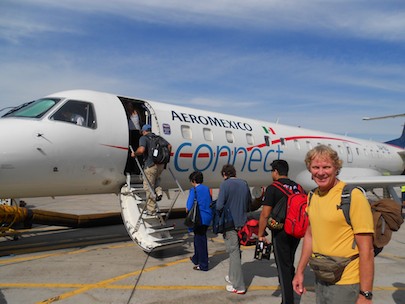
We put the buggy away in storage and finally flew out to Tapachula near the end of October. It took twelve hours of travel to get from our trailer’s door to our boat’s door, including three different planes and extraordinarily thorough baggage inspections before boarding each one.  When we stepped off the last plane in Tapachula at 1:30 a.m., we felt like we were stepping into a sauna, and we were suddenly immersed in the thick, dense, pungent air of the tropics.


Sailboat in Marina Chiapas (Puerto Madero) Mexico

Groovy was happy to see us.

Groovy was waiting patiently at the dock, and even in the dark the boat sparkled, inside and out.  Our friend Andrés Reyes Prudente, the captain of a neighboring sport fishing boat, had taken good care of her during our absence.

Palms at sunset in Marina Chiapas (Puerto Madero) Mexico

The moody skies were enchanting

It was still the end of the rainy season in the tropics, and every day we were treated to fantastic clouds, a few showers, and even one doozy of a thunder and lightning storm that pelted everything with sheets of water and made us jump out of bed when a bolt hit somewhere very nearby.

Marina Chiapas (Puerto Madero Puerto Chiapas) sunset and empty slips

Sunset at Marina Chiapas


Of course, having just completed a long to-do list for the trailer in Arizona, we now faced another long to-do list for the boat.

Mark leapt into action on the engine, and we ran off to super markets several times for provisions.  Taking the “combi” van to Walmart, we found ourselves packed in like sardines as 23 people squashed into each other and sat on each other’s laps to fit into a van built to seat just 15 people.  Ah, Mexico!

Marina Chiapas (Puerto Madero Puerto Chiapas) sunset on palm treet

Yanmar 55hp engine Hunter 44DS sailboat

Mark says “Hello” to his good friend, our Yanmar 54hp engine

As each person climbed into the “combi” van, they greeted everyone already aboard with a friendly “buenos días,” a practice we have seen over and over here.  In my younger days I rode very crowded subway trains all over Boston, but I sure don’t recall anyone ever greeting anyone else with a big smile and friendly “good morning” as they got on.

Sailing in Puerto Chiapas (Marina Chiapas and Puerto Madero)

What fun to be sailing on Groovy once again

The intense heat zapped our energy every day.  We don’t have air conditioning on the boat (probably a “must” both here and in the deepest of the tropics).  The temps inside the cabin got up to 94 every afternoon.  There wasn’t a breath of air.  Sweat covered our bodies, head to barefoot toe, even if we sat motionless in front of a fan.

Fishing at Puerto Chiapas (Marina Chiapas and Puerto Madero)

Andres brought his fishing poles

We hadn’t been on the boat 48 hours when we excitedly untied the lines and took it out into the bay to cool off in the ocean breezes and see if all the systems still worked.

Andrés joined us, and he brought two fishing poles in hopes of catching dinner.  The fish weren’t biting, but the ocean water felt great, even at 91 degrees.

Sunset on the docks at Marina Chiapas in Puerto Chiapas Mexico

The sunsets were exquisite

The Chachalacas (birds!) sat in the trees and made their funny bird calls at each other morning and night, and exotic flowers grew on their own among the weeds on the roadsides.

Passion flower growing at Marina Chiapas in Puerto Chiapas Mexico

Mark found a Passion flower in the weeds

Every afternoon the sunsets transformed the marina and inspired us.

Sunset at the docks in Marina Chiapas (Puerto Madero) Puerto Chiapas Mexico

The fun thing about being in a marina like this is that everyone has a long to-do list for their boat, and sometimes you can abandon your own list to help a friend with theirs instead.

sportfishing Marina Chiapas (Puerto Madero Puerto Chiapas)

We hitch a ride to the fuel dock

One afternoon Andrés needed to take his boat over to the fuel dock to fill up, so we came along for the ride to help with the dock lines.

The fuel dock is tucked into a back corner of the estuary and it has grubby black rubber tires that put marks all over your white fiberglass when you tie up, so having some extra hands to help with the maneuver makes it easier.

We needed to test some more systems on Groovy too, so off we went for another daysail in the bay once again.  This port is a border port (just a few miles from Guatemala), so it is tightly controlled by the Port Captain and the Navy.

Marina Chiapas Porto Bello Restaurant Puerto Chiapas (Puerto Madero) Mexico

The restaurant “Porto Bello” under the newly completed palapa at Marina Chiapas

Every time we went out for a daysail, and every time we returned, we had to call the Port Captain on the VHF radio to let him know what we were doing.

Sport fishing at Puerto Chiapas in Marina Chiapas Mexico (Puerto Madero)

Success!!

We are capable of doing this in rudimentary Spanish ourselves, but it was fun to turn the task over to Andrés and watch him rattle away on the radio on our behalf, giving the Port Captain all the detailed information he needed about our bay voyages.

He also had success fishing that day, and happily reeled in a Sierra.  This pretty Spanish Mackerel is covered with yellow polka dots, and it made a yummy dinner.  A small fish doesn’t go too far for three people, but a pile of tortillas and refried beans with hot sauce stretched it nicely.

Sierra (Spanish Mackerel) has yellow polka dots Puerto Chiapas Mexico

Sierra (Spanish Mackerel)

By the way, neither of us would have ever even considered eating those things with fish before living in Mexico, but when Andrés said, “no frijoles??” when he saw his plate, I quickly remembered what a great combo that is and warmed up some refried beans.  We were slowly getting our Mexican vibe back.

Groovy gradually came together, and the to-do list got whittled down to just a few items.

Sailboat at Marina Chiapas (Puerto Madero) in Puerto Chiapas Mexico

Getting used to the Life Aquatic

We had been watching the weather to see if a window would open up for us to dart across the difficult Gulf of Tehuantepec — at the same time that Frankenstorm Sandy swirled up the east coast — and eventually it looked like there might be a 12 hour window of total calm between the endless march of gales.

This is hardly long enough to be called a real “window,” and our cruising guide warned that windows for crossing the Tehuantepec can “slam shut in an instant.”

Sailboat at Marina Chiapas Puerto Chiapas (Puerto Madero) at sunset

Catch a ride on this pretty sailboat with local tour operator Macaw Tours Tapachula


But “Tehuantepeckers” had been blowing for a full week since our arrival, and they were forecast to continue to blow for the entire following week too.  Good grief, what kind of crazy place is this gulf?

So, while we had hoped to take an inland trip to the local coffee plantation Finca Hamburgo for a few days, when the chance came to leap back into cruising and cross the Gulf of Tehuantepec, we grabbed it.

For waypoints and cruising notes for Marina Chiapas as well as an inland travel guide for what you can see OFF the boat in southern Mexico, please visit our Marina Chiapas Cruising Guide.

<- Previous                                                                                                                                                                                      Next ->


Bisti Badlands NM – Mysterious rocks and an alien egg factory!

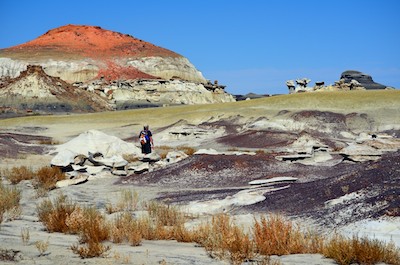
Bisti Badlands hiking in the wash

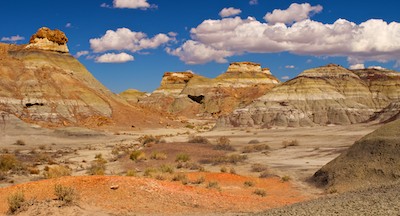
Hiking into the remote and mysterious Bisti Badlands.

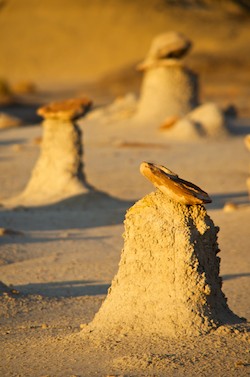
Late September, 2012 – One of the great things about hanging out with the photography pros at Nasim Mansurov’s Colorado Landscape Photography Workshop was that they knew where the cool places were to take pictures.  Nasim suggested we check out the Bisti Badlands in New Mexico where there are all kinds of rock formations, hoodoos and some mysterious alien looking “eggs.”

Bisti Badlands New Mexico Hiking through the rock formations

We hiked on ridges and in valleys

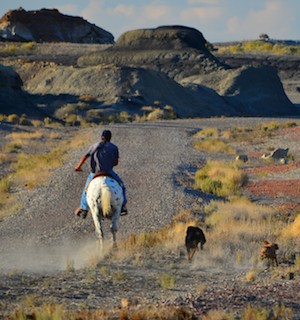
This is a very remote place, 36 miles south of Farmington, New Mexico, and when you get here after miles and miles of boring flat land, it is a wonder to behold.  Even more startling for us, though, was having an Indian on a spotted Appaloosa horse ride up to our campsite to chat with us.  His name was Nelson, and I suspect his first language was Navajo, as he spoke English with an unusual accent.  He had been out rounding up a miscreant brahma bull that had wandered away when his nephew accidentally left the paddock gate open.

Bisti Badlands New Mexico lots of colors in the rocks and Teepees

The colors vary from one neighborhood to the next.

Tourists from all over the world make their way to Bisti Badlands, and Nelson has met folks from Europe, Asia, and all the states.  It is a wilderness area, so there are no signs and no trail markers, and too often hese tourists wind up on his ranch, quite lost.  The rather baffling maps from the BLM office make it look easy to find your way, but they quickly prove almost useless once you start hiking.

Bisti Badlands New Mexico Indian on an Appaloosa Horse

An Indian visits our campsite on his spotted Appaloosa horse “Oreo”

Just last week Nelson had rescued a Japanese family that saw the light on in his house near midnight.  They knocked on his door seeking refuge from the cold, scary desert night.  He brought them back to their car in the morning.  “Don’t they see the movement of the sun, or watch the moon?” He asked us, shaking his head in disbelief.  Then he spurred his horse and cantered down the road in a cloud of dust, his faithful dogs following.

Bisti Badlands New Mexico hoodoos

Exotic hoodoos surrounded us.

Wow.  That was right out of the movies!!

Bisti Badlands Alice in Wonderland furniture

Mark finds himself a little table.


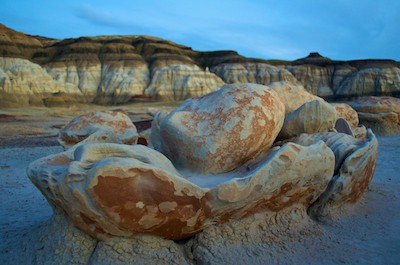
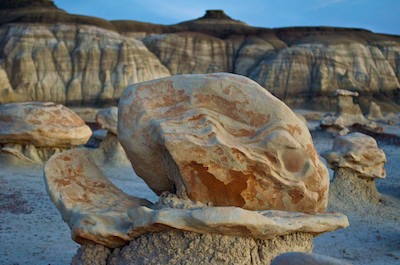
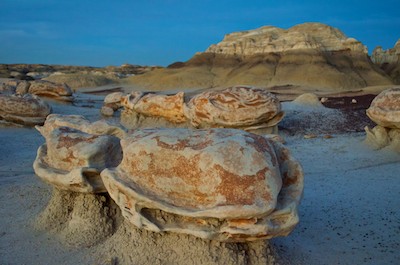
We ventured into the badlands armed with a compass, binoculars, a good sense of the sun’s path, a bunch of food and water, and our cameras.  The “egg factory” is a collection of rocks that look like aliens hatching out of their eggs, and finding it was our ultimate goal (as it is for most travelers here).  But the rock formations and desert colors we saw on the way were just as inspiring.

Bisti Badlands New Mexico Alice in Wonderland hoodoos

Obama and Romney should pontificate a bit out here!!

We hiked for hours, following first one wash and then another, climbing up and over tall pyramid shaped rocks and skirting around the bottoms.  Over the years visitors have given the different groups of rock formations names:  The Wings, Alice in Wonderland, The Teepees, etc.  Spread out over several square miles, you only know you’ve arrived in a particular neighborhood when the rock formations look like the names they’ve been granted.

Bisti Badlands New Mexico searching for the cracked eggs

Mark scans the horizon for the eggs

Bisti Badlands New Mexico Collared Lizard

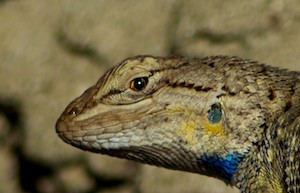
This lizard wasn’t lost!

We came across a group of rock formations that looked like furniture.  A perfect little table and a podium were fun to pose with.


But where in the world were those crazy eggs?  They were supposed to be about two miles into the badlands area, along a wash that branched southeast.  Well, there were lots of washes, and they branched all over the place.  We saw lizards scampering along the desert floor.  Surely they knew exactly how things were laid out in this vast barren place.

Bisti Badlands Rock Formations

Well, the eggs aren’t here, but this is cool!

Bisti Badlands New Mexico Wings

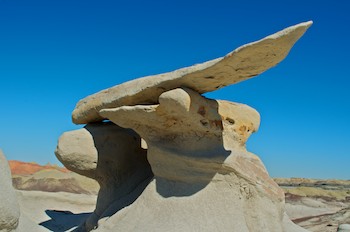
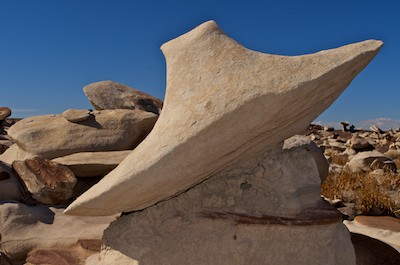
Winged things.

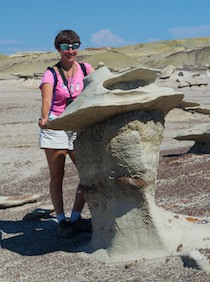
Bisti Badlands New Mexico Flying Saucer

A flying saucer!


We found ourselves in another area of formations that had flat roofs, or wings.  These hoodoos were otherworldly.  One even looked like a flying saucer.  Some of the flat tops were detachable and could be lifted off.

Bisti Badlands New Mexico Pyramids

Mark stands at the base of a pyramid

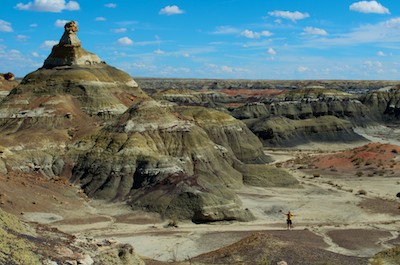
Continuing on, we wandered between tall pyramid shaped formations that were decorated with fantastic horizontal stripes.  They stood just a hundred feet or so high, and were easy to scramble up onto for a birds-eye view.

Bisti Badlands New Mexico colorful black and red pyramids

The colors change to black and red

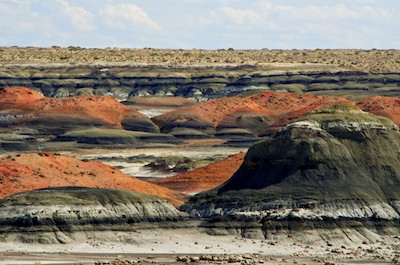
The landscape changed from shades of white and yellow to shades of red and black.  It was all quite beautiful and exotic.  But the eggs were nowhere to be found.

Bisti Badlands bird

Bisti Badlands New Mexico searching for the egg factory

“North is that way!”

We returned to our campsite and studied the BLM map once again.  Maybe they would turn up on a second day’s quest.  We headed out again the next day and this time recognized many of the landmarks and had a much better sense of where we were.  “North is that way,” Mark said at one point.  He had a photo of the eggs from the BLM and now we knew what they would look like if we found them:  small egg-like rocks backed by white eroded cliffs.

Bisti Badlands New Mexico cracked eggs

Two of the elusive alien eggs

Finally we found them and whooped and hollered in triumph.

Bisti Badlands New Mexico the black boobs

The black boobs – important landmarks!

In the end, they are actually very easy to find.  There are GPS coordinates available on the web, but here is an easy landmark-based way to get there:


Follow the fence on the left side of the parking lot into the badlands.  When the fence takes its second sharp 90 degree turn to the left, look straight ahead in the direction you’ve been walking, and look for two black “boobs.”

Bisti Badlands New Mexico the egg factory

Mark sits among the eggs

Walk towards them.  As you approach them, walk around the leftmost one (the further one), leaving it on your right, and continue on to the black topped white cliffs in the distance.  The little collection of eggs is right there in front of the cliffs.

Bisti Badlands New Mexico egg factory

The best light for these guys is dawn and dusk

Bisti Badlands New Mexico cracked eggs

Bisti Badlands New Mexico egg factory

We had arrived at the eggs in the glare of midday, but who cares?

Bisti Badlands New Mexico the egg factory

In a softer light at dusk

Bisti Badlands New Mexico the eggs

An alien rises up out of its shell!

Bisti Badlands New Mexico the eggs at dusk


We felt like successful Explorers!  The following afternoon we returned to the eggs a second time to capture them in the softer light of sunset.

Bisti Badlands New Mexico egg factory light painting

A full moon rises behind the eggs

There were a few other photographers with us, and we all had very a funny moment when we suddenly noticed the full moon rising opposite the setting sun.  All the cameras and tripods turned around in one motion!

Bisti Badlands New Mexico Cracked Eggs light painting

Light painting on the eggs

We hung out as the sky darkened, and we played with a new photography technique Mark had learned:  light painting.  Using a flashlight, we “painted” the eggs with light and used long exposures to get a wonderfully eerie effect.

This was the last of our RV travels before we returned to Phoenix to visit friends and family. Then it was time to store the trailer and board a plane to Mexico where our sailboat Groovy waited for us in a slip down south in Marina Chiapas.

<- Previous                                                                                                                                                                                      Next ->

We returned to Bisti Badlands in the spring of 2017:

Alien Eggs in Bisti/De-Na-Zin Wilderness (Bisti Badlands) New Mexico

Subscribe
Never miss a post — it’s free!

Other exotic landscapes we have loved:

Our most recent posts:

More of our Latest Posts are in the MENU.
New to this site? Visit RVers Start Here to find where we keep all the good stuff!!

Colorado GOLD – A Fall Foliage Photography Workshop

Telluride Colorado Dallas Divide Photography Workshop

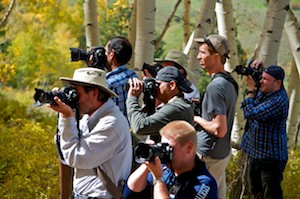
Photo workshop students line up for the sunrise shot.

Late September, 2012 – We went to Ridgway, Colorado, for a landscape photography workshop, and the Colorado Rockies were bursting with fall foliage colors when we arrived.

Dallas Creek Road Colorado Fall Foliage Ridgway Telluride Golden Aspen

The rising sun lights up our view.

Our group of 20 or so photography enthusiasts gathered at Ridgway Lodge the night before the big shoot to review our camera equipment and basic photography techniques.  My, oh my, I have never seen so many top-of-the-line Nikon cameras in one room.

The next morning, before dawn, we all piled into four cars and set off for our first shooting locale.  A scenic overlook along Route 62 heading to Telluride is a favorite among photographers, and we all lined up in front of a fence to get shots of the rising sun as it cast its pink and golden light across the colorful foothills leading to the San Juan mountains.

Dallas Divide Colorado Fall Foliage Photography Workshop

Sunrise at the San Juan mountains.


Our instructor, Nasim Mansurov, gave marching orders for how to set up our cameras for this shot.  He wanted us to shoot in manual mode, something Mark understands but that I’d never done before.  His instructions were spot on, and as the landscape before us came to life, the images on our cameras miraculously did too.  How funny it was, though, to stand shoulder to shoulder with other photography buffs in the pre-dawn light, waiting for the magic to happen in front of us!!

Telluride Colorado Dallas Divide Photography Workshop

Golden aspens and evergreens.


As we progressed from one shooting location to the next, Nasim explained the importance of using “leading lines” in our photos to draw our viewers’ eyes into our pictures.  “If you go to Rome or Egypt you’ll see that the ancient architects used leading lines everywhere,” he told us.

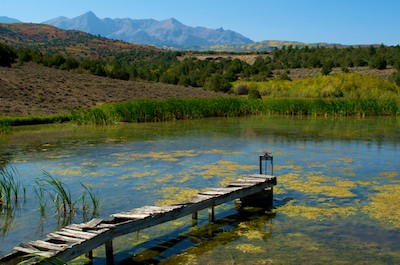
At a small pond along Dallas Creek Road, he explained that the pier could be used to create a leading line coming in from the lower left corner of the photo.  Suddenly all the cameras pointed that way to try to get the shot he described.

Dallas Creek Road Colorado Ridgway Telluride Autumn Colors

We learned about using “leading lines” in our photos.


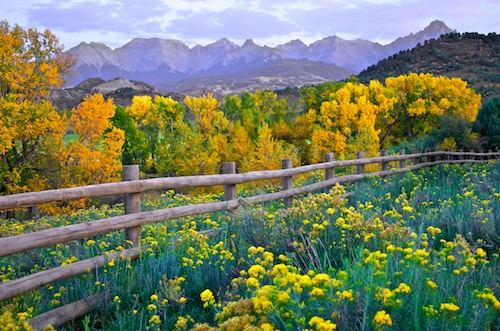
We stopped again, trying this time to incorporate an old, crooked, wooden fence into our images.  Nasim explained that the fence in the foreground would lead to the golden aspen in the mid-ground and then to the craggy mountains in the background.  Neither Mark nor I were happy with our results, but an elk hunter who was watching all of us crazy photographers crawling all over the wooden fence got a chuckle out of the scene.

Telluride Colorado Elk Hunter Dallas Divide

A hunter tells me of a celebrity wedding on Ralph Lauren’s property.


The hunter and I began chatting and he told me that at this time last year Jeb Bush’s son and Ralph Lauren’s daughter had gotten married on Lauren’s massive estate (he owns most of the stunning land in this area).  What an event that must have been, with Secret Service protecting two former presidents, and helicopters bringing in celebrities from all over.  Apparently all the national forest roads were blocked off for several days, annoying more than a few hunters and campers who were stuck on one side or the other!   Isn’t it ancient wisdom that if you’re gonna throw a big noisy party you gotta invite all your neighbors??!!

Dallas Divide Colorado Aspen Grove Last Dollar Road Photography Workshop

The aspen get paparazzi treatment!

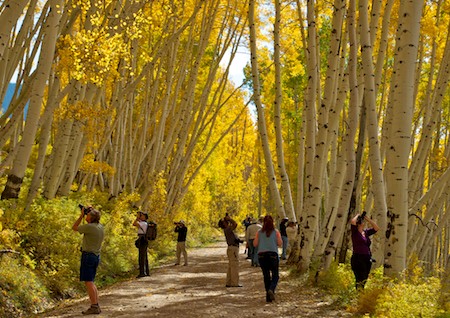
When we came to an unusual canopy of aspen trees shrouding a section of Last Dollar Road, Nasim asked us all to hold back before we walked in among the trees so we wouldn’t get in each other’s photos.  This made for a funny paparazzi crowd at the entrance to the aspen grove.  Those aspens were getting celebrity treatment worthy of Ralph Lauren himself!!

Telluride Colorado Last Dollar Road Dallas Divide Aspen Grove Photography Workshop

Photography students roam around under the canopy of aspen.


After a few moments we all wandered into the stand of aspens and let our cameras loose.  What a blast!

Last Dollar Road Colorado Aspen in the Dallas Divide

Last Dollar Road Colorado Dallas Divie Aspen Grove

True love.

Mark and I were lucky enough to be passengers in Nasim’s station wagon for the entire workshop, so we were privy to some lively exchanges between him and the other very knowledgeable folks in the car about the merits of all kinds of gear and various photography techniques and tricks.

Telluride and Ridgway Colorado Fall Foliage on the Dallas Divide


Colorado Fall Foliage Photography Workshop - what's in your bag?

A mascot comes along for the ride.

We heard about polarizing filters, graduated neutral density filters, and the quality of this lens versus that.  We chatted about figuring out an image’s hyperfocal length and dividing an image’s composition into thirds.  The discussions were fast and furious.  For us, it was an intense immersion into a new, exciting world.

As we piled in and out of the car all day, camera bags got loaded on and off laps at every stop.  And although each pocket of every camera bag was stuffed to the gills with the latest and greatest gear, Mark found one pocket that had been reserved for a special companion…

Dallas Divide Colorado between Ridgway and Telluride Fall Foliage Colors in the San Juan mountains

Inspiring Colorado views!


When the day began to wind down, we stopped for a sunset shot looking back across fields of hay bales towards the mountains.  Unfortunately, the sky didn’t cooperate with magical colors, and many of us had worn out our shutter fingers by then and reached the point of saying, “No more!!”  But Mark was still going strong, and he took one of my favorites shots for the whole day of a fence tucked snugly into a field of wildflowers.

Colorado wildflowers

Folks had flown in from all over the country, and some didn’t have to leave for another day or two, so an impromptu group gathered to take more photos the next day.  But the weather was deteriorating rapidly, and the crisp blue skies gave way to clouds and rain.  When we finally left the area, a heavy rain had fallen overnight, which blessed us with a sprinkling of snow on mountains.

Telluride Colorado Dallas Divide Fall Colors snow on mountains

What a glorious drive from Telluride towards Dolores!

Our drive from Telluride southwest to Dolores was among the most beautiful I have ever seen.  The aspens were rich in color and heavy with moisture, and the skies seemed to be brooding about the coming winter.

Telluride Colorado Dallas Divide Snowcapped Mountains and fall colors

Majestic scenery in every direction.

The aspens filled in the valleys with a vivid tapestry of green and yellow, and when I caught Mark smiling beside the edge of the road at one point, it seemed like he was standing in front of a painting.

Telluride Colorado Fall Foliage at the Dallas Divide

Is that backdrop real??

Route 62 Telluride Colorado Dallas Divide Aspens

The views continued to inspire us as our buggy sashayed along the twisting mountain roads through the mountains.  We stopped briefly at Lizard Head Pass and again in the tiny hamlet of Rico, shivering in the growing cold and sharing the exquisite views with all the other lookie-loos who’d gathered in the scenic pullouts alongside us, cameras and grins flashing.

Telluride Colorado San Juan Mountains fall foliage

The misty mountains got a little blue sky.

San Juan Mountains Colorado fall foliage

Nature’s tapestry.

Lizard Head Colorado Rocky Mountains

Colorful mountains beside Trout Lake


Finally, and sadly, the postcard landscape eventually came to an end.  We had been treated to a glorious stay in this gorgeous part of Colorado at the most colorful time of year.  As we dropped south out of the mountains into more mundane scenery, the brilliant images we had left behind became a blur in our memories.

Dallas Divide Telluride Colorado Autumn Colors aspen

Fields of gold.


What a place.  If you haven’t seen the fall colors in Colorado, it really deserves a spot on your lifetime bucket list!!!  The magic happens sometime around the third week of September…

Rico Colorado fall foliage

Rico, Colorado – near the end of this magical drive.


Of course, our next stop in New Mexico’s Bisti Badlands was pretty exotic too, and it capped off one of our best summers in our trailer!

<- Previous                                                                                                                                                                                      Next ->

Subscribe
Never miss a post — it’s free!

Related posts about Colorado’s spectacular fall color and where to see it:

More blog posts from our RV trips to Colorado:

Our most recent posts:

More of our Latest Posts are in the MENU.
New to this site? Visit RVers Start Here to find where we keep all the good stuff!!
Ridgway, CO – Peak fall foliage on the Dallas Divide – WOW!!

Ridgway Colorado Fall Colors - Owl Creek Pass Chimney Rock Dallas Divide San Juan Mountains

Chimney Rock, Owl Creek Pass

Late September, 2012 – Over the summer, while I busied myself converting our website to WordPress, Mark delved into a passionate study of photography.  Pouring over books and websites for days at a stretch, his photography skills soared.  Mine improved a bit too, since he had a tendency to read every favorite passage (which was pretty much everything) out loud.

Ridgway Colorado Autmn Foliage Yellow Aspens Owl Creek Pass Dallas Divide San Juan Mountains

Owl Creek Pass

In his studies he found a photographer who was offering a one day Fall Foliage Landscape workshop in Ridgway, Colorado, at the end of September.  We signed up immediately.  For over a month, getting to Ridgway by September 22nd  shaped our travels.

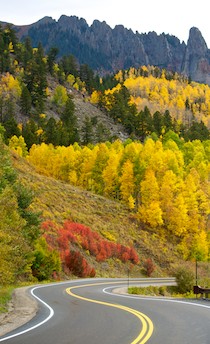
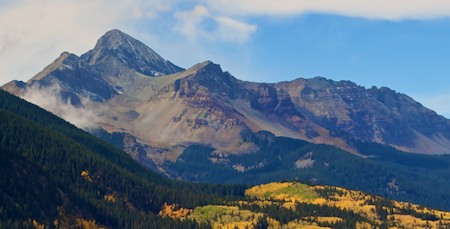
We left Fruita, Colorado, behind, and trucked down to Ridgway a few days before the workshop so we could begin the hunt for a spot to boondock.  We drove the dirt road that goes up and over Owl Creek Pass, and were thrilled to find one absolutely jaw-dropping vista after another.  The aspens were at the peak of color and the air was crisp and cool.  Our camera shutters clicked like mad all day.

Ridgway Colorado True Grit Shootout Location Owl Creek Pass

Gotta truck camper? What a boondocking spot! It’s also where the shootout took place in John Wayne’s “True Grit.”

We found an ideal boondocking spot, but there was no way we could ever get the trailer to it on that skinny, steep dirt road.  After admiring the spot for a while — and imagining how we’d set up camp and orient the rig to maximize the view — a couple showed up.  The husband walked over to me.

“Are you a True Grit fan?”  He asked.  “Did you know this is the location of the big shootout near the end?”

True Grit?” I said dumbly.  “Is that a movie?” Mark smirked and the guy raised an eyebrow.

“It’s one of John Wayne’s best ones!  A lot of it was shot right here on Owl Creek Pass!”

Ridgway Colorado True Grit John Wayne Drunk Scene Owl Creek Pass

Mark channels John Wayne.

We drove on and Mark filled me in on John Wayne.  I confess that I didn’t know a whole lot about his movies, so Mark had a lot to say since he had been a big fan as a kid.

Ridgway Colorado True Grit John Wayne Drunk Scene Owl Creek Pass

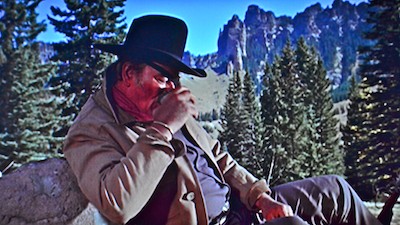
The Duke gets drunk on Owl Creek Pass

Up around the corner we came to another gorgeous clearing in the woods with a peek-out view of the colorful mountains.  That guy we’d just talked to and his wife pulled up at the same time.

“This is where John Wayne got drunk!” He said, plopping down on a rock and posing as if taking a swig.  His wife took a few photos of him, lining up the mountains in the background. Then he hopped up and motioned for Mark to sit down and for me to get a similar picture.  I had no idea how the shot was lined up in the movie, but I took a guess while Mark pretended to tip back a bottle.

Ridgway Colorado Fall Foliage Dallas Creek Road San Juan Mountains Dallas Divide

Dallas Creek Road

A few days later,  we located a copy of the movie and  waited eagerly for the drunk scene on the mountain — and then there it was!  We had gotten the shot pretty darn close!

Ridgway Colorado Autumn Colors West Dallas Creek Road Dallas Divide

This spot always has photographers in it.

The next day we met up with our workshop instructor, Nasim Mansurov of PhotographyLife.com, and we piled into his car along with some other students to scout out locations for the workshop the next day.  What fun!  We started at the fence where we would take our morning sunrise shot.  This is a very popular place for photographers, and sure enough a few were there with cameras set up on tripods.

Ridgway Colorado Fall Colors West Dallas Creek Dallas Divide San Juan Mountains

West Dallas Creek Road

Ridgway Colorado Autumn Foliage Dallas Creek Dallas Divide San Juan Mountains

Dallas Creek Road

We drove out on Dallas Creek Road where the colors ran from yellow to vivid reds and oranges.  One of the key pieces of equipment for this workshop was a polarizing filter that would enhance the fall colors.  I had inadvertently left the one for my wide angle lens on our boat back in March. Arrghh!!

However, I did have the one for my 55-300 mm lens.  So here I was looking at these wide open, vast, colorful panoramas with a telephoto zoom lens. Oh well! I focused on finding patterns in the landscape.

Ridgway Colorado Fall Foliage Dallas Creek Road Dallas Divide San Juan Mountains

Dallas Creek Road

Ridgway Colorado Fall Colors West Dallas Creek Road Dallas Divide San Juan Mountains

West Dallas Creek Road

Telluride Colorado Autumn Colors Last Dollar Road Dallas Divide San Juan Mountains

Last Dollar Road


Ridgway Colorado Fall Foliage West Dallas Creek Road Dallas Divide San Juan Mountains

We drove on a washboard dirt road…(smile)

Mark tried some wonderful artistic techniques he’d read about, and got some cool effects.

Ridgway and Telluride Colorado Coyote

A coyote poses for an instant.

On our way down out of the mountains on Last Dollar Road we passed a coyote who posed just long enough for us all to hang our cameras out the car window and take some shots.

Coming into Telluride, the afternoon sun lit the entire town in brilliant colors.  We had fallen in love with Telluride years ago when we visited in a car with a tent.  But that had been in July when the town’s colors were grey and green from the mountains and trees.  Now it was a kaleidoscope of colors and was truly sensational.

Telluride Colorado Fall Colors

Telluride’s red rocks and golden aspen

We were both ecstatic to find ourselves surrounded by such beauty.  Colorado is challenging for our style of RVing, since the roads are steep and narrow and there are rules and regulations preventing RVs from parking just about anywhere.  So we had decided against it as a destination — until this workshop.  Sure enough, we never did find a place to boondock.  After four months of never paying a dime to camp, we suddenly found ourselves paying $29 a night for a site at Ridgway State Park.  Ouch, that hurt!!  But the thrill of taking photos in this incredible location was worth ever penny.

Telluride Colorado Autumn Foliage

Telluride – one of America’s prettiest towns!

That night we oohed and ahhed over each other’s pictures as we downloaded them on our computers.  We could hardly wait for the workshop to begin on the Dallas Divide the next morning with the sunrise shot at oh-dark-thirty.

Last Dollar Road Colorado Fall Foliage

Last Dollar Road on the way down to Telluride

<- Previous                                                                                                                                                                                       Next ->

Subscribe
Never miss a post — it’s free!

Related posts about Colorado’s spectacular fall color and where to see it:

More blog posts from our RV trips to Colorado:

<-Previous || Next->

Our most recent posts:

More of our Latest Posts are in the MENU.
New to this site? Visit RVers Start Here to find where we keep all the good stuff!!

Colorado National Monument & Fruita CO – Red Rocks, Cycling & Wine!

Fruita Colorado National Monument Mountain Biker

Fruita is cycling heaven!

Mid-September, 2012 – We dropped south from Dinosaur National Monument to Fuita, Colorado, where we found a huge billboard of a mountain biker catching air on the side of an industrial building. How cool! We had heard from friends that this area was mountain biking and road cycling heaven, and so it was!

WTF - Welcome to Fruita

Besides a vibrant mountain biking culture — or maybe because of it — this town seems to enjoy being a little bit irreverent. Stickers and patches emblazoned with “WTF” were for sale everywhere. It’s short for “Welcome to Fruita.”

Fruita lies to the west of its much bigger neighbor, Grand Junction. Paved bike paths weave along the edge of the Colorado River, which flows alongside by these towns, and we enjoyed several rides in the area.


Fruita Colorado Paved River Bike Path

Paved bike paths weave along the river.

Colorado National Monument - Scenic Rim Rock Drive

Scenic Rim Rock Drive

However, most serious road cyclists here head into Colorado National Monument to take on the challenging climbs and sweeping descents of Scenic Rim Rock Drive. We decided to tackle it with the truck instead, so we could bring spare lenses and tripods, and were told at the gate, “You can do the drive in about 45 minutes…”

Colorado National Monument a great place to take your RV!

Beautiful views!

Four hours later we’d made it through only half of the park! What a stunningly beautiful drive. It is loaded with gorgeous viewpoints and short hikes, and we found it impossible to drive straight through without stopping every few minutes. We came back the next day to try to see the rest of it, and after another four hours still hadn’t seen it all.

Colorado National Monument - Window Rock

Window Rock

The road twists and turns along the edges of the canyon, poking out onto peninsula-like points and winding back around valleys, offering ever-changing views of red rock formations. One of the most impressive pinnacles is Independence Monument, a 450 foot tall monolith that dominates the center of the valley.

Fruita Colorado National Monument - Independence Monument

Independence Monument

As we scrambled along the wonderful flat rock shelves that make up the Canyon Rim and Window Rock hiking trails, we kept hearing voices from the valley below us.

Rock climbers on Independence Monument at Colorado National Monument

Watch this!!
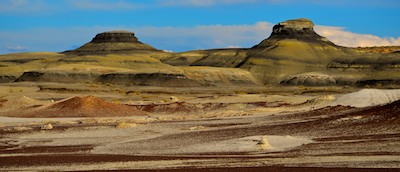
We couldn’t tell exactly where they were coming from for the longest time, but then suddenly a group of people appeared on the top of the spire. Independence Monument is a tall skinny rock, and the tiny figures ambled around on top, peering over the edges.

Suddenly they threw a rope over the side and started rappelling down. Now this is not just a straight sided cliff. There is a huge rock overhang at the peak, and each climber dangled for a few moments on the rope, bumping his way down until he got his footing on the rock below. Yikes. We were glad to have lots of solid footing all around us on all sides!

Monument Canyon at Colorado National Monument

Monument Canyon

We learned later that every Fourth of July local climbers scale this peak and plant a huge American flag on the summit of the spire.

The first climber to scramble up that sheer rock wall was John Otto, and today’s most popular route to the top is the one he took in the early 1900’s. He loved this canyon and wanted it to be preserved for future generations, and he campaigned tirelessly for the creation of the Colorado National Monument.


Devils Kitchen - Colorado National Monument

Devils Kitchen – for scale, see my red shirt!!

It was finally established in 1911. Not only did he oversee construction of Rim Rock Drive, which was initially called the Serpents Trail with 52 switchbacks in just four miles, but while he was the park’s first custodian he created many of the hiking trails that are still enjoyed in the park today.

Fruita Colorado National Monument Cold Shivers Point

Cold Shivers Point

Even more intriguing than the official park history, however, was the bizarre history we found engraved in the stones at Cold Shivers Point. As we walked towards the edge of this spectacular overlook, stepping across nature’s broad, unevenly spaced patio stones, we looked down and saw each one was etched with all kinds of names, initials, and dates. The dates ranged as far back as the early 1930’s, and included every decade to the current year.

Fruita Colorado National Monument Cold Shivers Point graffiti

Engraved initials date back to the 1930’s

Some names were big, some small, some were in pairs with a plus sign, and others were surrounded by hearts.

Fruita Colorado National Monument Cold Shivers Point graffiti

The Wongs were here 70+ years ago

The Wongs had included a Chinese character, and “R.A.S” had pecked his/her initials out like a woodpecker in 1938.

Fruita Colorado National Monument Cold Shivers Point graffiti

This guy used a woodpecker technique

This was a lover’s lane of sorts, and we found out later it has also been used as something of a lover’s leap too.

Back down in the valley of Fruita we discovered this area is rich farmland. The farmer’s market had some of the most wonderful fruits and vegetables we have sampled anywhere. The apples were tiny but crisp and bursting with flavor, the cucumbers tasted heavenly — who would think a cucumber could taste heavenly? — and the melon stand had a line of people around it slurping noisily. “We don’t have to go to Green River to get good melons,” an old fellow said to me, wiping his chin. We knew what he meant. We’d been to Utah’s Green River during the melon festival years ago, but these melons were every bit as delicious.

Fruita Colorado Farmers Market band

A band was playing at the farmer’s market

A lady selling alpacas and their wool kept the kids occupied for hours. These friendly, gentle animals made sweet humming noises as the kids hung over the fence and petted their thick fur. They are relatives of camels, she told us, but they’re so much cuter!

Fruita Colorado Farmers Market Alpacas for sale

Alpaca

This is also wine country, and on the other side of Grand Junction the small town of Palisade is home to lots of vintners. We drove the wine route and sampled some delicious wines. The port wine from Graystone Winery  was my favorite, while Mark fell for a white wine early on in our tour. But by the end neither of us could remember which one it was!!

Fruita Colorado Palisade Colorado Wineries and Wine Country

Palisade boasts lots of wineries

In late September we often go to the Interbike trade show in Las Vegas to check out the latest bicycles and cycling gear.  This year, however, we opted to attend a photography workshop in Colorado instead.

Fruita Colorado Palisade Colorado Wineries

We had fun on a wine tour

We did get a tiny whiff of bike stuff, though.  A friend of ours builds bicycle wheels at DT Swiss in Grand Junction, and we got a peek at the shop. Spokes were flying off the production line and the truing stands were whirring at this small, high end bicycle wheel manufacturer.

Grand Junction Colorado DT Swiss Wheel Building Factory

DT Swiss bicycle wheel builders

Soon the photo workshop day arrived, and we made our way to Ridgway, Colorado, where the leaves were in the absolute peak of color. What a majestic place that turned out to be!!

More blog posts from our RV trips to Colorado:

<- Previous                                                                                                                                                                                       Next ->


Dinosaur National Monument, UT – More than fossilized dinosaur bones!

Dinosaur National Monument has great road cycling

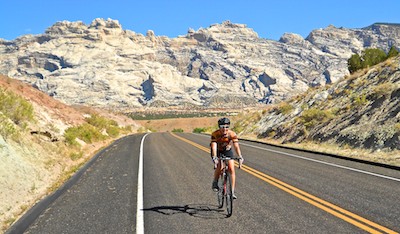
Dinosaur National Monument is great for cycling.

Early September, 2012 – Dinosaur National Monument is a big park that sprawls between NE Utah and NW Colorado. Many visitors buzz through this park, seeing only the bone display at the quarry.

However, the scenery, homesteads and petroglyphs elsewhere in the park kept us hanging around for quite a few days.

Dinosaur National Monument Road Cycling

We had fun on the bikes.

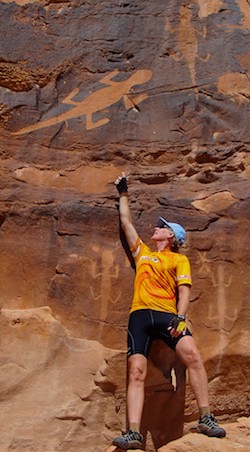
Dinosuar National Monument Lizard Petroglyphs

Lizard images crawl up the wall

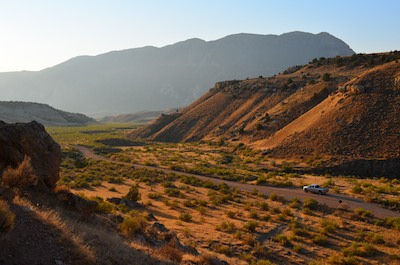
We rode our bikes on the ~12 mile road that heads into the western heart of the park. This is a fantastic road for cycling.

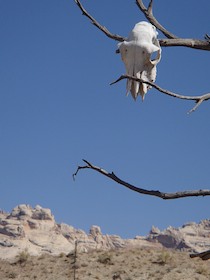
Dinosaur National Monument skulls in a tree

Skulls hung in a tree.

Only a handful of cars passed us in four hours of pedaling and stopping for photos, and the sweeping turns, rolling hills and stunning vistas were a total thrill.

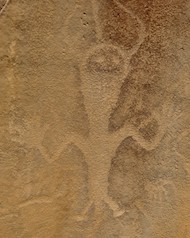
Dinosaur National Monument Petroglyph

What’s that on his head??

There are lots of petroglyphs along this road.  Most are a bit faint, and you have to do the billy goat thing to get up close to a few of them, but they are intriguing, with odd designs of people wearing strange things on their heads.

Dinosaur National Monument Josie's Cabin

Josie’s Cabin


Someone had hung a slew of animal skulls in a tree that we passed.  It was a little weird and gave the area an air of mystery.

The clearest petroglyphs we found on this road were on a sheer wall filled with lizards (photo above).  They march upwards from the bottom of the wall towards the top.  One six foot long lizard heads off to the right.  A perfect photo op would have been if a real lizard had snuck across the petroglyphs for us, but we didn’t get that lucky!!

Dinosaur National Monument Josie's Cabin

It’s a tiny, wee cabin

At the far end of this road, after it turned to dirt, we came across the Josie Morris Cabin.  This tiny four room cabin was home to a very plucky single woman for fifty years.  Married five times and divorced four, a rarity in her time, she bought this small ranch when she was a single mom nearing 40 in the early 1900’s.  She lived here first with her son and then alone until her death at 90 in 1964.

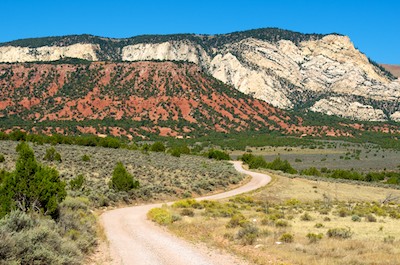
Dinosaur National Monument McKee Springs Road

McKee Springs Road – Where the artists rocked!

The building is wee, and walking around the property to her chicken coop and pasture, it was hard to imagine what life had been like out here, miles from nowhere.  But she was a tough old biddy.  She brewed apricot brandy during Prohibition and got arrested twice for cattle rustling when she was in her 60’s.

Dinosaur National Monument McKee Springs Petroglyphs

McKee Springs Petroglyphs


Dinosaur National Monument McKee Springs Petroglyphs

One morning we came into the park from another angle, taking the road to McKee Springs.  Here, in a wide valley, we found the finest petroglyphs we have ever seen anywhere.

Dinosaur National Monument McKee Springs Petroglyphs

This must tell a story.

Dinosaur National Monument McKee Springs Petroglyphs

Dinosaur National Monument McKee Springs Petroglyphs

A ghostly double? Two sets of arms? Huh??

Like all petroglyphs in this part of the country, they date back about 1,000 years to the Fremont culture, but lord knows what they say. All the figures wore headdresses or spiky things in their hair (antlers? feathers? antennae?). Some had elaborate decorative things around their necks, wore earrings, or dressed up their hair on the sides of their heads.

These petroglyphs are all lined up along the sheer faces of a cliff at eye level, and a path leads from one set to the next.  It is like walking through a museum, but there are no curator’s notes explaining what you are looking at.  That is left up to the imagination!!

Dinosaur National Monument Rainbow Park

Dinosaur National Monument’s Rainbow Park

At the far end of this road there is a tiny campground on the Green River at Rainbow Park.  Not a soul was around.  We thought about bringing the rig down here, but we wanted to get to the other side of the park, and for that we had to go into Colorado and come in from the southern end along Harpers Corner Road.

Dinosaur National Monument Echo Canyon Scenic Drive

The drive to Echo Canyon was beautiful

The highlight of this road was the 13 mile drive down the steep dirt switchbacks into Echo Canyon (4×4 required).  At the top the views stretched on forever, and as we dropped lower and lower into the canyon, the cliffs soared upwards on either side of us.

Dinosaur National Monument Whispering Cave

The cliffs towered on each side of the road.

Dinosaur National Monument Chew Homestead

The Jack Chew Homestead


Partway into the canyon we stopped at another early 20th century homestead, this one built by the Chew family.

Dinosaur National Monument Whispering Cave

You gotta stoop to get into Whispering Cave.


Dinosaur National Monument Whispering Cave

This cave features vaulted ceilings!

Unlike Josie’s solitary life, the Chews brought 6 of their 12 children to live here, starting with a dugout in 1910 and moving into a cozy one room cabin in 1911.  How a family of that size could squeeze into one small room during the long dark winters baffled us.

Steamboat Rock Dinosaur National Monument at Echo Canyon on Yampa River Green River

Steamboat Rock

But this gorgeous, harsh land has sheltered people in tiny places for eons.  The Whispering Caves a little further on had a low entrance but high ceilings inside, and a steady cool breeze blew from between the towering cliff walls.

Steamboat Rock is the centerpiece of Echo Canyon, and we hiked around the valley get a look at it from many angles.  The Yampa and Green Rivers swish around its base, and folks were swimming and kayaking around it.

Dinosaur National Monument Harpers Corner Trail

Views of thousand foot cliffs from Harpers Corner Trail

Instead of swimming, we got our exercise hiking Harper’s Corner Trail, a fantastic out-and-back trail that goes along a ridge overlooking canyons on either side.  From this high vantage point it was easy to see how the rivers had carved out their route between the craggy, horizontally striped cliffs.

Dinosaur National Monument Green River Views

The Green River weaves its way towards us.


On the other side of the trail the Green River made its curvy way towards us.  We watched a group of river rafters floating down stream, a thousand feet below us.

The night skies in this park are among the darkest in the country, and when we ventured out of the trailer one night, the Milky Way was a thick white band, like a wide belt, that crossed the entire sky.

Star Trails at Dinosaur National Monument

Star Trails

Mark had been reading up on various photography techniques, and this was a great place to try a star trails photo.  Pointing the camera at the North Star on his tripod, he left the camera shutter open for an hour to catch the movement of the stars in the sky.

Well, he meant to do it for an hour.  He came into the trailer to warm up, laid down on the sofa, and promptly fell asleep.  When he woke up, an hour and a half had passed!  Oh well — it just made the star trails a little longer!!

We were both very well rested by the time we pulled ourselves away from Dinosaur National Monument, and we were ready for a little in-town activity in nearby Fruita, Colorado.

Our story Dinosaurs and Much Much More was featured in RV Life Magazine in the September 2013 issue.

<- Previous                                                                                                                                                                                       Next ->


Vernal, UT – Colorful Gateway to Dinosaur National Monument

Vernal Utah summer flowers

Flowers decorate the streets of Vernal, Utah.

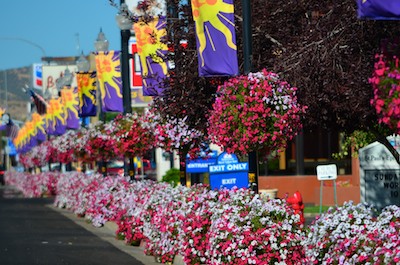
Early September, 2012 – From the brilliant colors of Flaming Gorge National Recreation Area in Utah we dropped south to Vernal, Utah.  The town streets were lined with colorful flowers in planters and hanging baskets, and I hung my head out the window taking photos on the fly.  What a beautifully decorated town!

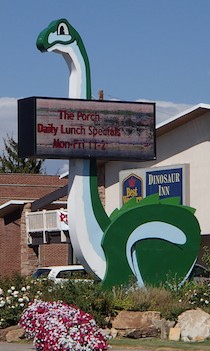
From our RV window we see a dinosaur welcoming us to Vernal, Utah

A dinosaur welcomes us to Vernal!

We see a lot of small towns in our travels.   Some we like immediately while others grow on us slowly.  Vernal was one of those that made us smile right away.

The dazzling masses of flowers were so inviting.  It seemed like a happy town, and we both said in unison, “I like this place!”

Dinosaur Museum Vernal Utah

Dinosaurs were everywhere!

Some small towns have a theme, especially if it hosts a lot of tourists.  The theme might be something general and a bit vague, like “seaside beach town” or “woodsy mountain town” or “college party town.”   Sometimes you have to kind of hunt around to figure out what it is.

Dinosaur at Best Western in Vernal Utah

Come stay with us at the Best Western hotel!

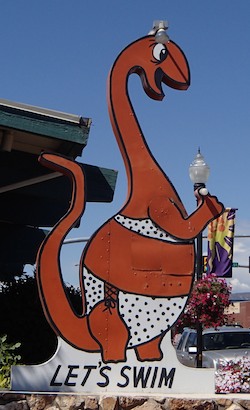
But Vernal’s theme is right out there, front and center:  This is Dinosaur Town!  Dinosaurs were everywhere.  They were welcoming folks to town, hawking rooms at the Best Western, inviting kids to go swimming, and milling around outside the Dinosaur Museum.  There were so many dinosaurs in this town that we did a special bike ride up and down the streets to capture as many as we could with the camera.  What a totally fun place.

Dinosaur Museum Vernal Utah

Welcome to the Dinosaur Museum

Of course, there is a reason this is Dinosaur Town, besides the townsfolk having a fascination with them.  Vernal is the gateway to Dinosaur National Monument where paleontologist Earl Douglas found a nearly perfect Apatosaurus skeleton in 1909.  It all started when he first unearthed a string of the beast’s vertebrae buried in the dirt in a nice little row.  The skeleton now resides at Carnegie Museum (Andrew Carnegie funded the work of Douglas and later scientists who quarried bones here).

Apatosaurus (Brontosaurus) at Dinosaur National Monument Utah

Apatosaurus

Apatosaurus is a long necked and long tailed plant eating dinosaur that walked on all fours, stood about 16 feet high, and was 70 feet long end to end.  If one of them tried to hide behind a typical one-story ranch style house, the head and tail would stick out either end.  Watch out for that swishing tail!

A Dinosaur in Vernal Utah invites kids to swim at a hotel pool - taking your RV there is fun too.

What a fun pal in the swimming pool…

This big guy has also been known as Brontosaurus, a name I remember from my childhood.

How did that 149 million year old skeleton happen to wind up on a hillside in the vast, empty, rocky area south of Vernal, waiting for a fossil-collecting paleontologist to find it in 1909?  It turns out it was sitting in the middle of what scientists discovered was something of a dinosaur graveyard.

Vernal Utah is a great RV destination with a fun dinosaur theme

Did you know dinosaurs liked watermelon??

Back in dinosaur days, all those millions of years ago, North America and Eurasia were just beginning to go their separate ways, and the climate was dry in this part of the world.  Rivers and flood planes wound through the area.  Dinosaurs ate the vegetation at the river’s edge, and as the water flooded and receded, they died in the muddy riverbed and were quickly embalmed in sediment.  Over time, at a molecular level, the sediment replaced the organic parts of the carcasses, and the bones became petrified, or crystallized, into rock.

RV Blog - dinosaurs in Vernal Utah

Dinosaurs mill around all over town.

Dinosaur in Vernal Utah

In this area a lot of dinosaurs met that fate, and consequently the “Dinosaur Quarry” is a deep and wide field of bones from the Jurassic Period.

The find that Earl Douglas made fired up the imagination of the early 20th century folk.  These were the days before the children’s book “Danny and the Dinosaur,” the Flintstones’ “Dino,” and lovable, purple Barny.

Vernal Utah dinosaur bares its teeth to RV travelers

This one has teeth!!

The newspaper accounts of the time had to follow the word “Dinosaur” with the explanation, “a pre-historic animal-reptile,” since not everyone knew what a dinosaur was.

Shuttle bus rides to Dinosaur National Monument make it feel like a Disney Theme Park

Is this a Disney Theme Park?

Douglas’ dream was to allow the public to see what the hillside looked like when the topsoil was removed — since it is a veritable pile of massive bones — and he envisioned a viewing area built over the quarry that would protect it from the elements and offer shade to visitors. The National Park Service obliged a few decades later.

Wall of bones on display at Dinosaur National Monument

A wall of bones is sheltered by a unique building.

At the visitors center we hopped into one of the open air shuttles that the NPS provides visitors to get to the quarry site. We felt a little like we were at a Disney theme park when we jumped in. It is a short, steep ride to the unique quarry building.

In our RV travels we found a Dinosaur graveyard at Dinosaur National Monument

This was a dinosaur graveyard.

The original building was considered a masterpiece of design, set off with a graceful butterfly roof. But the geology of the area wasn’t fully understood at the time, and natural forces began to wreak havoc with the structure. The National Park Service renovated the building in the early 2000’s and now it will presumably last a long time.

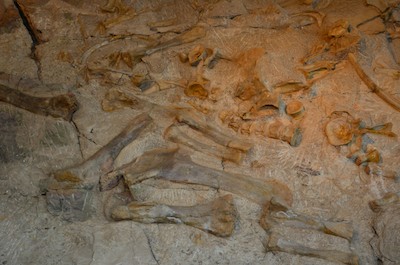
When we walked in the door, we found ourselves staring at a wall of dinosaur bones.

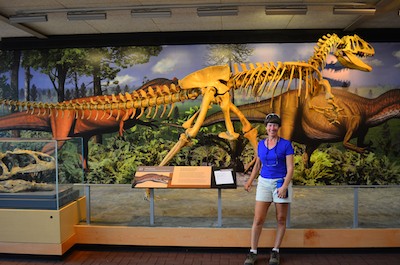
A reconstructed dinosaur skeleton at Dinosaur National Monument

It is hard to fathom how big these guys were and how long ago they lived.

History came alive as we walked along this slab of earth where Earl Douglas and so many subsequent paleontologists have painstakingly studied these layers of bones.

Vertebrae, skulls, leg bones and other intriguing things are all lying there, still encased in the rocky soil.

The National Park Service encourages visitors to touch the dinosaur bones

Mark checks out an enormous bone.

Visitors are encouraged to touch the bones, and putting a hand on an immense bone is quite a thrill.  However, we both still found it very hard to fathom the vast span of time that the dinosaurs existed (nearly 90 million years), and the antiquity of that era (they went extinct about 65 million years ago).  Usually our visits to “ancient sites” take us to places where humans lived just a thousand or so years ago.

A skull on display at Dinosaur National Monument

That is one big head!!

Wildflowers outside Dinosaur National Monument

To our surprise, we found out Dinosaur National Monument is loaded with treasures from those more recent times too.

So we stayed for several days, seeking out some of the best petroglyphs we have seen anywhere, hiking and driving through some spectacular scenery, and wandering through two homesteads from the early 1900’s.


Click here for our next post about PETROGLYPHS and CYCLING at Dinosaur NM.

Our story Dinosaurs and Much Much More was featured in the September 2013 issue of RV Life Magazine.

<- Previous                                                                                                                                                                                       Next ->

Flaming Gorge Utah – Fiery canyons, a cool river, and nearly tame bighorn sheep

Flaming Gorge Utah Rainbow over our RV

A rainbow frames the buggy

Early September, 2012 – Leaving the northern half of Flaming Gorge in Wyoming, we settled down near the heart of the gorge in Utah where it is a part of the National Park Service.

Flaming Gorge Utah RV Views

Mark gets a front row seat to the view.

The storms continued to march across the sky every afternoon, and one day, just as the sun was setting, the sky went black and a brilliant rainbow formed right over the buggy.

Flaming Gorge Utah Greendale Overlook

Kids monkey around for the camera

The overlooks and walking paths near the Visitors Center offer the most impressive views of the gorge, and we wandered out to the edge of the cliffs repeatedly to see the breathtaking scene from every possible vantage point.

Flaming Gorge Utah Canyon Rim Hike

The Canyon Rim hike goes through the woods too.

Brilliant mornings complemented the brooding afternoons.  As we paused one afternoon to enjoy the views from one overlook, a crowd of young families showed up.

Flaming Gorge is a perfect area for families, as there are all kinds of things to do, from hiking to biking to camping to visiting with herds of grass-eating animals to taking a tour of the dam.  This group of families was having a ball.  Half the parents were out on mountain bikes somewhere while the other half chilled at the overlook.  The kids romped all over the place in very high spirits, despite the gathering afternoon storm.

RV boondocking view of Flaming Gorge Utah meadow at sunrise

Meadow at sunrise.

They posed for their moms to take a photo, and they were all so cute I had to get one too.  Just minutes after that the skies opened up and we had a downpour that pelted everyone and everything and soaked us all to the bone.  The kids laughed it off, but we felt badly for the late returning dads who had to hurry in the driving rain to get all the mountain bikes back on their bike racks before they drove off in a blur of spray.

RVers coming to Flaming Gorge will find stunning views and camping

Breathtaking views at every turn.

Between storms we were gifted with glorious sunshine.  We hiked the Canyon Rim between the visitors center and the Canyon Rim Campground, taking two photos for every five steps.  What a place!  Rock outcroppings hang out over the edges of the cliffs all along the rim, making for dramatic views (and a little bit of stomach churning if you stand on the edge and look straight down).  Campers can set up in sites with marvelous views.

RV boondocking offers amazing views of Flaming Gorge

Now it’s my turn to perch on a cliff.

The big horn sheep are very much at home in this terrain, though, and a large herd was mingling with the campers in the Canyon Rim Campground.

Another woman watching them through the viewfinder of her camera (just like we were) told us they had been wandering between the campsites  all four days she had been there.

Bighorn sheep at Flaming Gorge's Canyon Rim Campground, an RVers delight

A herd of bighorn sheep hung out at the campground. Rangers track their movement by radio.

As we chatted, the group of sheep stood and stared at us, barely moving.  They formed something of a protective circle, facing outwards.  They stood there so long the young ones got bored, as we did, and eventually two of them laid down behind the shield of their parents’ legs.

Big horn sheep at the Flaming Gorge Canyon Rim Campground

We watched each other carefully.

These guys were very accustomed to humans, and they let us get close enough to see that the largest one had been outfitted with a radio collar.  A large antenna stuck out from the radio on his neck like a third antler behind his head.  Rangers told us they track the herd very closely.

Flaming Gorge Dam

Flaming Gorge Dam

Flaming Gorge used to be a free-flowing river, and one afternoon we took a tour of the Flaming Gorge Dam.  Built in the late 1950’s, it was one of the West’s many water reclamation projects of the mid-1900’s that tamed the west’s wild rivers and provided electrical power to nearby communities.

Flaming Gorge Dam turbine

An original turbine was replaced recently and is now on display.

The most amazing thing about these dams, I find, is that in order to build them the rivers had to be re-routed temporarily.  At Flaming Gorge, as at all the other major western dams, a huge tunnel was dug into the cliff so the water would bypass the dam construction area.  The concrete is so thick in Flaming Gorge dam that it will take 100 years to cure fully at its center.

Turkey vultures dry their wings on the scaffolding outside the Flaming Gorge dam.

When the sun came out, the whole flock dried off its wings.

That means the concrete at the core is only half cured now, and it puts the cure date sometime just before 2060!

A turkey vulture at Flaming Gorge Dam

Seeing an original turbine that had recently been replaced was interesting, but what really caught our attention was the huge flock of turkey vultures sitting on the scaffolding outside the dam.

Sweeping views from the Flaming Gorge Visitors Center in Utah

Flaming Gorge was an awe-inspiring place to visit.

When we started the tour raindrops were falling, and these guys were hunkered down waiting for the typical afternoon deluge.  But when we emerged from the bowels of the dam’s massive structure an hour later at the end of the tour, we discovered the sun had come out and all the turkey vultures were now sitting with wings outstretched, drying off their feathers!

Flaming Gorge is a magical place, and we dallied for a while.  But eventually the lure of dinosaurs drew us away and we drove further south to Vernal Utah and Dinosaur National Monument.

<- Previous                                                                                                                                                                                       Next ->

Latitude 38 uses our Mexico Cruising Guides for their new “First Timer’s Guide to Mexico”

Latitude 38's First Timer's Guide to Mexico Cover (1)

Posted: October 1, 2012

The new edition of Latitude 38’s First Timer’s Guide to Mexico, which is used by the Baja Ha-Ha Rally fleet, is out — and we were a part of its production!!  Last year Latitude 38 publisher Richard Spindler discovered our Mexico Cruising Guides Part I and Part II and liked them so much he incorporated them into the new edition of the First Timer’s Guide to Mexico!  The e-book is here.  How cool is that??!!