

Las Vegas lights at night.

Harrah's Casino & Hotel.

View of the Venetian.

For a cool $18 grand, this bike could be yours.

A true giant of the bike
industry, Ernesto Colnago.

A bikcycle with a royal pedigree:
Colnago and Ferrari.

The bike ridden by '09 Tour de France winner
Alberto Contador on the final stage of the race.

Eddie Merckx
5-time Tour de France
champ.

Glittering walls inside the Venetian.

The Venetian recreates aspects of Venice.

Alice Cooper
ready to rock at 7 a.m.

Bob Roll, famous (or infamous)
bike race announcer.

George Hincapie signs
autographs.

21 lb. Calfee carbon fiber tandem.
Could two men sprint on that bike?

Wooden bike seemingly made of pencils.

Chris Carmichael, famous for designing Lance
Armstrong's workouts.

Calico Hills hike.

Red Rock Canyon.

Intriguing formations at every turn.

Desert plants eke out a living in this
harsh environment.

The cliffs are bigger than they appear at a distance.

Hands across the ages.

Stately Joshua trees line the road to
Spring Mountain Ranch.

Wild burros.

The burros enjoy the only lush
green grass for miles.

A roadrunner greets me at the ranch.

Spring Mountain Ranch house.

The kitchen's copper stoves were replaced with stainless
steel by Howard Hughes.

Vera Krupp's dressing room.
Two sides of Las Vegas, Nevada
Late September, 2009 - We continued down I-15 from Utah and traveled to
Las Vegas, Nevada for the annual Interbike bicycle trade show, a week long
testosterone-filled bicycle love-fest for crazed bike junkies. The largest show of
its kind on this continent, I have attended enough times over the years that I
opted out this year. I chose instead to spend a quiet week alone just outside
Sin City at peaceful Red Rock Canyon National Conservation Area while Mark
and his son lived it up at the Imperial Palace on the Strip. They brought back
endless stories and photos, the highlights of which I'll share here (my Red
Rock Canyon notes are further down the page).
The amazing thing I noticed about Las
Vegas ages ago, while on a plane flying
away from the city, is that it is entirely lit
up with colorful lights at night. No
ordinary urban night sky, every
building is outlined in red or
yellow, green or blue.
Huge neon signs blast the
names of the casinos into the
night air, and spot lights
transform each building's
facade into a colorful canvas.
Mark took a few shots from the
window of his room at the
Imperial Palace, showing
Harrah's and the Venetian in
their evening finery.
Entering the Sands Convention Center for Interbike is like opening the door to
the most massive bike shop you can imagine. Acres and acres of vendors fill
the entire hall, showing off bikes, clothing, gear, and everything else that is
even remotely related to the bicycling industry. Vendors are situated in
international groupings, with China and Taiwan occupying a large piece of turf
at one end of the hall while the Italians dominate another. English is in short
supply when you enter these regions. Mark has a soft spot for classic Italian
bikes, and he made a beeline for the Pinarello booth where their new Dogma
was on display. This little puppy would set you back a mere $17,900. And that
doesn't include pedals. What a ride!
Ernesto Colnago is a
legendary Italian bike builder,
and he posed for a quick
photo. He has never owned a
car and routinely turns out
some of the most beautifully
crafted bicycles in the world.
His company has teamed up
with race car manufacturer
Ferarri recently, and their
collaborative effort was on
display.
Over at the Trek booth Mark found the bike ridden by 2009 Tour de
France champion, Alberto Contador, on his winning laps around the
Champs-Elysee in Paris this past July. The ultimate overall yellow jersey
winner usually has a pretty good hunch he'll be the champion when he
arrives for the final stage in Paris, so his team goes all out with the yellow
trim paint job on the bike (and the yellow clothes, helmet and gloves as
well) for that stage.
Eddie Mercx of Belgium was arguably
the finest cyclist that ever lived.
Although he won just five Tours, as
compared with Lance Armstrong's
seven, he also entered every race
offered all year long, winning most of
those as well.
In contrast, Lance raced only a few races each
year, and those not to win but simply in
preparation for his Tour de France campaign.
What a thrill to catch the great Eddie himself
signing autographs.
Interbike causes extreme bike overload, and it is
nice to get out into the regular world of Las Vegas
tourism. The Venetian casino and hotel is a glitzy
recreation of elements of Venice with a strong
American materialistic accent.
The ceilings are adorned with
elaborate, glittering artwork, and
outside the gondolas drift across
a languid pool.
The gondolas are authentic,
made in Venice. The gondoliers
are hired actors with good singing
voices.
Vegas never sleeps, and when
Mark staggered out for breakfast
at 7 a.m., he found himself face to
face with Alice Cooper. Mark's
sister had just seen Alice in concert in Michigan a
week earlier. And here he was again, in Vegas of
all places!
Not quite as dressed up in the early hours of the
morning, but showing every bit as much support
for the classic era of Rock on his T-shirt, Bob Roll
stood chatting with passersby at the show.
Famous as a great cyclist, but even more
infamous for bringing a distinctly low-brow
American slant to the brilliantly high-brow race
commentary of Brits Phil Liggett and Paul Sherwin,
Bob is both loved and hated for his televised and
blogged analysis of The Tour.
Nearby, Lance Armstrong's legendary lieutenant,
George Hincapie, was hawking his line of clothes
and signing autographs as well.
Back to the bikes, Calfee had a phenomenal 21-
pound wonderbike for two. Made of carbon fiber
and intended for all-out tandem racing, you can
only wonder how it would support two full grown
men pounding on the pedals in a sprint finish.
Interbike is as much about innovation and
weirdness as it is about fast, sleek racing
machines. Bikes made of bamboo, odd cycles
involving more than two wheels and more than
one drive-train were on display all over the place.
The wooden bike made of hexagonally cut birch
caught Mark's eye. It looks to me like it is made
of pencils.
One more icon of the biking
world wound up in Mark's
camera lens: Chris
Carmichael. We turned to
his books for training tips
many times in years past.
Deriving his fame from
creating Lance's workout
plans, he is the master of
periodic and interval training
techniques and was here
promoting his latest book.
While the boys were nourishing their bike lust in
Las Vegas, I settled into a quiet routine of reading,
writing and bicycling in nearby Red Rock Canyon.
This spectacular National Conservation Area,
administered by the BLM, boasts a huge range of
red rock mountains. Revered the world over for its
top notch rock climbing, we hiked the easy Calico
Hills route together before Interbike began. This is
a simple hike along a gravel trail flanked on one
side by enormous red rock cliffs.
Once a vast land of sand dunes, not unlike the
Sahara today, the sand's massive weight caused it
gradually to solidify into rock while underground
streams oozed mineral deposits through the sand
and stained it many shades of red.
The desert vegetation clings on for dear life,
subsisting on rare sips of water in baking sun.
In places, using a bit of imagination, the mounded
domes of rock almost resemble sand dunes.
Clearly visible stripes show the shifting direction of
the winds over millennia, as the sand piled up one
way and then another.
Humans have been here for a mere blip in
geological time, a few thousand years as compared
to hundreds of millions of years. Along the Willow
Loop trail there is a rock wall with a few pictographs
of human hands. The hands were child-size by
today's standards, but they are clear and distinct.
What an unusual mark to leave for the ages. And
what kind of pigment did they use to stain the rock
for the next few thousand years, lasting through
rains, winds and desert sun? What did it do to their
hands?? Isn't ironic that for all our technical
sophistication, modern house paint needs to be
replaced every few years while these pictographs
have been here for eons.
A few miles from Red Rock Canyon is Spring Mountain Ranch State
Park. This ranch has been built and added on to by many owners over
the last 150 years. Starting with a "mountain man" and most recently
owned by Howard Hughes, the history is downright quirky.
Before getting
started on the ranch
house tour, I got a
glimpse of some wild
burros in the grass.
There were all kinds
of signs on the
scenic roads in the
area warning drivers
about the wild burros. I thought at first I was
looking at domestic donkeys, but I soon learned
that these guys aren't just wild, they are also
wily and smart. This was the only green grass
anywhere around for many miles. After the
burros' persistence succeeded in several
break-ins through the fence, the park rangers had
finally given up and let them come and go on the ranch
property at will. These wild burros had it all figured out.
Afterall, who wants to eat cactus and brown prickly
shrubs when manicured grass is right there for the
munching?
A little roadrunner greeted me too as I pulled up to the
ranch house. He checked me out for a while before
running away.
The house at Spring Mountain
Ranch is humble. Various owners
have added wings and features to
it over the years, but it remains
essentially a small home. The
kitchen featured stainless steel
appliances, but I learned these
were from the most recent
owner, Howard Hughes, who
never lived here (and possibly
never even came out here!). He
removed the original copper
appliances and had his hotel
guys do a lot of renovating with
plain, hotel quality materials.
The previous owner, Vera Krupp, a pre-World War II German movie
star, added a dressing room to the bedroom suite. She is known for
having owned the 33 carat diamond that Richard Burton ultimately
purchased (at auction) for Elizabeth Taylor. That diamond seems to
have been a bit of a curse, as some armed robbers stormed into this
remote ranch and ripped the ring from her finger while she was
wearing it! She got it back six weeks later, however, and forever after
wore it pinned to her underwear.
Vera also had an ultra-private room built for herself, with a secret
access through the second "closet" door to the right of her vanity.
She was not to be disturbed when she retired to this room. It was a
tiny room with floor to ceiling windows on either side, a perfect
sanctuary for her quiet pleasure.
I had enjoyed my week of sanctuary too. When it came to an end, we escaped a 100+ degree heat wave that baked Las Vegas for
a few days by scrambling back to Cedar City, Utah, to cool off. When a cold front stormed across the west a few days later, we
ventured south again to the other side of Las Vegas. By then the temperatures at Valley of Fire were perfect.
Helmville Rodeo, MT – RV Camping with Horses

The rodeo horses run in from a distant pasture.

Some rodeo kids stop by our rig.

Ladies' Barrel racing.

What a thrill!

Sharp turns and quick starts and stops.

Mom and daughter watch the races.

The 10-and-under riders took their time.

Future rodeo star.

Kids clamp onto sheep's wool for the
Mutton Busters race.

They all fell off eventually.

Some get plucked off when the going gets too rough.

One tried to ride upright.

He was a crowd pleaser.

The kids loved every bit of the rodeo scene.

Can I pet you?

Moo.

The pros.

Resting between events.


2009 Finals
Elite Professional Bullriders, Inc.

And that's what this profession is all about.

Youngsters learning to take the kicks...

Face plant.

Steer wrestling.

Tie down roping - first rope the calf.

Then tie it down as your horse keeps tension on the line.


Tie the knots well so the calf can't wriggle free later!

Team cow roping and milking.

Getting a cup of milk for the referee.

Helmville, Montana Rodeo (2)
Labor Day Weekend, 2009 - The Helmville Rodeo
in Montana had so much going on that we took
1,000 photos between us and had a hard time
choosing just 50 for the website. First thing in the
morning the rodeo horses were all driven from a
distant pasture over to the arena, right past our
campsite. What a magnificent sight as they
thundered effortlessly past us, manes and tails
flying, nostrils flaring and snorting.
A group of kids stopped by our trailer to sell us some bead
jewelry they had made. Their freckles and happy faces
were irresistible. Mark bought a bracelet so he could
engage them in conversation for a little while before they
ran off. "Hey, can you girls stand over there so I can get a
photo?" He asked. A little voice piped up from the back.
"I'm not a girl!" Oops. But so cute!! Several were siblings,
and all of them turned up later in the the 10-and-under
barrel race.
Over at the
rodeo that
afternoon the
young cowgirls
showed us
what barrel
racing is all
about. These
gals flew past
in a blaze of
hooves.
The distance
wasn't far, but
getting around the barrels
required perfect timing and
impeccable human-equine
communication to slow down
enough to get around in a tight
turn without knocking over the
barrel and then accelerate to
the next barrel.
The joy of riding at such
speeds lit every girls face, and
was by far my favorite event.
The fastest time was an
electrifying 27 seconds or so.
The kids were up next, and we
rooted for each of our young
friends from around our
campsite. The little boy whom
Mark had accidentally lumped
into the group of "you girls" did a
stately walk on his horse around
the course. The littlest girl went
at such a leisurely stroll that she
finished with a noble time of
some 1 minute 52 seconds or so.
"Don't worry," the announcer said as her horse walked down the back stretch,
"We've rented this rodeo space for the whole afternoon." The kids store our
hearts.
Scanning the stands, our hearts
were stolen again. Donna Lea
snapped a photo of a little boy
sitting on a toy steer wearing a
large cowboy hat.
Out in the rodeo arena the
announcer got us all chuckling as
we watched the "Mutton
Busters." Here the under-7 set
clung onto the backs of sheep as
they raced across the field, trying
like heck not to slip off.
Eventually each kid wound up on
the ground and the sheep
scampered away, some of them
leaping as they went.
Some kids got plucked off the backs of the sheep by their
beltloops when it looked like they might get trampled
under the sheep's hooves.
One little boy tried riding his sheep like a horse.
It didn't last long, but he sure knew how to ham it up after he fell off.
The kids were the true delight of this rodeo. They were
everywhere, and they seemed to love every bit of it.
Even the cattle pens looked like so much fun the kids climbed
in with them to pet them.
I don't know if I'd want to get that close. Saying hello through
the bars of the pen was good enough for me.
But there is a professional
side to the rodeo business,
and we enjoyed watching
the cowboys preparing and
resting between events.
It was a world apart for us. For
them it's a profession and involves a
lot of hard work, big kicks and pride.
Seeing them getting tossed from the
bulls seemed like a rough way to
make a living.
There was a category of bull riding
for kids too.
Next up was the steer wrestling. In
this event the cowboy chases after
the calf on his horse and
then slides off onto the
ground, grasping the
steer's head in his
arms. Once on
the ground, the
cowboy uses all
his might to twist
the steer's strong
neck to thrust it
onto it's back.
This was followed by the tie down
roping. Here the cowboy roped the calf
by the neck and then relied on his
horse to hold the line to the calf taught
while he tied up the calf's legs. The
horse would slowly back up if the line
loosened.
Then, to prove that the calf was
properly tied, the horse
would walk forward to
release the tension on
the line slightly. At that
point several calves
wriggled free, showing
that the cowboy needed
to go home and work on
his knots.
The last event was a crazy free-for-all. Pairs of people ran across the
field swinging ropes while a herd of mother cows was released at the
other end. The goal was to rope a cow and get her to stand still while
you got a cup of milk from her. Right! Sure enough, one pair of guys
in front of us pulled it off. As they rushed to the referee with their cup
of milk we saw another pair of guys at the opposite end running to the
referee at the same time, cup of milk held high. It was a tie.
We left the rodeo still chuckling. What a fun celebration of
the ranching lifestyle. Each event represented a ranching
technique that is (or was) used in the daily process of
managing cattle in far flung ranges.
We spent days trying to trim our gazillion pictures down to a manageable number. The air was getting chilly too, so
we turned the trailer south on I-15 through Utah to head to the annual Interbike bicycle trade show in Las Vegas,
Nevada.
Helmville Rodeo, MT – Bull-riders, Bucking Broncos and Cute Kids

We select a campsite in the pasture.

Families exercisied their horses all around us.

9-year-old Szeplyn was on her horse all afternoon.

She stopped by for a visit.

Szeplyn shows us how her horse can smile.

The steer dashes across the field with the ropers in pursuit.

Ropes fly as the "header" tries to snag the horns.

Success - the steer's horns are caught.

Tied head and foot, the steer rolls his eyes.

Header and Heeler pause for a split second then release the steer.

Catching a steer this way is no easy task.

The round-robin ropers wait their turn and laugh at the
antics of a buddy in the ring.

The steer are herded from the landing pen back to the
starting pen for another round.

Standing room only in the starting pen.

No kid is too young for a rodeo.

Montana !!

The bucking broncos do their best to
fling their riders into the air.

Hang on!!

This is not for the faint hearted.

This horse came out kicking.


Mark does Annie Oakley.
Helmville, Montana Rodeo (1)
Labor Day Weekend, 2009 - Our Stevensville, Montana friends, Bob
and Donna Lea, wanted us to get a taste of the real western cowboy
experience, so they took us to the Helmville Rodeo. This is an annual
three-day event over Labor Day weekend that attracts rodeo stars and
ranch hands from all over the west. Spectators and entrants alike find a
spot in the pasture to park their campers and horse trailers, and
everyone sets up for a fun-filled weekend.
We soon found
ourselves surrounded
by kids and their
parents exercising
their horses. The
thick grasses and
expansive lands that
spread out against
the rolling brown
Montana hills seemed
perfect for taking your
horse out for a spin.
One little girl in
particular caught our
eye. Nine-year-old
Szeplyn had a
magical way with her
horse. She pranced past us repeatedly,
hair flying in the wind, as free and happy
as any girl her age could be. At other
times she would wander by in a more
contemplative mood, scanning the
distant horizon. She seemed to drift by
us on silent feet, at one with her horse,
the breeze and her world.
She stopped by our campsite to pay us a
visit and introduced herself. She was
going to be in the barrel race the next
day. There was a special category for
kids 10-and-under from the local area.
She was excited and we watched her
practicing with her dad.
During our visit she showed us how she
could make her horse smile. Funny thing, he didn't seem to mind much as she pulled his lips into a
big toothy grin. There was a real affection in this relationship that went both ways.
Next morning, down at the rodeo fairgrounds, the round-robin team
roping event was already underway when we got there. In this event
a steer would be released to run across the field. Two ropers would
the follow in hot pursuit.
One roper, the "header," would attempt to rope the steer's
horns. Only one in five ropers managed to snare those horns.
Most steer got across the field in record time, untouched.
If the steer's horns were caught, the other roper, the "heeler," would
attempt to rope the steer's feet. The was very tricky, as the feet are
running darned quickly and the rope has to slip under them mid-stride.
Of the steer whose heads were caught only a few got their feet caught
too.
Once the steer was strung out between the two ropers, a
huge cheer would go up. Then, as fast as you could click
the shutter on your camera, the steer would be released.
Of the forty or so round-robin ropers waiting their turn, every header in the
bunch would pair up with every heeler, giving every possible pairing of
ropers a chance.
There was a
large herd of
cattle that
participated,
and once they
each had run across the field in a
scrambling effort to evade getting
caught, they would all be herded back
to the starting line so they could run
another time.
The holding pen of steer waiting to
run across the field was very tight.
We learned later that these cattle are
rented to rodeos for performance purposes, so
they have a pretty good handle on what's
ahead of them. I'm sure some of all that
mooing in the pen was a lively discussion about
how to outwit the ropers. There might have
even been a bit of story telling among them about their
escapades in the rodeo.
The rodeo was a family event, and we saw kids of all ages
enjoying the fun. No youngster was too small to be a part.
After the round-robin event was over, the professional show
started, kicked off by a circling of the Montana flag, then the
US flag, and finally everyone stood for the national anthem.
The bucking broncos were a real eye opener. These horses get
their privates cinched up in a way that makes men cringe. The
gate is flung open and the horse leaps into the air while the
cowboy hangs on for dear life.
Some horses really let their riders have it. But
some riders manage to stay on for a miraculously
long time too.
One horse came out clawing the air. His rider
somehow stayed on his back, even though the
horse reared a second time before giving him a rip-
roaring ride.
The facial expressions of the riders were priceless.
The event is timed in seconds, and rarely lasted
more than a few, but time must have been standing
still for those dare-devil men as they got
flung about like rag dolls.
The rodeo was a place where testosterone
was in very good supply. Getting a burger,
we stood behind a fellow whose thoughts
about gun ownership were proudly
emblazoned on the back of his shirt.
There was a raffle for a gun Mark thought
was especially cool, and he did his best
Annie Oakley after he bought a ticket. I
don't know what his plans were for the gun
if he'd won it, but his ticket didn't turn out to
be a winner in the end.
Neither of us has
spent much time
around horses or
farm animals, so we
loved every minute of
this action packed
weekend. In the
evening we retreated
to our campsite,
watching the kids
trotting around on their horses. We fell asleep to the sounds of horses
whinnying and snorting all around us as they stood outside tied to their
trailers. Next morning we were up bright and early to catch more of the
Logan Pass, Bear Lake, Mt. Nephi, & Cedar City, Utah

Valley of a Thousand Haystacks, Montana.


Rugged cliffs along the Logan Pass

Jagged peaks define the views of Logan Pass.

Limber Pine Natural Trail

2,560 year old Limber Pine
(or is it 560 years old?)

Tree-hugger.

Sneak peak at Bear Lake

The view of Bear Lake opens up before us.

Shore of Bear Lake, Utah

Bear Lake Marina

Fresh raspberries in the Cache Valley.

Classic Utah rock formations line the road.

The Nebo Loop Scenic Byway.

Tiny Devil's Kitchen rock formation.

A motorcycle rally greets us at Mt. Nebo

It's great to be alive!

The bikes roar off, and then silence.

Nebo Scenic Loop Drive.

Cedar City Balloon Festival

Bike path in Cedar City, UT

Sunset at Cedar City, UT
Logan Pass, Bear Lake, Mt. Nebo, & Cedar City, Utah
Mid-September, 2009 - We left Helmville, Montana and turned south,
with the ultimate destination of Las Vegas in mind. On our way we
passed many wonderful sights. First was the surprise of finding
ourselves in the Valley of a Thousand Haystacks. All across the country
we have seen one farm field after another strewn with hay bales, and at
our friend Carl's ranch in Montana I had sat in a modern hay baler. This
amazing machine transforms growing grasses into perfectly tied hay
bales, all at the push of a button. As the driver sits in air conditioned
comfort, the electronic readout keeps him posted on the progress of each
bale as it is tied and wrapped and dropped off in the wake of the vehicle.
So I had forgotten that hay used to be stored in haystacks. Yet here they
were, for miles, huge haystacks on either side of the road.
North of Salt
Lake City, Utah, we took a detour and packed a picnic for the gorgeous
scenic drive that crosses Logan Pass to Bear Lake. This winding road
passes between towering, craggy cliffs.
Near the summit we hiked the short Limber Pine Nature Trail.
Following a soft path of pine needles, we came across a very old tree.
The sign at the start of the trail (and in the brochures of the area)
claimed this tree was 2,560 yeras old. The trunk was thick and gnarled
and inviting, so we climbed up. But the sign in front of the tree said it
was just 560 years old. The sign hadn't simply lost a "2." It was
actually printed that way.
Well, whether it germinated
during the rise of ancient Greece
or some 2,000 years later during the burgeoning the
Renaissance, it was a stately tree.
This hike gave us the first glimpse of Utah's
"Caribbean," the shores of Bear Lake. Descending
on the road, the view of the lake expanded.
The water was a pretty shade, and there were boats
of all kinds bobbing in the marina.
As we crossed the Cache Valley on our return, we saw many farm
stands selling fresh raspberries. What fun to stop and sample different
varieties. One type was softer and sweeter, and another was lighter in color and firmer.
We thought we were being indulgent when we bought a large box, but the lady behind us
bought an entire flat!
Further south, we stopped for a few days in
Nephi, Utah and drove the scenic Mt. Nebo Loop.
This forty mile drive took us on another beautiful
winding road into the mountains. Back in the land
of red rocks, we walked out into Devil's Kitchen, a
small gathering of bright orange hoodoos that
looks like it was lifted out of Bryce Canyon.
It was a Sunday, and when we pulled into the
large Mt. Nebo lookout area we could barely find
a place to park because it was teeming with
motorcycles. A local motorcycle club was out on
a Sunday drive and they were taking a breather at this
stunning stop. We wandered among the bikes and
chatted with the riders. Riding a bike seemed to be the
best way to do this loop. We saw a
cyclist too, but getting from 6,000 feet
at one end of this drive to over 9,000
feet in the middle seemed really
challenging, and the descents were
narrow and twisting.
Continuing our trek towards Las
Vegas, we stopped briefly in Cedar
City ("Festival City") as well. We had
fallen in love with this town the
previous year when we arrived just in
time for the Western Rodeo Days
(see our experiences at What's it
Like?). We missed that this year but
got to see some of the Balloon
Festival instead.
We took our bikes out on the paved
bike path and descended down into
the expansive farmlands where flat
roads wander between farm fields
seemingly forever.
A pretty sunset over the
strange lighthouse that
marks the southern end of
Cedar City capped off a nice,
though brief, jaunt down I-15
in Utah. Las Vegas hung
just over the horizon.
Valley of Fire, NV – A Cauldron Cooled

Red Rock flames lick the edges of the older dolomite hills.

Arches and holes near the walk-in tent sites.

Scorpion petroglyph.
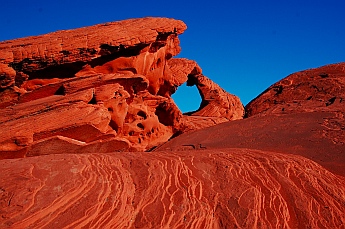
A red rock hand forms the "okay" sign.

Chaos resulting from cosmic clashes.

One of the Beehives

Elephant Rock

A glance across 350 million years of
geological evolution.

Geological look back across time.

Petrified log.

View across the valley.

RIbbon of road near the Seven Sisters formation.

Snaking road near the east entrance.

The CCC Cabins built in 1935.

Cozy fireplace inside a cabin.

What a view out the window!

Great views here too, plus running water and a fridge!

Dime store photo booth!

A thin desert scrub flourishes.

Holding hands at Mouse's Tank.

Another group of four plus two sheep.

Nature's bouquet.

How many toes?

People, shapes, fat animals with short horns,
thin ones with long horns. What does it all say?

Fire Canyon / Silica Dome: red and white sandstone
reaches back to dolomite seabed rock.


Pink and white stripes burst apart.

Scenic Road to White Dome hiking trail.
Valley of Fire, Nevada (2)
Late September-Early Oct, 2009 - Just as Interbike
ended, Las Vegas was engulfed by a ferocious heat
wave. We escaped up I-15 to Cedar City, Utah.
Creeping back down again a few days later when the
temps had receded, we made our way to Valley of
Fire. We had visited this gorgeous state park two
years earlier and loved it so much we wanted to
return for more. Born from the dark fossilized
organic remains of an ancient sea bed, the area is
dominated today by flaming orange petrified sand
dunes, making the whole park appear as if red rock
embers burn against charred hillsides.
There are red rocks everywhere you turn. Even in the campground, where
walk-in tent campers can tuck themselves deep into the crevices of these
fantastic formations, we couldn't stop our cameras from clicking.
The face of Atlatl Rock bears a
huge panel of petroglyph rock
art placed so high up in the air
you have to climb several
stories' worth of stairs to get to
it. I had seen it two years ago,
but wanted to check it out
again. The foggy plexiglas
protecting much of the rock art
had thankfully been replaced.
So this time, along with the big
horn sheep, people, footprints
and shapes I recognized from
before, I also saw a scorpion.
Around the corner is Arch Rock, which looks to me a little like an enormous
hand making the "okay" sign with thumb and forefinger.
The visitors
center has some
outstanding
displays, and
one describes in
detail how a
warm sea
covered most of
Nevada and parts of Utah off-and-on for 400 million years beginning
about 550 million years ago. On the last retreat of this sea, sand began
to blow in from nearby ridges, creating huge, shifting sand dunes.
These dunes were stained red by
underground mineral-rich streams
and then, under their own weight,
compressed into rock. Wow! I
know I had learned all this over at
Red Rock Canyon last week, but
I still found it hard to fathom.
Over time, the tectonic plates
clashed, as the one supporting
the West Coast tried to sneak
under the one supporting the rest
of the country. The solid dark
seabed and bright orange
sandstone were thrust about,
creating the chaotic shapes
of the park today. Some shapes are random, but others seem to
have been created with a specific image in mind.
Coming in from the
east, you look across
350 million years of
time, from the young
200 million-year-old red
rocks to the ancient
dark dolomite of the
seabed floor that has
been thrust upwards by
violent eruptions from
the earth's core.
The park even has two areas
with petrified wood logs.
They are fenced off, so they
are a little awkward to see,
but they are definitely logs
that are wood no longer. It is
hard to imagine the geological changes that have happened over the
vast reaches of time, as there isn't a tree anywhere in the park or in
this part of the world for many miles. Amazingly, these logs were from
large trees. The theory is that they floated in on the sea.
We had to scramble up a
gravel slope to see one
of the logs. Once
up on the precipice,
we looked back
towards the valley
where the road
brought visitors
from other sights.
Maybe it's just my
love of travel, but
my favorite aspect
of this park is the
two beautifully
maintained roads
that run through it.
Both roads sweep through dramatic
turns, climbing and diving through hilly
terrain. They run along expansive,
scruffy valleys, dodge between jagged
red walls, and loop through pink and
white domes of sandstone.
The Seven Sisters is a series of seven
towering orange monoliths that simply
refuse to fit into a single photograph,
so I contented myself with capturing
the silky road that slips past nearby.
Back in 1935, the CCC built three tiny
adjoining stone cabins. Used by park
workers as they built the park (it was the first
Nevada state park and opened in 1936), the cabins
were later used by park visitors. Each cabin is just a
single 9'x9' room, barely large enough for a small
bed and chair, but the setting is to die for.
There is a small door and window in each room, and a
tiny fireplace too. It must have been incredibly rustic
accommodations for those early tourists, complete with
uneven stone floors, but it sure put them right in the
heart of the Valley of Fire experience.
What a view to wake up to -- but how did they make
their coffee?? There was no mention of how those
tourists got their meals or even how they got water.
There was a plaque, however, that described how in
1915 a soldier who had survived the Civil War fifty years
earlier perished under the shade of his open-air horse-
drawn buggy because he couldn't find water. The Colorado River, now the dwindling Lake
Mead, is just a few minutes away by car, but less than 100 years ago this exquisite land cost
that sergeant his life.
Besides the enticing roads and views, the campground is my other
favorite feature of the Valley of Fire. We had inspiring images of red
rocks out every window.
One morning I woke up with a bright idea -- let's get a photo of us
with the buggy in this very cool place! I quickly set up the tripod,
trying to ignore Mark's groans about the idea. Kids were climbing all
over the rocks around us, still in their pajamas and bare feet,
shouting to each other as they played hide-and-seek. Their bleary-
eyed parents were stumbling about their campsites, coffee cups in
hand, as the aroma of frying bacon quickly filled the air. It felt a little
funny, in the midst of all this action, to be taking pictures of
ourselves as if we were in a dime store photo booth. But ya gotta
have something for mom's Christmas card!
The major sight we had missed in our
previous visit was the hike through
Petroglyph Canyon to Mouse's Tank.
Mouse was an outlaw Paiute Indian
who found a large rock bowl that
would fill with many gallons of water
when it rained. Deeply recessed at
the far back of a canyon, this gave him
a great place to hide out. As we
walked into the canyon, trudging
through soft sand, the rock walls
towered on either side with very
sparse sprinklings of vegetation.
The petroglyphs aren't marked. Instead it is left
as an exercise for the hiker to find them. Most
are 10-20 feet up in the air. At least two show
groups of four individuals holding hands.
In these groups,
two people look
human and two
don't. The
scientific experts
think the two non-humans might be shamans or ghostly spirits
from another world, perhaps leading the two humans towards
the afterlife.
Mark spotted
a flowering
bush growing out of a
crevice. It looked like a
bouquet of flowers
hung on the wall.
Other petroglyphs
showed images of
hands and feet.
Looking closely, I
noticed that in one pair of feet, the right one had just four toes. I've seen
this missing digit theme in other rock art. Why did they do that? Even if
the people who pecked these pictures out of the rock lived 4,000 years
ago, they knew how to count. They never drew animals with three or
five legs. "Maybe they just ran out of room," Mark suggested. Or
maybe it wasn't meant to be a human footprint.
Who knows! I really love this odd, other-wordly graffiti. I just wish there was
an accurate petroglyph-English dictionary so we could know what it all means.
Recent rock scratches from our own culture nearby looked amateurish in
comparison.
Out in Fire Canyon
- Silica Dome we
got another
glimpse of the
sandstone set
against the
dolomite
mountains.
Evidence of sea creatures has been found in the distant dark rock.
Here, in this canyon, some sandstone was evenly striped but had
been broken apart by tectonic crushes and uplifts.
We took our time on the scenic drives, stopping frequently to
scramble up the sandstone walls where we tried to gather the
dramatic scenes into a single photograph. The pinks and reds and
oranges sometimes looked as if they were sliding downhill,
perched on a perilous slope.
After a few days, we got blown out of the Valley of Fire by a huge
windstorm that swept all the dust for miles around into enormous,
billowing clouds. The campground was sandblasted for hours on end.
Shaking the dust out of our hair and wiping it out of our eyes and off
our cheeks, we slammed the doors of the truck and tore out of there
as fast as we could. A thick wall of dust swirled around the back of the
trailer behind us as we drove off. Onward, southbound, to Laughlin,
Nevada, where we could escape to the climate-controlled indoors until
the wind died down.
More blog posts from our travels in Nevada:
- A Back Roads RV Trip – AZ to NV to UT – Colorado River & Spanish Trail 04/13/18
- Lake Mead Scenic Drive + A Great RV Pit Stop at “Redstone” NV! 12/14/17
- A Las Vegas Light Show — WOW!! 10/06/17
- Into the Great Wide Open – Nevada to Oregon 06/11/14
- From Salt to Snow in Nevada – Bonneville to Lamoille Canyon 06/06/14
- Nevada Open Road Challenge – A NEED for SPEED! 05/30/14
- Laughlin, NV – A Little Known Canyon, Petroglyphs & A Car Museum! 10/01/09
- Las Vegas – The Interbike Tradeshow and Awesome Red Canyon! 09/29/09
- Valley of Fire, NV – A Cauldron Cooled 09/25/09
- Pioche & Cathedral Gorge, NV – The Wild West 09/23/08
- Valley of Fire, NV – Sweeping Vistas 10/29/07
Other great RV dry camping areas:
- Lost Dutchman State Park: GORGEOUS scenery & RV campground! 04/12/24
- Windy Hill Campground + Tonto National Monument 03/08/24
- Lynx Lake, Arizona – Great RV Camping Near Prescott! 05/17/23
- Dead Horse Ranch State Park + Tuzigoot and Clarkdale 02/17/23
- Catalina State Park & Roosevelt Lake: RV Camping in AZ 01/20/23
- Oliver Lee Memorial State Park, New Mexico – A Dog’s Eye View! 11/30/18
- Lost Dutchman State Park Campground – Arizona Gold in the Superstitions 02/15/18
- Lake Pleasant & Canyon Lake – Waterfront Camping in Arizona’s Sonoran Desert 02/02/18
- Sand Hollow State Park, Utah – An Oasis in the Desert! 11/21/17
- RV Camping with the Rock Art Petroglyphs in Gila Bend, AZ 04/21/17
- City of Rocks State Park, NM – RV Camping in the Hoodoos! 12/03/15
- Boondocking at Big Bend National Park – Cheap & Scenic RV Camping 03/26/15
- Roosevelt Lake – Lakeside Camping in AZ 05/01/14
- Wupatki Nat’l Monument – Ancient Indian Ruins & Great Camping in AZ! 08/25/11
- Valley of Fire, NV – A Cauldron Cooled 09/25/09
- Zion NP, Kodachrome Basin & Snow Canyon, UT – Great Red Rocks! 10/31/07
- Goblin Valley, UT – Where the Ghosts Are 10/16/07
Our most recent posts:
- Buckskin Mountain State Park – Fun on the Colorado River! 01/31/26
- How to Install Starlink Gen 3 in an RV? Use the Speedmount! 08/07/25
- Escape to Paradise – Rocky Mountain Magic! 08/01/25
- Is Forest River a Good RV? Well Built? Here’s Our Experience 06/20/25
- Sunset Crater Nat’l Monument – Lava & Camels at Bonito CG! 06/06/25
More of our Latest Posts are in the MENU.
New to this site? Visit RVers Start Here to find where we keep all the good stuff!!
Stevensville, MT – Real Ranching and Grass Fed Beef!

Hat shop in Salmon, Idaho.

Trade-in hats from loyal customers.

Lemhi County Fair

Cowboys watch the rodeo.

Beautiful barn and ranch in the Bitterroot.

Little Buck eyes me up.

He did exactly as my reins told him.

A peaceful but busy ranch.

Calves come barreling down the chute to be
inoculated.

They are held in a small pen for their shots.

That's a mighty big syringe!

Two quick shots. Some calves barely seemed to
notice.

And off they run to join their waiting friends.

Sunset casts a warm glow on the Bitterroot mountains.

A wildfire had burned for a month in the nearby hills.

Carl shows us what ranchers do in their free time.

The views became more and more
grand as we climbed.

New growth from the wicked 1910 blaze to the left and
new charred scarring on the right.


Beetles bore into the tree bark
and the tree responds by oozing
thick sap.

The newest ranch hand.

Wild turkeys pay us a visit.

Just a few feet to one side and we'd have had a good sunny
glimpse of the family.

Bambi trots across the grass nearby.

The cows come when called.

Yum, freshly mowed grass!

That's something to moo about.

The moms circle us.

A few treats to lure them in, and they know the next
step is a romp in a new pasture.

This guy was hopeful mom still had some milk for him.

And they're off to greener grass on the other side of the fence.
Stevensville, Montana
Late August, 2009 - We left Stanley, Idaho and continued traveling
north towards Montana, following the wonderful twists and turns of the
Salmon River as it descended down the mountains. During two days of
leisurely driving along the river's edge, we watched the terrain gradually
change from tall pines on steep mountainsides to rolling, barren hills that
seemed to have been shaped and smoothed with care. We slowly
began to feel the mood changing from fly fishing in fast-moving streams
under cool trees to ranching on the wide open range under the big sky.
Stopping in the small town of Salmon, Idaho, we found a shop filled with
cowboy hats. The new ones on the racks looked very crisp, but the
ones with real character were the crumpled ones the customers had
turned in. These hats lined the tops of the walls in the store. Each hat
was crinkled and worn in a different way, and each had the owner's
name under it.
Outside of town we found the Lemhi
County Fair in progress. There was
all kinds of horse activity going on,
and we watched a little as the riders
competed with each other to be the
fastest one to sort out a single cow
from the herd.
It was more fun watching the
cowboys watch the event.
Some of the ranches and farms we passed were beautiful properties. One red barn in
particular caught my eye, and later I found that this same barn
was featured on a glossy Montana calendar.
We went to Stevensville to visit our friends Bob and Donna Lea.
Before we'd even said "hello" to them, we met their horse Little
Buck. He was carrying Bob's ranching boots on his back.
I got a chance to try my legs at
riding a horse. This was just the
third time I'd been on a horse
since my first outing on a pony at
the church fair when I was five. I
managed okay, but I got the
signals crossed for turning right
versus left and consequently had
to duck under a very low branch.
Bob had work to do at his
neighbor Carl's ranch, and we got
a fantastic inside view of what
ranching is like. This was the day
the cows and their calves had to
be inoculated with two vaccines
and sprayed with an anti-fly
spray. I had no idea what to
expect, but I loved the sights and
smells and busy activity on the
ranch.
First the calves were sent down a chute to a single-calf sized holding
pen. There they were held in place with a clamp on either side of their
neck so they could bob their head up and down but couldn't wriggle out.
This made it easier to give them their shots. They didn't seem thrilled
with the idea, but they didn't protest too much. A scratch on the head
helped the medicine go down. Next, two ranchers lined up with the
shots. The syringes were pretty good sized. Bigger than I'd want,
anyways!
Then the vaccines were injected and
the calf was released to run off to his
friends down the hill. There was all kinds of mooing going on in the distance, as the calves and
cows had been separated from each other for this project, and they kept calling to each other
from their separate pens.
Eventually everyone got their shots
and later they all got their spray. We
had a chance to go through the
calving barn to see where and how
that is done (in March when it is zero
degrees and snowing). As I looked at
the apparatus for handling a breach
birth and for nurturing a sickly calf, I
was amazed at how much biological
and medical knowledge a rancher
needs to have. I missed most of the
scientific words Carl was throwing
around.
Yet there was a cozy intimacy to this family enterprise that brought a new group of calves into
this world each year. I felt like I was peeking in on a James Herriott story. In the distance that
evening the mountains were lit with a momentary splendor, adding a special glow to this world of
Montana cattle ranching.
A wildfire had been burning in the
nearby mountains for a month.
During the day you could smell the
smoke, and at times the fire danced across the mountainside,
sending up a ribbon of smoke first from one area and then another.
A few days into our visit a torrential rainstorm came, dropping an inch
of water on the mountains and valley (along with a thin layer of pea-
sized hail). That doused the fire long enough for us to take a
mountain bike ride up to a nearby peak to get a closer look.
Our new ranching friend Carl showed us that ranchers don't just raise
cattle. They mountain bike too.
Once we got up in the hills a
few miles we had an
expansive view of the
Bitterroot Valley below. We
met some US Forest Service
rangers at the crest of the
mountain, and they told us that
the fire was subdued but not
quite out. As we looked out at
the charred hillside in the
distance (on the right side of
the photo below) we could not
see any smoke just then, but
in later days it returned.
The modern wildfire fighting method is to let them burn, as fires are natural in this part of
the country. The hillside on the left of the photo shows the forest's re-growth since the
1910 inferno that roared from Washington state across Idaho and into Montana. The shorter, even trees covering most of the hill
are the regrowth and the taller, darker ribbon of trees that lines the ravine going down the hillside are the original pre-1910 trees.
One hundred years later and the evidence of that fire is still plain to see.
Hopefully the burnt areas from this year's fire will grow back
a little faster, as the fire was not hot enough to sterilize the
ground (like the 1910 fire did). All the fire talk aside, it was a
good moment for a photo op.
The fire was working its way across many healthy trees, but
we found ourselves in a stand of beetle infested trees. The
beetles bore into the bark and the tree tries to repel them
with thick sap. This gives the tree a pock-marked look.
Some trees are able to stave off the infestation, but most
Meanwhile, back at the ranch, Carl had just acquired an
adorable new cow dog. She was all cuddles and goofiness,
just settling in to her new home before learning the ropes of
her ranch job.
Out in the "wildlife sanctuary," a portion of the pastureland allowed to grow
wild, two families of wild turkeys showed up. They had been in the area all
summer and at one time numbered two adult females and 17 chicks.
We counted 15 chicks with
the moms, but couldn't get
them to stand still or pose for
us in the sunshine for a family
portrait. They ran across the
road in the shadows instead.
In the midst of taking way too
many photos of these
turkeys, I looked up and saw
Bambi running across the
field, white spots and all.
A few days later, Carl invited us
over to see a "cattle drive" at the
ranch. This wasn't the big round-
up you might imagine, but a simple
walk-through from one pasture to
another. The cows had made
short work of all the grass in their
current field, and when Carl called
to them, they came running.
He presented them with some
freshly mowed grass and they got
very excited. The mooing was
tremendous, and each cow came
bellowing over to us, calf in tow.
They all stood around us in a circle,
expectantly. He hand fed a few,
telling me some of the stories behind
each one. The bulls were lounging
under the trees in another pasture
way down the hill. It was like a boys
school and a girls school with each
waiting for spring time when they
could finally get together at the prom.
Each May he puts two bulls in a
pasture with 50 cows for 70 days. By
the end just about every cow is
pregnant and the bulls have a
lot of notches on their belts.
Some cows had been on his ranch
for 13 years, and others for just a
year or so, but each had a history
and a personality.
This big guy was still nursing (a
little old for that, perhaps!). He
spent quite some time going round
and round from teat to teat, quite
sure that there was something
there for him, but not finding what
he wanted. Finally momma just
walked off.
Carl led the cows and calves through the gate, and they went running down
the lush green hillside. They were delighted with their new digs. The grass
was tall and soft, and the view was superb. The cattle on this ranch have it
good.
We said goodbye to Carl, and took off with Bob and Donna Lea for the
annual Labor Day Helmville Rodeo.
Sawtooth Scenic Byway and Stanley, Idaho – Picturesque!

Stanley Lake

Creek near Stanley Lake

Stanley Lake


Camping at Stanley Lake

Scenery near Stanley.

Sawtooth Mountains.

Sawtooth Luce's.

Homes perched on the hills in Stanley

Redfish Lake

Redfish Lake

Beach at Redfish Lodge

Ghosting along on Redfish Lake


Private boat-in campsite on Redfish Lake


Salmon Festival in Stanley

Namesake for Redfish Lake

Cattle enjoy a nice view.


Sawtooth Mountains near Stanley.


"Ahhh" moment as we walk towards Stanley Lake.


Sunrise on our final morning

Salmon River

Drive along the Salmon River
Stanley, Idaho
Late August, 2009 - We drove
north from Ketchum/Sun
Valley to Stanley Idaho along
As with Indiana's Amish
Heritage Trail that we had
recently driven, we discovered
the tourism folks of central
Idaho have created a series of
CDs to accompany the
beautiful scenic drives through
their state. Complete with mile
marker indicators, music and
driving instructions, the
recording was expertly made and we enjoyed having a tour guide right there in the truck with
us. We learned tidbits about the mining history, Indian history and geology of the area, and
the CD recommended some excellent stops at scenic viewpoint along the way.
Stanley is a tiny hamlet with just 40 year-round residents, although the population soars to
300 each summer. It is frequently the coldest place in the continental US in the wintertime, but in summer the days are hot. We
rode our bikes to Stanley Lake and found crystal clear water sleepily lapping the shores of towering mountains.
We returned with the kayak and spent a blissful morning drifting across
the mirrored reflections of the rugged peaks. As we floated into the cool
shade under the thick pines on the far side of the lake, we felt intoxicated
by their heady, pungent scent. We laid back and lazily watched the
rainbow trout jumping for moths. Each foolish bug would flirt with the
water's surface until his wings got wet, and then he'd start a spinning
death spiral that ended with the gulp of a fish.
There is a
campground
and several
hiking trails
around Stanley
Lake as well.
We made a few trips to the lake
over the next week, each time
enjoying that burst of "ahhh" as
the trees parted and the lake
came into view.
It seemed like a perfect spot to
bring the family for a week of
camping. The sites are
perched right on the water's
edge and there are endless
activities to keep kids amused
along the shore.
The early mornings were cold
and quiet, but as each day
wore on and the sun flooded
the shore, the sounds of kids
voices carried across the
water.
The Sawtooth Mountains line the horizon like the cutting edge of
a saw blade, and everywhere we turned their snowcapped tops
formed a backdrop. Stanley sits at the intersection of three of
Idaho's official "scenic highways," and there are viewpoint pullouts
and photo-op spots all over town.
One afternoon we got a pizza at Sawtooth Luce's. This little log cabin
eaterie has been in the same family for several generations, and our
waiter proudly announced that three weeks earlier the owners had just
given Stanley its first locally born baby in 30 years.
We took the kayak to Redfish Lake, another
expanse of clear, turquoise water set against a
wide mural of the Rockies. The water was
cool, but so inviting, with every rock and fallen
log clearly visible many feet below the surface.
There were several beaches, some accessible
by car and others, we later learned, accessible
only by boat. The sand on every beach was
wonderfully white.
We cast about for a while to find a good launching spot and settled
on the beach by Redfish Lodge. This is a fun and busy place.
There are cabins, a lodge, a camp store, boat rentals, a marina
with slips and moorings for powerboats and sailboats alike, and a
white sand beach loaded with families. It is an ideal swimming
area, as the water is shallow for a long distance, keeping it
somewhat warm. We quickly inflated the kayak and cast off.
It didn't take long for the playful voices from the beach to fade into
the distance as we pedaled our way along one shore. There was
a point in the distance that lured us, tantalizing us with images of
what might lie beyond. The crests of a few jagged peaks poked
above the nearby trees, promising a dramatic view once we
rounded the point. It seemed like we would never get there, but
suddenly the point swung wide, like a door opening to another
land, and we found ourselves in an emerald green pool of
shallows at the feet of two majestic mountains.
Many evergreen
trees along the
shore were red.
They were going
through their
death throes as
beetles invaded
the tender flesh under their bark. This made for interesting colors among the
trees, but was disconcerting in a forest that should be solid deep green. From a
distance much of the forest high up on the ridge was grey, as many trees had
already succumbed to the armies of invading pests. In places it seemed just one
in ten trees was wearing its intended green hue.
We found a perfect spot to land for a shore-side snack. It was actually a boat-in campsite,
complete with a fire ring, a wood pile left by a previous camper, and a table. A tiny beach
stretched along the shore,
and a large rock sat out a
ways in the lake. Mark was
tempted to go swimming,
but he didn't want to be
soggy wet and cold for the
return trip. So he settled
for wading out towards the
big rock, carefully hiking his
shorts up higher and higher
as he went. He stepped
gingerly from one submerged rock to another, leap-frogging
towards the big boulder. Just as it looked like he'd made it to the rock
island, his foot slipped on some algae and he doused himself thoroughly.
Oh well, so much for staying dry.
After kayaking a little further we turned around, leaving the dramatic
rocky horizon behind us. Before long, the sounds of kids playing in
the water at Redfish Lodge pierced our little oasis of silence, and
we paddled our way back into the hustle and bustle of a hot
summer day at the beach. Kids licking ice cream cones, parents sipping cold beer, and sunbathing teens changing from white to
pink greeted us as we deflated the kayak and folded it back into its bag.
That weekend the town of Stanley hosted the Salmon Festival, a fair
celebrating the local salmon. We knew nothing about salmon when we got
there, other than how to grill it, but by the end of the day we had learned
many amazing things about the life cycle of these intrepid fish. We were
astonished to learn that when 3-year-old salmon make their way from
Stanley down the Salmon River to the Snake River to the Columbia River to
the ocean some 900 miles away, they make a mental note of the smells
along the way so they can sniff their way back home a year or two later,
never making a wrong turn up a wrong tributary. Once home, they flirt with
each other and the females choose their mates. The males quiver
alongside their females, waiting impatiently for them to lay their eggs so
they can be fertilized. Once the seeds for the next generation have been
sown, the parents die.
We had known that salmon fishing
had deteriorated badly in recent
years, but were shocked to learn
that in the decade of the 1990's
only 10 local salmon made it
back to Stanley to spawn, putting
them on the endangered species
list. This year 750 or so are
expected to return, a recovery
attributed to the removal of many
dams along the rivers and
meticulous breeding in
hatcheries. We had known that
river dams impeded salmon
migration, but were stunned to
find out the trouble is during
their trip down to the ocean, not during their return up river to spawn years later. Young
salmon approaching a dam as they swim towards the ocean are guided out of the river to
be loaded onto trucks and barges so they can be taken around the dam and then returned
to the river on the other side where they continue their swim to the ocean. For Stanley
area salmon this happens at four dams on the Snake River and four on the Columbia.
That's a lot of corralling, loading and unloading for a six inch fish that is designed just to
swim with the current to the ocean. Most don't make it. The young are tagged with
microchips before they leave the hatchery so they can be identified upon their return from
the ocean, at which point they have grown to recognizable salmon size. The
microchip tags aid in isolating a few fish for hatchery breeding when they return,
keeping the hatchery DNA pool as wide as possible.
This was a lot to take in and gave us a far greater appreciation for the wild caught
filets we buy at the supermarket. Mulling it all over, we wandered about the town
of Stanley, taking several bike rides along the scenic highways. The views
everywhere were breathtaking.
We went to a lecture at the Stanley
Museum given by a man who had
kayaked the same route that the salmon
take: the Salmon River to the Snake River
to the Columbia River to the ocean. He covered the
distance in 52 days in 2001, experiencing some of the
same hassles the fish do at the dams as he took his
kayak through the lock systems.
Stanley also has a mining history, but we didn't stay long
enough to delve into it too deeply. There are some
intriguing mining relics and ghost towns in the area that
we decided to save for a return trip another year.
We took one last hike out to the far end of Stanley
Lake and breathed in the moist pine scent.
On our final day in the area
the sun cast an orange
glow on the rocky peaks for
a few moments as it rose in
the sky.
Then we started a two-day
trip down the road along the Salmon River, thinking of the salmon and of the kayaker as
we drove. The river was our constant companion as we descended northwards towards
Sun Valley Idaho – Music, History & Celebrities

Ketchum Farmer's Market

Sun Valley outdoor skating rink.

Outdoor restaurant overlooking the skating rink.

A young skater gets some coaching.

Quaint buildings around the Sun Valley resort.

Swans greet visitors to the Sun Valley Lodge

Welcome to Sun Valley
Lodge.

A bright fire crackled in the Lodge's fireplace.

Upstairs brunch was being served.

Arnold in the Austrian Alps of the west.

Figure skating legends Dorothy Hamill and
Charlie Tickner.

Peggy Fleming.

Ore wagon for shuttling ore
and supplies between mining
camps.

One of the Ketchum Fast
Freight ore wagons.

Fog drifts between the mountains.

Rolling mountains surround the town.

What a spot for a summer cabin.

The paved bike path near Elkhorn.

Pre-performance talk at the Sun Valley Pavilion.

Listeners picnic on the lawn outside.

The Sun Valley Symphony Orchestra.

A young concert-goer blows bubbles.

Fairy princesses show us the Wolf.

Pirouettes...

...and curtsies.

The instrument "petting zoo."

Ketchum welcomes all visitors
whether funky or fancy.

Funny statues are everywhere.

Both big kids and little kids paused by
this stuffed bear for a quick hug.

Our stay in Ketchum will always be a highlight among our
travel memories.
Ketchum & Sun Valley, Idaho
August, 2009 - We had been in Ketchum / Sun Valley for several
weeks, but we were enjoying ourselves so much we didn't want to
leave. The town was bustling with activity, and there was always
something going on. We arrived in time for the Farmer's Market one
afternoon, and after eyeing up the beautiful produce, we made our way
over to the Sun Valley Lodge.
I had heard about the summer figure skating at Sun Valley when I was
growing up, and it was a thrill to see the outdoor rink. It is shaded from
the hot sun by a mesh canopy, and it sits across from an open air
outdoor restaurant at the Lodge.
On Saturday nights in summertime there is a full-fledged ice show, and
diners can enjoy a gourmet meal at the cafe's tables while watching
World and Olympic champions perform.
While we were there it was an open public skating session. Kids and
adults of all ages were playing, practicing and having fun. We watched
a few young skaters diligently training with their coaches.
The Sun Valley Lodge complex is spread out over a large area and
includes not just the outdoor ice rink but an indoor one as well. There
are extensive walking paths that wander between quaint buildings and
little shops, taking guests to the Opera House and the Sun Valley
Pavilion where the symphony orchestra performs outdoors every night in
August. We got lost quite a few times and found ourselves going in
circles.
There is a little pond that is home to
several swans. The Lodge itself is a
grand old structure with an elegant
entrance.
Inside the Lodge we found a cozy fire
burning brightly in an inviting living room
just inside the lobby. Upstairs there is a
huge library that overlooks the outdoor
skating rink, as well as an elegant
dining room.
Along the walls there are dozens of
photographs of all the celebrities that
have visited Sun Valley. Averell
Harriman, Sun Valley's founder in 1936,
invited everybody who was Somebody
to be a guest
at his resort.
Hollywood
legends were regulars, and he encouraged artists and writers like Ernest
Hemingway to make this new resort area their home. Many presidents
and their families were photographed out on the slopes.
I was naturally
drawn to the
figure skating
heroines of my
youth: Dorothy
Hamill and Peggy
Fleming. We also
visited the Ski &
Heritage Museum where there are skis of every imaginable type, many
hand-made by miners and ranchers to get around in winter. The museum
showed video clips of 1956 Olympic champions Dick Button and Tenley
Albright at their winning moments. Every famous winter athlete has spent
time in Sun Valley.
Over at the Ore
Wagon museum we
learned that fifty years before Sun Valley was created, Ketchum was a
hotbed of mining activity. "Galena," a
silver-lead ore, was found throughout the
mountains in the area, and the ore was
carried by wagons down to the railroad
trains and smelters in Ketchum.
The Ketchum Fast Freight Line consisted
of many teams of horses, mules and
oxen that pulled these wagons on a 160
mile loop through the rugged mountains,
stopping at the mining camps to deliver
goods and pick up loads of ore. Thirty
wagons were on the road at any one time, and the grades these teams of 14-20
animals climbed were as steep as 12-15%. Once the mining faded, Ketchum
became home to Peruvian sheep herders, and in 1920 was second only to Sydney,
Australia in sheep production.
Today the peaceful valley boasts multi-million dollar celebrity homes on every hillside.
A quick scan of the real estate page lists eye-popping prices that make you wonder
where the regular folks live. Chatting with a caterer and a former maid, I learned that
most ordinary people live in the outlying towns of Hailey and Bellevue. However, the
pretty, light fog that drifts between the mountains around Ketchum/Sun Valley each
morning doesn't know the difference between miners, sheep herders and VIPs.
We took the paved bike path through the Elkhorn area southeast of town and stopped
at Hemingway's memorial, a humble little statue under a tree.
The views all around town are spectacular, and it is easy to imagine an artist finding
his muse in this setting. A group of artists were coming to town to set up easels
outdoors and paint, but our visit had drawn to a close before they arrived.
We did watch Clint Eastwood's movie Pale Rider while we
were in the area, however. The movie was set in the Boulder
Mountains just north of town where
we camped, and we learned that the
movie people built an entire town
back in the hills, shot the movie and
then removed the town once they
were done. It was a classic Clint flick,
where his stone-faced, gritty, lonely
character took on the gang of local
bullies by himself, liberating the
defenseless, harrassed miners who
had been the bullies' easy prey.
It is hard to imagine the size, sounds and smells of the mine and smelter
that dominated the Ketchum landscape in the 1880's. Today there is a
brand new $5 million symphony concert hall, the Sun Valley Pavilion,
where the prestigious Sun Valley Symphony is in residence all summer,
treating the locals and visitors to beautiful (and free) music almost every
night.
We sat outside on the grass with the locals on opening night while
the sponsors of the summer's series got wined and dined inside
the hall with a private concert. The music is piped outside all
around the hall so listeners can picnic in the grass during each
concert if they wish. Humming along to Rodgers and Hammerstein's
best songs, we were hooked. We returned for three more concerts
when the seats inside were free and the music soared.
They offered a Brahms night, and I was torn between that and the
group bike ride up the long climb to Galena Lodge. Why do the best
things always happen at the same time? Brahms won, as I love his'
dark and brooding music, and wanted to hear it live. Mark wasn't
sure about going until I pointed out that one of the pieces they were
performing, the Academic Festival Overture, sets the stage in one of
his all-time favorite movies: Animal House.
One Saturday was Family Day. It
started with a doll parade in the
morning, where every little girl in town
dressed up as a fairy princess, and it
ended with a symphony concert
geared towards kids. We watched
the many fairy princesses prance
around the lawn outside the Pavilion
during the concert.
Some little girls nearby acted out all
the scenes in Peter and the Wolf.
They showed us the cat, the little bird in the tree, the duck
quacking in the pond and, of course, the wolf.
We were treated to some
pirouettes and fancy moves, and
finally a curtsy. The symphony
orchestra had an instrument
"petting zoo" that day where you
could check out the instruments up
close. There was a festive, easy-
going air to everything the
symphony orchestra did.
Before the concerts, you could
attend the final rehearsals for that
evening's performance and listen to
a short lecture about the music to be played that
night. Afterwards, the players and audience
descended on the town. All the stores stayed open
late, and the coffee shops, bistros and even the
grocery store were suddenly flooded with ruffled white
tuxedo shirts, black dress pants and shiny shoes as
the orchestra players mingled with family and friends.
We enjoyed every minute of
our stay in this area. For all
the high-brow music and
fancy homes, there was also a playful side to this town. Sitting
outside a coffee shop one morning, we watched a roller-blader
doing laps around the center of town. He kept a smile on our
faces as he ducked and dodged and swerved in and out of
traffic.
The funny dog statue near the ice cream shop was watching him
too. Even the silly stuffed bear that waited patiently outside the
chocolate shop kept an eye on him.
We had passed a pretty flower-lined fence every day on our way
in and out of town, and it was with a wistful sigh that we got a
final photograph, packed up, and drove north out of town for the
last time, on our way to new sights in Stanley, Idaho.
Related Post about Figure Skating:
A Unique Encounter with Figure Skating Legend Toller Cranston 01/28/15
Related posts from our RV travels to the Sun Valley area:
- Sun Valley, Idaho – A Joyful Return to a Favorite RV Spot! 08/13/22
- Sun Valley Idaho – An RV Traveler’s Delight in Ketchum, ID! 09/16/16
- Sun Valley Idaho – in Trailer Life Magazine! 08/07/15
- Craters of the Moon + Cataclysms from Sun Valley ID to Alpine WY 09/02/14
- The Artsy Side of Sun Valley, ID 08/26/14
- Ice Queens of Sun Valley, ID 08/21/14
- Sun Valley Road Rally – Go Granny Go! 08/16/14
- Sun Valley Idaho – Music, History & Celebrities 08/15/09
- Sun Valley Idaho – RV Camping, Car Racing & Skating Legends 08/06/09
- Sun Valley & Ketchum ID – Beauty & Fun in the Mountains! 07/25/09
Sun Valley Idaho – RV Camping, Car Racing & Skating Legends

We discovered moose are rare here.

Our welcoming committee.

The Harriman Trail.

Soaring mountain views.

We never tired of the view, and it changed constantly.

A storm covered the mountains in a blanket with a
black lining.

The sun shone a spotlight on us for a moment as the
storm gathered steam.


The worst of the storm passed us by in the end.

We awoke to clouds embracing the mountains. When they
cleared the peaks were white.

Sheriff's speedtrap at the Sun Valley Road Rally.

Family Porsche - mom-181, daughter-183, son-188, and dear old dad-186 mph.

Ford GT - Ties for the day's honors at 188 mph.

Young hot racer drove the
crowd wild at 183 mph.

The movie theater shows "Sun Valley Serenade"
every afternoon for free.

The young Norwegian refugee arrives.

Sonya Henie, a charming, flirtatious pixie.

Milton Berle and Sonya Henie.

Glenn Miller leads his band in "In the Mood."

Trapped in a ski lodge, and falling in love...

Sun Valley guests were escorted by horse-drawn sleigh from
the train station to the resort.

Sonya Henie's elegance is mirrored on the ice.

This was a special skating show and movie that doesn't
have a parallel today.
Ketchum / Sun Valley, Idaho (2)
July / August, 2009 - Still camped in the national forest outside Ketchum,
Idaho, we left our dream campsite along the creek and moved to another
one with a spectacular mountain view. The welcoming committee here
was a moose. He came two nights in a row and quietly munched the
grasses down by the river.
A fisherman and his
son came by one
morning and said they
had been fishing this
river for 25 years and
had never seen a
moose. We suggested
they come by at dusk,
as the moose seemed to like visiting at twilight. Our new friends came by at the
appointed hour, but the moose was on a different schedule that night. He must
have had something else going on earlier, because he didn't make his
appearance until an hour after our friends had left.
We were in a stunning setting with the Harriman Trail running behind
us on one side and the most amazing mountain view soaring into the
sky on the other side.
We rode the trail up to Easley Hot Springs where a swimming pool
and hot tub have been built to take advantage of the springs.
Further on, the trail winds through the forest and meadow. I wanted
to ride it the remaining 10 miles up to Galena Lodge, but the weather
had other ideas.
A magnificent storm swept in during the afternoon and
blanketed the whole valley with black clouds. I was way up the
trail somewhere on my bike, hoping to outpace the downpour coming
back. I made it back just in time, but Mark had gotten nervous that I'd
be caught out somewhere, so he had climbed onto the roof of the buggy
to see where I had disappeared to.
When I got back the sky darkened even more. The sun peeked
through the clouds for a moment and gave us the most unusual
lighting all around the trailer.
We were both enchanted. What a magical moment. As the
lightning started in the distance and the rain began to fall on
the horizon, we were overcome with a delicious, eerie
feeling. We could see Ketchum getting pelted by rain in the
distance, but our little oasis had a tiny spotlight of sun.
The worst of the storm
passed to the north of us,
but it affected the weather
for the next week.
We woke up the next
morning to find the
mountains embraced by clouds and covered
in ice and snow. The warm daytime
temperatures had vanished. We would get a
few hours of cloudless skies and bright
sunshine each morning, but by noon an echo
of that storm would begin to well up in the
mountain peaks. By mid-afternoon each day
we would be engulfed in overcast skies.
Ketchum / Sun Valley is a town for the Rich
and Famous, and we stopped noticing
Porsche Carerra 4's after the umpteenth
sighting on our first day in town. Fortunately, for the wealthy car enthusiasts in
town, the Sheriff has a great affection for raw power. One morning we found
ourselves in the midst of the unusual Sun Valley Road Rally. The Sheriff had
agreed to shut down a few miles of Route 75, the Sawtooth Scenic Highway
heading north out of town, so the townsfolk could race their cars.
This was a
charity event, and
entrants paid $1,500
a run to drive their
cars as fast as they
could past the
Sheriff's speed trap.
He then wrote up a
fake ticket showing
the speed they were
going when they
passed the radar
gun. For three
hours the cars went
off at five minute intervals.
Twice each hour for 15 minutes the road was temporarily opened to regular traffic.
Mark had a field day watching the Ford GT's, Vipers and Porsches parade past the spectators to
the starting point beyond the top of the hill. We would hear each car in the distance first, and he
would try to guess what it was by its whine. Then the car would crest the hill and start its descent
towards the radar gun. An announcer would tell us the type of car and the speed it was going,
and we had fun guessing the speeds before they were announced. The Toyota Prius was a big
surprise at 107 mph, and the vintage (1956) Ferrari with its equally vintage driver was cute at
117 mph. A Bentley and souped up truck joined the fun.
However, the big surprise came when a middle-aged mom with
long dark hair stepped out of a Porsche after it was clocked
going 181 mph. She got a round of applause, but left us all even
more shocked when she handed the keys over to a young
blonde, gave her a hug and sent her off to the starting line.
When the Porsche showed up again, the radar read 183 mph.
The crowd went wild, and the young girl emerged. We
discovered that she was the mom's 22-year-old daughter, and that the boy she was handing the
keys to was her 23-year-old brother. When he came roaring by at 188 the crowd went ballistic.
Finally, dad got a turn at the wheel. We were hoping he would show us all how it is done, but he
didn't quite match his son, coming in at just 186 mph. The young boy in that Porsche shared the
crown for the day with a Ford GT that also reached 188 mph.
All that fast-paced excitement had
to be countered with something a little lower key. We went in to
Sun Valley to watch the 1941 movie, "Sun Valley Serenade,"
starring Sonya Henie. There is a free showing every afternoon.
The movie theater is the Sun Valley Opera House, a cute building
in the middle of the Sun Valley Resort complex.
This movie was originally made, in part, to promote Sun Valley
as a winter destination. Who better to be the star than the
utterly charming 3-time Olympic figure skating champion of the
day, Sonya Henie.
The producers put together a first-
rate show, with Milton Berle and
Glenn Miller's band taking
supporting roles. The story tells of a
young Norwegian refugee who
beguiles her unsuspecting sponsor
into falling in love with her.
As you listen to "In the Mood" and
"Chattanooga Choo Choo"
performed by the master himself,
the movie unfolds with scenes of
Sun Valley, appearing as it did when
it first opened.
Trains brought visitors into town from far away places, and horse-drawn sleighs took them to the
resort from the train station. Sun Valley was a bright light of pure fun and fantasy at the end of
the Great Depression, and its promotional movie is bewitching.
Besides Henie's dazzling
performance as a piquant
and mischievous flirt, some of
the most intriguing scenes
are on the ice where she
performs with a partner and
supporting cast on a sheet of
ice covered in a thin layer of
water. The scenes were shot
at night, and as the skaters
glide across the ice, their
reflections make them seem
to be dancing on water.
We left that movie with smiles on
our faces, caught up in the charm of
Sun Valley as it once was. We had
gotten the idea to see the movie
from the Visitor Center's list of "50
Fun Free Things To Do in
Ketchum / SunValley," and when we
checked the list that night there
were still quite a few to go. No
need to leave Ketchum/Sun Valley
just yet.
Related Post about Figure Skating:
A Unique Encounter with Figure Skating Legend Toller Cranston 01/28/15
Related posts from our RV travels to the Sun Valley area:
- Sun Valley, Idaho – A Joyful Return to a Favorite RV Spot! 08/13/22
- Sun Valley Idaho – An RV Traveler’s Delight in Ketchum, ID! 09/16/16
- Sun Valley Idaho – in Trailer Life Magazine! 08/07/15
- Craters of the Moon + Cataclysms from Sun Valley ID to Alpine WY 09/02/14
- The Artsy Side of Sun Valley, ID 08/26/14
- Ice Queens of Sun Valley, ID 08/21/14
- Sun Valley Road Rally – Go Granny Go! 08/16/14
- Sun Valley Idaho – Music, History & Celebrities 08/15/09
- Sun Valley Idaho – RV Camping, Car Racing & Skating Legends 08/06/09
- Sun Valley & Ketchum ID – Beauty & Fun in the Mountains! 07/25/09
Sun Valley & Ketchum ID – Beauty & Fun in the Mountains!

Lots of folks jump from the 480 foot tall Perrine Bridge
in Twin Falls, Idaho.

Pretty bike bath along the Snake River.

The first settler built his farm in this valley.

The welcome committee greets us outside Ketchum.

A mule deer stopped by our campsite every night.

The paved rails-to-trails bike path runs for 30 miles.

Averell Harriman wanted a world class
ski resort destination on his railroad line.

The Harriman Trail runs 20 miles north from Ketchum.

It is a great place for mountain biking.

We saw lots of riders on the trail everyday.

Lance Armstrong's quest for gold in the
Tour de France inspires cyclists even in
this remote outpost.

The Elephant Perch bike shop has a weekly group ride
into the postcard-like scenery.

This laid back town is full of whimsy.

Even the huge chair is wearing
cowboy boots.

The whole town lives outside for the summer months.

In this upscale town the free samples are gourmet
meats and imported cheeses.

Flowers and mountains frame the town.

The town rallied support for Pfc.
Bowe Bergdahl who had recently
been captured in Afghanistan.


We found the ideal campsite.

...but the views and serenity were worth the white
knuckles and scuff marks.

Perched on the edge of a glittering creek, we had to
go to great lengths to shoehorn our rig down a trail
into this paradise...


The sun always disappeared as soon as Mark
stepped into the ice cold water.

This place is ideal for rest and
relaxation.


Ketchum / Sun Valley, Idaho
Early July, 2009 - After landing in Burbank, California, following our
seven week sojourn in Michigan, we collected our trailer and made a
circuitous route to Idaho in search of some R&R. We had fallen in love
with the small town of Kellogg, outside of Coeur d'Alene, two years
earlier, and everything we had heard about Idaho from other travelers
was outstanding. One six-year full-timing veteran we met in Pioche, NV
last year told us, "I just came from a boondocking spot in Stanley,
Idaho, and it was exactly what I've been looking for all these years:
gorgeous mountain views, meadows filled with wildflowers, clear
streams, and lots of wildlife." This image had been in the back of our
minds ever since.
After a long
slog across
the Nevada
desert, we aimed for Twin Falls, Idaho. We had thought we'd blow right
through town, but instead we got a blowout on one of the trailer tires
about 60 miles from town. We limped into Twin Falls on the spare tire
with eyes only for Les Schwab Tires. Once a new tire was in place, we
opened our eyes a little more and began to look around. What a neat
town.
It is legal to
jump off the
huge bridge
spanning the Snake River with a parachute, and we watched for quite a
while as people suited up with all kinds of lines and parachute gear,
walked to the middle of the bridge, climbed over the railing, and jumped
off. In the distance we could see the spot where Evel Knievel tried to
jump the Snake River with his motorcycle back in 1974 (his parachute
opened too early and he landed on the water's edge just below his
launch site).
There is a pretty bike path that goes along the edge of the Snake River,
offering fantastic views into the canyon and river below. The first settler
had put his farm on the river's edge smack in the middle of the canyon.
Today the same area is home to a beautiful pair of golf courses. As I gathered tourist material at the visitor's center, I wanted to
stay longer, but this was a hot time of year to be here, and the mountains were calling up ahead. I had emailed the head of the
Escapees' Boondockers club, asking where the best boondocking
spot might be in the Sawtooth Mountains, and got the response,
"There are MANY beautiful spots." I was a little bemused by this
vague answer, but when I arrived at the Sawtooth National
Recreation Area I discovered that she was right: there are
gorgeous spots all over the place, no planning needed.
Our welcome committee the first night was a young mule deer.
He walked through our campsite, totally unconcerned about our
presence. One special patch of grass kept him occupied for over
an hour. The second night, in a new site, another mule deer
stopped by to say "hello." We were quickly feeling all the cares of
the world slip away.
There is a wonderful rails-to-trails paved bike path that goes between
Bellevue, to the south, and Ketchum, to the north. Thirty miles or so
in overall length, it does several loops in and around the Ketchum/
Sun Valley area as well. We rode it into town regularly, although the
wide shoulder on Route 75 makes for great cycling too. Riding these
paths and roads, I kept feeling as though I was riding through a
bicycle touring catalog's best photos.
The town of Ketchum has its deepest roots in silver mining, but it also
has the distinction of being home to a world class ski resort. Averell
Harriman, a railroad baron, wanted a prime winter tourist destination
somewhere on his line. He hired an Austrian count to scour the
countryside along the railroad in order to find the best location. After
several months of searching, almost ready to call it quits, the count
made one last trip -- to Ketchum -- and decided this was the spot.
The Sun Valley resort opened to
great fanfare in 1936. It was such a
celebrated wonderland of ice and
snow and the rich and famous that far
far away in New York City my mom
grew up in the 1940's fantasizing
about visiting someday (and she did,
in 2003).
We first heard of Mr. Harriman
because of the mountain bike trail that bears his name. It runs from Ketchum north for 20 miles
to Galena Lodge, winding along the Big Wood River. Between that trail to the north and the
paved bike path to the south, we were very happy campers, getting out on our bikes every day.
Brilliant deep blue skies greeted us every morning during our first week,
giving way to puffy clouds every afternoon. It was paradise.
Our first stop in town was the bike shop, of course. There are many
bike shops in Ketchum, but the one in the center of town -- and the
one broadcasting the Tour de France every day -- was the Elephant
Perch. Lance Armstrong was in the hunt when we arrived, and there
were high hopes he'd pull off one of his famous maneuvers to win.
The Elephant's Perch has a group bike ride every Wednesday night,
and they were relying on Lance for inspiration to tackle the
mountains around town.
We saw some of the faster riders out on the road and vowed to join
them the following Wednesday. Unfortunately, ten miles into the ride
(just as I was wondering how I was going to fare on the big hill up
ahead) the heavens opened up, and it poured. Mark and I took that as our cue to exit and dashed back to the trailer as fast as we
could go. The ride leader, Nappy, had told us that the group never misses a date at The Roosevelt, a restaurant in town where
they reserve a private room to imbibe a bit after the ride. We didn't realize just how serious these post-ride dates were until later:
the whole group had turned back when the downpour began, but they went straight to the bar!
This happy-go-lucky spirit pervades the whole town. Whimsical statues
grace the main drag, from huge cowboy booted
flamingos to huge cowboy booted rocking chairs to
fun and crazy animals and other sculptures.
The summer is short here, so
everyone spends a lot of time
outside. There are a zillion cute
bistros, with cafe tables all over
the place, and there are events
going on every day.
If it isn't a musician strumming his
guitar in the middle of town, it's the
gourmet meat and cheese vendor
giving away samples (even pure
angus beef "sliders"). Every day
we came into town we were swept
up into something fun.
On a more serious note, the town was trimmed head to
toe in yellow ribbons, with plaintive signs stating, "Bring
Bowe Home." Beloved local boy, Pfc. Bowe Bergdahl, a
Hailey, Idaho native, had recently been captured in Afghanistan, and a video tape of him had
just been released by his Al Queda captors. The community had rallied around his family, and
there were offerings of support everywhere.
Grateful to everyone, past and present, who has gifted
us with freedom, we enjoyed many strolls around town.
There were flowers everywhere, pretty mountains in the
distance (with ski runs plain to see), and it was a big
enough town that it took several strolls on different days
to see all of it.
We had been out of our home and away from our
lifestyle for so long that these kinds of easy days in a
friendly town were exactly what we needed. Stanley,
which we had assumed would be our destination, was
still 60 miles up the road, but we couldn't tear ourselves
away from Ketchum.
We even got library cards at the local library so we
could take out some CDs and DVDs to enjoy in the
trailer (there was little radio and no TV reception in the
national forest).
We scouted out many boondocking areas by bike, and
happened on the ideal spot 3 miles down a very bad dirt road. It was too tempting not to try, but
in hindsight it was a once-in-a-lifetime experience. I stood on the roof of the trailer and trimmed
branches for quite some time before we shoe-horned ourselves into the spot. Only after we'd
gotten in did we think about getting out. Yikes. On the day we pulled out there was thunder and
lightning in the distance and big, fat threatening raindrops falling all around us. Our patch of dirt
quickly turned into a mudhole. But Mark managed to do a 30-point turn with the trailer, dodging
two large boulders and three trees, and got us turned around.
In the end, however, the white
knuckles and scuffs were all worth it:
the many days between our arrival
and our departure were pure
storybook fantasy.
We were camped on the edge of a creek with a
cascade of mountains rising behind us. The mule
deer came by every evening, except on the
weekends when the forest had too many human
visitors.
The sun shone so warmly that we ran around in
shorts and tank tops, that is, until Mark decided to
sponge off in the water. Then the sun always
went behind a huge cloud and stayed there, leaving him in shade while he hooped and hollered and
thundered like an ornery bull, splashing ice water all over himself. It was all very impressive, but I preferred
taking a hot shower in the rig. Of course, by that time the warm sun would be out again.
We spent our days walking and riding along the dirt road,
reading and listening to things we'd gotten from the library,
tidying up the many loose ends that had been frayed with our
hasty departure in May, and generally getting back to our old
selves. It felt so good to unwind in our own home.
Our return to the rig had been a little rockier than we would
have liked. We dashed first to San Diego and then to San
Francisco in pursuit of one final sailboat deal before giving up for
the season. We had learned over the course of the preceding
months that the sailboat brokerage business is not one for the faint
of heart. It is a cut-throat, dog-eat-dog world of ruthless
backstabbers. One broker told us how another had robbed him of
a deal at a boat show and then gloated openly for days afterwards.
Another lamented that his employer had stolen a deal from him at
the last minute and refused to pay his commission after he had
invested weeks of effort in the transaction. He later found out the
employer owed other employees tens of thousands of dollars in
commissions too. Apparently honesty isn't a policy in that industry.
So it was no surprise when the boat that we had been assured had
air conditioning ("I saw the compressor myself") turned out not to. However, it was a very big surprise when on
the same day, in the same town (tony Sausalito), a pair of well respected brokers who had been selling one of
the highest end European brands of yachts for years got hauled off to jail for embezzling several hundred
thousand dollars from their clients. How reassuring (though depressing) to discover that our assessment of the
California boat business was right on the mark.
We were able to laugh about all that now, in the shade of a tall pine with the water glistening on the rocks in
front of us. Our dream had sent us on a wild goose chase, including a whirlwind tour of Michigan. We hadn't
ended up where we expected, but all had turned out well. These woods, this town, our trailer -- all wonderful.
We were living a dream right now, and, as life has taught us over the years, dreams can
be very flirtatious and hard to capture. Sometimes they make us feel like toddlers,
running around on stubby legs, waving our arms, chasing butterflies. The best moments
in life are gifted to us like jewels from leprechauns, unexpectedly, as if by magic.
Thank goodness for our beautiful national forests. As we hung around Ketchum for a
month, we were able to take our "summer cottage" from one priceless creek-side
campsite to another stunning mountain-view campsite, and enjoy exquisite scenery all
around us every day.
We had partied long and hard with friends and family all winter, and then we had eaten
our way around Michigan for almost two months. Who can pass up fresh raspberry pie
made by the Amish? Or hot-out-of-the-oven pastries and cookies at a cute Canadian
farm stand overlooking Lake Erie? Not us! But now our clothes told the rest of the story,
as everything we owned was too tight. It was time to get fit and healthy again. We
started doing daily runs and bike rides, and we got our hand weights out of their hiding spot way under
the back seat of the truck.
But man, were we sore. A little exercise sent us
straight to bed for an afternoon nap each day.
What's more, the sun didn't crest the mountains
until after 9:00 in the morning, so why get out of
bed before that? For a while I think all we did
was sleep, exercise and nibble a little here and
there. We had driven 4,000 miles around
Michigan, and done another 1,600 to get here
from California. It felt really good just to stop.
And what a place to do it: Ketchum and Sun
Valley are worthy of a really long visit.
Related posts from our RV travels to the Sun Valley area:
- Sun Valley, Idaho – A Joyful Return to a Favorite RV Spot! 08/13/22
- Sun Valley Idaho – An RV Traveler’s Delight in Ketchum, ID! 09/16/16
- Sun Valley Idaho – in Trailer Life Magazine! 08/07/15
- Craters of the Moon + Cataclysms from Sun Valley ID to Alpine WY 09/02/14
- The Artsy Side of Sun Valley, ID 08/26/14
- Ice Queens of Sun Valley, ID 08/21/14
- Sun Valley Road Rally – Go Granny Go! 08/16/14
- Sun Valley Idaho – Music, History & Celebrities 08/15/09
- Sun Valley Idaho – RV Camping, Car Racing & Skating Legends 08/06/09
- Sun Valley & Ketchum ID – Beauty & Fun in the Mountains! 07/25/09