

Our saguaro friends say "hi."

Holding the moon close.


Wearing a halo.


An early Cardinal travel trailer.

1940's vintage

Another vintage Cardinal.

Saguaro holding pen.

First glimpse of Bartlett Lake.

These saguars have looked down this hillside for
more than a hundred years.

View of Bartlett Lake.

Pretty roads wind through the park.

From high on a ridge.

Cholla cactus catches the rays.

Lakeside Camping

Yellow Cliffs

Every saguaro has its own
personality.


Campground Full.
Not !!!!

Stray kitty says hello.


She'll be the new station cat for the
hot-shot firefighting crew.

Bartlett Dam.

North end of the lake.

Another great kayak ride.

A blue heron stalks the
shore.

The Bicycle Haus team takes a break in their 85 mile ride.

Dirt roads wander through the desert.

Hallelulia

Swoopy saguaro

Warm (prickly)
embrace.

After old age.
White Tanks & Bartlett Lake, Arizona
Early November, 2009 - We left Havasu Springs Resort ready for an exciting
change of pace: White Tanks Regional Park on the west side of Phoenix. This is a
pretty park and campground set smack in the middle of some of the nicest Sonoran Desert
there is. We couldn't help but smile as the saguaro cactuses greeted us with arms held high.
The overall climate in central Arizona's Sonoran Desert
doesn't feel much different than the Mojave Desert of
Nevada, California and northwestern Arizona, but what a difference in vegetation. It is lush
and vibrant, filled with unusual plant life, singing birds and hopping bunnies.
The central figure in this desert is the saguaro cactus, and they give the area its charm. Each
one is unique, striking a pose with arms raised that suggests an almost reverent spirit. These
precious and protected plants define the landscape, and as we drove into the park we felt like
we were coming home.
We woke up the next morning to find that one
section of the campground had been taken over
by a raft of tiny, ancient trailers. Their owners, all
women, were gathered around a campfire,
and we learned that this was a rally of the
group "Sisters on the Fly."
Priscilla, one of the first members of the
group, invited me into her 1948 Pleasure
Craft trailer (unfortunately I never got a
photo). The woodwork was beautiful,
but it was the antique refrigerator with
its heavy external latch that caught my
eye. "That's what sold me on this
trailer," she said. "That and this stove
here." Both appliances were original,
and Priscilla was too. What a great
gathering of ladies and buggies.
With their sporty air of independence,
laced with a touch of sass, these gals
seemed to have a great weekend
together. I later checked out their
website, www.sistersonthefly.com, and thoroughly enjoyed their "Caravan Trailers"
link. It is a gallery of photos of their members' fantastic vintage trailers, many featuring
wonderful and humorous paint jobs. Started ten years by two sisters, the club has
grown to over 1000 members. What fun.
We left White Tanks to spend a little time at Bartlett Lake. On the
way out we passed the sad sight of what happens to saguaro
cactuses when developers do their thing. In order to build a new
library, something that will enhance the human community
immensely, the lovely Sonoran Desert abutting the park must be
cleared. In the process, the cholla cactus, mesquite, and creosote
bushes get mowed down without a thought. The saguaros,
however, are protected and endangered, so they get moved to a
holding pen for later transplanting. Seeing all these fun little
personalities standing in a jail cell, arms up, awaiting an unknown
fate, always makes my heart ache. It happens all over central
Arizona all the time, but that doesn't make it any easier to witness.
It is unfortunate that the most lush and gorgeous of our American
deserts has also turned out to be such a popular place to live. There are thousands of square miles of barren Mojave desert, but
the beautiful Sonoran desert that is unique to Arizona and northern Mexico has been systematically dismantled in Arizona for the
last century in order to make way for the urban sprawl of Phoenix and Tucson. If only those cities had been founded in a place that
didn't lose its unique beauty when bulldozed.
The road to Bartlett Lake is one of the area's most scenic. The
lake pops into view as you round a bend, and grows larger and
larger as you descend towards it.
Taking many bike rides along the roads that wind through this
part of the Tonto National Forest over the next few days, I kept
holding us both up by stopping to get photos.
This rich desert landscape is
otherworldly, although it is alive with
animal activity. The prickly plants of
all shapes and sizes ring out with the
unique calls and rustlings of the
Gambel's quails, curve-billed
thrashers, cactus wrens and gila
woodpeckers.
Teddy bear chollas look so cuddly I
always find myself stomping into the desert to get a closer
look, only to find myself sitting with a pair of pliers later,
yanking their long thick thorns out of the soles of my shoes.
There is dispersed camping along the lake's shores, and
because the lake was being drained to an unusually low
level during our visit, to allow for dam repairs, the choice of
campsites was immense.
We rode down to the Yellow
Cliffs and circled back to our
campsite. This area is layered in
memories for us, as we used to
ride our bikes out here
frequently to "get in some miles" and get away from the city, Mark
used to bring his kids here to swim, and we spent some happy
nights here in our popup as well.
Shortly after we pulled into our
campsite, we heard an incessant
meowing. A little black and white kitty
suddenly came over to us and started
rubbing herself on our legs. Where did
she come from? The nearest house is in a huge masterplanned
community of mansions 14 miles away. There was no way this
little cat had come that far. Her coat was still clean and she was
perfect coyote snacking size. We guessed she had been
abandoned or had snuck out of someone's car during a visit to
the lake in the last day or two.
We gave her some tuna,
and watched her lustily
chow down and lick the can
clean. She promptly
adopted our top front step
as her own and spent the
afternoon watching the
world through half-closed
eyes from that vantage
point. We couldn't keep her
and kept racking our brains
to come up with a friend in the area who might need
a cat these days. None came to mind.
But at that moment a US Forest Service truck pulled
up and two young fellows jumped out. They were
on the hot-shot forest fire crew for Tonto National
Forest and were busy trimming trees while waiting
for the next forest fire to break out. They took one
look at the little kitten and fell in love too. "Our
station cat was really old and he just died," one of
them said. "We need a new station cat!" How cool
is that. The guys said they still had a stack of cat
food back at the station too. The kitty hung out in
the shade near the fire fighters for the rest of the
day, and they whisked her off to the station once
their shift ended. Truly one of the best stray cat
stories I've ever seen.
We've been to Bartlett Lake
countless times but had never
explored its back roads that wind
behind the dam. After a steep
climb we got a great view of the
lake and then descended to the
river beyond the dam where there
are small campsites.
We even got out on the kayak and had
a chance to get up close and personal,
checking out the exposed shoreline. A blue heron was patiently
fishing nearby.
One Saturday morning we got a glimpse of our old lives as the
Bicycle Haus bike team arrived from Scottsdale, flying down the
final screaming descent towards the lake. We rode with
them back up to the ranger's station, some 14 miles from
the lake, and were glad we didn't have another 30 miles to
go after that to get to the starting point like they did.
Instead, we wandered along the roads at a slow pace, taking
leisurely photos of our dear friends, the saguaros.
In the backs of our minds we were mulling over what to do once
the winter weather started to arrive. We didn't know just yet, but
new and different kinds of adventures were in store for us on the
Caribbean island of Grenada.
Havasu Springs Resort, AZ – Lucky Break!

Lake Havasu.

View from the resort.

Lakeside vacation mobile homes.

Ready to launch.

Secluded cove.

Resting on the resort's beach.

Solitary fisherman.

Green grasses line the shore.

Deserted Island.


Clear green water at a private campsite.

Water pumping station.

Salt Cedar sapling takes root on a bouy.

Nesting site on stilts.

Lighthouse guides boaters in.

Houseboats at the marina.
Havasu Springs Resort, Arizona
Late October, 2009 - We left Laughlin, Nevada with a hankering to get the kayak out onto Lake Havasu, one of the manmade
lakes that have bubbled the Colorado River into a string of elongated beads as it runs south. Problem was, where to stay? We
pulled into a Love's gas station as we exited I-40 to take AZ-95 south, and a man in an old pickup engaged Mark in conversation.
"Where are you going?" He asked.
"South."
"Where are you staying?"
"I'm not sure."
"Can I interest you in a free 5-day, 4-night stay at Havasu Springs Resort?"
Mark's ears perked up. Sure! It turned out that one of the oldest RV
park timeshare membership programs, Colorado River Adventures,
was promoting their parks to the snowbirds as they migrated south.
We could choose from four different RV parks for the promo package,
but he told us Havasu Springs was the nicest. "You'll have to take a 90
minute tour, but it won't be any longer than that, I promise. You'll also
get a $100 Walmart gift card."
Score!! Going to timeshare presentations was something of a sport in
the Phoenix area in the late 1990's. The resorts were lovely, the
giveaways were lavish, and the presentations were usually not that long
or grueling. During coffee breaks on our group bike rides in those days
we'd sit around with our friends and compare notes on the different
timeshares we'd toured. Of course, it's a sport fraught with danger, as
almost everyone we knew had given in and purchased a timeshare
somewhere along the line. Nowadays our savvy friends buy them for pennies on the dollar on the internet.
We looked at the brochure the man in the pickup had handed us, saw the
pictures of the pretty beaches along the lake, and jumped at the chance.
Once there, while we were checking in, Mark noticed a poster on the wall
that offered two free dinners at the resort's restaurant if you took a tour of
the condos that were for sale. Within minutes we'd scheduled our condo
tour for later that day and our timeshare membership tour for the next
day. Ironically, we then accidentally took a self-guided half-hour tour of
the whole resort on our own, with our monster rig, as we got lost several
times looking for our campsite.
We were assigned
an appealing end site. Our rig filled the entire site, and we had to juggle our
position to get the slides out without hitting the electrical box or the tree, but
we gleefully plugged into electrical, water and sewer hookups for the first time
in 8 months. We planned to bask in four days of very very long showers and
we set the air conditioning so it would cycle on and off at will (this is not
possible when we run the a/c from the generator: when the a/c cycles on it
overloads the generator, shutting it off, so we simply run the a/c til we are cool
and then turn it off, effectively cycling it manually).
Our condo salesman was at our door
just as we removed the last bungee
cord from the cabinets. What fun to cruise through a fabulously decorated $800k condo
with views of the lake and mountains, envisioning ourselves hosting elegant parties that
spilled from the beautiful great-room out onto the sprawling deck. We found out we could
pick up this piece of paradise for less than $500k because of the stalled economy. What a
deal!
We politely declined, but the free
dinner at Springs that night was
wonderful. We had a pretty table
overlooking the marina, and we
toasted each other and our fine
meal while we were serenaded by a
wonderful female vocalist. The sun
set slowly behind the distant
mountains and we kept laughing
about what crazy good luck it was to
run into the guy in the pickup at the
gas station.
The biggest perk for us at this
resort was the chance to get out on
the lake with the kayak. Early the
next morning we snuck down to the
boat ramp and launched the boat.
It was promising to be a very
blustery day, and the water soon
kicked up as we pedaled and
paddled along.
The funny thing about this tandem
kayak is that the front person gets
drenched by waves slapping the bow. Mark thought it was all quite hilarious as wave after
wave splashed over the boat and all over me while he remained perfectly dry. I got the
last laugh, however, as the water that dripped off of me followed gravity
and made its way along the bottom edges of the boat to soak Mark's seat.
After a while he was sitting in quite a puddle. We cracked up when we
finally returned to the boat ramp and crawled out of the kayak, two wet
rats.
The timeshare presentation was later that afternoon, and we were
radiating grins when we arrived in our salesman's office after our morning
adventure. He took one look at us, heard Mark explain that we live off the
grid, and he said, "I know you're not going to buy, so I'll keep this short."
He gave us a brief synopsis of what the membership program was all
about (summarized under the "High End Membership Programs" on the
Fulltiming page, about 40% down the page). And before 45 minutes was
up, he was shaking our hands and wishing us safe travels. There had
been a mixup about the Walmart gift card, so
he handed Mark a check for $100. "I bet this
was the easiest $100 you ever made."
Absolutely!!
Soon afterwards we saw him in his golf cart
greeting some friends who had just moved into
a site behind us. Not only did he know we
weren't going to buy, but he had better things
to do with his time late on a Friday afternoon.
We hit the resort's bar for $1.50 steak tacos
and rode our bikes all over the place. It is an
expansive property with several hotels and
marinas, and we enjoyed roaming the grounds
so much we forgot to check out the swimming pool and hot tub. However, we met a couple who
had just completed 20 years of sailing in the Caribbean, and we enjoyed a lengthy conversation with
them about that lifestyle. They were now building a home base in Vancouver and had come south
in their RV to escape the cold for the winter.
They were happier cold weather creatures than
we were, however, as their long term plans
were to buy an old fishing trawler and explore
Alaska by boat.
The winds died down and we were gifted with
one glorious day on the water with the kayak.
This time we both remained dry and we
explored much further north along the lake. It is
a huge lake, some 50 miles long, so there was no chance to get to the other
end where the famed London Bridge stands. However, we probably got about
4 or so miles out, and we passed countless boat-in BLM campsites along the
shore. These are charming little spots with private beaches, picnic tables and plenty
of room to spread out. Only one of these pretty campsites was occupied.
We stopped at one that was set in a private cove and wandered along the clear
green water. What a perfect place to take a young family for a weekend. The kids
could run free, and the adults could
unwind.
The Parker Dam, which creates Lake
Havasu, is a huge concrete structure.
This business of controlling the
Colorado River took a lot of
engineering to create, and evidence of
the will humankind has exerted upon
this river appears in the vast
unpopulated hillsides in the form of water pumping stations with huge pipes and
industrial buildings
Heading in the
opposite direction,
towards the Bill
Williams Marsh, we found a wildlife nesting preserve. Large tower
structures make inviting nest sites for birds. We didn't see any of
the occupants, but there was plenty of evidence they had been
there, with nests on every tower.
We followed the lighthouse's beacon to one of the resort's marinas
and meandered between the houseboats. There are all kinds of
ways to enjoy this corner of the world, staying at a resort hotel, in
an RV or a houseboat, or living in a condo or old mobile home
vacation house. It's a small community tucked into a corner of the
lake on a long stretch of deserted shoreline. It's one of those special little secrets that isn't necessarily advertised in bright lights
but we were fortunate enough to be lured in by a man in a pickup clutching a fist full of brochures. We were still shaking our heads
in disbelief at this quirky detour in our travels as we made our way towards friends and family in Phoenix.
Laughlin, NV – A Little Known Canyon, Petroglyphs & A Car Museum!

Stewart Point, Lake Mead

Overton Beach, Lake Mead. All the green grass used to be the lake.

Laughlin, Nevada grew out of the desert.

Northern visitors en-route to Arizona gather for cocktail hour
to socialize in the parking lots.

CSC_0545.JPG

Laughlin brings back
memories of the old Las
Vegas strip.

The Colorado Belle Casino lights up the night sky.

Joe's Crab Shack is a jumping joint along the
Laughlin riverwalk at night.

A family of raccoons stopped
by the restaurant to check for
scraps.

A skunk joined the raccoons on
the beach.

Opening to Grapevine Canyon.
Petroglyphs fill the rock faces on both sides of the entrance.

Geometric patterns dominate this art that has been
dated to 150-800 years ago.

Big horn sheep -- or other romping herd animals.

Were they trying to tell us about the water in the
canyon, or merely doodling?

Petroglyph. Put here as
part of a religious
ceremony or just a kid's
fantasy pecked out on
granite?

Looking back at the entrance to Grapevine Canyon.

Surrounded by grapevines in Grapevine Canyon.

Water-smoothed rock leading to a
balance rock.

Peaking under the balance rock at
the thick grapevine growth.

Cattails in Grapevine
Canyon.

A Cottonwood amid grapevines.

Vegetation grows along the canyon
floor.

A time for reflection.

Boats of all kinds offer excursions to Lake Havasu
downstream.

Fiesta Queen river boat.

Abandon all hope, ye who enter here.

1907 REO Runabout.

The Black Princess ridden 460,000 miles around the
world by Emilio Scotto.
Laughlin, Nevada
Early-Mid October, 2009 - As the wind chased us out of the Valley of Fire,
we took a brief detour to Lake Mead. When we were here two years
earlier, we were told the lake was 105 feet below normal (three years
before that, in 2004, it had been 85 feet below normal). We were curious
how the lake level was doing now. At Stewart Point we found a lovely
beach. We were tempted to stay for a few days, but the high winds were
expected to continue and this is a very exposed area.
When we got to Overton Beach, we were in for quite a shock. Back in
2007, the lakefront community and facilities had been closed permanently
just before our visit because the lake level was so low. When we saw it
then, the boat ramp ended above the lake level, but the lake was still there.
Ducks and seagulls had paddled around the water's edge about 100 feet
below the end of the boat ramp. Now there was no lake in sight.
As far as the eye could see, for miles in
every direction, what had once been
water was now grass. What a travesty.
The beautiful, brand new visitors center
was closed; the enormous new boat ramp
that could support dozens of large boats
and trailers lay unused; the vast parking
lots were vacant; the RV park that had
been home to many RVers was
abandoned.
We heard later that all these National
Recreation Area facilities were built just a few years before the whole area was closed due to lack of water. It was hard to shake
the frustration of seeing such waste, and bewildering to think of how best to fix the problem from here. The mighty Colorado River,
unhappily harnessed to provide water and recreation for millions, now shows terrible signs of strain.
Downstream, however, Laughlin, Nevada is a
bustling riverside town. Sitting below the dam, it
receives regular flows of water released from
Lake Mead. Over the last forty-odd years,
Laughlin has grown out of a desert wasteland.
In high school, Don Laughlin discovered he
made more money from getting friends to play
his slot machine than he did working. A few slot
machines later, he made more money than his
teachers. After getting proper casino training in
Las Vegas, he bought a run-down motel on a
dusty road along the Colorado River in 1966. He introduced his
trusty slot machines to his motel business, and laid the foundation
for a mini Las Vegas, giving the burgeoning town his own name.
We planned to stay just a night or two, but before we knew it 16
days had passed. When we got there, we were one of just a
handful of RVs in town taking advantage of the free overnight
parking offered by several of the casinos. Gradually, snowbirds
began arriving from the northern states and Canada and the
parking lots filled up.
These crazy RVers happily set up their camp chairs in the parking
lots and cheerily compared notes on just how cold it was when they
left home a few days earlier. "Alberta is 100 degrees colder than
here right now," one fellow said brightly. Knowing that made the
unexpected mid-October 100-degree heat wave in Laughlin a little
more bearable. Soon the northern freeway floodgates opened, and
the flocks of snowbirds in Laughlin swelled.
Laughlin's casinos line the river front,
and a delightful boardwalk runs the
whole length of the casino strip. The
evenings were balmy and we lazily
strolled the boardwalk with the other
tourists.
Laughlin resembles the "old" Las
Vegas strip before its mega-casino
glamor days. As we walked the
boardwalk towards Joe's Crab Shack
one night, we saw lots of people
hanging over the railing taking photos
of something on the rocks below.
We looked down and saw seven raccoons waddling over the rocks. Every so often one would stop
and peer up at everyone with a hopeful expression. Just then a skunk appeared at the other end of
the beach and made his way towards the raccoon family. I don't think these guys scored any
scraps, but I have a hunch this little
restaurant stop is part of their regular
routine. None of the ducks or gulls in
the water seemed particularly surprised
to see them.
I had noticed the word "petroglyphs" nearby Laughlin on our atlas and wanted to check
them out. A few miles west of town there is a short hike into Grapevine Canyon, and this is where the petroglyphs are. A spring
flows in the back of the canyon, which has allowed some thick vegetation to take route in this otherwise barren landscape.
A deep wash used to run like a river out of the canyon much of the
time, but it has been dry for several years now. Walking along its
sandy banks towards the mouth of the canyon we discovered the
rocks at the entrance are covered with petroglyphs that have been
dated to 150-800 years ago. The rocks are is easy to spot and
most images are geometric patterns.
One image showed a group of big horned sheep, or other horned
animals. Looking closely, it seemed to me that four were original, looking
crisp, uniform, and neatly chiseled. It seemed to me the one farthest to
the left and the one underneath might have been added later by an
imitator with less skill.
Since the surrounding desert is hopelessly dry and barren, I would
imagine that some of these very congested drawings say something
about the presence of water.
Or is it just
doodling?
Certainly kids
draw strange
beings like this all
the time and no
one ever assigns
any deep
meaning to it.
The canyon is a nice rock
scramble along coarse
granite. We crawled up
and over and jumped down
and around. Then
suddenly we found
ourselves surrounded by
thick vegetation --
grapevines. As we
followed the
trail through
these vines, we
were shoulder-
high in
greenery.
The rock in the deepest
parts of the canyon is
very smooth from water
flowing over it. Most of
the rock is granite rather
than sandstone, so the
smooth stones don't
provide much traction.
There were even some cat tails growing
under a balanced rock. Just beyond, we
saw a huge, proud cottonwood.
Grapevines clung to its lower branches.
The view leading out of the canyon was
impressive, with dense plant life filling the
base of the canyon. The indians who once
walked these lands must have been very
grateful for this little patch of cool greenery and water.
Back in town we kept getting drawn back to the pretty boardwalk.
The days kind of melted into one another as we paused to reflect,
saying a last goodbye to our summer adventures while we began
to plan our winter ones.
The river gives this area it's rhythm and its life. Before the dams, the
river had a mind of its own, rushing and halting as the seasons in
Colorado cycled. Now, however, the water level in the river is
deliberately raised on weekends so the boaters can have some fun.
Jet skis appeared out of nowhere, flying at top speed towards
somewhere.
Watching the river rise and fall gives it a tidal feeling. However, we
learned that "units" of water are released on schedule depending on
demands downstream as well as recreational boating demands in
Laughlin. One morning a boat pilot told us three units were being
released at 8:00 a.m. and another two at 9:00 a.m. Sure enough, the
current swirled and the water rose, right on schedule.
We aren't gamblers, but we met quite a few. Legend has it that some
snowbirds are able to pay for their entire winter vacation in Arizona with a
well-played hand in Laughlin in October.
One day we
stopped by the
Riverside Casino
where there is an
ongoing indoor antique car
show. There are cars of all
types, from muscle cars to hot
rods to funny little buggies built
at the dawn of the auto age.
Most fascinating for me was
the motorcycle ridden around
the world by Emilio Scotto.
Leaving his home in Argentina
in April, 1985, he rode a 1980
Gold Wing 1100 on a journey
around the world through 280
countries covering 460,000
miles. He left with $300 in his
pocket and returned ten years later to enter the Guinness Book of World
Records. Not only was he named "King of the Road," but he was included
on an international list of the 40 greatest explorers in human history (along
with Columbus, Magellan and the rest). His bike, the Black Princess, is on
permanent display in this car show. Now that's a traveler!! His experiences
ranged from seeing some of the greatest beauty on this planet to being
imprisoned six times, witnessing a public beheading, being shot at in the
war in Somalia and almost dying of malaria in the Congo. Hmmm... now that's adventure!
As rare mid-October heat wave baked the area, we sweltered in 100+ degree heat. We were able to get temporary relief at the
hotel swimming pools around town, but our air conditioner sure gave the little generator a good workout every day. Finally, the
wind piped up and the heat broke and we headed a little further south to Havasu Springs Resort.
Las Vegas – The Interbike Tradeshow and Awesome Red Canyon!

Las Vegas lights at night.

Harrah's Casino & Hotel.

View of the Venetian.

For a cool $18 grand, this bike could be yours.

A true giant of the bike
industry, Ernesto Colnago.

A bikcycle with a royal pedigree:
Colnago and Ferrari.

The bike ridden by '09 Tour de France winner
Alberto Contador on the final stage of the race.

Eddie Merckx
5-time Tour de France
champ.

Glittering walls inside the Venetian.

The Venetian recreates aspects of Venice.

Alice Cooper
ready to rock at 7 a.m.

Bob Roll, famous (or infamous)
bike race announcer.

George Hincapie signs
autographs.

21 lb. Calfee carbon fiber tandem.
Could two men sprint on that bike?

Wooden bike seemingly made of pencils.

Chris Carmichael, famous for designing Lance
Armstrong's workouts.

Calico Hills hike.

Red Rock Canyon.

Intriguing formations at every turn.

Desert plants eke out a living in this
harsh environment.

The cliffs are bigger than they appear at a distance.

Hands across the ages.

Stately Joshua trees line the road to
Spring Mountain Ranch.

Wild burros.

The burros enjoy the only lush
green grass for miles.

A roadrunner greets me at the ranch.

Spring Mountain Ranch house.

The kitchen's copper stoves were replaced with stainless
steel by Howard Hughes.

Vera Krupp's dressing room.
Two sides of Las Vegas, Nevada
Late September, 2009 - We continued down I-15 from Utah and traveled to
Las Vegas, Nevada for the annual Interbike bicycle trade show, a week long
testosterone-filled bicycle love-fest for crazed bike junkies. The largest show of
its kind on this continent, I have attended enough times over the years that I
opted out this year. I chose instead to spend a quiet week alone just outside
Sin City at peaceful Red Rock Canyon National Conservation Area while Mark
and his son lived it up at the Imperial Palace on the Strip. They brought back
endless stories and photos, the highlights of which I'll share here (my Red
Rock Canyon notes are further down the page).
The amazing thing I noticed about Las
Vegas ages ago, while on a plane flying
away from the city, is that it is entirely lit
up with colorful lights at night. No
ordinary urban night sky, every
building is outlined in red or
yellow, green or blue.
Huge neon signs blast the
names of the casinos into the
night air, and spot lights
transform each building's
facade into a colorful canvas.
Mark took a few shots from the
window of his room at the
Imperial Palace, showing
Harrah's and the Venetian in
their evening finery.
Entering the Sands Convention Center for Interbike is like opening the door to
the most massive bike shop you can imagine. Acres and acres of vendors fill
the entire hall, showing off bikes, clothing, gear, and everything else that is
even remotely related to the bicycling industry. Vendors are situated in
international groupings, with China and Taiwan occupying a large piece of turf
at one end of the hall while the Italians dominate another. English is in short
supply when you enter these regions. Mark has a soft spot for classic Italian
bikes, and he made a beeline for the Pinarello booth where their new Dogma
was on display. This little puppy would set you back a mere $17,900. And that
doesn't include pedals. What a ride!
Ernesto Colnago is a
legendary Italian bike builder,
and he posed for a quick
photo. He has never owned a
car and routinely turns out
some of the most beautifully
crafted bicycles in the world.
His company has teamed up
with race car manufacturer
Ferarri recently, and their
collaborative effort was on
display.
Over at the Trek booth Mark found the bike ridden by 2009 Tour de
France champion, Alberto Contador, on his winning laps around the
Champs-Elysee in Paris this past July. The ultimate overall yellow jersey
winner usually has a pretty good hunch he'll be the champion when he
arrives for the final stage in Paris, so his team goes all out with the yellow
trim paint job on the bike (and the yellow clothes, helmet and gloves as
well) for that stage.
Eddie Mercx of Belgium was arguably
the finest cyclist that ever lived.
Although he won just five Tours, as
compared with Lance Armstrong's
seven, he also entered every race
offered all year long, winning most of
those as well.
In contrast, Lance raced only a few races each
year, and those not to win but simply in
preparation for his Tour de France campaign.
What a thrill to catch the great Eddie himself
signing autographs.
Interbike causes extreme bike overload, and it is
nice to get out into the regular world of Las Vegas
tourism. The Venetian casino and hotel is a glitzy
recreation of elements of Venice with a strong
American materialistic accent.
The ceilings are adorned with
elaborate, glittering artwork, and
outside the gondolas drift across
a languid pool.
The gondolas are authentic,
made in Venice. The gondoliers
are hired actors with good singing
voices.
Vegas never sleeps, and when
Mark staggered out for breakfast
at 7 a.m., he found himself face to
face with Alice Cooper. Mark's
sister had just seen Alice in concert in Michigan a
week earlier. And here he was again, in Vegas of
all places!
Not quite as dressed up in the early hours of the
morning, but showing every bit as much support
for the classic era of Rock on his T-shirt, Bob Roll
stood chatting with passersby at the show.
Famous as a great cyclist, but even more
infamous for bringing a distinctly low-brow
American slant to the brilliantly high-brow race
commentary of Brits Phil Liggett and Paul Sherwin,
Bob is both loved and hated for his televised and
blogged analysis of The Tour.
Nearby, Lance Armstrong's legendary lieutenant,
George Hincapie, was hawking his line of clothes
and signing autographs as well.
Back to the bikes, Calfee had a phenomenal 21-
pound wonderbike for two. Made of carbon fiber
and intended for all-out tandem racing, you can
only wonder how it would support two full grown
men pounding on the pedals in a sprint finish.
Interbike is as much about innovation and
weirdness as it is about fast, sleek racing
machines. Bikes made of bamboo, odd cycles
involving more than two wheels and more than
one drive-train were on display all over the place.
The wooden bike made of hexagonally cut birch
caught Mark's eye. It looks to me like it is made
of pencils.
One more icon of the biking
world wound up in Mark's
camera lens: Chris
Carmichael. We turned to
his books for training tips
many times in years past.
Deriving his fame from
creating Lance's workout
plans, he is the master of
periodic and interval training
techniques and was here
promoting his latest book.
While the boys were nourishing their bike lust in
Las Vegas, I settled into a quiet routine of reading,
writing and bicycling in nearby Red Rock Canyon.
This spectacular National Conservation Area,
administered by the BLM, boasts a huge range of
red rock mountains. Revered the world over for its
top notch rock climbing, we hiked the easy Calico
Hills route together before Interbike began. This is
a simple hike along a gravel trail flanked on one
side by enormous red rock cliffs.
Once a vast land of sand dunes, not unlike the
Sahara today, the sand's massive weight caused it
gradually to solidify into rock while underground
streams oozed mineral deposits through the sand
and stained it many shades of red.
The desert vegetation clings on for dear life,
subsisting on rare sips of water in baking sun.
In places, using a bit of imagination, the mounded
domes of rock almost resemble sand dunes.
Clearly visible stripes show the shifting direction of
the winds over millennia, as the sand piled up one
way and then another.
Humans have been here for a mere blip in
geological time, a few thousand years as compared
to hundreds of millions of years. Along the Willow
Loop trail there is a rock wall with a few pictographs
of human hands. The hands were child-size by
today's standards, but they are clear and distinct.
What an unusual mark to leave for the ages. And
what kind of pigment did they use to stain the rock
for the next few thousand years, lasting through
rains, winds and desert sun? What did it do to their
hands?? Isn't ironic that for all our technical
sophistication, modern house paint needs to be
replaced every few years while these pictographs
have been here for eons.
A few miles from Red Rock Canyon is Spring Mountain Ranch State
Park. This ranch has been built and added on to by many owners over
the last 150 years. Starting with a "mountain man" and most recently
owned by Howard Hughes, the history is downright quirky.
Before getting
started on the ranch
house tour, I got a
glimpse of some wild
burros in the grass.
There were all kinds
of signs on the
scenic roads in the
area warning drivers
about the wild burros. I thought at first I was
looking at domestic donkeys, but I soon learned
that these guys aren't just wild, they are also
wily and smart. This was the only green grass
anywhere around for many miles. After the
burros' persistence succeeded in several
break-ins through the fence, the park rangers had
finally given up and let them come and go on the ranch
property at will. These wild burros had it all figured out.
Afterall, who wants to eat cactus and brown prickly
shrubs when manicured grass is right there for the
munching?
A little roadrunner greeted me too as I pulled up to the
ranch house. He checked me out for a while before
running away.
The house at Spring Mountain
Ranch is humble. Various owners
have added wings and features to
it over the years, but it remains
essentially a small home. The
kitchen featured stainless steel
appliances, but I learned these
were from the most recent
owner, Howard Hughes, who
never lived here (and possibly
never even came out here!). He
removed the original copper
appliances and had his hotel
guys do a lot of renovating with
plain, hotel quality materials.
The previous owner, Vera Krupp, a pre-World War II German movie
star, added a dressing room to the bedroom suite. She is known for
having owned the 33 carat diamond that Richard Burton ultimately
purchased (at auction) for Elizabeth Taylor. That diamond seems to
have been a bit of a curse, as some armed robbers stormed into this
remote ranch and ripped the ring from her finger while she was
wearing it! She got it back six weeks later, however, and forever after
wore it pinned to her underwear.
Vera also had an ultra-private room built for herself, with a secret
access through the second "closet" door to the right of her vanity.
She was not to be disturbed when she retired to this room. It was a
tiny room with floor to ceiling windows on either side, a perfect
sanctuary for her quiet pleasure.
I had enjoyed my week of sanctuary too. When it came to an end, we escaped a 100+ degree heat wave that baked Las Vegas for
a few days by scrambling back to Cedar City, Utah, to cool off. When a cold front stormed across the west a few days later, we
ventured south again to the other side of Las Vegas. By then the temperatures at Valley of Fire were perfect.
Helmville Rodeo, MT – RV Camping with Horses

The rodeo horses run in from a distant pasture.

Some rodeo kids stop by our rig.

Ladies' Barrel racing.

What a thrill!

Sharp turns and quick starts and stops.

Mom and daughter watch the races.

The 10-and-under riders took their time.

Future rodeo star.

Kids clamp onto sheep's wool for the
Mutton Busters race.

They all fell off eventually.

Some get plucked off when the going gets too rough.

One tried to ride upright.

He was a crowd pleaser.

The kids loved every bit of the rodeo scene.

Can I pet you?

Moo.

The pros.

Resting between events.


2009 Finals
Elite Professional Bullriders, Inc.

And that's what this profession is all about.

Youngsters learning to take the kicks...

Face plant.

Steer wrestling.

Tie down roping - first rope the calf.

Then tie it down as your horse keeps tension on the line.


Tie the knots well so the calf can't wriggle free later!

Team cow roping and milking.

Getting a cup of milk for the referee.

Helmville, Montana Rodeo (2)
Labor Day Weekend, 2009 - The Helmville Rodeo
in Montana had so much going on that we took
1,000 photos between us and had a hard time
choosing just 50 for the website. First thing in the
morning the rodeo horses were all driven from a
distant pasture over to the arena, right past our
campsite. What a magnificent sight as they
thundered effortlessly past us, manes and tails
flying, nostrils flaring and snorting.
A group of kids stopped by our trailer to sell us some bead
jewelry they had made. Their freckles and happy faces
were irresistible. Mark bought a bracelet so he could
engage them in conversation for a little while before they
ran off. "Hey, can you girls stand over there so I can get a
photo?" He asked. A little voice piped up from the back.
"I'm not a girl!" Oops. But so cute!! Several were siblings,
and all of them turned up later in the the 10-and-under
barrel race.
Over at the
rodeo that
afternoon the
young cowgirls
showed us
what barrel
racing is all
about. These
gals flew past
in a blaze of
hooves.
The distance
wasn't far, but
getting around the barrels
required perfect timing and
impeccable human-equine
communication to slow down
enough to get around in a tight
turn without knocking over the
barrel and then accelerate to
the next barrel.
The joy of riding at such
speeds lit every girls face, and
was by far my favorite event.
The fastest time was an
electrifying 27 seconds or so.
The kids were up next, and we
rooted for each of our young
friends from around our
campsite. The little boy whom
Mark had accidentally lumped
into the group of "you girls" did a
stately walk on his horse around
the course. The littlest girl went
at such a leisurely stroll that she
finished with a noble time of
some 1 minute 52 seconds or so.
"Don't worry," the announcer said as her horse walked down the back stretch,
"We've rented this rodeo space for the whole afternoon." The kids store our
hearts.
Scanning the stands, our hearts
were stolen again. Donna Lea
snapped a photo of a little boy
sitting on a toy steer wearing a
large cowboy hat.
Out in the rodeo arena the
announcer got us all chuckling as
we watched the "Mutton
Busters." Here the under-7 set
clung onto the backs of sheep as
they raced across the field, trying
like heck not to slip off.
Eventually each kid wound up on
the ground and the sheep
scampered away, some of them
leaping as they went.
Some kids got plucked off the backs of the sheep by their
beltloops when it looked like they might get trampled
under the sheep's hooves.
One little boy tried riding his sheep like a horse.
It didn't last long, but he sure knew how to ham it up after he fell off.
The kids were the true delight of this rodeo. They were
everywhere, and they seemed to love every bit of it.
Even the cattle pens looked like so much fun the kids climbed
in with them to pet them.
I don't know if I'd want to get that close. Saying hello through
the bars of the pen was good enough for me.
But there is a professional
side to the rodeo business,
and we enjoyed watching
the cowboys preparing and
resting between events.
It was a world apart for us. For
them it's a profession and involves a
lot of hard work, big kicks and pride.
Seeing them getting tossed from the
bulls seemed like a rough way to
make a living.
There was a category of bull riding
for kids too.
Next up was the steer wrestling. In
this event the cowboy chases after
the calf on his horse and
then slides off onto the
ground, grasping the
steer's head in his
arms. Once on
the ground, the
cowboy uses all
his might to twist
the steer's strong
neck to thrust it
onto it's back.
This was followed by the tie down
roping. Here the cowboy roped the calf
by the neck and then relied on his
horse to hold the line to the calf taught
while he tied up the calf's legs. The
horse would slowly back up if the line
loosened.
Then, to prove that the calf was
properly tied, the horse
would walk forward to
release the tension on
the line slightly. At that
point several calves
wriggled free, showing
that the cowboy needed
to go home and work on
his knots.
The last event was a crazy free-for-all. Pairs of people ran across the
field swinging ropes while a herd of mother cows was released at the
other end. The goal was to rope a cow and get her to stand still while
you got a cup of milk from her. Right! Sure enough, one pair of guys
in front of us pulled it off. As they rushed to the referee with their cup
of milk we saw another pair of guys at the opposite end running to the
referee at the same time, cup of milk held high. It was a tie.
We left the rodeo still chuckling. What a fun celebration of
the ranching lifestyle. Each event represented a ranching
technique that is (or was) used in the daily process of
managing cattle in far flung ranges.
We spent days trying to trim our gazillion pictures down to a manageable number. The air was getting chilly too, so
we turned the trailer south on I-15 through Utah to head to the annual Interbike bicycle trade show in Las Vegas,
Nevada.
Helmville Rodeo, MT – Bull-riders, Bucking Broncos and Cute Kids

We select a campsite in the pasture.

Families exercisied their horses all around us.

9-year-old Szeplyn was on her horse all afternoon.

She stopped by for a visit.

Szeplyn shows us how her horse can smile.

The steer dashes across the field with the ropers in pursuit.

Ropes fly as the "header" tries to snag the horns.

Success - the steer's horns are caught.

Tied head and foot, the steer rolls his eyes.

Header and Heeler pause for a split second then release the steer.

Catching a steer this way is no easy task.

The round-robin ropers wait their turn and laugh at the
antics of a buddy in the ring.

The steer are herded from the landing pen back to the
starting pen for another round.

Standing room only in the starting pen.

No kid is too young for a rodeo.

Montana !!

The bucking broncos do their best to
fling their riders into the air.

Hang on!!

This is not for the faint hearted.

This horse came out kicking.


Mark does Annie Oakley.
Helmville, Montana Rodeo (1)
Labor Day Weekend, 2009 - Our Stevensville, Montana friends, Bob
and Donna Lea, wanted us to get a taste of the real western cowboy
experience, so they took us to the Helmville Rodeo. This is an annual
three-day event over Labor Day weekend that attracts rodeo stars and
ranch hands from all over the west. Spectators and entrants alike find a
spot in the pasture to park their campers and horse trailers, and
everyone sets up for a fun-filled weekend.
We soon found
ourselves surrounded
by kids and their
parents exercising
their horses. The
thick grasses and
expansive lands that
spread out against
the rolling brown
Montana hills seemed
perfect for taking your
horse out for a spin.
One little girl in
particular caught our
eye. Nine-year-old
Szeplyn had a
magical way with her
horse. She pranced past us repeatedly,
hair flying in the wind, as free and happy
as any girl her age could be. At other
times she would wander by in a more
contemplative mood, scanning the
distant horizon. She seemed to drift by
us on silent feet, at one with her horse,
the breeze and her world.
She stopped by our campsite to pay us a
visit and introduced herself. She was
going to be in the barrel race the next
day. There was a special category for
kids 10-and-under from the local area.
She was excited and we watched her
practicing with her dad.
During our visit she showed us how she
could make her horse smile. Funny thing, he didn't seem to mind much as she pulled his lips into a
big toothy grin. There was a real affection in this relationship that went both ways.
Next morning, down at the rodeo fairgrounds, the round-robin team
roping event was already underway when we got there. In this event
a steer would be released to run across the field. Two ropers would
the follow in hot pursuit.
One roper, the "header," would attempt to rope the steer's
horns. Only one in five ropers managed to snare those horns.
Most steer got across the field in record time, untouched.
If the steer's horns were caught, the other roper, the "heeler," would
attempt to rope the steer's feet. The was very tricky, as the feet are
running darned quickly and the rope has to slip under them mid-stride.
Of the steer whose heads were caught only a few got their feet caught
too.
Once the steer was strung out between the two ropers, a
huge cheer would go up. Then, as fast as you could click
the shutter on your camera, the steer would be released.
Of the forty or so round-robin ropers waiting their turn, every header in the
bunch would pair up with every heeler, giving every possible pairing of
ropers a chance.
There was a
large herd of
cattle that
participated,
and once they
each had run across the field in a
scrambling effort to evade getting
caught, they would all be herded back
to the starting line so they could run
another time.
The holding pen of steer waiting to
run across the field was very tight.
We learned later that these cattle are
rented to rodeos for performance purposes, so
they have a pretty good handle on what's
ahead of them. I'm sure some of all that
mooing in the pen was a lively discussion about
how to outwit the ropers. There might have
even been a bit of story telling among them about their
escapades in the rodeo.
The rodeo was a family event, and we saw kids of all ages
enjoying the fun. No youngster was too small to be a part.
After the round-robin event was over, the professional show
started, kicked off by a circling of the Montana flag, then the
US flag, and finally everyone stood for the national anthem.
The bucking broncos were a real eye opener. These horses get
their privates cinched up in a way that makes men cringe. The
gate is flung open and the horse leaps into the air while the
cowboy hangs on for dear life.
Some horses really let their riders have it. But
some riders manage to stay on for a miraculously
long time too.
One horse came out clawing the air. His rider
somehow stayed on his back, even though the
horse reared a second time before giving him a rip-
roaring ride.
The facial expressions of the riders were priceless.
The event is timed in seconds, and rarely lasted
more than a few, but time must have been standing
still for those dare-devil men as they got
flung about like rag dolls.
The rodeo was a place where testosterone
was in very good supply. Getting a burger,
we stood behind a fellow whose thoughts
about gun ownership were proudly
emblazoned on the back of his shirt.
There was a raffle for a gun Mark thought
was especially cool, and he did his best
Annie Oakley after he bought a ticket. I
don't know what his plans were for the gun
if he'd won it, but his ticket didn't turn out to
be a winner in the end.
Neither of us has
spent much time
around horses or
farm animals, so we
loved every minute of
this action packed
weekend. In the
evening we retreated
to our campsite,
watching the kids
trotting around on their horses. We fell asleep to the sounds of horses
whinnying and snorting all around us as they stood outside tied to their
trailers. Next morning we were up bright and early to catch more of the
Logan Pass, Bear Lake, Mt. Nephi, & Cedar City, Utah

Valley of a Thousand Haystacks, Montana.


Rugged cliffs along the Logan Pass

Jagged peaks define the views of Logan Pass.

Limber Pine Natural Trail

2,560 year old Limber Pine
(or is it 560 years old?)

Tree-hugger.

Sneak peak at Bear Lake

The view of Bear Lake opens up before us.

Shore of Bear Lake, Utah

Bear Lake Marina

Fresh raspberries in the Cache Valley.

Classic Utah rock formations line the road.

The Nebo Loop Scenic Byway.

Tiny Devil's Kitchen rock formation.

A motorcycle rally greets us at Mt. Nebo

It's great to be alive!

The bikes roar off, and then silence.

Nebo Scenic Loop Drive.

Cedar City Balloon Festival

Bike path in Cedar City, UT

Sunset at Cedar City, UT
Logan Pass, Bear Lake, Mt. Nebo, & Cedar City, Utah
Mid-September, 2009 - We left Helmville, Montana and turned south,
with the ultimate destination of Las Vegas in mind. On our way we
passed many wonderful sights. First was the surprise of finding
ourselves in the Valley of a Thousand Haystacks. All across the country
we have seen one farm field after another strewn with hay bales, and at
our friend Carl's ranch in Montana I had sat in a modern hay baler. This
amazing machine transforms growing grasses into perfectly tied hay
bales, all at the push of a button. As the driver sits in air conditioned
comfort, the electronic readout keeps him posted on the progress of each
bale as it is tied and wrapped and dropped off in the wake of the vehicle.
So I had forgotten that hay used to be stored in haystacks. Yet here they
were, for miles, huge haystacks on either side of the road.
North of Salt
Lake City, Utah, we took a detour and packed a picnic for the gorgeous
scenic drive that crosses Logan Pass to Bear Lake. This winding road
passes between towering, craggy cliffs.
Near the summit we hiked the short Limber Pine Nature Trail.
Following a soft path of pine needles, we came across a very old tree.
The sign at the start of the trail (and in the brochures of the area)
claimed this tree was 2,560 yeras old. The trunk was thick and gnarled
and inviting, so we climbed up. But the sign in front of the tree said it
was just 560 years old. The sign hadn't simply lost a "2." It was
actually printed that way.
Well, whether it germinated
during the rise of ancient Greece
or some 2,000 years later during the burgeoning the
Renaissance, it was a stately tree.
This hike gave us the first glimpse of Utah's
"Caribbean," the shores of Bear Lake. Descending
on the road, the view of the lake expanded.
The water was a pretty shade, and there were boats
of all kinds bobbing in the marina.
As we crossed the Cache Valley on our return, we saw many farm
stands selling fresh raspberries. What fun to stop and sample different
varieties. One type was softer and sweeter, and another was lighter in color and firmer.
We thought we were being indulgent when we bought a large box, but the lady behind us
bought an entire flat!
Further south, we stopped for a few days in
Nephi, Utah and drove the scenic Mt. Nebo Loop.
This forty mile drive took us on another beautiful
winding road into the mountains. Back in the land
of red rocks, we walked out into Devil's Kitchen, a
small gathering of bright orange hoodoos that
looks like it was lifted out of Bryce Canyon.
It was a Sunday, and when we pulled into the
large Mt. Nebo lookout area we could barely find
a place to park because it was teeming with
motorcycles. A local motorcycle club was out on
a Sunday drive and they were taking a breather at this
stunning stop. We wandered among the bikes and
chatted with the riders. Riding a bike seemed to be the
best way to do this loop. We saw a
cyclist too, but getting from 6,000 feet
at one end of this drive to over 9,000
feet in the middle seemed really
challenging, and the descents were
narrow and twisting.
Continuing our trek towards Las
Vegas, we stopped briefly in Cedar
City ("Festival City") as well. We had
fallen in love with this town the
previous year when we arrived just in
time for the Western Rodeo Days
(see our experiences at What's it
Like?). We missed that this year but
got to see some of the Balloon
Festival instead.
We took our bikes out on the paved
bike path and descended down into
the expansive farmlands where flat
roads wander between farm fields
seemingly forever.
A pretty sunset over the
strange lighthouse that
marks the southern end of
Cedar City capped off a nice,
though brief, jaunt down I-15
in Utah. Las Vegas hung
just over the horizon.
Valley of Fire, NV – A Cauldron Cooled

Red Rock flames lick the edges of the older dolomite hills.

Arches and holes near the walk-in tent sites.

Scorpion petroglyph.
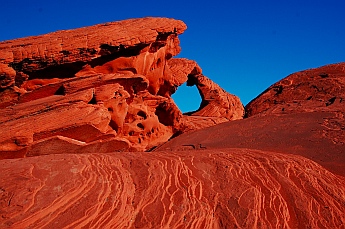
A red rock hand forms the "okay" sign.

Chaos resulting from cosmic clashes.

One of the Beehives

Elephant Rock

A glance across 350 million years of
geological evolution.

Geological look back across time.

Petrified log.

View across the valley.

RIbbon of road near the Seven Sisters formation.

Snaking road near the east entrance.

The CCC Cabins built in 1935.

Cozy fireplace inside a cabin.

What a view out the window!

Great views here too, plus running water and a fridge!

Dime store photo booth!

A thin desert scrub flourishes.

Holding hands at Mouse's Tank.

Another group of four plus two sheep.

Nature's bouquet.

How many toes?

People, shapes, fat animals with short horns,
thin ones with long horns. What does it all say?

Fire Canyon / Silica Dome: red and white sandstone
reaches back to dolomite seabed rock.


Pink and white stripes burst apart.

Scenic Road to White Dome hiking trail.
Valley of Fire, Nevada (2)
Late September-Early Oct, 2009 - Just as Interbike
ended, Las Vegas was engulfed by a ferocious heat
wave. We escaped up I-15 to Cedar City, Utah.
Creeping back down again a few days later when the
temps had receded, we made our way to Valley of
Fire. We had visited this gorgeous state park two
years earlier and loved it so much we wanted to
return for more. Born from the dark fossilized
organic remains of an ancient sea bed, the area is
dominated today by flaming orange petrified sand
dunes, making the whole park appear as if red rock
embers burn against charred hillsides.
There are red rocks everywhere you turn. Even in the campground, where
walk-in tent campers can tuck themselves deep into the crevices of these
fantastic formations, we couldn't stop our cameras from clicking.
The face of Atlatl Rock bears a
huge panel of petroglyph rock
art placed so high up in the air
you have to climb several
stories' worth of stairs to get to
it. I had seen it two years ago,
but wanted to check it out
again. The foggy plexiglas
protecting much of the rock art
had thankfully been replaced.
So this time, along with the big
horn sheep, people, footprints
and shapes I recognized from
before, I also saw a scorpion.
Around the corner is Arch Rock, which looks to me a little like an enormous
hand making the "okay" sign with thumb and forefinger.
The visitors
center has some
outstanding
displays, and
one describes in
detail how a
warm sea
covered most of
Nevada and parts of Utah off-and-on for 400 million years beginning
about 550 million years ago. On the last retreat of this sea, sand began
to blow in from nearby ridges, creating huge, shifting sand dunes.
These dunes were stained red by
underground mineral-rich streams
and then, under their own weight,
compressed into rock. Wow! I
know I had learned all this over at
Red Rock Canyon last week, but
I still found it hard to fathom.
Over time, the tectonic plates
clashed, as the one supporting
the West Coast tried to sneak
under the one supporting the rest
of the country. The solid dark
seabed and bright orange
sandstone were thrust about,
creating the chaotic shapes
of the park today. Some shapes are random, but others seem to
have been created with a specific image in mind.
Coming in from the
east, you look across
350 million years of
time, from the young
200 million-year-old red
rocks to the ancient
dark dolomite of the
seabed floor that has
been thrust upwards by
violent eruptions from
the earth's core.
The park even has two areas
with petrified wood logs.
They are fenced off, so they
are a little awkward to see,
but they are definitely logs
that are wood no longer. It is
hard to imagine the geological changes that have happened over the
vast reaches of time, as there isn't a tree anywhere in the park or in
this part of the world for many miles. Amazingly, these logs were from
large trees. The theory is that they floated in on the sea.
We had to scramble up a
gravel slope to see one
of the logs. Once
up on the precipice,
we looked back
towards the valley
where the road
brought visitors
from other sights.
Maybe it's just my
love of travel, but
my favorite aspect
of this park is the
two beautifully
maintained roads
that run through it.
Both roads sweep through dramatic
turns, climbing and diving through hilly
terrain. They run along expansive,
scruffy valleys, dodge between jagged
red walls, and loop through pink and
white domes of sandstone.
The Seven Sisters is a series of seven
towering orange monoliths that simply
refuse to fit into a single photograph,
so I contented myself with capturing
the silky road that slips past nearby.
Back in 1935, the CCC built three tiny
adjoining stone cabins. Used by park
workers as they built the park (it was the first
Nevada state park and opened in 1936), the cabins
were later used by park visitors. Each cabin is just a
single 9'x9' room, barely large enough for a small
bed and chair, but the setting is to die for.
There is a small door and window in each room, and a
tiny fireplace too. It must have been incredibly rustic
accommodations for those early tourists, complete with
uneven stone floors, but it sure put them right in the
heart of the Valley of Fire experience.
What a view to wake up to -- but how did they make
their coffee?? There was no mention of how those
tourists got their meals or even how they got water.
There was a plaque, however, that described how in
1915 a soldier who had survived the Civil War fifty years
earlier perished under the shade of his open-air horse-
drawn buggy because he couldn't find water. The Colorado River, now the dwindling Lake
Mead, is just a few minutes away by car, but less than 100 years ago this exquisite land cost
that sergeant his life.
Besides the enticing roads and views, the campground is my other
favorite feature of the Valley of Fire. We had inspiring images of red
rocks out every window.
One morning I woke up with a bright idea -- let's get a photo of us
with the buggy in this very cool place! I quickly set up the tripod,
trying to ignore Mark's groans about the idea. Kids were climbing all
over the rocks around us, still in their pajamas and bare feet,
shouting to each other as they played hide-and-seek. Their bleary-
eyed parents were stumbling about their campsites, coffee cups in
hand, as the aroma of frying bacon quickly filled the air. It felt a little
funny, in the midst of all this action, to be taking pictures of
ourselves as if we were in a dime store photo booth. But ya gotta
have something for mom's Christmas card!
The major sight we had missed in our
previous visit was the hike through
Petroglyph Canyon to Mouse's Tank.
Mouse was an outlaw Paiute Indian
who found a large rock bowl that
would fill with many gallons of water
when it rained. Deeply recessed at
the far back of a canyon, this gave him
a great place to hide out. As we
walked into the canyon, trudging
through soft sand, the rock walls
towered on either side with very
sparse sprinklings of vegetation.
The petroglyphs aren't marked. Instead it is left
as an exercise for the hiker to find them. Most
are 10-20 feet up in the air. At least two show
groups of four individuals holding hands.
In these groups,
two people look
human and two
don't. The
scientific experts
think the two non-humans might be shamans or ghostly spirits
from another world, perhaps leading the two humans towards
the afterlife.
Mark spotted
a flowering
bush growing out of a
crevice. It looked like a
bouquet of flowers
hung on the wall.
Other petroglyphs
showed images of
hands and feet.
Looking closely, I
noticed that in one pair of feet, the right one had just four toes. I've seen
this missing digit theme in other rock art. Why did they do that? Even if
the people who pecked these pictures out of the rock lived 4,000 years
ago, they knew how to count. They never drew animals with three or
five legs. "Maybe they just ran out of room," Mark suggested. Or
maybe it wasn't meant to be a human footprint.
Who knows! I really love this odd, other-wordly graffiti. I just wish there was
an accurate petroglyph-English dictionary so we could know what it all means.
Recent rock scratches from our own culture nearby looked amateurish in
comparison.
Out in Fire Canyon
- Silica Dome we
got another
glimpse of the
sandstone set
against the
dolomite
mountains.
Evidence of sea creatures has been found in the distant dark rock.
Here, in this canyon, some sandstone was evenly striped but had
been broken apart by tectonic crushes and uplifts.
We took our time on the scenic drives, stopping frequently to
scramble up the sandstone walls where we tried to gather the
dramatic scenes into a single photograph. The pinks and reds and
oranges sometimes looked as if they were sliding downhill,
perched on a perilous slope.
After a few days, we got blown out of the Valley of Fire by a huge
windstorm that swept all the dust for miles around into enormous,
billowing clouds. The campground was sandblasted for hours on end.
Shaking the dust out of our hair and wiping it out of our eyes and off
our cheeks, we slammed the doors of the truck and tore out of there
as fast as we could. A thick wall of dust swirled around the back of the
trailer behind us as we drove off. Onward, southbound, to Laughlin,
Nevada, where we could escape to the climate-controlled indoors until
the wind died down.
More blog posts from our travels in Nevada:
- A Back Roads RV Trip – AZ to NV to UT – Colorado River & Spanish Trail 04/13/18
- Lake Mead Scenic Drive + A Great RV Pit Stop at “Redstone” NV! 12/14/17
- A Las Vegas Light Show — WOW!! 10/06/17
- Into the Great Wide Open – Nevada to Oregon 06/11/14
- From Salt to Snow in Nevada – Bonneville to Lamoille Canyon 06/06/14
- Nevada Open Road Challenge – A NEED for SPEED! 05/30/14
- Laughlin, NV – A Little Known Canyon, Petroglyphs & A Car Museum! 10/01/09
- Las Vegas – The Interbike Tradeshow and Awesome Red Canyon! 09/29/09
- Valley of Fire, NV – A Cauldron Cooled 09/25/09
- Pioche & Cathedral Gorge, NV – The Wild West 09/23/08
- Valley of Fire, NV – Sweeping Vistas 10/29/07
Other great RV dry camping areas:
- Lost Dutchman State Park: GORGEOUS scenery & RV campground! 04/12/24
- Windy Hill Campground + Tonto National Monument 03/08/24
- Lynx Lake, Arizona – Great RV Camping Near Prescott! 05/17/23
- Dead Horse Ranch State Park + Tuzigoot and Clarkdale 02/17/23
- Catalina State Park & Roosevelt Lake: RV Camping in AZ 01/20/23
- Oliver Lee Memorial State Park, New Mexico – A Dog’s Eye View! 11/30/18
- Lost Dutchman State Park Campground – Arizona Gold in the Superstitions 02/15/18
- Lake Pleasant & Canyon Lake – Waterfront Camping in Arizona’s Sonoran Desert 02/02/18
- Sand Hollow State Park, Utah – An Oasis in the Desert! 11/21/17
- RV Camping with the Rock Art Petroglyphs in Gila Bend, AZ 04/21/17
- City of Rocks State Park, NM – RV Camping in the Hoodoos! 12/03/15
- Boondocking at Big Bend National Park – Cheap & Scenic RV Camping 03/26/15
- Roosevelt Lake – Lakeside Camping in AZ 05/01/14
- Wupatki Nat’l Monument – Ancient Indian Ruins & Great Camping in AZ! 08/25/11
- Valley of Fire, NV – A Cauldron Cooled 09/25/09
- Zion NP, Kodachrome Basin & Snow Canyon, UT – Great Red Rocks! 10/31/07
- Goblin Valley, UT – Where the Ghosts Are 10/16/07
Our most recent posts:
- Buckskin Mountain State Park – Fun on the Colorado River! 01/31/26
- How to Install Starlink Gen 3 in an RV? Use the Speedmount! 08/07/25
- Escape to Paradise – Rocky Mountain Magic! 08/01/25
- Is Forest River a Good RV? Well Built? Here’s Our Experience 06/20/25
- Sunset Crater Nat’l Monument – Lava & Camels at Bonito CG! 06/06/25
More of our Latest Posts are in the MENU.
New to this site? Visit RVers Start Here to find where we keep all the good stuff!!
Stevensville, MT – Real Ranching and Grass Fed Beef!

Hat shop in Salmon, Idaho.

Trade-in hats from loyal customers.

Lemhi County Fair

Cowboys watch the rodeo.

Beautiful barn and ranch in the Bitterroot.

Little Buck eyes me up.

He did exactly as my reins told him.

A peaceful but busy ranch.

Calves come barreling down the chute to be
inoculated.

They are held in a small pen for their shots.

That's a mighty big syringe!

Two quick shots. Some calves barely seemed to
notice.

And off they run to join their waiting friends.

Sunset casts a warm glow on the Bitterroot mountains.

A wildfire had burned for a month in the nearby hills.

Carl shows us what ranchers do in their free time.

The views became more and more
grand as we climbed.

New growth from the wicked 1910 blaze to the left and
new charred scarring on the right.


Beetles bore into the tree bark
and the tree responds by oozing
thick sap.

The newest ranch hand.

Wild turkeys pay us a visit.

Just a few feet to one side and we'd have had a good sunny
glimpse of the family.

Bambi trots across the grass nearby.

The cows come when called.

Yum, freshly mowed grass!

That's something to moo about.

The moms circle us.

A few treats to lure them in, and they know the next
step is a romp in a new pasture.

This guy was hopeful mom still had some milk for him.

And they're off to greener grass on the other side of the fence.
Stevensville, Montana
Late August, 2009 - We left Stanley, Idaho and continued traveling
north towards Montana, following the wonderful twists and turns of the
Salmon River as it descended down the mountains. During two days of
leisurely driving along the river's edge, we watched the terrain gradually
change from tall pines on steep mountainsides to rolling, barren hills that
seemed to have been shaped and smoothed with care. We slowly
began to feel the mood changing from fly fishing in fast-moving streams
under cool trees to ranching on the wide open range under the big sky.
Stopping in the small town of Salmon, Idaho, we found a shop filled with
cowboy hats. The new ones on the racks looked very crisp, but the
ones with real character were the crumpled ones the customers had
turned in. These hats lined the tops of the walls in the store. Each hat
was crinkled and worn in a different way, and each had the owner's
name under it.
Outside of town we found the Lemhi
County Fair in progress. There was
all kinds of horse activity going on,
and we watched a little as the riders
competed with each other to be the
fastest one to sort out a single cow
from the herd.
It was more fun watching the
cowboys watch the event.
Some of the ranches and farms we passed were beautiful properties. One red barn in
particular caught my eye, and later I found that this same barn
was featured on a glossy Montana calendar.
We went to Stevensville to visit our friends Bob and Donna Lea.
Before we'd even said "hello" to them, we met their horse Little
Buck. He was carrying Bob's ranching boots on his back.
I got a chance to try my legs at
riding a horse. This was just the
third time I'd been on a horse
since my first outing on a pony at
the church fair when I was five. I
managed okay, but I got the
signals crossed for turning right
versus left and consequently had
to duck under a very low branch.
Bob had work to do at his
neighbor Carl's ranch, and we got
a fantastic inside view of what
ranching is like. This was the day
the cows and their calves had to
be inoculated with two vaccines
and sprayed with an anti-fly
spray. I had no idea what to
expect, but I loved the sights and
smells and busy activity on the
ranch.
First the calves were sent down a chute to a single-calf sized holding
pen. There they were held in place with a clamp on either side of their
neck so they could bob their head up and down but couldn't wriggle out.
This made it easier to give them their shots. They didn't seem thrilled
with the idea, but they didn't protest too much. A scratch on the head
helped the medicine go down. Next, two ranchers lined up with the
shots. The syringes were pretty good sized. Bigger than I'd want,
anyways!
Then the vaccines were injected and
the calf was released to run off to his
friends down the hill. There was all kinds of mooing going on in the distance, as the calves and
cows had been separated from each other for this project, and they kept calling to each other
from their separate pens.
Eventually everyone got their shots
and later they all got their spray. We
had a chance to go through the
calving barn to see where and how
that is done (in March when it is zero
degrees and snowing). As I looked at
the apparatus for handling a breach
birth and for nurturing a sickly calf, I
was amazed at how much biological
and medical knowledge a rancher
needs to have. I missed most of the
scientific words Carl was throwing
around.
Yet there was a cozy intimacy to this family enterprise that brought a new group of calves into
this world each year. I felt like I was peeking in on a James Herriott story. In the distance that
evening the mountains were lit with a momentary splendor, adding a special glow to this world of
Montana cattle ranching.
A wildfire had been burning in the
nearby mountains for a month.
During the day you could smell the
smoke, and at times the fire danced across the mountainside,
sending up a ribbon of smoke first from one area and then another.
A few days into our visit a torrential rainstorm came, dropping an inch
of water on the mountains and valley (along with a thin layer of pea-
sized hail). That doused the fire long enough for us to take a
mountain bike ride up to a nearby peak to get a closer look.
Our new ranching friend Carl showed us that ranchers don't just raise
cattle. They mountain bike too.
Once we got up in the hills a
few miles we had an
expansive view of the
Bitterroot Valley below. We
met some US Forest Service
rangers at the crest of the
mountain, and they told us that
the fire was subdued but not
quite out. As we looked out at
the charred hillside in the
distance (on the right side of
the photo below) we could not
see any smoke just then, but
in later days it returned.
The modern wildfire fighting method is to let them burn, as fires are natural in this part of
the country. The hillside on the left of the photo shows the forest's re-growth since the
1910 inferno that roared from Washington state across Idaho and into Montana. The shorter, even trees covering most of the hill
are the regrowth and the taller, darker ribbon of trees that lines the ravine going down the hillside are the original pre-1910 trees.
One hundred years later and the evidence of that fire is still plain to see.
Hopefully the burnt areas from this year's fire will grow back
a little faster, as the fire was not hot enough to sterilize the
ground (like the 1910 fire did). All the fire talk aside, it was a
good moment for a photo op.
The fire was working its way across many healthy trees, but
we found ourselves in a stand of beetle infested trees. The
beetles bore into the bark and the tree tries to repel them
with thick sap. This gives the tree a pock-marked look.
Some trees are able to stave off the infestation, but most
Meanwhile, back at the ranch, Carl had just acquired an
adorable new cow dog. She was all cuddles and goofiness,
just settling in to her new home before learning the ropes of
her ranch job.
Out in the "wildlife sanctuary," a portion of the pastureland allowed to grow
wild, two families of wild turkeys showed up. They had been in the area all
summer and at one time numbered two adult females and 17 chicks.
We counted 15 chicks with
the moms, but couldn't get
them to stand still or pose for
us in the sunshine for a family
portrait. They ran across the
road in the shadows instead.
In the midst of taking way too
many photos of these
turkeys, I looked up and saw
Bambi running across the
field, white spots and all.
A few days later, Carl invited us
over to see a "cattle drive" at the
ranch. This wasn't the big round-
up you might imagine, but a simple
walk-through from one pasture to
another. The cows had made
short work of all the grass in their
current field, and when Carl called
to them, they came running.
He presented them with some
freshly mowed grass and they got
very excited. The mooing was
tremendous, and each cow came
bellowing over to us, calf in tow.
They all stood around us in a circle,
expectantly. He hand fed a few,
telling me some of the stories behind
each one. The bulls were lounging
under the trees in another pasture
way down the hill. It was like a boys
school and a girls school with each
waiting for spring time when they
could finally get together at the prom.
Each May he puts two bulls in a
pasture with 50 cows for 70 days. By
the end just about every cow is
pregnant and the bulls have a
lot of notches on their belts.
Some cows had been on his ranch
for 13 years, and others for just a
year or so, but each had a history
and a personality.
This big guy was still nursing (a
little old for that, perhaps!). He
spent quite some time going round
and round from teat to teat, quite
sure that there was something
there for him, but not finding what
he wanted. Finally momma just
walked off.
Carl led the cows and calves through the gate, and they went running down
the lush green hillside. They were delighted with their new digs. The grass
was tall and soft, and the view was superb. The cattle on this ranch have it
good.
We said goodbye to Carl, and took off with Bob and Donna Lea for the
annual Labor Day Helmville Rodeo.
2005 Fleetwood Colonial Popup Camper


Closer view of the buggy itself.


We got a license plate with the buggy's name on it.

Luvnest Floorplan
2005 Fleetwood Colonial Popup
We used our popup for three years of vacation travel from 2004-2007, and we named it the Luvnest because it was so darned
cute and so much fun. Whenever we spent time in it, even just a weekend in a local campground, we fell in love all over again.
We took it out whenever possible. In the first two years we spent 157 nights in it.
We bought it after a trip to Bryce Canyon National Park (Utah) in a tent. The rain was relentless. While we drove around looking
for warm coffee shops and cozy places for lunch and dinner we noticed that all the people in RVs at the campground were
happily playing board games and reading, snug inside their trailers. All the tenters packed up and left. When we got home we
went shopping for a popup.
The 2005 Fleetwood Colonial Folding Tent Trailer is 12' long
end-to-end, including the hitch. It has a 10' x 8' box containing
the dinette, sink, cupboards and some nice shelving and gives
150 square feet of living space. There is a King bed at the
hitch end and a Double bed at the other end, We had a
furnace and outside shower which both came in very handy.
We never camped anywhere that required air conditioning, but
we often had chilly nights and ran the furnace. When we got
hookups we would use a Holmes ceramic space heater
instead, as heating the trailer with the furnace used a lot of
battery power.
It had 26 gallons of fresh water (including the 6 gallon hot
water tank). There was no holding tank and no toilet. We
kept two small sets of Rubbermaid drawers in the trailer.
One set contained our toiletries and the other had all those
miscellaneous things you need like scissors, string, tape,
stapler, pens and pencils, pads, sewing kit, etc.
We pulled the popup with a 2004 Toyota Tundra pickup truck
(4.7 liter engine). It was a perfect combination for towing. The
trailer was easily within the truck's capabilities and there was
plenty of storage under the cap of the pickup for all the things
that wouldn't fit in the trailer.
We purchased a bike rack for the roof, as this particular
model did not include a roof rack. It was a little awkward to
get the bikes on the roof, because the rack system required
strapping the bikes down in addition to using Bike Tites to
clamp the fork to the roof, but it gave us more room in the
truck.
The beauty of a popup is that it is light and easy to tow, can fit
in almost any campsite at any campground and can be
parked in the garage. Most have a king bed. The
disadvantage is that the canvas sides don't provide any
insulation and you can't easily overnight in a Walmart or eat
lunch at the dinette while stopped at a rest area.
A popup offers a fantastic introduction to RVing. We learned all about the basic RV systems: batteries, gas fridge, gas hot water
heater, furnace, etc., with the popup. We also learned how to conserve water with our showers and how to conserve battery
use. We did not have solar, but we could spend about a week in this rig without charging the batteries. We often used candles
at night to extend our stay. The furnace was very effective but used a lot of battery power. I nicknamed it the Fire Breathing
Dragon, because it was quite loud and would make the buggy so hot I'd have to unzip the canvas near my nose to get some
fresh air! We found that if we were staying several days in a place where temperatures got into the 30's at night we were
happier with hookups so we could run our electric heater all night long. The lowest temperature we ever camped in was 28
degrees in Moab, Utah, in March. We like to be warm and we don't camp in humid areas, so we have never had a need for air
conditioning in any of our rigs -- except when we were east of central Texas.
Long-term travel in a popup can be done, but it is the exception. We met a couple in their mid-sixties that has full-timed in a
Fleetwood Niagra popup for four years. They had a bumper sticker, "Life is better outdoors," and they were grinning ear to ear.
We also met a couple in their twenties that was spending six months in their Fleetwood Santa Fe touring the country and
peforming music in local bars as they searched for a community they liked enough to settle in.
It was hard to give up our first Luvnest when we purchased our Lynx travel trailer. However, our good friends Rich and Mary are
now the proud owners of this rig, and we have had a ball camping with them, seeing our old Luvnest in a nearby campsite.