Huatulco’s Las Palmas Resort – 24 Hours in Heaven!

Mid-December, 2012 – Life aboard our sailboat Groovy, anchored in Bahía de Santa Cruz in Huatulco, had become deliciously languid and slow, with one day flowing seamlessly into the next.  Huatulco was gradually filling with tourists, and every day we saw more and more people going out on the tour boats and sunning themselves on the beaches.

Santa Cruz Bay Anchorage Huatulco Mexico

Groovy is anchored peacefully in Santa Cruz Bay

Santa Cruz Bay Huatulco Anchorage sail blog Banana Boat

Lots of boats circled Groovy to wave “Hola!”

Sitting on Groovy, we had front row seats to whatever action cropped up in the bay, and it was pleasant entertainment just watching whatever was going on around us. Many of the tour boats would take a little detour on their way in or out of the bay to circle Groovy and give us an enthusiastic wave and a chorus of greetings from happy guests.


Playa de Entrega, Santa Cruz Bay, Huatulco sail blog

View of Playa de Entrega on our walk to Las Palmas

One morning two couples in kayaks and a paddle board floated over to our boat.  We exchanged hellos and “where are you from” queries and “what a beautiful day this is!” comments.  We discovered that they were from Lake Tahoe and were boating enthusiasts too.

Las Palmas Resort Huatulco - visited on our Mexico cruise

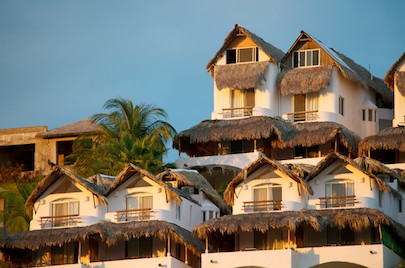
Las Palmas Resort

We had met so few Americans in Huatulco that it was suddenly really heartwarming to share a few memories of home with them over our transom.  One paddler, Ron, mentioned he had sailed quite a bit in the past, and when I asked where they were staying, he said, “I own a resort up there on the hill.  It’s called Las Palmas.”

Las Palmas Resort Huatulco Mexico (sail blog)

Lush landscaping everywhere

View of Playa Violin from Las Palmas Resort Huatulco Mexico

Playa Violin has wonderful cliffs

Wow!  Most folks we meet say they are staying at a resort.  This was the first time we met someone who owned one.  And he looked so relaxed and happy sitting there in his kayak. Gosh…and I had thought that we were living the dream!!

“Come on up sometime!  You can see the resort and have a beer with us.”  My jaw dropped as he continued on, explaining how to walk to the resort.  “It overlooks Playa Violin,” he said.  Then his little group paddled away and Mark and I turned to look at each other, wide eyed, and grinning.  That just wouldn’t have happened in our old workaday life in our old neighborhood.  Never!  What a fun encounter.  What a neat opportunity!

From our Mexico cruise: Las Palmas Resort on Playa Violin in Huatulco

Looking down at Playa Violin from Las Palmas


Over breakfast the next morning we debated:  Go to the beach, do errands in town, or check out that resort?  That was a short debate!  We quickly dinghied ashore and began hoofing it up and over the hills to try to find Las Palmas.

views from our sailing cruise: Las Palmas Resort in Huatulco Mexico

Las Palmas Resort

It’s easy to find, but we got lost anyway and went well beyond it.  On our way back we looked across the little beach of Playa Violin, and there it was, an ethereal group of buildings and terraces perched on the edge of the cliffs.  “That must be it,” Mark said, picking up the pace down the hill.
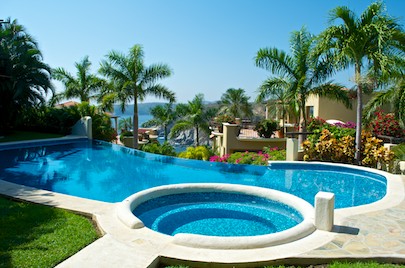
From our sailboat cruise of Mexico: Las Palmas Resort, Huatulco

Pools, palms, views, and more…

Then we glanced up and saw a pickup truck coming towards us with Ron driving and his friend, Craig, who had been the one on the paddle board, in the passenger’s seat.

Las Palmas Resort Terraces Huatulco Mexico (sail blog)

Las Palmas Resort

They picked us up, and suddenly we were passing through the tall entrance gates of Las Palmas Resort, driving into a gorgeous luxury property.
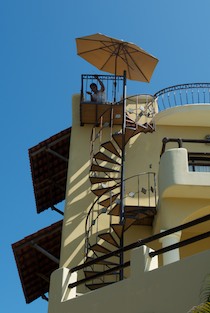
Las Palmas Resort Huatulco Mexico from our sail blog

The rooms and terraces soar above the views

Ron’s wife Jackie and Craig’s wife Terri were there welcoming us, but everything was a blur around us.  All we could see was the lovingly nurtured landscaping, lush with flowers and tropical plants, that hugged the myriad of balconies and lookouts and infinity pools all around us.

Las Palmas resort Huatulco on our Mexican sailing cruise

The property was built high on a hill, and the buildings and palm trees soared even higher, offering stunning views of the beach, little Violin bay, the open Pacific ocean, and the bay of Santa Cruz, depending on where you stood and which way you turned your head.
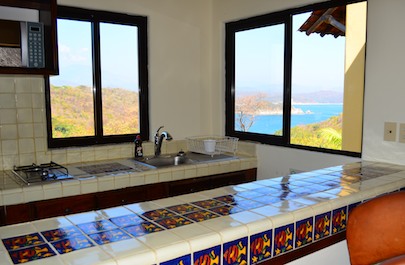
Las Palmas Resort a day away on our Mexico cruise

Some suites have kitchens too!


We have seen a lot of resorts in this cruising lifestyle.  In many ways, cruising Mexico’s Pacific Coast can be an ongoing tour of oceanside resorts, as most anchorages are located in spots that lend themselves to resort development.  And quite often we’ve had a chance to wander through to see how the other half lives.

View of Chahue Bay from Las Palmas Resort in Huatulco Mexico from our sail blog

View of Chahue Bay from that suite’s kitchen

But this resort was head and shoulders beyond anything we’ve seen.  It was intimate, each room was unique, and everything about it quietly blended into the surroundings, giving guests a true retreat while pampering them with the finest of everything.

Las Palmas Resort Palapa Restaurant

A nice gathering place for guests


A little restaurant/bar under a thatched palapa roof seemed the ideal spot for all the guests to gather and mingle.  However, we were lucky enough to have met these new friends before peak season hit.  For the moment, we had the place to ourselves.

On our sailing cruise of Mexico, we visited Las Palmas Resort, Huatulco Mexico

Palms of “Las Palmas”

“A lot of people come here for a few weeks,” Ron was telling us.  “They get to know each other, and now there’s a community of people who come back year after year.”  What a way to spend the coldest part of winter!  Gourmet meals are prepared in a beautifully appointed kitchen, and the colorful parrot Lucy greets everyone.
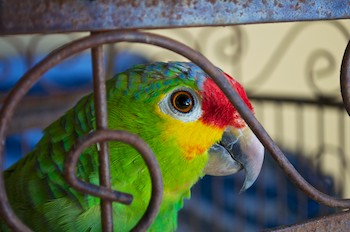
Las Palmas Resort Huatulco Mexico from our sail blog

Lucy checks me out

Building this resort was an act of enormous faith, propelled by Ron’s brilliant vision of bringing charm and luxury to paradise.  Running several tourist businesses in Lake Tahoe, he had never developed a luxury resort before.

Las Palmas Resort Playa Violin Huatulco Mexic (sail blog)

Views from Las Palmas Resort


What an accomplishment!  There are lots of laws, rules, regs and hurdles to leap to create a property like this on the Mexican coast.

Gourmet kitchen Las Palmas Resort Huatulco Mexico

Margarita prepares gourmet meals in this airy kitchen

Too many resorts in Mexico remain unfinished, with rebar, bare concrete and gaping holes staring forlornly out to sea from exquisite perches on land.  To complete a project of this scale is an incredible achievement.  And right down to the unusual decorative tiles and lovely fittings adorning each room, every possible detail has been thought of and completed to perfection.
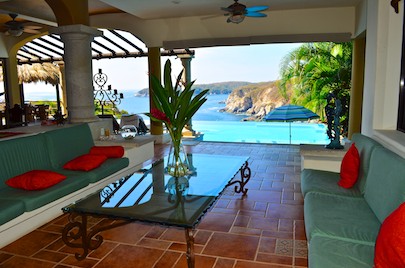
Las Palmas Resort in Huatulco Mexico

The spacious rooms open onto the pools and views

What I loved most, though, was that all the windows and doors in all the rooms can be thrown open to bring in the ocean breezes along with the view.  Every room Ron showed us was unique in the way it took advantage of its particular position on the hill, and all the rooms eagerly welcomed the outdoors in.

We quickly lost track of how many rooms there were, and how many buildings made up the property, and where all the infinity pools were located.  But there was a main house that was often rented for big family gatherings, weddings, or corporate retreats, and standing in that space made us feel like we’d stepped into the lives of the rich and famous.

A room at Las Palmas Resort in Huatulco Mexico (sail blog)

What a delightful room…

Suddenly, Ron asked if we’d like to spend the night.  “I know how it can be on a boat.  Sometimes it’s really nice to get off the boat for a night and get a long hot shower.”  Holy cow.  Getting off the boat to a stationary bed would be nice.  But staying here at Las Palmas would top anything we’d imagined by a long shot!

View from a room at Las Palmas Resort Huatulco Mexico (sail blog)

…with an awe-inspiring view

He showed us the room where we’d be staying.  It was in an incredible spot with the doors thrown wide to a spectacular view of the beach and cliffs.
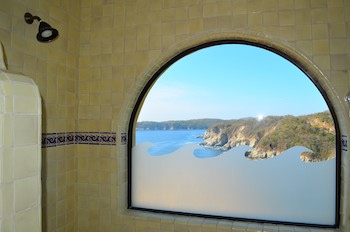
Las Palmas Resort even the shower has a view (sail blog)

You can enjoy the view even in the shower!


Rather than a mere window onto the view, the opening to the deck was almost the full width of the room, bringing the outdoors rushing in, and flooding the room with the bay’s soft light of late afternoon.  Even the shower had a view.

Las Palmas Resort Huatulco Mexico dolphin pool

One pool has an image of a dolphin on the bottom!

Somehow, effortlessly, the logistics for our stay sorted themselves out.  We dashed back to Groovy for an overnight bag, and then found ourselves enjoying the golden hour in the big house’s picturesque infinity pool as the sun slipped behind the cliffs.

Terri put a delicious Margarita in my hand, and I watched Mark swim over to the edge of the pool to soak in the view with Craig.  “I feel like I died and went to heaven,” I said happily as I slid into the silky warm water to join them.

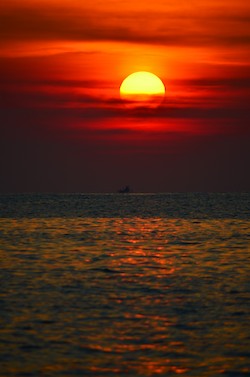
Las Palmas Resort Huatulco a groovy sunset during our sailboat cruise

Mark and Craig enjoy the sunset from the infinity pool


How, exactly, had we been granted 24 hours in heaven?  Who knows!  It was the best and most vivid dream, yet we were wide awake in the midst of it.

More margaritas on the deck overlooking the pool, dinner out at Huatulco’s finest restaurant, a pink sunrise reflecting off the water, and an amazing American/Oaxacan brunch poolside once again in the morning, all made us feel like Santa had come early and invited us to spend a day in someone else’s life.

Las Palmas Resort Huatulco Mexico romance on our Mexico sailing cruise

When we returned to Groovy after our day away, we found conversation impossible.  All we could say to each other was, “Can you believe that just happened?”  “What an amazing experience!”  “How fortunate we are…”

And then, what a joy it was to be able to take our new friends out sailing a few days later.  The gods of the wind and the sea cooperated beautifully and gave us ideal conditions for a daysail.  Modest breezes, flat seas, and bright sunny skies followed us along the coast.

Sailing Groovy in Huatulco Mexico

Mark and Ron enjoying our wonderful daysail aboard Groovy


As we chatted, the boat took flight in the light wind, and we discovered that  “boating enthusiast” was an understatement in Ron’s case.  He had crewed on the TransPac ocean sailing race from California to Hawaii as a youngster, and had become a licensed Coast Guard captain to boot.  As if welcoming the sailor back to the sea, Groovy came alive and took us all on a speedy, carefree ride, and the world fell away in our wake.

One of the most exciting things in our traveling lifestyle is that we never know what is going to happen next.  We are continually blessed with surprises we couldn’t plan if we tried.  We just never know who’s going to paddle over in a kayak to say “hello.”

We continued to stay in the Bays of Huatulco and enjoy its delights, including a visit to its wild side at Playa La Bocana.

<- Previous                                                                                                                                                                                      Next ->

Huatulco’s Santa Cruz Bay – great beaches & a cute harbor village – Paradise!

Santa Cruz Bay Huatulco Mexico sailing blog

Santa Cruz Beach and anchorage in Huatulco set against the backdrop of Oaxaca’s mountains

Early December, 2012 – After our beautiful day in the tropical orchard of Hagia Sofia, we left Marina Chahué to anchor out once again.  There are a dozen or so anchorages to choose from in the Bays of Huatulco, and we decided to spend a while in Santa Cruz Bay where we found three beautiful beaches, a snug little harbor-side village, and easy access to the town of La Crucecita.

Santa Cruz Bay and Chahue Bay Huatulco Mexico

View across Santa Cruz Bay to Chahué Bay

s/v Groovy in Santa Cruz Bay Huatulco Mexico sailing blog

Groovy finds its groove in Santa Cruz Bay

The roads along the bay are hilly, and we got a great feeling for the lay of the land on our many walks along the road that hugs the bay.

Various viewpoints give an awesome look down into the bay and across the little harbor and village. Groovy settled into a quiet spot right off a small beach.  The anchorage can hold about three or four cruising boats, but we were the only ones there for a long time.

Santa Cruz Bay Huatulco Mexico sailing blog

We had a great view of a tiny beach and two tempting beach bars

Santa Cruz Bay Huatulco Mexico sailing blog

Looking out at the anchorage from the beach bars

The ospreys, pelicans and frigate birds circled in the air above us all day long, and the two beach bars on the little beach came alive at night.

After staring at those beach bars from the boat for a while, we just had to check out the view out into the bay from where they sat.  Not surprisingly, their view of us was just as appealing as our view of them!

Santa Cruz Bay Huatulco

We had our own nearly private beach

Santa Cruz Bay Huatulco

Pretty views everywhere


These were quiet days filled with simple pleasures.  Having easy access to activities on shore gave us the amusements of both surf and turf.  We could wander around on dry land whenever the mood struck us, but we could still take advantage of having a waterborne home.

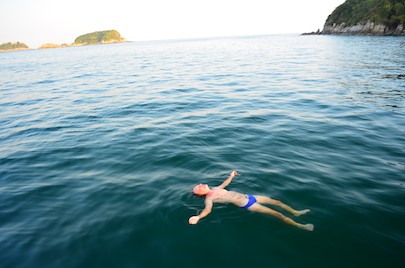
The ocean was over 80 degrees, and the cabin temperatures were still frequently hitting 90 degrees in the late afternoons, so swimming became a natural part of every day.  Swimming off the boat is without doubt one of the greatest joys of living at anchor.  But being able to wade in from the beach and feel sand between our toes was just as nice.

Santa Cruz Harbor Huatulco sailing blog

Santa Cruz Harbor and Beach

The village of Santa Cruz surrounds a small harbor, and on the backside of town is Santa Cruz Beach, a slightly larger but wonderfully intimate little beach that soon became a frequent hangout for us.

Santa Cruz Beach Huatulco dinghy ride and groovy

Our dinghy got us everywhere in minutes

It was a five minute dinghy ride to get over there, and as soon as our feet hit the sand we instantly turned into beach bums.


Santa Cruz Beach Huatulco

Palm trees and a beach – perfection!

There are sweeping palm trees that reach for the sky alongside a small row of very inviting beachside restaurants and bars.  All you have to do is grab a table and stake a claim to your own piece of paradise.  Stay until you’ve had your fill.

Santa Cruz Beach Al Frente del Mar Restaurant

Have a seat…!

We kept pinching ourselves day after day, absolutely thrilled with life and amazed we could be living this way.  This was our third season of cruising Mexico, but it had never been anywhere near this good.

Like so many other hopeful cruisers, we had cast off the dock lines long ago to head to distant shores and “live the dream” of cruising.

Living the dream sailing blog in Santa Cruz Beach Huatulco Mexico

Living the dream!

But the challenges of that dream had too often made it far from dreamy.  Rolly anchorages and sleepless nights, red tide and cold water, exhausting 200 miles passages and frightening overnights at sea had all joined forces each season to make us question our sanity in wanting to live on a sailboat.

Santa Cruz Beach Huatulco Mexico sailing blog

Santa Cruz Beach

However, this year, during these weeks, in this place, it all came together and we were in heaven. The bay stayed calm, the water was intoxicatingly clear and warm, and the gods smiled down on us day after day.

On Santa Cruz Beach happy vacationers and locals alike would just wade out into the water a bit, have a seat, and stay seated with the water up to their necks, until they were totally water logged.  Families, couples, groups of teenage friends and toddlers all immersed themselves in the lapping waves, swishing their hands around, chatting and laughing for hours.  We did too!

Underwater at Santa Cruz Beach Huatulco

A fish checks out our new camera

Under water the fish milled around the rocks, nibbling here and there, and watching the snorkelers with curiosity.  We’d never played around with an underwater camera before, and we soon learned that getting Jacques Cousteau shots is not so easy.  Nothing stays still!  Just as we’d get the shot lined up, the fish would wriggle away or a wave would pick us up and move us — and the camera — a few feet.  But it was so much fun trying.

Santa Cruz Beach Huatulco sailing blog

This is a wonderfully intimate little beach


On the beach the best entertainment was the little kids.  The small waves were just the right size for toddlers — big enough to lure them into the water but small enough not to be scary.  In and out they’d go, running, running, running.

Toddler on Santa Cruz Beach Huatulco sailing blog

The waves were just right for toddlers


Toddlers on Santa Cruz Beach Huatulco Mexico sailing blog

It’s so fun to watch the waves break in your lap!

A brother and sister sat mesmerized by the waves for a long time, letting the waves break right in their laps, wave after wave after wave.

Everyone wanted to get pics of each other to send home.  This is the kind of fun you just have to share, and we all knew we could make everyone back home incredibly jealous.

Santa Cruz Beach Huatulco Mexico sailing blog

Friends posed for each other, getting the sand and water and blue sky lined up just right. Pairs of young girls did endless sexy poses for each other, each one showing off her assets while her friend clicked away.  After they’d do a few bikini model shots showing off the bathing suit from both the front and back, they’d suddenly lie down in the water to go for a curvaceous, alluring water shot. I suspect there are some lucky boyfriends out there!

Santa Cruz Beach Huatulco Mexico sailing blog

We all took pics of each other

Mark was only too happy to help out with these mini photo shoots, but the show always instantly became very G-rated!  The nice return was that we got some shots of ourselves to make our friends envious too.

Santa Cruz Beach Huatulco sailing blog

Happy!


Up among the beach umbrellas where the margaritas and beers flowed with enthusiasm at every table, vendors wandered through selling their wares.  The usual stream of women passed through selling commercially made bead jewelry.

Japanese vendors on Santa Cruz Beach Huatulco Mexico sailing blog

Cruising Mexico in a VW Microbus selling jewelry!

Far more intriguing was the young Japanese couple who stopped by.  Hailing from Kyoto, Japan, they were traveling across Mexico in a VW Microbus, funding their adventure with their own hand-made jewelry.

Vendor sells corn bread on the beach Huatulco

Corn bread for sale!

Another women sold bread that had the exact taste and texture of corn muffins — quite yummy.  And several women braided and beaded girls’ hair like Bo Derek.  One woman was very eager to do Mark’s hair. It is getting a little long, but I don’t think a head full of braids would be that becoming on him.

Lots of hair braiding on Santa Cruz Beach in Huatulco Mexico

A little girl gets her hair braided

Some guitarists meandered by strumming melodies and then an old man showed up pushing an ice cream cart through the sand.

Ice cream vendor Santa Cruz Beach Huatulco

An ice cream vendor rolls his cart through the sand

This beach was a great place to kick back and watch the world go by.

The little harbor village of Santa Cruz is filled with pangas, open outboard-driven skiffs.  Some offer tours of the bays to tourists and many others are fishing boats.  As we wandered back to get our dinghy one afternoon a pair of young fellows on a scooter showed off the fish they had just caught.

FIsh on a scooter - Santa Cruz Harbor Huatulco sailing blog

Catch of the day!

A few minutes later, on our way out to the boat, we spotted two fishermen in a panga at the dock carving up some fish they had just caught.

Santa Cruz Bay anchorage sailing blog Huatulco Mexico

Late afternoon view from our cockpit


A quick conversation and negotiation, and we were suddenly waving goodbye and motoring away with a fillet for dinner.

Fishing near Groovy in Santa Cruz Bay anchorage Huatulco Mexico sailing blog

Fishermen suddenly cast nets all around Groovy

Back at Groovy a bunch of fishermen had surrounded our boat and were casting nets into the water.  I don’t know what kind of fish had arrived, but the fishermen knew they were there.  We had always had peaceful sunsets to ourselves, but for three nights in a row we got caught up in a flurry of fishing activity.  The fish were so thick around our boat we could see them from the cockpit.  Then one day the fish were gone and the fishermen were gone too.

Santa Cruz Bay anchorage Huatulco Mexico full moon and frigate bird

These were beautiful days of seaside living that blended into each other in a blur of wonder.

Tuesday rolled into Saturday and then it was suddenly Wednesday, or was it Friday? Who knew, and who really cared?  Mid-December caught us by surprise.  Time disappeared in a delicious, unhurried way.

Wouldn’t it be beautiful if life were always like this?  It is a dream so many of us share… For a precious time, our lives were suspended in tropical perfection.

And then, to top it off completely, we were gifted with 24 hours in heaven at the exquisite Las Palmas Resort!

<- Previous                                                                                                                                                                                      Next ->

Huatulco’s Hagia Sofia (2) – Hammocks, hills, waterfalls and a Oaxacan feast

Hagia Sofia Huatulco has wonderful riverside hammocks

Mark gets a little hammock time

Thanksgiving, 2012 – Our walk through the exotic tropical flowers at Hagia Sofia had been exciting, but when our host Armando led us to a group of hammocks hung from trees by the riverside, they looked so inviting we just had to lie down awhile.  What a spot!

Armando has rigged these hammocks up with pull-strings, so as you lie on your back you can lightly tug on the string to get yourself rocking a little.  Such bliss.

Hagia Sofia Huatulco leaf in river


The river lazily trickled by us as we rocked in the hammocks.  One day there will be cabins near this part of the property where guests can overnight on these lush grounds.  I can imagine many a happy afternoon spent lolling in those hammocks by the river.

Hagia Sofia Huatulco dragonfly

Armando even had a little table set out with fresh, chilled juice-water ready and waiting for us. This water is lightly spritzed with juices from mangos and limes and sweetened with honey, all from his orchard. It was so refreshing in the heat of the day.

Mark spotted a leaf catching a ride downriver, and a dragonfly alighted nearby on a twig.  There was a peacefulness here that warmed our souls.

Hagia Sofia Huatulco orchard views

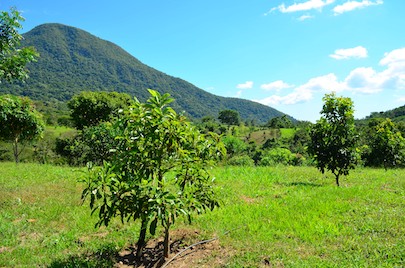
We stroll among the fruit trees on the hills

Refreshed from our rest in the hammocks, Armando led us out onto the crest of a hill where many of the fruit trees grow.  Groups of papayas, avocados, and other fruit trees we’d never heard of before studded the hillside.  Similar fruits were being grown together, but rather than being lined up in GPS-perfect rows, as we’ve seen so often on large commercial farms, the trees were scattered about.

Hagia Sofia Huatulco orchards

Views from the orchard

Of course, different fruits grow at different times of the year, but a bunch of pineapples that looked ready for picking caught our eyes.

Hagia Sofia Huatulco potted plants sailing blog

Potted plants waiting for transplanting

Hagia Sofia Huatulco pineapple

A pineapple ready for picking

Hagia Sofia Huatulco tunnel of tress sailing blog

A tunnel of trees

Off to one side there were rows of potted baby plants.  Over the years Armando brought bags of seeds back to Mexico with him from his many trips to Asia, and he carefully planted and nurtured them.  As we walked along he would proudly point out, “I grew that tree from seed, and that one and that one too.”  We said he must have a green thumb, a phrase that didn’t seem to have an equivalent in Spanish, but when he caught our meaning he gave all the credit to the men who work his land.

He has often consulted a Zapotec farmer (from the local indigenous culture) for his wisdom about the natural world and his great skill with plants.

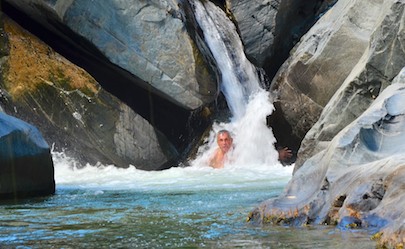
Hagia Sofia Huatulco waterfall (sailing blog)

The waterfall was cool and inviting

At one point we passed a group of bee huts where he keeps his own bees for pollination.

Hagia Sofia waterfall

The rushing water gives a great massage

Hopping into his truck once again, he drove us to a spot in the river where there is a beautiful waterfall.

Hagia Sofia Huatulco outdoor kitchen in the woods

The outdoor kitchen in the woods is a delight

The water was cooler than the ocean water we’d been swimming in lately, but it felt really good on our hot feet.  There are changing rooms for visitors to change into swimsuits, but we had forgotten to bring ours (darn!).

Armando dove in with gusto and got a massage on his back from the rushing water.

As we drove back towards the flower trail we stopped at the plateau where the cabins will one day welcome guests.  What a beautiful view they will have, overlooking the orchard and the distant mountains beyond.

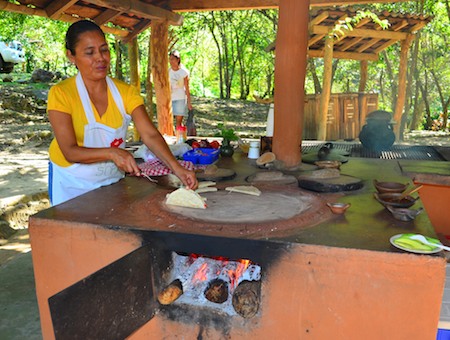
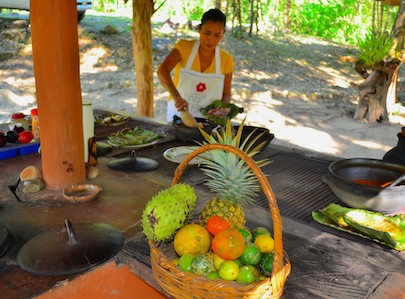
Back at the beginning of the flower trail, Armando’s chef Blanca had been busy all morning preparing a Oaxacan feast for us.  Working in a fabulous outdoor kitchen under a palapa in the cool shade of the woods, she made tortillas, fried up prickly pear cactus leaves and made some wonderful hot sauces.

Hagia Sofia Huatulco fruits for breakfast

The fruits and fruit-waters were delicious


To one side a spread of exotic fruits lay waiting, each labeled in Spanish and English so we’d know what we were eating.  Some of these things, like kumquats, we recognized but had never tried.  But the plate of bananas — tiny ones just the length of a ballpoint pen — really surprised us.

Hagia Sofia Huatulco bananas

We’ve never tasted such sweet, tangy bananas

Hagia Sofia Huatulco Oaxacan feast

Blanca prepares a feast for us on an outdoor wood-fired stove


There were three different varieties, one quite red, but the bright yellow “apple bananas” had a sweetness and tanginess that was intoxicating.

Hagia Sofia Huatulco (sailing blog) Oaxacan meal preparation

Our plates are filled with exotic, yummy goodies

Hagia Sofia Huatulco Oaxacan brunch at darling outdoor tables

We sit at a log table under the trees

We sat down for our meal in the outdoor dining room, a charming group of tables and chairs hewn from tree trunks and shaded by tall trees.  It was the day before Thanksgiving, and what a feast we had.

Hagia Sofia Huatulco ceiba tree

Tree Hugger

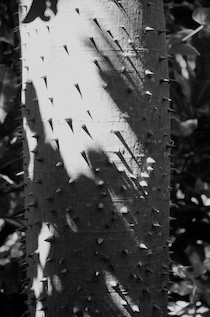
At the end of this magical day we made one final stop with Armando as we were leaving.  The biggest tree on the property is a Ceiba tree, an ancient wonder that is covered with spikes.  Armando gave it a big hug, showing us just how big around the trunk was.  The branches soared into the sky.

Hagia Sofia ceiba tree

The branches seem to reach the sky


Hagia Sofia Huatulco (sailing blog) ceiba tree thorns

Young ceiba trees have thorns

When these trees are young they are covered with thorns, making them extremely difficult to climb.  But as they age they have fewer and fewer thorns, and this big old guy was very huggable.

We left Hagia Sofia in high spirits after an inspiring day close to nature.

Hagia Sofia Huatulco Oaxacan Kiss Ice Cream (sailing blog)

We stop for a Oaxacan kiss snow cone

We weren’t sure if the better part of the day was the scenery and our wanderings among the tropical plants or our time spent with such a fascinating entrepreneur whose a beautiful vision for profitable farming and eco-tourism in the hills of Oaxaca resonated so deeply within us.

On our drive back to the marina, Armando made a quick stop in the small town of Santa María de Huatulco for an “ice cream” sold from a cart in the street.  This tasty treat is called a nieve (snow) and is something like a snow cone but made with natural flavors.  The one I got was very milky and was topped with shavings of carrots and nuts. It was called Beso Oaxaqueño or Oaxacan Kiss.

Our few days of land-based living in the marina had come to an end, and we soon sailed out into the Bays of Huatulco once again, this time anchoring alongside the little village of Santa Cruz.

<- Previous                                                                                                                                                                                      Next ->

Huatulco’s Hagia Sofia (1) – Exotic fruits and tropical flowers in a lush garden oasis

Armando Canavati Nader host and creator of Hagia Sofia in Huatulco Mexico

Armando Canavati Nader, host and creator of Hagia Sofia

Late November, 2012 – While staying at Marina Chahué in Huatulco, we took a day trip to nearby Hagia Sofia, a 350 acre fruit orchard and tropical flower garden.  Every so often in this life we are blessed with a day that is an utter delight from start to finish, and that was the kind of day we had at Hagia Sofia.

Tagamia Hagia Sofia Huatulco Mexico Flower Nursery

“Tagami”

Armando Canavati Nader, the owner and visionary behind this orchard, picked us up at the marina and drove us an hour and a half out to his stunning property.  It turned out that we were the sole visitors that day, and he gave us a tour we will never forget.

Armando is a man who is living his dream to the fullest.  There is something enchanting and greatly inspiring about those fortunate folks whose passion has become their life.  Armando radiates enthusiasm for his orchard and his vision for Oaxaca’s ranchers.

She Kong Hagia Sofia Huatulco Mexico Flower Nursery

“She Kong” – hangs down about six feet!

He has been fascinated by agriculture since he was very young, and he has a deep love of plant life and the earth.  His dream is to develop his orchard and flower garden to be self-sustaining and to become a model for other Oaxaca farmers.

Cuna de Moises - Hagia Sofia Huatulco Mexico Flower Nursery

“Moses’ Cradle”

Armando’s life wasn’t always about encouraging beautiful plants to thrive, however.  His grandfathers came from Lebanon and Bethlehem, respectively, at the turn of the last century.  One was just sixteen at the time — with a fourteen year old wife — and they worked their way across the ocean aboard ship.

As his grandfather later told him, he left his war-ravaged country only to arrive in Mexico on the eve of the Mexican Revolution in 1910.  Sometimes the grass isn’t really greener on the other side!

Anturio Hagia Sofia Huatulco Mexico Flower Nursery

“Anturio”

Armando’s granddad started a shirt factory in his new homeland, but it was Armando’s father, a truly gifted entrepreneur, who grew the enterprise, Grupo Manchester, to where it stands at the heights of international business today.

Regina Hagia Sofia Huatulco Mexico Flower Nursery

“Regina”

Hagia Sofia Huatulco Mexico Flower Nursery

Everywhere we turned something lovely was in bloom


Despite being a Mexican corporation, it was so named because Manchester (England) was the very heart of the world’s textile industry at the time.  The company now employs 1,000 workers in Monterrey, Mexico.

Hagia Sofia Huatulco Mexico Flower Nursery

Some flowers almost didn’t seem real

Bridesmaids Hagia Sofia Huatulco Mexico Flower Nursery

The little flowers at the base are the “bridesmaids”


Beautiful flower - Hagia Sofia Huatulco Mexico Flower Nursery

Each flower we saw seemed more exotic than the last

Hagia Sofia Huatulco Mexico Flower Nursery Bridge

Walk two steps, take ten photos!

Specializing in men’s clothing, they manufacture some of the world’s biggest designer brands and export their products to Central and South America.

Although he wanted to study agriculture in college, Armando grew up supporting his father’s dream instead, becoming Manchester’s lead fashion designer.  He traveled internationally for decades in search of the best fabrics and to find inspiration for new fashion designs.

For twenty years he spent several months a year traveling in Thailand and the Pacific Rim.  One day, after admiring the basket of exotic fruits in his hotel room, he asked the owner of a Thai fabric factory to drive him out to a local orchard where he spoke at length with the orchard’s proprietor, learning about the climate, fruits and flowers.

Hagia Sofia Huatulco Mexico Flower Nursery Rooster Tails

“Rooster Tails”

Hagia Sofia Huatulco Mexico Flower Nursery Cat Tails cola de gato

“Cat tails”

This encounter initiated his personal study of tropical agriculture, which burgeoned as the years went by.  Although his work kept him based in Monterrey, Mexico, his favorite state was Oaxaca, and he began to study which of the wonderful, exotic plants he saw in his world travels would do best in Oaxaca’s low hills.

Dreaming of a way to give back some of the good fortune he had enjoyed in the apparel industry, he began developing the idea of creating an orchard and flower garden — a Garden of Eden — where visitors could find respite from the workaday world in its lovely cabins and the harvest would support operations.

After visiting many, many properties in Oaxaca, he came across a former German coffee plantation that had long been in decline, and set about reworking the land in the early 2000’s to support as many varieties of fruits and flowers as possible.

Hagia Sofia Huatulco Mexico Flower Nursery

Many flowers had this type of overall shape

Germans had flocked to this area 100 years ago to develop coffee plantations, but when the coffee market crashed in the late 1950’s, many of them closed, among them this ranch.

Hagia Sofia Huatulco Mexico Flower Nursery

The flowers were big with sturdy petals

Armando named his new property “Hagia Sofia,” which means, roughly, “Holy Wisdom,” and is also the name of the eastern Christian mother church that was built in Constantinople (Instanbul, Turkey) in 537 AD (it was converted to a mosque in 1453, is now a museum).  Armando has a daughter Sofia, as well, which also inspired the name.

“Oaxaca is naturally a very rich state,” he said to us as we drove onto the gorgeous, hilly, verdant property.  “But its people are so poor.  I want to teach them how to use this beautiful land in the most productive way possible.”

He went on to explain that most local ranchers grow corn, only because their fathers grew corn.  Two acres of corn can produce $500 per year in profits for these farmers.

Butterfly Hagia Sofia Huatulco Mexico Flower Nursery

Thousands of butterflies flutter between the flowers

Hagia Sofia Huatulco Mexico Flower Nursery Hooked Leaf

A flower catches a falling leaf…

In startling contrast, they could be growing mangosteen fruit trees instead.  Two acres of land will support 200 trees which can produce 150-300 kg of fruit per year.  “That’s $40,000 in profits!” he said excitedly.

Mangosteen is a fruit native to Central America that is far richer in anti-oxidants and other healthful properties than just about any other fruit available.  An ounce or two a day of mangosteen juice is said to give radiant health and to fix all manner of ills.

Hagia Sofia Huatulco Mexico Flower Nursery

Often sold in the US in multi-level marketing schemes structured like Amway, I remember seeing mangosteen juice for sale for $60 a liter at the fitness studio where I worked.

Hagia Sofia Huatulco Mexico Flower Nursery Indonesian Button

“Indonesian Button”

Armando’s not kidding that mangosteen fruit is far more valuable than corn!

“But changing the way people farm takes time,” he went on.  “They have their corn fields in place already.  A mangosteen tree won’t produce fruit for 8 years after it’s planted and doesn’t reach maturity until 20 years of age.”  That is a long wait in a region where most people live from hand to mouth.

“This is a business that a rancher sets up for his children and grandchildren.  That’s why I am doing it.  I will have something beautiful and productive for my grandchildren and great-grandchildren to inherit.  If a rancher plants his land with the right trees and flowers now, his grandchildren will be very wealthy from the harvest.”

Hagia Sofia Huatulco Mexico Flower Nursery

Armando’s orchard is getting noticed, and the town leaders all around Oaxaca are recognizing his wisdom.  When I asked him if the farmers hear him when he tells them to consider farming differently, he laughed.  “The town leaders all say ‘We need more Armandos!'”

Hagia Sofia Huatulco Mexico Flower Nursery


The 500 mangosteen trees Armando planted 6 years ago aren’t the only exotic fruit he is cultivating in his orchard.  He has reforested his property with 15,000 trees, among them teak trees, bamboo and molina trees (which produce a medicinally valuable bark).  He has 20,000 plants in the flower nursery, raises 9 kinds of mangos, has 7 different types of bananas and 6 varieties of avocados.

Hagia Sofia Huatulco Mexico Flower Nursery

These leaves were two feet long

But the 500 meter long flower trail (signed in the local Zaptoec language, “Nesa Sti Guie,” in recognition of their culture and agricultural knowledge) was our first introduction to the property.

As we started on the path, surrounded on all sides by thick greenery and unique, brilliantly colored flowers, Armando joked that he is often asked how long a walk on the flower trail takes.  “I tell them, ‘For me, two months!  But for most people, a few hours.'”

We ended up spending the better part of a day wandering down this trail, marveling at the flowers.  “They look like they’re plastic, don’t they?” Armando said.  It was true, many of them were sturdy, thick and shiny, and we felt tempted to touch each one to verify it was real.

Hagia Sofia Huatulco Mexico Flower Nursery

The insects buzzed all around us and a river accompanied us on most of our walk.  Lots of trees had symbiotic vines that wound around their trunks, and we strolled under a shaded canopy of greenery the whole way.  At one point we came across a stand of cactus (“So people can see what the desert is like”) and at another stop we saw a hillside of coffee plants.

Hagia Sofia Huatulco Mexico Flower Nursery

As we walked among at the immense variety of trees, ferns, shrubs and flowers that grew so harmoniously with each other, it was impossible to imagine that the entire property was once filled with coffee plants and nothing else.  We were enveloped in a thick blanket of green, dotted with vibrant red, pink and yellow flowers.

When we finally emerged from this beautiful trail of flowers, Armando took us to the wide open crests of the hills where the views reached far into the distance. Hagia Sofia’s fruit trees were sprinkled across the hillsides, eagerly soaking up the sun on their way to maturity.

Next up on our tour’s agenda was a walk among the fruit trees, a drive to the locations where the visitors’ cabins will soon stand, and a memorable day-before-Thanksgiving feast.

<- Previous                                                                                                                                                                                      Next ->

Huatulco’s Marina Chahué – Landlubbing with parrots!

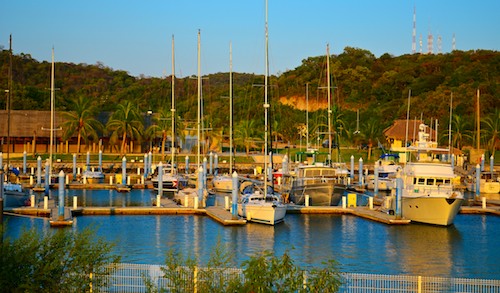
Marina Chahue Bahias de Huatulco Mexico

Marina Chahue at the golden hour

Mid-November, 2012 – The great thing about this beautiful little cruising ground among the Bays of Huatulco is that when it gets gnarly out in the bays, you can run for cover in the shelter of the marina.  We left Tangolunda Bay after two days of swinging back and forth like a church bell gone wild, and instantly relaxed as the boat steadied and then went into a wonderful, motionless torpor in the marina.
Marina Chahue Bahias de Huatulco Mexico

We were gifted with some pretty sunsets

We were treated to lovely afternoon sunsets that lit the sky in shades of gold and pink and orange, and we walked and walked and walked, thrilled to be back on terra firma.  We had been loving swimming off the back of the boat, but the newfound pleasure of stepping off the boat onto dry land was equally thrilling.
Unfortunately, Huatulco’s Marina Chahué (pronounce Cha-WAY) is a poorly appointed little marina that is hopelessly overpriced.  Run by the government, our jaws dropped when we were told the fee would $30 USD a night without hookups to electricity and water!! (those luxuries would have been $5 more).

Marina Chahue Bahias de Huatulco Mexico

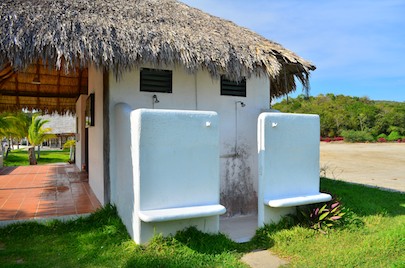
Cold water outdoor showers – without privacy!!

The one amenity on offer for visiting boaters is a cold water outdoor shower that doesn’t even have a curtain or door!  Needless to say, there is never a line for the shower!!

By comparison, for the same price, Paradise Village Marina, a resort marina in Puerto Vallarta, offers swimming pools, hot tubs (including a an indoor candle-lit hot tub for the gals), a spa, a beautifully appointed gym with all the latest equipment, a pretty and meticulously groomed beach that goes for miles, and walking access to all the restaurants and boutiques a tourist could ever hope for.  It is no wonder that Marina Chahué is nearly vacant while Paradise Village has lots of boats, especially given the hundreds of miles and several overnights at sea required to get here.

Legacy Westport 164 at Marina Chahue Bahias de Huatulco Mexico

Our new neighbor “Legacy” arrives

What could be a fabulous cruising destination is just a brief stopover point for the handful of boats that pass through.

One such transient boat pulled in during our stay.  The neat thing about megayachts is that you can often look them up online and get a tantalizing peek at what lurks behind the tinted windows.  This one, “Legacy,” is 164′ long and is listed on Charter World as having been launched in December, 2011.  It’s basically brand new!

Cruising friends Colleen and Mark

Young cruisers Colleen and Mark from s/v Mer-Sea

The photos of the interior are lovely, but we had to satisfy ourselves with taking photos of the outside and dreaming.  Other than seeing the scurrying hands while the boat was docking, we never saw a soul on deck!

Even more fun than the exotic super yachts, though, are some of the unusual cruisers we meet along the way.  As we pulled in, we were greeted by Colleen and Marc of the Catalina 27 Mer-Sea.  They had recently sold their boat to our friend Arturo of Macaw Tours Tapachula to be used for daysailing tours around Puerto Chiapas.  We had known only that “a young couple sailed the boat down from California and then sold it to Arturo over the summer.”

Mer-Sea at Marina Chiapas Mexico

After an exciting cruise south, Colleen and Marc’s boat is ready to take visitors daysailing in Chiapas.


What fun it was to meet them and their dog Torch as they got ready to pile into their pickup-conversion-camper and drive home to Texas after an adventurous cruise down the Mexican coast.

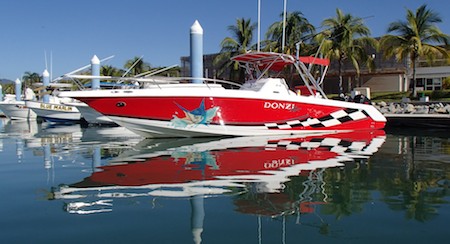
Donzi at Marina Chahue Bahias de Huatulco Mexico

A true chick-magnet


It is common for retirees to set sail on a boat after years of dreaming and planning.  Their boats are solid and decked out in the latest gear to make living aboard as comfortable and as safe as possible.  Their boats are ready for all that the sea might dish out.  Old folks have the money and the time to do these things, and 95% of cruisers in Pacific Mexico are over 50.

Pura Vida at Marina Chahue Bahias de Huatulco Mexico

All boats need regular scrub downs

How refreshing and inspiring it is, then, to meet a couple in their twenties who threw caution to the wind, bought a small 1970’s vintage boat, and took off down the scary coast, latest fancy gear be damned.  The boat sailed well, what more could you want?  Now, with one big cruise in their back pockets, they are off to make a little money in Texas and then do it all again — in the Caribbean.

anchor chain and Ultra anchor

The anchor chain is laid out on the dock. The more frequently used end near the anchor is rusted.

Old or new, big or small, if you want your boat to be a chick magnet — or at least to look its best — you gotta work at it.  When the 100 footer Pura Vida pulled in, within moments of tying up, the crew went to work cleaning, polishing and waxing.  At least a few hours of work on a boat each day is just part of the boating life, whether you are paid crew or a grubby cruiser living the Life of Riley.

Mark had a long list of things to do on the boat and we jumped right in.  Most were mundane, like fixing a leak in the kayak (again! but darn, we love that little boat anyway…), and polishing away the various rust stains that had appeared on parts of the hull.  But most interesting was swapping the anchor chain end-for-end.

end for end anchor chain on the dock

Mark puts new tie-wraps at 30′ intervals

After 550 days of anchoring out, the link holding the anchor had been startlingly eaten away by rust, while the opposite end of the chain was still bright silver.

A few of the tie-wraps marking the distances had come off too, so Mark had a chance to put new ones on at 30′ intervals.  That way he has some idea of how much chain he has let out in the water — the deeper the water (or more stormy the situation), the more chain you want to let out.

Marinas are always lively places that are full of action, even little-used ones like Marina Chahué.  One afternoon a TV crew showed up at the mansion on the end of the point.  We discovered the Mexican TV mass media company “Televisa” was doing a segment on Huatulco for a show that highlights cool spots around Mexico.

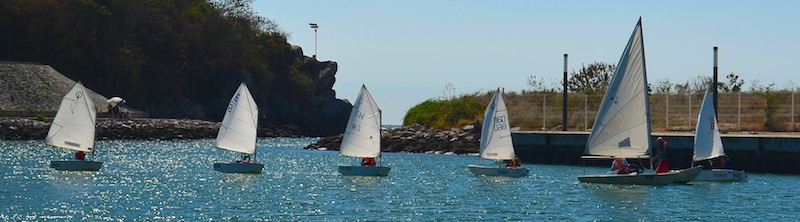
Sailboat regatta Marina Chahue Bahias de Huatulco Mexico

A little sailboat race makes a perfect backdrop for the TV cameras

Marina Chahue Bahias de Huatulco Mexico

Palm at sunset

Very conveniently, the local kids’ racing fleet had a small regatta that day, right out front.  They zig-zagged back and forth as the TV cameras rolled.  They were very cute.

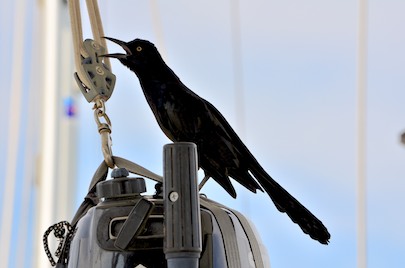
During our brief stay, Marina Chahué was loaded with birdlife.  We were woken in the mornings with the calls of great kiskadees, which sound just like their name, “kis-ka-dee.”  Grackles made themselves at home in our cockpit at times, squeaking at each other and peering at us to see just how much intrusion they could get away with before we shooed them off.

A grackle sits on our outboard in Marina Chahue Huatulco Mexico

A cheeky grackle makes himself at home on our outboard

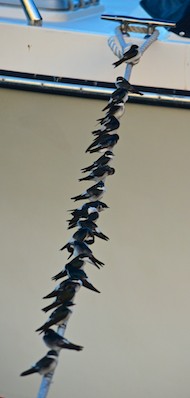
One morning Mark popped his head out the companionway and saw a row of birds sitting on the dock line of the boat next to us.  There is quite a bit of surge in this marina, and the boats move around a lot.  As the neighboring boat swung around in its slip, the dock line rose up and down.  The birds didn’t seem to mind one bit as their perch soared and then fell.

Swallows on the dock lines in Marina Chahue Huatulco Mexico

A flock of small birds rides the dock lines

Great egret Marina Chahue Huatulco Mexico

A great egret stares us down in the kayak


Taking the kayak out to explore the estuary in the back of the marina, we came across a rather stern looking great egret.  He kept a close eye on us and our bright yellow boat as we drifted past him.  But other than annoying him enough for him to lower one foot for a moment, just in case, he seemed okay with us coming quite close.

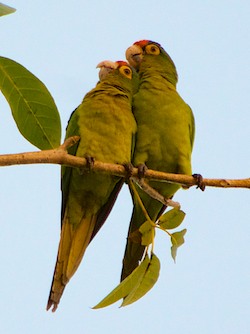
The prize bird sighting came on land about a quarter mile from the marina, though.  Just outside the busy supermarket, we heard the unmistakeable squeals of a flock of parrots.  They were perched on every available branch of a tree, almost within arm’s reach.  Unfortunately, the wide angle lens I’d brought with me couldn’t quite capture them… And why hadn’t I brought my telephoto lens to the supermarket??  I’m beginning to learn:  take all the camera stuff everywhere!


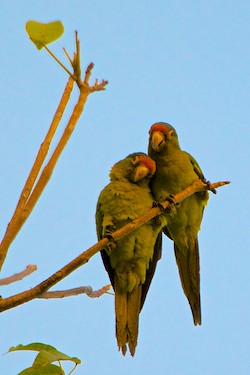
half moon conures in Huatulco Mexico

Half moon conures flirt at sunset

half moon conures bahias de huatulco mexico

A little kiss

We hurried home, teased most of the way by this exuberant flock as it zoomed every which way in the sky, buzzing us repeatedly and landing in trees and chattering at us all along our route home.  Why, oh, why didn’t I have that long lens?  I looked them up online later and found out they were half-moon conures.

We had planned to leave the marina the next morning, but Mark gave me a smirk when I said something about staying one more day — we both knew why.  The next afternoon I ran over to the supermarket, this time with the long lens and fully charged battery, all ready to roll.  I could hear the parrots in the distance.  Suddenly, there they were, landing in the tree right above me at a hopelessly busy street corner.

Half moon conures La Crucecita Bahias de Huatulco Mexico

“Pssst — I think you’re really cute”

I snapped some shots.  Wrong settings — all dark.  I snapped some more — better, but blurry.  Oh gosh, Don’t fly away!!!  I kept thinking.  Then I remembered the settings Mark had recommended as I leapt off the boat a few minutes ago, and I punched the buttons as the buses and taxis whipped around the corner at rush hour speeds.

half moon conures La Crucecita Huatulco Mexico

“Aaaah — that feels so good!!”

Half moon conures Bahias de Huatulco Mexico

“Can we snuggle just a little closer?”

Camera finally set, the birds began to settle down too.  Little pairs sidled up to each other at the ends of each of the branches.  They all flirted with each other shamelessly, clucking, preening, smooching and all.

One pair just above me put on a wonderful show, nuzzling together like the happiest of lovers, all beneath a single heart shaped leaf.

When they finally finished snuggling with each other and got down to serious preening, two birds were back-to-back.  They craned their necks towards each other, forming a perfect heart shape.

half moon conures La Crucecita Huatulco Mexico

“Mmmm…”

What a beautiful few moments.  Eventually the parrot noises in the tree quieted down to a low murmur as the sun stole out of the sky.  I left the birds to their romantic starlit night and wandered home to my own love, totally happy inside.

The incredible charms of the Huatulco area continued to enchant us when we visited the tropical fruit and flower orchard of Hagia Sofia.

half moon conures Marina Chahue Bahias de Huatulco Mexico


<- Previous                                                                                                                                                                                      Next ->

Huatulco’s Tangolunda Bay – Anchored inside a ring of luxurious tropical resorts!

Sunrise in Tangolunda Bay in Huatulco, Mexico

Sunrise in Tangolunda Bay

Early November, 2012 – After the thrill of crossing the dreaded Gulf of Tehuantepec, it was a relief to wake up to a stunning sunrise in calm, picturesque Tangolunda Bay.  As we watched that sunrise, it felt like our cruising season had begun at last.

 Tangolunda Bay in Huatulco, Mexico

Resorts line the bay.

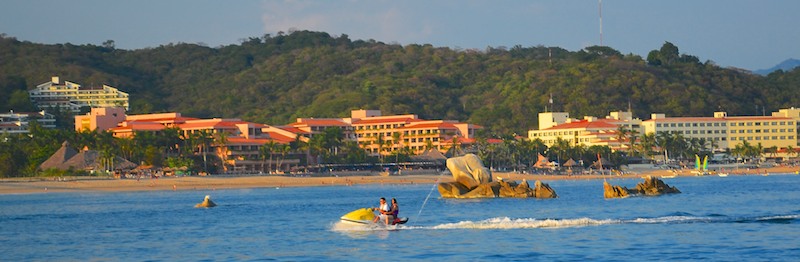
Las Bahías de Huatulco is made up of seven bays tucked into a ten mile stretch of coast, an ideal little cruising ground.  Tangolunda Bay is at the southern end, and it’s the “party bay,” rimmed by ten or so high-end resorts.  They all slowly came to life as the day progressed.

Tangolunda Bay in Huatulco, Mexico

A great scene to wake up to…

The air temperature here was just a little bit cooler and drier than Puerto Chiapas, but the water was still warm and clear.  In no time we had donned masks, snorkels and fins and begun paddling around the boat.

Of course, in the cruising life you are never far from boat maintenance work, and before we could check out the colorful fish swimming around the rocks nearby, we had to clean the bottom of the boat!

Terry cloth towels in hand, we swished and swiped the bottom of the hull, creating great swirling clouds in the water as the resident algae was brushed away.

Tangolunda Bay in Huatulco, Mexico, relaxing on a sailboat

Just chillin’

Tangolunda Bay in Huatulco, Mexico, relaxing on a sailboat

Savoring these precious days.


An hour later, with that chore finally out of the way (phew!), we swam off to visit the angel fish and other critters hiding underwater in the rocks near the shore.

Tangolunda Bay Huatulco Mexico Barcelo Resort jet skis

Huatulco is a favorite weekend getaway for people from Oaxaca City

Tangolunda Bay, Huatulco, Mexico, Barcelo Resort

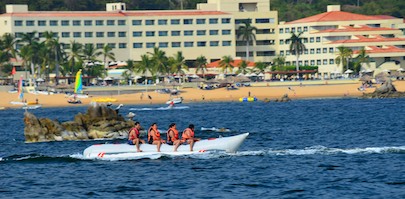
Banana boats zoomed past us.

Large blue angel fish, each sporting a yellow vertical stripe and yellow tail, were the prize sightings, but there were lots of smaller, plainer fish too.  What I liked, though, were the waves of warm and cool water that caressed our bodies as we swam.  The cooler waters of the approaching winter were starting to sweep in, but bathwater warm pools of summer still enveloped us here and there.

Bahias de Huatulco Tangolunda Bay relaxing on a sailboat

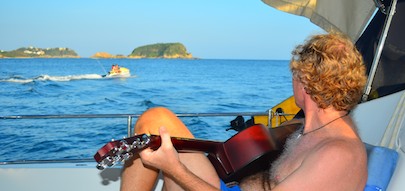
Mark unwinds with some tunes in the cockpit.

Above water, the vacationers at the resorts zoomed past on jet skis, in sailing catamarans and on banana boats.  All were Mexican, and all seemed to hail from Oaxaca City.  This is the perfect weekend getaway place for them, as it is just an hour’s flight.

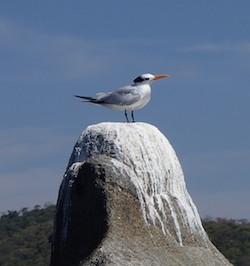
Bahias de Huatulco Tangolunda Bay tern

A tern checks us out.

Tangolunda Bay Huatulco jet ski

Mark practiced getting action photos on the water.

The long 8-hour drive over the speed-bump ridden mountain roads from Oaxaca will soon be replaced by a freeway that will get the tourists here in just three hours by car.  The jet skis will be swarming in droves then!!

Several dads with kids sitting in their laps paddled and drifted by us in kayaks and sailboats.  Each was curious about where we were from and what life afloat was like.  “Do you have a kitchen on your boat?” One kayaker asked.  Another guy on a catamaran called out, “I’m going to be doing what you’re doing in a few years!”

Bahias de Huatulco Tangolunda Bay jet ski rental

We got lots of waves — both kinds!

For us, this was the ideal place to relax for a while and regroup.  We took the kayak out and paddled around the bay one afternoon.  As we passed the resorts on shore, it seemed each one had its own flavor.

Tangolunda Bay, Bahias de Huatulco, kayaking

We took the kayak out exploring…

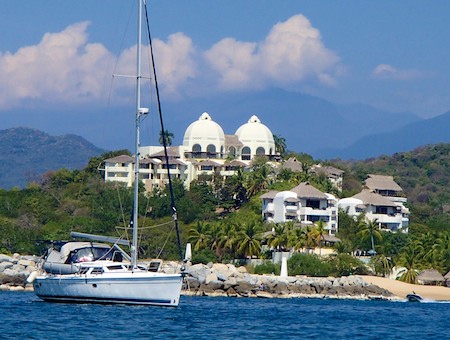
There’s the romantic getaway, Camino Real Zaashila, tucked into the far corner of the beach.  At the opposite end of the beach, swank Quinta Real dominates the scene with its two big exotic looking domes.  I suspect vacationers there enjoy the beach “sand free,” from a distance, with room service on their balconies!  In the middle there’s the party hardy resorts, Barceló and Dreams, where loud music plays at the water’s edge, kids splash in the waves, and undoubtedly Margaritas flow freely.

Huatulco Tangolunda Bay Dreams Resort with Sailboat

Groovy poses against the fantastic backdrop of Quinta Real

It seems that vacationers of every kind can find their tropical paradise here.  When we got back to the boat, the afternoon entertainment had begun poolside at the Las Brisas resort next to us.  A woman on a loudspeaker was conducting a contest among the kids to see who could recognize the most Disney movie and cartoon theme songs.

Bahias de Huatulco Tangolunda Bay

Snippets of Mary Poppins and The Little Mermaid wafted past us while we imagined a very lively scene at the resort’s swimming pool which was hidden from us by a row of bushes.

Tangolunda Bay Bahias de Huatulco Mexico

Tangolunda’s main beach is a long sweeping crescent

How funny it was to hear this very American contest all afternoon after they had played hours of Mexican music over their sound system all morning. Needless to say, we knew all the answers, but not all the kids did!!

Huatulco Mexico Tangolunda Bay wedding fireworks

Wedding fireworks!

One evening a lucky couple got married on the beach right in front of our boat.  Suddenly the black night sky was split by a huge colorful explosion above us.  After yelling, “No no, not on our boat!” as we panicked that falling embers would land on us, we ran for our cameras to catch the fireworks show.

Tangolunda Bay Huatulco great place for relaxing

Ahhhh….

It didn’t last long — the couple had ordered only three fireworks — but Mark got a terrific shot of one of them.

Our days and nights melted into the sweet oblivion of doing nothing but basking in this beautiful setting.  This was the life!!  I think most cruisers take off on their voyages with something like this in mind.  But boatloads of boat work, endless challenging passages, and the frequent cranky moods of Mother Nature all stand like steep hurdles blocking the way between cruisers and the heavenly, bucolic days they seek.  We savored each hour of each day as the happy blessing that it was.

Tangolunda Bay Huatulco Camino Real Zaashila Resort

Romantic Camino Real Zaashila is tucked into a quiet corner of Tangolunda bay

This season, unlike the previous two, we don’t plan to travel a long distance, so there is nothing prodding us to move on or do anything in particular.  Perhaps we have finally “slowed down” in our cruising lifestyle the way we did in our RVing lifestyle.

Tangolunda Bay Huatulco catamaran sailing

Catamarans sailed around us in Tangolunda

Our “to-do” list of chores for the boat got pushed aside to the far corner of the nav station desk (I think I even flipped it over for a few days so I didn’t have to look at it!).  “Having fun” became the top priority for a while.  Mark’s guitar came out, our cameras went into overdrive as we tried to capture happy vacationers having a ball all around us, and we spent many hours in the cockpit scanning the scene saying to each other, “What a totally cool life!”

Bahias de Huatulco Tangolunda Bay sailboat

Groovy sits happily by the beach

But Mother Nature’s mood swings finally caught up with us and forced us to raise the anchor.  Tangolunda Bay is wide open to the swell coming in from the Pacific, and after a few very calm nights, the Pacific began to roll and Groovy rolled right along with it.

Huatulco sunrise at Tangolunda Bay

Sunrise in Huatulco

A few rolls overnight isn’t bad, but when the boat starts swinging and jerking like a bucking bronco, tossing its occupants and their stuff around like ping-pong balls all night long while the hull creaks and groans in noisy agony, it’s time to seek new shelter!

After a beautiful sunrise one morning, we headed out on a daysail.  What fun it was to sail whichever way the wind was best, not trying to reach a particular destination.  After a few hours, we ultimately pointed the bow towards Marina Chahué in the next bay over from Tangolunda, where sweet nights of flat calm awaited us.


<- Previous                                                                                                                                                                                      Next ->

Gulf of Tehuantepec, Mexico – Squeezing in a crossing between blows

Halloween, 2012 – We had enjoyed Marina Chiapas, but now it was time to leave.  However, because this marina borders a fabled body of water — one known for its bad attitude not its beauty — leaving was not such an easy thing to do!

The staccato way Mexicans pronounce “Tehuantepec” (Te-wan-te-PECK) makes it sound almost distasteful — they spit out the ending “Pec” with force.  Among cruisers, the Gulf of Tehuantepec is one of the few places in Pacific Mexico that can strike terror in our hearts.  I’ve heard it pooh-poohed only one time, by a married pair of 20-year veteran single-handers in Zihuatanejo (¼ down page) who were completing their third circumnavigation (aboard separate boats).  They brushed it off, saying, “The Tehuantepec is way overrated!” and promptly set off to sail 500 miles out to sea around it en route to the Panama Canal.  But for most ordinary cruisers, including us, it is a place to be respected and planned for, as it is known for its nasty temper and very big teeth.

Crossing the Gulf of Tehuantepec Mexico between Marina Chiapas and Marina Chahue

From red dot (Marina Chiapas) to blue (Huatulco), this is not a great time to cross the Gulf of Tehuantepec! Wind in light blue is 4-7 mph, wind in dark orange is 39-46 mph.

The Tehuantepec blows and calms down in cycles that depend on the winds in the Gulf of Mexico.  When the wind blows out of the north on the Caribbean side of Mexico, it picks up speed when it hits the Gulf of Tehuantepec and often reaches gale force.  Then it settles down for a few days before doing it all over again.

The goal for sailors is to look for a 3-day or longer period of calm to dash from one side of the Tehuantepec to the other.  There are marinas on either side, Marina Chahué in Huatulco on the west and now the new Marina Chiapas in Puerto Chiapas on the east, but there is nowhere to hide in-between other than the big, smelly industrial port of Salina Cruz that is loaded with freighters and requires the Port Captain’s permission to enter.

Going straight across this gulf is about 210 miles, but that’s a dangerous route because if the Tehuantepec suddenly gets ugly, you are stuck in a storm with hours of miserable sailing to get to safety near shore.  So the recommended course is to hug the coastline the whole way, sailing ¼ mile to ½ mile offshore, where the winds are slightly less and the waves are significantly smaller.  Going this way is 260 miles.  Crossing takes anywhere from 30 to 50 hours, on average.

Golfo de Tehuantepec crossing from Puerto Chiapas to Huatulco during calm

This calm period looks much better, doesn’t it?! Wind in light blue and lavender is 4-12 mph.

Compounding the problem of finding a good weather window to cross, when leaving from Marina Chiapas on a westbound trip, there is the additional hassle of checking out of the port.  Because Puerto Chiapas is on the border of Guatemala, every boat leaving Marina Chiapas for another destination in Mexico is required to pay a personal visit to the Port Captain’s office on the far side of town to purchase the official exit document (about $7 USD).

Also, 2 hours prior to the boat’s departure, you must invite both the Navy and their drug sniffing dog aboard for a final inspection of the boat as well as the Port Captain who comes to the boat for a final review of the paperwork.  You can’t just sneak out when the forecast looks good and the timing feels right!

The Tehuantepec had been blowing full force non-stop since our arrival a week earlier, but we studied Passage Weather (North Pacific->California to Mexico) to determine the best time to cross, and we spotted a slim opening of about 12 hours of calm between two modest blows that would peak about 40 hours apart.  These websites, updated every three hours, seem to be very accurate in their prediction of the weather, but the resolution is small.  A one inch portion of the chart represents the entire 260 mile passage, and the time is given in GMT which was 5 hours earlier than local time in Marina Chiapas.

Some sailors don't like the Gulf of Tehuantepec

Anticipating crossing the Tehuantepec can make you a little crazy.

Studying these websites, I wrote out two pages of notes listing GMT, local time, forecasted wind states and sea states.  As of Monday, it seemed that Wednesday morning at 3:00 a.m. would be the best time to leave.  If we missed that window by 3 hours we would need to stay in port another week.

Marina management instructed Mark to visit the Port Captain right away to complete our exit paperwork.  They told us the exit document had no expiration date — it would be good indefinitely.

This meant that if the weather forecast changed, we could opt not to leave, and we’d still have a good exit document for when we were finally ready to go.  We also planned to hail the Port Captain on the radio about 8:00 Tuesday night to make arrangements for him, the Navy, and their dog to visit our boat around midnight.  We would be required to leave within two hours of that visit — or we’d have to invite them back to repeat the process.

Marina Chiapas slips and docks at sunset

It was hard to leave the safety of pretty Marina Chiapas but the windows for crossing the Tehuantepec were infrequent.

In the backs of our minds we were thinking that if the weather forecast changed on Tuesday and no longer looked good for a crossing, we would stick around the area another week or so and take advantage of the downtime to spend a few days at the coffee plantation Finca Hamburgo which has lovely cabins in the mountains.  They also have an exotic flower nursery, oodles of tropical birds and hiking trails throughout their property.  It sounded delightful.

We awoke Tuesday morning to find the marina’s internet was no longer working, so we couldn’t get a weather forecast.  On top of that, we discovered that marina management at this new marina had not understood all nuances of the rules related to boats leaving Puerto Chiapas.  It turns out that once a boat that is remaining in Mexico obtains its exit document, it must leave within 48 hours of the “leave by” date stated on the document — or return to the Port Captain’s office to obtain new exit paperwork.  So much for our option of easily sticking around for a week and hitting the coffee plantation if the weather forecast turned ugly.  We had to leave by Thursday afternoon, or spend another three hours going to the Port Captain’s office a second time to get a new exit document.

Marina Chiapas Porto Bello Restaurant Mexican Flags

Mexican flags fly at the marina’s new restaurant.

The last weather forecast we’d seen had been 10 hours earlier on Monday night.  So I hustled to nearby Puerto Madero to renew our Telcel USB modem (which provides internet access via the Mexican cell phone system).  When I was finally able to get online and see the forecast, I was horrified.  Everything had changed.  We needed to leave in 90 minutes — at 3:00 p.m. today, Tuesday, 12 hours ahead of our original planned departure time — or not leave for at least a week.

This would have us chasing a receding Tehuantepec blow for the first 18 hours, put us at the apex of the Tehuantepec at 3:00 p.m. Wednesday when it would be calm, and then have us chased by a newly growing Tehuantepec blow for the last 6 hours of our trip, delivering us to Huatulco at 3:00 a.m. Thursday, after 36 hours of sailing.  It would be a tight squeeze with little margin for error.

There was one other window a few days later that might work for very fast boats with very brave crew — but we weren’t in that category.

As Mark and I studied the weather charts, I felt a fear so palpable that my heart raced, palms sweated and mouth went dry.  “Stay or go?” I asked him.  I wanted to stay.  I wanted to run away to the coffee plantation high on that mountain and never come back.  He gave me a big happy smile.  “I have total confidence in you, Sweetie.  If you think this window will work, we’ll be fine.  You’re a great navigator and a great researcher and planner too!  I think we should go.”

Birds at Marina Chiapas

One of the best things about this marina is the constant sound of unusual bird calls.

My eyes were saucers.  He had that kind of faith in me?  What if I were wrong?  What if I’d miscalculated GMT and local time?  What if the weather changed in the next 24 hours before we got to the most vulnerable part of the voyage?  What if he got injured out there because of my decision?  What if the boat were damaged?  What if we had a horrible trip and then found out if we’d waited three days it would have been easy?  What if?  What if?  What if???  I was a mess.

Mark began organizing the boat, and after much consternation I picked up the VHF mic to invite the Port Captain and the Navy to our boat for our exit inspection.  I was intercepted by the marina manager who kindly said all the right things to the Port Captain in Spanish to convince them to come in 20 minutes.  45 minutes later, the Port Captain arrived by car.  But he wouldn’t come down to the boat until the Navy showed up in their launch boat, so he just waved from the parking lot.  Another 20 minutes went by before the launch arrived, complete with pooch.  They tied up at the dock.  The four men ambled onto our boat and took out clip boards, papers and pens while the dog sniffed everything.

Marina Chiapas at Puerto Madero - evening on the docks

At first we thught we’d leave at 3 a.m. but changed our minds to leave 12 hours earlier.

Mark watched the minutes tick by as they first had me run up to the marina office to make yet another a copy of our passports for them.  Then they struggled to understand what state had the abbreviation “SD” (our domicile) and where it was located.  “What are the border states?” they asked with great, unhurried curiosity.  North Dakota wasn’t a helpful answer, as they didn’t know that one either.  Montana got a nod.  Egads — we needed to leave, and now!!  At last they stood up to go.  Our engine was running almost before the last man stepped off the boat, and we were gone.  It was 40 minutes later than we wanted to leave, but still within the 3 hour window we’d set as our outer limit.

The Tehuantepec was blowing hard ahead of us, but we anticipated 18 hours of smooth sailing before we would get near the bad stuff, and it would be calming down in the meantime.  After an anemic sunset, the full moon we had looked forward to hid behind clouds, leaving us in the dark and making the lights on the row of 16 shrimpers off our port beam look even brighter.  Suddenly an intense white light appeared behind us.  The light grew brighter, and then we could see the red and green running lights of a boat’s bow and blasts of bow spray as it bore down on us at 30 knots or so.

Through the binoculars Mark could see it was a Mexican Navy ship.  “Maybe we’ll get boarded,” he said, shrugging.  The boat was coming straight for us.  Suddenly it swerved to our starboard side and stopped.  After a long pause (verifying our boat name with headquarters at Puerto Chiapas, perhaps?), it pulled around ahead of us and zoomed off into the middle of the shrimping fleet.  Minutes later we heard the Navy captain hailing one of the shrimpers on the radio, informing them that they were going to perform a routine inspection of their boat.  Twenty minutes after that the Navy captain hailed another shrimper for a routine inspection of his boat.  And so it went, the line of shrimpers stopped at a standstill, mid-ocean, awaiting inspections, while we slipped by on their right.

Neither of us likes night sailing at all, and since we are both light sleepers, we have found it very difficult to get good sleep while at sea.  The motion of the boat, slapping of waves on the hull and noise of the wind in the rigging are unsettling.  I tried my best to sleep, but after two hours something got me out of bed.

I found Mark in the cockpit staring into the darkness saying, “What do you make of this?  Watch.  He’s been doing this for 15 minutes…”  As he pointed, suddenly a powerful spotlight — by far the brightest I have ever seen on a boat — lit up our cockpit.  I felt naked.  When the light shifted for a moment we could see the source was a small panga, or outboard-driven open fishing boat, with two men in it.  The light flooded our cockpit again, this time strobing on and off, as the launch approached Groovy at top speed.  Then it swerved away.  The light turned off.  Then on again with another rush at our boat.  Then it was off, and the boat wheeled away from us.  All the blood drained from my face and my throat went dry.

Mark kept studying the boat.  It traveled at our speed for about 20 minutes, staying about half a mile or so behind us, and then made another rush towards us, spotlight strobing.  Finally it swerved away.  Were they trying to tell us something, to warn us about a fishing net?  Did they think we were somebody else?  Were they meeting a boat out there somewhere and we fit the description?  We’ll never know.  A few hours later another similar boat did the same thing, but with less intensity.  Who knows what it was all about.

I laid on my back in the cockpit and studied the sky to calm down.  The full moon now backlit the clouds whenever it was able to penetrate their depths.  For hours a flock of four frigate birds took turns trying to land on the top of our mast.  The mast swung wildly and it was impossible for those big wings and big webbed feet even to think about landing successfully, but they sure had a good time trying.  They easily went 30 miles with us, playing like that.

Gulf of Tehuantepec when it is calm

The Tehuantepec was calm at first

Overnight the conditions were so calm we let the distance grow between us and the shore until we were 15 miles out.  In the morning there was no dawn, just clouds.  But the good news was that a following current pushed us along as we motor-sailed at nearly 8 knots the whole time.  We had more than made up the time we had lost checking out with the officials.  The sooner we could scoot across the gulf the better — unless we went too fast and caught up to the big winds ahead of us before they died down.

The wind began to build, and with it the seas.  We started seeing 22 knots of true wind (30 apparent) and the boat began to slam into the waves.  It would rise into the air, the front half airborne, and then drop onto the water with a loud crash.

Gulf of Tehuantepec storm clouds on the ocean

Weird storms appeared and disappeared around us.

“Wow, check this out — storm cells on the radar!”  Mark called out excitedly.  Sure enough, two huge 8 mile wide pink blobs blocked our way forward, and up ahead we could see weird clouds with rain streaking out of them.  We dodged one by going towards shore, and then it disappeared, as if laughing at us for changing course to avoid it.  We tried going out to sea to avoid the next one, but it got bigger and bigger and we made no progress against it.  Then the one we had defeated reformed and suddenly we were boxed in by the two systems.  At the time I thought “who needs to see a photo of a chart plotter with two huge pink blobs boxing Groovy in?” but now I wish I could show it to you.

With rain starting and seas growing, the two storm cells suddenly began to flash with lightning.  Thunder rumbled ominously.  According to the forecast, we were supposed to be cruising along in 8 knots of light breeze with no storms, but that’s not what was here.  So it was time to seek shelter and hug the coast.  We made a beeline for shore, and after two long hours of pounding over the waves, we got to the safety zone by the beach — the recommended travel lane — where the depth is a sandy 40′ and the distance to shore is 0.2 miles.  The true wind dropped below 20 knots and the seas went flat.  Amazing!  We zipped along at over 8.5 knots for many hours on end.  It would have been a thrilling ride.  It would have been our best sailing in Mexico to date — after all, how often do you get lively wind on a close reach with flat seas? — but the fear in our hearts dissolved all sense of fun.

Gulf of Tehuantepec salt spray covers our dodger

Groovy got whip-lashed by a few big waves that smacked our dodger and soaked it.

How easy it is to walk on a 6×8 plank sitting on the ground.  Put it 30′ in the air and it’s terrifying, because all you can think of is falling off.  So it is with great daysailing in the Gulf of Tehuantepec.  Even when you get ideal sailing conditions, you keep waiting for the grisly sea monster to rise up and swallow you.

It had been 22 hours since we had last seen a weather forecast on the internet, and the one we’d just heard on the VHF radio rattled off the wind speeds and wave heights for all the regions of Pacific Mexico in Spanish — and in metric — way too fast.

Suddenly a panga with 6 guys in it appeared alongside us.  They circled us, yelling in Spanish.

“You’ve got to get out of here!  There’s going to be a lot of wind.”
“When? When?” I yelled back.  “We’re going to Huatulco!”
They all grinned heartily and gave us the thumbs up: “Mañana!”

We guessed that meant we were okay — we’d be long gone from here by then.  How incredibly kind of them, though, to make a detour to our boat to warn us of the coming weather.  We are always impressed by the thoughtfulness of the Mexicans.

As we approached the apex of the Tehuantepec’s danger zone, the true wind climbed to 25 knots, apparent was into the 30’s, and we were soaring on flat water at 9 knots, watching people flying kites an arm’s length away on the beach.  I held the laptop high overhead and was able to pick up a very faint internet signal from somewhere on shore.  After twenty minutes of standing with the laptop overhead (a great shoulder workout!), I had downloaded a tiny 599KB zip file containing a complete weather forecast from Passage Weather’s low-bandwidth site.  Nothing had changed.  Phew!!!  We were on perfect schedule.  All we had to do was let another 12 or so hours march by.  The only weird thing was we were supposed to be in 8-12 knots of wind at this point, not 25.

As darkness fell, we threaded a path between all the freighters anchored off Salina Cruz.  The coast turned more southward and we now had the wind off our starboard quarter.  The noise and mayhem settled way down as the wind from our own forward motion canceled out some of the wind blowing behind us.  We scooted along, continuing to slice through the water at almost 8 knots.

Tangolunda Bay Bahias de Huatulco

The morning after we relax in Huatulco’s beautiful Tangolunda Bay

It was Halloween, and we celebrated this eerie night of goblins and ghouls by watching the nearly full moon rise blood red in the black sky.  We’ve never seen the moon such a rich shade of red.  As it climbed higher, it slowly faded from ruby red to orange, passing through wisps of grey clouds.  What a classic Halloween image.  We tried to capture it with the camera, but the boat was rolling and all we got was blurry red blobs.

In our final hours we felt the winds and seas building again, and knew we had successfully scooted ahead and avoided the rising maelstrom behind us.  At long last, around 2:30 a.m. on Thursday morning after 35 hours and 260 miles (a whopping average (for us) of 7.4 knots, or 8.5mph), we pulled into Tangolunda Bay, a big bay at Huatulco’s south end.  We knew this bay from last year, and it was a relief to retrace our track on the chartplotter and drop the hook right where we had pulled it up eight months earlier.

We sat in the cockpit, securely anchored to the sand beneath us, and stared at the twinkling lights of the many resorts lining the bay.  All the fear and worry of the past two days suddenly fell from our shoulders, and an incredible sense of accomplishment began to take its place.  Our first Tehuantepec crossing last spring had been a breeze, a no-brainer, “pan comida” (a piece of cake), as we’d had a six day window of minimal wind.  We had crossed near the middle, covering 228 miles in 36 hours.

Tangolunda Bay in the Bays of Huatulco

It’s party time in Huatulco’s Tangolunda Bay

Our crossing now had gone equally well, but had been a tactical challenge like none we have ever faced on the water before.  Everything had gone like clockwork: we had arrived at each landmark on schedule or slightly ahead, thanks to a 1 knot favorable current, and the Tehuantepec had cooperated by sticking to its forecasted plan (except for the unexpectedly blustery conditions near the apex).  If we hadn’t been so spooked by the potential for disaster, we might have even enjoyed the ride!

But for now we were excited at the prospect of swimming and snorkeling off the boat the next morning, and waving at the jet skis that would soon circle us from the fancy resorts that surround Tangolunda Bay.  All the resorts were quiet now in these wee hours of the morning, however, and we slept like babies as soon as our heads hit our pillows.

 <- Previous                                                                                                                                                                                      Next ->

Subscribe
Never miss a post — it’s free!

Blog posts from our wonderful stay in Huatulco, Mexico:

Blog posts from our inland trip to the colonial city of Oaxaca, Mexico:

Blog posts from our coastal and inland travels in Chiapas, Mexico:

Our most recent posts:

More of our Latest Posts are in the MENU.
New to this site? Visit Cruisers Start Here to find where we keep all the good stuff!!

Marina Chiapas in Puerto Madero (Puerto Chiapas) Mexico – Sailing near Guatemala

If you are taking your boat to Marina Chiapas, please visit our Marina Chiapas Cruising Guide for waypoints and travel ideas!

October, 2012 – As we watched New Mexico’s unique Bisti Badlands disappearing in our rearview mirror, we began to focus all our energy on exchanging our US land travels by RV for our Mexico travels by sailboat.

Phoenix Hermosillo Mexico City Flights - Mexico Map

Our route: Phoenix – Hermosillo – Mexico City – Tapachula (Marina Chiapas)

standin on a corner in winslowe arizona

There’s a girl, my Lord, in a flat bed Ford…

We breezed through Winslow, Arizona, just 24 hours after the conclusion of their big “Standin’ on a Corner in Winslow Arizona” festival, but we stopped long enough to stand on that special corner ourselves.

Javalina in Fountain Hills Arizona

Mark spots a javalina near a friend’s house in Arizona

Several weeks vanished in a flurry of visits with friends and family along with shopping for goodies we knew we’d need in Mexico but couldn’t buy there.

Phoenix Hermosillo Mexico City Tapachula airplaine flights

Three flights and 12 hours from RV to sailboat

We put the buggy away in storage and finally flew out to Tapachula near the end of October. It took twelve hours of travel to get from our trailer’s door to our boat’s door, including three different planes and extraordinarily thorough baggage inspections before boarding each one.  When we stepped off the last plane in Tapachula at 1:30 a.m., we felt like we were stepping into a sauna, and we were suddenly immersed in the thick, dense, pungent air of the tropics.


Sailboat in Marina Chiapas (Puerto Madero) Mexico

Groovy was happy to see us.

Groovy was waiting patiently at the dock, and even in the dark the boat sparkled, inside and out.  Our friend Andrés Reyes Prudente, the captain of a neighboring sport fishing boat, had taken good care of her during our absence.

Palms at sunset in Marina Chiapas (Puerto Madero) Mexico

The moody skies were enchanting

It was still the end of the rainy season in the tropics, and every day we were treated to fantastic clouds, a few showers, and even one doozy of a thunder and lightning storm that pelted everything with sheets of water and made us jump out of bed when a bolt hit somewhere very nearby.

Marina Chiapas (Puerto Madero Puerto Chiapas) sunset and empty slips

Sunset at Marina Chiapas


Of course, having just completed a long to-do list for the trailer in Arizona, we now faced another long to-do list for the boat.

Mark leapt into action on the engine, and we ran off to super markets several times for provisions.  Taking the “combi” van to Walmart, we found ourselves packed in like sardines as 23 people squashed into each other and sat on each other’s laps to fit into a van built to seat just 15 people.  Ah, Mexico!

Marina Chiapas (Puerto Madero Puerto Chiapas) sunset on palm treet

Yanmar 55hp engine Hunter 44DS sailboat

Mark says “Hello” to his good friend, our Yanmar 54hp engine

As each person climbed into the “combi” van, they greeted everyone already aboard with a friendly “buenos días,” a practice we have seen over and over here.  In my younger days I rode very crowded subway trains all over Boston, but I sure don’t recall anyone ever greeting anyone else with a big smile and friendly “good morning” as they got on.

Sailing in Puerto Chiapas (Marina Chiapas and Puerto Madero)

What fun to be sailing on Groovy once again

The intense heat zapped our energy every day.  We don’t have air conditioning on the boat (probably a “must” both here and in the deepest of the tropics).  The temps inside the cabin got up to 94 every afternoon.  There wasn’t a breath of air.  Sweat covered our bodies, head to barefoot toe, even if we sat motionless in front of a fan.

Fishing at Puerto Chiapas (Marina Chiapas and Puerto Madero)

Andres brought his fishing poles

We hadn’t been on the boat 48 hours when we excitedly untied the lines and took it out into the bay to cool off in the ocean breezes and see if all the systems still worked.

Andrés joined us, and he brought two fishing poles in hopes of catching dinner.  The fish weren’t biting, but the ocean water felt great, even at 91 degrees.

Sunset on the docks at Marina Chiapas in Puerto Chiapas Mexico

The sunsets were exquisite

The Chachalacas (birds!) sat in the trees and made their funny bird calls at each other morning and night, and exotic flowers grew on their own among the weeds on the roadsides.

Passion flower growing at Marina Chiapas in Puerto Chiapas Mexico

Mark found a Passion flower in the weeds

Every afternoon the sunsets transformed the marina and inspired us.

Sunset at the docks in Marina Chiapas (Puerto Madero) Puerto Chiapas Mexico

The fun thing about being in a marina like this is that everyone has a long to-do list for their boat, and sometimes you can abandon your own list to help a friend with theirs instead.

sportfishing Marina Chiapas (Puerto Madero Puerto Chiapas)

We hitch a ride to the fuel dock

One afternoon Andrés needed to take his boat over to the fuel dock to fill up, so we came along for the ride to help with the dock lines.

The fuel dock is tucked into a back corner of the estuary and it has grubby black rubber tires that put marks all over your white fiberglass when you tie up, so having some extra hands to help with the maneuver makes it easier.

We needed to test some more systems on Groovy too, so off we went for another daysail in the bay once again.  This port is a border port (just a few miles from Guatemala), so it is tightly controlled by the Port Captain and the Navy.

Marina Chiapas Porto Bello Restaurant Puerto Chiapas (Puerto Madero) Mexico

The restaurant “Porto Bello” under the newly completed palapa at Marina Chiapas

Every time we went out for a daysail, and every time we returned, we had to call the Port Captain on the VHF radio to let him know what we were doing.

Sport fishing at Puerto Chiapas in Marina Chiapas Mexico (Puerto Madero)

Success!!

We are capable of doing this in rudimentary Spanish ourselves, but it was fun to turn the task over to Andrés and watch him rattle away on the radio on our behalf, giving the Port Captain all the detailed information he needed about our bay voyages.

He also had success fishing that day, and happily reeled in a Sierra.  This pretty Spanish Mackerel is covered with yellow polka dots, and it made a yummy dinner.  A small fish doesn’t go too far for three people, but a pile of tortillas and refried beans with hot sauce stretched it nicely.

Sierra (Spanish Mackerel) has yellow polka dots Puerto Chiapas Mexico

Sierra (Spanish Mackerel)

By the way, neither of us would have ever even considered eating those things with fish before living in Mexico, but when Andrés said, “no frijoles??” when he saw his plate, I quickly remembered what a great combo that is and warmed up some refried beans.  We were slowly getting our Mexican vibe back.

Groovy gradually came together, and the to-do list got whittled down to just a few items.

Sailboat at Marina Chiapas (Puerto Madero) in Puerto Chiapas Mexico

Getting used to the Life Aquatic

We had been watching the weather to see if a window would open up for us to dart across the difficult Gulf of Tehuantepec — at the same time that Frankenstorm Sandy swirled up the east coast — and eventually it looked like there might be a 12 hour window of total calm between the endless march of gales.

This is hardly long enough to be called a real “window,” and our cruising guide warned that windows for crossing the Tehuantepec can “slam shut in an instant.”

Sailboat at Marina Chiapas Puerto Chiapas (Puerto Madero) at sunset

Catch a ride on this pretty sailboat with local tour operator Macaw Tours Tapachula


But “Tehuantepeckers” had been blowing for a full week since our arrival, and they were forecast to continue to blow for the entire following week too.  Good grief, what kind of crazy place is this gulf?

So, while we had hoped to take an inland trip to the local coffee plantation Finca Hamburgo for a few days, when the chance came to leap back into cruising and cross the Gulf of Tehuantepec, we grabbed it.

For waypoints and cruising notes for Marina Chiapas as well as an inland travel guide for what you can see OFF the boat in southern Mexico, please visit our Marina Chiapas Cruising Guide.

<- Previous                                                                                                                                                                                      Next ->


Yaxchilan and Bonampak – Haunting Ruins & Ancient Art in the Jungle

Sail blog post - the remote Mayan ruins of Yaxchilan and Bonampak in Chiapas, Mexico were highlight of inland trip from Marina Chiapas.

Kim Tours starts our day with a big breakfast.

Yaxchilan & Bonampak Tour - Cowboys on horseback hustle cattle down the road.

Cattle are hustled down the road.

Yaxchilan & Bonampak Tour - Boats waiting to take tourists to the ruins upriver.

Boats waiting to take tourists to the ruins upriver.

Yaxchilan & Bonampak Tour - Boats waiting to take tourists to the ruins upriver. Yaxchilan & Bonampak Tour - We all pile into our boat for an hour's journey to Yaxchilán.

We all piled into our boat for an hour's journey

to Yaxchilán.

Yaxchilan & Bonampak Tour - Boats waiting to take us to Yaxchilan Yaxchilan & Bonampak Tour - Our guide.

Our guide.

Yaxchilan & Bonampak Tour - We spot the edge of the Yaxchilán ruins through the trees.

We spot Yaxchilán through

the trees.

Yaxchilan & Bonampak Tour -

Hiking up to the

"Little Acropolis."

Yaxchilan & Bonampak Tour - The

The "Little Acropolis."

Yaxchilan & Bonampak Tour - Entering

Entering "The Labyinth."

Yaxchilan & Bonampak Tour - We emerge...

Light at last…!

Yaxchilan & Bonampak Tour - ...in front of

We emerge in front of "The Labyrinth."

Yaxchilan & Bonampak Tour - Green moss clings to everything.

Green moss clings to everything.

Yaxchilan & Bonampak Tour - Yaxchilan & Bonampak Tour - Yaxchilan & Bonampak Tour - Yaxchilan & Bonampak Tour - Note the boxy hieroglyphs above the doorway.

Note the boxy hieroglyphs carved

in the lintel above the doorway.

Yaxchilan & Bonampak Tour - Structure 33.  When built by Bird Jaguar (752-772), this made quite a sight from the river.

Structure 33.  When built by Bird Jaguar (who reigned

752-772 AD), this made quite a sight from the river.

Yaxchilan & Bonampak Tour - Structure 20.

Structure 20.

Yaxchilan & Bonampak Tour - Yaxchilan & Bonampak Tour - King Bird Jaguar IV plays ball amid symbolism about his rise to power.

King Bird Jaguar IV plays ball amid symbolism and hieroglyphs about his rise to power.

Yaxchilan & Bonampak Tour - King Bird Jaguar IV's mother, Lady Eveningstar.

King Bird Jaguar IV's mother,

Lady Eveningstar.

Yaxchilan & Bonampak Tour - Yaxchilan & Bonampak Tour Yaxchilan & Bonampak Tour -We're faster than that croc, aren't we?

We're faster than that croc, aren't we?

Yaxchilan & Bonampak Tour - Yaxchilan & Bonampak Tour - Van ride for our leg into the Lacadón Forest.

Van ride for our leg into the Lacadón Forest.

Yaxchilan & Bonampak Tour - Bonampak'a main plaza has shaded stelae and an enormous stairway with small buildings.

Bonampak's main plaza.

Yaxchilan & Bonampak Tour - The three doorways leading into the matchless rooms of Mayan murals.

Three doorways lead into three rooms of

matchless Mayan murals.

Yaxchilan & Bonampak Tour - Room 1: Pomp and circumstance for the presentation of Chaan Muan II's infant heir.

Room 1: Pomp and circumstance surround the presentation

of King Chan Muan II's infant heir.

Yaxchilan & Bonampak Tour - Mayans bound their foreheads to flatten them.

The detail -- nearly 1200 years later

-- was astonishing.

Yaxchilan & Bonampak Tour - Yaxchilan & Bonampak Tour -

Celebrating with trumpets.

Yaxchilan & Bonampak Tour - Yaxchilan & Bonampak Tour - Room 2:  Prisoners are tortured by pulling out their fingernails.

Room 2:  Prisoners are tortured by pulling out their fingernails.

Yaxchilan & Bonampak Tour - Room 3:  Nobelwomen pierce their tongues in ritual blood-letting.

Room 3:  Noblewomen pierce their tongues in ritual blood-letting.

Yaxchilan & Bonampak Tour - Lintel above Room 1's doorway:  Chan Muan holds a captive by the hair.

Lintel above Room 1's doorway:  Chan

Muan holds a captive by the hair.

Yaxchilan & Bonampak Tour - Modern day Lacandón girl.

She got a kick out of taking a

photo of Mark.

Yaxchilán & Bonampak, Mexico

March, 2012 - There are many beautiful things to see in the Palenque area and, for most tourists, rather than struggling to

drive on the little winding roads, the easiest way to see them all is by van tour.  Van tours are a big business in this region, and

almost all the vehicles on the small roads outside Palenque are vans filled with tourists.  Our van from Kim Tours picked us up at

7:00 a.m. for a 12-hour tour to the remote Mayan ruins of Yaxchilán and Bonampak.  After several hours on the road, everyone

in our group was grateful when the van stopped mid-morning for a sumptuous breakfast at a casual open-air restaurant.

Besides van tours, farming and agriculture play an important role

here too, and we watched with amusement as two cowboys on

horseback hustled a herd of cattle down the road while we were

getting back in the van after breakfast.  Those cows could trot

pretty fast!

After another hour or so of negotiating skinny, speedbump filled

roads, we finally arrived at the river that defines the border

between Mexico and Guatemala, the Río Usumacinta.  Here we

boarded a small outboard-driven boat with a canopy top for an

hour-long boat ride up the river.  Talk about remote -- these ruins

are really out there!

We were five

couples all together.

Two couples hailed

from Mexico City

and Argentina, and

they gabbed away in

Spanish with each other

and the guide.  The other

two couples were from

French Canada and

France, and they

chatted easily in

French.  We mostly

listened and enjoyed

the views.

The narrow river

meandered between

thick jungle greenery along its banks.  At long

last we spotted a tall pile of rocks between the

trees heralding our arrival at the ruined Mayan

city of Yaxchilán.

We climbed a steep, moist hillside trail and

suddenly found ourselves staring at the

familiar pyramid shape of a huge Mayan building, the "Little

Acropolis."  This building was extensive and had rooms and

windows and unroofed hallways that begged to be explored.

However, we were given only an hour to see the whole sight

and the "Great Acropolis" complex of buildings awaited us

further on.  If only you could go to a place like this easily on

your own and hang out for a few days...

Hiking back down and then up again,

we came to "The Labyrinth," a crazy

maze of winding tunnels that is pitch

dark inside.  We relied on flashes

from our cameras to light the way.

Finally shafts of light penetrated and

we emerged on the other side,

standing in front of a series of doors

into the Labyrinth and looking out

into the Grand Plaza.

The jungle here has been

conquered, seeded with grass lawns, and swept back to reveal these

impressive ruins.  But mossy overgrowth clings to everything.  As we

wandered past sturdy walls and rows of doorways, two thoughts kept

swirling through my mind:  what did this place look like when it was

newly constructed and filled with inhabitants?  And what did the

European discoverers think when they first found this large complex of

buildings in the tight grip of the

jungle in the mid-1800's?

It is mind-boggling to think that this

little bend in a nondescript, brown

silty river was once a very important

spot, a destination, a port for trade.

Today it would be indistinguishable

from the rest of the jungle

riverbanks if it weren't for the

sprinkling of tourists

arriving every few

hours in colorful

canopied boats.

Who built this stuff

and when?

Fortunately, Yaxchilán is loaded with doorway and window

lintels that are covered with square-shaped Mayan

hieroglyphic text, and they tell the story.  Unraveling the

meaning behind Mayan hieroglyphs began in the late

19th century, when the numeric system was first

deciphered.  Major breakthroughs came in the 1980's

(while studying lists of rulers in Palenque), and now

90% of Mayan writings can be read.  The history of

conquests, defeats and transfers of power in Yaxchilán

are surprisingly well known, right down to specific days

and years due to the detailed Mayan calendar.

The area was likely settled by 250 AD, but

the first historic text points to 359 AD when

Yaxchilán's first ruler ascended the thrown.

Rulers with evocative names like "Bird

Jaguar" and "Moon Skull" reigned for

centuries, each date of ascension to the

throne carefully recorded in stone.  One

ruler's wife, Lady Pakal, lived to the ripe old

age of 98.  That may not have been a typical

ancient Mayan lifespan, but the ruling class

obviously lived well.

The city reached its peak in the early 8th

century, and most of the ruins date from that

time period when the reigning king (who lived

into his nineties) went on a building spree.

The amazing thing at this site, besides the expansive

grounds filled with 120 or so ruined buildings, is the

detailed carvings on the lintels.  Passing under a

doorway you look up and see the most beautiful and

intricately carved stone just overhead.  The images are

clear, and archaeologists have sorted out what almost

all of them depict -- with the help of the descriptive boxy

hieroglyphs that accompany each one.

One relief shows King Bird Jaguar IV playing ball in the

ball court, a game that had deep mystical overtones in

Mayan culture.  The text around the images makes reference to

both blood letting and the decapitation of three deities leading to

three "dawnings."  Two dwarfs are marked with the signs of Venus.

It is thought that they figuratively sweep the path for this rising king

as Venus sweeps the path for the rising sun.

Now it helps to know a little background about this guy Bird Jaguar IV.  He was not born

in direct line to the throne, being the son of the 2nd wife rather than the 1st wife of the

king.  It seems his mother, Lady Eveningstar, was quite ambitious for her son, however,

and there might have been a power struggle after her husband's death.  She may have

even ruled Yaxchilán temporarily while she waited for her boy to grow up and take

over.  After nearly ten years her son was finally crowned King Bird Jaguar IV.

Another relief shows this woman, the ambitious Lady Eveningstar, dressed to the nines.

Yaxchilán and its neighbors alternated between being friends and enemies, making

alliances through marriage, and taking each other's kings captive by turns.  Victory

seems to have rotated between the city-states for a while, but Yaxchilán seems to have

come out on top in the early 9th century AD before

the entire ancient Mayan world slipped away into the

grasp of the jungle (possibly due to deforestation and

overpopulation).

One of the nearby rivals was Bonampak, and

fortunately for us, its unique ruins were our next stop.

First, however, we had to take another river boat ride

back to the van.  Waiting to see us off at the river's

edge was a very large, grinning crocodile.  Our

boatman took us pretty close to this fellow so we

could get a good look, but he assured us our

outboard engine was

faster than the croc!

The ruined Mayan city of Bonampak is situated in the

Lacandón Jungle where a very special group of

indigenous people, the Lacandones, make their home,

deep in the rainforest.  When the Spanish arrived in the

16th century, the Lacandón people retreated further

into the rainforest and were never discovered.

Although they had frequent contact with other Mayan-descended groups through the centuries, the rugged lands around them

helped them keep the world at bay, retain their identity and avoid the fate of most other indigenous groups for a long time.

Numbering just 650 or so native speaking Lacandón people today, it is only in the last fifty years that relentless logging,

ranching and tourism development have invaded their space and forced them to go through the conversions and changes that

the rest of Mexico underwent four hundred years ago.  Besides learning Spanish, many converted to Christianity (mostly

Protestantism).  Conversion was a change the men largely frowned upon because of its intolerance of polygamy.  But the

women favored the idea because there was very little ritualistic cooking involved (unlike their own traditions).  Ironically, the

recent introduction of TV and popular culture has largely brought an end to spiritual rituals of any kind among the younger

generation.

Today the Lacandones hang onto their traditions as best they can while

participating in the modern economy by working within the tourist trade.

They offer a peak into their world selling hand-crafted items, shuttling

tourists to ancient Mayan sites, taking them on tours of the rainforest, and

hosting them overnight.

At the edge of their land we were transferred into a van driven by a

Lacandón man in traditional dress (a white sack-like garment with wide

short sleeves).  He spoke perfect Mexican Spanish and wore an official

badge.  As I watched him behind the wheel I wondered what his

grandfather would have thought of his grandson chauffeuring international

tourists into his homeland in a van.  Would his own future grandkids want

to stay in the forest, hosting tourists and preserving the memory of a

vanishing culture, instead of joining mainstream Mexican society?

The main plaza of the

Bonampak ruins are

very compact.  A few

large, carved stelae

under shade canopies

are sprinkled across a

wide lawn.  An

enormous stairway

with small buildings

fills a hillside at the far

end.

We climbed the stairs and poked our heads into the first doorway of the little white

building half-way up.  Holy mackerel!  We were absolutely blown away.

Inside was a single room with a steeply vaulted ceiling, and every single square inch of

the interior was painted with extraordinary, brightly colored frescoes.  In the images

encircling the room people were engaged in all kinds of activities, wearing loincloths and

elaborate headdresses.

The side-view stance of each figure looked like those of the ancient Egyptians with the

feet placed one before the other and head in profile.  But unlike the Egyptians the

shoulders were shown in side-view rather than twisted with one shoulder forward and

one back.

We moved on to

the next doorway

and found another similar room with a

totally different story to tell, and likewise

inside the third doorway.  Wow!

Bonampak's construction began in the 6th

century, but the paintings were completed

in 790 AD.  This was the same time that

Charlemagne was rising to power in

Europe and the Vikings were beginning

their raids in England.

These murals were "discovered" in 1946

when a Yale researcher was brought to

them by a Lacandón guide.  The

Lacandones had revered the murals and

worshipped at the site and never shown

them to outsiders before.  Sadly, in an

effort to document and preserve them

(hadn't they been preserved already for

1,150 years?), the scientists covered the

murals with

kerosene which

brought out the

colors temporarily

but weakened the

plaster so it started

to flake off.  They

photographed like

mad, but today the

photos they took

are considered

incomplete and Yale

has renewed their

efforts to document the

paintings.

Standing there, jaw agape, however, I didn't

care how much the paintings had faded in

the last 60 years.  They are magnificent.

The expansive story-telling nature of the

paintings and their incredible detail had all of

us visitors oohing and ahhing to each other

in the doorways.

We later learned that the first room depicts

the presentation of the son and heir of King

Chan Muan II and Lady Rabbit (a

noblewoman from nearby Yaxchilán), in 790 AD, with great processions, trumpet playing and fanfare.

Unfortunately the city was abandoned before the infant came into power.  The second room depicts the

violent conquering of an unknown enemy.  Among several gruesome scenes, the unfortunate captives are

being tortured by having their fingernails pulled out.  The third depicts a royal celebration, including ritual

blood-letting that the noblewomen performed by piercing their tongues.

Like Yaxchilán, the lintels over the doorways are highly decorated,

and the image carved over the first door shows King Chan Muan

holding a captive by the hair.  Not only is the carving beautifully

executed, but the original blue painted background and some of the

red trim can be seen even today.  Astonished by their good

condition, I had to ask the attendant if the lintels were original -- and they

were.

While I was standing in awe of all this, trying to twist my body so I could

get the best possible shots of the murals despite the restrictive tourist

barriers, Mark had wandered off down the hill.  When I caught up to him

he excitedly showed me a photo of a little Lacandón girl he had taken.

These ruins were her playground, and she climbed among the trees and

played with sticks in the dust as she watched the tourists coming and

going.  Mark tried to talk to her, but Spanish and English got him nowhere.

Then he handed her the camera and showed her how to take a picture of

him and she grinned.  They traded taking pics of each other and giggled

at the images on the back of the camera, all language barriers gone.

We got back to Palenque exhausted but happy.  It had been quite a day.

But after a rest day in town we were ready to go again to see the famous

Agua Azul and Misol-Ha waterfalls.

Click here to see more from our adventure travels in Mexico.

Find Yaxchilán and Palenque on Mexico Maps.


Agua Azul & Misol-Ha – Waterfall Adventures in Mexico

Sail blog post - traveling inland by bus from Marina Chiapas, we toured he incomparable waterfalls outside Palenque, Mexico: Misol-Ha and Agua Azul.

Misol-Ha waterfall, a thin, pure stream.

Behind the falls, Misol-Ha waterfalls, Chiapas, Mexico

Behind the falls.

Through the trees, Misol-Ha waterfalls, Chiapas, Mexico

Misol-Ha.

Four-year-old Amina.
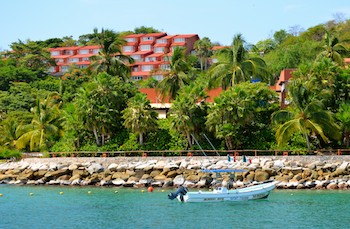
Agua Azul waterfalls, Chiapas, Mexico

Agua Azul's falls are wide and fast.

Crashing water, Agua Azul waterfalls, Chiapas, Mexico

Agua Azul.

Tumbling into turquoise pools, Agua Azul waterfalls, Chiapas, Mexico Serene aquamarine pools, Agua Azul waterfalls, Chiapas, Mexico

Agua Azul's pools of turquoise.

Little Amina goes

swimming.

Visitors get photos of themeselves, Agua Azul waterfalls, Chiapas, Mexico

Everyone gets photos of themselves at the falls.

Vendors at Agua Azul waterfalls, Chiapas, Mexico

Vendors in palapas line the falls.

Eating mango-on-a-stick, Agua Azul waterfalls, Chiapas, Mexico

Mango-on-a-stick.

Agua Azul waterfalls, Chiapas, Mexico

The falls tumble down many layers of boulders.

Agua Azul waterfalls, Chiapas, Mexico Agua Azul waterfalls, Chiapas, Mexico Agua Azul waterfalls, Chiapas, Mexico Van tour, Agua Azul & Misol-Ha waterfalls, Chiapas, Mexico.

Our companions get into another van.

Comitán's Santo Domingo Church, late 16th century.

Comitán's Santo Domingo, built in the late 1500's.

Santo Domingo Church, Comitán, Chiapas, Mexico

Santo Domingo steeple.

Church steeple, Comitán, Chiapas, Mexico

Lots of church steeples in this town.

Church bells, Comitán, Chiapas, Mexico Lots of churches to visit in Comitán, Chiapas, Mexico Modern sculpture in the Zócalo, Comitán, Chiapas, Mexico

Modern sculpture in the Zócalo

Mayan woman, Comitán, Chiapas, Mexico Happy old vendor, Comitán, Chiapas, Mexico Lovers in the Zócalo, Comitán, Chiapas, Mexico Patio of wooden columns, Comitán, Chiapas, Mexico

Patio of wooden columns.

Flowering trees in spring, Comitán, Chiapas, Mexico

Spring is in the air.

Hilltop view from Comitán, Chiapas, Mexico

Hilly streets offer views into the surrounding

countryside.

Tenem Puente ruins & Spring Equinox celebration, Comitán, Chiapas, Mexico

Crowds take seats on the Mayan stadium stairs.

Tenem Puente Spring Equinox performance, Comitán, Chiapas, Mexico

Performers appear on the 1200-year-old ruins.

Spring Equinox at Tenem Puente, Comitán, Chiapas, Mexico Blowing a conch shell, spring equinox celebration, Tenem Puente, Comitán, Chiapas, Mexico

Blowing on a conch shell.

Dramatic headdresses, spring equinox performance, Tenem Puente ruins, Comitán, Chiapas, Mexico Mayan rituals for the deceased victim in a spring equinox celebration at Tenem Puente Mayan Ruins, Comitán, Chiapas, Mexico

Rituals for the dead victim.

Marina Chiapas at dawn.

(Photo courtesy of Capt. Andrés Reyes Prudente).

Agua Azul, Misol-Ha & Comitán, Mexico

March, 2012 - Besides the mysterious ruins of Yaxchilan & Bonampak, the Palenque

area is bursting with beautiful natural features as well.  We hopped on another van

tour, this time to see waterfalls.  We went with a no-name tour company, one of dozens

selling tours in town.  It was cheap, this was just a day trip, and all we really needed

was transportation to the falls.  We sat behind a very seasoned Central American

traveler from North Carolina named Tom who was just starting a four-month tour from

Mexico to Colombia.  His itinerary, unlike ours for some reason, included both the

waterfalls and the Palenque ruins.

"I never have any expectations

when I get on a bus in these

parts."  He said knowingly.  We

had had plenty of bus

adventures, so we nodded with

him, almost as knowingly.

Our first stop of the day, after

bouncing over the rough roads

out of town, was the magnificent

Misol-Ha waterfall.  A thin wisp

of water flowed in a steady

stream off a cliff into a cool, wide

pool.  We followed a short trail

down to the falls and discovered

we could crawl underneath a rock

outcropping behind them.  The fine

mist that sprayed us all was

refreshing.

Our group was in high spirits in the

early morning air as we piled back

into the van.  Young European

backpackers dominated our group,

including a pair of gorgeous, tall,

leggy, blonde Danish girls up front

and three boys from Switzerland, Austria and Germany speaking German together in the

rear.  A little four-year-old Mexican girl, Amina, from Playa del Carmen in the Yucatan, sat

next to me and asked to see our waterfall photos on our cameras.

A very comical and rudimentary conversation in Spanish ensued as our chatter wandered

to our granddaughters and she told us about her cousin.  There's nothing like having a

four-year-old native speaker show you just how poor your command of Spanish really is.

Her giggles and funny faces made it clear we sounded pretty goofy to her.  Luckily her

grandma bailed us (and her) out a

few times when our conversation

reached a total impasse of

incomprehension.  We were quite

humbled when she later talked up a

storm with the van driver!

Our next stop was Agua Azul, a

series of cascading waterfalls that

rushes over stair-stepping boulders

and lands in the most exquisite

turquoise pools.  Wooden viewing

platforms encourage tourists to take

their time soaking in the views and

posing for photos.  The water

thunders down the rocks from

several directions and then rests for

a bit in shades of aquamarine before

sliding on.

The tour vans line up outside the park

while visitors are granted anywhere from

an hour to an afternoon to enjoy the falls

and pools.  Lots of young travelers

eagerly donned their swimsuits and

jumped into the water.

Vendors selling all kinds of snacks and

trinkets under makeshift palapas line the

sides of the waterfalls at various levels beside the endless wooden stairs going up.  We climbed up

and up and up looking for the top of the falls.  The clan of young boys from our van rushed ahead

and later reported that there was a fantastic swimming hole

a mile or so away.  We never got that far.  Instead we

settled at a picnic table to enjoy eating mango on a stick (a

great way to eat mangos!) and watermelon slices in a cup.

After a few wonderful afternoon hours at these rushing

falls and placid pools, we all made our way back to the

van, a little damp, and rather tired at the end of a great

day.  The drive back should have taken just an hour, but

this was a budget van.  It turned out that not only had our

North Carolina friend, Tom, not been taken to the ruins in

Palenque as he expected, but the European travelers with

us were not returning to the town of Palenque at all.  They

were headed in the opposite direction to San Cristóbal de

las Casas, some 5 hours away.  Huh?

Apparently our van was supposed to meet another van on the

road somewhere and transfer the travelers over.  Problem

was, "where" and "when" were not well defined, and although

we all stood by the side of the road in the middle of nowhere

waiting for over an hour, the other van never showed up.  Tom

just nodded knowingly with a smirk on his face.

Luckily we all had lots to talk about, comparing notes about

what we'd seen in Mexico, and talking about what we missed

most from home.  The young German fellow said he missed

his wiener schnitzel terribly, and we all missed our favorite dark

beers from home.  Travel is wonderful, but homesickness for

familiar things steals over you once in a while.

Eventually the driver hailed a van labeled "San Cristóbal" and payed

for five tickets out of his own pocket so our companions could get to

their promised destination.  That van was already full, so I can only

imagine what everyone thought when five extra people and their

luggage were piled into and on top of it for five hours of travel on

twisty, miserable roads filled with speed bumps.  Tom said he'd just

catch a cheap combi van to the Palenque ruins on his own the next

day.  No problema!

We could have easily stayed in Palenque another week, but

disturbing news from family in the US began to take on a more and

more urgent tone, and we decided it was best to begin our trek out

of the jungle just in case we needed to fly back soon.  In the bus

station I saw a poster for a huge Spring Equinox celebration at the

Palenque ruins.  Oh my!  We were leaving the Mayan world on the

eve of the equinox!  You can't do that!!  Oh well.

The distance from Palenque to Puerto

Chiapas where Groovy was waiting for

us is only 550 miles, but it is two long

days of bus travel.  We decided to

break it up by stopping in Comitán, a

colonial city we had glimpsed from the

bus window on our way to San

Cristóbal and that had perked our

interest.

After spending several weeks plunk in

the middle of the touristy Gringo Trail,

surrounded by fellow travelers from

foreign countries, it was a delightful

change to walk the streets of Comitán.

It has all the colonial charm of other similar towns, but has

not been singled out for tourism development in the same

way.  Everyone on the streets was a local, or at least

Mexican, and all the happenings around town were put on

by the locals for the locals.

It is a hilly town, with a multitude of church spires piercing the sky.  The

Santo Domingo cathedral is the oldest, dating to the late 16th century,

some 50 years or so after Comitán was conquered by the Spanish.

Santo Domingo sits on the edge of the Zócalo, or town square, and while

we wandered among the beautiful shade trees and colorful flowers in the

late afternoon, we listened to the priest giving a sermon to his flock,

broadcast over speakers on the outside of the church.

The Zócalo is the heart of the town, and people hang out in the park doing all the fun

things that parks are made for: relaxing, people watching, selling stuff, buying stuff,

and, of course, enjoying each other's company in a romantic setting.

While wandering around I

looked up to see a huge

poster advertising -- a

celebration of the Spring

Equinox at the local

Mayan ruins of Tenem

Puente!  That afternoon!!

What luck!!!

We quickly jumped into a

local combi van and

headed out to the ruins a

few miles away.  This was

a hugely popular event

and the van was stuffed

to overflowing with

people.  It was full body

contact on all sides for

everyone.  Every

bare limb, thigh,

elbow, etc., was

pressed tightly

against those of fellow

passengers on each side.

We all breathed each

other's breath, except

those lucky enough to be

near an open window.

Dads stacked their kids

on their laps, oldest ones

on the bottom and

toddlers on top.

We learned that the

Mayan city of Tenem

Puente was at its peak

between 600 and 900

AD, although it was

occupied until 1200 AD.

It wasn't discovered by

archaeologists until 1925.

Unfortunately, when we

got there the ruins had

been closed off for the

celebration, so we saw

just the first building which stood opposite a hill of

staircases so common to Mayan sites.  Those stairs make

perfect stadium seating, and as they quickly filled with

hundreds of people I got a chill thinking of

how the ancient Mayans had probably sat

there just like we were now for their own

gatherings over a thousand years ago.

Suddenly a trumpet sounded and some

figures appeared on the building.  The men

wore enormous feather headdresses and

scrambled over the ruin.  An announcer

had talked for a while about the

performance before it began, but I couldn't

quite catch all the details.  The performance

depicted a battle, a killing, and some rituals

related to the death of the victim.  I think I

had expected something mystical involving

the alignment of the setting sun and the

buildings and some fascinating connection

to the Mayan calendar.  But this dance and music celebration had its own special

magic, especially as I scanned the crowd and realized that more than a few among

them may have had ancestors that lived inside these ruined walls when they were first built.

We took the overnight bus

to Tapachula that night, and returned to our sailboat Groovy in

the morning.  The boat, the marina and the world of cruising

suddenly seemed very foreign in those early dawn hours.  The

Tehuantepec had quieted down for a few days and boats

were arriving from Huatulco at the marina hourly.  As we

caught the dock lines for the incoming boats our groggy minds

were still far away, filled with the vibrant images of the jungle.

Soon, however, we would be immersed in reality and thrust

back into modern American life on a long road that eventually

led to northeastern Arizona.

Find Palenque and Comitán on Mexico Maps.