

San Evaristo: a family visits to sell us
"langostas" (lobster).

"Gosta" said the toddler, eliciting proud smiles.

Puerto los Gatos is rimmed with smoothly rounded
red rocks. Utah on the ocean.

Sedona meets the Sea.

Vibrantly striated cliffs along the Sierra de La Giganta mountains lining the Sea of Cortez.

Punta Gavilán ("Oarlock Point").

Sea cave at Ensenada de la Ballena.

Inside the sea cave was a
complete ecosystem.

Brilliantly colored crab.

Cactus grows among the rocks on the beach at
Ensenada de la Ballena (Bahía Berrendo).

A whale's pelvic bone sits on the beach at aptly
named Ensenada de la Ballena ("Whale Cove").

Those guys are big!!

Groovy braces for the norther at
Bahía Santa Marta.

The results of a
savage wave.

Two days later Agua Verde
is the mirror of tranquility.

"Roca Solitaria" evokes the Grand Canyon's "Point Imperial."

The red rock cliffs tower above
the sailboats at anchor.

A sailboat disappears against Baja California's
spectacular mountains.

Cactus and pretty water
at Agua Verde.

Peace.

Agua Verde's picturesque bay.

Agua Verde village church.

Goats wander freely.

Everyone rests in the shade
at midday.

Maria's Tienda

Mini Market Miguelito with a solar panel out front.

No fancy gourmet goods, but the basics are all here.

Outdoor refrigerators contain chilled vegetables.

Agua Verde is all about fishing.

Sea kayakers travel
this area frequently.


Agua Verde's old cemetery dates from the mid-1900's.

Where's the beef? Free-range cattle
make a meager living out here.


Groovy is boarded by La Armada de
México (the Mexican Navy) once again.

Path from town to the beach.
Agua Verde, Baja California Sur, Mexico
Late April-Early May, 2011 - We left Isla San Francisco to head north knowing that a "Norther" (several days of big north
winds and seas) was due to arrive in a few days. So in the back of our minds at each anchorage we visited we asked
ourselves "would this be okay in northerly blow?"
Our first stop was San Evaristo, a small pair of coves on either
side of a fishing camp that houses a few families. As the sun was
setting a panga loaded with people came out to visit our boat. It
turned out to be a family, including a baby.
"Negocios!! Quieren langostas?" (Let's do business! Do you want
lobster?). I explained that we don't really like lobster but we love fish.
To my astonishment, the young driver told me they had no fish on the boat but he would be back in an hour with some for us.
When they came back, as promised, it was dark. A young girl held up the toddler. "Escucha!" (Listen!") she said, and then
prompted the toddler to say "langosta," the word for lobster. "Gosta" the little girl said hesitantly. The mom beamed at me
with pride and everyone in the boat laughed. There's nothing so cute as a baby struggling to say its first words, even when
they don't quite say them right. If only my feeble efforts at Spanish were met with such delight!
We decided to move further north and stopped at Puerto Los Gatos.
This is a stunning cove, just big enough for a few boats, where
beautiful, smoothly rounded red rocks roll down to the water.
Before we had a chance to explore ashore, we were suddenly
chased out of the anchorage by a horde of thirsty bees. They
buzzed all over Groovy looking for fresh water. There are so many
fresh water sources fit for a bee on our boat (faucets, shower
heads, sinks and toilets) that it was easier for us to leave the cove
than to persuade the bees to leave the boat.
The Baja coast along this
stretch pierces the sky in
enormous, jagged
mountains, cliffs and rock
formations. In many places
the carved rock faces are
striated in a rainbow of
whites, reds and browns.
We stopped briefly at Ensenada de la Ballena, also known as Bahía Berrendo, a
small gravel beach tucked into the south side of a craggy point. High up on the cliffs
is a perfectly round hole giving the point its name "Oarlock Point" or "Punta Gavilán."
There is a small sea cave in this bay as well,
and we snuck inside and listened to the waves
echoing off the back walls.
Lots of little bright red legged crabs crawled
around the inside of the cave.
It still amazes me to see this junction of the
desert and the sea. A large stand of cactus
filled a valley behind the beach and ran up the sides of two mountains.
Here and there, tucked into the beach rocks, we found baby cactus
taking root.
A little further on
we came across
a whale's pelvic
bone. It was very
well preserved,
with individual
vertebrae and
some very long
narrow bones
resting nearby.
There are three anchorages in this area
that offer north wind protection, and we
chose the prettiest one, Bahía Santa
Marta, to wait out the Norther. There was a beach with a
collection of palm trees at one end, and the red rocks
rising behind the beach were layered. In hindsight a
better choice would have been Bahía San Marcial (also
known as Bahía San Marte). But you don't necessarily
know these things ahead of time.
Once the wind started to blow it seemed like it would
never let up. We saw gusts over 30 mph, and later we
heard that a few miles north in Puerto Escondido where
"Loreto Fest" was taking place the gusts got into the 40's.
The last day of their activities had to be canceled as no
one wanted to leave their boat. Some boats broke off
their mooring lines and other boats dragged their anchors.
We had no such trouble, but the swell was merciless.
Groovy rocked and rolled and the two of us fell all over ourselves
and each other as we tried to move about the boat.
I snuck off in the porta-bote just to get a change of scenery during
each of the three days, but the conditions were downright scary in
the dink and I didn't go far. Our anchor chain got hung up under some
rocks and pinned the boat on a very short leash for a while. This made the
jerking motion even worse as the bow of the boat yanked at the chain like
a wild dog. At one point Mark came up into the cockpit asking if I'd seen
the kitchen knife. We use this knife many times every day, and it never
goes missing. "I left it on the counter..." I said. He found it stuck in the
floor like a javelin. The force of one of the boat's rolls had flung it off the
counter with such power it had landed point down and stuck in the floor
about a quarter inch. Thwang!!!
We were grateful when the norther finally blew itself out. Rounding the
point we finally made radio contact with the rest of the cruising fleet and
were relieved to hear human voices and stories once again. We
discovered this had been supposed to be a "mild late-season norther," and it caught everyone a
bit off guard. Everybody was amazed that a blow like this could hit with such ferocity as late as
early May.
When we arrived in idyllic Agua
Verde, where the water was
smooth and the wind just a
pleasant breeze, it occurred to
us that the Sea of Cortez has a
Jeckyll and Hyde soul. One
minute the Sea is a raging
terror, and the next minute it
is a tranquil paradise.
We took the dinghy out at
daybreak one morning and
slipped across mirrored water.
The rock pinnacle "Roca Solitaria"
stands sentinel at the mouth of
Agua Verde bay, and it stood out
in sharp relief against the striped
rock cliffs on the shore behind it. I
was reminded of "Point Imperial"
at the Grand Canyon's North
Rim. But the glassy water at the
foot of the cliffs planted this place
firmly in the Sea.
Agua Verde is very popular, offering
three unique and delightful spots to drop
the hook. The boats were dwarfed by
the rocky mountains rising behind them.
We took a hike up and over the hills that
rise behind the northern beach. The
views looking back down at the bay were
breathtaking.
Wandering into the village one morning,
we walked the dusty streets. The
nearest town, Loreto, is 60 miles away,
25 miles of which is a mountainous a dirt
road. This little fishing village is isolated
and close-knit.
Goats wander freely, their little bells tinkling as they walk. Spring
had been good to the goats, and almost all the goats we saw were
mothers with their babies.
Days are hot and still, and everyone takes shelter in any kind of shade
they can find. We passed a school and watched the children walking
home in their tidy little uniforms carrying their school papers and
backpacks.
We were in need of a few
supplies and had heard that
Maria's Tienda (Maria's Store)
had a few supplies. The only
thing that distinguished Maria's
Tienda from the surrounding
homes was a little bit of writing
outside the door on the front wall.
She had some staples, but not what we were looking for, so she sent us
on to the other village store, telling us to look for a red building. "Mini-
Market Miguelito" was much better marked and a group of moms was
hanging around inside chatting with each other. These village stores are
not supermarkets or even convenience stores, by any stretch of the
imagination, but the few shelves had a surprising variety of items.
When I asked about vegetables I was led outside to some
large top-loading refrigerators under the trees outside. I
peered in one and was astonished to find peppers, celery,
cucumbers and apples. What impressed me even more is
that these refrigerators -- as well as almost every building in
town -- were powered by a solar panel or two outside. A
simple wire ran from the panels to the charge controller, car battery and inverter.
Agua Verde lives and dies by fishing, and the dads went out in
their pangas twice a day six days a week to fish. Early in the
morning the men would suit up in bright orange foul weather
gear and cast off, waving goodbye to their wives on shore. In
the early afternoon they would return and a whole commercial
exchange would take place. Fish were unloaded from the boats
and carefully counted and loaded into coolers in pickup trucks.
One by one the trucks would take off, including one small
refrigerator truck. Another truck carrying gasoline tanks would
arrive and run a hose to fill the gas tanks on the fishing boats.
Then the beach would clear out for a few hours and return to the
possession of the gulls and pelicans. As the sun was setting the
whole process would repeat, with the wives and kids waving off
the fishermen as they left for the night's catch. Long after dark
we would hear the pangas return.
I was reminded of my great-grandfather who was a lobsterman on Massachusetts' north shore in the
early 1900's. He rowed his dory from lobster pot to lobster pot faithfully every day, hauling them by
hand. His village was small and tight-knit too, made up mostly of Scandinavian immigrants and
situated at the end of a long journey from Boston. Agua Verde lives in the early 21st century,
however, and the Honda outboards were big and powerful and the pickup trucks were late models
from Dodge and Chevy. One fisherman was putting in his iPod earbuds as he zipped past our boat,
and they all had VHF radios and antennas. The trade is the same, but it is a different era.
This part of the Sea is traveled by kayakers
as well as fishermen and cruisers, and we
met several who were kayaking and camping
en route to La Paz from Loreto.
One day we hiked over the hill past an old
cemetery. The tombstones were from the
1930's to the 1960's, and some still bore
adornments lovingly placed there by living family members.
The hiking trail
follows a wash
out to the
beach, and
the free-ranging cattle were
in abundance.
Laid out on the ground in
one spot we saw the
skeleton of what we thought
was a horse, complete with
skull, vertebrae and leg
bones. All the bones were
bleached white in the sun, and a jawbone laid off to one
side showing a full row of molars.
One afternoon a Mexican Navy boat entered the bay
and anchored. All the cruisers kept an eye on the boat,
waiting for the inevitable moment when we
would all get a visit. To our surprise the Navy
boarded several fishing pangas as the
fishermen headed out for the evening's catch.
This business of being boarded by the Mexican
Navy is an equal opportunity affair. A few
lagging pangas snuck out of the bay on the far
side to avoid being detained, but another went
straight to his buddy who had been waylaid and
waited for him to finish with the Navy so they
could go out to fish together.
The cruisers' turns came the next
morning, and as before it was an
easy process. This time it was
more like a US Coast Guard
boarding: along with the usual paperwork they wanted to see that our flares were up
to date, our fire extinguishers hadn't expired and that we had life preservers for
everyone on board. We have now been boarded three times in two months (the
second was so trivial I didn't mention it on these pages). Seasoned cruisers say it
was never this way in the past. It's just a sign of the times.
Agua Verde was a classic Sea of Cortez stop. Clear turquoise water, calm nights and
a dusty but vibrant fishing village, all set against the soaring jagged peaks of Baja
California's Sierra de la Giganta mountain range. By the time we left our sprits were
completely restored after the wild ride we'd been given during the late season
Norther, and we were ready for more Baja adventures in the Loreto area.
Find San Evaristo, Puerto Los Gatos and Agua Verde on Mexico Maps.
La Paz: Ensenada Grande & Isla San Francisco – Stunning Anchorages

Red rocks and cactus at
Ensenada Grande on Isla Partida

Cactus on the water's edge, at
Isla Partida's Enseanda Grande

This could be Sedona,
Arizona!

Unusual rock formations line the far edge of the bay.

These cliffs dwarf the huge
cactus rooted on them.

The calm, clear waters of
Ensenada Grande bring
charterboats of all sizes.

A campsite for dive charters on the beach at Enseanda Grande.

You can sleep in a tent or out under the stars.

These funny little buildings turned out to be
outhouses.

Not bad facilities for a beach camp
on a desert island.

Divers kick back here to contemplate all
they saw on their Sea of Cortez dives.

We wander up a wash and look back at the cove.

Cardón cactus, cousins of
Arizona's Saguaro cactus, grow
all over the canyon.


Bats pollinate these cactus at night.

As we hiked into the canyon
the heat and stillness erased
all thoughts of the ocean.

It is a bit of a stair-step hike.

Little whispy trees seem to thrive.

The hike ends at cliff's edge
overlooking the Sea.

Looking east from isla Partida.


On our way back the view of Ensenada Grande grows larger.

Beach living at its best.

Isla San Francisco just a few miles north of Isla Partida.

Vivid colors of Isla San Francisco

Isla San Francisco's popular "hook" anchorage.

The anchorage opposite the "hook."

Hiking trail on the ridge of Isla
San Francisco.

Moorings bareboat charter boat.

Spectacular views reward hikers after a long scramble.


Isla San Francisco.
Ensenada Grande & Isla San Francisco, Mexico
Late April, 2011 - Our first stop north of La Paz was at
Ensenada Grande located on the west side of Isla Partida.
This is one of the few anchorages in the area that is well
protected from the nasty nighttime south/southwesterly
Coromuel winds, and we tucked right up into a tiny cove
where we were well sheltered by red rock hillsides.
Looking at the scenic bay around us, it seemed we were
at the meeting place of the desert's most spectacular
cactus-adorned red rocks and the jade green sea.
We jumped in the kayak to see everything up close, and
moseyed along the base of the red rock cliffs. Cactus
grew out of crevices in the rock, somehow eking out a
living from those few morsels of dirt that had gotten
wedged into the cracks.
The deeper water undulated turquoise green, while the
shallower water revealed all the details of the rocks and
fish under the surface.
On the far side of the bay the rock
formations were intriguing. Carved
out underneath by the wind and
waves, the rock cliffs were smooth
and rounded, as if shaped by a divine
hand working in wet clay. On top of
the bluff the desert's crispy crust
seemed almost to drip over the sides
towards the water. The tall cactus
seem small compared to the cliffs.
Leading up to the main beach the
water runs shallow for 100 yards or
more, rising and falling in a billowing
veil over the sand. This is a popular spot for day and
weekend charters from La Paz, and during our stay we saw
several extraordinarily appointed megayachts stopping in for
an afternoon or an overnight in the bay.
We pulled the kayak up onto the beach and were very
surprised to find a little encampment perched on the water's
edge. A Mexican fellow was singing Queen tunes as he raked
the word "Welcome" into the sand. His name was Hernando,
and he told us this little oasis was a "campsite" for visiting dive
charters. Three large, rugged tents were set up with cots and
bedding. True nature lovers could take their cots out onto the
beach and sleep under the stars.
Off to one side stood several homemade little shacks with
doors. Peaking inside one I discovered it was a neat little
outhouse, complete with a marine pump toilet, toilet paper
and a colorfully woven wall covering.
Hernando started
working in the
little kitchen
building, and he explained that
this place was used by dive
charter companies and was open
every day from April to
November. Down on the beach
there were plastic lounge chairs
and some fantastic varnished
wood chairs and umbrella tables.
What a cool place to take a load off after a
reef dive in the Sea of Cortez.
Turning back towards the red rock canyons
behind the dive camp, we found a desert
wash running down from the mountains to
the beach. Lush vegetation grew all around
and beckoned to us to
walk in a little further.
Wandering into the wash,
we found ourselves
surrounded by healthy,
vigorous cactus. As we
got deeper into the
canyon, the sounds of
the bay began to vanish, replaced
by the buzz of heat bugs
alternating with the intense silence
of the hot desert rocks.
We have been away from the
desert for so long it felt like coming home. We happily
soaked up the dry heat, enjoying the feeling of the sun
prickling our arms. The cactus were amazingly thick,
and as we walked deeper into the canyon we were
suddenly immersed in utter silence.
We had come ashore just for a quick look around and
were wearing water shoes and bathing suits. This
place deserved a much closer look, and the next day
we came back dressed more appropriately for a
desert hike, armed with hats and hiking boots.
A few cardón cactus arms were trimmed
with flowers. Like their northern cousins,
the Saguaro cactus, these guys get
pollinated at night by bats, so their
flowers are timed for nighttime opening.
The hike is a scramble up a boulder filled
wash, and it was a good little workout
stair-stepping our way up. As the bay and
boats and beach receded behind us, we
became more and more certain that we were
deep in the Arizona desert, far from all
thoughts of oceans or water.
Little scraggly trees grew here and there, taking tiny sips
of water from the moisture that occasionally seeped down
the wash. Lizards crawled on the rocks at our feet.
Finally the boulders in the wash gave
way to a wide open pebbly expanse,
and we marched up and out of the
canyon onto a vast plateau. Sensing a
stunning view just over the rise, we
picked up the pace to a near run until
we stopped short at the edge of a cliff
that hung out over the water below.
The Sea of Cortez stretched for miles
of blueness into the distance, and we
could clearly see every rock and
contour of the water hundreds of feet
below us.
After inhaling a few
deep breaths of
success and
satisfaction we started
back down again,
watching the little cove
of Ensenada Grande
growing beyond the
desert rocks and
cactus. What a
fantastic combination of
desert and ocean.
As we walked the last few steps through the scrubby brush at the base of the wash, the dive
camp reappeared along the beach. The scene looked so inviting, like a little slice of heaven.
The Coromuel winds continued to howl at 20 knots all
night every night, making the boat swing and sway on the
anchor line. But we were close enough to the shore to
prevent any waves from reaching us, so we stayed flat and
slept well.
One morning we caught the tail end of the previous night's
Coromuel wind for a ride up to Isla San Francisco. With
the breeze at our backs we romped along steadily at 8
knots, exhilarated to feel the boat surge forward in
response to even the slightest puff.
Isla San Francisco has a picturesque anchorage that is shaped like a
huge circular hook and is lined with a thin white beach. We took our
position among the collection of anchored boats and then just stared
at the shore for a while, mesmerized by the colors and the view.
Bright blue sky, craggy reddish rock hills, blindingly white sand, and
smooth green water lay before us. The island begged to be explored,
and we immediately dashed ashore to scurry up the short hike to the
ridge trail that snakes along the hills at one end of the bay. What a
perfect perch to gaze down at the anchorage and out across the bay
to the Baja mountains on the horizon.
There is another anchorage on the other side of the
island, opposite the favored "hook" anchorage, and it is
easily visible from this ridge trail as well. We pranced
along the skinny footpath, meeting the crews from
several other cruising boats and charter boats along the
way. This place is "not to be missed" and few boats
coming up from La Paz ever miss it.
During our stay we connected with the crews from two
bareboat charters. One was a young couple form
Vancouver Island aboard a McGregor 26 for a week.
After seeing so many heavily outfitted 40' cruising
sailboats driven by grey haired retirees, it was refreshing
to see these two kids in a little boat arrive in the anchorage.
Their sailboat was outfitted with just a simple outboard
engine, tiny solar panel and mini-fridge, but what a blast
they were having. They swam and snorkeled with
abandon, and when we invited them aboard Groovy for
cocktails along with some other cruisers, it was soon
evident that even at their young age they were more
experienced sailors than many cruisers.
We saw several sleek
charter sailboats from
the Moorings too. The
one with the Swiss
family aboard was our favorite. They were celebrating their 20th anniversary and sharing
the moment with their four young teenage and pre-teen children. The mom and dad were in
and out of the water as much as the kids were. Sunbathing, reading, teasing each other,
and pushing each other over the sides, this family made the most of every day. They were
on the boat for just a week and they liked Isla San Francisco so much they stayed for four
nights. Like the other young charterers, they were seasoned sailors, and had chartered all
over the Mediterranean and Caribbean. We were impressed when they headed out for an
afternoon daysail and sailed off their anchor with ease, rather than using the engine.
Watching these exuberant vacationers was
inspiring. It is easy, after living this lifestyle for a
while, to forget just how special each day is. When
Mark stood on the swim platform for a very long
time one afternoon, debating whether or not to
brave the cold water, I reminded him, "Hey, those
folks on the charter boats wouldn't think twice..." With
a loud splash and a gurgled shriek, he hit the water
and bounced back to the surface
wearing a satisfied smile.
Isla San Francisco has another
hiking trail that leads up to a higher
peak. This trail is not used too often,
and after passing a few rock cairns
that marked the start of the trail, we
were soon scrambling up an
unmarked pebbly, slippery slope.
At the top we were rewarded with
marvelous views that were well worth
the dicey descent that followed.
We had heard news of an impending late season "Norther" that would
bring big north winds and stormy seas for a few days. Crews of boats
began strategizing which anchorage would offer the best protection,
and because of the huge cruising event called "Loreto Fest" going on
a bit north of us, we knew we would be challenged to find a good
anchorage that wasn't already loaded with other boats if we didn't get
going soon. Looking back with 20-20 hindsight we now realize we
should have stayed put at Isla San Francisco for another week, as it
offers the best north wind and wave protection in the area. But we
didn't, and we were soon in for a wild ride before we found paradise
again at Agua Verde.
Find Isla Partida (Ensenada Grande) and Isla San Francisco
on Mexico Maps.
La Paz: La Paz, Bahía San Gabriel & Puerto Balandra – Beauty & The Beast

Golf course near La Paz's Costa Baja Resort Marina.

Brand new buildings rise out of the desert in La Paz.

Future development plans are marked in the desert hills.

A mega waterslide.

Old and new: a renovated schooner cruises past a
brand new golf course.

Boats of all sizes enjoy La Paz harbor.

Marina de La Paz.

The La Paz malecón.

Inviting park benches line the malecón.
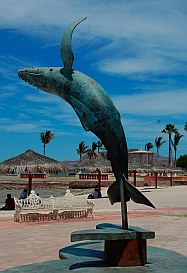
Humpback whale breaching.

Evocative statues enliven the malecón.


Dressy trash cans.

A turtle statue gives a mural a
3D twist.

Musical sea shells.

The malecón is a great place to sit a spell.


Carlos Slim's super yacht drops in for a few days.

The Mexican Navy kicks off the Semana Santa (Holy Week) celebrations in dress whites.

Mexican Navy ships behind us.


Embroidered and knitted items for sale.

Manual orange juicers in a kitchen shop.

Katty took our measurements and made fantastic
lycra snorkeling suits for us.

The La Paz eddy?

Puerto Balandra.

Lagoon entrance at Puerto Balandra.

Puerto Balandra.

Cardón cactus greet us.

A sunflower starfish (the
camera's flash made a bright
spot in the center).

Peace.

Happy afternoons in the cockpit.

Sunset in Puerto Balandra.
La Paz & Puerto Balandra, Baja California, Mexico
Mid-April, 2011 - After a few quiet days in Ensenada de
Los Muertos at the tip of the Baja peninsula we felt
sufficiently recovered from visiting Mazatlan and crossing
the Sea to make our way into another big city: La Paz.
Coupled with Mazatlan and Puerto Vallarta, La Paz
makes the third urban leg of the triangle joining the Sea
of Cortez and the Pacific Ocean (see Mexico Maps).
The beautiful marinas in each of these cities often keep cruisers
tied to the docks for weeks, as the deliciously comfortable resort
lifestyle makes it hard to untie the lines and move on. We had
been told repeatedly before we left for Mexico, "Don't spend too
long in Puerto Vallarta like we did," or "We got stuck in Mazatlan
way too long," or "We were trapped in the 'La Paz eddy' and ran
out of time." Staying out in the anchorages instead of the marinas
throughout our Mexico cruise has kept us mobile, and we planned
a brief visit to La Paz.
As we approached La Paz, motoring down the several mile long
entrance channel, the area seemed bursting with the thrill of new
resorts going up. A brilliant green golf course defied the brown
desert surroundings while stunning glass plated multi-story
buildings rose from the hills. Behind a huge unfinished building,
markings on the hillside revealed how the land will be carved up
for future development. It all pointed to a town flush with hopes
of hosting well-heeled tourists for many years to come.
A massive water slide made our jaws drop, and we could hear
the screams of the kids on one of the slides.
It was nearing the start of
"Semana Santa," or the
Holy Week surrounding
Easter that is Mexico's
major vacation week, and
boats of all shapes and
sizes were heading out of
the channel into the island
playground that is just
beyond the city's limits.
Marina de La Paz has
space at their dinghy dock
for boats that anchor in the bay. They
are also home to Club Cruceros, a
cruising club that offers a ready-made
community of knowledgeable fellow
cruisers for visiting sailors, complete
with morning coffee hour gatherings
and a very large book exchange.
The heart of La Paz is the malecón, or
seaside boardwalk, that extends for
several miles along the bay. This is a
wonderful place for both leisurely
strolls and energetic jogs. The
malecón is dotted with inviting
white wrought iron park benches
and charming sculptures.
A deep love of the sea and a
little bit of whimsy fill each statue,
reminiscent of San Diego's
Urban Trees. Even the trash
cans are dressed up as sea
creatures.
A huge mural of
the undersea world of the Sea of Cortez incorporates a
sculpture of sea turtles in an intriguing way, and we
found a band of shells strumming instruments a little
further on.
Despite being a
bustling city, you can't
help but slow down
along the malecón and take a breather while looking out at
the many cruising boats anchored in the harbor.
During our stay we had lots of things
on our "to do" list, and we scurried
around town gathering provisions both for the dinner table and the boat. This was the first
city where we had found a chandlery, Lopez Marine, that not only had all of the items we
needed but was run by a Canadian ex-pat who understood both our language and our
boat's fussy needs. We had struck out at boat-oriented stores in Manzanillo, Puerto
Vallarta and Mazatlan before this, so we were thrilled to stock up on all the items we had
neglected to bring with us from San Diego.
We also discovered we were definitely in Baja and not on the mainland anymore as we
shopped for the galley and stopped at street-side vendors for snacks. We had searched
high and low for fish tacos and grilled beef tacos on our travels on the southern mainland,
always coming up empty. Flour tortillas are nonexistent on menus south of Puerto Vallarta
and aren't available for purchase save for one brand in the supermarkets. Now we rejoiced in $1.50 grilled beef tacos with all
the fixings, we scarfed a few fish tacos, and grabbed a variety of brands of flour tortillas for the galley.
The richest guy in the world, Mexican communications
tycoon Carlos Slim, also seems to like La Paz. His
megayacht was in port getting a little window washing
during our stay.
We woke up the day before Good Friday to find the
Mexican Navy in celebration behind us.
Several small Navy ships were anchored just off our stern, flags
flying. A whole group of Sailors lined up on shore looking very
sharp in their dress whites.
La Paz is an older town, and it has hilly, narrow streets that give it a different, cozier kind of
feeling than other Mexican coastal cities we've visited. As in the US where so many towns
are beginning to look alike with matching big box stores, Mexico's chains and street vendors
give many of their towns a similar appearance. Familiar Mexican businesses like Coppel,
Elektra, Comex, Soriana, Comercial Mexicana, Bancomer, TelCel and Banamex show up in
every city, often accompanied by American counterparts like Walmart, Home Depot, KFC,
Office Max, Subway, McDonalds and others.
But the streets of La Paz go up and down,
rather than being wide and flat, and many
seem to be one-way. Even the street vendors
here seemed to be offering slightly different
wares, including one who was selling
embroidered and knitted goods.
We got a tip from friends that a seamstress in
town makes custom fitted snorkeling suits.
With long sleeves and long legs, these lycra
outfits offer a little bit of warmth
and a lot of abrasion protection.
We visited Katty's house for a
fitting and three days later had
two wonderful new body
suits for less than the
price of a bikini back
home.
As we made our way
back to the boat one
day, a small school of
fish was swarming in
circles under our
friends' boat.
Were they caught
in that infamous La
Paz eddy too?
Hmm... maybe it
was time to leave.
The anchorages in the first 100 miles north of La Paz are considered to be
some of the best in the Sea of Cortez. We wanted to visit every one, so
we started at Bahía San Gabriel at the southern end of Isla Espiritu Santo.
This pretty bay had us each sighing "ahhhh" all afternoon once the hook
was down. A noisy frigate bird nesting colony filled the trees along one
part of the shore, and the long white sand beach begged to be walked.
"Tomorrow..." we both said simultaneously, envisioning a quiet kayak ride
to shore and a slow walk-swim-walk together along the water's edge.
From the perfect stillness of the cockpit we watched the sun set in spectacular colors, anticipating a quiet night. So we were
quite surprised when the boat began to roll mysteriously. An ominous, low roar gradually filled the air around the boat.
Suddenly the wind began to pick up, sending us into the cabin to get out of the cold and then bringing us back on deck in
alarm as it quickly accelerated over 20 knots. The boat began to buck and roll, and we watched in awe as the one other boat
in the anchorage, a 65' Swiss flagged yacht, pitched wildly in the growing maelstrom. We struggled to keep our footing as we
scrambled down below again. What the heck?
For 15 straight hours the boat jerked violently and the wind bellowed and whistled through the rigging. We were wide awake
throughout the night, our only comfort being the knowledge that the seven people on the other boat were wide awake too. By
morning we had read every book on board about the La Paz Coromuel winds. Good grief. Who woulda thunk that a heavenly
little tropical anchorage could transform into a nightmarish haunted house and roller coaster ride so fast? Well, we learned
that it happens every night in the late spring and summer within 40 miles of La Paz. The word "Coromuel" is the Spanish
pronunciation of the name of British privateer Samuel Cromwell.
This odd, all night phenomenon of absolutely vicious south/southwest winds is caused by hot desert air rising from Baja's
southern tip near La Paz and sucking in the cold Pacific air across the low lands without any mountains to slow it down. By
11:00 each morning the show is over and the winds vanish, replacing the word "nightmarish" with the word "idyllic" in the
description of every southwest-facing anchorage in the area. With great optimism, many travel guides dismiss this horror as
"a cool evening breeze," which it may be if you are on a protected patio somewhere.
So the trick in spring and summer near La Paz is to stay only in
those anchorages that have south to southwest protection. We
found such a spot at Puerto Balandra.
Tucking up under the towering cliffs
to the south, we spent three stunning
days gazing at the white sand
beaches and jade green water, smug
in the knowledge that when the
ferocious winds came at night we would be completely
protected from the huge waves and modestly protected from
the howling wind.
It had been 16 months since we had spent any time in the
Sonoran desert, and it felt wonderful to be back again. The tall
cárdon cactus, close relatives of our beloved Arizona saguaro
cactus, seemed to reach their arms out to us in a big wave
"hello." In the distance we heard the familiar chortle of a cactus
wren. Our sinuses got all crackly again and every towel on the
boat dried out in an hour or so.
Slathered in sunscreen once more, we explored the pristine
beaches by foot and with mask and snorkel. We spotted a
sunflower starfish under the still, clear water. From the boat we
could hear the happy voices of kids playing on one of the white
beaches a mile away while the sun baked our bodies. It
reminded us both of our childhood days -- on Michigan lakes for
Mark and on New England beaches for me.
We hung out in the cockpit every
afternoon, and Mark got inspired to strum a few tunes.
This bay is a perfect weekend getaway for folks in La Paz. After
a few days of blissful vacation we zipped back into the city for
some final provisions before hitting the remote and largely
uninhabited islands to the north in the Sea of Cortez where our
first discoveries were Isla Partida's Ensenada Grande and then
Find La Paz and Puerto Balandra on Mexico Maps.
Mazatlan Area: San Blas & Isla Isabel – Urban Agitation and Booby Joy


The ruined church on the hill that held
Longfellow's Bells of San Blas.

The "new" church that replaced the
church on the hill.


This newest church that replaced the "new" church
next door.


Every wife deserves a ride like this from
her hubby.

It was a crazy busy day in the
town square and we saw all
kinds of folks...


A mural depicts the town of San Blas.

The guys liked the cannons at the fort.

The Belle of the Ball preps for her
15th birthday.

A path over a ridge on Isla Isabel
led to a frigate bird rookery.

A frigate bird keeps an eye on me, his red pouch
deflated.

A frigate bird chick huddles on its nest.

Two frigate bird eggs resemble
chicken eggs.

A pale headed & dark faced
brown booby on a cliff.

A dark headed brown booby

Booby chicks.


A blue footed booby!

Yep, those are blue feet.

The blue footed booby blocks the path
and tells me to go home.

A colorful snake winds around a
tree trunk.

The flock waits for handouts from the fishermen.

How we look after an overnight passage.
San Blas & Isla Isabel, Mexico
Early April, 2011 - We left the crowd of cruisers in La Cruz and eagerly looked forward to more quiet anchorages on our way
north to Mazatlán. The winds were in our favor and we had two glorious days of sailing, stopping for an overnight at Isla Peña.
The second morning was sunny and warm with a light breeze, and the boat danced easily on its course. We were both
somewhere out there in daydream land when suddenly we heard an enormous splash. Leaping to our feet we watched a
humpback whale shoot straight up out of the water, turn, and fall crashing back down on its side.
When a much smaller whale tail flapped nearby, we realized this was a mother
with a baby. A few moments later the whale surged out of the sea again, this
time doing a full twist before falling back into the depths. A little ways away the
smaller tail waved again.
Our second night we stopped at Ensenada
Mantachén, a large bay that looked at first like an
ideal spot to spend a few days.
It is a short
bus ride from
the little community of Mantachén into the town
of San Blas, which is famous for inspiring
Longfellow's poem The Bells of San Blas.
Reading that wistful poem made us curious
about the ruined church on the hill whose once
clanging bells are now muted and "green with
mould and rust." At one time they symbolized a
dark era of conquest, when Spain ruled and "the
world with faith was filled." But now the bells
stand silent, reminding us of "an age that is
fading fast" while "the world rolls into light."
We walked through the ruins of the church on
the hill, and then explored the ruins of the "new"
church down in the town. The new church has
been replaced by another even newer church
next door. This newest church is where today's
faithful go to worship.
San Blas was very busy on the day of our visit.
Citizens, government officials and armed
soldiers filled the town square. I asked several
people what was going on but didn't fully understand the
explanations. I think it was some kind of survey of the local people to
determine their standard of living. As tourists, we simply enjoyed
watching the scene.
Up on the hill by the old church
stands an old fort that we explored
with friends. The cannons were fun
for the guys. More fun for us gals
was seeing a young girl getting
photos taken for her "quinceañera,"
or 15th birthday. This is a very
important milestone birthday for
Mexican girls, a kind of "coming
out," and it is celebrated with a
huge party and a fantastic prom
dress.
Many small towns exude charm and make visitors feel welcome and
safe, but San Blas is not that way. As one fellow cruiser put it, "I wouldn't go out after dark
here." At the beach palapa restaurant in Mantachén the owner even wore a sidearm. We
had been put on guard immediately upon arrival at the Matanchén anchorage when a group
of cruisers pulled alongside our boat in their dinghy and said, "Make sure you lock your
outboard at night. There have been some outboard and dinghy thefts in the last few
weeks." We put cable locks on everything on deck but slept fitfully. Mark bolted out of bed
at 2:30 a.m. when he heard people on a panga nearby tapping on the panga's hull. They
appeared to be fishing, so he went back to sleep. Next morning our friends discovered their
Mercury 9.9 hp outboard had been stolen. They had raised their dinghy in its davits so it
was 6 feet off the water, but they hadn't locked the outboard. It seemed to us that this theft
had been carefully orchestrated and must have involved more than one person.
We had planned the next day to go on an estuary tour that many other visitors to the area
have raved about, but we had a sour taste in our mouths after that episode and we left right
away.
Isla Isabel waited peacefully on the horizon for us, just 50 or so miles away to the north. No
sooner had we dropped the hook than the couple on the neighboring sailboat swung by and
invited us to go ashore with them. Stepping out of the dink onto the beach we found
ourselves in the middle of a fish camp. A row of pangas sat on the beach in front of a row
of shacks, and piles of fishing nets filled the space in between.
A friendly fisherman guided us to a
path that goes to the interior of the
island, and after climbing up and
over a ridge we found ourselves in
the heart of a frigate bird rookery.
A canopy of short trees formed a
roof above us, and on every
branch a frigate bird hunched over
an impossibly rickety little nest.
The chicks were nearly full-sized,
but their feathers weren't fully
grown in yet, and they had that
goofy look of pre-adolescents
everywhere.
The ground was thick with guano, and we danced around
looking up at the undersides of the birds while ducking in fear
that we might become targets for droppings. I found the
remains of a few chicks that must have fallen out of their nests
a while ago, and we found two unhatched eggs. They were
the size of chicken eggs, but they were heavy. No doubt each
one held a well formed chick that didn't make it out in time.
We followed the path up another hill and emerged onto the
cliffs that line the edge of the island. In front of us, blocking the
way, were legions of boobies. They stared at us with quiet
curiosity, watching our every move, but showed no particular
signs of fear or of getting out of the way.
We had seen our first boobies several months earlier when
we sailed into Manzanillo Bay. It had been late afternoon and
lines of them were commuting back home to roost. We
weren't sure what kind of bird they were, but we started
calling them "tuxedo birds" because of the way they dressed.
Seeing them so close
now I realized there are
several variations. Some
have light colored heads
with a dark face and
some have dark colored
heads with a light face.
But all the chicks were
fluffy and cute.
We pressed on through
the crowd along the edge
of the cliff, and each
parent/chick pair backed away a little as we went by. Then
we turned a corner, and faced an unusually obstinate
booby. This one had blue feet!
Apparently the
Galápagos islands are
not the only habitat in
the world where blue
footed boobies live, and this little mom was doing her
darndest to make sure her species thrived here on Isla
Isabel.
She stood her ground as we
approached, effectively blocking her
chick and the path with a very
impressive display. She fluffed up her
feathers, made all kinds of noises and
generally told us to back off.
A few quick photos and we did as we were told, tromping back down the hill into the frigate
bird colony and back to the beach.
Mark is a woodsman at heart, and he spotted an unusual snake in a tree. We tried to
remember the rhyme about the color patterns on coral colored snakes, "Red touch yellow,
kill a fellow," or something like that, but we couldn't quite remember how it went. We later
found the coral snake rhyme online and discovered our little guy was a milk snake.
After all this exotica it
seemed rather pedestrian to
watch the congregation of
seagulls and pelicans lining
up for scraps from the
fishermen. But I still love
these guys too. These gulls
make a cry that sounds like,
"Ow ow ow," as if someone
is pinching them mercilessly.
While at San Blas we visited the cultural center which has a gallery with
a handful of paintings in it. One in particular caught my eye because it
shows the exact expression we have on our faces whenever we do an
overnight passage on the boat. The trip from Isla Isabel to Mazatlan is
90 miles, just long enough to require an overnight. Fortunately we were
able to sail almost the entire way rather than run the engine. However,
the wind was right on the nose, so we had to tack back and forth in a
zig-zag pattern for 20 hours. The wind also changed strength every
hour, which required us to reef and unreef the sails repeatedly so the
boat could take advantage of the wind rather than the other way around.
By the end of the night we actually looked a bit worse than the guy in
this painting.
Find San Blas and Isla Isabel on Mexico Maps
Mazatlan – A Little Strange

Rock formation at Isla Isabel.

Sunset at sea after leaving Isla Isabel.

A scum line of foam stretches
between Groovy and our neighbor.

Dinks line up on the beach as the owners stop for
shrimp & garlic pizza.


A perfect beach for toddlers and dinghy landings.

A water taxi arrives to take us to
downtown Mazatlan.

Mazatlan's malecon.

Unusual monuments along the
malecon.

Exotic modern architecture.

Stately antique architecture.

Mazatlan's town square has an odd excess of
shoe shiners.

Renovated buildings brighten some spots.

Elaborate antique wrought iron gates remind us that
Mazatlan has battled crime for eons.

Renovations on one side of the street distract your
gaze away from...

...unrenovated buildings across the street.


Groovy's window dips face down into the
turquoise Sea of Cortez.

The kayak begs to go for a ride...

...and what a great ride it is.

Bleached coral twigs lie in the sand.

Mansions sprout along this quiet and remote bay.

We've arrived.
Matazatlan, Mexico
Early April, 2011 - It is a 90 mile run from Isla Isabel to Mazatlan, but with the wind
directly on our nose the whole way, we knew we could easily cover as much as 140
miles tacking back and forth by the time we got there. So we left shortly after dawn,
anticipating 24 hours in transit. Sure enough, we sailed all but the last ten miles,
witnessing both a stunning sunset and a pretty sunrise before we arrived at the Stone
Island anchorage just outside of the entrance to Mazatlan harbor.
We had been warned about
fishing long-line nets ages
ago, but in our 2,200 miles of
sailing along the Mexican
coast for the past four
months we hadn't seen any
until we had approached Isla
Isabel a few days earlier.
They are poorly marked, usually with a small black buoy flying a black
triangular pennant a foot or two off the water. Generally, about 100
feet from the pennant buoy there will be a soda pop bottle or other
small buoy that marks the end of the long-line net. Somewhere out in
the distance, 1/4 mile or more away, there will be another pennant
buoy. If there is a plastic bottle bobbing near that one, then that
marks the other end of the long-line, and you need to go around the whole thing or get caught in the net. Sometimes the long-
lines can extend for several miles, with small black buoys placed every 200 feet or so along the entire length of the net.
As we approached Mazatlan we found ourselves in totally flat calm water in mid-
morning. Rather drowsy from sailing all night, we were shocked awake when a
pennant buoy slipped right by the boat. We barely missed the end of the long-line net.
Suddenly wide awake, we were astonished to find one long-line net after another
blocking our way for the entire 10 mile approach to the harbor. We had been tacking
all night long as we sailed, and now we found ourselves zig-zagging all over the sea
while under power to avoid these crazy nets.
We settled into the scenic Stone Island anchorage just outside the mouth of Mazatlan
harbor but were discouraged to find ourselves in a scum line that connected Groovy to
the next boat in the anchorage with a ragged film of foam. To keep our spirits up, we
reminded ourselves that the Huichol people believe all animal life springs from this
foam, as the foam is the Sun God's very fertile saliva.
There is a small beach
around the corner from the
anchorage where we
discovered the most delicious
shrimp and garlic pizza in a
casual beach palapa. This
pretty beach has the
sweetest and gentlest waves and is ideal for toddlers and dinghy
landings. Our kayak took its place on the shore alongside the other
dinghies from our neighboring cruisers.
The beach was serene and peaceful most days, seeming a
world apart from the very busy city that lay just beyond.
From Stone Island we
took a water taxi across
Mazatlan Harbor to the
edge of Old Town. This
made getting to and from
the city of Mazatlan a kayak-walk-water taxi affair, but it also placed us in a pretty
setting far from the urban challenges that make up Mazatlan.
A walk along the city's
malecon, or boardwalk,
revealed a waterfront that
could be very attractive.
There is a long beach,
some unusual homes
perched on impossible
cliffs, and some unique statues
and monuments.
However, Mazatlan is not a
friendly place. For the first
time in Mexico a bus driver
tried to cheat us when he made change,
giving us 25 pesos in change rather than the
40 he owed us. It took three refusals of his
token offers of small coins to get the total we
were due, and he offered no apology.
Similarly, where other Mexicans in other
places happily smile and wave when they
pass, here we found downcast eyes and
solemn expressions. It is not a happy city.
We had heard mixed reviews of Mazatlan
before we arrived, with most people saying
they hadn't liked it. However a few were very
enthusiastic about the Old Town architecture.
The cathedral was impressive.
More impressive to us, however, was that the
town square was filled with shoe-shiners. On
each of the four sidewalks surrounding
the square we found two or three shoe-
shine people, for a total of 10 or 12
around the square. They laughed when
we pointed at our Keene sandals -- no
sales there -- but we had never seen
such a high density of people shining
shoes for a living.
At one time Mazatlan was prosperous,
and quite a few ornate buildings have
been renovated. There is a tiny half-
block sized park that is surrounded by
brightly painted renovated buildings. A
few three- and four-table restaurants
catering to gringo tourists spill out onto
the sidewalk. Another
cobbled street sports a brief row of antique buildings whose imposing
wrought iron gates over the doors and windows are reminders that
even in wealthier times this city was gripped by crime. Unfortunately,
renovation is only skin deep. Across the street from one architectural
make-over was another building begging for repair.
We heard rumors that an American tourist in Mazatlan had
recently been caught in the cross-fire of drug-related gang
violence and killed, leading the cruise ships to reroute their
cruises away from this city.
The many busted up buildings, the endless graffiti all over town and the
truckload of soldiers patrolling the supermarket parking lot where we
went shopping all seemed to support the sad story that there is a very
dark side to this city.
It didn't help when a taxi driver told us to be sure never to walk through
the neighborhood next to where he dropped us off, as it was the worst of
the drug and gang infested neighborhoods.
Waking up to dense pea soup fog three days in a row did nothing to
lighten our mood, and on the fourth morning we left well before dawn to
make our trek across the Sea of Cortez to the southeastern tip of the
Baja peninsua.
Mazatlan to Bahia Los Muertos is a 190 mile journey, and for us it was
largely upwind. We motored along overnight. Just like four months
earlier, we listened to the nutty fishermen calling each other all night long on the VHF radio. Paying no attention to the
international regulations regarding the strict use of Channel 16 as a hailing channel only, these guys held long conversations
with each other, broadcast favorite songs, whistled at each other, yelled, and teased each other all night long. It makes for a
strange moonless night at sea when invisible waves noisily lick the hull while crazy Mexican fishermen cat-call each other on
the radio at the top of their lungs between playing snippets of Tina Turner and Mexican mariachi music.
All night long we impatiently watched the wind gauge, waiting for the wind to slide off our nose just enough so we could sail.
The moment finally came on our second morning as the sun was rising, and we got in 7 hours of sprightly sailing.
What a joy it was, as the boat heeled over in the brilliant sparkling
morning seas, suddenly to see bright turquoise water. Due to all
the red tide and estuary run-off this year, the ocean along the
Mexican Pacific coast had ranged from grey-green to brown to
burgundy. I was so thrilled by the color of the water streaming by
our hull as we approached the Los Muertos anchorage that I
quickly got some photos of our cabin window submerged in the
beautiful water, even though having the window face down in the
water meant it was well past the time to reef the sails and stop
heeling so much!
Not only was the water at Los Muertos a spectacular color, but the
anchorage was calm. We jumped in the kayak as soon as the
anchor was down. Calm, clear, pretty water surrounded us, and
we were like two happy kids paddling around.
There were lots of dark patches in the water, and we soon
discovered these were coral heads. What a surprise. On the
beach there were lots of little branches of bleached coral resting in
the sand.
Los Muertos is a large bay with little development, but the waterfront
mansions are on their way. A growing development at one end has
beautiful condos and a few fantastic homes. The guidebook's
mention of an RV park is long outdated, as not one of the people we
met on shore had ever known of RVs coming this way.
A little more research on our part and we discovered that at
one time this area was a boondocker's paradise. RVs would
line up right along the shore where the golf course now
sprawls.
Times change, but after leaving Mazatlan and making our
second Sea of Cortez crossing, Mark had no doubt about
where we were standing: Paradise.
After a few days of resting in this relaxing bay, we sailed
around the corner of the Baja peninsula into the bustling
town of La Paz.
Find Mazatlan and Los Muertos on Mexico Maps
PV: La Cruz & Sayulita – Cruisers, Surfers & Fun Loving Mexicans

Marina Nayarit at La Cruz de
Huanacaxtle.

Cobbled streets of La Cruz.

Mark buys some Sierra at the local fish market.

The Vancouver Sailing Academy was in residence for a week of training.

The March 11 tsunami destroyed a dock at Marina Narayit.

The whale attack resulted in a bent
strut and missing propellor.

Huichol Galeria at the Octopus's Garden.

Huichol yarn art. Yarn is pressed into a wax backing.

Like their yarn art, Huichol bead art involves
pressing beads into a wax backing, sometimes
on a sculpture as with this jaguar.

Alvaro Ortiz works on a sun and moon.

The finished product a few hours later.

Bead bracelets and necklaces come off
of small looms like this one.

Huanacaxtle pods, or "ears" in
Nahuatl.

God one-upped the devil and
shaped the Cuastecomate tree's
leaves like crosses.

Sayulita's campground was teeming with surfer dudes and dudettes.

Sayulita's surf beach.


The tsunami nearly sent the public bathrooms into
the drink.

Hot bikini babes everywhere.

Surf and surfing are the heart of Sayulita.


Like father like son.


Leaf art on exhibit at
Sayulita's Huichol
gallery.

Leaf carving.

The pros show us how to get a big heavy
panga off the beach into the surf.


An iguana poses at Marina Vallarta.

...all done posing.

A pile of dough sits at the top of
a tortilla machine.

We join a group of Mexicans in a dusty yard for beers and
"pollo asado."

Gilberto shares his beer with a bull.

Marciela is the perfect young hostess.

Baby Juliana is at the center of it all.
La Cruz de Huanacaxtle, Nayarit, Mexico
Late March, 2011 - Cruisers gathered in Bahía Chamela for days, waiting for the
right weather to make the overnight passage north around Cabo Corrientes ("Cape
of Currents") to the Puerto Vallarta area. This cape is known for being treacherous
at times, willfully dishing out strong currents, powerful winds and contrary wave
patterns and offering nowhere to hide. We got lucky. The wind was perfect, and we
had a delightful sail all afternoon and all night long. It was the best sailing we've had
in Mexico yet. We arrived in Banderas Bay ("Flag Bay") in utter pitch dark with no
moon and no horizon to be seen anywhere, flying along at 7.5 knots into black
oblivion, relying on our radar to show us all obstacles.
Suddenly the radar screen was filled with green dots. Bogies everywhere! Looking
around, a huge fleet of commercial fishing boats surrounded us, their lights filling the
inky night air like bright pin pricks. One large boat was bearing down on us with
such speed we could clearly see the fishing booms lit up on either side. We threw
on every light on our boat to make sure they saw us and tacked outta there in a
hurry. Just then a cruise ship appeared, blazing across the radar screen at full
speed. It loomed on the water as it passed us, a christmas tree of party lights and
good times steaming by. Back on the radar screen, a line of fellow cruising sailboats
that had crept around the cape under power made a ragged line of dots. They
hailed each other repeatedly on the radio, keeping tabs on who was where in line
and how things were going on each others' boats. This bay was a busy place.
As the sun rose the wind
died and the boats disappeared, but a multitude of voices filled the
radio waves. Banderas Bay is 20 miles wide with 60 miles of
shoreline, and as we motored across the glassy water we listened
to two different cruisers' nets on the radio, each originating in
separate marinas on the bay. We heard well over 100 boat names
checking in, along with another 30 or so vendors pitching their
services. Despite the suddenly still air and sunny waters around us,
I felt like we were arriving at JFK.
Puerto Vallarta was the original heart of the bay, but the area has
grown so much that there are now several hearts. None of them
has an anchorage, however, just pricey marinas, so we stayed on
the outskirts of it all at La Cruz de Huanacaxtle (pronounced
"wanna-cox-lay").
As we dropped the hook among 35 other boats and
dinghied ashore into the pin cushion of sailboat
masts at the new Marina Nayarit at La Cruz, my
impression changed from JFK airport to San Diego
South. Swank amenities for boaters abound,
accompanied by equally swank prices.
The daily schedule of organized entertainment is long, and the pace
of life is fast, with yoga classes, art classes, sailing academies for kids
during the days, followed by marina hosted movie nights, restaurant
hosted meat loaf nights, and live music at many venues. And this is
just one of the four major marinas in the area.
We finally found a tiny hint of Mexico across from the marina
at a small upscale fish market, and we enjoyed watching an
expert fillet three Sierras. These are beautiful silver mackerel
covered with golden polka dots.
Over in the boatyard
we found the final
chapter of Luffin' It,
the boat that had been
struck by a whale back in Tenacatita (bottom of page). The propellor strut was bent,
the prop was gone, and the starboard side of the hull suffered huge cracks in the
fiberglass. The boat was considered a total loss by the insurance company. Watch out
for those whales!
The town of La Cruz
itself is just a
nondescript dusty
stretch of charmless
cobblestone streets.
However, the tight-knit
sailing community and plethora of gringo bars makes it a
favorite for many cruisers. We enjoyed an afternoon at The
Octopus's Garden where a courtyard is shaded by an
enormous huanacaxtle tree and an ex-pat Frenchman roasts
and grinds his own French roast coffee while overseeing a
small gallery of Huichol art.
The Huichol (who call themselves the Wixaritari, or "the
people") are one of the few indigenous groups that
survived the Spanish conquests. 16,000 of them retain
their language, religion and culture to this day.
One of their beliefs is that their father, the sun, created all the creatures of
the earth, including people, from his saliva which is red sea foam. We feel
like experts on sea foam now, since we have seen a lot of it over the past
few months, especially when the red tide blooms begin to wane. Little
foamy blobs and all kinds of flotsam float around in the foam, and as it
ages it coagulates and gets stringy and sticky, like phlegm. Red tides have
happened for eons, but it is refreshing to know that at least one culture has
been able to find not only a kind of beauty in it but a purpose for it too.
We stopped to chat with Alvaro Ortiz one morning, a Huichol artist who sits quietly
creating beautiful beaded works by a coffee shop many days. Like so many indigenous
people who set up shop on folding tables to sell their wares to tourists, it was easy to
dismiss him, and most people brushed by him with hardly a glance in his direction.
As we chatted in simple Spanish, he
opened a notebook showing newspaper
clippings of his amazing work. He was one
of eight Huichol artists who decorated a
VW bug with their bead art a few years
ago. The photos featured him at the wheel,
and the car is now on a traveling exhibit
across Europe.
He has recently been commissioned by the
Mexican government to decorate a piano
with Huichol bead art too. Besides
traditional craftwork, he is an accomplished
musician as well. In April he will be giving a
concert of classical piano, traditional Huichol
flute and operatic songs, and he is currently
composing an opera.
This kind of renaissance skill is hard to find in these days of ultra-specialization, and we
talked a bit about that. "In my culture, to be an artist and musician and composer is not
unusual," he explained. "But in the modern world most people are very limited." It is
also easy to shrug off street hawkers as one step above beggars. We bumped into him
later at a market. Dressed in conventional western clothes, he looked like any other well
dressed Mexican.
Back in the Octopus's Garden, the French owner of the Galería Huichol explained to us
that the huanacaxtle tree shading his courtyard is named for its ear-shaped pod:
"huanacaxtle" means "ear" in the indigenous language Nahuatl. It is one of the few
specimens of this enormous tree remaining in this town that bears its name, La Cruz de
Huanacaxtle. A cross ("La Cruz") made of its wood stands in the center of town. He
went on to explain that the Cuastecomate tree, for which the Bahía Cuastecomate
between Barra de Navidad and Tenacatita is named, also has a unique story.
Apparently the devil and God both contributed to
the creation of the Cuastecomate tree. The devil
created a spider's web of ugly criss-crossing
branches with weird hard tennis ball sized fruit
growing right out of the branches. God threw his
blessing on the tree by gracing it with cross-shaped
leaves.
We found a bit
more of the
devil's and God's
work nearby at
Sayulita. This is
a hippie surfing town that is the opposite of La Cruz.
Rather than grey haired retired cruisers enjoying
sedate organized activities, this place was humming
with the buzz of twenty-something surfers. A
campground in the middle of town was home for a lot
of them, and a stroll through it revealed the gritty life
of young backpackers out on a surfing safari. Tents
were jammed together cheek-by-jowel, and as noon
neared the kids were still walking around in sandy pj's
with slitted sleepy eyes.
The tsunami had left a set of public bathrooms in the lurch,
but brought in a surf break that still seemed to be pounding.
Hot babes in bikinis were all over town, and everyone had
wet hair and sandy feet from playing in the waves.
Non-surfers can learn the
moves from an array of surf
shops, surf instructors and
surf rental places all over
the beach, and one dad was giving his young
son a quickie lesson on a roller board.
In town we found another Huichol art gallery
that was featuring a new art form: carved
leaves. Leaves of all kinds had been
surgically cut along the veins to create
silhouettes of people and animals.
After struggling with dinghy launches and
landings on this crazy surf-pounded Pacific
coast, it was fun to watch the professionals
do it. A couple had hired a panga for a
tour, and it took no less than a five people
to get the boat into the water after a pickup
truck pushed it down from the high water
mark. Timing the waves carefully, they got
off with just one little hop over a wave. The
panga before that -- and before I had my
camera in hand -- had gone completely
airborne three times as it flew over the
crashing surf to deeper water.
La Cruz is a 30
minute bus ride from
downtown Puerto
Vallarta, and we
took the wild city bus
one day. There are
many different
buses, and being
new to the area we
did not realize that
some are express and others go through the back barrios. What a
surprise to get into the outer parts of urban Puerto Vallarta and see
the dusty shacks that house many local residents. A man herded
twenty pigs across the bus's path at one point, and there were
cows and chickens in many yards. Once we got to Marina Vallarta,
however, the world of high end luxury engulfed us once again.
What fun to see an iguana perched along the rocks overlooking the
boats. He posed for a while, looking like a sculpture planted there
for effect. He drew a chuckle from everyone when he crawled
away across the sidewalk towards the row of shops.
Back in La Cruz we were missing
the simplicity of the little Mexican
towns that have hosted us for the
past few months. Joining the
cruisers for tacos at a featureless
gringo hangout called "Tacos on
the Street" and bar-hopping at
cruiser bars where I found bathrooms labeled "Ladies" because no Mexican women ever uses
them, we had a good time but could have easily been in Austin, Texas where Americans enjoy
a nightly live music scene that is every bit as active as in La Cruz/Puerto Vallarta.
We finally found the homeyness we were looking for when we wandered into the streets at the
farther end of town. We watched a man loading dough into a tortilla machine and sampled his
delicious "totopos." These are deep fried corn tortilla chips that make a yummy snack.
A little further on we bought a
"pollo asado," which is chicken
grilled street-side. These delicious
chickens are opened
up and cooked flat,
looking like roadkill
spread across the grill.
We were asked if we
wanted to take it with
us or eat it there in the
dusty yard behind the
grill. We peered out
back and looked at the
group of Mexican men
drinking beer at a folding table. Roosters and chickens squawked and scratched
at their feet while a large bull chewed its cud in the corner. "We'll eat here!" we
both grinned. A rip-roaring Spanglish conversation ensued as we sat down with
Hugo, Joel and Gilberto and shared a few beers at their table. We toasted each other and
life, and watched in amusement as Gilberto wandered over to the bull and held out his
beer for it to drink. Between the bull's slurps, Gilberto took a swig now and then, while a
toddler bounced and cooed in a swing between us all. We knew enough of each other's
languages to talk in simple terms about the joys of grandkids, the perils of sailing, the heat
of living in Phoenix and the contentedness of their life in La Cruz.
This strange town, Banderas Bay, and the
Puerto Vallarta area in general hadn't really
appealed to us until that moment.
Suddenly, sitting in tottering plastic chairs
under the shade of a big tree at a rickety
table while our sandals scuffled the soft dirt
at our feet, we felt La Cruz had reached our hearts. Listening to the hearty
laughter of these rugged, burly men as they teased each other and us in
whatever mixture of language we could share, we felt welcomed. All the while
the mom worked her grill and sold chickens to passersby, and her sweet seven-
year-old daughter played perfect hostess to us all, giggling shyly as we asked
her basic questions with a poor Spanish accent and iffy grammar.
Before long it was time to move on, and we soon made our way north towards Mazatlan via San Blas and Isla Isabel.
Find La Cruz (Puerto Vallarta) on Mexico Maps
Costalegre: Chamela Bay Islands – Remote Getaway

Score!!

The rookies take the game!!

Dinghy group lands on the beach in La Manzanilla.

A steaming cauldron keeps a
dog's attention.

Concrete is mixed by hand.

Post-red tide scum creates patterns on the water.

Pelicans dive for supper.


Mark gets a good look at his catch.

Thick fog greets us in the morning.


A river of water isolates a favorite cruiser restaurant.


Chamela's three little islands are a great hideaway.

There's nothing like an uninhabited tropical island.

Hermit crabs dashed urgently
all over the sand.

Island paradise.


Lots of cactus lined the shore.


Craggy rocks and tidepools grabbed our attention.


The water seems clear enough to
clean the bottom of the hull.

See you down under!
Chamela Bay & Islands, Jalisco, Mexico
Mid-March, 2011 - Despite the drawbacks of red tide, jelly fish blooms and land disputes,
the anchorage at Tenacatita held us in its grasp for ten happy days. Old time cruisers
who had been coming to Tenacatita for years initiated games of Bocce ball on the beach,
they encouraged cruisers to gather for beers at the beachfront palapa restaurant La
Vena, and they organized group dinghy provisioning
trips across the bay to the village of La Manzanilla.
Beginners luck prevailed for us in Bocce ball, and we
nailed a few throws to win the first game.
Dinghy landings in this bay are quite a challenge,
because of the pounding waves and surf on the beach.
We hitched rides with friends several times to learn the
technique for landing the dink and launching it again
later without getting too wet. We learned that waves
come in sets, often 6 or 7 at a time, and the trick is to
wait until a set has passed to make your move. You get a total of about 15 seconds to ride
behind the last wave to shore or to jump in the dink and start the outboard during a launch
off the beach. One false move by a passenger, or an unexpectedly stalled engine, or a
miscalculation of when the last wave has actually passed can spell the difference between
being wet up to your shorts or flipping the dinghy entirely and getting drenched head to toe.
We watched in amazement from the beach as one
seasoned pro accidentally flipped his dinghy during a
launch when his inexperienced passenger took too long to
climb into the boat. The dinghy hit a huge oncoming wave
and flew straight up in the air like a rocket, landing upside
down in the surf. Workers from the restaurant dashed
down to the beach carrying a five gallon jug of fresh water
to flush the outboard engine while cruisers searched the
waves for lost cargo. Fortunately the outboard responded
to the treatment, most items were found, and the dinghy
was soon re-launched without mishap.
La Manzanilla on the far side of the bay is a small
seaside village, and we enjoyed watching the locals
going about their daily activities. Two men stirred a
cauldron filled with ham hocks (hooves included),
while a dog waited patiently.
There was plenty of construction going on, all done
by hand. We watched one worker shovel gravel into
a bucket on the street and then hoist it to the roof of
a building using a rope and pulley system. Water
was then hoisted in another bucket, and the worker
on the roof mixed and poured the concrete by hand.
In another area we watched a worker mix his
concrete in a little pile of gravel right on the street.
This may not produce the highest grade concrete,
but there is a quiet calm and pride in the way these
men go about their work.
Out in the bay the red tide began to go through its lifecycle phases.
First the water turned from beet red to murky brown to grey green.
Then a huge blanket of foam formed in the middle of the bay.
Several hundred feet across, the foam began as a solid sheet of tiny
white bubbles and then began to dissipate into elaborate patterns as
the current ebbed and flowed beneath it.
The pelicans had no qualms about
the water quality, and they dove for
fish each afternoon. They looked like
flying knives being hurled into the
water. I tried in desperation to get a
picture of one just at the moment of
impact when their wings are pressed
tightly against their bodies, but I
never quite caught it.
One morning we awoke to a pan-pan call on the
radio. This is an emergency alert for anyone within
earshot, and as I laid in bed with my eyes closed
debating how we'd spend our day I heard, "Japan has had a massive earthquake
and a tsunami is headed this way. It will arrive here in two hours." That got me out
of bed in a hurry! Pre-coffee and still half-dressed in pj's, we hauled the anchor and
dashed out of the anchorage. A fishing panga was nearby and we waved them over
to pass on the warning. I hated the thought that they might fish by the rocks all
morning and never know what hit them.
Out on the open water we were able to connect to the internet, sort of. If I stood in
the cockpit holding the laptop over my head with the USB antenna pointed towards
shore, I could download a page in about 3 to 5 minutes. This was just enough to get some Google News reports detailing the
unfolding disaster. Meanwhile the radio was abuzz with cruiser chatter. People were sharing information they were receiving
from single side band radio broadcasts, from cell phone calls to friends and family on the west coast and from the internet.
We soon realized the predicted time for the arrival of the wave was 1:45 pm, not 10:45 a.m. as we were first told, and the
effects could last up to nine hours after the intial wave hit.
This meant a long day of sailing. We had planned to stay in Tenacatita for a few more days, but once we were out in the
ocean it made more sense to travel up the coast a bit to Chamela Bay.
Almost the entire cruising fleet joined us in the open water, and a huge game of musical chairs ensued. Just about everyone
changed anchorages and moved north or south to the next spot on their itinerary along the coast.
Out on the water the regular ocean swell was running about five
feet, so the five foot tsunami waves were undetectable. Our
biggest challenge was trying to determine whether the waves
had arrived on shore or not, and whether or not it was safe to go
in to anchor. Once the initial waves had hit California and then
Cabo San Lucas, all new internet reporting ceased. The
Mexican news stories were only about warnings, not about
actual wave arrivals in the various ports nor about damage, so
we had no idea what the status was along our coast.
However, the air was warm and the breeze too light to sail
much, so Mark lazily dropped a handline over the side of the
boat as we motored along. Within an hour the line suddenly
went taut and then limp. He brought it in to find that a huge fish
had struck and broken the clasp holding the leader line to the
handline. Somewhere out there a fish was swimming around
with a six inch blue feather lure hanging out of its mouth while
fifty feet of nylon leader trailed behind him. Darn!
He quickly found another lure with a stronger clasp and thicker leader line, and threw it over the side. Wham! Another fish
was on the hook. Holy cow. Mark has trailed handlines up and down this entire coast with only one catch so far. And now
within minutes he had two, with the one that got away being (undoubtedly) one of the biggest fish in the ocean. Was the
tsunami herding the fish somehow? Whatever the cause, he hauled the fish in and we had a good look at it. It was beautiful:
big and silver with bright yellow fins and tail. Unfortunately, it was the inedible Jack Crevalle, or "toro" in Spanish, a fish that
has meat so red and bloody that it is considered inedible. Toros have big puppy dog eyes, though, and this guy was staring
up at Mark in stark terror. He quickly unhooked the lure from its mouth and we could feel his utter relief as he swam off into
the depths.
We pulled into Chamela Bay around 5:00 p.m., thinking the worst of the waves must have passed. As we lowered the anchor
over the flat sand bottom, I watched the depth gauge read a steady 22 to 23 feet and then suddenly dip to 14 feet and then
rise again to 22 feet. Within seconds I heard an enormous crash of a mammoth wave pounding the shore, and I turned to see
its foaming mass sweep well past the highest tide mark on the beach.
Our radio instantly crackled to life as a friend of ours used her hand-held radio to describe the utter pandemonium she was
seeing on the beach. Mark had to calm me down a bit, as I started to rant, but no waves quite that big rolled through after
that. However, all was not right in the water. Every boat in the anchorage did steady 360 degree turns around its anchor,
completing a full turn every minute or two. After a few clockwise turns the boats would all begin to turn counterclockwise as
their hulls followed the pull of the ocean surge washing in and out of the bay.
The next morning we woke to thick fog, the first we had
seen since we were in Chamela Bay four months earlier.
The scene around us had an eerie glow.
We walked along the shore later in the day. The ghost town
feeling that Chamela Bay had had in November still
persisted, especially now that the fleet of fishing pangas had
been dragged high onto the beach out of reach of the
tsunami waves.
A little restaurant at one end of the beach was stranded
by the tsunami. Usually a path through soft sand leads
to this building, but the tsunami swell was continuing to
disturb the peace a day or two after the first waves
arrived. A steady river of water washed to and fro in an
estuary, making access to the restaurant a dicey affair
that included wading in water up to your shorts.
Elsewhere around Chamela Bay little had changed. More flowers
seemed to be in bloom, but the pretty little waterfront RV park was
totally empty now.
We decided to take Groovy out into the bay for a few days where three
small uninhabited islands huddle together. There are several
anchoring spots out there, and we found it to be a cozy, hidden
paradise.
As we dropped the hook we heard the loud and rather
urgent cries of hundreds of pelicans roosting in the trees
on the shore. These islands are an ecological preserve
zone, and pelicans rule.
We took the dinghy ashore and stood in awe watching two different
species of pelicans engaging in what can only be described as a
springtime orgy. Throaty groans, flapping wings, and awkward
physical postures gave the rugged shore an emotional vibe that
made us feel we were intruding on the most intimate of erotic
moments.
Averting our eyes from these
impassioned birds, we found
a host of hermit crabs
scurrying across the sand.
They crawled over each
other and tapped on each
other's shells. These little
guys were inhabiting a huge
variety of shells, and one or
two were running around
naked looking for a new home.
The water was a
gorgeous shade of
blue, a welcome
change from the post-
red tide grey-green
that filled Chamela's
main anchorage.
Around the beach there were cactus and palm trees, and stubby little deciduous trees
too. But it was the tide pools that really got our attention. The waves sloshed in and out
with a vengeance, but a few were out of reach of the surf, and life in those pools was
calm and serene.
Back on the boat it
seemed we were in the
perfect place to have a look at the underside of our
hull. We had been cleaning it every week or so
down in Zihuatanejo where the water was warm
and the barnacles grew quickly. Since we had
been up north of Manzanillo, however, we hadn't
had a chance to give it a good look or a good scrub
because of the murky water.
Mark tackled the lowest parts of the hull and keel
with his scuba gear while I held my breath with a
snorkel and popped the offending barnacles off the
higher parts of the hull. The water wasn't exactly
clear, and while we were in it a new wave of post-
red tide scum floated by. Suddenly the water was
full of white puffy stringy stuff, and we quickly
wrapped up our work. Unfortunately, the waves
were surging so vigorously that at one point each
of us accidentally gulped a huge mouthful of water.
Over the following days we both
went through a series of weird symptoms, starting with sore shoulders
followed by swollen glands in our necks and nasty head aches. Mine
ended with a round of vomiting, while Mark was nauseous for two days.
After a week the symptoms passed. My advice to anyone following in
our path: don't drink water tainted by red tide.
Chamela Bay is the last good anchorage along the coast heading north
before the much feared Cabo Corrientes where high winds and
conflicting swell can make for a miserable passage. The bright lights of
Puerto Vallarta lie beyond that point, but it is a 100 mile trip to get there,
so boats gather in Chamela Bay and watch the weather forecasts like
hawks, waiting for the best 24 hours to make the trip. Before long we
got our chance, and we dashed out of the bay towards the Puerto
Vallarta suburb of La Cruz de Huanacaxtle.
Find Chamela on Mexico Maps
Visit Anchorages on the "Mexican Riviera" (northern Pacific coast) to see more cruising posts from this area!
Costalegre: Tenacatita – Not Heavenly for Cruisers Any More

Cuastecomate, the "Secret Anchorage."

A Mexican Navy ship approaches.

A tender of Mexican Navy men circles Groovy.

The Mexican Navy boards Groovy.

It was a routine and courteous inspection.

Red tide surrounds us as we motor into Tenacatita.

Red tide fills the anchorage.

A carpet of jelly fish surrounds us.

The Blue Bay Resort is the only resort at this end of the bay.

Chippy the dolphin.

Beginning of the "Jungle Tour."

The mangroves quickly close in.


Thick jungle brush reflects in the
glassy water.


Our friends are the only other river tourists.


The old dinghy landing at the end of the jungle tour.


"Luffin It" is pushed into the anchorage
after a whale strike.

La Manzanilla is a cute small town.

Lots of little grocery stores have all the
provisions you need.

Loaded down with
provisions.

Ahh... so much easier to have a local panga run your errands for you.

A dinghy raft-up offers hints of Tenacatita's former glory.
Tenacatita Bay, Jalisco, Mexico
Early March, 2011 - After a week of laid back
decadence at Barra de Navidad, complete with
French baked goods, flat calm nights and civilized
water taxi rides to shore, we moved a few miles north
to Cuastecomate. This small anchorage lies between
the two large and very popular anchorages of Barra de
Navidad and Tenacatita, and in the past was
apparently neither well documented nor well-known, so
it was nicknamed the "Secret Anchorage." With the
publication this year of Pacific Mexico, a new cruising
guide for this area, the cat is out of the bag, as the
GPS coordinates for the anchorage are given along
with an enticing description..
There was just one other sailboat in the anchorage when we arrived, along with a
Mexican Navy ship sitting quietly in the middle of the bay. As we began to anchor we
noticed the Navy ship drawing closer. Once we got the anchor down and began to get
settled, the Navy ship launched five men in a tender that soon circled our boat. They
asked permission to board Groovy. Just a week earlier four Americans had been killed
on their sailboat off of Somalia. This was geographically very far from Mexico but, as
fellow cruisers, the event felt close enough in spirit to make me suddenly feel quite
vulnerable as a camouflage suited soldier climbed up our swimstep carrying a machine
gun.
He walked forward to our bow and stood watch, while two other Navy men in bullet-
proof vests climbed aboard and settled into our cockpit. Intimidating as it was for a few
moments, this visit was both friendly and routine.
With the taste of almond croissants still on our lips and the sun
sparkling on the water all around the boat, I thought we made an
odd assortment on board Groovy. Mark was dressed for another
day of vacation in running shorts, bare feet and no shirt, while the
Navy men were dressed for an armed conflict, complete with heavy
boots. The tender with the two remaining men moved away from
our boat and hovered nearby, one of the men resting his machine
gun across his lap.
They were extremely gracious, speaking to us in simple Spanish once I
revealed I was willing to practice my language skills with them. They
merely wanted to see our boat papers and passports and to verify that
we didn't have any drugs on board or any extra passengers who were
not documented on our crew list.
I asked them a little about their work and learned we were the second
boat they had boarded that day, the first being the other sailboat in this
little anchorage. The day before they had inspected four boats. They
regularly patrol the 150 miles between Puerto Vallarta and Barra de
Navidad, rotating shifts of days or weeks spent aboard the ship followed
by time at home with their families. "It's hard on family life and hard on
your marriage," we all agreed. In the ensuing days we found many
other boats had been similarly boarded this year, although in prior years
it was not a common occurrance in this area.
Their inspection was more thorough and detailed than
any of the many US border patrol checkpoints we have
driven through towing our fifth wheel on the US
interstates. There we have always been waved
through without even having to slow down below 10
mph, despite towing an enormous trailer.
We were given two forms to sign, one written in English
and one in Spanish. The English language form was a
waiver absolving the Mexican Navy of any responsibility
if we ever asked them for a tow and they damaged our
boat. Fair enough. To my utter surprise, the Spanish
language form was an evaluation of the boarding process. I looked at them with a lopsided grin: "This form evaluates your
performance today?!" They nodded, smiling. "It is for your boss?!" More nods and grins. Polite young men all of them, they
deserved the highest rating in every category.
Before leaving, the Mexican Navy men reassured us that if we ever had any trouble or needed them in any way, we should call
them on the radio on VHF Channel 16. What a contrast to the way I was so rudely dressed down by the San Diego Harbor
Police for screwing up the sign-in procedures at San Diego's transient cruiser's dock, or the way the US Coast Guard yelled at
us through a megaphone because we had not written "T/T Groovy" on the bow of our dinghy.
Cuastecomate is known for its beautiful snorkeling spots, but
remnants of a recent red tide removed any thoughts of swimming.
Two days later when we motored into Tenacatita Bay we saw the
most expansive red tide to date. The entire bay, several miles
across, was filled with tea colored water. The stunning shade was
toned down a bit from the ruby red wine color that fellow cruisers
reported seeing the day before.
How sad. Blue Bay -- Tenacatita's other name -- often has water
that is gin clear and bright turquoise. The snorkeling off of one
point is so stunning that the cove is nicknamed "The Aquarium." In
the past cruisers have moved in here for a month or more at a time
for a spell of life in Paradise, going so far as to have weekly
scheduled events and an elected "mayor" of the anchorage.
Not so this year. At no time during our stay did we have the least
desire to put even a toe in the water. After red tide algae dies off,
thick rivers of brown foam begin to form. Zig-zagging scum lines lie
along the boundaries between current flows, and in places the foam
gathers into potato sized balls that punctuate the scum lines with little
brown puffs. Leaving the bay for a daysail one day, we returned to
the anchorage through line after line of brown scum.
Not only was the red tide a
shock, but a jellyfish bloom
stunned us as well. We had
sailed through miles of baby
jellyfish a week or so earlier,
hanging over the rails in amazement as the boat parted waves that were thick with two
inch long baby jellies that lay in layers below the surface. All babies grow up, and one
morning in Tenacatita we awoke to find the boat sitting in a carpet of adult jellyfish.
They surrounded the boat so densely that it seemed you could walk across them.
After the hundred foot diameter carpet of jellies floated through the anchorage,
engulfing each boat in its path, it finally landed on the beach in front of the Blue Bay
Resort. Thousands of jelly fish blanketed the sand for an afternoon. As the tide went
out, the jellies were left high and dry, and they died.
Tenacatita was suffering this year in other ways
besides the red tide and the jellyfish. During a
land dispute along one of the bay's beaches last
August, 150 Jalisco State Police evicted 800
people who lived and worked there. All their
homes, restaurants and a hotel were bulldozed in preparation for the construction of a huge beachfront resort. During our
stay the construction had not yet begun, but the land was actively patrolled by armed security guards. Cruisers who had
arrived earlier in the season had been shooed off the beach and out of that anchorage.
One Tenacatita resident rose above all these depressing changes, however,
putting up with the strange water and turning a blind eye to the land dispute
around the corner. Famed resident Chippy the dolphin has been loved by
cruisers for years, and we found him lolling around the anchorage, showing his
notched dorsal fin every time he surfaced through the water. He happily
scratched his back on the boats' anchor chains as he always has.
Tenacatita features a "Jungle River Dinghy
Tour" that meanders up a lush estuary, and this
self-guided tour has actually benefitted from the
land dispute, as it is rarely traveled now. You
have to brave some crashing surf and shallows
to get the dink into the estuary, but once inside you are in
a world apart.
The estuary tour begins as a calm river between thick
mangrove sides that twists and turns as it takes you
upriver. Snowy egrets and other leggy fowl peer out at
you as you pass, and they don't flinch, even at the sound
of the dinghy's outboard.
In places the water
was so calm that
the foliage formed
a perfect reflection
in its depths.
Before the land dispute,
this estuary led to the
backside of the community
of homes, restaurants and
stores that has since been
bulldozed out of existence.
In those days it was heavily
traveled, and apparently
the animals were not quite
as easy to see.
We passed an iguana sunning himself on
the branches of a mangrove and we saw
several raccoon-like coatimundi
scampering overhead. One coatimundi
stopped and stared at us long enough to
get some photos, but darned if all the pics
of him didn't turn out completely blurry.
Only one other
boat shared the
estuary with us
that day, friends of
ours from another
cruising boat.
The estuary narrows
dramatically, to the
point where you can
pull yourself along
by grabbing the branches overhead. In places the dink can barely
squeeze through, as the mangroves close in on either side and
you have to duck the overhead jungle canopy.
At the far end, the estuary opened to a very small and shallow
lagoon, and we found the dock where cruisers used to land their
dinghies. The silhouette of an armed guard in the distance kept
us from attempting to land, and we returned through the thick
mangroves to the bay.
This all added up to plenty of excitement for a few days' stay in Tenacatita, but a Mayday call
on the radio late one afternoon pumped our adrenaline up another notch. A whale had
attacked the 36' sailboat "Luffin' It" just outside the anchorage. Mark and four other cruisers
responded to the call, zipping out to the terrified couple in three dinghies. They had been sailing along quietly when a whale
appeared out of nowhere and bashed the port side of the boat, knocking it over 45 degrees. He repeated this bashing on the
starboard side and then got beneath the boat and began thrashing his tail, damaging the rudder and bending the propellor
shaft in the process. The boat began taking on water, which prompted their Mayday call.
The rescuers used the most powerful dinghy to push the boat into the
anchorage, as the sailboat's engine could barely run due to the bent
prop shaft. After saying a round of "thank yous" to the rescuers before
settling in for the night to a humming bilge pump, the couple shocked
us all when they motored out of the anchorage the next morning,
putting up the sails as they rounded the point en route to Puerto
Vallarta for repairs 130 miles away.
The main anchorage at Tenacatita is near
a small beach palapa restaurant, but there
are no stores nearby. All provisioning must
be done far across the bay in the town of
La Manzanilla. One morning a group of
cruisers took their dinghies to the town
across the bay, and we walked around the
cute village. Loading up on fruits and
veggies in several of the many small
markets, I soon looked like a pack mule.
How funny to return to the anchorage later in the day, covered with salt spray from the lively dinghy ride and happily worn out
from a day of shopping, to find the megayacht anchored behind us had called a panga to run their errands and bring them all
the provisions they needed. We watched the uniformed crew serving the two couples aboard and marveled at the many ways
you can live a life.
Our low brow boating life is a pretty good one, though, and one
afternoon the cruisers all gathered for a dinghy raft up.
Everyone brought an appetizer to share and the dishes
circulated from boat to boat. Our friend Bill was elected Mayor
of the Anchorage, and he gave a rousing speech in praise of
the folks who had helped with the rescue of the whale struck
boat a few days earlier. In the odd way of Tenacatita this year,
however, the anchorage that had harbored 22 boats for one
busy night was down to just 6 by the next afternoon, as there is
little to hold people here this season. However, because we
are rarely ones to move quickly, we stayed a full week before
venturing on to Bahía Chamela and its beautiful islands.
Find Tenacatita on Mexico Maps
Visit Anchorages on Mexico's North Pacific Coast to see more posts from this area!
Costalegre: Barra de Navidad – Upstairs / Downstairs

Barra de Navidad has a narrow and shallow entrance channel.

Fishermen cast nets in the lagoon.

The serenity in Barra's lagoon is a big contrast to most Pacific coast anchorages.

The French Baker makes his rounds.

Emeric delivers croissants, quiches and
baguettes right to your boat!

Barra's pier.

The Grand Bay Resort overlooks the lagoon.

"Las Sirenas" ("The Mermaids").

View across the water taxi piers.

Barra is loaded with cute little eateries.

Unlike other Mexican towns we've visited, almost all
tourists here during our stay were gringos.

How about a meal looking through the branches of an
enomous piñata decorated tree?

A 1921 sloop in the lagoon.

A restaurant's mascot macaw
blushes as I snap his photo.

Mark finds the Beatles in Mexico once again.

Many of Barra's front
doors are very ornate.


The lagoon has many
species of long legged
fishing birds.


One of many boat-in palapa restaurants on the lagoon.


Water taxis ferry visitors all over the lagoon.

Happy Valentine's Day.

The Grand Bay Resort proudly overlooks the gritty,
quirky town of Barra.

Approaching the Grand Bay you suddenly feel a little out
of place in a bathing suit and flip flops.

Hammocks by the lagoon shore.


Overlooking the marina to the cruising boats in the
lagoon anchorage beyond.

A yacht traverses the narrow channel.

A McGregor 26 (without its mast) slides past us at a fast clip.

Dinghies scramble to save a sailboat from an unattended Offshore
48' power yacht that's suddenly on the loose.

A frustrated couple spends the day off-kilter on a
beached sailboat.
Barra de Navidad, Jalisco, Mexico
Mid-February, 2011 - After the gentility of the Las Hadas
Resort in Manzanillo and the sweeping waves and beach
scene of Playa La Boquita in Santiago Bay, we were
surprised to find yet another totally contrasting lifestyle just
25 miles up the coast in the eclectic hideaway of Barra de
Navidad. Pulling into the anchorage, we felt like we were
landing on another planet. For starters, the anchorage is
an almost fully enclosed lagoon, and to enter it requires
motoring down a very narrow and very shallow channel.
Fortunately the GPS waypoints given in the guidebook are
accurate, as the channel is marked with buoys for only half its
length, and the chartplotter is off by about a mile. In these waters,
being off by 100 feet will put you hard aground.
But the real surprise lay inside the anchorage: 50 cruising boats
were crammed into the lagoon. Until now, every anchorage we
had been in had hosted fewer than twenty boats. What a crazy
zoo scene this was! To top that off, being low tide, everywhere we looked for a spot to drop the anchor we had just inches of
water under the keel. The lagoon's water is extremely silty, and you can barely see your toes when your legs are in water up
to your knees, so there was no way to tell the depth other than trust the boat's depth sounder. In such a shallow and tightly
packed anchorage it made sense to let out just 50' or so of anchor chain. A neighbor quickly set us straight however,
informing us that boats drag regularly through the soft mud and that everyone around us had 100' of chain out, despite being
in less than 10' of water.
Once the anchor was down, the sun began to drop low in the sky. We kicked back in the cockpit and watched flocks of long
legged birds commuting home to roost while fishermen cast their nets behind the boat. A chorus of lagoon bird songs filled
the air as they settled into the surrounding mangroves.
The next morning I poked my head out of the companionway to see a picture that for
all the world looked like one of the many beautiful anchorages in Maine where I grew
up cruising years ago. Most Pacific coast anchorages are defined by mountains and
waves, making for dramatic scenery and often dramatic rolly nights. In contrast, this
anchorage was as flat calm as could be and was rimmed by low lying trees. The boats
were all well behaved, lined up with military precision, facing the gently rising tide with
dignity. This is nothing like most Pacific coast anchorages where the boats tend to
pitch and roll, swinging in different directions, often quite wildly, challenging each other
to see which one can be the buckingest bronco of them all.
Suddenly the radio came alive with chatter; it was Barra's morning VHF cruiser's net.
For a full twenty minutes cruisers ran through the roll call of all the boats arriving,
departing or staying put in one of several anchorages in the area. As soon as the net
ended, all fifty boats in Barra began hailing each other at once, making plans for
daytrips ashore, plans to meet in future harbors or plans for cocktails and dinners
together later in the day. In the midst of all this conversation a heavily accented voice broke into the fray, announcing, "This is
ze French Baker and I am entering ze lagoon now." A child's voice called out,
"French Baker, French Baker, we would like two chocolate pies." The accented
voice answered, "I have only one." "We'll take it!" came the happy reply.
Emeric Fiegen, a Frenchman who now hails from Canada, came to Barra years
ago and in 2003 created a unique niche for himself in this ex-pat community.
Opening "El Horno Frances" (The French Bakery), he sells French baked goods
out of a shop onshore and also out of a panga that he personally drives around
the lagoon each morning. Offering quiches, croissants, baguettes and other
delicacies, he does a brisk business and is always sold out by the time he gets
to the far side of the anchorage. This, unfortunately, was where we were
located, so we quickly learned we needed to email him our order the night
before. After months of tacos, burritos and hot sauces it sure was a treat to sink
our teeth into chocolate croissants and miniature bacon and cheese quiches.
Barra de Navidad is a unique gringo hangout. The town
hovers along one side of the lagoon, its small streets teeming
with cute tourist shops, charming outdoor restaurants, cheap
hotels and North American retirees escaping the cold winters
back home. The mood is laid back and slightly gritty, with flip
flops and beachwear being the accepted attire.
A pretty pier extends along
one side of the lagoon's
entrance channel, leading
strollers out to views of the
bay and beach on the
ocean side of town. On the
opposite side of the lagoon's channel the imposing Grand Bay Resort rises out of the
mangroves, offering high class and high dollar vacations to the younger still-employed (and
well-employed) set.
Cruisers stay in Barra for weeks
and even months each winter,
charmed by the convenient and
pleasing town, the picturesque
anchorage, and calm nights. Some
sneak swims at the Grand Bay
Resort's beautiful pool (after a fine luncheon), and everyone winds up
at the Sands Hotel's pool or pool bar at some time, as that
establishment openly welcomes cruisers.
The social scene
in the lagoon is
intense. It is an
easy dinghy ride
to visit your
neighbor for
happy hour,
and there are
a seemingly
infinite number
of places to
explore with
friends ashore.
All conversations
on the radio are
public, so
everyone's business is quickly well known. The kids on two boats were the cutest to
listen to. As they made plans to visit each other, the parents were consulted in the
background: which boat, at what time, and with whose dinghy would they would get
together to play?
Sometimes this public forum
can get a little awkward.
Two women discussed the
dishes each would bring to a
dinner party and wondered
aloud whether or not to invite a third
boat that neither one was convinced
had arrived in Barra yet: "I think I
saw them in the lagoon but they
aren't due for another week..." "I
have enough salad for all of us..."
"Okay, but I'm sure they would have
called us by now if they were here..."
Two men troubleshot a plumbing problem in detail: "You gotta turn that pipe 180 degrees."
"Yeah, but that sucker won't turn..." They had forgotten to take their conversation to a
separate channel, away from the channel where boats hail each other, so they were soon
interrupted by a voice saying: "Attention Fleet: Which restaurant has the best burger in
town?" "La Oficina" came the reply. "La Casina?" "No, La Oficina..."
Three boats were awaiting a mutual friend arriving from the airport. A
comedy of errors ensued as the guest arrived with a hand-held VHF radio,
but because he was standing in the Grand Bay's lobby behind the massive
concrete structures of the resort, he was unable to hear any of the boats
responding to his calls from the lagoon. For twenty minutes he hailed
three boats in the lagoon and they hailed back, to no avail. Finally one
boat took a dinghy ashore and met the poor fellow in person in the lobby.
We took the kayak out on Valentine's Day for a quiet morning ride but found
so much to see that we didn't get back to the boat until almost dark. First the
various long legged birds of the lagoon caught our eye. The mangroves are
thick and the water is loaded with fish, making it an ideal location for birds to
quietly stalk their prey.
Along one edge of the lagoon there are a series of boat-in eateries
you can get to either by water taxi or with your own dinghy. Several
restaurants seemed immensely popular and patrons filled every waterfront
seat.
Being our anniversary as well as Valentine's Day, we wanted to find
a quieter more romantic spot. Fortina's fit the bill perfectly. We
pulled the kayak onto their little beach and followed the sand right
to a table overlooking the water. What an ideal spot to while away
the afternoon and reflect on the happy years we have spent in each
other's company.
On another day we took the kayak over to the dinghy dock at the
Grand Bay Resort and wandered through the beautiful grounds.
Manicured landscaping, even the jungle kind on the edges of the
golf course, define the fringes of this resort. A row of hammocks
on a beach fronting the lagoon look out on a private island, and
everything about the resort oozes elegance.
We found a balcony overlooking the marina and the lagoon anchorage
in the distance beyond, and we watched a megayacht navigate the
skinny lagoon entrance channel past one of the resort's pretty outdoor
restaurants. From simple beer and tacos on plastic chairs along the
lagoon's edge to haute cuisine in a stunning setting at the Grand Bay,
Barra de Navidad has everything a gringo escaping reality in Mexico
might want.
But living there in
the lagoon on a
boat can bring
reality back to you
in a heartbeat.
One morning,
while sampling
almond croissants
from the French Baker and pondering the unusual wind shift we were
seeing, panicky voices on the radio abruptly brought us to our senses.
"Attention Fleet: a McGregor 26 is dragging through the anchorage on the
north side of the lagoon." We turned our heads and there it was, moving
at a fast clip right past us.
In an instant five dinghies rushed over to the wayward boat.
No one was on board, but the fast acting men in the dinks
quickly brought the boat to heel, deploying a second anchor
they found stored in one of the boat's lockers. We hadn't yet
assembled our dink and put it in the water, so we watched all
the action feeling rather useless.
No sooner had the McGregor 26 settled down than another
call went out on the radio. "Attention Barra Fleet: I've gone
aground." The wind shift had caught one sailor by surprise
and moved his boat onto a sandbar that had been a safe 50
feet away from him for the past few days.
Unfortunately, being a full moon, the tide was going to be the lowest of
the month that afternoon, and for six hours the boat laid further and
further over on its side while the owners crawled around on the high side
making the best of a bad situation. Luckily, the soft mud bottom insured
that no damage was done to the boat. At the tide's lowest point we
dropped a line over the side of our boat and measured 6' 8" of water --
and we draw 6' 6".
A friend stopped by in his dinghy, and we began discussing the morning's
crazy events when we noticed the 48' Offshore motor yacht anchored
behind us was suddenly much further away than it had been for the past
few days. It was dragging too, with no one on board! A large sailboat
was directly in its path, and the sailboat's crew were all on deck, madly
putting fenders out to save their boat from the impending collision.
Again the radio burst to life and dinghies zoomed to the scene from all corners of the lagoon. In 15 quick minutes the dinghies
pushed the boat to a safe spot and redeployed the anchor. There was a lesson in that escapade for everyone in the lagoon,
as the wheelhouse on the boat was locked, so there was no way to start the engine and move the boat under its own power.
Fortunately, the dinghies had strong enough outboards to keep the boat from crashing into the sailboat and to push it to a new
location despite the high wind. A call soon went out to the fleet reminding us all to leave the keys in the ignition when we went
ashore so that others trying to save our boats could do so easily. This, of course, was quite a contrast to the instructions we
had also all received to raise our dinghies and lock our
outboards each night since several outboard motors had
been stolen in this anchorage over the past two seasons.
Hmmm... lock the car but leave the house key in the front
door of your home... Such are the funny contrasts of this
quirky town.
We could have easily stayed in Barra de Navidad for a
month, along with many other boats in the fleet who kept
delaying their departure day after day, but we felt an urge
to see some new things. So after a week we made our
way a few miles north towards Tenacatita.
Find Barra de Navidad on Mexico Maps
Visit Anchorages on the Mexican Riviera (northern Pacific coast) to see more posts from this area!
Costalegre: Las Hadas Resort Anchorage – Beautiful!

Las Hadas Resort.

"The Fairies" ("Las Hadas").

Las Hadas Resort and the marina basin.
Manzanillo's main port is on the horizon.

Las Hadas.

Barceló Resort and Playa Salahua.

Las Hadas Resort.


Playa La Audiencia.


Las Hadas Anchorage.

Groovy hangs out by the 18th hole.


Iguana sunning on the rocks.

Monkeys at the back of a restaurant.

Whimsically pruned bushes line the waterfront.

A tribute to a bygone era of
seafaring.

Corn tortilla "factory."

Street percussion.

Pineapples are tossed and loaded onto a handcart.

A wheelbarrow load of body parts goes to market.

Xilonen V, a 162' megayacht fills the marina.

The megayacht dwarfs the boats
on either side.

Fellow Hobie riders.


Ready for the brochure.

Hobies lined up on Playa La Escondida ("Hidden Beach")

A slot canyon in the ocean.
Las Hadas Anchorage, Manzanillo, Colima Mexico
Early February, 2011 - Las Hadas Resort at the northwest end of Manzanillo Bay is so
picture perfect that anyone with even the simplest camera in hand will find it easy to
take perfect pictures. We enjoyed this spot so much we couldn't stay away. For
several weeks we alternated between this breathtaking cove, embraced by the
enchanting Las Hadas resort, and the soaring openness of the expansive anchorage
over at Playa La Boquita a few miles away in Bahía Santiago. Motoring from one
anchorage to the other, we would take advantage of having the engine running both to
make fresh water and to heat the water in our hot water tank. On a few occasions we
had a blistering sail when the afternoon winds kicked up. Groovy heeled nicely while
the knot meter park itself in the mid-8's.
Las Hadas begs to be explored on foot,
and with each foray onto the cobbled
paths that climb the steep hillsides, we
found more discoveries. "Las Hadas"
means "The Fairies" (the origins of the
resort's name are explained here), and
we found two rather stern looking fairies
just beyond an underpass leading to the
resort's front door. I'm not sure if these
two gals were knighting
some obedient resort
workers or granting
three wishes to
incoming guests.
Hiking further up the hill, the views grow ever larger, until you can
see clear across the resort, it's anchorage and the marina to the
smoke stacks of Manzanillo far across the bay. The road twists
and turns in exhilarating switchbacks that leave walkers panting
and some bus riders wishing they had worn seasickness bracelets.
Next door to Las Hadas is the Barceló Karmina Palace resort. It is
much more modern and swank, offering visitors a truly high end lap
of luxury. But its mammoth marble and glass-filled foyers and grand
open spaces lack the otherworldly prettiness, coziness and charm of
Las Hadas. As we trudged higher and higher over the hilly peaks we
paused to catch our breath and marvel at the beauty spread out
below us.
The Las Hadas
anchorage is rimmed with restaurants overlooking the
cove. One has a huge sign offering discounts to
boaters (along with their wifi password), and we
treated ourselves to an afternoon of gazing out at the
anchorage and Manzanillo's busy port across the bay.
Banana boats, water skiers and jet skis zig-zagged
among the boats, throwing white wake patterns
everywhere.
We discovered the source of all this action on the water was
Mexico's Constitution Day weekend. It seemed that half of the
huge inland city of Guadalajara had come to vacation on this bay.
This national holiday celebrates the signing and approval of
Mexico's constitution on February 5th, 1917 and, like the Fourth
of July, is clearly fully worthy of an afternoon of being towed at full
speed across the water followed by a raucous evening of happy
partying to loud music.
While walking the beach we
came across an iguana
sunning himself on the rocks.
Just a few weeks later we
discovered these guys can
swim, and we watched one
make its way across a
stretch of calm water, its
head bobbing up every so
often to get some air and
look around.
This is an easy climate for keeping
an exotic pet caged outdoors, and
we have seen loads of parrots,
parakeets, canaries and doves
caged outside all kinds of stores from flower shops to small groceries
to beachwear boutiques. The squawk of a macaw drew us to the back
of a restaurant we were passing, and to our surprise, in addition to the
huge colorful birds, we found three large cages filled with monkeys.
They nimbly and silently climbed up and down the cage bars and
nibbled on fruits while staring us down.
The resorts and villas around Las
Hadas and Sanitago are the most
scenic parts of Manzanillo, but we took
the bus into the more gritty downtown area for a change of pace. Manzanillo is a bustling port
with an urban heart, however whimsy and history can still be found. The road leading into
town is lined with creatively pruned bushes, and we passed bushes shaped as hearts and
anchors and dogs. A ficus tree pruned to look like a small boat caught my eye, as did the
bronze sculpture of a seaman at the helm of ship from another era. Four hundred years ago
the Spanish used ports along this southern Pacific coast of Mexico as a link for trading goods
with the orient via Manila in the Phillipines.
I have gradually come to realize that
Mexico is a true blend of indigenous
Indian and foreign Spanish heritage,
beautifully expressed by the rich dark
complexions and lively Spanish
language of the people we encounter.
At one street corner in Manzanillo I said
something to a street vendor-beggar in
my passable American accented
Spanish, and she shook her head at me with that blank look of "No hablo
español" that is so familiar on gringo faces here. There are pockets of
people throughout Mexico, especially in the southern areas, who speak
only their indigenous language, not Spanish.
Music is a universal language, however, and we found street musicians playing
wonderful tunes and rhythms on xylophone and drums.
Growing up and living in
the sanitized world of
saran wrapped
supermarket products
that have been delivered
by tractor trailers on the
interstates, it is always
surprising to encounter
other methods of food
distribution. Here on the
streets of Manzanillo we
watched three people
unload a pickup truck full
of pineapples into crates on
a handcart to roll into the central
market. They tossed the
pineapples to each other with
ease. Does our food really get
thrown around like that? A little
further on, another wheelbarrow
full of what appeared to be
lambs' heads, shanks and
backbones was ready to be
rolled into the market as well.
At the far opposite end of the reality scale, a megayacht pulled into the
Las Hadas marina, dwarfing all the boats around it. Xilonen V is 162 feet
long, and when it was med-moored to its spot (tied to the docks at the
stern with a bow anchor thrown into the middle of the marina basin), the
bow of the ship was plunk in the center of the marina.
We had seen a couple float by the back of our boat on matching yellow
inflatable Hobie kayaks, just like ours, and we joined them to get a closer
look at this megayacht. Xilonen V is staffed by a captain and crew of
11 people, and three of them were busy polishing the decks when we
floated by. Of course all we could really see up close from our vantage
point was the waterline!
Lots of cruisers carry a hard-shell kayak or two on their
deck, but we haven't seen any other inflatable Hobies.
These new friends of ours have a condo in the area, and
when they bought their Hobies their neighbors all
thought they were so cool that they bought Hobies too. Now the
building's kayak rack is filled with seven bright yellow inflatable
Hobie kayaks. It looks like the final inspection and shipping
department at the Hobie factory.
We landed the kayaks on a private little beach, Playa La Escondida
("Hidden Beach") around the corner from the resort and took some
photos we thought worthy of a Hobie ad.
At one end of the little beach there is a kind of slot canyon that fills with
swishing waves as the tide rises and falls. When the water swept back to
reveal the soft sand bottom, I walked in a little ways. Suddenly a wave
roared in behind me and rushed around my legs and out the other side,
nearly knocking me off my feet.
It was finally time to venture to some new grounds, so at long last we left
Manzanillo Bay and putted 25 miles north to Barra de Navidad. More and
more cruisers had started reaching this part of the coast during their winter's
cruising in Mexico, and on that brief trip we saw five other sailboats, a record.
Find Manzanillo on Mexico Maps
Visit Anchorages on the "Mexican Riviera" (northern Pacific coast) to see more cruising posts from this area!